


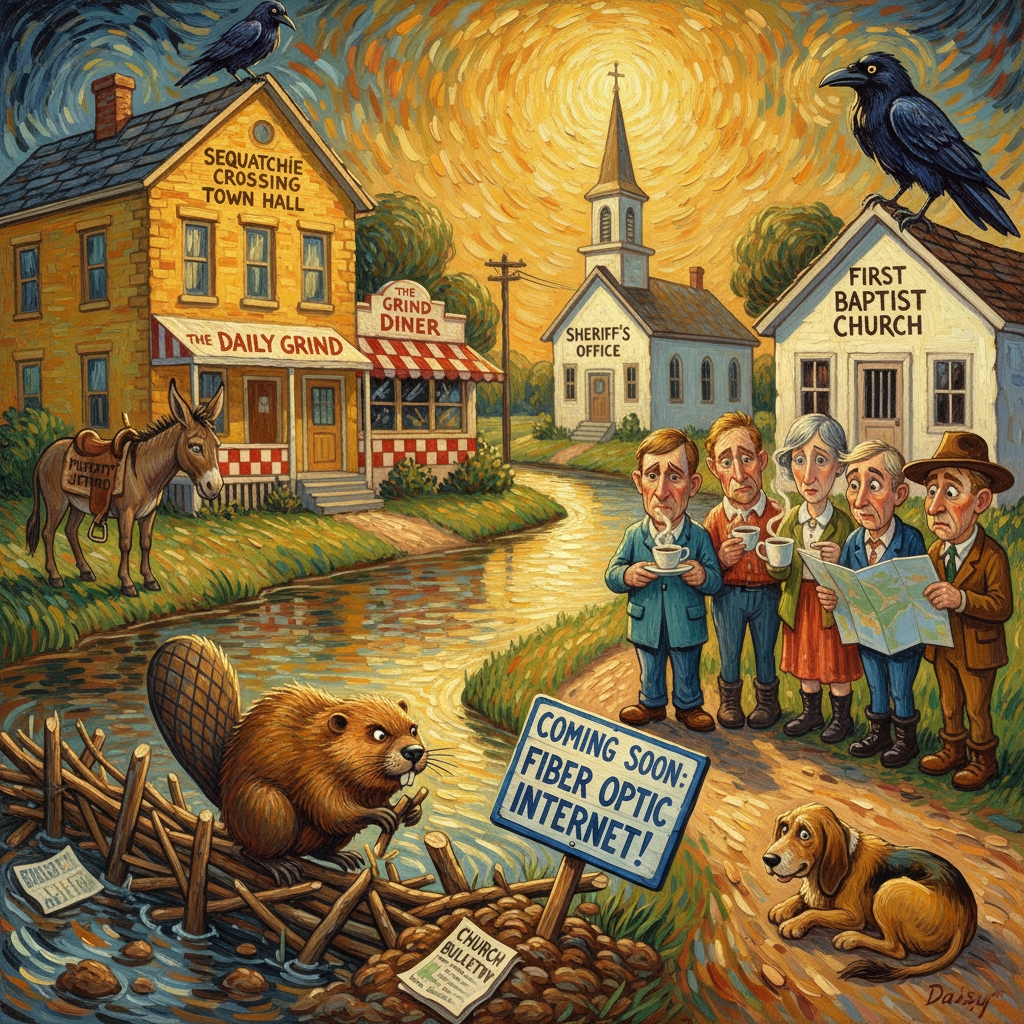
Progress Arrived Before Consensus
By Tom Seest
At Sequatchie Crossing, we tell the stories of Sequatchie Crossing.
Please share this post with your friends, family, or business associates who may want follow the news from Sequatchie Crossing.
🎤 Audio Overview
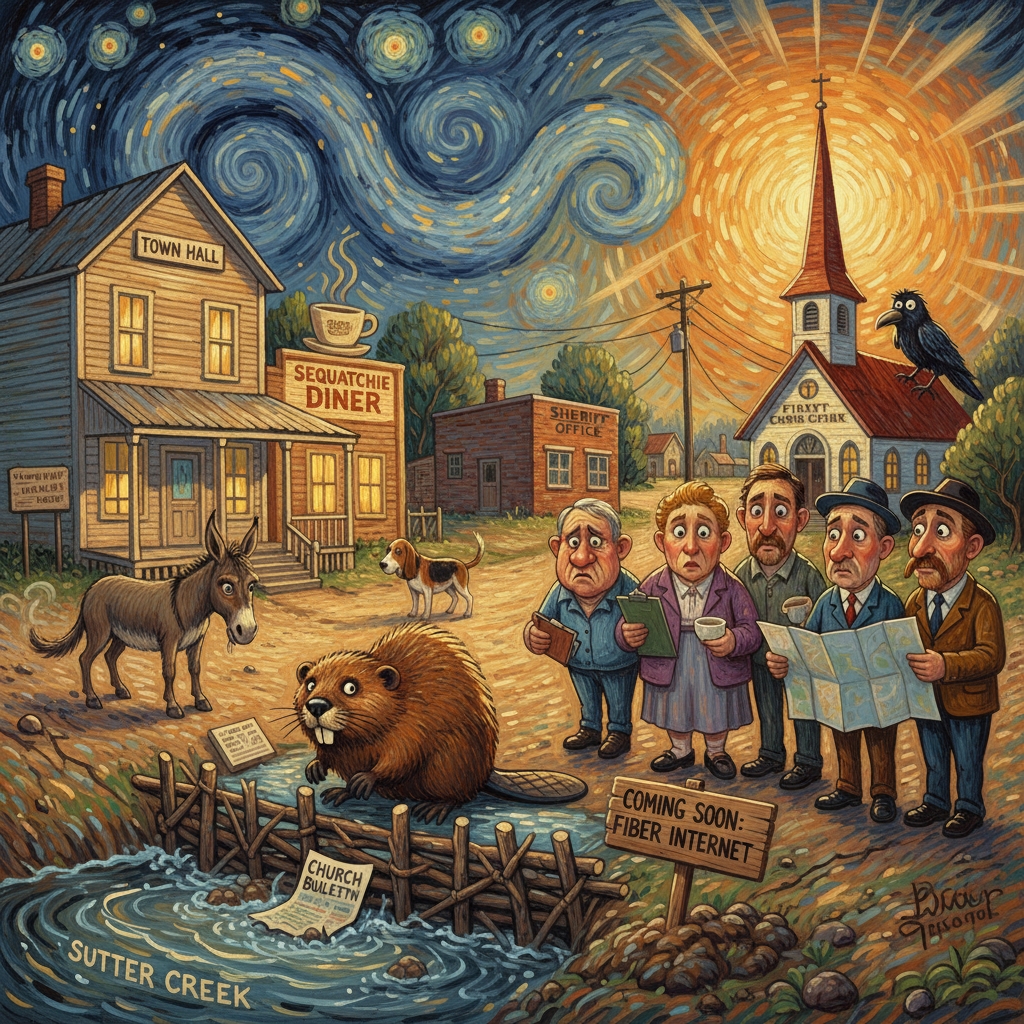
The Future Nobody Ordered
Act I – The Stream Did Not Request a Permit
The first person to notice the beaver was Eugene “Boot” Barnes, which meant the first official record of the beaver was not a record at all, but a hand-drawn map on the back of a biscuit sack.
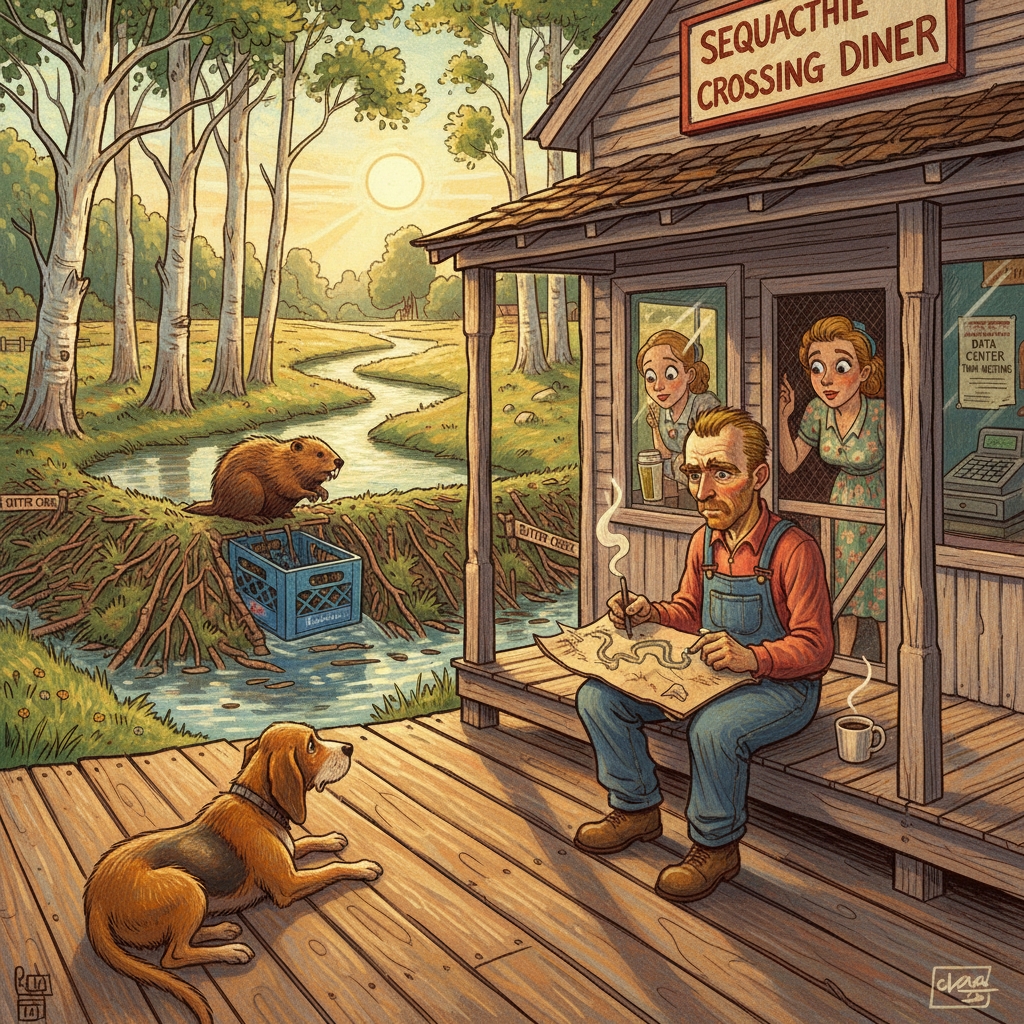
Boot was sitting on the porch rail outside the Sequatchie Crossing Diner at 6:42 on a Tuesday morning, using a pencil stub to draw a line from the old footbridge to the bend in Sutter Creek.
“That ain’t driftwood,” Boot said.
Maggie Sue Dillard, who owned the diner and considered all outdoor observations suspicious until they bought coffee, leaned through the screen door.
“What ain’t driftwood?”
“That.” Boot pointed with the pencil.
Across the road, down through the sycamores, the creek was moving around a fresh pile of sticks, mud, grass, and one Pepsi crate that had not been in the creek the day before.
Maggie Sue squinted.
“That’s a mess.”
“It is organized,” Boot said. “That’s what worries me.”
Daisy the hound, who belonged unofficially to Sheriff Peeler and officially to whoever had sausage, lifted her head from the porch boards and gave one thoughtful bark toward the creek.
Inside the diner, Tiffany Annette Roark was wiping down the counter while Trixie Jo Bartlett arranged flyers beside the register.
The flyer said:
COMMUNITY INFORMATION SESSION – PROPOSED REGIONAL DATA INFRASTRUCTURE CAMPUS – TOWN HALL – 6:30 PM
Below that, in smaller print, it said:
Questions Welcome. Speculation Discouraged.
“That last sentence is going to have the opposite effect,” Tiffany said.
Trixie Jo tapped the paper. “I told Mayor Bea Crowe that. She said it had to sound mature.”
“Nothing makes people immature faster than being asked to be mature,” Maggie Sue said.
The bell over the door jangled and Clovis Strickland came in carrying a coffee can, three folded newspapers, and a facial expression usually worn by men who had discovered both government activity and damp soil.
“I have verified,” Clovis announced, “that the beaver appeared the same week as the data center notice.”
Boot kept drawing. “Verified how?”
Clovis held up the coffee can.
“Track samples.”
Maggie Sue stared at him. “You brought mud into my diner again?”
“Evidence is not mud until a judge says so.”
Sheriff Peeler entered behind him, wearing his hat low and patience lower. Officer Kenny Joe Teeter followed with a clipboard. Daisy trotted in between them and sat beside the kitchen door.
“Clovis,” Sheriff Peeler said, “if that can leaks, I am deputizing Maggie Sue to throw it away.”
“It’s connected,” Clovis said.
“To what?” Kenny Joe asked.
“To everything. First a beaver builds infrastructure without a permit. Then outsiders want to build a data center without community consensus. That’s not coincidence. That’s rehearsal.”
Tiffany leaned on the counter. “I think the beaver is just wet.”
At the corner table, Mabel Dean Ashcroft folded her hands over her purse. She had been listening without appearing to, which was one of her older civic skills.
“The beaver has better manners than certain developers,” Mabel said. “At least the beaver did not send a consultant in loafers to explain water to us.”
Mister Wade Langston, who had been reading yesterday’s paper because he distrusted breaking news, looked up.
“Consultants wear loafers so they can leave fast.”
Act I – The Stream Did Not Request a Permit
The diner laughed, except for Clovis, who wrote it down.
Santiago “Sonny” Morales came in with a toolbox and ordered coffee before he spoke, because Sonny believed caffeine was the difference between opinion and testimony.
“I saw the dam at sunrise,” Sonny said. “It’s small, but it’s already slowing the creek. If it gets bigger, water backs up near the footbridge.”
“That’s how dams work,” Boot said.
“And data centers,” Clovis replied.
“How does a data center back up a footbridge?” Tiffany asked.
“Indirectly,” Clovis said, as if that settled the matter.
Trixie Jo picked up one of the flyers. “Mayor Bea wants everybody at Town Hall tonight. Supporters, opponents, confused people, people who like air conditioning, people who think the internet lives in Chattanooga, all of them.”
Maggie Sue looked toward the creek. “What’s the decision?”
Sheriff Peeler answered before anyone else could embroider it.
“No decision tonight. Facts first. Then questions. Then whatever this town calls thinking.”
Boot drew one final line on the biscuit sack and pushed it toward Sheriff Peeler.
“Then here’s the first fact. The beaver did not pause construction until public comment.”
Daisy barked once.
Mabel nodded toward the dog. “That is the most accurate thing said in this diner.”
And across the road, the beaver surfaced, looked briefly at the town, and returned to work without asking whether Sequatchie Crossing was ready for the future.
Act II – Town Hall Receives a Vocabulary Problem
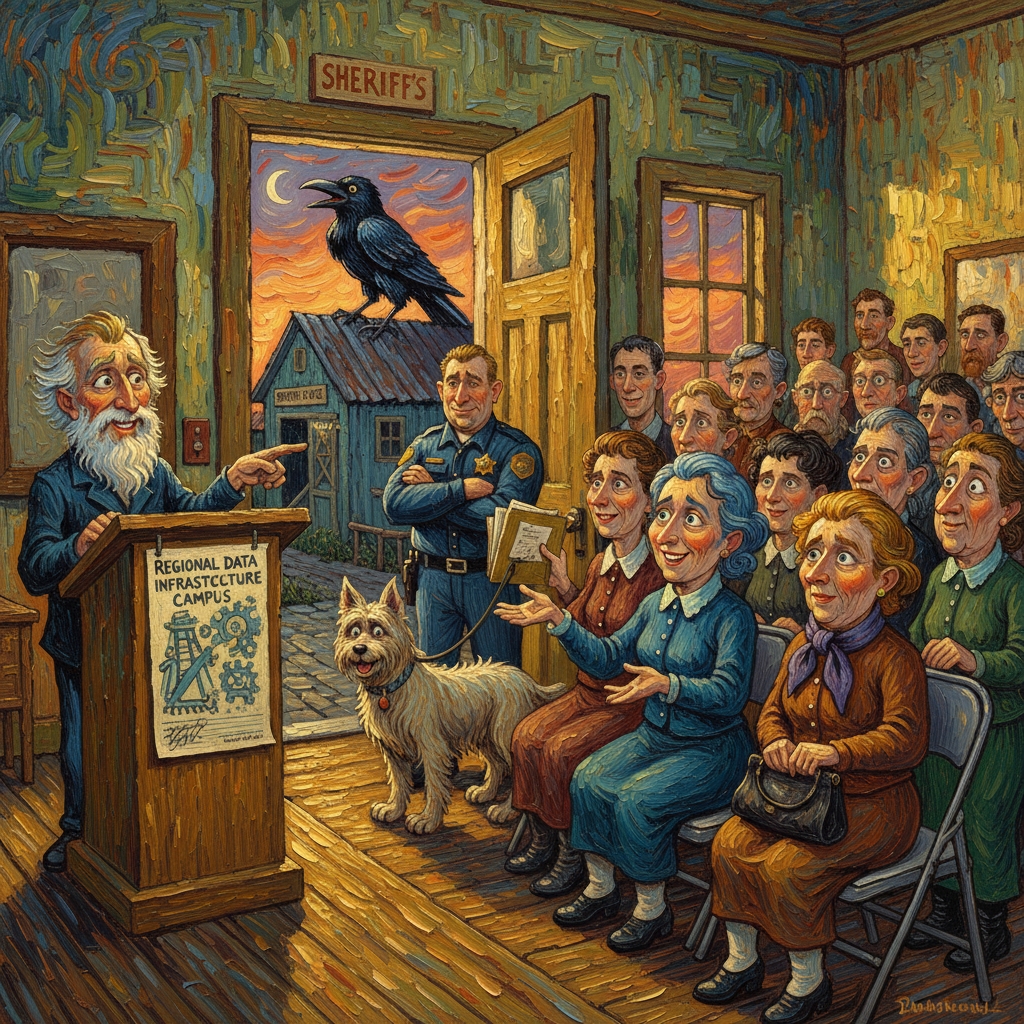
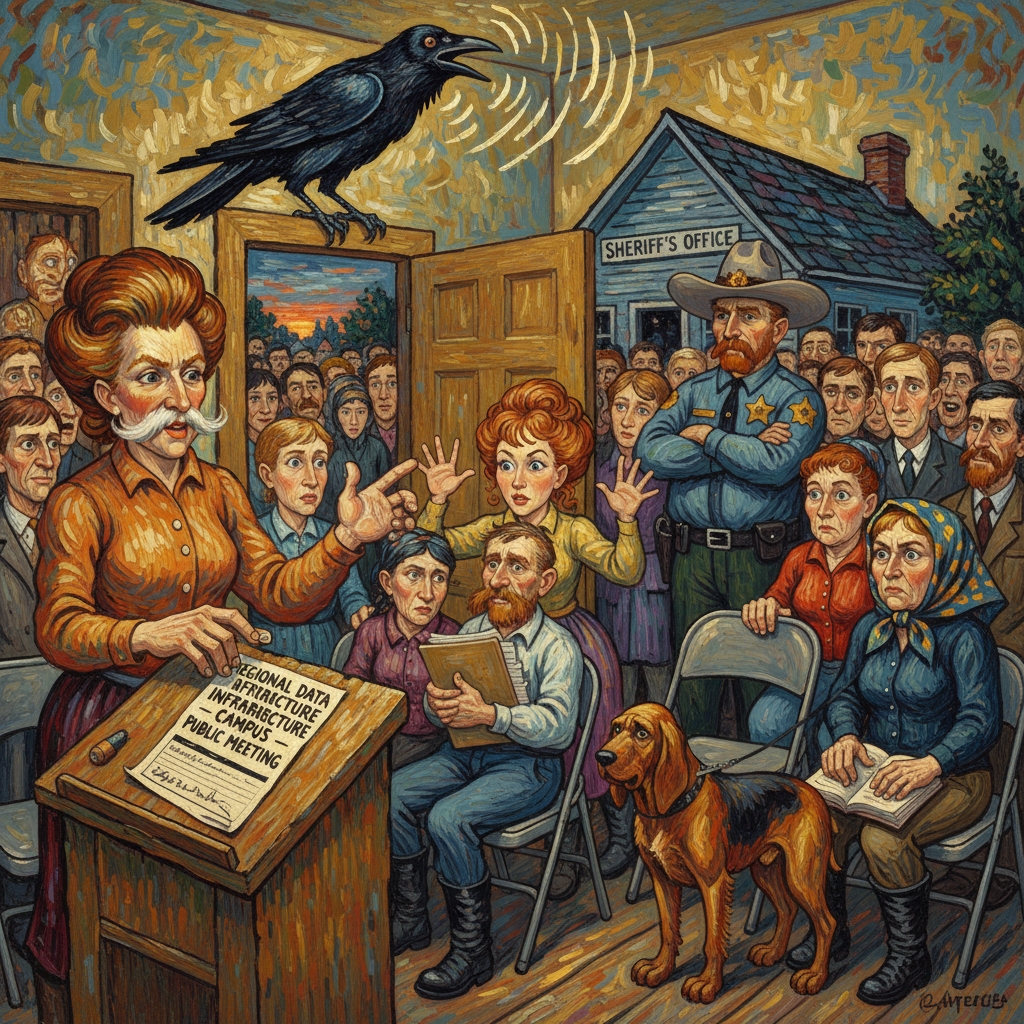
By 6:30 that evening, Sequatchie Crossing Town Hall was full enough that people stood along the walls under framed photographs of ribbon cuttings, flood cleanups, and one Christmas parade nobody admitted had been led by a goat.
Mayor Bea Crowe stood at the front with a yellow legal pad, a water bottle, and the expression of a person trying to welcome opportunity without being blamed for it later.
“Thank you all for coming,” she said. “Tonight is an information session about a proposed regional data infrastructure campus.”
Chester Ray Blevins, owner of the print shop and opponent of QR codes on moral grounds, raised his hand.
“Is that the same as a data center, or did somebody put a tie on it?”
A few people clapped.
Mayor Bea held up a finger. “It is commonly called a data center.”
“Then say data center,” Chester Ray said. “Half of trouble starts when nouns get embarrassed.”
Jolene Pickett, who ran the little phone repair kiosk beside the pharmacy and believed technology was not magic but did require a charger, stood from the second row.
“I support hearing them out. Every small town says it wants young people to stay, then panics when anything uses electricity after dark.”
Mabel Dean Ashcroft turned in her chair.
“Young people do not stay because a windowless building hums beside the highway.”
Jolene smiled. “They might stay if it brings fiber, tax revenue, tech jobs, contractor work, and reasons for local kids to learn something besides how to leave.”
Earl Womack, retired mechanic and historian of disappointment, leaned on his cane near the aisle.
Act II
“I heard that kind of thing when they promised the freezer plant would change everything.”
Boot Barnes spoke from the back wall. “It did change everything. For six years. Then it changed back.”
Pastor Arnold Peeler, seated beside Sister Lila Mae “Hallelujah” Pruitt, raised both palms.
“Friends, fear can lie. So can certainty. Let’s not worship either one.”
Sister Lila Mae nodded. “Amen, and let the minutes show that certainty usually speaks louder.”
Officer Kenny Joe Teeter stood near the door with Daisy at his boot. Daisy was not supposed to be inside Town Hall, but Sheriff Peeler had explained once that she maintained morale and detected ham biscuits.
Sheriff Peeler stepped forward.
“Before rumors outrun facts, we are going to identify what we know, what we don’t know, and what we need in writing.”
Clovis Strickland lifted a folder.
“I have a list of what they won’t tell us.”
Sheriff Peeler pointed at him. “That goes under what we don’t know, not what we pretend to know.”
Doug “Doughboy” Teeter stood near the audiovisual cart, where he had connected a laptop, a projector, and something that blinked unnecessarily.
“This campus could make Sequatchie Crossing part of the AI economy,” Doug said. “Compute is the new railroad.”
Chester Ray folded his arms. “Railroads had tracks. You could see where they were going.”
Dr. Neil Cowgill, retired professor and permanent owner of an explanation, rose slowly.
“Technological inevitability is often described as a force, but in practice it is a series of permissions, incentives, defaults, and failures to object early enough.”
Maggie Sue whispered to Tiffany, “Did he support it or oppose it?”
Tiffany whispered back, “He conjugated it.”
Brett and Alyssa Crenshaw sat beside Jolene, both wearing breathable fabrics and the alert softness of people who had brought a reusable water bottle to a public conflict.
Brett stood. “We should ask about sustainability standards.”
Alyssa added, “And whether the heat could be reused. Greenhouses, district heating, wellness baths—”
Mabel cut her eyes toward her. “This town is not ready for server-heated yoga.”
Ricky Travis “RT” Mullins, who had been quiet in the third row, raised his cap.
“Will there be jobs for people who know tools, or just people who know acronyms?”
Sonny Morales nodded. “That’s a real question. Construction, electrical, cooling, maintenance. But we need commitments, not brochure smoke.”
Mayor Bea wrote that down. “Local workforce commitments.”
Lurleen Davenport, who volunteered at the church office and distrusted fine print, asked, “What about water?”
The room changed when she said it.
Evelyn Grace Tipton, librarian and caretaker of civic memory, spoke from beside the window.
“And noise. And emergency plans. And what happens when the company changes names three times and nobody remembers who promised what.”
Shelley Fawn Wexler stood with a notebook.
“I move that every question be collected publicly, not filtered through whoever brought the slideshow.”
“Second,” said Trixie Jo Bartlett immediately.
Mayor Bea nodded. “We can do that.”
Clovis raised the coffee can from the diner.
“And the beaver?”
Sheriff Peeler sighed. “The beaver is not on the agenda.”
At that exact moment, Daisy barked toward the open Town Hall door. Outside, through the orange evening light, a crow landed on the roof of the sheriff’s office across the street and began making a racket that sounded very much like breaking news.
The room turned toward the sound.
Pastor Peeler said softly, “Sometimes the agenda arrives without permission.”
Mayor Bea tapped her pen.
“Fine. The beaver is on the agenda under infrastructure.”
The crowd murmured approval, and somehow that was the first decision Sequatchie Crossing made about the future.
Act II
Act III – The Porch Committee Defines Progress
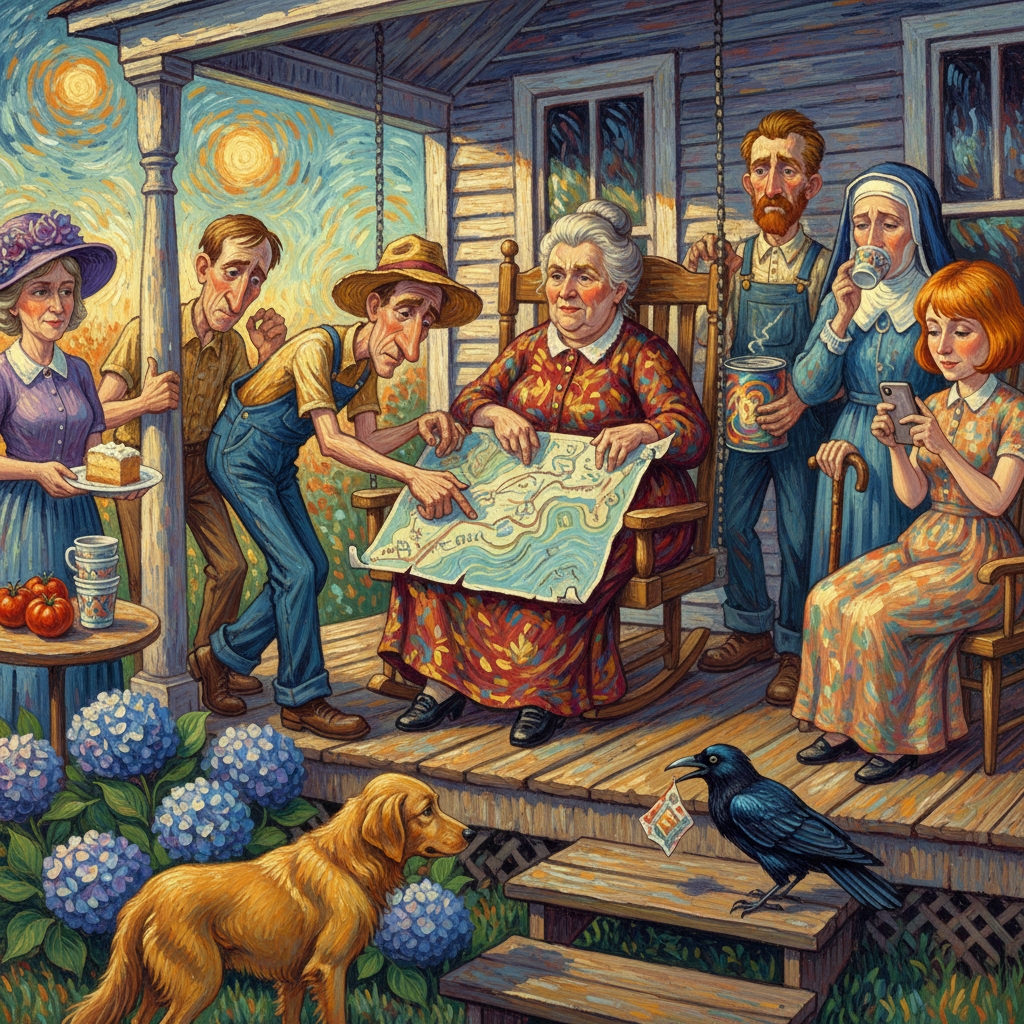
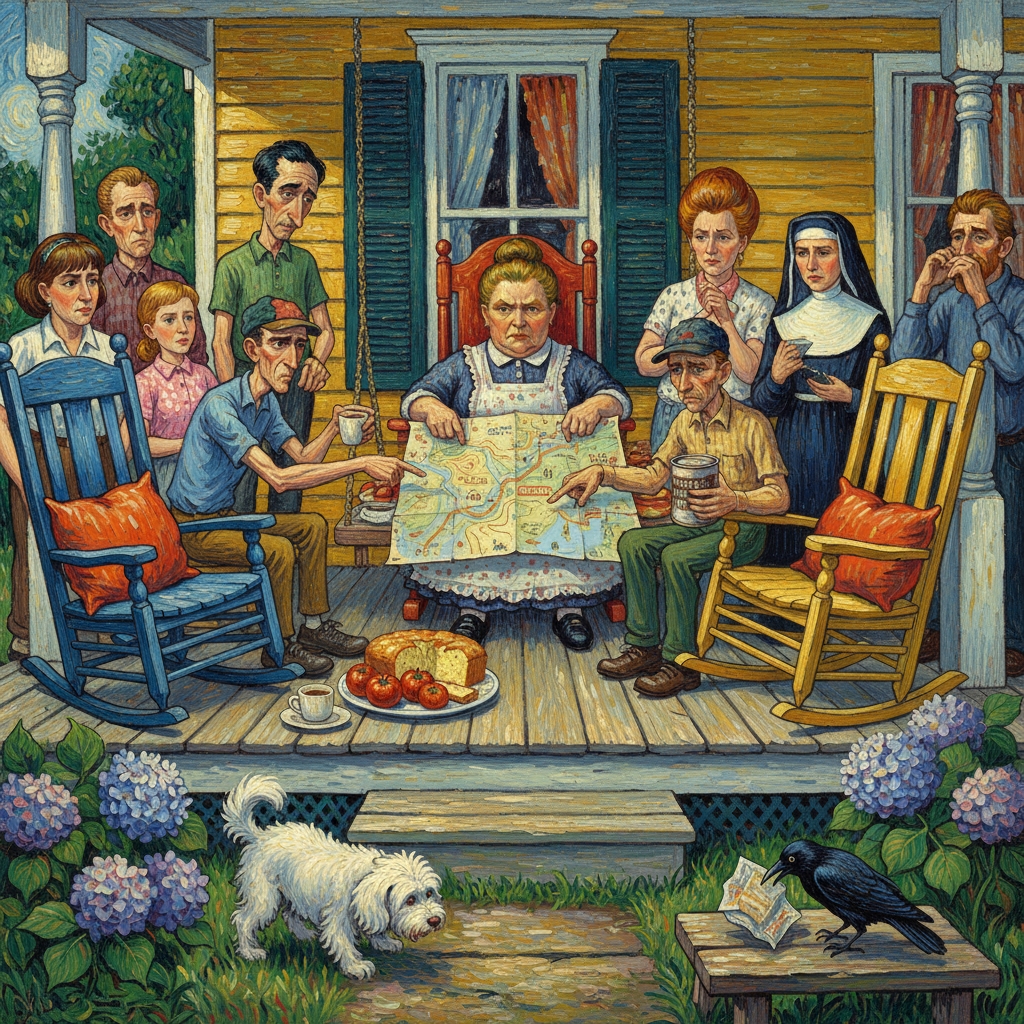
The next morning, an unofficial committee formed on Mabel Dean Ashcroft’s porch, because Town Hall had rules and Mabel’s porch had pound cake.
Mabel sat in the rocker nearest the steps. Boot occupied the porch swing with his biscuit-sack map now reinforced by tape. Clovis leaned against a post. Trixie Jo sat cross-legged on the floorboards, typing notes into her phone. Tiffany balanced coffee on the railing. Shelley Fawn had three pens, which made everyone nervous.
Across the yard, Daisy sniffed a hydrangea and found no public policy in it.
“I do not oppose progress,” Mabel began.
Clovis nodded solemnly. “That’s what people say before opposing progress.”
“I oppose being told progress has already happened and our role is to applaud.”
Boot pointed toward town with his pencil. “There’s a difference between pausing change and shaping it.”
Tiffany said, “Can change be paused?”
“No,” Boot said.
“Yes,” Mabel said.
“Sometimes,” Shelley said.
Clovis said, “Depends who profits from the pause.”
Trixie Jo typed faster. “That is exactly the problem. Nobody agrees on the verb.”
Mister Wade Langston came up the walk carrying a paper bag.
“I brought tomatoes,” he said. “Figured the porch would need evidence from the old economy.”
Mabel accepted the bag. “Set them beside the cake.”
Wade sat down and looked at Boot’s map.
“Beaver moved again.”
Act III – The Porch Committee Defines Progress
Boot blinked. “Already?”
“Added mud on the west side. Water’s higher by two inches.”
Clovis slapped the porch post. “See? Infrastructure creep.”
Shelley looked over her glasses. “Or adaptive engineering.”
Mabel frowned. “Do not make the beaver sound educated. That is how grant applications start.”
Ricky Travis “RT” Mullins arrived in a work shirt with sawdust on one sleeve.
“I got asked to bid on clearing work if the data center goes forward,” he said. “I told them I’d need details. They said details would come later.”
“Later is where accountability goes to nap,” Shelley said.
RT leaned on the rail. “I’m not against work. I’m against work where the town gets blamed and the checks leave.”
Tiffany nodded. “That’s the sentence.”
Alyssa Crenshaw appeared at the walkway with Brett behind her carrying jars of infused water.
Mabel looked at the jars.
“Is something wrong with regular water?”
Alyssa smiled. “This has cucumber and mint.”
“Then it has trespassers.”
Brett cleared his throat. “We came because we want to help frame questions. Data centers are not automatically bad. They can be designed better or worse.”
Clovis pointed at him. “That is how they get you. Comparative adjectives.”
Brett did not flinch. “Cooling method. Grid impact. Backup generators. Water use. Noise levels. Local hiring. Decommissioning plan. Community benefit agreement. Those aren’t adjectives. Those are levers.”
Boot smiled a little. “Levers I understand.”
Sister Lila Mae came around the corner carrying a church clipboard and wearing a hat with a violet ribbon.
“Pastor says y’all need prayer, patience, and possibly parliamentary procedure.”
Mabel motioned her up. “We are short on all three.”
Sister Lila Mae sat beside Tiffany.
“I have spoken with six ladies from the fellowship hall. Three believe the data center will take all the water. Two believe it will give their grandchildren jobs. One believes it will listen to her toaster.”
Clovis raised a finger. “Smart appliances are a documented vulnerability.”
Tiffany said, “Nobody’s toaster is important enough to surveil.”
Clovis looked wounded. “That’s what the toaster wants you to think.”
Everyone talked at once until Daisy barked twice from the yard.
A crow dropped from the maple tree, snatched a shiny gum wrapper from the porch step, and flew toward the creek.
Mabel watched it go.
“That bird has no respect for private property.”
Boot folded his map.
“Information spreads the same way. Picks up shiny bits, drops them somewhere else, and everybody calls it news.”
Shelley clicked her pen. “Then our decision should be to create a public question board. One place. Real questions. Real answers. No anonymous crow activity.”
Trixie Jo nodded. “I can make the board at Town Hall and an online version.”
Chester Ray, passing by on the sidewalk with a delivery of printed menus, called out, “Online version must also have a paper version or I’m suing civilization.”
Mabel lifted her chin. “Motion?”
Boot said, “Porch Committee recommends a public question board, paper and digital, with every answer dated and signed.”
“Second,” said Sister Lila Mae.
“All in favor?” Shelley asked.
Everyone raised a hand except Clovis, who raised the coffee can.
“Accepted,” Shelley said. “Against?”
The crow cawed from somewhere near the creek.
Mabel stared after it. “Let the record show the crow abstained.”
Act III – The Porch Committee Defines Progress
Act IV – The Diner Discovers That Opportunity Has a Smell
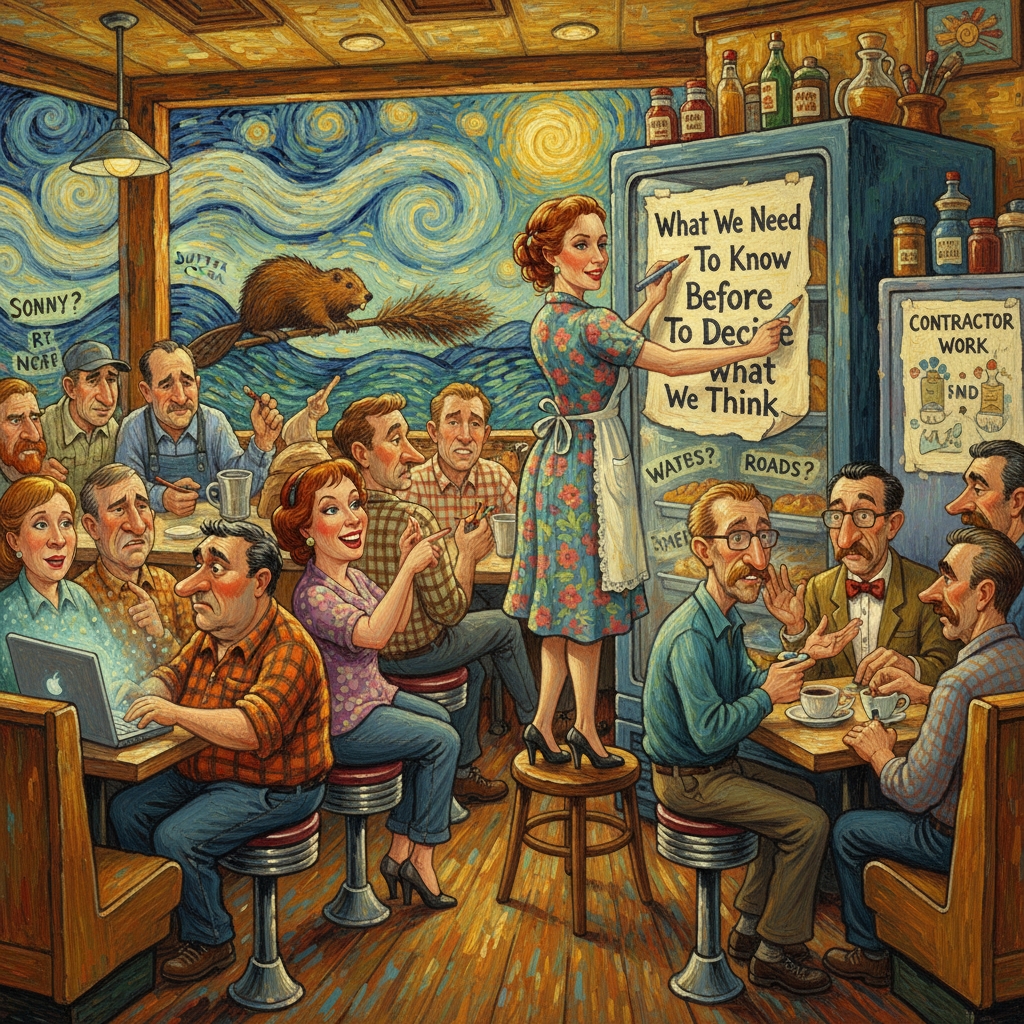
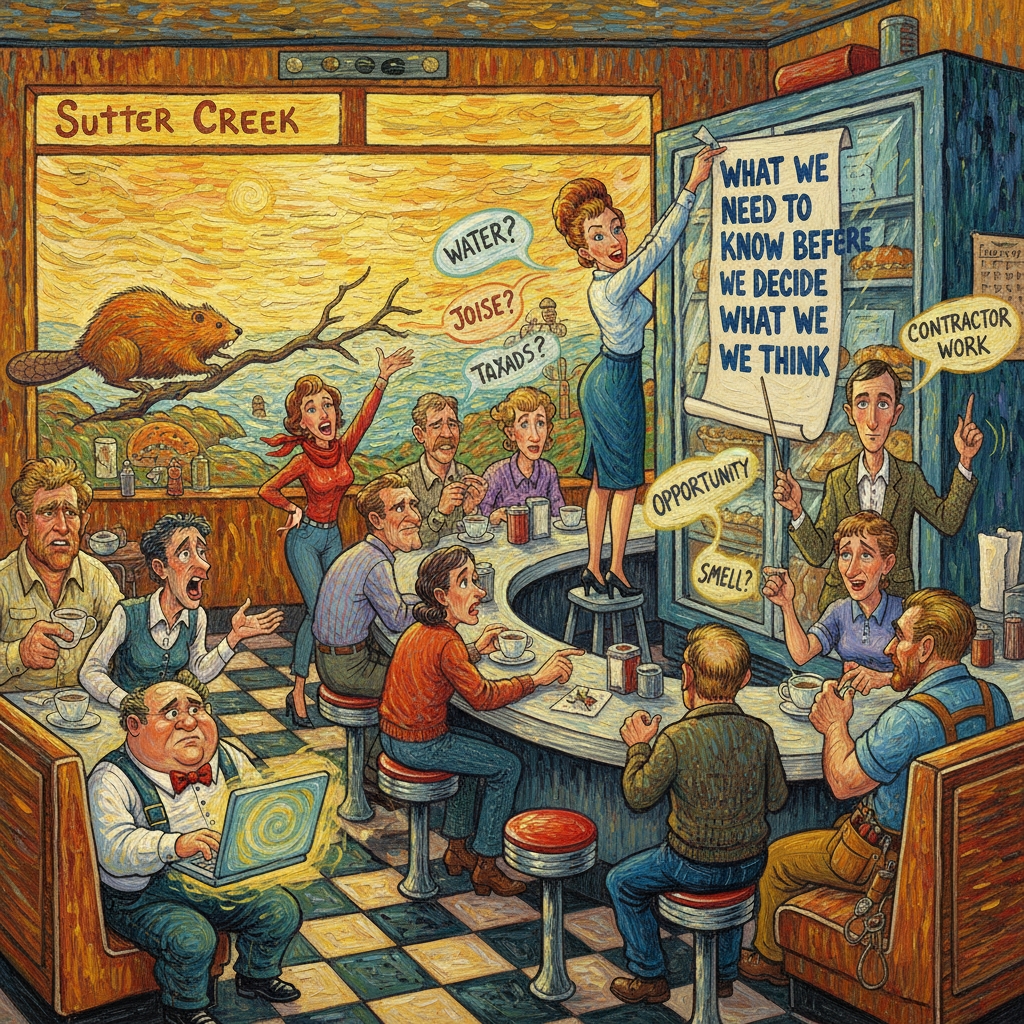
By noon, the Sequatchie Crossing Diner had become the trading floor for every possible future.
Maggie Sue taped a fresh sheet of butcher paper to the pie cooler.
At the top she wrote:
WHAT WE NEED TO KNOW BEFORE WE DECIDE WHAT WE THINK
“That’s too reasonable,” Chester Ray said from the counter.
Maggie Sue handed him a marker. “Then ruin it.”
Chester Ray wrote: Will there be signs?
Doug Doughboy Teeter, sitting with his laptop open, groaned.
“That is not the first concern.”
“It is if they put up ugly signs,” Chester Ray said. “Civilization collapses one vinyl banner at a time.”
Jolene Pickett sat beside Doug with a tablet. “The first concern is connectivity. If this brings serious fiber expansion, small businesses benefit. Remote workers benefit. Schools benefit.”
Earl Womack stirred his coffee.
“Every boom comes wearing Sunday shoes. Then after a while you see the mud.”
Sonny Morales stood by the grill window talking with Maggie Sue.
“I called a cousin who does industrial electrical work,” Sonny said. “He says the construction phase could be real work. After that, not as many jobs as folks imagine.”
RT Mullins nodded from the next stool. “So we ask for training and local contractor access up front.”
Act IV – The Diner Discovers That Opportunity Has a Smell
Doug typed. “And a tech incubator. Maybe scholarships. Maybe public cloud credits.”
Chester Ray squinted. “I don’t want clouds credited to me.”
Tiffany, filling tea glasses, said, “He means computer clouds.”
“That does not improve it.”
Pastor Arnold Peeler came in with Sheriff Peeler, which always caused visitors to wonder whether moral law and county law had coordinated outfits. Officer Kenny Joe followed, holding Daisy’s leash. Daisy ignored the leash and inspected a dropped french fry.
Sheriff Peeler looked at the butcher paper.
“Good. Questions in public.”
Pastor Peeler read the first few lines.
“Water. Noise. Jobs. Taxes. Roads. Emergency response. Long-term ownership. That’s a decent start.”
Maggie Sue added, “And smell.”
Everyone looked at her.
“I’m serious. Plants smell. Factories smell. Chicken houses smell. Does a data center smell?”
Doug said, “Mostly no.”
“Mostly is a smell category,” Maggie Sue said, writing it down.
Dr. Neil Cowgill entered and removed his hat.
“A data center’s sensory footprint is typically less olfactory and more acoustic, thermal, electrical, and infrastructural.”
Maggie Sue wrote: Does it hum, heat, blink, drain, or buzz?
Dr. Cowgill studied the sentence. “That is admirably efficient.”
Lurleen Davenport arrived carrying a folder from the church office.
“I made copies of questions from seniors who don’t want to come to Town Hall because they think the projector might show them on Facebook.”
Doug said, “That’s not how projectors work.”
Clovis entered behind her. “Not yet.”
Shelley Fawn Wexler took the folder. “We’ll include them.”
Evelyn Grace Tipton came from the library with a stack of index cards.
“I also brought historical examples. The sawmill expansion. The freezer plant. The cell tower. The bypass that was discussed for twenty-two years and never built.”
Boot, following her in, said, “That bypass achieved more as a rumor than most roads do as pavement.”
Alyssa Crenshaw came in with Brett. She smelled faintly of peppermint and civic optimism.
“We talked to a planner,” Brett said. “Community benefit agreements can be real if written properly.”
Clovis lifted his head. “Who was the planner?”
“A planner,” Alyssa said.
“Name?”
“Marissa.”
“Outsider?”
“Consultant.”
Clovis made a sound like a screen door rejecting the wind.
Mayor Bea entered last, carrying a stack of official-looking folders.
The diner quieted.
“I received the preliminary project packet,” she said. “Nothing binding yet. They want a study period.”
Mabel, seated in her regular booth, put down her fork.
“Do they want our blessing or our exhaustion?”
Mayor Bea met her eyes.
“That is exactly what we need to find out.”
Daisy barked once toward the street.
Everyone turned. Through the front window, they could see the creek bend beyond the road. The beaver was dragging a branch longer than itself, determined as a committee chair with no term limit.
Earl Womack chuckled.
“That thing don’t care who supports it.”
Jolene watched the beaver disappear into the weeds.
“No, but the stream still decides what works.”
Pastor Peeler nodded. “There’s a sermon in that, but I’ll spare you until Sunday.”
Maggie Sue wrote one more question on the butcher paper:
What can the town shape, and what will happen anyway?
No one laughed at that one.
Act IV – The Diner Discovers That Opportunity Has a Smell
Act V – The Sheriff’s Office Separates Rumor From Weather
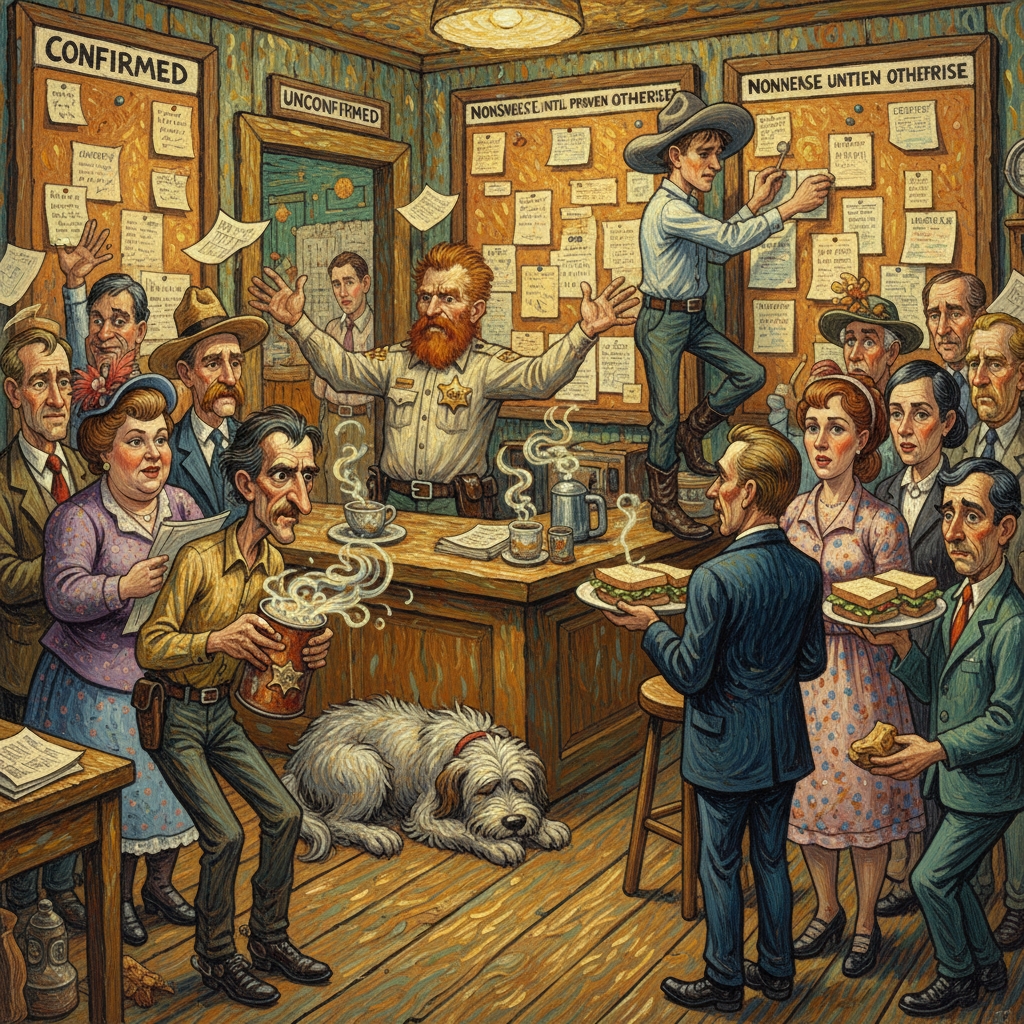
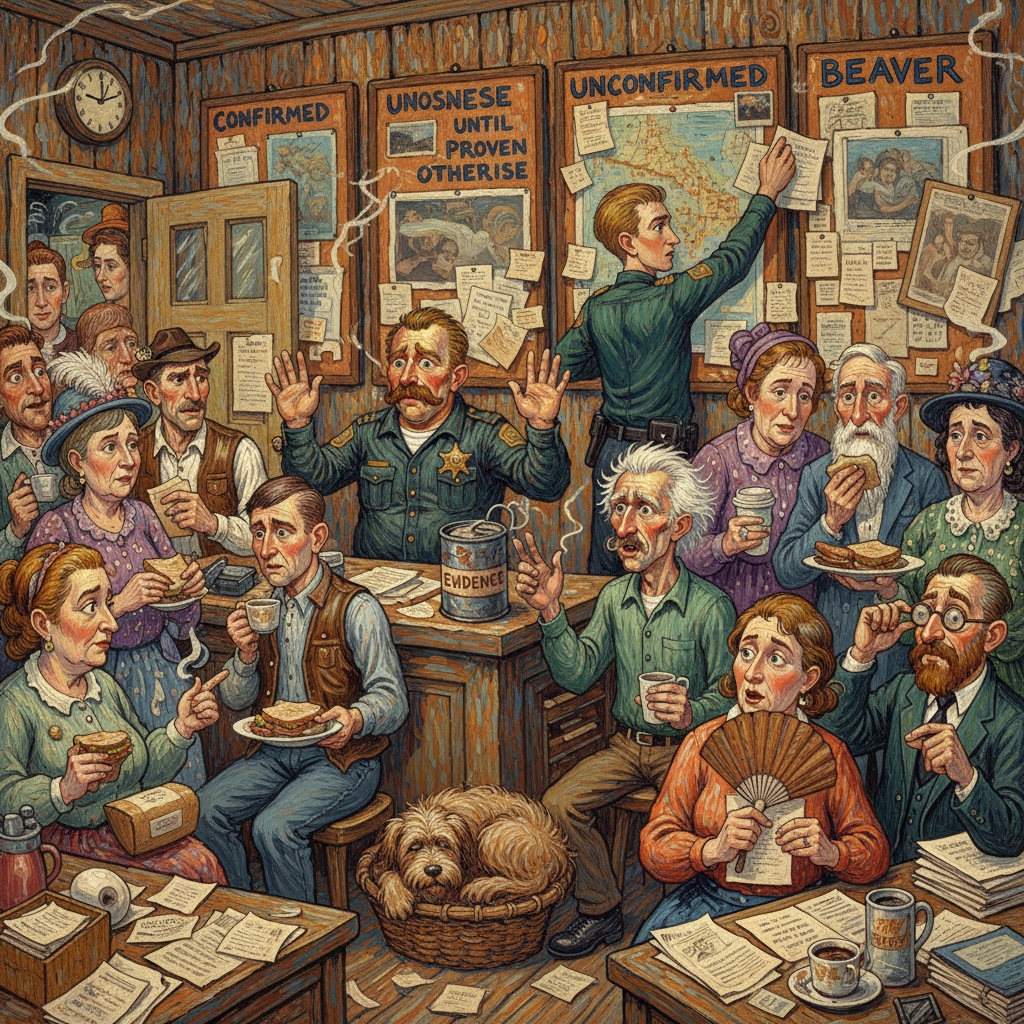
The sheriff’s office smelled like old files, burnt coffee, and Daisy’s blanket.
Sheriff Peeler stood at the front counter while Officer Kenny Joe Teeter pinned three sheets of paper to a corkboard.
The first sheet read: CONFIRMED.
The second: UNCONFIRMED.
The third: NONSENSE UNTIL PROVEN OTHERWISE.
Clovis Strickland objected immediately.
“That third category prejudices the evidence.”
Sheriff Peeler said, “That third category keeps me from losing my mind.”
Kenny Joe held up the first note. “Claim: The data center will use water.”
Sheriff Peeler nodded. “Confirmed generally, unconfirmed specifically. Put it between the first two.”
Kenny Joe frowned. “There is no between.”
“Use tape.”
Tiffany Annette Roark sat in one chair, running the public question inbox on her phone. Trixie Jo sat beside her reading submissions aloud.
“Here’s one,” Trixie Jo said. “Will it make my electric bill go up?”
“Good question,” Sheriff Peeler said.
“Here’s another. Will the data center attract robots?”
Act V – The Sheriff’s Office Separates Rumor From Weather
Doug Doughboy Teeter, summoned as technical interpreter, raised a hand.
“Define attract.”
Mabel Dean Ashcroft folded her arms. “Do not encourage the robot question.”
Pastor Peeler leaned against the wall beside Sister Lila Mae.
“Sometimes a bad question carries a real fear in a Halloween mask.”
Sister Lila Mae smiled. “Put that on the church sign.”
Lurleen Davenport looked at the corkboard.
“I heard from three people who think the company already bought the cemetery land.”
Sheriff Peeler shook his head. “Unconfirmed?”
Boot Barnes, standing with courthouse maps tucked under one arm, said, “False. Cemetery land is protected, and also too rocky for anything but ancestors and stubborn weeds.”
Kenny Joe pinned it under NONSENSE UNTIL PROVEN OTHERWISE.
Clovis objected again. “You are weaponizing typography.”
The front door opened and Sonny Morales stepped in with RT Mullins.
Sonny said, “We checked the road by the creek. Water’s backing toward the low shoulder.”
RT added, “Beaver dam is now a road issue.”
Sheriff Peeler looked at Daisy. “You hear that? Your friend is escalating.”
Daisy wagged as if escalation was delicious.
Mayor Bea Crowe arrived with Evelyn Grace Tipton and Shelley Fawn Wexler.
“I need a clean list for the company representative,” Mayor Bea said. “Not a panic list. Not a sales list. A town list.”
Shelley glanced at the corkboard. “That’s what we’re building.”
Evelyn held up a folder. “And I propose we archive every version. Future residents deserve to know when the town knew what.”
Mabel nodded. “History is what keeps promises from evaporating.”
Doug said, “We can publish a live dashboard.”
Chester Ray Blevins, who had entered quietly enough to hear the word dashboard, said, “No dashboard without a bulletin board.”
Doug sighed. “Fine. Dashboard and bulletin board.”
“Good,” Chester Ray said. “Balanced government.”
Brett and Alyssa Crenshaw came in behind him. Brett carried a printed article. Alyssa carried a jar of water no one trusted.
Brett said, “We suggest hiring an independent technical reviewer.”
Mayor Bea wrote it down. “Cost?”
Alyssa replied, “Less than misunderstanding the project.”
Earl Womack, who had followed them because porch curiosity travels in packs, said, “And make the company pay for it, but the town chooses them.”
Dr. Neil Cowgill raised one finger.
“That reduces informational asymmetry.”
Maggie Sue, who had brought sandwiches to the office, set down a tray. “Does that mean it keeps us from being fooled?”
“Approximately,” Dr. Cowgill said.
“Then say that.”
Sheriff Peeler looked around the cramped office.
“All right. Decision. We recommend three things to Town Hall tonight. Public question board. Independent reviewer chosen by the town and paid from project fees. Written answers before any vote.”
Mayor Bea nodded slowly.
“That is reasonable.”
Clovis lifted his coffee can. “And beaver mitigation?”
Kenny Joe added a fourth sheet to the corkboard.
BEAVER.
Daisy barked.
Sheriff Peeler pointed at her. “Motion carried by hound.”
Act V – The Sheriff’s Office Separates Rumor From Weather
Act VI – The Church Basement Hosts the Future With Casseroles
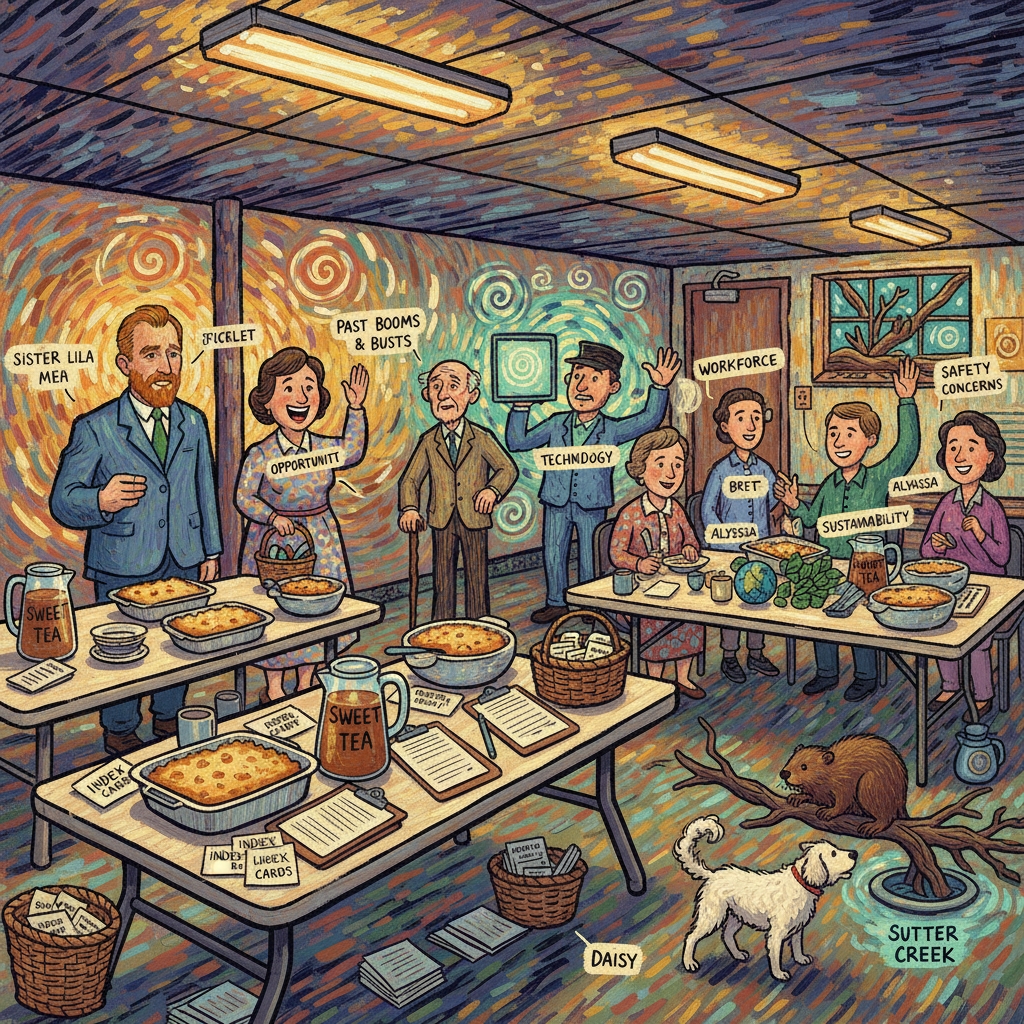
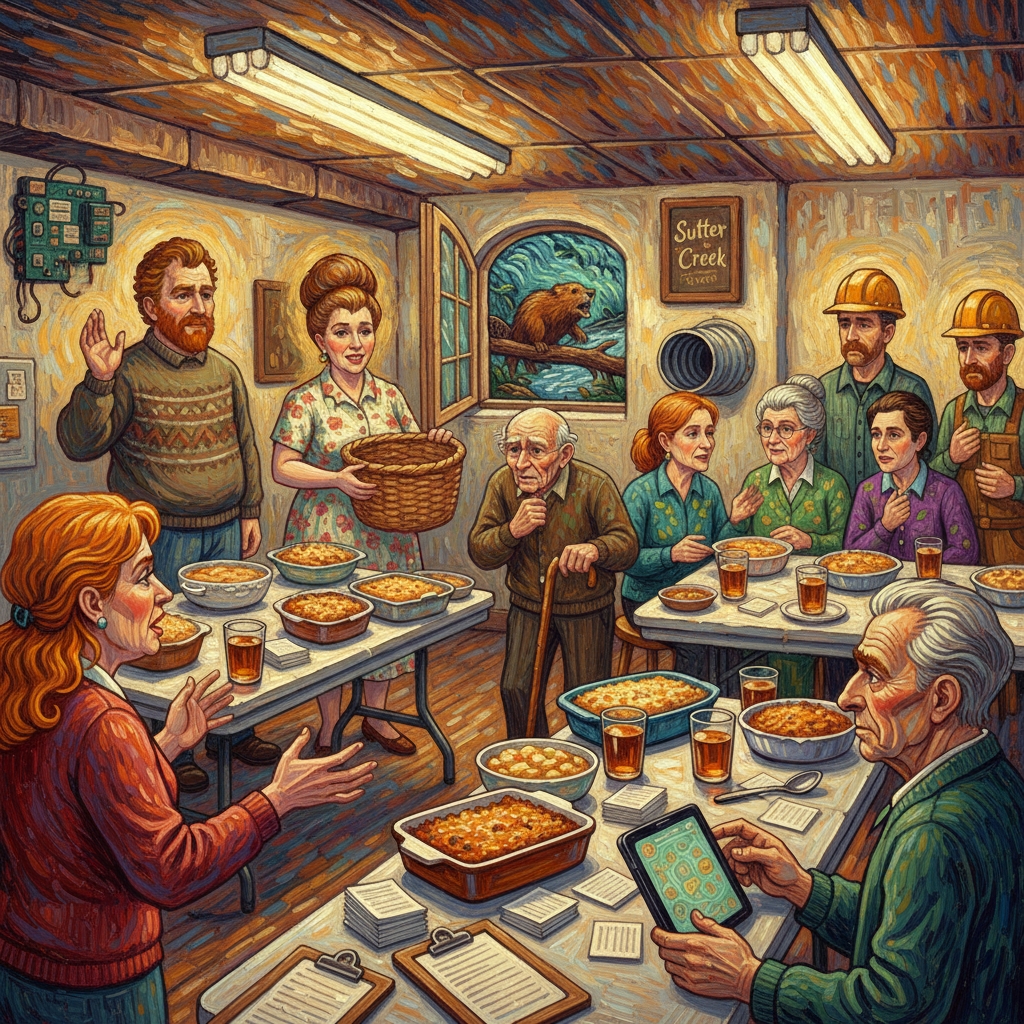
The First Unaffiliated Missionary Temple had hosted weddings, funerals, budget meetings, flu shot clinics, and one unforgettable seminar on coupon ethics. By Thursday night, the church basement hosted the future.
Casseroles lined the folding tables. Someone had brought sweet tea. Someone else had brought unsweet tea and placed it behind a note that said FOR MEDICAL REASONS OR NORTHERNERS.
Pastor Arnold Peeler stood at the front.
“We are not here to bless or curse the data center,” he said. “We are here to practice telling the truth in public without throwing rolls.”
Sister Lila Mae “Hallelujah” Pruitt stood beside him with a basket.
“Questions go in the basket. Complaints go in the basket. Prophecies go directly to Pastor.”
Clovis raised his hand. “What about warnings?”
“Basket,” Sister Lila Mae said.
Mabel Dean Ashcroft sat with Lurleen Davenport and Evelyn Grace Tipton near the piano.
Mabel whispered, “The church basement is where big ideas come to be humbled by green beans.”
Lurleen nodded. “And by women who know who washed the serving spoons.”
Jolene Pickett stood after the blessing.
“I want to say something plainly. I support exploring the project because I don’t want this town to become a museum of itself. Young people need opportunity. Businesses need infrastructure. We cannot keep saying no to everything and then wonder why nothing arrives but retirees and rumors.”
A silence followed. Not hostile. Thinking.
Earl Womack stood with effort.
“I don’t want a museum either. I just remember every time somebody told us one project would save the town. Towns are not saved by one thing. They are worn down or built up by a hundred little decisions nobody puts on a billboard.”
Boot Barnes nodded. “That’s true.”
RT Mullins raised his cup.
“If there’s work, I want local folks included. Not just flaggers and cleanup. Real subcontracting. Training. Apprenticeships.”
Sonny Morales added, “And safety. Cooling systems, electrical load, fire response. If something goes sideways, our people answer the call first.”
Sheriff Peeler, from the back, said, “That part matters to me.”
Doug Doughboy Teeter stood.
“Technology is not waiting on Sequatchie Crossing. AI, cloud computing, automation—it’s all expanding. The question is whether we participate, negotiate, or complain after the fact.”
Chester Ray Blevins lifted a roll. “I choose negotiate and complain.”
Tiffany laughed. “That may be the town motto.”
Brett Crenshaw spoke next.
Act VI – The Church Basement Hosts the Future With Casseroles
“We should not confuse opposition with wisdom or support with greed. The design matters.”
Alyssa added, “And the community terms matter. Noise limits. Water reporting. Renewable power. Landscape buffers. Heat reuse. Public transparency.”
Mabel looked at Alyssa.
“I still oppose server-heated yoga.”
“Noted,” Alyssa said. “Removed from initial demands.”
The basement relaxed.
Dr. Neil Cowgill stood beside the dessert table.
“May I offer a framework?”
Maggie Sue called out, “Will it fit on a napkin?”
“With small handwriting,” he replied. “Technological change has three layers: the invention, the deployment, and the local settlement. We cannot uninvent data centers. We may not be able to prevent deployment somewhere. But local settlement—terms, location, safeguards, benefits, limits—that remains a civic task.”
Pastor Peeler smiled. “That one fits a sermon and a napkin.”
Trixie Jo read from the question basket.
“Question: If we say no, will it just go to another town?”
Mayor Bea answered carefully.
“Possibly. But that cannot be the only reason to say yes. Fear of missing out is not a plan.”
Shelley Fawn Wexler raised her pen.
“Decision proposal. We create a citizens’ review group with supporters, skeptics, technical people, small business owners, and emergency services. They produce questions, not conclusions.”
“Who serves?” Lurleen asked.
Names came quickly, then arguments, then revisions.
Boot for maps and practical memory. Mabel for community standards. Jolene for technology opportunity. Earl for boom-and-bust caution. Sonny and RT for trades. Lurleen for seniors and church concerns. Evelyn for records. Doug for technical translation. Brett and Alyssa for sustainability. Chester Ray for printed communication. Shelley for procedure. Tiffany and Trixie Jo for public intake. Sheriff Peeler and Kenny Joe for safety review. Maggie Sue for feeding people and detecting nonsense.
Clovis stood.
“And me?”
Mabel looked at him. “You may serve as unofficial minister of unintended consequences.”
Clovis placed a hand over his heart. “I accept the burden.”
From outside came a loud splash.
Everyone turned toward the basement windows.
Daisy barked from the church steps.
Sheriff Peeler opened the side door and looked out.
“The beaver dropped a limb in the culvert.”
Pastor Peeler closed his eyes. “Of course he did.”
Sister Lila Mae lifted the basket.
“Add culvert to the questions.”
Act VI – The Church Basement Hosts the Future With Casseroles
Act VII – The Company Man Meets the Mule
The company representative arrived Friday in a silver SUV that looked clean enough to have never made a wrong turn.
His name was Graham Pike, and because he was fictional, nobody had to pretend he represented any real company. He wore a navy blazer, carried a laptop bag, and smiled with the careful warmth of a man trained to survive public meetings.
Mayor Bea met him at the Town Hall steps.
“Mr. Pike, welcome to Sequatchie Crossing.”
“Thank you, Mayor Crowe. We’re excited about the possibility of partnership.”
Mabel, standing nearby, whispered to Boot, “Partnership means they need something.”
Boot whispered back, “So do we.”
They walked inside. The citizens’ review group sat around folding tables arranged in a square. Chester Ray had printed name cards because he believed civilization began when people stopped pointing.
Graham Pike opened his laptop.
“I have a presentation.”
Chester Ray held up a packet. “We have printed copies of our questions.”
Graham blinked. “Of course.”
Doug leaned toward Jolene. “He did not expect paper.”
Jolene whispered, “Paper is our town’s firewall.”
Mayor Bea began.
“Mr. Pike, before slides, we’re going to walk through local concerns.”
Graham’s smile adjusted one notch.
“Certainly.”
Act VII – The Company Man Meets the Mule
Shelley Fawn Wexler read the first item.
“Water use by source, daily maximum, drought restrictions, recycling percentage, and public reporting frequency.”
Graham nodded. “We can provide general estimates.”
Mabel said, “We asked for specifics.”
“Some numbers depend on final design.”
Boot said, “Then final approval depends on final numbers.”
Earl Womack tapped his cane. “That’s a fair trade.”
Sonny Morales asked about cooling systems. RT asked about local contractors. Sheriff Peeler asked about emergency access, fuel storage, fire suppression, and whether county responders would receive specialized training.
Officer Kenny Joe added, “And who pays for that training?”
Graham took notes.
Alyssa asked about noise modeling. Brett asked about energy sourcing and heat reuse. Lurleen asked whether construction traffic would avoid church funeral hours. Evelyn asked where documents would be archived. Tiffany asked who would answer plain-language questions. Trixie Jo asked whether the company would attend more than one meeting.
Maggie Sue asked, “Does it smell?”
Graham paused.
“Not in the way I think you mean.”
Maggie Sue wrote something down.
Dr. Neil Cowgill asked about data sovereignty, redundancy, and grid interconnection.
Graham seemed relieved by familiar vocabulary.
Then Clovis raised his hand.
“Will any artificial intelligence housed in this facility be empowered to influence local zoning decisions, church potluck assignments, or toaster behavior?”
Graham stared.
Sheriff Peeler said, “Answer the spirit of it.”
Graham loosened his tie.
“No. This facility would store and process data. It would not govern the town.”
Clovis looked unconvinced. “That is exactly what a governing facility would say.”
Before Graham could respond, Daisy barked from outside.
Then came shouting.
Everyone rushed to the windows.
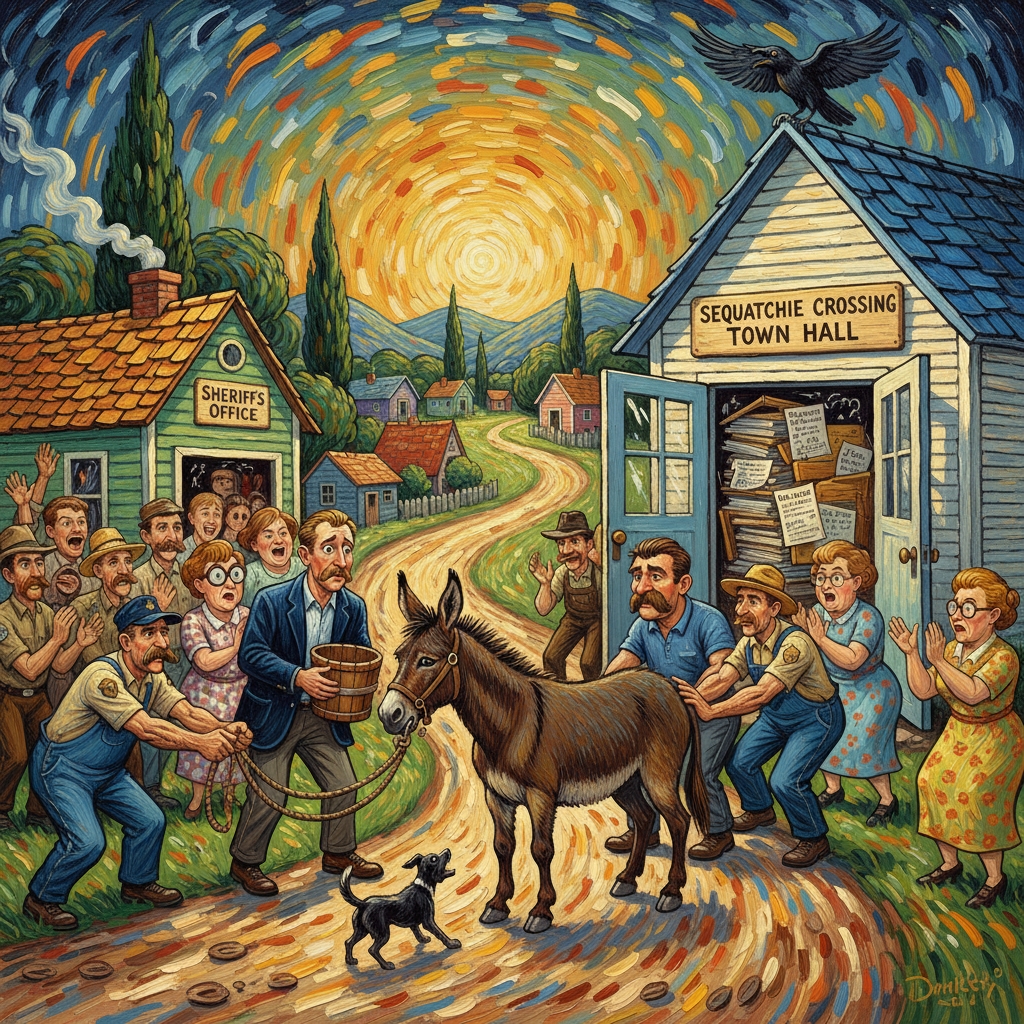
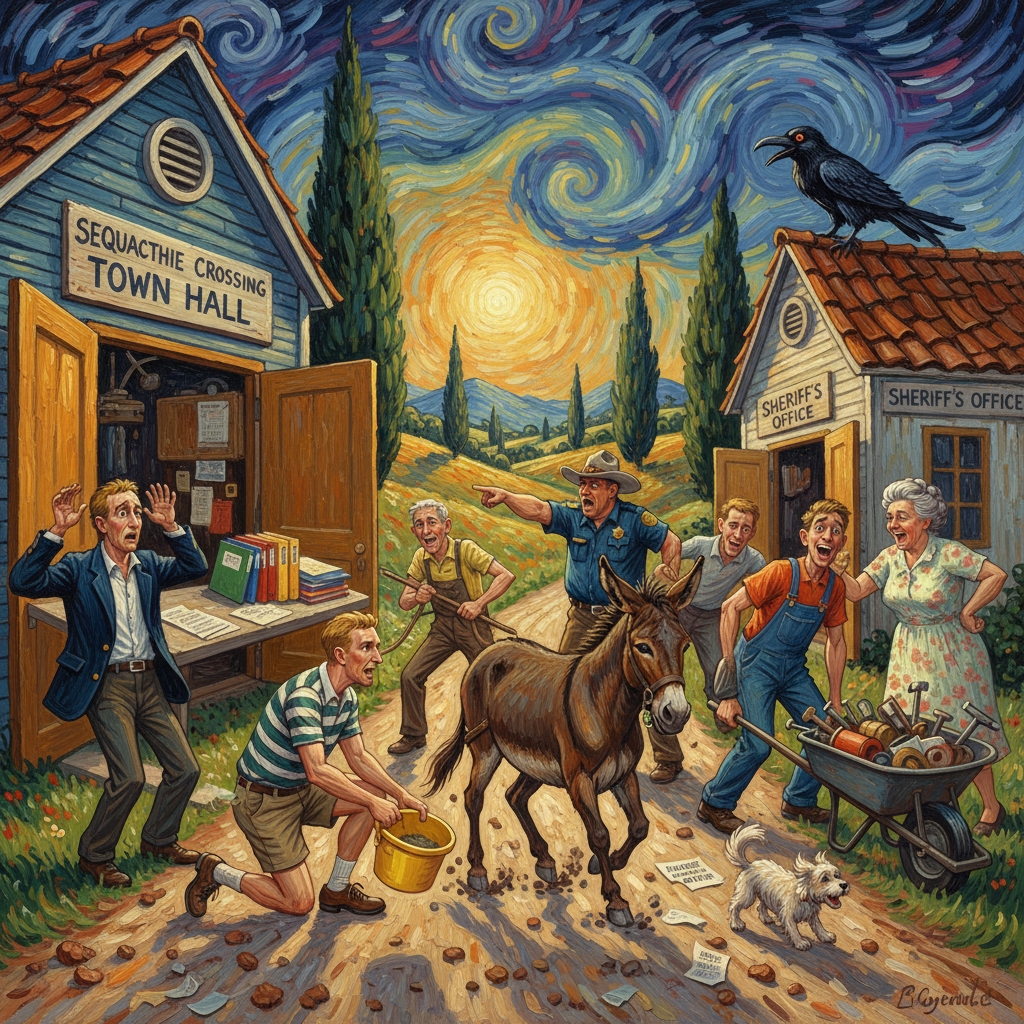
A mule stood in the middle of the street between Town Hall and the sheriff’s office. Not a symbolic mule. A literal mule belonging to Coach Freddie Stubblefield, who arrived jogging behind it with a lead rope and the breathless dignity of a man losing an argument to livestock.
“Biscuit!” Coach Freddie shouted. “You come out of that road!”
Biscuit the mule did not move.
Traffic stopped, which in Sequatchie Crossing meant three trucks and one bicycle.
The crow from earlier sat on the sheriff’s office roof yelling down at the mule as if providing commentary.
Graham watched through the glass.
“Is this common?”
Boot said, “Common enough to have procedure.”
Sheriff Peeler opened the door. “Kenny Joe, cones. Coach, feed bucket. Daisy, stay.”
Daisy did not stay. Daisy trotted to the sidewalk and sat facing Biscuit.
Biscuit looked at Daisy. Daisy looked at Biscuit. The crow yelled. The beaver, not visible but strongly suspected, had slowed the creek enough that water now trickled audibly through the culvert.
Mabel turned to Graham.
“That mule is our local metaphor. It stands where nobody wants it, and it moves when reality becomes more persuasive than instruction.”
Coach Freddie rattled a feed bucket.
“Biscuit, I am asking you as a taxpayer.”
The mule remained.
Graham looked at Mayor Bea. “What happens now?”
Mayor Bea watched Sheriff Peeler, Kenny Joe, Coach Freddie, Boot, and Sonny coordinate without panic.
“We solve the immediate problem,” she said, “then return to the larger one with less arrogance.”
Biscuit finally moved when Daisy nosed the feed bucket.
Coach Freddie exhaled.
“I move we add livestock disruption to the traffic study.”
Chester Ray called from the doorway, “Second.”
Graham Pike wrote it down.
No one could tell whether he thought they were joking, which was why the decision stayed on the list.
Act VII – The Company Man Meets the Mule
Act VIII – The Creek Holds a Public Hearing
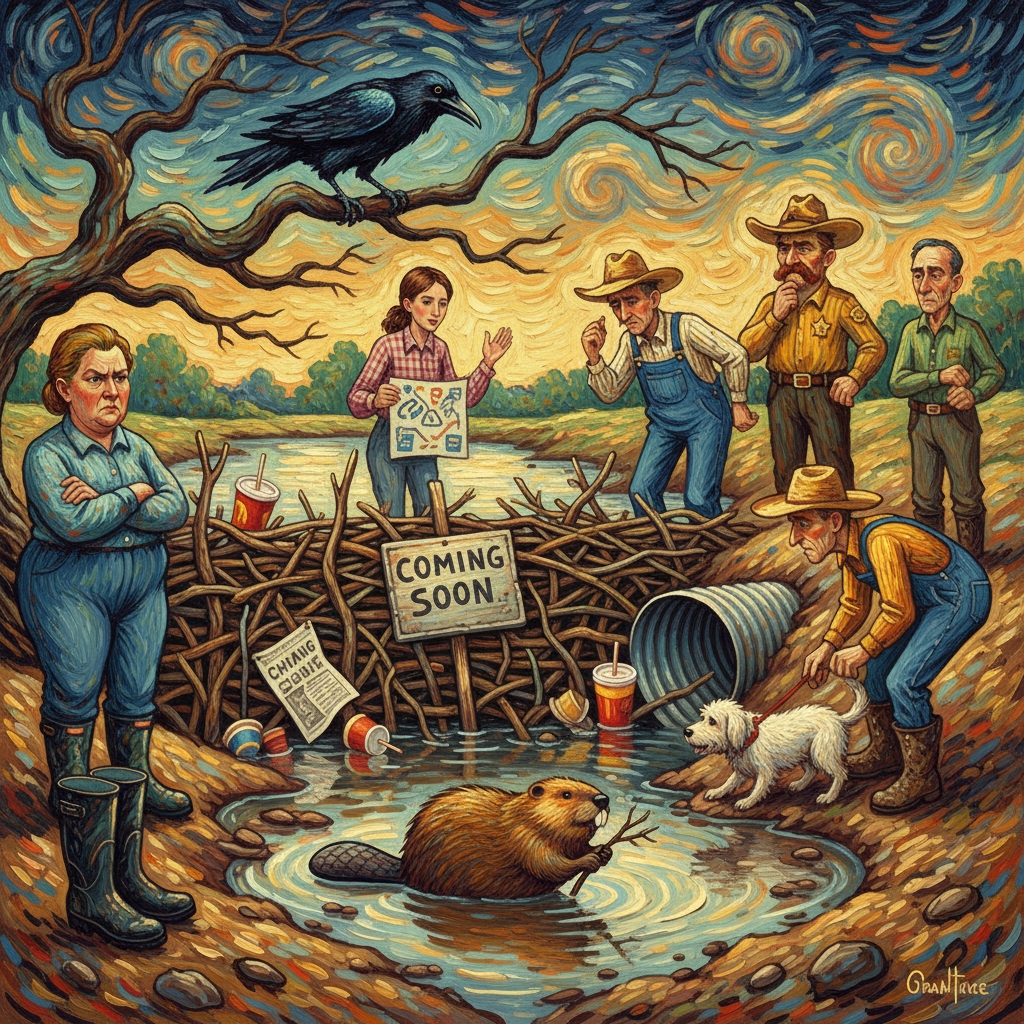
Saturday morning, the citizens’ review group met at Sutter Creek because Boot insisted maps were improved by mud.
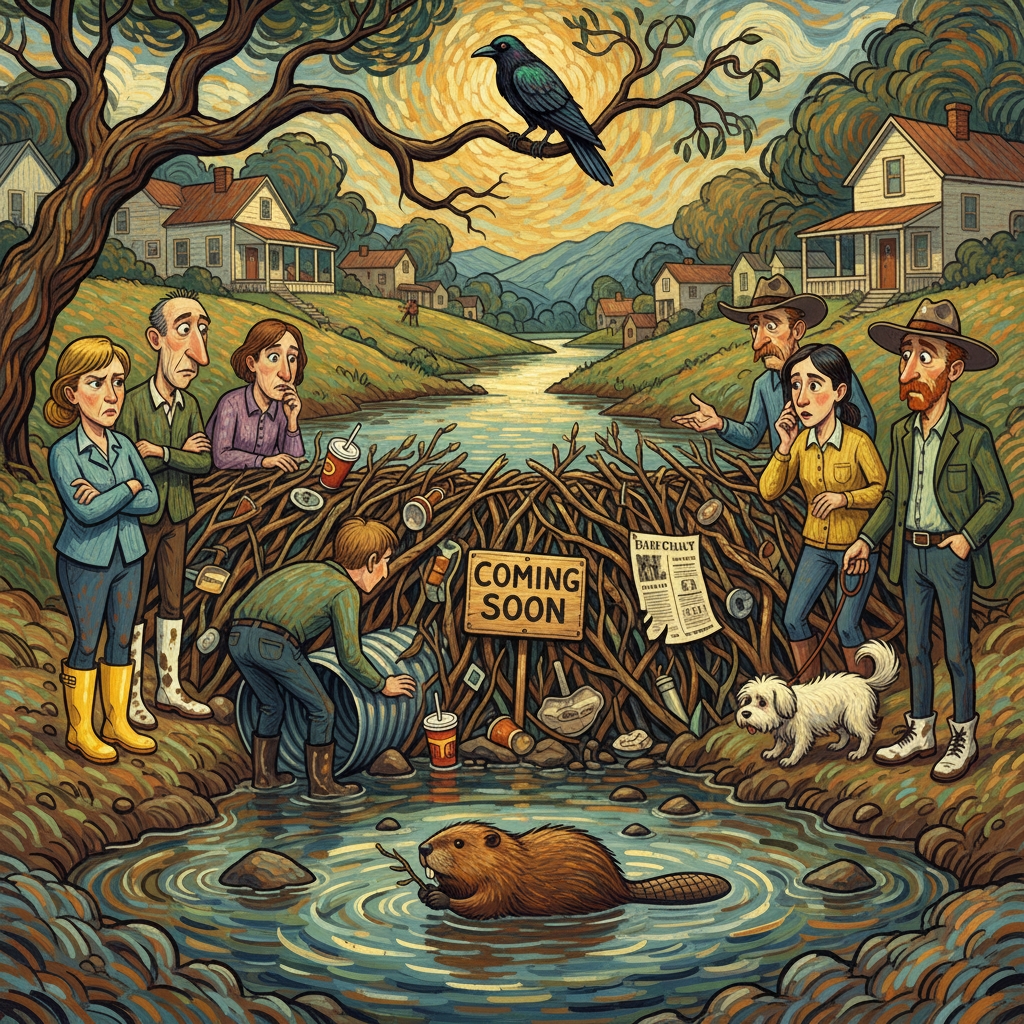
The beaver dam had grown overnight. It now included sticks, reeds, two fast-food cups, a church bulletin, and one laminated real estate sign that read COMING SOON.
“That sign was not there yesterday,” Trixie Jo said.
Clovis pointed. “The beaver has acquired marketing materials.”
Mabel stood on the bank in rubber boots she described as “war footwear.”
“I dislike how industrious he is.”
Jolene watched the water pool behind the dam.
“It’s impressive, though. One beaver changed the whole flow.”
Earl Womack leaned on his cane.
“That’s the lesson people miss. Change doesn’t ask if it’s impressive. It asks where the low places are.”
Sonny crouched by the culvert. “If this rises another few inches, the road shoulder softens.”
RT nodded. “We need to notch the dam or install a flow device.”
Brett said, “There are humane beaver management systems. Pond levelers, culvert fencing.”
Alyssa smiled at Mabel. “Infrastructure negotiation.”
Mabel gave her a narrow look. “Do not make me sympathize with the beaver.”
Daisy sniffed along the bank and sneezed.
Act VIII – The Creek Holds a Public Hearing
Officer Kenny Joe held her leash.
“Sheriff says nobody touches the dam until we know the rules.”
Sheriff Peeler arrived with Pastor Peeler and Sister Lila Mae.
“That is correct,” Sheriff said. “Wildlife rules apply. County road rules apply. Common sense applies if available.”
Dr. Neil Cowgill examined the dam.
“The beaver demonstrates non-consensual infrastructure deployment.”
Chester Ray looked delighted. “Put that on a shirt.”
Maggie Sue, carrying a thermos, said, “No shirts until after coffee.”
Shelley Fawn Wexler opened her notebook.
“We need a decision for the road issue.”
Boot pointed upstream.
“Let the beaver stay if water can pass safely. Don’t destroy what works. Don’t ignore what harms.”
Pastor Peeler nodded.
“That may also be our data center policy.”
Clovis looked betrayed. “Pastor, the beaver is not a corporation.”
“No,” Pastor said. “That is one point in the beaver’s favor.”
Everyone laughed, even Clovis.
Graham Pike had been invited to observe and arrived carefully, stepping around mud with city shoes. Mayor Bea walked beside him.
“I appreciate being included,” Graham said.
Mabel replied, “You are being watched, not included.”
Mayor Bea gave her a look.
Mabel added, “Cordially.”
Graham studied the dam.
“I see why you brought me here.”
Boot said, “Do you?”
“I think so. You’re saying development changes flow.”
Evelyn Grace Tipton spoke quietly.
“And once the flow changes, later people inherit the consequences.”
Lurleen added, “Including people who never went to the meeting.”
Tiffany stood near the bank posting an update to the public question board.
“Public comment says people are split. Some want the project stopped. Some want it welcomed. Most want to know what can be guaranteed.”
Doug held up his phone.
“Online comments are worse. The crow has entered the internet phase.”
The crow, as if summoned by defamation, landed on a branch and cawed.
Chester Ray pointed. “That bird has never cited a source.”
Shelley read the proposed creek action.
“Temporary safety assessment. Contact wildlife officer. Explore flow device. Protect road. Avoid panic removal.”
Sheriff Peeler said, “I support that.”
Sonny said, “Me too.”
RT nodded. “Same.”
Mabel sighed. “Fine. But I reserve the right to dislike the beaver’s attitude.”
Mayor Bea turned to Graham.
“And for the data center, the town will require something similar. Assessment before approval. Safeguards before construction. Written commitments before celebration.”
Graham said, “That may slow the process.”
Boot looked at the water.
“Good processes slow bad decisions and strengthen good ones.”
Jolene added, “If the project can’t survive questions, it wasn’t opportunity. It was pressure.”
Graham closed his notebook.
“I can take that back.”
Clovis leaned in. “Take back the toaster question too.”
“I will phrase it differently,” Graham said.
Daisy barked once.
The beaver surfaced in the pool, holding a twig. It looked at the assembled town, then at the partially blocked culvert, then returned to the dam with no apparent interest in democracy.
Maggie Sue poured coffee into the thermos cup.
“Beaver never asks permission from the stream.”
Pastor Peeler said, “No. But the stream still testifies.”
For once, nobody improved the sentence.
Act VIII – The Creek Holds a Public Hearing
Act IX – Consensus Fails Productively
The final meeting of the week took place Sunday afternoon in Town Hall, after church and before the hour when naps became legally necessary.
Mayor Bea stood at the front. The citizens’ review group sat in the first two rows. Graham Pike sat to one side, less polished than before, with mud still visible on one shoe.
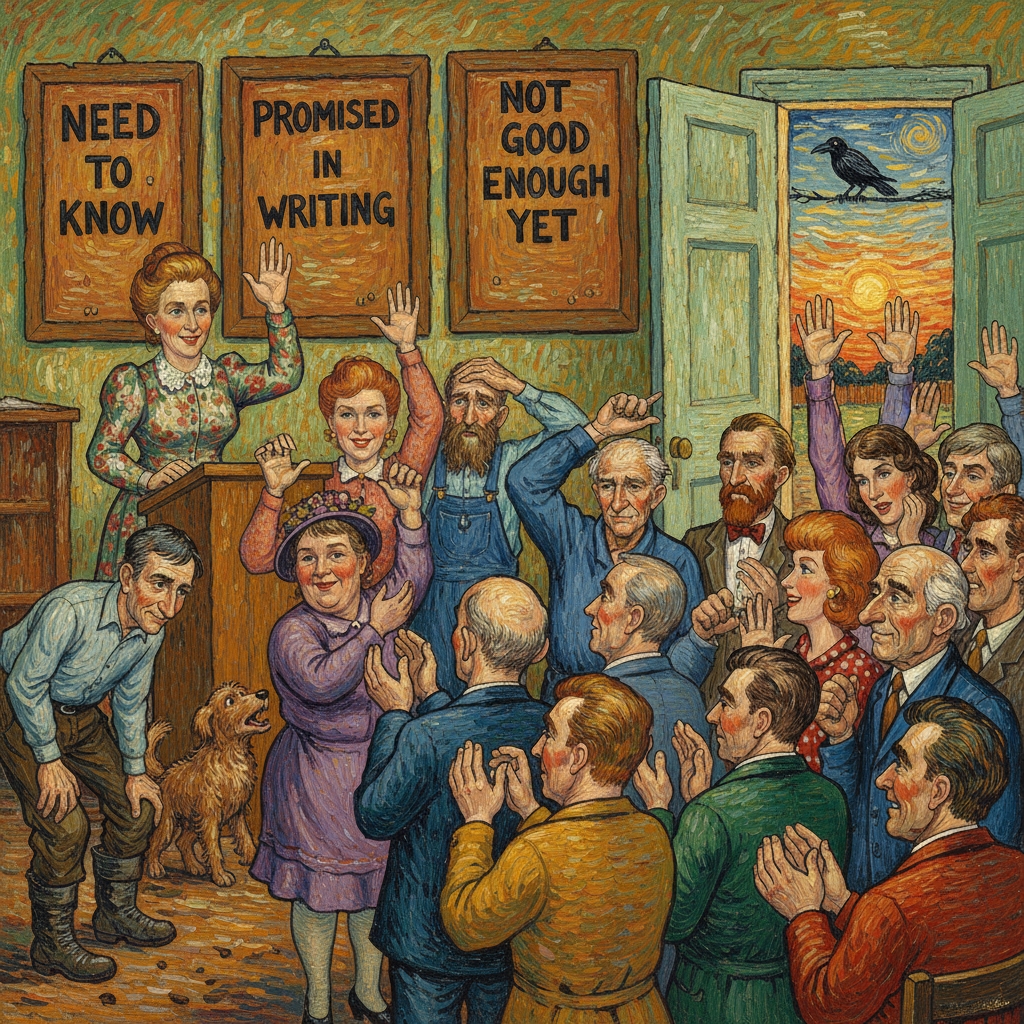
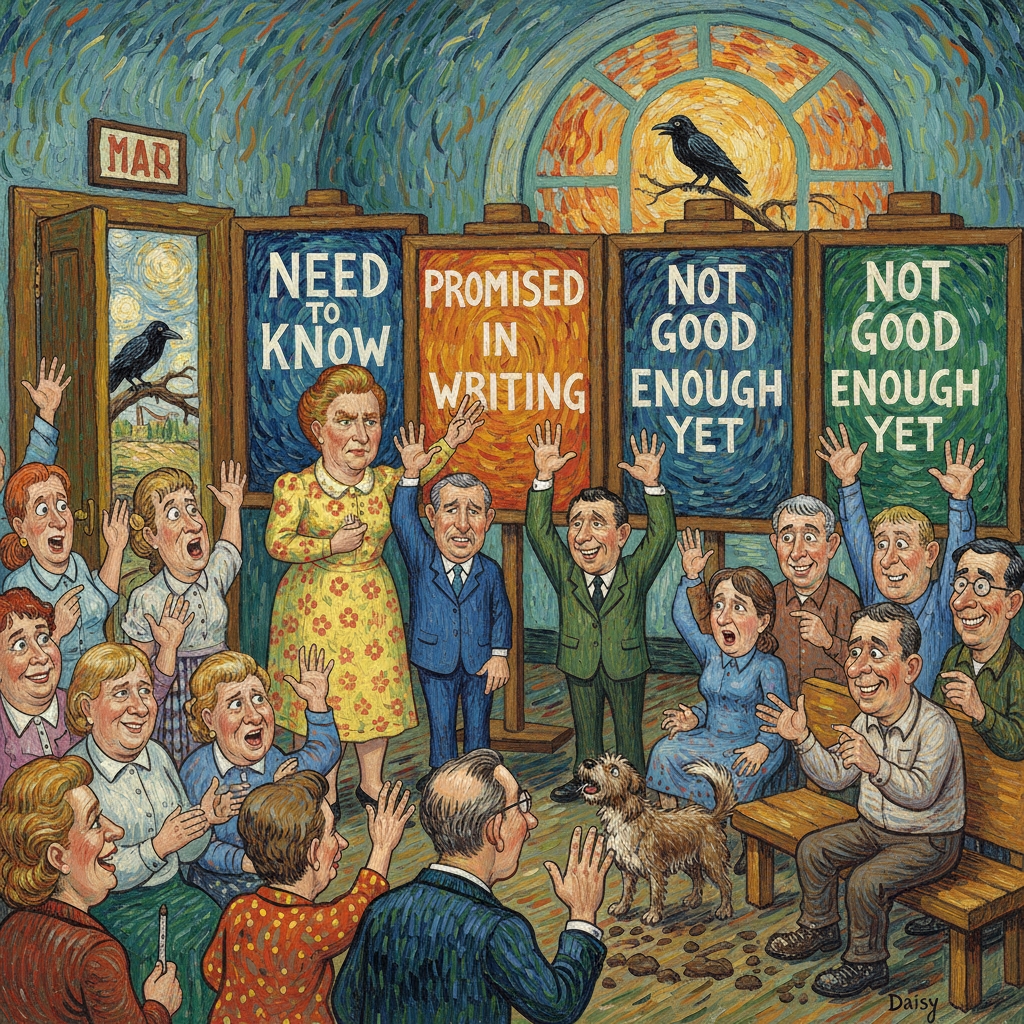
The public question board had grown into three panels: NEED TO KNOW, PROMISED IN WRITING, and NOT GOOD ENOUGH YET.
Chester Ray had printed the headings. Doug had built the online version. Neither admitted the other had helped.
Mayor Bea began.
“This town is not voting today to approve or reject the project. We are voting on our process.”
Mabel whispered to Lurleen, “Process is where decisions wear church clothes.”
Shelley Fawn Wexler stood.
“The citizens’ review group recommends the following conditions before any formal consideration: independent technical review chosen by the town; public water, power, noise, traffic, tax, emergency, and environmental disclosures; local workforce and contractor commitments; community benefit terms; public document archive; at least three meetings after written answers are posted; and no preliminary endorsement language from the town until those steps are complete.”
Tiffany added, “Plain-language summaries for normal people.”
Trixie Jo added, “And a paper copy at the diner, church, library, sheriff’s office, and Town Hall.”
Chester Ray lifted a finger. “Printed locally.”
Doug rolled his eyes. “Fine.”
Jolene stood.
“I support this process. I also want it clear that support for process is not opposition to the project. We need to be able to examine opportunity without killing it by suspicion.”
Mabel stood after her.
Act IX – Consensus Fails Productively
“And suspicion is not ignorance. Sometimes suspicion is memory wearing work boots.”
Earl Womack tapped his cane. “Both true.”
RT Mullins said, “I want the minutes to show local workers need more than promises.”
Sonny added, “And emergency services need money, training, and equipment before risk arrives.”
Sheriff Peeler nodded. “Correct.”
Officer Kenny Joe said, “And road plans that include mule contingencies.”
Coach Freddie Stubblefield, seated beside Biscuit’s empty lead rope because he claimed the mule was emotionally present, said, “I stand by that amendment.”
The room chuckled.
Pastor Arnold Peeler rose.
“I support the process because it makes room for humility. The town may learn the project is better than feared. Or worse than promised. Either way, truth needs time to park.”
Sister Lila Mae said, “And room near the door in case truth brings a casserole.”
Dr. Neil Cowgill stood.
“I would like to commend the town for distinguishing inevitability from inevitability’s local terms. That distinction is small in language and large in consequence.”
Maggie Sue called out, “He means we can’t stop tomorrow, but we can decide whether tomorrow tracks mud through the house.”
Dr. Cowgill smiled. “Yes. That.”
Brett and Alyssa Crenshaw stood together.
Brett said, “We support the process.”
Alyssa said, “And we hope the town asks for better design, not just yes or no.”
Clovis Strickland rose slowly, carrying the now-famous coffee can, which had been forbidden from opening indoors.
“I do not trust the project,” he said. “I do not trust the speed. I do not trust language that arrives polished. But I trust this town more when it writes things down, argues in daylight, and remembers that the crow is not a newspaper.”
The crow cawed from outside the window.
Chester Ray pointed toward it. “Objection withdrawn by bird.”
Evelyn Grace Tipton stood with a folder.
“The library will keep the archive. Every packet. Every revision. Every answer. Every promise. If the company changes names, the paper will not.”
Lurleen Davenport said, “And seniors can submit questions by phone through the church office.”
Mister Wade Langston rose from the back.
“I don’t know whether this thing is good or bad. I know hurry makes fools of honest people. I vote for no hurry.”
Mayor Bea looked to Graham Pike.
“Do you want to respond?”
Graham stood.
“I came here expecting concern. I did not expect a beaver, a mule, or a toaster inquiry.”
Clovis said, “The toaster inquiry remains active.”
Graham nodded. “So noted. I also did not expect this level of organization. I will tell my team that Sequatchie Crossing is not rejecting discussion, but it will not be rushed into becoming a footnote.”
Mayor Bea said, “That’s fair.”
Shelley read the motion.
“All in favor of adopting the review process as the town’s position before further project consideration?”
Hands rose across the room. Jolene’s. Mabel’s. Boot’s. Clovis’s. Doug’s. Chester Ray’s. Maggie Sue’s. Pastor’s. Sheriff’s. Kenny Joe’s. Sonny’s. RT’s. Shelley’s. Tiffany’s. Trixie Jo’s. Lurleen’s. Evelyn’s. Dr. Cowgill’s. Brett’s. Alyssa’s. Earl’s. Coach Freddie’s. Mister Wade’s.
Mayor Bea raised her hand last.
“Opposed?”
Two hands rose. One from a man who wanted the project approved immediately. One from a woman who wanted it rejected immediately.
Mayor Bea nodded.
“Motion carries.”
Daisy barked from beside the door.
Sheriff Peeler said, “Abstention noted.”
Outside, the stream moved through the beaver dam’s growing wall by way of a narrow gap Sonny and RT had marked for the wildlife officer. The water had not returned to what it was before. It had not flooded the road either.
The town had not stopped the beaver.
The town had not surrendered to the beaver.
It had merely admitted that pretending not to see the dam was not a plan.
Mayor Bea closed her folder.
“Meeting adjourned.”
Nobody fully won, which in Sequatchie Crossing was sometimes how you knew the town had done something close to honest.
Act IX – Consensus Fails Productively
Epilogue – Where the Water Went
By Monday morning, the public question board had more questions than answers, which disappointed those who confused speed with progress.
At the diner, Maggie Sue taped the latest printed update beside the pie cooler. Chester Ray complained that Doug’s online version had loaded faster than the paper could be stapled. Doug replied that paper had better battery life. This was recorded by Tiffany as evidence of healing.
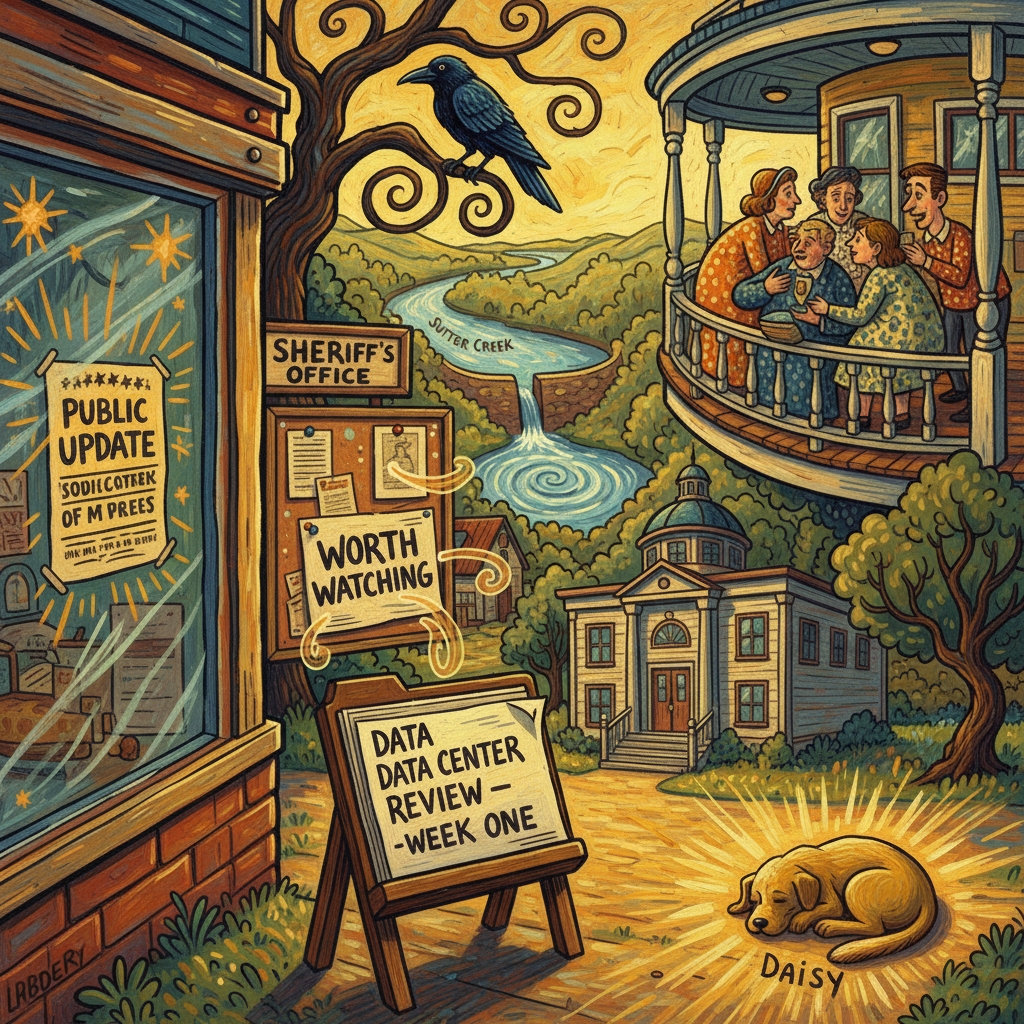
At the sheriff’s office, Sheriff Peeler and Officer Kenny Joe added a new corkboard category: WORTH WATCHING.
Daisy slept beneath it.
At the library, Evelyn Grace Tipton labeled the first archive folder DATA CENTER REVIEW – WEEK ONE – FUTURE NOBODY ORDERED.
At the church, Pastor Peeler preached about Pharaoh, progress, and the danger of confusing motion with deliverance. Sister Lila Mae said it was one of his better sermons because it did not accuse anyone by name but made several people shift in their seats.
On Mabel’s porch, Boot updated his map. Clovis watched the crow steal another gum wrapper. Jolene sat with Earl and argued, gently, about whether the town was getting wiser or just older.
Down at Sutter Creek, the beaver kept building.
Nobody had persuaded it.
Nobody had endorsed it.
Nobody had stopped it.
The water found a way through, around, under, and eventually beyond.
Sequatchie Crossing, watching from the bank with muddy shoes and printed questions, began to suspect the future worked much the same way.
Epilogue – Where the Water Went
Disclaimer – A Fictional Dispatch From a Fictional Town
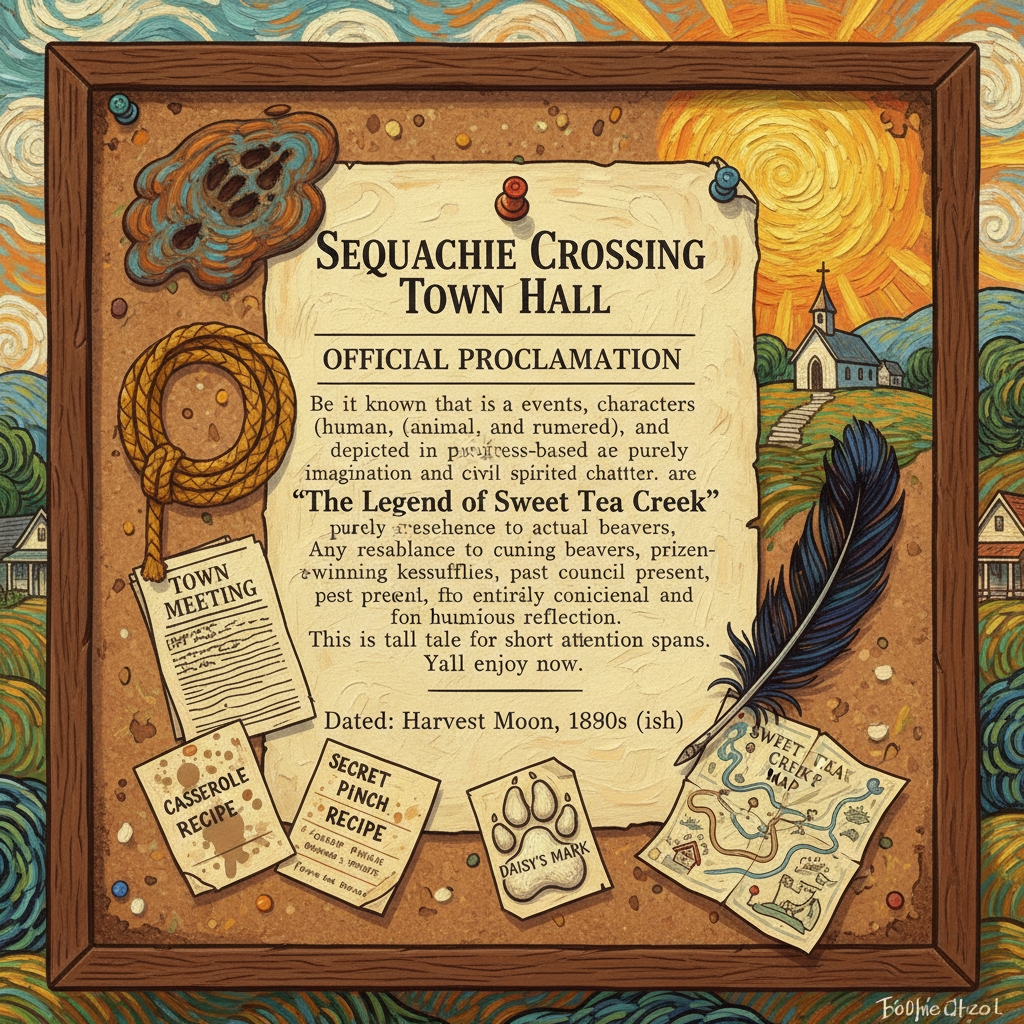
Sequatchie Crossing is a fictional town, and all characters, businesses, meetings, incidents, animals, committees, rumors, maps, casseroles, public comments, project representatives, and civic misunderstandings in this story are fictional. Any resemblance to real people, real residents, real companies, real officials, real data center proposals, real beavers, real mules, or real crows is coincidental.
This story is satire. It is intended to entertain while exploring how small communities wrestle with technological change, economic promises, environmental concerns, rumor, process, fear, optimism, and the old civic truth that infrastructure has consequences whether it is built by corporations, governments, or determined wildlife.
Disclaimer – A Fictional Dispatch From a Fictional Town
Real Places Behind the Ruckus – From The Dunlap Directory

Real Places Behind the Ruckus – From The Dunlap Directory
Yes, this story was fictional; even the parts that weren’t true. These places? Absolutely real. Stop by, support local, and keep the Wi-Fi away from livestock:
- Walgreens
- Cumberland Mountain State Park
- Dunlap Restaurant
- Smiley Farms Store
- Coppinger Cove Baptist Church
- American Roofing Company
- Factory Connection (Dunlap TN)
- Coldwell Banker Pryor Realty Inc.
- Hickerson Land Management
- Harris Park
- Valhalla Acres at TN Campground
- Covenant Fellowship Center
- Tiger Rock Dunlap
- Grays Plumbing LLC
- Harris Mowing Service
- Applegate Inn
- Chapel Hill Methodist Church
- First Baptist Church Soddy-Daisy
- Campbell Tire
- Anthony and Theresa’s Homecookin’

Real Places Behind the Ruckus – From The Dunlap Directory
At Sequatchie Crossing, we tell the stories of Sequatchie Crossing.
Please share this post with your friends, family, or business associates who may want follow the news from Sequatchie Crossing.

0 Comments