


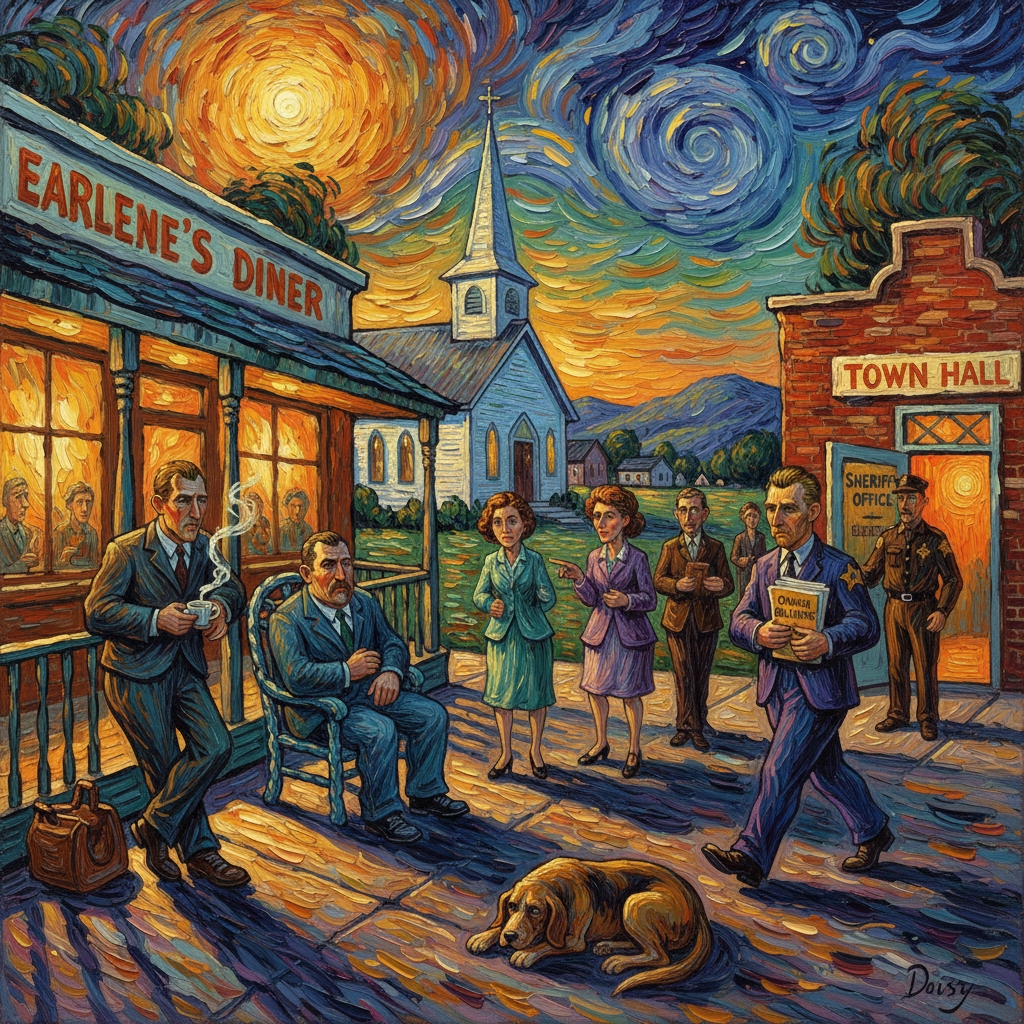
Previously Avoided Topic Now Referenced In Lowered Voices
By Tom Seest
At Sequatchie Crossing, we tell the stories of Sequatchie Crossing.
Please share this post with your friends, family, or business associates who may want follow the news from Sequatchie Crossing.
🎤 Audio Overview
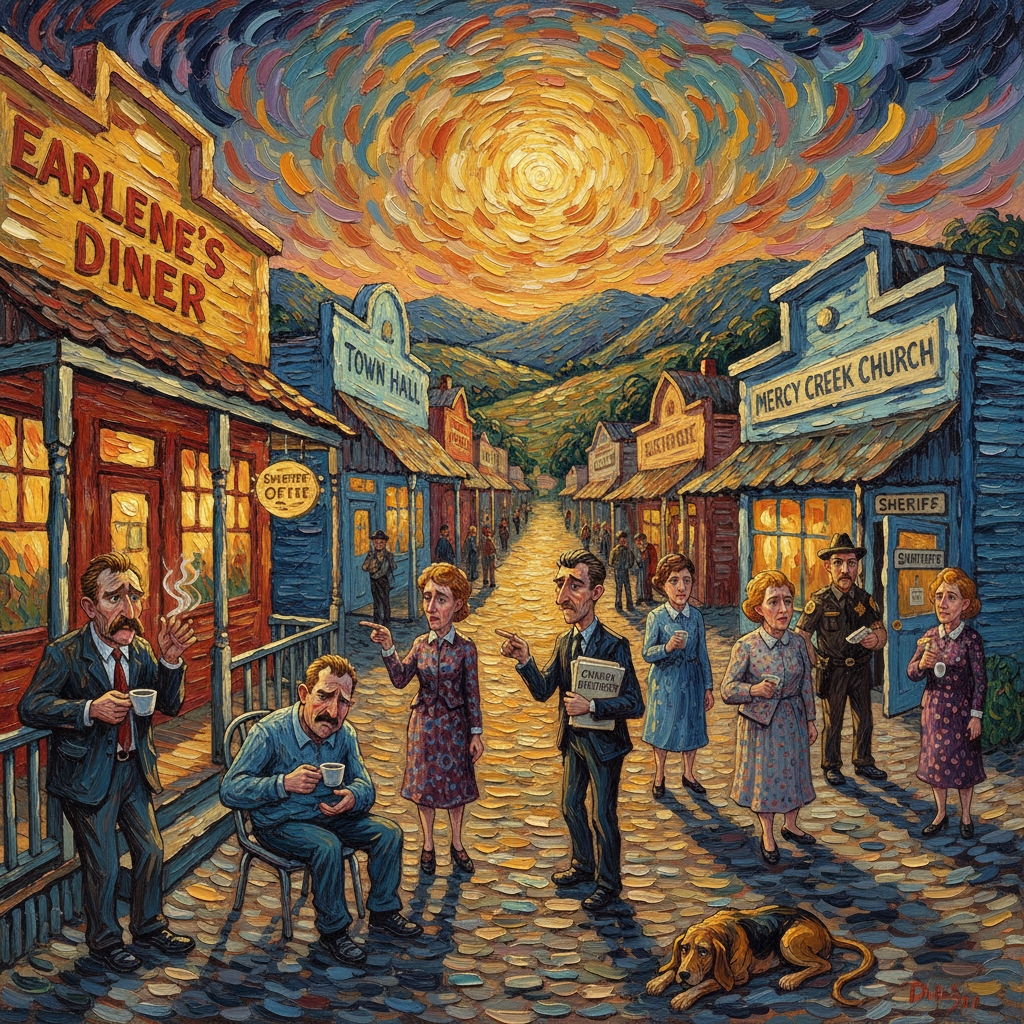
People Begin Mentioning Problem Quietly, As If It Was Always Known
ACT I – The Porch Language Changes
By Monday morning, the problem had acquired pronouns.
Nobody in Sequatchie Crossing said exactly what the problem was. They only referred to it the way people refer to a relative who had once thrown a lawn chair through a church fellowship hall window and afterward still expected potato salad at reunions.
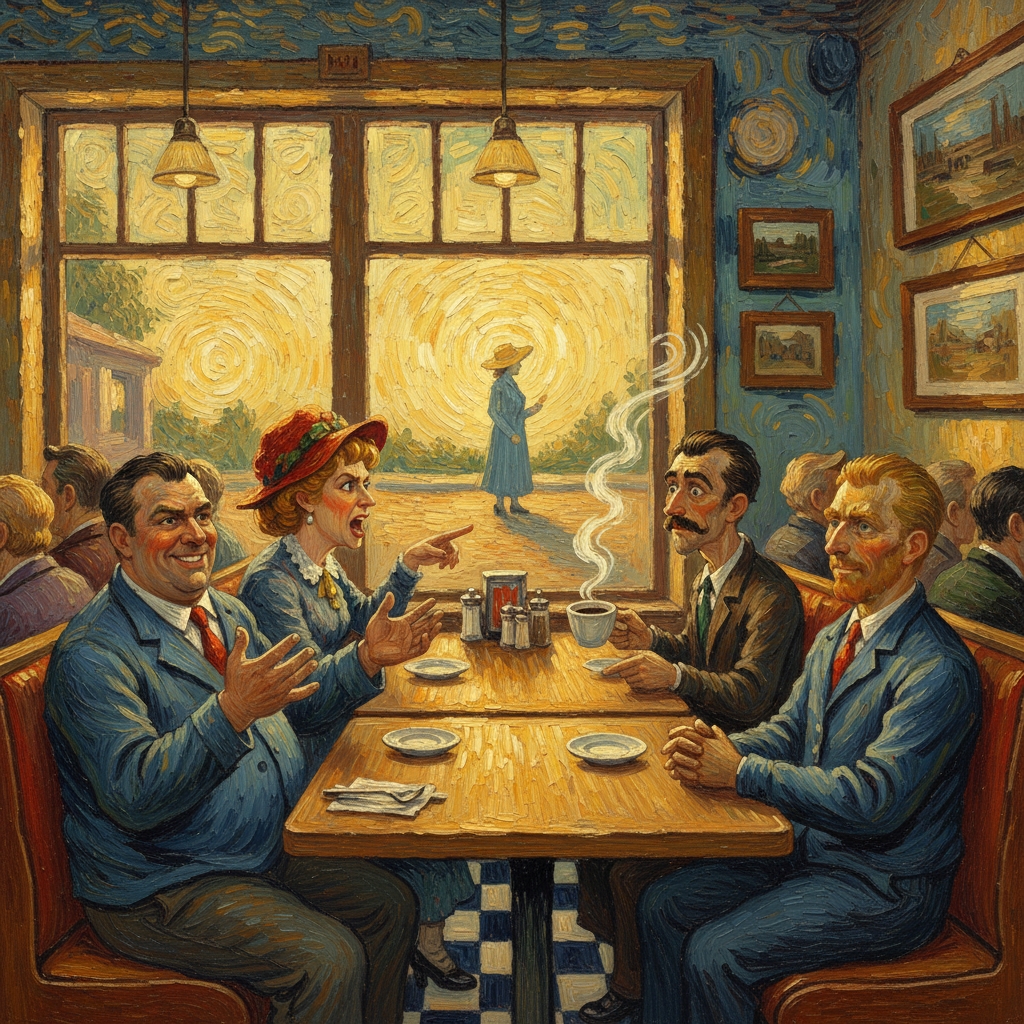
Boot Barnes first noticed it outside Earlene’s Diner around seven-thirty while drinking coffee that tasted vaguely electrical.
Daisy the hound lay beside the porch steps with one eye open and both ears pointed toward the parking lot like satellite equipment.
Clovis Strickland sat backward in a metal chair, chewing thoughtfully on a toothpick and observing traffic with the suspicious patience of a man who believed every fourth vehicle was probably federal.
“Folks are sayin’ it now,” Boot announced.
Clovis didn’t look up.
“They ain’t sayin’ it,” he replied. “They’re orbitin’ around it.”
“That’s still sayin’.”
“No,” said Clovis. “Sayin’ is direct. This here is verbal camouflage.”
Inside the diner, silverware rattled like nervous insects.
Mabel Dean Ashcroft emerged carrying a styrofoam cup and a look of permanent spiritual disappointment.
“Now they’re sayin’ it,” she declared immediately.
Clovis pointed at her triumphantly.
“See?”
Mabel sat down heavily.
“For two years,” she said, “people acted like mentionin’ it caused weather. Now all of a sudden everybody’s whisperin’ it over pie.”
Boot nodded solemnly.
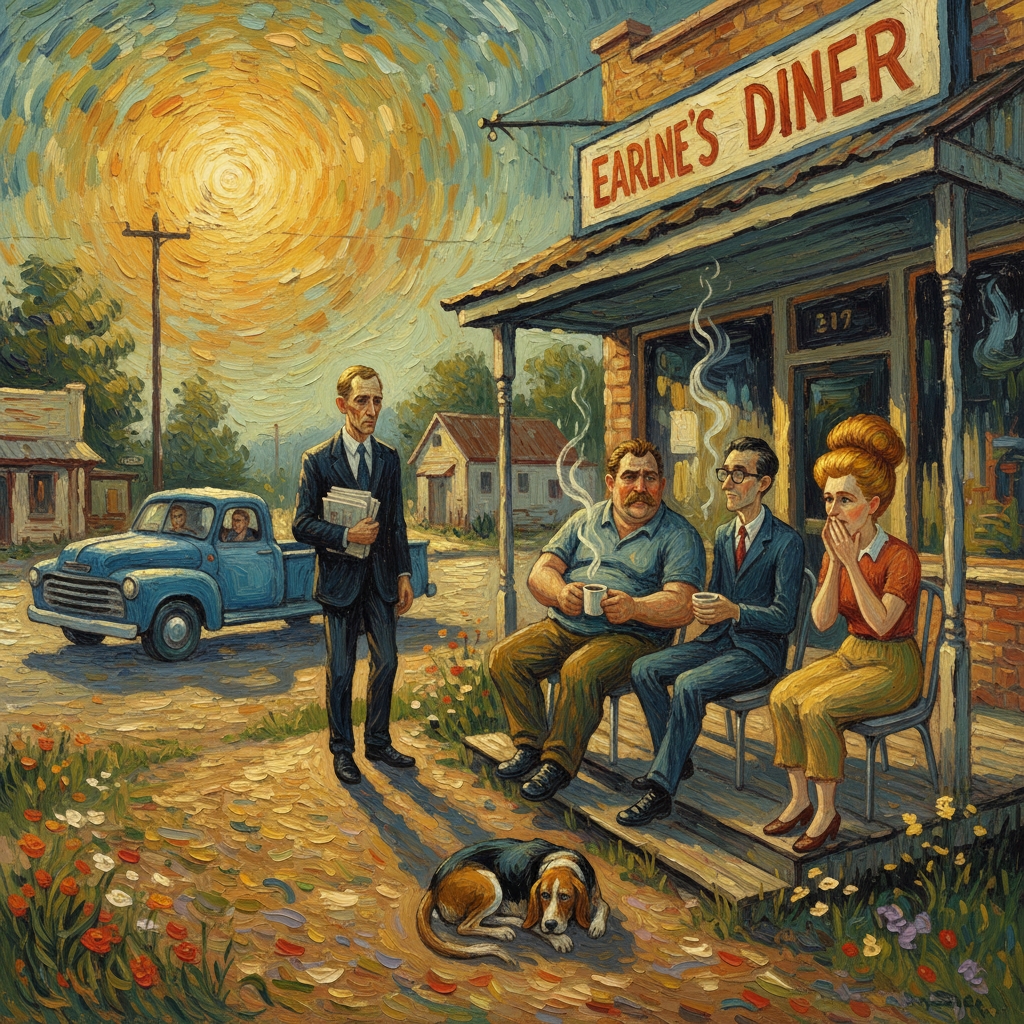
Act I – The Porch Language Changes
“I heard three people mention it at the feed store.”
“Same sentence?” asked Clovis.
“No. They spread it out over twenty minutes like respectable cowards.”
Daisy lifted her head.
A truck rolled slowly past the diner.
Inside the truck sat Brett and Alyssa Crenshaw, both staring forward with the fixed expressions of people attempting not to look directly at local tension.
“They know too,” said Mabel.
“Everybody knows,” Clovis muttered. “That’s what makes it powerful.”
Pastor Arnold Peeler crossed the street carrying a box of church bulletins under one arm. He paused near the porch.
Nobody spoke.
The pastor nodded once.
Not agreement.
Not denial.
Just acknowledgment.
“Morning,” he said quietly.
Then he continued walking.
Mabel watched him disappear toward the church.
“See that?” she whispered.
“What?”
“He didn’t redirect the conversation.”
Boot leaned closer.
“That means somethin’.”
“It means everything,” said Clovis.
Across the street, Officer Kenny Joe Teeter exited the sheriff’s office carrying a biscuit wrapped in napkins. He spotted the porch gathering and immediately slowed down, which in Sequatchie Crossing was the behavioral equivalent of a possum freezing under a porch light.
“You all discussin’ it?” he asked cautiously.
“Discussin’ what?” said Clovis.
Kenny Joe hesitated.
Then lowered his voice.
“You know.”
Nobody answered.
Daisy suddenly stood up, stared toward the road, listened for several seconds, then calmly lay back down again.
Boot watched the dog carefully.
“She hears it too.”
“No,” Clovis said. “She just knows when folks stop lyin’.”
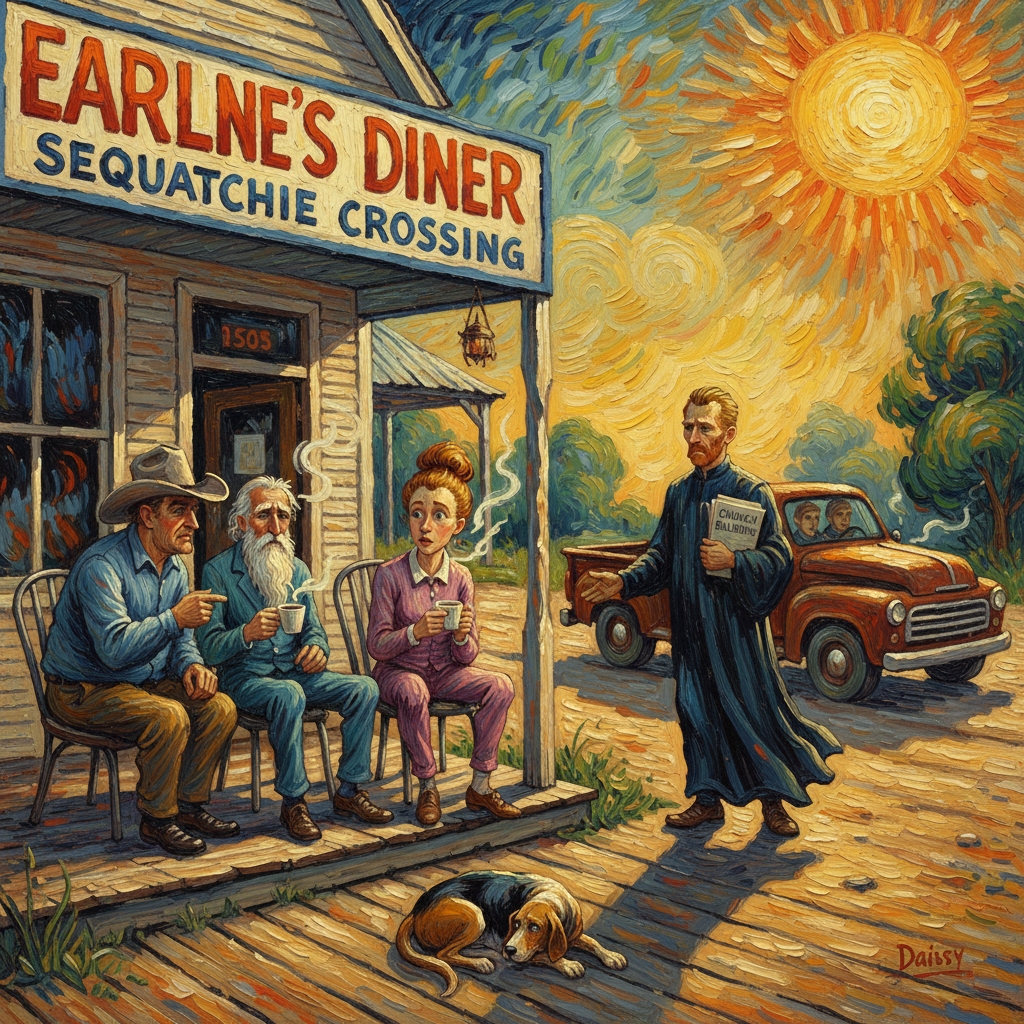
Act I – The Porch Language Changes
ACT II – Whisper Volume at the Hardware Store
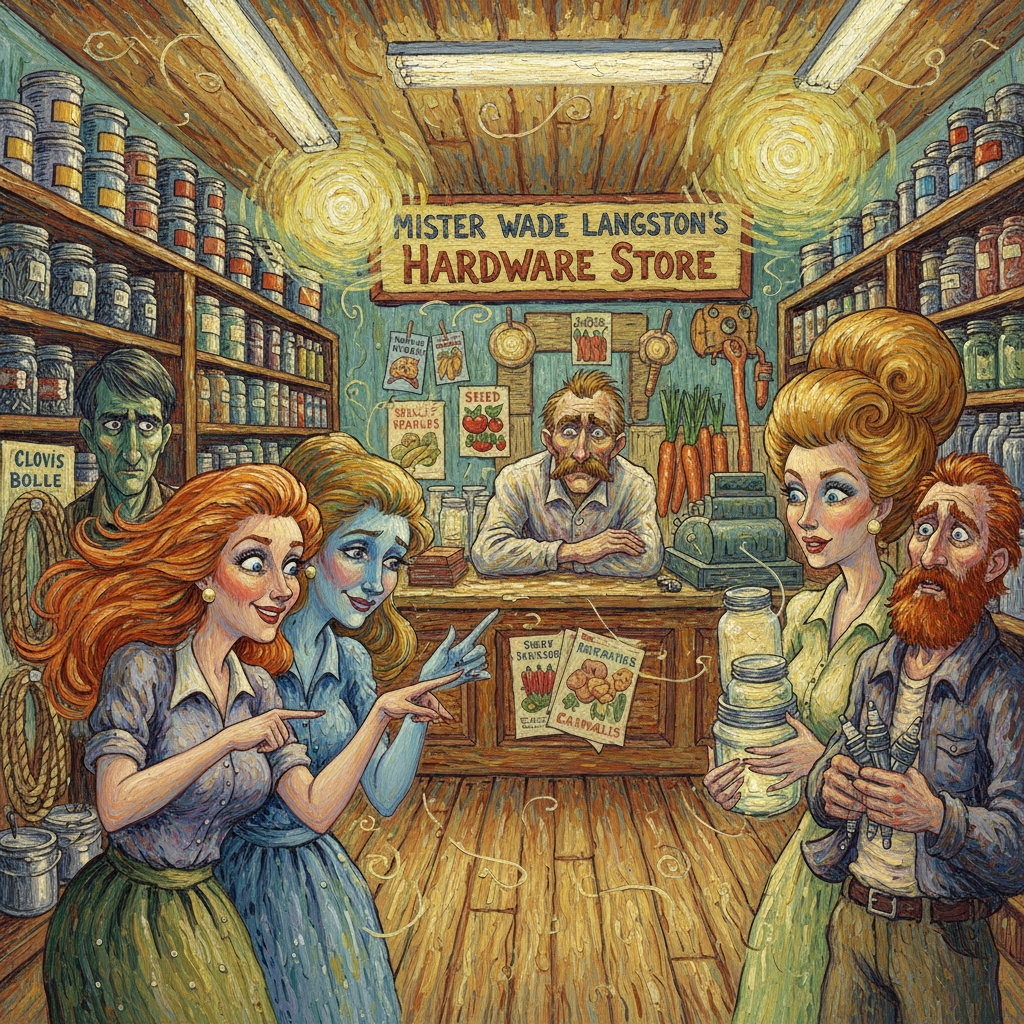
By ten o’clock the problem had migrated to Mister Wade Langston’s hardware store.
The hardware store functioned as Sequatchie Crossing’s unofficial Department of Emotional Processing. Nails, fertilizer, electrical tape, and unspoken anxieties all moved through the same register.
Mister Wade stood behind the counter reading seed catalogs with the expression of a man personally betrayed by modern tomatoes.
Shelley Fawn Wexler wandered through the paint aisle pretending to compare shades while actively listening to everybody else.
Trixie Jo Bartlett entered dramatically despite nothing dramatic occurring.
“I’m not gonna say it,” she announced loudly.
“Then don’t,” said Wade.
“But everybody’s thinkin’ it.”
“That’s usually how thinkin’ works.”
Shelley drifted closer.
“People are being careful with their nouns today.”
“That’s because nouns create liability,” Clovis said from the bolt section.
Nobody had seen him enter.
Trixie Jo lowered her voice theatrically.
“Well… ever since… you know…”
“See?” Clovis said. “There it is.”
“What?”
“The pause. Folks used to avoid the pause. Now they’re usin’ it like punctuation.”
Wade removed his glasses.
“I remember when people still pretended not to notice.”
“Pretending’s expensive,” Shelley said softly.
Act II – Whisper Volume at the Hardware Store
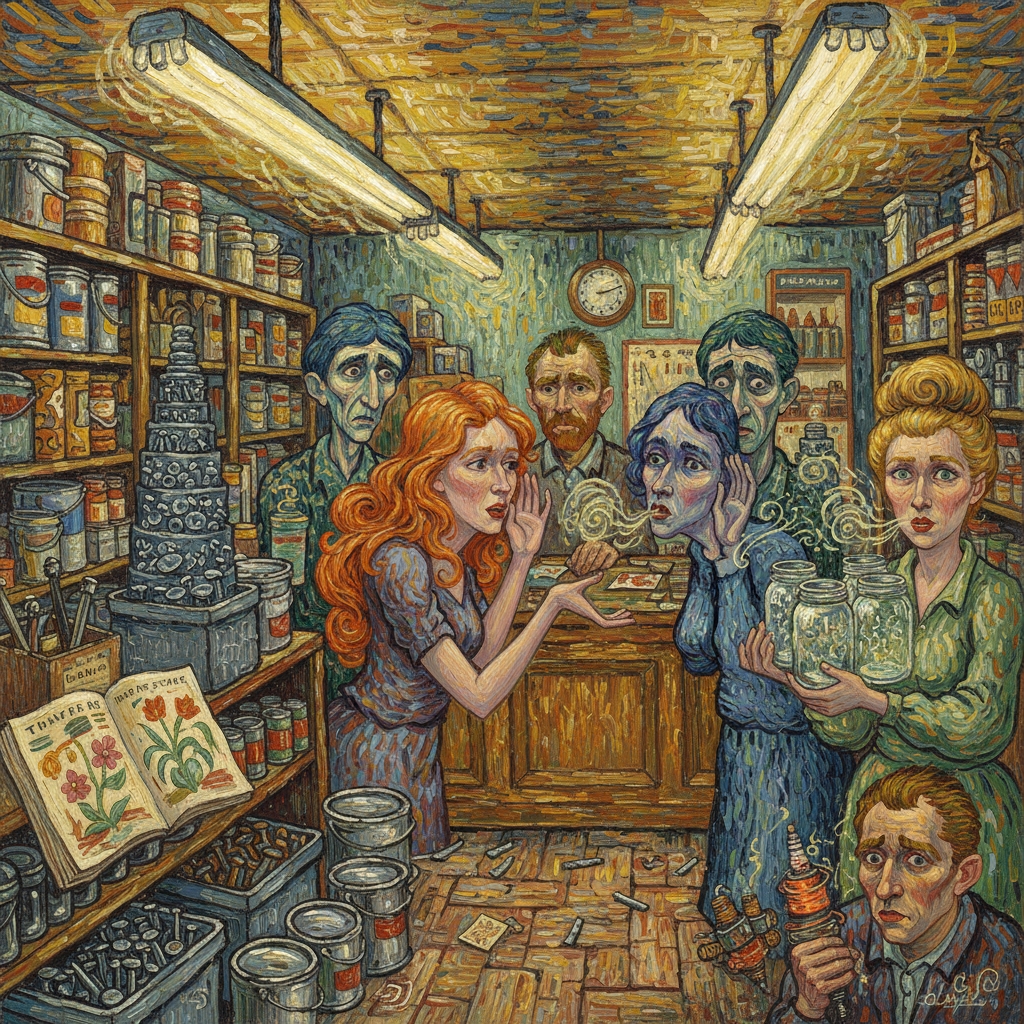
Tiffany Annette Roark appeared carrying two decorative mason jars and the exhausted aura of someone who had spent all morning pretending online optimism was sustainable.
“My Facebook comments section has started dancing around it,” she said.
“That’s bad,” Wade muttered.
“People are posting inspirational quotes with suspicious timing.”
“That’s the final stage before public acceptance,” Clovis warned.
Shelley nodded gravely.
“Quotes are where denial goes to die.”
RT Mullins entered carrying spark plugs and anxiety.
“Is this one of them conversations where everybody already knows the answer but keeps speakin’ in riddles so nobody can be blamed later?”
“Yes,” said Wade.
“Good,” RT replied. “I just wanted context.”
Trixie Jo leaned closer.
“I heard folks mentionin’ it at church yesterday.”
Wade blinked.
“Out loud?”
“Well… church-out loud.”
“That’s practically public record.”
The room grew quiet.
Even the fluorescent lights seemed nervous.
Then Chester Ray Blevins stepped in carrying printer paper under one arm.
“I got three separate orders this mornin’ for flyers that vaguely refer to ‘recent concerns,’” he announced.
“How vague?” asked Shelley.
“One flyer just says ‘We Are Aware.’”
Boot entered through the side door.
“I heard somebody at the diner say maybe the town oughta finally discuss it.”
Every head turned.
Wade looked horrified.
“Discuss it formally?”
Boot nodded.
The entire hardware store recoiled like he had proposed public nudity at the Christmas parade.
“Lord no,” said Shelley.
“You can’t formally discuss somethin’ folks only recently admitted exists,” Mabel declared from nowhere near the gardening tools.
Again, nobody had seen her arrive.
“That causes structural panic.”
“What’s structural panic?” asked RT.
“When everybody starts actin’ reasonable all at once,” Clovis explained.
They all considered this grim possibility in silence.
Act II – Whisper Volume at the Hardware Store
ACT III – Pastor Peeler’s Strategic Nodding
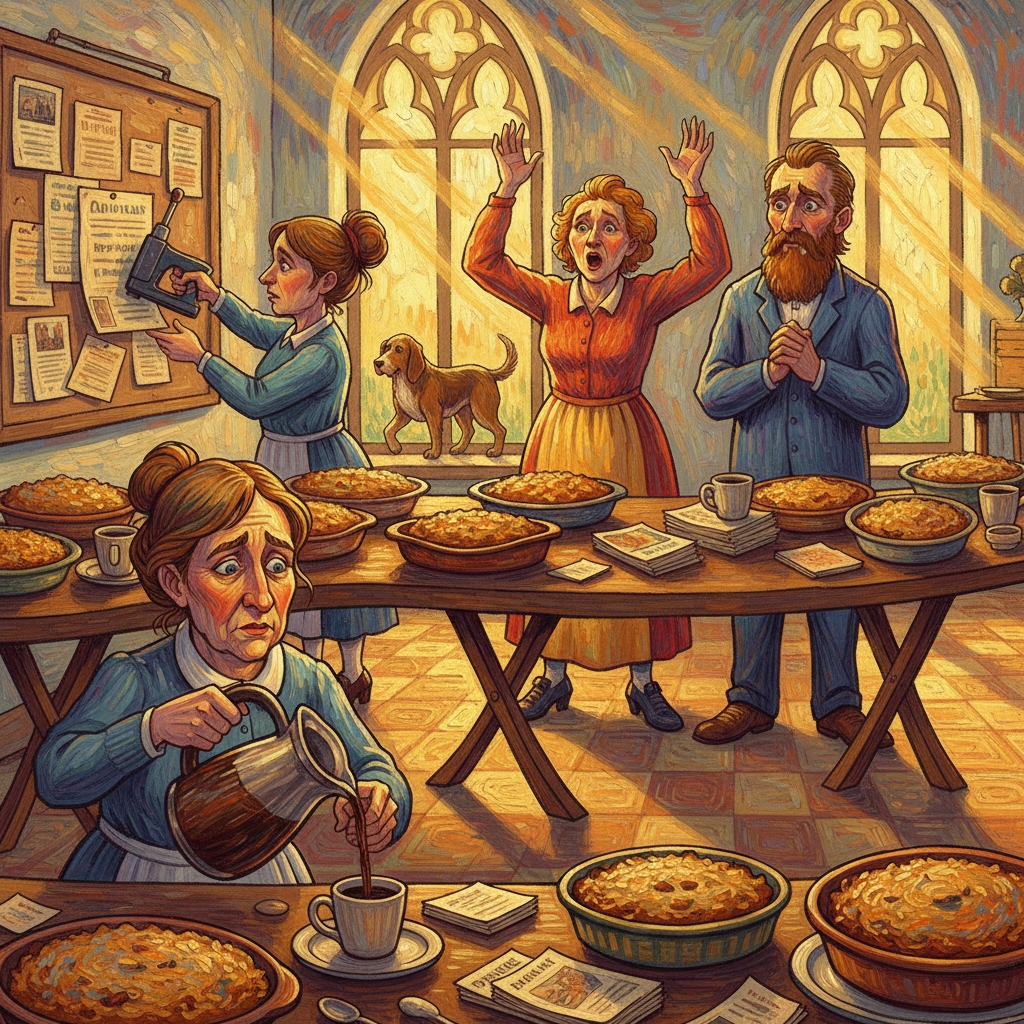
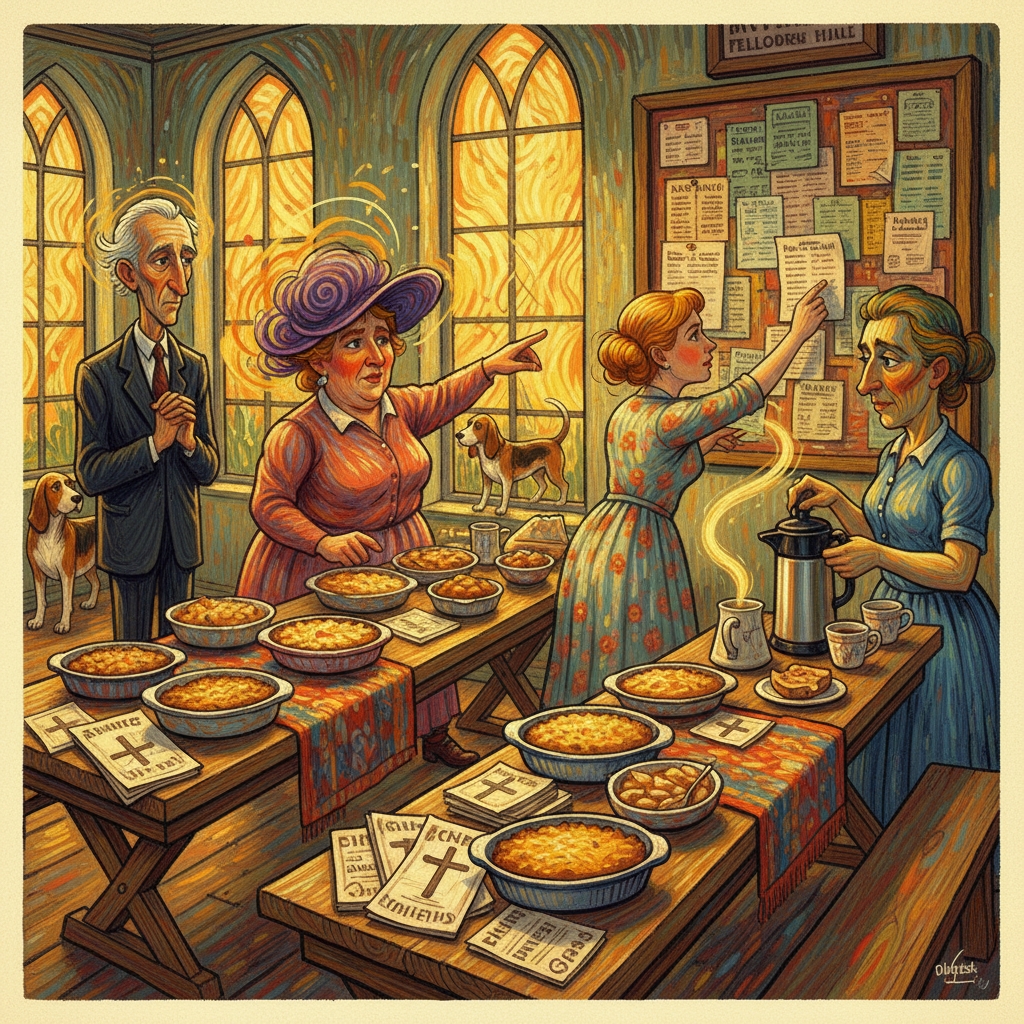
The fellowship hall at Mercy Creek Church smelled faintly of lemon cleaner, old coffee, and cautious theology.
Pastor Arnold Peeler stood near the folding tables while Sister Lila Mae “Hallelujah” Pruitt arranged casserole dishes with military precision.
Maggie Sue Dillard stapled announcements to a bulletin board that already contained seventeen older announcements nobody intended to remove.
Evelyn Grace Tipton poured coffee slowly, as though sudden movements might trigger doctrinal consequences.
Nobody mentioned the problem directly.
Which meant everybody absolutely was.
“You hear folks talkin’ differently?” Evelyn asked quietly.
Pastor Peeler nodded.
“Mm.”
That was all he said.
Lila Mae narrowed her eyes.
“Pastor, I need more than a church grunt.”
He sighed gently.
“People are approaching acknowledgment.”
Act III – Pastor Peeler’s Strategic Nodding
“That sounds like a pamphlet.”
“It’s the safest phrasing I got.”
Maggie Sue lowered her stapler.
“Well I noticed it too. Folks are using phrases like ‘as we’ve all known for some time.’”
Lila Mae gasped.
“That’s advanced denial language.”
The pastor nodded again.
“Mm.”
“Arnold,” Lila Mae said firmly, “you gotta contribute at least six actual words to this conversation.”
Pastor Peeler adjusted his glasses.
“When fear weakens, people test truth sideways.”
Silence settled over the room.
Evelyn looked impressed.
“Well that was unexpectedly profound.”
“I save sentences,” the pastor admitted.
From outside came the sound of Daisy barking once.
Then stopping.
The dog wandered past the fellowship hall windows, paused, listened toward Main Street, then continued calmly along the sidewalk.
Lila Mae watched her carefully.
“That dog knows things.”
“She knows humans repeat patterns,” Pastor Peeler replied.
Maggie Sue frowned.
“What exactly is changin’?”
The pastor folded church bulletins thoughtfully.
“People have moved from pretending not to see… to quietly checking whether everybody else sees too.”
“That’s worse,” Evelyn whispered.
“No,” he said gently. “It’s actually healthier.”
Nobody liked hearing that.
Healthy developments made towns uncomfortable.
Especially towns that preferred tradition over emotional clarity.
Lila Mae crossed her arms.
“Well if people finally admit it publicly, what happens then?”
Pastor Peeler looked toward the sanctuary doors.
“They’ll probably act like they said it all along.”
Act III – Pastor Peeler’s Strategic Nodding
ACT IV – The Sheriff’s Office Avoids Specifics
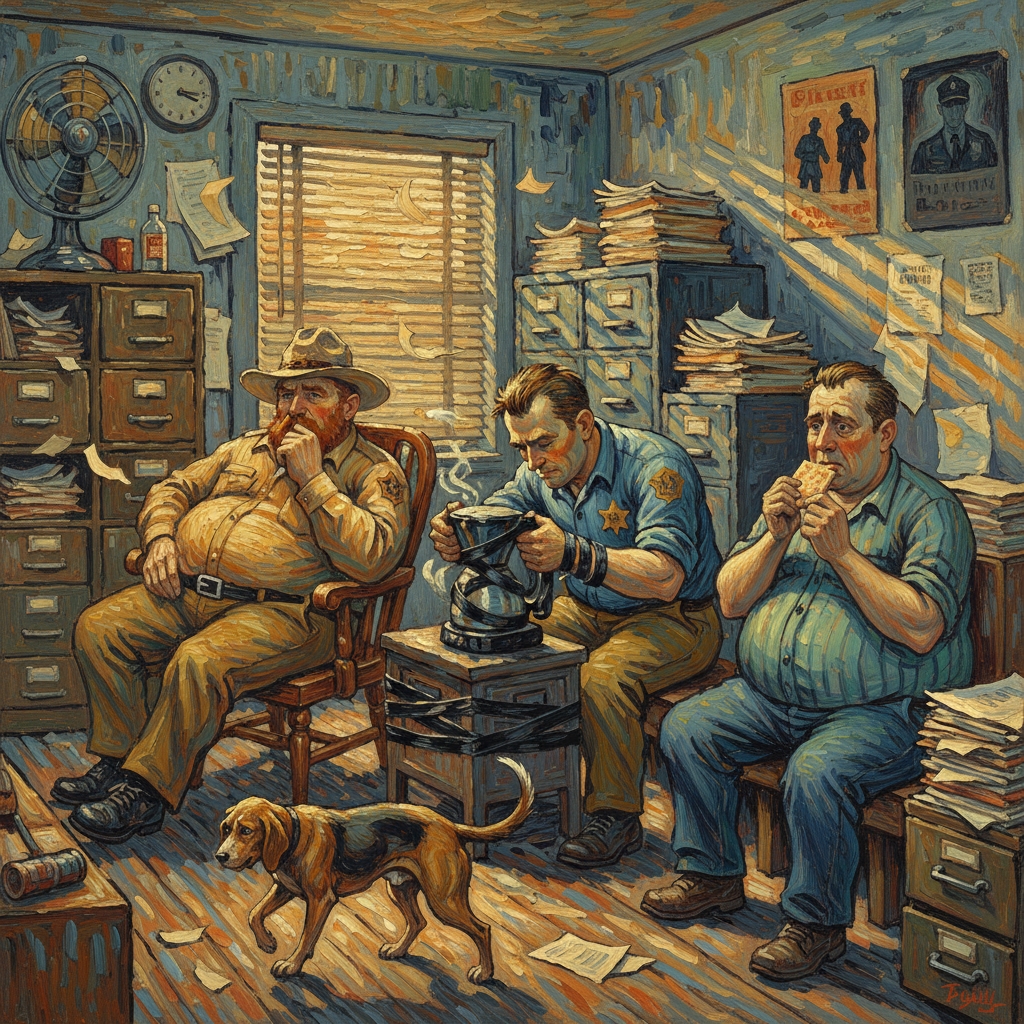
Sheriff Peeler’s office contained three desks, one oscillating fan, two filing cabinets, and approximately four decades of accumulated skepticism.
Sheriff Peeler leaned back in his chair while Officer Kenny Joe Teeter attempted to repair the coffee maker using electrical tape and misplaced confidence.
Doug “Doughboy” Teeter sat nearby eating crackers loudly enough to qualify as civic interference.
“We’ve had six separate calls today,” Kenny Joe said.
“About what?”
Kenny Joe hesitated.
Then lowered his voice instinctively.
“You know.”
The sheriff rubbed his forehead.
“They actually sayin’ it?”
“Not directly. More like emotionally adjacent.”
Doughboy nodded with cracker dust on his shirt.
“Folks keep askin’ if we’re aware of ‘ongoing circumstances.’”
“That could mean anything in this town.”
“Exactly.”
Boot wandered in without knocking.
“I heard at least twelve people mention it before lunch.”
Sheriff Peeler sighed.
“You countin’?”
“I believe in data.”
“What’d they say?”
Boot sat carefully.

Act IV – The Sheriff’s Office Avoids Specifics
“Well one lady said ‘ever since all this started.’ Another fella said ‘it’s probably connected.’ Then somebody at the gas station whispered ‘we all know what this really is.’”
Kenny Joe shivered slightly.
“That’s advanced-stage local dialogue.”
Sheriff Peeler stared at the ceiling fan.
“You know what concerns me?”
“Everything?” asked Doughboy.
“The calmness.”
That landed heavily.
Because he was right.
There had been no yelling.
No dramatic Facebook declarations typed entirely in capital letters.
Just quiet references.
Soft acknowledgments.
A collective easing toward honesty.
And somehow that unnerved everybody worse.
“You think people are finally accepting it?” Kenny Joe asked.
Sheriff Peeler shook his head slowly.
“No. I think they’re rehearsing acceptance.”
Daisy wandered through the open office door.
Paused.
Looked around.
Listened.
Then continued into the hallway without concern.
Boot pointed after her.
“Even the dog ain’t alarmed anymore.”
“That’s because dogs adapt faster than committees,” the sheriff replied.
Outside, a church bell rang once across town.
Nobody moved.
Nobody spoke.
Then Doughboy cleared his throat carefully.
“I sorta mentioned it yesterday myself.”
The room froze.
“You did what?” Kenny Joe whispered.
“Well not directly.”
“How indirectly?”
“I said ‘certain conditions appear increasingly difficult to ignore.’”
Sheriff Peeler stared at him.
“That’s practically journalism.”
Act IV – The Sheriff’s Office Avoids Specifics
ACT V – Trixie Jo Conducts Informal Research
By late afternoon, Trixie Jo Bartlett had transformed herself into what she called a “community atmosphere investigator.”
This mostly involved standing near people holding sweet tea while pretending not to eavesdrop.
At Earlene’s Diner, she slid into a booth beside Shelley Fawn Wexler and Tiffany Annette Roark.
“I’ve gathered evidence,” Trixie Jo announced.
“No you haven’t,” Shelley replied.
“I absolutely have.”
“You overheard nervous farmers.”
“That’s still data.”
Sonny Morales arrived carrying takeout containers from the grill.
“I heard folks at the garage talking in code,” he said.
“What kind of code?”
“They kept saying things like ‘current realities.’”
Tiffany looked troubled.
“That’s corporate language. We’re evolving.”
Coach Freddie Stubblefield entered wearing athletic shorts and the emotional burden of supervising teenagers.
“Y’all discussing the Thing?”
Everybody looked around cautiously.
No one corrected him.
That alone felt historic.
Coach Freddie sat down slowly.
“At practice today, three parents casually referenced ‘the situation.’”
Shelley leaned forward.

Act V – Trixie Jo Conducts Informal Research
“Casually?”
“That’s what bothered me.”
Trixie Jo scribbled notes into a spiral notebook labeled PUBLIC SENTIMENTS.
“You see?” she whispered dramatically. “We’re crossing thresholds.”
Sonny blinked.
“You keep sayin’ thresholds like we’re hauntin’ a Victorian mansion.”
“We might be.”
Across the diner, Brett and Alyssa Crenshaw spoke quietly with Maggie Sue Dillard.
Nobody could hear the conversation.
But every few seconds one of them nodded gravely.
“Look at that,” Tiffany murmured. “They’re nodding.”
“Public nodding is serious,” said Shelley.
Boot appeared beside the jukebox.
Nobody questioned how.
“I heard Pastor Peeler say people are testing truth sideways.”
The entire booth grew silent.
“That sounds accurate,” Sonny admitted.
“Sounds biblical,” Coach Freddie added.
“Sounds expensive,” Shelley muttered.
Daisy wandered through the diner.
Paused beside a table where two older men whispered:
“Well… after everything…”
“Mm-hm.”
“…it’s probably time.”
The dog listened briefly.
Then calmly moved on toward the kitchen.
Trixie Jo watched carefully.
“She’s no longer startled by the tone shift.”
“That dog’s emotionally ahead of half this county,” Shelley replied.
Outside the windows, evening sunlight spread across Main Street in soft orange bands.
The town looked peaceful.
Which somehow made everybody more nervous.

Act V – Trixie Jo Conducts Informal Research
ACT VI – Town Hall Without Official Purpose
Nobody called an official meeting.
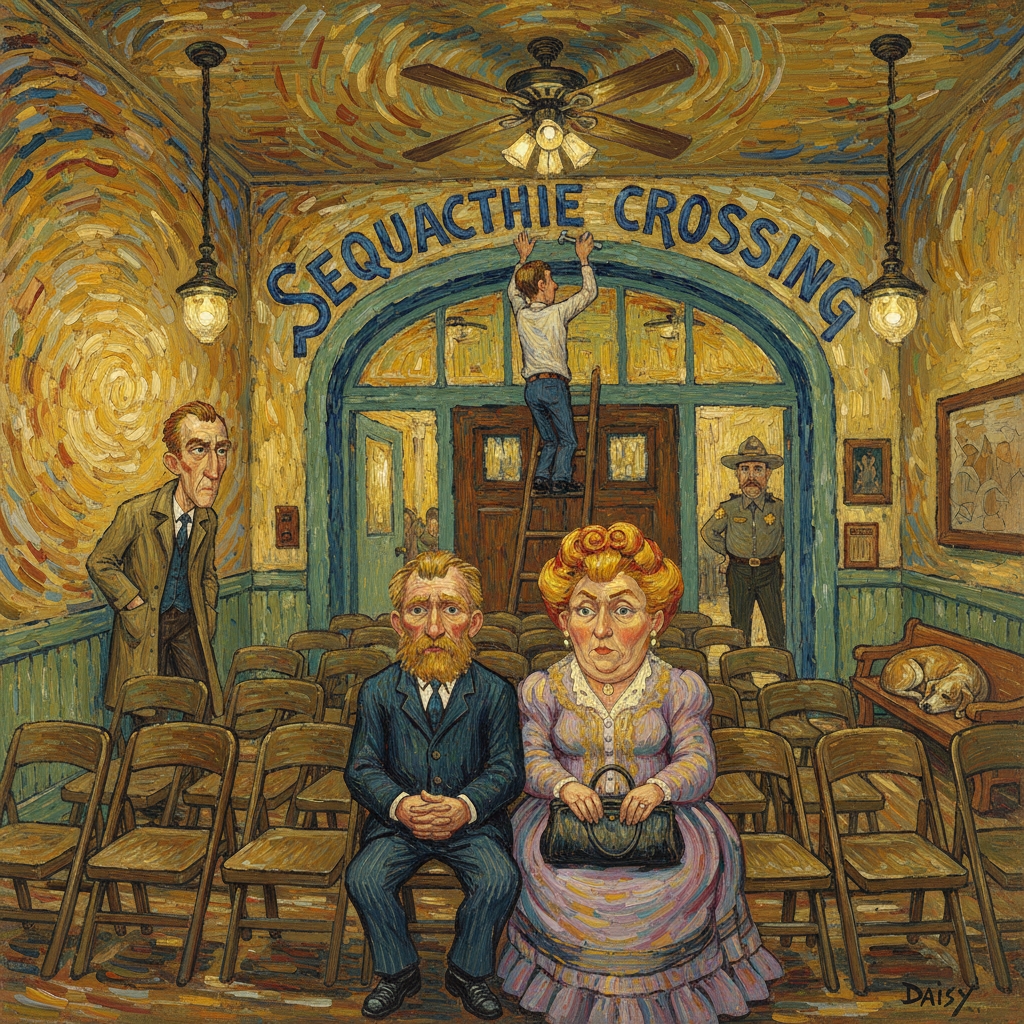
Which was precisely why thirty-seven people showed up at Town Hall.
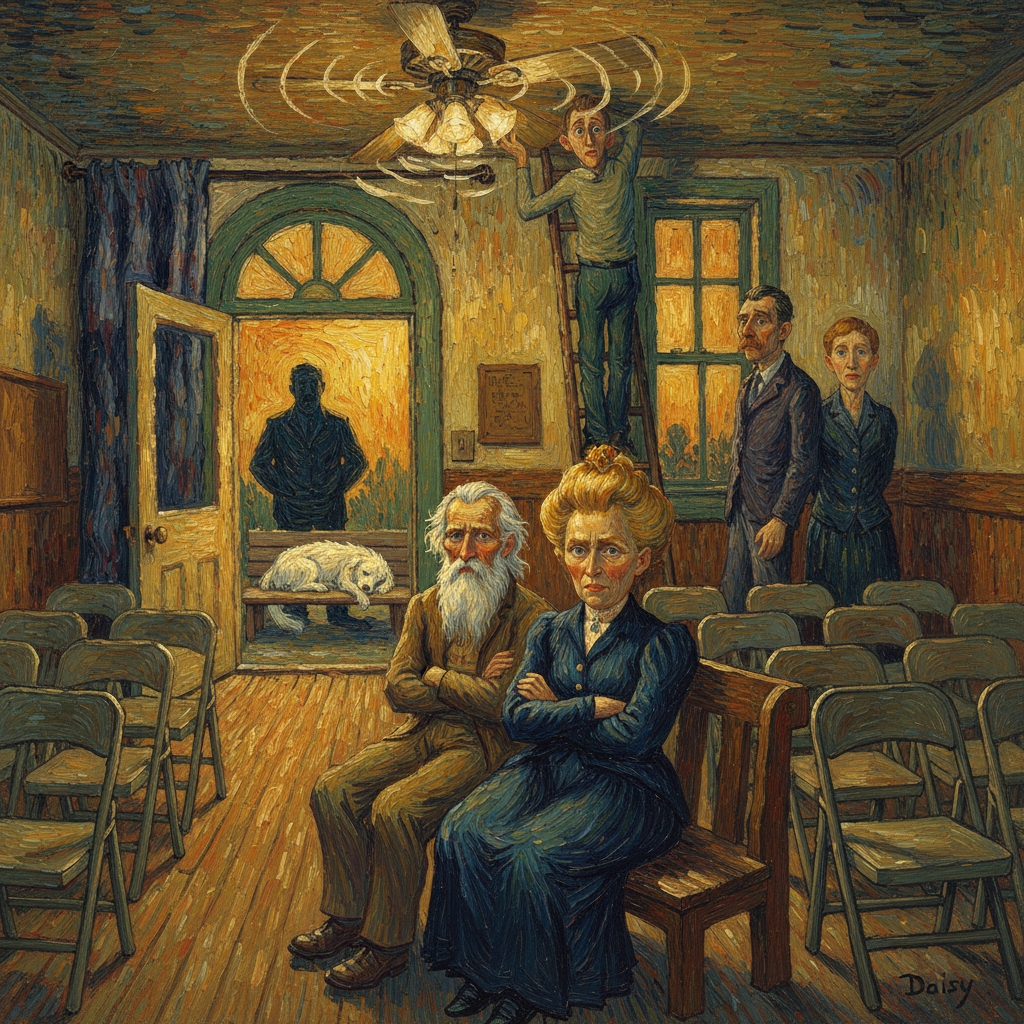
Clovis stood near the back wall with crossed arms while Chester Ray adjusted a malfunctioning ceiling fan that sounded like distant crop dusters.
Mabel sat front-row center like a disappointed queen awaiting testimony.
Sheriff Peeler remained near the doorway.
Pastor Peeler occupied a folding chair beside Evelyn Grace Tipton, nodding occasionally at nothing specific.
No agenda existed.
Which meant the meeting had emotional authenticity.
“Now before anybody says anything,” Mister Wade began carefully, “this is not technically a discussion.”
Everybody nodded.
“Correct,” said Clovis. “This is communal hovering.”
Trixie Jo raised her notebook.
“I’ve documented increased indirect references across five commercial zones.”
Shelley sighed.
“You make the town sound like a raccoon infestation.”
“Patterns matter.”
Mabel leaned forward.
“Well I’ll say this plainly.”
The room tightened.
“Now they’re saying it.”
Dead silence.
Act VI – Town Hall Without Official Purpose
Not because anyone disagreed.
But because she had finally spoken the emotional truth aloud without camouflage.
Sheriff Peeler rubbed his jaw.
“They are.”
Pastor Peeler nodded quietly.
“Mm.”
Boot stood up.
“I heard it at the post office, diner, gas station, and church parking lot.”
“That’s all major sectors,” Chester Ray whispered.
Evelyn folded her hands.
“I think folks got tired.”
“Tired of what?” asked Coach Freddie.
“Tired of carrying awareness privately.”
Nobody moved.
The ceiling fan clicked overhead like slow mechanical applause.
Clovis finally stepped forward.
“You wanna know what changed?”
The room waited.
“People discovered everybody else already knew.”
That landed harder than expected.
Because it was true.
The problem had not suddenly appeared.
Only the silence around it had weakened.
Lila Mae stood dramatically.
“Well then what are we supposed to do?”
Nobody answered immediately.
Finally Pastor Peeler spoke.
“Probably the same things we always done.”
“That’s your solution?”
“No,” he said softly. “That’s reality.”
Outside Town Hall, Daisy barked once toward the darkening street.
Paused.
Listened.
Then lay down peacefully beneath a bench.
Act VI – Town Hall Without Official Purpose
ACT VII – The Problem Appears in Public Language
Tuesday’s newspaper did not mention the issue directly.
But Chester Ray Blevins noticed changes in submitted announcements.
One church newsletter requested prayers for “ongoing matters known within the community.”
A bake sale flyer referenced “recent tensions.”
The barber shop ad promised “normal conversation despite current atmospheres.”
Chester Ray sat inside the print shop studying the pages like an archaeologist discovering emotional fossils.
Clovis wandered in carrying nothing but suspicion.
“You seein’ it too?”
“The language has shifted.”
“That’s how civilizations collapse,” Clovis said.
“Through syntax?”
“First syntax. Then decorative signs.”
Boot entered moments later.
“People are no longer avoiding eye contact after mentioning it.”
Chester Ray looked disturbed.
“That’s a major development.”
Tiffany Annette Roark appeared holding her phone.
“My online audience has entered the vague-supportive phase.”
Shelley Fawn Wexler followed behind her.
“That’s dangerous.”
“Somebody posted ‘healing starts with acknowledgment.’”
Clovis closed his eyes slowly.

Act VII – The Problem Appears in Public Language
“It’s spreading.”
“What exactly is spreading?” Boot asked.
“Collective permission.”
The room fell quiet.
Outside, traffic rolled lazily through downtown.
Nobody protested.
Nobody panicked.
The town simply continued functioning while reality slowly surfaced through lowered voices and sideways references.
Tiffany sat carefully.
“You know what’s strange?”
“What?”
“Folks seem calmer now that they’re hinting at it.”
Chester Ray nodded reluctantly.
“Secrets exhaust communities.”
Clovis looked offended by the emotional intelligence of that statement.
“Careful,” he warned. “You keep talkin’ like that and somebody’ll appoint you to a committee.”

Act VII – The Problem Appears in Public Language
ACT VIII – Supper Conversations Grow Softer
That evening, houses across Sequatchie Crossing glowed with porch lights and television static.
Inside kitchens and dining rooms, conversations bent gently toward acknowledgment.
Brett and Alyssa Crenshaw hosted a small supper gathering involving Sonny Morales, Maggie Sue Dillard, and RT Mullins.
Nobody intended to discuss the issue.
Which guaranteed it arrived by dessert.
RT stared into his tea.
“I guess we all sorta knew.”
Alyssa nodded slowly.
“Maybe we just needed permission to hear ourselves say it.”
Sonny leaned back thoughtfully.
“That’s the odd thing about towns. Everybody waits for somebody else to go first.”
Maggie Sue smiled sadly.
“And then later everybody claims they always agreed.”
At another table across town, Mabel Dean Ashcroft sat with Evelyn Grace Tipton and Lila Mae Pruitt eating pound cake under a rotating ceiling fan.
“Well,” Mabel said quietly, “I noticed people stopped changing the subject.”
“That’s true,” Evelyn admitted.
“They used to redirect immediately,” Lila Mae added. “Now they linger.”
Mabel took a slow sip of coffee.
“That’s how truth enters places like this.”

Act VIII – Supper Conversations Grow Softer
Across town again, Pastor Peeler sat on his porch beside Sheriff Peeler.
Neither spoke much.
Crickets handled most of the conversation.
Finally the sheriff sighed.
“You think this is good?”
The pastor considered carefully.
“I think honesty usually arrives before solutions.”
“That ain’t very comforting.”
“No,” said Pastor Peeler. “But it’s usually accurate.”
Daisy wandered along the sidewalk between houses.
She paused near one porch where neighbors whispered quietly:
“…guess it finally had to be said…”
“Mhm.”
“…everybody already knew anyway…”
The dog listened.
Then calmly continued down the street beneath the porch lights.

Act VIII – Supper Conversations Grow Softer
ACT IX – Monday Becomes Part of Town Memory
By the following Monday, people in Sequatchie Crossing had already begun rewriting history.
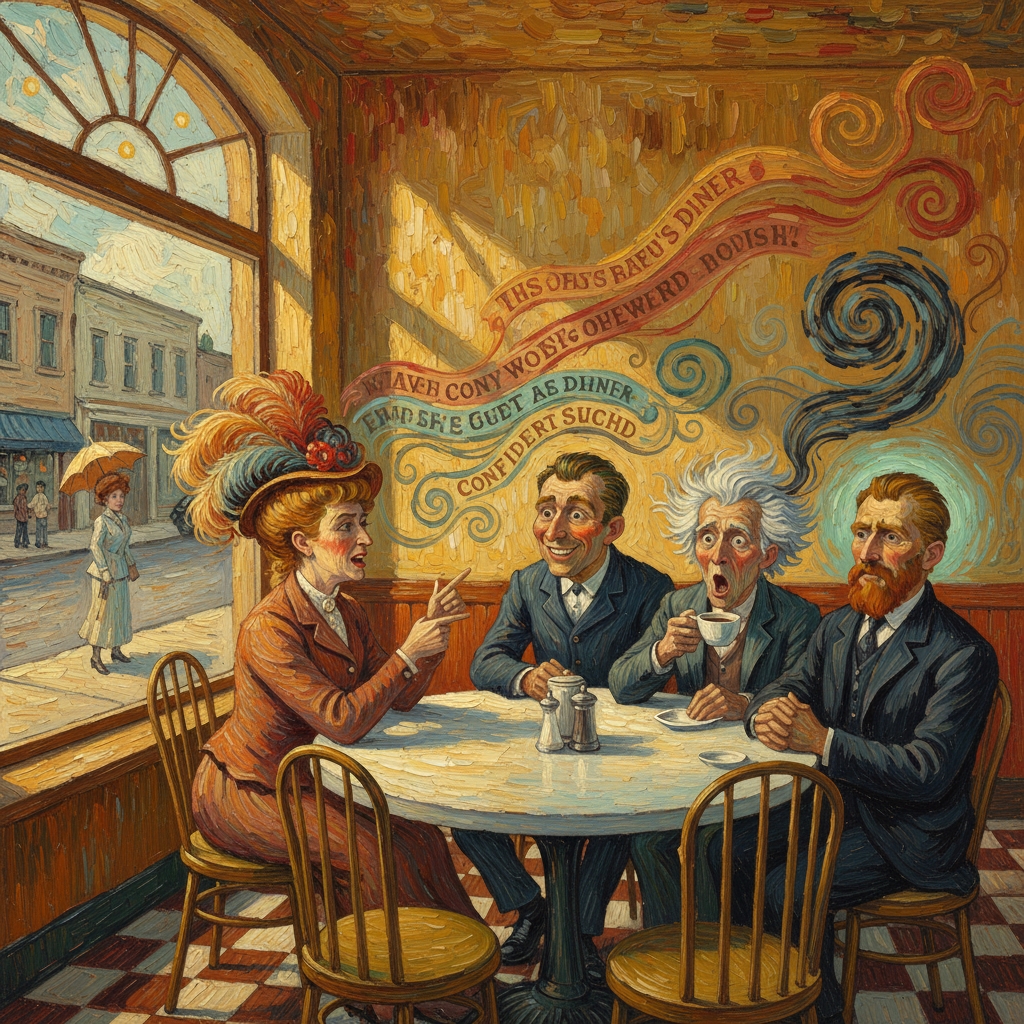
At Earlene’s Diner, conversations carried the tone of people pretending they had never avoided the subject in the first place.
“Well we all knew eventually,” one man said confidently.
“Been obvious for years,” another replied.
Clovis nearly choked on his coffee.
“Oh now suddenly everybody’s a prophet.”
Boot nodded eagerly.
“I heard six people claim they mentioned it months ago.”
“They absolutely did not,” Mabel snapped.
Shelley stirred cream into her coffee thoughtfully.
“Memory edits itself to protect dignity.”
“That sounds psychological,” said RT.
“It is.”
Pastor Peeler entered quietly.
People nodded at him differently now.
Not because he had solved anything.
But because he had survived the transition without pretending certainty.
The pastor sat beside Boot.
“You notice how calm folks are?” Boot whispered.
“Yes.”
“Why?”
Pastor Peeler looked around the diner.
Because it was true:
Act IX – Monday Becomes Part of Town Memory
The tension had changed.
Not disappeared.
Changed.
People no longer carried the exhausting burden of pretending not to notice.
But acknowledgment had softened the strain of silence.
“Truth,” Pastor Peeler said carefully, “usually becomes less frightening once spoken aloud enough times.”
Mabel overheard him.
“Well that’s annoyingly wise.”
The pastor smiled faintly.
“I been savin’ sentences.”
Outside the diner, Daisy paused at the curb.
She listened briefly toward the quiet morning traffic.
Then calmly crossed the street without urgency.
As if even the dog understood that something important had shifted.
Not loudly.
Not officially.
Not through declarations or speeches or dramatic revelations.
Just slowly.
Quietly.
Through lowered voices.
Through nods.
Through hesitant phrasing.
Through side conversations and unfinished sentences.
The town had not solved the problem.
But it had finally stopped pretending silence made it disappear.
And in Sequatchie Crossing, that counted as historic progress.
Act IX – Monday Becomes Part of Town Memory
EPILOGUE – The Sound Beneath the Talking
Weeks later, nobody could identify exactly when the shift had happened.
Some blamed the diner.
Others blamed church parking lots.
Clovis blamed “linguistic erosion.”
Mabel blamed exhaustion.
Pastor Peeler blamed time.
Boot blamed “accumulated hearin’.”
But everyone remembered the feeling.
The strange softening that came when people finally realized acknowledgment was less dangerous than avoidance.
Towns like Sequatchie Crossing rarely changed through declarations.
They changed through repetition.
A phrase spoken quietly enough times eventually became acceptable.
Acceptable became ordinary.
Ordinary became history.
And history, once settled, always pretended it had been obvious from the beginning.
That was simply how communities protected themselves from the embarrassment of delayed honesty.
Outside Earlene’s Diner, Daisy the hound lay beneath the porch rail watching traffic drift through town.
A truck slowed nearby.
Two men inside spoke quietly.
“…well everybody knows now…”
Daisy lifted one ear.
Listened.
Then rested her head back on her paws peacefully.
As if the whole town had finally caught up to something the animals understood long ago:
Truth almost never arrives shouting.
It usually walks in quietly and waits for somebody to stop changing the subject.

Epilogue – The Sound Beneath the Talking
DISCLAIMER
The events, conversations, emotional evasions, strategic nodding, indirect acknowledgments, casserole-adjacent revelations, public hovering, coded church language, cautious diner sociology, hardware store philosophy, sheriff’s office ambiguity, and dog-assisted truth recognition depicted in this story are entirely fictional.
Any resemblance to real towns, real residents, real whispered concerns, real “ongoing situations,” real public tensions, real Facebook quote-posting behavior, or real attempts to pretend everybody “always knew” is purely coincidental and probably being discussed quietly somewhere already.
No actual dogs were consulted regarding emotional transitions within municipal communication structures, although several appeared more emotionally mature than the surrounding adults.

Disclaimer – People Begin Mentioning Problem Quietly, As If It Was Always Known
Real Places Behind the Ruckus – From The Dunlap Directory

Real Places Behind the Ruckus – From The Dunlap Directory
Yes, this story was fictional; even the parts that weren’t true. These places? Absolutely real. Stop by, support local, and keep the Wi-Fi away from livestock:
- Red’s Innovations TN
- JM Lawncare
- ATM at Circle K
- Mercy Ministries
- Church Trainer
- Bigfoot Adventure and Baggenstoss Farm
- New Dimensions Complex
- Dairy Queen
- Dunlap Lions Club
- North End Collision Center
- Sequatchie Valley National Scenic Byway
- United Country Southeast Land Solutions
- Coops Creek Greenway Trail Head
- McCarty Farmstead
- Sequatchie River Blueway
- Shadowlands RV
- Bee Creek Farm
- Amy Painter Photography
Real Places Behind the Ruckus – From The Dunlap Directory
At Sequatchie Crossing, we tell the stories of Sequatchie Crossing.
Please share this post with your friends, family, or business associates who may want follow the news from Sequatchie Crossing.

0 Comments