


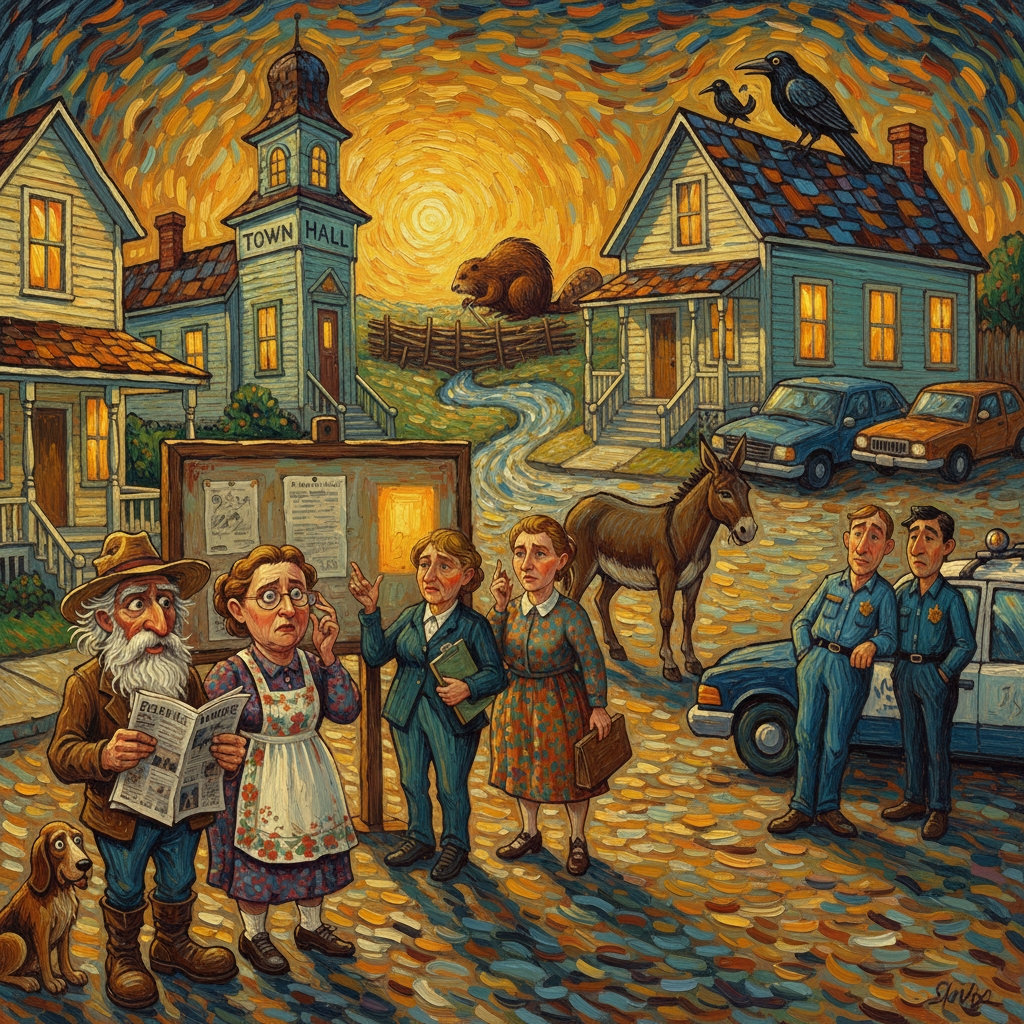
Construction Numbers and Permanent Numbers Were Not the Same Thing
By Tom Seest
At Sequatchie Crossing, we tell the stories of Sequatchie Crossing.
Please share this post with your friends, family, or business associates who may want follow the news from Sequatchie Crossing.
🎤 Audio Overview
The Thousand Jobs That Became Fifty
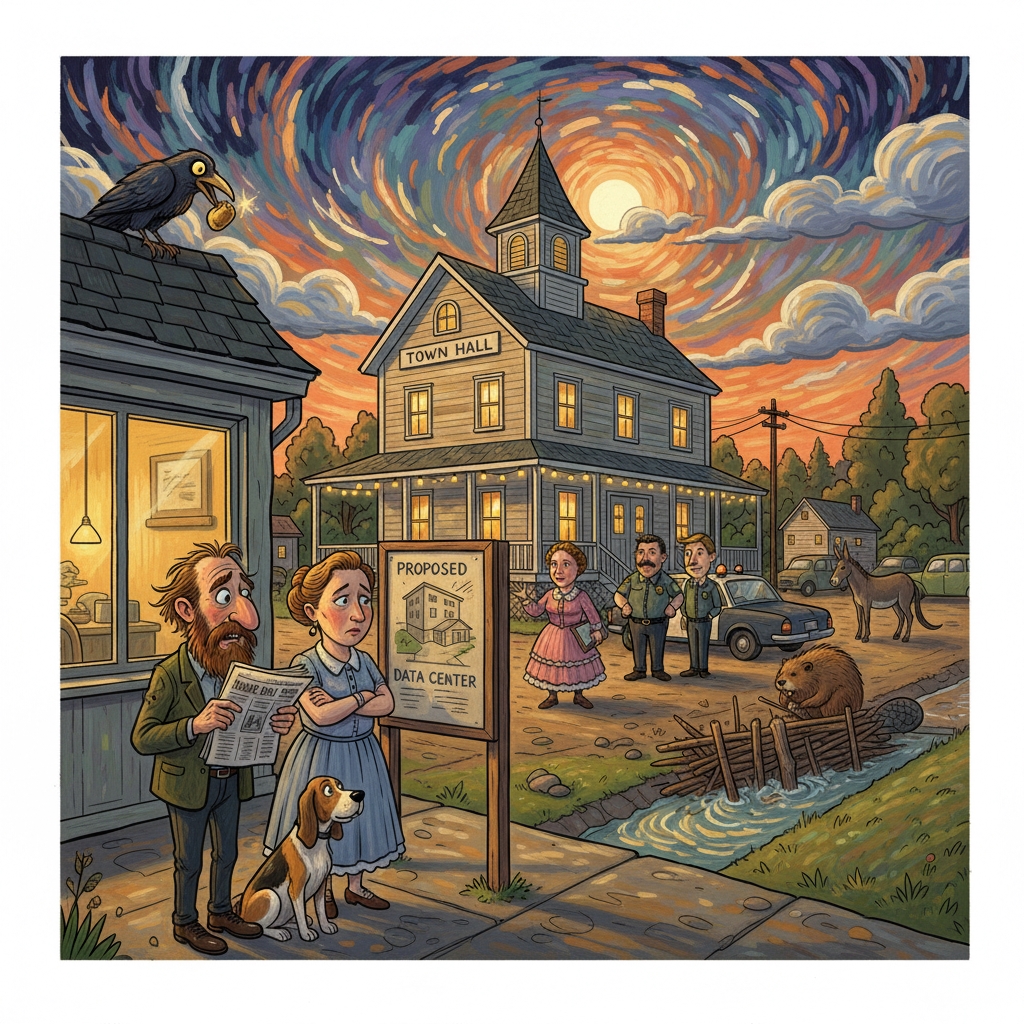
The Thousand Jobs That Became Fifty
Act I – The Number on the Porch
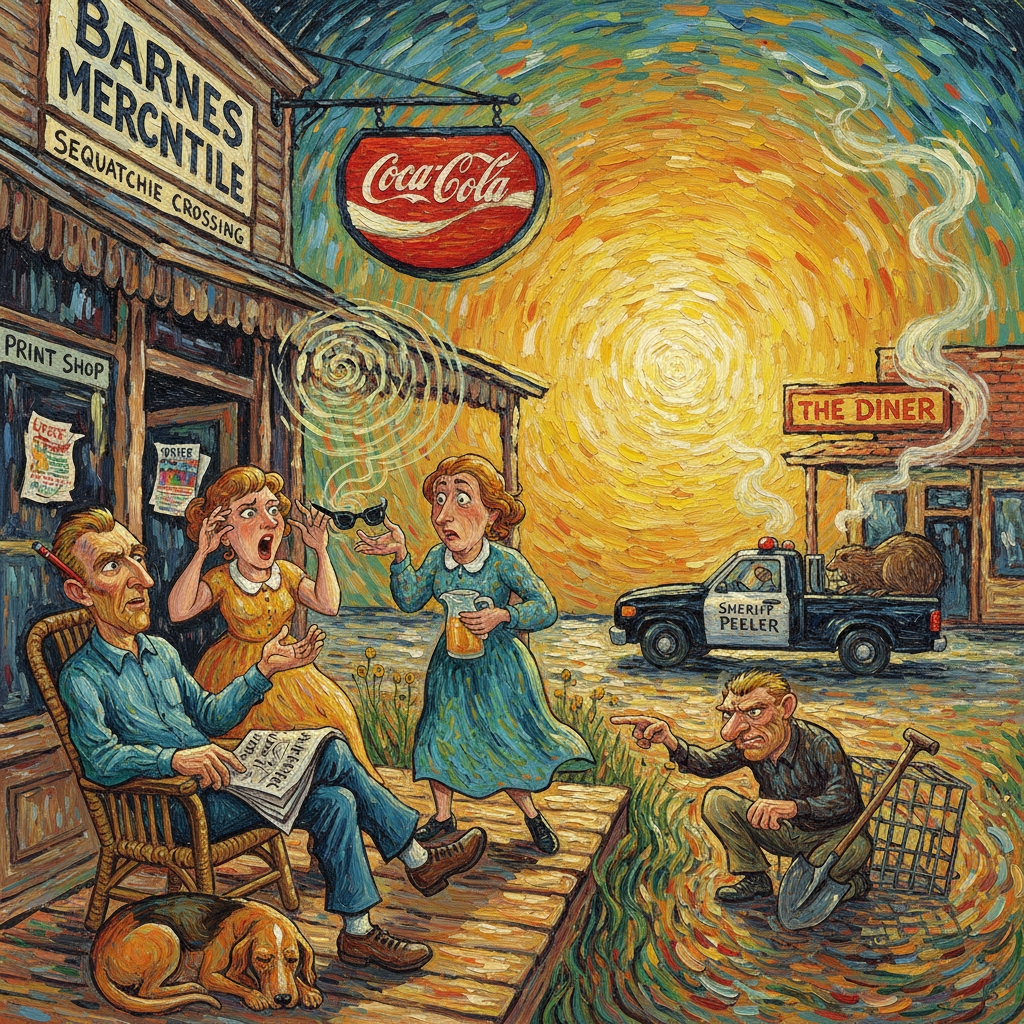
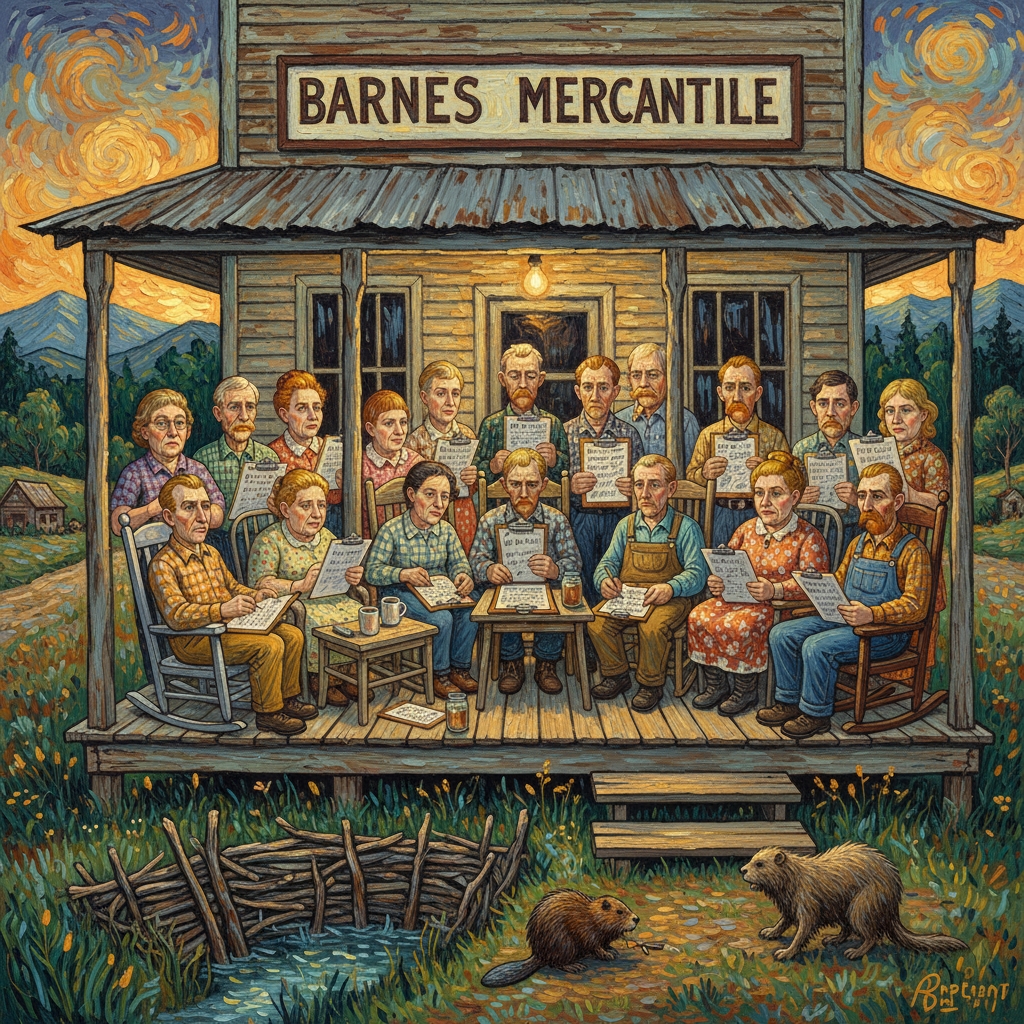
The first time anybody in Sequatchie Crossing said the words “one thousand jobs” out loud, it happened on the porch of Barnes Mercantile, beneath the busted Coca-Cola sign, beside a humming box fan that had been turned toward the public in a gesture of civic mercy.
Eugene “Boot” Barnes sat in his cane chair with a folded newspaper across his knee, one boot propped on a milk crate, and a pencil tucked behind his ear like he was prepared to audit the Lord’s own receipts.
Trixie Jo Bartlett came up the sidewalk holding her phone at arm’s length.
“It says right here,” she announced, “the Valley Ridge Data Campus will create up to one thousand jobs.”
Mabel Dean Ashcroft lowered her sunglasses.
“Up to,” she said.
“That’s still a number,” Trixie Jo said.
“So is zero,” Mabel said.
Clovis Strickland, who had been studying the road ditch with suspicious attention, turned around.
“Depends who said it,” Clovis said. “One thousand is a round number. Round numbers roll downhill.”
Boot tapped the newspaper.
“The article says construction jobs,” he said. “Different from permanent jobs.”
Trixie Jo frowned at the screen. “Well, it says economic impact.”
“Economic impact,” Boot said, “is what happens when somebody throws a watermelon off a bridge. There’s impact. Don’t mean there’s supper.”
Daisy the hound, stretched under Boot’s chair, opened one eye and thumped her tail once.
At the far end of the porch, Chester Ray Blevins came out of the print shop with a stack of flyers still warm from the machine.
“I printed both versions,” Chester Ray said. “One says ‘Welcome Progress.’ One says ‘Count the Jobs Twice Before Cheering.’ Same font. Neutral as a courthouse bench.”
Maggie Sue Dillard stepped from the diner next door carrying a pitcher of tea and six plastic cups.
Act I – The Number on the Porch
“Neutral won’t last past lunch,” she said. “Somebody already asked if we were doing a special called the Server Farm Skillet.”
Boot looked interested. “What’s in it?”
“Hash browns,” Maggie Sue said. “Because everybody’s confused.”
Lurleen Davenport arrived next, wearing her church secretary expression, which meant she already knew more than she planned to say.
“Mayor Bea Crowe called a meeting at Town Hall tonight,” Lurleen said. “She wants facts, not hollering.”
Mabel snorted. “Then she should not have invited people.”
Santiago “Sonny” Morales leaned against the porch rail, wiping grease from his hands with a red rag. “Jobs are jobs,” he said. “Construction work pays. Trucking pays. Concrete pays. Folks around here need paychecks.”
Tiffany Annette Roark, who had been scrolling with both thumbs, nodded. “My cousin’s boy would take a construction job tomorrow if it came with overtime and didn’t require moving to Chattanooga.”
“Permanent jobs matter too,” Shelley Fawn Wexler said, arriving in a floral blouse and civic-minded earrings. “A town can’t plan around a promise that goes away when the buildings are finished.”
Dr. Neil Cowgill, who had been silent long enough to alarm everyone familiar with him, cleared his throat.
“There is a useful distinction,” he said, “between direct construction employment, indirect supplier employment, induced local spending, operational employment, contracted maintenance labor, and what economists sometimes call—”
“Neil,” Boot said.
“—a multiplier,” Dr. Cowgill finished, wounded but obedient.
Doug “Doughboy” Teeter rode up on an electric scooter, nearly struck the porch step, and recovered with what he later described as intentional agility.
“I made a dashboard,” he said. “It shows one thousand jobs as an animated bar graph.”
“Does it show fifty?” Mabel asked.
Doug blinked. “It can, if the bar is very short.”
At that moment, Sheriff Peeler’s cruiser rolled slowly past, followed by Officer Kenny Joe Teeter in the department pickup. In the bed of the pickup sat a confused-looking beaver inside a borrowed dog crate, chewing the wooden handle off a shovel.
Daisy jumped up and barked.
Boot stared.
“Why,” Boot asked carefully, “does the sheriff have a beaver?”
Sheriff Peeler leaned out the cruiser window.
“Because the beaver got to the creek before the contractors did.”
Officer Kenny Joe added, “And because it appears to understand infrastructure better than most of us.”
The porch went quiet.
The beaver kept chewing.
Mabel looked at Trixie Jo’s phone, then at the sheriff, then at the flyers.
“Well,” she said, “there’s your meeting agenda.”
Boot folded his newspaper.
“Tonight,” he said, “we count.”
Daisy barked once, as if seconding the motion.

Act I – The Number on the Porch
Act II – Town Hall Learns Arithmetic
By seven o’clock, Sequatchie Crossing Town Hall was fuller than it had been since the Christmas parade committee accidentally scheduled the parade on a Tuesday and had to defend the calendar.
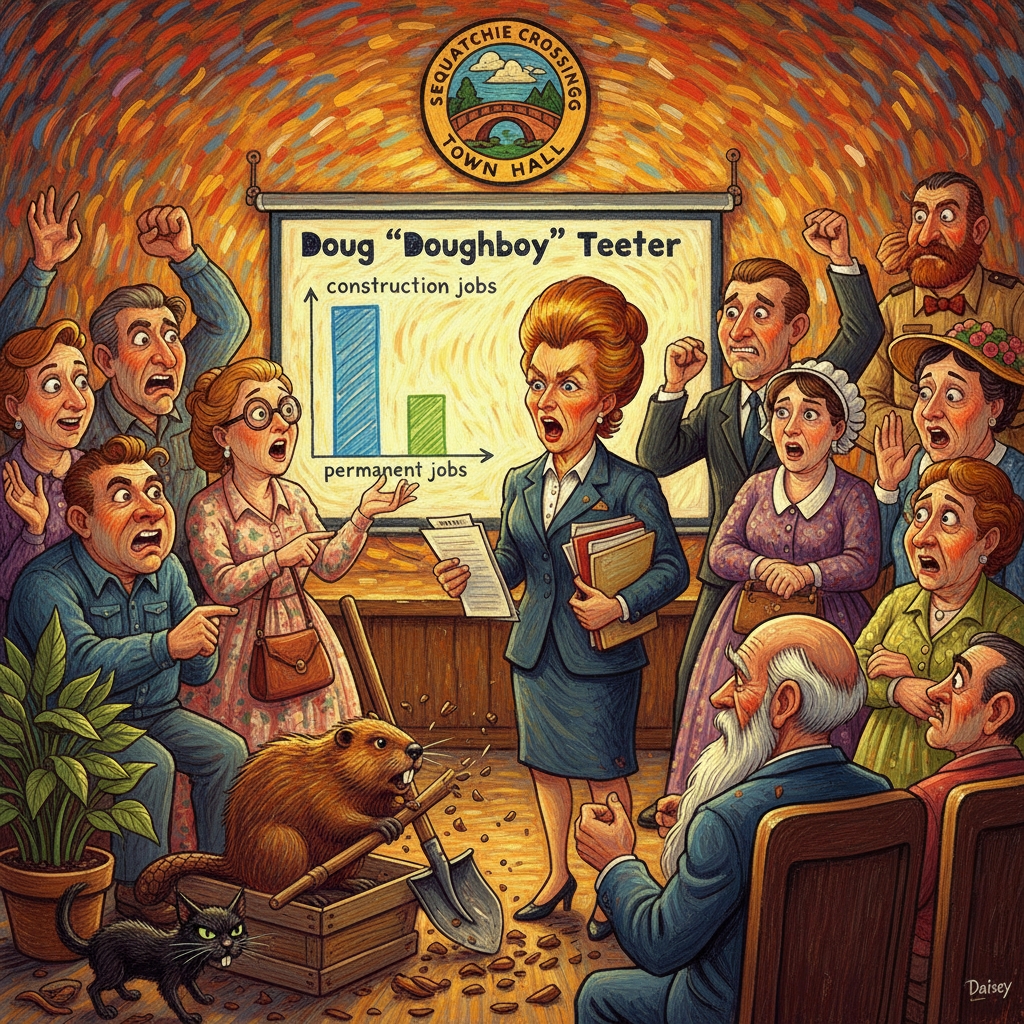
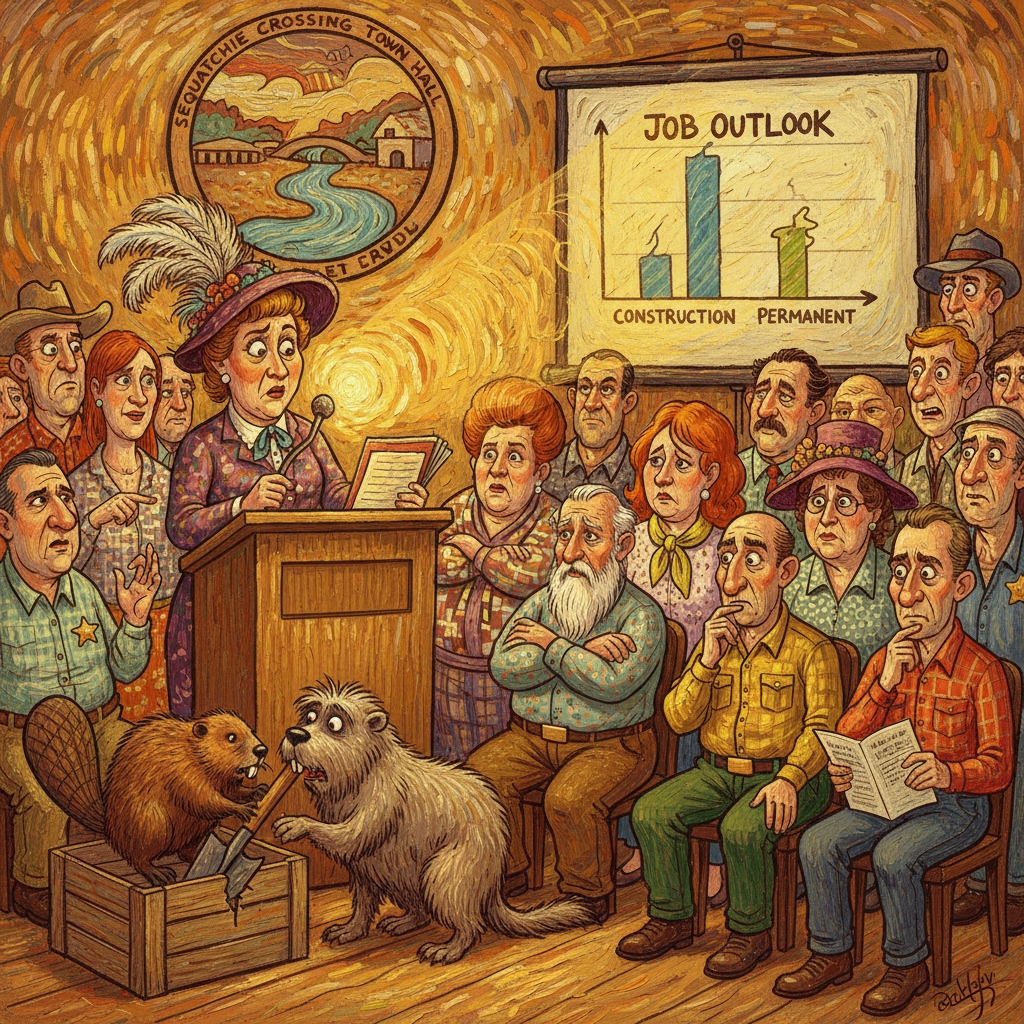
Mayor Bea Crowe stood at the front beneath the town seal, which featured a river, a ridge, and a mule no one remembered officially adopting. She had three folders, two legal pads, and the expression of a woman preparing to disappoint all sides evenly.
Sheriff Peeler stood by the wall with his arms crossed. Officer Kenny Joe Teeter guarded the side door, though from whom no one could say. Daisy lay beneath Boot’s chair, having been allowed inside after Boot argued she was more composed than several taxpayers.
The beaver crate sat in the corner because nobody had decided where else public infrastructure evidence belonged.
Mayor Crowe tapped the microphone. It squealed.
“That sound,” Mabel said, “is government trying to speak.”
Mayor Crowe waited.
“We are here,” she said, “to discuss the proposed Valley Ridge Data Campus and clarify what is meant by job numbers.”
Jolene Pickett, the town’s most enthusiastic technology supporter and the only person in the room wearing a blazer with sneakers, raised her hand before the mayor had finished breathing.
“Before we panic,” Jolene said, “can we acknowledge that this is an opportunity? Data centers are part of modern life. Cloud computing, artificial intelligence, medical records, small business websites—everything runs somewhere.”
Clovis lifted a finger. “So do rumors.”
“That too,” Jolene said.
Act II – Town Hall Learns Arithmetic
Earl Womack, seated near the back, leaned on his cane. “I remember when the poultry plant was going to save three counties. I also remember when half the folks who cheered it complained about the trucks.”
Sonny stood. “Construction money spends local if we make it. Gravel, fuel, lunches, rooms, equipment repair. We can’t act like temporary work ain’t real work.”
Shelley Fawn rose next, holding a notebook. “Temporary work is real. But families make permanent decisions based on permanent jobs. If the number is fifty after construction, we need to say fifty.”
Tiffany nodded. “And if it’s fifty good-paying jobs, say that too. Don’t hide the good in the fine print.”
Brett Crenshaw raised his hand from beside Alyssa. “Some of us moved here because remote work lets you live anywhere. Digital infrastructure is part of that.”
Alyssa added, “But we also moved here for the quiet. So both things can be true.”
Mabel turned around. “That kind of sentence is how committees reproduce.”
Pastor Arnold Peeler stood from the second row.
“Fear can make people deaf,” he said. “So can excitement. If you already know the answer before the question is asked, you’re not listening. You’re recruiting.”
Sister Lila Mae “Hallelujah” Pruitt rose immediately beside him.
“Amen,” she said. “And if anybody says one thousand jobs in a whisper and fifty jobs in a footnote, the Lord may forgive them, but I will require a printed correction.”
Chester Ray lifted his flyers. “I can print those.”
Doug Doughboy projected his dashboard onto the wall. A bright blue bar shot upward labeled CONSTRUCTION JOBS. Beside it, a tiny green bar appeared labeled PERMANENT JOBS.
The room leaned forward.
“That green line looks like a piece of okra,” Maggie Sue said.
Doug adjusted the zoom. “It’s accurate.”
“Accurate can still be rude,” Lurleen said.
Dr. Cowgill stood, clasping his hands.
“The difficulty,” he began, “is that construction labor may include workers who live elsewhere, subcontractors counted for limited periods, and roles that overlap. The permanent jobs may include facility technicians, security, administrative staff, grounds maintenance, and vendor contracts, but not necessarily all local residents.”
Boot nodded. “Say it plain.”
Dr. Cowgill sighed. “A thousand people may help build it. Fifty may work there when it’s built.”
The room murmured.
Mayor Crowe held up a hand. “That is why we are not voting tonight. We are forming a citizens’ review table.”
RT Mullins, who had been leaning against the back wall in his feed-store cap, spoke up.
“Does the review table include people who can read a contract without getting dazzled?”
“Preferably,” Mayor Crowe said.
Mister Wade Langston, seated with polished shoes and a retired banker’s posture, raised his hand.
“I’ll serve,” he said. “But I want the payroll claims separated from construction projections, tax abatements, water use, power load, and road maintenance. A promise is only useful when you know what column it belongs in.”
Evelyn Grace Tipton, quiet until now, said, “And we need to know who benefits first, who waits, and who pays if the estimate is wrong.”
The beaver gnawed through another piece of shovel handle.
Everyone turned.
Sheriff Peeler looked at the crate. “For the record, that animal began work without a public hearing.”
Mabel pointed at it.
“At least the beaver didn’t inflate its employment numbers.”
The mayor wrote on her legal pad.
“Motion,” Boot said. “We inspect the site tomorrow. We invite supporters, skeptics, and those aggravated by both.”
“Second,” said Daisy, by barking at the beaver.
Nobody objected.
Act II – Town Hall Learns Arithmetic
Act III – Breakfast at the Diner, Where Certainty Was Served Hot
The next morning, Maggie Sue’s Diner smelled like bacon, coffee, and premature conclusions.
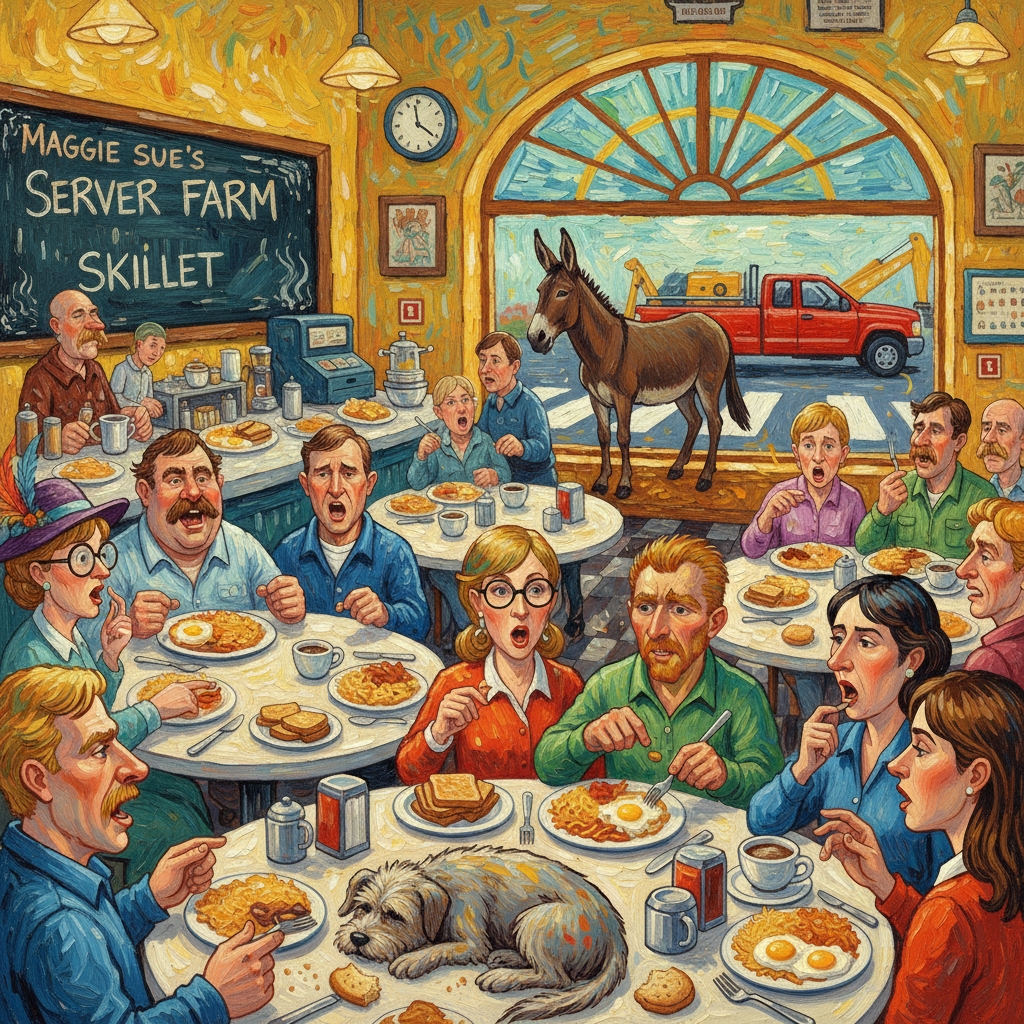
The front table had been pushed against the window for what Maggie Sue called “the unofficial official pre-inspection breakfast.” Boot sat with Sheriff Peeler, Pastor Arnold, Mabel, Clovis, Jolene, Sonny, Shelley, Trixie Jo, and Dr. Cowgill. Daisy slept under the table near a dropped biscuit.
Maggie Sue placed plates down hard enough to establish order.
“Hash browns are the Server Farm Skillet,” she said. “Eggs over medium. Toast on the side. Any arguing must pause while I refill coffee.”
Trixie Jo held up her phone. “People online are already saying the town is blocking one thousand jobs.”
Shelley said, “Nobody blocked anything. We asked what kind of jobs.”
“Online doesn’t do categories,” Clovis said. “Online does weather, outrage, and recipes nobody actually cooks.”
Jolene stirred her coffee. “I don’t want Sequatchie Crossing to become the town that says no to everything because it arrives with a logo.”
Mabel leaned toward her. “And I don’t want us to become the town that says yes to everything because the brochure used the word future.”
Sonny cut into his eggs. “My concern is simpler. If this thing gets built, somebody needs to fix machines, grade roads, weld gates, deliver parts, service generators, feed crews, clean offices. That may not show as permanent headcount, but it’s work.”
Mister Wade Langston entered, hung his hat on the rack, and joined them.
“That’s true,” he said. “But public money follows public claims. If the company requests incentives based on one thousand jobs, then the town should know whether those jobs last eighteen months or eighteen years.”
Lurleen Davenport came in carrying a church binder. “And whether they count one worker twice if he pours concrete in March and installs conduit in May.”
Officer Kenny Joe stepped in behind her, looking tired.
“Sheriff,” he said, “the beaver escaped the crate.”

Act III – Breakfast at the Diner, Where Certainty Was Served Hot
Maggie Sue froze with the coffee pot.
“Not in my diner.”
“No ma’am,” Kenny Joe said. “It escaped at the sheriff’s office. It is now behind the evidence shed arranging sticks.”
Sheriff Peeler closed his eyes.
Pastor Arnold smiled faintly. “Even creation prefers to work where it understands the mission.”
Doug Doughboy rushed in with a laptop under one arm and a drone controller in the other.
“I can track it,” Doug said.
“No drones over town without permission,” Sheriff Peeler said.
“It’s under forty feet.”
“No drones.”
“It has beaver recognition.”
“Doug.”
Doug sat down.
Coach Freddie Stubblefield arrived wearing a whistle around his neck, despite having no team present.
“I’ll help count jobs,” Coach Freddie said. “I once managed forty-eight boys, twelve helmets, and one missing left shoe. Counting is discipline.”
Brett and Alyssa Crenshaw came in from the sidewalk, each holding a smoothie from their trailer.
“We brought samples,” Alyssa said. “One is called Green Infrastructure.”
Mabel looked at it. “That is not helping your side.”
Ricky Travis “RT” Mullins slid into a chair near Sonny.
“I’ve got two nephews in concrete,” RT said. “They’ll drive three counties for a pour. They’d be counted as jobs here and spend money at a gas station here, but they won’t join the church choir or buy a house.”
Sister Lila Mae came through the door, heard “church choir,” and pointed.
“If they can hold a note, I’ll count them spiritually.”
Tiffany Annette laughed. “That may be the cleanest jobs category yet.”
Evelyn Grace Tipton opened her notebook. “Can we ask the company for a plain-language table? Construction jobs, permanent onsite jobs, local vendor opportunities, temporary out-of-town workers, and public costs.”
Chester Ray, who had been listening from the counter, lifted a finger.
“I can design that as a one-page handout. No clip art. Clip art causes mistrust.”
Boot took out his pencil.
“Good,” he said. “Today at the site, nobody shouts numbers without naming the column.”
Clovis peered out the window.
“What about that mule?”
Everyone turned.
Across the street, a mule stood in the middle of the crosswalk, motionless, blocking a white contractor pickup.
The driver honked.
The mule did not move.
Sheriff Peeler stood slowly.
“That,” he said, “is a visual aid.”
Daisy lifted her head, considered the mule, and went back to sleep.
Act III – Breakfast at the Diner, Where Certainty Was Served Hot
Act IV – The Site Visit and the Beaver’s First Report
The proposed Valley Ridge Data Campus site sat beyond the old mill road, where hayfields gave way to a low creek bend and a ridge that caught afternoon light like a tin roof.
By ten o’clock, the inspection group had assembled near the gate: Mayor Bea Crowe, Boot, Mabel, Clovis, Sheriff Peeler, Officer Kenny Joe, Pastor Arnold, Sister Lila Mae, Jolene, Earl, Sonny, Shelley, Tiffany, Trixie Jo, Doug, Dr. Cowgill, Mister Wade, Maggie Sue, Lurleen, Evelyn Grace, Coach Freddie, Chester Ray, RT, Brett, Alyssa, and Daisy, who had no official role but better instincts than several attendees.
A temporary sign read FUTURE HOME OF VALLEY RIDGE DATA CAMPUS.
Underneath, someone had taped a paper sign reading HOW MANY JOBS AFTER THE RIBBON CUTTING?
Chester Ray squinted. “That is not one of mine.”
Mayor Crowe addressed the group.
“We’re here to observe, not trespass beyond the marked boundary.”
“Marked by who?” Clovis asked.
“The survey crew,” Mayor Crowe said.
Clovis looked at the stakes. “Survey stakes have been wrong before. Ask any fence line.”
Daisy began sniffing near the creek.
Officer Kenny Joe groaned. “I know that look.”
A splash came from the bank. Then another.
The beaver emerged from the reeds, dragging a branch twice its length. It ignored the crowd entirely, crossed a muddy patch, and shoved the branch against a growing dam.
Mabel folded her arms.
“There he is. First employee on site.”

Act IV – The Site Visit and the Beaver’s First Report
Jolene smiled. “More like first contractor.”
Mister Wade said, “Unpermitted contractor.”
Sonny walked closer to the creek, careful not to cross the boundary tape. “That dam’s already backing water into the low side.”
Dr. Cowgill leaned forward. “Fascinating. The beaver has begun modifying hydrology before any human infrastructure has been approved.”
Boot looked at the creek.
“Plain version, Neil.”
“He built first,” Dr. Cowgill said. “Now everything else must account for him.”
Pastor Arnold nodded. “A sermon with teeth.”
Doug raised his drone controller halfway.
Sheriff Peeler did not even look at him. “No.”
Doug lowered it.
Trixie Jo filmed the beaver with her phone. “This is going online.”
“Caption it carefully,” Shelley said. “Don’t say beaver opposes data center.”
Clovis said, “How do you know he doesn’t?”
Earl Womack leaned on his cane. “That beaver don’t oppose nothing. He just knows water runs downhill and wood stacks crossways. That puts him ahead of most economic development reports.”
Brett walked the edge of the fence line with Alyssa.
“It’s not impossible to build responsibly,” Brett said. “There are ways to manage stormwater, noise, power usage, cooling systems.”
Alyssa nodded. “But responsible means measured. Not just promised.”
Coach Freddie blew his whistle.
Everyone jumped.
“Sorry,” he said. “Habit. But look there.”
Across the field, the mule from town had appeared again, standing squarely in front of a stack of survey stakes.
Sheriff Peeler stared at it. “How did it get here?”
RT said, “Same way most stubborn things arrive. Uninvited and early.”
Daisy barked at the mule. The mule flicked one ear.
Sister Lila Mae shaded her eyes. “That animal has planted itself between intention and execution.”
Mabel pointed at the beaver, then the mule.
“One builds without asking. One blocks without explaining. That’s the whole meeting in livestock.”
Mayor Crowe looked tired but alert.
“Then let us learn from both,” she said. “We need questions for the company before next week’s hearing.”
Evelyn Grace began writing.
“Question one,” Boot said. “How many permanent onsite jobs?”
“Question two,” Mister Wade said. “What is the wage range?”
“Question three,” Shelley said. “How many construction jobs are local versus imported?”
“Question four,” Sonny said. “What local vendors can bid?”
“Question five,” Jolene said. “What infrastructure upgrades benefit the town afterward?”
“Question six,” Clovis said. “What happens if the projections are wrong?”
“Question seven,” Lurleen said. “Who pays to fix the road if heavy trucks ruin it?”
“Question eight,” Maggie Sue said. “How many lunch orders should I actually expect?”
Everyone looked at her.
“What?” Maggie Sue said. “Some of us plan inventory.”
The beaver slapped its tail.
Daisy barked.
Boot looked at the dam.
“Add one more,” he said. “Who maintains what gets built after everybody else leaves?”
The beaver resumed stacking branches.

Act IV – The Site Visit and the Beaver’s First Report
Act V – The Sheriff’s Office and the Rumor Crow
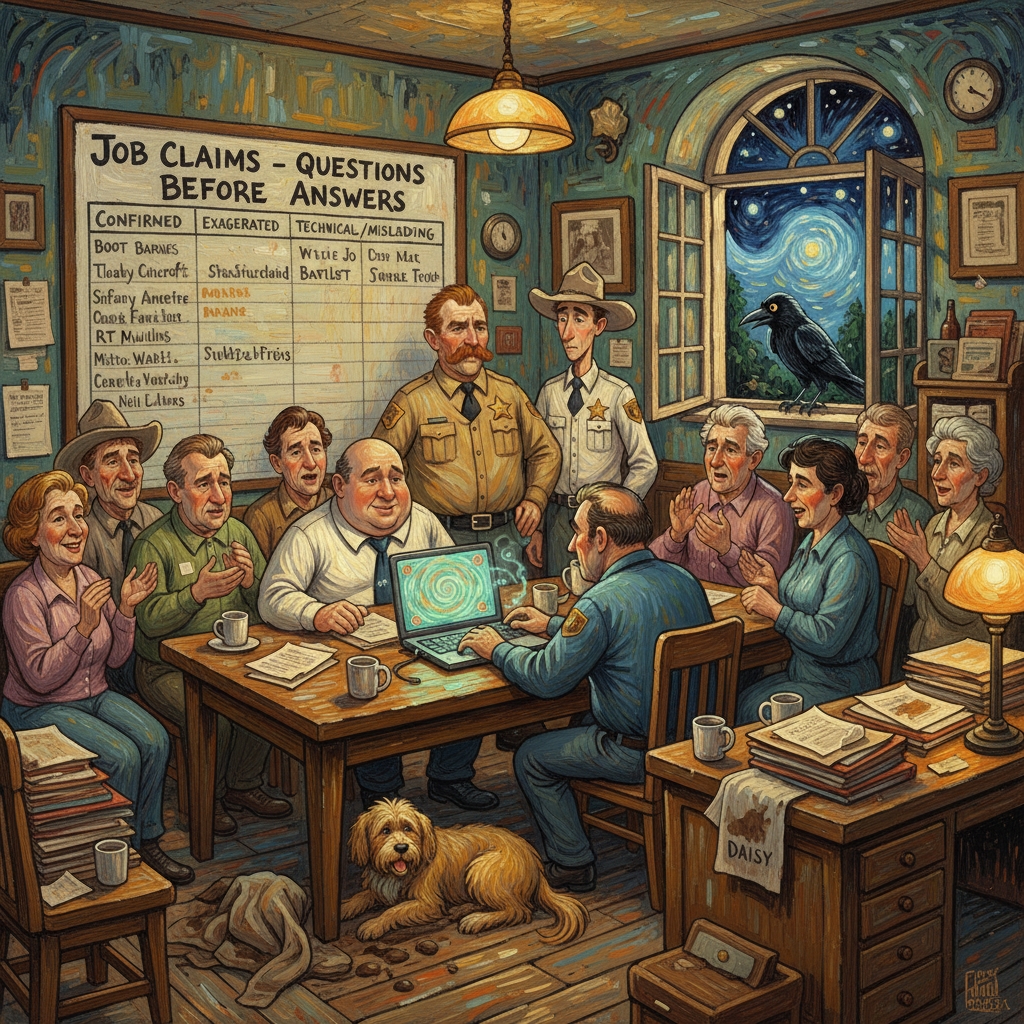
By afternoon, the sheriff’s office had become a temporary clearinghouse for facts, rumors, and one muddy towel Daisy had dragged in from the creek.
Sheriff Peeler stood behind his desk while Officer Kenny Joe pinned a large paper chart to the wall. Chester Ray had printed it in bold type: JOB CLAIMS – QUESTIONS BEFORE ANSWERS.
Doug Doughboy connected his laptop to a small monitor.
“I scraped public posts,” Doug said. “I categorized the rumors into fear-based, hope-based, confusion-based, and cousin-based.”
“Cousin-based?” Sheriff Peeler asked.
“Posts that begin, ‘My cousin heard,’” Doug said. “They’re statistically dangerous.”
Clovis leaned forward. “That’s how oral history works.”
“No,” Boot said. “Oral history has witnesses. Cousin history has Wi-Fi.”
Tiffany read from her phone. “One post says the data center will employ one thousand local residents permanently.”
Shelley shook her head. “False until verified.”
Trixie Jo said, “Another says it will employ nobody because robots will run everything.”
Jolene sighed. “Also false. Facilities still need people.”
Mabel said, “Just fewer people than the ribbon-cutting speech suggests.”
Pastor Arnold sat beside Sister Lila Mae on the bench used for witnesses, visitors, and husbands waiting during domestic disputes.
“The trouble,” Pastor Arnold said, “is that people do not merely repeat rumors because they believe them. Sometimes they repeat them because the rumor gives shape to a feeling.”
Sister Lila Mae nodded. “And sometimes they repeat them because they enjoy being first more than being right.”
A loud caw came from the open window.
A black crow landed on the sill, dropped a shiny bottle cap onto Sheriff Peeler’s desk, and cawed again.
Officer Kenny Joe stared.
“Is that the same crow from the recycling bin incident?”
Clovis said, “Crows remember faces.”
Sheriff Peeler looked at him. “Why do you always know the part nobody wants?”
Act V – The Sheriff’s Office and the Rumor Crow
The crow cawed again, then flew off toward Town Hall.
Lurleen Davenport entered with a folder from the mayor’s office.
“The crow has already been to Town Hall,” she said. “It stole a paper clip and frightened the zoning intern.”
Mabel looked satisfied. “Information is moving.”
Mister Wade reviewed the chart.
“We need to classify statements before they spread,” he said. “Confirmed, unconfirmed, exaggerated, and wishful.”
RT Mullins leaned against the wall.
“Add ‘technically true but designed to mislead,’” he said. “That’s where a lot of business lives.”
Sonny pointed at him. “That category matters. One thousand construction jobs may be technically true. But if folks hear permanent, that’s the problem.”
Evelyn Grace said, “The town needs a public explainer.”
Chester Ray lifted his hand. “I’ll print it.”
Doug said, “I’ll make a web version.”
Boot said, “And I’ll make one for people who don’t trust printers or websites.”
“How?” Trixie Jo asked.
“I’ll tell them on the porch,” Boot said.
Daisy barked once from the floor.
Sheriff Peeler stepped toward the chart.
“Decision,” he said. “No sharing numbers without a category. If someone says one thousand jobs, ask: construction, permanent, local, indirect, or rumor?”
Mabel said, “And if they say they don’t know?”
“Then they stop saying it,” Sheriff Peeler said.
Coach Freddie, who had been studying the chart like a playbook, slapped his knee.
“That’s defense,” he said. “You don’t stop the runner by hating football. You stop him by knowing the lane.”
Dr. Cowgill opened his mouth.
Boot warned, “Plain.”
Dr. Cowgill nodded. “Define terms before fighting over them.”
The crow cawed outside, louder this time.
Officer Kenny Joe looked out the window.
“It’s on the cruiser,” he said. “With the bottle cap.”
Sheriff Peeler sighed. “That crow has made more public records requests than some citizens.”

Act V – The Sheriff’s Office and the Rumor Crow
Act VI – Church Supper With Side Dishes of Doubt
That evening, First Unaffiliated Missionary Temple hosted a covered-dish supper because Pastor Arnold believed people argued better after carbohydrates.
The fellowship hall held long tables lined with casseroles, deviled eggs, green beans, and three desserts labeled “Sugar-Free” in handwriting nobody trusted.
Pastor Arnold stood near the serving line.
“Tonight,” he said, “we eat first, speak second, and decide nothing while holding a fork.”
Sister Lila Mae added, “And nobody compares data centers to Revelation unless they brought scripture and not just vibes.”
Mabel sat with Boot, Lurleen, Maggie Sue, and Evelyn Grace. Across from them were Jolene, Brett, Alyssa, Sonny, and RT. Sheriff Peeler and Officer Kenny Joe stood near the door because law enforcement in Sequatchie Crossing had learned never to sit too far from pie-related disputes.
Tiffany Annette Roark passed out printed copies of the job categories.
“I posted the explainer,” she said. “It’s already calmer than yesterday.”
Clovis, carrying a plate with four kinds of casserole arranged by suspicion level, said, “Calmer online is usually just people typing longer.”
Shelley Fawn Wexler stood near the bulletin board, pinning up a large sheet titled QUESTIONS FOR PUBLIC HEARING.
“Permanent jobs,” she read. “Construction jobs. Local vendor opportunities. Tax incentives. Road costs. Power usage. Water usage. Emergency services. Noise. Security lighting. Long-term maintenance.”
Doug Doughboy raised his hand. “Can we add data literacy?”
Mabel said, “I don’t know what that is, so yes, probably.”
Brett leaned forward.
“I want to say something for the project,” he said. “Not as a salesman. As someone who works online. Rural communities need a path into the digital economy. We can’t preserve a town by freezing it.”
Earl Womack nodded slowly from the next table.
“That’s true,” Earl said. “But you can’t revive one by believing every man with a site plan.”

Act VI – Church Supper With Side Dishes of Doubt
Alyssa said, “So maybe the goal is not yes or no tonight. Maybe it’s conditions.”
“Conditions are where truth goes to either live or get buried,” Mister Wade said.
Sonny wiped his mouth with a napkin.
“I’d support it if local businesses get a fair shot and roads get protected. I’d oppose it if the town gives away taxes for a promise that evaporates.”
Jolene nodded. “I can live with that.”
Mabel looked surprised. “Careful. Agreement weakens the immune system.”
Daisy, having slipped into the fellowship hall behind Boot, appeared beneath the dessert table.
“Mabel,” Lurleen whispered, “Daisy is under the banana pudding.”
Boot looked down. “Daisy, leave the pudding.”
Daisy did not leave the pudding.
Officer Kenny Joe moved toward her.
Daisy backed up, bumped the table leg, and caused a spoon to slide into the pudding bowl. The spoon launched a small yellow arc onto Coach Freddie’s whistle.
The hall went silent.
Coach Freddie looked at the whistle.
“Well,” he said, “that’s one way to quiet athletics.”
Laughter moved through the room, gentle at first, then relieved.
Pastor Arnold seized the moment.
“See,” he said. “Every creature in this hall wants something. Daisy wants pudding. The beaver wants water held where he can use it. The mule wants not to move. The crow wants shiny things. People want jobs, peace, fairness, and proof they weren’t fooled. Wanting is not sin. Pretending your want is the whole truth is where trouble starts.”
Sister Lila Mae clapped once. “That’ll preach.”
Evelyn Grace wrote at the bottom of the hearing sheet: WHAT DO WE WANT, AND WHAT DO WE KNOW?
Boot read it and nodded.
“That,” he said, “is better than most agendas.”

Act VI – Church Supper With Side Dishes of Doubt
Act VII – The Public Hearing and the Vanishing Zeroes
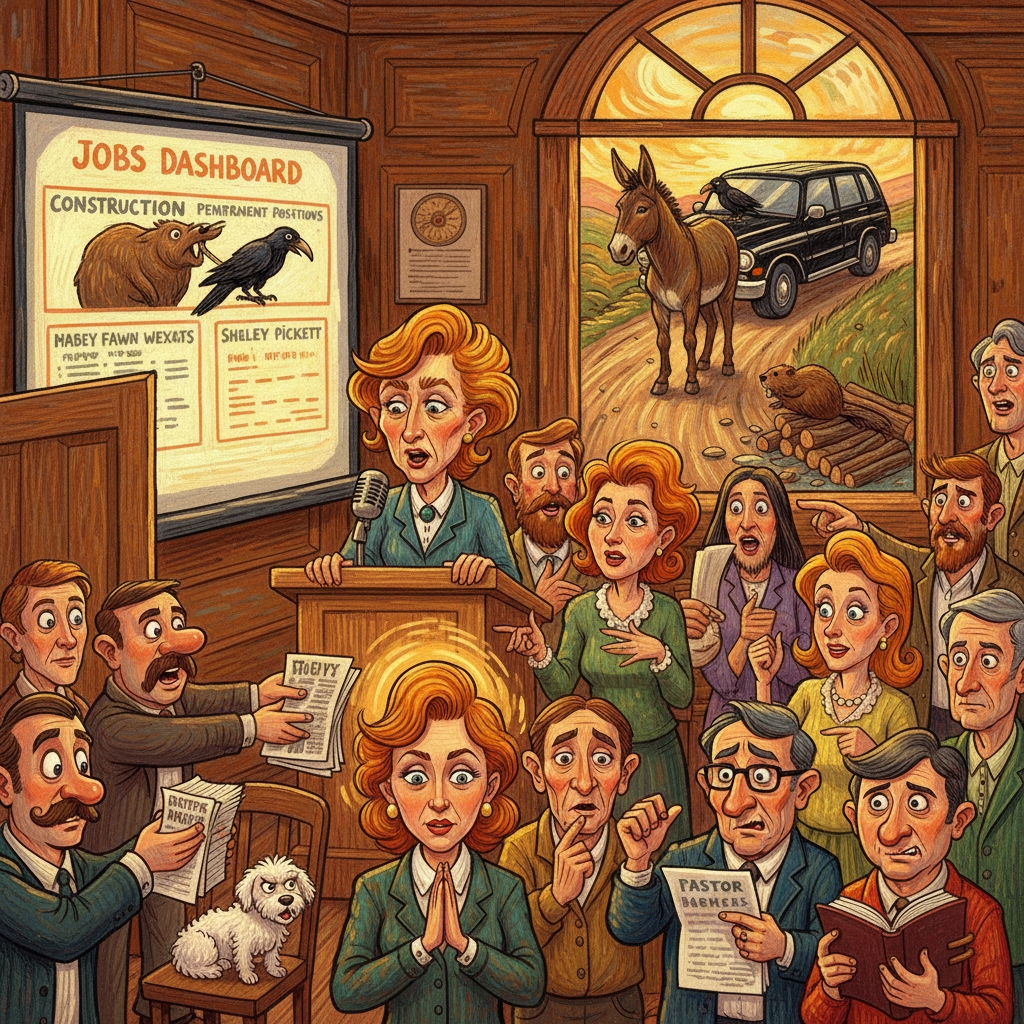
The public hearing drew so many people that Town Hall opened the side room and ran an extension speaker through a window, which Clovis inspected for surveillance before allowing it to exist.
Mayor Bea Crowe called the meeting to order.
“This is a public hearing regarding the Valley Ridge Data Campus proposal,” she said. “We will hear from residents, business owners, and the review table. Speakers will state claims with categories.”
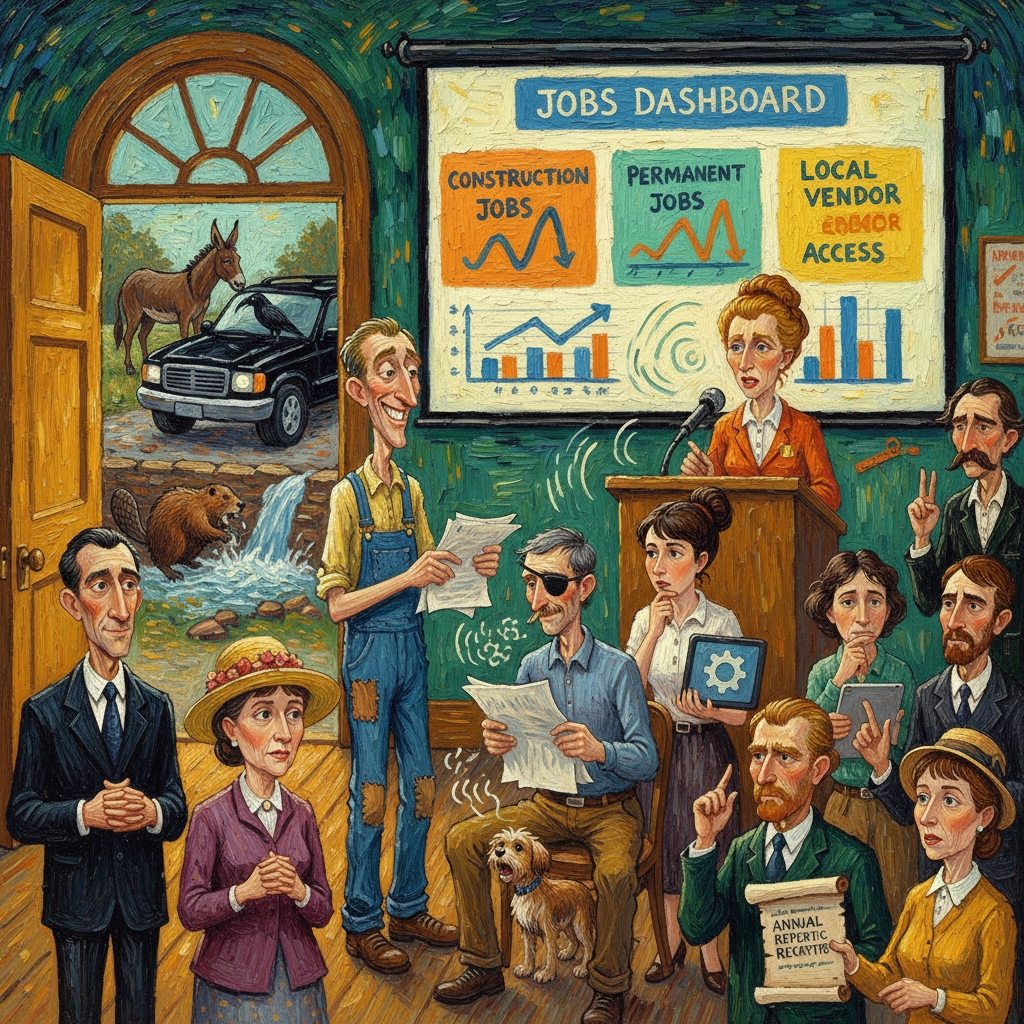
Chester Ray stood by the door handing out the printed explainer. Doug’s web dashboard glowed on the wall, now redesigned after Mabel complained the permanent jobs bar looked like a vegetable insult.
Mayor Crowe nodded to Boot.
Boot stood, unfolded a sheet, and put on reading glasses.
“We reviewed public claims,” he said. “The phrase ‘one thousand jobs’ refers to projected construction-related employment over the buildout period, including direct, subcontracted, and supplier-related work. The projected permanent onsite jobs appear closer to fifty, with possible additional contracted services depending on operations.”
The room stirred.
Mabel stood.
“That means the thousand didn’t vanish,” she said. “It changed clothes.”
Jolene rose next.
“And fifty permanent jobs are not nothing,” she said. “A small town should not sneer at fifty technical or facility jobs, especially if training paths exist.”
Shelley followed.
“But fifty is not one thousand,” she said. “If public support is being built on one number while the town lives with another, people deserve clarity.”
Sonny stepped to the microphone.
Act VII – The Public Hearing and the Vanishing Zeroes
“I want local bid access,” he said. “If this gets built, don’t bring every sandwich, bolt, tire, and repair truck from somewhere else. Put local vendors on the table.”
RT leaned into the next microphone.
“And don’t count my nephew for three years because he pours concrete for three weeks.”
Laughter broke the tension.
Mister Wade adjusted his glasses.
“I recommend any agreement separate construction claims from operational headcount and tie incentives to measurable deliverables. If fifty jobs are promised, define them. If local vendor spending is projected, document it. If roads require repair, fund it.”
Evelyn Grace spoke after him.
“We should also require annual reporting. Not to punish anyone. To keep the town from arguing over memories.”
Clovis stood, carrying a folder thicker than necessary.
“I still don’t trust the glowing words,” he said. “But I trust a table more than a slogan. I want the table public, searchable, printable, and hard to quietly revise.”
Chester Ray called from the back, “I can make revisions obvious.”
Doug said, “I can log version history.”
Mabel said, “I can remember who lied.”
Mayor Crowe rubbed her forehead. “Thank you, Mabel.”
Pastor Arnold approached the microphone.
“I urge the town not to confuse caution with hostility, or enthusiasm with corruption. The question is not whether change is holy or wicked. The question is whether we can tell the truth while wanting different things.”
Sister Lila Mae stepped up beside him.
“And whether anybody using the phrase ‘up to’ should be required to stand under a ceiling fan until they explain the bottom number.”
Sheriff Peeler allowed himself half a smile.
Officer Kenny Joe stepped outside briefly, then returned.
“Sheriff,” he whispered, loud enough for three rows to hear, “the mule is back.”
Nobody moved at first.
Then everyone looked out the window.
The mule stood in the Town Hall parking lot, blocking a shiny black SUV with out-of-county plates. On the hood of the SUV sat the crow, pecking at its reflection in the windshield.
Near the drainage ditch beyond the parking lot, the beaver was placing sticks across the runoff channel.
Daisy erupted in barks.
Mayor Crowe stared through the glass.
“Is this some kind of protest?”
Boot shook his head.
“No,” he said. “It’s operations.”
Dr. Cowgill stood.
“The beaver is responding to water flow created by the parking lot grade,” he said. “The mule is responding to its own unwillingness. The crow is responding to vanity.”
Maggie Sue folded her arms. “That covers most meetings.”
The room laughed again, but the laughter had changed. It had stopped being nervous. It had become useful.
Mayor Crowe returned to the microphone.
“Then let’s continue,” she said. “We are not here to chase a mule. We are here to write conditions.”
Act VII – The Public Hearing and the Vanishing Zeroes
Act VIII – The Conditions Committee Meets on Boot’s Porch
Three nights later, after the hearing and before the vote, Boot’s porch hosted the Conditions Committee because Town Hall was being cleaned after someone dropped seven deviled eggs into the floor vent.
The porch held mismatched chairs, two clipboards, Maggie Sue’s thermos of coffee, and Daisy, who had appointed herself sergeant-at-arms.
Mayor Crowe sat beside Boot.
“We need language,” she said. “Not speeches.”
Mister Wade read from the draft. “Condition one: All public communications must distinguish construction employment from permanent operational employment.”
“Good,” Shelley said.
Jolene added, “Include training opportunities for local residents.”
Evelyn Grace wrote it down. “Condition two: The company must publish a workforce development plan, including job types, qualifications, and local training partnerships where feasible.”
Mabel frowned. “Where feasible is slippery.”
Tiffany said, “Make them explain infeasible.”
Lurleen nodded. “Add ‘with written explanation.’”
Chester Ray marked the change.
Sonny leaned forward.
“Condition three: Local vendors get notice of bid opportunities.”
RT said, “And enough time to bid. Don’t post it Tuesday for a Wednesday deadline and call that local access.”
Alyssa said, “Condition four should include environmental monitoring, especially water runoff.”
Act VIII – The Conditions Committee Meets on Boot’s Porch
Brett added, “And noise and lighting.”
Clovis raised a hand.
“And electromagnetic weirdness.”
Dr. Cowgill sighed. “Clovis, that is not generally the primary concern.”
Clovis said, “I didn’t say primary. I said weirdness.”
Boot said, “Put down ‘technical systems disclosures as required by law.’ That’ll hold him.”
Doug said, “Condition five: public dashboard.”
Mabel stared. “You just want a dashboard.”
“Yes,” Doug admitted. “But also transparency.”
Sheriff Peeler leaned against the porch rail.
“I want emergency response planning. If they build a facility with generators, batteries, security gates, and restricted access, first responders need procedures.”
Officer Kenny Joe added, “And maps that don’t require a password nobody remembers.”
Pastor Arnold sat with Sister Lila Mae near the steps.
“Add a community review after one year,” Pastor Arnold said. “Not because anybody failed. Because humans forget what they promised once the ribbon is cut.”
Sister Lila Mae pointed at the draft. “And the review must be public. No supper-room whisper meeting.”
Coach Freddie lifted his whistle, noticed the banana pudding stain still faintly present, and put it back down.
“I want measurable goals,” he said. “In football, you know where the end zone is. In government, folks move it and call it process.”
Maggie Sue poured coffee.
“My condition is lunch projections,” she said.
Mayor Crowe gave her a look.
“I’m serious,” Maggie Sue said. “If construction crews are coming, local businesses need timelines. We can hire, stock, and plan. Or we can get surprised and run out of bacon.”
Boot looked at the draft.
“That fits under local economic coordination.”
Maggie Sue smiled. “Government English for bacon.”
The porch steps creaked as Earl Womack arrived late.
“You writing conditions?” Earl asked.
“Yes,” Mayor Crowe said.
“Then write this,” Earl said. “No town should sell tomorrow for a headline today.”
The porch went quiet.
Daisy stood, walked to the edge, and barked toward the creek.
In the fading light below the road, the beaver moved through the ditch, inspecting his dam. He placed one branch, paused, and shifted another.
Boot watched him.
“He builds,” Boot said, “then he maintains.”
Mabel nodded slowly.
“That’s the part people leave out.”
Mayor Crowe wrote the last condition herself.
“Condition six,” she said. “Long-term maintenance obligations must be identified before approval.”
Clovis looked at the paper.
“Not bad,” he said. “For civilization.”

Act VIII – The Conditions Committee Meets on Boot’s Porch
Act IX – The Vote That Did Not Feel Like Winning
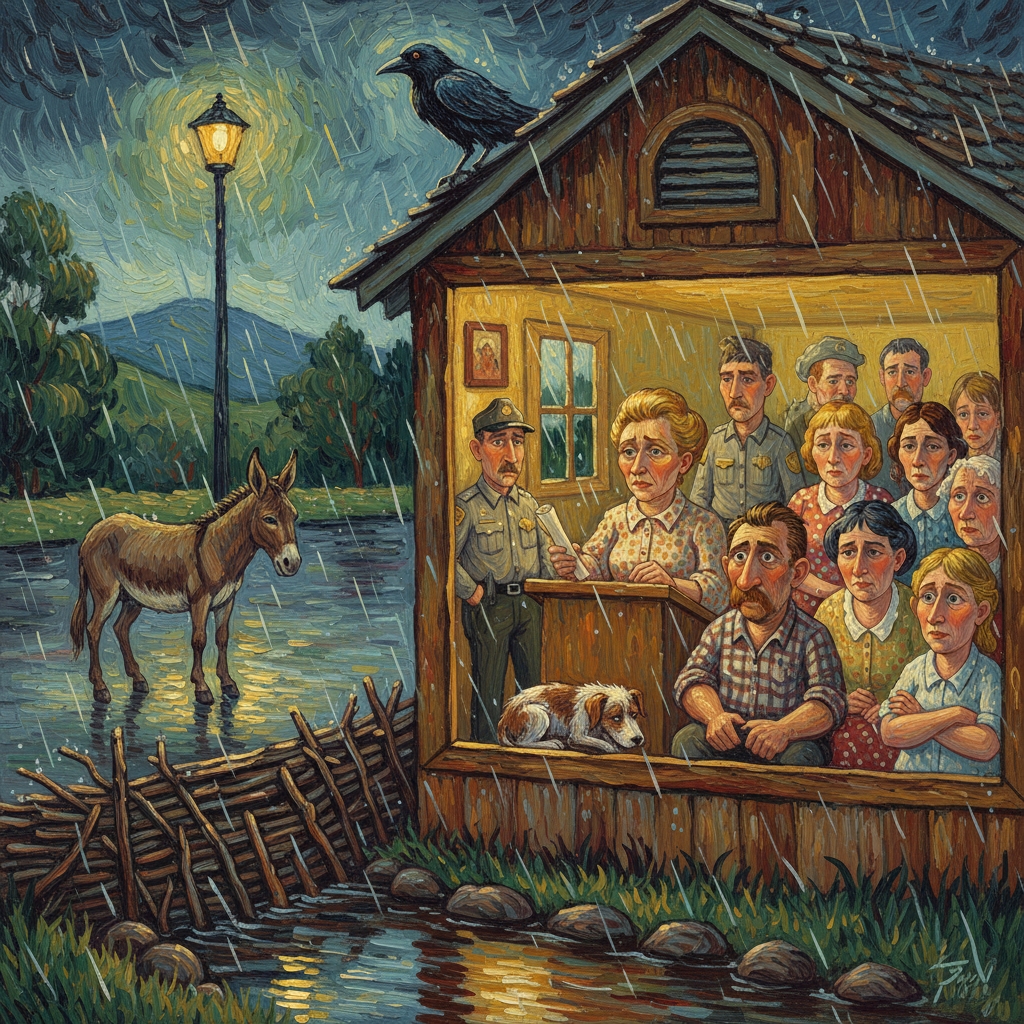
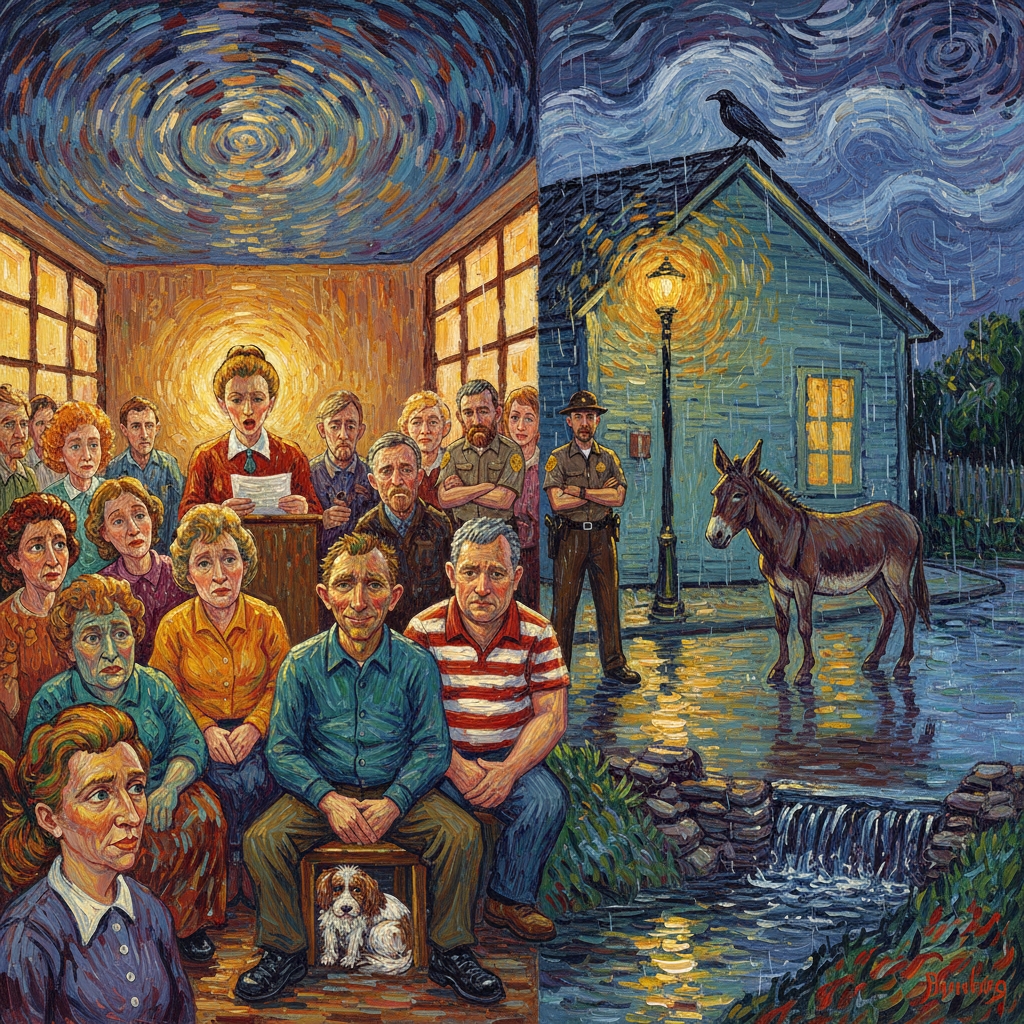
The vote happened on a Thursday evening with rain tapping the Town Hall windows and half the county smelling like wet gravel.
Mayor Bea Crowe read the revised conditions aloud before the council considered the proposal.
The data campus would not be approved on slogans. Any agreement would require separate reporting of construction and permanent jobs, local vendor access, road maintenance funding, emergency planning, environmental monitoring, public annual reports, and clear language around incentives.
In the front row, Mabel sat with her arms crossed. Jolene sat two seats away, hands folded. Between them sat Boot, not because he enjoyed symbolism, but because both women had arrived early and left exactly one chair.
Sheriff Peeler stood at the side. Officer Kenny Joe stood near the door. Daisy lay under Boot’s chair, damp from rain and satisfied with her place in government.
Mayor Crowe opened public comment one final time.
Trixie Jo stepped up first.
“I came in thinking one thousand jobs meant one thousand permanent jobs,” she said. “That was wrong. I’m glad we asked.”
Tiffany Annette followed.
“I still think people need work,” she said. “But people also need honest numbers. I support moving forward only with reporting.”
Shelley said, “I can accept a project I don’t fully love if the town keeps its eyes open.”
Jolene stood.
“I support it because technology is not going away,” she said. “But I support the conditions because trust is infrastructure too.”
Mabel stood next.
“I still don’t like shiny promises,” she said. “But if we’re going to do this, I want the promises nailed down so hard they squeak.”
Sonny stepped up.
Act IX – The Vote That Did Not Feel Like Winning
“I support the conditions,” he said. “Local business needs a fair shot.”
RT said, “And temporary work should be respected without being misrepresented.”
Mister Wade said, “The town should approve process before it approves enthusiasm.”
Evelyn Grace said, “Annual reporting gives future residents a record, not just a legend.”
Lurleen said, “And minutes. We need minutes.”
Chester Ray said, “And printed copies.”
Doug said, “And digital copies.”
Clovis said, “And copies that survive mysterious deletion.”
Sheriff Peeler said, “And fewer mysterious anything.”
Pastor Arnold approached last with Sister Lila Mae.
“No decision tonight will make everyone happy,” Pastor Arnold said. “That may be evidence it is a real decision.”
Sister Lila Mae added, “But if anybody says one thousand jobs after tonight without saying construction, I will correct them in public with Christian firmness.”
Coach Freddie whispered, “That’s the strongest kind.”
The council voted to move the proposal forward with conditions, not final blessing, not rejection, not celebration, and not condemnation.
For a moment nobody clapped.
Then Maggie Sue stood.
“I’ll make a smaller skillet,” she said.
The room laughed.
Outside, as people spilled into the wet parking lot, the mule stood beneath the streetlamp, no longer blocking anything, simply watching. The crow hopped along the roofline of Town Hall with a stolen zipper pull. Down by the ditch, the beaver’s dam held through the rain, not perfectly, not permanently, but enough to change the flow.
Daisy barked toward the darkness.
Boot looked at the others.
“Well,” he said, “we didn’t stop the future.”
Mabel said, “We made it fill out paperwork.”
Jolene smiled.
“That may be the Sequatchie Crossing version of progress.”
Sheriff Peeler opened his cruiser door.
“Progress,” he said, “is when nobody gets arrested during arithmetic.”
Officer Kenny Joe looked toward the ditch.
“Should I move the beaver?”
Boot shook his head.
“Not yet,” he said. “He’s the only one who started maintenance before the vote.”
Act IX – The Vote That Did Not Feel Like Winning
Epilogue – Fifty Jobs and a Beaver Clause
Two weeks later, the official town notice appeared on the bulletin board at Town Hall, in the diner window, on the church announcement table, on the sheriff’s office door, and beside the cash register at Barnes Mercantile.
Chester Ray printed the headline in plain black letters:
VALLEY RIDGE DATA CAMPUS – JOB NUMBERS BY CATEGORY
Below it, the notice showed construction-related jobs, projected permanent jobs, local vendor opportunities, reporting requirements, and public review dates.
Mabel stood before the mercantile copy with her purse on her arm.
“Looks less exciting than one thousand jobs,” she said.
Boot stood beside her.
“Truth often has poor marketing.”
Jolene came up carrying a laptop bag.
“It’s still a chance,” she said.
Mabel nodded. “It is.”
Shelley joined them. “And still a concern.”
Mabel nodded again. “It is.”
Sonny parked his truck at the curb. “And still work.”
Boot said, “That too.”
Pastor Arnold walked by with Sister Lila Mae, who was carrying a casserole dish and a correction pen.
“I like this better,” Pastor Arnold said. “It leaves room for humility.”
Sister Lila Mae uncapped the pen. “It also leaves room for grammar.”
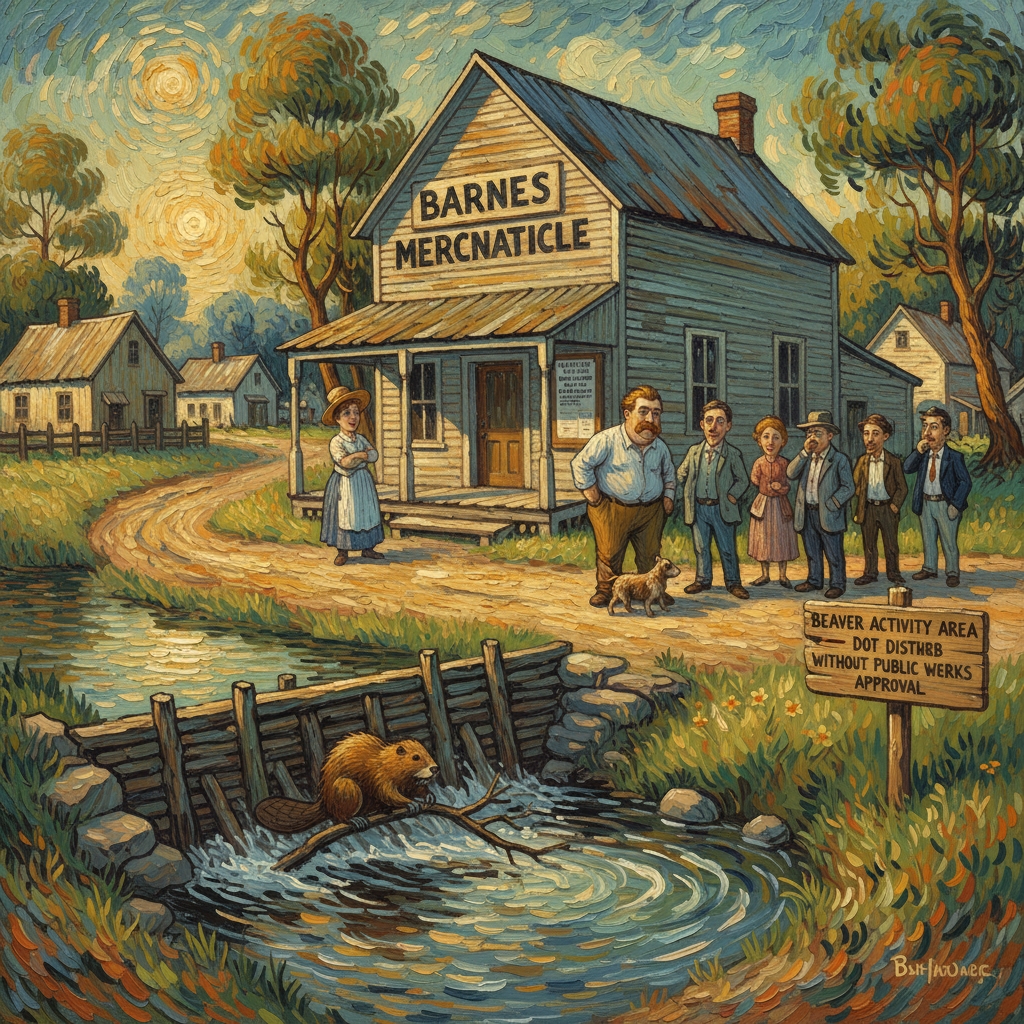
Across the street, Sheriff Peeler and Officer Kenny Joe stood beside the drainage ditch, where a new town sign had been installed.
It read:
BEAVER ACTIVITY AREA
DO NOT DISTURB WITHOUT PUBLIC WORKS APPROVAL
Officer Kenny Joe looked at the sign.
“Did we just regulate the beaver?”
Sheriff Peeler said, “No. We acknowledged existing infrastructure.”
Epilogue – Fifty Jobs and a Beaver Clause
Daisy sniffed the sign, sneezed, and sat down.
At the creek edge, the beaver placed another branch on the dam.
He did not attend hearings. He did not issue projections. He did not promise one thousand jobs or fifty. He built what he understood, adjusted when water moved, and returned the next morning to maintain what yesterday had made necessary.
Boot watched him from the porch.
“That,” he said, “is the part every town learns late.”
Mabel looked at the sign, the ditch, the notice, the road, and the people gathered around all of it.
“What part?”
Boot folded the newspaper under his arm.
“The building is temporary,” he said. “The maintaining is permanent.”
The beaver slapped the water with his tail.
Daisy barked once.
Nobody took a vote, but everyone understood the motion had carried.

Epilogue – Fifty Jobs and a Beaver Clause
Disclaimer
Sequatchie Crossing is a fictional town. All characters, businesses, public officials, churches, meetings, events, animals, committees, data centers, job projections, beavers, mules, crows, arguments, slogans, misunderstandings, and civic conditions in this story are fictional or used satirically. Any resemblance to real people, real residents, real companies, real projects, real public officials, real churches, real counties, or actual local controversies is coincidental.
This story is written as observational small-town satire. It is not a factual report, endorsement, opposition statement, economic analysis, legal opinion, zoning recommendation, environmental review, investment advice, or public policy document. The purpose is to entertain readers while exploring how communities discuss promises, fears, incentives, construction numbers, permanent jobs, infrastructure, and trust.
No real person or real resident of Dunlap, Tennessee, Sequatchie County, or any surrounding community is named or depicted. All named characters are fictional members of the recurring Sequatchie Crossing cast.

Disclaimer – The Thousand Jobs That Became Fifty
Real Places Behind the Ruckus – From The Dunlap Directory

Real Places Behind the Ruckus – From The Dunlap Directory
Yes, this story was fictional; even the parts that weren’t true. These places? Absolutely real. Stop by, support local, and keep the Wi-Fi away from livestock:
- Shadowlands RV
- Sequatchie Valley Low Cost Spay & Neuter
- H&R Block
- Windmere Apartments
- Dunlap Animal Clinic
- Sunset Hill Coops
- Sequatchie Valley Lodge
- Verizon
- JM Lawncare
- W N Lofty Grading & Paving Co
- Sugar Mama’s Cakes by Keisha
- Patron Mexican Grill
- Harris Mowing Service
- Law Office of Samuel F. Hudson
- Creation Station
- Boyd Family Eyecare – Dunlap
- Stevenson Branch Campsite
- Pudge’s Excavating & Landscaping
- Animal Sitting by Chloe Holloway
- Dunlap TENNESSEE For Free/Giveaway

Real Places Behind the Ruckus – From The Dunlap Directory
At Sequatchie Crossing, we tell the stories of Sequatchie Crossing.
Please share this post with your friends, family, or business associates who may want follow the news from Sequatchie Crossing.


0 Comments