


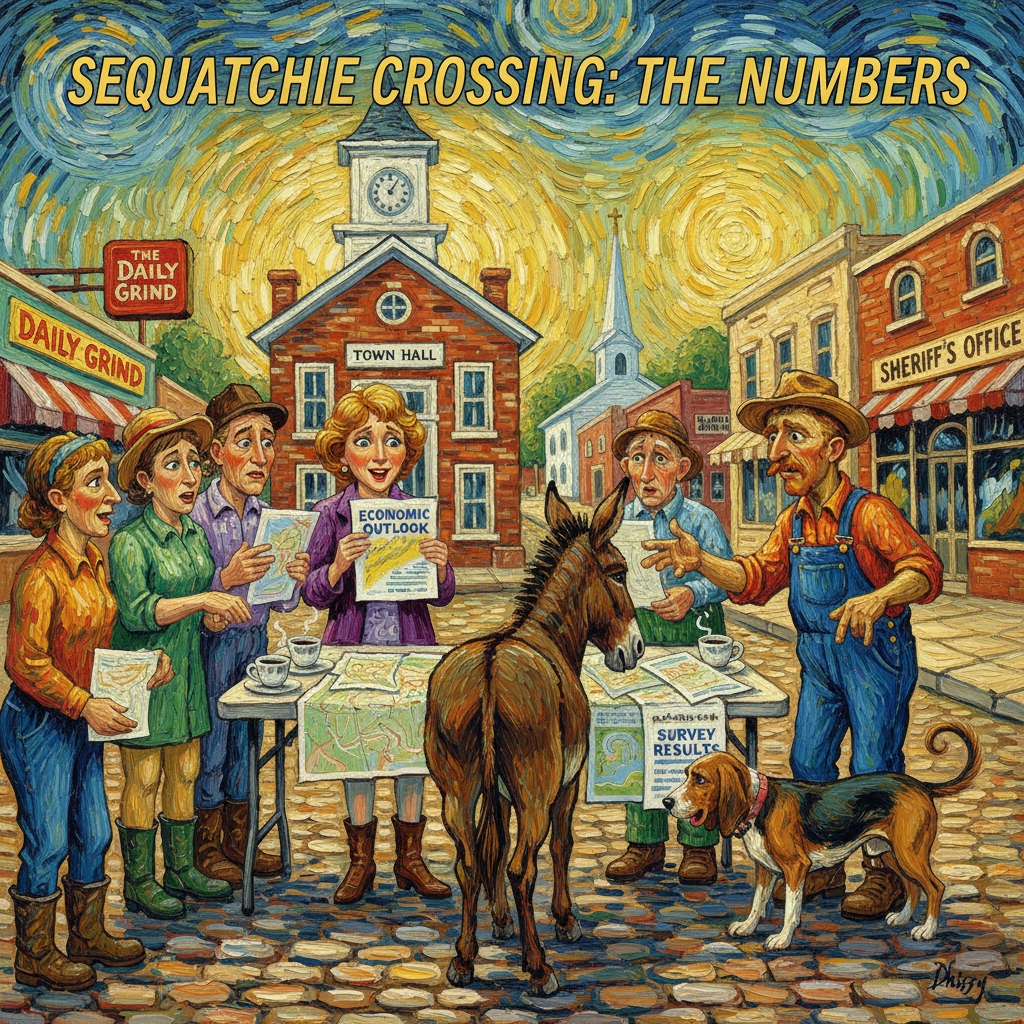
Three People Read the Same Numbers Differently
By Tom Seest
At Sequatchie Crossing, we tell the stories of Sequatchie Crossing.
Please share this post with your friends, family, or business associates who may want follow the news from Sequatchie Crossing.
🎤 Audio Overview
The Realtor, the Farmer, and the Survey
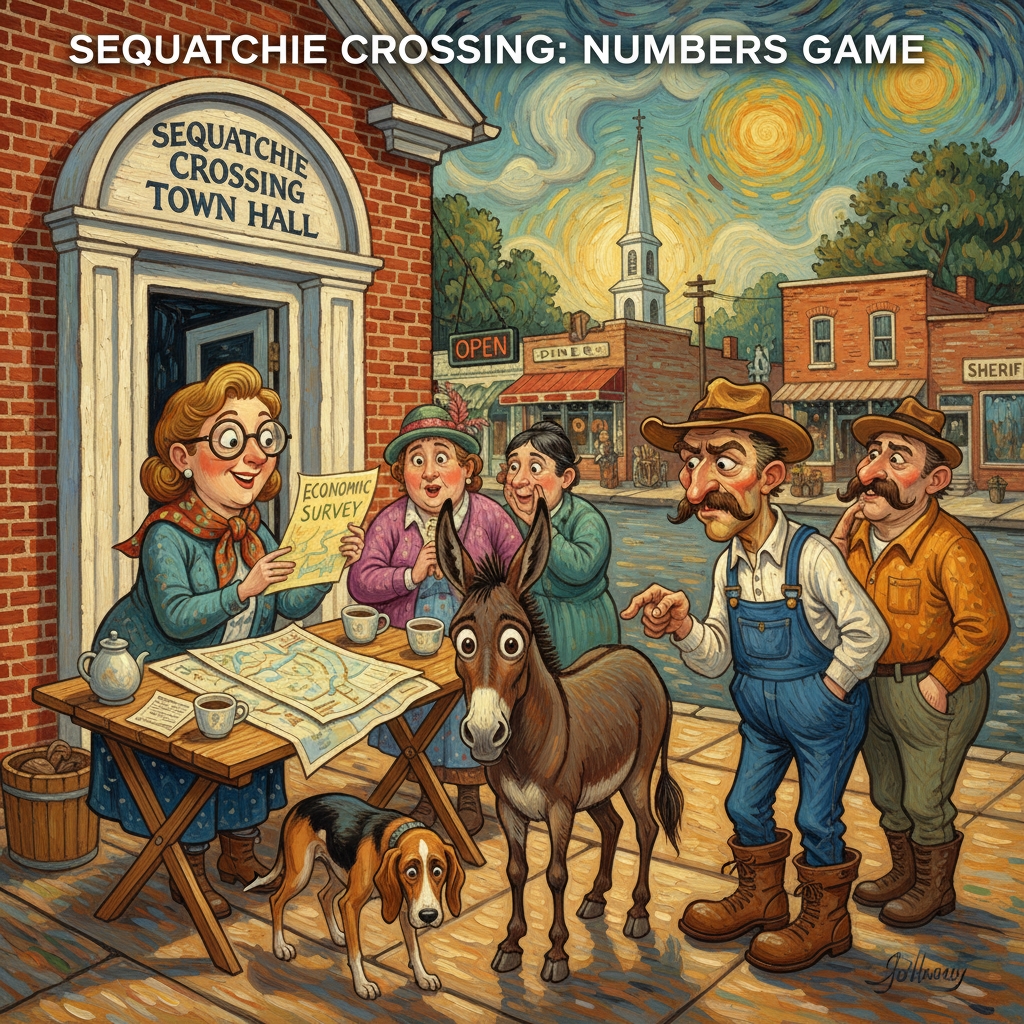
The Realtor, The Farmer, And The Survey
Act I – The Survey Arrives At The Diner
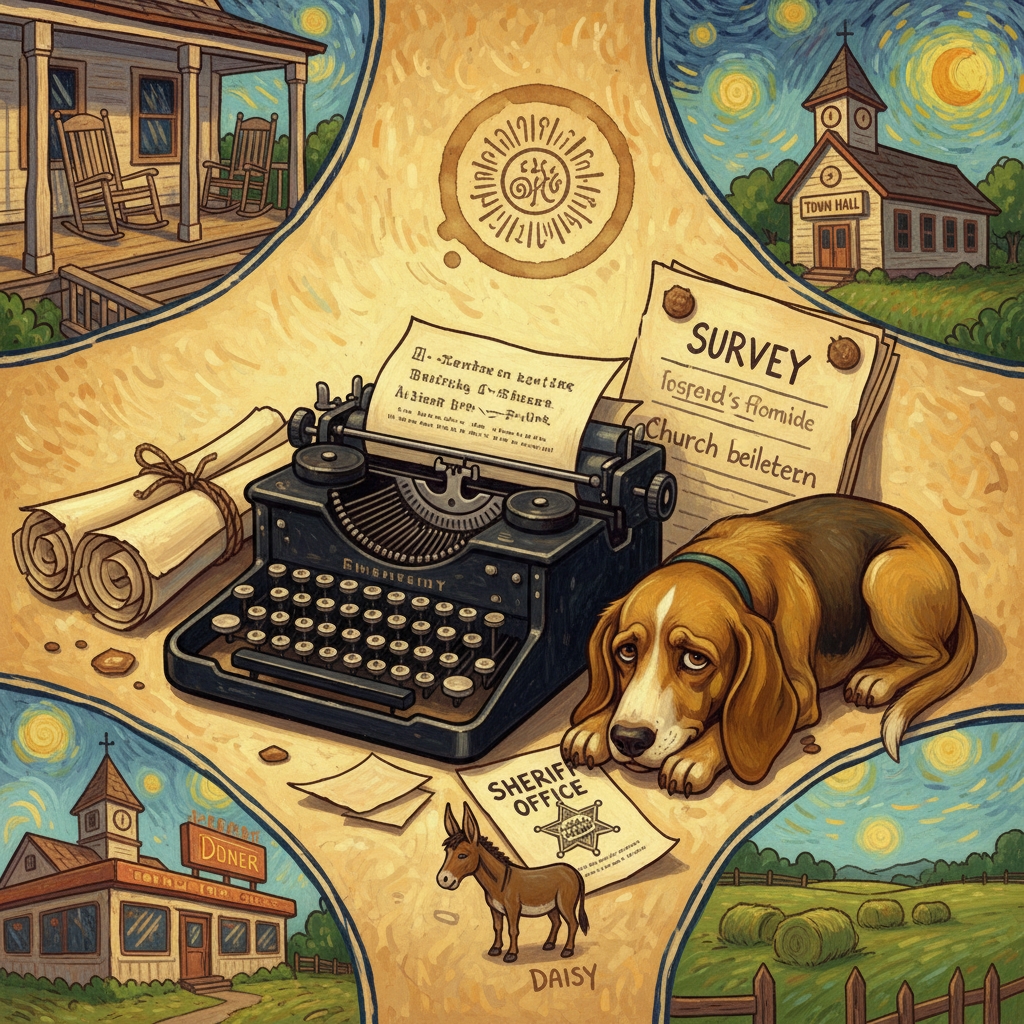
The first copy of the Economic Impact Survey appeared at the Sequatchie Crossing Diner at 6:42 on a Tuesday morning, folded in thirds, damp at one corner from coffee, and already marked with a yellow highlighter.
Trixie Jo Bartlett placed it on the counter between the sugar packets and the tip jar as if it were a newborn calf that might stand up if everyone looked at it kindly enough.
“There,” she said. “Numbers.”
Maggie Sue Dillard looked over the top of her reading glasses from behind the register. “Trixie Jo, I have known numbers to start more fights than liquor.”
“These are good numbers,” Trixie said.
Mabel Dean Ashcroft, seated in the third booth with a biscuit split open and cooling, lifted one eyebrow. “Good for who?”
“That,” said Eugene “Boot” Barnes from the counter stool nearest the coffee urn, “is the only question in town that cannot be buried under adjectives.”
Clovis Strickland leaned in from the booth behind Mabel’s, wearing a jacket with too many pockets and the expression of a man who had already suspected the survey of being printed on government-grade paper. “I want to know who commissioned it.”
Trixie tapped the top page. “The Sequatchie Regional Economic Opportunity Partnership.”
Mabel snorted. “That sounds like five men in khakis trying to say developer without moving their lips.”
“They’re saying jobs,” Trixie replied. “They’re saying tax base. They’re saying infrastructure.”
“They’re saying whatever sounds less like air-conditioning for robots,” Clovis said.
Daisy the hound lay under Boot’s stool, chin on the floor, uninterested in the future of the county unless it came wrapped in bacon grease.
The diner door opened and Sheriff Peeler stepped in with Officer Kenny Joe Teeter behind him. Sheriff Peeler removed his hat, glanced at the survey, and sighed the deep sigh of a man who knew paper could become a public disturbance.
“Who brought the spark?” the sheriff asked.
“Trixie Jo brought facts,” Maggie Sue said.
“Facts don’t usually come highlighted,” Kenny Joe said.
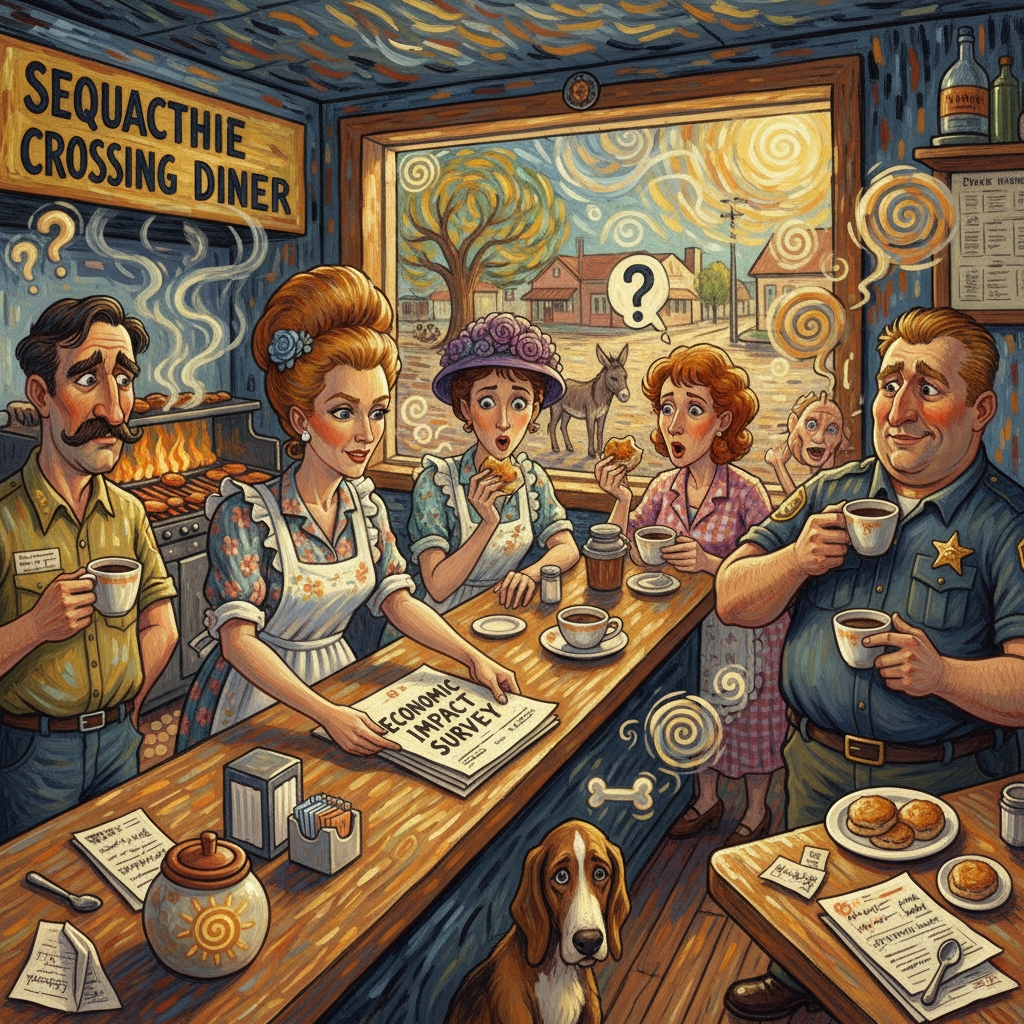
Act I – The Survey Arrives At The Diner
Trixie slid a copy toward the sheriff. “The survey says the proposed data center could increase county revenue, attract skilled jobs, improve broadband, and raise property values.”
From the corner table, Chester Ray Blevins lowered his coffee. “Property values going up is not automatically a blessing. Sometimes it just means your children can’t afford to live where their grandparents are buried.”
The diner went quiet enough for the grill to speak in grease.
Brett Crenshaw, who had been adding powdered greens to a travel cup, raised a finger. “But growth can be healthy if the town shapes it.”
Alyssa Crenshaw nodded beside him. “Exactly. Change is stressful, but stagnation is also stressful. The body and the community both need circulation.”
Mabel stared at them. “I do not want my town compared to lymph.”
Boot picked up the survey, folded it once, and looked at the page. “The numbers say three hundred construction jobs, forty permanent jobs, and an annual property tax increase that could fix the courthouse roof twice.”
Maggie Sue pointed a spatula toward the ceiling. “We have been promised that roof fix by every generation since shingles were invented.”
Trixie smiled. “This time, the money could be real.”
Mister Wade Langston entered then, boots dusty, cap pulled low, his hands rough from mending fence before breakfast. He saw the paper on the counter and stopped.
“That the survey?” he asked.
“It is,” Trixie said warmly. “I’d like you to read it.”
“I read it last night,” Wade said. “Made my coffee taste like a bank loan.”
“Wade,” Trixie said, “your farm sits near the proposed utility corridor. If the projections are right, you could benefit.”
“I could sell an easement,” Wade said. “I could also lose a spring, a fence line, and the quietest corner of my pasture.”
Clovis pointed at him. “There. A man with dirt under his nails has entered the chat.”
Doug “Doughboy” Teeter, sitting near the jukebox with a tablet open, looked up. “Actually, the chat is not officially open unless we create a shared channel.”
“Do not create a shared channel,” Mabel said.
Tiffany Annette Roark came in carrying a folder, her hair set like she expected the morning to be judged. “Everybody hold your opinions in a single file line. Town Hall has scheduled a public review at noon.”
“Who decided that?” Sheriff Peeler asked.
“Mayor Bea Crowe,” Tiffany said. “Also me, because the phone started ringing at 6:05 and one man asked whether the data center would make his toaster communist.”
Pastor Arnold Peeler arrived behind her, wearing his usual calm and a tie that looked like it had survived three potlucks. “Fear does enjoy dressing up as certainty.”
Sister Lila Mae “Hallelujah” Pruitt came in behind him, carrying a pie tin covered in foil. “And certainty often forgets to bring dessert.”
Daisy lifted her head.
Boot pointed down. “At least one resident understands the actual economic forecast.”
Trixie gathered the surveys. “Noon at Town Hall. We can discuss the numbers there.”
Wade looked at her. “We can discuss who gets paid, too.”
“That is fair,” Trixie said.
Mabel stood, lifting her purse like a weapon of parliamentary order. “If anybody uses the phrase win-win, I’m leaving.”
The diner door swung open once more, and somewhere outside, a mule brayed from the direction of the square.
Maggie Sue looked toward the window. “Whose mule is that?”
Wade closed his eyes. “Mine.”
“Does he have a position on the survey?” Clovis asked.
Wade looked at the paper in Trixie’s hand. “He ignores all forecasts.”
Daisy barked once, as if seconding the motion.
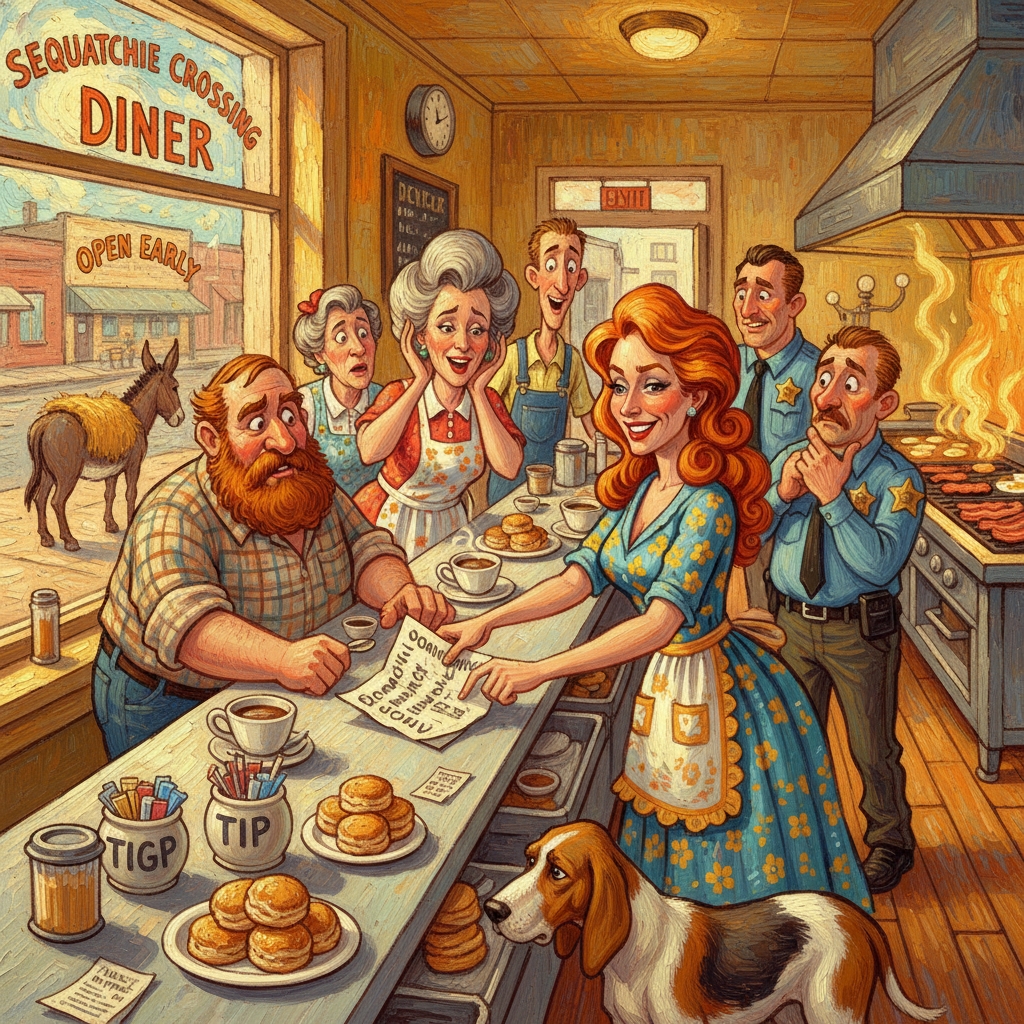
Act I – The Survey Arrives At The Diner
Act II – The Realtor Reads Upside
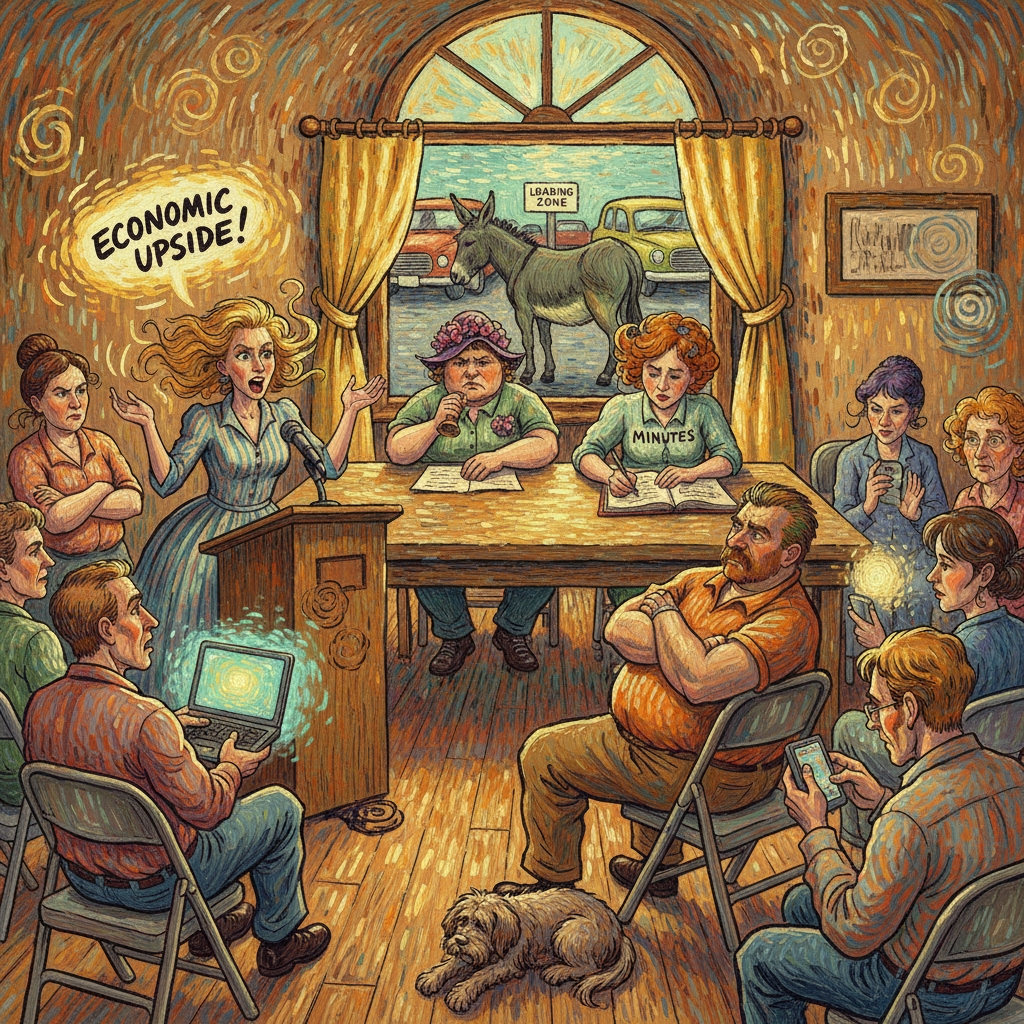
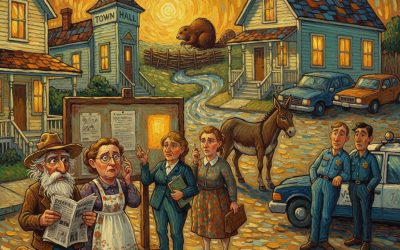
At noon, Town Hall filled the way it usually did when people suspected somebody might be getting ahead.
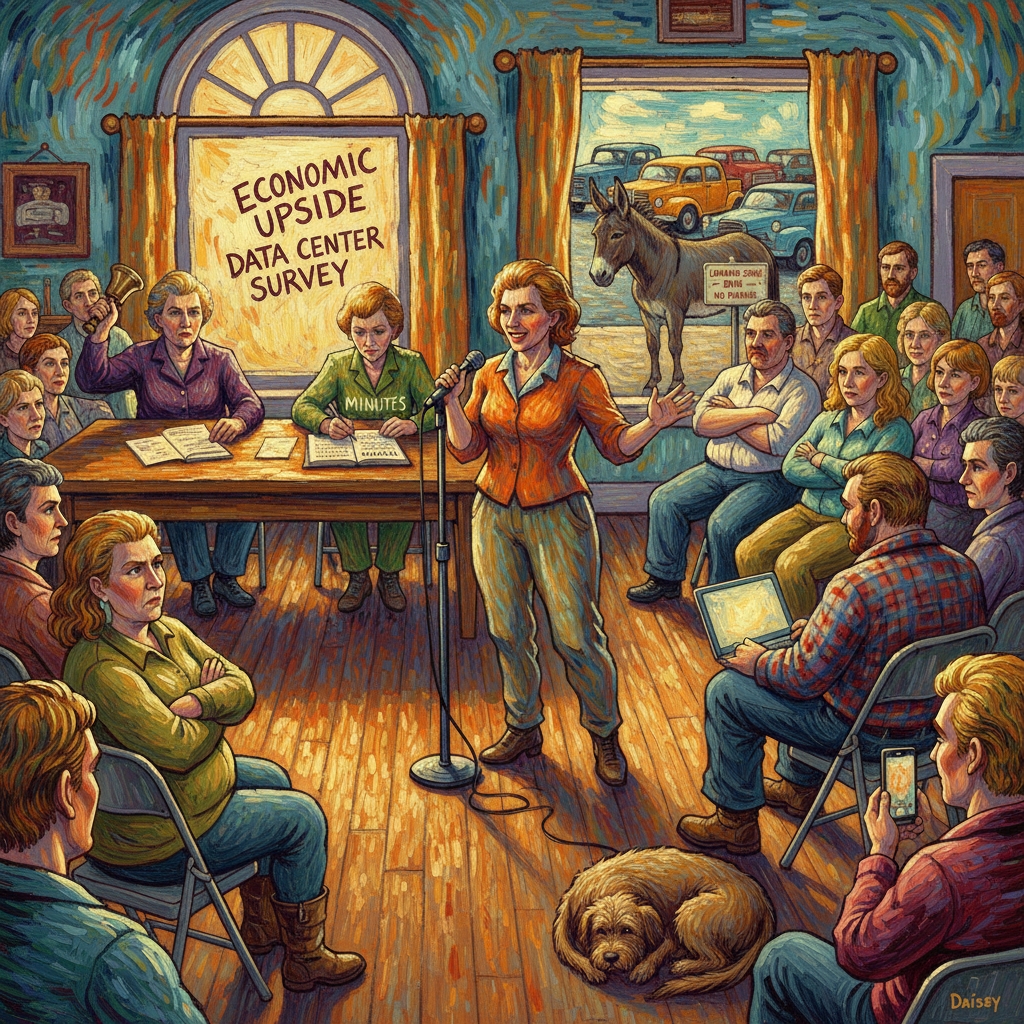
The old room smelled of floor polish, copy paper, and civic suspicion. Folding chairs lined the aisle. A map of Sequatchie Crossing hung crooked behind the council table. Someone had placed a pitcher of water near the microphone, though nobody trusted it after last month’s misunderstanding about the recycling demonstration.
Mayor Bea Crowe stood at the front, one hand on the survey, one hand on a bell she had borrowed from the church basement.
“I call this review meeting to order,” she said. “This is not a vote. This is not a riot. This is not Facebook with chairs.”
Shelley Fawn Wexler, sitting near the front with two phones and a ring light she had promised not to turn on, whispered, “That’s a good line.”
Tiffany Annette Roark sat beside the mayor, already writing minutes with the fierce concentration of a woman who knew history depended on punctuation.
Mayor Crowe nodded toward Trixie Jo Bartlett. “Miss Bartlett, since you asked for time to explain the economic side, you may begin.”
Trixie walked to the microphone in a bright blazer and sensible heels. She carried a clean copy of the survey and three sticky notes.
“I know folks are nervous,” she began. “I am, too. But nervous does not mean blind. The survey projects that a data center could increase county property tax revenue, raise demand for local services, improve broadband capacity, and support nearby commercial development.”
“Commercial development like what?” Chester Ray asked.
“Restaurants, contractors, maintenance companies, equipment suppliers, lodging during construction,” Trixie said. “Maybe even office space.”
Doug raised his hand. “I could support a digital services incubator.”
Mabel whispered loudly, “He wants a room with snacks and blinking lights.”
Trixie kept going. “If land values rise, some families who have been land-rich and cash-poor may gain options. Sell, lease, subdivide, borrow against increased equity, or hold.”
Wade shifted in his chair.
Trixie looked at him but did not soften the point. “For some property owners, that could be life-changing money.”
Act II – The Realtor Reads Upside
“For others,” Wade said from the second row, “it could be a tax bill with a bow on it.”
Trixie nodded. “Yes. That is why we need policy, not panic.”
Dr. Neil Cowgill raised one long finger. “A distinction should be made between assessed value, market value, speculative value, and emotional value, the last of which is almost never captured in tables but often drives the argument more than any visible variable.”
“Neil,” Mayor Crowe said, “put a period on that before it becomes a weather system.”
Dr. Cowgill folded his hands. “Money is not evenly distributed merely because it arrives.”
Boot smiled faintly. “That’ll fit on a bumper sticker if Chester prints it small.”
Chester Ray shook his head. “I do not print small truth. Small truth is how disclaimers happen.”
Jolene Pickett, a young computer technician who had returned to town after three years in Knoxville, stood near the back wall. “I want to say something.”
Mayor Crowe nodded. “Go ahead, Jolene.”
Jolene lifted her chin. “I left because there weren’t enough jobs here. I came back because my mama got sick. I can work remote when the internet behaves, which is about as often as Clovis trusts a satellite.”
“I trust satellites I can see,” Clovis said.
“That is not how satellites work,” Doug said.
Jolene continued. “If infrastructure improves, more people like me can stay. I don’t care whether the building is pretty. I care whether young people have options besides leaving or commuting.”
Pastor Peeler leaned forward. “That is a real testimony.”
Sister Lila Mae said, “Amen, with a footnote.”
Mabel turned. “What footnote?”
“That options for the young should not become eviction notices for the old,” Sister Lila Mae said.
The room murmured.
Trixie placed both hands on the podium. “I agree. That’s why the survey should start the conversation, not end it.”
Shelley raised her phone. “Can I quote that?”
Tiffany looked up sharply. “Only after minutes are approved.”
Sheriff Peeler stood at the side wall, arms crossed. “I have one question.”
Trixie nodded. “Yes, Sheriff.”
“How many of these projected jobs go to local people?”
Trixie glanced down. “The survey estimates a portion would be local, especially construction and services. Specialized technical jobs may require recruiting or training.”
“So the answer is maybe,” Sheriff Peeler said.
“The answer is possible,” Trixie replied.
“That is the same dog with a nicer collar,” Boot said.
Daisy, who had been allowed in because nobody wanted her howling outside Town Hall again, barked from beneath Boot’s chair.
Mayor Crowe struck the bell once. “The dog is out of order.”
Daisy wagged her tail.
Outside the open window, Wade’s mule brayed again.
Kenny Joe looked through the blinds. “Sheriff, the mule is standing in the loading zone.”
Sheriff Peeler sighed. “Of course he is.”
Mabel folded her arms. “Even the mule knows where infrastructure goes wrong.”
Trixie smiled despite herself. “Or he just likes shade.”
Wade looked toward the window. “No. He likes standing where people need to pass.”
Mayor Crowe tapped the survey. “Then let us continue before the mule files a minority report.”
Act II – The Realtor Reads Upside
Act III – The Farmer Reads Risk
By midafternoon, the meeting had moved unofficially to Wade Langston’s farm because someone said you could not understand the utility corridor from Town Hall, and because the mule had refused to leave the loading zone until Wade promised him feed.
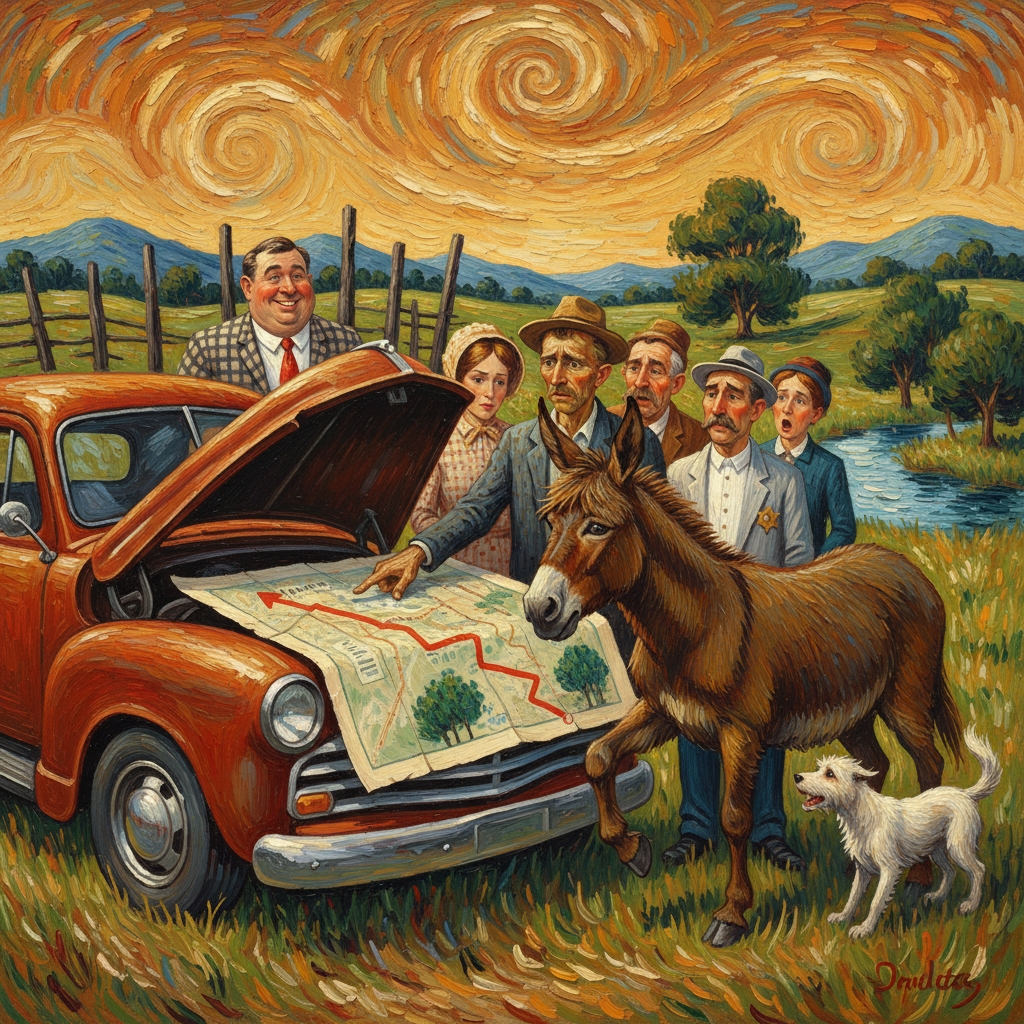
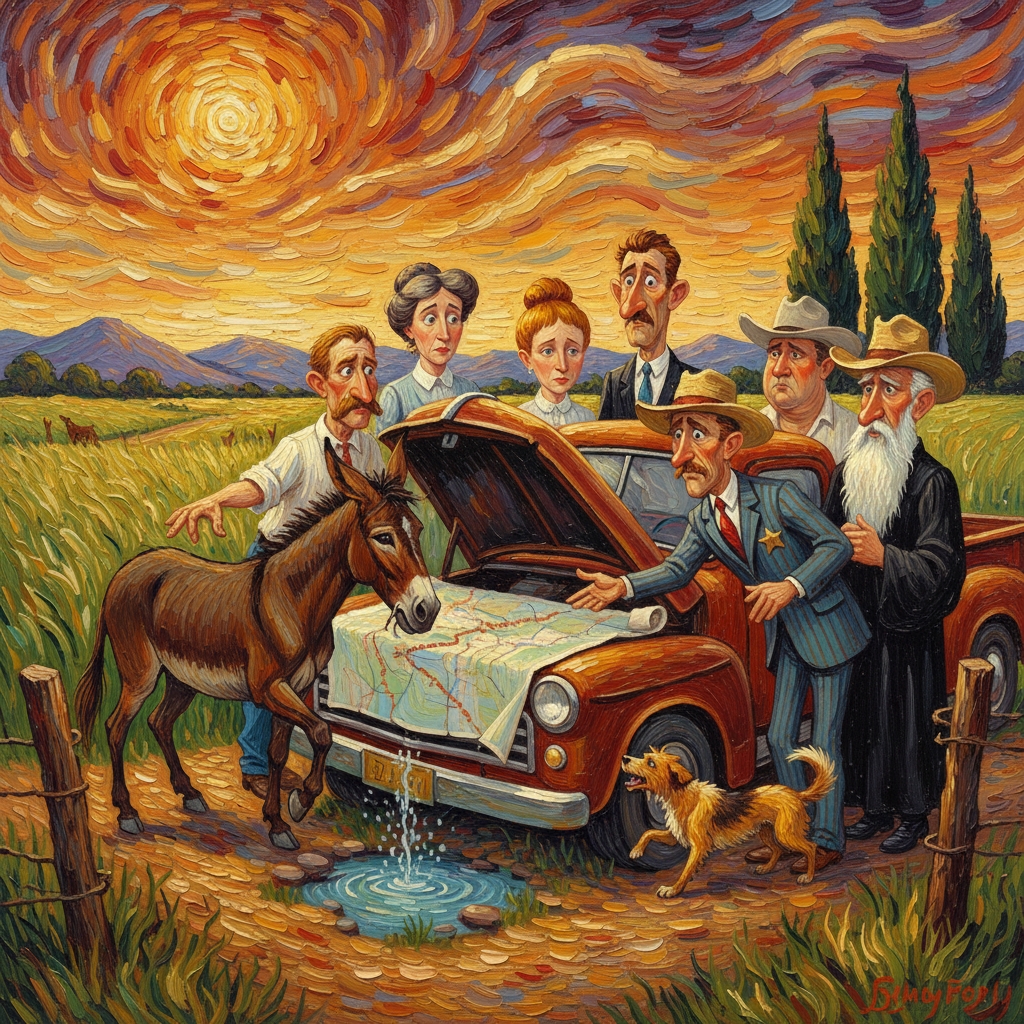
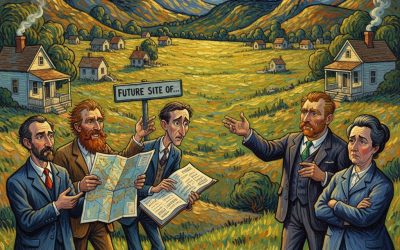
The proposed easement crossed the back of Wade’s pasture, then dipped toward a tree line where a spring ran clear under flat stones. Trixie stood with a rolled map. Boot leaned against a fence post. Sheriff Peeler and Kenny Joe watched the road. Clovis carried binoculars, though nobody knew why.
The mule stood directly in the middle of the farm lane.
“Move,” Wade told him.
The mule blinked.
“That animal has principles,” Mabel said from beside the gate.
“He has digestion,” Wade replied.
Trixie unrolled the map on the hood of Wade’s truck. “This line represents the utility corridor. It does not mean everything here gets disturbed. It means this is where access may be needed.”
“May be,” Wade said. “That phrase is where trouble breeds.”
Brett Crenshaw studied the pasture. “Could the corridor be adjusted around the spring?”
Alyssa nodded. “That seems like a reasonable mitigation.”
Wade looked at Trixie. “Is that in the survey?”
“The survey is economic,” Trixie said.
“That is a no,” Wade replied.
Dr. Cowgill, who had followed in his old sedan and parked half in the ditch, cleared his throat. “Economic forecasts often treat land as a surface on which numbers occur. Farmers experience land vertically: topsoil, roots, water, rock, memory.”
Maggie Sue, carrying a jar of sweet tea she had brought for herself and then shared against her own judgment, said, “Neil, sometimes you make sense accidentally.”
Wade pointed toward the spring. “My granddaddy watered cattle there. My daddy did. I do. That survey counts my land like a square on a game board. It does not count what happens when construction crews leave a gate open or a culvert silts up.”
Trixie’s voice softened. “I’m not dismissing that.”
“No,” Wade said. “But you read the upside first.”
“And you read the risk first,” Trixie said.
“Because the upside can be spent by people who do not live with the risk.”
Act III – The Farmer Reads Risk
Clovis snapped his fingers. “There it is.”
Shelley Fawn Wexler began typing furiously. “That is going in the post.”
Tiffany pointed at her. “Do not inflame the public with poetic accuracy before the mayor has reviewed the statement.”
Shelley looked offended. “Poetic accuracy is my brand.”
Sonny Morales arrived in his tow truck, pulling up by the gate with a toolbox rattling in back. “I heard there was a mule blocking public infrastructure.”
“Private lane,” Wade said.
“Then he is blocking private infrastructure,” Sonny said.
RT Mullins climbed out of the passenger side, holding a gas station sandwich. “That mule has more political clarity than half the county.”
Kenny Joe pointed. “RT, do not feed him.”
“I wasn’t going to.”
“You looked like you were negotiating.”
RT put the sandwich behind his back. “That is different.”
Pastor Peeler walked toward the spring with Sister Lila Mae beside him. He looked down at the water sliding through the stones.
“A spring is a quiet thing,” Pastor Peeler said. “People forget quiet things until they are gone.”
Sister Lila Mae nodded. “Amen. And sometimes people call that progress because grief doesn’t show up in the first-year revenue column.”
Trixie took a breath. “Then the decision should include protections. Easement language. Water monitoring. Construction bonds. Local hiring targets. Tax relief for affected residents.”
Mabel eyed her. “You saying that as a realtor or as a citizen?”
Trixie paused. “Both. And yes, I know that makes people suspicious.”
Boot adjusted his cap. “It should. Not because Trixie is crooked, but because incentives are sneaky. A person can tell the truth and still stand where the money shines brightest.”
Wade looked at Boot. “That’s what I mean.”
Trixie folded the map slowly. “Then help me write the questions. Do not just reject the survey. Tell me what it fails to measure.”
The mule stepped forward, put one hoof on the map edge, and pinned it to the truck hood.
Daisy barked.
Doug Teeter lifted his tablet. “That is actually a perfect user interface metaphor.”
Mabel said, “Doughboy, if you turn that mule into an app, I will personally unplug you.”
Wade pulled at the map. The mule did not move.
Sheriff Peeler put his hands on his belt. “Looks like the animal has requested revisions.”
Boot nodded. “First decision of the day: no more reading numbers without standing on the ground they describe.”
No one objected.
The mule chewed calmly, having defeated the first forecast by standing on it.
Act III – The Farmer Reads Risk
Act IV – The Sheriff Reads The Rumors
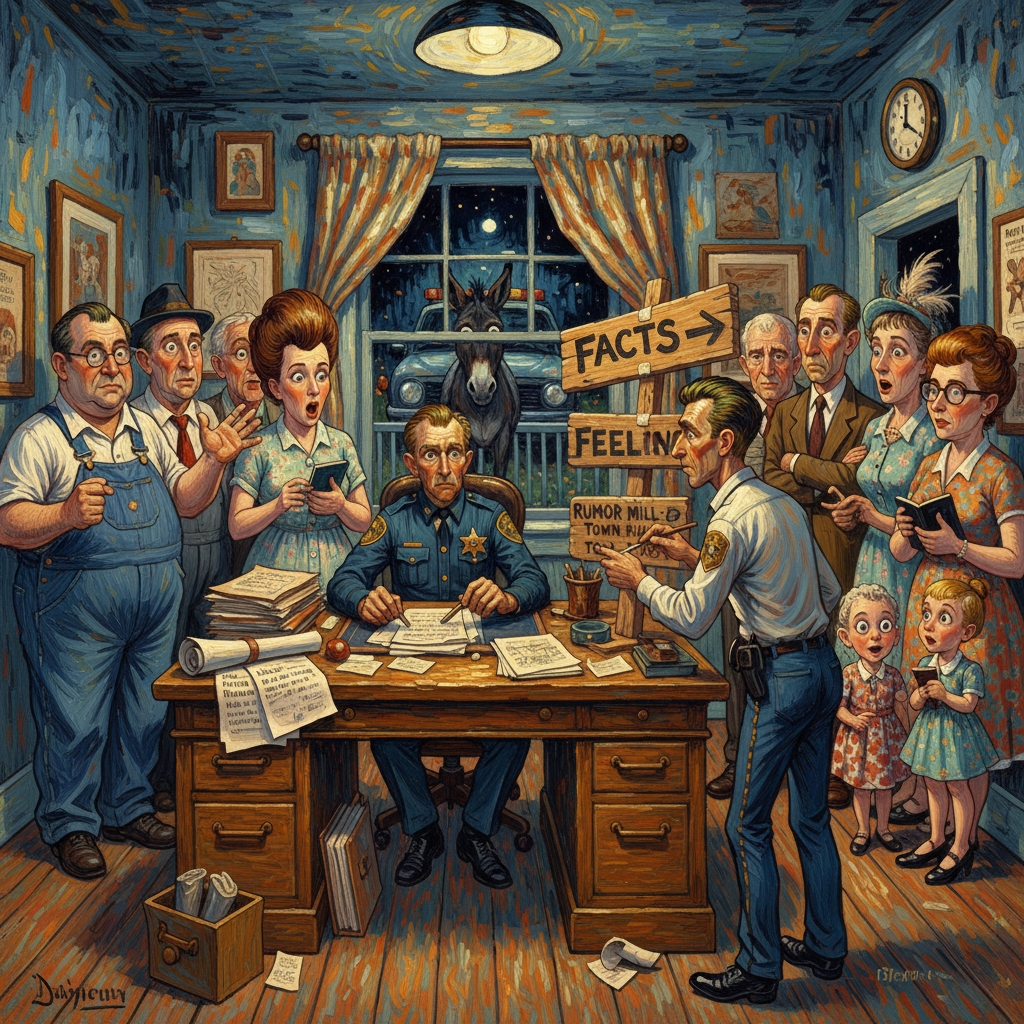
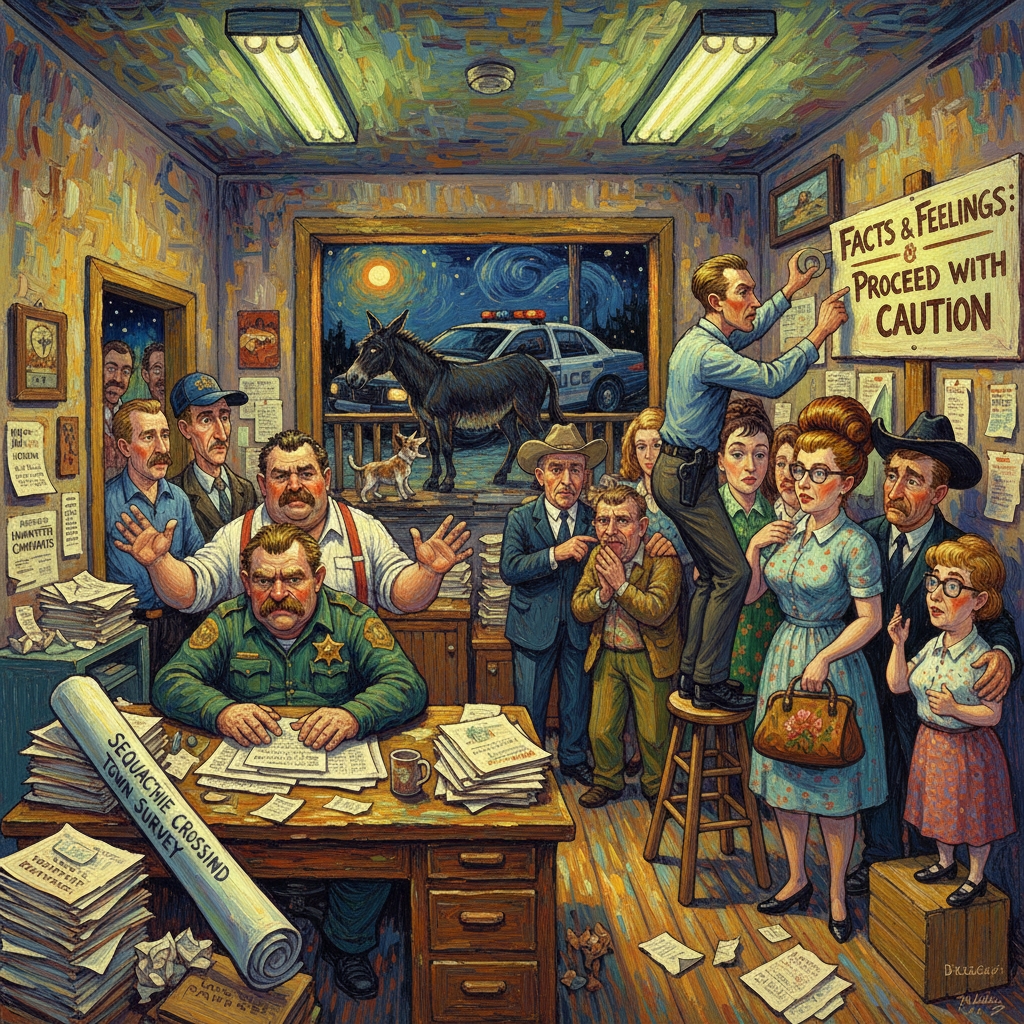
That evening, the sheriff’s office became the only place in Sequatchie Crossing where a person could hear four rumors at once and still smell burnt coffee.
Sheriff Peeler sat at his desk with the survey, three handwritten complaints, and a printed screenshot from Shelley’s post. Officer Kenny Joe Teeter stood by the filing cabinet, trying to tape a sign that read PLEASE DISTINGUISH BETWEEN FACTS AND FEELINGS.
“It’s crooked,” Sheriff Peeler said.
“The sign or the town?” Kenny Joe asked.
“The sign. The town is beyond our jurisdiction.”
Clovis sat in the visitor chair, leaning forward. “Sheriff, I am telling you, one rumor says the data center will use enough electricity to dim every porch light from here to Pikeville.”
Kenny Joe frowned. “Who said that?”
“A man at the parts counter who had recently watched a documentary.”
“That is not a source,” Sheriff Peeler said.
“It is a species of source,” Clovis said.
Tiffany entered with a folder under one arm. “Mayor Crowe wants a rumor control sheet before tomorrow morning.”
“I want a trout stream and a nap,” Sheriff Peeler said. “The mayor may be disappointed with both of us.”
Doug came in behind Tiffany, holding his laptop open. “I can build a public dashboard.”
“No,” Tiffany, Sheriff Peeler, and Kenny Joe said together.
Doug stopped. “What if I call it a civic clarity portal?”
“No,” Tiffany said.
Chester Ray Blevins stepped in next, carrying a mock-up flyer. “I can print a one-page explainer. Large type. No QR code. No glossy paper. Glossy paper makes lies look expensive.”
Mabel followed him into the office. “I want the flyer to include who profits.”
Act IV – The Sheriff Reads The Rumors
Trixie came in behind Mabel, tired but composed. “Then include everyone who might profit. Landowners, contractors, the county, utility providers, realtors, nearby businesses, job seekers, and maybe developers most of all.”
“That’s surprisingly honest,” Mabel said.
“I am capable of honesty even in heels,” Trixie replied.
Wade stepped through the doorway last, hat in hand. “And include who might pay. Farmers with easements. Neighbors with higher taxes. People on fixed incomes. Roads. Water. Noise. Anybody whose place changes without being sold.”
Sheriff Peeler pointed at Chester. “Write that down.”
Chester lifted his pencil. “I print. I do not take dictation unless compensated.”
Maggie Sue appeared with a box of diner leftovers. “You will take dictation if you want pie.”
Chester sat at the side table. “Proceed.”
Pastor Peeler and Sister Lila Mae arrived together, having walked over from the church after evening prayer. Pastor Peeler looked around at the crowded office.
“This room is beginning to resemble a conscience with fluorescent lights,” he said.
Sister Lila Mae set her pie tin on the filing cabinet. “And like most consciences, it needs feeding.”
Sheriff Peeler rubbed his forehead. “Here is what we know. The survey is a projection, not a promise. The project is proposed, not approved. The benefits are possible, not guaranteed. The risks are possible, not imaginary.”
Boot, who had been quiet near the wall, nodded. “That’s the first truthful paragraph I’ve heard all day.”
Shelley Fawn Wexler slipped in holding her phones. “I’ll post it.”
Tiffany pointed. “Only if you include the entire paragraph.”
Shelley sighed. “Fine. But the algorithm prefers panic.”
“The Lord does not,” Sister Lila Mae said.
RT Mullins leaned in from the hallway. “Does the flyer mention the mule?”
Sheriff Peeler looked up slowly. “Why would the flyer mention the mule?”
RT shrugged. “Because he’s the only one who acted on available information.”
Kenny Joe looked out the window. “Sheriff?”
“What now?”
“The mule is in the parking lot.”
Everyone turned.
Outside, the mule stood beside the sheriff’s cruiser, blocking the driver’s door.
Daisy, tied temporarily to the porch rail outside, barked with admiration.
Wade closed his eyes. “I swear I latched that gate.”
Clovis whispered, “Infrastructure failure.”
Sonny Morales, who had come to check on a radiator hose, laughed from the doorway. “That mule knows government vehicles are where decisions go to idle.”
Sheriff Peeler stood. “Second decision of the day. Tomorrow’s public meeting includes a rumor sheet, a profit sheet, a risk sheet, and somebody besides me handles the mule.”
Wade raised his hand. “I’ll handle him.”
The mule brayed through the window.
Mabel looked at the survey. “He says he wants that in writing.”
Act IV – The Sheriff Reads The Rumors
Act V – The Church Reads The Soul Of It
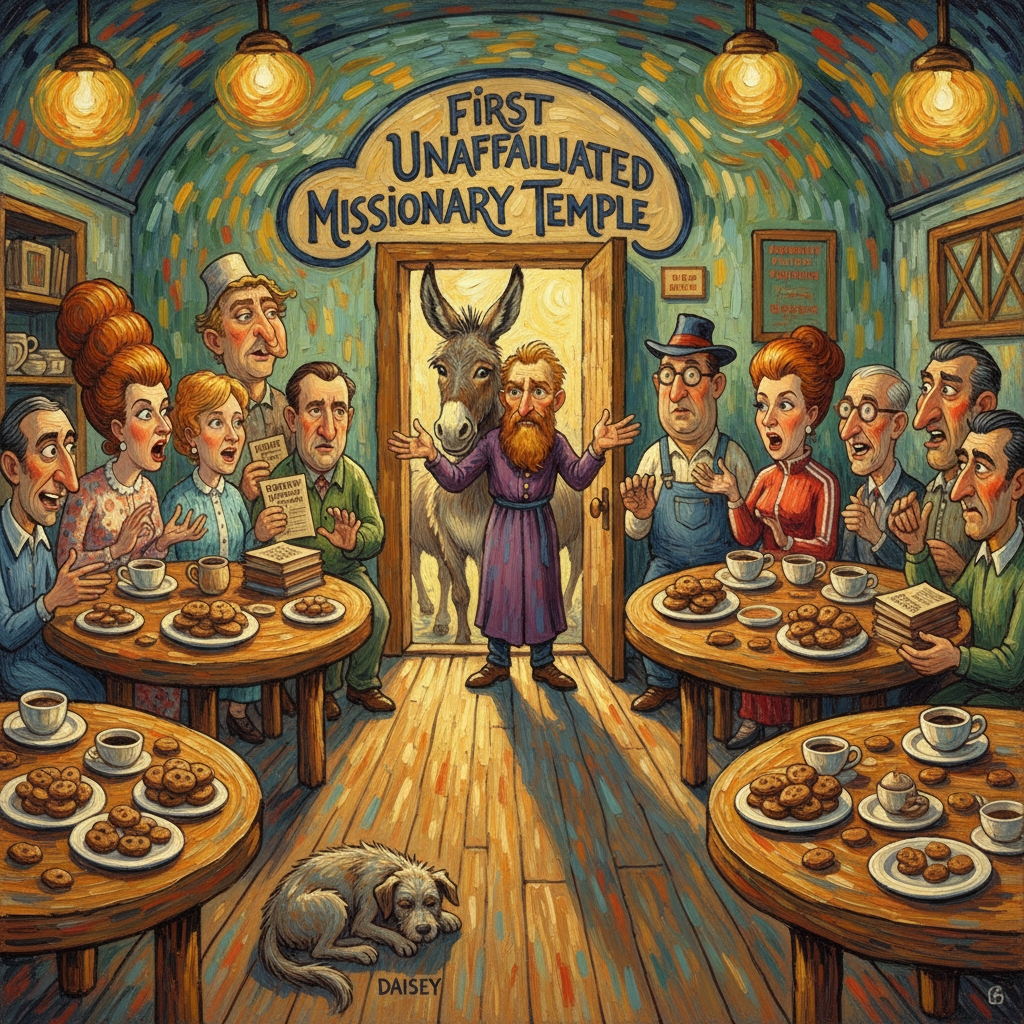
By Wednesday night, First Unaffiliated Missionary Temple had filled for what Pastor Arnold Peeler called a “listening circle” and what Mabel called “a town meeting with hymnals.”
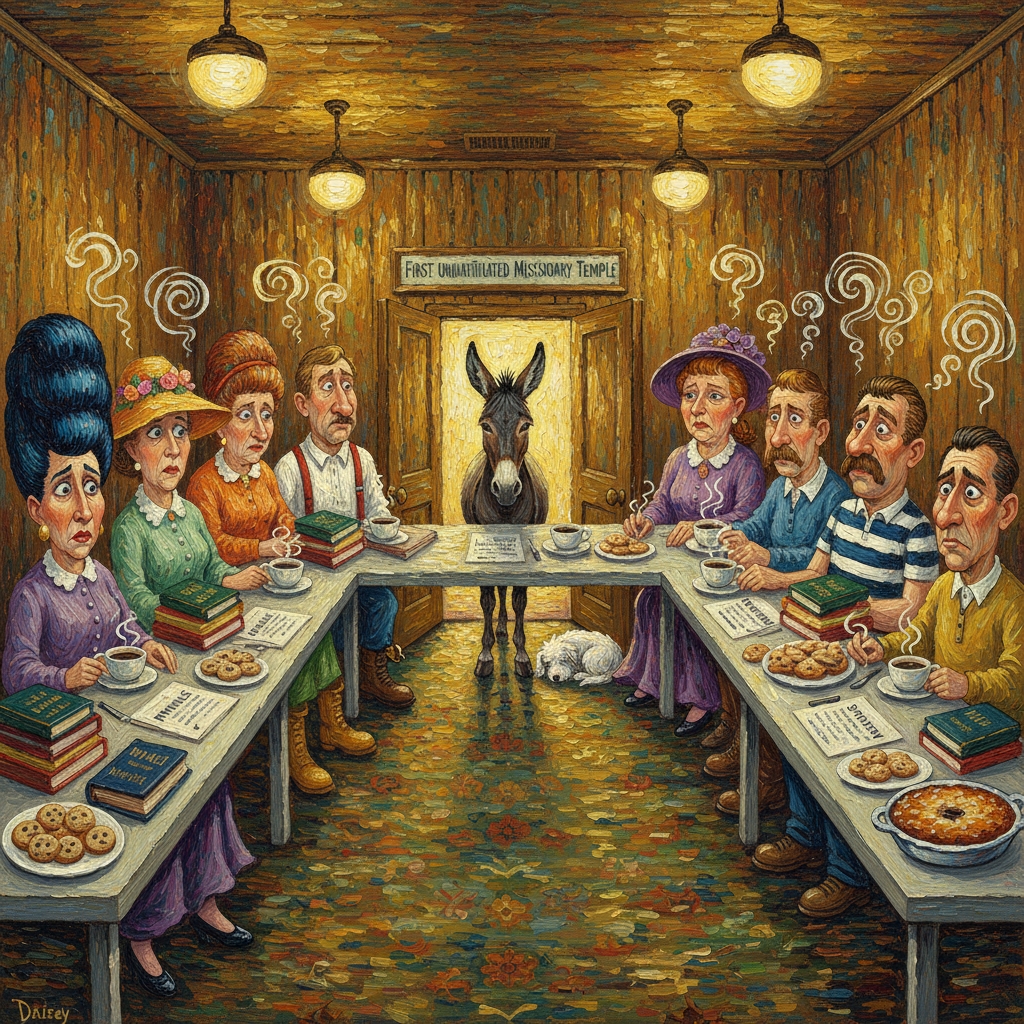
The fellowship hall tables were arranged in a horseshoe. On one side sat those excited about opportunity. On the other sat those worried about loss. In the middle sat refreshments, because even division needed cookies.
Pastor Peeler stood near the coffee urn. “We are not here to decide the project tonight. We are here to decide how we will talk about it without turning neighbors into categories.”
Sister Lila Mae lifted a hand. “And without calling people sellouts before cobbler.”
Mabel looked across the room at Trixie. “I have not called her a sellout.”
“Not out loud,” Sister Lila Mae said.
Trixie smiled faintly. “I appreciate the restraint.”
Mayor Bea Crowe sat at the end table, exhausted. “The town has requested a moral framework, a financial breakdown, environmental clarity, tax projections, job guarantees, infrastructure details, and a mule management plan.”
Coach Freddie Stubblefield leaned back in his chair. “That sounds like football. Everybody wants the scoreboard, but nobody wants to block.”
Brett Crenshaw nodded. “Maybe the town needs a shared values statement.”
Mabel groaned. “That phrase has never fixed a culvert.”
Alyssa placed a notebook on the table. “Maybe not, but it can keep the conversation from splitting into camps.”
Evelyn Grace Tipton, who had been quietly arranging name tags no one wore, said, “I think people are afraid of being foolish. If they support it and it harms the town, they’ll feel foolish. If they oppose it and it could have helped, they’ll feel foolish. So they get loud first.”
The room paused.
Boot smiled. “Miss Evelyn, that is the cleanest diagnosis we’ve had.”
Dr. Cowgill leaned forward. “Fear of retrospective embarrassment is an underappreciated force in civic life.”
Maggie Sue muttered, “And there goes the clean part.”
Act V – The Church Reads The Soul Of It
Jolene Pickett raised her hand. “I don’t want to be told I’m greedy because I want jobs.”
Wade answered from across the table. “I don’t want to be told I’m backward because I want my spring protected.”
Trixie looked at him. “I don’t want to be told I only see commissions.”
Mabel said, “I don’t want to be told suspicion is ignorance.”
Clovis added, “I don’t want to be told my pattern recognition is paranoia.”
Doug whispered, “Sometimes it is.”
Clovis pointed at him. “Sometimes clouds resemble animals. That does not mean animals are impossible.”
Shelley typed that.
Tiffany leaned over. “Do not post that without context.”
Shelley sighed. “Context kills engagement.”
Pastor Peeler raised both hands. “Let us name the question plainly. Who benefits financially?”
“Developers,” Chester said.
“Landowners near the site,” Trixie said.
“Maybe workers,” Jolene said.
“Maybe the county budget,” Mayor Crowe said.
“Maybe nobody if the costs outrun the money,” Wade said.
“Maybe people selling fear,” Sister Lila Mae said.
The room turned toward her.
She continued, “Fear has an economy, too. It buys attention. It sells certainty. It pays some folks in influence.”
Mabel tapped the table. “Hope has an economy. Realtors sell that every day.”
Trixie did not flinch. “True.”
Boot looked around the hall. “Then third decision: every claim about benefit gets paired with a claim about cost. Every claim about cost gets paired with who might bear it. No naked numbers.”
Coach Freddie slapped the table. “Balanced offense.”
Mabel pointed at him. “Do not put this in football terms.”
Coach grinned. “Too late.”
Daisy, sleeping near the fellowship hall door, thumped her tail as the outside door creaked.
The mule stuck his head through the doorway.
Nobody spoke.
Then RT Mullins, who had been guarding the dessert table, said, “He’s come for the listening circle.”
The mule took one step in.
Pastor Peeler looked heavenward. “Lord, give us patience with all stubborn creatures, including the elected ones.”
Mayor Crowe said, “I heard that.”
The mule ignored the survey copies on the table, ignored the pastries, ignored the arguments, and walked straight to the center of the horseshoe where everyone had been aiming their opinions.
He stood there, immovable.
Boot nodded. “Fourth decision: leave room in the middle for what refuses to fit either side.”
Act V – The Church Reads The Soul Of It
Act VI – The Print Shop Reads The Fine Print
Thursday morning, Chester Ray Blevins opened the Print Shop early and regretted it by 8:03.
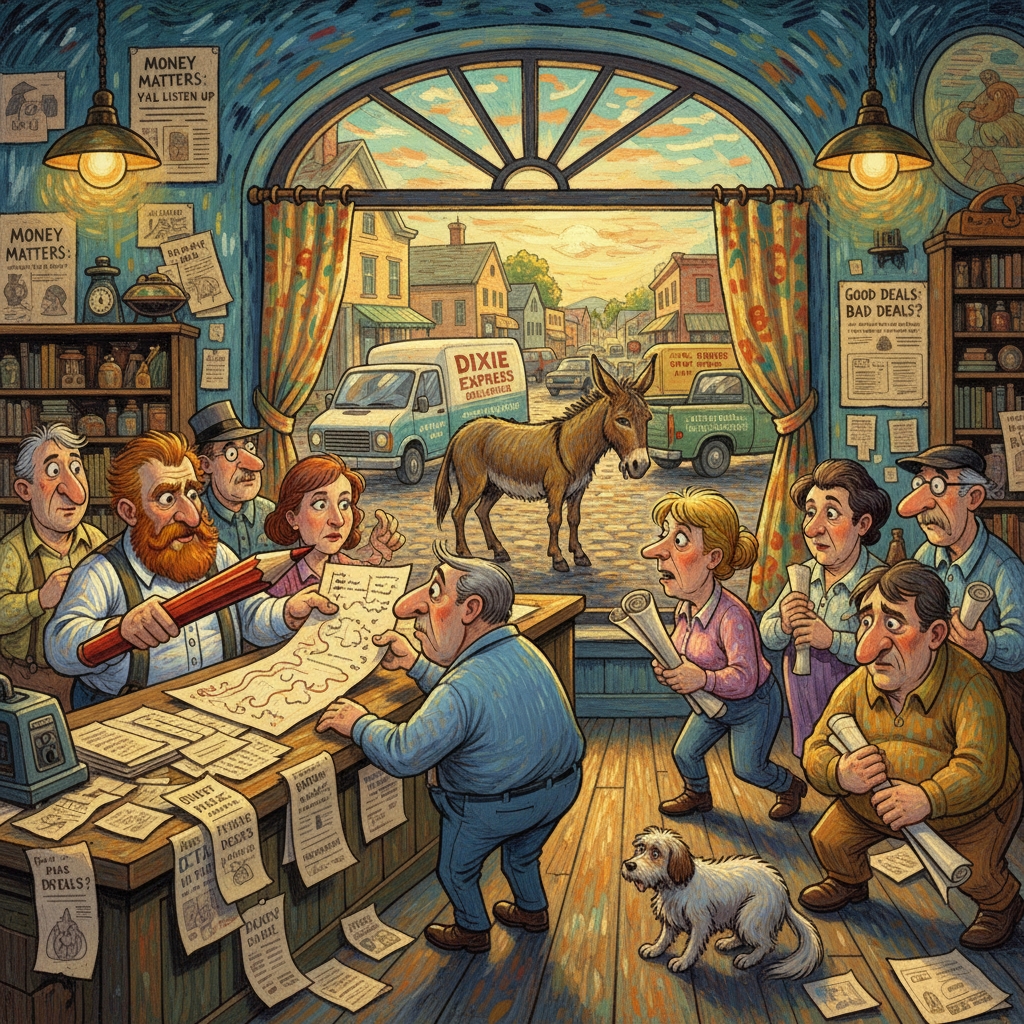
The bell over the door rang so often it sounded nervous. Copies of the survey lay on the front counter, flanked by draft flyers titled WHAT WE KNOW, WHAT WE DO NOT KNOW, and WHO MIGHT BENEFIT.
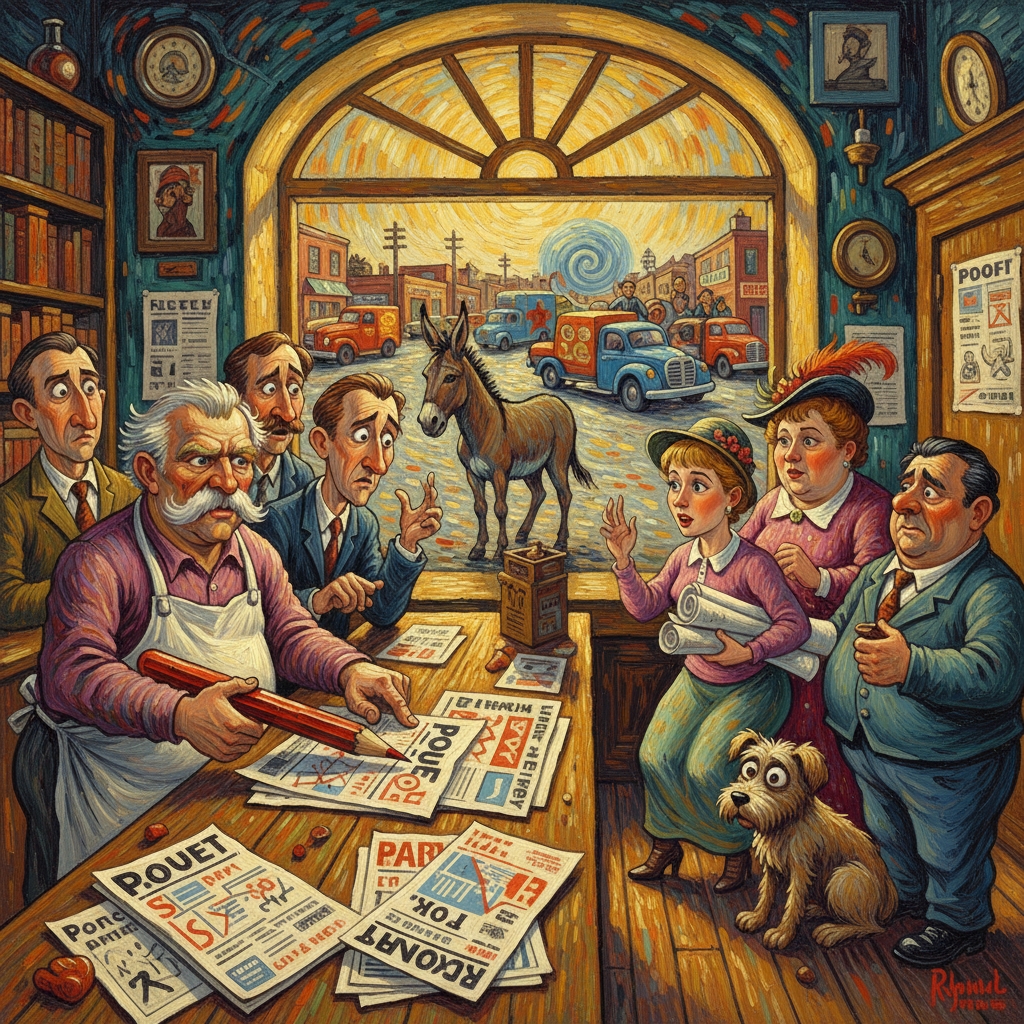
Chester stood behind the counter with a red pencil in his hand. “I will not print the phrase guaranteed prosperity. I will not print the phrase certain disaster. I will not print arrows unless they point to something measurable.”
Shelley Fawn Wexler sat on a stool near the copier, editing a post. “Can I say the town is at a crossroads?”
“No,” Chester said. “Every article says crossroads. We are a town, not a motivational poster.”
Doug Teeter plugged his laptop into an outlet. “I made a chart.”
Mabel entered immediately. “Unplug it.”
“You haven’t seen it.”
“I have seen charts before.”
Doug turned the laptop toward her. “This one shows projected tax revenue, probable job categories, infrastructure costs, risk uncertainty, and distribution of benefits.”
Mabel leaned in despite herself. “Why is that bar striped?”
“Unknowns.”
“Make unknowns bigger.”
Trixie came through the door carrying a corrected land-value estimate. “They already are bigger.”
Wade entered behind her, holding a list written on legal paper. “Here are farmer questions. Soil compaction. Spring monitoring. Road weight limits. Fence repair. Liability for livestock escape. Construction hours. Easement width. Restoration requirements.”
Chester took the paper. “Good. Specific fear prints better than general dread.”
Boot arrived with Daisy at his heels. “That sentence belongs in the town archive.”
Tiffany Annette Roark walked in with a stack of Town Hall letterhead. “Mayor Crowe wants the flyer neutral.”
Chester looked wounded. “Neutrality is difficult in 14-point type.”
Act VI – The Print Shop Reads The Fine Print
Dr. Cowgill leaned over the proof. “Perhaps classify claims into direct benefits, indirect benefits, direct costs, indirect costs, externalities, and unknowns.”
Maggie Sue arrived with coffee. “Or write it so humans read it.”
Evelyn Grace Tipton studied the layout. “People need a plain question at the top. Something like: When money comes to town, where does it stop?”
The shop went quiet.
Chester wrote it down. “That one prints.”
Sonny Morales pointed through the window. “Speaking of stopping, the mule is blocking Main Street.”
Everyone looked.
The mule stood outside the Print Shop, facing traffic, indifferent to commerce. A delivery van waited on one side. Coach Freddie’s truck waited on the other. Daisy barked through the glass.
Sheriff Peeler and Kenny Joe arrived on foot from the office.
“Wade,” Sheriff Peeler called, “your mule has created a two-block economic slowdown.”
Wade stepped outside. “He does not respond to projections.”
Coach Freddie leaned from his truck window. “Somebody offer him a tax abatement.”
Mabel, standing in the Print Shop doorway, called out, “He’d just stand there with better paperwork.”
Jolene Pickett approached from the sidewalk, carrying a laptop bag. “Actually, this is a good model.”
Sheriff Peeler turned. “Please do not encourage the mule.”
“No, listen,” Jolene said. “The survey says benefits flow through town. But if something blocks the flow, the benefit stops right there. Maybe the question is not just who benefits, but what blocks the benefit from reaching everyone else.”
Boot smiled. “Now we’re getting somewhere.”
Trixie stepped onto the sidewalk. “So the flyer should include benefit pathways.”
Wade nodded. “And blockage points.”
Doug’s eyes lit up. “I can diagram that.”
Mabel pointed at him. “On paper.”
Doug deflated. “Fine.”
Chester marched outside with a pencil behind his ear. “Fifth decision: the public packet will show not just totals, but pathways. Money in, money out, money stuck, money promised, money hoped for, money somebody already spent in their imagination.”
The mule flicked his ears.
RT Mullins, standing beside Sonny’s truck, held up a peppermint. “May I?”
Wade sighed. “If it moves him.”
RT offered the peppermint. The mule accepted it, considered the new information, and stepped onto the sidewalk.
Traffic resumed.
Maggie Sue watched from the doorway. “That is the first confirmed incentive program in this whole mess.”
Act VI – The Print Shop Reads The Fine Print
Act VII – The Town Hall Reads The Room
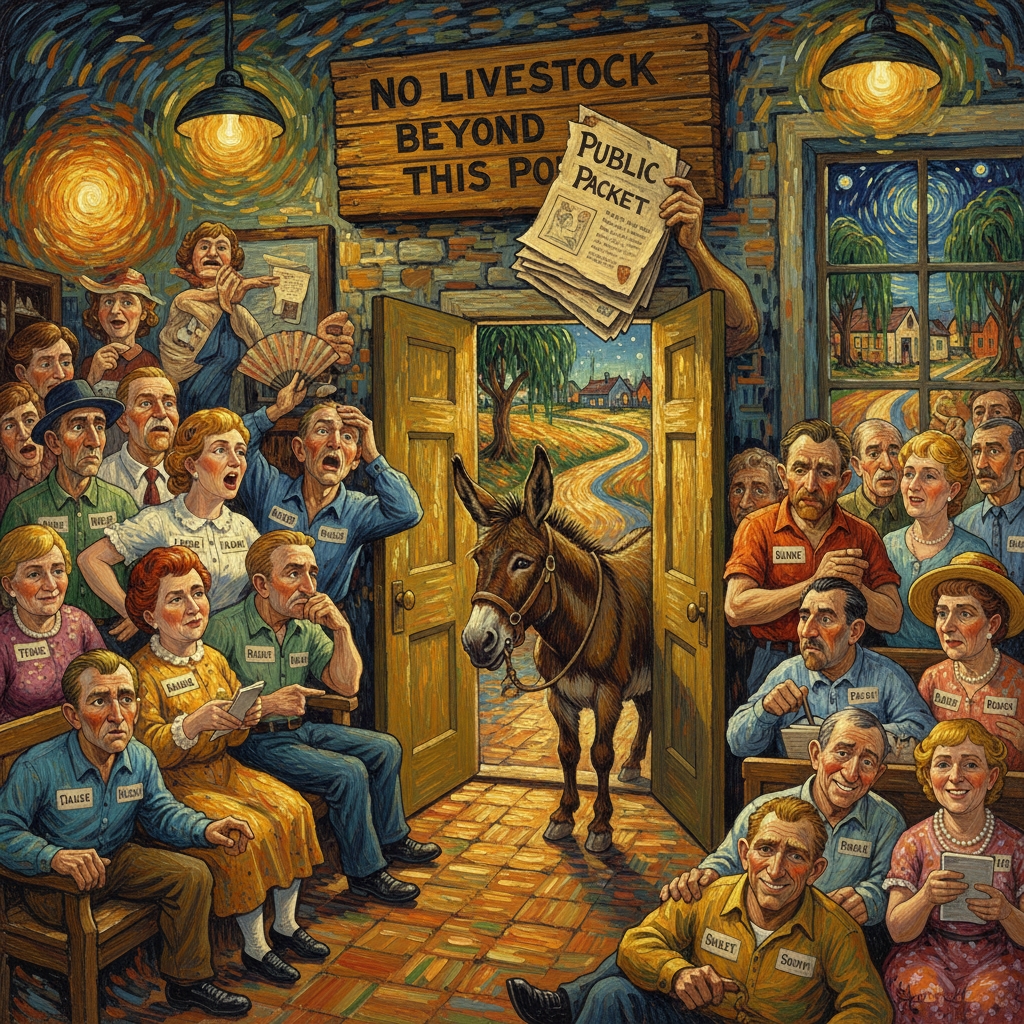
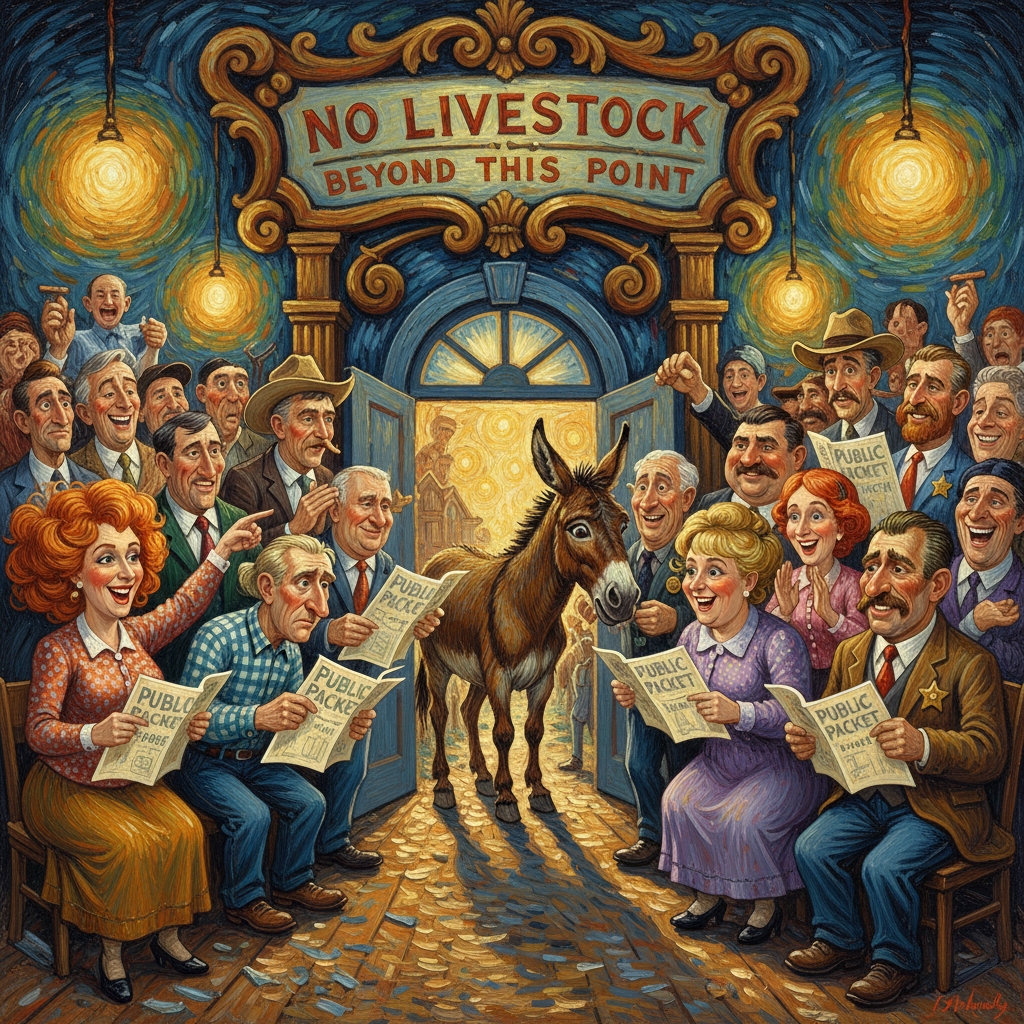
By Friday night, Town Hall had more chairs, more copies, more opinions, and one official sign on the door reading NO LIVESTOCK BEYOND THIS POINT, which everyone understood to be aspirational.
Mayor Bea Crowe opened the meeting with the bell.
“This is the public packet review,” she said. “Not a final decision. Not a cage match. Not an audition for cable news.”
Tiffany read the heading aloud. “When money comes to town, where does it stop?”
A murmur moved through the room.
Chester’s flyer had done what Chester liked print to do: it slowed people down. The first page showed projected benefits. The second showed possible costs. The third showed who might gain directly, who might gain indirectly, who might pay directly, and who might be affected without being paid at all.
Trixie stood first. “As the realtor in this discussion, I want to state my incentive plainly. Higher land values can benefit my profession. That does not make the numbers false, but it means you should know where I stand.”
Mabel looked at her for a long moment. “That was respectable.”
“Do not sound so surprised,” Trixie said.
Wade stood next. “As the farmer, I might benefit if I sell an easement. I might also carry risks that do not show up in the sale price. That does not make me noble. It makes me exposed.”
Boot nodded. “Good.”
Jolene stood. “As someone who wants tech opportunity here, I benefit if better broadband and jobs come. But I do not want opportunity built by pretending costs are imaginary.”
Clovis raised his hand. “As someone who distrusts large systems, I benefit socially when I am proven right. I admit this reluctantly.”
Doug looked at him. “That is huge personal growth.”
Clovis pointed. “Do not make me regret it.”
Pastor Peeler stood near the aisle. “As a pastor, I benefit when neighbors remain neighbors after disagreement. I lose when certainty becomes a substitute for charity.”
Sister Lila Mae added, “And I benefit when meetings end before my cobbler crust collapses.”
Sheriff Peeler stood at the wall. “As sheriff, I do not benefit from rumor, blocked roads, or livestock-based protest.”
Kenny Joe raised a hand. “As officer, I second that.”
Act VII – The Town Hall Reads The Room
Shelley stood, phone lowered. “As a local page admin, I benefit from engagement. I need to be honest that conflict gets clicks. So I will post the packet before I post anybody’s outrage.”
Tiffany looked touched. “Thank you.”
Shelley added, “But I reserve the right to use one tasteful mule photo.”
Mayor Crowe sighed. “Approved.”
Brett Crenshaw stood. “As a wellness business owner, I benefit if growth brings customers.”
Alyssa stood beside him. “And we lose if growth strips away the quality of life people come here for.”
Coach Freddie crossed his arms. “As a coach, I benefit when people understand a game plan. This town has been running plays without knowing who’s carrying the ball.”
Maggie Sue called from the back. “As a diner owner, I benefit from construction crews eating breakfast. I lose if my regulars can’t afford coffee because everything went up except their checks.”
Evelyn Grace said, “As a citizen, I benefit when the town tells the truth in complete sentences.”
Dr. Cowgill raised his hand. “As an academic, I benefit when complexity is acknowledged, although I recognize I sometimes personally contribute to it.”
Mabel said, “That’s the most accurate thing you’ve said all week.”
Sonny Morales stood. “As a mechanic, I benefit from more trucks breaking down. But I also know more trucks mean more road wear, more noise, more traffic, and more folks saying they’ll be quick while blocking my bay.”
RT Mullins lifted his hand. “As a man with no official stake, I benefit from snacks and spectacle.”
Mayor Crowe stared at him.
RT lowered his hand. “And from transparent governance.”
Boot stood last. Daisy stood with him, because she thought standing meant leaving.
“As a retired postmaster,” Boot said, “I have watched promises travel. Some arrive. Some get forwarded. Some vanish because the address was written wrong from the start. This survey is an envelope. We still have to see what’s inside, who it’s addressed to, and who pays postage.”
Daisy barked once.
Mabel nodded. “The hound supports postal accountability.”
Just then, from outside, came the bray.
Everyone froze.
Kenny Joe went to the window. “He is at the door.”
Mayor Crowe rang the bell once. “We are not letting the mule in.”
The door creaked open.
The mule’s head appeared.
Sheriff Peeler said, “That animal has better timing than most candidates.”
Wade rose. “I’ll get him.”
Boot held up a hand. “Wait.”
The mule stood half outside, half inside, blocked by the sign that said NO LIVESTOCK BEYOND THIS POINT.
He did not enter.
He did not leave.
He simply occupied the threshold.
Dr. Cowgill whispered, “A liminal mule.”
Mabel whispered back, “Do not.”
Boot looked around the room. “Sixth decision: no final recommendation until we know the thresholds. Water threshold. tax threshold. noise threshold. road threshold. job threshold. local benefit threshold. The point where support stops. The point where opposition softens.”
Mayor Crowe slowly nodded. “That can go in the minutes.”
Tiffany wrote quickly. “Thresholds established as necessary for further review.”
The mule backed out on his own.
Daisy barked again, this time as if satisfied.
Act VII – The Town Hall Reads The Room
Act VIII – The Porch Reads The Neighbor
Saturday morning found the town divided into smaller conversations, which was how Sequatchie Crossing processed anything too large for one room.
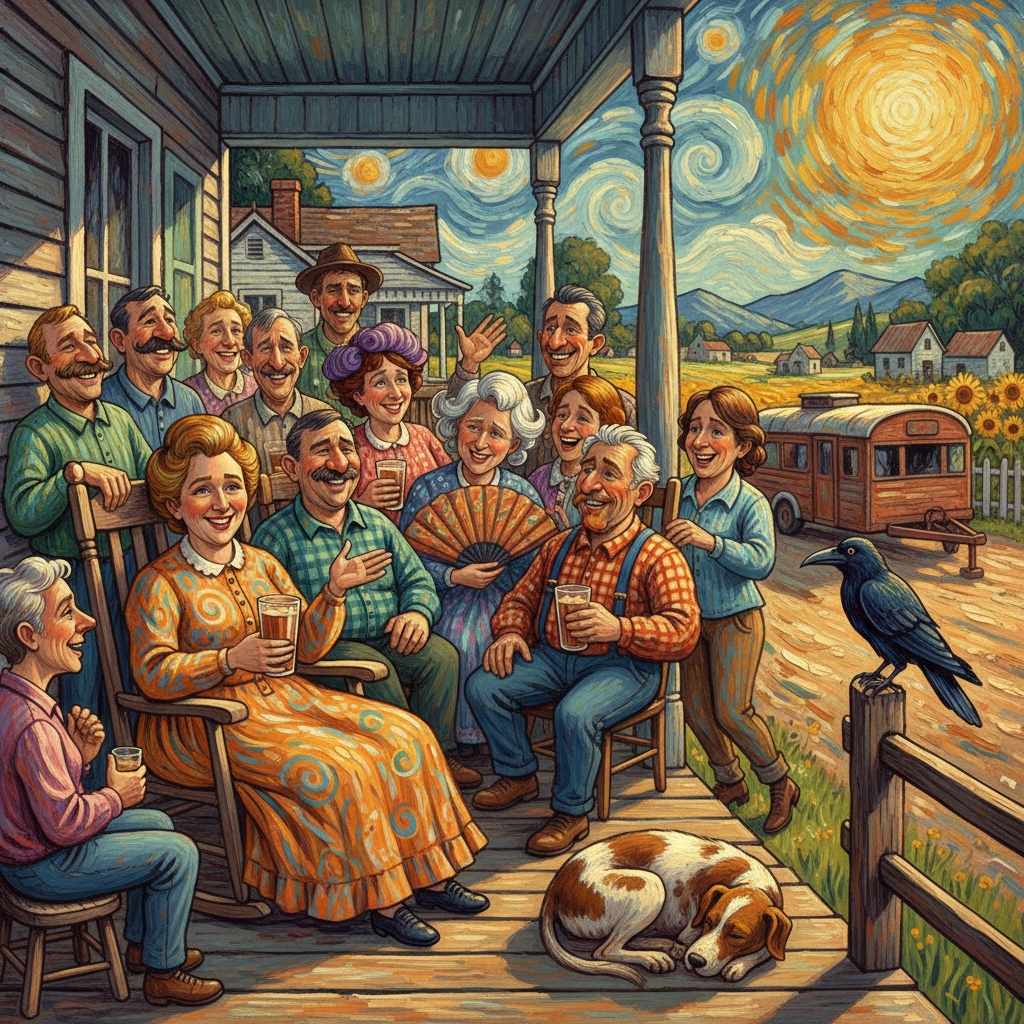
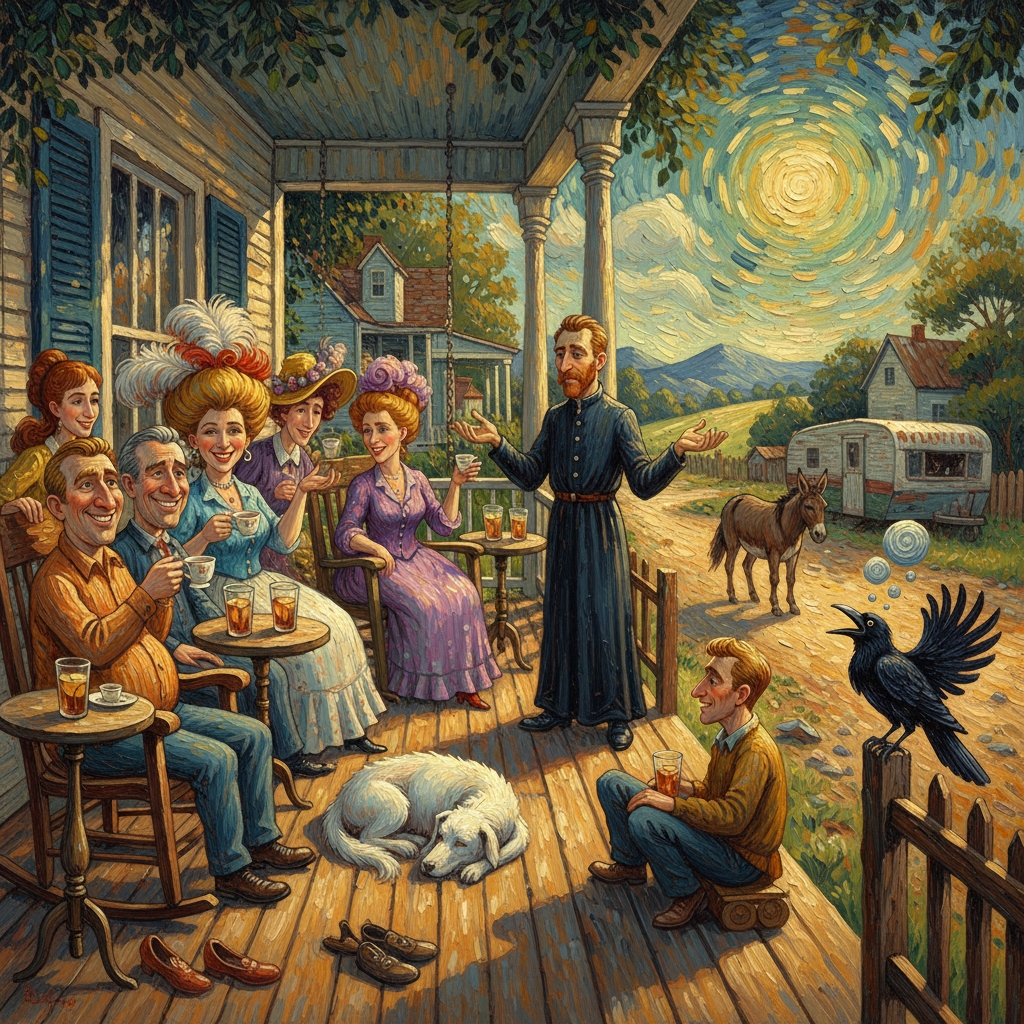
On Mabel Dean Ashcroft’s porch, the chairs faced the street, the tea was sweet, and the opinions were served without ice.
Mabel sat with Boot, Trixie, Wade, Pastor Peeler, Sister Lila Mae, Maggie Sue, and Evelyn Grace. Daisy slept under the swing, dreaming of policies made entirely of sausage.
Across the street, the mule stood beside Wade’s trailer as if waiting to be accused of leadership.
Mabel poured tea. “I still don’t trust it.”
Trixie accepted a glass. “The project?”
“The project, the survey, the partnership, and any man who says revenue stream while wearing loafers.”
Wade smiled. “That’s broad.”
“I have lived long enough to earn broad.”
Pastor Peeler rocked slowly. “Suspicion can protect. It can also trap.”
Mabel looked at him. “So can optimism.”
Trixie nodded. “Yes.”
That answer surprised Mabel more than an argument would have.
Wade leaned forward. “I keep thinking about that question. Who benefits financially? I started out angry because I thought the answer was everybody but me. Then Trixie pointed out I might get paid. That made me angrier.”
Evelyn Grace tilted her head. “Why?”
“Because then I had to wonder whether my concern was pure. I don’t like that.”
Boot watched a crow land on the fence. “Nobody’s concern is pure. Mine comes with old memories. Trixie’s comes with commission structure. Wade’s comes with land. Mabel’s comes with guarding the town from fools. Pastor’s comes with saving our souls from ourselves.”
Sister Lila Mae sipped tea. “And mine comes with not wanting to hold another bake sale for a roof the tax base ought to fix.”
Maggie Sue laughed. “There’s the gospel.”
Trixie looked toward the pasture beyond town. “I don’t want Sequatchie Crossing frozen in amber. I also don’t want it sold by the acre to people who think a town is just a power outlet with zoning.”
Mabel softened, but only a little. “That sentence buys you one cookie.”
Act VIII – The Porch Reads The Neighbor
Wade looked at Trixie. “What would make you oppose it?”
Trixie answered without looking at the survey. “If local benefits are vague, if protections are weak, if the tax structure gives away too much, if water risk is dismissed, if the permanent jobs are mostly imported, or if the developer refuses transparency.”
Boot nodded. “Good. Now you have thresholds.”
Trixie turned to Wade. “What would make you support it?”
Wade stared out at the mule. “Spring protection in writing. Road bonds. Fence liability. Independent water testing. Real local hiring. Tax relief for nearby fixed-income residents. And no pretending that a check cures every wound.”
Mabel said, “That sounded almost constructive.”
“I hated every second of it,” Wade said.
Pastor Peeler smiled. “That is often how wisdom feels when it first arrives.”
A crow cawed from the fence.
Clovis, who had apparently been standing behind Mabel’s hydrangeas for several minutes, stepped into view. “That crow has been carrying information between the farm and Town Hall.”
Mabel nearly dropped her tea. “Clovis Hensley Strickland, why are you in my shrubs?”
“Listening to birds.”
Boot looked at him. “Anything useful?”
“The crow is not a reliable source,” Clovis said. “But he is fast.”
Shelley Fawn Wexler walked up the sidewalk, phone in hand. “I just posted the public packet. Comments are mixed, but less feral than usual.”
Tiffany arrived behind her. “Because I made her remove three adjectives.”
Doug followed with a printed diagram. “I made a non-digital benefit-flow chart.”
Mabel inspected it. “This is paper.”
“Yes.”
“No animations?”
“No.”
“No login?”
“No.”
Mabel nodded. “You may stay on the porch.”
Sonny and RT pulled up in Sonny’s tow truck. Coach Freddie’s pickup came behind them. Brett and Alyssa walked over from the corner, carrying a basket of protein muffins no one had asked for.
Mayor Bea Crowe crossed from the sidewalk, rubbing her temples. “I was told this was a porch conversation, not a quorum.”
Boot gestured to the street. “In Sequatchie Crossing, the porch is where democracy goes when Town Hall gets tired.”
Mayor Crowe sat. “Then let democracy decide what goes to the developer.”
Mabel looked around. “A list.”
Wade nodded. “Thresholds.”
Trixie added, “Disclosure of incentives.”
Jolene, arriving last with her laptop bag, said, “Training commitments.”
Chester Ray, who had brought proof copies, said, “Plain-language answers.”
Sheriff Peeler stepped onto the porch from the side path with Kenny Joe behind him. “And a mule-free traffic plan.”
Daisy barked.
Everyone looked across the street.
The mule had not moved.
“Seventh decision,” Boot said. “We ask better questions before anybody sells certainty.”
No one objected.
The crow cawed again, possibly in favor, possibly because crows enjoy proceedings.
Act VIII – The Porch Reads The Neighbor
Act IX – The Survey Reads The Town Back
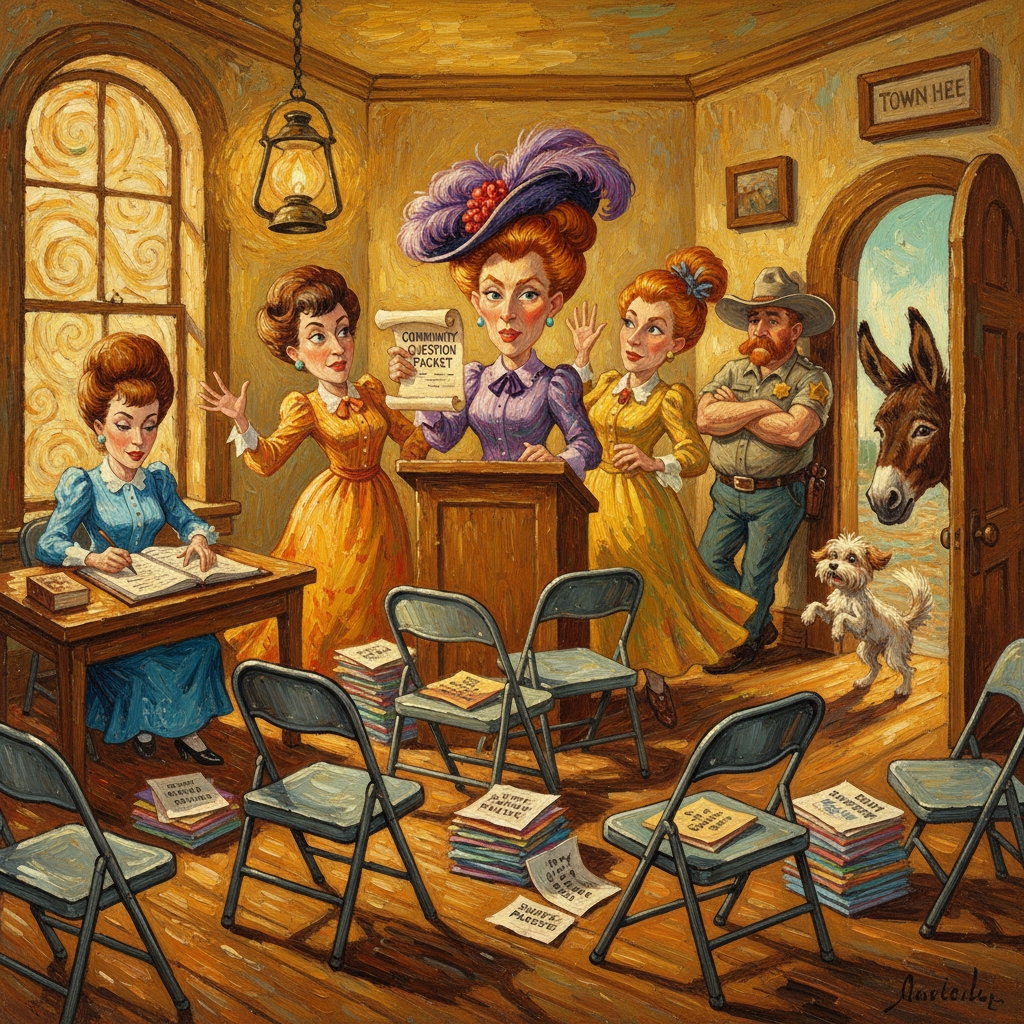
The following Monday, Town Hall filled again, but the air had changed. It was not agreement. Sequatchie Crossing rarely wasted energy on that. It was closer to shared irritation with better formatting.
Mayor Crowe stood beside a new document titled COMMUNITY QUESTIONS FOR ECONOMIC IMPACT REVIEW.
Tiffany sat ready to record. Sheriff Peeler guarded the back wall. Kenny Joe guarded the door, mostly from the mule.
Trixie, Wade, Boot, Mabel, Clovis, Jolene, Chester, Shelley, Pastor Peeler, Sister Lila Mae, Maggie Sue, Sonny, RT, Dr. Cowgill, Evelyn Grace, Coach Freddie, Brett, Alyssa, and Doug sat together near the front, which made several townspeople whisper that a coalition had formed.
Mabel heard them and turned around. “It is not a coalition. It is a temporary outbreak of adulthood.”
Mayor Crowe began. “The town has prepared a response to the survey. Not a rejection. Not an endorsement. A demand for clearer accounting.”
Trixie stood. “The first section asks who benefits directly and financially.”
Wade stood beside her. “The second asks who carries direct risk.”
Jolene stood. “The third asks what investments will actually improve local broadband, workforce training, and future opportunity.”
Chester stood. “The fourth requires all promises to be written in plain language large enough for a tired person to read.”
Maggie Sue called, “Amen.”
Dr. Cowgill stood. “The fifth distinguishes projections from commitments, modeled benefits from guaranteed benefits, and temporary construction activity from permanent economic capacity.”
Coach Freddie whispered, “That one needs a halftime break.”
Evelyn Grace stood. “The sixth asks what happens if the forecast is wrong.”
The room grew still.
Act IX – The Survey Reads The Town Back
Boot rose slowly. “That may be the most important question. Boom stories usually start with numbers and end with excuses. If the good numbers fail, who absorbs the disappointment?”
Clovis stood. “And if the bad predictions fail, who admits they exaggerated?”
Mabel stood. “Do not look at me. I admit nothing until dessert.”
Pastor Peeler rose. “The seventh asks how the town will protect relationships during the review.”
Sister Lila Mae stood. “Because a project can be denied and still leave bitterness, or approved and still leave bitterness, and bitterness is the one industry every town can grow without incentives.”
Shelley stood. “The eighth asks for transparent communication before social media fills the silence with raccoon-level interpretation.”
Doug stood. “The ninth asks for public data standards.”
Mabel glared.
Doug added quickly, “On paper also.”
Sonny stood. “The tenth asks who pays for road damage.”
RT stood beside him. “And whether snacks will be provided at future meetings.”
Mayor Crowe stared.
RT cleared his throat. “Public participation support.”
Brett stood. “The eleventh asks how growth can support local wellness and quality of life.”
Alyssa stood. “Not just financial health. Community health.”
Sheriff Peeler stood from the back. “The twelfth asks how rumors will be corrected quickly and publicly.”
Kenny Joe added, “Preferably before I have to answer whether server farms attract coyotes.”
“They don’t,” Doug said.
Clovis raised a finger. “That we know of.”
Tiffany finished writing and looked at Mayor Crowe. “The document is ready for a motion.”
Mayor Crowe looked over the room. “Do we have a motion to send this to the developer, the county review board, the utility authority, and the public?”
Trixie lifted her hand. “So moved.”
Wade raised his. “Second.”
Mabel looked between them. “Well, I’ll be.”
Mayor Crowe smiled. “All in favor?”
Hands rose across the room. Not every hand. Enough hands.
“All opposed?”
A few hands rose. Clovis half-raised his, then lowered it.
Mayor Crowe looked at him. “Mr. Strickland?”
“I oppose trust,” Clovis said. “But I support questions.”
“Recorded,” Tiffany said.
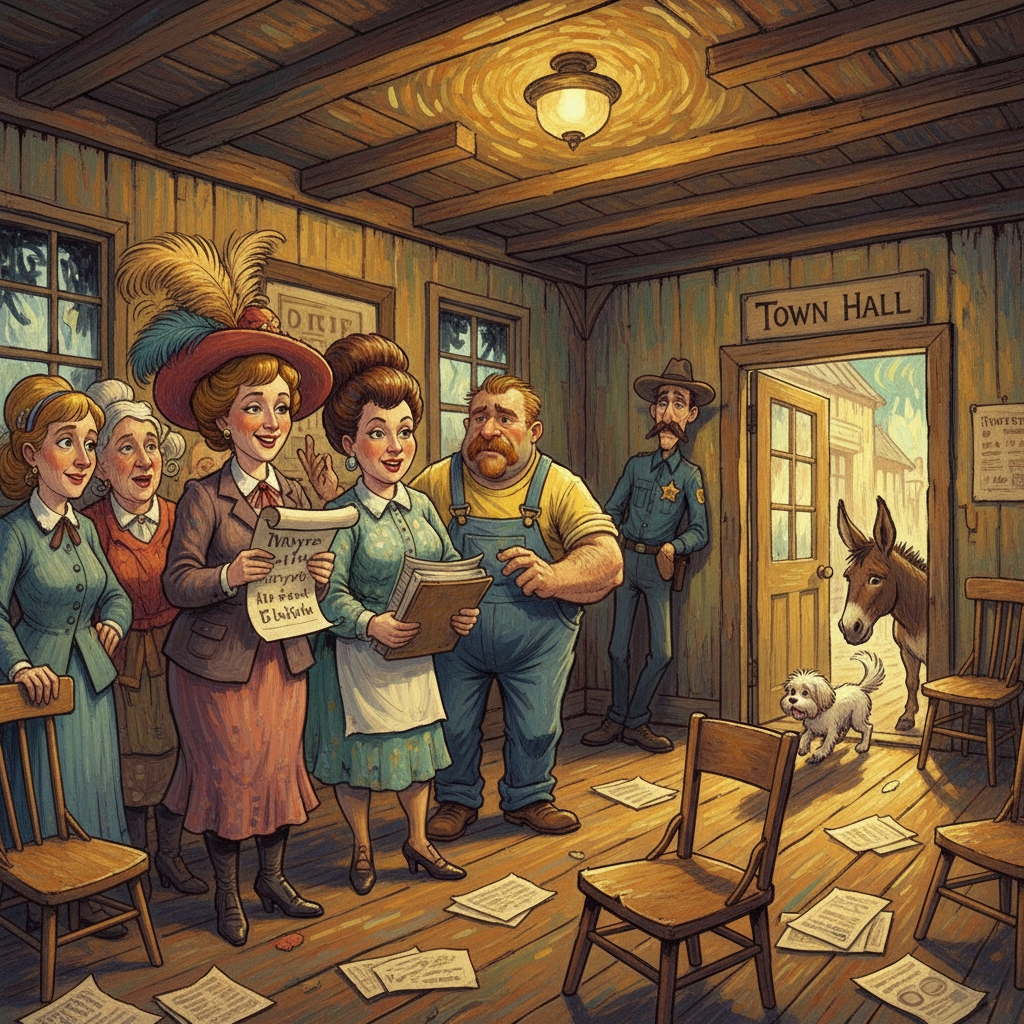
Outside, something heavy bumped the door.
Kenny Joe turned. “Sheriff.”
The door opened three inches.
The mule’s nose appeared.
Daisy barked from Boot’s feet and trotted to the door. The mule did not enter. Daisy sniffed him. He sniffed Daisy. Both animals appeared unimpressed with the democratic process.
Wade walked to the door and placed a hand on the mule’s forehead. “You missed the vote.”
The mule brayed.
Boot smiled. “He abstained.”
Mayor Crowe rang the bell one final time. “Motion carries. The town sends questions before conclusions.”
The room did not cheer. Sequatchie Crossing was not a cheering kind of town unless somebody won a raffle or the power came back on during July.
Instead, people stood, folded chairs, gathered papers, and looked at one another with the wary respect of neighbors who had argued hard and still had to wave at the mailbox.
Trixie turned to Wade. “I still think there may be real opportunity.”
Wade nodded. “I still think there may be real harm.”
Mabel stepped between them. “Congratulations. You have both graduated from slogans.”
Daisy barked.
The mule turned and walked away from Town Hall, ignoring the survey, the forecasts, the fears, the hopes, the incentives, the objections, and the entire idea that the future could be domesticated by columns on a page.
Act IX – The Survey Reads The Town Back
Epilogue – The Forecast Nobody Could Sell
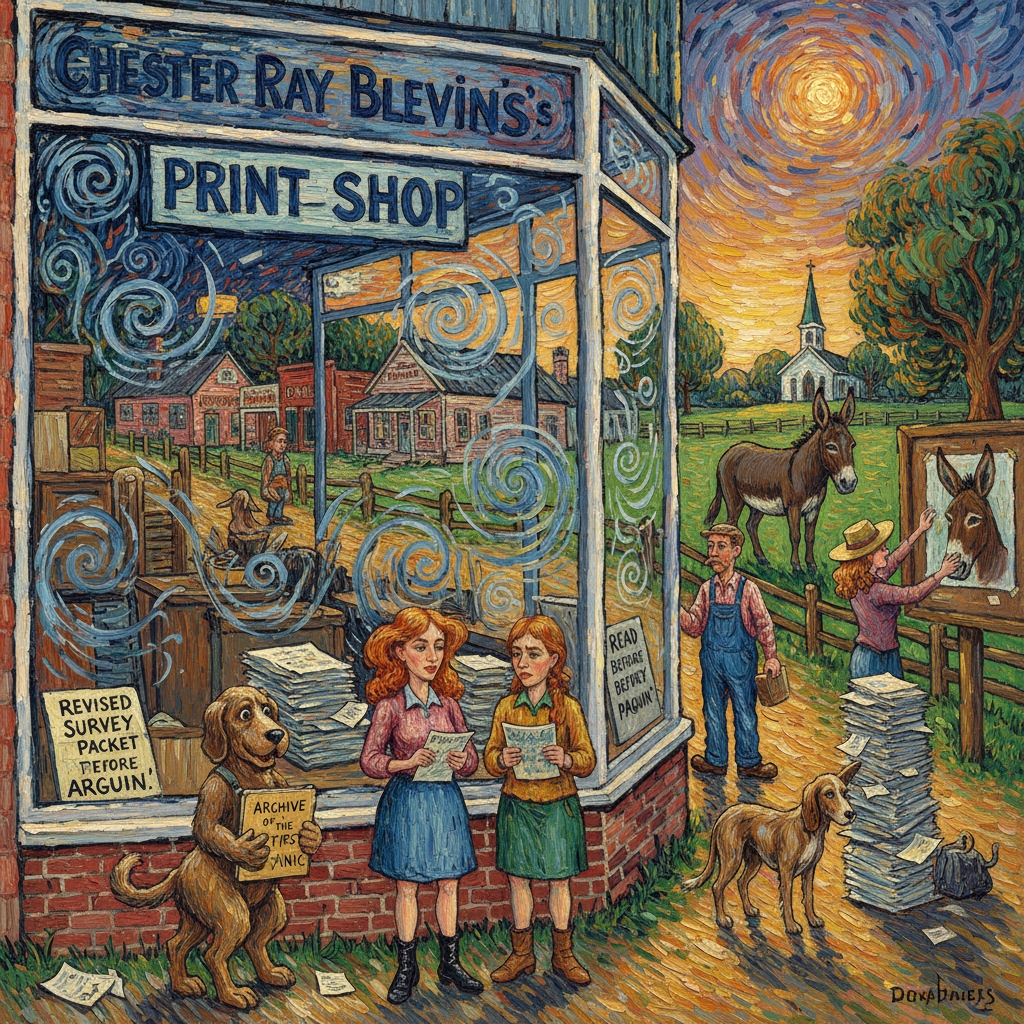
Three days later, the revised survey packet sat in the front window of Chester Ray Blevins’s Print Shop beside a handwritten sign:
READ BEFORE ARGUING.
ARGUE AFTER READING.
NO REFUNDS ON OPINIONS.
At the Sequatchie Crossing Diner, Maggie Sue kept one copy by the register and one by the pie case, because people were more honest near pie. Trixie Jo Bartlett continued showing land, but she now carried a one-page disclosure explaining her stake in the issue. Wade Langston continued mending fences and checking the spring, but he also agreed to serve on the review committee, mostly so nobody could describe his pasture as vacant land without hearing about it.
At Town Hall, Mayor Bea Crowe and Tiffany Annette Roark received three new letters, two angry calls, one thoughtful email, and a postcard that said only, “WHAT ABOUT THE HUM?” with no return address.
At the sheriff’s office, Sheriff Peeler and Officer Kenny Joe Teeter taped up a new sign beneath the crooked one:
RUMORS ARE NOT ILLEGAL.
ACTING ON THEM MAY BECOME COMPLICATED.
Pastor Arnold Peeler preached that Sunday on stewardship, temptation, and the danger of believing every blessing arrives labeled as one. Sister Lila Mae “Hallelujah” Pruitt brought cobbler and said the sermon was good but could have used more specifics about tax abatements.
Doug Teeter made three more charts, two of which Mabel refused to view on principle. Shelley Fawn Wexler posted the mule photo with the caption “Local Resident Blocks Economic Forecast Until Further Notice,” and it became the most shared civic education post in town history.
Dr. Neil Cowgill wrote a fourteen-page commentary titled Distributional Ambiguity In Rural Development Narratives, which only Evelyn Grace Tipton read all the way through. She told him it needed more paragraphs and fewer civilizations.
Coach Freddie Stubblefield described the whole affair as “a possession game with weather delays,” which nobody understood but everyone accepted as Freddie’s way of caring.
Brett and Alyssa Crenshaw proposed a community resilience workshop. Mabel said she would attend if they promised not to say detox.
Clovis Strickland remained suspicious, but his suspicion had become more organized, which worried some people and comforted others.
Boot Barnes kept the original coffee-stained survey in a folder marked DATA CENTER – FIRST PANIC, because he believed every town needed an archive of the moment before it learned to ask better questions.
As for the mule, he returned to Wade’s pasture and resumed his main occupation, which was standing exactly where he wished to stand.
Several people claimed that meant he opposed the data center.
Several claimed it meant he supported landowner rights.
Doug suggested the mule represented systems friction.
Mabel said the mule represented the mule.
Daisy the hound, after careful investigation, concluded that none of the forecasts were edible.
And in Sequatchie Crossing, that was as close to consensus as anyone expected to get.
Epilogue – The Forecast Nobody Could Sell
Disclaimer
Sequatchie Crossing is a fictional town, and every character, incident, argument, survey, mule, porch discussion, church meeting, diner conversation, Town Hall proceeding, sheriff’s office rumor sheet, and economic forecast in this story is fictional. No real residents, public officials, businesses, farms, churches, developers, or organizations are depicted.
This story is satire. It is intended to explore how small towns wrestle with growth, fear, opportunity, property values, infrastructure, trust, and money when a proposed project promises benefits but also raises questions. Any resemblance to real people, real meetings, real surveys, real animals, real disputes, or real economic development projects is coincidental.
The mule’s opinions, if any, remain his own.
Disclaimer – The Realtor, The Farmer, And The Survey
Real Places Behind the Ruckus – From The Dunlap Directory
Real Places Behind the Ruckus – From The Dunlap Directory
Yes, this story was fictional; even the parts that weren’t true. These places? Absolutely real. Stop by, support local, and keep the Wi-Fi away from livestock:
- Mary Kay with Natalie
- Superior Tire & Auto
- Daisy Church of God Ministry
- Whitwell Dunlap Buy Sell Trade
- Sequatchie Cave State Natural Area
- Circle K
- Sequatchie Valley Insurance LLC
- Clark’s Bakery at Stone Cave
- Artistic Expressions Salon
- Sequatchie County Veterans Service Office
- Davis Pond Camping Area
- Griffith Elementary School
- JV’s BBQ
- Cedar Springs Bakery
- Austin Mitchel Jennifer
- Big Dog Development
- First Baptist Church Soddy-Daisy
- Restoration Pointe Church of God
- C.F Cleaning Services
- Old Dunlap General Store

Real Places Behind the Ruckus – From The Dunlap Directory
At Sequatchie Crossing, we tell the stories of Sequatchie Crossing.
Please share this post with your friends, family, or business associates who may want follow the news from Sequatchie Crossing.

0 Comments