


Acknowledgment Introduced Without Immediate Response
By Tom Seest
At Sequatchie Crossing, we tell the stories of Sequatchie Crossing.
Please share this post with your friends, family, or business associates who may want follow the news from Sequatchie Crossing.
🎤 Audio Overview
Problem Finally Said Out Loud, Room Goes Quiet
Act I – The Sentence Lands
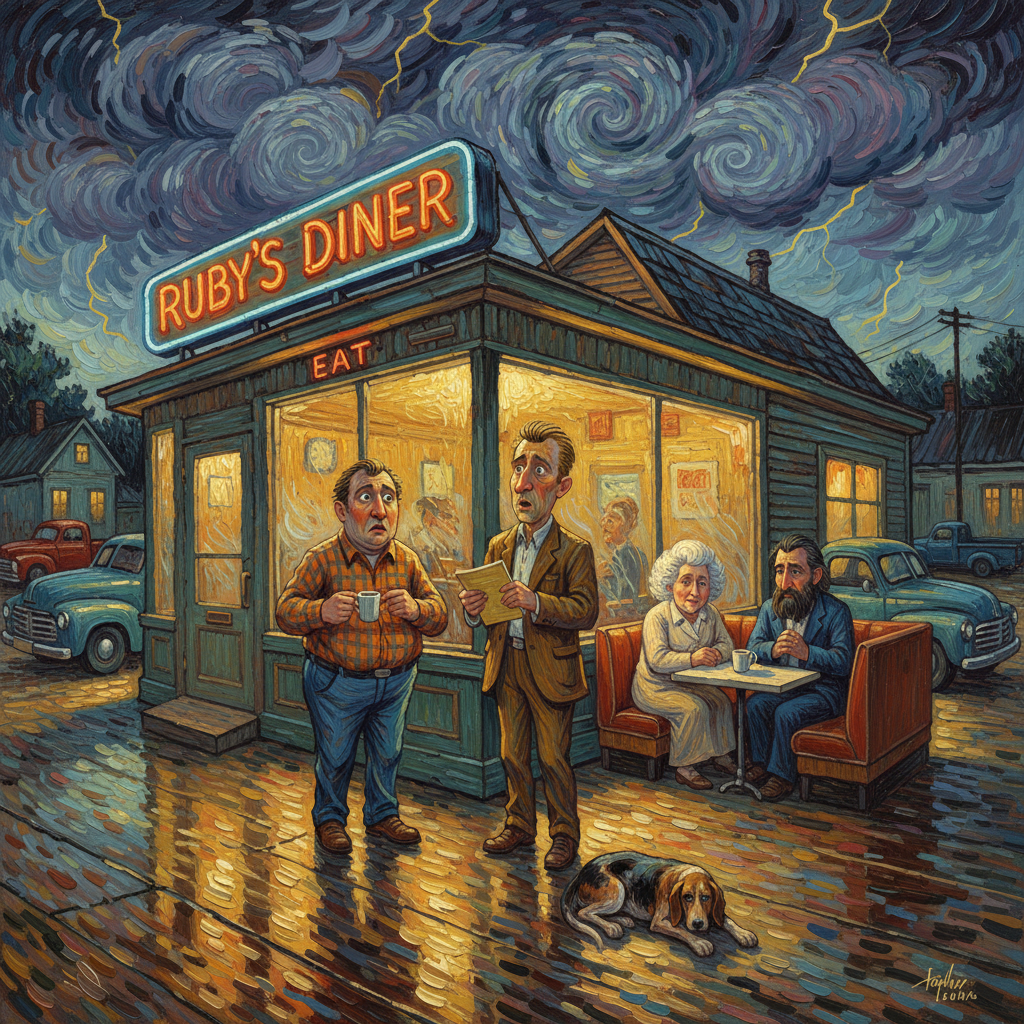
By seven-thirty on a Thursday morning, the counter at Ruby’s Diner had already split into its usual camps.
Truck men sat near the windows facing Main Street like weather monitors. Church women occupied the long side booth beneath the crooked painting of a barn nobody recognized. The younger crowd drifted near the coffee station pretending they were in a hurry while remaining seated for over an hour.
Outside, rain hung over Sequatchie Crossing without fully committing to itself.
Inside, the smell of bacon and burned toast settled over the room like municipal carpeting.
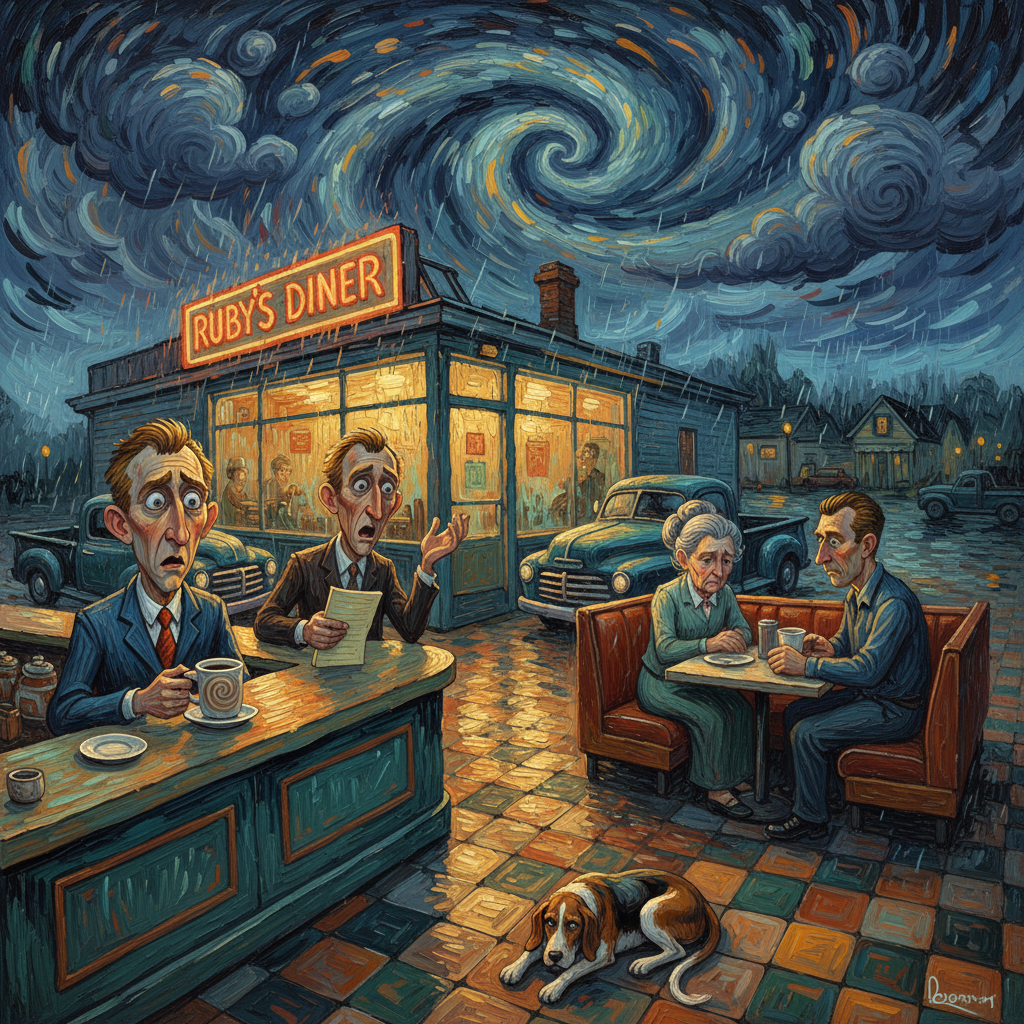
Eugene “Boot” Barnes sat at the far end of the counter turning a spoon slowly inside an empty mug. Daisy the hound lay beneath his stool with her chin on her paws, ears twitching every time the griddle hissed.
Across from him, Clovis Strickland scribbled furiously into a yellow legal pad labeled:
KNOWN IRREGULARITIES – SPRING EDITION
Nobody knew exactly what counted as an irregularity anymore. Clovis had long since stopped dividing between electrical outages, suspicious hawks, changing grocery prices, and people moving into town from places with sidewalks.
“All I’m sayin’,” Clovis muttered, not looking up, “is a man don’t install six cameras on a chicken coop unless he expects retaliation.”
“Or raccoons,” said Sonny Morales.
“Raccoons don’t coordinate.”
“They absolutely do,” said Mabel Dean Ashcroft from the booth. “I seen one carry off an entire coconut cake one Easter.”
“That was Doug Teeter,” Boot said.
Mabel paused.
“Well,” she admitted, “that does explain the footprints.”
Doug “Doughboy” Teeter looked wounded from three stools away.
“I was younger then.”
“You was forty-eight,” said Sheriff Peeler.
The room chuckled softly.
Pastor Arnold Peeler sat near the pie display quietly stirring sweetener into black coffee. He hadn’t said more than six words all morning.
That itself was considered notable.
At the booth, Tiffany Annette Roark scrolled through her phone while Shelley Fawn Wexler adjusted a stack of flyers advertising the upcoming “Community Alignment Forum,” a phrase Shelley had invented because “town meeting” sounded accusatory.
“We’re trying to create constructive dialogue,” Shelley explained.
“That phrase usually means somebody’s about to cry,” RT Mullins said.
“It means organized participation.”
“It means folding chairs and yelling.”
Coach Freddie Stubblefield leaned back with a biscuit in one hand.
“Honestly, that’s still better organized than football boosters.”
The diner laughed again.
Small laughter. Comfortable laughter.
The kind that fills space so nobody has to think too hard.
Then Maggie Sue Dillard walked in carrying a cardboard file box under one arm.
Rainwater dripped from her coat.
The room shifted slightly.
Maggie Sue wasn’t dramatic by nature, which made everyone nervous when she looked serious.
She set the box beside the counter.
“What’s in there?” Boot asked.
“Copies.”
“Of what?”
“Complaints.”
Nobody answered immediately.
Clovis kept writing.
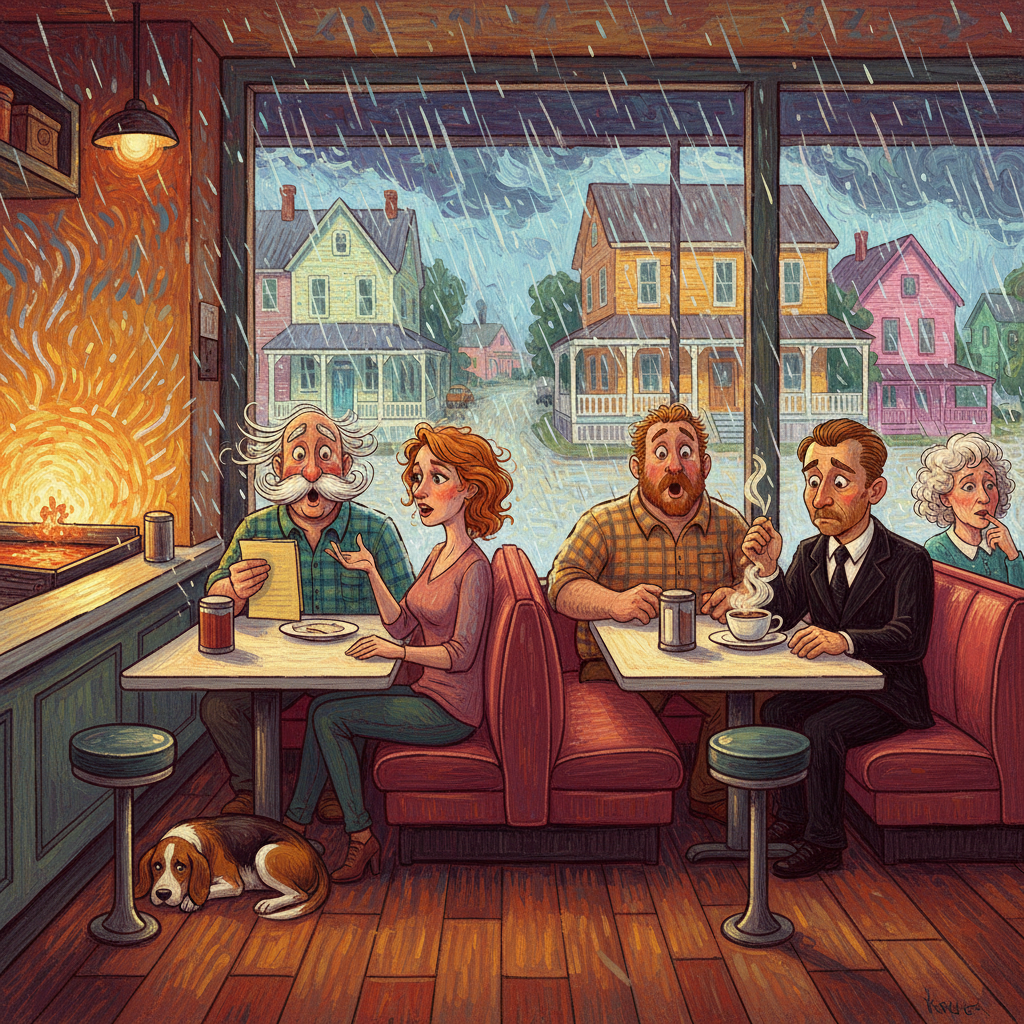
Maggie Sue removed several folders and spread them across the counter.
Noise complaints.
Road complaints.
Water pressure complaints.
Property line disputes.
School concerns.
Utility concerns.
Anonymous letters.
Act I – The Sentence Lands
Unsigned petitions.
Emails printed in all caps.
The folders stretched nearly the length of the counter.
Ruby herself stopped pouring coffee.
“Lord,” whispered Lurleen Davenport.
Sheriff Peeler cleared his throat.
“Well now,” he said carefully. “Folks got concerns from time to time.”
Maggie Sue nodded.
“Yes.”
Then she said it.
Plain.
Without decoration.
Without softening.
“We got too many people pretending things are fine because they’re scared naming the problem might make it real.”
The room stopped.
Not metaphorically.
Stopped.
The sizzling griddle suddenly sounded enormous.
Daisy lifted her head.
Outside, even the rain seemed to hesitate.
Clovis stopped writing mid-sentence.
Mabel Dean nodded once. Slowly.
Pastor Peeler lowered his spoon into his coffee and said absolutely nothing.
Boot looked around the diner like he expected someone else to answer first.
Nobody did.
Not immediately.
Not even Clovis.
And that was the moment everybody later agreed the room changed.
Not behavior.
Not decisions.
Just the room itself.
Like somebody had opened a window nobody noticed before.
Every animal in the diner stilled.
Daisy.
The old calico cat sleeping by the register.
Even the sparrows outside the window ledge.
Still.
Silent.
Waiting.
Nobody argued with Maggie Sue.
That was the strangest part.

Act I – The Sentence Lands
Act II – The Porch Committee
By noon the sentence had spread across town faster than weather warnings.
Not because anyone repeated it accurately.
But because Sequatchie Crossing possessed a communication system more efficient than fiber internet and more destructive than state politics.
Porches.
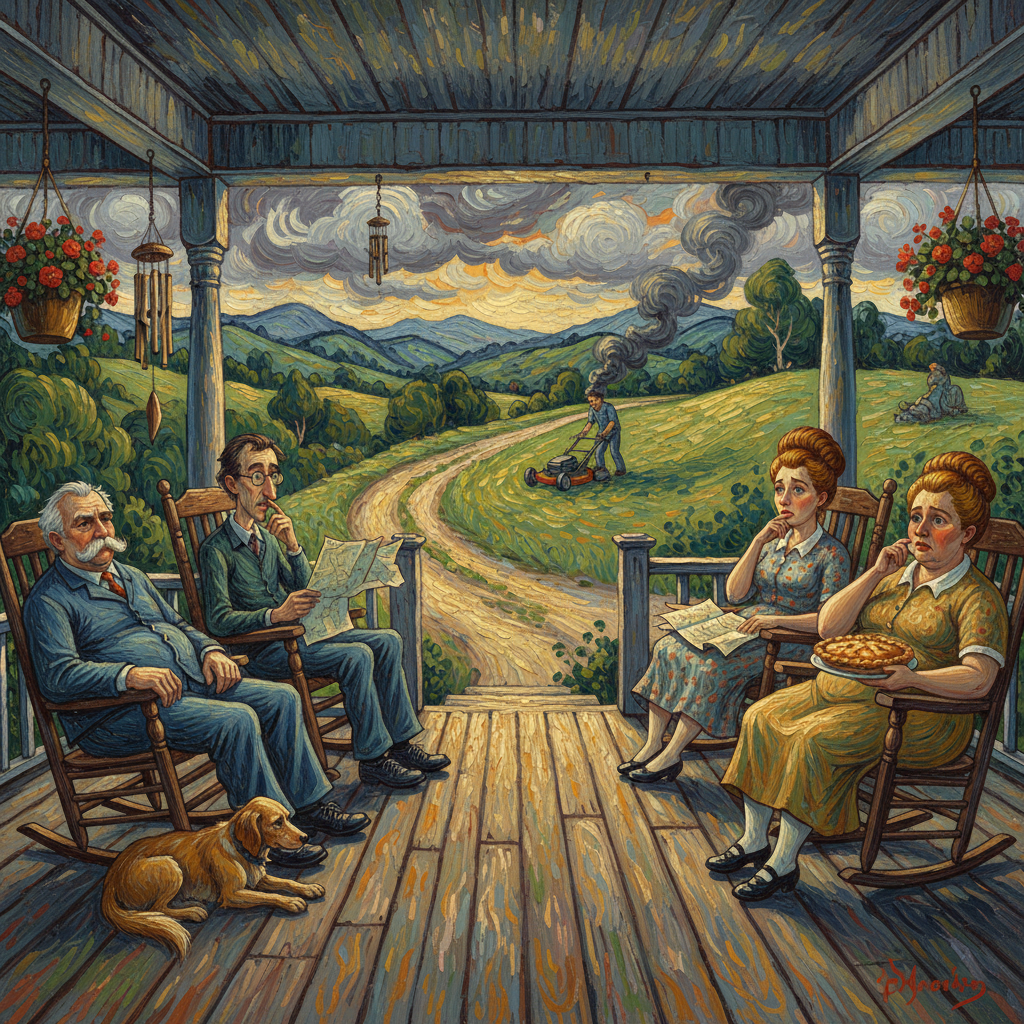
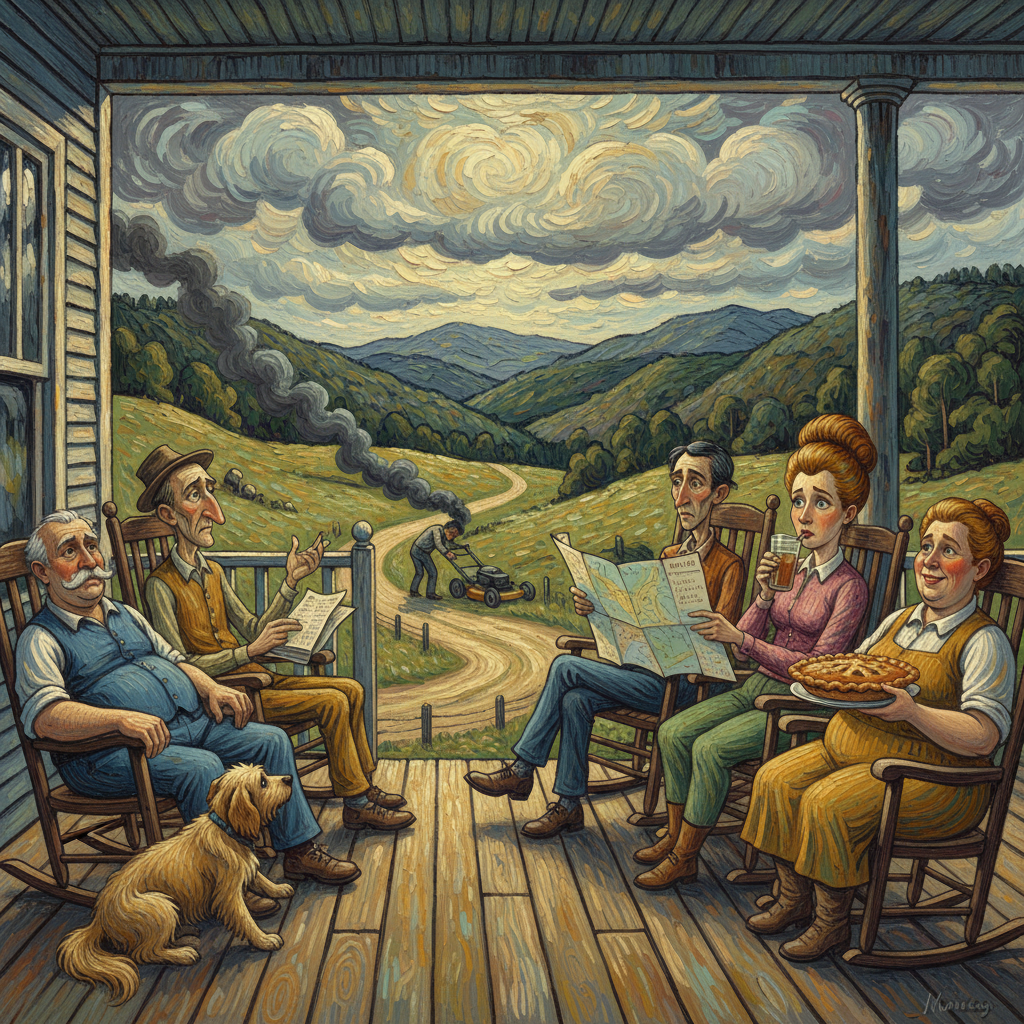
Boot Barnes sat on Mister Wade Langston’s porch watching pickup trucks pass by in slow suspicion.
Mister Wade rocked gently in a chair held together mostly by tradition.
“You hear what Maggie Sue said?”
“I heard fourteen versions,” Wade replied. “In one of ’em she accused the post office of emotional manipulation.”
“That one sounds less likely.”
“Actually,” Wade admitted, “that one might’ve been Clovis.”
Sure enough, Clovis arrived carrying the same yellow legal pad plus three new pages stapled onto the back.
“I have categorized responses,” he announced.
“Already?”
“There’s urgency.”
“What categories?”
Clovis flipped pages.
“Denial. Defensive agreement. Quiet agreement. Aggressive concern. Passive concern. Concern about concern itself.”
“That last one’s real popular,” Wade observed.
Trixie Jo Bartlett came up the porch steps carrying sweet tea in mason jars.
“People’re rattled.”
“Why?” Boot asked. “She didn’t say nothin’ folks didn’t already know.”
“That’s exactly why.”
Act II – The Porch Committee
Trixie handed him tea.
“People can live beside a thing forever,” she said. “Long as nobody says it directly.”
Clovis pointed dramatically with his pencil.
“That is historically accurate.”
“You say that about everything.”
“History repeats because nobody files paperwork properly.”
From across the road came the sound of a lawn mower starting and immediately dying.
Then restarting.
Then dying again.
“RT’s workin’ on machinery,” Wade sighed.
“That explains the smoke.”
Indeed, gray smoke drifted above RT Mullins’ property like the opening stages of a federal inquiry.
Mabel Dean appeared at the edge of the porch carrying a pie nobody had requested.
“I brought chess pie.”
“No occasion?”
“Truth unsettles digestion.”
That felt reasonable to everyone present.
Mabel sat carefully.
“You know what bothered folks most?”
“What?”
“She didn’t blame outsiders.”
The porch quieted.
That was true.
Most town conversations eventually circled toward blame migration.
Newcomers.
Nashville.
The government.
Teenagers.
Tourists.
The weather.
California.
Sometimes all five in one sentence.
But Maggie Sue hadn’t blamed anybody.
She’d simply named the condition itself.
Like a doctor saying the test result aloud.
Across town, Daisy barked once from somewhere near the sheriff’s office.
Then stopped.
Mister Wade stared out toward the road.
“Folks’ll try to turn this into a meeting.”
“Everything becomes a meeting,” Boot replied.
“Meetings are where truth goes to wait.”
Clovis wrote that down immediately.
Act II – The Porch Committee
Act III – Town Hall Air Pressure
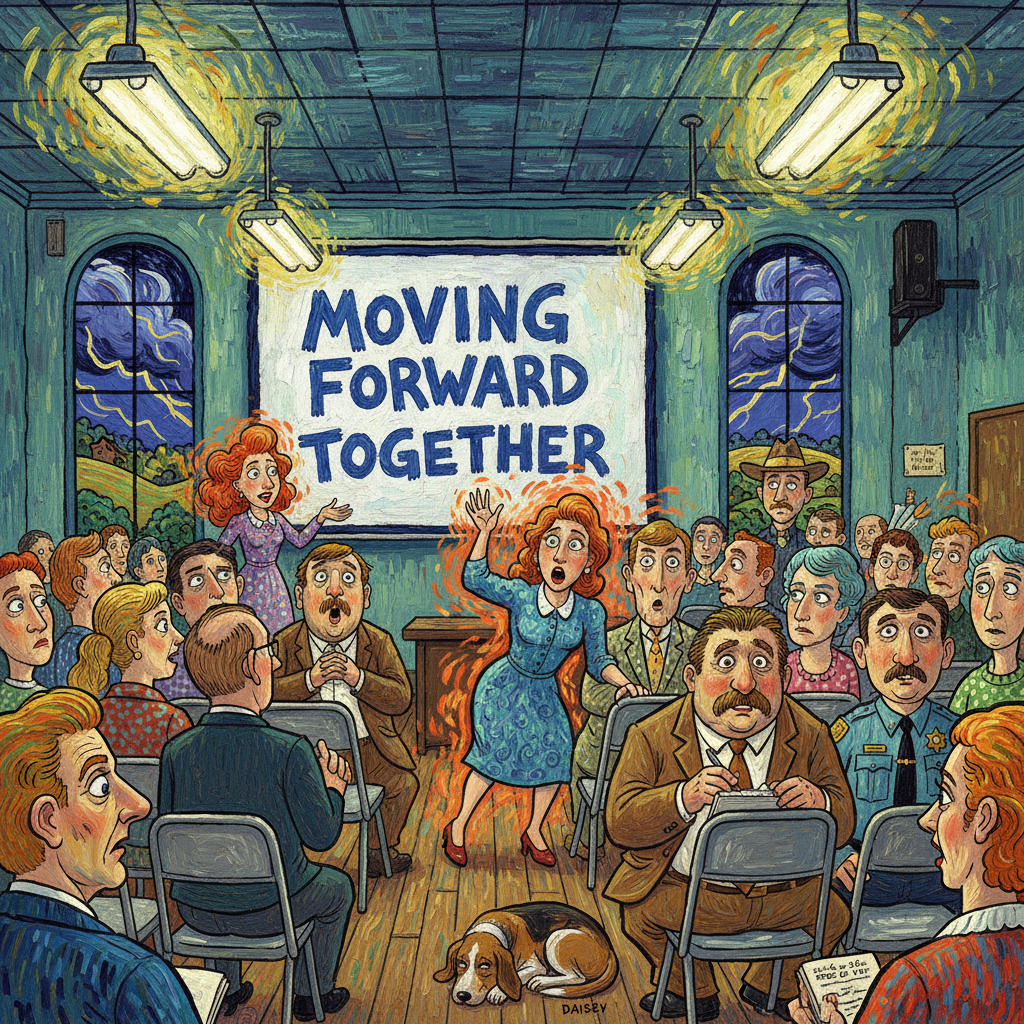
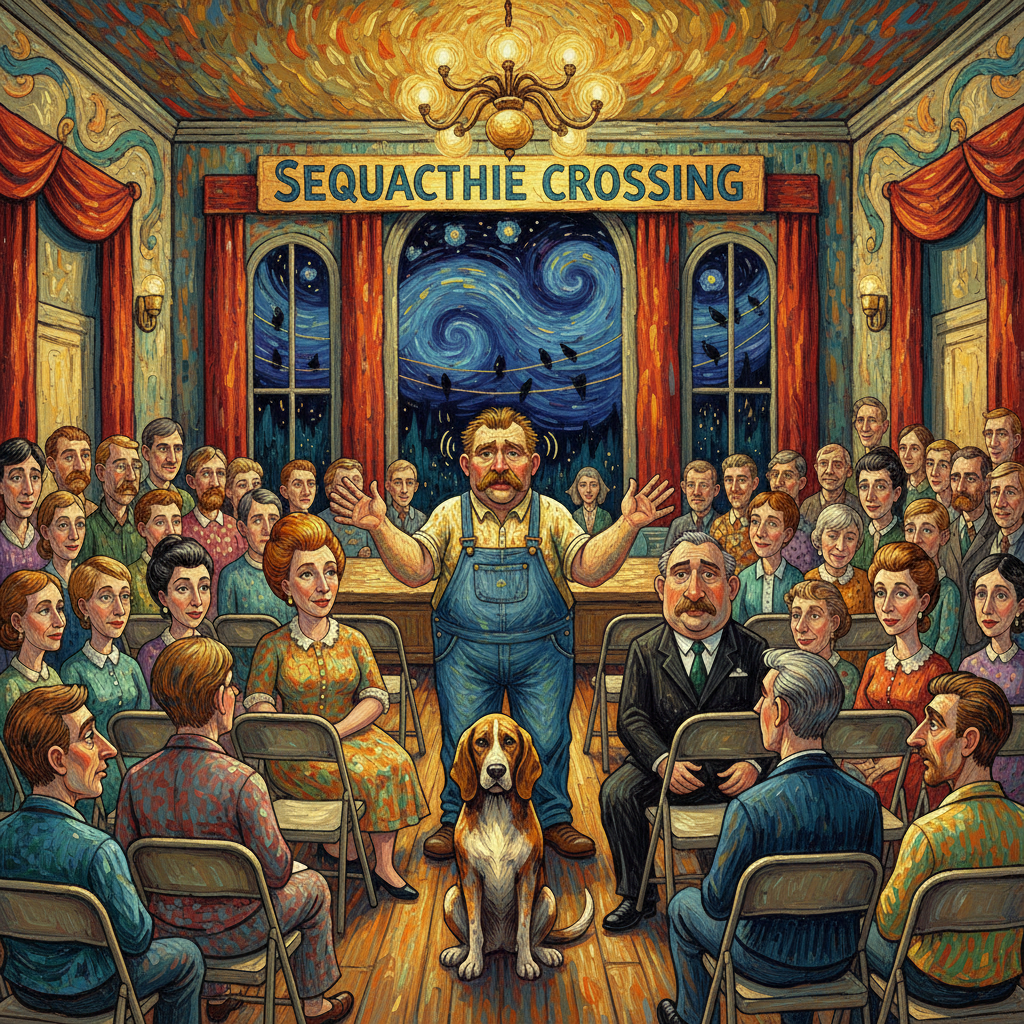
The emergency “Community Alignment Forum” began at six-thirty sharp inside Town Hall despite nobody fully admitting it was connected to Maggie Sue’s statement.
Shelley Fawn Wexler stood beside a projector screen showing a slide titled:
MOVING FORWARD TOGETHER
Underneath, in smaller text:
WITHOUT OVERREACTING
The folding chairs filled slowly.
People entered cautiously like they feared being assigned responsibility.
Officer Kenny Joe Teeter directed parking outside with the grim expression of a man anticipating both civic unrest and casserole delivery.
Inside, Tiffany Annette Roark arranged bottled waters while muttering.
“We should’ve canceled.”
“We can’t cancel,” Shelley whispered back. “Canceling implies significance.”
“Pretty sure the packed room implies significance.”
Indeed, Town Hall overflowed.
Boot and Clovis sat together near the back.
Pastor Peeler occupied the second row silently.
Mabel Dean fanned herself with the meeting agenda.
Daisy rested beneath Sheriff Peeler’s chair.
The dog had refused to stay home.
Shelley adjusted the microphone.
“We appreciate everybody coming tonight to engage in respectful collaborative dialogue concerning recent community sentiment.”
“See?” RT whispered. “Nobody knows what that means.”
Coach Freddie leaned over.
“It means she’s scared.”
Act III – Town Hall Air Pressure
Shelley continued.
“As a town, we must avoid divisiveness while also acknowledging evolving perspectives regarding local conditions.”
“Good Lord,” Boot muttered. “She done wrapped the sentence in insulation.”
Murmurs rippled.
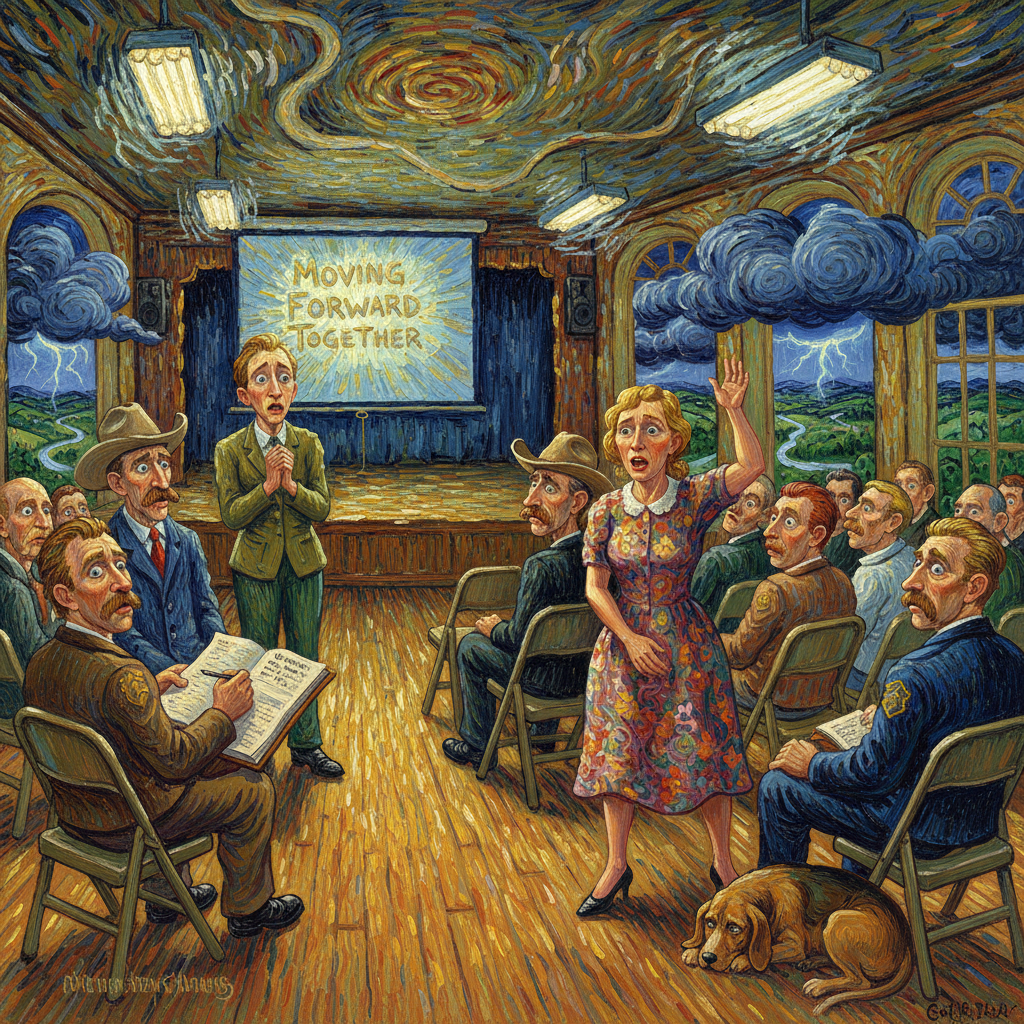
Then Maggie Sue stood from the middle row.
Not loudly.
Not angrily.
Just stood.
Shelley froze immediately.
Maggie Sue looked around the room.
“We keep describing the smoke,” she said calmly. “But nobody wants to say the house feels hot.”
Silence again.
Immediate.
Heavy.
Clovis physically stopped writing.
The scratch of his pencil vanished mid-word.
Every head turned slightly.
Pastor Peeler stared at the floor.
Daisy stopped panting.
Even the ancient ceiling fan seemed quieter.
Nobody argued.
Nobody disagreed.
Nobody defended anything.
Because the room understood exactly what she meant.
And because once spoken plainly, the truth no longer required interpretation.
Shelley attempted recovery.
“Well certainly everyone recognizes there are nuanced—”
“No,” Maggie Sue interrupted gently. “Not nuanced.”
That landed harder.
People shifted in folding chairs.
RT stared at the floor.
Trixie Jo crossed her arms tightly.
Mabel Dean nodded again.
Slowly.
Outside, thunder rolled across the valley.
Clovis finally whispered:
“I don’t like when facts lose their decorations.”
Boot leaned toward him.
“You ain’t mad at her.”
“No.”
“What then?”
Clovis swallowed.
“I’m realizing I knew already.”
That frightened him more.
Act III – Town Hall Air Pressure
Act IV – The Church Fellowship Hall
Sunday arrived under gray skies and emotional caution.
At New Hope Fellowship Church, conversations occurred in fragments.
Small ones.
Careful ones.
Nobody mentioned Maggie Sue directly at first.
Instead they discussed weather.
Potluck attendance.
A suspicious raccoon behind the Dollar General.
All conversational detours eventually circled the same invisible center.
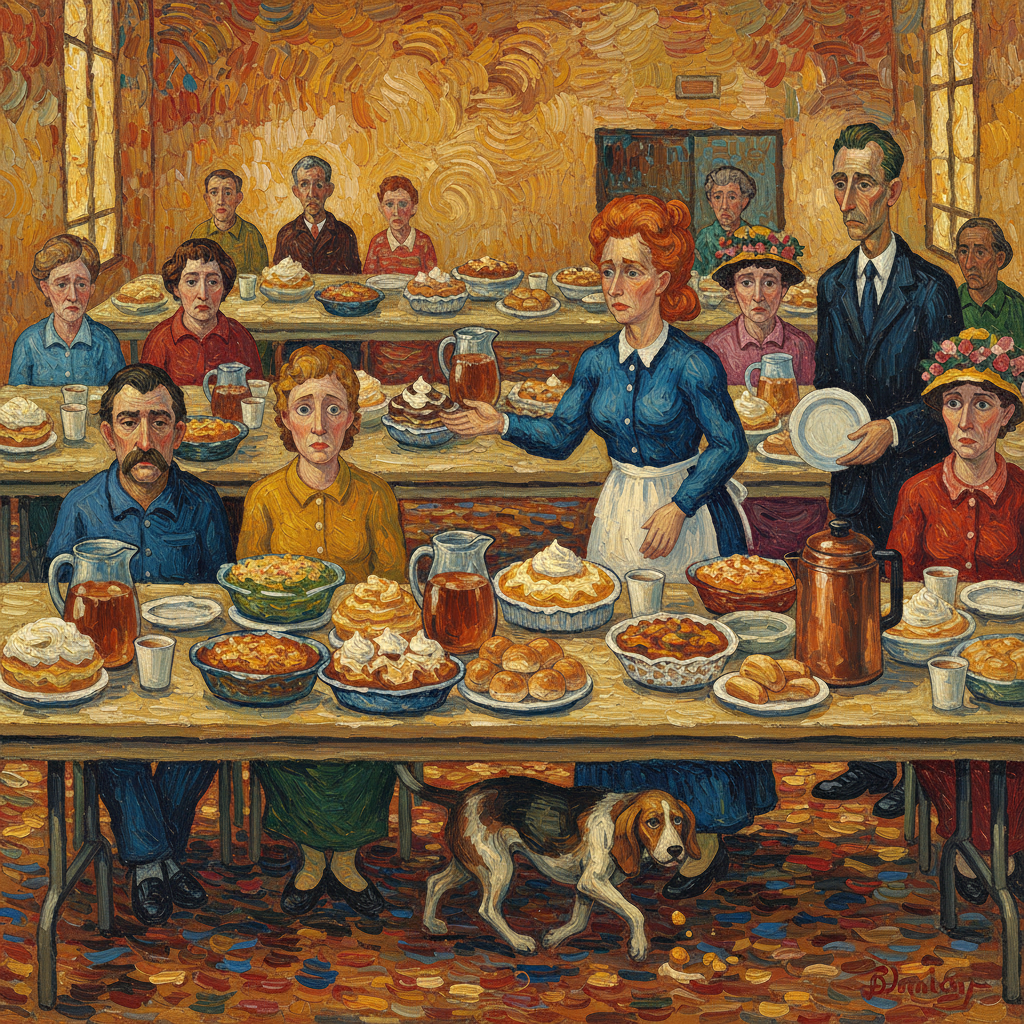
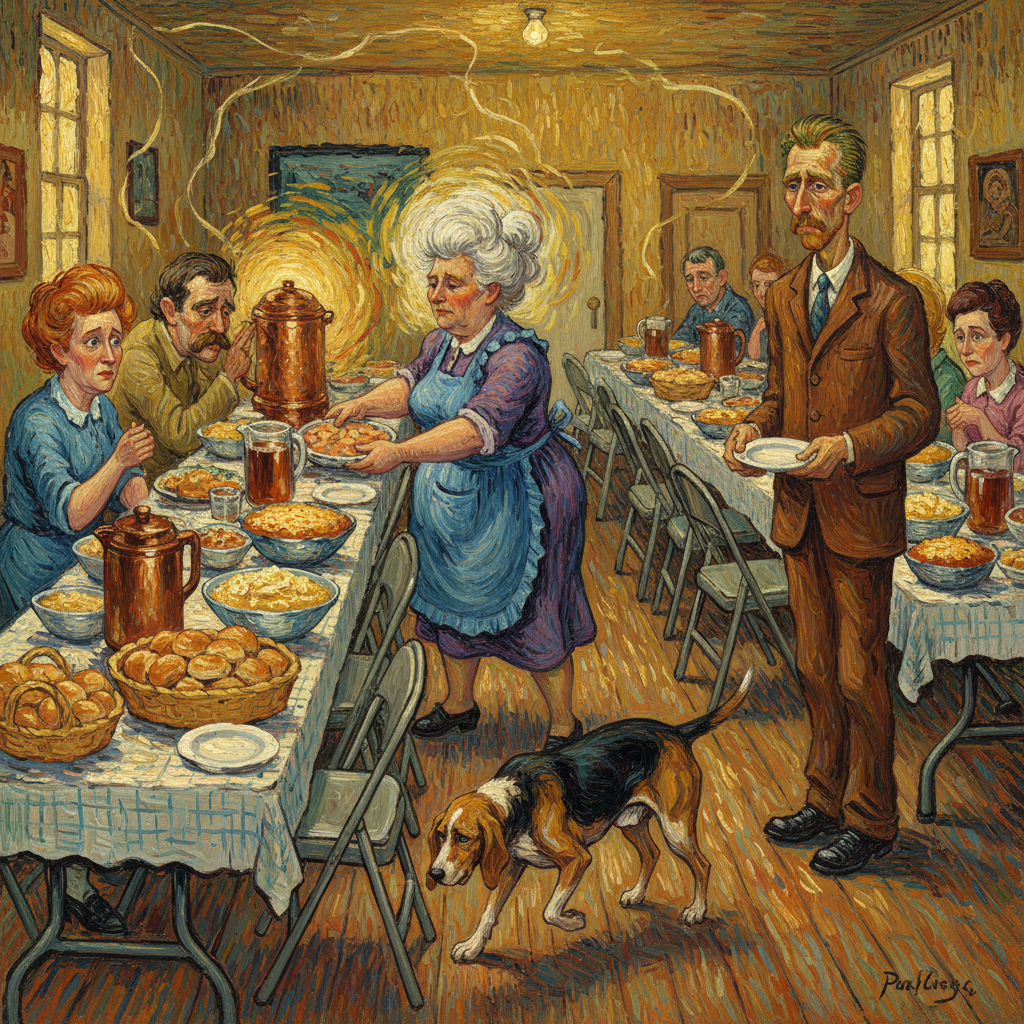
Inside the fellowship hall, Sister Lila Mae “Hallelujah” Pruitt arranged banana pudding with military intensity.
“You can feel it,” she whispered to Evelyn Grace Tipton.
“Feel what?”
“The silence.”
Evelyn nodded uneasily.
Normally church suppers contained enough overlapping opinions to simulate industrial machinery.
Tonight felt padded.
Muted.
Pastor Arnold Peeler moved between tables greeting people gently, though he himself remained unusually quiet.
Boot cornered him near the coffee urn.
“You gonna address it?”
“Address what?”
“You know what.”
Pastor Peeler sighed.
“A preacher learns there’s a difference between revelation and readiness.”
“That sounds slippery.”
“It’s accurate.”
Nearby, Clovis adjusted a camcorder pointed suspiciously toward the parking lot.
“What’re you filming now?”
“Behavioral adjustments.”
“People eatin’ casserole?”
“Patterns emerge.”
Mabel Dean approached carrying rolls.
“You know why everybody’s uneasy?”
“Truth?” Boot guessed.
“No. Recognition.”
Mabel set down the tray.
“Truth scares folks less than realizing they’ve participated in avoidance.”
At the dessert table, Tiffany Annette spoke quietly with Shelley.
“I think people wanted a villain.”
“They always do.”
“But there ain’t one.”
“That’s what makes this worse.”
Daisy wandered between tables accepting unauthorized ham.
Act IV – The Church Fellowship Hall
Nobody stopped her.
Animals seemed calmer tonight.
Too calm.
Coach Freddie noticed it first.
“Where’s all the noise?”
He was right.
No barking outside.
No birds fluttering near the windows.
No cats fighting behind the dumpster.
The whole town felt paused.
As if Sequatchie Crossing itself were listening.
Pastor Peeler finally stood near the center of the hall holding a paper plate untouched.
Conversations faded naturally.
Not because he demanded silence.
Because people expected something.
He looked around the room carefully.
Then said only this:
“Sometimes saying a thing aloud removes our ability to pretend we misunderstood it.”
That was all.
No sermon.
No resolution.
No prayerful conclusion.
Just the sentence.
And once again, nobody answered immediately.
Act IV – The Church Fellowship Hall
Act V – The Sheriff’s Office Investigation Into Nothing Specific
Monday morning at the sheriff’s office began with three unrelated complaints and one suspicious goat.
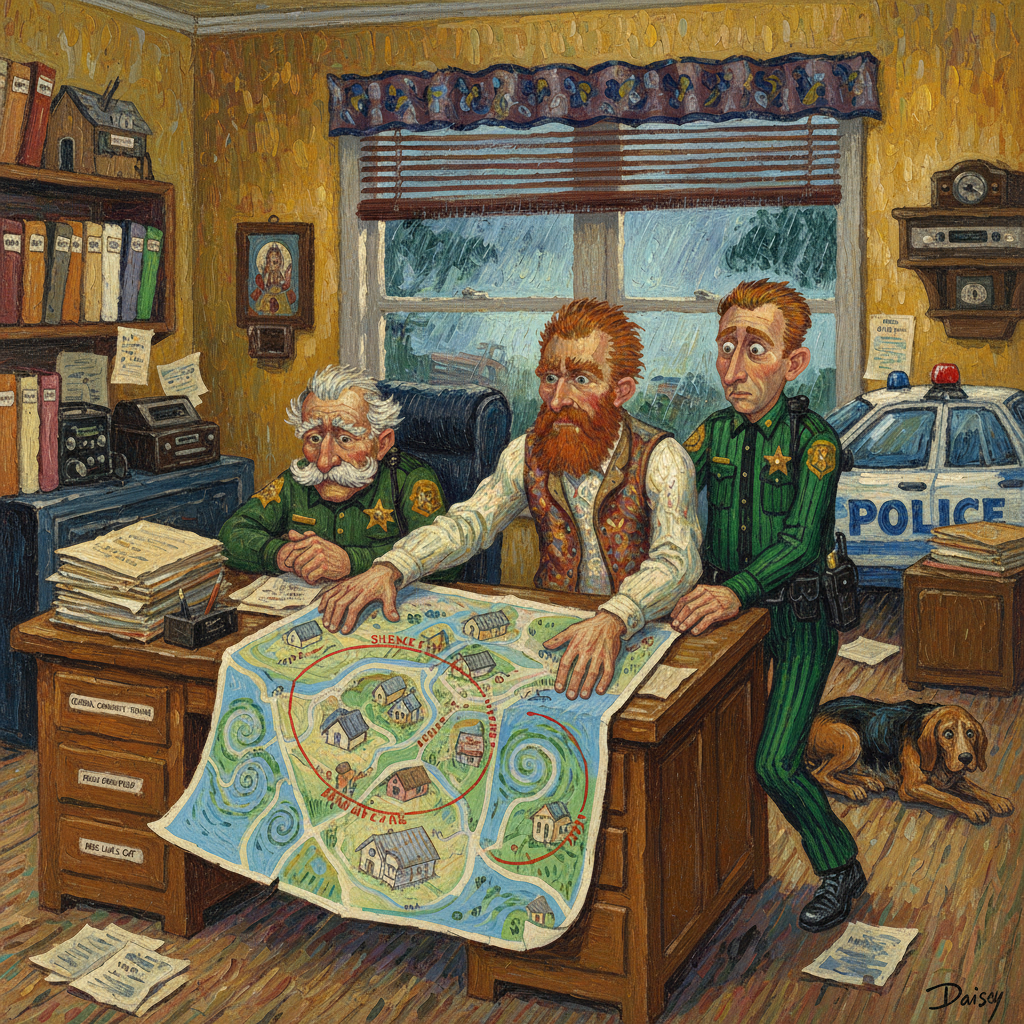
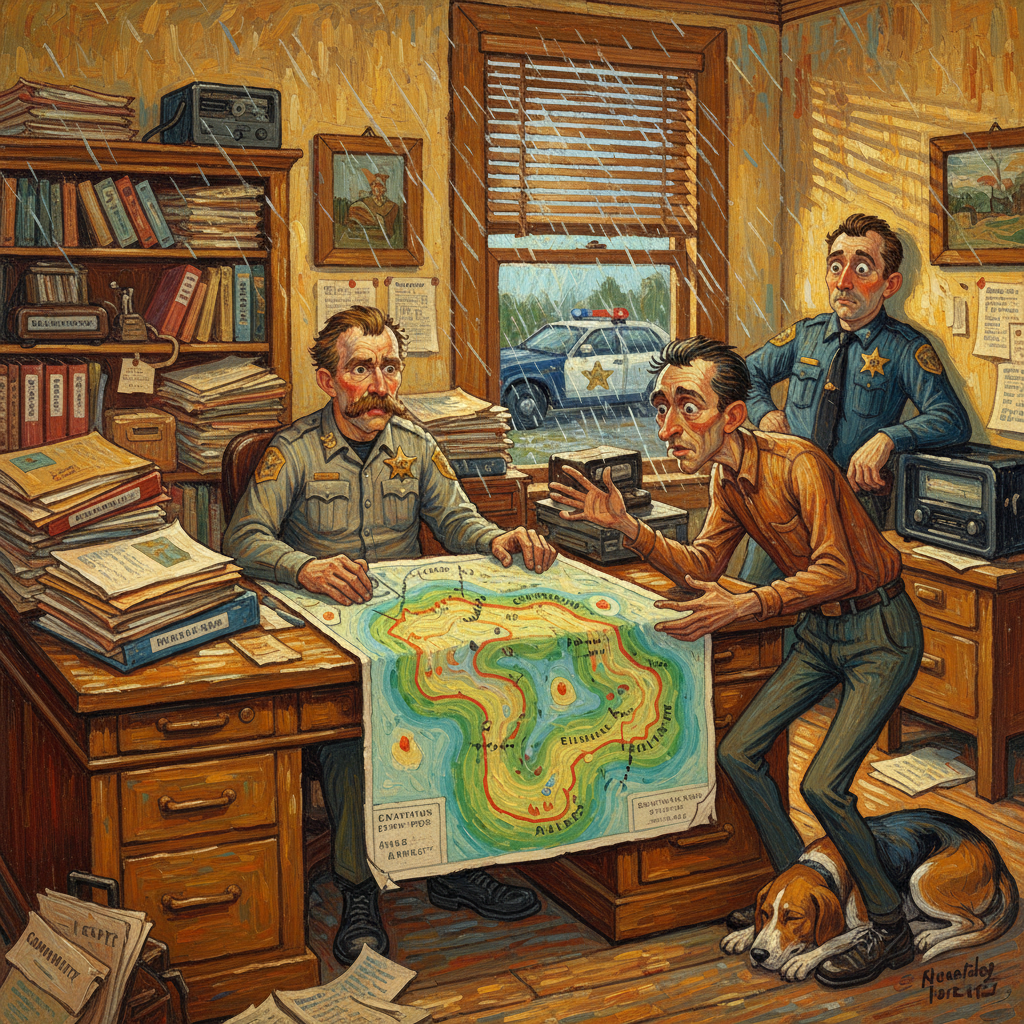
Sheriff Peeler sat behind his desk holding two aspirin and a folder labeled:
GENERAL COMMUNITY TENSION
Officer Kenny Joe Teeter leaned against the filing cabinet.
“We got folks reportin’ weird behavior.”
“What kind?”
“Quiet.”
Sheriff Peeler rubbed his forehead.
“That ain’t illegal.”
“Feels ominous though.”
Outside the office window, Daisy slept beneath the patrol cruiser in a shaft of sunlight.
Perfectly still.
No twitching.
No barking.
Nothing.
“She been like that all mornin’,” Kenny Joe observed.
“She old.”
“No. This feels different.”
Before Sheriff Peeler could respond, Clovis burst through the door carrying maps.
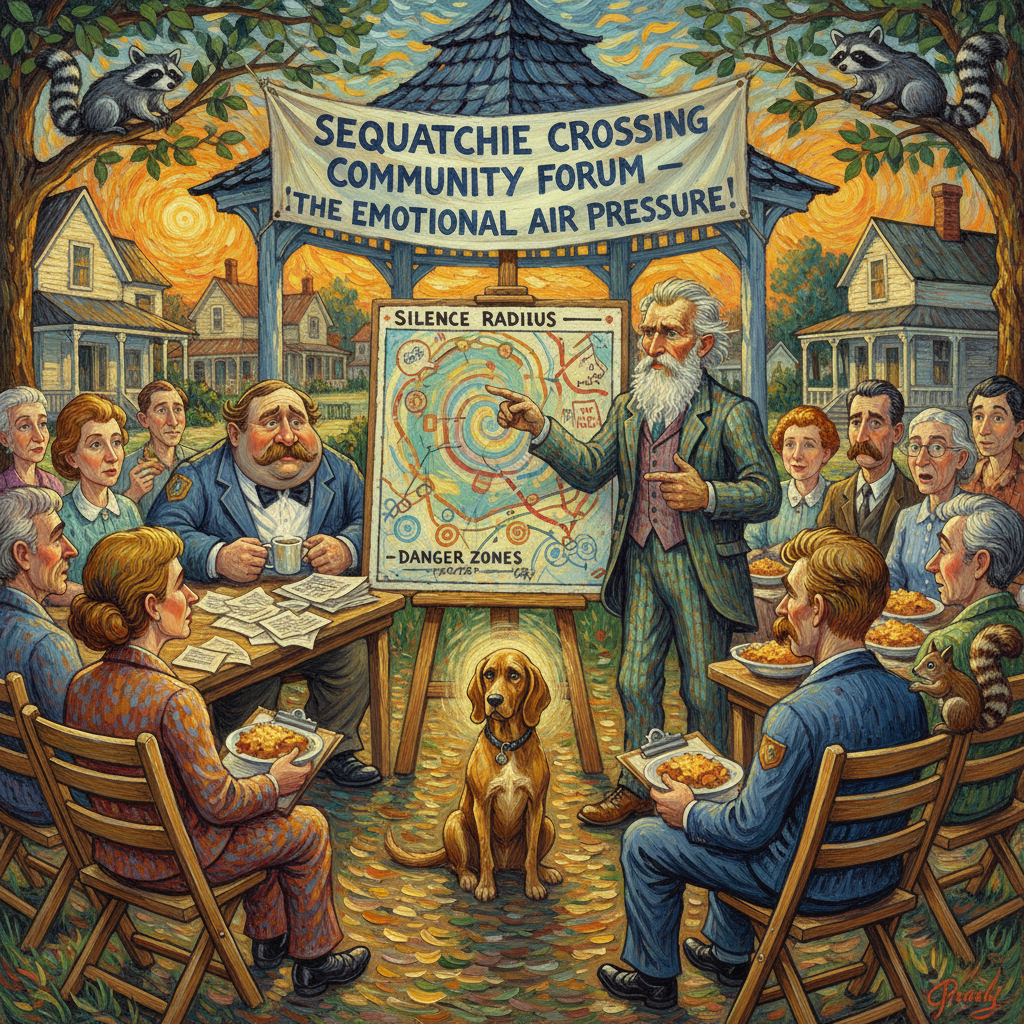
“I have identified the silence radius.”
“There’s a silence radius now?”
Act V – The Sheriff’s Office Investigation Into Nothing Specific
“Yes.”
Clovis spread maps across the desk.
Colored circles surrounded Town Hall, Ruby’s Diner, the church, and the post office.
“You mapped emotional discomfort?”
“Somebody had to.”
Sheriff Peeler stared.
“How exactly did you calculate this?”
“Animal response.”
“…What?”
“Bird activity down twenty-three percent near civic gathering areas. Dogs bark less after sunset. Even squirrels appear contemplative.”
“That squirrel bit me last year.”
“It regrets things now.”
Kenny Joe leaned over the maps.
“You honestly think saying the problem aloud changed the town?”
“No,” Clovis replied.
“I think hearing it without denial did.”
That shut the room down briefly.
Sheriff Peeler looked toward the window again.
The street outside appeared normal.
Cars moved.
People waved.
The diner sign buzzed.
But underneath all of it existed an unfamiliar tension.
Not panic.
Not anger.
Recognition.
Which somehow felt heavier.
Maggie Sue entered moments later carrying additional complaint folders.
“You wanted these filed?”
Sheriff Peeler accepted them carefully.
“Maggie Sue…”
She waited.
“You understand folks think you started something.”
“No,” she said softly.
“I think I interrupted something already happening.”
Nobody argued.
Again.
That was becoming its own form of evidence.
Outside, Daisy finally lifted her head.
But instead of barking, she merely watched the street.
Like she too understood the town had crossed some invisible threshold.
Act V – The Sheriff’s Office Investigation Into Nothing Specific
Act VI – The Diner After Dark
By Tuesday evening Ruby’s Diner had transformed into an accidental philosophy center.
Nobody intended that.
It simply happened because Sequatchie Crossing processed emotional events through pie.
Rain hammered the windows while townsfolk gathered beneath fluorescent lights pretending to discuss ordinary matters.
RT Mullins argued with Sonny Morales about generators.
Coach Freddie explained football drills nobody asked about.
Shelley attempted optimism.
“We’re communicating better.”
“No we ain’t,” said Boot.
“We’re just quieter while avoiding each other.”
“That’s not entirely unhealthy.”
“It ain’t healthy either.”
Mabel Dean stirred coffee thoughtfully.
“You know what changed?”
“What?”
“Folks stopped arguing about whether the problem exists.”
That landed.
Because it was true.
Before Maggie Sue’s statement, every concern turned into debate.
Now conversations skipped straight past denial into uneasy logistics.
“What do we even do?” Tiffany Annette asked.
Nobody answered immediately.
Clovis closed his notebook entirely for the first time anyone could remember.
“I don’t know.”
Boot stared at him.
“You don’t know?”
“I mostly specialized in suspicion.”
“Thought you specialized in preparedness.”

Act VI – The Diner After Dark
“They overlap.”
At the counter, Pastor Peeler quietly ate chicken and dumplings while listening.
Ruby herself finally spoke from behind the register.
“My daddy used to say people tolerate discomfort longer than confusion.”
“Meaning?” asked Shelley.
“Meaning folks can survive bad conditions. But once the conditions become understandable…”
She shrugged.
“Then decisions start matterin’.”
Outside, lightning flashed.
Every person in the diner briefly reflected against the dark windows like ghosts attending their own town meeting.
Daisy stood slowly beside Boot.
The old hound walked to the middle of the diner.
Then simply sat there.
Still.
Watching everyone.
No whining.
No tail wagging.
The entire diner unconsciously stopped talking.
Again.
Animals had become emotional weather vanes around Sequatchie Crossing.
Mabel looked toward Daisy.
“She knows.”
“What?” RT asked nervously.
“That the room changed.”
Nobody laughed at that.
Not even RT.
Pastor Peeler finally stood.
Folks expected another careful statement.
Instead he merely placed money beside his plate and said:
“Truth rarely fixes anything immediately.”
He paused.
“But pretending delays everything.”
Then he walked out into the rain.
Leaving the diner utterly silent for nearly thirty seconds afterward.
Which, in Sequatchie Crossing, qualified as a civic event.

Act VI – The Diner After Dark
Act VII – The School Gym Listening Session
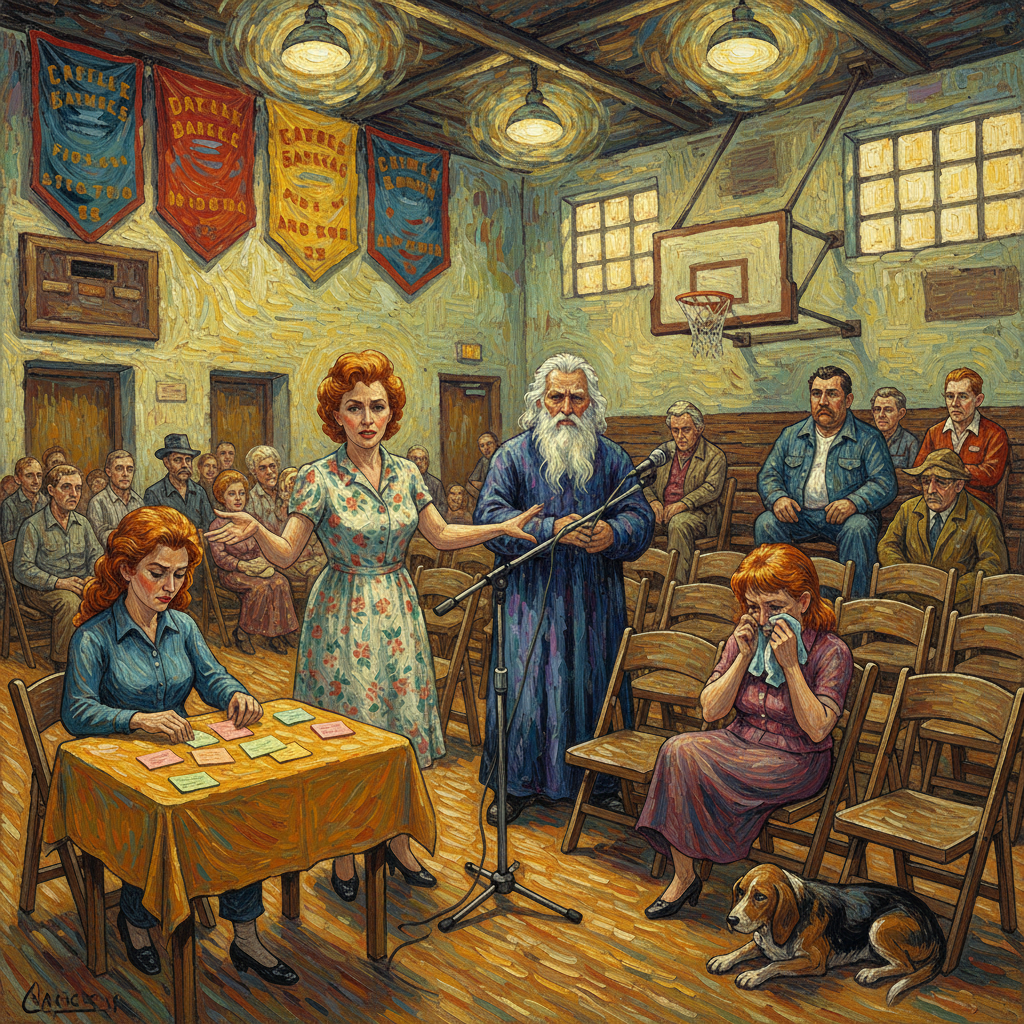
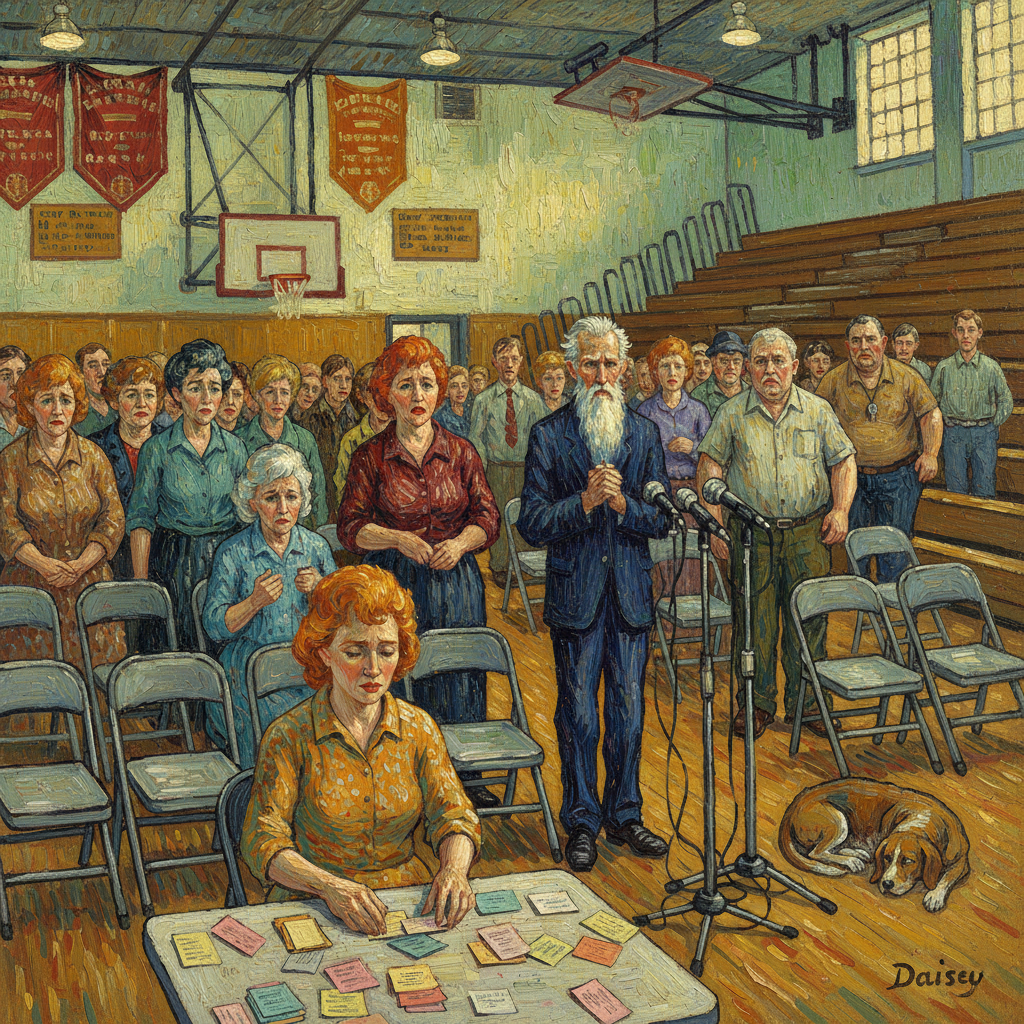
The county school gym smelled faintly of old varnish and adolescent regret.
Rows of folding chairs stretched beneath basketball banners celebrating achievements from years people preferred remembering.
Shelley organized the “Public Listening Session” with color-coded note cards.
Green for concerns.
Blue for solutions.
Yellow for “community emotions.”
RT held up a yellow card suspiciously.
“What’s the acceptable number of emotions?”
“Just write honestly.”
“That feels dangerous.”
Boot and Coach Freddie occupied the bleachers while Clovis adjusted audio equipment no one authorized.
“I’m documenting shifts in vocal tone.”
“You ever consider rest?” Boot asked.
“Civilization doesn’t.”
The gym slowly filled.
Mabel Dean arrived with cookies.
Sister Lila Mae carried sweet tea.
Sheriff Peeler stood near the exit like a man preparing for either diplomacy or wrestling.
Pastor Peeler entered last.
Quiet as always lately.
The meeting began awkwardly.
Nobody wanted to speak first.
Finally Shelley pointed gently toward Brett Crenshaw.
Brett stood reluctantly.
“Well… I guess things feel strained.”
People nodded carefully.
Alyssa Crenshaw added:
“And folks’re tired.”
More nodding.
Then Chester Ray Blevins stood from the second row holding a stack of printed flyers nobody requested.
“The print shop’s been busier than election season,” he declared. “Everybody suddenly wants signs, notices, petitions, statements, corrections to statements—”
“That ain’t the issue,” somebody muttered.
“No,” Chester admitted. “But it’s a symptom.”
The gym quieted again.
Finally Maggie Sue rose slowly from her chair.
No dramatic music.
No confrontation.
Just exhaustion.
“We all keep waiting for somebody to disagree,” she said.
Her voice echoed softly in the gym.
“But nobody really does anymore.”
Silence.
Heavy silence.
Act VII – The School Gym Listening Session
Clovis stopped adjusting microphones.
Coach Freddie leaned forward.
Shelley lowered her clipboard.
Even the air-conditioning unit seemed to soften itself.
Maggie Sue continued.
“We’re still behaving like denial’s available. But it ain’t.”
A basketball somewhere overhead creaked faintly against rafters.
Nobody spoke.
Because everybody understood.
Pastor Peeler finally stood.
Not as preacher.
As neighbor.
“We spent years treating discomfort like weather,” he said quietly.
“Something passing through.”
He looked around the gym carefully.
“But weather don’t usually come from inside the house.”
That sentence hit even harder than Maggie Sue’s.
Several people looked down immediately.
Trixie Jo wiped at one eye angrily like tears had arrived without permission.
Daisy lay beneath the bleachers perfectly still.
Every animal silent again.
No barking outside.
No chirping through open doors.
Nothing.
The whole gym held its breath.
And for the first time, nobody tried changing the subject.
Act VII – The School Gym Listening Session
Act VIII – The Night Walk
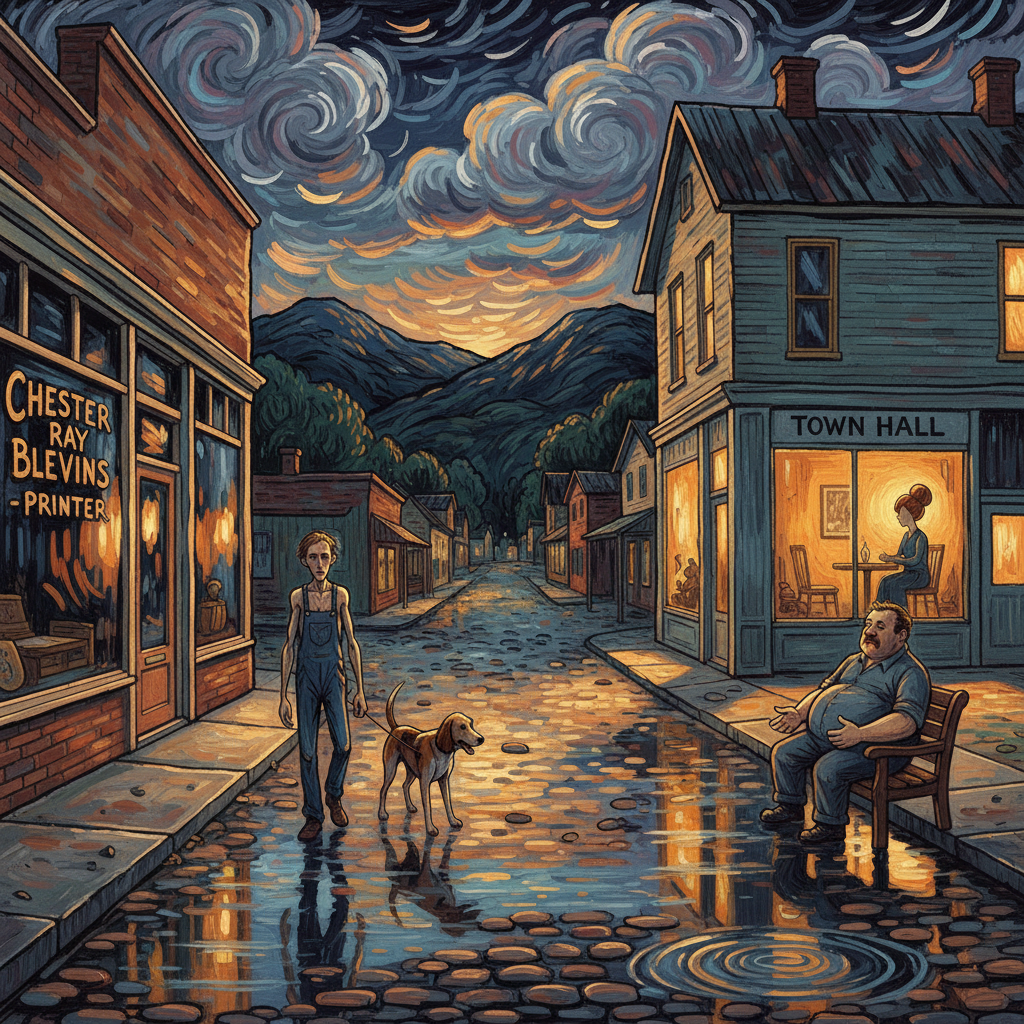
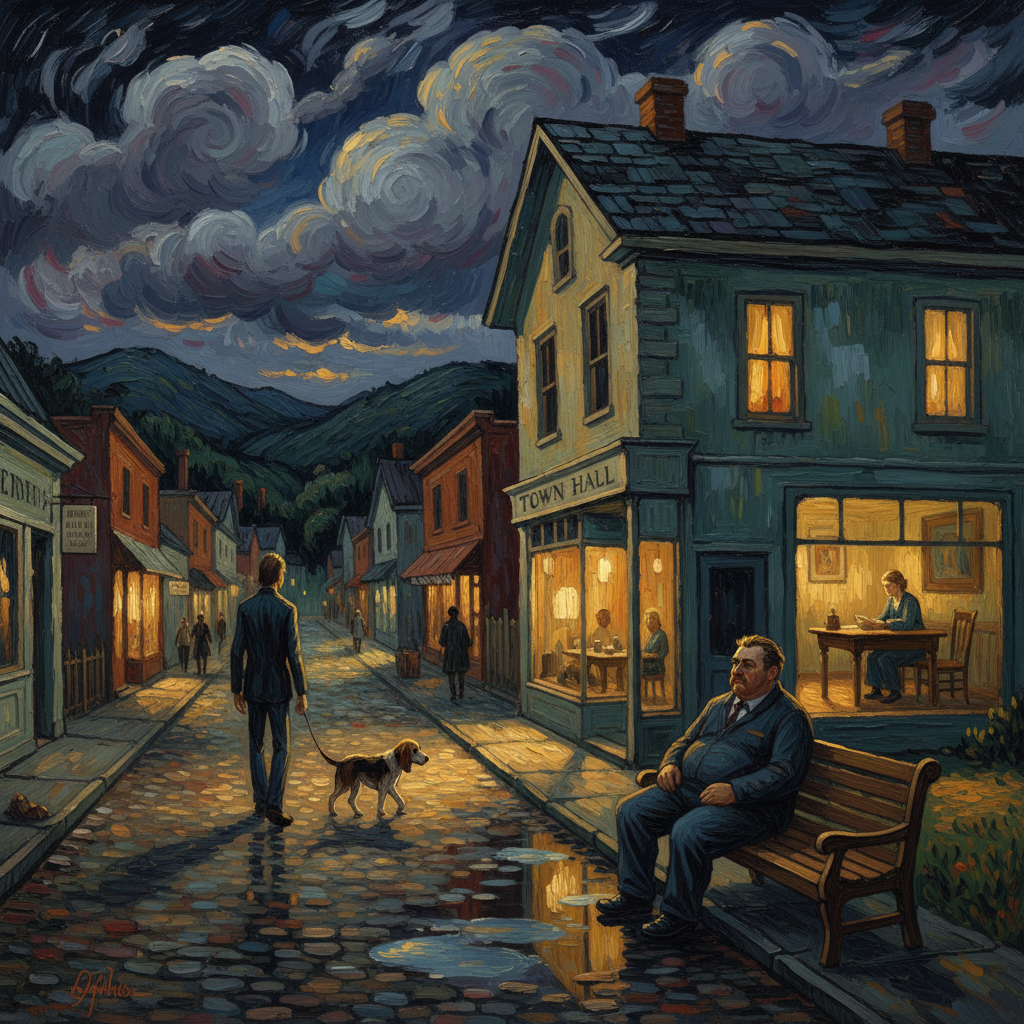
Later that night Boot Barnes walked Main Street alone with Daisy beside him.
Storefronts glowed dimly.
The old hardware store sign flickered.
Rainwater pooled beneath streetlights.
Sequatchie Crossing looked ordinary.
That was the unsettling part.
Truth had altered nothing visible.
The roads remained cracked.
The diner still smelled like grease.
Town Hall still leaned slightly left during humid weather.
Yet somehow everything felt exposed.
Like wallpaper removed from a room.
Boot passed Clovis sitting outside the closed print shop.
“You surveillin’?”
“No.”
“That sounds unhealthy for you.”
Clovis nodded.
“I think I’m tired.”
Boot sat beside him.
For a while neither spoke.
Finally Clovis asked:
“You ever realize most folks ain’t actually scared of problems?”
“What’re they scared of then?”
“Responsibility after acknowledgment.”
That sat heavily between them.
Across the street, Daisy stopped walking.
The hound stared toward Town Hall motionless.
Boot followed her gaze.
Inside Town Hall, one single light remained on.
Mabel Dean sat alone at a table visible through the window.
Just sitting.
Act VIII – The Night Walk
Thinking.
Boot sighed.
“She probably can’t sleep.”
“Nobody’s sleeping good.”
A train horn echoed faintly from somewhere beyond the valley.
Clovis looked toward the dark hills.
“You know what scares me?”
“You sayin’ that sentence.”
“We all knew already.”
Boot nodded slowly.
“Yeah.”
“And now everybody knows everybody else knew.”
That was the true transformation.
Not information.
Mutual recognition.
A whole town suddenly aware its private suspicions had become public consensus.
The kind of realization communities spend decades avoiding.
Boot stood carefully.
“Well,” he said, “sun’s still gonna come up.”
“That ain’t always comforting.”
“No.”
He whistled softly for Daisy.
The hound didn’t move immediately.
Just kept staring toward Town Hall.
Still.
Listening.
Act VIII – The Night Walk
Act IX – The Room Changes Again
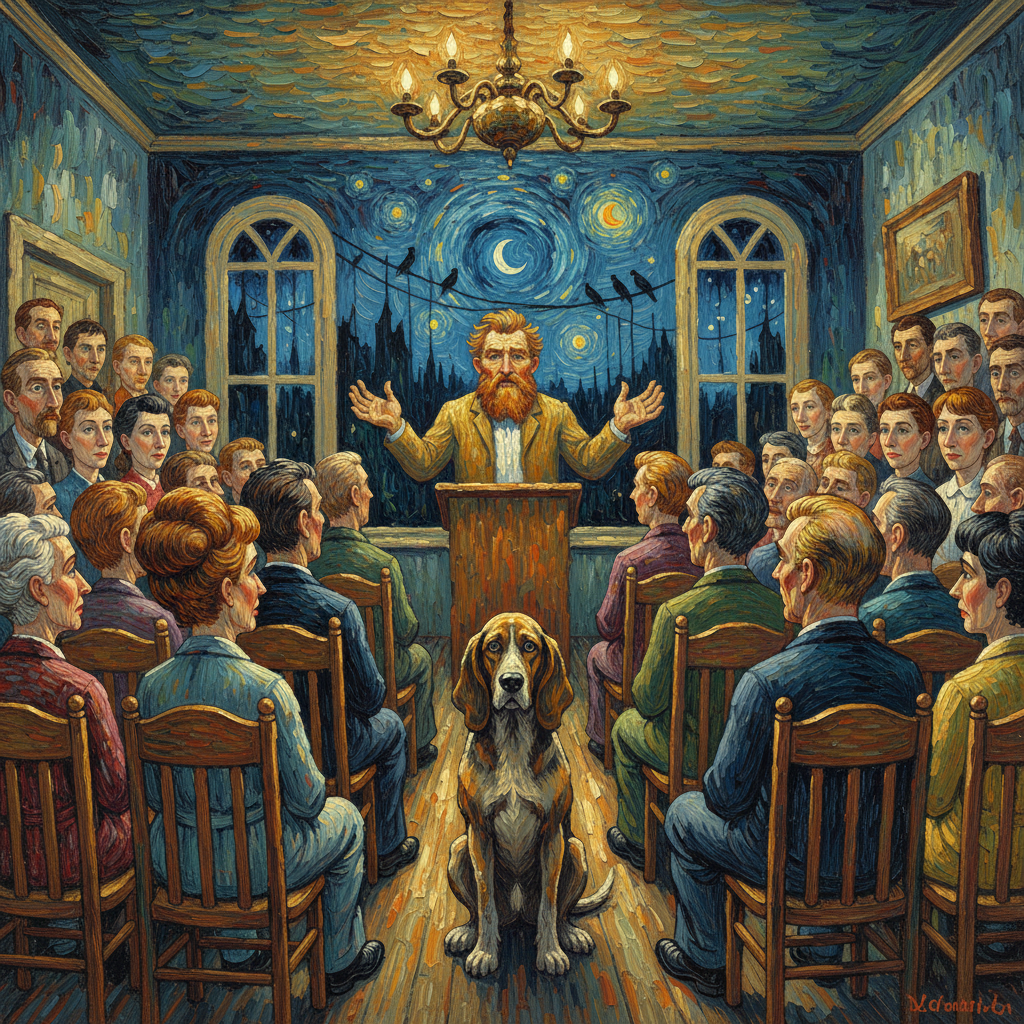
Friday evening brought the largest crowd Town Hall had seen in years.
Nobody called it a crisis meeting.
That would imply urgency.
Nobody called it reconciliation either.
That would imply progress.
Officially, it was labeled:
Open Civic Discussion Regarding Ongoing Community Conditions
Which meant absolutely nothing and therefore offended no one.
Every chair filled.
People lined walls.
Even teenagers appeared, mostly because rumors suggested emotional collapse.
Shelley stood exhausted near the podium.
Tiffany Annette handled coffee distribution with the efficiency of battlefield medicine.
Sheriff Peeler kept doors open for airflow.
Pastor Peeler sat beside Maggie Sue this time.
Deliberately.
No distance.
No ambiguity.
Boot noticed immediately.
“So did everybody else,” Mabel whispered.
Clovis carried no notebook tonight.
That disturbed people more than the notebook itself.
The meeting began without speeches.
Without PowerPoint slides.
Without procedural nonsense.
Just people sitting quietly together.
Waiting.
Finally Boot stood.
Not because he planned to.
Because silence required somebody.
He looked around the room slowly.
“I keep thinkin’ maybe somebody’s supposed to solve this.”
Nobody interrupted.
“But maybe this town’s spent too long waitin’ for permission to notice what’s obvious.”
He scratched his jaw nervously.
“That ain’t directed at anybody specific.”
“Which is why it hurts,” RT muttered.
Several people laughed softly.
Tired laughter.
Real laughter.
Mabel Dean stood next.
“I’m eighty-two years old,” she said calmly. “And I have watched folks spend entire lifetimes avoiding plain language because they believed naming reality caused division.”
She looked around carefully.
“But division already existed. The silence just hid it better.”
Nobody argued.
Again.
Outside the windows, birds settled onto telephone wires.
Still.
Quiet.
Pastor Peeler finally rose.
No sermon voice.
No theatrical cadence.
Just Arnold Peeler speaking plainly.
“I think the room changed because nobody attacked the truth after it was spoken.”
He paused.
“And maybe that’s the first honest thing we’ve done together in years.”
Act IX – The Room Changes Again
Complete silence followed.
Not awkward silence.
Not hostile silence.
Recognition.
Shared recognition.
The kind communities rarely survive cleanly.
Daisy wandered slowly into the center aisle.
The old hound sat down facing the crowd.
Still as stone.
Nobody moved.
Nobody whispered.
Even Clovis remained motionless.
Then, from somewhere outside, came the first sound anybody had heard from the animals all week.
A single cricket.
Then another.
Then dozens.
Gradually the night filled again.
Birds rustled.
A dog barked somewhere down the road.
Life resumed its ordinary soundtrack.
Mabel Dean smiled faintly.
“Well,” she whispered.
“There it is.”
Boot looked around the room.
Nothing had been solved.
No votes taken.
No miracles delivered.
No behavior magically transformed.
But the atmosphere had shifted again.
Less pressure.
Less pretending.
Truth had not fixed the town.
It had merely removed the burden of maintaining fiction.
Which, in Sequatchie Crossing, counted as meaningful progress.
Act IX – The Room Changes Again
Epilogue – Saturday Morning Returns
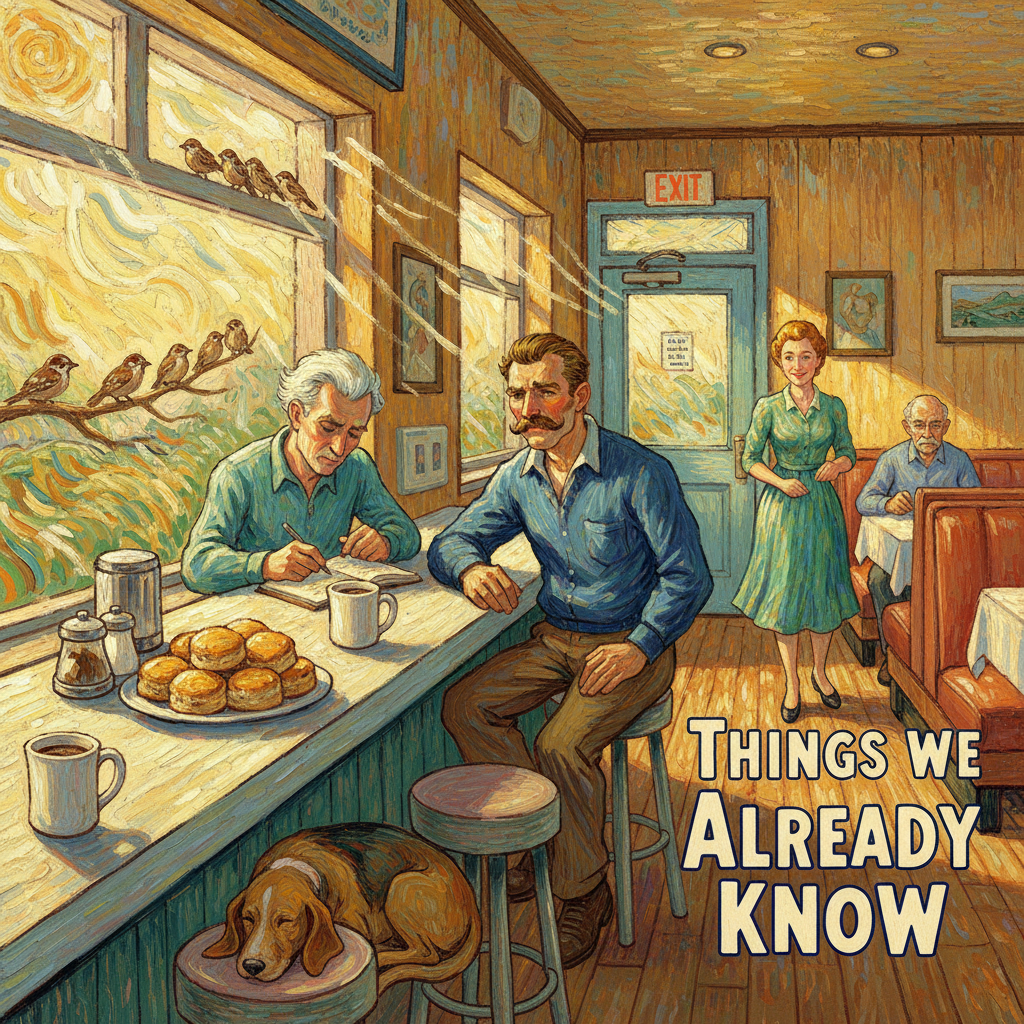
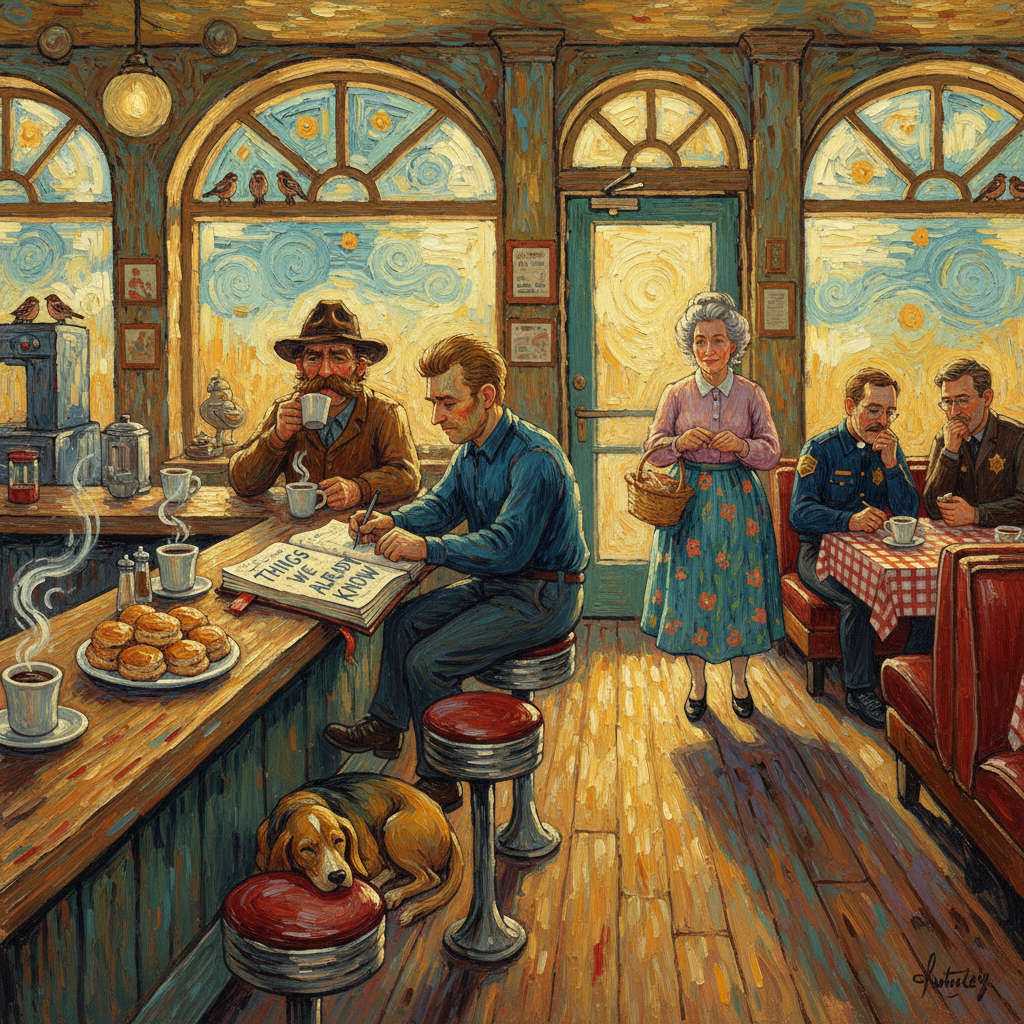
The next morning Ruby’s Diner filled early again.
Coffee poured.
Biscuits baked.
Rain finally cleared from the valley.
The regulars resumed familiar positions.
Boot at the counter.
Mabel in the booth.
Clovis with his legal pad.
Though now the front page simply read:
THINGS WE ALREADY KNOW
Sheriff Peeler entered carrying newspapers.
Pastor Peeler followed quietly behind him.
Daisy slept beneath the stools once more.
Outside, sparrows hopped along the sidewalk loudly arguing about breadcrumbs.
Normal sounds.
Ordinary life.
Ruby poured coffee for Maggie Sue as she entered.
“You stir up the whole town,” Ruby muttered.
Maggie Sue shrugged tiredly.
“No.”
Epilogue – Saturday Morning Returns
She glanced around the diner.
“I think the town was already stirred.”
Boot lifted his mug slightly.
“To naming things.”
Nobody toasted dramatically.
Nobody cheered.
But several people nodded.
Slowly.
And for the first time all week, the room didn’t go quiet afterward.
People simply continued talking.
More honestly than before.
Not perfectly.
Just honestly enough to hear each other.
Which was new.
And in Sequatchie Crossing, new things tended to arrive slowly.
Like weather.
Or truth.
Epilogue – Saturday Morning Returns
Disclaimer
The events, conversations, institutions, emotional weather systems, casserole diplomacy, silence patterns, and unusually introspective animal behavior depicted in this story are entirely fictional and belong solely to the world of Sequatchie Crossing.
Any resemblance to real towns, real residents, actual public meetings, suspiciously tense church suppers, emotionally loaded folding-chair gatherings, or communities discovering that acknowledgment changes air pressure is entirely coincidental.
No actual squirrels were surveyed for contemplative behavior during the creation of this story, though several may have independently reached conclusions.
All characters appearing herein are fictional residents of the satirical universe of Sequatchie Crossing, where bureaucracy functions as folklore, porches operate as communication infrastructure, and truth occasionally enters a room without an escort.
Disclaimer – Problem Finally Said Out Loud, Room Goes Quiet
Real Places Behind the Ruckus – From The Dunlap Directory

Real Places Behind the Ruckus – From The Dunlap Directory
Yes, this story was fictional; even the parts that weren’t true. These places? Absolutely real. Stop by, support local, and keep the Wi-Fi away from livestock:
- Rent-A-Center
- Standefer-Reed Funeral Home
- 9-Line HVAC & Electric
- Fireside Camp + Lodge
- Home Folks Family Restaurant
- Happy Bottom Office Services
- Stoker + Bro’s Mowing + More
- Dunlap Tennessee Overview
- ProMobile Automotive
- No Limit Fab
- Skull Island Campground
- Little Cove Campground
- S & S Farmers Market
- Dunlap Animal Clinic
- Sequatchie Valley Homestead
- Everlee & Co Construction
- Agricultural Extension Services
- Dellview Homestead
- Valhalla Acres at TN Campground

Real Places Behind the Ruckus – From The Dunlap Directory
At Sequatchie Crossing, we tell the stories of Sequatchie Crossing.
Please share this post with your friends, family, or business associates who may want follow the news from Sequatchie Crossing.


0 Comments