


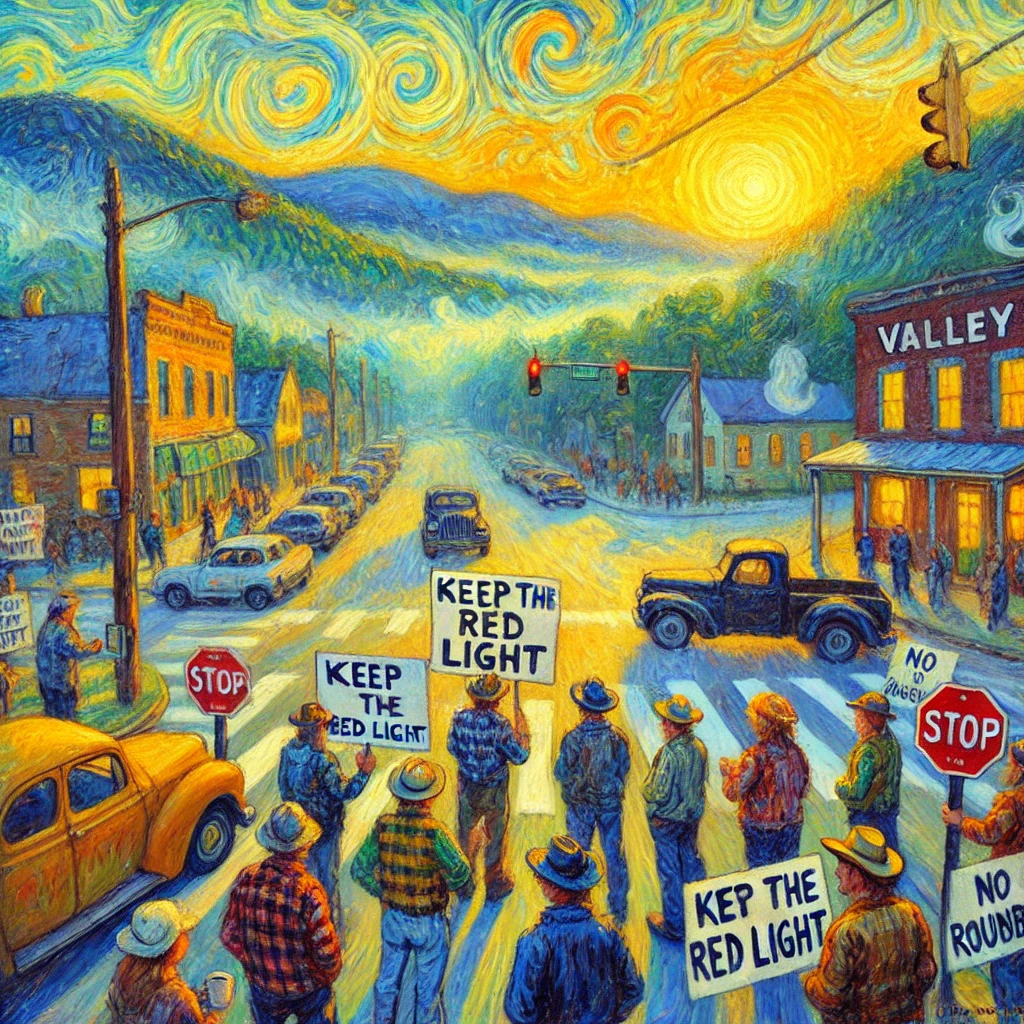
Locals Unite to Stop Traffic From Moving Smoothly, on Principle Alone.
By Tom Seest
At Sequatchie Crossing, we tell the stories of Sequatchie Crossing.
Please share this post with your friends, family, or business associates who may want follow the news from Sequatchie Crossing.
🎤 Audio Overview
The Roundabout Revolt: Sequatchie Crossing Circles the Wagons and Then Itself
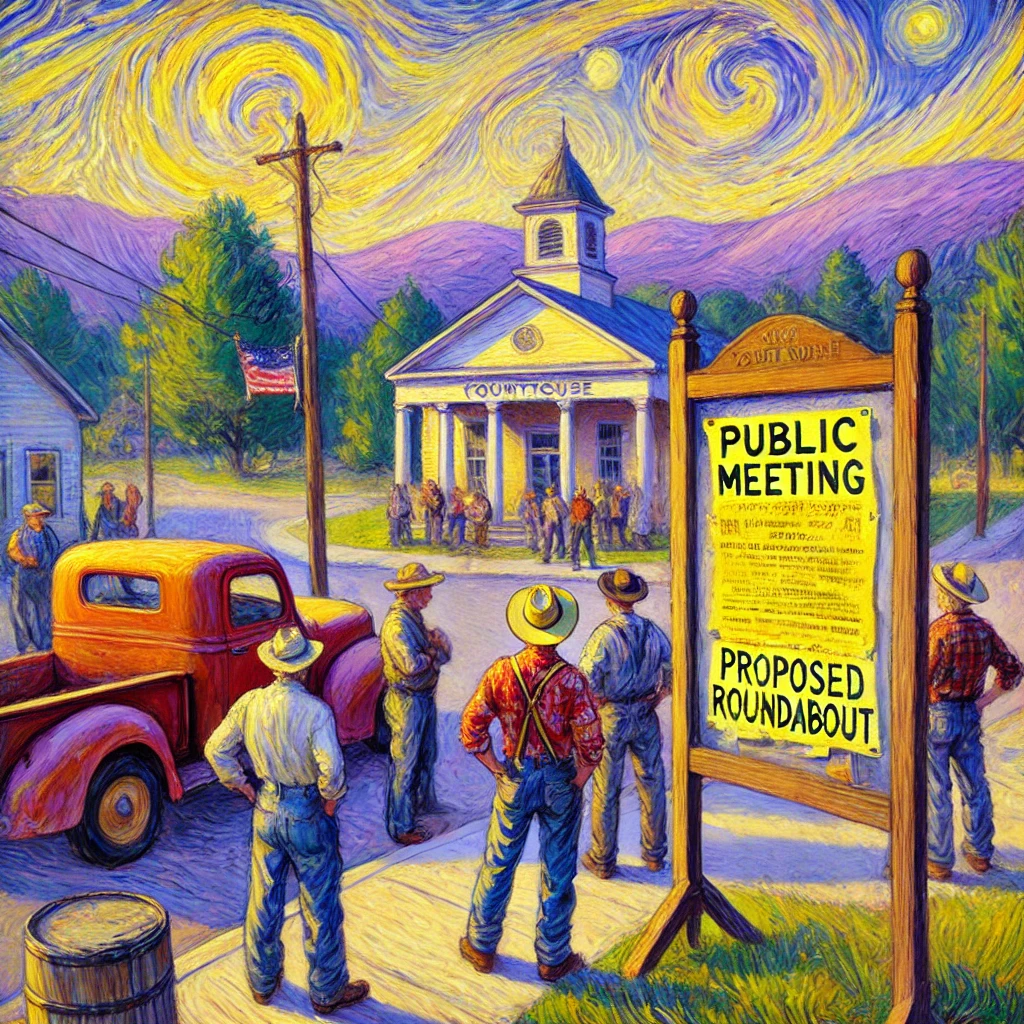
Act I – The Announcement Heard ’Round the Valley
Act I – The Announcement Heard ’Round the Valley
Sequatchie Crossing greeted Tuesday with the same half-awake rhythm it always did—school buses coughing to life, the courthouse flag rising unevenly, and the radio on WSCX announcing lost dogs and bake sales. Then came the news: “Public Meeting This Thursday, 5 PM — Proposed Roundabout Near HiTec.” It hit the airwaves like a fender bender in slow motion.
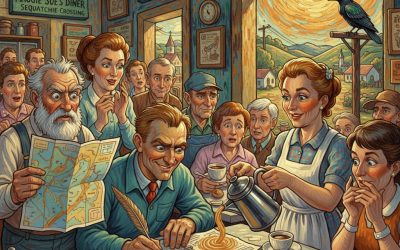
By the time the 8 a.m. coffee crowd sat down at Dean’s Diner, the notice was already pinned to the corkboard between “Free Kittens” and “Lost Mailbox Key.” Every customer paused to read it, as if it were an eviction notice for the whole town.
Mabel Dean, owner and guardian of both the grill and local sanity, poured coffee for Boot Barnes and Sheriff Peeler.
“A peanut roundabout?” she said. “I don’t trust any sentence that starts with a legume and ends in construction.”
“Maybe it’ll keep traffic moving,” Boot offered.
“So would closing the road,” Mabel shot back.
Across town, Flint Barker was already in lecture mode outside the hardware store. “First it was the stoplight back in ’98. Now this! They’ll be installing electric sidewalks next.” He spoke to an audience of two—one retired mechanic and a beagle—but his voice carried like a sermon.
The school drop-off line that morning ran halfway to the feed store. Hattie Layne, ever the parent volunteer and voice of order, leaned out her window. “I don’t care what they call it—a circle, a peanut, a pretzel—if they slow down this line one bit, I will homeschool so hard it makes the news.”
The assistant principal nodded solemnly; he’d seen Hattie organize a fundraiser and knew she could move mountains with a clipboard.
By midday, the local AM station opened its phone lines. Call one: “It’ll ruin everything.” Call two: “It’s about time we got one.” Call three: “Can someone explain what a roundabout is?” DJ Marla chuckled between calls and finally said, “If y’all keep circling around the topic, we’ll have ourselves one before Thursday.”
After lunch, the news jumped from airwaves to Facebook. Within minutes the Sequatchie Crossing Community Board had eighteen threads and two hundred comments. Somebody had already uploaded a diagram of a “peanut roundabout,” and someone else added googly eyes to it.
The mood was officially apocalyptic with sprinkles of memes.
At the library, Miss Calloway printed out every comment “for the historical record.” By closing time she had three inches of paper and declared it “a primary source in how not to behave on the internet.”
Meanwhile, Reverend Gentry met Sheriff Peeler outside the post office. “Brother Peeler,” he said, “perhaps we should pray for unity before folks start laying cones in the parking lot.”
The Sheriff nodded. “Prayer’s fine, but I’d better gas up the cruiser just in case they try to block the intersection again.”
By sundown, a hand-painted banner appeared outside HiTec that read: “ROUND AND OUT WITH THE ROUNDABOUT.” Someone had spelled “about” two different ways on the same line. No one corrected it.
In Sequatchie Crossing, grammar was optional but opinion was mandatory.

Act II – The Comment Wars Begin
Act II – The Comment Wars Begin
By Tuesday night, the great peanut uprising had moved entirely online. The Sequatchie Crossing Community Board—a digital space meant for lost pets and bake sales—had become a virtual gladiator arena. Each comment came faster than a blinking hazard light.
The original post read:
“Public Meeting this Thursday. Roundabout by HiTec. Be there if you care about Sequatchie Crossing!”
The first reply: “We don’t need it.”
The second: “We sure don’t.”
The third: “What’s a peanut roundabout?”
By the twelfth comment, the emojis alone could have qualified as modern art.
Boot Barnes was the first to add humor to the chaos. “I say we vote on it. And by vote, I mean someone bring donuts, and we’ll decide by icing preference.”
That earned fifty laughing faces and three furious ones—one of which came from Flint Barker, who replied, “This ain’t a joke, Boot! It’s an assault on Sequatchie civilization.”
Flint’s next post featured a blurry photo of an intersection from Ohio. “You think THIS is progress? That truck is stuck like a hog in a fence.” He had circled it in red using Microsoft Paint and labeled it “EVIDENCE.”
Over at Dean’s Diner, Mabel leaned over the counter reading her phone aloud to the breakfast crowd. “Listen to this one—‘Roundabouts cause confusion and moral decay.’” She looked up. “Moral decay, Boot. Can you get that from a traffic circle?”
Boot shrugged. “Depends on who’s drivin’.”
By morning, the town had divided neatly into two camps: the Keep the Light crowd and the Roundabout Realists. Between them lay a no-man’s-land of sarcasm and GIFs. One user posted a hamster running in a wheel. Another replied, “Perfect metaphor for this town.”
Then came the private messages—except they weren’t private.
Someone had accidentally posted a screenshot of a group chat where Hattie Layne wrote, “If this thing slows the school drop-off, I’m chaining myself to a cone.” Within minutes, the phrase #ConeHattie was trending locally, with T-shirts promised by Friday.
Clovis Strickland joined the thread late, typing with all caps and none of the punctuation. “THEY ARE USING THIS TO PUT IN CAMERAS THAT CAN READ LICENSE PLATES AND SOULS.” Someone asked if he could cite a source. “YEAH,” he replied, “COMMON SENSE.”
Meanwhile, Matt McCawley, Sequatchie Crossing’s unofficial statistician, started posting links to studies showing how roundabouts reduced fatal crashes by 70%.
Each link was met with either a heart emoji or a “Fake news!” reply, depending on which coffee shop the reader preferred.
“Progress is scary,” Matt typed patiently, “but this will make traffic flow smoother.”
“Progress is fine,” Flint fired back, “as long as it stays somewhere else.”
The Reverend tried to mediate. “Friends,” he wrote, “let’s remember Proverbs 4:26—‘Give careful thought to the paths for your feet.’”
Within two minutes, Clovis replied, “Is that before or after they paved paradise?”
By lunchtime Wednesday, the post had more engagement than the town’s Christmas Parade livestream. Even the high school civics teacher printed it out for “educational discussion,” though she admitted privately that it was also “good theater.”
The Sheriff, meanwhile, refused to read the comments. “That’s how wars start,” he said, stirring his coffee. “Over opinions and poor punctuation.”
The most thoughtful contribution came unexpectedly from teenager James “Spins” Roberts, who wrote: “I can’t wait to drive donuts around it. Progress, baby.” His comment received a record 243 laughing emojis and at least four concerned DMs from adults.
By Wednesday evening, someone had built a cardboard model of the roundabout in the diner parking lot using traffic cones, folding chairs, and a kiddie pool. Boot stood at the center wearing a lifejacket, calling it “interactive civic engagement.”
Mabel just sighed. “We’re gonna need a bigger menu section for this.”
Even the mayor’s office couldn’t escape. By nightfall, City Hall’s answering machine had filled with thirty-seven messages ranging from “Thank you for progress!” to “You’ll ruin this town like you ruined the Christmas lights in 2012.”
By bedtime, one thing was clear: the roundabout wasn’t just a traffic issue—it was a referendum on Sequatchie Crossing’s soul.
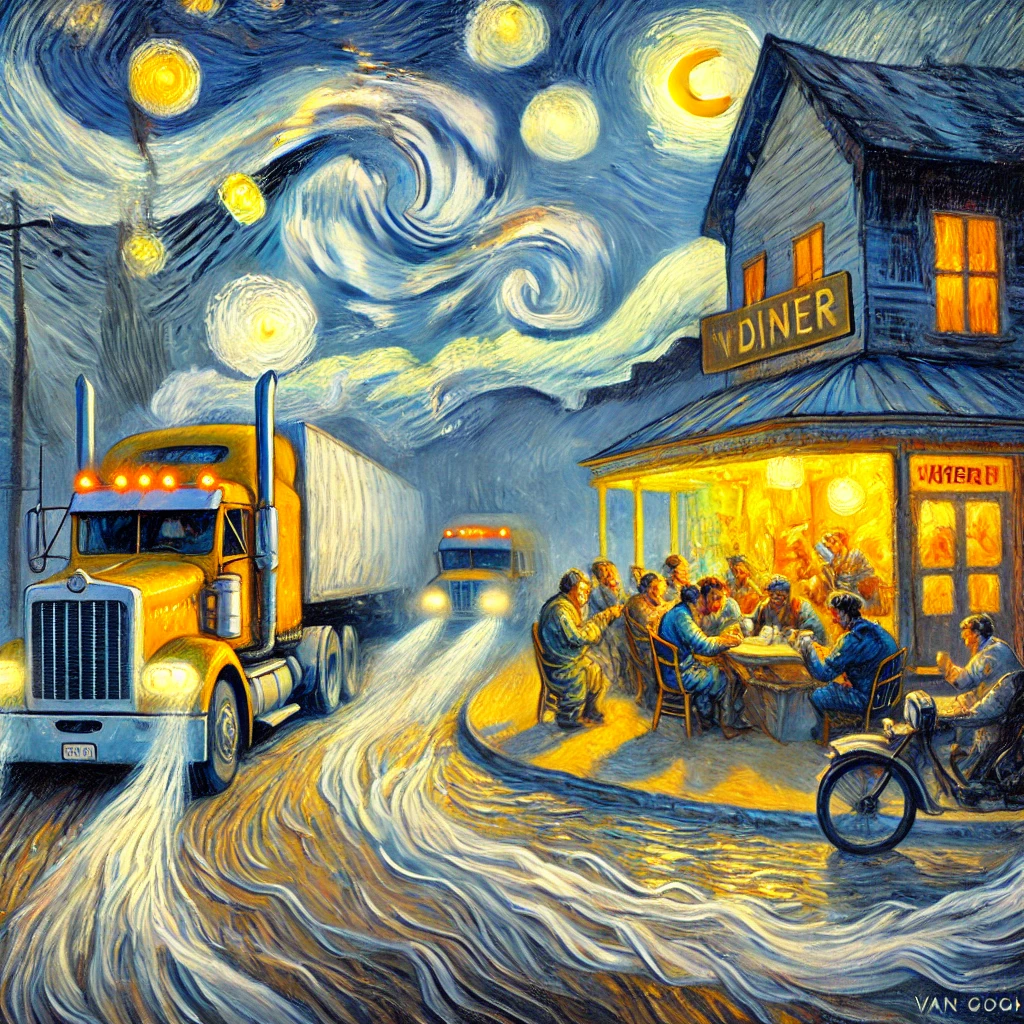
Act III – Trucks, Trailers & Trauma
Act III – Trucks, Trailers & Trauma
Thursday dawned with a low mist hanging over the valley, the kind that made headlights look like ghost eyes. Truck engines coughed awake across Sequatchie Crossing, ready to haul gravel, lumber, or indignation—whichever came first.
At Dean’s Diner, the morning crowd filled every booth. The regulars leaned close, cups steaming, the air thick with opinion. On the chalkboard, Mabel had added a new special: “Roundabout Breakfast – Comes Full Circle.” It sold out before 8 a.m.
Flint Barker occupied the corner booth, his voice carrying like a freight whistle. “Back when I was a kid,” he began, “you could ride your bike straight down Main and not meet a single car. Now it’s nothing but tailgaters and Teslas. They call it progress, but I call it the end of the line.”
“Flint,” Mabel said, refilling his cup, “you’ve been callin’ it the end of the line since 1987, when they put a second pump at the gas station.”
Boot Barnes laughed into his sausage biscuit. “I remember that stoplight scare of ’98. Folks thought the world was endin’. Preachers preached, dogs barked, and somebody chained themselves to the crosswalk sign.”
“That was my cousin,” said Hattie Layne from the next booth. “She said the light was a government plot to make us late for work.”
Reverend Gentry nodded. “I recall performing a prayer circle at that intersection. Didn’t solve the traffic, but it did wonders for fellowship.”
Outside, Dusty Crawfield climbed down from his dump truck and stomped into the diner. His arrival rattled the windowpanes and shifted the conversation instantly.
“Morning, Dusty,” Mabel greeted. “What’ll it be?”
“Three eggs, bacon, and a logical explanation for this roundabout nonsense,” he grumbled. He set his gloves on the counter like he was laying down evidence.
“Explain it to me,” Dusty continued. “How’s an 18-wheeler supposed to bend around a peanut? It’s geometry abuse, that’s what it is. I got eighty thousand pounds of gravel that don’t steer like a go-kart. You’ll have me scraping curbs and praying to Goodyear.”
Boot, ever the optimist, said, “They make the outer ring wide for trucks, don’t they?”
Dusty pointed a calloused finger. “Son, you ever tried making a left turn while a Prius driver thinks they’re invincible? They’ll dive in like it’s Nascar and I’m the prize.”
The table roared. Even Mabel laughed so hard she nearly spilled coffee on her apron. “You’re gonna give yourself a heart attack before the roundabout even gets built,” she said.
Across town, Matt McCawley stood in the parking lot of City Hall with a folding table, a stack of printed traffic studies, and a handwritten sign that read “Ask Me About Safety Metrics!” Most folks walked by pretending not to see him, as if statistics were contagious.
Clovis Strickland showed up, pointing at the sky. “You ever notice how all these projects start after the full moon? That’s not coincidence—it’s coordination.”
Matt sighed. “Clovis, it’s an infrastructure improvement project, not witchcraft.”
“You say that now,” Clovis muttered, “but mark my words, one day we’ll wake up with toll booths on every driveway.”
By noon, the mood had shifted from humor to something heavier. Outside the high school, a group of teenagers argued about who would be first to do a burnout once the road opened. Across from them, old men shook their heads at what the world was coming to.
At the feed store, a man named Coy claimed he’d already seen the future in a dream: “Traffic backin’ up from the bridge clear to the Piggly Wiggly. And a goose in the middle of the roundabout, honkin’ like the end times.”
Even the town’s FM station got involved. Between country hits, the DJ played a call-in segment titled “Round or Red? The Great Debate.” Callers shared stories of roundabouts gone wrong from distant towns. One woman claimed hers was haunted. Another said she hadn’t stopped turning for three days.
“Maybe we just need faith,” Reverend Gentry said later that afternoon. “A roundabout can’t steal our peace unless we let it.”
Boot grinned. “Reckon that’s what they said about disco, too.”
By sunset, Sheriff Peeler was parked near the HiTec intersection, watching as locals slowed down to stare at the spray-painted survey marks on the pavement. He counted seventeen near-rear-endings in an hour, and that was before a single cone had gone up.
He called Mabel on his radio. “Looks like we’re gonna need more coffee for the meeting tonight.”
Mabel replied, “And maybe a few helmets.”
As dusk settled, the entire valley seemed to buzz with nervous energy. Porch lights flicked on like fireflies as the townsfolk rehearsed their speeches for the upcoming meeting. Sequatchie Crossing wasn’t just preparing to discuss a traffic feature—it was bracing for cultural combat.
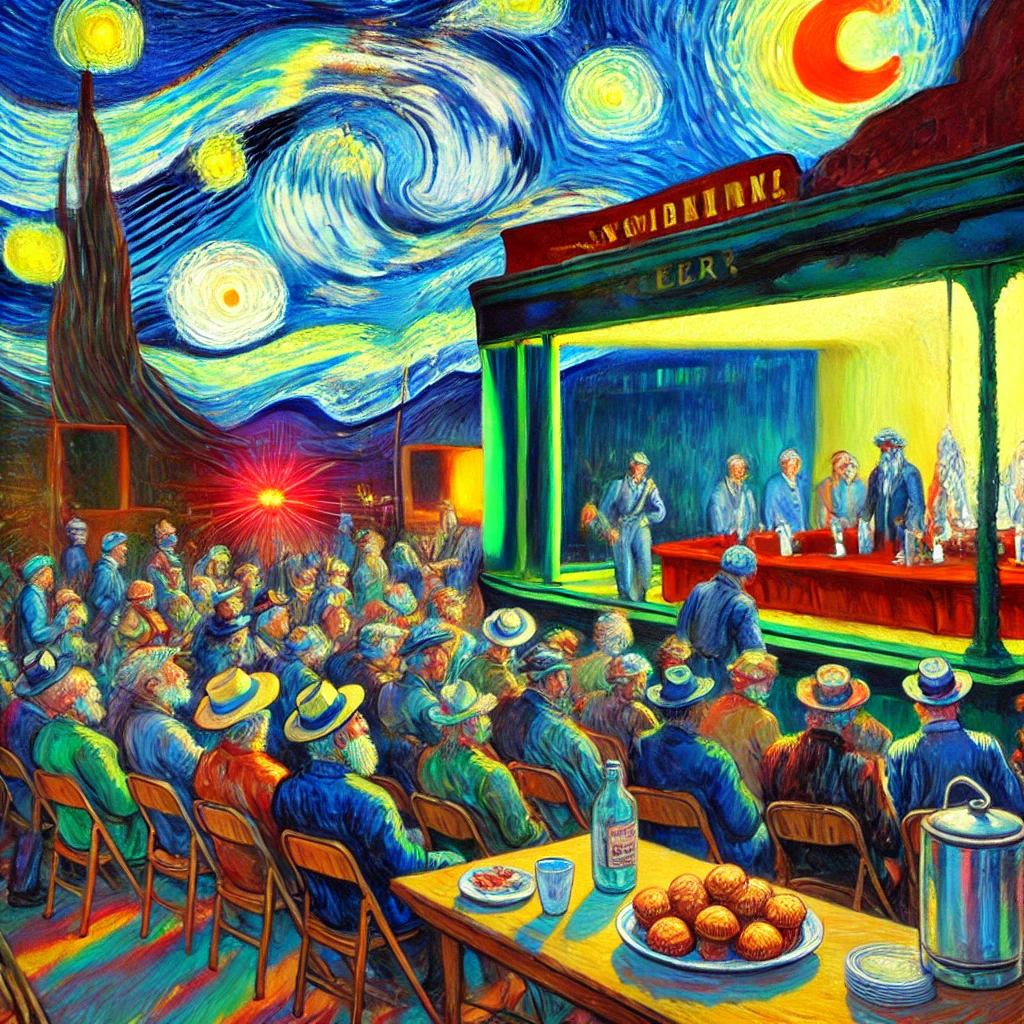
Act IV – The Meeting Nobody Could Reach
Act IV – The Meeting Nobody Could Reach
At precisely five o’clock, Sequatchie Crossing came to a complete stop. The irony was so perfect it could’ve been choreographed by the universe itself. Traffic choked every approach to the HiTec intersection, all the way back to the feed mill on one side and the church parking lot on the other. Folks trying to get to the public meeting about traffic improvement were trapped in the very gridlock they’d come to protest.
Inside the town hall, the air was heavy with the musk of cologne, diesel, and frustration. The folding chairs—fifty of them borrowed from the Baptist fellowship hall—were full before the meeting even started. Latecomers lined the walls, clutching styrofoam coffee cups like stress toys.
At the front of the room stood Mayor Hutherton, who looked like a man wishing for an invisibility cloak. The town clerk whispered, “Do you want me to start the slideshow?” He whispered back, “Do you want to start a riot?”
The projector, humming faintly, displayed a cheerful rendering of the proposed “Peanut Roundabout.” Its yellow lanes glowed against a background of cheerful landscaping. It was the most optimistic peanut ever drawn.
The mayor cleared his throat. “Evenin’, folks. Appreciate you all comin’ out. As you know, we’re here to discuss the proposed intersection improvement project—”
“Improvement for who?” shouted Flint Barker from the third row. “Out-of-towners?”
“Let’s hold questions until after the presentation,” said Hutherton, smiling a politician’s smile so tight it might chip.
From the back, Clovis Strickland raised a hand. “Before we start, I’d like to ask if anyone’s done a background check on this peanut.”
The mayor blinked. “Sir, it’s an intersection.”
“That’s what they said about Area 51!” Clovis hollered, earning a murmur of agreement from the conspiracy wing of the room.
Meanwhile, Mabel Dean entered quietly through the side door carrying two trays of muffins labeled “Roundabout Snacks.” She set them on the refreshment table with a note that read: *“Please keep conversation moving clockwise.”*
Reverend Gentry took the floor next. “Before we start debating circles,” he said, “perhaps we could begin with a prayer for wisdom, patience, and low insurance premiums.”
Heads bowed. A few eyes stayed open, glaring across the aisle. The prayer ended with a loud, collective “Amen” that carried both holiness and hostility.
The mayor clicked the first slide. “As you can see, the Tennessee Department of—”
“Wait!” interrupted Belinda Minerly, the former city grant writer, standing near the window. “This isn’t a TDOT project. It’s a city grant from years ago—applied for before Mayor Hutherton was even in office.”
Half the room turned toward her like she’d just confessed to inventing traffic itself.
“So you’re saying we did this to ourselves?” asked a voice.
Belinda sighed. “Technically, yes. But it was meant to include sidewalks, safety features, bridge widening—”
A woman in the back stood up. “I don’t need sidewalks, I need sanity!”
At that exact moment, the projector bulb exploded with a pop. The room went dark. Someone shouted, “It’s a sign!” Someone else clapped. Sheriff Peeler shined his flashlight toward the ceiling and muttered, “Sign or not, that thing’s not under warranty.”
With the technology dead, the crowd seized control. Flint Barker took the opportunity to deliver a speech he’d apparently been rehearsing since breakfast.
“Folks,” he began, pacing like a revival preacher, “they tell us it’s progress. They said that about the strip mall. They said it about the water tower with the wrong zip code. Every time they say progress, we lose somethin’ we didn’t know we valued. You can’t pave over a sense of belonging.”
Applause erupted—some earnest, some just impressed by the poetry.
Then Matt McCawley rose, papers in hand. “I understand the nostalgia,” he said. “But change isn’t the enemy. The real problem is congestion and accidents. Roundabouts save lives. That’s not opinion—it’s data.”
From the front row, Dusty Crawfield muttered, “Data’s never hauled gravel uphill at rush hour.”
“Maybe not,” said Matt, smiling, “but data doesn’t run stoplights either.”
Boot Barnes stood next. “I move we call it a ‘Traffic Doughnut’ instead. That way at least it sounds friendly.”
Laughter broke the tension. Even the mayor cracked a grin. “Noted, Boot. I’ll forward that to the state.”
The crowd gradually relaxed as Mabel passed around her muffins. The scent of cinnamon worked miracles diplomacy couldn’t. Reverend Gentry leaned over to Sheriff Peeler. “You see? Nothing calms the spirit like baked goods.”
Outside, headlights continued to crawl past the building, honking occasionally in solidarity—or protest—it was hard to tell. By the time the meeting adjourned, nobody had voted on anything, but everybody felt like they’d won an argument.
The mayor stood alone afterward, collecting crumpled handouts from the floor. “You think they’ll ever agree?” asked the clerk.
He looked out at the blinking taillights disappearing into the fog. “Sure,” he said. “Eventually. Once we get through the roundabout.”
Act V – Full Circle
Act V – Full Circle
The first orange cones appeared before dawn on Monday. By sunrise, Sequatchie Crossing looked like it had been visited by a colony of neon termites. Excavators hummed at the HiTec intersection, backhoes moved dirt like slow dancers, and men in reflective vests shouted in a language made entirely of hand signals and sarcasm.
Mabel Dean stood in front of the diner holding her coffee like a candle. “Well,” she said to Boot Barnes, “there it is—the beginning of the end of the beginning.”
Boot squinted through the haze. “Looks like a NASCAR pit stop had a baby with a peanut festival.”
Down the street, Sheriff Peeler leaned against his cruiser, watching cars snake through temporary detours. “I’ve already given three warnings,” he told Reverend Gentry, who’d stopped by to deliver cinnamon rolls to the crew. “Apparently, people think ‘ROAD CLOSED’ is just a polite suggestion.”
“Faith requires patience,” the Reverend said, handing him a roll. “So does traffic.”
By week’s end, the roundabout had begun to take shape—a broad asphalt ellipse surrounded by curbs, new signage, and a thousand fresh opinions. Rumors spread faster than concrete could cure. One man swore the center island would contain a statue of the mayor. Another said it was going to be a helipad for government drones. Clovis Strickland took photos of every new cone “for evidence.”
The project lasted three months, during which the town experienced every known stage of grief: denial, anger, bargaining, potholes, and acceptance. School buses found new routes. The UPS driver learned to meditate. Even Dusty Crawfield, after weeks of muttering, admitted he kind of liked the wide lanes—though he refused to call them “engineer-approved.”
Finally, on a crisp December morning, the barricades came down. The new peanut-shaped roundabout gleamed like a fresh promise under the winter sun. The town gathered to watch the first car make its way through.
Naturally, it was Boot Barnes. He rolled forward in his old Ford pickup, creeping into the circle like it might bite. Once inside, he grinned, waved to the crowd, and made a full extra loop just for show.
The crowd cheered. “He made it!” shouted Mabel, tossing her apron in the air.
Next came Dusty’s dump truck, its engine growling like a thunderstorm. He downshifted, turned, and cleared the outer lane perfectly. For a moment, time froze—then erupted in applause. Dusty stuck his arm out the window and saluted. “Still thinkin’ it’s stupid,” he yelled, “but at least it works.”
Children laughed, pointing at the new signs. “Yield to Joy!” someone had written in chalk on the pavement. Even Clovis cracked a smile—though he quickly added, “That’s exactly how they get you.”
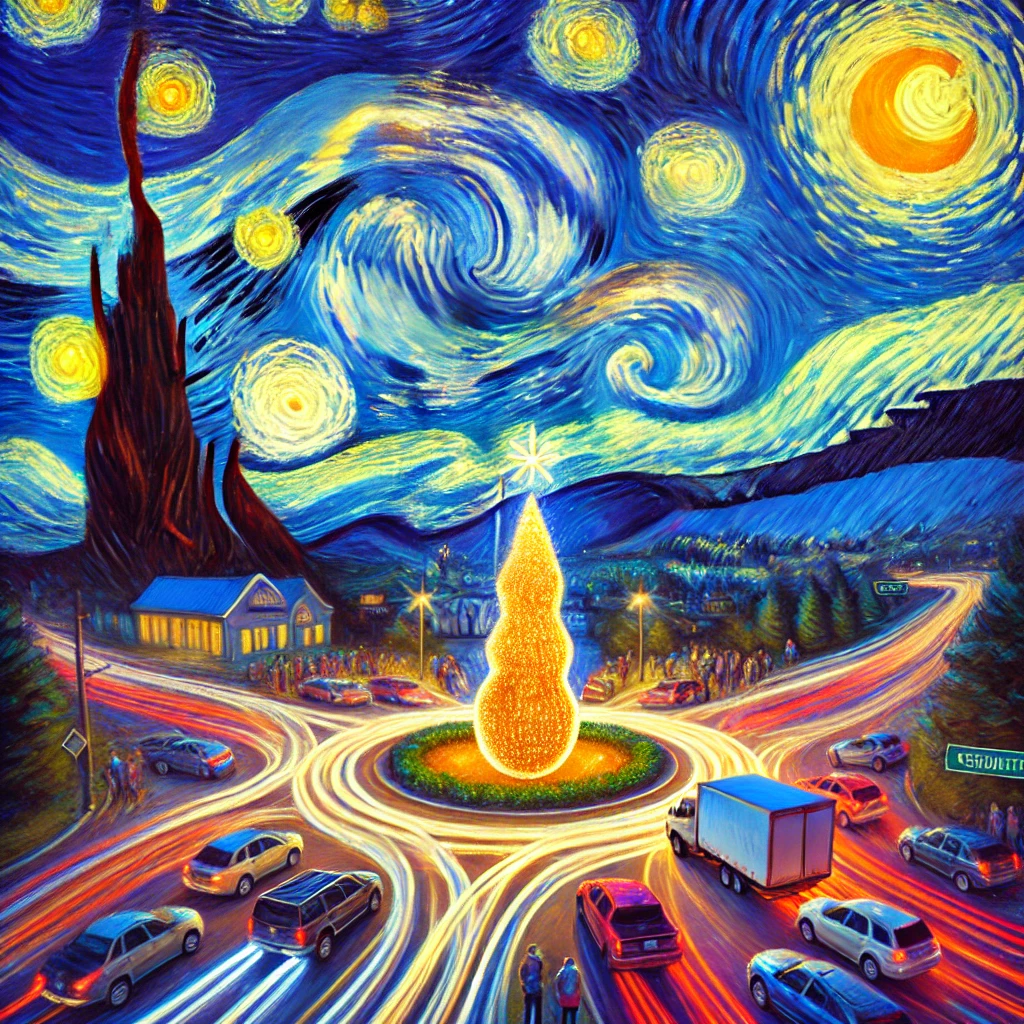
By nightfall, Sequatchie Crossing’s newest feature was lit by Christmas lights strung from lamppost to lamppost. A small tree sat in the center island, its ornaments glimmering as cars glided past. The whole scene shimmered like a snow globe painted by optimism.
Sheriff Peeler directed the first evening of traffic, his flashlight tracing arcs of soft light. “Not bad,” he said into his radio. “Not bad at all.”
Reverend Gentry held an impromptu blessing at the curb, reading from Psalm 25: “Show me your ways, O Lord; teach me your paths.” The irony wasn’t lost on anyone.
At Dean’s Diner that night, the regulars gathered to debrief. “It ain’t perfect,” Mabel said, wiping down the counter, “but it beats waiting through three red lights just to get to the post office.”
Boot nodded. “Progress don’t always look how we want it to. Sometimes it just looks… circular.”
Flint Barker, who had fought the hardest against it, sat quietly for a long moment. Finally, he said, “You know, I thought this would ruin the town. But maybe it’s just reminding us we’re all goin’ the same direction, even if we don’t like the route.”
From a booth near the window, Tommy Seeger, the town’s unofficial columnist, scribbled in his notebook. Later that week his piece would appear in the Sequatchie Crossing Dispatch under the headline: “Progress Comes Full Circle.”
He wrote:
“In the end, Sequatchie Crossing didn’t collapse under the weight of change—it just adjusted its steering. We argued, circled, yielded, and survived. Maybe that’s what small towns do best: resist until they understand, then embrace until it feels like tradition.”
Outside, the roundabout glowed under a swirl of stars and headlights. From above, it looked less like chaos and more like choreography—every car, every person, every opinion moving in loops of light, trying, somehow, to find their way home.
Disclaimer – Purely Factual After Two Cups
Key Takeaway
Sequatchie Crossing didn’t just debate a roundabout—it measured the distance between what it was and what it’s becoming.
Progress, it turns out, isn’t about moving forward or backward. It’s about learning how to keep moving, even when the road starts to curve.
Disclaimer
All names, characters, and opinions expressed herein are entirely fictional — though they might remind you suspiciously of someone you saw at the diner. Any resemblance to actual people, events, or traffic disputes is purely coincidental and probably exaggerated for dramatic effect.
All directions are approximate, all logic subject to detour, and all opinions may go in circles. Please yield to laughter, stop for coffee, and proceed with caution.
Real Places Behind the Ruckus – From The Dunlap Directory
Real Places Behind the Ruckus – From The Dunlap Directory
Yes, this story was fictional; even the parts that weren’t true. These places? Absolutely real. Stop by, support local, and keep the Wi-Fi away from livestock:
- Dunlap Plumbing Company
- Chattanooga Ghost Tours Inc
- The Chef’s Restaurant
- Rent-A-Center
- Ginger’s Car Detail
- Waldemar Design & Machine
- Kubota of Chattanooga
- Eco Home Solutions
- Old Dunlap General Store
- Holloways
- Mossy Oak Properties Land Sales, LLC.
- Subway
- JM Lawncare
- AutoZone
- Highland Drive Warehouse
- L & C Concrete Finishing
- Amy Painter Photography

Real Places Behind the Ruckus – From The Dunlap Directory
At Sequatchie Crossing, we tell the stories of Sequatchie Crossing.
Please share this post with your friends, family, or business associates who may want follow the news from Sequatchie Crossing.

0 Comments