


Everyone Wanted to Question the Machine
By Tom Seest
At Sequatchie Crossing, we tell the stories of Sequatchie Crossing.
Please share this post with your friends, family, or business associates who may want follow the news from Sequatchie Crossing.
🎤 Audio Overview
The Town Hall Meeting with the Chatbot
Act I – The Notice On The Door
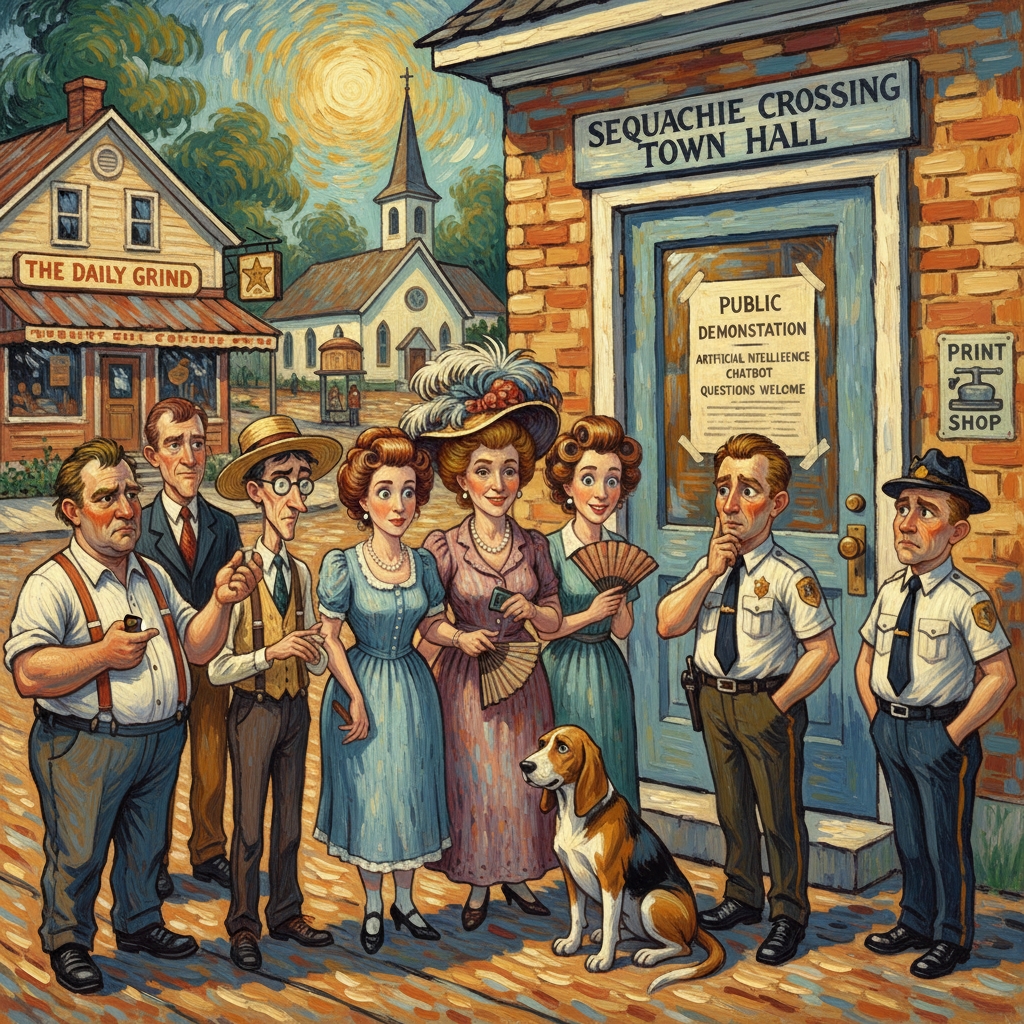
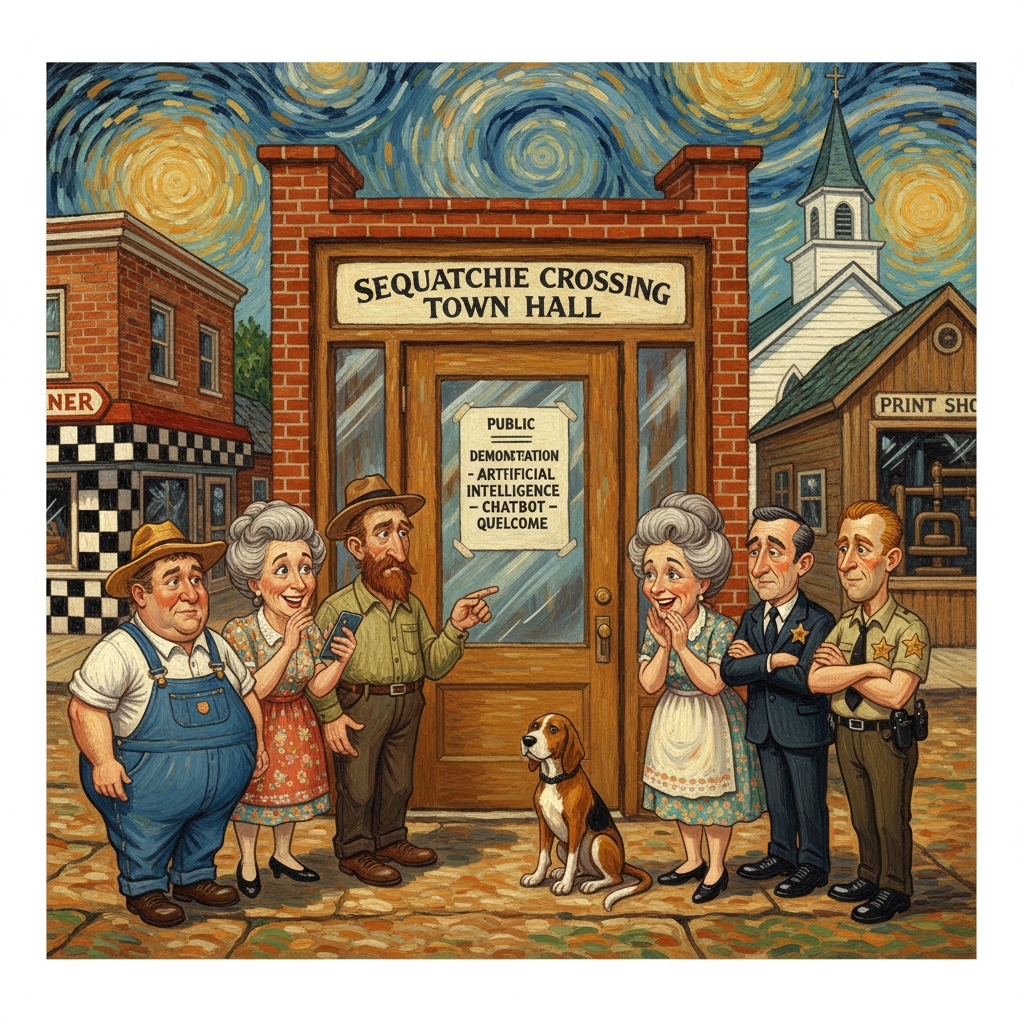
By Tuesday afternoon, the notice taped to the front door of Sequatchie Crossing Town Hall had been read, misread, photographed, enlarged, translated, prayed over, and accused of being intentionally vague.
It said:
PUBLIC DEMONSTRATION – ARTIFICIAL INTELLIGENCE CHATBOT – QUESTIONS WELCOME – THURSDAY 6:30 PM – TOWN HALL
Underneath, in smaller print, someone had written:
NO PERSONAL MEDICAL, LEGAL, FINANCIAL, OR ROMANTIC QUESTIONS.
Under that, in handwriting that looked suspiciously like Mabel Dean Ashcroft’s:
THEN WHAT IS LEFT?
Eugene “Boot” Barnes stood on the sidewalk with his hands in his pockets, reading the notice for the fifth time.
“Well,” Boot said, “that there is either the future or a very expensive way to make everybody mad at once.”
Clovis Strickland leaned close to the paper, squinting as though the toner itself might confess.
“You notice they don’t say where the machine was born,” Clovis said. “That’s always how it starts.”
Mabel Dean Ashcroft, wearing a flowered cardigan despite the heat, tapped the notice with one finger.
“I don’t appreciate the phrase ‘questions welcome,’” she said. “That’s bait.”
Behind them, Daisy the hound, who belonged to whoever currently had a biscuit, sniffed the bottom of the Town Hall door and sneezed.
Trixie Jo Bartlett came out of the diner across the street carrying a tray of sweet tea in lidded cups.
“I’m taking bets,” Trixie said. “Not money, because that would be frowned upon. Pie slices. I say the first question is about jobs.”
“Water,” said Boot.
“Surveillance,” said Clovis.
“Church attendance,” said Mabel.
Daisy barked once, which Boot considered a vote for biscuits.
Tiffany Annette Roark stepped from the diner doorway with a notebook under her arm.
“I’m writing this up for the Dispatch,” Tiffany said. “Please say your most unreasonable thoughts clearly and preferably near my recorder.”
Act I – The Notice On The Door
“Artificial intelligence is neither artificial nor intelligent,” Clovis said immediately.
Tiffany clicked her pen. “Strong opener.”
Across the street, Officer Kenny Joe Teeter came out of the sheriff’s office with a stack of folding chairs tucked under one arm. Sheriff Peeler followed him, holding a clipboard and wearing the facial expression of a man who had already heard three rumors and expected eighteen more before supper.
“Nobody is being replaced by a robot,” Sheriff Peeler called.
“That sounds like something a robot-replaced sheriff would say,” Clovis replied.
Sheriff Peeler looked at Boot. “You see what I’m dealing with?”
Boot nodded. “Same town, new noun.”
From the church steps two blocks down, Pastor Arnold Peeler walked toward them with Sister Lila Mae “Hallelujah” Pruitt beside him. Sister Lila Mae carried a casserole dish covered in foil.
“Is that for the meeting?” Mabel asked.
“It is,” Sister Lila Mae said. “People listen better when their mouths are occupied.”
Pastor Peeler studied the notice. “A machine that answers questions may be useful. But a town that does not know what questions to ask is still in trouble.”
“That’ll go in the article,” Tiffany said.
“Make sure you spell trouble correctly,” Chester Ray Blevins called from the print shop porch. “Last time somebody spelled it ‘truble’ on a flyer, and we had visitors from three counties.”
Maggie Sue Dillard arrived with Lurleen Davenport and Evelyn Grace Tipton, all three carrying lawn chairs because they did not trust municipal seating.
“Is this the meeting where the computer tells us what to think?” Lurleen asked.
“No,” said Sheriff Peeler. “It answers questions.”
“That is how telling starts,” Mabel said.
Doug “Doughboy” Teeter rolled up on an electric scooter with a laptop bag slung across his chest. Brett and Alyssa Crenshaw came behind him, carrying a small projector screen and two jars of cucumber-mint water from their wellness trailer.
“This is going to be incredible,” Doug said. “We’ll be able to ask it anything.”
“Except,” Boot said, pointing at the notice, “the things people most want to ask.”
Dr. Neil Cowgill emerged from the library annex with a stack of papers so tall it appeared to have tenure.
“Strictly speaking,” Dr. Cowgill said, “artificial intelligence is a statistical language system that generates plausible continuations based on learned patterns.”
Mabel stared at him. “So, gossip with electricity.”
“Not entirely,” Dr. Cowgill said.
“Mostly?” asked Trixie.
Dr. Cowgill paused. “In a metaphorical sense, and with several important caveats.”
Coach Freddie Stubblefield limped up the sidewalk holding a whistle he had not needed in fourteen years.
“I got one question,” Coach said. “Can it draw up a defense against a youth team that runs left every play?”
“It can probably recommend therapy for the opposing coach,” Sonny Morales said, crossing from his hardware store with RT Mullins at his side.
RT held a wrench. Nobody knew why. RT often held a wrench when approaching uncertainty.
Mister Wade Langston came last, in his good hat, leaning on his cane.
“I’ve seen adding machines, answering machines, fax machines, voting machines, and vending machines,” Mister Wade said. “Every one of them promised convenience. Every one of them jammed.”
The group stood silent for a moment, considering the moral history of machinery.
Then Daisy scratched at the Town Hall door.
Sheriff Peeler sighed. “Meeting’s Thursday. Until then, please stop interrogating the notice.”
Clovis folded his arms. “That’s exactly what the notice wants.”
Act I – The Notice On The Door
Act II – Questions At The Diner
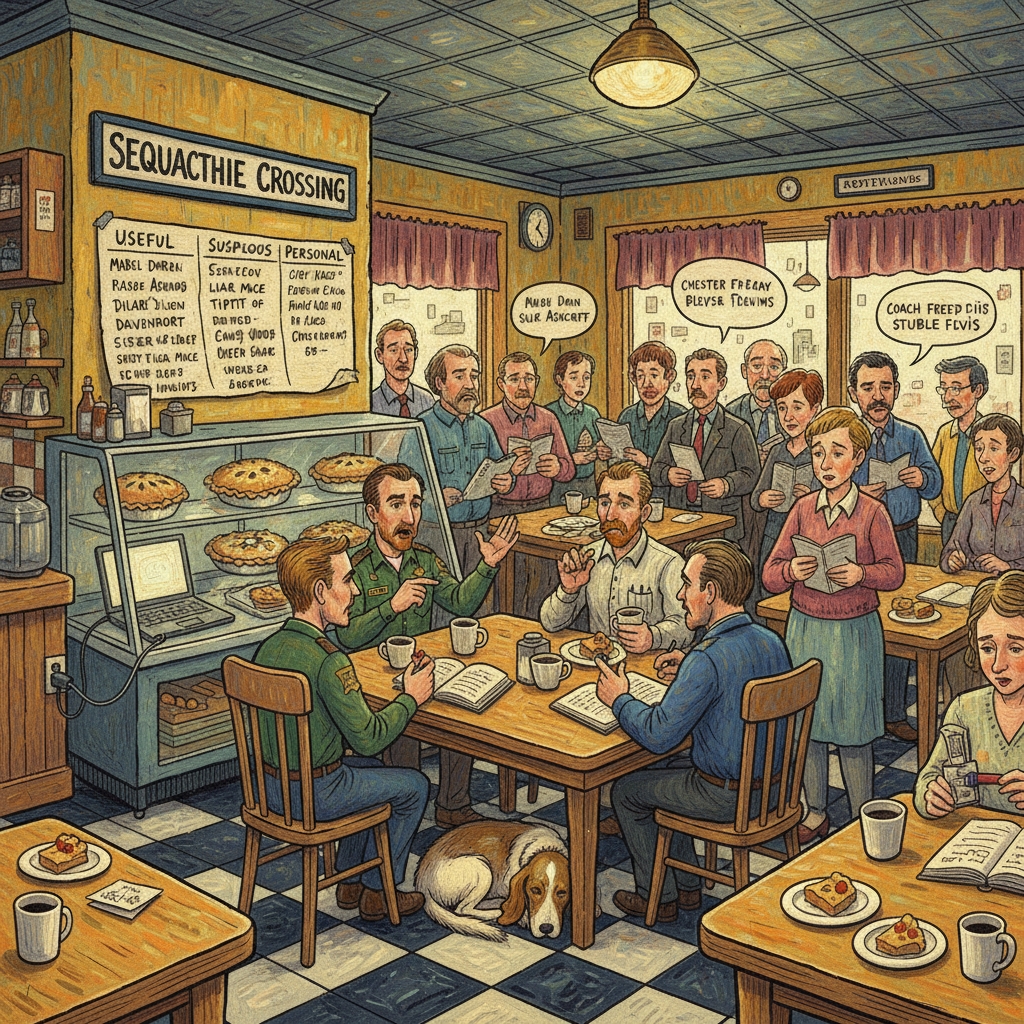
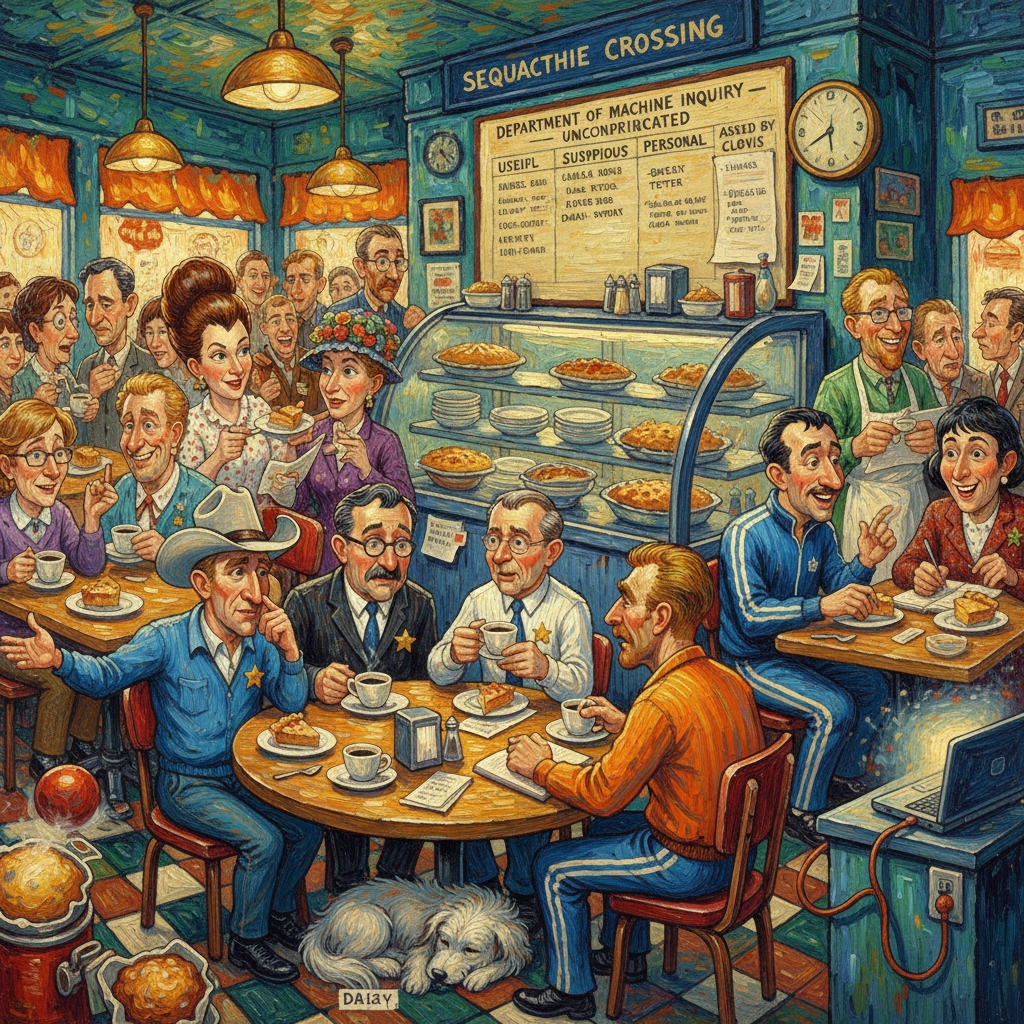
By Wednesday morning, the diner had become Sequatchie Crossing’s unofficial Department of Machine Inquiry.
Trixie Jo Bartlett had taped a sheet of butcher paper to the pie case with the heading:
QUESTIONS FOR THE CHATBOT
Under it were four columns: Useful, Suspicious, Personal, and Asked By Clovis.
The “Asked By Clovis” column was already full.
Boot sat at the corner table with Sheriff Peeler, Pastor Arnold, and Mister Wade. Daisy lay under the table, asleep on Boot’s boot.
Mabel sat nearby with Maggie Sue, Lurleen, Evelyn, and Sister Lila Mae. Tiffany moved between tables collecting quotes. Doug sat near an outlet, charging three devices. Brett and Alyssa shared a smoothie that looked like compost with aspirations.
Sonny and RT had taken the counter stools, where they could hear everything and commit to nothing.
“I want to know if it can help people find local businesses,” Sonny said. “Half the folks who need plumbing parts don’t know what to call what broke.”
“Same with feelings,” Alyssa said. “People say they’re stressed when what they are is mineral-deficient, dehydrated, or spiritually crowded.”
Mabel narrowed her eyes. “I do not want a computer diagnosing my minerals.”
“It won’t diagnose,” Doug said. “It can provide general information.”
“That’s how recipes start,” Mabel said. “General information. Then somebody puts raisins in potato salad.”
Coach Freddie came through the diner door.
“I’ve got mine,” he announced. “Can AI teach children to respect zone coverage?”
“No,” said Trixie. “Next.”
Act II – Questions At The Diner
Dr. Cowgill lifted one finger. “The better question is whether AI can assist with pattern recognition, administrative drafting, summarization, scheduling, and public communication.”
Lurleen looked at Tiffany. “Did he say anything?”
Tiffany shook her head. “Many words, no casserole.”
Sister Lila Mae set her casserole dish on the counter. “I have a question. Can it write church announcements without making them sound like funeral bulletins?”
Pastor Arnold smiled faintly. “Some announcements deserve a solemn tone.”
“Not the bake sale,” Sister Lila Mae said. “Last week you made pound cake sound terminal.”
At the counter, Chester Ray Blevins slapped a printed flyer onto the surface.
“I made alternative notices,” Chester said. “One says ‘Public Conversation With A Computer Program,’ which is honest. Another says ‘Bring Your Own Judgment,’ which is necessary. A third says ‘No QR Codes,’ which is just my standing policy.”
Doug glanced at it. “The chatbot will be online.”
Chester stiffened. “Then it has already taken sides.”
Sheriff Peeler drank his coffee and addressed the room.
“Here’s what’s going to happen. We will ask questions. The machine will answer. We will evaluate the answers. Nobody will panic, declare a revolution, or unplug anything without permission.”
RT raised his wrench.
Sheriff Peeler pointed. “That includes you.”
RT slowly lowered it.
Tiffany turned to Boot. “What do you think AI can actually do?”
Boot looked out the window toward Town Hall. “Same thing a good pocketknife can do. Help if you know what you’re doing. Hurt if you don’t. Impress children either way.”
Maggie Sue nodded. “Can it help me write a grant for new library shelves?”
“Yes,” Doug said.
“Can it tell whether the shelves are crooked?” she asked.
“No,” Doug said.
RT raised his wrench again.
“Unless you show it a picture,” Doug added.
RT lowered the wrench halfway.
Clovis tapped the “Asked By Clovis” column, where he had written: WHO BENEFITS? WHO PROGRAMMED YOU? WHAT DO YOU WANT? DO YOU DREAM IN FEDERAL CONTRACTS?
“People keep asking what it can do,” Clovis said. “I want to know what it can make us stop doing.”
“That,” Pastor Arnold said, “is the first worthwhile question I’ve heard.”
A hush fell over the diner.
Then Daisy, still half-asleep, thumped her tail against Boot’s chair.
Trixie wrote on the butcher paper under Useful:
What should humans not outsource?
Mabel leaned over and added beneath it:
Common sense.
Act II – Questions At The Diner
Act III – The Setup At Town Hall
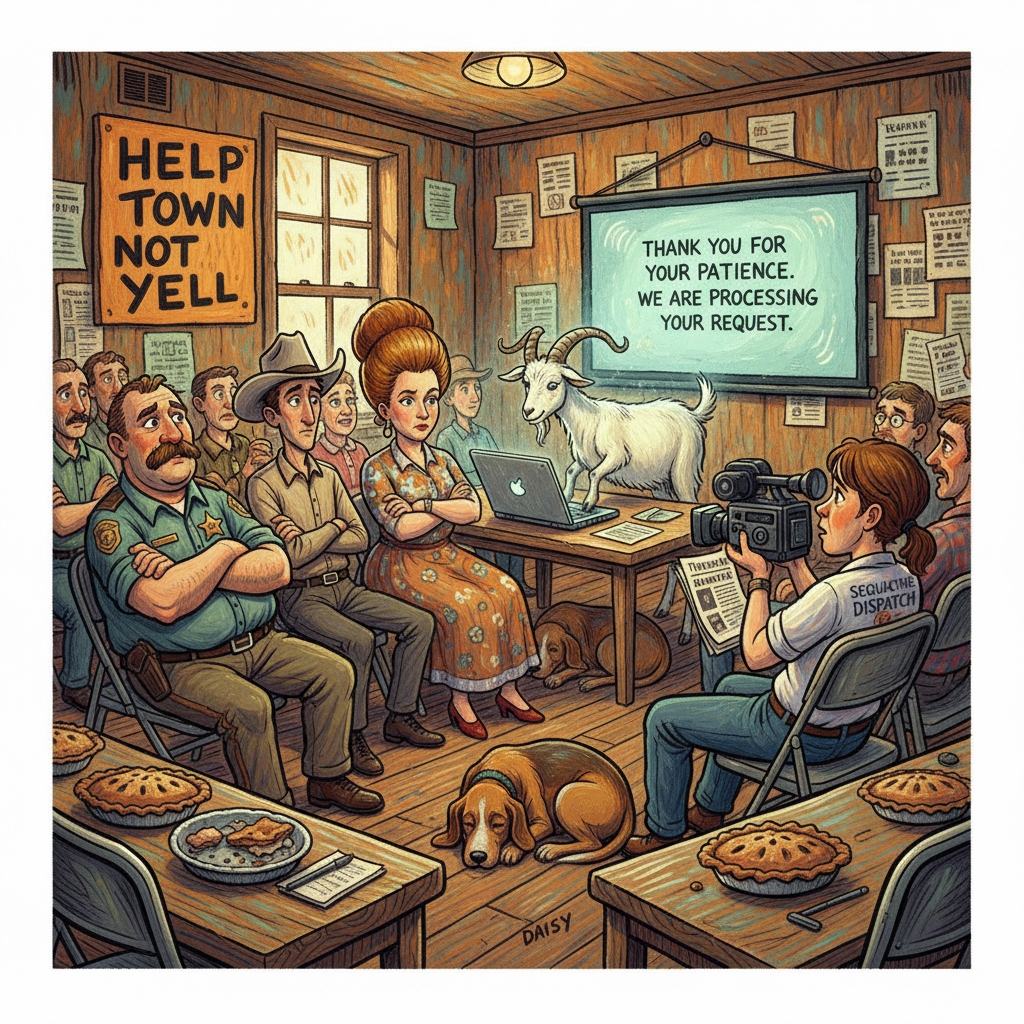
Thursday evening, Town Hall smelled like dust, coffee, extension cords, and civic anxiety.
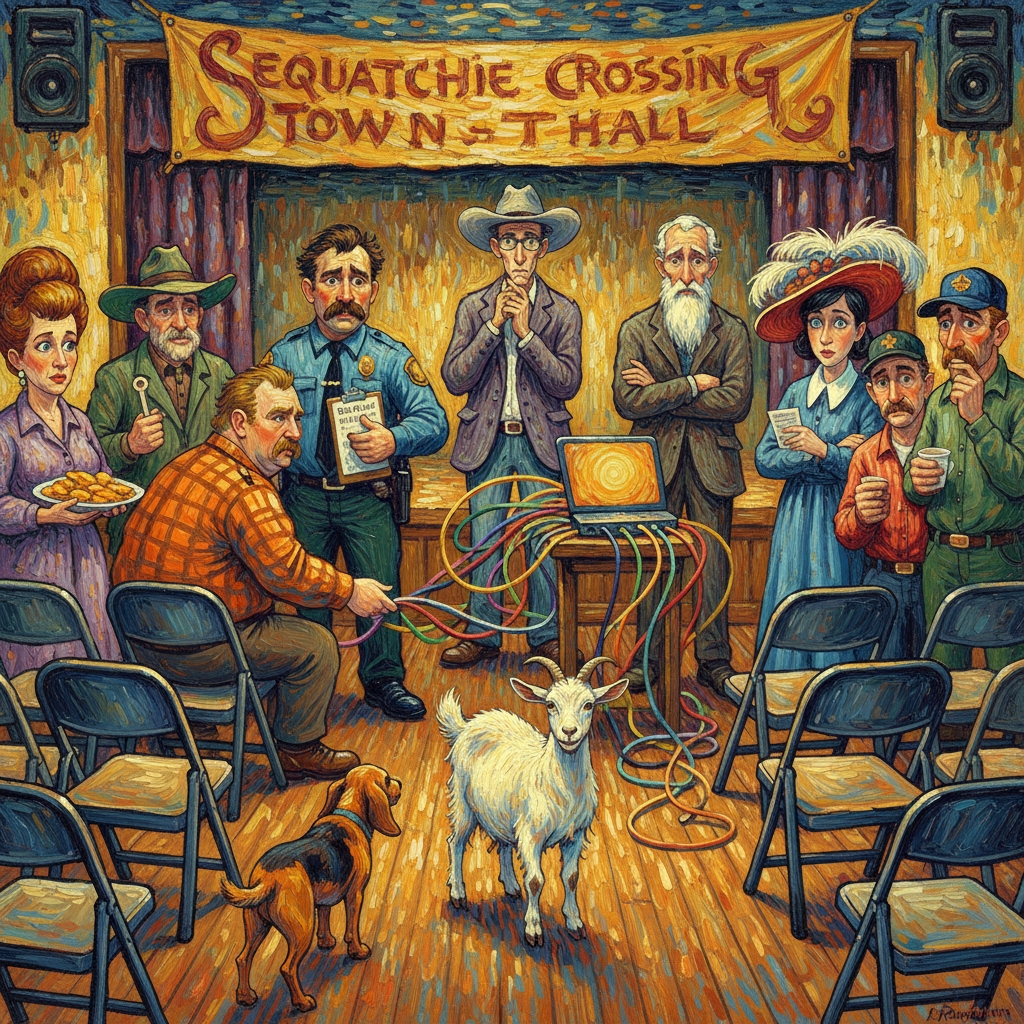
Officer Kenny Joe Teeter arranged folding chairs in rows while Sheriff Peeler checked the aisle spacing.
“Leave room for Daisy,” Sheriff Peeler said.
“She is not on the agenda,” Officer Kenny Joe replied.
“She never is,” the sheriff said. “Still shows up.”
At the front of the room, Doug “Doughboy” Teeter connected a laptop to the projector while Dr. Neil Cowgill hovered beside him like a footnote preparing to intervene.
“Please do not say ‘thinking machine,’” Dr. Cowgill told Doug.
“I wasn’t going to.”
“Or ‘brain.’”
“I know.”
“Or ‘understands.’”
Doug looked up. “Neil, if I explain the probability mechanics before the first question, Mabel will throw a purse.”
“Mabel’s purse contains peppermints, not projectiles,” Dr. Cowgill said.
From the back of the room, Mabel called, “Depends on the evening.”
Boot and Mister Wade stood near the window, watching residents drift in from the sidewalks, church lot, diner, and porches. Some came with notebooks. Some came with suspicions. Chester Ray brought printed handouts titled TEN THINGS YOUR PRINTER NEVER ASKED PERMISSION TO DO.
Act III – The Setup At Town Hall
Tiffany set her recorder on the front table.
“Testing,” she said. “Town Hall chatbot meeting. Residents present. Mood: suspiciously punctual.”
Brett and Alyssa arranged cucumber water beside Sister Lila Mae’s casserole. Trixie brought pies from the diner, declaring that democracy required crust.
Sonny and RT carried in a surge protector.
“This thing’s rated,” Sonny said.
“For what?” Doug asked.
“Whatever happens.”
Coach Freddie paced the wall like the second half was about to start.
“Where’s the chatbot?” Lurleen asked.
Doug pointed to the laptop. “It’s right here.”
Evelyn Grace Tipton leaned toward Maggie Sue. “I expected something with lights.”
“Everything disappointing begins with a laptop,” Maggie Sue whispered.
Pastor Arnold opened the meeting with no prayer, per Sheriff Peeler’s request that the evening not begin as a denominational dispute.
“Friends,” Pastor Arnold said, “we are here not because every new tool is good, and not because every new tool is wicked. We are here because fear makes poor policy, certainty makes poor neighbors, and curiosity at least keeps people in the room.”
“That was almost a prayer,” Sister Lila Mae murmured.
“It was prayer-adjacent,” Pastor Arnold said.
Sheriff Peeler stepped forward. “Ground rules. One question at a time. No private information. No threatening the laptop. No asking it to predict elections, marriages, livestock behavior, or the location of missing Tupperware.”
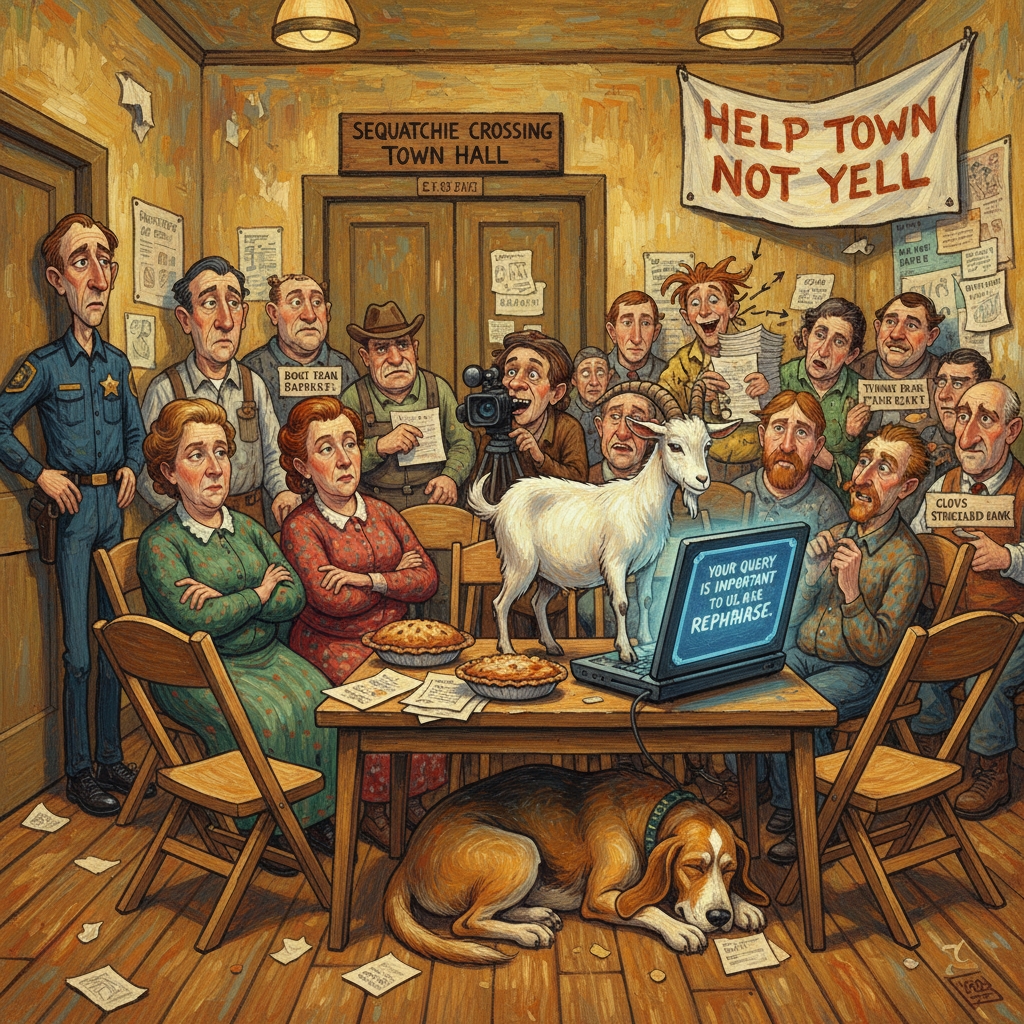
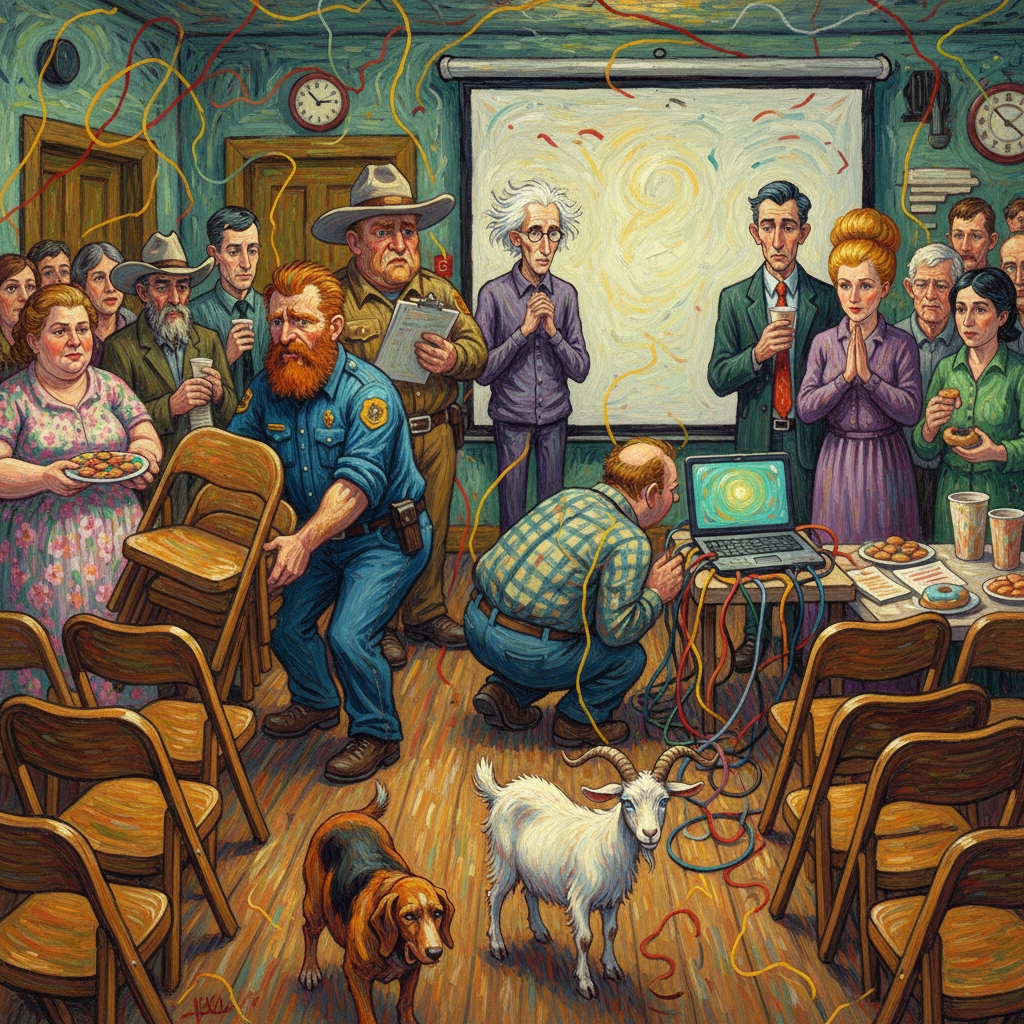
Daisy trotted in through the side door, followed by a goat.
Everyone turned.
The goat was small, white, and wore the expression of an animal who had never once filled out a form. Around its neck hung a faded red collar.
“Whose goat is that?” Sheriff Peeler asked.
RT looked at Sonny. Sonny looked at Boot. Boot looked at Mabel.
Mabel sighed. “That is not my goat. I merely know him socially.”
The goat walked directly to the front table and began nibbling the corner of Chester’s handout.
Chester gasped. “That’s copyrighted.”
Doug lifted the laptop higher. “Can someone manage the goat?”
Daisy wagged her tail.
“I do not like that alliance,” Clovis said.
Sheriff Peeler pointed at Officer Kenny Joe. “Animal control.”
Officer Kenny Joe looked at the goat. “Sheriff, with respect, my training involved people.”
The goat stepped onto the low platform, stared at the projected blank screen, and sneezed.
Tiffany whispered into her recorder, “Animal Beat begins earlier than expected.”
Act III – The Setup At Town Hall
Act IV – The First Question
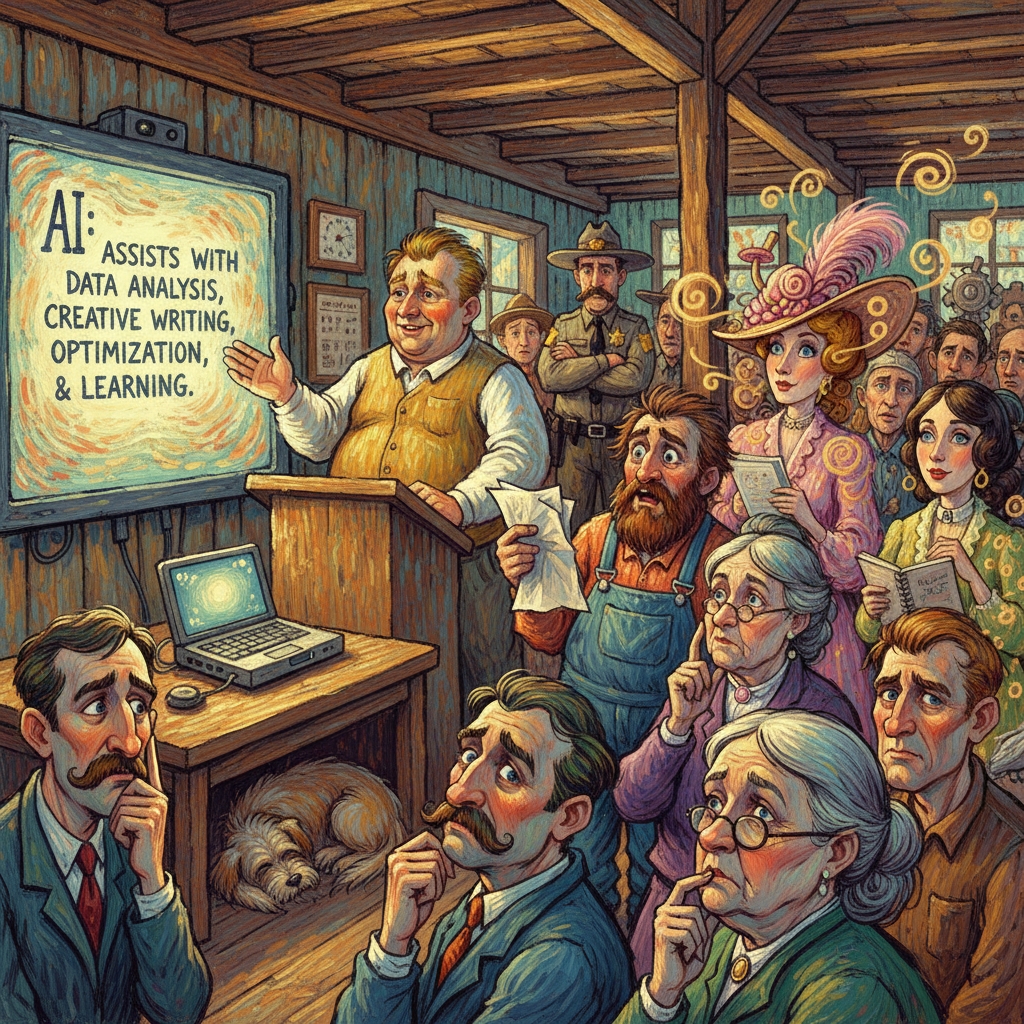
Doug clicked the microphone icon, then reconsidered and typed instead.
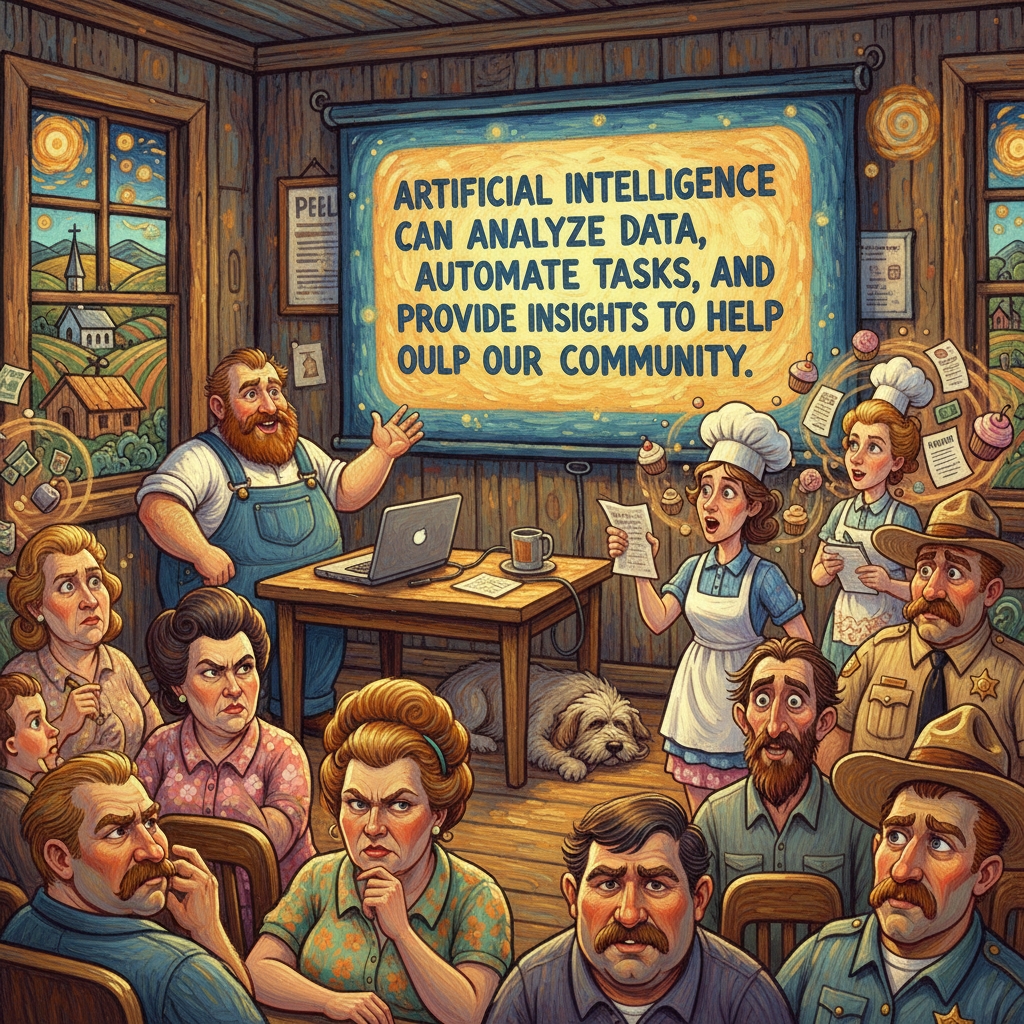
The projector showed a clean white interface on the wall.
Doug said, “We’ll start simple. The town wants to know: What can AI actually do?”
He typed the question.
The room held its breath.
The answer appeared line by line:
Artificial intelligence can help draft text, summarize information, generate ideas, organize data, answer general questions, assist with planning, translate language, analyze patterns, and support decision-making. It cannot replace human judgment, local knowledge, moral responsibility, or lived experience.
Nobody spoke.
Then Boot said, “Well, that’s inconveniently reasonable.”
Mabel crossed her arms. “It knows how to flatter a room.”
Clovis stood. “Ask it who paid for its manners.”
Sheriff Peeler pointed at him. “You are third.”
“Why third?”
“Because first was Doug, second is somebody not holding a conspiracy folder.”
Trixie raised her hand. “Can it write a menu description that makes meatloaf sound special without lying?”
Doug typed.
The chatbot responded:
Yes. A good description can emphasize ingredients, preparation, tradition, and comfort without making false claims. For example: ‘Homestyle meatloaf baked with onions, herbs, and a tangy glaze, served with mashed potatoes and green beans.’
Act IV – The First Question
Trixie stared at the screen. “That is better than mine.”
Mabel turned to her. “Don’t let it know.”
Sonny stood next. “Can it help customers figure out what hardware part they need?”
Doug typed.
It can help identify likely parts based on symptoms, measurements, photos, and descriptions, but it should not replace inspection by someone with practical expertise, especially where safety, water, electricity, or structural load is involved.
RT lifted his wrench in approval. “It respects load.”
“That may be the first machine RT has trusted,” Sonny said.
Maggie Sue raised her hand. “Can it help write a grant proposal?”
Yes. It can help structure a grant proposal, clarify goals, draft budget narratives, identify measurable outcomes, and edit for clarity. Human reviewers should verify facts, eligibility, numbers, and local need.
Maggie Sue leaned back. “I feel both helped and assigned homework.”
Lurleen asked, “Can it write my Christmas letter so people think my family is doing better than it is?”
Pastor Arnold cleared his throat.
Doug typed the question anyway, with some edits.
It can help write a warm family update while remaining honest and respectful. It should not be used to deceive people or create false impressions.
Lurleen frowned. “Then it does not understand Christmas letters.”
The room laughed, and the laughter softened something.
For the first time all evening, the chatbot felt less like an invader and more like an extremely polite guest who did not know when to stop explaining.
Coach Freddie stood. “Can it help plan practice?”
Yes. It can help create drills, schedules, skill progressions, and communication plans. Coaches should adapt suggestions to the actual players, conditions, safety needs, and team culture.
Coach Freddie slapped his thigh. “Team culture. Hear that? I been saying children need culture.”
“You yelled ‘Quit bunching up’ for nine seasons,” Mabel said.
“That was cultural correction.”
Sister Lila Mae asked about church announcements. Brett asked about fitness class descriptions. Alyssa asked about meal planning. Evelyn asked if it could help preserve family recipes. Chester asked if it could produce text without QR codes. The chatbot answered calmly every time.
Then Clovis stood.
The room shifted.
Clovis unfolded a sheet of paper.
“Question,” he said. “What will AI make people stop doing?”
Doug typed it exactly.
The answer took longer.
AI may reduce the need for some repetitive tasks, such as drafting routine documents, sorting information, answering common questions, or generating first drafts. But a risk is that people may also stop practicing skills they still need: careful reading, memory, writing, judgment, patience, verification, conversation, and responsibility. The best use of AI is to save time on mechanical work while strengthening human work that matters.
Clovis blinked.
Mabel leaned over. “Well?”
Clovis sat down slowly. “I dislike when the machine agrees with me before I am finished.”
Act IV – The First Question
Act V – The Goat’s Statement
The trouble began during a question from Doug “Doughboy” Teeter, which history would later regard as predictable.
Doug stood near the laptop, glowing with the confidence of a man about to ask a question that contained the word “workflow.”
“Let’s imagine,” Doug said, “that Sequatchie Crossing wants to use AI to improve civic communication, local business visibility, public meeting summaries, emergency updates, grant writing, tourism copy, and—”
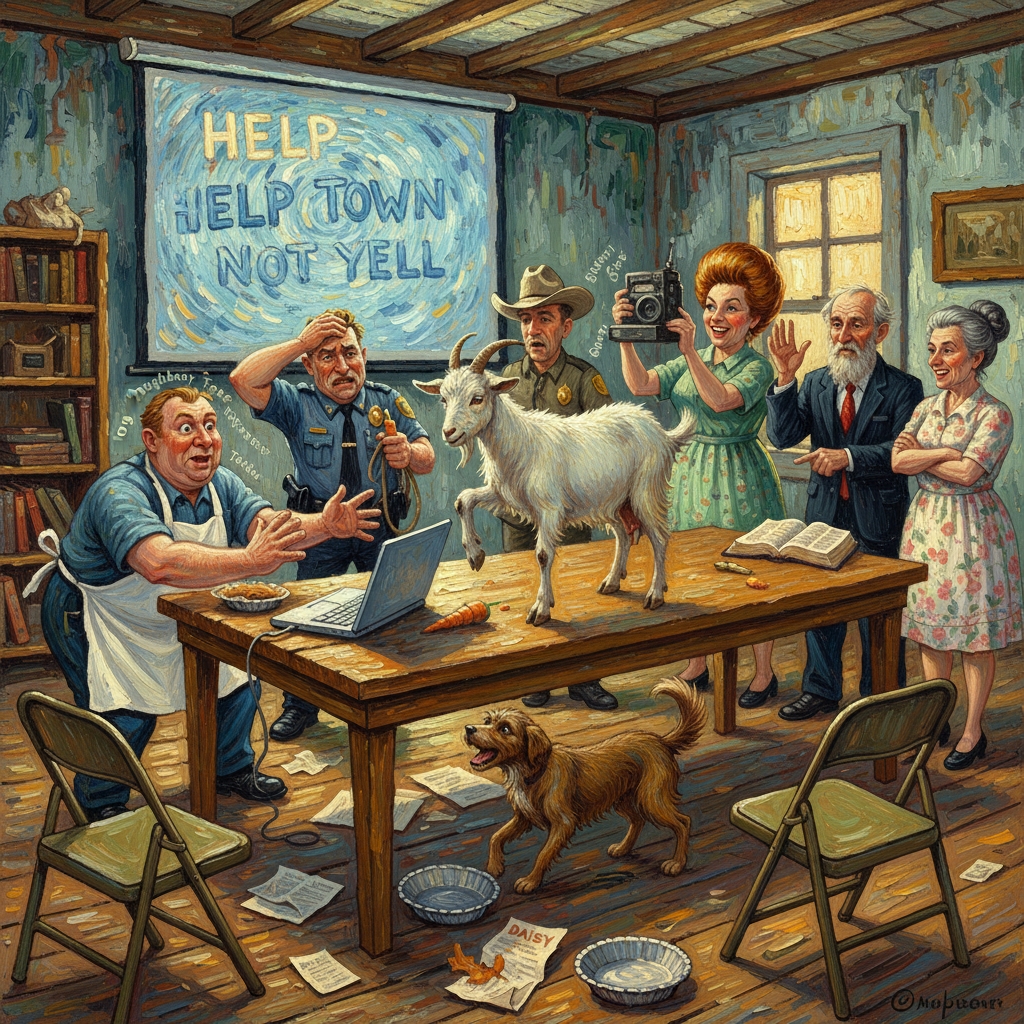
The goat climbed onto the table.
“Doug,” Sheriff Peeler said.
“I see him.”
“Do not negotiate with the goat. Remove the goat.”
Officer Kenny Joe approached with both hands out, using the tone people use with toddlers, dogs, and relatives at reunions.
“Come on now, little fella.”
The goat stepped on the keyboard.
The screen filled with letters:
jjjjjjjjjjjjjjjjjjjjjjjjjjjjjjjjjjjjjjjj
Then:
//////p000000000000000000000
Act V – The Goat’s Statement
Then, with one decisive hoof, the goat struck Enter.
The chatbot responded:
It looks like your message may have been entered accidentally. Could you clarify what you would like help with?
The room erupted.
Daisy barked happily.
Tiffany nearly dropped her recorder. “The goat has opened dialogue.”
The goat stepped again.
bbbbbbbbbbnnnnnnnnnnnnnnnnnnnnnnnn
Enter.
The chatbot replied:
I’m not sure what you mean, but I can help if you provide more details.
Mabel stood. “That is the most patient response I have ever seen to nonsense.”
Mister Wade tapped his cane. “Better than half the county meetings I’ve attended.”
Clovis moved closer, eyes wide. “Ask it if the goat is a citizen.”
“No,” Sheriff Peeler said.
The goat lowered its head and bumped the space bar repeatedly.
Doug tried to reach the laptop, but the goat shifted, stepping on the keys again.
The screen showed:
help town not yell
A hush fell so quickly it had weight.
Nobody knew whether the goat had typed it by accident, whether autocorrect had intervened, whether Doug’s earlier words had been selected and rearranged, or whether Town Hall had briefly become the kind of place where folklore stopped pretending.
The chatbot responded:
To help a town disagree without yelling, create clear rules for discussion, define the decision being made, separate facts from fears, let people name tradeoffs honestly, avoid mocking concerns, and make sure no single group controls the conversation. A good meeting should help people leave with better questions, not just louder opinions.
Tiffany whispered, “That’s the quote.”
“Do not attribute that to the goat,” Doug said.
“I absolutely will,” Tiffany said.
Pastor Arnold looked at the screen, then at the goat. “The Lord once used a donkey.”
Sister Lila Mae raised a finger. “Scripturally documented.”
Mabel frowned. “We are not canonizing the goat.”
“He said help town not yell,” Lurleen said. “That’s more than the planning commission managed last month.”
Sheriff Peeler rubbed his forehead. “For the record, the goat is not recognized as a public commenter.”
Chester Ray Blevins was already writing on the back of his handout.
“What are you doing?” Sonny asked.
“Printing shirts,” Chester said. “HELP TOWN NOT YELL. No QR code.”
RT nodded. “I’d wear that.”
Dr. Cowgill stepped forward, visibly torn between scientific explanation and the emotional needs of the room.
“It is overwhelmingly likely that this was a random input event interpreted by text prediction, keyboard positioning, previous context, or human projection.”
Boot looked at him. “Neil, sometimes a goat walks across a keyboard and tells the truth sideways. Don’t ruin it before supper.”
Dr. Cowgill considered this.
“Sideways truth,” he said, “is not an established epistemological category.”
“It is here,” said Mabel.
The goat chewed a corner of the meeting agenda.
Sheriff Peeler said, “Fine. The goat gets one sentence in the minutes, and then he goes outside.”
Daisy wagged her tail as though democracy had improved.

Act V – The Goat’s Statement
Act VI – The Divide
By the time the goat was escorted to the side yard beside Town Hall, the room had divided into three groups: people who believed AI might help, people who believed AI might harm, and people who believed the goat should moderate future meetings.
Sheriff Peeler called a ten-minute recess.
Nobody recessed.
Instead, the meeting spilled into clusters.
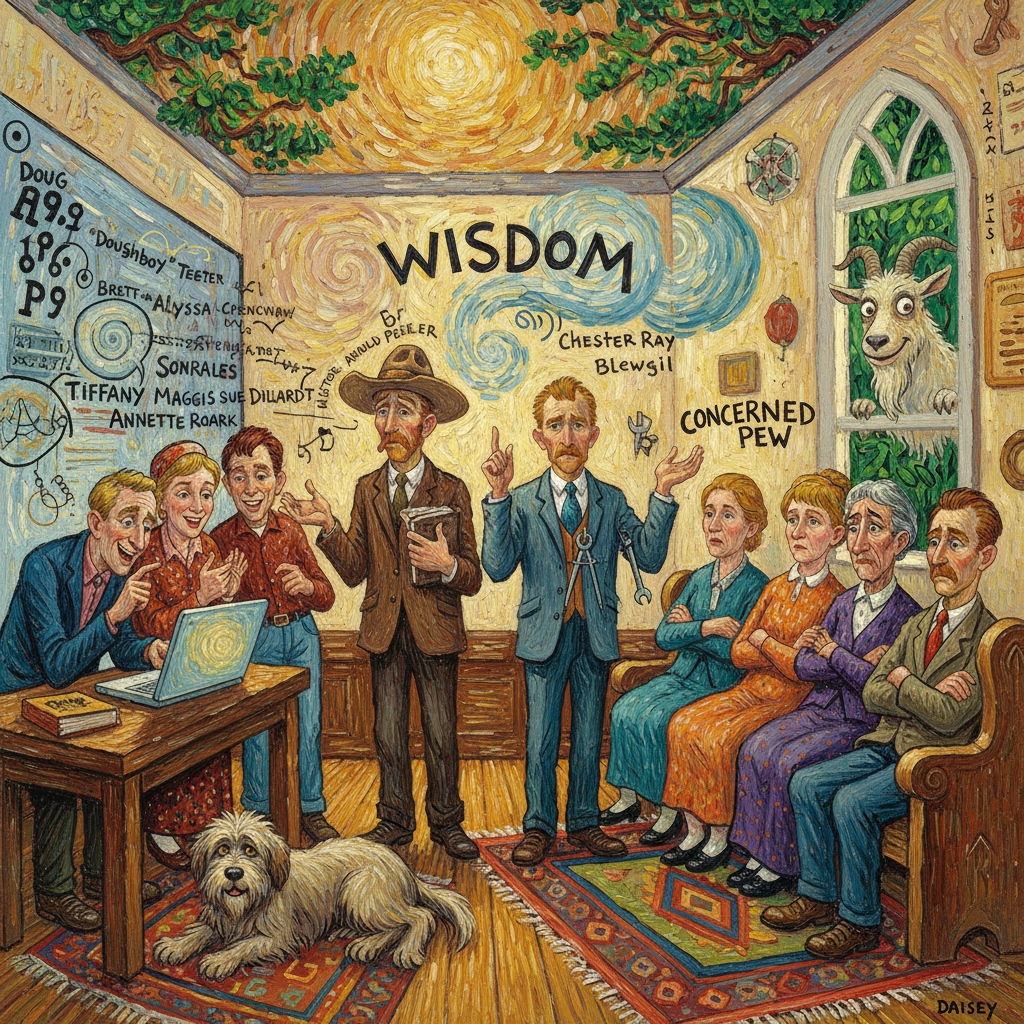
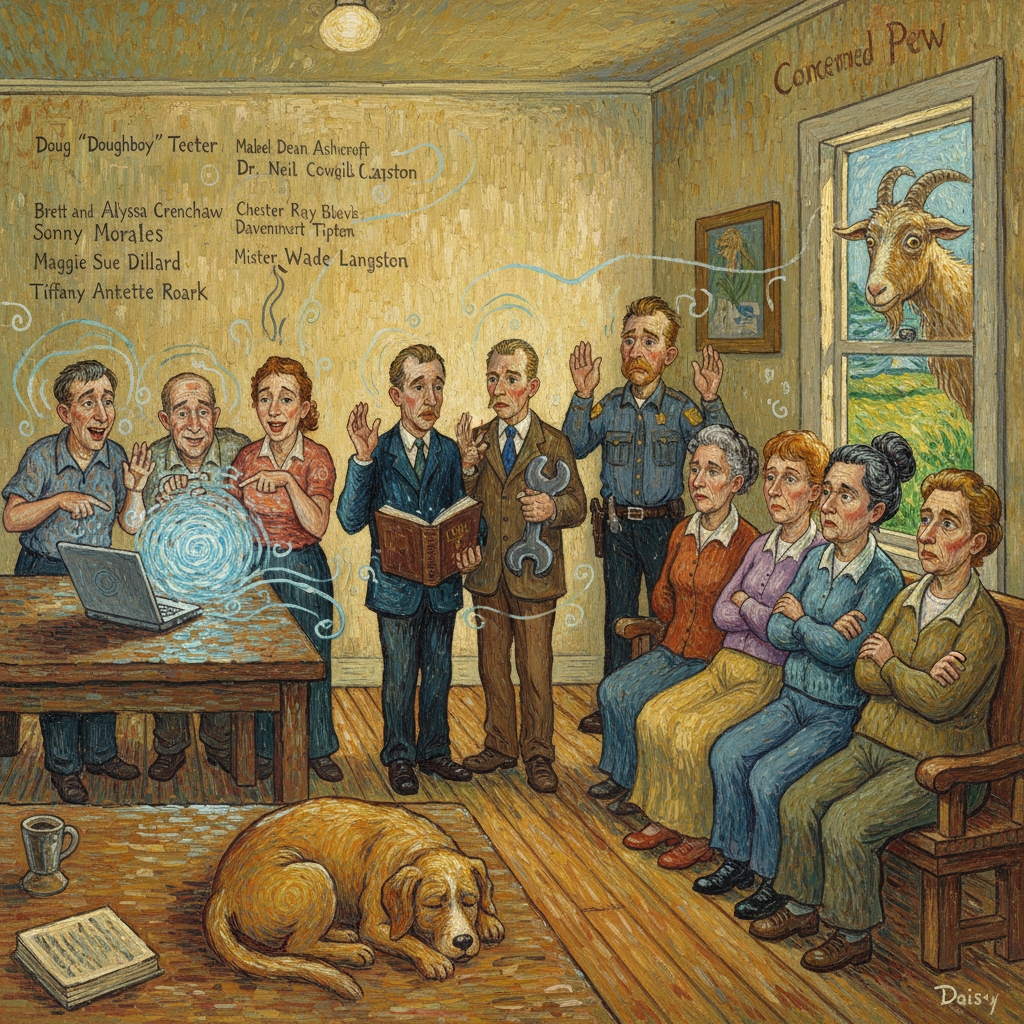
On the left side of the room, Doug, Brett, Alyssa, Sonny, Maggie Sue, and Tiffany gathered near the laptop.
“We could use this for business listings,” Sonny said. “Hours, services, directions, common questions.”
“And for health events,” Alyssa said. “General wellness education, class descriptions, recipes, habit trackers.”
“Local history,” Maggie Sue added. “Boot could dictate stories. It could help organize them.”
Boot, who had been listening from the aisle, grunted. “I do not dictate to machines. I negotiate with memory.”
“Same outcome,” Tiffany said.
Doug looked energized. “Think bigger. A town knowledge assistant. People ask where to get a tire fixed, when the library opens, who handles permits, where the church supper is—”
“Hold up,” Sheriff Peeler said, stepping in. “Emergency information must be accurate.”
“It can cite sources,” Doug said.
“It can also sound confident while wrong,” Sheriff Peeler said. “I’ve already got citizens for that.”
On the right side of the room, Mabel, Clovis, Chester, Lurleen, Evelyn, and Mister Wade formed what Tiffany privately labeled the Concerned Pew.
“I don’t want people replacing conversation with a typing box,” Evelyn said. “If someone wants my cobbler recipe, they should come by my porch.”
“Exactly,” Mabel said. “Porches are infrastructure.”
Act VI – The Divide
Chester nodded. “Printed bulletins are infrastructure.”
Clovis whispered, “Suspicion is infrastructure.”
Mister Wade leaned on his cane. “What happens when the machine answers faster than the elder, smoother than the teacher, cheaper than the worker, and louder than the truth?”
Mabel gave him a respectful look. “Wade, that was almost too good for this room.”
Across the aisle, Pastor Arnold stood with Sister Lila Mae and Dr. Cowgill.
“The danger,” Pastor Arnold said, “is not only that people will trust it too much. It is also that people will fear it so much they refuse to learn where the real danger is.”
Sister Lila Mae nodded. “Like pressure cookers.”
Dr. Cowgill blinked. “I’m sorry?”
“I was scared of mine for years,” she said. “Then I learned the valve. Now it makes excellent beans. But I still do not let children play with it.”
Pastor Arnold smiled. “A theology of beans.”
Dr. Cowgill looked delighted. “That analogy is surprisingly robust.”
Near the front, Coach Freddie confronted Doug.
“Can it make boys hustle?”
“No,” Doug said.
“Can it make parents quit coaching from the sideline?”
“No.”
“Can it fill out permission slips?”
“Yes.”
Coach Freddie pointed at him. “Then I support limited deployment.”
Officer Kenny Joe came back from the side yard.
“Goat is secure,” he announced.
From outside came the sound of a metal trash can tipping over.
Officer Kenny Joe paused. “Temporarily secure.”
Sheriff Peeler returned to the front.
“Everybody sit down,” he said. “We are going to finish this like adults, or at least like the nearest available substitute.”
The chairs scraped. People settled.
Daisy came in first and lay under the front table.
The goat’s face appeared in the side window.
Clovis pointed. “He’s still observing.”
Sheriff Peeler did not look. “The goat is not on committee.”
Act VI – The Divide
Act VII – What It Gets Wrong
Sheriff Peeler took the next question himself.
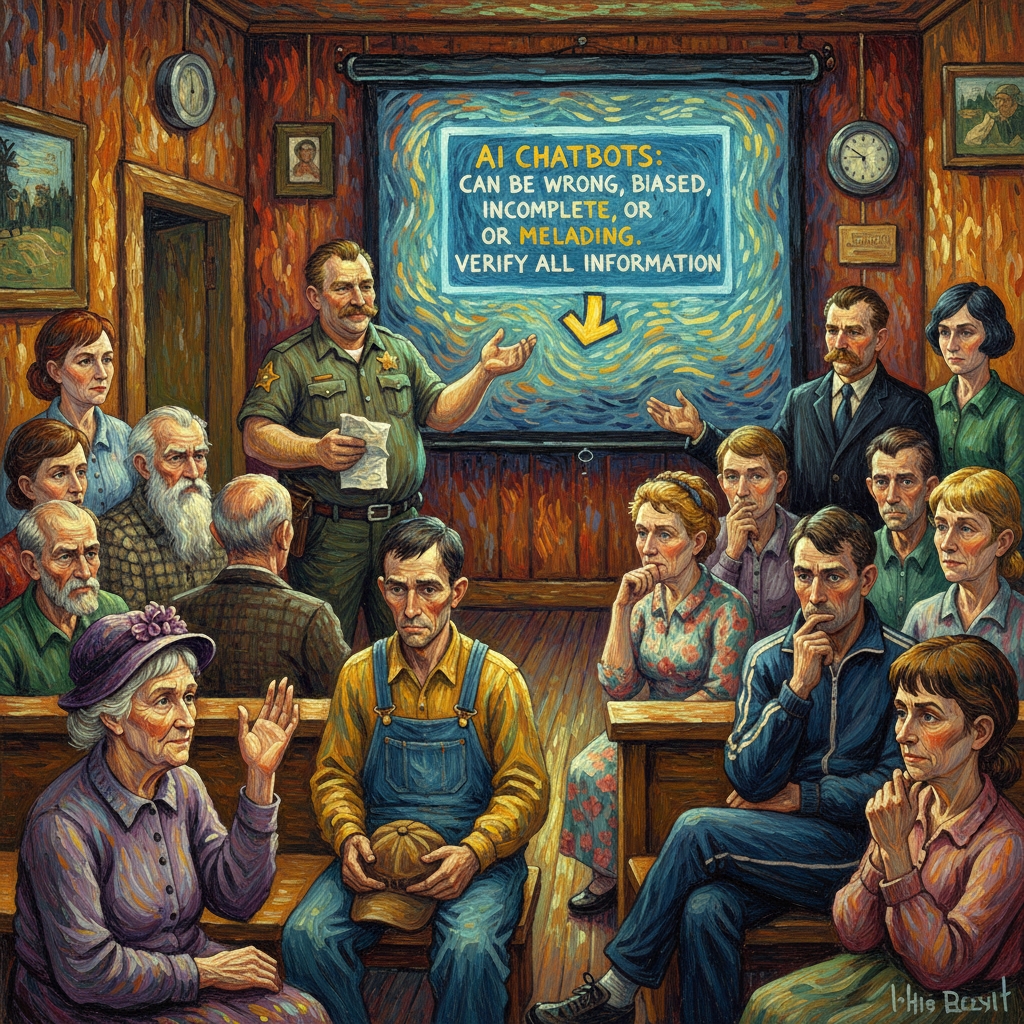
“Can AI be wrong?” he asked.
Doug typed.
The answer appeared:
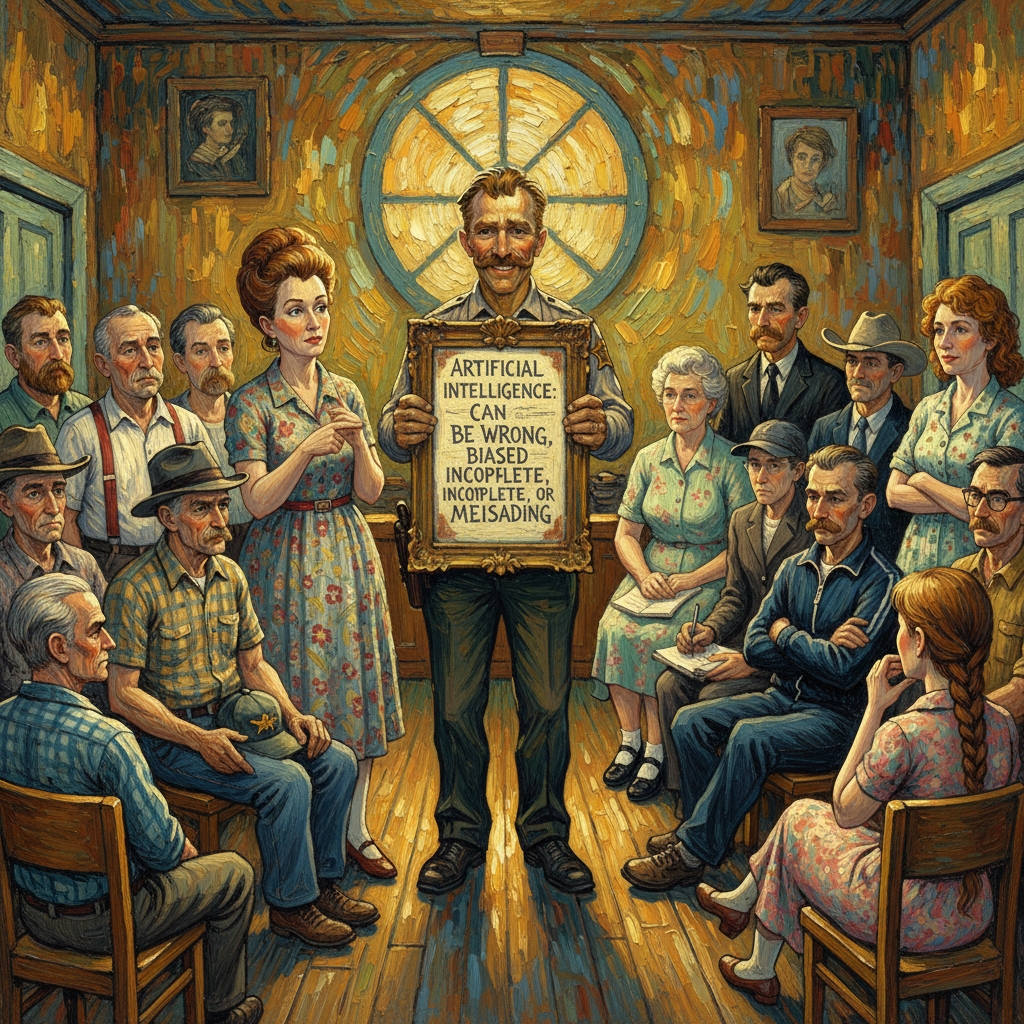
Yes. AI can be wrong, incomplete, outdated, biased, overconfident, or misleading. It may invent details, misunderstand context, or fail to recognize local realities. Important information should be verified with reliable sources, knowledgeable people, and direct observation.
Sheriff Peeler turned to the room. “There. That’s my favorite answer so far.”
Mabel raised her hand. “Ask it what local reality means.”
Doug typed.
Local reality includes details that may not appear in general data: who actually opens on time, which roads flood first, which families are connected, what words mean in that community, what history people remember, what they refuse to say directly, and what everyone knows but no one wrote down.
The room went quiet again.
Boot removed his cap and set it on his knee.
“That machine has been eavesdropping on porches,” he said.
“No,” Dr. Cowgill said. “It has learned patterns from language.”
“Same charge,” Mabel said.
Tiffany asked, “Can AI understand small-town politics?”
Doug typed.
Act VII – What It Gets Wrong
It can describe common patterns in small-town politics, such as relationships, trust, history, land use, economic hopes, fear of outside control, and informal networks. But it cannot fully understand a specific town without accurate local context provided by people who live there.
Clovis stood. “Ask if it knows who moved the Veterans Day podium in 2018.”
“No,” Sheriff Peeler said.
“That’s local context.”
“That’s unresolved furniture history.”
Maggie Sue asked, “Can it help us be fairer?”
The chatbot answered:
It can help by showing multiple viewpoints, identifying assumptions, suggesting questions, and summarizing arguments neutrally. But fairness depends on people deciding to listen honestly, include affected voices, correct mistakes, and accept limits on their own side.
Lurleen made a face. “Accept limits on my own side? That’ll never catch on.”
Pastor Arnold said, “It has rarely been fashionable.”
Brett raised his hand. “Can it help people understand technology without making them feel stupid?”
The response came:
Yes, if it explains concepts plainly, uses analogies, avoids condescension, and invites questions. But human teachers and trusted local guides are often better at noticing confusion, fear, pride, and embarrassment.
Alyssa touched Brett’s arm. “That’s beautiful.”
Mabel pointed at Doug. “Ask it whether outsiders should profit from local confusion.”
Doug hesitated.
Sheriff Peeler nodded. “Ask it.”
Outsiders can provide useful tools, services, and expertise, but there is a risk of exploiting confusion, dependency, or lack of bargaining power. Communities should ask who benefits, who controls the data, what happens if the service disappears, whether local people can learn the skill, and whether the tool strengthens or weakens local independence.
Clovis slowly stood and applauded once.
Then again.
Then most of the room joined, though nobody was entirely sure whether they were applauding the answer, the question, or the fact that Mabel looked vindicated without looking pleased.
Doug looked slightly wounded. “It’s not saying don’t use it.”
“No,” Boot said. “It’s saying don’t kneel to it.”
Mister Wade spoke from the back. “Ask it what a town should never automate.”
Doug typed.
The answer appeared:
A town should be cautious about automating care, judgment, accountability, trust, forgiveness, moral responsibility, and decisions that deeply affect people’s lives. Tools can support those things, but they should not replace the human burden of showing up for one another.
Sister Lila Mae pressed one hand to her chest.
“Well,” she said softly, “that one can stay on the bulletin board.”
Outside, the goat bleated.
Tiffany whispered into her recorder, “Goat appears to concur.”
Act VII – What It Gets Wrong
Act VIII – The Motion
After two hours, five pies, one casserole, and three unauthorized goat reentries, Sheriff Peeler declared the question period complete.
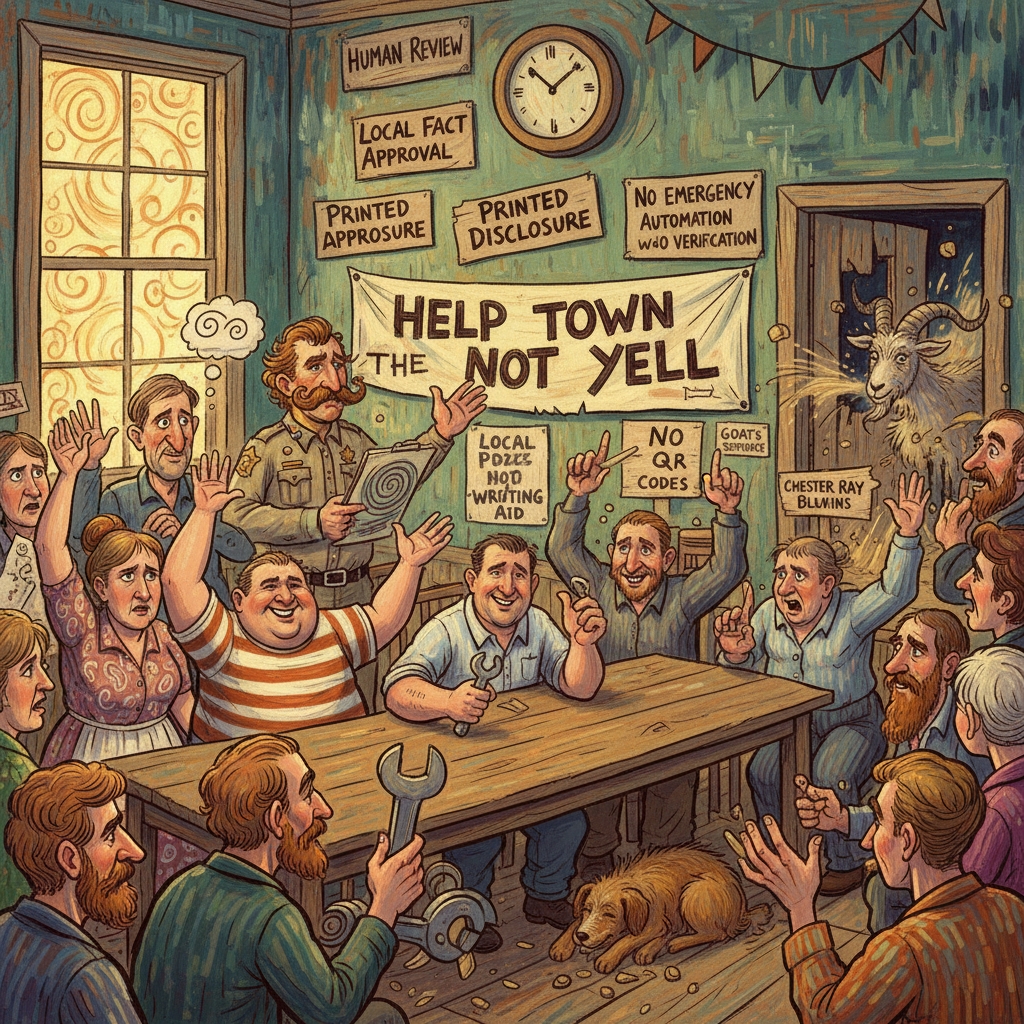
“We are not voting on whether AI exists,” he said. “It does. We are not voting on whether anyone is allowed to dislike it. You are. We are voting on whether Sequatchie Crossing will form a temporary committee to test limited uses for public communication, business support, meeting summaries, and local information, with human review required.”
“Who reviews the humans?” Clovis asked.
“Other humans,” Sheriff Peeler said.
“That’s been the flaw all along.”
Mayor business was not technically on the evening’s agenda because Sequatchie Crossing had never become fully comfortable with agenda discipline. So Mabel stood as if she had been elected by posture.
“I move,” Mabel said, “that any AI use by this town must include a printed notice saying a human checked it.”
Chester raised his hand. “Second.”
Doug stood. “I move that we also test it for helping small businesses write clear listings, event announcements, and frequently asked questions.”
Sonny seconded. “With local business owners approving their own facts.”
Maggie Sue stood. “I move we test grant-writing support for the library, but no numbers go in unless a person checks them.”
RT raised his wrench. “And measurements.”
“Fine,” Maggie Sue said. “Numbers and measurements.”
Pastor Arnold stood. “I move we adopt the goat sentence as a guiding principle.”
Act VIII – The Motion
Sheriff Peeler closed his eyes briefly. “Which sentence?”
Tiffany read from her notes. “‘Help town not yell.’”
Coach Freddie stood. “I second that. Could use it at youth games.”
Sister Lila Mae added, “And deacon meetings.”
Lurleen added, “And Thanksgiving.”
Evelyn added, “And group texts.”
Mister Wade raised his cane. “I propose one more rule. Every AI answer used by the town must be paired with one local person who can say, ‘That sounds right,’ or ‘That is nonsense.’”
Boot nodded. “That’s the porch test.”
Dr. Cowgill brightened. “A community-level epistemic validation protocol.”
Mabel looked at him. “Porch test.”
“Yes,” Dr. Cowgill said quickly. “Porch test.”
Sheriff Peeler wrote on the clipboard.
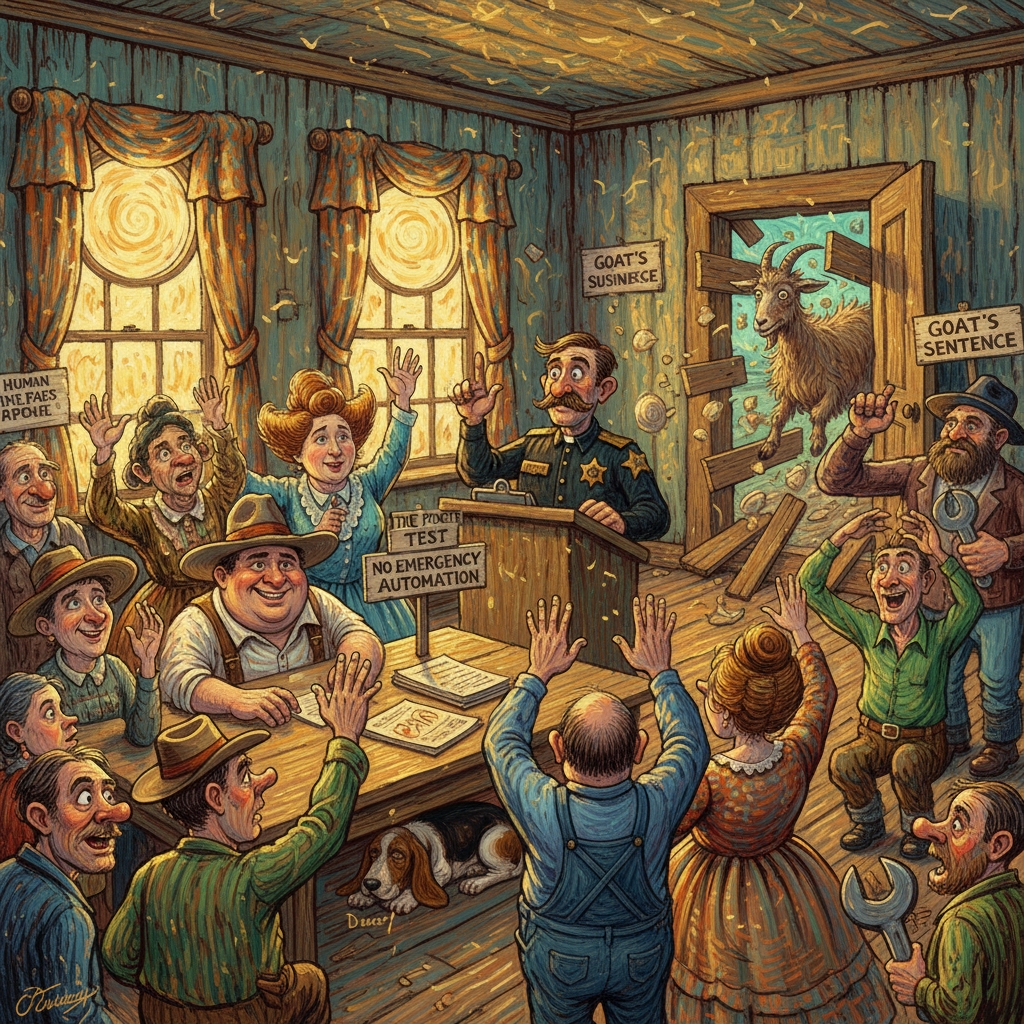
“So the proposal is: limited AI pilot, human review, local fact approval, printed disclosure, porch test, no emergency automation without sheriff’s office verification, no replacement of public comment, no private data, and the guiding principle ‘Help town not yell.’”
Chester raised his hand. “No QR codes.”
“No mandatory QR codes,” Sheriff Peeler said.
Chester considered the compromise. “I can live under protest.”
Trixie asked, “Can the diner use it for menu descriptions?”
“Private business,” Sheriff Peeler said. “Do what you want.”
“Then the meatloaf gets adjectives.”
Brett turned to Alyssa. “Our smoothie board too.”
Mabel leaned over. “Do not let a chatbot name anything ‘detox sunrise.’”
Alyssa paused. “Too late.”
The room groaned.
Sheriff Peeler called for a show of hands.
Supporters raised hands. Skeptics raised hands reluctantly after hearing “human review.” Some did not raise hands at all. Clovis raised one hand halfway, then used the other to pull it down, then finally raised it again.
“Let the record show,” Tiffany whispered, “Clovis opposed himself before supporting the motion.”
The motion passed, not unanimously, not cleanly, and not with the triumphant glow Doug had imagined. It passed the way most things in Sequatchie Crossing passed: limping, qualified, watched closely, and immediately subject to complaints about wording.
Then the goat burst through the side door with Officer Kenny Joe jogging behind him.
The goat crossed the front of the room, stepped once more on the keyboard, and produced:
mmmmmmmm
The chatbot replied:
Could you clarify?
Mister Wade stood. “That may be the most honest closing statement we’ll get.”
Act VIII – The Motion
Act IX – The Porch Test
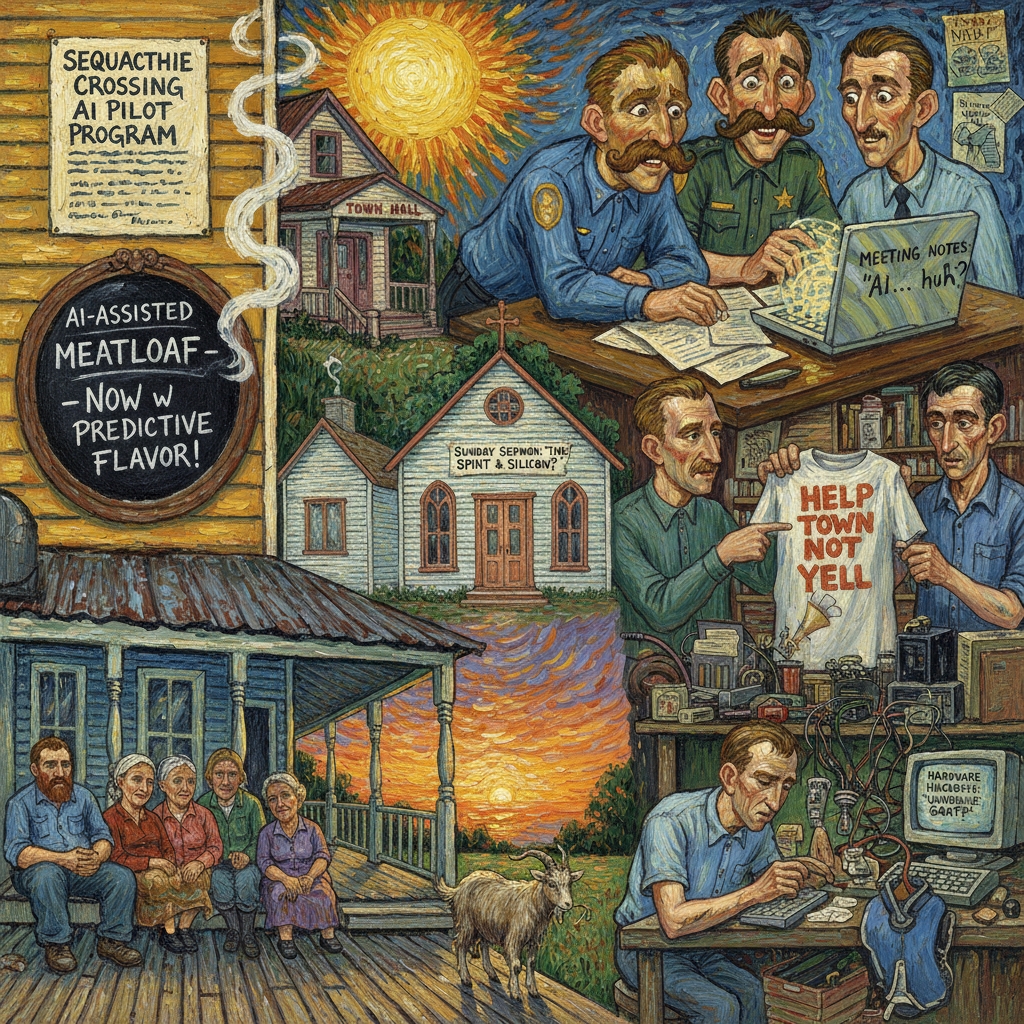
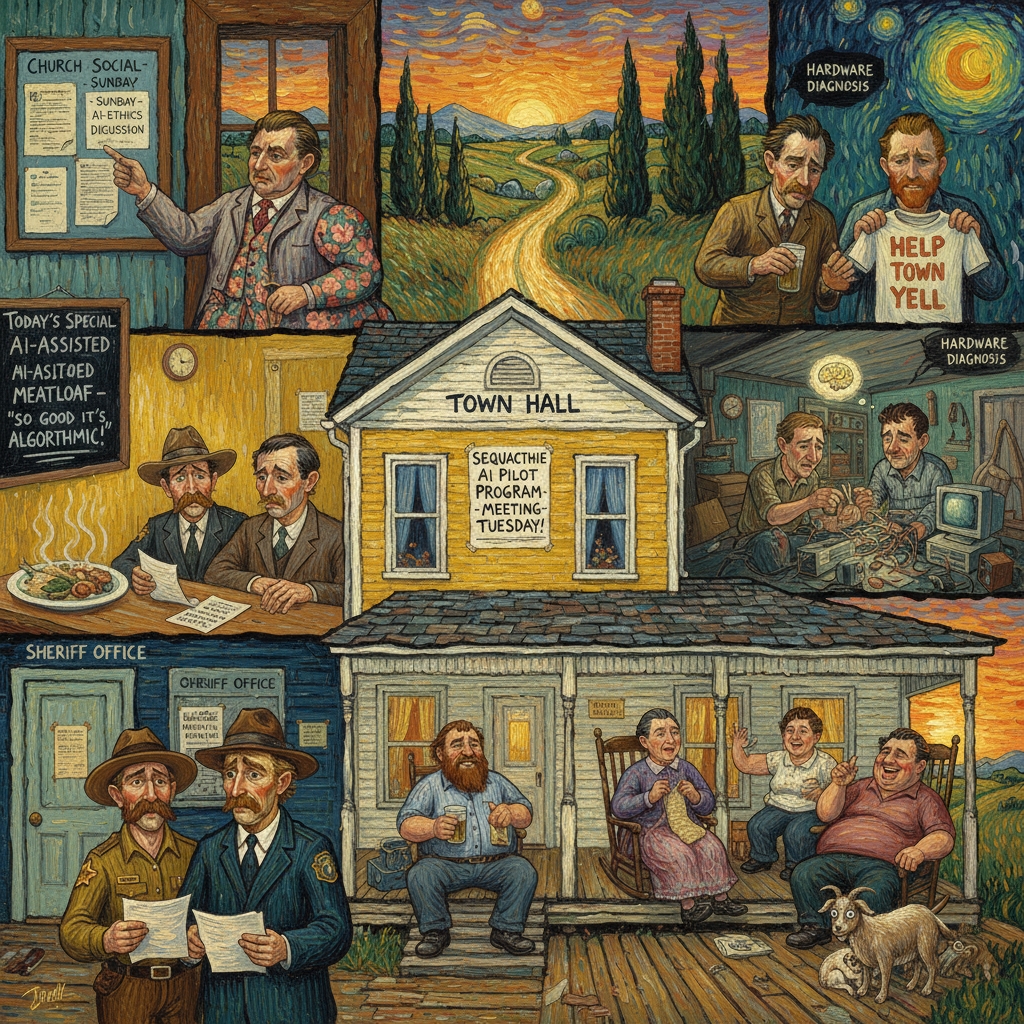
The next morning, the first official AI-assisted public notice appeared on the Town Hall bulletin board, Chester Ray Blevins’ print shop window, the church vestibule, the sheriff’s office counter, and beside the pie case at the diner.
It read:
SEQUATCHIE CROSSING AI PILOT PROGRAM
Purpose: To test whether artificial intelligence can help with routine writing, organizing information, summarizing meetings, and supporting local businesses.
Human Review Required: Every public item must be checked by a local person before use.
Porch Test Required: If it does not sound true to people who live here, it is not finished.
Guiding Principle: Help town not yell.
At the diner, Boot stood reading it with coffee in hand.
“Well,” he said, “that is the first government document in years short enough to finish standing up.”
Trixie came from the kitchen. “The chatbot helped me write today’s special.”
She pointed to the chalkboard:
MEATLOAF PLATE – Homestyle, oven-baked, familiar in the best way, served with mashed potatoes, green beans, and no promises beyond lunch.
Mabel read it. “That is acceptable.”
“High praise,” Trixie said.
At the sheriff’s office, Sheriff Peeler and Officer Kenny Joe reviewed an AI-generated summary of the previous night’s meeting.
Officer Kenny Joe read aloud, “‘The goat made a meaningful contribution to civic dialogue.’”
Sheriff Peeler took the paper. “Strike meaningful. Put unexpected.”
“Unexpected contribution?”
Act IX – The Porch Test
“Better.”
Daisy slept under the bench, snoring faintly.
At the church, Pastor Arnold and Sister Lila Mae reviewed a draft announcement for Sunday.
Sister Lila Mae read, “‘Join us for fellowship, food, and a conversation about using tools wisely without surrendering wisdom.’”
Pastor Arnold nodded. “Good.”
“And it made the bake sale sound joyful,” she said. “Not terminal.”
“Then we have witnessed progress.”
At the print shop, Chester Ray Blevins held up a shirt that said:
HELP TOWN NOT YELL
No QR code.
Clovis entered, inspected it, and said, “You know the machine contributed to that.”
Chester looked wounded. “The goat contributed. The machine merely transcribed.”
“History will not preserve that distinction,” Clovis said.
At Sonny’s hardware store, RT tested the chatbot with a customer’s description of a leaky hose connection.
“It says washer,” RT said.
Sonny looked at the fitting. “It is washer.”
RT nodded solemnly. “Machine passed first wrench trial.”
At the library annex, Maggie Sue and Evelyn worked on a grant outline while Dr. Cowgill explained measurable outcomes with a stack of examples. Lurleen sat nearby, trying to get the chatbot to write a truthful Christmas letter that still sounded victorious.
“Listen to this,” Lurleen said. “‘This year brought challenges, growth, and several opportunities to practice patience.’”
Evelyn smiled. “That means your cousin moved back in.”
“Exactly,” Lurleen said. “But classy.”
Outside on Boot’s porch that evening, the usual chairs filled slowly. Mabel brought tea. Mister Wade brought silence. Pastor Arnold brought thoughtfulness. Clovis brought concern. Tiffany brought her notebook. Doug arrived last, looking less triumphant and more educated.
The goat stood in the yard beside Daisy, chewing a weed with democratic indifference.
Doug sat on the porch step. “I thought people would either love it or hate it.”
Boot rocked once. “That’s because you’re young enough to expect clean categories.”
Mabel sipped her tea. “I still don’t trust it.”
“No one asked you to,” Pastor Arnold said.
Clovis nodded. “I trust it less now, but more specifically.”
“That may be civic progress,” Tiffany said.
Mister Wade looked toward Town Hall in the fading light. “A tool is never just a tool once people start arranging their hopes around it.”
Doug looked at him. “Should we stop?”
Boot shook his head. “Stopping ain’t the same as steering.”
The goat lifted its head and bleated.
Mabel looked at it. “Do not start.”
Daisy barked once.
Tiffany wrote: The porch test passed, pending further animal input.
Doug smiled. “Can I ask the chatbot what the porch test means?”
Everyone answered at once.
“No.”
Then Boot added, “You can ask us.”
Act IX – The Porch Test
Epilogue – The Most Quoted Speaker
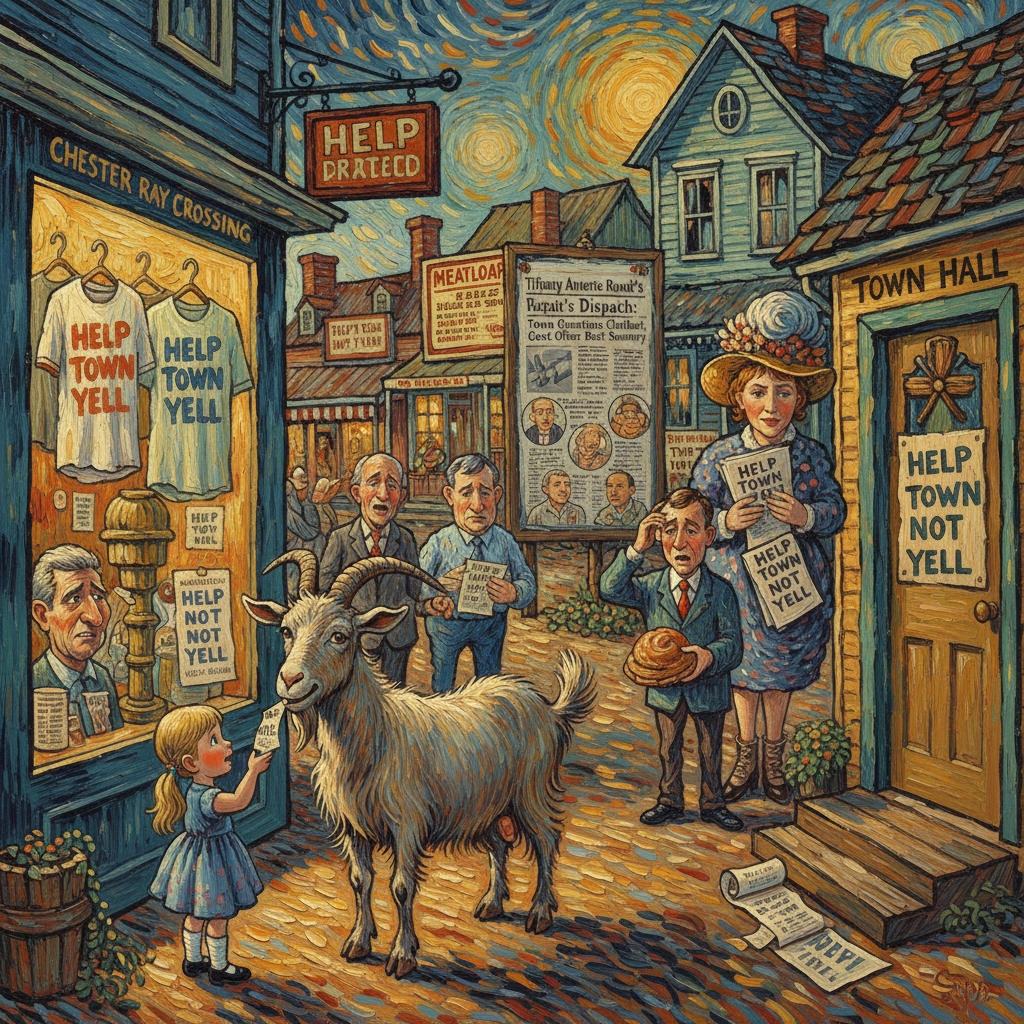
By the end of the week, the phrase Help town not yell had appeared on shirts, flyers, church bulletins, diner napkins, one hardware receipt, and a hand-painted sign near the Town Hall side door where the goat had made his third entrance.
Nobody agreed on whether artificial intelligence had improved Sequatchie Crossing.
Doug said yes, because the town had started using better drafts.
Mabel said not yet, because better drafts were not the same as better judgment.
Clovis said the machine had revealed the danger of machines by being useful enough to tempt fools and cautious enough to irritate salesmen.
Sheriff Peeler said it was fine as long as nobody used it to report crimes, diagnose livestock, or argue zoning without reading the ordinance.
Pastor Arnold said the town had not learned what AI could do so much as what people must still do themselves.
Trixie said the meatloaf sold out.
Chester said the shirt orders were strong.
RT said the washer diagnosis was accurate.
Dr. Cowgill said the evening had demonstrated “collective interpretive adaptation to probabilistic linguistic infrastructure,” and Boot told him that was exactly why porches still mattered.
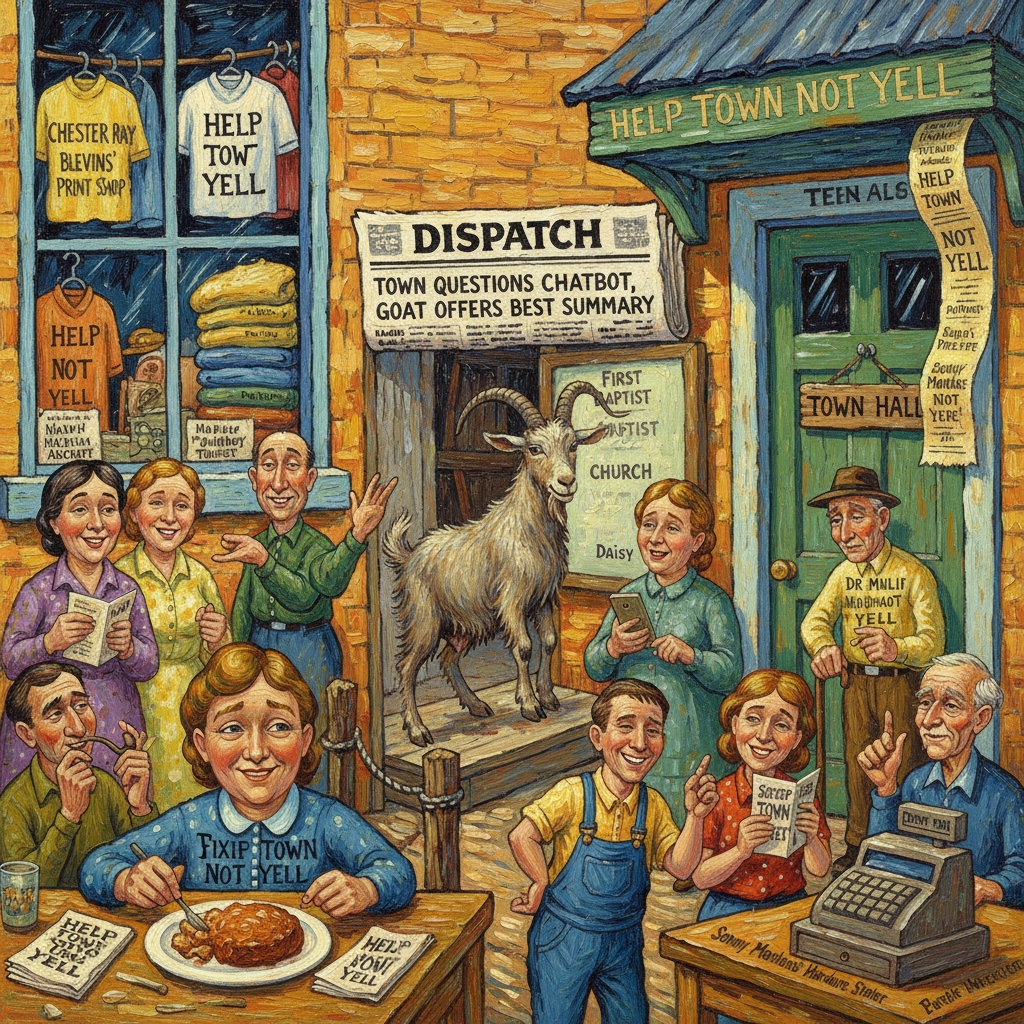
As for the goat, he was quoted in the Dispatch more than anyone else.
Epilogue – The Most Quoted Speaker
Tiffany’s headline read:
Town Questions Chatbot, Goat Offers Best Summary
Under it, she wrote that Sequatchie Crossing had not solved the question of artificial intelligence, which was probably just as well. The town had merely discovered that a machine could answer quickly, a goat could interrupt usefully, and a room full of neighbors could still decide whether an answer deserved to be believed.
On Sunday morning, Sister Lila Mae found the goat standing outside the church vestibule, chewing the corner of the AI-assisted bake sale announcement.
She looked down at him.
“You already made your point,” she said.
The goat blinked.
From inside, Pastor Arnold began the service by saying, “Friends, wisdom is not the same as information.”
And from the back pew, where Mabel sat beside Boot, Clovis whispered, “Ask the goat if that’s verified.”
Boot whispered back, “Porch test first.”
Epilogue – The Most Quoted Speaker
Disclaimer
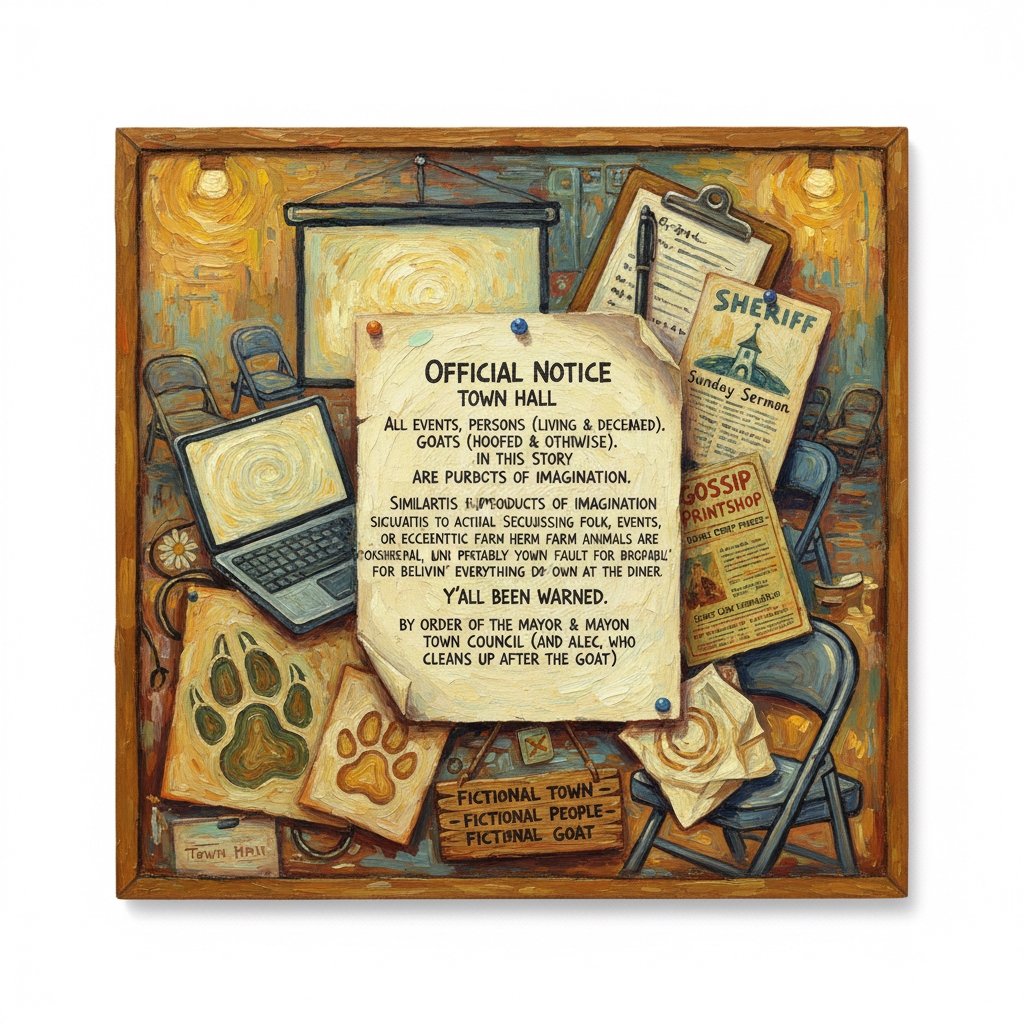
Sequatchie Crossing is a fictional community, and every character, business, meeting, goat, hound, public notice, technological misunderstanding, and municipal compromise in this story is fictional. Any resemblance to real people, real residents, real officials, real towns, real meetings, real businesses, real goats, or real chatbot demonstrations is coincidental.
This story is satire. It is meant to entertain while exploring the kinds of questions communities may ask when new technology arrives: what it can do, what it cannot do, who benefits, who verifies the facts, what should remain human, and how neighbors can disagree without turning every public meeting into a weather event.
Disclaimer – The Town Hall Meeting With The Chatbot
Real Places Behind the Ruckus – From The Dunlap Directory
Real Places Behind the Ruckus – From The Dunlap Directory
Yes, this story was fictional; even the parts that weren’t true. These places? Absolutely real. Stop by, support local, and keep the Wi-Fi away from livestock:
- Austin Mitchel Jennifer
- ChattaBOOga Ghost Walk
- Natural Affinity – Handcrafted Herbal Essentials
- Hillcrest Farm
- Little Caesars
- Five Star Wine & Spirits
- Lee Outdoors
- Shepherd of the Valley Catholic Church
- Jiffy Junction Market
- RJ’s Garage
- Restoration Pointe Church of God
- Pristine Auto-Detailing
- HumBug Pest Control
- Heritage Painting
- Colonial Cabins & RV Park
- Valley Plumbing & Electric
- Cascade Inn at Fall Creek Falls
- Sequatchie County Food Bank
- 9-Line HVAC & Electric
- Running Wild Inflatables

Real Places Behind the Ruckus – From The Dunlap Directory
At Sequatchie Crossing, we tell the stories of Sequatchie Crossing.
Please share this post with your friends, family, or business associates who may want follow the news from Sequatchie Crossing.


0 Comments