



Definitions Requested; Consensus Declines
By Tom Seest
At Sequatchie Crossing, we tell the stories of Sequatchie Crossing.
Please share this post with your friends, family, or business associates who may want follow the news from Sequatchie Crossing.
🎤 Audio Overview

Town Considers Ordinance Regulating How Concerned Is too Concerned
Act I: The Agenda Item That Looked Reasonable in Writing
The ordinance began, as most dangerous ideas in Sequatchie Crossing did, with a perfectly reasonable sentence read aloud in a perfectly unreasonable room.
“Item seven,” the clerk announced, tapping the microphone with the practiced confidence of someone who did not expect it to work on the first try. “Discussion of a proposed ordinance concerning… excessive expressions of concern.”
She paused.
There was a rustling in the audience, the collective sound of people leaning forward, backward, and sideways at once. Someone coughed. Someone else muttered, “Well, that depends.”
The clerk cleared her throat and continued.
“Specifically, an ordinance to define when concern expressed by citizens – whether verbal, written, gestured, or implied – exceeds what is considered productive civic engagement.”
She looked up.
“In other words,” she said carefully, “when concern becomes… too concerned.”
Silence followed, thick and suspicious.
Boot Barnes squinted at the printed agenda like it had personally insulted him. Clovis Strickland, seated two rows back with his legal pad already open, wrote ‘Concern Threshold?’ and underlined it twice. Sheriff Peeler leaned back in his chair, arms crossed, wearing the expression of a man who knew he would be asked to enforce something no one could explain.
From the back, a voice called out, “Who decides that?”
The clerk smiled tightly.
“That,” she said, “is part of what we’re here to discuss.”
And just like that, Sequatchie Crossing was officially debating whether caring too much was a municipal problem.
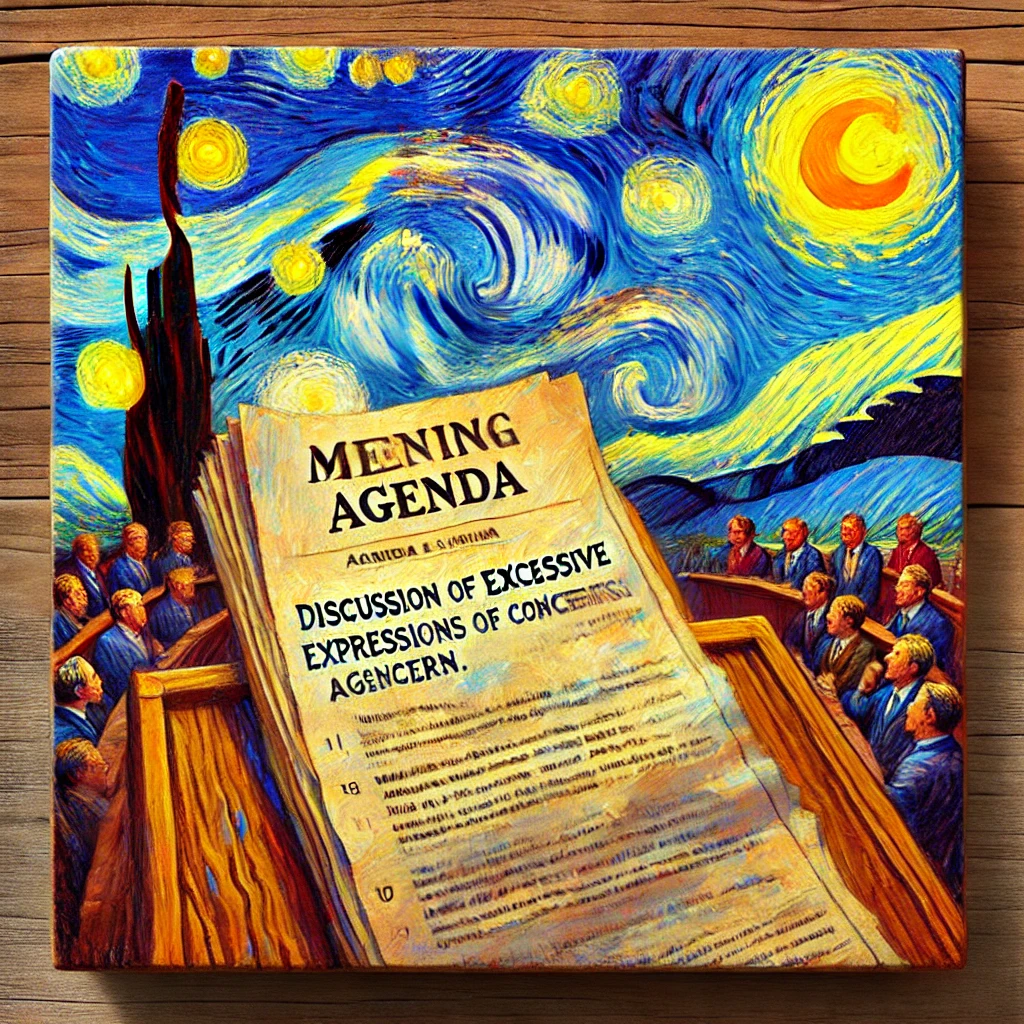
Act I – The Agenda Item That Looked Reasonable in Writing
Act II: How Did We Get Here, Exactly?
The mayor – who had not asked for this item but also had not stopped it – cleared his throat and offered context.
“Now, folks,” he began, palms up in a gesture meant to soothe. “This isn’t about stopping people from caring. We want engagement. We’ve said that repeatedly.”
A murmur of agreement rippled through the room, mostly from people who had, at various times, been told they did not care enough.
“But,” the mayor continued, “we’ve had… concerns. About concerns.”
That earned a few chuckles, though no one laughed for long.
He gestured vaguely toward the stack of printed emails beside him. “Phone calls. Emails. Letters. Notes taped to doors. Notes taped to other notes. Conversations that begin with ‘I’m not trying to be difficult, but – ’ and then become extremely difficult.”
Someone nodded vigorously.
“We’re hearing from residents who feel that certain individuals,” the mayor said diplomatically, “are expressing concern at a level that may be… disproportionate.”
Disproportionate to what, no one knew.
The clerk added, “And some of those concerns contradict each other.”
That got louder murmurs. Contradictory concern was a familiar species in Sequatchie Crossing.
“You’ve got one group deeply concerned that nothing is being done,” she continued, “and another equally concerned that too much is being done.”
“And a third,” Clovis said without looking up, “concerned that the wrong thing is being done in exactly the wrong way.”
Several heads turned.
“Is that written down somewhere?” someone asked.
Clovis smiled faintly and tapped his notebook.
“It is now.”

Act II – How Did We Get Here, Exactly?
Act III: Defining Concern, a Surprisingly Slippery Exercise
The first problem, it turned out, was defining “concern.”
A woman in the second row stood up. “Concern is when you see something wrong and speak up.”
A man across the aisle immediately raised his hand. “No, concern is when you speak up politely.”
Another voice cut in. “Concern is when you mind your business but still worry.”
“That’s anxiety,” someone muttered.
The clerk attempted to regain control. “Let’s try to be orderly. Maybe we can list characteristics of acceptable concern.”
She wrote on the whiteboard:
-
Timely
-
Relevant
-
Respectful
“Respectful how?” Boot Barnes asked. “Respectful to who?”
“To the process,” the clerk said.
Boot snorted. “The process has been disrespecting me for years.”
A smattering of applause followed, immediately countered by someone whispering, “That’s exactly the problem.”
The mayor rubbed his temples.
“What about frequency?” a council member suggested. “Is concern acceptable once? Twice? Every meeting?”
Clovis raised his hand.
“Historically,” he said, “some of our most cherished concerns were repeated for years before being addressed.”
“Yes,” another council member said, “but those were good concerns.”
Silence.
Someone finally asked the obvious question. “Who decides which ones are good?”
No one answered.
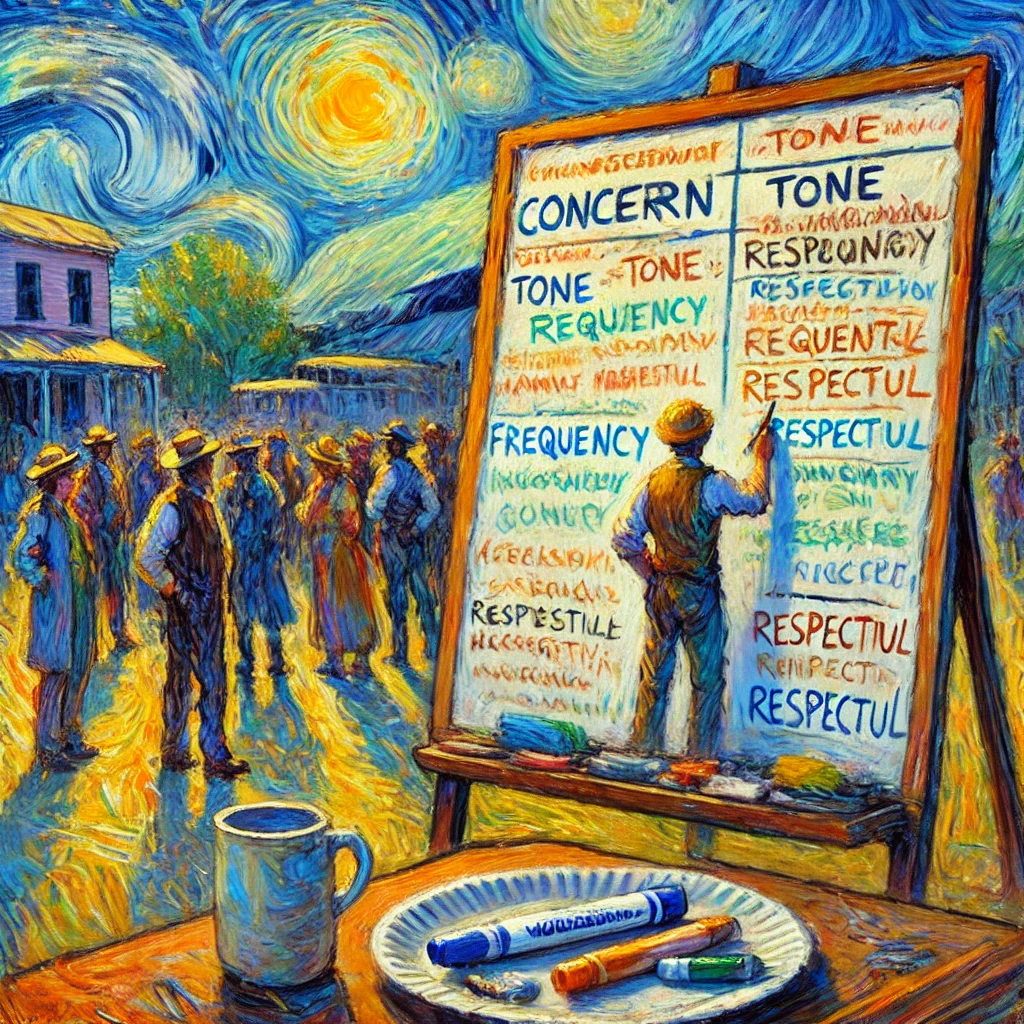
Act III – Defining Concern, a Surprisingly Slippery Exercise
Act IV: The Scale Proposal (Which Did Not Help)
In an effort to impose order, someone proposed a scale.
“A Concern Scale,” they called it.
“Like a weather advisory,” the council member explained. “Green concern. Yellow concern. Red concern.”
“What happens at red?” Sheriff Peeler asked.
The council member hesitated. “That’s… to be determined.”
“Do sirens go off?” someone asked.
“What about blinking lights?” another voice added.
Clovis began sketching a triangle in his notebook labeled Mild Unease, Firm Worry, and Existential Alarm.
“Where does Facebook fit?” someone yelled.
The room erupted.
“That’s a whole separate category!”
“Online concern counts double!”
“No, it counts less because anyone can post!”
“But it spreads faster!”
“What about vague posts? You know – ‘Not naming names, but…’”
The clerk banged her gavel.
“Order!”
When quiet returned, the mayor sighed. “This is exactly why we need guidance.”
“Or,” someone said quietly, “this is why you can’t have it.”
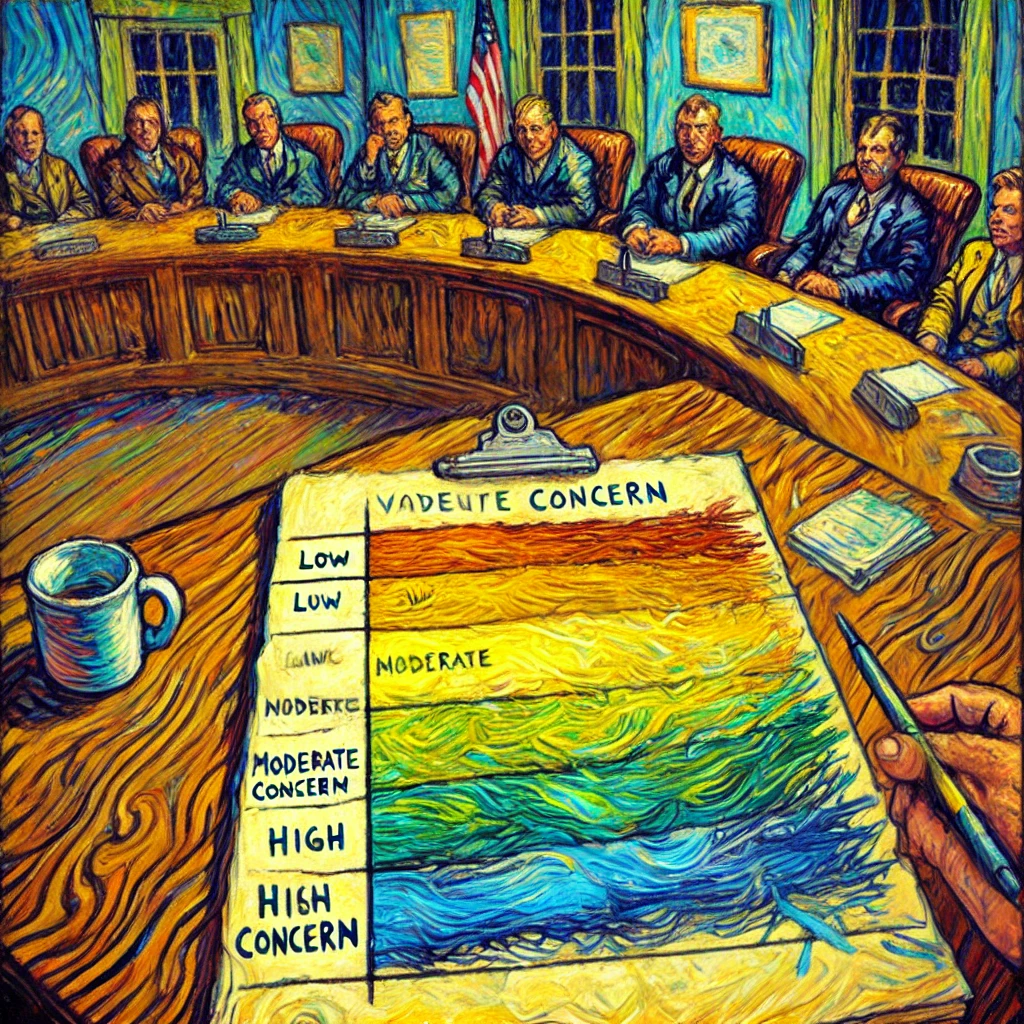
Act IV – The Scale Proposal (Which Did Not Help)
Act V: Test Cases From the Community
To clarify matters, the council invited examples.
A man stood up. “I’ve emailed about the pothole on Ridge Road twelve times.”
“That’s concern,” someone said.
“I’ve emailed back explaining we’re aware of it,” a council member replied.
“And I’ve emailed again because it’s still there,” the man said.
“Too concerned,” someone else declared.
“What if I fall in it?” the man asked.
“That’s injured,” the clerk said. “Different category.”
Another woman approached the microphone.
“I’m concerned about the new development,” she said. “Traffic, noise, drainage, wildlife displacement, and vibes.”
“Vibes?” the mayor repeated.
“Yes. The vibes are off.”
Several people nodded.
A council member whispered, “We can’t legislate vibes.”
“Not with that attitude,” someone replied.
Then came the emails. Printed out. Highlighted. Annotated.
Concerns about the flag. Concerns about the fence. Concerns about the meeting time. Concerns about how concern was being handled.
“Meta-concern,” Clovis murmured, adding it to his notes.

Act V – Test Cases From the Community
Act VI: Enforcement Questions Nobody Wanted Answered
Eventually, attention turned to enforcement.
Sheriff Peeler sat up straighter.
“I need to be real clear,” he said. “Are you asking me to tell someone they care too much?”
No one met his eyes.
“Because I can tell someone they’re trespassing. I can tell someone they’re speeding. I can’t tell someone they’re emotionally excessive.”
A council member ventured, “What about warnings?”
“‘Ma’am, this is your third concern today’?” the sheriff asked.
Laughter rippled, nervous and brief.
“What about written concern?” another member asked. “Do letters count?”
“Do anonymous letters count?” someone added.
“Those count triple,” someone else said. “Because they’re cowardly.”
“That sounds like a value judgment,” the clerk warned.
“And we’re trying to avoid those,” the mayor said, without irony.
Clovis flipped a page in his notebook.
“If I may,” he said, “any ordinance regulating concern would need to define: duration, intensity, medium, audience, repetition, tone, and perceived sincerity.”
The room went quiet.
“And,” he added, “that’s before we get to exceptions.”

Act VI – Enforcement Questions Nobody Wanted Answered
Act VII: Exceptions, Which Quickly Became the Rule
The first proposed exception was emergencies.
“If the building is on fire,” someone said, “you’re allowed to be very concerned.”
Agreed.
“What about perceived emergencies?” another asked.
“Like Facebook emergencies?” someone said.
Groans.
“What about long-standing concerns that were ignored until they escalated?” a woman asked. “Am I punished for persistence?”
“No,” a council member said quickly. “We don’t want to discourage persistence.”
“But that’s exactly what this does,” someone replied.
“What about people who are just naturally worried?” another voice chimed in. “Is that a personality fine?”
“What about people who aren’t concerned enough?” someone asked. “Can we regulate apathy?”
That suggestion lingered uncomfortably in the air.
Boot Barnes leaned forward.
“So let me get this straight,” he said. “If I don’t care, you want me to care. If I care, you want me to care quieter. And if I care loudly for too long, you want me to stop.”
The mayor opened his mouth, closed it, then said, “That’s… not entirely inaccurate.”
Act VII – Exceptions, Which Quickly Became the Rule
Act VIII: Public Comment Becomes a Demonstration
Public comment opened, and irony took the floor.
People expressed concern about the ordinance regulating concern.
Some spoke calmly. Others passionately. A few excessively, by any reasonable metric.
One man timed himself and stopped mid-sentence. “Didn’t want to cross the line.”
Another woman held up a sign reading ‘THIS IS ME CARING RESPONSIBLY.’
Someone else whispered their concern, then asked if whispering still counted.
The clerk took notes, her handwriting getting smaller and smaller.
Clovis filled pages.
At one point, two citizens began arguing over whose concern was more legitimate, until the mayor reminded them that this was not a competition – prompting both to insist that it absolutely was.
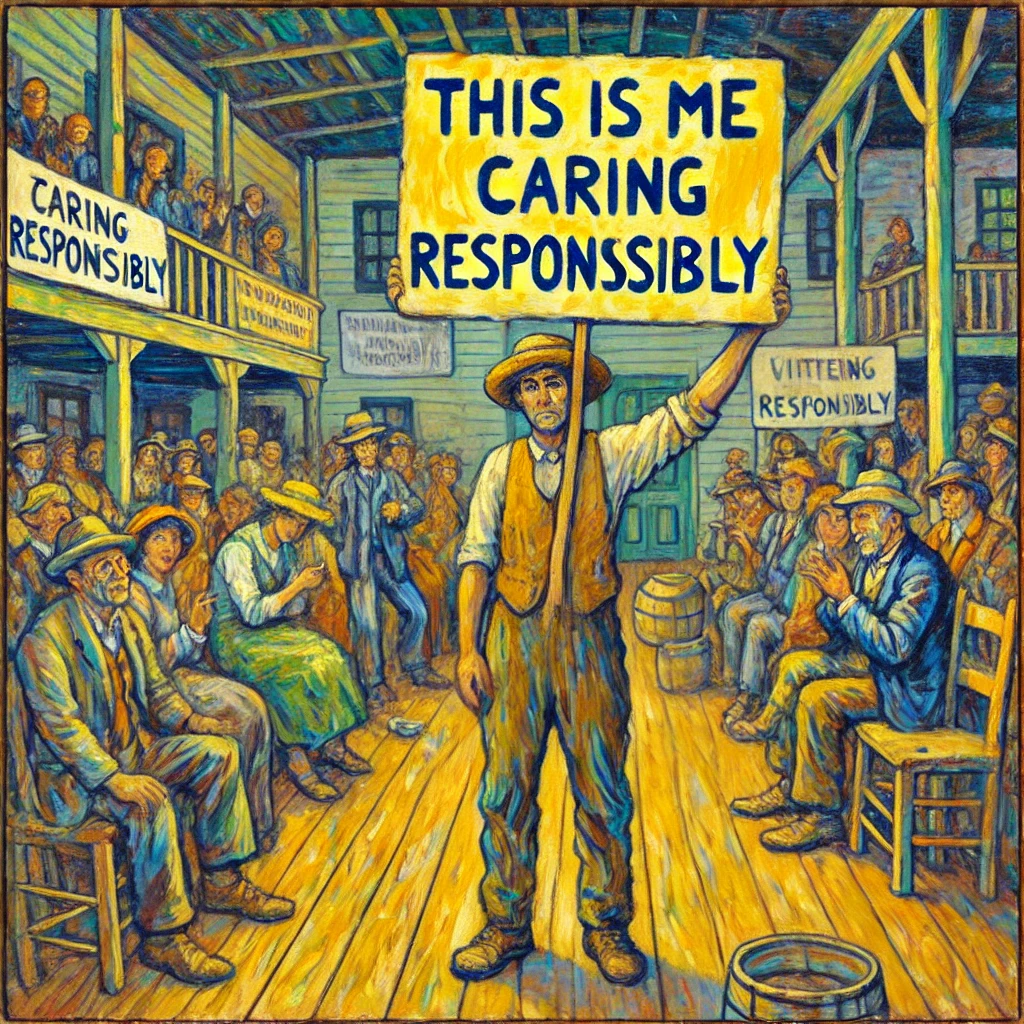
Act VIII – Public Comment Becomes a Demonstration
Act IX: Motion to Table, Reconsider, and Revisit Later
After three hours, no definitions, and several raised voices about tone, the mayor called for a motion.
A council member moved to table the ordinance pending further study.
Another seconded.
Before the vote, the mayor spoke.
“It’s clear,” he said slowly, “that concern is… complicated. And that caring about how people care may be even more so.”
The vote passed unanimously.
The ordinance was tabled.
As people filed out, conversations continued – concerned conversations, concerned about concern, concerned about what it all meant.
Clovis lingered, organizing his notes.
“What are you going to do with all that?” the clerk asked.
He smiled.
“File it,” he said. “So when this comes back, no one can agree on what happened tonight either.”

Act IX – Motion to Table, Reconsider, and Revisit Later
Epilogue: Concern Persists
The next morning, social media lit up.
Some were concerned the ordinance hadn’t passed.
Others were concerned it had been considered at all.
A few were concerned about the tone of the meeting.
One post read: ‘Not saying anyone cared too much, but last night was a lot.’
Another replied: ‘If you think that was a lot, you should see my emails.’
At Town Hall, the whiteboard still bore faint traces of the words Respectful and Timely, partially erased but not gone.
Concern, it seemed, was not regulated.
It was simply redistributed.
And in Sequatchie Crossing, that felt about right.

Epilogue – Concern Persists
Disclaimer
This story is a work of fiction. The town of Sequatchie Crossing, its ordinances, committees, meetings, procedures, and levels of concern are entirely imaginary. Any resemblance to real towns, real meetings, real agendas, or real people who have ever said “I’m just concerned” is coincidental and, in many cases, unavoidable.
The characters depicted herein are fictional composites created for satirical purposes. Their concerns, excessive or otherwise, should not be interpreted as commentary on any specific individual, organization, Facebook group, email thread, or ongoing civic dispute – past, present, or mysteriously unresolved.
No actual ordinances were harmed, passed, tabled, reconsidered, or quietly reintroduced under a different name during the creation of this story. Any similarities to real-world attempts to regulate tone, participation, enthusiasm, or emotional volume in public discourse are unintended, though statistically likely.
This story does not advocate for the regulation of concern, nor does it suggest that concern can be measured, quantified, enforced, or meaningfully defined. Readers experiencing elevated levels of recognition, irritation, or sudden clarity are advised that such reactions are normal and do not constitute evidence of satire being “too on the nose.”
All opinions expressed belong solely to the fictional residents of Sequatchie Crossing, who remain deeply concerned – but not, according to any official standard, too concerned.

Disclaimer – Town Considers Ordinance Regulating How Concerned Is too Concerned
Real Places Behind the Ruckus – From The Dunlap Directory

Real Places Behind the Ruckus – From The Dunlap Directory
Yes, this story was fictional; even the parts that weren’t true. These places? Absolutely real. Stop by, support local, and keep the Wi-Fi away from livestock:
- Signal Electric
- Fain Farm
- Tennessee Tree Toppers Club
- John Pauls Cycle Shop
- Dunlap Dental Center
- O’Reilly Auto Parts
- Buy, and Sale in Crossville, Pikeville, Dunlap, Cookeville TN
- Scenic City Lawn Pros
- Hickerson Land Management
- Sequatchie Farmers Co-Op
- Christy Cartwright Real Estate Agent
- D and T Designs
- Encanto Foods
- Southeast Tennessee Human Resource Agency
- Flying Camp Paragliding
- Flooring & Tile World – Dunlap
- Dunlap Medical Center
- Bird Fork Farm

Real Places Behind the Ruckus – From The Dunlap Directory
At Sequatchie Crossing, we tell the stories of Sequatchie Crossing.
Please share this post with your friends, family, or business associates who may want follow the news from Sequatchie Crossing.



0 Comments