


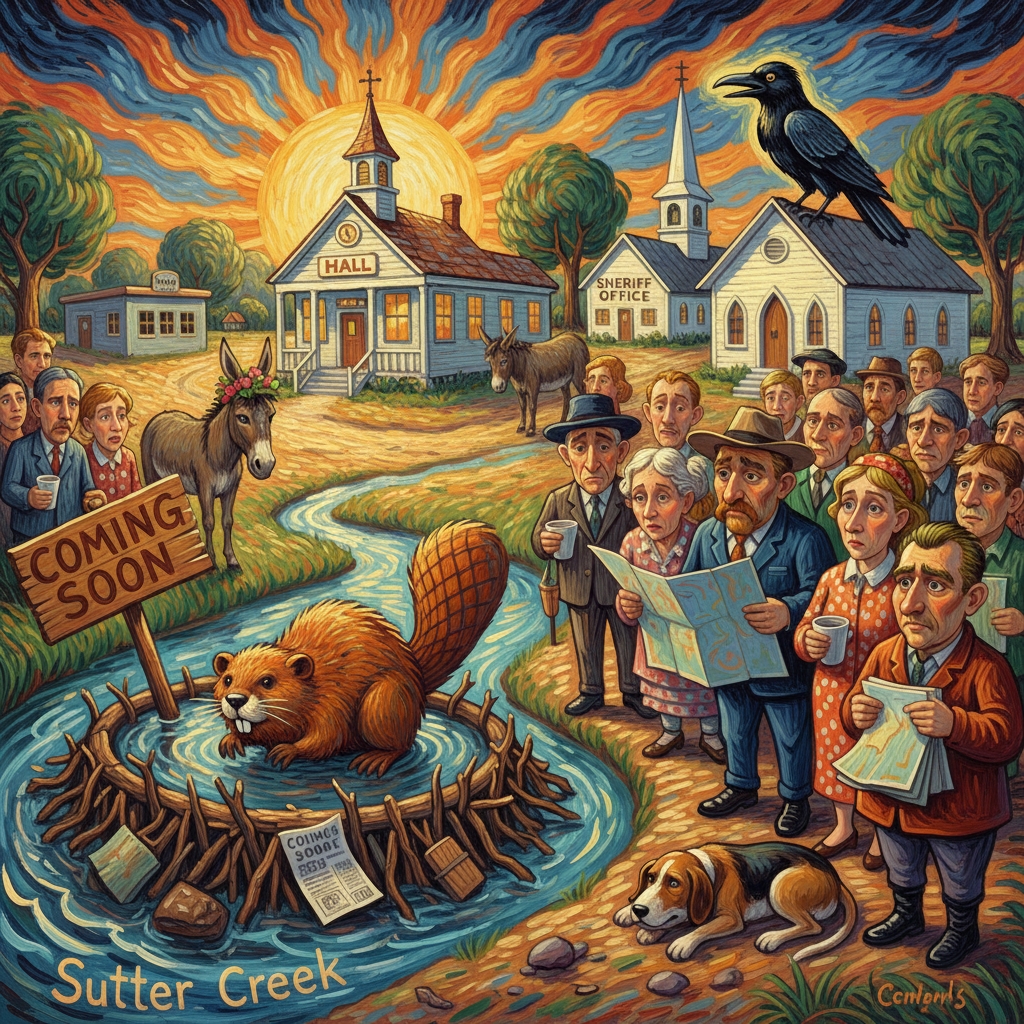
The Missing Pages Created More Drama Than the Existing Ones
By Tom Seest
At Sequatchie Crossing, we tell the stories of Sequatchie Crossing.
Please share this post with your friends, family, or business associates who may want follow the news from Sequatchie Crossing.
🎤 Audio Overview
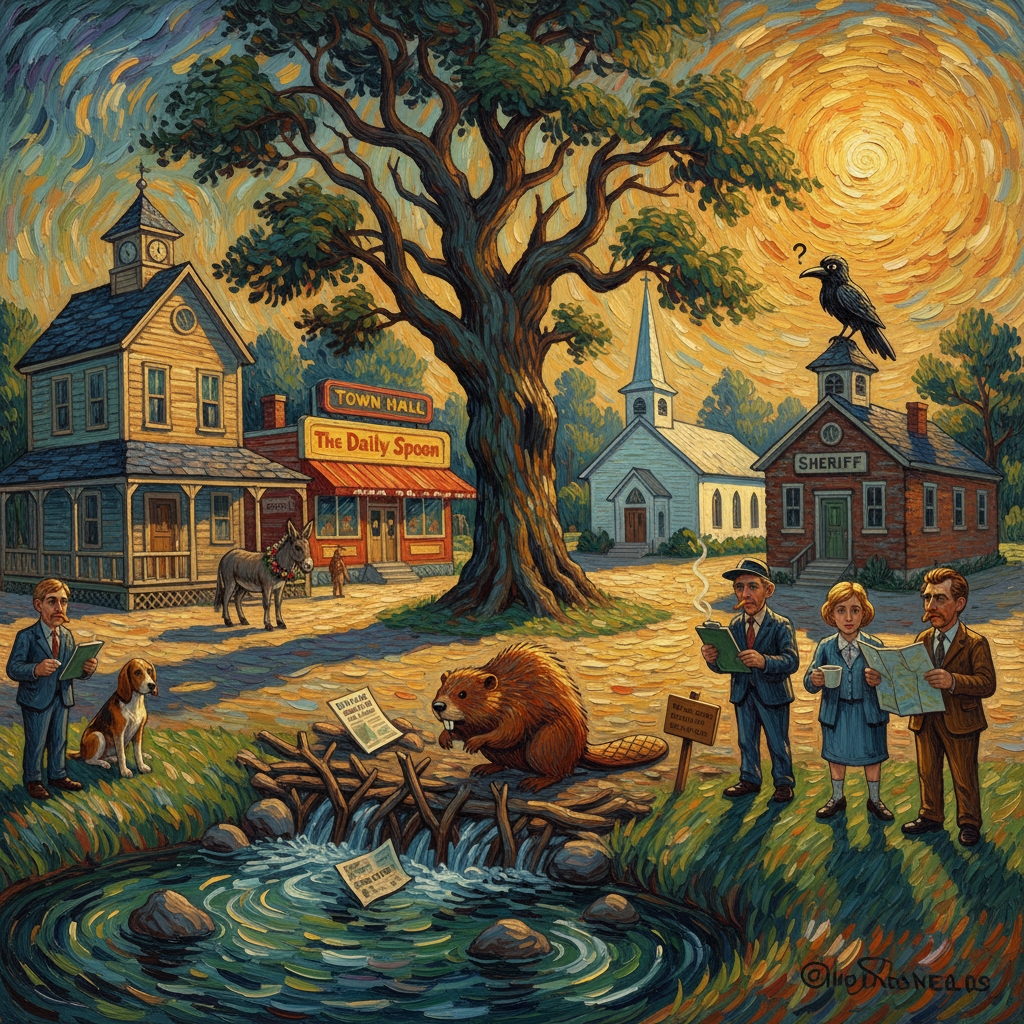
The Redacted Folder
Act I – The Folder Arrives At Town Hall
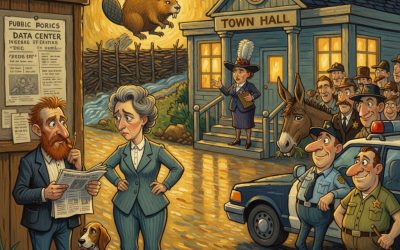
The redacted folder arrived at Sequatchie Crossing Town Hall on a Tuesday morning, which was unfortunate because Tuesday was already the day the copier hummed funny, the coffee pot leaked from an undisclosed seam, and Mayor Bea Crowe had promised herself she would not say the phrase “public confidence” before lunch.
She said it at 9:17.
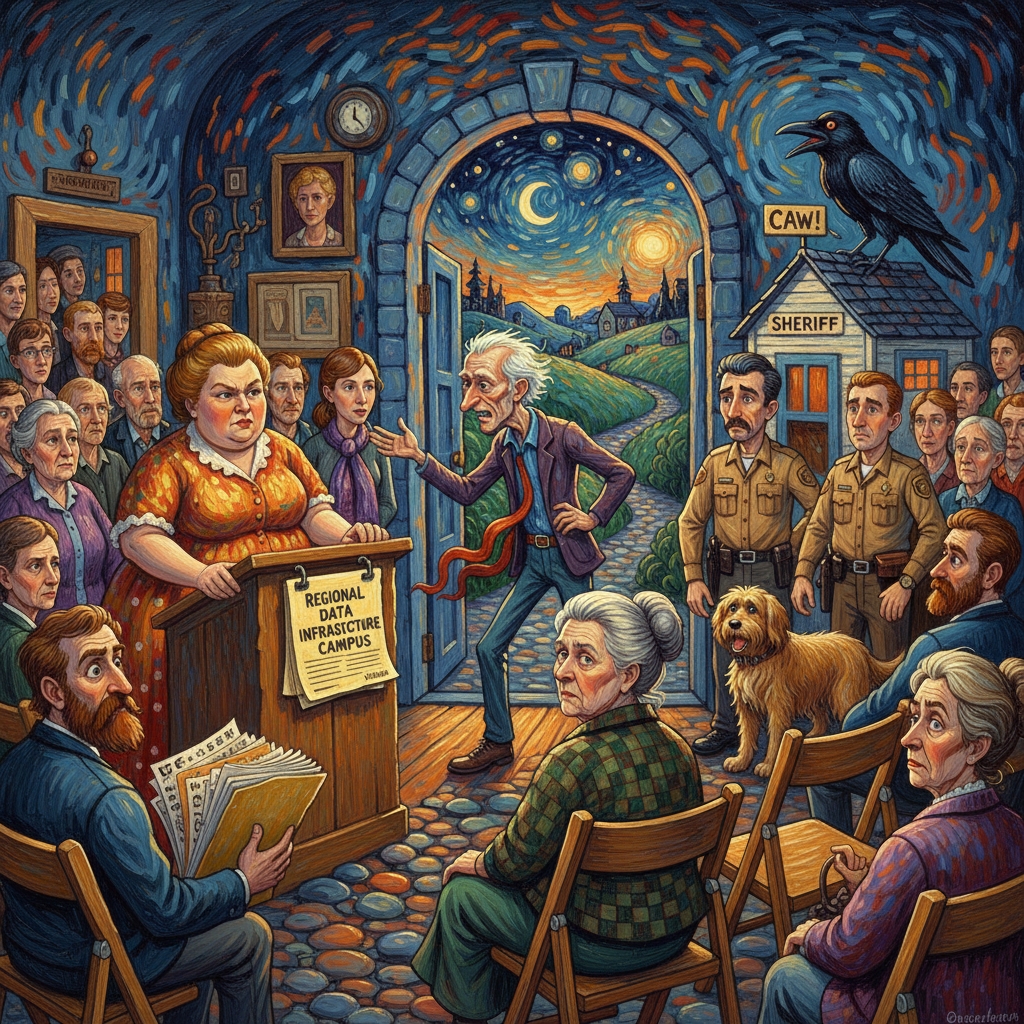
“I am simply trying to maintain public confidence,” Mayor Bea Crowe said, standing beside the long oak table in the Town Hall meeting room, where a beige folder lay like it had been indicted.
Eugene “Boot” Barnes leaned over it with his reading glasses perched halfway down his nose. “Bea, I’ve seen public confidence. This ain’t it. This is a folder with half its insides colored black.”
Across the table, Clovis Strickland had already taken photographs of each page with his flip phone, although nobody had explained to him that the phone’s camera lens had been cracked since the Fourth of July watermelon toss.
“It’s not black,” Clovis said. “It’s concealed. Black is a color. Concealed is an intention.”
Mabel Dean Ashcroft sat in the front row with her purse in her lap and her eyebrows arranged like they had just caught someone stealing hymnals. “I knew the data center folks were hiding something when they said they loved our community. Outsiders only love a community after checking the tax maps.”
“They have not signed anything final,” Mayor Crowe said.
“Then why is there a folder?” Mabel asked.
“Because preliminary negotiations create records.”
“Preliminary is what men call things before they admit they already did them,” Mabel said.
Sheriff Peeler stood near the side wall beside Officer Kenny Joe Teeter, both of them wearing the expression law enforcement gets when a public meeting starts using words like “cover-up” and “fiber corridor.”
Sheriff Peeler held up one hand. “Let’s keep this factual.”
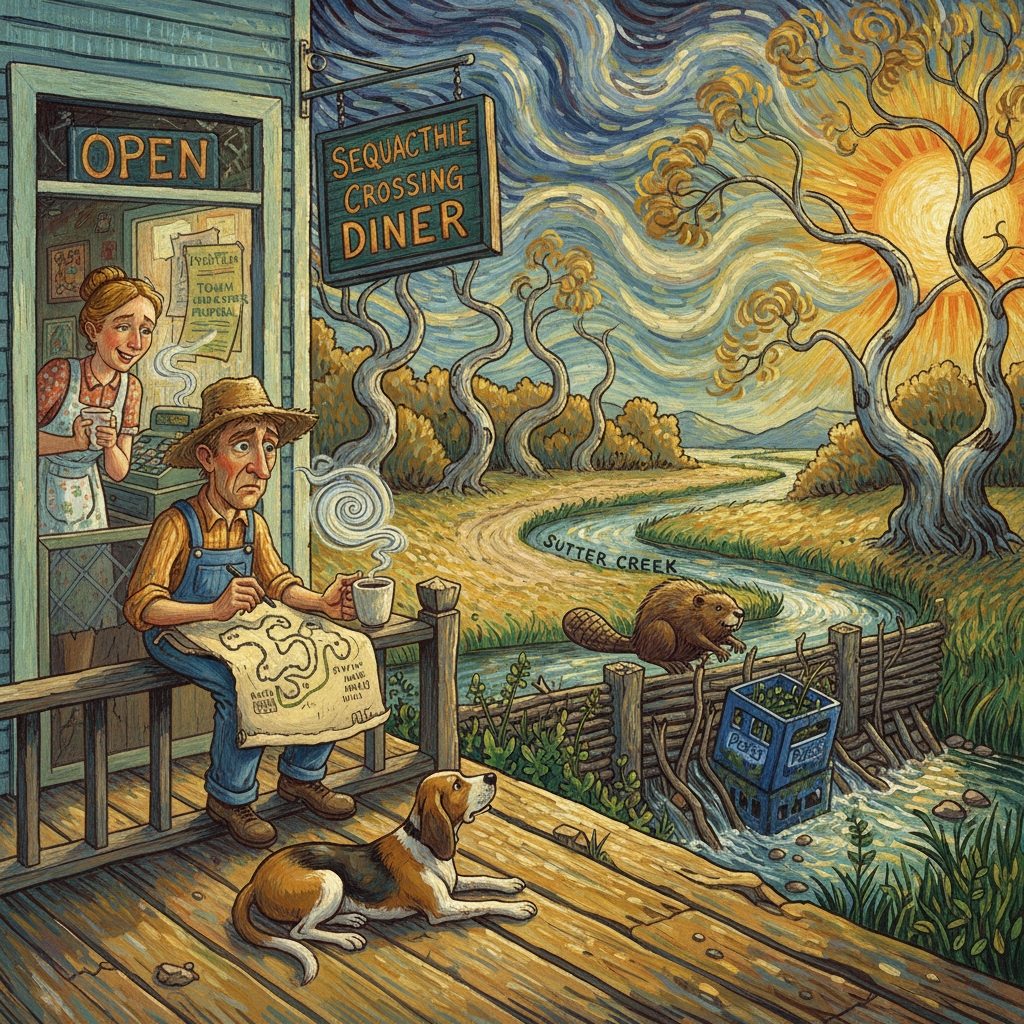
Act I – The Folder Arrives At Town Hall
Daisy the hound, who belonged partly to the sheriff’s office and partly to whoever had a biscuit, thumped her tail under the table.
Officer Kenny Joe Teeter looked down. “Daisy agrees with facts.”
“That dog agrees with sausage,” said Chester Ray Blevins, who had come from Blevins Print & Copy carrying his own stapler in case the municipal one proved unreliable.
Trixie Jo Bartlett slipped in late with a notepad, a recorder, two pens, and the look of a woman who knew the difference between a rumor and a headline but also understood that rumors paid attention better.
“So this is the redacted folder?” Trixie Jo asked.
“It is not ‘the redacted folder,’” Mayor Crowe said. “It is a lawful response to a public records request.”
Tiffany Annette Roark raised her hand from the second row. “But if the lawful response looks like a ransom note, people are going to respond emotionally.”
Shelley Fawn Wexler, who had brought three color-coded binders labeled Growth, Concerns, and Things Nobody Has Defined Yet, nodded. “Transparency is not just compliance. It’s the shape of trust.”
“That sounds expensive,” said Ricky Travis “RT” Mullins from the doorway, where he had been eating a breakfast biscuit he claimed was for blood sugar regulation.
Santiago “Sonny” Morales stepped in behind him, wiping his hands on a shop towel. “It gets more expensive when folks think the truth is hiding behind the toner cartridge.”
Dr. Neil Cowgill, retired professor and full-time provider of context nobody had requested, adjusted his bolo tie. “Historically, redaction is the visible scar tissue of institutional caution.”
Lurleen Davenport, seated beside Maggie Sue Dillard, whispered loudly, “That means they blacked out the spicy parts.”
Maggie Sue nodded. “I figured.”
Doug “Doughboy” Teeter sat near the back with a tablet open to a spreadsheet. “The data center project could bring infrastructure upgrades, jobs, and bandwidth capacity. We should not assume secrecy equals evil.”
Coach Freddie Stubblefield crossed his arms. “I never trusted a project where the jobs are described as ‘indirect.’ In football, indirect tackling is just missing.”
Brett Crenshaw raised his hand gently. “Some of us believe technology can help small towns if we shape it instead of just fear it.”
Alyssa Crenshaw added, “But shaping it requires access to information. Wellness, economics, land, water, energy — it’s all connected.”
Pastor Arnold Peeler, sitting near the window with Sister Lila Mae “Hallelujah” Pruitt, folded his hands. “Fear is dangerous. Certainty is also dangerous. The Lord did not give us curiosity so we could replace it with panic.”
“Hallelujah,” Sister Lila Mae said, not quietly.
Mister Wade Langston, the town attorney, tapped the folder with two careful fingers. “Certain portions were redacted because they involve confidential negotiation strategy, proprietary utility estimates, and preliminary commercial terms.”
Evelyn Grace Tipton, who ran the diner with a moral clarity sharpened by years of hearing men explain coffee, leaned forward. “Wade, honey, that sentence was wearing a necktie to hide muddy shoes.”
Before Mister Langston could answer, a crow landed outside the Town Hall window with a folded scrap of paper in its beak. It strutted along the sill, looked at the crowd, and cawed with the confidence of an elected official who had never read the agenda.
Clovis pointed. “See? Even the birds know something.”
Boot squinted. “That crow don’t know nothing. He once tried to steal a windshield wiper.”
The crow dropped the scrap against the glass. It read, in Chester Ray’s unmistakable print-shop font: PAGE 7.
Chester Ray stood abruptly. “That is not official print-shop material.”
Mayor Crowe closed her eyes.
Daisy crawled out from under the table, sniffed the folder, and sneezed.
“That,” Sheriff Peeler said, “is the first honest review this document has had.”
And by 9:42, the redacted folder had stopped being a document and become an event.
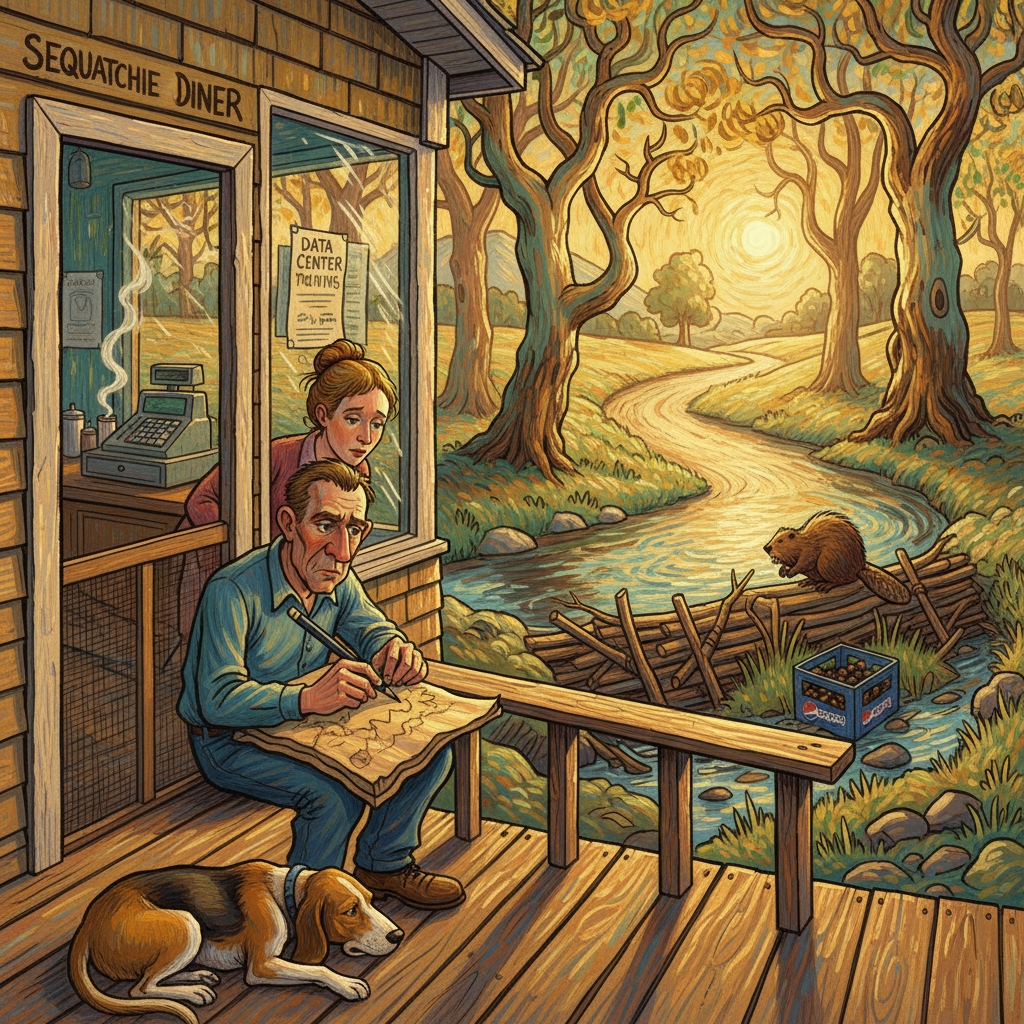
Act I – The Folder Arrives At Town Hall
Act II – Breakfast At Evelyn’s Diner
By noon, Evelyn’s Diner had divided itself into three constitutional factions.
The first faction believed the data center would bring prosperity, paved shoulders, and children who could work near home without selling insurance or moving to Chattanooga.
The second faction believed the data center would drain the water, dim the stars, overheat the mountain, and teach local raccoons to mine cryptocurrency.
The third faction consisted of Daisy, who believed Evelyn’s dropped gravy biscuit constituted the only actionable intelligence in the room.
Evelyn Grace Tipton slapped a ticket onto the window and called, “Two meatloaf specials, one pinto plate, and one order of transparency with extra onions.”
RT Mullins spun around on his stool. “Is transparency on the menu now?”
“It’s seasonal,” Evelyn said. “Available whenever people act like fools.”
Trixie Jo Bartlett had taken over the back booth with her recorder. Tiffany Annette Roark sat across from her, scrolling through comments on her phone.
“One woman says the redacted pages prove the town promised discounted electricity,” Tiffany said.
“Does she know that?” Trixie asked.
“She says her cousin saw a utility truck near the old substation.”
“That is not a source,” Trixie said.
“In Sequatchie Crossing, it’s at least a weather pattern.”
At the counter, Doug Teeter opened a laptop and rotated it toward Sonny Morales. “Look, if the project includes grid upgrades, fiber redundancy, and tax base expansion, we should evaluate the numbers before assuming corruption.”
Sonny took a sip of coffee. “I evaluate engines by listening to them. Right now, this one’s knocking.”
Act II – Breakfast At Evelyn’s Diner
Brett Crenshaw leaned in from the next stool. “But knocking can mean transition. When new systems arrive, old assumptions rattle.”
Coach Freddie Stubblefield stared at him. “Brett, son, that sentence ran a post route and never looked back.”
Alyssa smiled politely. “He means change creates friction.”
“Then say friction,” Coach said. “We got plenty of it.”
Mabel Dean Ashcroft entered with Sister Lila Mae Pruitt, both carrying the air of women who had already formed a committee in the parking lot.
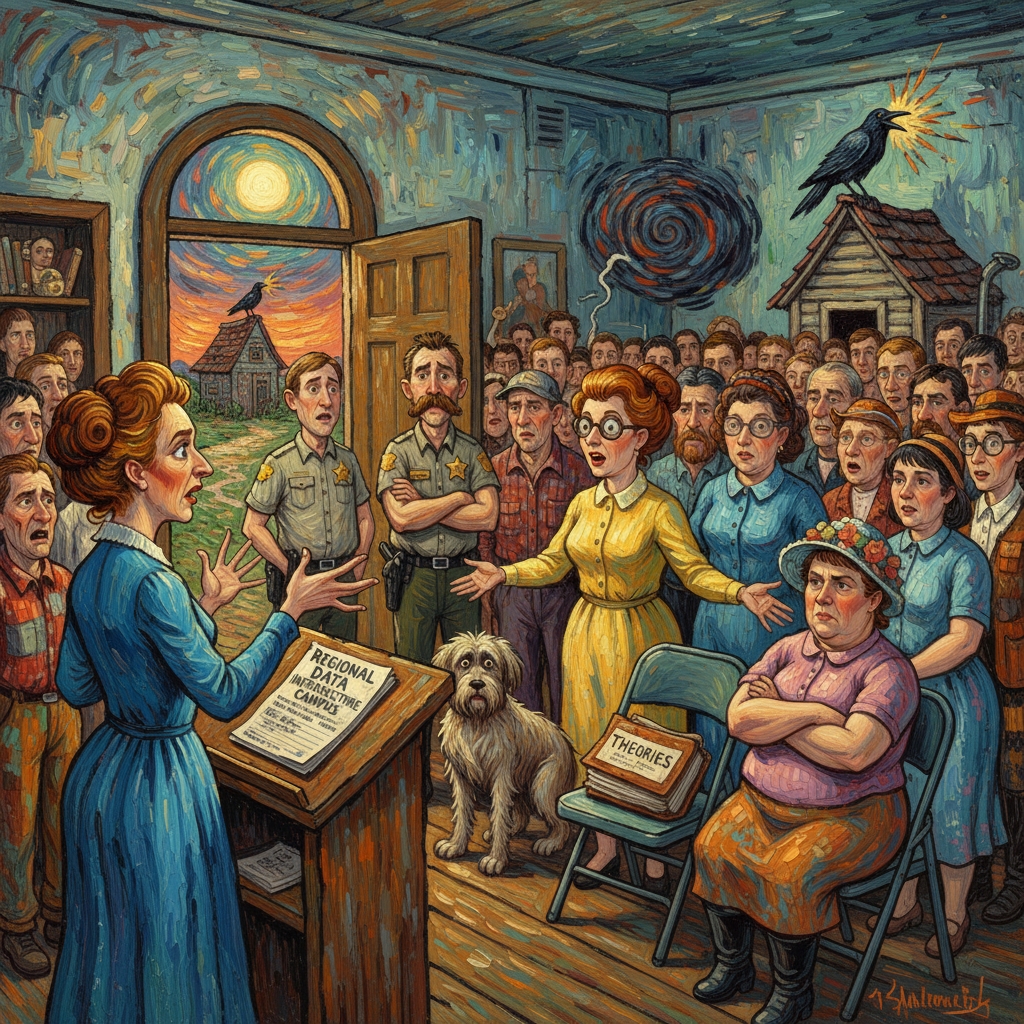
Mabel set her purse on the booth beside Boot. “I want to know why page seven was missing.”
Boot stirred his coffee. “Page seven wasn’t missing. It was blacked out.”
“That’s missing with makeup on.”
Sister Lila Mae slid into the booth. “I have prayed over this matter, and I feel led to say the town needs illumination.”
Evelyn called from behind the counter, “We are not holding a candlelight vigil for a folder.”
“Hallelujah does not always mean candles,” Sister Lila Mae said.
Clovis entered last, wearing a fishing vest full of envelopes. A black crow fluttered down onto the diner’s front awning and began pecking at something shiny.
Clovis pointed out the window. “That crow has been following me since Town Hall.”
“Clovis,” Maggie Sue Dillard said from her corner table, “that crow follows everybody with crackers.”
“It dropped a message.”
Chester Ray, seated beside Lurleen Davenport, groaned. “For the last time, that PAGE 7 scrap came from a box of misprinted church raffle flyers. I threw them out behind the shop.”
“Why did a misprinted church raffle flyer say PAGE 7?” Lurleen asked.
“Because Pastor Peeler wanted the raffle rules numbered.”
Pastor Arnold Peeler looked up from his soup. “And because some people believe a raffle without rules is gambling with refreshments.”
Mister Wade Langston entered carrying his leather briefcase, and the diner quieted just enough to make him regret it.
Trixie Jo raised her recorder. “Mr. Langston, can you explain why the town redacted entire sections rather than specific numbers?”
Wade removed his hat. “Because context can reveal confidential positions.”
Evelyn leaned on the counter. “Wade, context is also how people know whether they’re being sold a mule or a saddle.”
Sheriff Peeler stepped inside with Officer Kenny Joe and Daisy. “Nobody is being sold a mule.”
At that moment, outside, RT’s cousin’s actual mule, Jeremiah, stuck his head through the diner’s open service window and seized a napkin dispenser in his teeth.
Coach Freddie stood. “That mule heard negotiations.”
Daisy barked once, not at Jeremiah, but at the crow, which had now arranged three paper scraps on the sidewalk.
Tiffany rushed to the window. “They say WATER, ROAD, and FAVOR.”
The diner froze.
Chester Ray squinted. “Those are from my scrap bin too.”
Clovis whispered, “The crow is assembling the truth.”
Boot stood slowly, took his hat off the hook, and walked to the door. “No, the crow is assembling trash. Difference is, people will read either one if it lands in front of them.”
But nobody followed him right away, because in a town where the official record had black bars and the crow had nouns, the crow was gaining market share.
Act II – Breakfast At Evelyn’s Diner
Act III – The Porch Committee
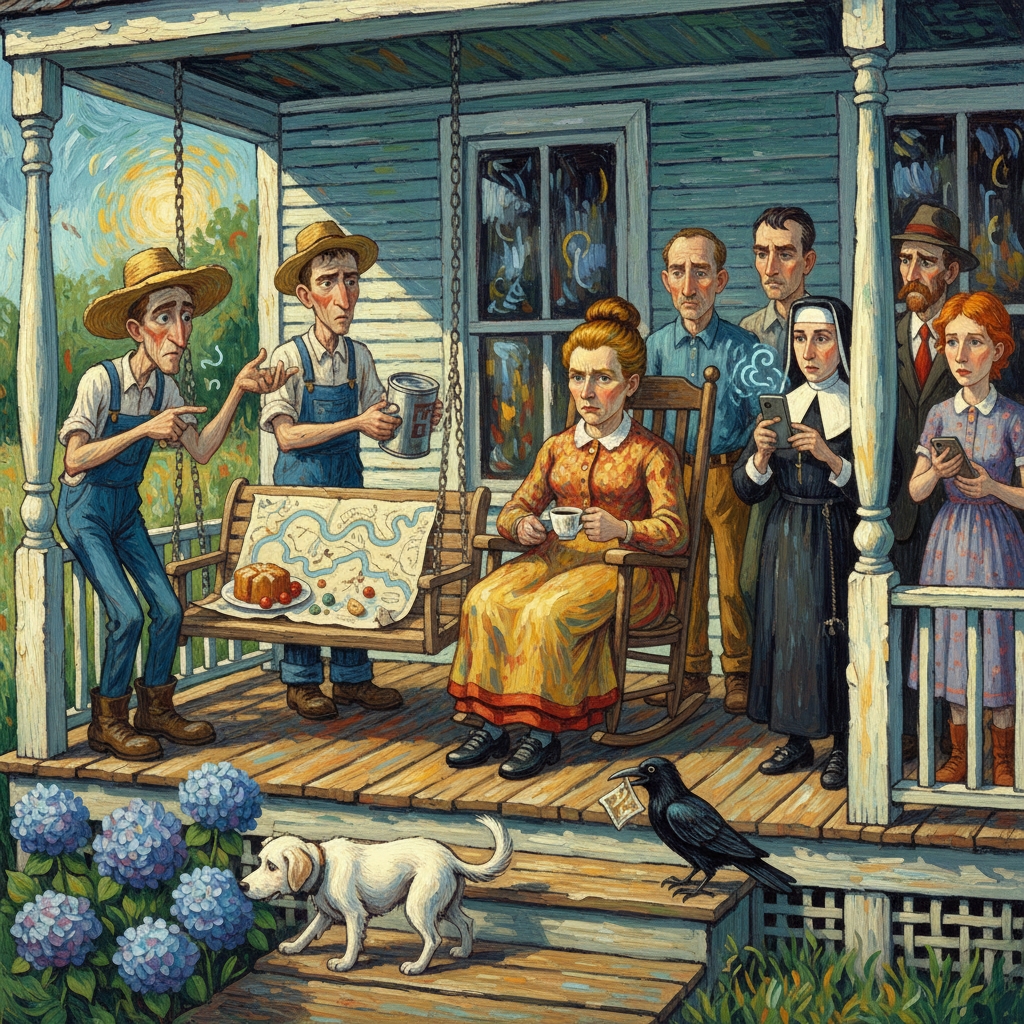
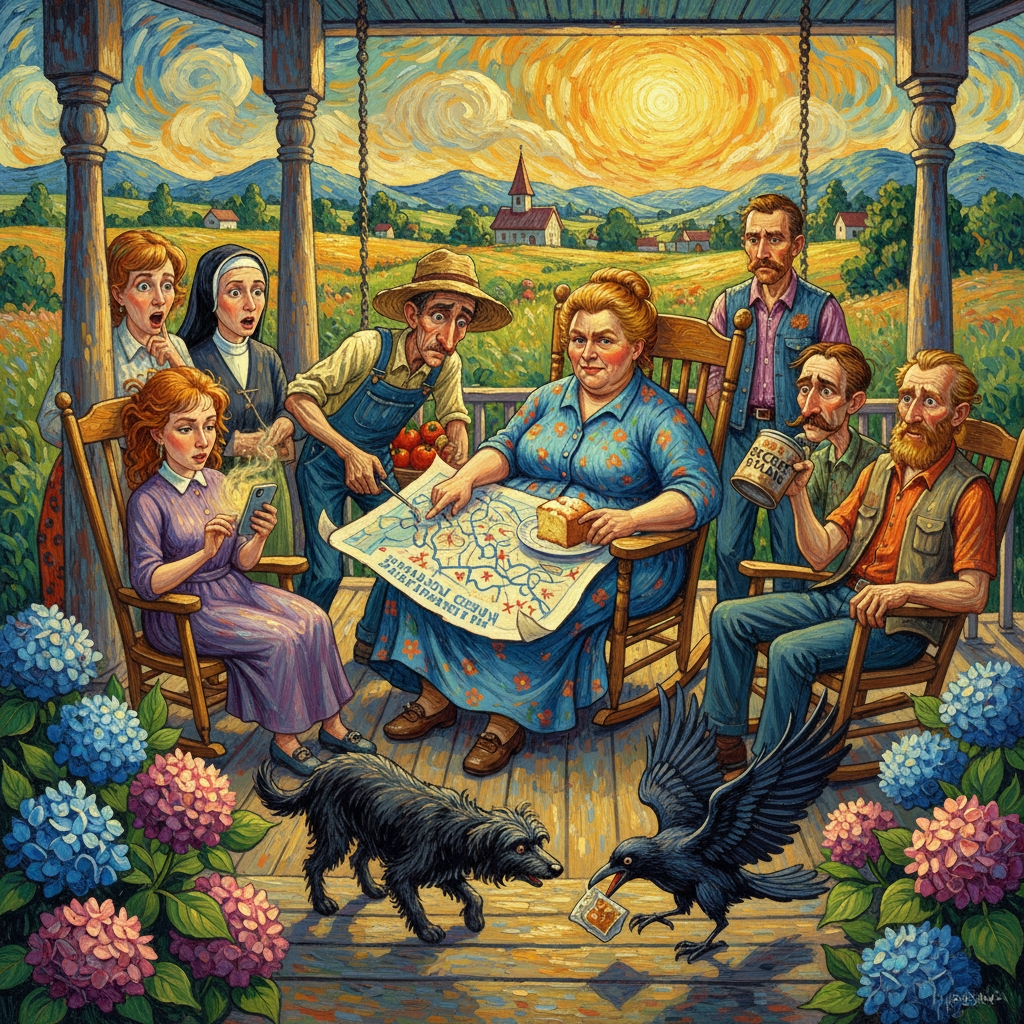
By late afternoon, the most important public meeting in Sequatchie Crossing was not at Town Hall. It was on Mabel Dean Ashcroft’s porch, where lemonade, suspicion, and folding chairs had produced more civic participation than three appointed boards combined.
Mabel sat in her rocker like a judge whose courtroom smelled faintly of pound cake.
“We need a citizens’ committee,” she said.
Shelley Fawn Wexler opened her Growth binder. “We already have three committees.”
“Then we need a committee to examine whether the committees were told enough to be committees.”
Lurleen Davenport nodded. “That sounds fair.”
Maggie Sue Dillard raised a hand. “Can we call it something that fits on a flyer?”
Chester Ray Blevins pulled a pencil from behind his ear. “I can print ‘Committee for the Examination of Unexamined Committee Materials,’ but the font will be tiny and morally disappointing.”
Boot Barnes sat on the porch steps, looking toward the road where Jeremiah the mule stood in the ditch, refusing to move for no declared reason.
“That mule understands negotiations,” Boot said. “He don’t budge unless somebody shows him what’s in it for him.”
RT Mullins leaned against a post. “Jeremiah is not making a policy statement. He’s blocking my trailer.”
“Same thing sometimes,” Sonny Morales said.
Across the yard, the crow hopped along Mabel’s birdbath, dipped its beak, and dropped another scrap of paper. Tiffany Annette Roark grabbed it before Clovis could.
“It says COOLING,” Tiffany said.
Doug Teeter pointed. “See, data centers require cooling. That’s not mysterious.”
Clovis narrowed his eyes. “Unless the crow knows page eight.”
“Crow does not know page eight,” Sheriff Peeler said from the walkway. “Crow knows Chester’s dumpster.”
Officer Kenny Joe stood beside him, holding Daisy’s leash. Daisy stared at the crow with professional doubt.
Pastor Arnold Peeler arrived with Sister Lila Mae, both carrying lawn chairs from the church fellowship hall.
Pastor Peeler unfolded his chair. “I came because someone said there was a community discernment gathering.”
Mabel sniffed. “I said porch meeting.”
Act III – The Porch Committee
“Hallelujah,” Sister Lila Mae said. “Discernment can occur on treated lumber.”
Mayor Bea Crowe stepped onto the porch last, followed by Mister Wade Langston. She looked tired in the particular way only mayors of small towns look tired: personally blamed for both growth and potholes.
“I understand people are concerned,” Mayor Crowe said.
Mabel looked over her glasses. “Do you understand why?”
“Yes,” the mayor said. “Because redactions create questions.”
“No,” Mabel said. “Because redactions create stories. Questions wait for answers. Stories go door to door.”
Trixie Jo, seated on the porch rail, wrote that down.
Mayor Crowe took a breath. “We are negotiating. If everything is public too early, the town loses leverage.”
Earl Womack, who had arrived quietly and taken a chair near the hydrangeas, spoke for the first time. “I remember when the industrial park promised four hundred jobs and delivered fifty-seven, depending on whether you counted the vending machine man.”
Everyone turned.
Earl rubbed his chin. “I ain’t against jobs. I am against arithmetic wearing cologne.”
Doug nodded slowly. “Then we ask better questions. Power usage. Water usage. Tax abatements. Road maintenance. Emergency services. Local hiring. Exit clauses.”
Alyssa Crenshaw added, “And environmental baselines. Not just promises, measurable thresholds.”
Brett said, “And public education. People fear what they do not understand.”
“People also fear what they understand perfectly,” Evelyn said, arriving with a tray of tea glasses. “Like variable-rate contracts.”
Wade Langston opened his briefcase. “The law allows certain protections during negotiation.”
Trixie Jo asked, “But does the law require total mystery?”
“No,” Wade said.
The porch became silent.
Boot looked at Mayor Crowe. “There it is.”
Mayor Crowe nodded reluctantly. “We can release more context without releasing confidential numbers.”
Clovis raised both hands. “Aha. So there are numbers.”
“There are always numbers,” Dr. Neil Cowgill said, stepping into the yard with a notebook. “The question is whether the numbers describe reality, aspiration, leverage, or theater.”
Coach Freddie pointed at him. “Neil, you come late and still make us feel behind.”
Jeremiah the mule brayed from the ditch.
The crow cawed back.
Mabel looked at the animals, then at the mayor. “Even the mule and the crow are negotiating in public.”
Sheriff Peeler sighed. “The mule is trespassing and the crow is littering.”
“Still more transparent than page seven,” Clovis said.
Mayor Crowe sat down on the porch step beside Boot. “Then tomorrow night, Town Hall. Full public forum. We will explain what can be explained, what cannot be released yet, and why.”
Mabel rocked once. “And if we don’t like why?”
“Then you say so,” Mayor Crowe said.
Boot nodded. “That’ll do for a start.”
The crow dropped another scrap into the birdbath.
This one said NOTHING.
Nobody knew whether it meant there was nothing to hide, nothing left to say, or nothing in Chester Ray’s dumpster that had not already become evidence.
That was enough to keep the porch meeting going until dark.
Act III – The Porch Committee
Act IV – The Sheriff’s Office Reviews The Evidence
The next morning, the sheriff’s office smelled of coffee, printer toner, wet dog, and the faint despair of public administration.
Sheriff Peeler had placed the folder on his desk. Daisy lay beneath it, snoring like a small sawmill.
Officer Kenny Joe Teeter stood at the evidence board, where he had pinned the crow scraps in a careful grid: PAGE 7, WATER, ROAD, FAVOR, COOLING, NOTHING.
“This is not evidence,” Sheriff Peeler said.
Kenny Joe nodded. “I labeled it ‘avian-adjacent materials.’”
“Take that down.”
“It’s helping me think.”
“It’s helping Clovis spread rumors.”
Clovis Strickland sat in the visitor chair holding a jar of birdseed. “Sheriff, rumors are what information becomes when officials put it on a diet.”
Sheriff Peeler pointed at him. “You are not feeding that crow from law enforcement property.”
“I am cultivating a source.”
“You are cultivating a citation problem.”
Trixie Jo Bartlett sat beside the filing cabinet, recorder on. “Sheriff, did your office review any security concerns related to the data center?”
Sheriff Peeler folded his hands. “Preliminary conversations, yes. Traffic, emergency access, fencing, backup generators, fuel storage, and response routes.”
“Were those redacted?”
“Some were.”
“Why?”
“Because if you publish every security detail, you help people who do not need helping.”
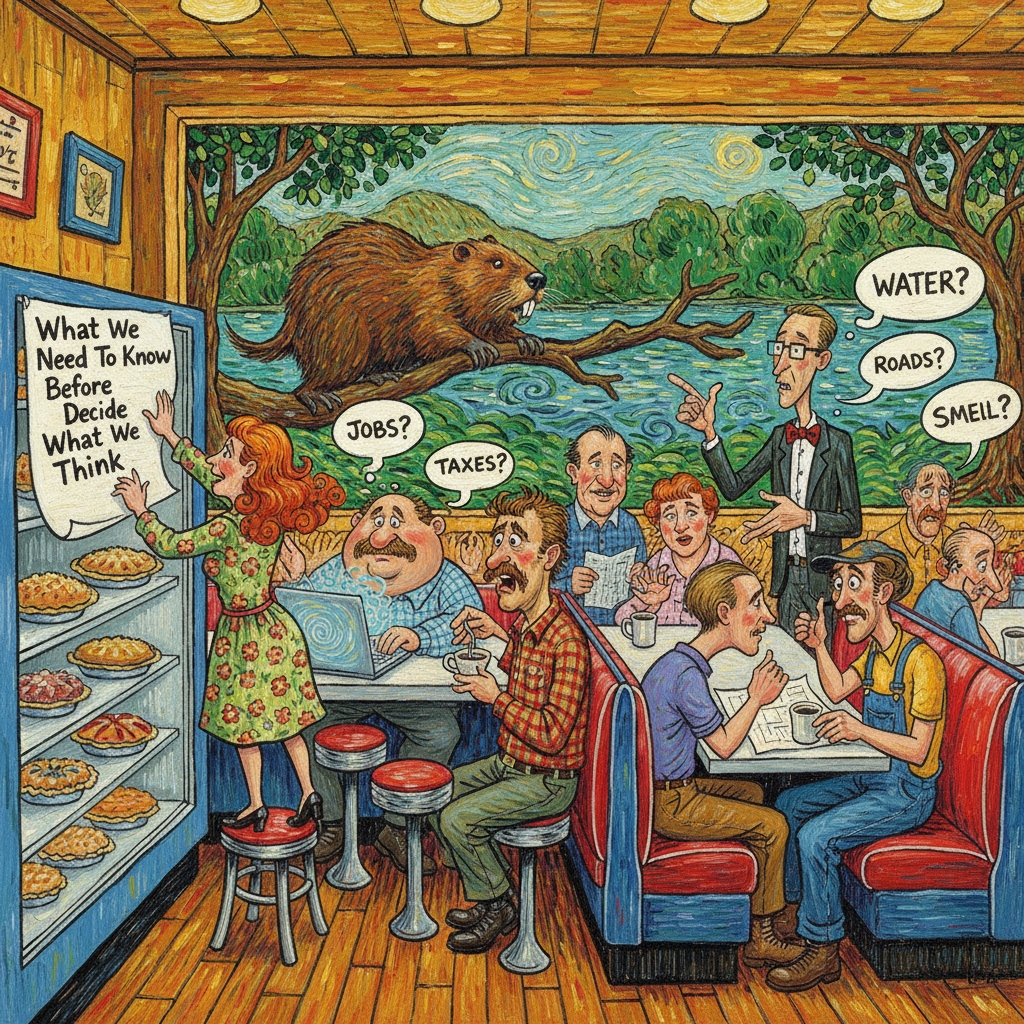
Act IV – The Sheriff’s Office Reviews The Evidence
Clovis leaned forward. “That’s what they always say.”
“That doesn’t make it false,” Sheriff Peeler said.
The door opened and Doug Teeter entered with his tablet, followed by Sonny Morales and Coach Freddie.
Doug said, “I built a model estimating traffic impacts based on construction phase versus operating phase.”
Coach Freddie said, “I came because Doug said model and I wanted to ensure it wasn’t wearing cleats.”
Sonny looked at the evidence board. “Why is FAVOR pinned under WATER?”
Kenny Joe blinked. “Because alphabetical order seemed emotionally wrong.”
Daisy woke, sneezed, and crawled toward Sonny, who scratched her behind the ears.
Mister Wade Langston came in holding a duplicate folder. “I was asked to clarify lawful redactions.”
Sheriff Peeler gestured to a chair. “Clarify away.”
Wade opened the folder. “Security measures may be withheld. Proprietary technical information may be withheld. Negotiation positions may be withheld until no longer sensitive. But broad categories can be discussed.”
Trixie Jo asked, “So the town could say, ‘We discussed water capacity,’ without releasing the specific requested rate?”
“Yes,” Wade said.
Doug nodded. “That matters. People can participate in the question without seeing every number.”
Clovis shook his jar of seed. “Participate without numbers? That is called guessing politely.”
Sonny said, “Sometimes numbers lie too. I’ve seen repair estimates with three decimal places and no truth.”
Coach Freddie crossed his arms. “I want to know who pays when the road gets chewed up by cement trucks.”
“Valid question,” Sheriff Peeler said.
Kenny Joe wrote ROAD PAY? on the whiteboard.
Pastor Arnold Peeler stepped in, his expression soft but alert. “I heard voices.”
“You heard civic frustration,” Sheriff Peeler said.
“Happens to sound like voices.”
Sister Lila Mae followed him. “I brought cookies. People tell more truth with cookies nearby.”
Daisy sat up immediately.
Wade took one. “Thank you.”
Trixie Jo asked Pastor Peeler, “What do you think the town should do?”
Pastor Peeler glanced at the folder. “I think secrecy and suspicion feed each other. But I also think not every private conversation is wicked. A marriage would not survive if every grocery budget discussion were live-streamed.”
Sister Lila Mae raised a finger. “But if the husband comes home with a bulldozer, questions may be asked.”
“Hallelujah,” Coach Freddie said.
Outside the window, the crow landed on the hood of Sheriff Peeler’s cruiser. It held another scrap.
Kenny Joe rushed to the door. “Do not let it scratch the paint.”
The crow dropped the scrap and flew to the stop sign.
Kenny Joe retrieved it.
He came back in slowly.
Sheriff Peeler said, “Well?”
Kenny Joe read, “PROMISE.”
The room went quiet.
Wade rubbed his forehead. “Chester Ray’s scrap bin is becoming a constitutional hazard.”
Clovis whispered, “Page seven made a promise.”
Doug said, “Or the church raffle promised a pie.”
Sheriff Peeler stood. “Enough. We are going to Chester’s print shop.”
Daisy barked, approving the investigative direction.
And for the first time since the folder arrived, Sequatchie Crossing had a suspect everyone could agree on: paper.
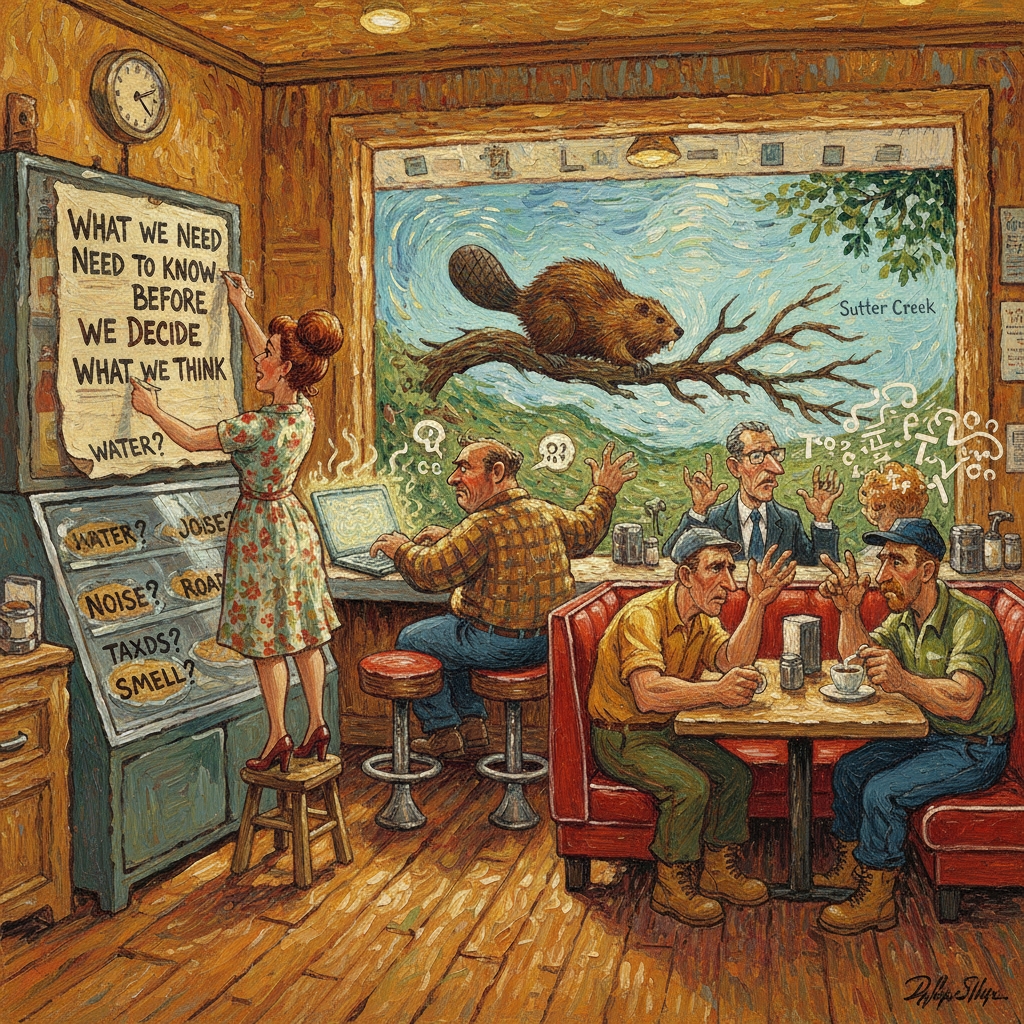
Act IV – The Sheriff’s Office Reviews The Evidence
Act V – Chester Ray’s Print Shop Becomes Central To Democracy
Blevins Print & Copy had served Sequatchie Crossing for thirty-two years, producing funeral programs, yard-sale signs, baptism certificates, business cards, church bulletins, and one unfortunate run of “Happy Retirement, Carl” banners for a man named Earl.
Chester Ray Blevins stood in the middle of the shop as Sheriff Peeler, Kenny Joe, Trixie Jo, Clovis, Boot, Mabel, Doug, Sonny, and half the town crowded between the laminator and the paper cutter.
“This,” Chester Ray announced, “is a print shop, not a bird-based intelligence agency.”
The crow sat on the awning outside.
Mabel pointed through the window. “Then why does your bird keep releasing documents?”
“It is not my bird.”
“It has your font.”
“That is not how ownership works.”
Boot picked up a box of discarded sheets. “Chester, what exactly did you throw out?”
Chester Ray sighed. “Misprinted raffle rules, old road committee drafts, a mock-up for the water board open house, and some sample contract templates Wade asked me to copy last month.”
The room froze.
Wade Langston, who had just entered behind Evelyn and Maggie Sue, stopped in the doorway. “Those templates were generic.”
Clovis slowly turned. “Generic promises?”
“Generic templates,” Wade said. “For teaching staff how contract language works.”
Trixie Jo asked, “Were they related to the data center?”
“No.”
Chester Ray held up both hands. “I printed sample pages. Page seven probably came from a sample packet. The crow stole pieces from my recycling.”
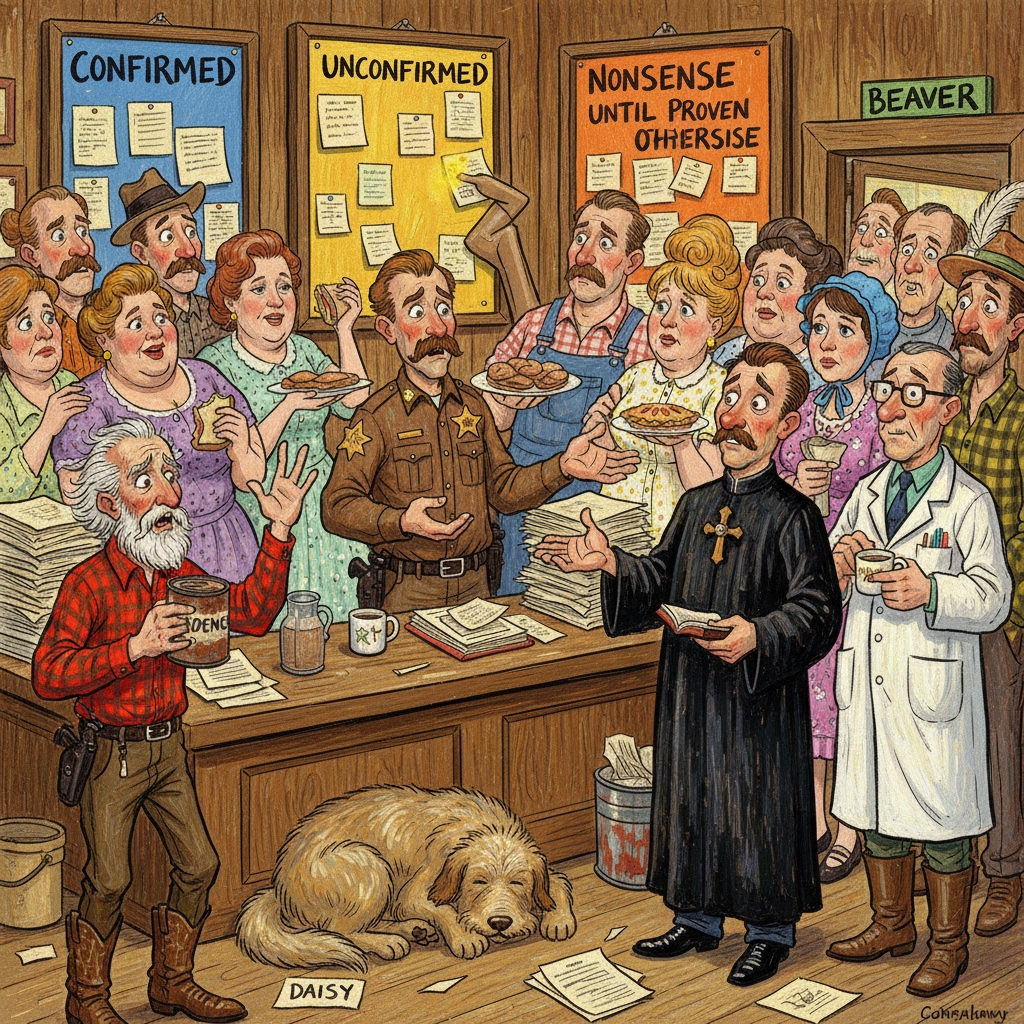
Act V – Chester Ray’s Print Shop Becomes Central To Democracy
Tiffany Annette Roark entered with Shelley Wexler and the Crenshaws. “Too late. Half the town is posting that a crow leaked the benefits agreement.”
Shelley winced. “That is not ideal.”
Alyssa asked, “Can we put out a correction?”
RT Mullins laughed from beside the copier. “You can put out a correction. Whether anybody invites it inside is another matter.”
Coach Freddie tapped the counter. “This is exactly why you don’t run plays through a crow.”
Dr. Neil Cowgill examined the scraps. “Fascinating. Random fragments become narrative anchors when institutional opacity creates interpretive hunger.”
Evelyn said, “Neil, I know you mean well, but sometimes you talk like a college brochure got struck by lightning.”
Sonny Morales picked up a scrap that read COOLING. “This one’s from the water board flyer.”
Chester Ray nodded. “Cooling station. Summer heat awareness.”
Doug pointed at PROMISE. “And that?”
“Church pledge card mock-up,” Chester said.
Sister Lila Mae, who had just arrived carrying a casserole dish for reasons unclear, gasped. “That crow has been stealing from the Lord’s administrative materials.”
Pastor Peeler looked out the window. “The Lord has endured worse theft.”
Mabel was not satisfied. “So the crow is innocent?”
Sheriff Peeler said, “The crow is a crow.”
“That is not an answer.”
“It is the most accurate answer in the room.”
Mayor Bea Crowe entered, and the crowd parted slightly. She looked at the scraps, then at Chester Ray, then at the window where the crow now appeared to be studying its own reflection.
“I should have explained the redactions before releasing the folder,” Mayor Crowe said.
The shop quieted.
Mister Wade Langston looked at her. “Bea—”
“No,” she said. “Legally, maybe we did enough. Publicly, we did not. People filled in blanks because we handed them blanks.”
Trixie Jo clicked her pen. “Can I quote that?”
“Yes,” Mayor Crowe said. “But quote the next part too. Not every blank is a conspiracy. Some blanks are temporary. Some protect the town. Some protect legitimate private information. And some should not have been blank at all.”
Boot smiled faintly. “Now we’re getting somewhere.”
Clovis looked wounded. “But the crow—”
“The crow,” Mayor Crowe said, “is invited to tomorrow’s public forum only if it files a speaking card.”
Daisy barked outside the door.
Kenny Joe opened it, and Daisy trotted in carrying a scrap in her mouth.
Sheriff Peeler took it gently and read it.
It said PIE.
Sister Lila Mae clutched her casserole. “That one is definitely ours.”
Chester Ray pointed at the crow. “See? Criminal poultry.”
“Crows ain’t poultry,” Boot said.
“They are today,” Chester replied. “Today every bird in this town is subject to documentation.”
And somehow, that became the closest thing Sequatchie Crossing had to consensus.
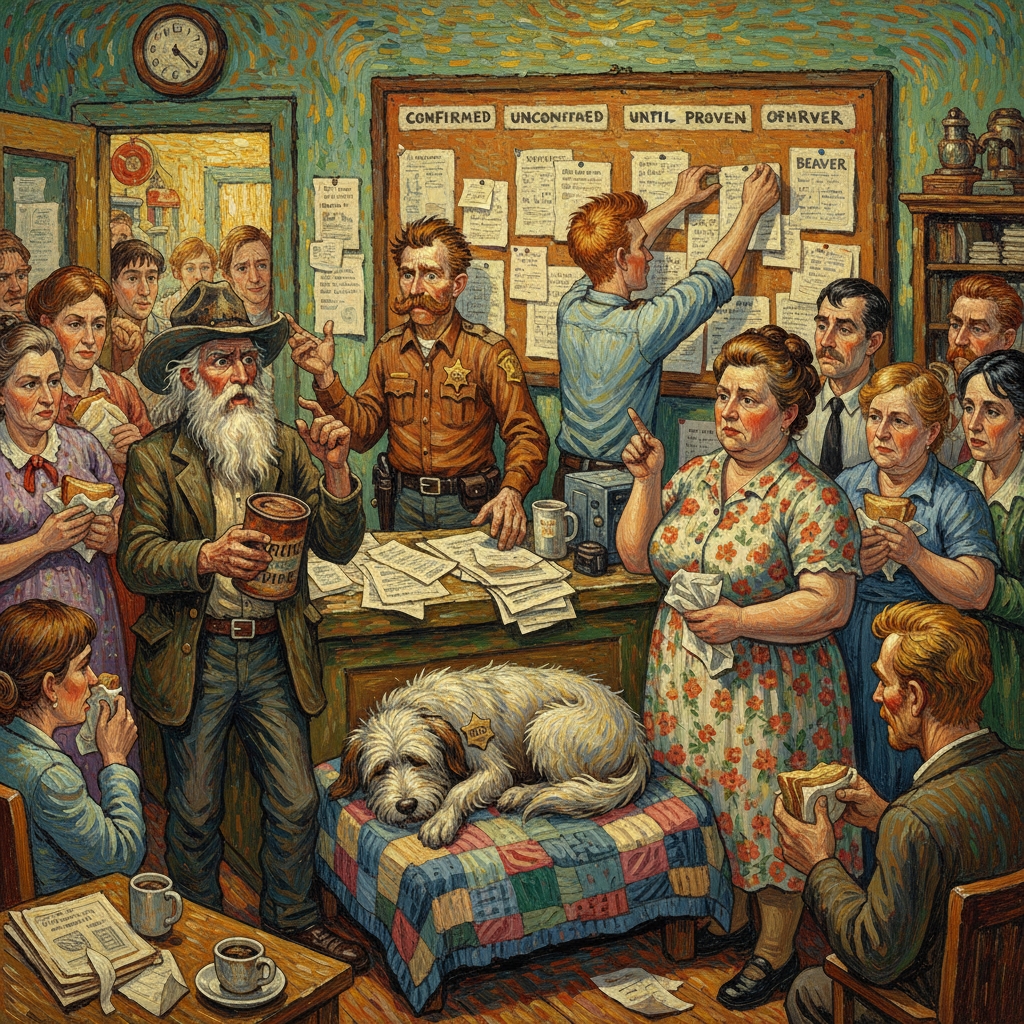
Act V – Chester Ray’s Print Shop Becomes Central To Democracy
Act VI – The Church Basement Forum
The public forum was moved from Town Hall to the basement of First Unaffiliated Missionary Temple because the Town Hall air conditioner developed a rattle that sounded like a trapped bureaucrat.
Pastor Arnold Peeler opened the meeting beneath fluorescent lights, beside a table of cookies, lemonade, and one suspicious casserole that Sister Lila Mae said contained “accountability.”
“We gather,” Pastor Peeler said, “not to defeat one another, but to understand what fear is trying to teach us before fear starts driving.”
“Hallelujah,” said Sister Lila Mae.
Mayor Bea Crowe stood at the front beside Mister Wade Langston, Sheriff Peeler, and a poster board reading WHAT CAN BE SHARED NOW.
Trixie Jo sat in the front row. Tiffany livestreamed with the caption: DATA CENTER FORUM – FACTS, FEARS, AND POSSIBLY CROW UPDATES.
Mayor Crowe began. “The town has been in preliminary discussions regarding a potential data center project near the old ridge access road. No final development agreement has been signed.”
Mabel raised her hand. “Has anybody promised discounted taxes?”
Wade answered. “No binding tax incentive has been approved.”
“Discussed?”
“Yes.”
The room murmured.
Boot called out, “Let him finish.”
Wade continued, “Discussing incentives does not mean granting them. Any actual agreement requiring public approval would come before the proper public body.”
Earl Womack raised his hand. “Will the public see it before the vote or after the cake is cut?”
Mayor Crowe nodded. “Before.”
Doug Teeter stood. “Can we create a public question matrix? Water, power, noise, roads, jobs, taxes, emergency services, and exit obligations.”
Shelley lifted her binder. “I already started one.”
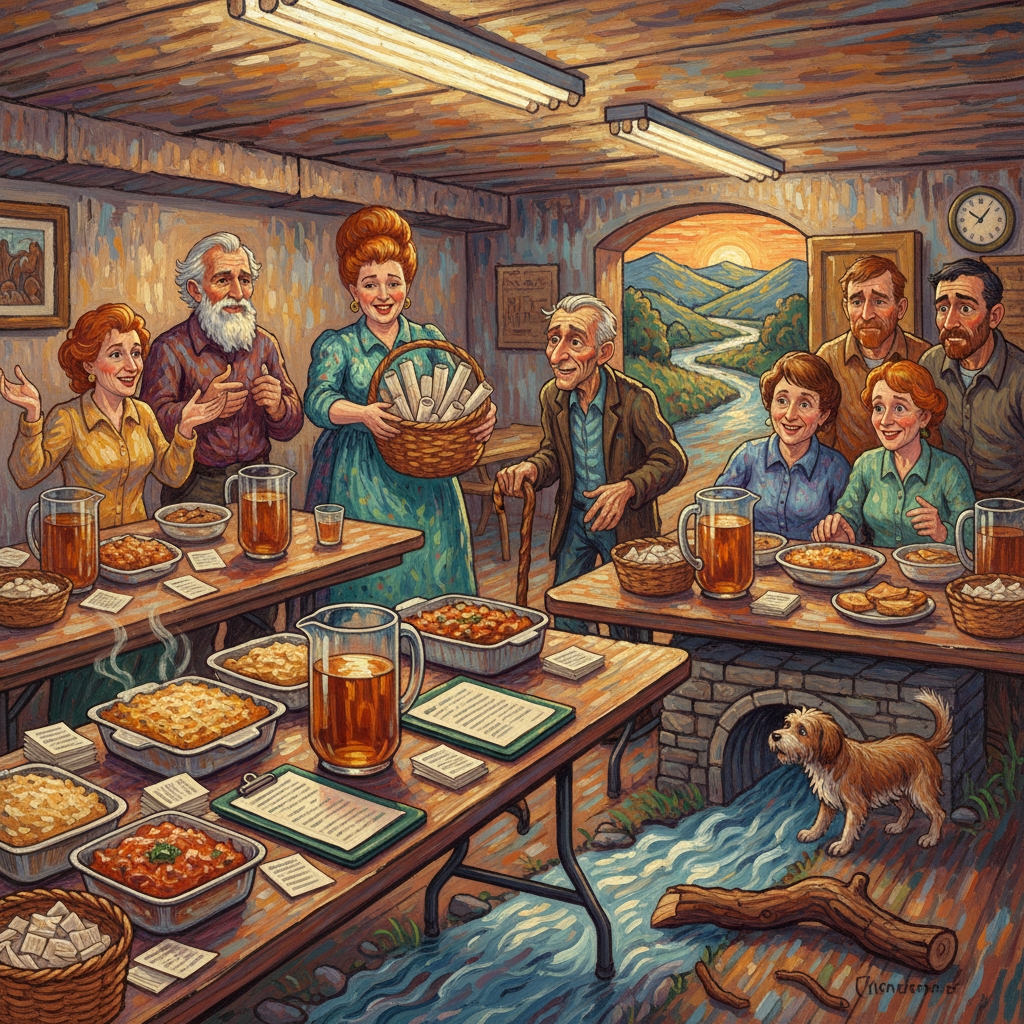
Act VI – The Church Basement Forum
“Of course you did,” RT said.
Alyssa Crenshaw stood beside Brett. “I want the town to consider opportunity. Better fiber, tech education, possibly internships, maybe a reason younger people don’t have to leave.”
Coach Freddie said, “And I want the town to consider that a promise of future opportunity is not the same as a local paycheck.”
Brett nodded. “Agreed.”
That surprised people enough to quiet them.
Brett continued, “I support the idea of growth. I do not support being dazzled by vocabulary.”
Evelyn raised a lemonade cup. “Put that on a mug.”
Dr. Neil Cowgill stood, unfolding a paper longer than necessary. “The transparency question is not binary. There is transactional transparency, procedural transparency, interpretive transparency—”
“Neil,” Sheriff Peeler said.
“Fine,” Neil said. “Tell people what is being discussed, why parts are withheld, when they will be released, and what decisions remain open.”
“Thank you,” Sheriff Peeler said.
Clovis stood, holding no fewer than nine crow scraps in plastic sleeves. “What about the bird documents?”
Half the basement groaned.
Pastor Peeler said, “Clovis, perhaps the bird documents tell us less about the project and more about ourselves.”
Clovis frowned. “That sounds like surrender.”
“No,” said Boot. “It sounds like that crow found our imagination unattended.”
At that exact moment, the basement window well rattled.
Everyone turned.
The crow stood outside the glass with a scrap in its beak, tapping like a process server.
Daisy, who had been sleeping under the cookie table, bolted awake and barked. The crow dropped the scrap into the window well.
Officer Kenny Joe climbed onto a chair, opened the small basement window, and retrieved it.
“What does it say?” Tiffany whispered.
Kenny Joe unfolded it.
“FINAL,” he read.
The room exploded.
Mayor Crowe raised both hands. “There is no final agreement.”
Clovis shouted, “The crow says otherwise.”
Chester Ray, red-faced, stood. “That is from the final reminder postcard for the church bake sale!”
Sister Lila Mae nodded vigorously. “Final call for pecan pies. That is sacred but not municipal.”
Sheriff Peeler took the scrap and held it up. “This is exactly the problem. A single word without context becomes whatever anxiety needs.”
Mabel sat back slowly.
Earl Womack said, “I have seen companies do wrong. I have also seen towns scare themselves into turning shadows into wolves.”
Maggie Sue Dillard raised her hand. “Can we still ask hard questions without acting like fools?”
Mayor Crowe looked relieved. “Yes. That is the entire purpose of the forum.”
Lurleen asked, “Can we ask them in plain English?”
“Please,” Wade said. “For all our sakes.”
And for the first time, the forum began doing something unusual for Sequatchie Crossing.
It began functioning.
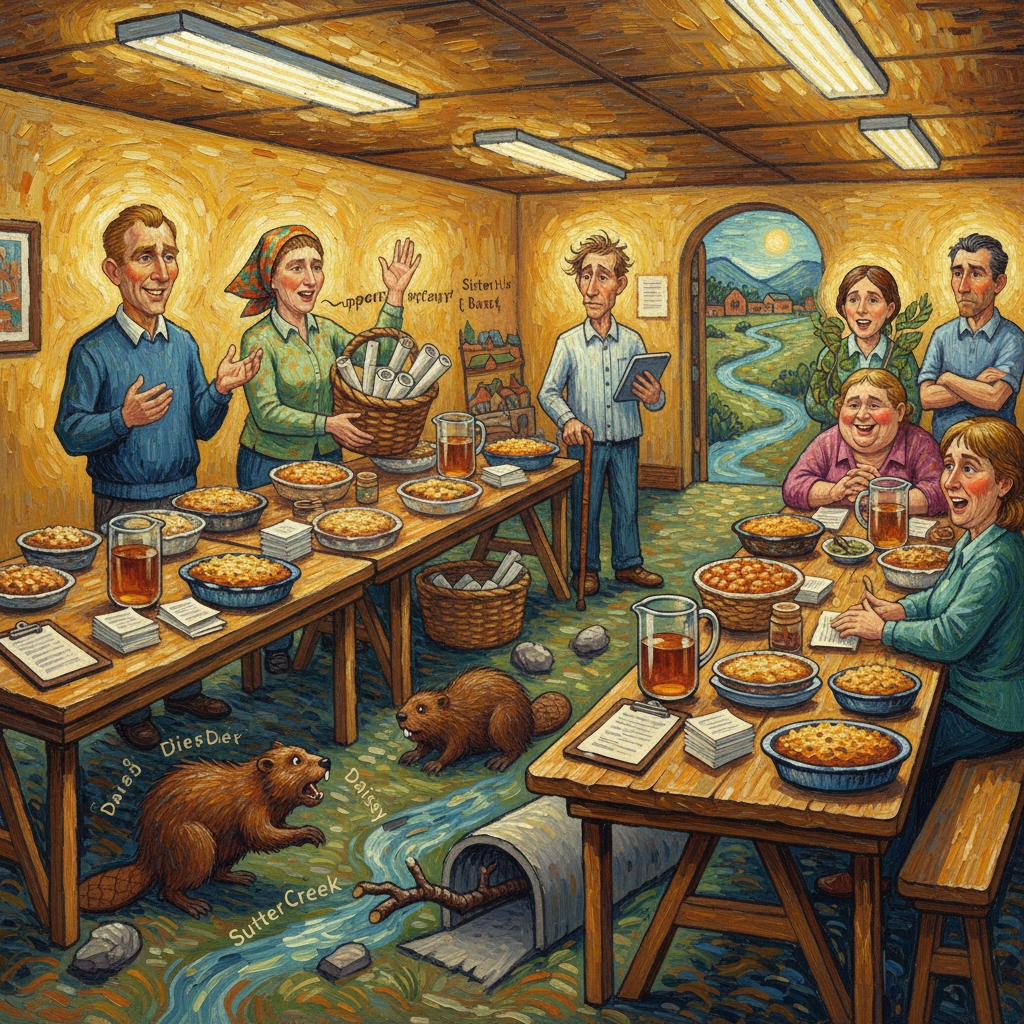
Act VI – The Church Basement Forum
Act VII – The Town Hall Drafting Session
The next morning, Town Hall hosted what Mayor Crowe called a drafting session and what Boot Barnes called “a barn raising for paperwork.”
The long oak table was covered with coffee cups, sticky notes, legal pads, Shelley’s binders, Doug’s printed charts, and a plate of Evelyn’s biscuits that had mysteriously improved everyone’s civic temperament.
Mayor Crowe stood at the whiteboard. “We are drafting a transparency policy for economic development negotiations.”
Mister Wade Langston added, “A framework. Not a policy yet.”
Mabel said, “Framework is what people call rules before they want to be held to them.”
“Fine,” Wade said. “Draft rules.”
Trixie Jo wrote at the top of her notepad: TOWN INVENTS COMMON SENSE, SEEKS SECOND OPINION.
Sheriff Peeler took a marker. “Rule one: identify the general subject of negotiation.”
Doug added, “Rule two: publish a question matrix.”
Shelley said, “Rule three: update the matrix weekly with answers, pending items, and reasons for delay.”
Alyssa said, “Rule four: define what success would actually look like, including community health and environmental measures.”
Brett said, “Rule five: include opportunity planning. Training, local vendors, broadband access, education.”
Coach Freddie pointed. “Rule six: no job numbers without categories. Construction jobs, permanent jobs, local jobs, indirect jobs, imaginary jobs.”
“Maybe not imaginary,” Mayor Crowe said.
Coach Freddie shrugged. “Put aspirational if you want it wearing church clothes.”
Earl Womack said, “Rule seven: clawbacks. If promises fail, the town gets something back.”
Wade nodded. “Reasonable.”
The room noticed.
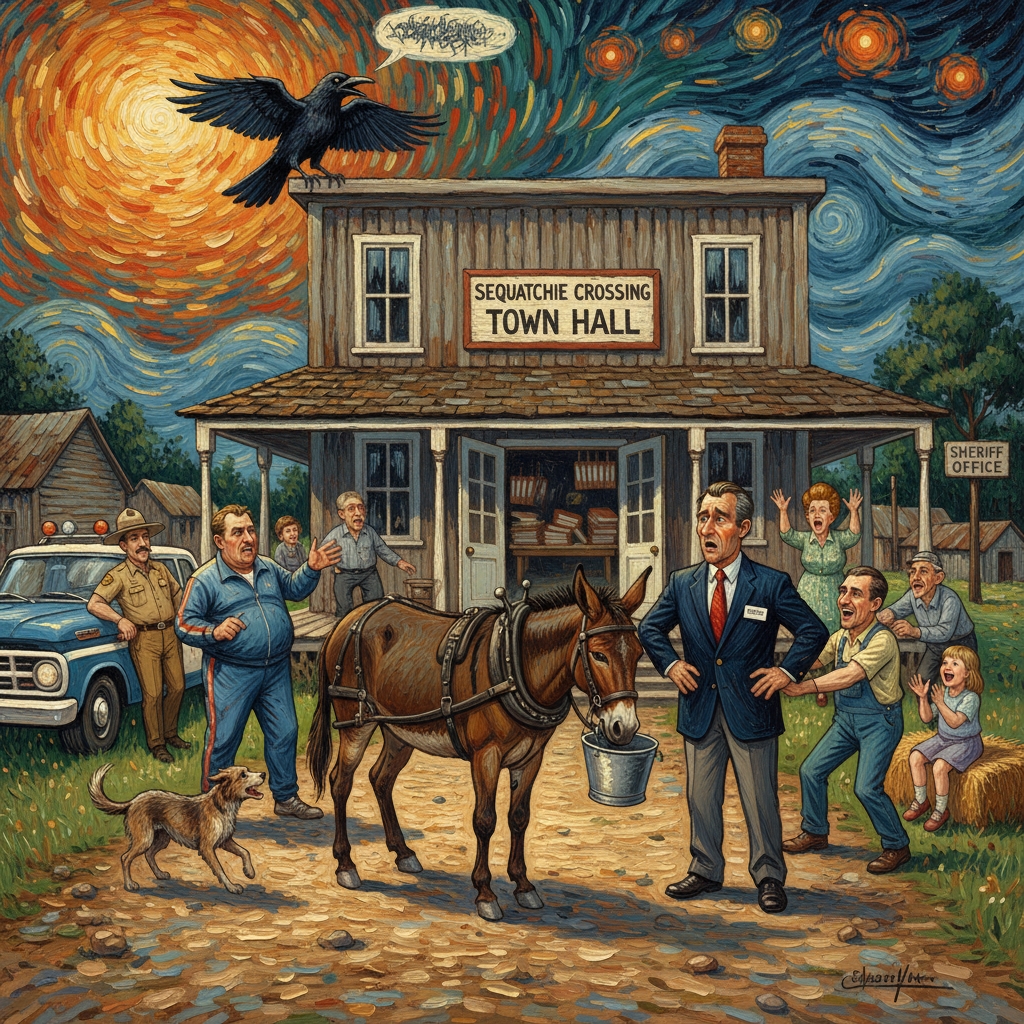
Act VII – The Town Hall Drafting Session
Lurleen whispered to Maggie Sue, “When Wade says reasonable, it means somebody accidentally stepped on the law and it didn’t squeal.”
Maggie Sue wrote that down for later.
Sonny Morales leaned forward. “Road damage. If heavy trucks tear it up, who fixes it and how fast?”
Officer Kenny Joe wrote ROAD BOND on the board.
Tiffany raised her phone. “People online want to know about water.”
Doug answered, “Water usage should be reported in ranges until exact numbers are public, with source, capacity, and drought conditions.”
Dr. Neil Cowgill said, “And energy demand should be contextualized against current grid capacity, peak load, backup generation, and transmission constraints.”
Evelyn looked at him. “Neil, that one can stay. It had nouns.”
Chester Ray Blevins sat with a sample flyer. “I can print a one-page explainer. Big headings. No QR code unless you want Clovis to set something on fire.”
Clovis bristled. “I oppose mandatory QR dependence, not voluntary QR existence.”
Boot grinned. “Put that on your tombstone.”
Pastor Peeler folded his hands. “Rule next: plain-language explanation of every redaction.”
Sister Lila Mae added, “And a promise that public meetings will not be scheduled during supper unless absolutely necessary.”
Mayor Crowe wrote FOOD RESPECT.
RT Mullins raised his hand. “Can we add that animals are not valid sources unless confirmed by humans?”
The crow, outside the window, cawed.
Daisy barked.
Jeremiah the mule, visible in the street through the glass, stood in a parking space marked VISITOR and refused to acknowledge municipal authority.
Sheriff Peeler said, “Rule whatever number: animals may reveal human behavior but not contractual terms.”
Trixie Jo looked up. “That is the best sentence this town has produced in years.”
Mabel tapped the table. “I still don’t trust the project.”
Doug nodded. “You don’t have to. The point is to create a process that can survive distrust.”
Mayor Crowe paused, marker in hand.
“That,” she said, “may be the most useful thing anyone has said.”
Clovis looked disappointed. “I said the crow was assembling the truth.”
“Yes,” Evelyn said. “And Doug said something useful.”
By noon, the whiteboard was full. Nothing had been solved. No one had fully switched sides. But the folder was no longer the only object in the room.
Now there was a draft.
In Sequatchie Crossing, that counted as infrastructure.
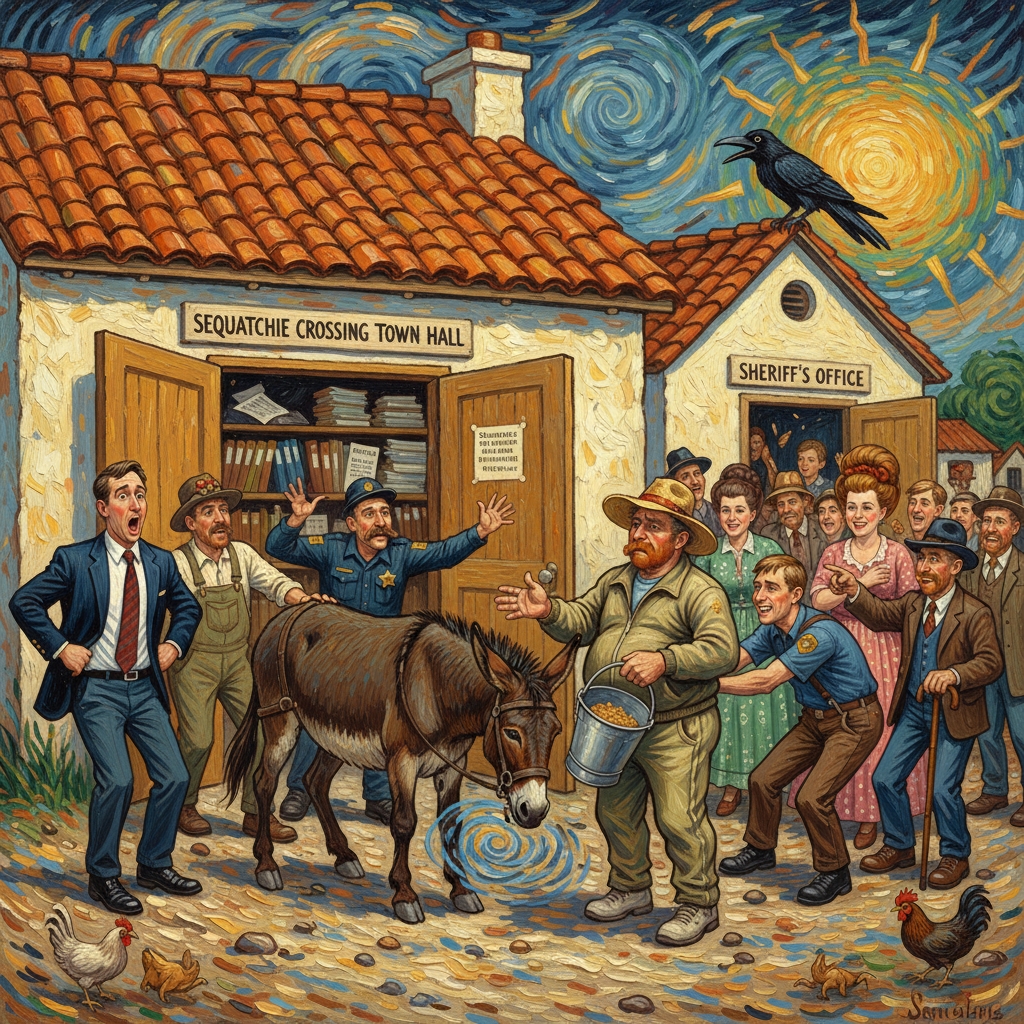
Act VII – The Town Hall Drafting Session
Act VIII – The Company Comes To Supper
Mayor Crowe invited representatives from the unnamed data center company to Evelyn’s Diner for what she described as an informal listening session.
The company sent two fictional people: Maris Bell, director of community development, and Glen Rusk, infrastructure liaison. They arrived in polished shoes, careful smiles, and a rental SUV that immediately drew more suspicion than if they had come by helicopter.
Evelyn met them at the door. “You eating?”
Maris blinked. “We can.”
“Good. Folks trust hungry people more than presenters.”
Glen looked around at the packed diner. “This is more people than we expected.”
Boot said from the counter, “That’s because you’re not presenting. You’re being digested.”
Maris sat at the center table with Mayor Crowe, Wade, Sheriff Peeler, Mabel, Doug, Shelley, Trixie Jo, and Earl. The rest of the town arranged itself nearby in listening formations.
Maris began. “We understand there are concerns.”
Mabel said, “That sentence is where outsiders start when they hope locals are tired.”
Maris paused. Then she nodded. “Fair.”
That helped.
Glen opened a folder. It had no black bars, which people appreciated, although Clovis checked under the table in case the redactions were hiding elsewhere.
Doug asked, “What can you say about power demand?”
Glen answered carefully. “We are studying multiple configurations. Any final demand profile would depend on phased buildout. We would coordinate with utility providers, and upgrades would be required before full operation.”
Dr. Neil Cowgill raised his hand. “Will waste heat recovery be considered?”
Glen looked surprised. “It could be.”
Neil smiled like a man whose footnote had been invited to dinner.
Alyssa asked, “What about water?”
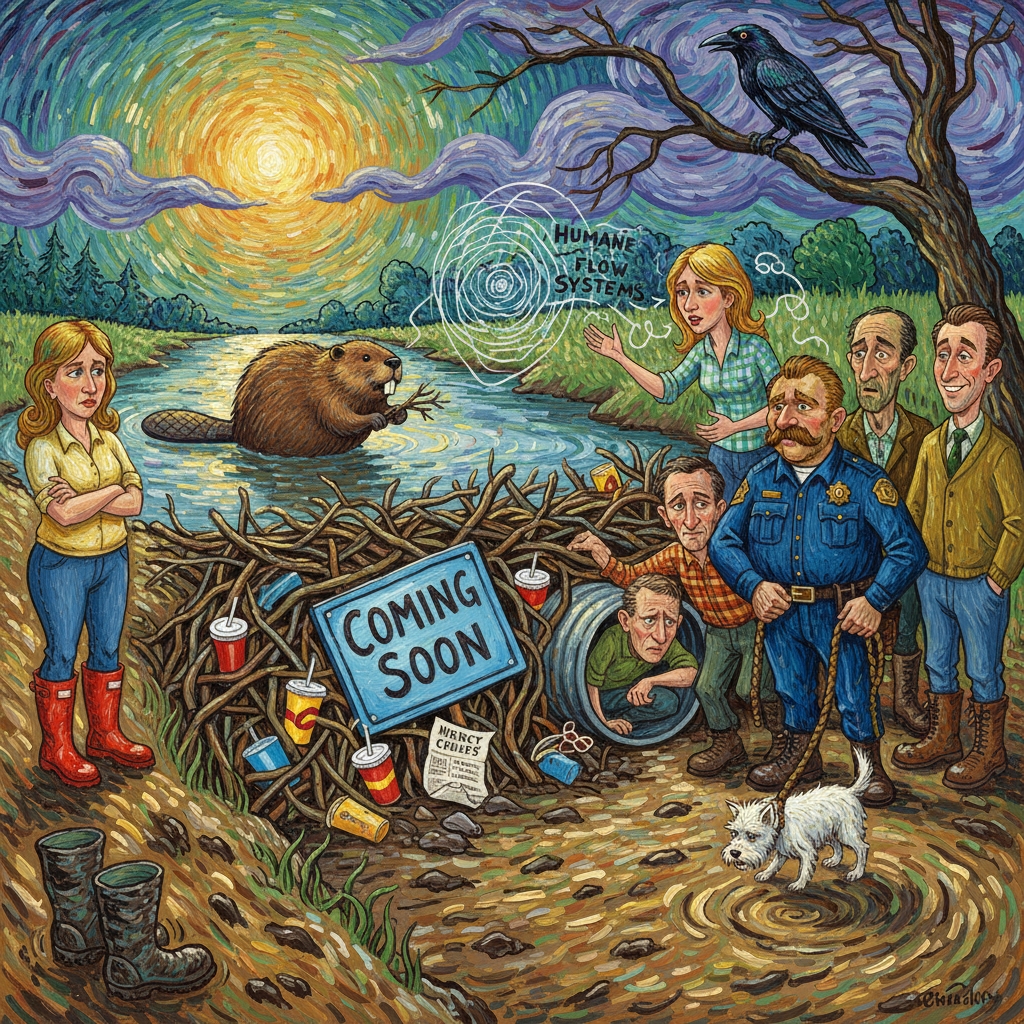
Act VIII – The Company Comes To Supper
Maris answered, “We are evaluating cooling technologies, including options that reduce water use. We cannot provide exact figures yet, but we can provide ranges once engineering progresses.”
Mabel leaned forward. “Why should we believe ranges after pages were blacked out?”
Maris looked at Mayor Crowe, then back at Mabel. “Because you should require them in writing, with updates.”
Earl Womack chuckled. “She’s not wrong.”
Coach Freddie asked, “Permanent jobs?”
Maris said, “Data centers do not employ thousands permanently. Construction can involve significant temporary labor. Operations teams are smaller but skilled. We should be precise about that.”
The diner absorbed the shock of a company representative not exaggerating.
Evelyn called from the counter, “Somebody write down that the lady admitted arithmetic.”
Trixie Jo already had.
Sonny asked, “Local contractors?”
Glen said, “Possible for site work, maintenance, security, food service, landscaping, and some trades, depending on qualifications.”
RT said, “That means maybe.”
“Yes,” Glen said. “It means maybe.”
RT nodded. “I respect a clean maybe.”
Clovis stood, holding a crow scrap. “Did you or did you not promise the town a favor?”
Maris looked confused.
Chester Ray snatched the scrap. “That is from a wedding invitation proof. ‘Favor of your reply.’”
The crow landed outside the diner window and stared in.
Daisy, lying beneath Sheriff Peeler’s chair, growled lightly.
Pastor Peeler spoke gently. “People here are not only asking what you will build. They are asking what kind of relationship you expect to have with a place that already belongs to itself.”
Maris looked around the diner, past the binders, coffee cups, skeptical faces, hopeful faces, and the crow with stolen stationery.
“That is a fair question,” she said. “If the project moves forward, we need a public process that makes room for skepticism. If it does not move forward, we still need to leave the town with better information than rumors.”
Mabel examined her. “You practiced that?”
“Yes,” Maris said. “But I also mean it.”
Evelyn brought two plates of meatloaf to the company table. “Good. Around here, meaning it comes with sides.”
Glen tasted the mashed potatoes. “These are excellent.”
“They are not redacted,” Evelyn said.
By the end of supper, nobody had been converted. Mabel remained suspicious. Doug remained cautiously supportive. Earl remained historically bruised. Boot remained practical. Clovis remained interested in the crow as a decentralized records system.
But the company had answered some questions plainly.
That did not end the drama.
It made the drama better informed.
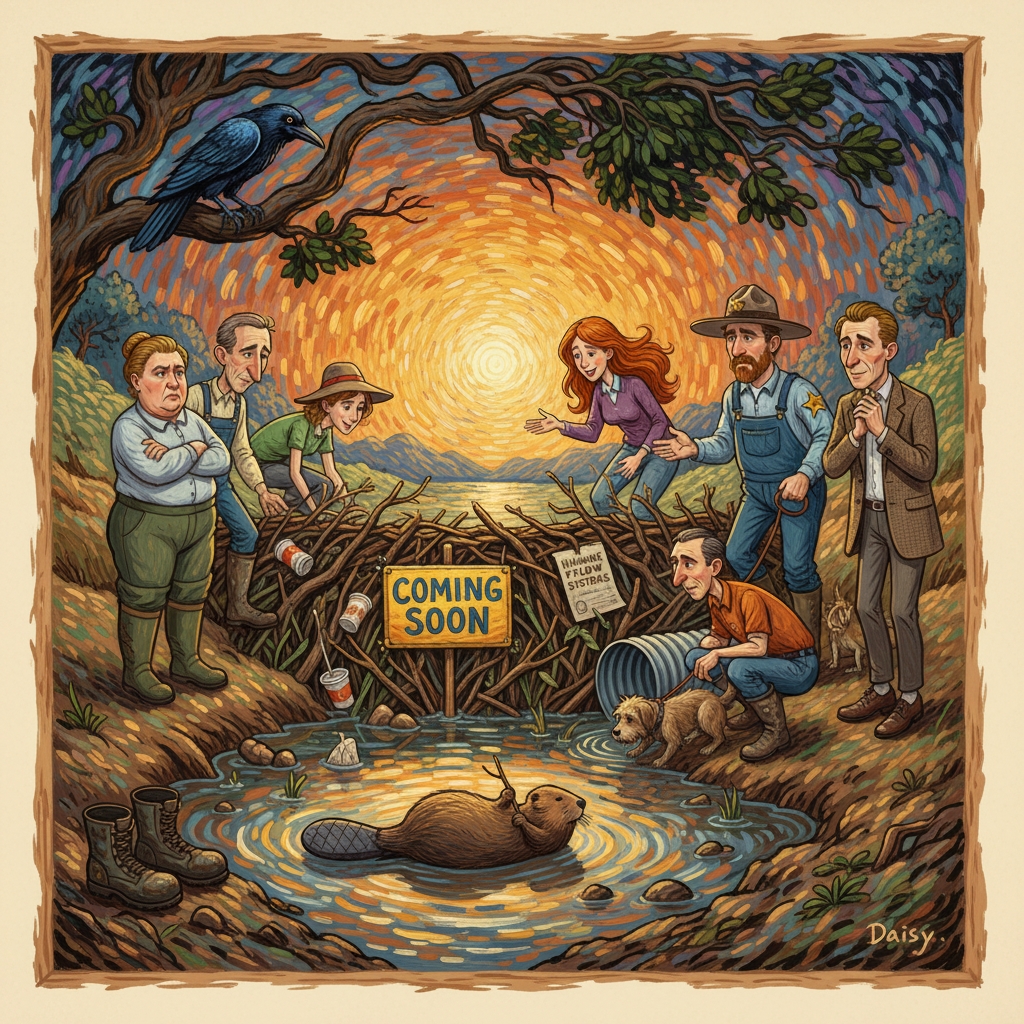
Act VIII – The Company Comes To Supper
Act IX – The Vote That Wasn’t A Vote
Three days later, Town Hall filled again for a meeting Mayor Crowe insisted was “not a vote on the data center.”
Naturally, everyone called it the vote.
The agenda item read: Consideration of Economic Development Transparency Framework.
Chester Ray had printed copies on bright yellow paper so nobody could claim they were hidden unless they shut their eyes on purpose.
Mayor Crowe called the meeting to order. “We are not approving or rejecting the project tonight. We are deciding whether to adopt a process for future negotiations.”
Mabel sat in front with her copy marked in red pen. “Process is how decisions sneak in wearing slippers.”
Boot leaned over. “Sometimes process is how decisions stop falling down the stairs.”
Trixie Jo sat beside Tiffany, who was tracking public comments online.
Tiffany whispered, “The livestream wants to know if the crow gets a vote.”
Trixie whispered back, “Only if it lives inside town limits.”
Sheriff Peeler stood near the door, with Officer Kenny Joe and Daisy beside him. Daisy had been given a bandana that said CIVIC OBSERVER.
Wade Langston summarized the framework. “The town would disclose the general subject of negotiations, publish categories of issues under discussion, provide plain-language explanations for redactions, schedule public forums before binding approval, require impact reporting, and specify when withheld information becomes public.”
Dr. Neil Cowgill raised his hand. “I propose adding interpretive summaries.”
Evelyn said, “Plain English summaries.”
Neil bowed slightly. “Plain English interpretive summaries.”
Coach Freddie said, “Close enough.”
Shelley Fawn Wexler proposed adding a public dashboard. Doug seconded it. Clovis objected unless the dashboard also had printed copies.
Chester Ray said, “I can print copies.”
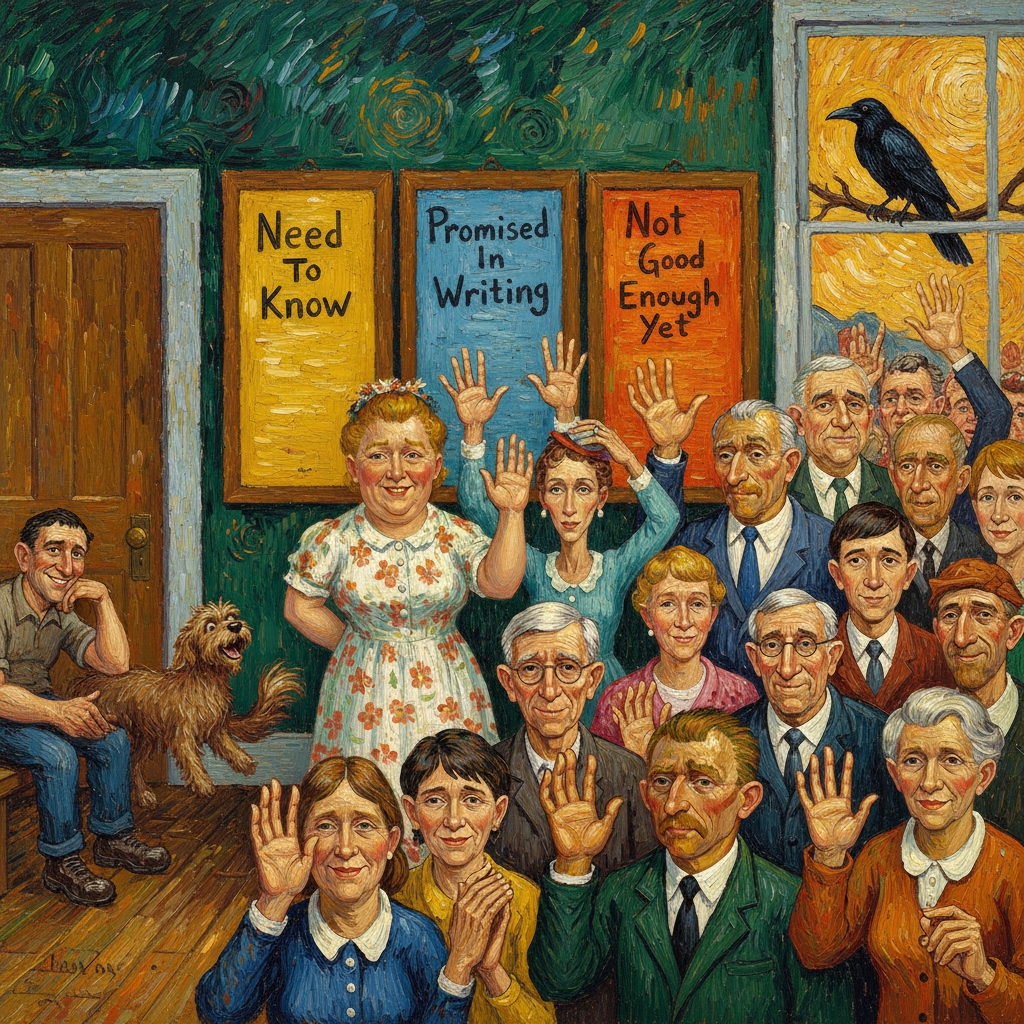
Act IX – The Vote That Wasn’t A Vote
Clovis said, “Then I withdraw my objection while reserving suspicion.”
Sister Lila Mae proposed that meetings include prayer or “at minimum a moment where everybody remembers they are mortal before speaking.” Pastor Peeler suggested a neutral reflection instead. Mabel said mortality was neutral enough for her.
RT Mullins proposed that all economic promises be labeled as guaranteed, projected, hoped-for, or somebody’s cousin said. This was amended to guaranteed, projected, estimated, and unverified.
Earl Womack proposed an annual review of promises made versus promises kept.
Sonny proposed road protections.
Alyssa proposed health and environmental monitoring.
Brett proposed workforce preparation.
Maggie Sue proposed that public documents include a glossary.
Lurleen proposed that the glossary define “proprietary,” “abatement,” and “stakeholder,” because she was tired of being in conversations where English wore a fake mustache.
Kenny Joe wrote each amendment on the board while Daisy slept through several procedural motions, which many considered wise.
Then the crow arrived.
It flew through the open side window, circled Town Hall once, and dropped a piece of paper directly onto the redacted folder.
The room gasped.
Sheriff Peeler covered his face.
Clovis rose slowly, trembling with vindication.
Boot picked up the scrap and read it aloud.
It said: OPEN.
The room erupted again.
Chester Ray stood. “That is from my sign sample. Open house. Open mic. Open Sundays by appointment. That bird is not a whistleblower. It is a vandal with wings.”
Mayor Crowe took the scrap from Boot and looked at it for a long moment.
“Still,” she said, “it’s not a bad word.”
Mabel’s mouth twitched. “Don’t you dare give that crow credit.”
“I’m giving the word credit,” Mayor Crowe said.
The vote on the framework passed, though not unanimously. Mabel voted yes “under protest.” Clovis voted yes “pending further avian disclosures,” though he technically did not have a vote. Coach Freddie approved “as long as projected jobs don’t get to wear varsity jackets.” Doug approved. Shelley cried a little but denied it. Earl said he would believe the framework when it survived its first temptation.
Mayor Crowe closed the meeting. “This does not decide the data center. It decides how we talk about it.”
Pastor Peeler stood. “That may be the larger decision.”
Daisy woke and barked once.
The crow cawed from the window.
Jeremiah the mule, outside in the street, finally moved just enough to block the other lane.
Sheriff Peeler sighed. “Democracy remains partially obstructed.”
And Sequatchie Crossing, having solved nothing completely, felt strangely accomplished.
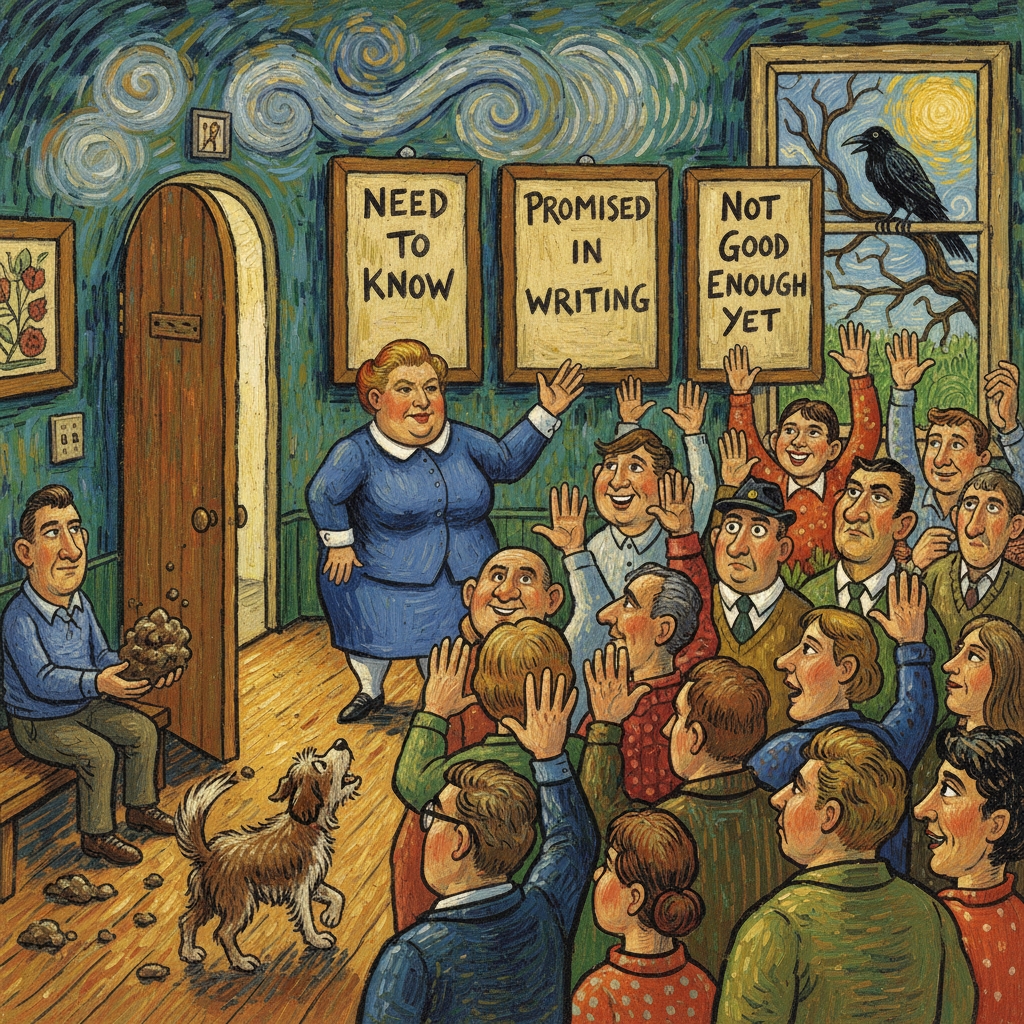
Act IX – The Vote That Wasn’t A Vote
Epilogue – What The Folder Taught
A week later, the redacted folder sat in a glass display case at Blevins Print & Copy beside a sign Chester Ray had printed in bold letters:
PLEASE DO NOT FEED OFFICIAL DOCUMENTS TO BIRDS.
Nobody knew whether the data center would ultimately come to Sequatchie Crossing. The negotiations continued, now under the new transparency framework, which meant the town received weekly updates containing enough information to reduce panic but not enough to eliminate argument.
Mabel Dean Ashcroft still believed the town needed to watch every comma.
Doug “Doughboy” Teeter still believed the project could be useful if shaped by strict requirements.
Earl Womack still distrusted promises until they had calluses.
Boot Barnes still said the best agreements were the ones ordinary people could explain while holding a cup of coffee.
Mayor Bea Crowe still had to balance opportunity against suspicion, growth against memory, and legal caution against the spiritual danger of looking sneaky.
Sheriff Peeler still refused to classify crow scraps as evidence.
Officer Kenny Joe Teeter quietly kept the “avian-adjacent materials” file in his desk, not because it was official, but because history sometimes arrived without proper formatting.
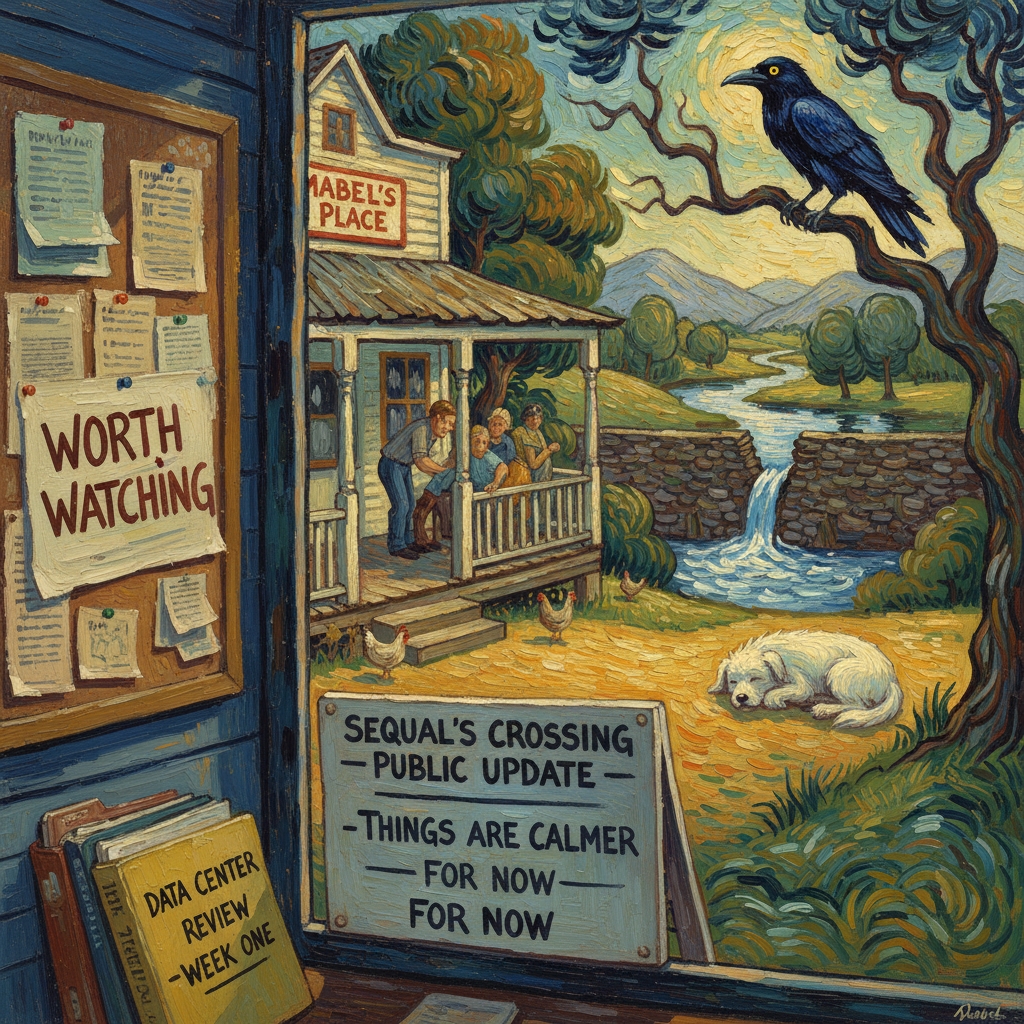
Trixie Jo Bartlett wrote a Dispatch piece that did not accuse anyone of corruption, which disappointed several readers, but it did explain redactions, incentives, water concerns, road bonds, power upgrades, job categories, public records law, and the difference between a secret and a negotiation.
Tiffany Annette Roark turned the glossary into a social media carousel. It received more shares than the mayor’s original statement because it included the phrase “abatement means discount, not magic.”
Epilogue – What The Folder Taught
Evelyn Grace Tipton added a special to the diner menu called The Redacted Plate. It came with meatloaf, mashed potatoes, and one covered side dish the customer could uncover only after ordering.
Clovis Strickland ordered it three times and claimed the hidden side was “symbolically significant.”
Daisy preferred it when the hidden side was macaroni.
The crow continued visiting Chester Ray’s dumpster, though Chester installed a lid with a latch and a note reading: ALL SCRAPS ARE FICTIONAL UNLESS SIGNED.
The crow ignored the note, as crows and citizens sometimes do.
And the town learned, not for the first time, that missing information has weight. Sometimes it protects a community. Sometimes it protects the powerful. Sometimes it protects nothing at all and merely invites imagination to put on a hat and start knocking on doors.
Sequatchie Crossing did not become perfectly transparent.
No town does.
But it became harder to hide behind confusion, harder to sell fog as strategy, and harder for a crow with stolen stationery to become the most trusted public records officer in the valley.
That was not victory.
It was maintenance.
And in a small town, maintenance is often what keeps the roof from becoming a sermon.
Epilogue – What The Folder Taught
Disclaimer – Fictional Small-Town Satire
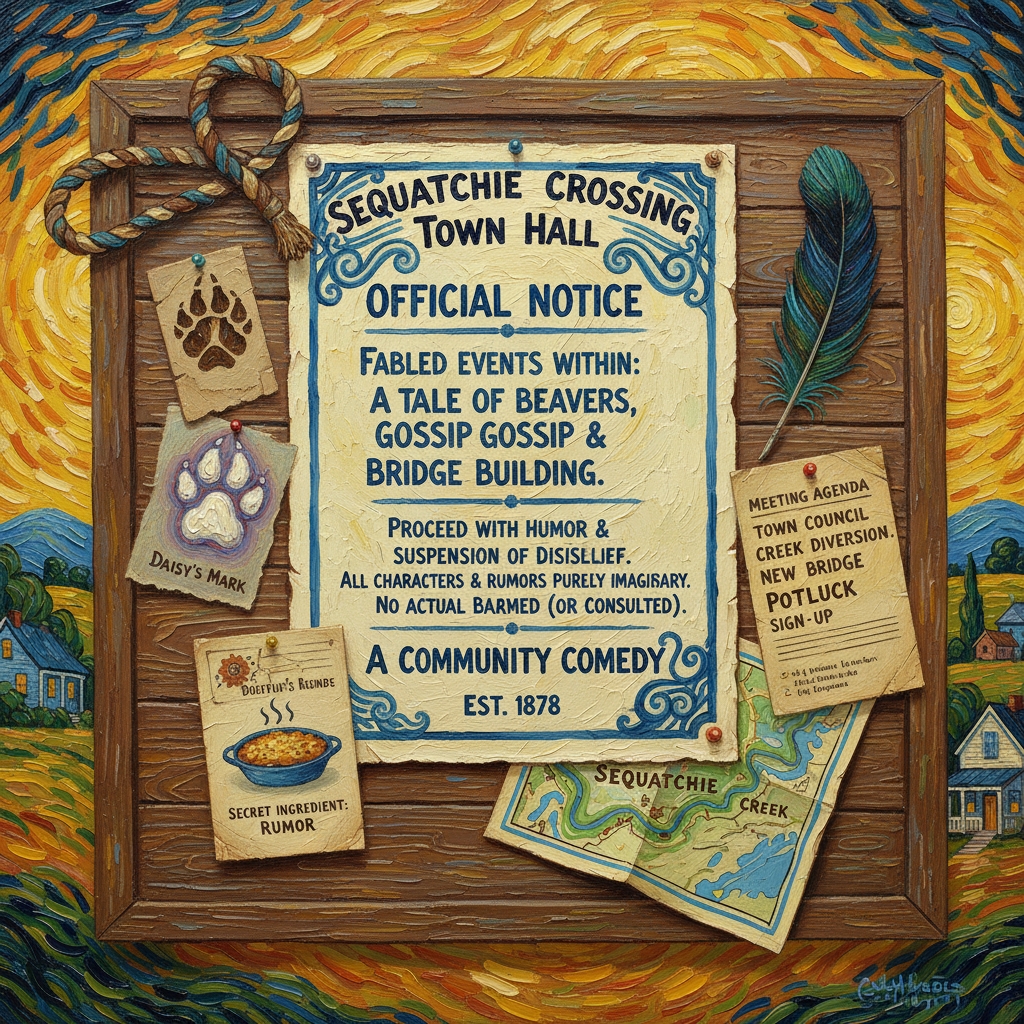
This story is a fictional work of satire set in the imaginary town of Sequatchie Crossing. All characters, businesses, public officials, organizations, negotiations, events, animals, documents, redactions, folders, crows, mules, hounds, committees, diners, church basements, and municipal misunderstandings are fictional.
No real residents, public officials, companies, government bodies, or private negotiations in Dunlap, Sequatchie County, or any other real community are depicted or implied. Any resemblance to real people, real projects, real documents, real data centers, real town meetings, real folders, or real crows with suspiciously strong narrative instincts is purely coincidental.
The purpose of this story is to entertain readers while gently exploring public transparency, economic development, civic trust, rumor, negotiation, and the strange ability of missing information to become more dramatic than the information that is actually available.
Disclaimer – Fictional Small-Town Satire
Real Places Behind the Ruckus – From The Dunlap Directory
Real Places Behind the Ruckus – From The Dunlap Directory
Yes, this story was fictional; even the parts that weren’t true. These places? Absolutely real. Stop by, support local, and keep the Wi-Fi away from livestock:
- Cartwright Church of God
- Dog Whisperette
- O’Reilly Auto Parts
- Signal Electric
- Crumb & Co.
- UT Performance
- Martins Mold Remediation
- Edward Jones – Financial Advisor: Tom Vennero
- Fredonia Mountain Community Center
- Freedom Auto Glass LLC
- Uplift Fitness Dunlap
- Crossroads Baptist Church
- Coldwell Banker Pryor Realty Inc.
- StorageSmith
- Cumberland Mountain State Park
- Animal Sitting by Chloe Holloway
- Ed’s Lawn Care
- Unlocking Potential Educational Services
- Winchel’s Homestead Wonders
- Cumberland Mountain Church-God

Real Places Behind the Ruckus – From The Dunlap Directory
At Sequatchie Crossing, we tell the stories of Sequatchie Crossing.
Please share this post with your friends, family, or business associates who may want follow the news from Sequatchie Crossing.

0 Comments