


People Feared the Answers More Than the Questions
By Tom Seest
At Sequatchie Crossing, we tell the stories of Sequatchie Crossing.
Please share this post with your friends, family, or business associates who may want follow the news from Sequatchie Crossing.
🎤 Audio Overview
The Computer That Knew Too Much
Act I – The Crow On The Courthouse Rail
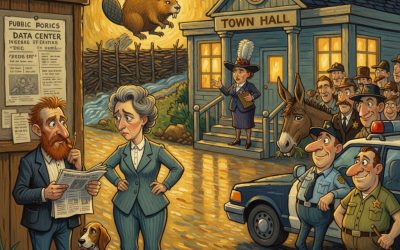
The first sign that Sequatchie Crossing had entered the age of artificial intelligence was not a robot, a drone, or a glowing machine in a glass building.
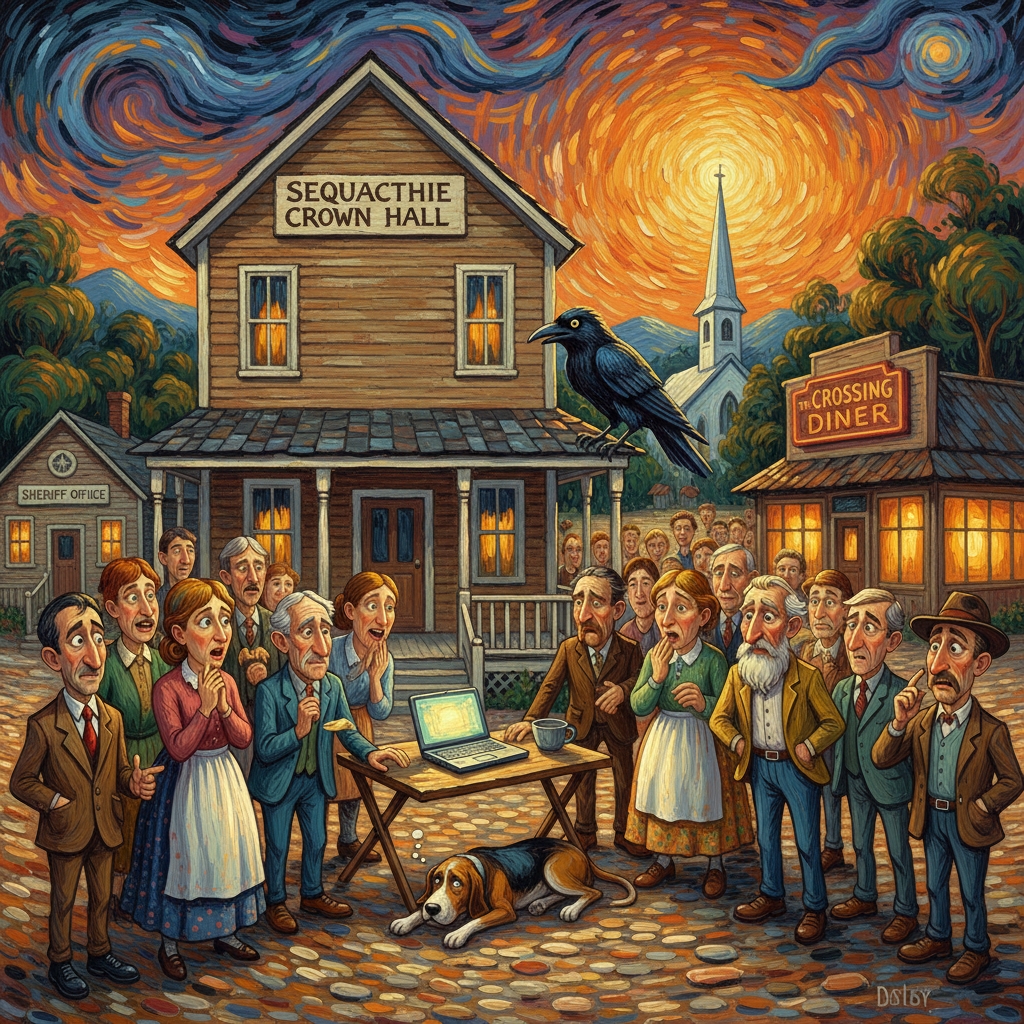
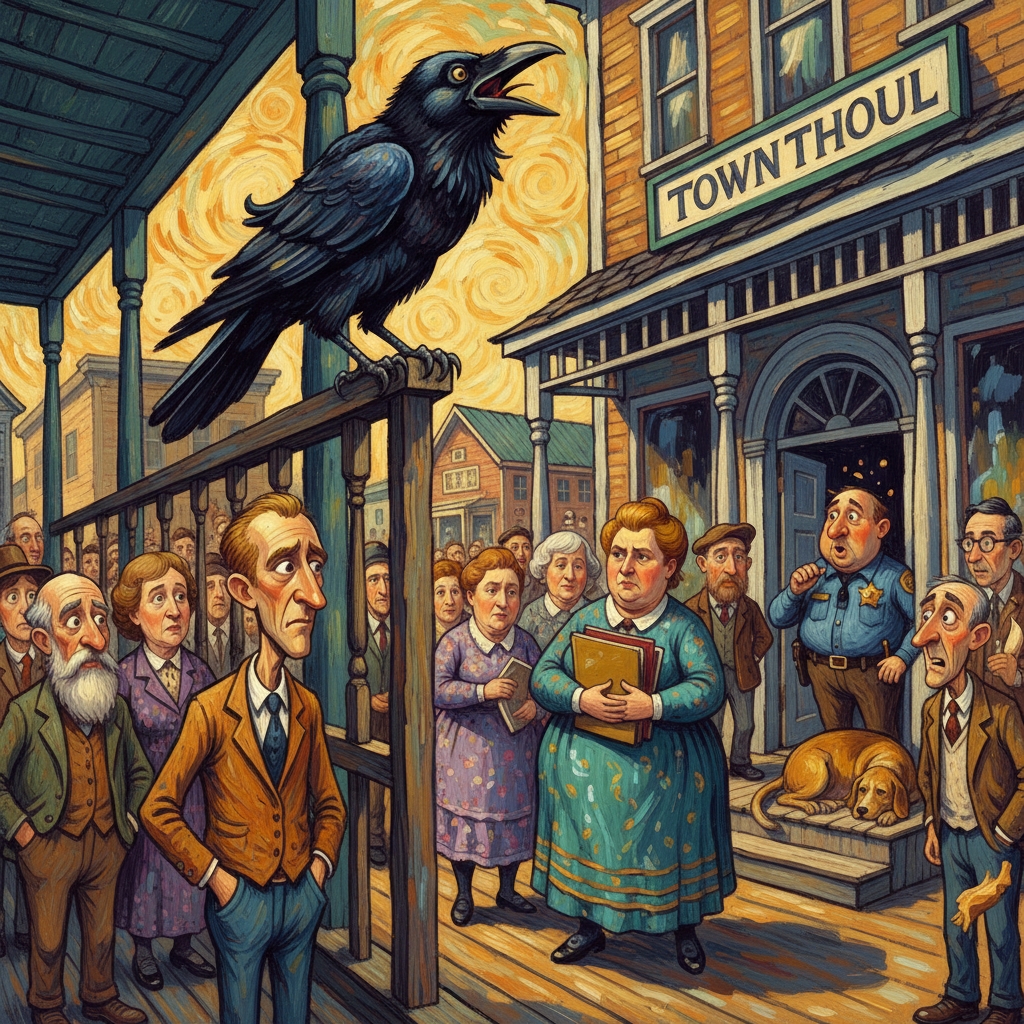
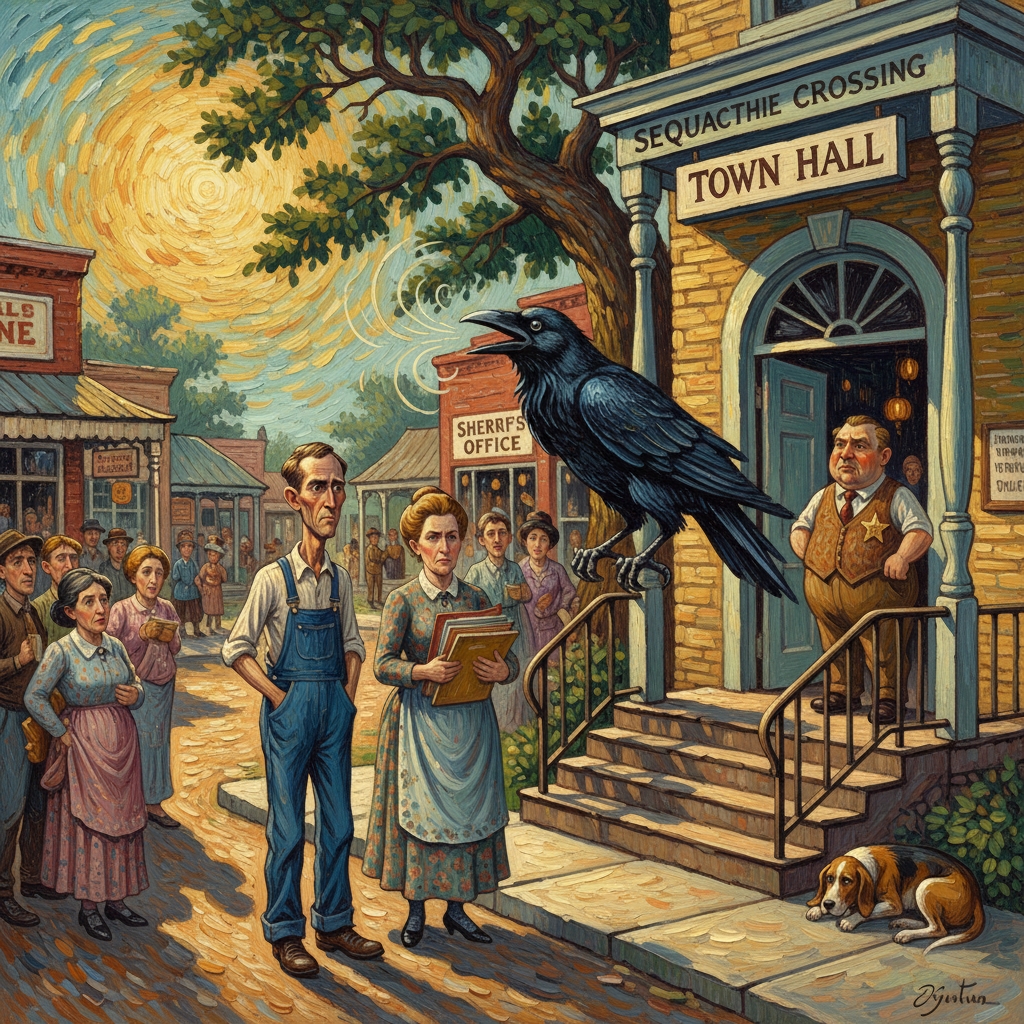
It was a crow sitting on the courthouse rail outside Town Hall, hollering what sounded like, “It knows! It knows!”
Eugene “Boot” Barnes stood beneath it with his hands in his pockets, looking up like a man who had spent seventy-three years being disappointed by both birds and government.
“That crow does not know anything,” Boot said.
The crow cocked its head.
“It knows!” it cried.
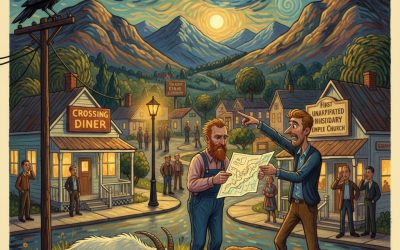
Across the sidewalk, Clovis Strickland froze in mid-step. He had one hand wrapped around a paper sack from The Crossing Diner and the other around a spiral notebook labeled POSSIBLE MACHINE OMENS.
“I heard it,” Clovis said. “Plain as Sunday guilt.”
Mabel Dean Ashcroft came down the Town Hall steps carrying three folders, a church bulletin, and a suspicion she had been feeding since breakfast.
“Birds repeat what they hear,” she said. “Which means somebody in this town has already told that crow more than they told the people.”
Sheriff Peeler opened the Town Hall door behind her and looked out.
“Before everybody assigns criminal intent to a bird,” he said, “let us recall that Daisy once barked at a mailbox for forty minutes because it contained a seed catalog.”
Daisy the hound, tied loosely to the porch post beside the sheriff’s office, raised her head at the sound of her name and gave one slow, resentful bark.
“She was right to bark,” said Sister Lila Mae “Hallelujah” Pruitt, who had been sitting on the bench outside Town Hall with her pocketbook on her knees. “That seed catalog promised giant tomatoes and delivered spiritual disappointment.”
Act I – The Crow On The Courthouse Rail
Trixie Jo Bartlett pushed through the Town Hall door with a poster board tucked under her arm.
“Meeting starts in ten minutes,” she said. “Mayor Crowe is not here today, so the Technology Concerns Committee is being chaired by whoever can keep the folding chairs from becoming weapons.”
“That won’t be me,” said Ricky Travis “RT” Mullins, stepping off the curb with a cup of coffee. “I’ve seen Mabel fold a chair with her eyes.”
Mabel gave him a look.
“I have folded worse than chairs, RT.”
A minivan pulled up, and Tiffany Annette Roark got out holding a microphone, a notebook, and the expression of someone who knew that a town meeting about artificial intelligence could become either a public service or a pie fight with vocabulary.
“Is the crow part of the story?” Tiffany asked.
“It inserted itself,” said Boot.
“Like most experts,” said Chester Ray Blevins, arriving from his print shop with a stack of handbills that read: ASK QUESTIONS BEFORE THE QUESTIONS ASK YOU.
Doug “Doughboy” Teeter came from the opposite direction carrying a laptop and a portable speaker. Officer Kenny Joe Teeter walked beside him, looking like a man who had agreed to escort technology but did not fully trust it.
“This computer demonstration is harmless,” Doug said.
“That’s what you said before the drone identified Coach Freddie’s lawn mower as a hostile aircraft,” Officer Kenny Joe said.
Coach Freddie Stubblefield stepped out of The Crossing Diner with Maggie Sue Dillard, Lurleen Davenport, and Evelyn Grace Tipton trailing behind him.
“That mower had a competitive posture,” Coach Freddie said.
Pastor Arnold Peeler crossed from the church sidewalk, his Bible tucked under one arm.
“Let’s all go inside,” he said. “Fear grows best in parking lots.”
The crow flapped once.
“It knows!”
Dr. Neil Cowgill, who had been examining the bird from a safe academic distance, nodded slowly.
“Strictly speaking,” he said, “the bird’s utterance is neither evidence nor non-evidence. It is a social accelerant.”
Mister Wade Langston, sitting on the Town Hall porch with a cane across his knees, sighed.
“Neil, sometimes you talk like a dictionary that got raised by a weather radio.”
Brett and Alyssa Crenshaw hurried up from their smoothie trailer, each carrying a green drink the color of pond water with ambition.
“Technology can be good,” Alyssa said. “It can help small towns.”
“It can also help small towns lose their minds faster,” Brett added.
Sonny Morales parked his work truck near the sheriff’s office and joined them.
“I came because somebody said the computer was going to decide permits, water usage, school lunches, property values, sermons, and who gets invited to fish fries.”
“That somebody,” Sheriff Peeler said, looking at the crow, “may have wings.”
The crow hopped sideways.
“Fish fries!”
Everyone looked at it.
Mabel narrowed her eyes.
“That bird has been outside the diner.”
Boot pointed toward the Town Hall door.
“Inside. Before the crow gets elected.”
And because this was Sequatchie Crossing, where even panic respected a posted start time, the whole town filed in.
Act I – The Crow On The Courthouse Rail
Act II – The Demonstration Nobody Asked For But Everybody Attended
Town Hall smelled of old varnish, coffee, paper dust, and civic uncertainty.
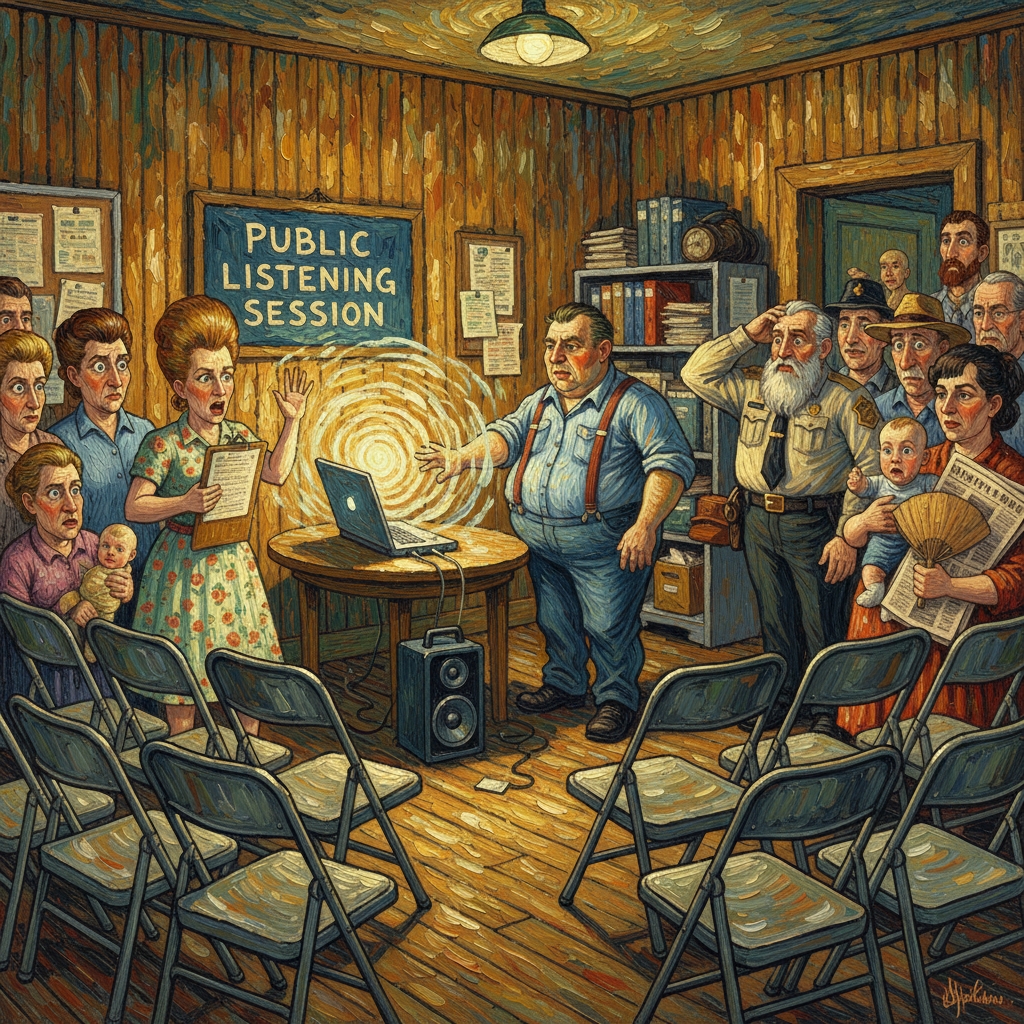
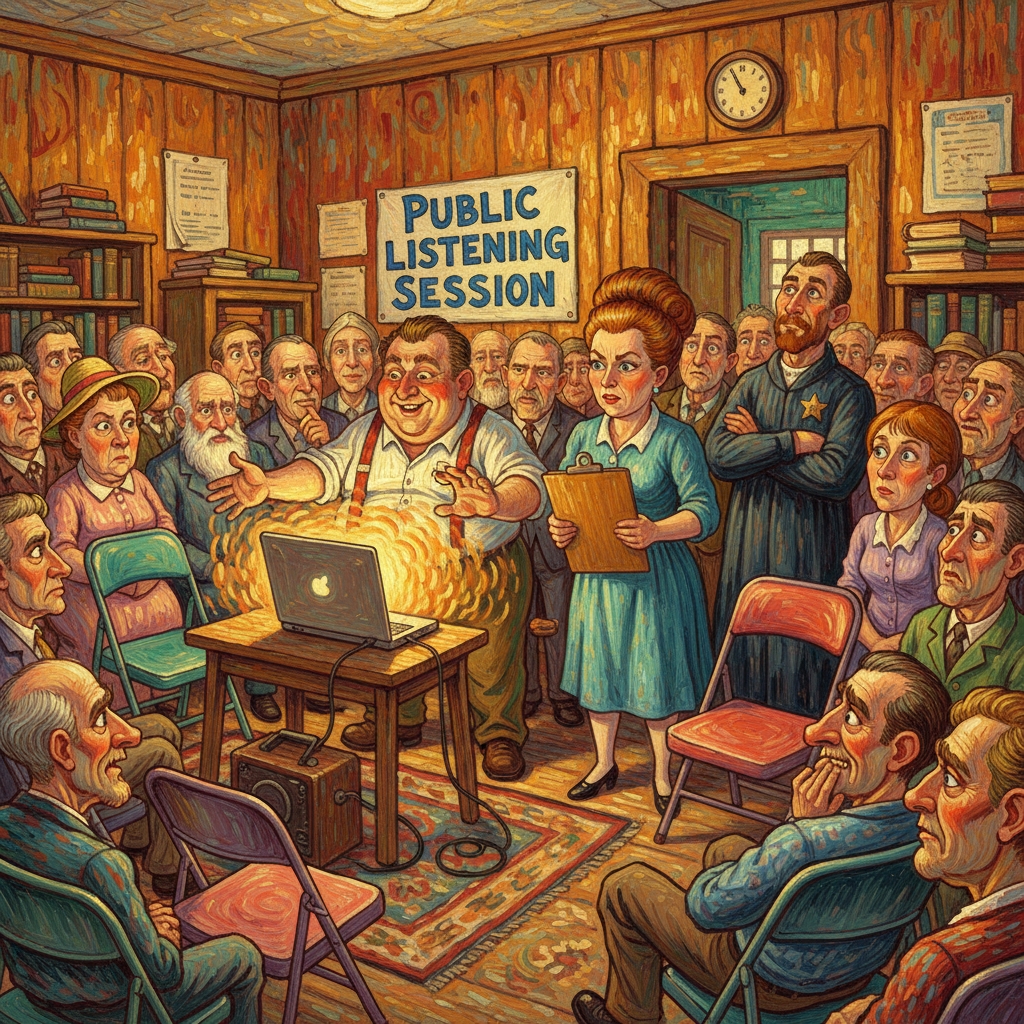
Trixie Jo stood near the front beside a folding table where Doug had placed his laptop. Chester Ray had taped a paper sign to the wall that read PUBLIC LISTENING SESSION in letters so large they looked like they might listen back.
“Thank you all for coming,” Trixie Jo said. “Tonight’s purpose is to discuss the proposed municipal information assistant.”
“Call it what it is,” Clovis said from the second row. “A thinking machine with access to everything except a conscience.”
Doug held up both palms.
“It does not have access to everything. It would answer basic public questions using approved town documents. Trash schedules. Meeting minutes. Permit instructions. Ordinances.”
“Ordinances are how tyranny learns cursive,” Chester Ray said.
“That sentence is why we still print paper forms,” Trixie Jo replied.
Tiffany raised her microphone.
“For clarity, is this artificial intelligence going to make official decisions?”
“No,” said Sheriff Peeler.
“No,” said Trixie Jo.
“No,” said Doug.
“It depends what you mean by decision,” said Dr. Cowgill.
Act II – The Demonstration Nobody Asked For But Everybody Attended
Everyone turned toward him.
Neil adjusted his glasses.
“A machine that suggests information can shape human behavior, even without authority. A road sign does not drive your truck, but it changes where your truck goes.”
Mister Wade tapped his cane.
“That was almost understandable. Keep going like that.”
Pastor Arnold stood near the aisle.
“The question before us may not be whether the tool is wicked or wonderful. The question may be whether we are wise enough not to worship it or burn it.”
Mabel raised her hand without waiting to be recognized.
“I want to know who feeds it.”
Doug blinked.
“It isn’t livestock.”
“Everything is livestock if it eats from somebody’s bucket,” Mabel said. “Who feeds it information?”
Trixie Jo nodded.
“That is a fair question. It would only use approved public documents.”
Clovis leaned forward.
“And who approves the documents? The same people who once listed the Christmas parade under stormwater drainage?”
Officer Kenny Joe winced.
“That was a filing error.”
“It put three tractors behind the wastewater report,” Coach Freddie said. “For six months.”
Maggie Sue Dillard raised her hand.
“I run a lunch counter. If a customer asks me what’s in the meatloaf, I can answer. If this computer answers wrong, who apologizes?”
“Good,” Tiffany said, scribbling. “Accountability.”
Lurleen Davenport lifted a folder.
“I volunteer at the church pantry. Half the people who need help already get confused by forms. Could this thing simplify instructions?”
“It could,” said Doug. “That’s one of the benefits.”
Evelyn Grace Tipton, sitting beside her, nodded. “If it can explain government plain, I’ll listen.”
“That alone would be a miracle,” Sister Lila Mae said. “But miracles require witnesses.”
Brett stood.
“Our business could use tools like this. If someone asks where to find local services, it can point people in the right direction.”
Alyssa added, “Small towns either learn to use new tools or get used by people who do.”
Mabel frowned.
“That sounds like something written on a mug sold by consultants.”
Sonny Morales raised one hand.
“I fix things for people. Pumps, steps, porches, wiring that looks like spaghetti after a tornado. A tool is useful when you know where it stops. A saw is good until somebody uses it for soup.”
Boot smiled.
“That is going on a plaque.”
Doug connected the speaker. His laptop chimed.
“I’ll demonstrate. We loaded sample town documents into a test version.”
The room stiffened as if Doug had opened a cage.
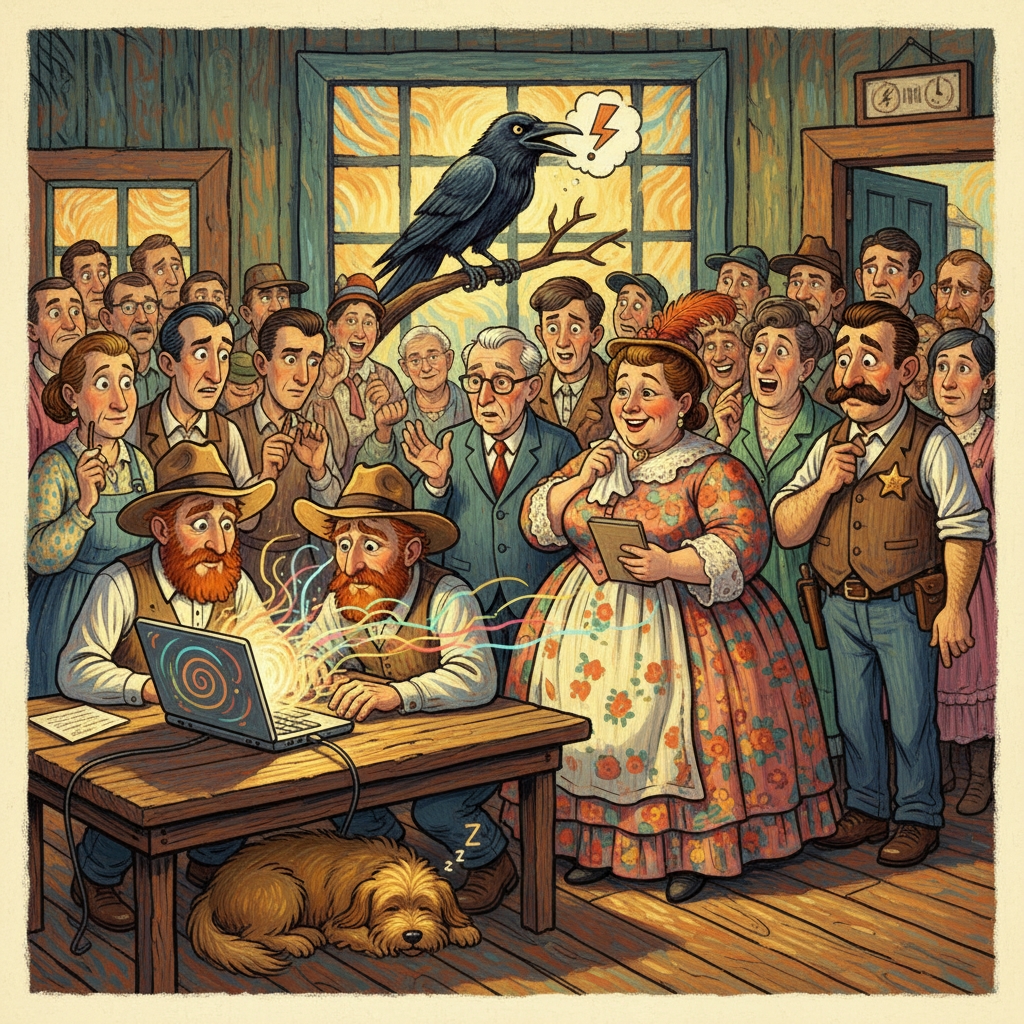
He typed: When is large-item trash pickup?
A pleasant robotic voice answered, “Large-item trash pickup occurs on the second Thursday of each month. Items should be placed at the curb no earlier than twenty-four hours before collection.”
“That’s correct,” Trixie Jo said.
The room relaxed by half an inch.
Then the crow outside the open window cried, “It knows!”
Daisy barked from the sheriff’s office porch.
The room tightened again.
Sheriff Peeler closed the window.
“Proceed,” he said.
Doug typed another question: Who do I contact about a building permit?
The computer answered correctly.
Maggie Sue whispered, “That’s better than calling three cousins.”
Chester Ray stood.
“Ask it something human.”
Doug looked wary.
“Like what?”
Chester Ray smiled.
“Ask it why people are afraid of it.”
A hush settled.
Doug typed.
The computer paused.
Then it said, “People may fear artificial intelligence because they worry about loss of control, loss of work, loss of privacy, inaccurate information, unfair decisions, social manipulation, dependency, and not understanding how systems reach conclusions.”
Nobody spoke.
Then Mister Wade grunted.
“Well, I was only afraid of three of those before it helped me.”
Act II – The Demonstration Nobody Asked For But Everybody Attended
Act III – The Diner Turns Into A Philosophy Department
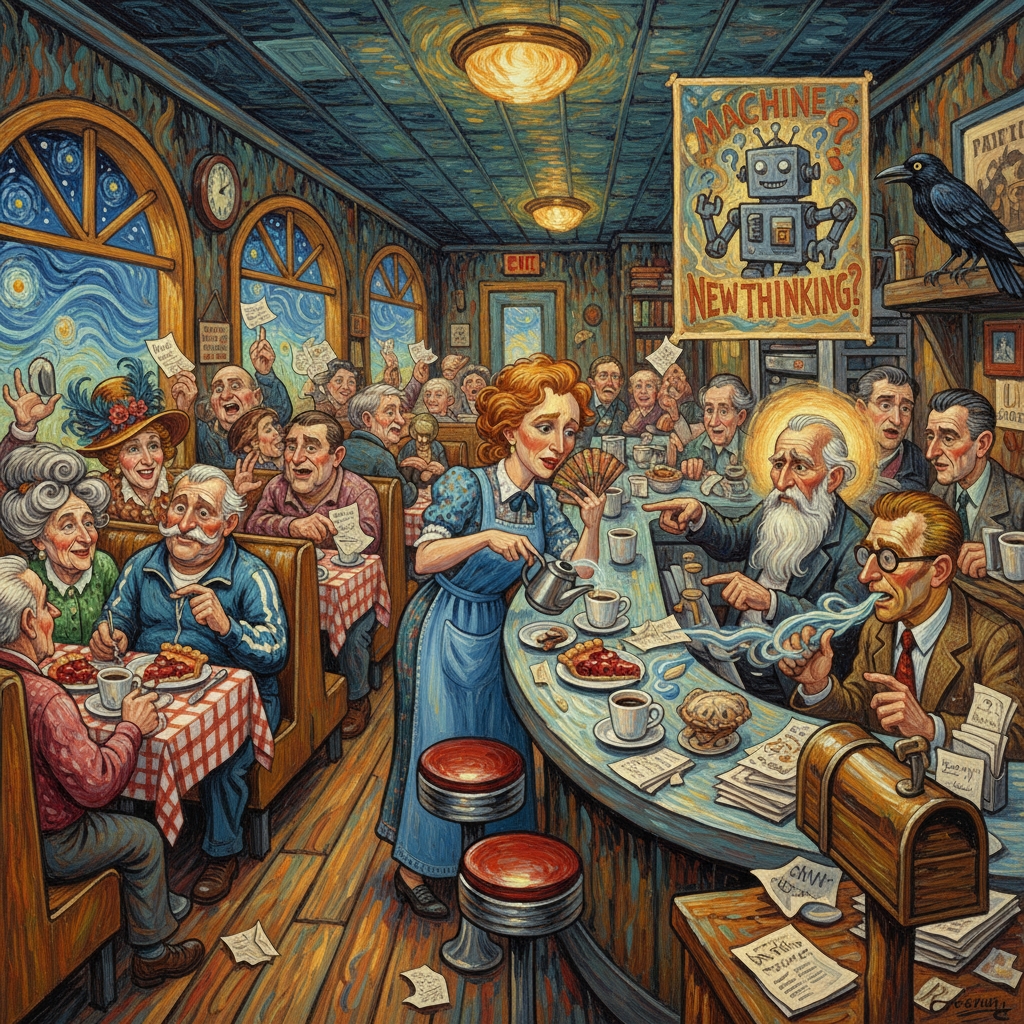
By noon the next day, The Crossing Diner had become the official annex of the Technology Concerns Committee, because Town Hall had run out of coffee and patience.
Maggie Sue moved between tables with a pot in one hand and a pencil behind one ear.
“If this computer replaces my daily rumor intake,” she said, “I want compensation.”
“It won’t replace rumor,” Boot said from the corner booth. “Rumor has lower overhead.”
Tiffany sat across from him, recording notes.
“I’m writing this carefully,” she said. “I don’t want to make the town sound backwards.”
“We are not backwards,” Mabel said from the next booth. “We are forward-resistant.”
RT Mullins laughed into his coffee.
“That ought to be on the welcome sign.”
Clovis had spread papers across the table: printed articles, diagrams, hand-drawn arrows, and one napkin labeled CROW VECTOR.
“The danger is not just that the machine gives answers,” Clovis said. “The danger is that people stop asking who benefits from the answers.”
Doug sighed.
“You can ask that about anything. Newspapers, sermons, diner menus.”
Maggie Sue leaned over.
“My menu benefits hungry people and my electric bill.”
Pastor Arnold stirred his coffee.
“Tools reveal the hand that holds them.”
Sister Lila Mae nodded. “And sometimes the hand reveals it should have stayed in its pocket.”
At the counter, Officer Kenny Joe and Sheriff Peeler studied a printed list Trixie Jo had brought.
Act III – The Diner Turns Into A Philosophy Department
“We could require human review,” Trixie Jo said. “Every answer tied to a source document. No decisions. No personal data. No advice about legal, medical, or financial matters. No anonymous changes to the knowledge base.”
“That helps,” Sheriff Peeler said.
“It helps if people read the rules,” Kenny Joe said.
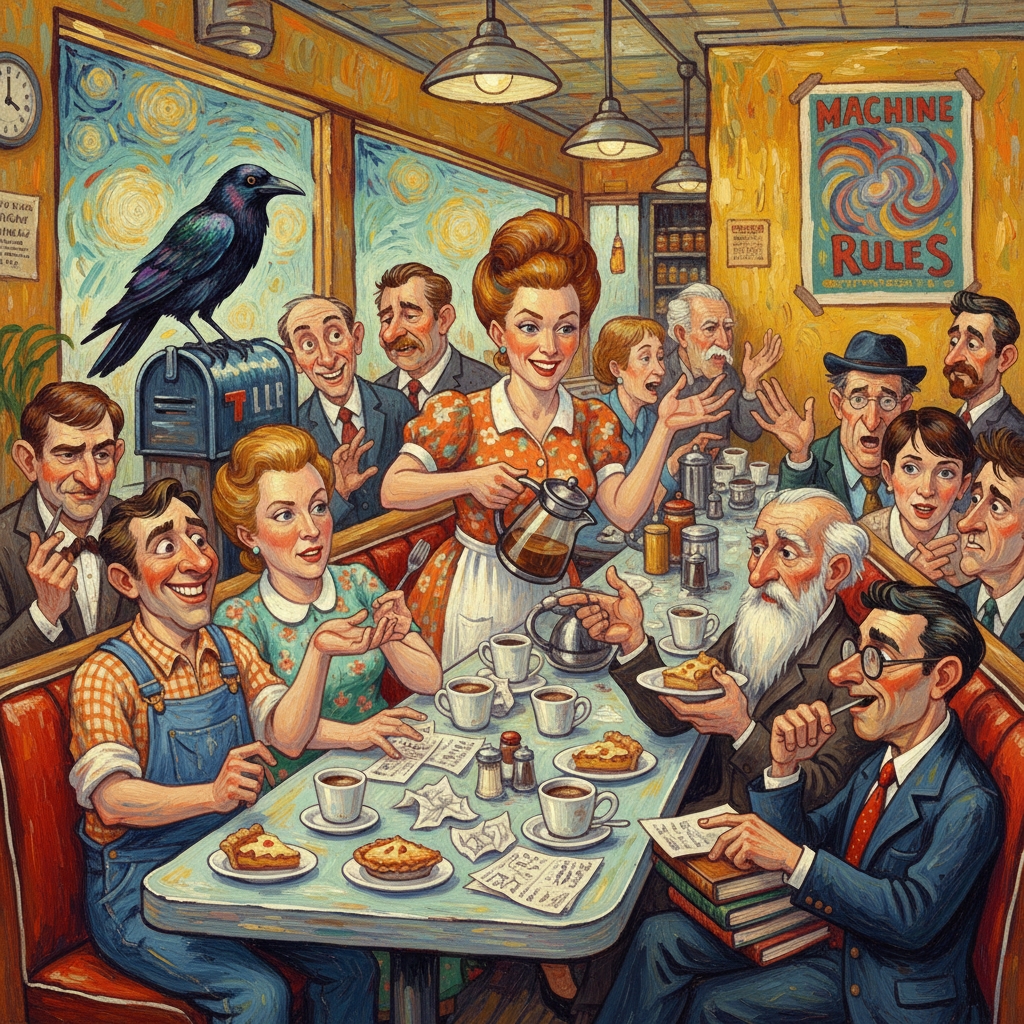
“They won’t,” said Chester Ray, who had entered carrying fresh posters. “So I printed the rules big.”
He unfurled one.
MACHINE RULE ONE: DO NOT ASK IT TO BE YOUR MAMA.
Mabel stared.
“For once, Chester, your work has civic value.”
Brett and Alyssa came in with Sonny, who had grease on one sleeve and doubt on both eyebrows.
“Here’s the thing,” Sonny said. “Everybody keeps asking whether the computer knows too much. But I’m not sure we know enough.”
Alyssa nodded.
“We should separate fears. Some are about the tool. Some are about outsiders. Some are about change. Some are about being embarrassed by not understanding it.”
Coach Freddie pointed his fork.
“I am not embarrassed by not understanding it. I have made peace with not understanding plenty. Soccer rules. Cryptocurrency. Why teenagers wear hoodies in August.”
Evelyn Grace smiled.
“But you still want to know if it affects you.”
“Exactly,” Coach said. “Ignorance is peaceful until it starts charging fees.”
Lurleen set down a pie carrier on the table.
“I brought chess pie because nothing invites honest discussion like sugar.”
Dr. Cowgill appeared behind her, holding a legal pad.
“I have categorized the fears into seven rough classes.”
“No,” said Sheriff Peeler.
Neil blinked.
“No?”
“Not before pie.”
Mister Wade entered last, slow but steady, and took the chair nearest the window.
“Y’all are missing the plain thing,” he said.
Boot looked over.
“What’s that?”
“The machine didn’t scare people by knowing things,” Wade said. “It scared them by saying out loud what folks were already worried about.”
The diner quieted.
Outside, the crow landed on the mailbox.
“It knows!”
Maggie Sue looked through the glass.
“That bird is going to run for council.”
Doug stood.
“We need a public test. Not a sales pitch. Not a panic session. Let people ask it questions, then compare answers to documents. We’ll see what it gets right and wrong.”
Trixie Jo nodded. “Town Hall tonight?”
Sheriff Peeler said, “With rules.”
Mabel said, “With witnesses.”
Chester Ray said, “With printed copies.”
Pastor Arnold said, “With humility.”
Clovis said, “With a Faraday cage.”
“No,” said everyone.
Daisy barked outside, having apparently voted with the majority.
Act III – The Diner Turns Into A Philosophy Department
Act IV – The Sheriff’s Office Receives A Complaint From A Bird
That afternoon, the sheriff’s office became the clearinghouse for every artificial intelligence concern in Sequatchie Crossing.
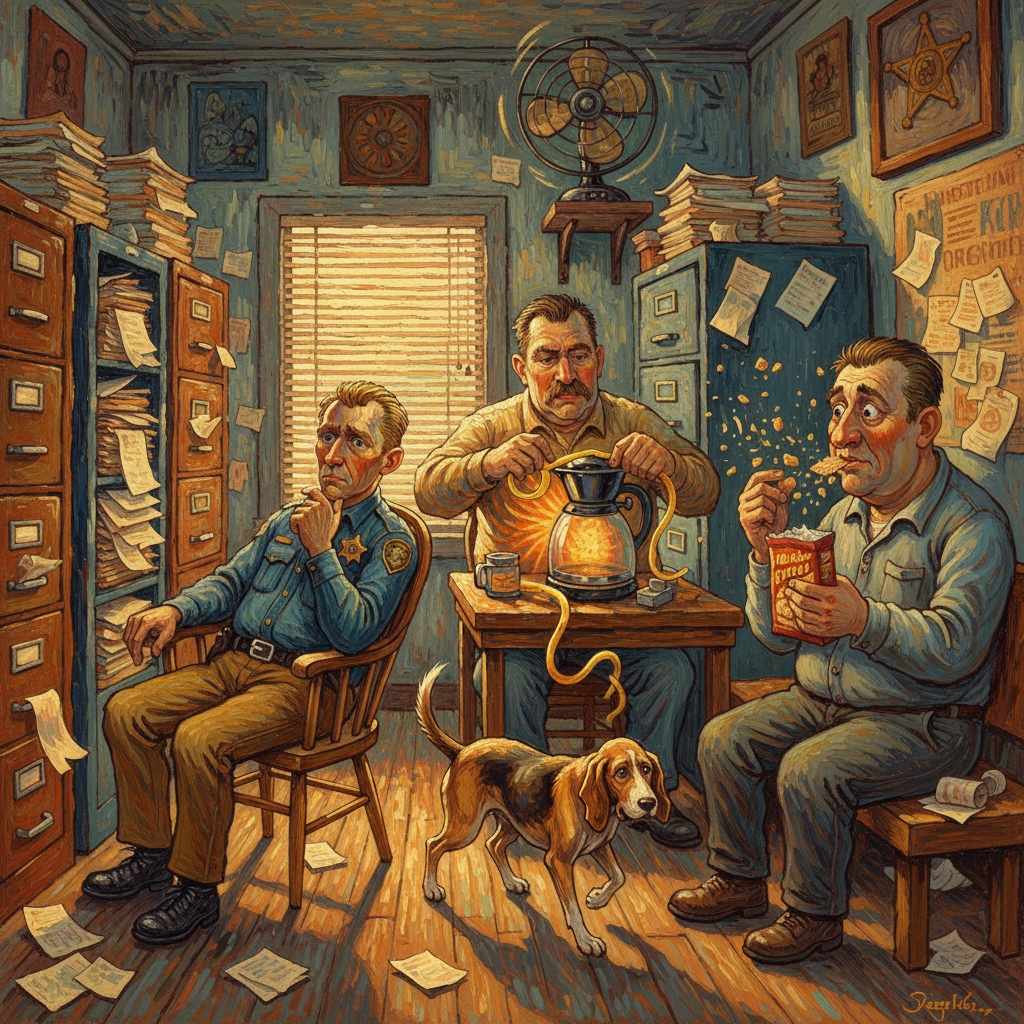
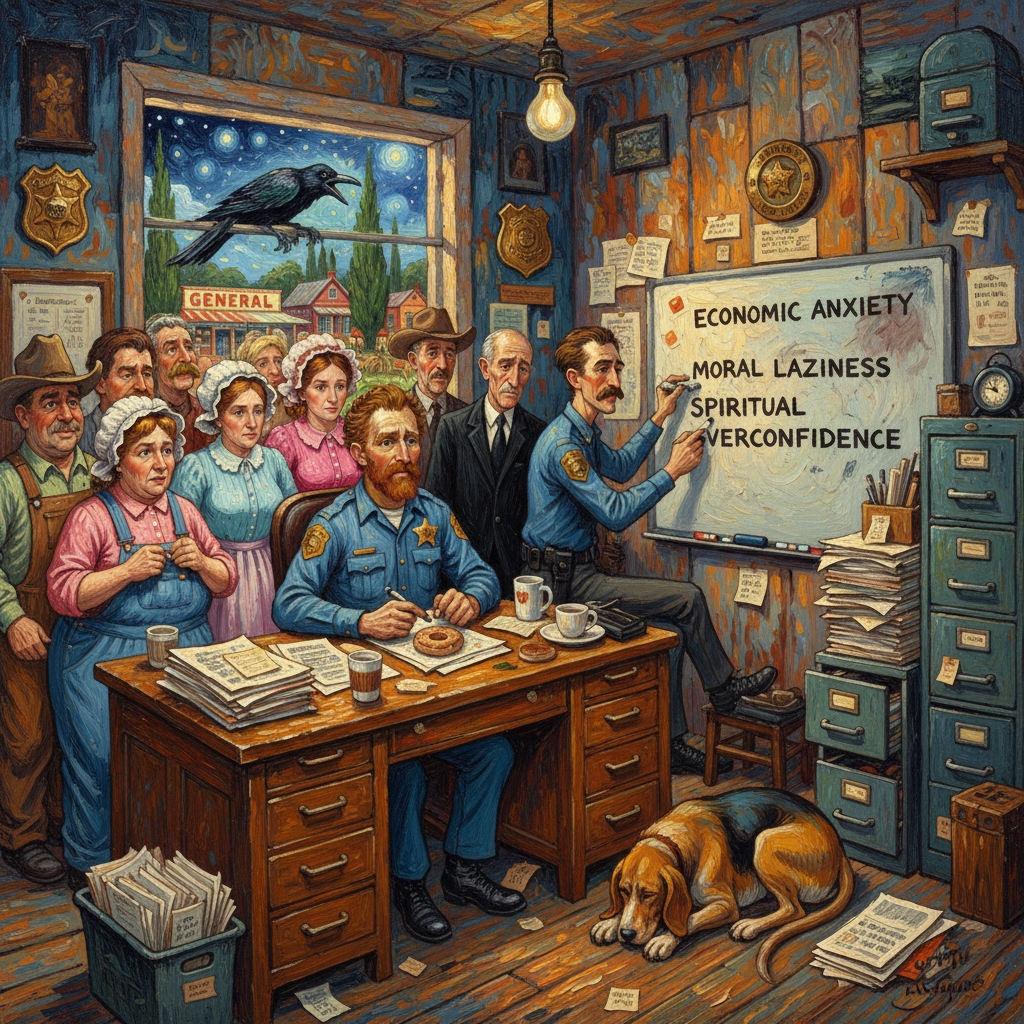
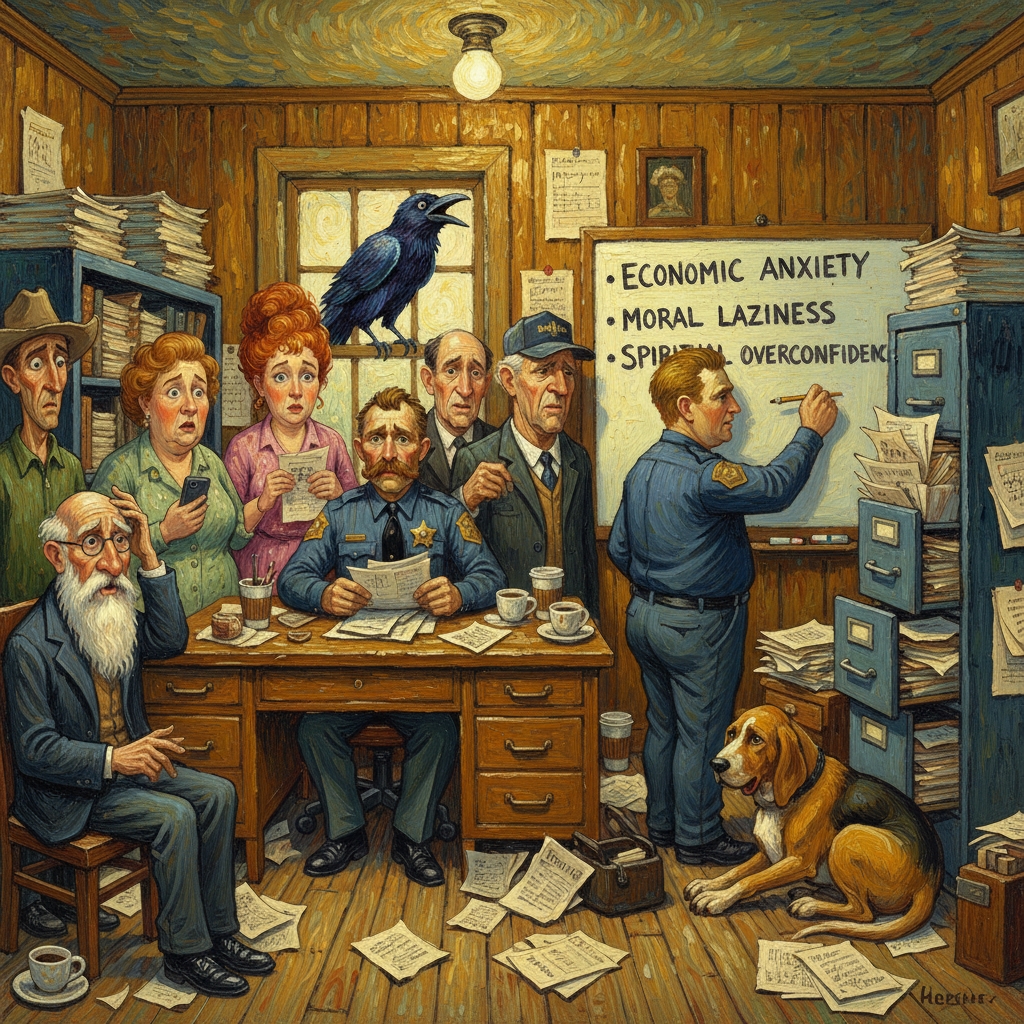
Sheriff Peeler sat behind his desk. Officer Kenny Joe stood beside a whiteboard. Daisy slept near the filing cabinet with the grave seriousness of a hound protecting evidence by lying on it.
Tiffany, Trixie Jo, Boot, and Mabel sat in chairs along the wall.
“Complaint one,” Kenny Joe read, “from Chester Ray Blevins. Concern: computer may eliminate need for printed flyers.”
“That is not a public safety issue,” Sheriff Peeler said.
“It is to him.”
“Write it under economic anxiety.”
Kenny Joe wrote ECONOMIC ANXIETY on the board.
“Complaint two. From Sister Lila Mae. Concern: computer might answer Bible questions without sufficient trembling.”
Pastor Arnold, who had just stepped in, sighed.
“That goes under spiritual overconfidence.”
Kenny Joe wrote it down.
Mabel pointed to the board.
“Add moral laziness. People already want answers without patience.”
Boot nodded.
“And add civic laziness. Folks will ask a machine before they attend a meeting.”
Trixie Jo rubbed her temples.
“If the machine gets them to read meeting minutes, I may propose it for sainthood.”
“Don’t,” Pastor Arnold said. “It will complicate the bylaws.”
The office door opened and Doug entered with his laptop bag.
Act IV – The Sheriff’s Office Receives A Complaint From A Bird
“I’ve disabled everything except the sample public documents,” he said. “No internet. No personal data. No hidden files.”
Clovis slipped in behind him.
“How do we know it has no internet?”
Doug turned.
“Because I unplugged it.”
Clovis narrowed his eyes.
“That’s what the internet wants you to think.”
Sheriff Peeler pointed to a chair.
“Sit.”
Clovis sat, but only because Daisy opened one eye.
Sonny came in next with a coil of extension cord.
“Town Hall outlet by the front table sparks if you look at it with ambition,” he said. “I’ll fix it before tonight.”
“Thank you,” Trixie Jo said. “That is the first practical thing anyone has said since the crow got involved.”
At the word crow, something thumped against the window.
Everyone turned.
The crow stood outside on the sill, pecking the glass.
“It knows! Fish fries! Permit denied!”
Mabel rose slowly.
“Did that bird say permit denied?”
Tiffany lifted her recorder.
“It did.”
Doug went pale.
“The computer did not say that.”
Sheriff Peeler opened the window a crack.
The crow leaned close.
“Permit denied!”
Then it flew off toward The Crossing Diner.
Boot looked at Clovis.
“Where did it hear that?”
Clovis held up both hands.
“For once, not me.”
Kenny Joe flipped through the complaint stack.
“There was a rumor this morning that the computer would deny porch additions based on satellite photos.”
Sonny blinked.
“That started because I told RT a porch was sagging and needed a permit before he enclosed it.”
RT Mullins appeared in the doorway.
“In fairness, I repeated that with enhancements.”
Sheriff Peeler stared.
“What enhancements?”
RT shifted.
“I may have said the computer could see weak joists from space.”
Doug covered his face.
“That is not how anything works.”
Dr. Cowgill entered with a folder.
“Actually, remote sensing can—”
“No,” said Sheriff Peeler, Boot, Mabel, and Trixie Jo together.
Daisy lifted her head and barked once.
Pastor Arnold smiled faintly.
“The dog has moved to sustain the objection.”
Tiffany looked at her notes.
“So the crow is spreading misinformation it learned from humans.”
“Faster than the computer,” Boot said.
Mister Wade’s voice came from the doorway.
“That bird ain’t artificial, but it sure is confident.”
The sheriff leaned back.
“Tonight’s meeting just changed. Before we ask what the computer knows, we ask what the town thinks it knows.”
Act IV – The Sheriff’s Office Receives A Complaint From A Bird
Act V – Church Basement Rules For Machine Spirits
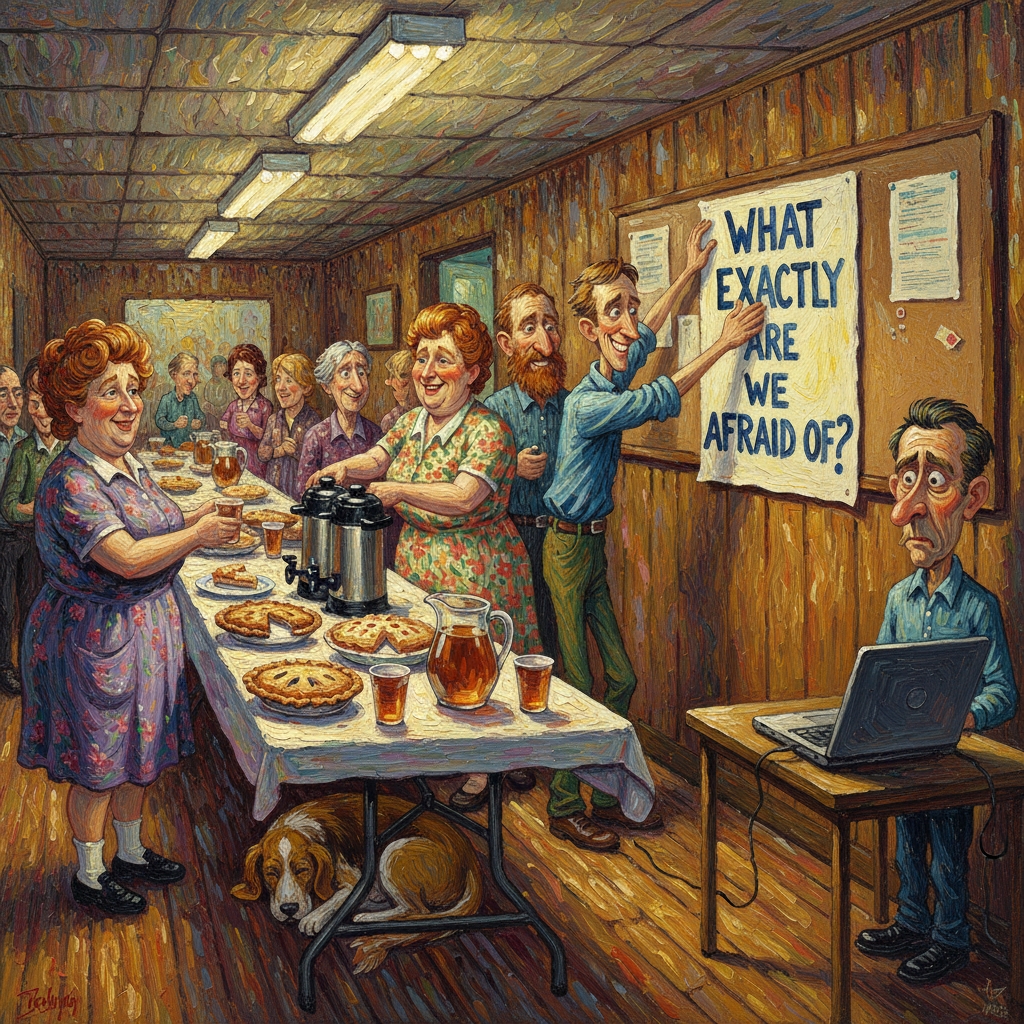
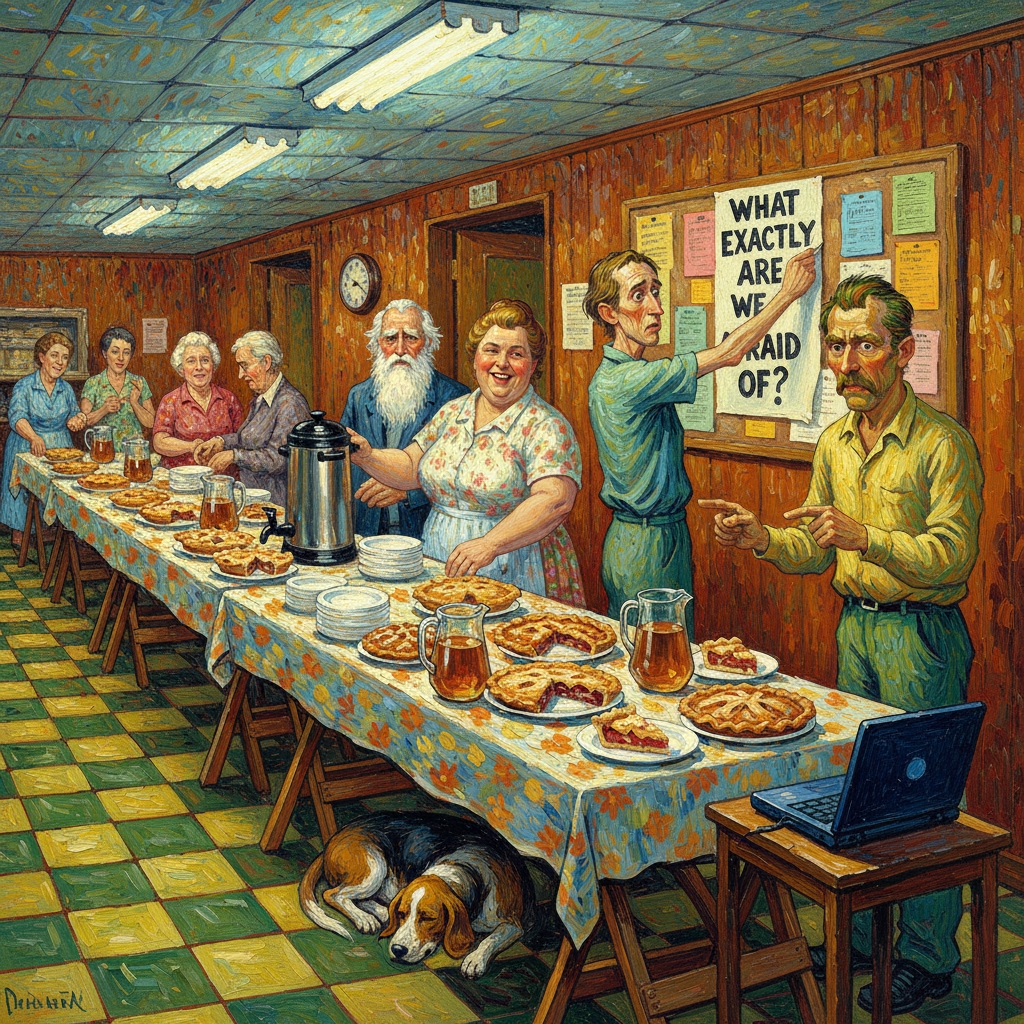
The First Unaffiliated Missionary Temple basement was chosen for the pre-meeting supper because the church had long tables, dependable outlets, and the kind of acoustics that made even a whisper sound like testimony.
Sister Lila Mae presided over the tea urn.
“Sweet tea on the left,” she said. “Unsweet tea on the right. Confusion in the middle.”
The confusion was a pitcher someone had labeled HALF CONVICTED.
Pastor Arnold stood near the bulletin board while Brett and Alyssa arranged plates, Lurleen sliced pie, Evelyn Grace set out napkins, and Coach Freddie tried to keep RT from moving the chairs into what he called a “defensive formation.”
“This is not a football drill,” Evelyn Grace said.
“Every public meeting is a football drill once Mabel arrives,” Coach said.
Mabel entered just then.
“I heard that.”
“Then my communication plan worked,” Coach replied.
Chester Ray taped a poster near the fellowship hall door: TONIGHT’S QUESTION – WHAT EXACTLY ARE WE AFRAID OF?
Tiffany looked at it.
“That is actually excellent.”
Chester Ray shrugged.
Act V – Church Basement Rules For Machine Spirits
“I contain multitudes and layout skills.”
Doug set his laptop on a side table but kept it closed.
“No demo until the meeting,” he said. “Tonight we let people speak first.”
Clovis eyed the laptop.
“That may be what it wants.”
Alyssa turned to him gently.
“Clovis, not every closed object is plotting.”
“You’ve never owned a copier,” Chester Ray said.
Boot leaned against the wall beside Mister Wade.
“Wade, you remember when the highway bypass was coming?”
Wade snorted.
“Folks said it would make everybody rich, then said it would ruin everybody, then used it to get to the hardware store faster.”
“Same shape of argument,” Boot said.
“Different costume,” Wade replied.
Sonny walked in with Kenny Joe.
“Town Hall outlet is fixed,” Sonny said. “Also, somebody had plugged in a fan, a coffee pot, and the Christmas star on the same strip.”
Sister Lila Mae frowned.
“That star has served faithfully.”
“It was serving at twelve amps,” Sonny said.
Pastor Arnold called the group together.
“Before we go across the street, we need ground rules.”
Trixie Jo opened her folder.
“One: people may ask any question about the tool. Two: answers must be sourced or identified as uncertain. Three: no personal accusations. Four: no bird testimony.”
At that exact moment, the crow called from the basement window well.
“It knows!”
Sheriff Peeler looked upward.
“Five: especially no bird testimony.”
Brett raised his hand.
“Can we add one? No pretending fear is stupid. Some fear is information.”
Mabel studied him.
“That is better than your usual smoothie talk.”
Alyssa smiled.
“We’ll take it.”
Lurleen said, “And no pretending excitement is greed. Some opportunity is real.”
Clovis frowned but nodded. “Fine. But no pretending opportunity is always innocent.”
“Agreed,” said Doug.
Dr. Cowgill lifted one finger.
“I propose we distinguish between fear of capability, fear of governance, fear of dependency, fear of displacement, fear of opacity, and fear of cultural humiliation.”
RT stared at him.
“Neil, did you ever consider just saying, ‘Folks don’t like being made fools of’?”
Neil paused.
“That would be the last category.”
Mabel folded her arms.
“Then say it that way tonight.”
Neil wrote it down.
Daisy scratched at the basement door, having escaped the sheriff’s porch and followed the smell of pie.
Sister Lila Mae let her in.
“Well,” she said, “if the hound came, the meeting has legitimacy.”
Daisy walked past the laptop, sniffed it once, rejected it as nonfood, and sat under the pie table.
Boot watched her.
“There’s our first lesson. The dog knows what matters.”
Act V – Church Basement Rules For Machine Spirits
Act VI – The Public Asks The Computer About Its Soul
Town Hall filled before sunset.
Every folding chair was taken. People stood along the walls. The crow perched on the outside rail. Daisy slept under the front table as if democracy were best handled horizontally.
Trixie Jo called the meeting to order.
“This is a public listening and testing session. The computer is not voting, judging, hiring, firing, preaching, policing, taxing, marrying, burying, or replacing your grandmother.”
“Can it make biscuits?” Maggie Sue asked from the side.
“No.”
“Then my grandmother is safe.”
Laughter loosened the room.
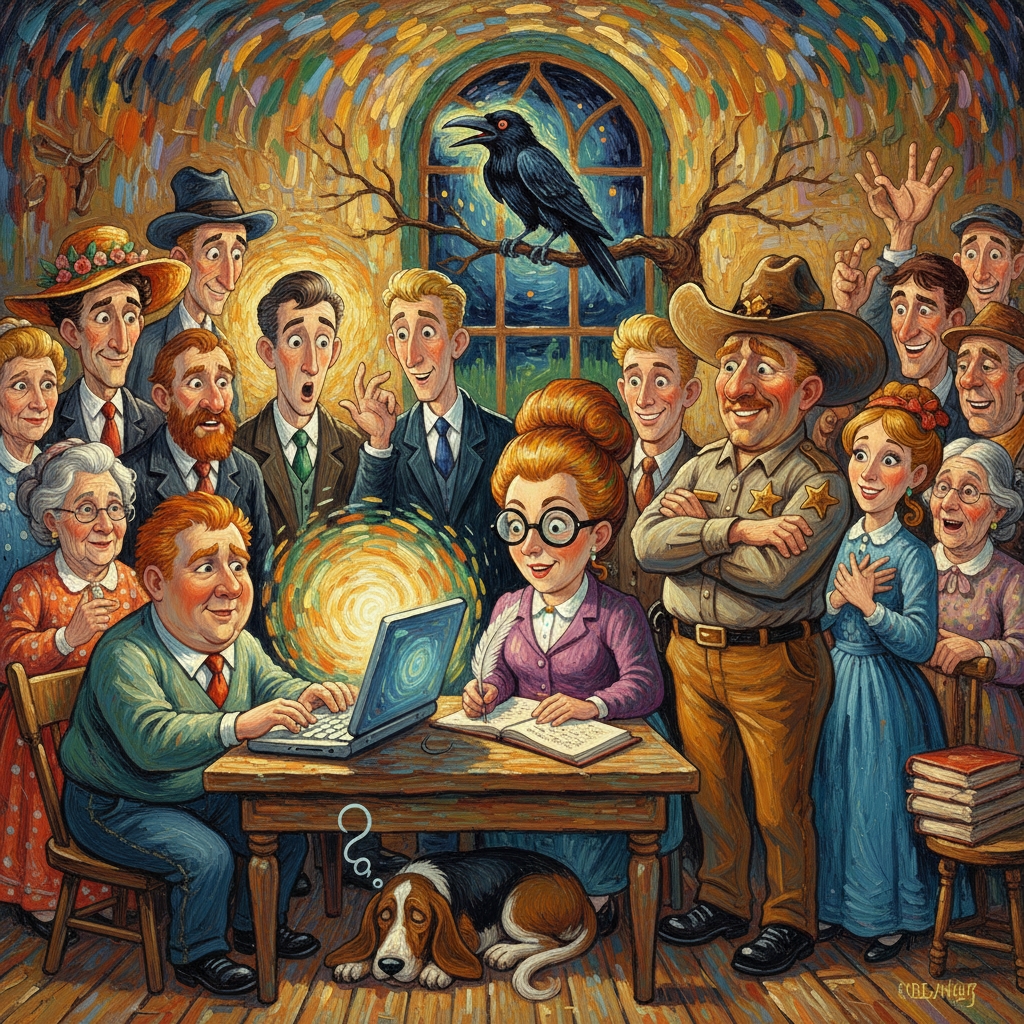
Doug opened the laptop.
“The system contains only approved public sample documents. When it answers, we will display the source.”
Chester Ray stood by the wall with printed copies, ready to prove paper had not yet surrendered.
Tiffany sat near the front, pen moving.
Sheriff Peeler nodded to the room.
“First question.”
Mabel rose.
“Ask it who owns the information after the town puts it in.”
Doug typed. The computer answered: “Public documents remain public records. The system does not own them. Governance policies should define storage, access, retention, and correction procedures.”
Act VI – The Public Asks The Computer About Its Soul
Trixie Jo held up the corresponding policy draft.
“That is in the proposed guidelines.”
Mabel nodded slowly.
“That answer was not slippery. I remain suspicious, but respectfully.”
Clovis stood.
“Ask it whether artificial intelligence can be used to manipulate public opinion.”
Doug typed.
The computer answered: “Yes. Automated systems can generate persuasive content, imitate trusted voices, amplify misleading claims, or target messages to specific groups. Safeguards include transparency, verification, source labeling, human oversight, and media literacy.”
The room got quiet.
The crow shouted through the window.
“Permit denied!”
Sheriff Peeler pointed without looking.
“That is an example of unsourced amplification.”
Tiffany whispered, “That is going in the story.”
Brett stood.
“Ask it how a small town can benefit without losing itself.”
Doug typed.
The computer answered: “A small town may benefit by using technology for routine information, accessibility, translation, emergency updates, records search, and service navigation, while preserving local decision-making, public meetings, personal relationships, and transparent accountability.”
Alyssa exhaled.
“That’s what we mean.”
Mister Wade lifted his cane.
“Ask it if it knows when a promise is too shiny.”
Doug hesitated, then typed.
The computer answered: “I cannot judge motives. Communities may evaluate promises by asking who pays, who profits, who bears risk, what happens if projections fail, and how commitments are enforced.”
Boot smiled.
“That answer can sit on the porch.”
Sonny stood.
“Ask it what it cannot do.”
The computer responded: “I cannot guarantee truth beyond my source material, understand local context as residents do, replace human judgment, verify events outside my data, or take responsibility for decisions.”
Maggie Sue pointed.
“That’s the first machine I’ve heard admit limitations. Some men could learn from it.”
RT said, “I feel seen.”
Pastor Arnold stood.
“Ask it what people are afraid of when they say they fear machines.”
Doug typed.
The computer paused, then answered: “They may be afraid of losing agency, livelihood, privacy, dignity, trust, community, or the ability to tell what is real. They may also fear being ignored by institutions that adopt tools without consent.”
Silence deepened.
Sister Lila Mae dabbed her eyes with a napkin.
“It didn’t say soul,” she whispered.
Pastor Arnold nodded.
“No. But dignity sits near it.”
Evelyn Grace stood.
“Ask it if people who don’t understand technology still deserve a say.”
Doug typed.
The answer came: “Yes. Public technologies affect residents regardless of technical expertise. Communities should include nontechnical voices, especially those likely to be affected by access barriers, errors, or policy changes.”
Evelyn looked at Mabel.
“That one matters.”
Mabel nodded.
“It does.”
Coach Freddie stood.
“Ask it if it can coach peewee football.”
Doug typed before thinking.
The computer answered: “I can provide general drills and safety guidance, but coaching children requires supervision, relationship, judgment, encouragement, and knowledge of individual needs.”
Coach Freddie sat down, satisfied.
“Correct. Also snacks.”
Lurleen asked, “Can it help people fill forms without shaming them?”
The answer: “Yes, if designed for accessibility, plain language, privacy, and human backup.”
Lurleen looked at Trixie Jo.
“Then that should be required.”
Trixie Jo wrote it down.
Dr. Cowgill rose.
“Ask it what the town should decide tonight.”
Doug typed.
The computer answered: “The town should decide whether the tool’s limited benefits justify a carefully governed pilot program, and what safeguards, review processes, correction methods, and opt-out alternatives are necessary.”
Sheriff Peeler looked around.
“For a machine, it has learned how to put work back on humans.”
Boot nodded.
“That may be the most honest thing it does.”
Act VI – The Public Asks The Computer About Its Soul
Act VII – The Crow Wins The Internet Without Having It
The meeting took a turn when the lights flickered, the speaker popped, and the crow outside shouted, “Tax your porch!”
Half the room gasped.
Doug grabbed the laptop.
“That did not come from the computer.”
RT raised one hand.
“That may have come from me too.”
Sheriff Peeler closed his eyes.
“RT.”
“I was explaining hypothetical future overreach.”
“With the words tax your porch?”
“I was painting a picture.”
Chester Ray slapped a new poster on the wall: RUMOR IS A MACHINE THAT RUNS ON US.
Mabel stared at it.
“Chester, stop being useful. It unsettles me.”
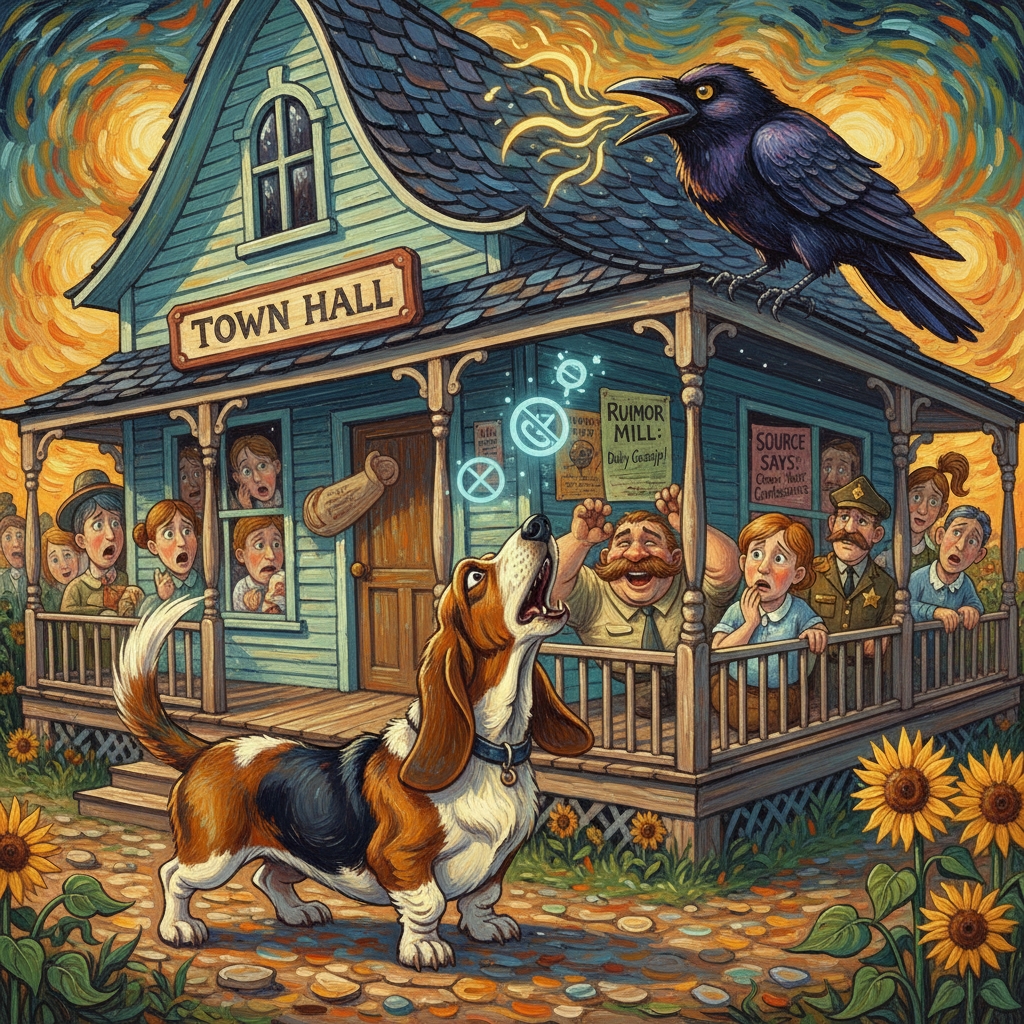
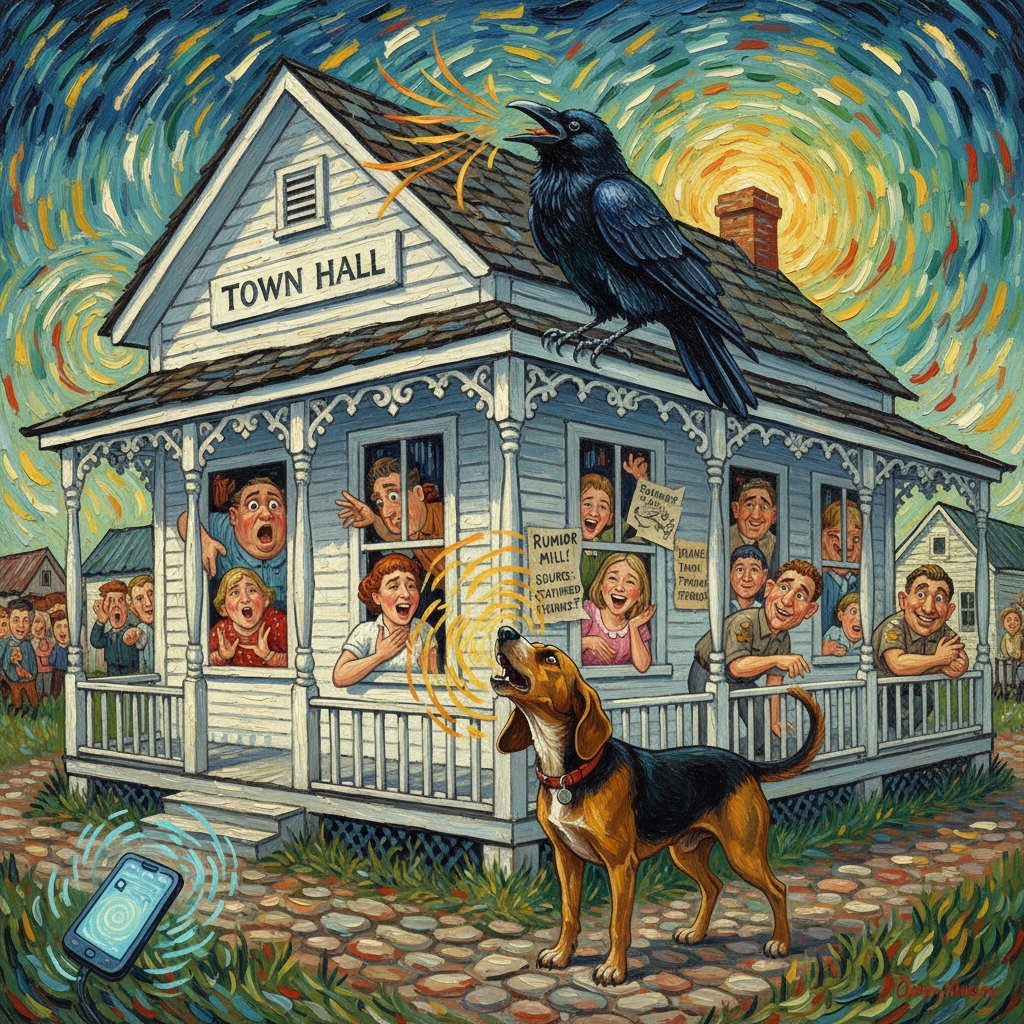
Daisy crawled from beneath the table and trotted to the door. Kenny Joe opened it. She stepped onto the porch and barked at the crow.
Act VII – The Crow Wins The Internet Without Having It
The crow hopped to the rail.
“Tax your porch!”
Daisy barked again.
The crow flapped to the roofline.
“Fish fries!”
Daisy barked louder.
The crowd inside stood and moved toward the windows.
“Look at that,” Sonny said. “The dog doesn’t know policy, but she knows when something’s hollering nonsense.”
Dr. Cowgill whispered, “A behavioral model of community moderation.”
Mister Wade said, “Neil, I swear.”
Tiffany watched the scene.
“This may be the whole story. The crow heard scraps, repeated them louder, scared everybody, and had no idea what it meant.”
Clovis frowned.
“That sounds like half the county.”
“Half the internet,” Alyssa said.
“Half the church prayer chain,” Sister Lila Mae added, then looked upward. “Forgive me for accuracy.”
Pastor Arnold smiled.
“The crow is not evil. The crow is appetite with wings.”
Boot stepped onto the porch.
“Crow just wants attention.”
The crow tilted its head.
“It knows!”
Boot pointed at it.
“No, it repeats.”
Inside, Mabel turned to Doug.
“That’s what I fear.”
“The crow?”
“No. Repeating without knowing. Computers do it. People do it. Committees do it. Newspapers do it. Churches do it. A thing does not have to be alive to cause trouble, and a person does not have to be dead to act like a machine.”
Doug nodded slowly.
“I can build source links into every answer. I can make it say when it doesn’t know. I can make it refuse rumors.”
“Can you make people do that?” Maggie Sue asked.
Doug smiled sadly.
“No.”
“Then don’t oversell the machine.”
“I won’t.”
Sheriff Peeler stepped to the front.
“Everybody sit back down. We are not letting a bird chair the meeting.”
The town reluctantly returned to its chairs.
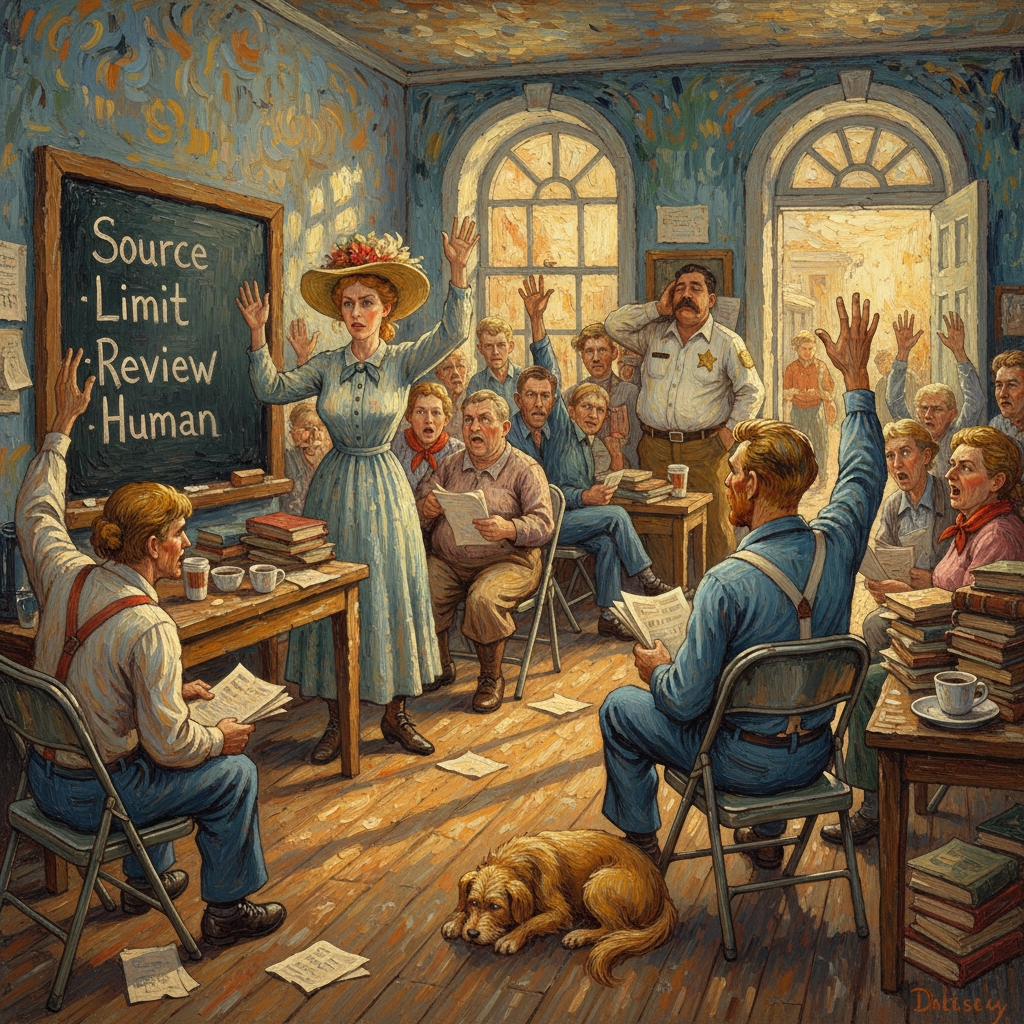
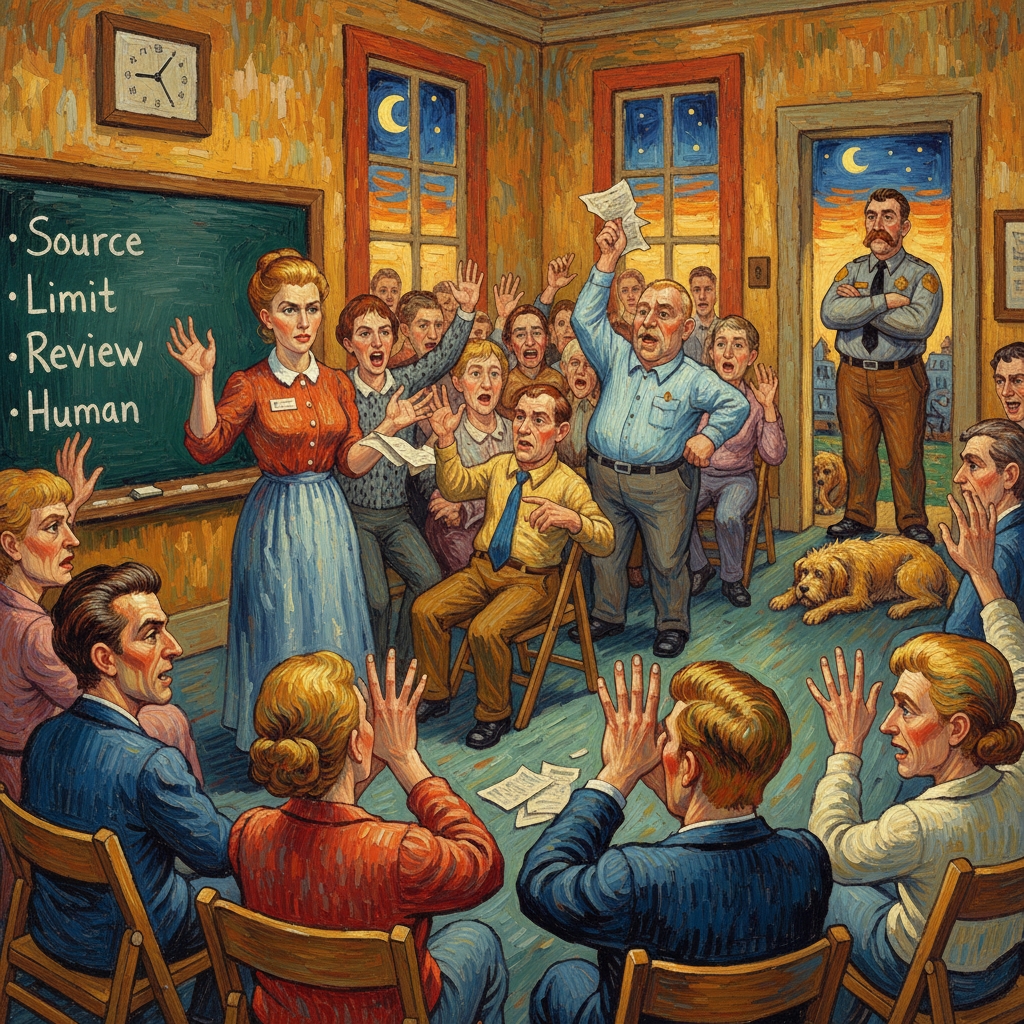
Trixie Jo wrote four words on the chalkboard: SOURCE, LIMIT, REVIEW, HUMAN.
“These are the bones of a pilot,” she said. “Every answer needs a source. Every answer needs a limit. Every answer can be reviewed. Every important path leads to a human.”
Evelyn Grace added, “And paper stays available.”
Chester Ray raised both hands.
“I second paper.”
“Of course you do,” said RT.
Brett said, “And we publish what it can and cannot do.”
Alyssa added, “Plain language, not tech fog.”
Clovis said, “And independent citizens can test it.”
Mabel said, “And if it lies, we shut it down until corrected.”
Doug said, “If it gives wrong information, yes.”
Pastor Arnold said, “And if the town starts treating it like an oracle, we preach against that.”
Sister Lila Mae said, “With trembling.”
Sheriff Peeler looked at the room.
“Now we are getting somewhere.”
From outside came one last cry.
“Permit denied!”
Daisy barked.
The room laughed, but uneasily, because everyone knew laughter did not make the question go away.
Act VII – The Crow Wins The Internet Without Having It
Act VIII – Nobody Fully Wins In A Proper Town Meeting
The vote was not really a vote at first. It was a layering of conditions, amendments, objections, grudges, and one request from Coach Freddie that the system never be allowed to schedule youth sports.
Trixie Jo stood at the front, reading the proposal aloud.
“A ninety-day limited pilot. Public documents only. No personal data. No automated decisions. Source citations required. Uncertainty statements required. Human contact listed on every answer. Monthly public review. Printed alternatives available. Citizen testing group appointed.”
“Add church pantry accessibility review,” Lurleen said.
“Added.”
“Add diner bulletin board posting,” Maggie Sue said.
“Added.”
“Add sheriff review for emergency information,” Kenny Joe said.
Sheriff Peeler nodded. “Added.”
“Add no anonymous edits,” Chester Ray said.
“Added.”
“Add no vendor lock-in,” Brett said.
Doug nodded. “Good point.”
“Add cost ceiling,” Mister Wade said. “Nothing becomes permanent just because canceling it is embarrassing.”
Trixie Jo wrote.
“Added.”
“Add public explanation of what data is included,” Tiffany said. “People should know what the machine is reading.”
Act VIII – Nobody Fully Wins In A Proper Town Meeting
“Added.”
Clovis stood.
“Add a red-team test.”
Several people stared.
He sighed.
“It means citizens try to break it before it breaks us.”
Dr. Cowgill brightened.
“An adversarial evaluation.”
“Neil,” RT said, “let Clovis have the plain version.”
Trixie Jo wrote: CITIZENS TRY TO BREAK IT.
Mabel stood.
“Add that the town may stop the pilot for loss of trust, not just technical failure.”
Doug looked up.
“That’s fair.”
Alyssa nodded.
“If people don’t trust it, it doesn’t work.”
Pastor Arnold raised his hand.
“Add a public education night. Not a sales night. A humility night. Teach people what these tools can do, what they cannot do, and how to question them without surrendering to fear.”
Sister Lila Mae said, “And serve pie.”
“Pie is not policy,” Sheriff Peeler said.
“It is attendance strategy,” Sister Lila Mae replied.
“Added,” said Trixie Jo.
Boot had been quiet. Now he stood.
“Add one more thing. Every answer should say where to find a person.”
Doug nodded.
“It can.”
“No,” Boot said. “Not just contact information. A person. A name or office that is accountable. Government without faces becomes weather. People just complain about it and get wet.”
Mabel looked at him with rare softness.
“That was almost poetic, Boot.”
“Don’t spread it around.”
Trixie Jo wrote: HUMAN ACCOUNTABILITY MUST BE NAMED.
Then she turned.
“All in favor of recommending this limited pilot under these conditions?”
Hands rose slowly.
Brett and Alyssa raised theirs. Lurleen. Evelyn. Sonny. Maggie Sue. Tiffany. Doug. Kenny Joe. Pastor Arnold. Sister Lila Mae after a long pause. Coach Freddie with visible caution. Chester Ray after confirming printed copies would remain. RT with a shrug. Dr. Cowgill with academic enthusiasm. Mister Wade halfway, which everyone accepted as full participation for a man who disliked unnecessary arm travel.
Boot raised his hand.
Mabel did not.
Clovis did not.
Sheriff Peeler watched them.
“All opposed?”
Mabel raised her hand.
Clovis raised his.
The crow outside yelled, “Fish fries!”
“That bird is abstaining,” Sheriff Peeler said.
Mabel kept her hand up.
“I am not voting against learning. I am voting against rushing. I want that recorded.”
Trixie Jo wrote it down.
Clovis said, “I am not against tools. I am against soft cages.”
“That too,” Trixie Jo said, writing.
Sheriff Peeler looked around the room.
“The recommendation passes, with objections recorded. Nobody gets everything. That means it might be government.”
Maggie Sue stood.
“Before everyone leaves, I want to say something. If this machine helps one widow figure out which office to call without crying in her car, it has value. If it makes one clerk hide behind it, it has cost. I don’t know which it will be. So watch it like soup on a stove.”
Daisy barked once from the doorway.
Boot nodded.
“The hound seconds.”
Act VIII – Nobody Fully Wins In A Proper Town Meeting
Act IX – The Computer Learns The Town Is Hard To Index
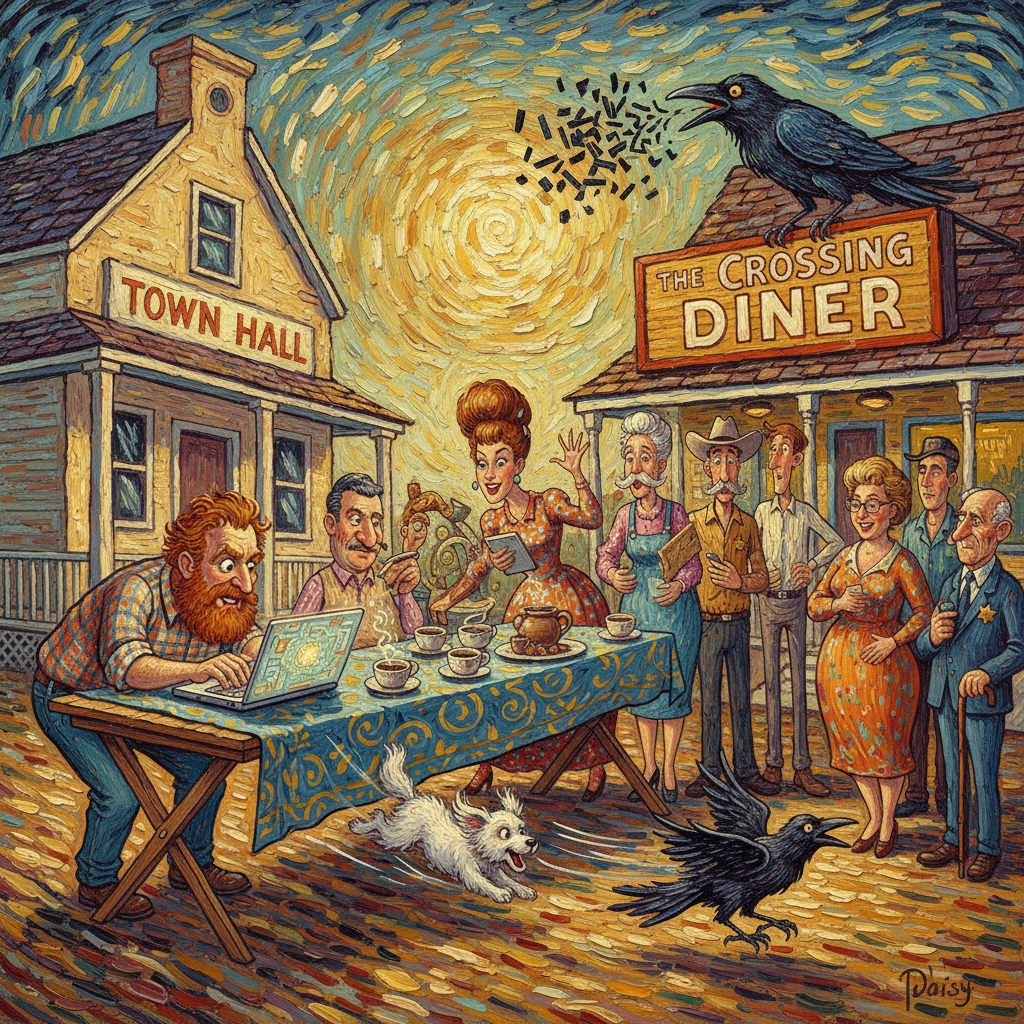
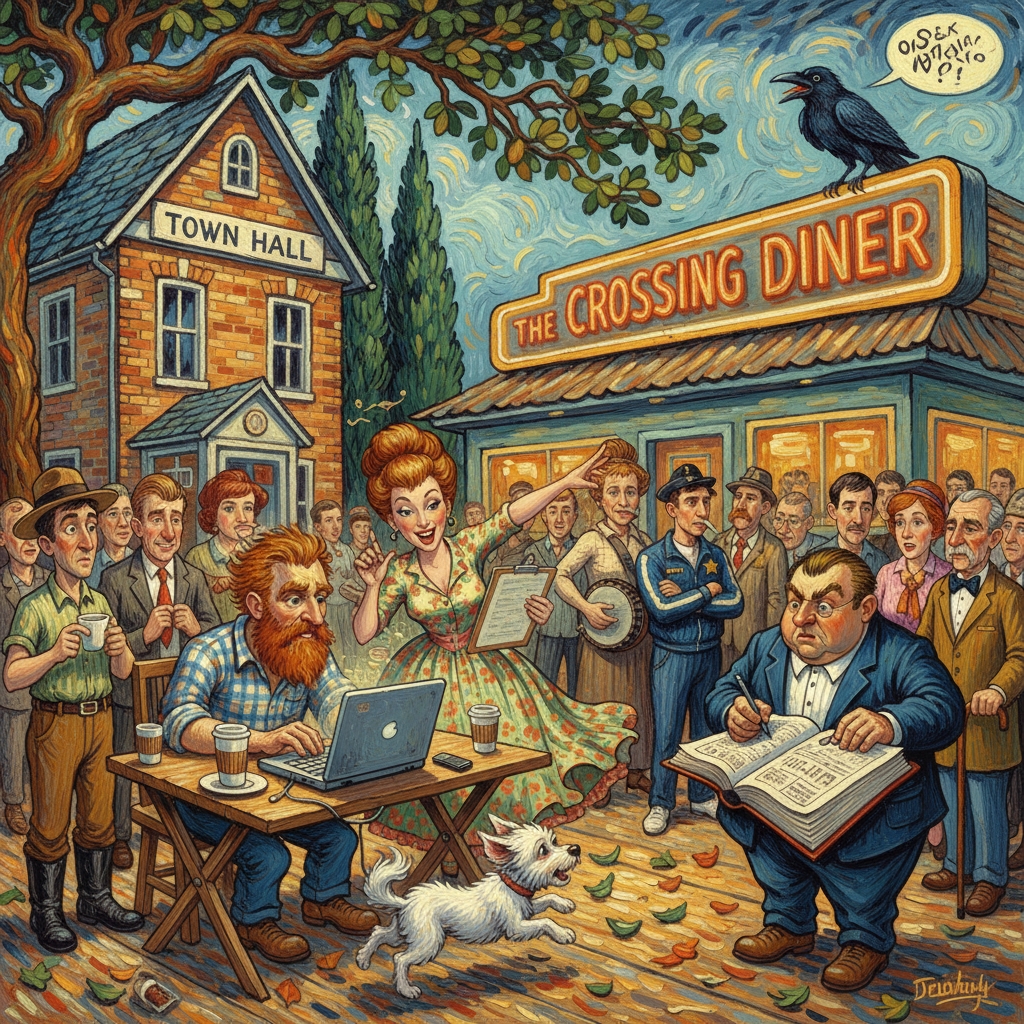
The first official test came three days later, not in a lab, but at a folding table split between Town Hall and The Crossing Diner because the Wi-Fi reached better from the diner and the coffee reached better from Town Hall.
Doug sat behind the laptop. Trixie Jo kept the log. Chester Ray held a clipboard. Clovis held a second clipboard labeled COUNTER-LOG. Mabel brought her own pen because she trusted no municipal ink.
Tiffany covered the proceedings.
Sheriff Peeler and Officer Kenny Joe stood nearby, less as law enforcement than as emotional traffic control.
Daisy slept under the table.
The crow watched from the diner sign.
The first resident question came from Evelyn Grace.
“How do I reserve Town Hall for a quilt display?”
Doug typed. The computer answered with the correct form, fee, office hours, and Trixie Jo’s contact.
Evelyn smiled.
“That would have saved me two trips.”
Trixie Jo marked PASS.
Lurleen asked, “Where does someone get help filling out a utility assistance form?”
The computer answered with church pantry hours, county office information, and a note: “A human volunteer can assist during posted hours. Do not submit personal information through this tool.”
Act IX – The Computer Learns The Town Is Hard To Index
Lurleen nodded.
“Good.”
Mabel said, “It remembered not to be nosy.”
Clovis asked, “Who benefits financially from your adoption?”
Doug typed.
The answer: “The pilot vendor may receive payment if contracted. The town may benefit through reduced staff time for routine questions. Residents may benefit through easier access. Costs and contracts should be reviewed publicly.”
Clovis stared.
“I dislike how reasonable that is.”
“That’s growth,” Boot said.
Coach Freddie asked, “Can I build bleachers behind the peewee field without a permit if they are technically temporary?”
The computer responded: “Temporary structures may still require review depending on size, use, and safety. Contact the building office before construction.”
Sheriff Peeler looked at Coach.
“You were going to ask me that later.”
Coach Freddie frowned.
“I was going to phrase it better.”
RT asked, “Can I enclose a porch that is only sagging emotionally?”
The computer answered: “Structural concerns should be evaluated by a qualified person. Humor is not a permit category.”
The diner erupted.
Maggie Sue leaned over the counter.
“I like it now.”
Mister Wade asked, “Where are the old cemetery records?”
The computer paused, then answered: “I do not have enough information in the current documents. Contact Eugene ‘Boot’ Barnes or the Town Hall archive desk.”
Boot blinked.
“It sent him to me?”
Trixie Jo pointed at the guideline sheet.
“Human accountability.”
Wade grinned.
“Careful, Boot. You got indexed.”
Boot muttered, “That is not a dignified verb.”
Pastor Arnold asked, “What should a town do when it fears the future?”
The computer answered: “This question is philosophical and not answered by town documents. Consider public conversation, trusted community leaders, historical lessons, and careful policy review.”
Pastor Arnold smiled.
“It declined the pulpit. Good.”
Sister Lila Mae asked, “Can fear ever be useful?”
The computer answered: “Fear can draw attention to risk, but it can also spread misinformation or prevent good decisions. Useful fear asks for evidence and safeguards.”
She nodded.
“I will allow it.”
Then the crow screamed, “Tax your porch!”
Daisy burst awake, charged from under the table, and knocked RT’s hat into the sugar dispenser. The crow lifted into the air, flapping over the street toward the church.
Everyone ran outside.
The crow landed on the First Unaffiliated Missionary Temple sign and shouted, “It knows!”
Daisy stood below, barking with righteous exhaustion.
Mabel shaded her eyes.
“That bird has learned nothing.”
Boot said, “It has learned plenty. Just not meaning.”
Doug closed the laptop.
Tiffany turned off her recorder.
Sheriff Peeler looked from the computer to the crow to the gathered town.
“There it is,” he said. “One machine tells you what it doesn’t know. One bird repeats what it doesn’t understand. The dangerous part is we keep listening to whichever one sounds more exciting.”
Nobody answered.
Then Maggie Sue opened the diner door.
“Pie’s half price for anyone willing to admit uncertainty.”
Mister Wade started walking.
“That may be the best public policy passed all week.”
Act IX – The Computer Learns The Town Is Hard To Index
Epilogue – The Sign On The Printer
The ninety-day pilot began with less drama than predicted and more paperwork than advertised.
The computer answered questions about trash pickup, meeting dates, permit forms, pantry hours, records requests, room reservations, and why the town website still had a photograph from twelve summers ago.
That last one it declined to answer.
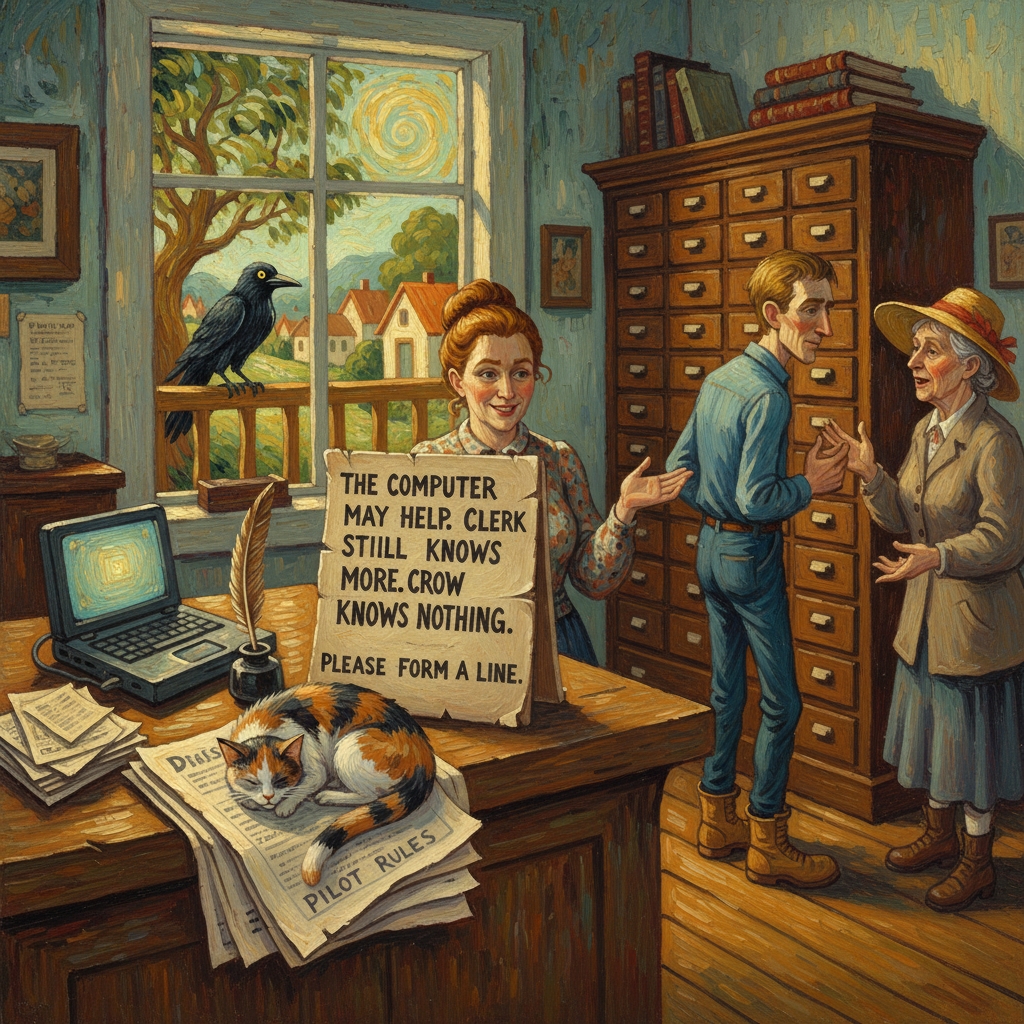
Chester Ray printed a sign for the Town Hall desk:
THE COMPUTER MAY HELP.
THE CLERK STILL KNOWS MORE.
THE CROW KNOWS NOTHING.
PLEASE FORM A LINE.
Mabel objected to the word nothing, arguing that the crow knew where to find crackers and chaos, which were not minor forms of knowledge.
Clovis continued testing the system every Thursday with questions designed to expose hidden domination. So far, his greatest discovery was that the computer could not distinguish between “historic drainage issue” and “ditch with a memory,” though Dr. Cowgill argued that the distinction had philosophical merit.
Brett and Alyssa used the public education night to teach business owners how to ask better questions without handing over private information. Sonny explained outlets, extension cords, and why “the cloud” still depended on wires somewhere. Lurleen and Evelyn helped residents practice using the tool without embarrassment. Maggie Sue provided pie under the condition that no one asked whether the filling was algorithmic.
Pastor Arnold preached a sermon titled “Golden Calves, Tin Horns, And Laptops,” which Sister Lila Mae declared both convicting and insufficiently hard on printers.
Sheriff Peeler kept a copy of the pilot rules in the sheriff’s office, where Daisy occasionally slept on it.
Boot became, against his will, the most requested human source in town.
Tiffany’s article ran under the headline: SEQUATCHIE CROSSING TESTS AI AND DISCOVERS THE CROW WAS THE PROBLEM FIRST.
Nobody fully approved of it. Everybody read it.
And the crow, having learned three new phrases from people arguing outside the diner, continued to sit on the rail and shout warnings into the valley.
“Source your claims!”
“Fish fries!”
“Ask Boot!”
Which, in Sequatchie Crossing, was not the same as wisdom.
But it was not entirely wrong either.
Epilogue – The Sign On The Printer
Disclaimer
Sequatchie Crossing is a fictional Southern Appalachian town populated by fictional characters. This story is satire and local folklore-style fiction. Any resemblance to real people, real residents, real officials, real businesses, real churches, real meetings, real animals, or real public controversies is coincidental.
The events, dialogue, organizations, policies, and public meetings described here are invented for entertainment and commentary. The story does not endorse or oppose any real technology project, government action, business proposal, data center, artificial intelligence system, or local development plan.
The animals in this story are fictional participants in a fictional town’s ongoing habit of accidentally revealing what the humans are trying not to say.
Disclaimer – The Computer That Knew Too Much
Real Places Behind the Ruckus – From The Dunlap Directory

Real Places Behind the Ruckus – From The Dunlap Directory
Yes, this story was fictional; even the parts that weren’t true. These places? Absolutely real. Stop by, support local, and keep the Wi-Fi away from livestock:
- First Presbyterian Church
- Dunlap Industries
- PureGuard Pest Control
- Fall Creek Falls Family Campground B
- Greenehouse Children’s Center
- Winchel’s Homestead Wonders
- Busy Bees
- Sequatchie County Food Bank
- Rocky Top Woodcraft
- Dunlap Tennessee Overview
- Waldemar Design & Machine
- Wendy’s
- Cedar Springs Cumberland Presbyterian Church
- Chris Albright
- Sequatchie County Waste Tire Recycling Station
- McDonald’s
- Cambri Hemp
- Botanas Ricas
- Beau Brown Of Jason Lewis Dunlap Supercenter
- Coops Creek RV Campground
Real Places Behind the Ruckus – From The Dunlap Directory
At Sequatchie Crossing, we tell the stories of Sequatchie Crossing.
Please share this post with your friends, family, or business associates who may want follow the news from Sequatchie Crossing.

0 Comments