


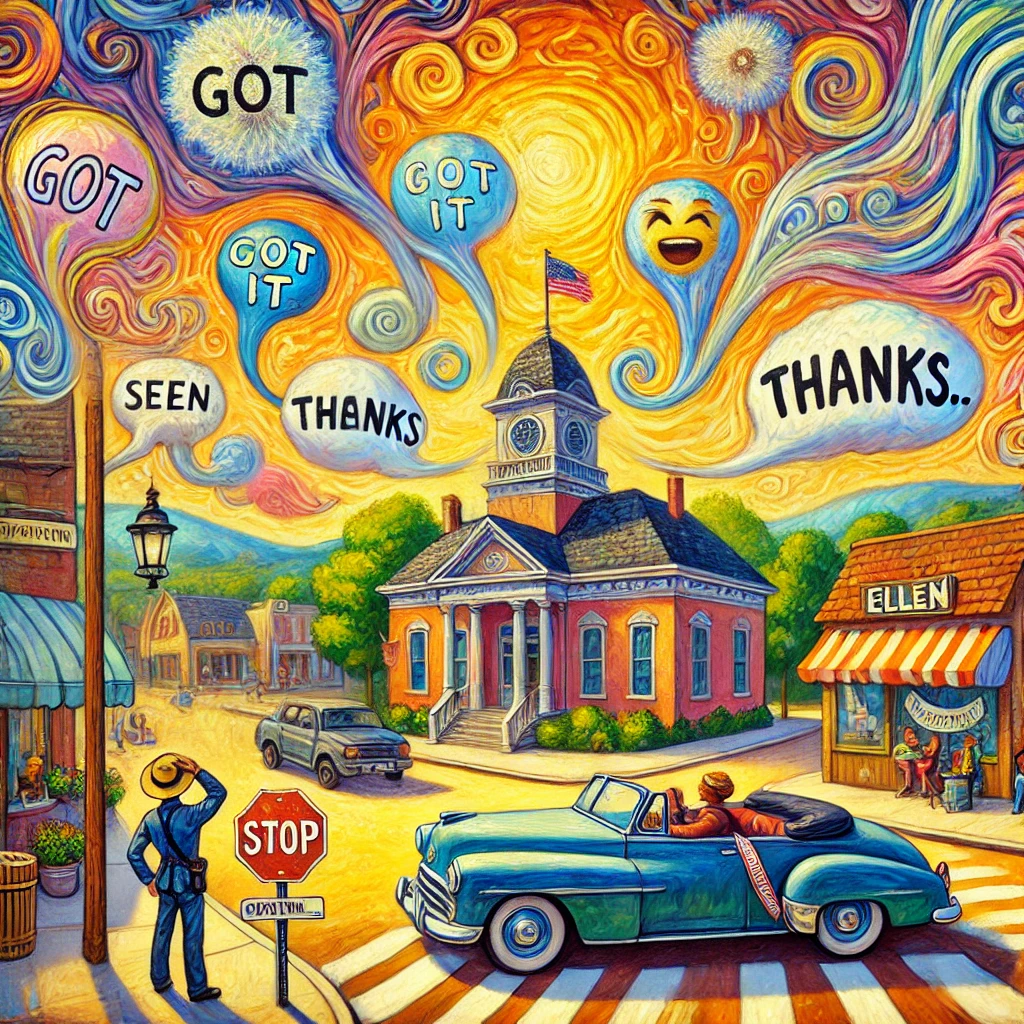
Locals Diagnose New Disorder, Decline to Confirm Receipt Of Diagnosis
By Tom Seest
At Sequatchie Crossing, we tell the stories of Sequatchie Crossing.
Please share this post with your friends, family, or business associates who may want follow the news from Sequatchie Crossing.
🎤 Audio Overview
Dramatis Personae
-
Boot Barnes — town’s self-appointed privacy advocate; owns a hardware store that sells more opinions than bolts.
-
Mabel Dean Ashcroft — president of every committee with a bake table.
-
Reverend Harlan Gentry — minister with a soft voice and a mischievous God.
-
Clovis — amateur technologist and full-time wrong conclusionist.
-
Sheriff Peeler — master of incident reports that begin, “As best as can be determined…”
-
Dr. Louella Pratt — Sequatchie Medical’s physician-philosopher, armed with a clipboard and three calm sighs.
-
Ellen from Atlanta — hopeful outsider who believes in “Got it!” like some folks believe in gravity.
-
Daisy — a dog with a badge (honorary), who always acknowledges a thrown tennis ball.
-
Town of Sequatchie Crossing — afflicted, affectionate, and famously unbothered by loose ends.

Act I – Symptoms
Act I — The Symptoms Present
It began like a breeze traveling down the valley, the kind you feel but don’t mention because you’re not sure whether anyone else felt it. First, a few phone calls that faded into silence. Then emails that disappeared into the town’s collective crawl space. Texts that dribbled into three dots and then… flatline.
By the time it had a name, Reply Deficiency Syndrome—RDS for short—had already colonized the inboxes, notebooks, and voicemail systems of Sequatchie Crossing.
Dr. Louella Pratt discovered the pattern by accident during a Tuesday clinic. She’d texted five patients their lab results and received precisely zero acknowledgments.
“Maybe they’re driving?” her nurse suggested.
“At the same time? Through the same cornfield?” Dr. Pratt asked, circling a note. “Hmm.”
Mabel Dean swore she had replied. “I did it with my eyes,” she explained. “I looked at the phone real hard and said ‘Thank you kindly, Lou.’” She tapped her temple. “Up here.”
Clovis, overhearing, nodded wisely. “The brain has Bluetooth.”
Ellen from Atlanta had just moved to Sequatchie Crossing and was still adjusting to town time—the speed of molasses catching up to a rumor. “Could someone just text ‘Got it’?” she asked at the coffee shop, holding her phone like a life preserver. “Just a ‘K’? A lowercase ‘k’?” She made the shape with her fingers as if she could pinch a letter into existence.
“Why?” asked Boot Barnes, not unkindly. “You know I got it.”
“Do I?” Ellen asked. “Do I truly know that?”
Boot smiled. “Doesn’t that make it exciting?”
No, it did not.
The outsider’s test was simple. Ask a local to do anything—bring a pie, fix a hinge, meet at seven—and then watch the message vanish into the sweet ether of Sequatchie Crossing, where acknowledgment went to pasture.
RDS Early Indicators (per Dr. Pratt’s clipboard):
-
Whispering “Yup” while putting the phone back in the shirt pocket, never touching Send.
-
Typing “T” as in “Thanks” and assuming the Lord will autocomplete.
-
Saying “I replied in my heart” at the Piggly Wiggly.
By Saturday, the town had a meme: “Silence Is Our Thank You.” Mabel Dean had tea towels printed. They sold out immediately, to be given as gifts that would never be thanked for.
Act II – Town Meeting
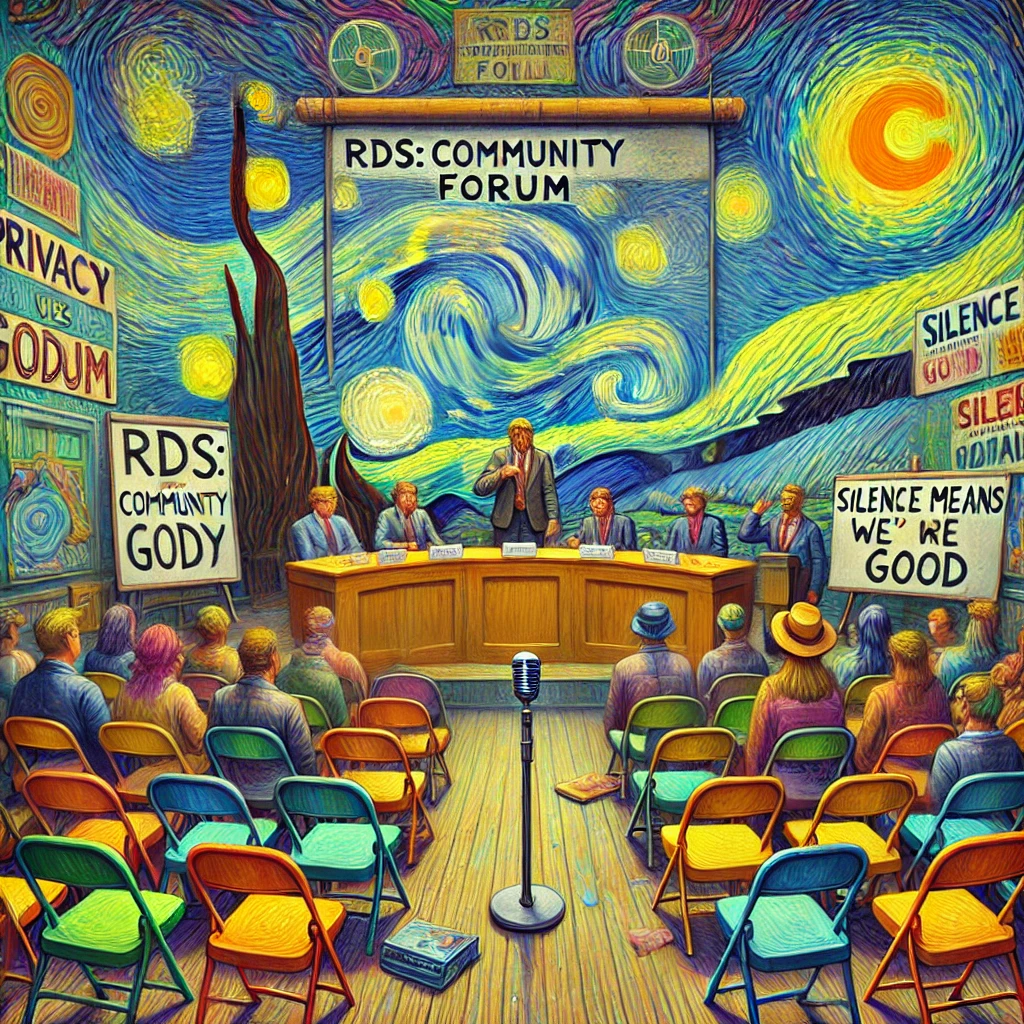
Act II — The Emergency Meeting (Unconfirmed)
The mayor called an emergency meeting about RDS. Notices were posted on the community board, sent as emails, printed in the Sequatchie Sentinel, and folded into origami cranes and dropped from Clovis’s drone. They contained the words “Please reply to confirm attendance,” followed by every known emoji for urgent.
Forty-three people showed up.
Zero had RSVP’d.
“Alright,” said Mayor Peeler, tapping the microphone like a woodpecker. “As far as we know, we all know why we’re here—unless nobody got the memo.”
“We got it,” Mabel said. “We simply declined to endorse the memo’s neediness.”
Reverend Gentry took the floor with a serene expression that meant he was about to commit holy mischief. “Friends, communication is the bread of fellowship.” He raised a slice of actual bread from a basket. “But lately some of us have been hiding the yeast.”
Boot stood to object. “It’s not that we ain’t thankful. It’s that we don’t need to say we’re thankful. Privacy is godly.”
“Boot,” Reverend Gentry said, “we can see your gratitude from space, but the sender of the message cannot.”
Clovis rolled a whiteboard to the front and drew a triangle. “The feedback loop is broken,” he announced. “I blame algorithms. Ever since Microsoft invented the ‘Thanks!’ button, Sequatchie developed a rash.”
“What’s a rash got to do with a reply?” asked Sheriff Peeler.
“Plenty,” Clovis replied. “Both spread.”
Mabel Dean offered a compromise: “Let’s adopt a town motto that meets everybody halfway.” She flourished a card she’d lettered: “Silence Means We’re Good.” “That way, when somebody hears nothing, they’ll feel uplifted by our official message.”
Ellen raised her hand, bright and hopeful. “Or we could just… reply?”
The room regarded Ellen the way people regard modern art: with respect, confusion, and a mild headache.
A motion was introduced for the formation of the Committee for the Acknowledgment of Receipt (C.A.R.). The motion was seconded, perhaps by Daisy the dog tapping her paw. Votes were requested by show of hands sent via text. No hands were raised. No texts arrived. The motion died as nobly as a message in airplane mode.
“Motion failed,” the mayor said. “Or passed. You’ll know either way when nobody tells you.”

Act III – Diagnosis
Act III — The Diagnosis (Peer Reviewed by Nobody)
Dr. Pratt, who had stopped waiting for lab confirmations sometime around 8 a.m., prepared a paper: “Ghosting as a Cultural Norm: The Sequatchie Model.” It argued that in Sequatchie Crossing, non-response wasn’t rudeness. It was a community ethic: don’t close the loop and nobody has to carry the loop. Perpetual openness meant nobody felt pinned; absence of acknowledgment operated like an anti-commitment serum.
She summarized to the town in plain language on the clinic steps: “Y’all are allergic to punctuation. A reply feels like a period, and y’all prefer ellipses.”
Boot Barnes raised his hand. “What’s them three dots called again?”
“Ellipses,” Dr. Pratt said.
“Bless you,” Boot replied.
Ellen listened, scribbling notes. “So the reply offends the culture because it’s too… final?”
Dr. Pratt nodded. “It creates accountability. You said you received the thing; now you might be expected to act on the thing.”
“Guilty,” Mabel confessed. “I don’t like to be seen making commitments while I’m still marinating.”
“Marinating?” Ellen asked.
“Thinking,” Mabel said.
Reverend Gentry considered the theological dimension. “In some traditions we pass the peace,” he said. “Here we pass the ellipses.”

Act IV – Outsider’s Crusade
Act IV — The Outsider’s Crusade
Ellen from Atlanta launched a one-woman reform movement. She wrote The Acknowledgment Manifesto, a one-page document with sample replies:
-
“Got it!”
-
“Thank you.”
-
“Received, will review.”
-
“Can’t do it, but I appreciate the ask.”
-
“No.”
She printed a hundred copies and slid them underneath doorways. She taped them at eye level in the gas station bathroom. She mailed them to herself just to feel the sensation of acknowledgment.
Her pièce de résistance was the Reply Confirmation Hotline (RCH), a number anyone could call to press 1 for “I got your message,” 2 for “I will do the thing,” and 3 for “No, but I wish you well.”
Locals called and said nothing. The Hotline documented three hundred minutes of pure Sequatchie.
Boot left a voicemail of his truck idling. Clovis submitted the sound of wind. Sheriff Peeler called and read the Miranda warning, then hung up on himself. Daisy the dog barked once. Ellen considered that bark a spiritual victory.
Ellen added a fourth button to the Hotline: press 4 for “I ain’t replying, but I want you to know I ain’t replying.” That button became the most popular selection in town history.
Act V – AI Arrives
Act V — The AI Arrives (And Also Doesn’t Reply)
Sequatchie Crossing has a complicated relationship with artificial intelligence. It loves the spectacle (Clippy once preached heresy at Reverend Gentry’s church and the congregation forgave it, mostly because Clippy apologized with a pop-up). It distrusts the automation. Still, necessity knocks louder than theory.
Clovis unveiled SequatchieSpeak, an AI trained on seven decades of town minutes, three sermons, Mabel’s recipe cards, and Sheriff reports redacted with a highlighter that didn’t work.
“It’ll reply for you in your own voice,” Clovis promised. “You say the words out loud, SequatchieSpeak turns that into a text and sends it. Removes the friction.”
Mabel tested it. “Thank you for the egg casserole invite. I’ll bring forks.”
SequatchieSpeak thought carefully. It texted back on Mabel’s behalf: “Bless your heart.”
“Delete it,” Mabel hissed.
Boot tried next. “Got your message. Will do that shelf install Tuesday.”
SequatchieSpeak, trained on Boot’s historical data, sent: “👍”
“Hey!” said Boot. “That’s more than I’d normally say.”
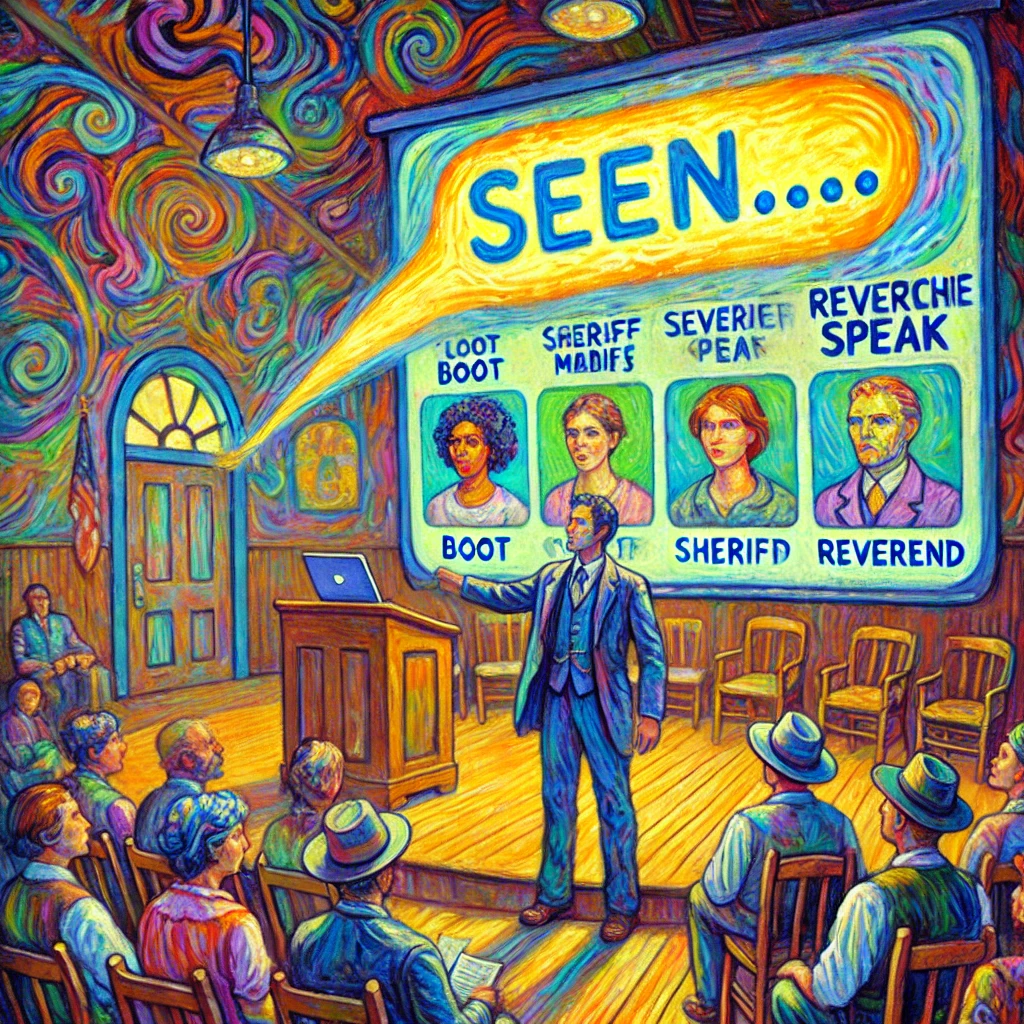
Ellen attempted to teach it the Atlanta ways. “Type ‘Received, thanks.’” SequatchieSpeak responded: “Seen.” Then it appended three dots as a courtesy. The town gathered around the screen and actually sighed with relief.
“Look,” said Reverend Gentry. “The ellipses are back.”
The bot took off like a kite in valley wind. By Wednesday, half the town had configured SequatchieSpeak to auto-reply to any message between 8 a.m. and forever. Replies varied by personality profile:
-
Boot Mode: “Seen…”
-
Mabel Mode: “I have beheld your missive with gladness… (ellipsis)”
-
Sheriff Mode: “As best as can be determined, this text has reached its destination.”
-
Reverend Mode: “Amen, I have received this note.”
-
Clovis Mode: “10-4, pagination pending.”
The system mostly worked until the county utility sent a boil water notice. SequatchieSpeak, trying to be helpful, replied on behalf of the town: “Seen…”—to the utility company. The utility took “Seen…” as acknowledgment. Nobody boiled the water. Half of Sequatchie reported tea tasting “mysteriously mineral-forward.”
Dr. Pratt added a footnote to her paper: “Artificial Intelligence Cannot Cure Social Ellipses.” She waited for peer review. It did not arrive.

Act VI – Acknowledgment Sunday
Act VI — The First Acknowledgment Sunday
Sometimes the Lord solves our habits by handing us a microphone and a hymn. Reverend Gentry announced Acknowledgment Sunday—a liturgy of call-and-response grounded in a single act: reply to the person next to you.
The sanctuary filled. The plan was simple: after the opening prayer, everyone would text “Amen” to a group list confirming attendance. Pastor’s phone would ding like Pentecost.
It did not ding.
“Well,” Reverend Gentry said into the silence, “isn’t this instructive.”
He went to Plan B. “We’re going to practice holy acknowledgments, voice to ear.” He looked straight at Boot. “Boot, please repeat after me: ‘Got it.’”
Boot swallowed. “G—” He grimaced. “G—uh—”
Mabel stepped in. “We can do a softer form. ‘Heard.’ Like a goose.”
“‘Heard’ is good,” Reverend agreed. “Let’s try, ‘Heard and appreciated.’”
Boot attempted it like a man learning to whistle backwards. “Heard’nappreciated.”
The congregation murmured approval. Ellen trembled. The angels took notes.
“Now,” Reverend said, “turn to the person behind you and say, ‘Thank you for telling me.’”
The church swiveled. Pews shifted. The town made the sound of a porch screen door opening for the first time in spring. Quiet at first. Then stronger. There were smiles. A few tears. Somebody said “Likewise” and nearly passed out from the exertion.
Mabel raised her phone. “Should we text this to folks we owe replies to?”
Reverend nodded. “Send them your thanks. Tell them you received the message. No essays. No explanations. No excuses. Just confirmation, humble and complete.”
Clovis mass-selected every thread on his phone and typed: “Received, thank you.” He hit send. The church gasped as if he’d proposed to the entire county. His phone buzzed. One reply came back: “K.” He clutched his heart.
“Who was it?” Ellen whispered.
“My electric company,” Clovis said, weeping. “We’re reconciled.”
After the benediction, the congregation lingered on the lawn, practicing. “Got it.” “Thanks.” “Heard.” “Appreciated.” The words sounded strange in Sequatchie air, like a new bird establishing territory.
“Now,” Reverend told them, “go forth and close a few loops.”
Act VII – Program
Act VII — Government Steps In, Kind Of
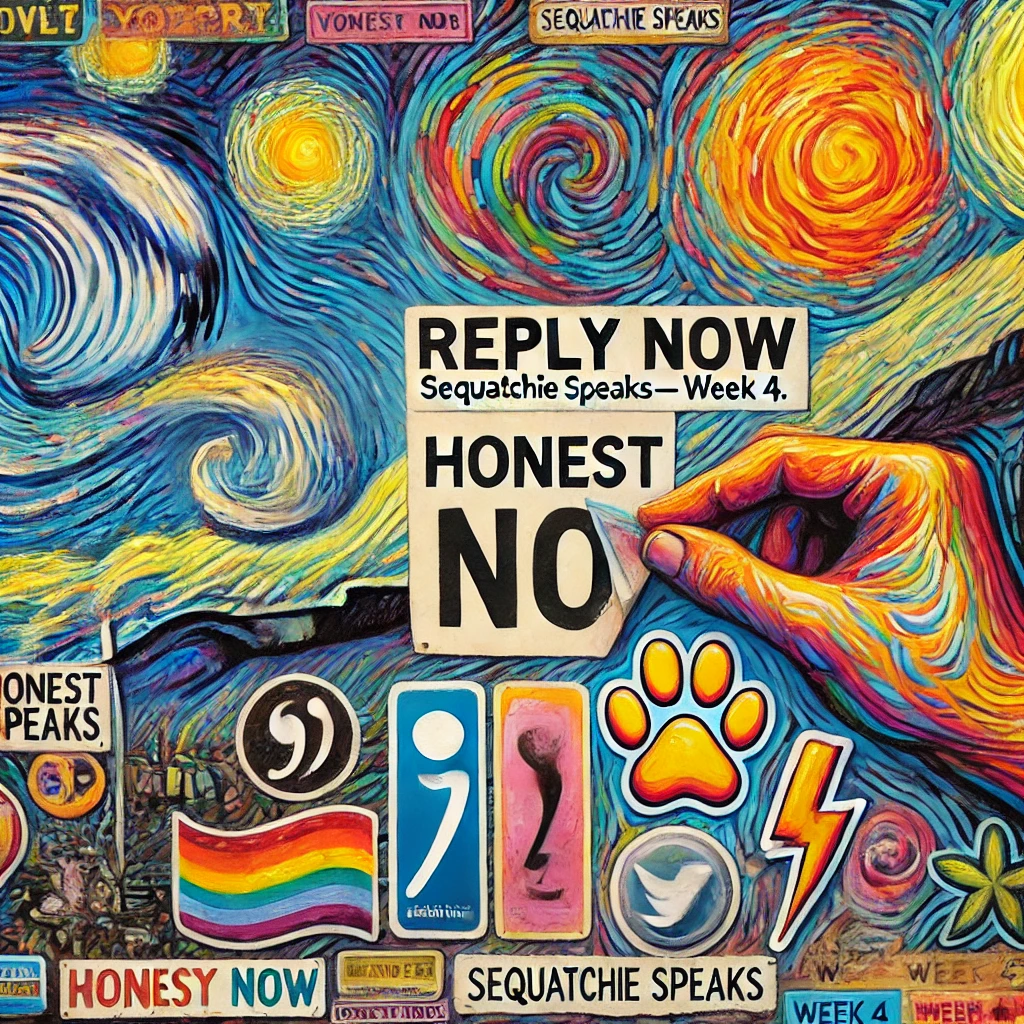
The council announced a program: Reply Now: Sequatchie Speaks. Ten weeks of micro-habits to rewire the valley’s communication reflexes.
Week 1: The Two-Word Reply — “Got it.” (Participants earned a sticker shaped like a period.)
Week 2: Add Gratitude — “Got it, thanks.” (Sticker: comma.)
Week 3: Honest No — “Can’t do that.” (Sticker: tiny lightning bolt.)
Week 4: Offer Next Step — “Can’t Tuesday, can do Wednesday.” (Sticker: arrow.)
Week 5: The Daisy Rule — if a dog can acknowledge a thrown ball, so can you. (Sticker: paw.)
Week 6: The Elder Honor — text your elders back, even if it scares you. (Sticker: rocking chair.)
Week 7: The Vendor Pledge — reply to invoices before the threat of spiritual bankruptcy. (Sticker: dollar sign.)
Week 8: The Friend Mercy — reply to hard news with presence not fixes. (Sticker: heart.)
Week 9: The Stranger Grace — acknowledge the unknown number: “Wrong number, but received.” (Sticker: question mark.)
Week 10: The Sabbath Pause — reply “Received; answering tomorrow.” (Sticker: sunrise.)
Attendance was… not acknowledged. Classes were… probably held. Progress was… implied.
Sheriff Peeler’s office issued a PSA: “If you see silence, say something.” It was printed in six-point font someplace nobody read.
Still, something shifted. A handful of people started replying. Not everyone. Not always. But enough that you could feel the breeze of responsibility starting to move the curtains.

Act VIII – The Bell
Act VIII — The Great Reply Experiment
Ellen, ever the implementer, proposed the Reply Bell: a small, pleasant chime that sounds when a message is acknowledged within one hour. The bell was mounted high on the courthouse, where the clock never agreed with itself.
On Tuesday at 10:00, the first bell rang after the postmaster texted Mabel, “Your package arrived.” Mabel replied, “Got it, thanks.” The whole square looked up like sunshine had made noise.
Boot Barnes bet everyone a case of RC Cola the bell wouldn’t ring again that day. At 10:17 it rang twice—once for a 4-H reminder answered “Ok,” and once for a plumbing appointment confirmed “Yes.” Boot sighed and began loading RC into shopping carts like a man carrying a small cross.
Clovis livestreamed the bell to the town Facebook page. Comments flooded in:
“Is that the lunch whistle?”
“Is the mayor microwaving fish again?”
“Who’s getting married to responsibility?”
By Thursday, the bell felt less like scolding and more like weather. Sometimes it rang; sometimes it didn’t. When it did, people smiled, and Daisy wagged as if the tone had been tuned to her particular brand of hope.
Ellen installed a second bell inside the church. It rang once, shyly, during choir practice. Reverend Gentry nodded to the altos as though harmony could be taught to habits.
Act IX – Resistance, Ritual, and a Pie
Act IX — Resistance, Ritual, and a Pie
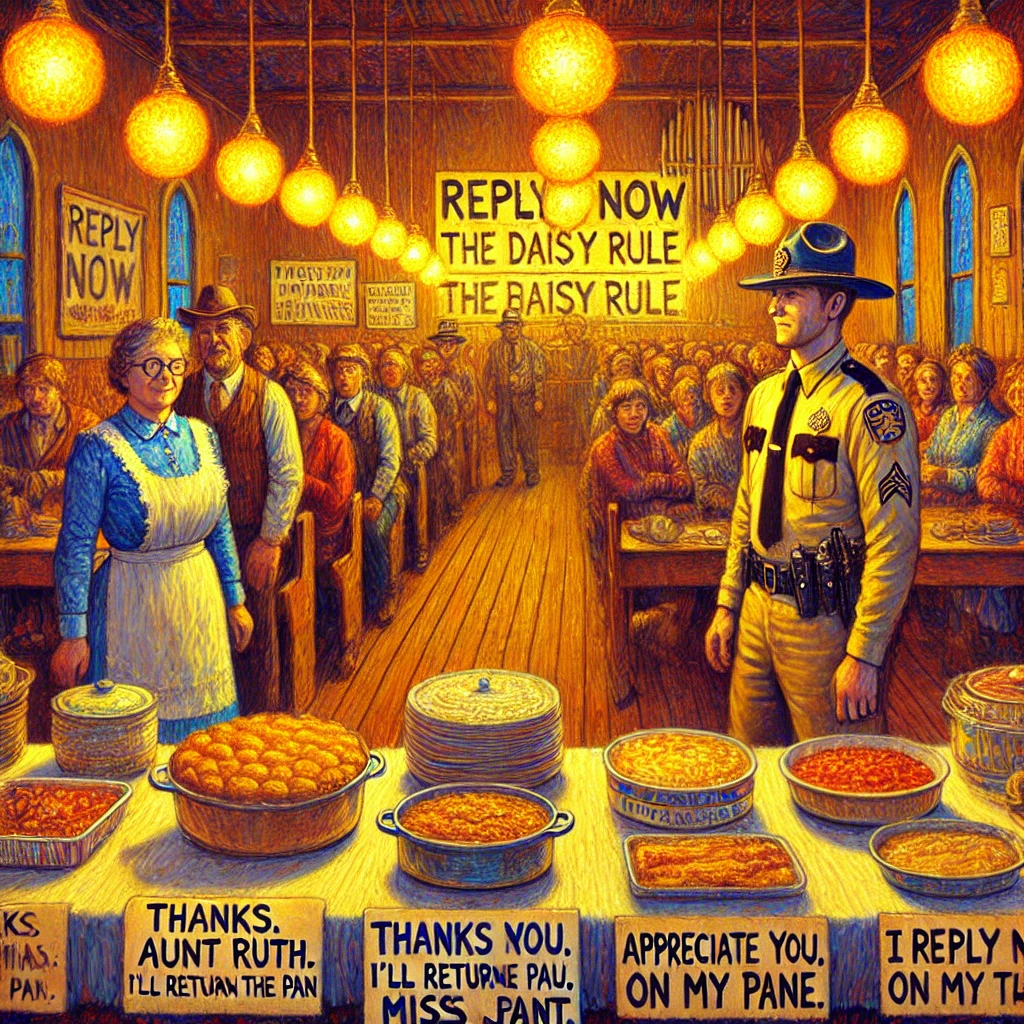
Not everyone bowed to the bell. Some declared Reply Neutrality Zones: front porches, fishing boats, the cereal aisle. Boot started selling hats that read “I Reply On My Time” and bumper stickers saying “Ellipses Against Tyranny.”
Mabel hosted a Reply Potluck where every dish’s recipe had to be accompanied by a two-sentence email of acknowledgment: one sentence thanking the cook who taught it to you, one sentence stating what you’ll do with leftovers. The green bean casserole came with “Thanks, Aunt Ruth. I’ll return the pan.” The banana pudding bore “Appreciate you, Miss Janet. I’ll share slices with the shut-ins.” People blushed sending these acknowledgments aloud, but the room felt warmer, as if ovens continued to glow.
Sheriff Peeler tried something practical. He began answering texts with a template: “Received at [time]. Acting by [time].” His phone stopped exploding at midnight. For the first time in a decade, his coffee cooled before more news arrived.
Clovis announced a firmware update to SequatchieSpeak. “We taught it a new sentence,” he said, triumphant. “It’s 100% local and 100% clear.” The new default reply: “Heard.” No punctuation. No promise. Just the thin line between silence and speech.
“Progress,” Dr. Pratt said. “A single-syllable bridge.”
Boot put a hat on the bot and took a photo. “Look at him. Replies like a gentleman.”

Act X – The Parade
Act X — The Parade No One Confirmed
Sequatchie Crossing loves a parade the way a child loves an unearned ribbon. Mabel proposed the Mailbox Parade: decorate wheelbarrows like inboxes, march down Main Street, and throw canned replies to the crowd. The idea was unanimous by the special metric of this town—the loud silence of immediate non-argument. Nobody signed up. Everyone showed.
Float themes included:
-
The Outbox — a rolling desk on which a teenager sat, typing “Got it” until his thumbs smoked.
-
The Read Receipt — a giant papier-mâché eye following the crowd. It made three elders cross themselves.
-
The Daisy Rule — Daisy rode in a convertible, catching tennis balls labeled “Message,” returning them labeled “Acknowledged.”
-
The Ellipses — three enormous black balloons drifting just slightly out of reach.
Ellen rode as Grand Marshal in a sash that said “THANK YOU.” She waved and then—because habit had to be practiced—she texted every float: “Appreciate you!” People responded. Not all. Not many. But some.
On the courthouse steps, Reverend Gentry offered the benediction of brevity. “We have received this day,” he said, lifting his hands. “Thanks be to God.”
A bell rang. One person clapped. Then ten. Then most. The ones who didn’t clap nodded, which was Sequatchie for clapping.
Boot sidled up to Ellen, hat in hand. “I owe you an apology,” he said. “I thought replying was a kind of surrender.”
“And now?” Ellen asked.
Boot grinned. “Turns out, it’s just manners.”
Ellen looked out across the square. “Manners with a bell.”
“Don’t get used to it,” Boot warned. “We’re still us. We’ll forget. We’ll go fishin’ and let the phone nap.”
“I’ll take a bell a day,” Ellen said. “And a Daisy bark.”
Daisy barked right on cue. Sheriff Peeler wrote in his notebook: “Acknowledgment achieved (canine).”

Epilogue – Porch Quiet
Epilogue — The Quiet We Choose
RDS didn’t vanish. Nothing vanishes in Sequatchie Crossing; it gets reorganized into folklore. Folks still forgot to reply. Whole days would pass in benevolent hush. But the hush wasn’t weaponized anymore. It wasn’t avoidance dressed as culture. It was just quiet, like the valley cooling after sunset.
Some nights, if the breeze had a west in it and the moon stood off to think, you could count three rings from the courthouse bell—someone received a recipe, someone confirmed a ride, someone said “Thanks.”
Not perfection. Not a policy. Just an answered note in a place that had learned to play one.
Ellen kept her Hotline alive. Sometimes it still recorded minutes of silence, and she no longer minded. She’d sit on her porch and listen. On good evenings, right after a stretch of true Sequatchie nothing, she’d hear a single beep—someone pressing 1 for “Got your message.” She’d smile and whisper “Me too.”
Disclaimer – The Silence Is the Reply
Appendix — Satirical Remedies for Reply Deficiency Syndrome (RDS)
1) The Daisy Rule:
If a dog can acknowledge a thrown ball, you can acknowledge a message. Throw = send; bring-back = “Got it.” Practice with an actual ball if necessary.
2) The Two-Word Minimum:
Every message deserves either “Got it” or “No, thanks.” Either closes the loop with dignity. Ellipses are a controlled substance.
3) The Sabbath Pause:
When you can’t reply fully, reply briefly: “Received; I’ll answer tomorrow.” Tomorrow has room when today tells it so.
4) The Potluck Covenant:
Bring a dish, bring a reply. Sequatchie law of conservation: for every casserole there exists an equal and opposite thank-you.
5) The Reverend’s Blessing:
Acknowledge as worship. Not performative—participatory. The “amen” of daily life.
6) The Sheriff’s Template:
Time-stamp your commitments: “Received at 9:14. Acting by 3:00.” Better to be plain than poetic.
7) The Boot Barnes Exception:
If you must withhold reply for privacy, state that boundary kindly: “Received. Will not engage further.” (“Bless your heart” is not a boundary, merely cardio.)
8) The SequatchieSpeak Failsafe:
If the bot sends “Seen…” for you, your next human act is to text “Thanks.” You’re not a robot; prove it with vowels.
Disclaimer – The Silence Is the Reply
Disclaimer
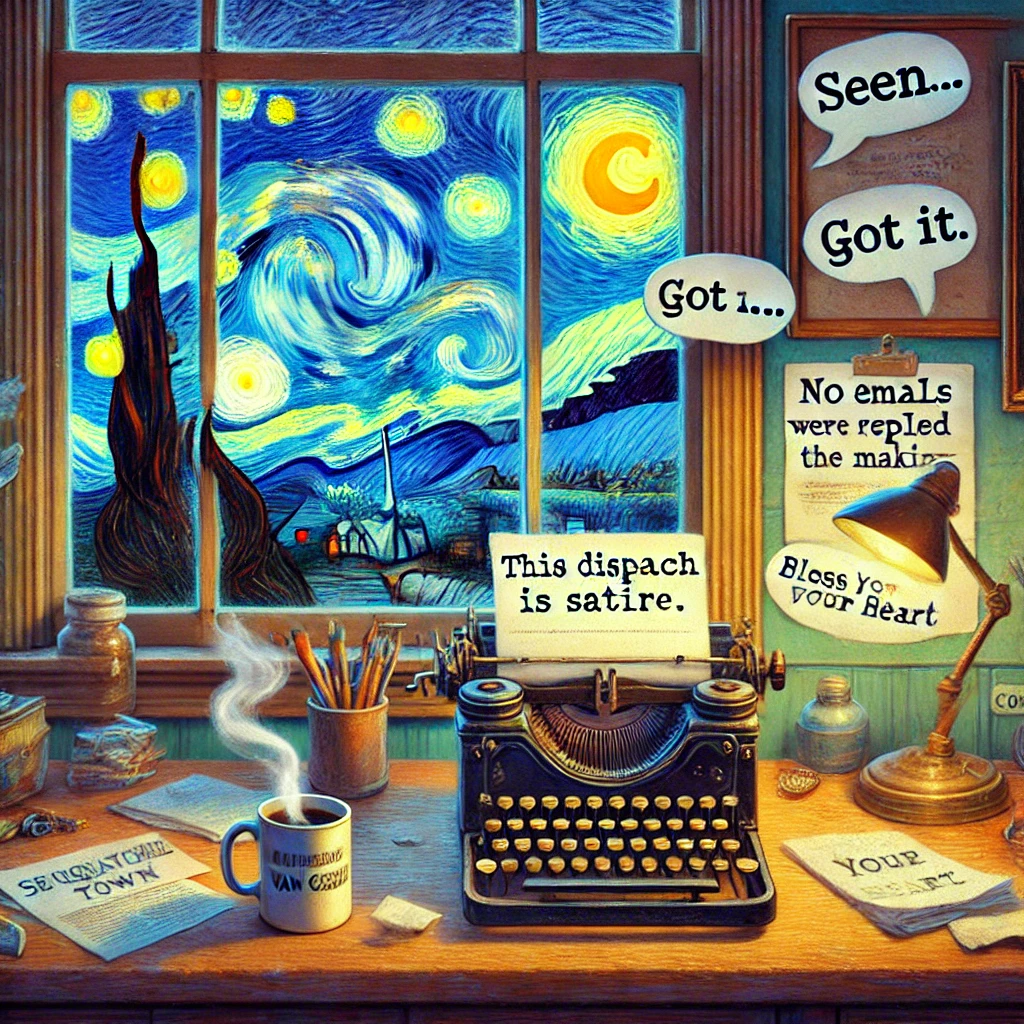
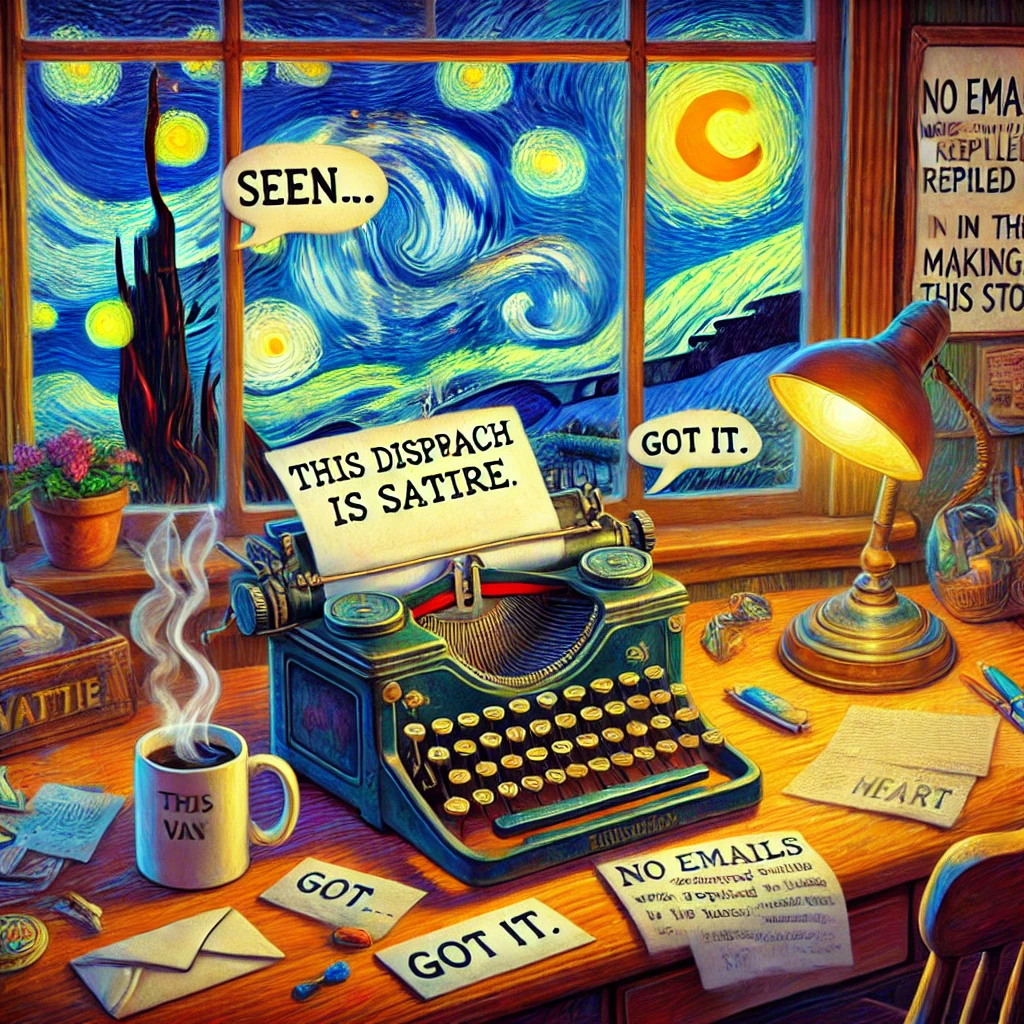
This Dispatch is a work of satire. Any resemblance to persons living, deceased, or chronically unresponsive is purely intentional, offered in love. No emails were replied to in the making of this story; several were seen… The town of Sequatchie Crossing exists exactly as written and also not at all, which is how most towns choose to be remembered.
Real Places Behind the Ruckus – From The Dunlap Directory

Real Places Behind the Ruckus – From The Dunlap Directory
Yes, this story was fictional; even the parts that weren’t true. These places? Absolutely real. Stop by, support local, and keep the Wi-Fi away from livestock:
- Lewis Chapel Volunteer Fire Department
- Mossy Oak Properties Land Sales, LLC.
- Krispy Krunchy Chicken
- Elder’s Ace Hardware-Dunlap
- Omni Rehab – Dunlap Office
- Heritage Painting
- Music Makers
- Yamato Japanese Steakhouse
- Funk Excavation
- Sequatchie Valley Construction
- Mendy Tennille Laundry
- MANN+HUMMEL
- Smokey Ridge BBQ
- Cafe on 28
- Martins Mold Remediation
- Ketner’s Mill
- Affordable Seamless Gutter
- Chris Albright
- Scenic City Lawn Pros
- The Tin Shop Paint Shop

Real Places Behind the Ruckus – From The Dunlap Directory
At Sequatchie Crossing, we tell the stories of Sequatchie Crossing.
Please share this post with your friends, family, or business associates who may want follow the news from Sequatchie Crossing.




0 Comments