


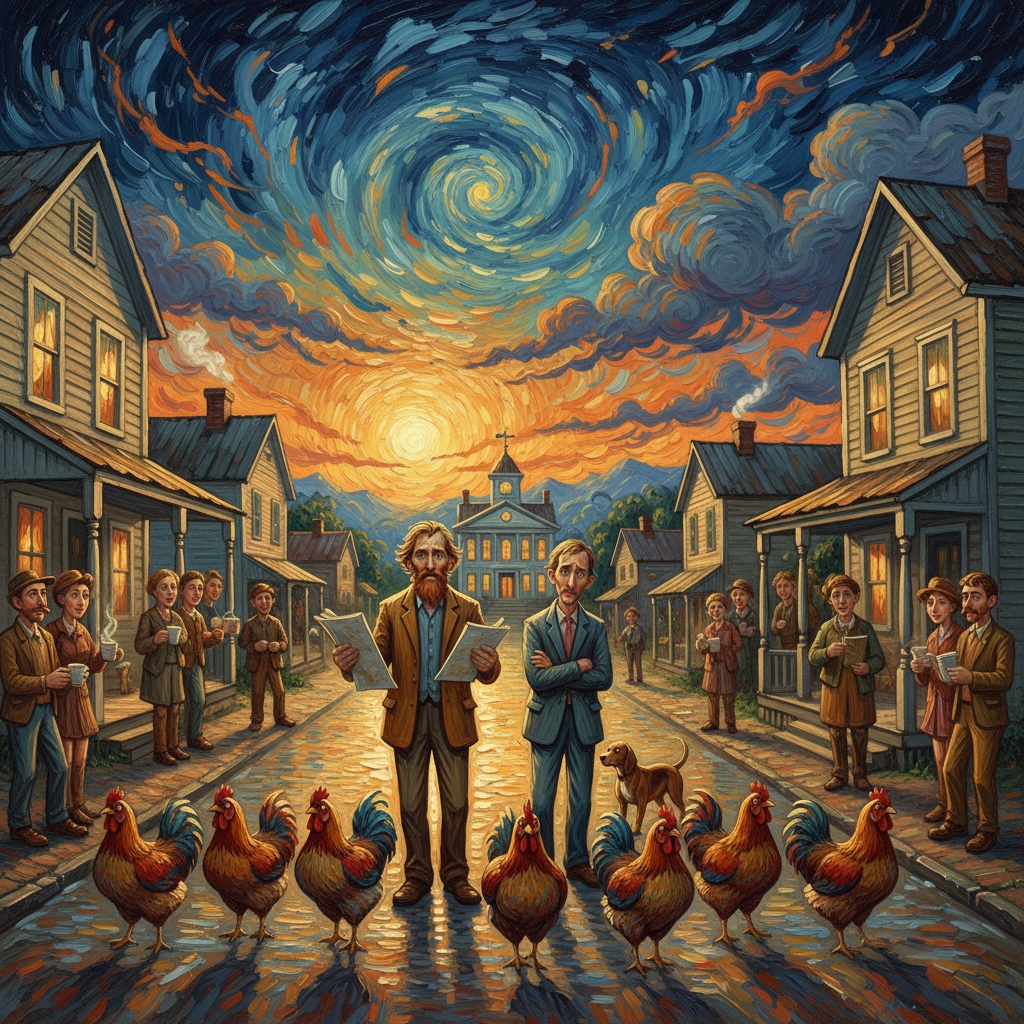
Repeated Events Now Recognized As Connected Following Accumulation
By Tom Seest
At Sequatchie Crossing, we tell the stories of Sequatchie Crossing.
Please share this post with your friends, family, or business associates who may want follow the news from Sequatchie Crossing.
🎤 Audio Overview

Town Notices Pattern It Previously Declared Nonexistent
Act I – The Chickens Begin Again
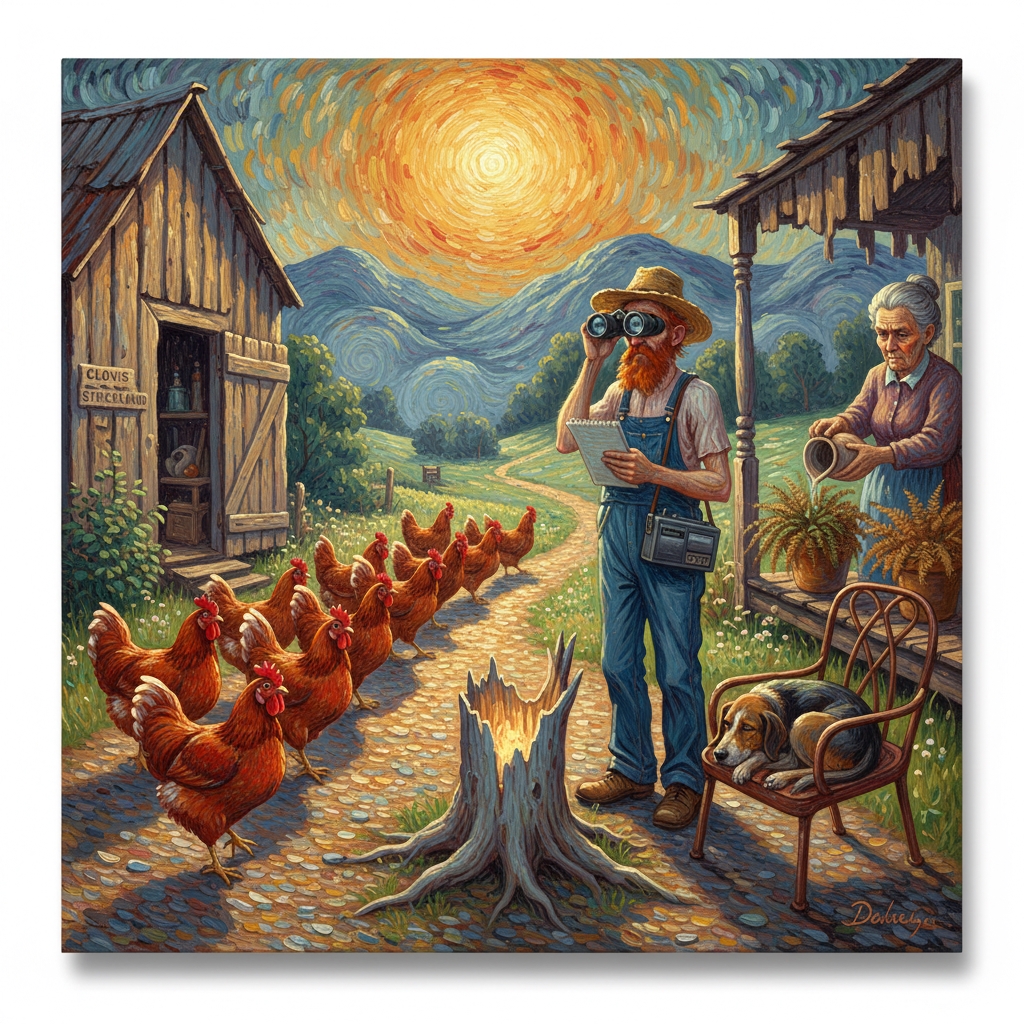
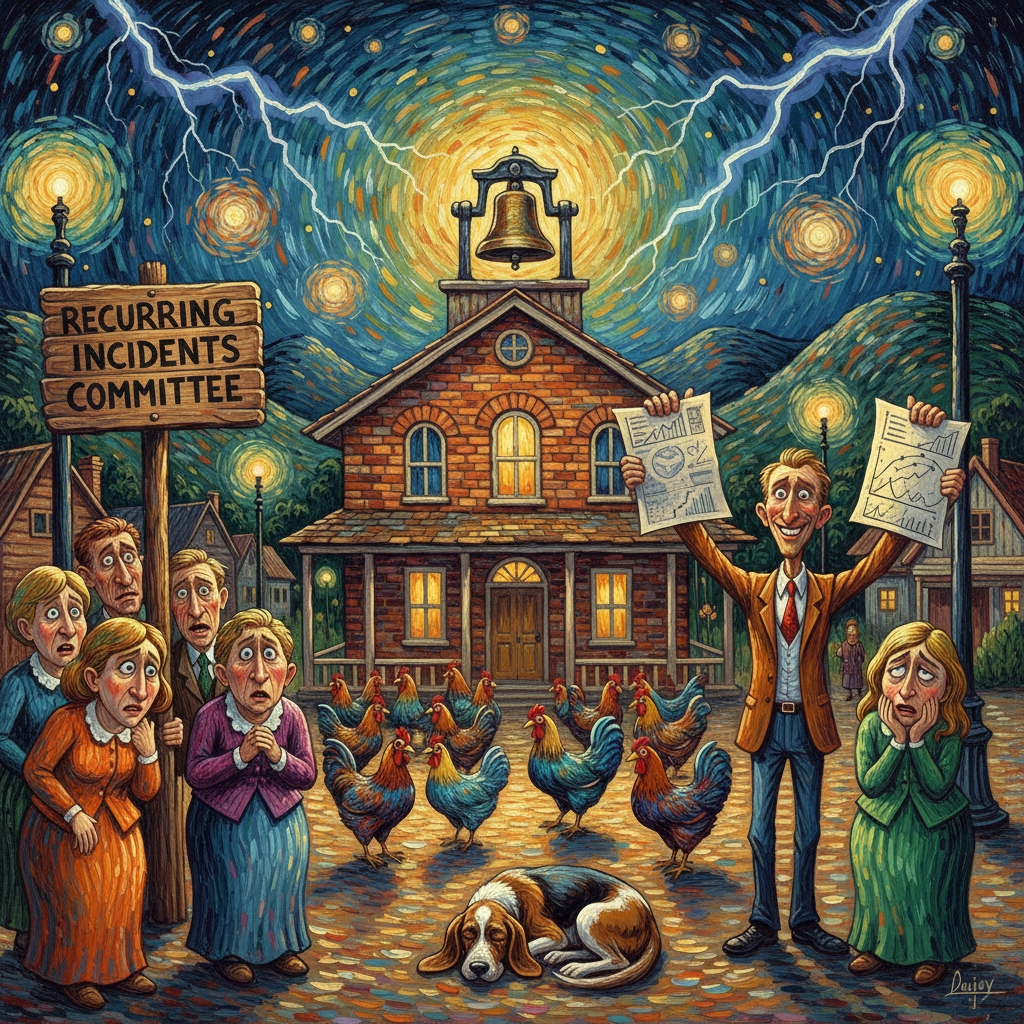
By the third Tuesday morning that month, the chickens behind Clovis Strickland’s shed had once again formed what he called “the line.”
Not a random gathering.
Not pecking behavior.
A line.
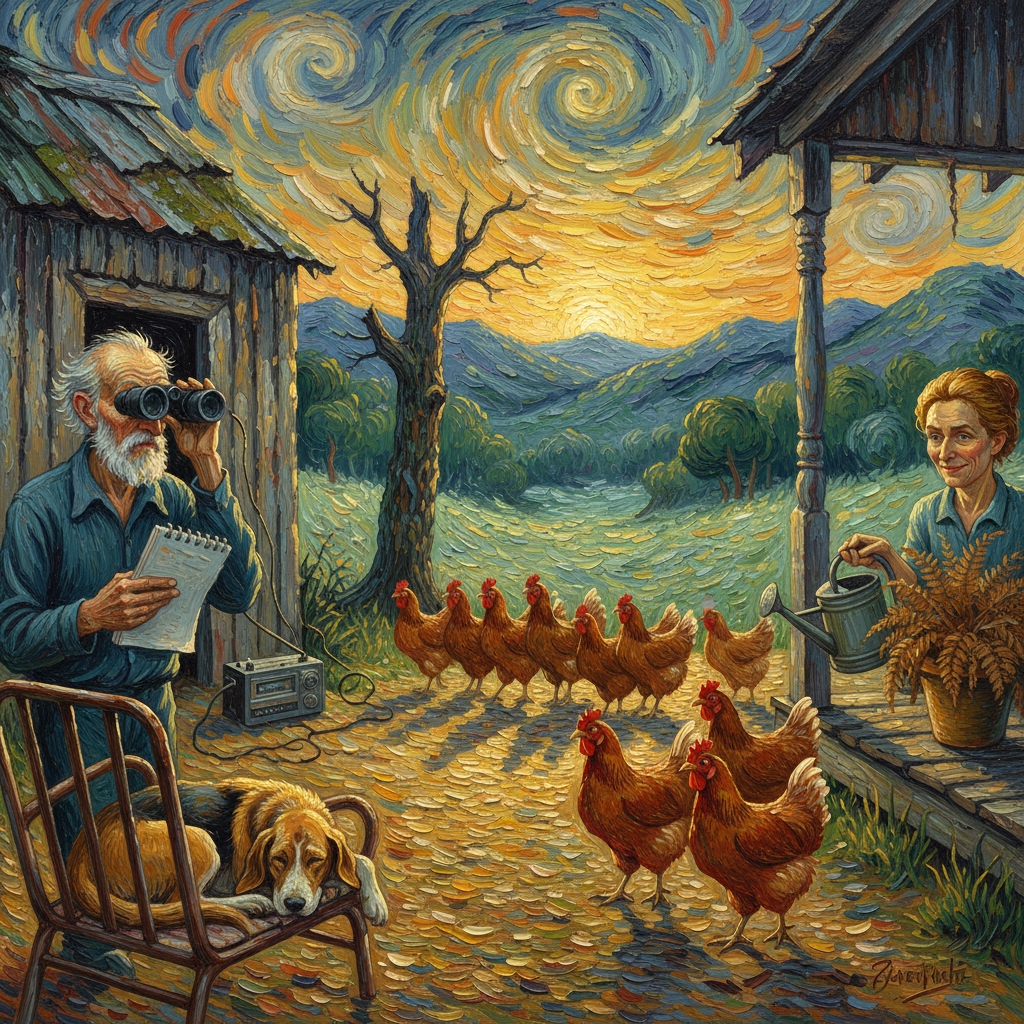
Eight Rhode Island Reds and one suspiciously judgmental barred rock had emerged from behind the compost barrels at exactly 7:12 a.m., crossed the gravel lane in single file, circled the dead mimosa stump beside the propane tank, paused for eleven seconds, then turned collectively toward the old railroad grade and stared.
Nobody had noticed the first two times except Clovis.
That was largely because nobody wanted to.
“You’re assignin’ military motives to poultry,” Eugene “Boot” Barnes had told him earlier that week while sitting on the porch outside Darlene’s Diner.
Boot leaned back in the aluminum chair with a biscuit in one hand and skepticism in the other.
“They’re chickens, Clovis.”
“That’s what people said about weather patterns before satellites,” Clovis replied.
“That sentence don’t even make sense.”
“It will eventually.”
Now Clovis stood near his fence with a spiral notebook and binoculars while Daisy the hound watched from beneath a rusted lawn chair with the emotional exhaustion of an animal accustomed to human beings.
Clovis whispered into a handheld cassette recorder.
“Movement initiated. Same timing as previous incidents. Formation integrity maintained.”
The chickens crossed again.
Pause.
Turn.
Stare.
Exactly eleven seconds.
Then they dispersed.
Act I – The Chickens Begin Again
Clovis lowered the binoculars slowly.
“Oh no,” he muttered.
From the porch of the neighboring duplex, Evelyn Grace Tipton called over while watering three nearly dead ferns.
“You still watchin’ them chickens?”
“They’re watchin’ something.”
“They’re birds.”
“So were carrier pigeons.”
Evelyn sighed.
“You need a hobby.”
“This is a hobby.”
“No, this is documentation.”
That afternoon Clovis marched into Chester Ray Blevins’ print shop carrying three notebooks, a folded county map, and what appeared to be a hand-drawn timeline made with red string and thumbtacks.
Chester Ray stared at the pile.
“You opening a museum?”
“I need copies.”
“Of what?”
“The pattern.”
Nobody in Sequatchie Crossing liked when Clovis used the word “pattern.”
That word had historically preceded several regrettable town experiences including:
- The Great Water Meter Panic
- The alleged drone migration of 2023
- The “alphabetical surveillance” incident involving license plates
- The twelve-day boycott against square-shaped meatloaf
Still, Chester Ray reluctantly fed papers into the copier.
“What exactly am I lookin’ at?”
Clovis spread the documents across the counter.
Chicken movements.
Water pressure fluctuations.
Power flickers at Town Hall.
The repeated appearance of the same muddy tire tracks behind the Methodist church.
The exact timing of Pastor Arnold Peeler’s microphone failures during sermons mentioning stewardship.
The unexplained disappearance and return of three folding chairs from the civic center basement.
Chester Ray blinked twice.
“You connected chairs to chickens.”
“I connected repeated events.”
“That’s worse.”
Clovis leaned forward.
“They all happen every six days.”
The copier stopped mid-print as though even it required a moment.
From the back room emerged Maggie Sue Dillard carrying sweet tea in a mason jar.
“What’s happenin’?”
“Clovis done discovered arithmetic,” Chester Ray said.
But Maggie Sue looked closer.
Her expression shifted slightly.
“Well,” she said carefully, “that is an awful lot of things happenin’ together.”
Chester Ray looked offended by her willingness to entertain the possibility.
“You too?”
“I’m not sayin’ he’s right,” Maggie Sue replied. “I’m sayin’ coincidences usually don’t schedule themselves.”
Clovis pointed dramatically.
“Exactly.”
Outside, the courthouse clock rang noon.
And somewhere behind the print shop, unseen by everyone except Daisy the hound sleeping beside a pickup truck, three chickens crossed the alley in single file and stopped facing east.
Act I – The Chickens Begin Again
Act II – The Meeting Nobody Wanted To Have
The Town Hall meeting began the way most Sequatchie Crossing meetings began:
late,
humid,
and already irritated.
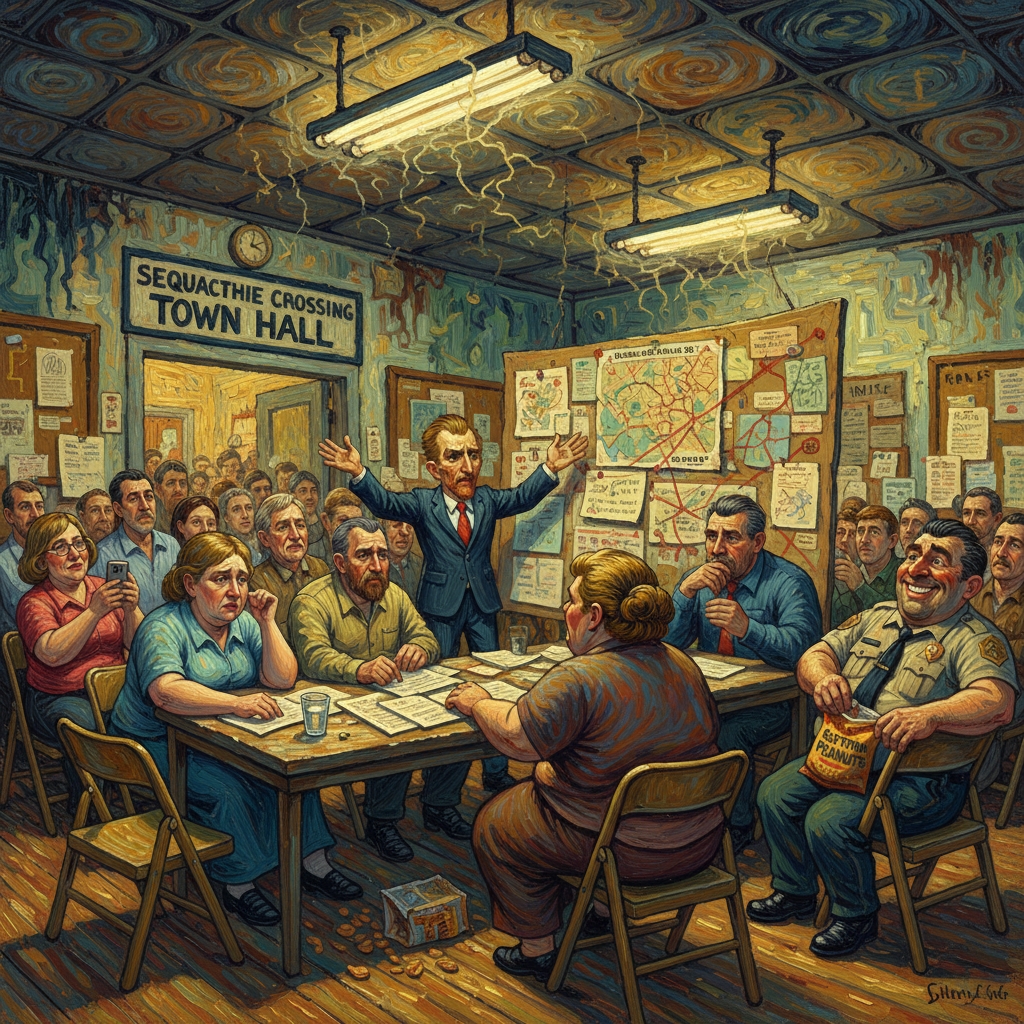
Shelley Fawn Wexler sat at the folding table near the front with a stack of municipal binders and the posture of a woman who regretted literacy.
“First item,” she announced, “ongoing concerns regarding recurring infrastructure irregularities.”
Nobody reacted.
Because nobody understood what that meant.
Boot leaned toward RT Mullins.
“That means somethin’ broke repeatedly.”
“Why didn’t she just say that?”
“Government language gains weight by hidin’ nouns.”
At the rear of the room, Trixie Jo Bartlett adjusted her phone tripod for livestream coverage.
“Sequatchie Crossing citizens,” she whispered dramatically into the camera, “we are once again gatherin’ under fluorescent lights to discuss mysteries no one planned to acknowledge.”
Officer Kenny Joe Teeter immediately waved.
“Tell everybody I said hey.”
“You’re interruptin’ journalism.”
Sheriff Peeler entered carrying two folders and a sack of gas station peanuts.
“Sorry I’m late. Somebody reported suspicious raccoons near the Dollar General.”
“Were they suspicious?” asked Tiffany Annette Roark.
“They were wearin’ expressions.”
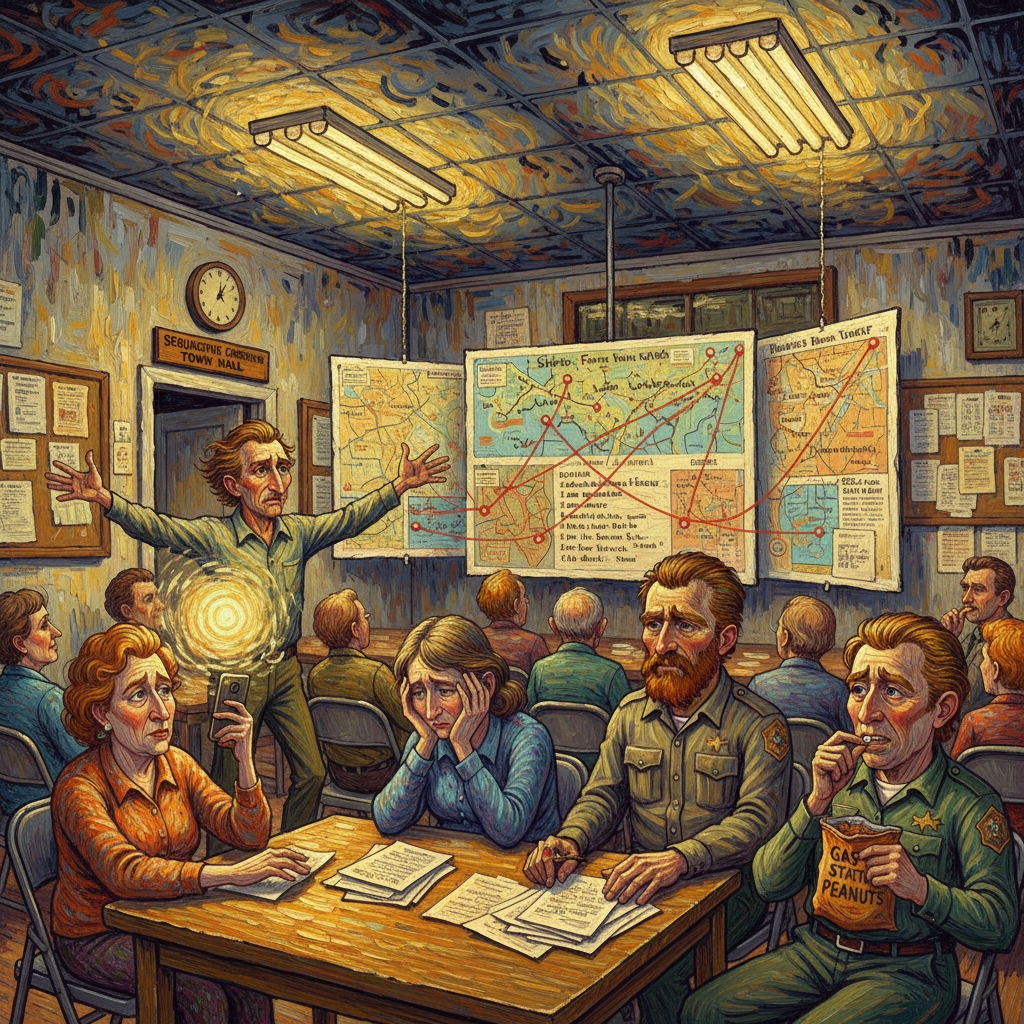
Clovis stood before being invited.
“I have evidence.”
A collective groan moved through Town Hall like weather.
Shelley pinched the bridge of her nose.
“Mr. Strickland—”
“The pattern has intensified.”
“Please don’t use poster boards again.”
Too late.
He unfolded three.
One showed dates.
One showed maps.
One showed what appeared to be chicken footprints connected by arrows.
Pastor Arnold Peeler squinted thoughtfully.
“Well,” he said quietly, “those are remarkably straight lines.”
Mabel Dean Ashcroft, seated beside Sister Lila Mae Pruitt, slapped both palms against the table.
“That’s what I BEEN sayin’.”
The room froze.
Nobody liked when Mabel used that tone because it generally meant she possessed receipts.
“You all laughed,” she continued. “Every time somebody mentioned strange repetition around here, folks acted like we was fools.”
Boot scratched his chin.
“To be fair, some of the evidence did involve poultry.”
“The Lord uses humble messengers,” Sister Lila Mae declared.
“Sometimes He uses forms,” Shelley muttered.
Clovis pointed at the timeline.
“Every six days:
- the church microphone cuts out,
- the water tower pressure dips,
- chickens march east,
- lights flicker at Town Hall,
- and Sonny Morales receives duplicate propane invoices.”
Sonny raised a hand from the back row.
“I thought that was unrelated.”
“That’s what patterns WANT you thinkin’.”
“Patterns don’t have motives,” Shelley said.
Act II – The Meeting Nobody Wanted To Have
“That’s exactly what a pattern would prefer.”
Tiffany Annette whispered into her livestream:
“He’s currently accusin’ abstract repetition of intentional behavior.”
Coach Freddie Stubblefield leaned back in his chair.
“I ain’t sayin’ I believe any of this… but our scoreboard at the football field has been resettin’ itself every sixth day.”
The room quieted.
Shelley looked up slowly.
“Seriously?”
“Every time it lands on 14 to 7.”
“Who’s winnin’?”
“No idea. It happens at night.”
Maggie Sue crossed her arms.
“And the diner coffee machine leaks every six days too.”
Now more heads turned.
Lurleen Davenport spoke carefully.
“The pharmacy freezer alarm also goes off every six days.”
Dr. Neil Cowgill frowned.
“I replaced that sensor twice.”
Pastor Peeler stood.
The room immediately respected the posture if not always the conclusions.
“There comes a time,” he said gently, “when enough repeated events stop bein’ isolated inconveniences and start revealin’ themselves as connected truth.”
Nobody spoke.
Because that sentence landed harder than expected.
Boot finally broke the silence.
“So now what?”
And somehow that question felt larger than chickens.
Act II – The Meeting Nobody Wanted To Have
Act III – Porch Analysis
The next morning half the town began quietly looking for patterns while pretending not to.
This was the Sequatchie Crossing way.
Nobody wanted to appear gullible.
But nobody wanted to ignore something obvious either.
So they investigated indirectly.
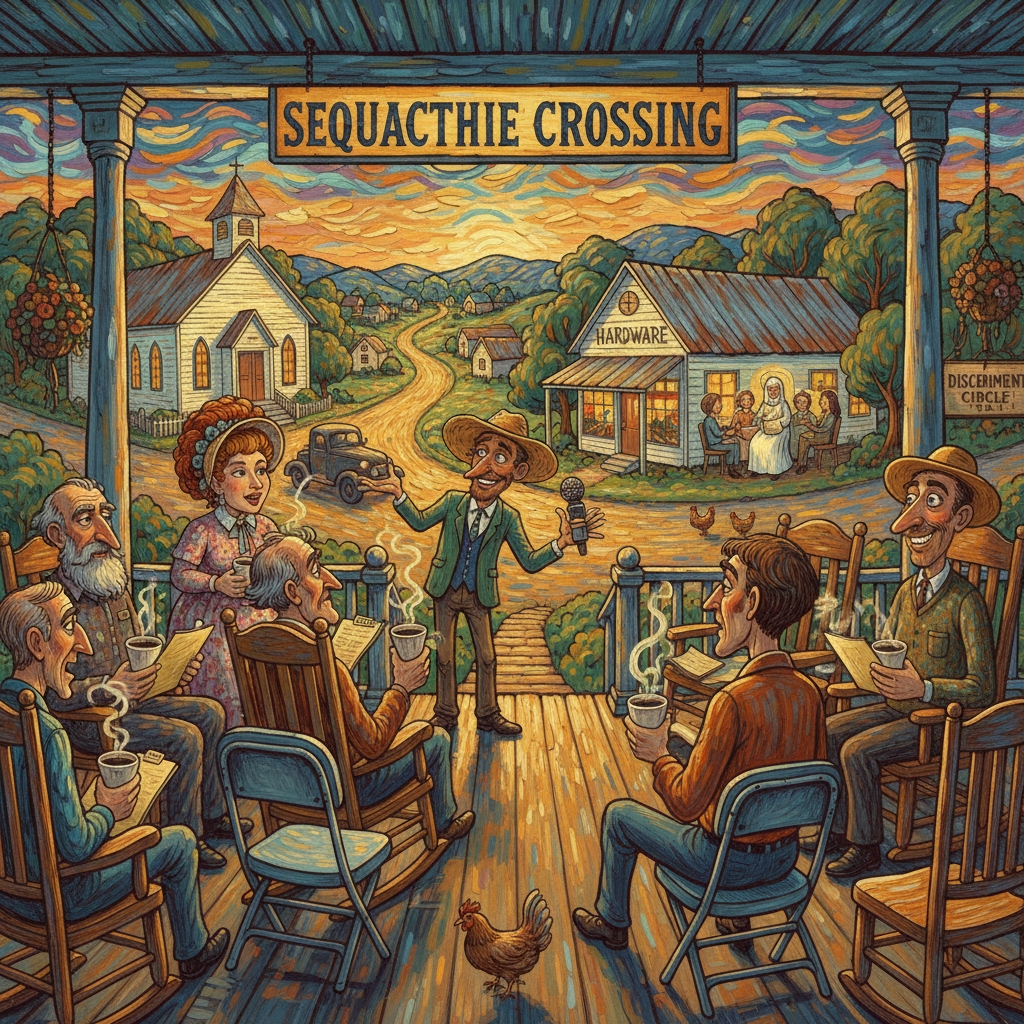
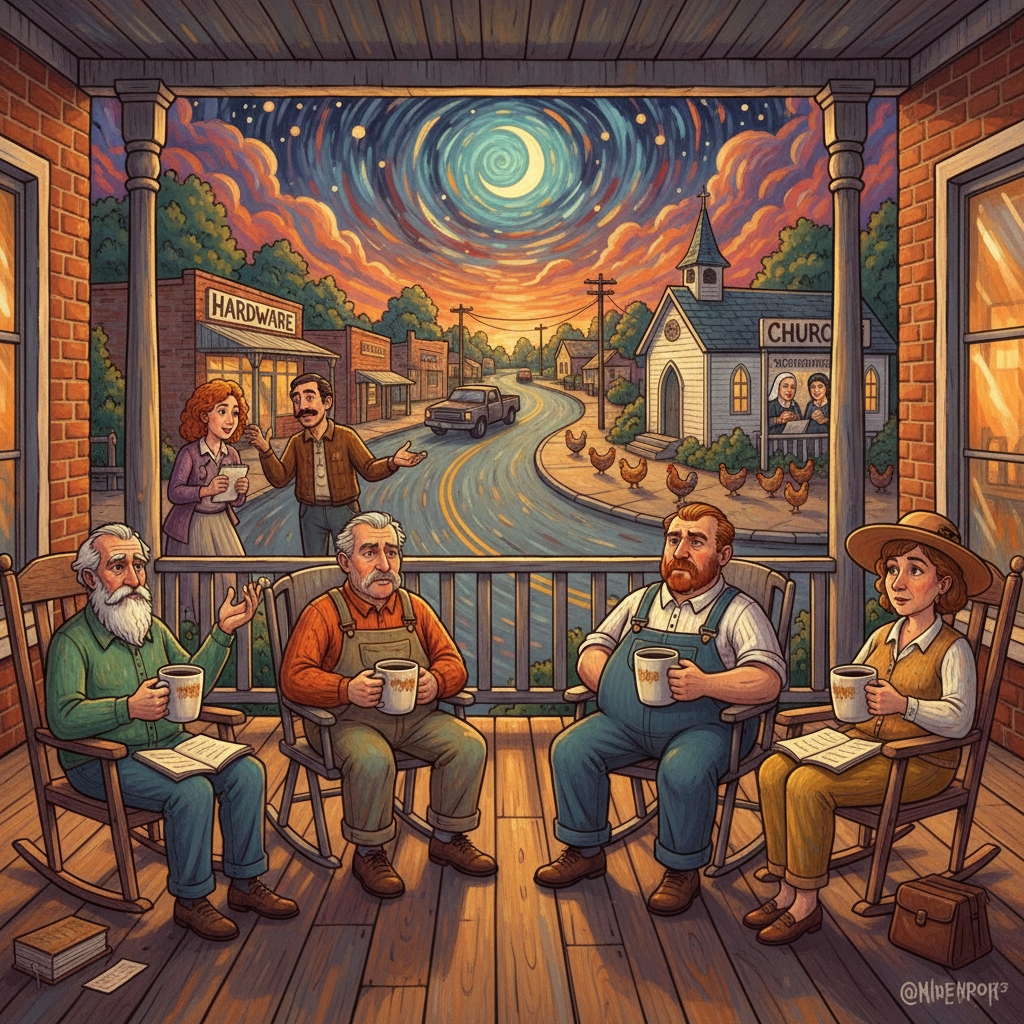
On Mister Wade Langston’s porch, four residents sat drinking coffee while watching traffic like amateur intelligence officers.
Wade pointed toward Main Street.
“Third blue pickup this mornin’.”
“Same one?” asked Evelyn Grace.
“Maybe.”
“That ain’t evidence.”
“No,” Wade admitted. “But it’s emotionally suspicious.”
Nearby, Daisy the hound slept through all investigative activity with the confidence of someone unconcerned by municipal awareness.
Boot arrived carrying a legal pad.
“You makin’ lists too?”
“I’m makin’ observations.”
“That’s just slower list-makin’.”
Boot sat.
“I’ll admit somethin’.”
Act III – Porch Analysis
“That you enjoy conspiracies?”
“No. That Clovis might’ve stumbled into somethin’ accidentally while lookin’ for somethin’ insane.”
“That’s usually how discoveries work,” Wade replied.
Across town, Trixie Jo and Tiffany Annette had begun interviewing residents.
“Have you personally noticed repeated phenomena?” Tiffany asked Sonny Morales outside the hardware store.
Sonny adjusted a stack of feed buckets.
“Well… every sixth day somebody asks if we sell bulk extension cords.”
“That could be seasonal.”
“In February?”
Trixie lowered her sunglasses.
“That IS strange.”
Meanwhile at the church fellowship hall, Sister Lila Mae organized what she called a “Discernment Circle.”
Which sounded spiritual but was effectively gossip with prayer breaks.
Mabel stood beside a dry erase board listing recurring events.
“Now,” she said, marker in hand, “who else got examples?”
Doug “Doughboy” Teeter raised a cautious hand.
“My truck radio only plays Conway Twitty every sixth mornin’.”
“That sounds more like mercy than evidence,” Pastor Peeler said.
Laughter spread briefly.
Then stopped when Clovis entered carrying another notebook.
“I found one more.”
Shelley groaned from the corner.
“How are there MORE?”
“The chickens only perform the movement after the courthouse clock rings.”
Silence.
Clovis looked around triumphantly.
“You see?”
“No,” Shelley answered honestly. “We really don’t.”
“But they wait for the signal.”
“What signal?”
“The bell.”
Tiffany scribbled furiously.
“Signal-triggered poultry ritual.”
Officer Kenny Joe Teeter blinked.
“That sounds federal.”
Pastor Peeler stepped closer to the board.
“You know what troubles me most?”
“What?” asked Mabel.
“How quickly we dismissed repetition because acknowledging it might require action.”
The room quieted again.
That sentence lingered.
Recognition had begun spreading through town not like panic—but like overdue memory.
Outside the fellowship hall, chickens crossed the church parking lot in perfect formation while nobody noticed except Daisy, who opened one eye briefly before returning to sleep.
Act III – Porch Analysis
Act IV – The Evidence Multiplies
By Friday, Sequatchie Crossing had entered what Shelby Fawn Wexler privately labeled “community-adjacent pattern hysteria.”
Residents now carried notebooks.
People timed things.
Conversations included phrases like:
- “statistically speakin’”
- “repeat occurrence”
- “correlation”
- and “that happened again.”
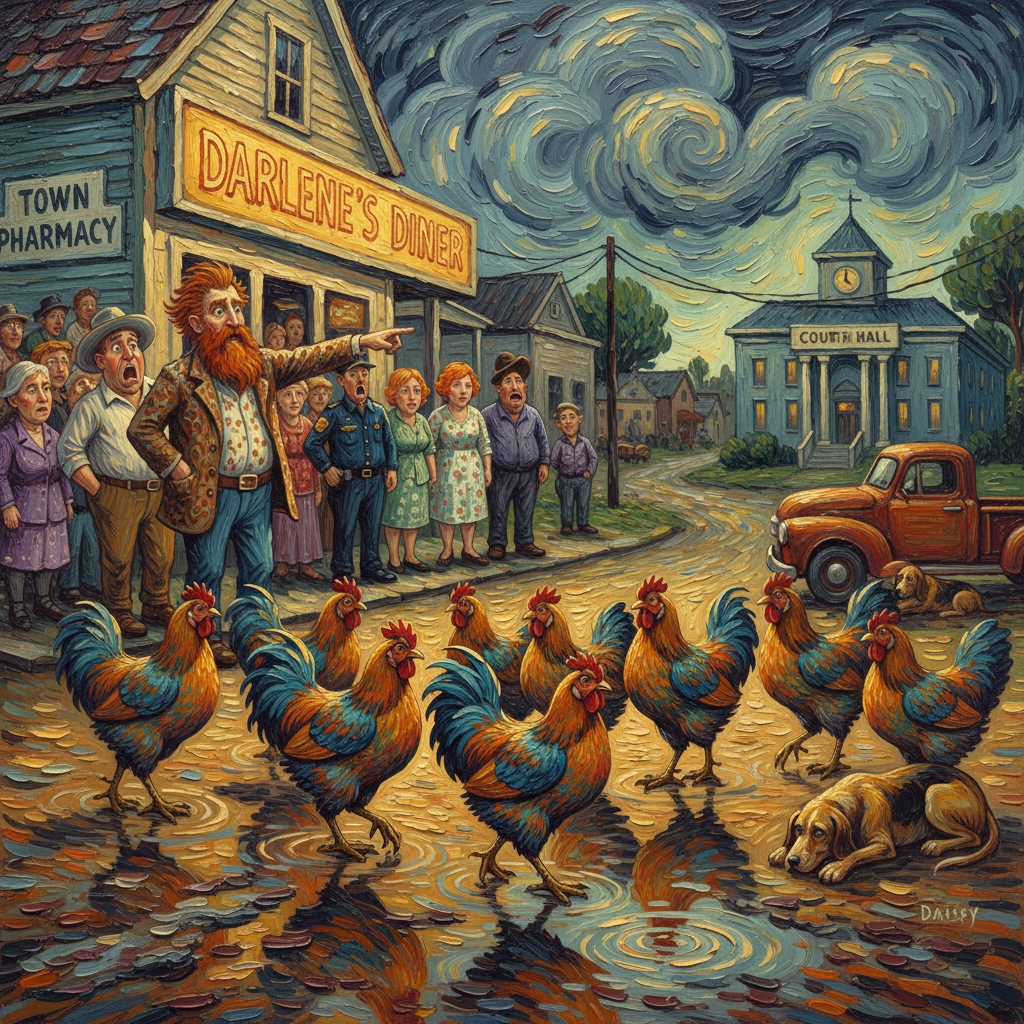
At Darlene’s Diner, Boot spread papers across a booth while RT Mullins counted hash browns absentmindedly.
“You know what worries me?” RT asked.
“That you’re countin’ potatoes?”
“No. That once folks start seein’ patterns, they start seein’ ALL patterns.”
Boot nodded slowly.
“That’s true.”
At the counter, Maggie Sue overheard.
“But sometimes there really IS a pattern.”
“Sure,” Boot said. “Question is whether it means somethin’ or whether life just repeats itself when nobody pays attention.”
Nearby, Clovis adjusted a wall map using thumbtacks.
Darlene herself finally emerged from the kitchen.
Act IV – The Evidence Multiplies
“If you poke one more hole in my wallpaper, I’m callin’ the sheriff.”
Sheriff Peeler raised a hand from his coffee.
“I’m already here and honestly I ain’t sure this qualifies as a crime anymore.”
Trixie Jo entered breathless.
“The chickens did it again.”
Forks paused midair across the diner.
“Where?” Clovis demanded.
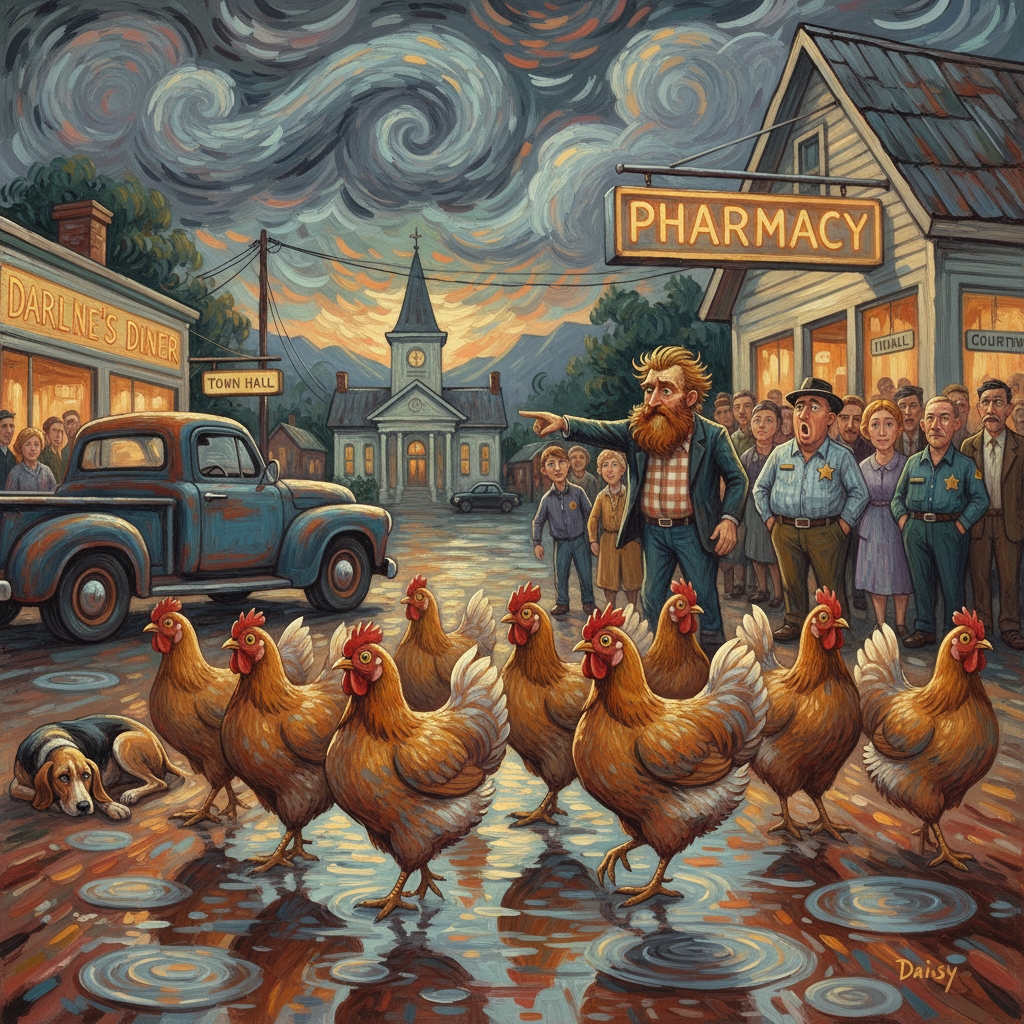
“Behind the pharmacy.”
“How many?”
“Nine.”
“Formation?”
“Perfect.”
Everyone looked at one another.
Then, without discussion, half the diner stood up and walked outside together.
That was how recognition worked in small towns:
not suddenly,
but collectively.
The group arrived behind Lurleen Davenport’s pharmacy just in time to watch the birds circle a puddle and stare toward Town Hall.
Eleven seconds.
Exactly.
Pastor Peeler removed his glasses slowly.
“Well.”
Mabel folded her arms triumphantly.
“That’s what I BEEN sayin’.”
Shelley looked exhausted.
“I still don’t understand what the pattern MEANS.”
“Maybe it don’t mean anything,” Boot said. “Maybe meanin’ ain’t the point.”
Clovis stared at the chickens.
“No,” he whispered. “It means something.”
“What?”
He pointed toward Town Hall.
“That’s where they keep lookin’.”
Everyone turned.
The building sat quietly beneath gray skies with three flickering exterior lights and a loose gutter nobody had repaired since Easter.
Officer Kenny Joe frowned.
“You reckon somethin’s in there?”
“Records,” Shelley answered immediately. “Mostly budget forms.”
“That’s exactly where secrets hide,” Clovis declared.
Sheriff Peeler sighed heavily.
“I swear to goodness if this turns into another basement investigation…”
Too late.
Boot already started walking toward Town Hall.
“So now what?”
Act IV – The Evidence Multiplies
Act V – The Basement Records
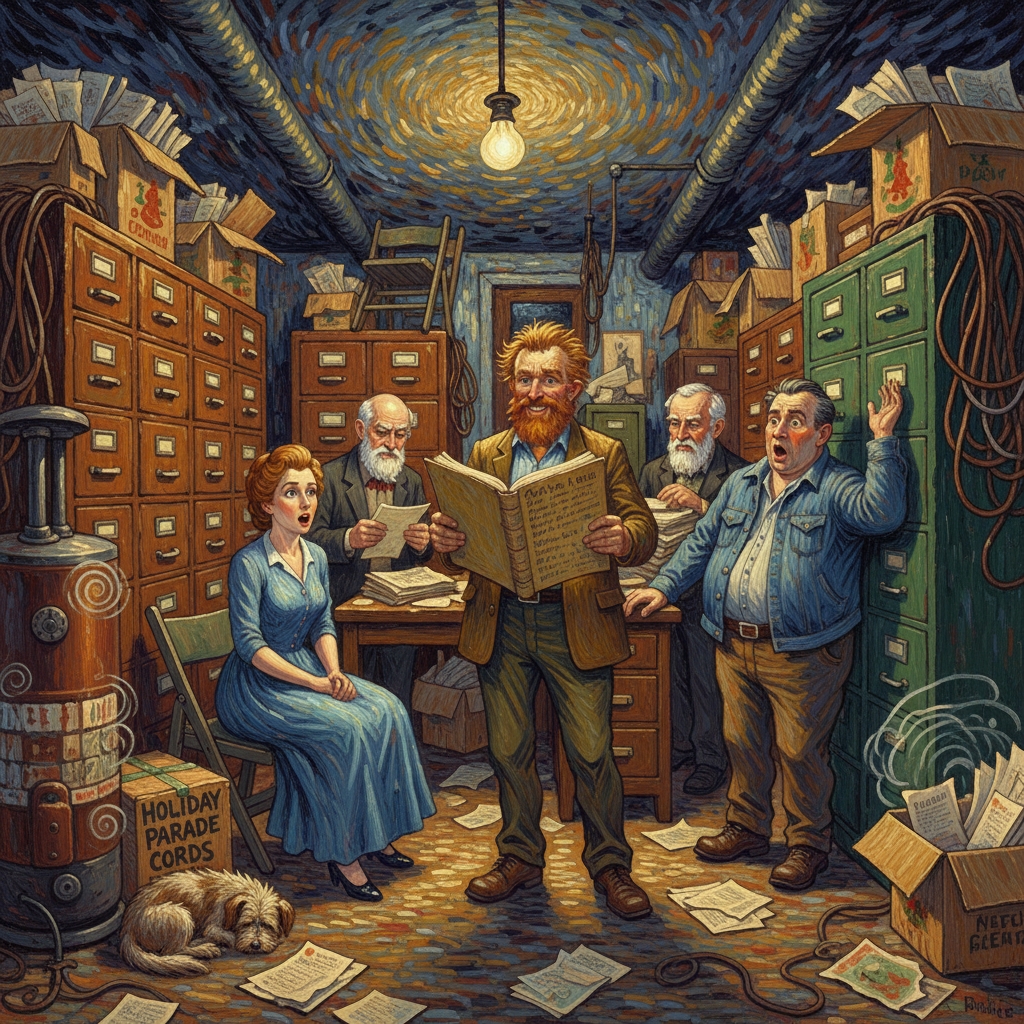
Town Hall’s basement smelled like mildew, extension cords, and unresolved grants.
Shelley unlocked the door reluctantly while muttering legal disclaimers under her breath.
“You are all officially unauthorized.”
“We appreciate your cooperation,” Clovis replied.
The basement lights flickered twice.
Everyone stopped.
“See?” whispered Tiffany.
“That’s faulty wiring,” Shelley insisted.
“It’s suspiciously faulty.”
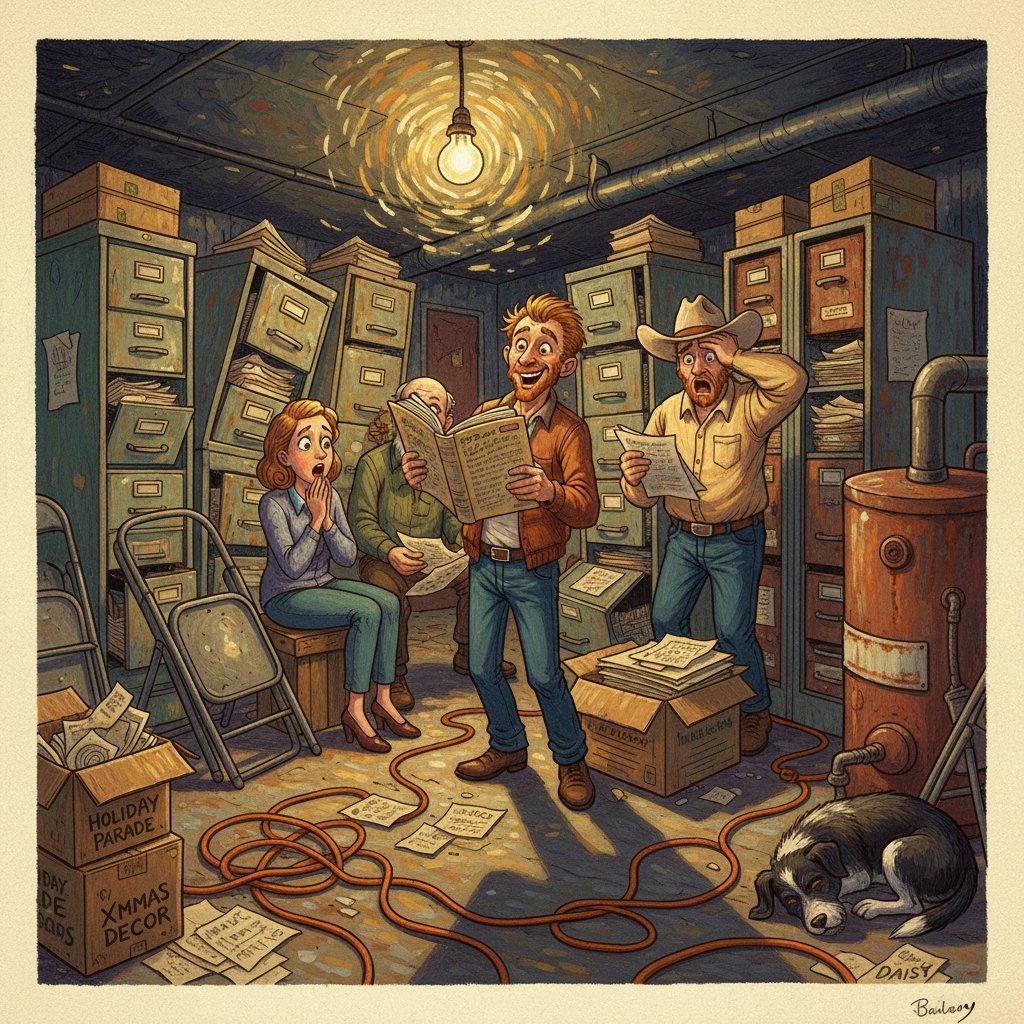
Rows of filing cabinets lined the walls beside stacked folding chairs and Christmas decorations from administrations nobody remembered.
Daisy wandered downstairs and immediately curled beside a water heater.
Boot opened a cabinet.
“Lord alive.”
Inside sat decades of maintenance reports.
Water pressure complaints.
Electrical notes.
Service interruptions.
Same dates.
Every six days.
Shelley stared blankly.
“That can’t be right.”
Clovis grinned with terrifying satisfaction.
“I told you.”
Pastor Peeler leafed through yellowing documents carefully.
“These reports go back years.”
“How’d nobody notice?” Maggie Sue asked.
“Because they filed everything separately,” Shelley whispered.
Recognition spread across the room like cold weather.
Nobody had seen the pattern because bureaucracy had divided it into categories.
Water department.
Electrical.
Facilities.
Road maintenance.
Church permits.
Noise complaints.
Each issue existed alone.
Separated.
Harmless.
Until combined.
Mabel sat heavily in a folding chair.
Act V – The Basement Records
“My Lord.”
Sheriff Peeler scratched his neck.
“So this whole town’s been experiencin’ the same cycle for years?”
“Looks that way,” said Dr. Cowgill quietly.
Clovis opened another folder.
“And every time somebody brought it up, folks dismissed it as coincidence.”
Boot leaned against a cabinet.
“Well… some of the people bringin’ it up WERE Clovis.”
“That prejudiced the evidence.”
“No,” Boot replied. “It complicated marketing.”
Trixie Jo filmed the basement dramatically.
“Citizens of Sequatchie Crossing,” she whispered, “we are now standin’ inside archival proof that the town ignored repetition because repetition arrived disguised as inconvenience.”
Shelley sank onto a crate labeled HOLIDAY PARADE CORDS.
“We’ve spent years reactin’ instead of observin’.”
Pastor Peeler nodded slowly.
“Patterns reveal themselves gradually because denial weakens gradually.”
Silence followed.
Even Clovis stopped talking for almost six seconds.
Then Officer Kenny Joe opened a final cabinet.
Inside sat a handwritten ledger dating back forty years.
The title read:
RECURRING INCIDENTS – POSSIBLY CONNECTED
Everybody stared.
“What in the world,” Boot muttered.
Sheriff Peeler opened the first page.
The handwriting belonged to former town clerk Bernice Holloway.
Entry after entry documented the same cycle.
Including chickens.
Mabel gasped.
“She noticed too.”
The final line, written decades earlier, read:
“People reject patterns that imply responsibility.”
Nobody spoke after that.
Because everybody understood exactly what it meant.
Act V – The Basement Records
Act VI – The Public Realization
By Saturday morning, the town had transformed.
Not dramatically.
Subtly.
Which was worse.
People now spoke carefully around repeated events.
Citizens paused when lights flickered.
Drivers noticed the same potholes reopening.
Residents recalled years of strange repetition they’d previously laughed away.
Recognition had entered public consciousness.
And once that happened, denial became exhausting.
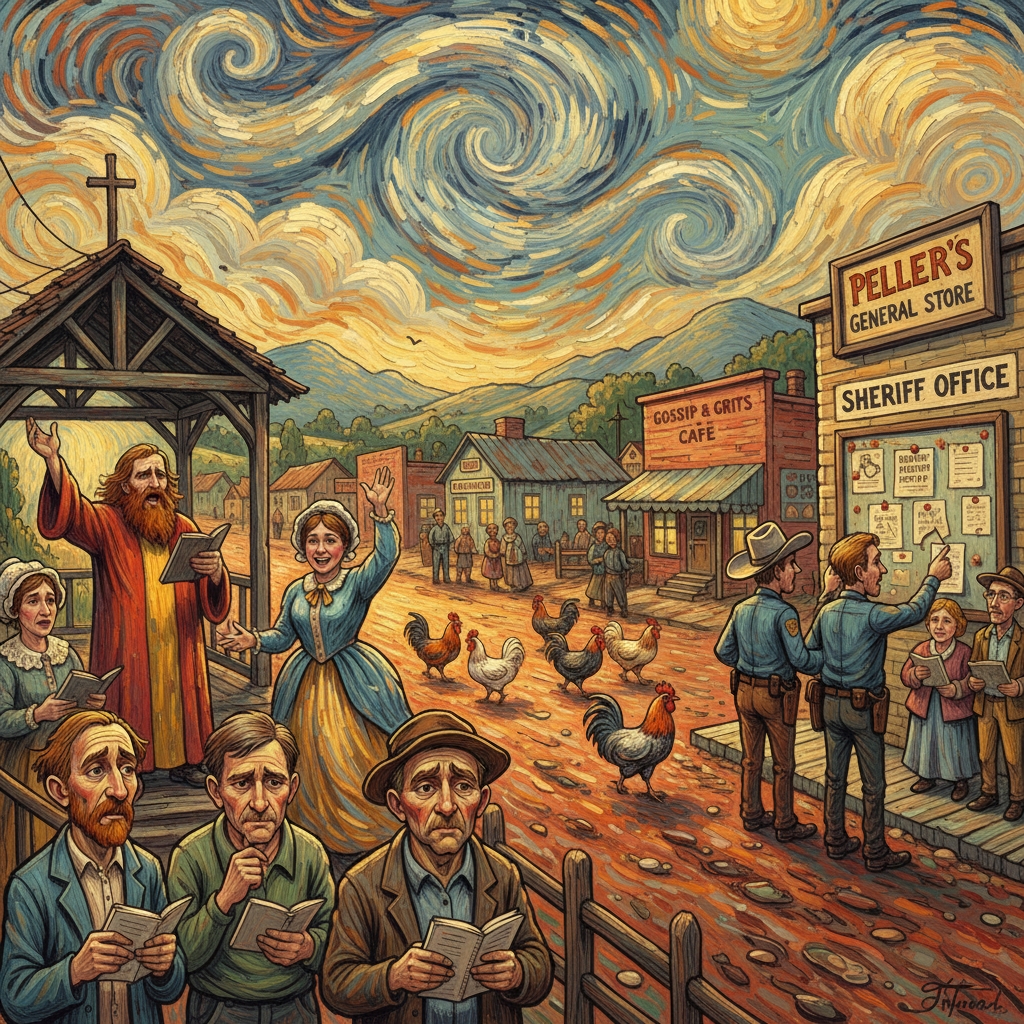
Outside the diner, Mister Wade Langston addressed a small crowd.
“You know what this reminds me of?”
“Nixon?” offered RT.
“No. Roof leaks.”
“That’s specific.”
“You ignore one drip long enough, eventually the ceiling introduces itself.”
Maggie Sue pointed toward Main Street.
“Y’all notice the crosswalk light only malfunctions on cycle days?”
Three people immediately nodded.
Clovis nearly levitated with vindication.
“Yes!”
Boot held up both hands.
“Easy now. We still ain’t discovered whether the pattern means sabotage, infrastructure decay, fate, or deeply organized chickens.”
“Why not all four?” asked Trixie.
At the church, Pastor Peeler delivered an impromptu sermon to residents gathered beneath the pavilion.
“The danger of ignored patterns,” he preached, “is not merely inconvenience. It is the gradual training of people to normalize dysfunction.”
Several folks exchanged uncomfortable looks.
Act VI – The Public Realization
Because the sentence reached beyond water pressure and chickens.
Sister Lila Mae stood and shouted:
“Hallelujah for overdue recognition!”
“Amen,” replied half the crowd automatically.
Nearby, Shelley and Dr. Cowgill reviewed copies of the basement records.
“This changes municipal planning completely,” Shelley muttered.
“How?”
“We’ve been treatin’ symptoms separately instead of structurally.”
“That sounds expensive.”
“It absolutely is.”
Meanwhile at the sheriff’s office, Kenny Joe had begun charting incident reports on a corkboard.
Sheriff Peeler stared at it nervously.
“You’re makin’ it look criminal.”
“Everything looks criminal with enough thumbtacks.”
Daisy barked once from the hallway.
Kenny Joe froze.
“You think she notices patterns too?”
“She’s a dog.”
“That ain’t a no.”
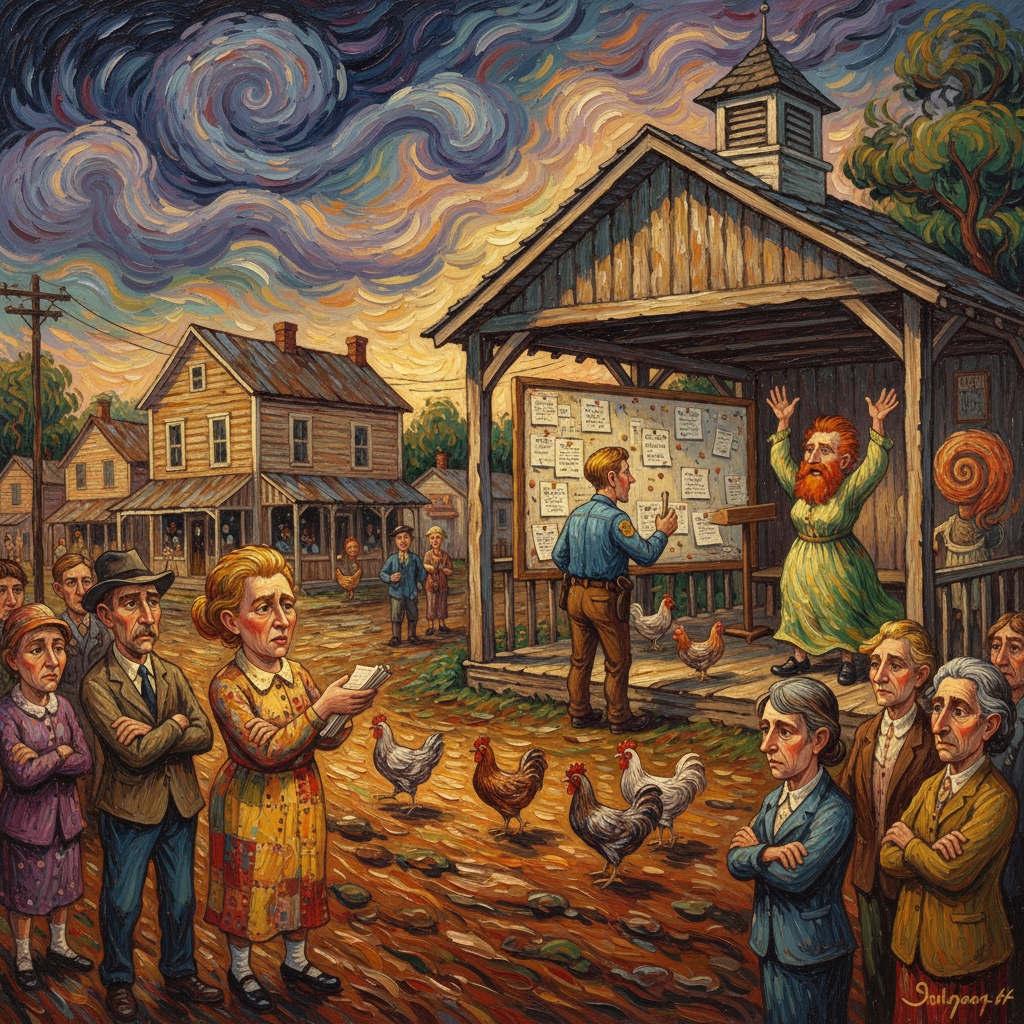
Across town the chickens marched again.
This time people watched.
Nobody laughed.
The birds crossed the gravel lot, circled the stump, stared east, paused eleven seconds, and dispersed.
An entire crowd stood silently observing.
Finally Boot spoke.
“Well.”
“What?” Clovis asked eagerly.
“I’ll be damned.”
Act VI – The Public Realization
Act VII – The Town Attempts Interpretation
Recognition, unfortunately, created a second problem:
interpretation.
Once everybody accepted the pattern existed, opinions multiplied like mosquitoes near standing water.
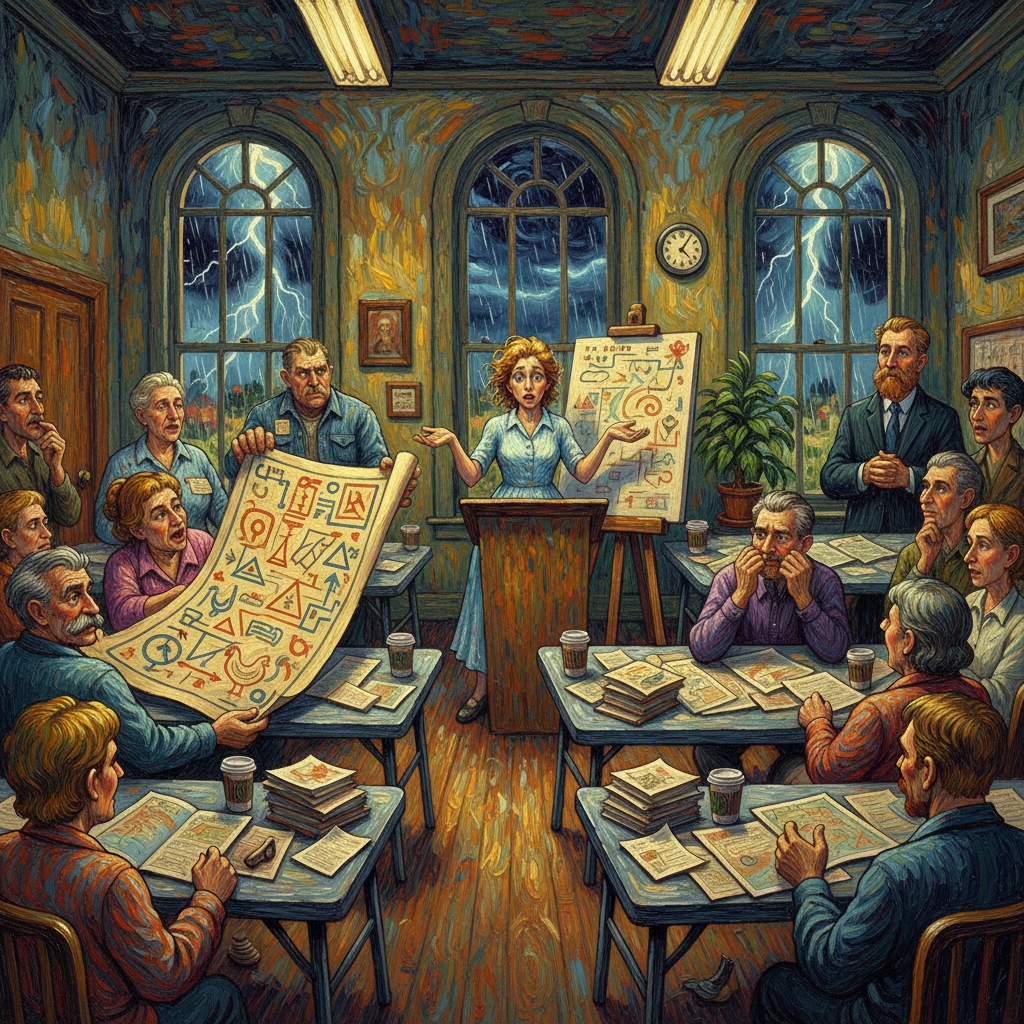
At Town Hall, Shelley attempted to moderate what quickly became twelve simultaneous theories.
“It’s deferred maintenance,” she insisted.
“It’s spiritual stagnation,” Sister Lila Mae countered.
“It’s behavioral conditioning,” Dr. Cowgill offered.
“It’s directional poultry intelligence,” Clovis added.
“No,” Shelley snapped.
Coach Freddie believed the football field sat atop magnetic rock.
Tiffany Annette suspected algorithmic interference from traffic apps.
RT blamed “modern wiring.”
Mabel blamed “people refusin’ to listen.”
Pastor Peeler blamed avoidance itself.
Boot sat quietly near the back until everyone noticed.
“Well?” asked Sheriff Peeler.
Boot shrugged.
“I think folks hate patterns because patterns suggest consequences.”
The room quieted.
He continued.
“If events repeat long enough, eventually you gotta admit they ain’t accidents anymore. And once you admit that, somebody usually gotta change somethin’.”
“That’s unpleasantly reasonable,” Shelley admitted.
Mabel pointed directly at him.
Act VII – The Town Attempts Interpretation
“That’s what I BEEN sayin’.”
Outside, rain began tapping against Town Hall windows.
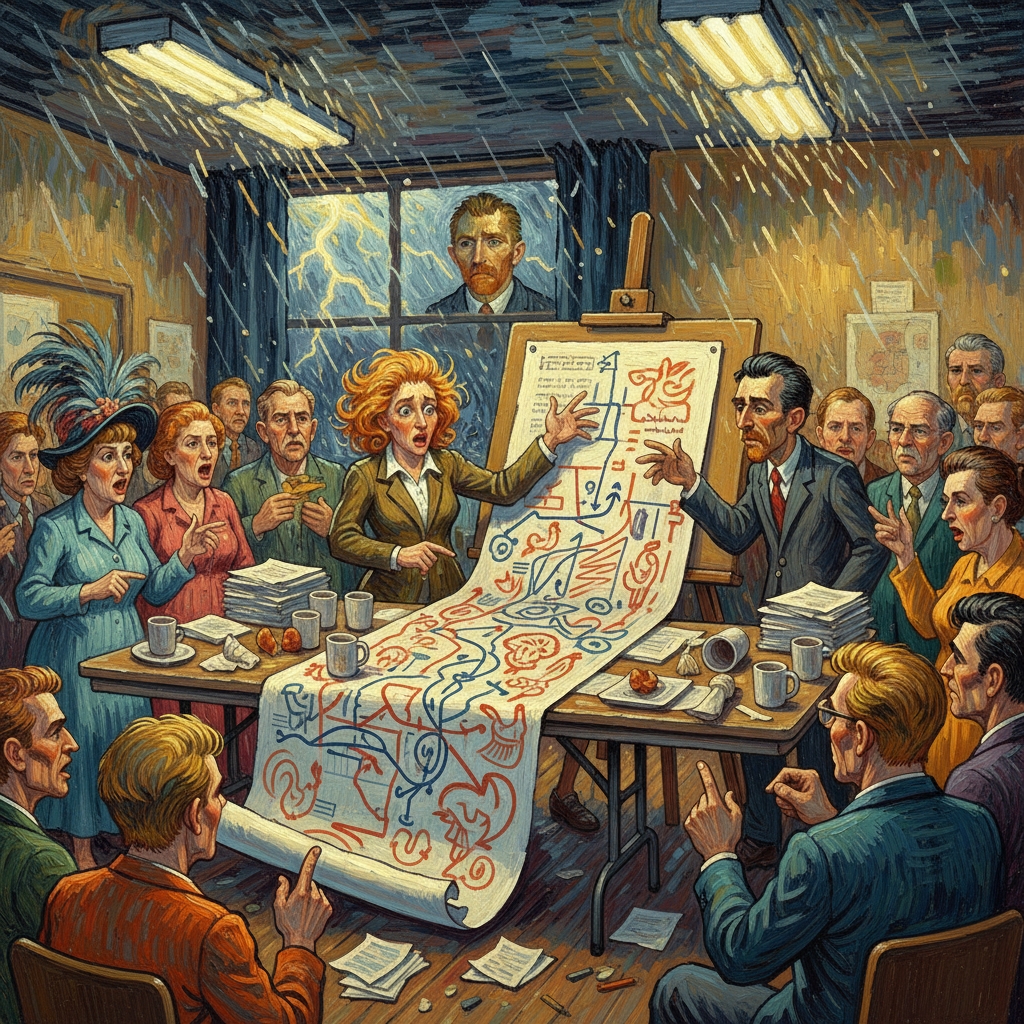
Clovis unfolded another chart.
“I tracked one more thing.”
“Oh dear God,” Shelley whispered.
“The courthouse bell rings eleven seconds before every chicken movement.”
“We know that.”
“Yes,” Clovis said, eyes wide, “but today the bell malfunctioned.”
Everybody leaned forward.
“And?”
“The chickens hesitated.”
Silence.
Even Shelley looked unsettled.
“You’re serious?”
“They waited four extra seconds.”
Officer Kenny Joe crossed himself instinctively.
“That feels important.”
“It feels weird,” Boot corrected.
Pastor Peeler smiled softly.
“Sometimes recognition begins with weirdness.”
The storm intensified outside.
Town Hall lights flickered.
Again.
This time nobody ignored it.
Act VII – The Town Attempts Interpretation
Act VIII – The March
On the sixth morning after the basement discovery, nearly the entire town gathered near Clovis Strickland’s property before sunrise.
Nobody officially organized it.
People simply showed up.
Coffee cups.
Rain jackets.
Folding chairs.
Curiosity.
Recognition had evolved into observation.
Daisy wandered among the crowd accepting biscuits like a minor politician.
Trixie Jo prepared livestream commentary while Tiffany adjusted battery packs.
“History,” Tiffany whispered dramatically, “may be occurring.”
“Or chickens,” Boot replied.
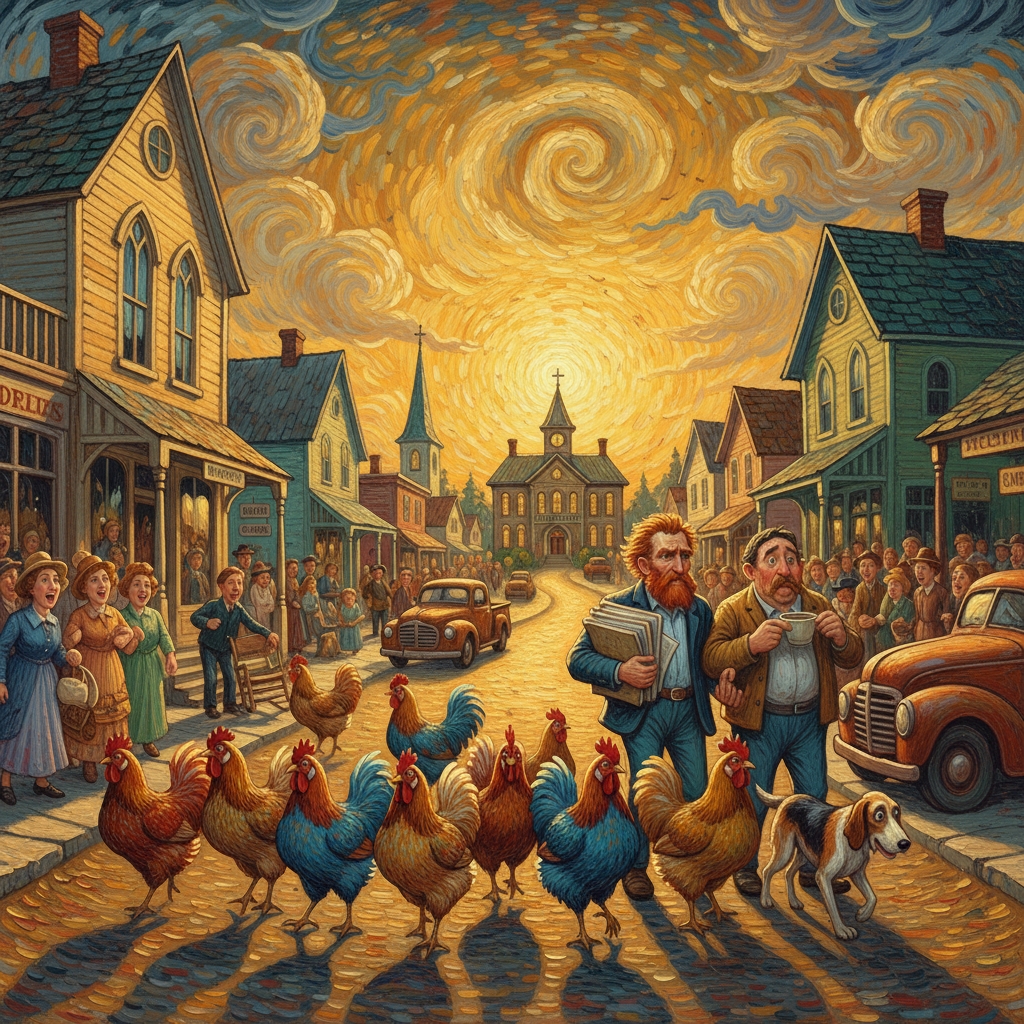
At exactly 7:12 a.m., the courthouse bell rang.
The chickens emerged.
Single file.
Perfect formation.
The crowd remained silent.
The birds crossed the gravel.
Circled the stump.
Paused.
Turned toward Town Hall.
But this time they did not stop.
Instead they continued walking.
Straight down Main Street.
Gasps spread through the crowd.
“Oh Lord,” whispered Evelyn Grace.
The entire town followed.
Not running.
Walking.
As though participating in an accidental parade organized by uncertainty itself.
The chickens marched past:
- Darlene’s Diner
- the pharmacy
- the barber shop
- the sheriff’s office
- the church
People stepped onto porches to watch.
Visitors slowed traffic.
Somebody began recording vertically despite repeated instructions not to.
At the front of the procession walked Clovis with absolute vindication radiating from his body like dangerous sunlight.
“I knew it.”
“You suspected it,” Boot corrected.
“I emotionally knew it.”
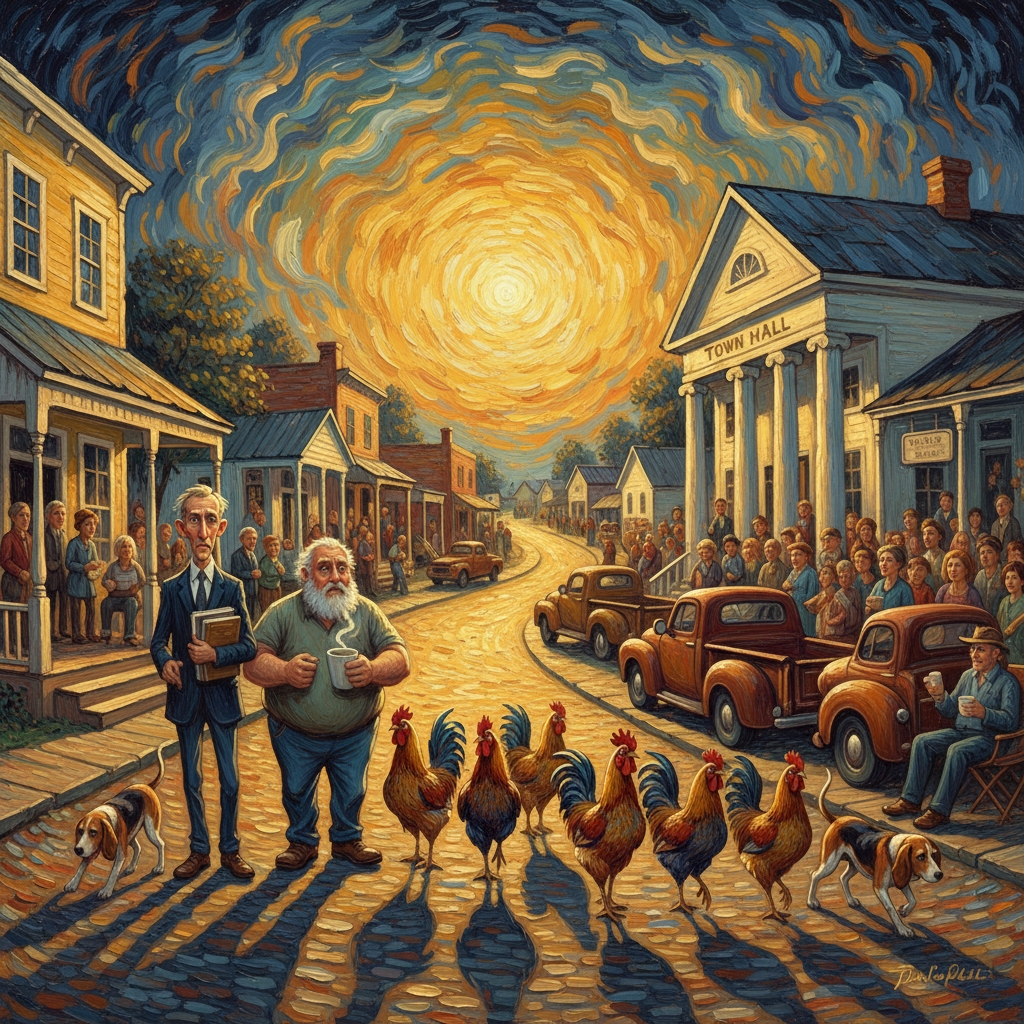
The chickens reached Town Hall.
Then stopped.
All nine birds turned toward the basement door simultaneously.
Nobody spoke.
Shelley swallowed visibly.
“You have GOT to be kidding me.”
Act VIII – The March
Sheriff Peeler stepped forward slowly.
“You reckon they smell somethin’?”
Mabel folded her arms.
“No. I reckon they remember somethin’.”
That sentence settled heavily over the crowd.
Pastor Peeler moved beside her.
“Places remember neglect,” he said quietly. “Communities do too.”
The basement lights flickered beneath the building.
Clovis pointed dramatically.
“There!”
“That’s electricity,” Shelley replied weakly.
But even she sounded unconvinced now.
Boot looked around at the gathered townspeople.
Everybody stood together silently:
the skeptical,
the believers,
the exhausted,
the curious.
Recognition had unified them more effectively than certainty ever had.
Finally Daisy barked once.
The chickens dispersed instantly.
Just walked away.
Gone.
The crowd remained motionless.
After a long silence, Boot removed his cap.
“So now what?”
Act VIII – The March
Act IX – What Happens After Recognition
Three weeks later, Sequatchie Crossing remained changed.
Not because anybody solved the pattern.
Nobody did.
No grand revelation emerged.
No hidden machine.
No criminal conspiracy.
No secret underground chicken society.
What changed was simpler.
And therefore more difficult.
People began paying attention.
Town departments started comparing records together instead of separately.
Maintenance schedules aligned.
Residents reported repeated issues without embarrassment.
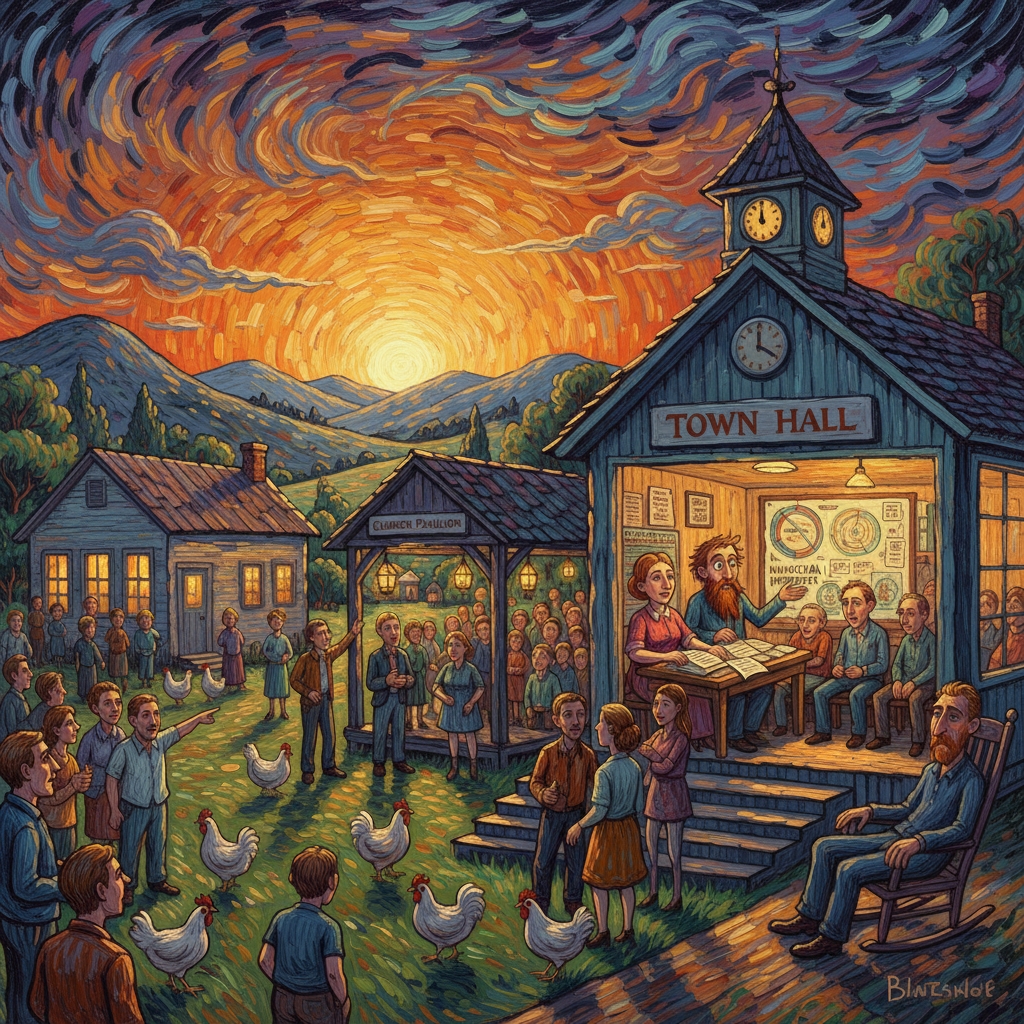
Shelley established something officially called the “Cross-Departmental Recurring Incident Committee,” which everyone immediately shortened to “the Pattern Board.”
Clovis attended every meeting with terrifying enthusiasm.
Act IX – What Happens After Recognition
Mabel attended every meeting with vindicating satisfaction.
Boot attended mostly for snacks.
At the church pavilion, Pastor Peeler addressed another gathering.
“Recognition,” he told them, “does not always provide answers. Sometimes its first purpose is merely ending denial.”
Nearby, Sister Lila Mae shouted:
“Hallelujah for overdue awareness!”
Even Shelley nodded slightly this time.
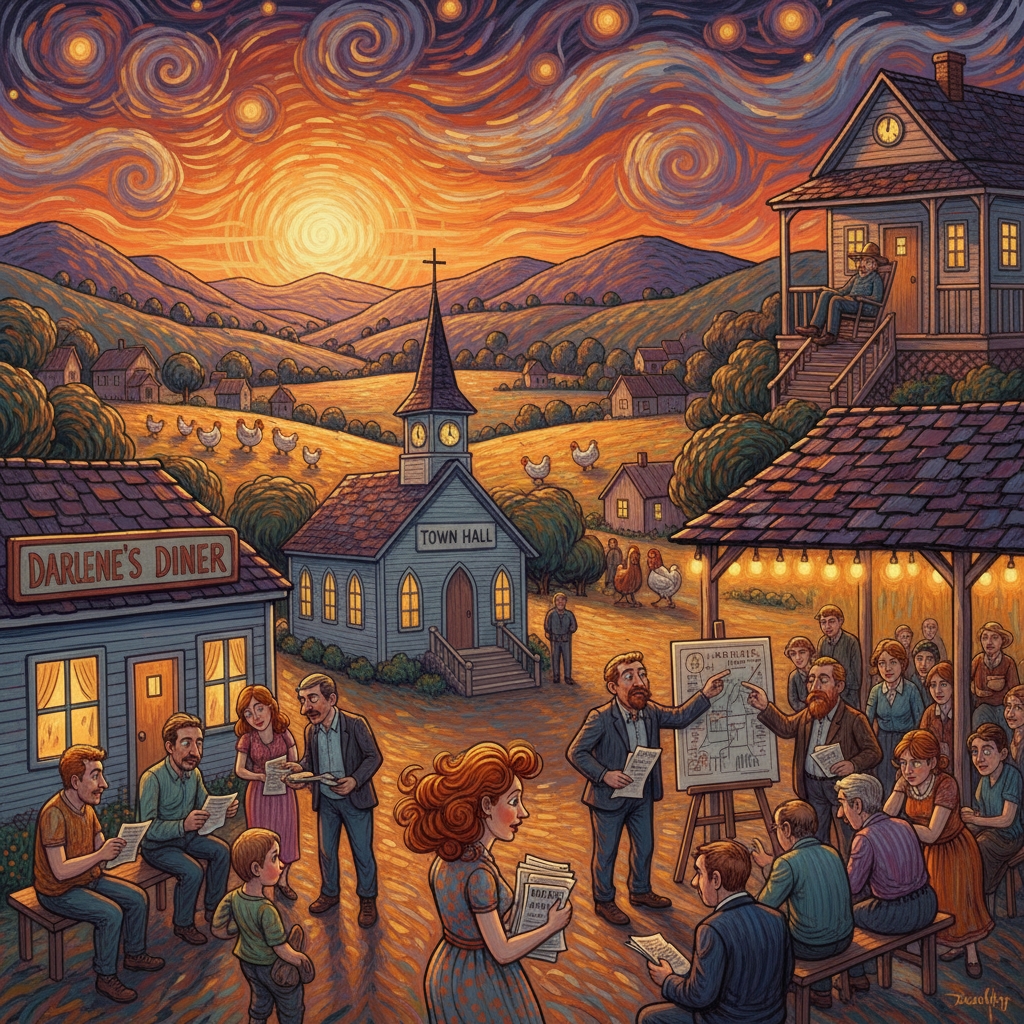
At Darlene’s Diner, conversations changed.
Folks now asked:
- “Has this happened before?”
- “Who else noticed?”
- “What are we missin’?”
- “Did anybody write it down?”
The town became less reactive.
More observant.
And strangely calmer.
Because once patterns became visible, people no longer felt individually crazy.
One evening Boot sat on Wade Langston’s porch watching sunset settle across Sequatchie Valley.
“You know somethin’?” Boot said.
“What?”
“I think the scariest part wasn’t the pattern.”
“What was?”
“That everybody got used to repetition so gradual they stopped askin’ whether things should be happenin’ at all.”
Wade nodded slowly.
“That’ll preach.”
Across the valley, courthouse bells rang softly.
Daisy lifted her head.
Far down Main Street, nine chickens emerged briefly beside Town Hall.
They crossed together.
Paused.
Turned east.
And for the first time, half the town noticed immediately.
Nobody laughed.
Act IX – What Happens After Recognition
Epilogue – The Ledger Continues
Months later, the basement ledger continued growing.
New entries appeared weekly.
Not dramatic ones.
Small things.
Repeated things.
Noticed things.
Shelley contributed infrastructure notes.
Sheriff Peeler added incident timing.
Dr. Cowgill tracked utility fluctuations.
Mabel documented “everybody finally catchin’ up.”
Clovis added maps nobody fully understood.
Boot occasionally wrote practical observations like:
“Problem still ain’t fixed.”
Which, according to many residents, remained the most accurate entry in the entire book.
The chickens continued marching every sixth morning.
Nobody stopped them.
Nobody entirely understood them either.
But understanding had ceased being the point.
Recognition itself had changed the town.
Patterns once dismissed as isolated annoyances now existed within shared memory.
And once a community begins recognizing repetition together, denial loses much of its authority.
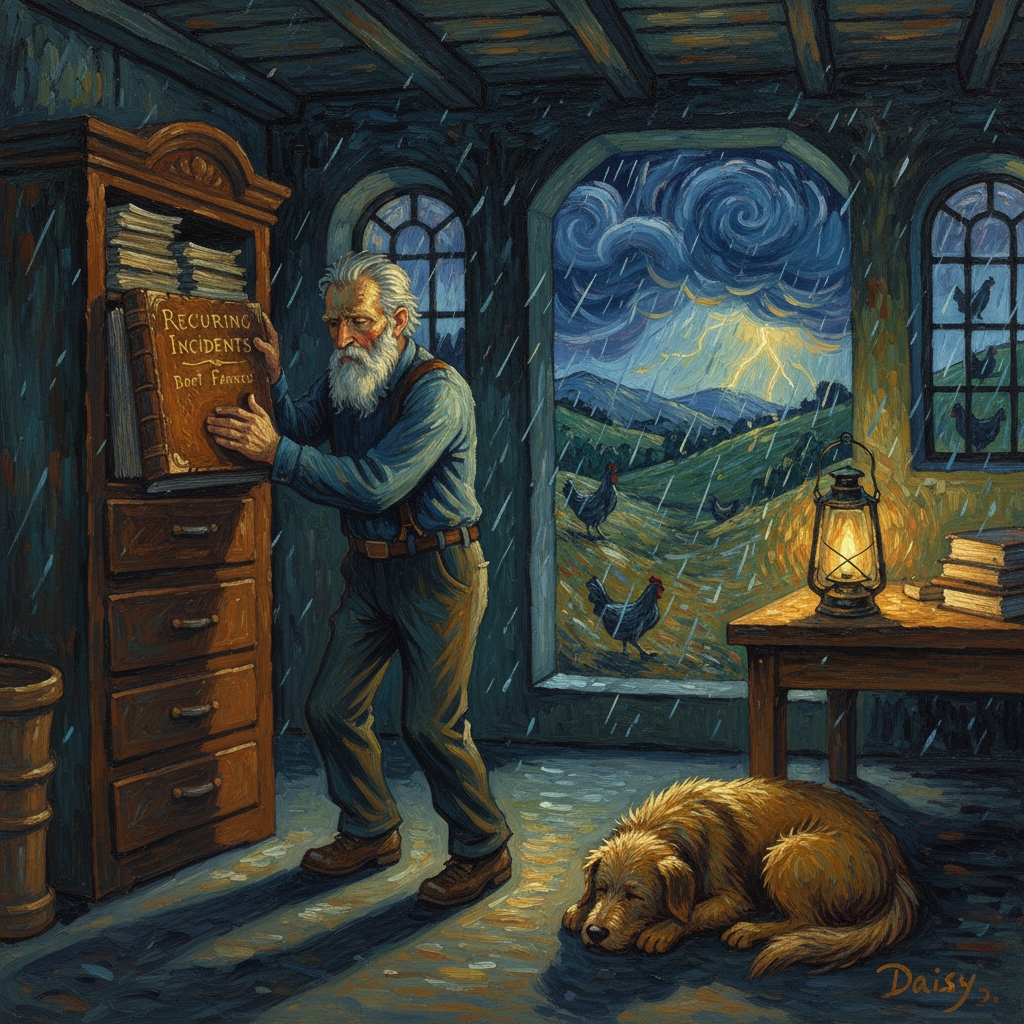
One rainy evening Pastor Peeler closed the ledger carefully and placed it back inside the cabinet.
“You know,” he said softly to Mabel, “truth rarely arrives all at once.”
Mabel smiled.
“No,” she replied. “Usually it just keeps happenin’ till folks get tired of pretendin’ otherwise.”
Outside, thunder rolled gently through Sequatchie Valley.
The courthouse bell rang.
And somewhere in the dark, chickens began moving again.
Epilogue – The Ledger Continues
Disclaimer
The events, businesses, locations, poultry formations, infrastructure irregularities, and recurring chicken behaviors depicted in this story are entirely fictional and part of the ongoing satirical world of Sequatchie Crossing Dispatch.
Any resemblance to actual persons, towns, municipal frustrations, unexplained patterns, folding chair incidents, basement ledgers, or emotionally suspicious chickens is purely coincidental.
No real residents of Dunlap, Tennessee are portrayed in this fictional work.
Citizens are nevertheless encouraged to document recurring events responsibly.
Disclaimer – Town Notices Pattern It Previously Declared Nonexistent
Real Places Behind the Ruckus – From The Dunlap Directory

Real Places Behind the Ruckus – From The Dunlap Directory
Yes, this story was fictional; even the parts that weren’t true. These places? Absolutely real. Stop by, support local, and keep the Wi-Fi away from livestock:
- Applegate Inn
- Big Soddy Creek Gulf
- Citgo – Little Store
- County Veterans Service Offices
- W N Lofty Grading & Paving Co
- Four Point Lounge
- MaKyla-Kai Photography
- Adoration Home Health and Hospice
- Brockdell Produce
- TA Surveys
- Wilson’s Lawn Care
- New Shade Painting & Co
- Results Physiotherapy Dunlap Clinic
- Sequatchie Valley TN
- Western Union – Walmart
- Stone Creek Farm
- Highland Enterprise

Real Places Behind the Ruckus – From The Dunlap Directory
At Sequatchie Crossing, we tell the stories of Sequatchie Crossing.
Please share this post with your friends, family, or business associates who may want follow the news from Sequatchie Crossing.

0 Comments