


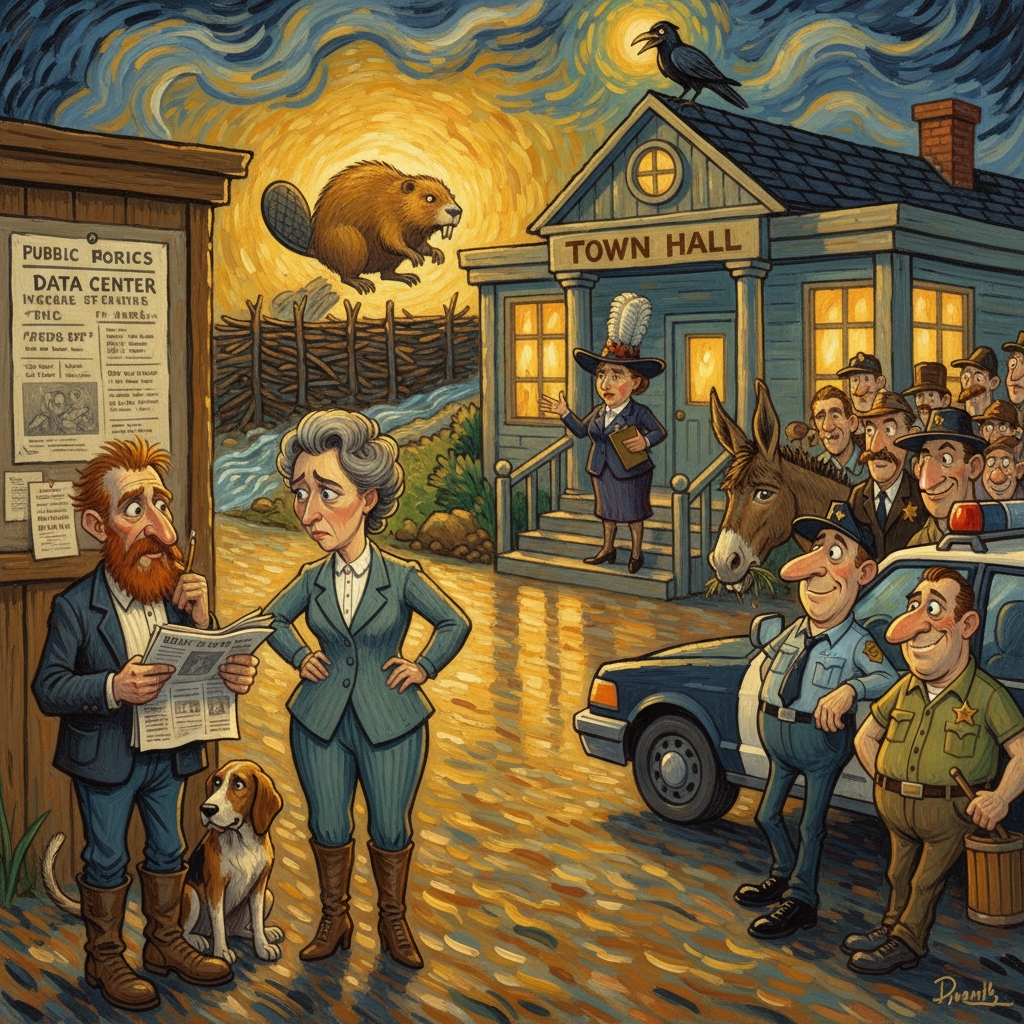
Automation Became Both Promise and Threat
By Tom Seest
At Sequatchie Crossing, we tell the stories of Sequatchie Crossing.
Please share this post with your friends, family, or business associates who may want follow the news from Sequatchie Crossing.
🎤 Audio Overview
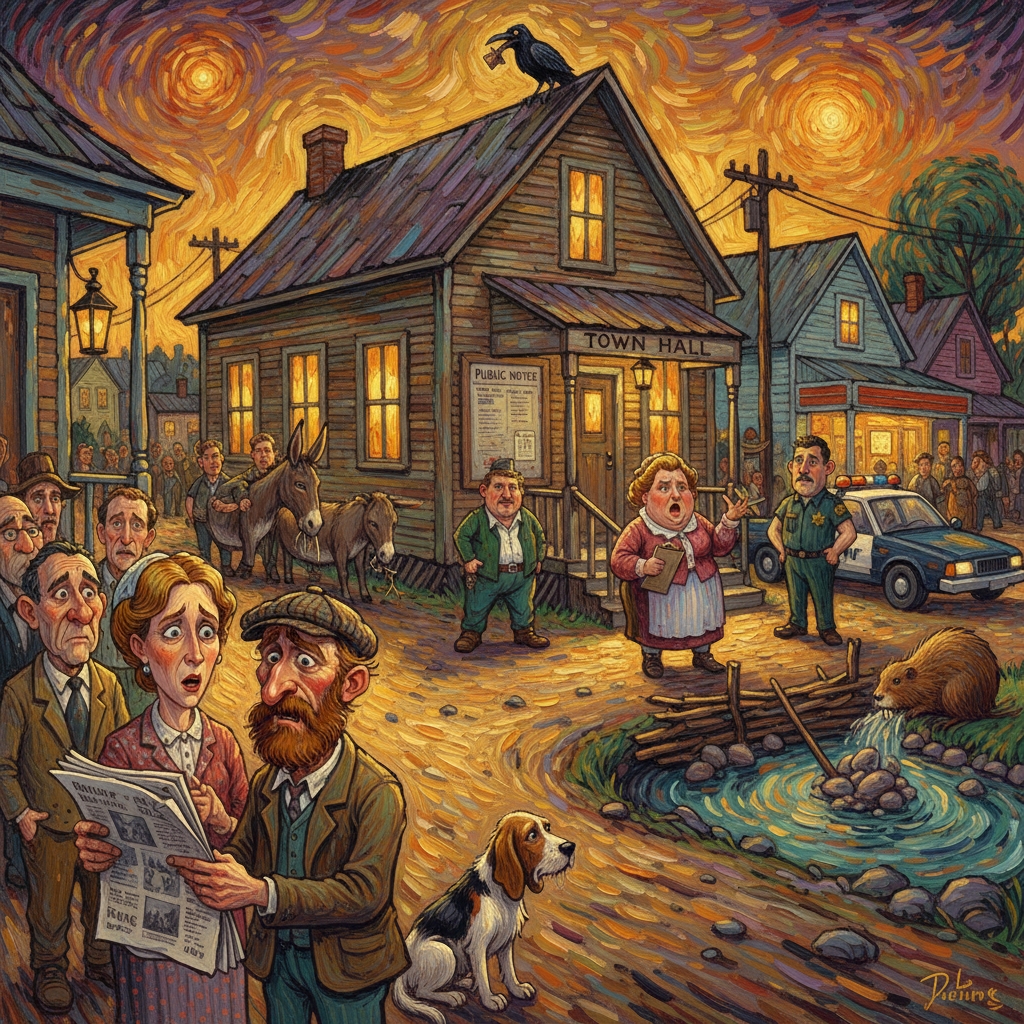
The Robot Working Overtime
Act I – The Diner Where The Robot Took Breaks Nobody Authorized
The first person in Sequatchie Crossing to declare that artificial intelligence had gotten too big for its britches was not a computer programmer, a school board member, or anybody who had ever read a white paper.
It was Mabel Dean Ashcroft, standing beside the pie warmer at Dillard’s Crossroads Diner, holding a laminated coupon for one free cup of coffee with the purchase of a full breakfast, and staring at the new order-taking tablet like it had insulted her ancestors.
“I asked for eggs over medium,” Mabel said. “This machine has given me eggs over ‘optimized.’”
Trixie Jo Bartlett, who owned the diner on paper but not spiritually, leaned over the counter and tapped the screen with one finger.
“It says ‘over medium,’ Miss Mabel.”
“It says ‘recommended based on prior patterns.’ That is not breakfast. That is surveillance with toast.”
At the far booth, Eugene “Boot” Barnes lowered his coffee cup and squinted.
“Prior patterns,” Boot said, “are how half this town gets through the day. I know when Chester Ray comes in, he wants black coffee, no spoon, two napkins, and to complain about whatever the newspaper font has become.”
Chester Ray Blevins, sitting two booths away with an ink stain on his thumb, pointed a biscuit at Boot.
“That is not artificial intelligence. That is civilization.”
Behind the register, the new tablet chimed.
Trixie read it aloud. “Customer sentiment declining. Suggest complimentary hash browns.”
Mabel’s eyebrows rose.
“It’s bribing me.”
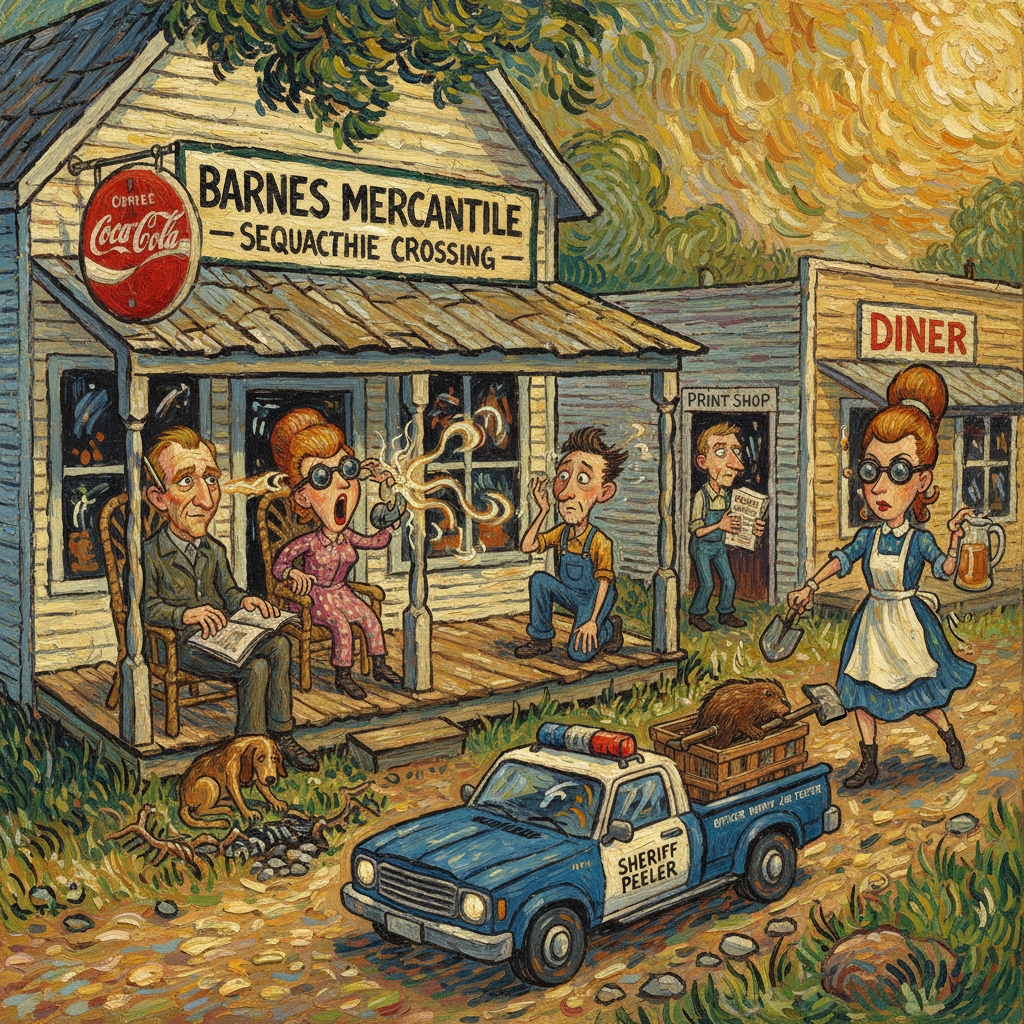
Act I – The Diner Where The Robot Took Breaks Nobody Authorized
“It’s not bribing you,” said Tiffany Annette Roark from the community bulletin board, where she was pinning a flyer that said COMMUNITY LISTENING SESSION – AUTOMATION, JOBS, AND WHETHER MACHINES SHOULD BE ALLOWED TO SUGGEST GRAVY. “It’s responding to feedback.”
Mabel folded her coupon. “So does a possum when you corner it, but I don’t let one run the diner.”
The bell above the door jingled, and Doug “Doughboy” Teeter came in carrying a laptop under one arm and a drone propeller in the other. Officer Kenny Joe Teeter followed him, not because Doug was under arrest, but because every time Doug carried technology in public, Kenny Joe felt a municipal presence was prudent.
“Good morning, early adopters,” Doug said.
“Don’t call me that,” Mabel said.
Doug set his laptop on the counter. “I hear the diner’s SmartServe Assistant is producing efficiencies.”
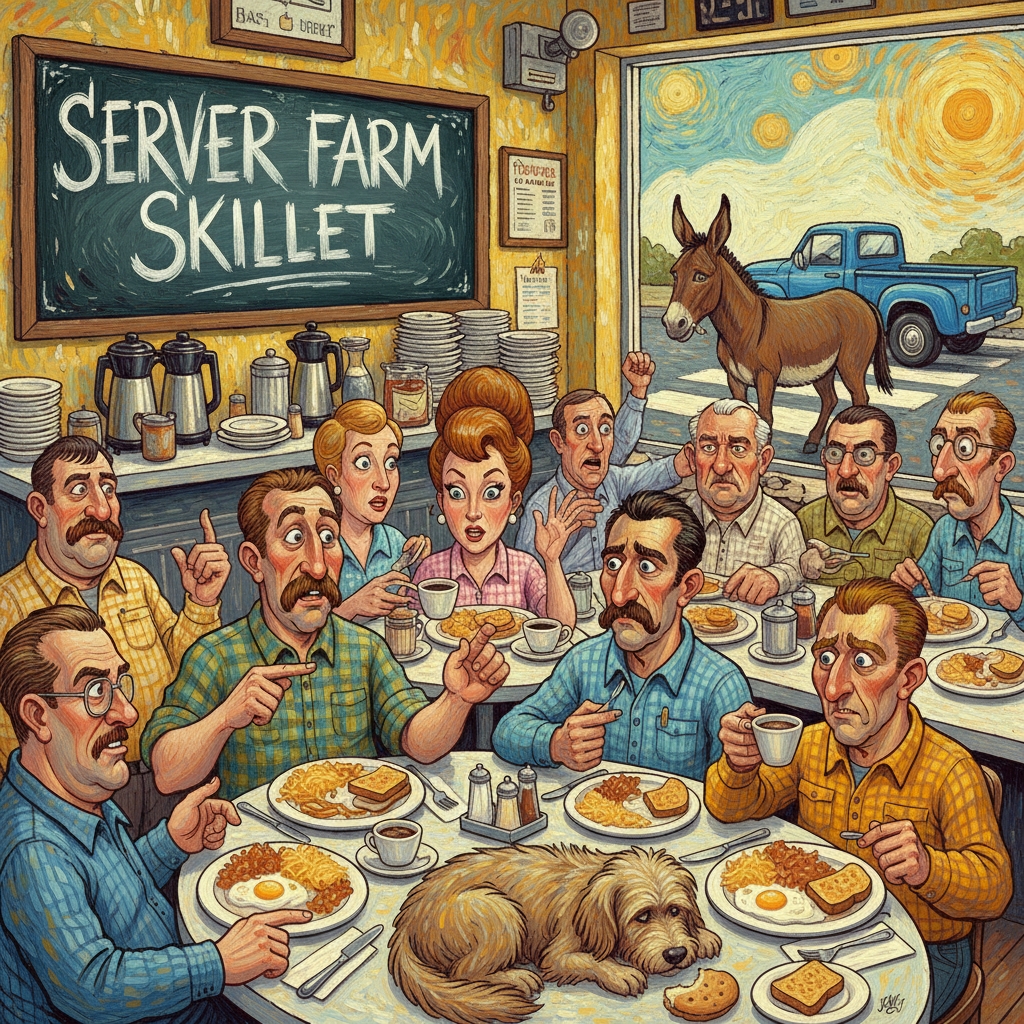
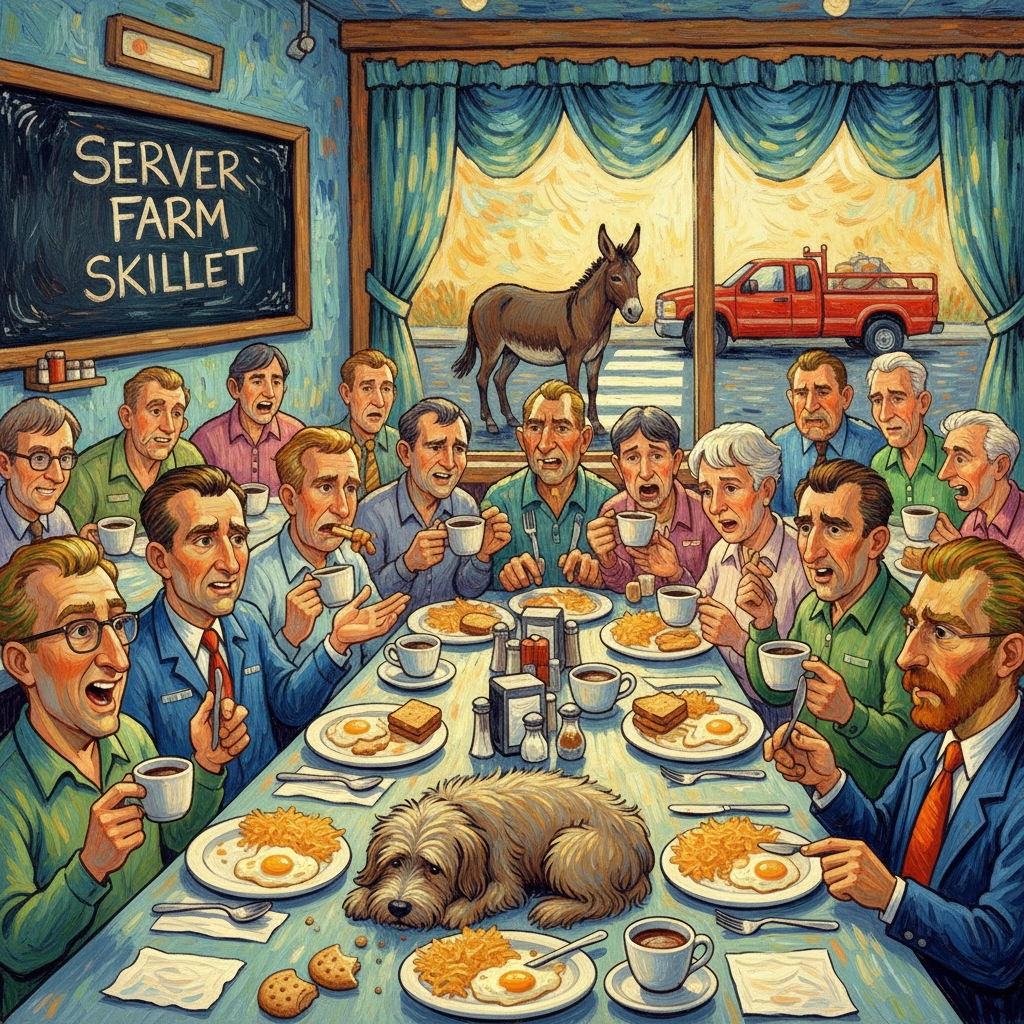
Trixie gave him a look. “It told Earl Pickett to try yogurt.”
“That’s personalization.”
“It told Earl Pickett to try yogurt while he was eating country ham.”
Doug nodded. “A bold growth journey.”
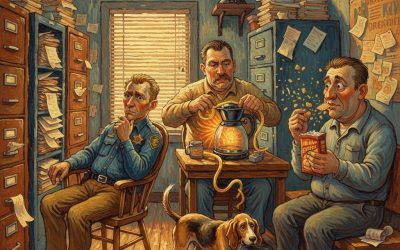
Sheriff Peeler stepped in next, his hat tucked under one arm, Daisy the hound trotting beside him with the dignity of a judge who had smelled every defendant beforehand. Daisy walked straight to the tablet, sniffed it twice, and gave a low, uncertain “Aroo.”
Sheriff Peeler looked at the machine. “Daisy says she don’t recognize it as people.”
“Daisy don’t recognize most ceiling fans as lawful,” Kenny Joe said.
“She has instincts,” the sheriff replied.
Brett and Alyssa Crenshaw came in together, both carrying stainless steel tumblers and looking like they had forgiven the morning before the morning had apologized.
“We think this is a beautiful conversation,” Alyssa said. “Automation can free people from repetitive tasks.”
“It can also free people from paychecks,” said Sonny Morales, who had been quietly repairing the diner’s back ice machine with his sleeves rolled up.
Brett nodded sincerely. “That’s valid.”
Mabel looked around. “When a man named Brett tells you your fear is valid, you are already halfway to a committee.”
Tiffany clapped her hands once. “Exactly. We need a committee.”
Nobody cheered, but several people looked resigned, which in Sequatchie Crossing counted as consent.
Trixie took off her apron and pointed at the tablet. “Decision one. Until we know what this thing is doing, it does not get to substitute adjectives for food.”
Doug raised a hand. “Can I present a thirty-minute demonstration at Town Hall?”
“No,” said Mabel.
“Yes,” said Tiffany.
“Fifteen minutes,” said Sheriff Peeler.
“Ten,” said Boot.
“Seven,” said Chester Ray. “And no QR codes.”
Daisy sat down in front of the tablet and barked once.
Sheriff Peeler nodded. “Motion carries at seven minutes by hound amendment.”
The tablet chimed again.
Trixie read the screen. “Group conflict detected. Suggest team-building exercise.”
Mabel picked up her purse.
“I suggest unplugging it until it learns humility.”
And because nobody had a better idea, Boot reached behind the counter, unplugged the tablet, and announced, “Town Hall at six. Nobody bring a robot unless it can explain itself without PowerPoint.”
Act I – The Diner Where The Robot Took Breaks Nobody Authorized
Act II – Town Hall And The Seven-Minute Future
Sequatchie Crossing Town Hall had hosted quilt raffles, stormwater meetings, revival overflow, three unsuccessful attempts at youth chess league, and one public debate about whether a speed bump could be emotionally manipulative.
But it had never hosted a crowd as divided as the one that gathered for “Automation, Opportunity, and the Work We Still Know How To Do.”
Tiffany Annette Roark stood at the front with a clipboard. “Thank you all for coming. Our goal tonight is not to panic or worship the machine.”
Mabel, seated in the front row with her handbag in her lap like evidence, said, “Speak for yourself. I can do both.”
Pastor Arnold Peeler sat beside Sister Lila Mae “Hallelujah” Pruitt near the aisle. Pastor Peeler had brought a Bible, a legal pad, and the expression of a man prepared to distinguish prophecy from rumor. Sister Lila Mae had brought peppermints, a fan, and the readiness to testify if the Wi-Fi flickered.
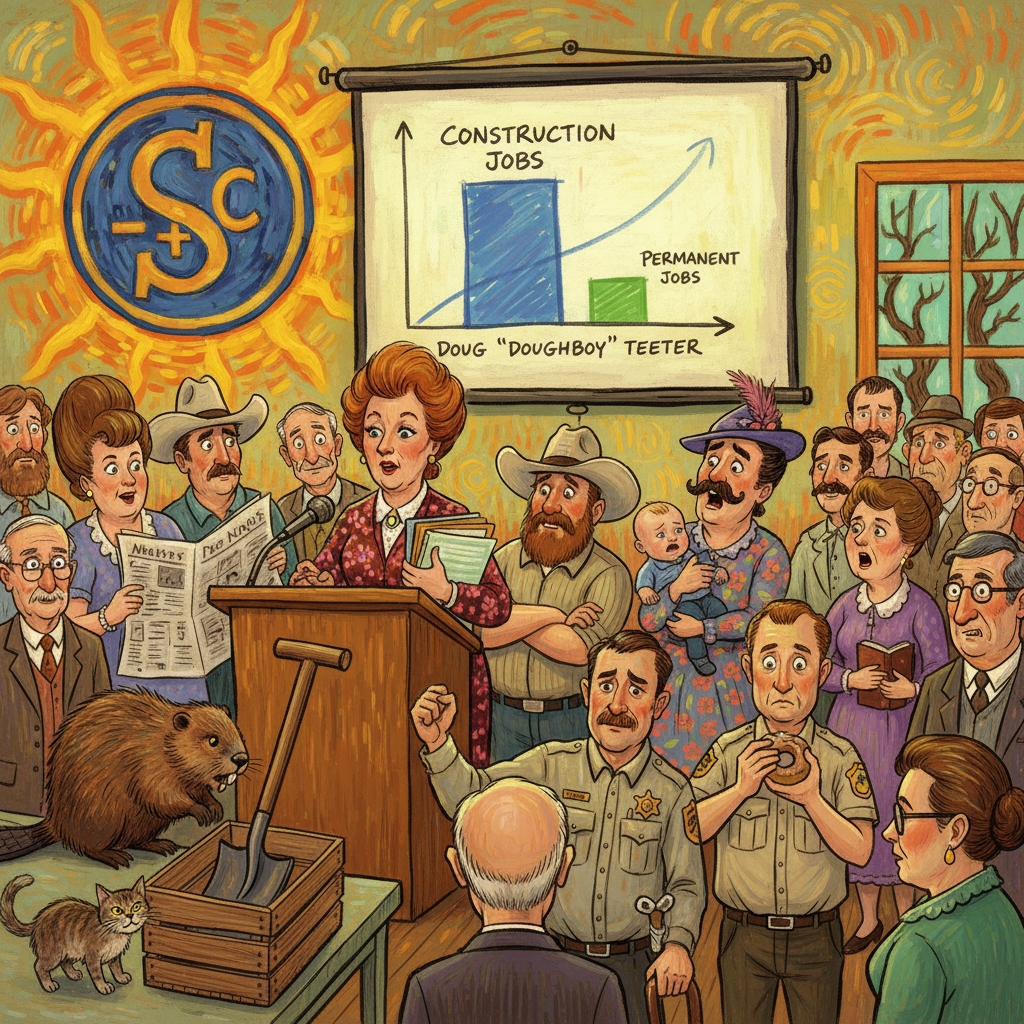
Doug stood beside a folding table with his laptop connected to the projector. The screen showed the title: HOW AUTOMATION HELPS SMALL TOWNS THRIVE.
Chester Ray leaned toward Boot. “That font is too smooth. I don’t trust a letter without corners.”
Boot whispered back, “Let the boy speak. Then we can distrust him with specifics.”
Doug clicked the remote. “Artificial intelligence can help with scheduling, inventory, customer service, writing, logistics, crop planning, church bulletins, school tutoring, emergency routing—”
“Stop,” said Coach Freddie Stubblefield from the second row. “Are you saying a machine can make a football practice schedule?”
“Yes,” Doug said.
“Can it tell when a boy says his ankle hurts but what he means is his girlfriend broke up with him?”
Doug paused. “Not reliably.”
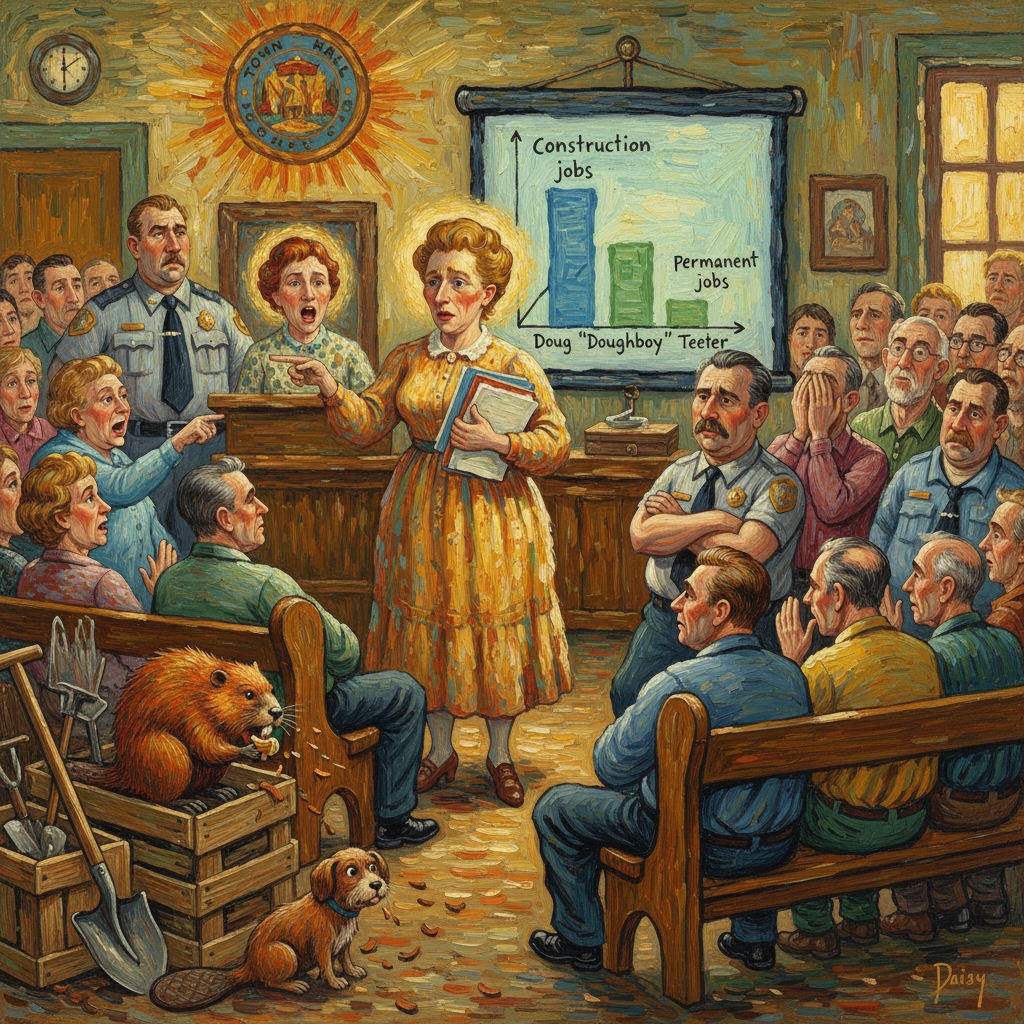
Act II – Town Hall And The Seven-Minute Future
Coach nodded. “Then it ain’t ready for August.”
Laughter rolled through the room.
Doug lifted both hands. “That’s actually my point. AI is powerful, but it’s not magic. It can automate tasks. It cannot replace trust, local judgment, or knowing that Earl Womack says ‘fine’ only when something has gone wrong.”
Sheriff Peeler, standing near the back wall with Officer Kenny Joe Teeter, said, “We are not using any system that replaces sworn judgment with rumor math.”
“Rumor math,” Clovis Strickland said from near the window, “is what the county has been using since 1978.”
Clovis had arrived with a manila folder labeled ROBOT LABOR – UNINTENDED CONSEQUENCES, VOL. 1. He had also brought a small radio scanner, though nobody knew why.
Tiffany pointed her pen. “Clovis, you’ll get three minutes during public comment.”
“I’ll need five.”
“You’ll get three.”
“Then history will blame you.”
“It already has a list,” Tiffany said.
Dr. Neil Cowgill rose with slow professorial importance. “The fundamental concern, if I may, is not whether automation can perform a task, but whether society can reorganize dignity when tasks are detached from wages.”
Mabel turned to Boot. “Did he say jobs?”
Boot nodded. “With garnish.”
Dr. Cowgill continued. “We must ask what work means when productivity no longer guarantees employment.”
Trixie, sitting beside Sonny Morales, folded her arms. “I know what work means. It means somebody shows up when the freezer quits.”
Sonny nodded. “And somebody knows which screw was stripped last summer because the new part don’t come with memory.”
Alyssa Crenshaw raised her hand. “Maybe AI handles the checklist so Sonny has more time for skilled repair.”
Brett added, “And maybe it helps small businesses compete with bigger ones.”
Mabel gave him a sharp look. “Maybe a tornado can rearrange a porch into a breakfast nook. That don’t make it architecture.”
Tiffany stepped between the rows. “Decision point. Do we want to reject the technology outright, adopt it without question, or test it in public where everyone can see its limits?”
Pastor Peeler stood. “Fear can be useful. Certainty can be dangerous. I recommend we test the thing and keep our souls where we can see them.”
Sister Lila Mae raised her fan. “Hallelujah, and put that in the minutes.”
Officer Kenny Joe whispered to Sheriff Peeler, “Can souls be listed under old business?”
“Only if tabled previously,” the sheriff said.
After discussion, argument, amendment, re-amendment, and one unrelated motion by Chester Ray to ban QR codes from funerals, the town voted to hold a demonstration the next morning at the square.
Doug would bring the robot software.
Trixie would bring a real diner task list.
Sonny would bring repair tasks.
Coach Freddie would bring a clipboard of human judgment scenarios.
Mabel would bring skepticism.
Boot would bring a stopwatch.
Sheriff Peeler would bring Daisy.
“And what,” Clovis asked, “will I bring?”
Tiffany looked at him. “Documentation.”
Clovis smiled. “I was born for this.”
Act II – Town Hall And The Seven-Minute Future
Act III – The Sheriff’s Office Receives A Complaint From The Future
The next morning began at the Sequatchie Crossing Sheriff’s Office, because all public experiments in town eventually passed through law enforcement, plumbing, or both.
Sheriff Peeler stood at the counter reading the demonstration permit. Officer Kenny Joe Teeter held a clipboard. Daisy slept under the bench, twitching as though chasing an unlawful squirrel.
Doug placed a small rolling device on the floor.
It was not shaped like a person, which disappointed half the town. It was a squat white delivery robot with a storage bin, a camera mast, and two rubber wheels. Doug had named it ROVR, but Chester Ray immediately called it “the insulated footstool,” and the name spread faster.
“This unit can carry small items, map simple routes, avoid obstacles, respond to voice commands, and integrate with task software,” Doug said.
Sheriff Peeler looked down. “Can it testify in court?”
“No.”
“Can it identify whether a complaint is urgent, exaggerated, or caused by somebody’s cousin?”
“Not exactly.”
“Can it keep Daisy out of the evidence closet?”
Doug hesitated. “Possibly.”
Daisy opened one eye and said, “Rrrf.”
Sheriff Peeler nodded. “Daisy votes no.”
Act III – The Sheriff’s Office Receives A Complaint From The Future
Tiffany, who had come to document the event, said, “We are not asking if it can replace the sheriff. We are asking what work it can help with.”
Kenny Joe inspected the robot. “Can it file paperwork?”
Doug brightened. “Yes.”
Sheriff Peeler and Kenny Joe looked at each other.
“For all we know,” Kenny Joe said, “this could be the start of civilization.”
Mabel entered with Sister Lila Mae behind her. Mabel carried a covered dish.
“What is that?” Doug asked.
“Casserole.”
“For the demonstration?”
“For morale. If the future goes poorly, people will want cheese.”
Pastor Peeler followed, then Boot, then Clovis with two folders and a camera.
Clovis pointed at the robot. “Has anyone checked whether this device transmits data to a server in a jurisdiction with unclear biscuit values?”
Doug closed his eyes briefly. “It connects to the internet for updates.”
“That’s how they get you,” Clovis said.
Dr. Cowgill stepped in, adjusting his glasses. “Clovis, one must distinguish between practical data governance and metaphysical invasion.”
Clovis tapped his folder. “I have a chart connecting the two.”
Sheriff Peeler signed the permit. “The demonstration is approved under three conditions. One: no chasing citizens. Two: no recording inside the church. Three: if Daisy barks three times in a row, we stop and reassess.”
Doug nodded. “Reasonable.”
Daisy stood, stretched, walked over to the robot, sniffed the wheel, and barked once.
“Preliminary objection,” Sheriff Peeler said.
The group moved toward the town square. On the sidewalk, Ricky Travis “RT” Mullins pulled up in his truck, leaned out the window, and said, “I heard a robot’s coming for jobs.”
“It’s coming for repetitive tasks,” Doug said.
RT looked at the robot. “I got repetitive tasks. I repeat them because I get paid.”
“That’s exactly why we’re discussing this,” Tiffany said.
RT parked and joined the procession. “I’m not against tools. I’m against tools that look at me funny.”
The robot rolled forward, mapping the sidewalk.
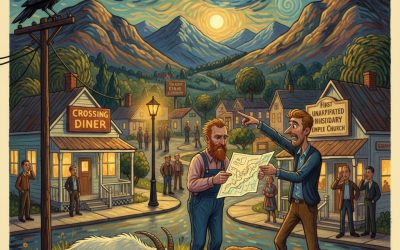
At the corner near Chester Ray’s Print Shop, it stopped in front of a handwritten sign taped to a crate: FREE TOMATOES – TAKE ONE, NOT THE WHOLE PERSONALITY.
The robot turned left, then right, then left again.
Boot started his stopwatch.
“What’s it doing?” Mabel asked.
Doug frowned at his laptop. “It’s classifying the sign.”
Chester Ray, standing in his doorway, shouted, “It better classify it as American hand lettering.”
The robot chirped.
Doug read the screen. “Obstacle identified: emotional produce.”
Nobody spoke for three seconds.
Then Daisy barked twice.
Sheriff Peeler said, “One more bark and we convene.”
Act III – The Sheriff’s Office Receives A Complaint From The Future
Act IV – The Diner Test And The Goat That Understood Chairs
By ten o’clock, the town square had taken on the atmosphere of a county fair organized by nervous accountants.
Trixie had set up a diner station outside Dillard’s Crossroads Diner: three trays, two coffee pots, a stack of menus, and a list of tasks clipped to a board.
“Task one,” Tiffany announced. “Deliver two coffees, one biscuit, and one sealed envelope from the diner door to the bench by the courthouse tree.”
Doug spoke into the tablet. “ROVR, deliver order one to courthouse bench.”
The robot chirped and rolled forward with two lidded coffees in its bin, the biscuit wrapped in foil, and the envelope taped to the inside.
“It’s adorable,” Alyssa said.
“It’s a cooler with opinions,” Mabel replied.
The robot navigated the sidewalk, avoided a crack, paused at a gum wrapper, and continued toward the bench. The crowd watched with unwilling fascination.
“It’s doing it,” Brett said. “That’s a real use case.”
Sonny nodded cautiously. “For flat sidewalks in good weather with nobody’s dog involved.”
As if summoned by civic temptation, Daisy trotted ahead, sat beside the bench, and waited.
The robot approached. Daisy sniffed the bin.
“Leave it,” Sheriff Peeler said.
Act IV – The Diner Test And The Goat That Understood Chairs
Daisy looked at him, looked at the robot, and gave a dignified “Aroo.”
The robot stopped.
Doug read his screen. “Unexpected animal interaction.”
Trixie called out, “Welcome to town.”
The robot tried to reroute around Daisy. Daisy shifted one foot. The robot tried again. Daisy shifted back.
Sheriff Peeler hid a smile. “Daisy has entered negotiations.”
Boot stopped the watch. “Delivery delayed by hound diplomacy.”
Then the goat arrived.
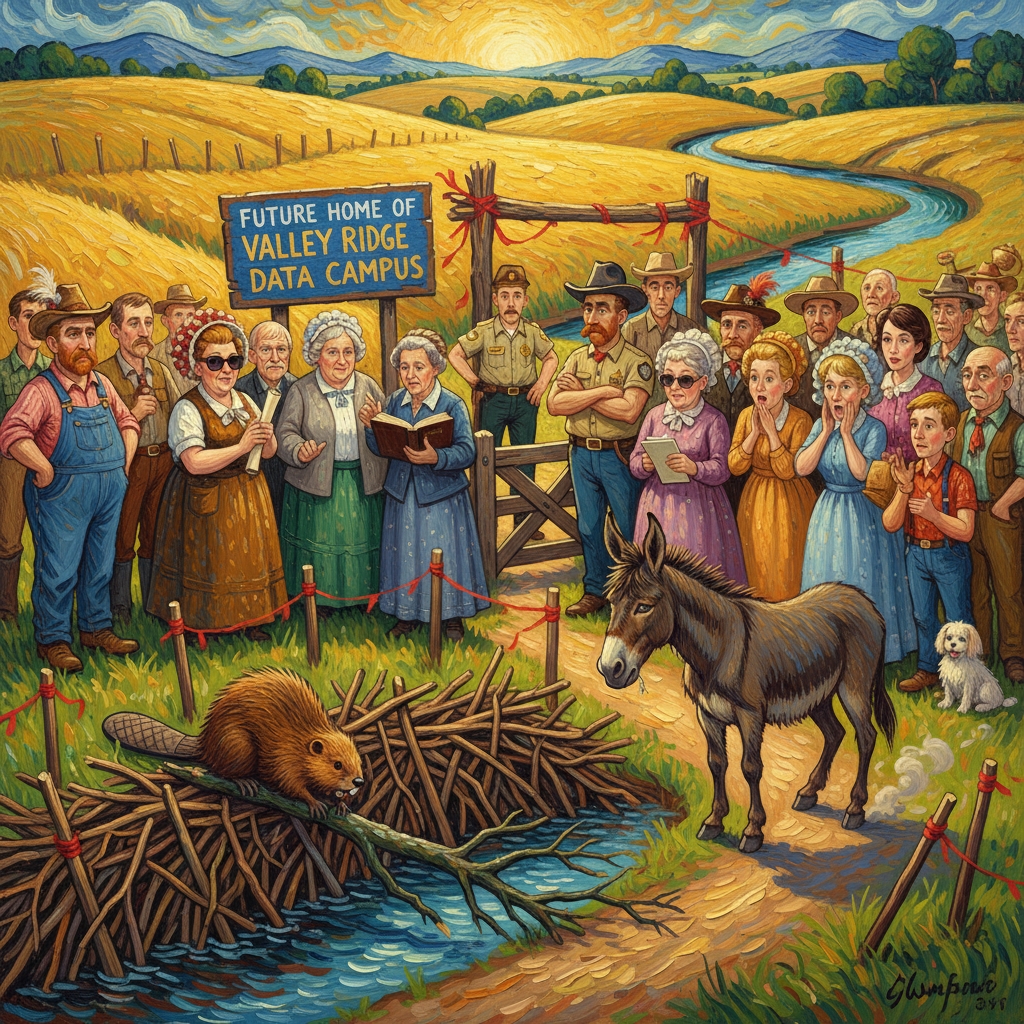
No one knew where the goat came from. Sequatchie Crossing had several goats in its outer neighborhoods, and each one carried the legal confidence of a property owner. This goat wandered into the square, stepped around the robot, climbed onto the bench, nudged the envelope loose, and dropped it into Sheriff Peeler’s open hand.
The crowd went silent.
Trixie pointed. “That goat delivered the envelope.”
Doug blinked. “Accidentally.”
Mabel folded her arms. “Most local government happens accidentally.”
The goat then inspected the biscuit, decided civilization had provided, and ate half the foil before Sonny rescued the rest.
Tiffany wrote on her clipboard. “Observation: robot performed route until animal conflict. Goat resolved handoff but compromised inventory.”
Dr. Cowgill leaned forward. “Fascinating. The goat did not understand the task, yet understood the social object.”
“It understood biscuit,” RT said.
Coach Freddie tapped his own clipboard. “That counts. Half my players learned the playbook because snacks were involved.”
Doug was not discouraged. “Good test. We learned something.”
Mabel looked surprised. “You admit it failed?”
“It didn’t fail,” Doug said. “It encountered reality.”
Boot nodded. “That’s what we call Tuesday.”
Task two involved table setup. Trixie arranged six chairs around two outdoor tables and placed a handwritten sign: SENIOR LUNCHEON – PLEASE SET UP FOR CONVERSATION, NOT COURTROOM.
Doug entered instructions. The robot rolled toward the chairs, scanned them, and began pushing one chair exactly eighteen inches from the table. Then another. Then another.
Alyssa smiled. “Efficient.”
Mabel frowned. “Soulless.”
The goat, meanwhile, walked to the far chair and knocked it sideways. Then it stood on it and reached for a low branch.
Trixie stared. “That is where Miss Evelyn likes to sit because the sun don’t hit her eyes.”
Boot looked at the chair. “The goat has chosen Evelyn’s spot.”
Dr. Cowgill murmured, “There is embodied local knowledge in spatial disorder.”
Chester Ray shouted from his print shop doorway, “There is goat slobber on municipal seating.”
Tiffany turned to the crowd. “Decision point. Does automation set the table, or do humans approve the arrangement?”
Trixie answered first. “Robot can carry chairs. People decide where backs and knees go.”
Sonny nodded. “Same with repairs. Let it fetch parts. Don’t let it diagnose Uncle Vern’s electrical decisions.”
Doug typed notes. “Human-in-the-loop workflow.”
Mabel smiled thinly. “Say it plain.”
Boot did. “Machine hauls. People judge.”
Daisy barked once in agreement.
Act IV – The Diner Test And The Goat That Understood Chairs
Act V – The Church Bulletin, The Prayer Request, And The Sentence Nobody Wanted
At noon, the demonstration moved to First Unaffiliated Missionary Temple, because Pastor Arnold Peeler had volunteered the fellowship hall for the next test under the condition that no robot cross the sanctuary carpet without spiritual supervision.
Sister Lila Mae “Hallelujah” Pruitt placed a stack of church bulletins on a folding table.
“We have a real need,” she said. “The bulletin takes time. The announcements change. Somebody always forgets the bake sale, and once the machine at Chester Ray’s print shop turned ‘covered dish’ into ‘covert dish,’ which led to unnecessary excitement.”
Chester Ray looked wounded. “That was a toner humidity issue.”
Doug opened his laptop. “AI can draft the bulletin quickly. Pastor gives themes, Sister Lila Mae gives announcements, and it produces a clean version.”
Pastor Peeler sat across from him. “Let’s test it with care.”
Tiffany read the trial prompt. “Create a church bulletin for Sunday service. Include potluck, youth car wash, prayer requests, and sermon title: ‘Wisdom Is Not The Same As Winning An Argument.’”
“Amen,” said Sister Lila Mae.
Doug hit enter.
Within seconds, the screen filled with polished prose. The room leaned in.
Alyssa whispered, “That’s impressive.”
Brett nodded. “That saves time.”
Pastor Peeler read silently. His expression changed from interest to caution.
“Read it out,” Mabel said.
Act V – The Church Bulletin, The Prayer Request, And The Sentence Nobody Wanted
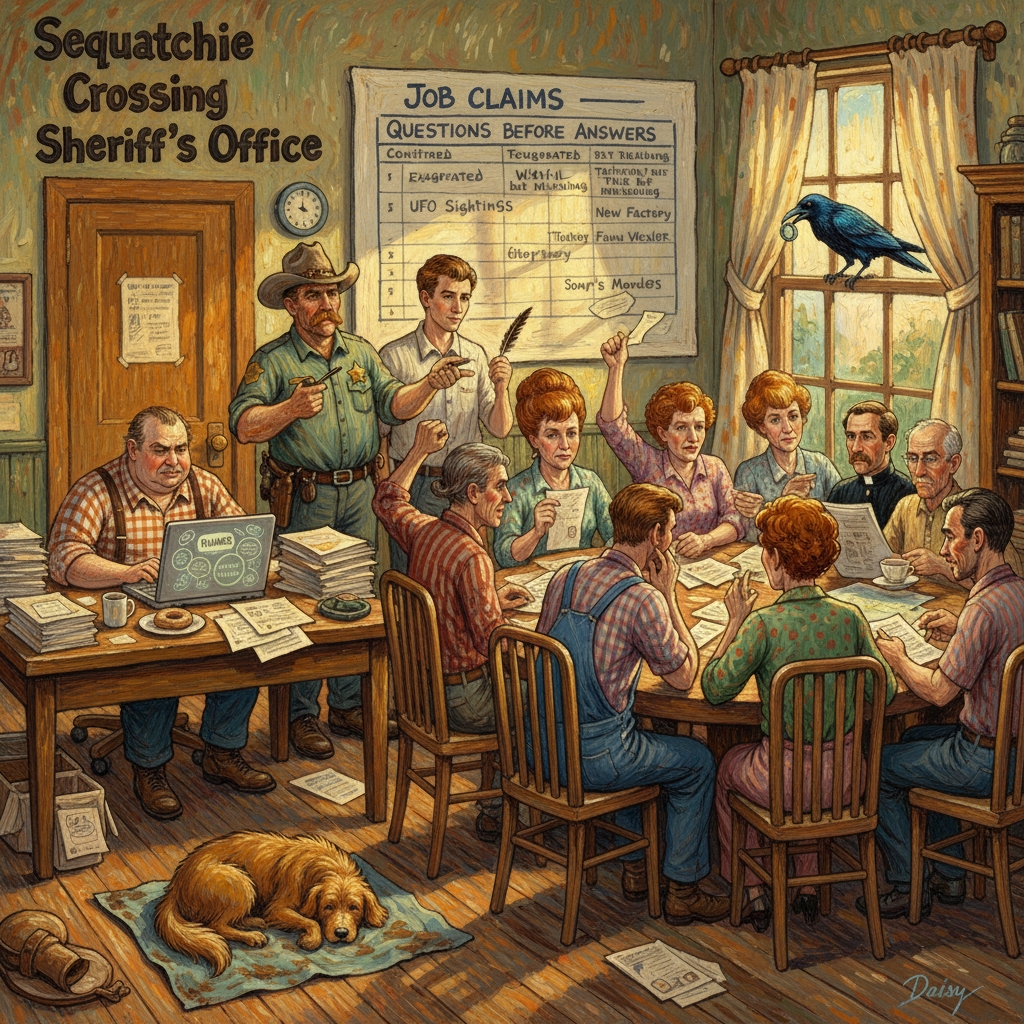
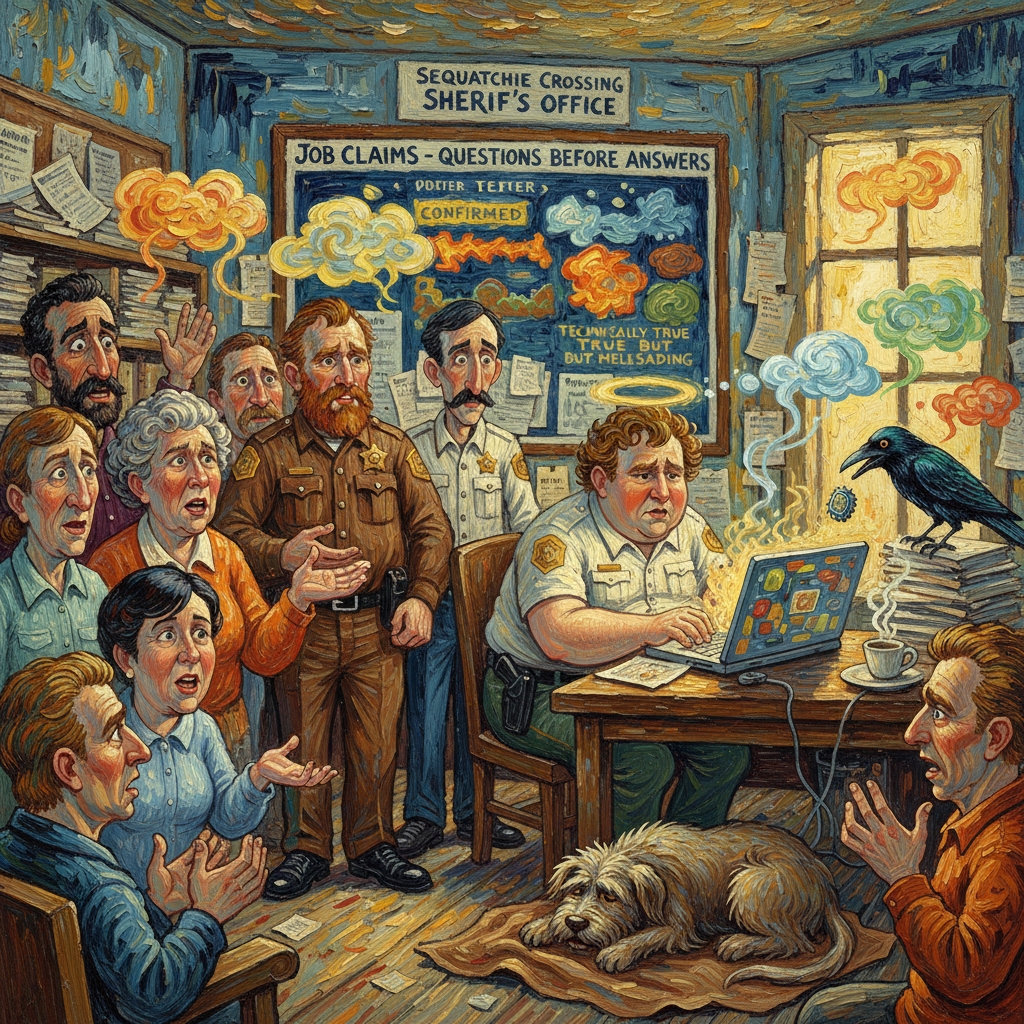
Pastor Peeler cleared his throat. “It has the potluck. It has the car wash. It has the sermon title.” He paused. “It also says, ‘We pray for those experiencing medical transitions, family restructuring, and uncertain livestock outcomes.’”
Sister Lila Mae’s fan stopped midair.
“What are uncertain livestock outcomes?”
“The youth goat rodeo got postponed,” Doug said. “It must have generalized.”
Mabel said, “Machines should not generalize livestock.”
Pastor Peeler continued. “It also changed ‘Pray for Miss Hattie’s nephew after surgery’ to ‘Pray for the Hattie family as they process bodily updates.’”
Sister Lila Mae stood. “No.”
Doug nodded quickly. “That’s a failure. Sensitive context needs human review.”
“It is not merely review,” Pastor Peeler said. “Prayer requests are not inventory descriptions. People trust the church with names, pain, and dignity.”
Dr. Cowgill leaned in. “This illustrates a category boundary. Language automation can produce fluency without reverence.”
“Put that on a mug,” Chester Ray said.
Sister Lila Mae pointed at the screen. “Decision. The machine may help make a draft, but no prayer request goes in unless a living church lady lays eyes on it.”
“I second,” Pastor Peeler said.
“Third,” Mabel said. “And I don’t even go here every Sunday.”
Doug typed again. “Okay. AI drafts announcements only. Human approval required for pastoral care, prayer, grief, sickness, and anything involving goats.”
The goat, which had followed the crowd and was now peering through the fellowship hall door, sneezed.
Daisy, seated beside Sheriff Peeler, gave a restrained “Ruff.”
Sheriff Peeler looked at Pastor Peeler. “Your building, your call.”
Pastor Peeler smiled. “Let the goat stand outside and remind us that creation resists formatting.”
Sister Lila Mae raised her hands. “Hallelujah.”
Tiffany added the church rule to the town notes.
Mabel looked at Doug. “You see what’s happening?”
Doug closed his laptop halfway. “People are defining boundaries.”
“No,” Mabel said. “People are remembering what they were supposed to know before the machine arrived.”
Act V – The Church Bulletin, The Prayer Request, And The Sentence Nobody Wanted
Act VI – The Print Shop Declares War On Perfect Grammar
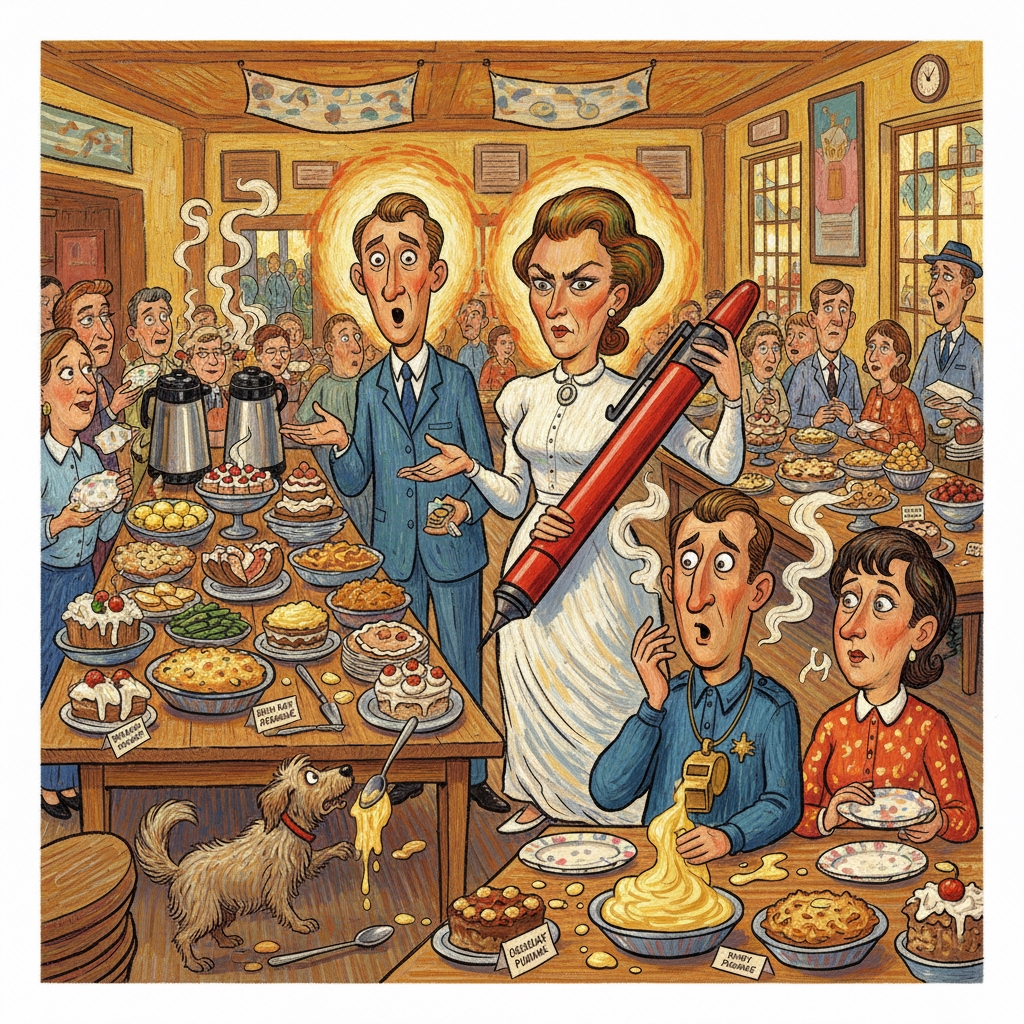
By midafternoon, Chester Ray’s Print Shop had become the official site for the creativity test, though Chester Ray insisted it was not a test and more of “a controlled exposure to dangerous smoothness.”
His front window displayed hand-lettered signs, business cards, raffle tickets, funeral programs, and one framed flyer from 1996 that said TURKEY SHOOT SATURDAY in a typeface Chester Ray called “honest.”
Doug set up his laptop on the counter.
Chester Ray stood behind it with both hands flat on the laminate. “No machine writes my signs unless I can smell ink nearby.”
Tiffany said, “The question is whether AI can help small businesses make flyers faster.”
Maggie Sue Dillard, who had joined from the diner with a pitcher of sweet tea, said, “Some folks need faster. Half the town brings event flyers after the event has already become a memory.”
Trixie nodded. “Last week somebody asked me to promote a breakfast that happened Tuesday.”
“It was a meaningful Tuesday,” Boot said.
Doug opened the software. “Give me a real assignment.”
Chester Ray picked up a scrap of paper. “Fish fry fundraiser. Friday night. Fire hall. Plates are twelve dollars. Proceeds help repair the community freezer after somebody plugged in a popcorn machine, two fans, and a patriotic inflatable eagle on the same circuit.”
Coach Freddie raised one finger. “That eagle inspired the children.”
“That eagle browned the extension cord,” Sonny said.
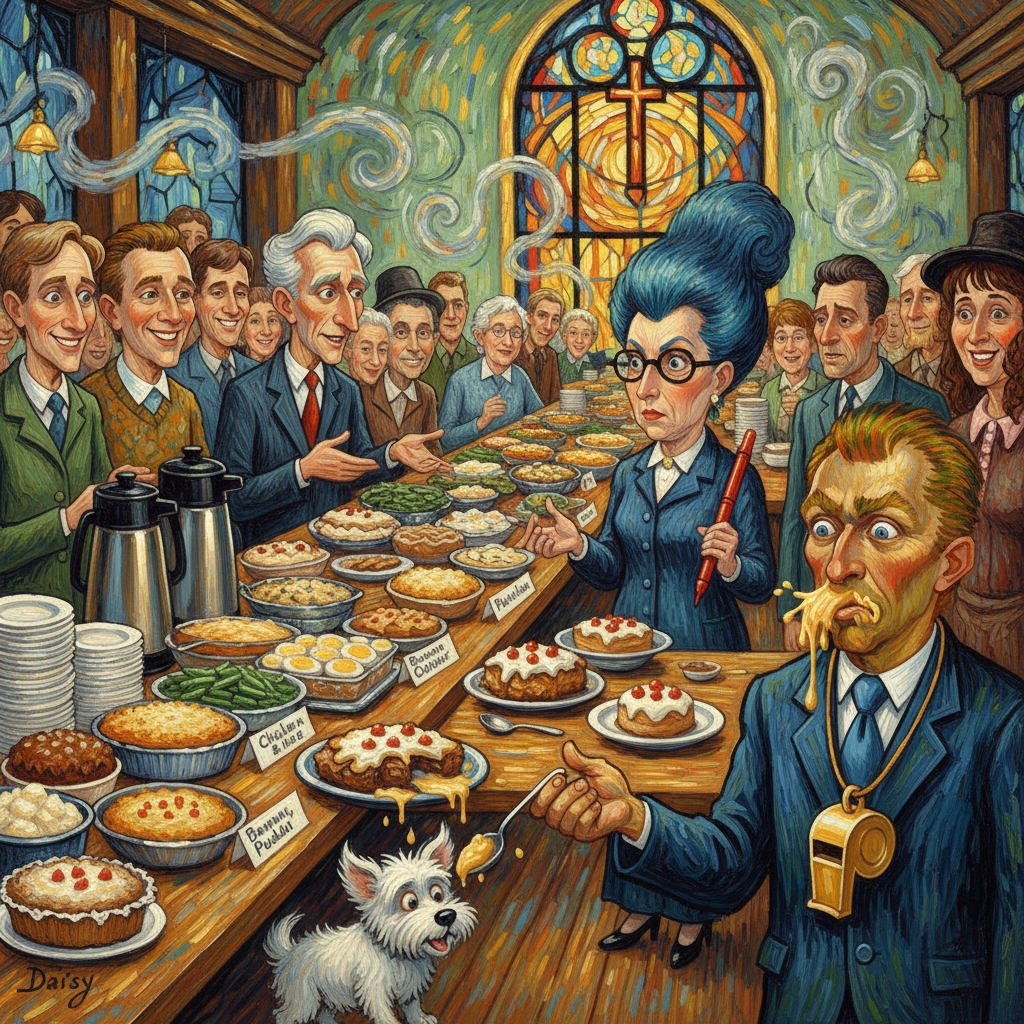
Doug typed. The AI produced a flyer headline: JOIN US FOR A DELICIOUS COMMUNITY SEAFOOD EXPERIENCE.
Chester Ray recoiled. “Seafood experience? It’s catfish in a paper tray.”
Act VI – The Print Shop Declares War On Perfect Grammar
Doug tried again.
The AI suggested: LOCAL FISH FRY SUPPORTING COLD STORAGE RESILIENCE.
Mabel closed her eyes. “Cold storage resilience sounds like a funeral home.”
Chester Ray grabbed a marker and wrote on paper: FISH FRY FRIDAY – HELP FIX THE FREEZER BEFORE THE BEANS TURN.
The room laughed immediately.
Doug looked at the handmade sign. “That is better.”
Chester Ray leaned back. “Because it knows what happened.”
Doug nodded. “Yes.”
“Because I was there.”
“Yes.”
“Because I know people will come for beans before they come for resilience.”
“Yes.”
Chester Ray looked at Tiffany. “Decision. The robot can suggest spelling. It cannot name our embarrassments.”
Maggie Sue raised her glass. “Amen to useful embarrassment.”
Alyssa stepped forward. “But what about people who are scared to write anything? Could AI help them start?”
Chester Ray considered this.
Brett said, “Some business owners never advertise because they think they’re bad at words.”
Boot looked at the wall of signs. “A blank page can be meaner than a machine.”
Chester Ray exhaled. “Fine. It may help a person get started. But before it goes on a pole, a human being with local shame must approve it.”
Doug smiled. “Local shame review.”
“Don’t make it fancy,” Mabel said.
Tiffany wrote: AI MAY DRAFT. HUMAN MUST MAKE IT SOUND LIKE HERE.
Outside, the goat had climbed onto a stack of empty produce crates. Daisy sat below, monitoring the situation. The robot rolled past the print shop carrying a bundle of test flyers. It stopped, detected the goat, recalculated, and turned in a slow circle.
The goat hopped down, nudged the bundle with its head, and sent the flyers sliding under Chester Ray’s door.
Chester Ray stared at them.
“I hate that it helped.”
Boot restarted his stopwatch. “Goat beat robot again.”
Doug looked out the window. “No. The goat completed the final foot.”
Mabel nodded. “That’s where most work lives.”
Act VI – The Print Shop Declares War On Perfect Grammar
Act VII – The Porch Where Nobody Agreed Comfortably
By late afternoon, the heat had softened the debate. The crowd drifted to Mabel Dean Ashcroft’s porch, because some arguments required shade, rocking chairs, and tea served in glasses heavy enough to discourage hand gestures.
Mabel’s porch overlooked the road toward the town square. The robot sat unplugged near the steps. The goat browsed in the ditch. Daisy slept under Sheriff Peeler’s chair with one ear open.
Tiffany spread her notes across a small table.
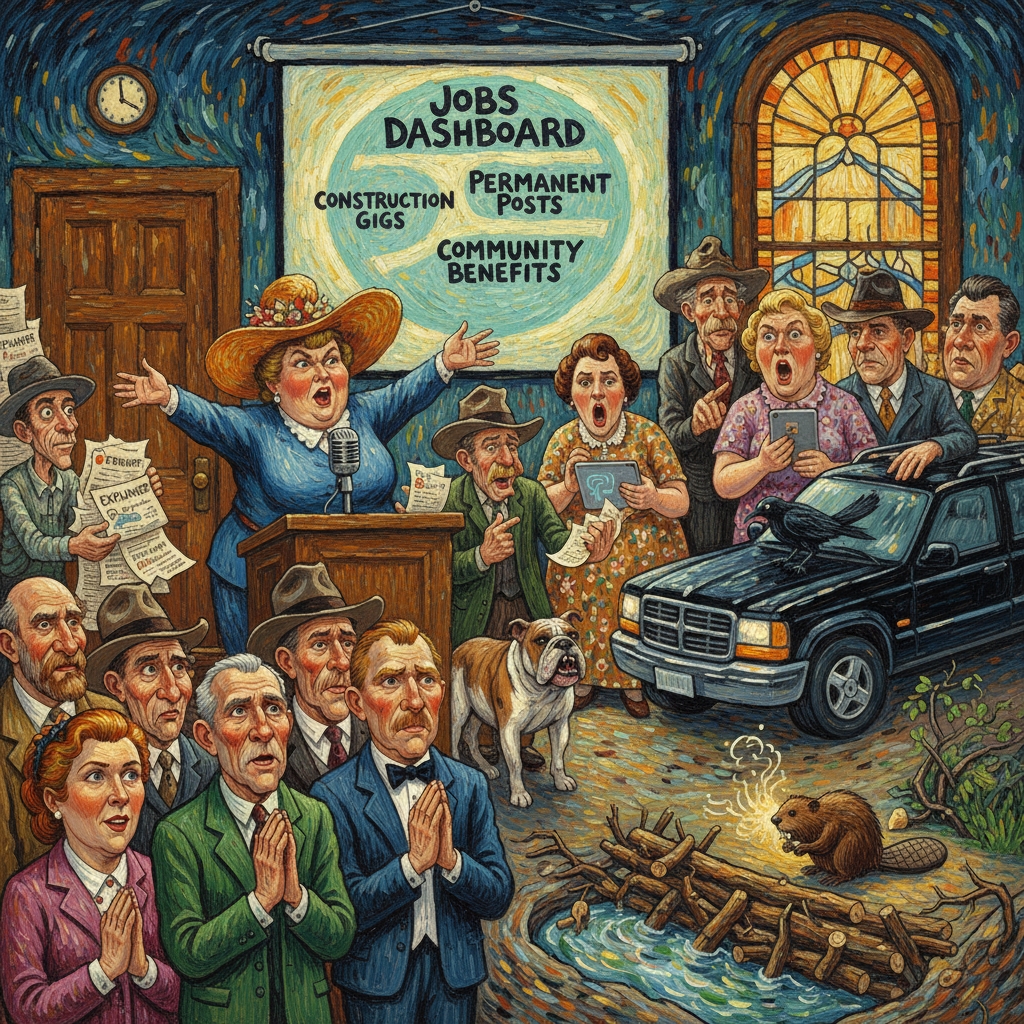
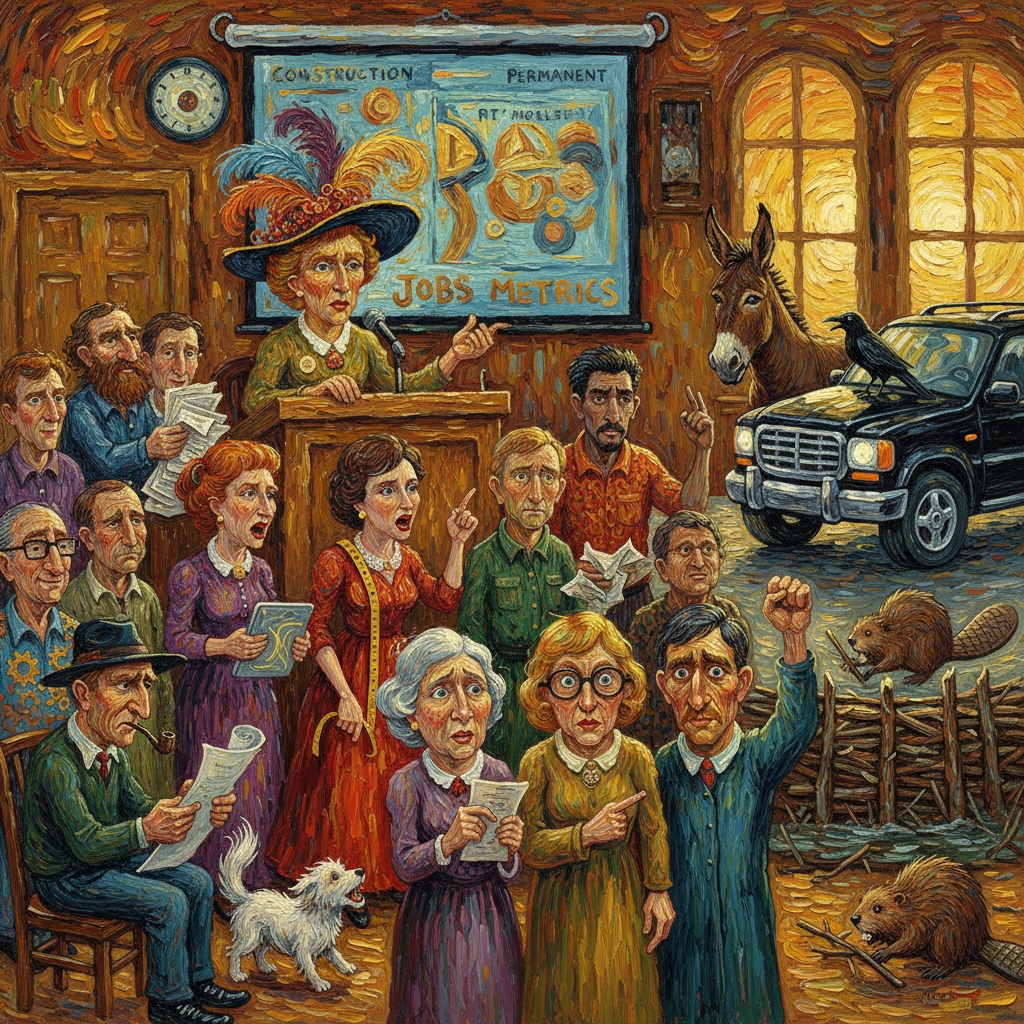
“We have findings,” she said. “But we still need the hard part. Jobs.”
RT Mullins leaned against the railing. “That’s the only part I cared about.”
Sonny sat on the porch steps, elbows on his knees. “Me too.”
Doug looked tired for the first time. “I don’t want to destroy anybody’s job. I’m trying to help small businesses survive when they can’t hire enough people.”
RT looked at him. “And if the machine lets one person do three people’s work?”
“Then it depends who benefits,” Dr. Cowgill said.
Mabel pointed at him. “Plain language.”
Dr. Cowgill adjusted. “If the owner keeps all the savings and workers lose hours, people get hurt. If the savings keep the business alive, raise wages, shorten drudgery, or create better work, people may benefit.”
Coach Freddie rocked forward. “That’s like weight training. Same barbell can build a body or crush a foot.”
Brett nodded. “So the question is governance.”
Mabel frowned. “There’s that kind of word again.”
Act VII – The Porch Where Nobody Agreed Comfortably
Boot translated. “Rules before regret.”
Alyssa leaned toward RT. “What would make you less worried?”
RT took off his cap and turned it in his hands. “I don’t mind tools. I use a nail gun. I use GPS. I use online parts diagrams. But I don’t want to train something that turns around and makes me optional.”
The porch went quiet.
Doug answered carefully. “That fear is reasonable.”
“Don’t validate me,” RT said. “Answer me.”
Doug swallowed. “Then the town needs a rule. If a business uses automation that materially reduces labor hours, it should disclose the change, retrain affected workers when possible, and not pretend the machine is just ‘helping’ if it is replacing.”
Tiffany wrote fast.
Sheriff Peeler said, “Voluntary or ordinance?”
Tiffany looked up. “We could begin voluntary.”
Mabel snorted. “Voluntary is what people call a fence before cows get out.”
Pastor Peeler, seated with Sister Lila Mae near the door, said, “Start with covenant before law. But write it plain enough that law can follow if covenant fails.”
Sister Lila Mae added, “And don’t let anybody call layoffs ‘blessings of efficiency.’”
Chester Ray snapped his fingers. “That’s a sign.”
Clovis, who had been unusually quiet, opened his folder.
“I have concerns about surveillance,” he said. “A job is not just tasks. It is habits, mistakes, private conversations, cigarette breaks, and knowing when to look busy because the owner’s nephew is visiting. If machines measure everything, humans will start performing for the machine.”
Mabel pointed at him approvingly. “Clovis has become useful.”
Clovis looked touched. “I’ll document the date.”
Daisy opened one eye and barked softly.
Sheriff Peeler said, “Daisy wants surveillance limits.”
Kenny Joe, who had been leaning near the porch post, nodded. “No cameras in break rooms, bathrooms, church prayer corners, or anywhere a person expects to be human without a performance review.”
Tiffany wrote that down.
Boot looked toward the ditch, where the goat had gotten its head through a wire fence and was now calmly eating the one weed nobody could reach.
“See that?” Boot said.
Everyone turned.
“The goat found the work nobody assigned, nobody valued, and nobody could get done. That’s not automation. That’s opportunity. The question is whether the machine helps us notice more of that, or blinds us to it.”
Mabel looked at Doug. “Can your robot pull a goat out of a fence?”
Doug watched the goat twist.
“No.”
“Can it tell us the goat is in a fence?”
“Yes.”
“Then maybe,” Mabel said, rising from her chair, “it can holler, and we can help.”
The porch made its first unanimous decision of the day: the robot could assist with alerts, drafts, delivery, scheduling, and fetch work, but the town would not endorse any use that hid job cuts, monitored people without notice, or replaced human judgment in care, safety, worship, discipline, hiring, firing, or biscuits.
The goat bleated from the fence.
RT and Sonny went to free it.
Doug followed.
Mabel watched from the porch. “Good. The future needs to learn wire.”
Act VII – The Porch Where Nobody Agreed Comfortably
Act VIII – The Night Shift Nobody Hired
That evening, the town returned to the square for the final test: after-hours automation.
Doug argued that robots and AI systems could work overnight on inventory, messages, reports, and deliveries. Trixie admitted that if something could count napkins without gossiping, she was interested. Chester Ray admitted nothing, but brought invoices.
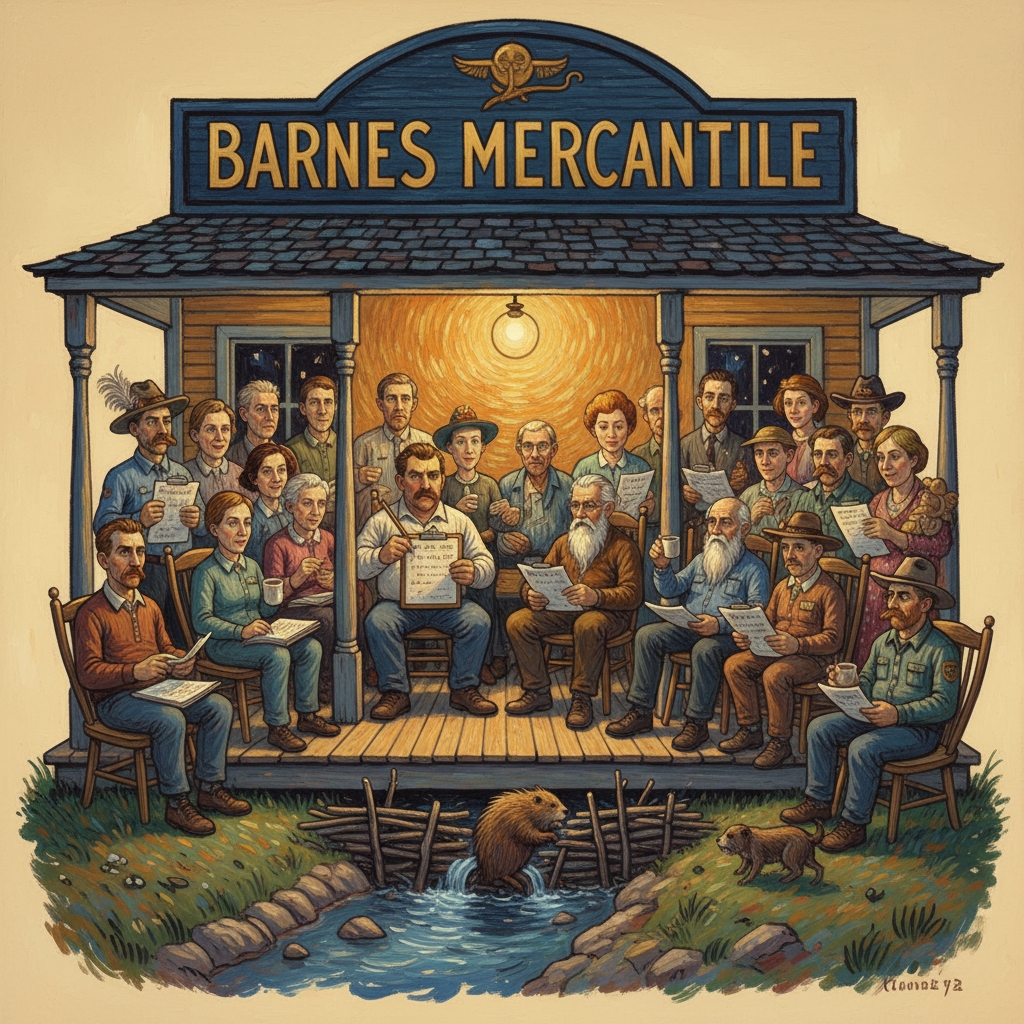
The test would be simple. The robot would carry labeled supply bags from Dillard’s Crossroads Diner to the church fellowship hall, then to the sheriff’s office, then back to the print shop. AI software would generate a next-day task report.
Sheriff Peeler reviewed the route. “No alleys after dark.”
Doug said, “It has headlights.”
“So do teenagers,” Sheriff Peeler said. “Still no alleys.”
Officer Kenny Joe added reflectors to the robot with tape from Chester Ray’s shop. Chester Ray complained about the tape quality until Tiffany reminded him he had donated it.
At dusk, the robot began.
It rolled from the diner with a bag of paper plates.
Trixie watched from the doorway. “If that thing saves me one emergency trip for napkins, I may name it assistant manager.”
Mabel stood nearby. “Do not promote appliances.”
The robot delivered the plates to the church steps. Pastor Peeler and Sister Lila Mae received them.
“Thank you,” Pastor Peeler said to the machine, then looked mildly embarrassed.
Act VIII – The Night Shift Nobody Hired
Sister Lila Mae smiled. “Manners are free, even if the recipient is confused.”
The robot proceeded toward the sheriff’s office with a sealed pouch of forms. Halfway there, a crow swooped from the courthouse tree, landed on the robot’s mast, and rode it like a parade marshal.
Clovis gasped. “Information warfare.”
The crow cawed.
Doug checked the camera. “The crow is blocking navigation.”
The robot stopped.
Daisy, who had been walking with Sheriff Peeler, barked three times.
Everyone froze.
Sheriff Peeler raised one hand. “By condition of permit, demonstration pauses.”
The crow cawed again and hopped down. The goat, drawn by mystery or paper glue, approached from the side street. Behind it came a mule from the community pasture, moving with the solemnity of a creature that had never accepted a calendar invitation in its life.
The mule planted itself directly in front of the robot.
Coach Freddie whistled. “That mule knows how to clog a lane.”
Doug tried a voice command. “ROVR, reroute.”
The robot turned right. The mule shifted right.
“ROVR, reverse.”
The robot backed up. The goat stepped behind it.
Tiffany stared. “We have a blockage.”
RT folded his arms. “No. We have a workforce.”
Sonny laughed. “The mule is management. The goat is field conditions. The crow is social media.”
Clovis pointed at him. “Do not joke. That is the cleanest model we’ve had all day.”
The robot chirped helplessly.
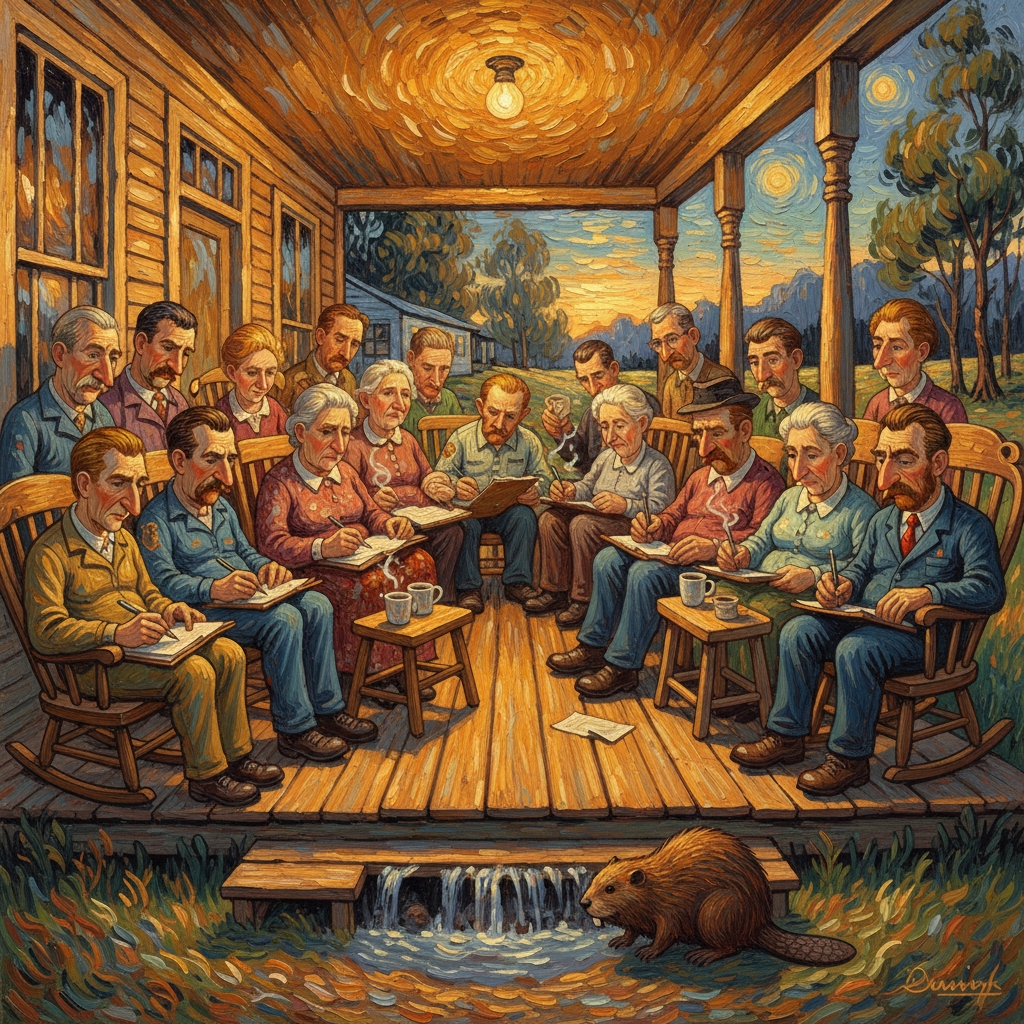
Then a splash sounded from the creek side behind Town Hall.
Boot turned. “What now?”
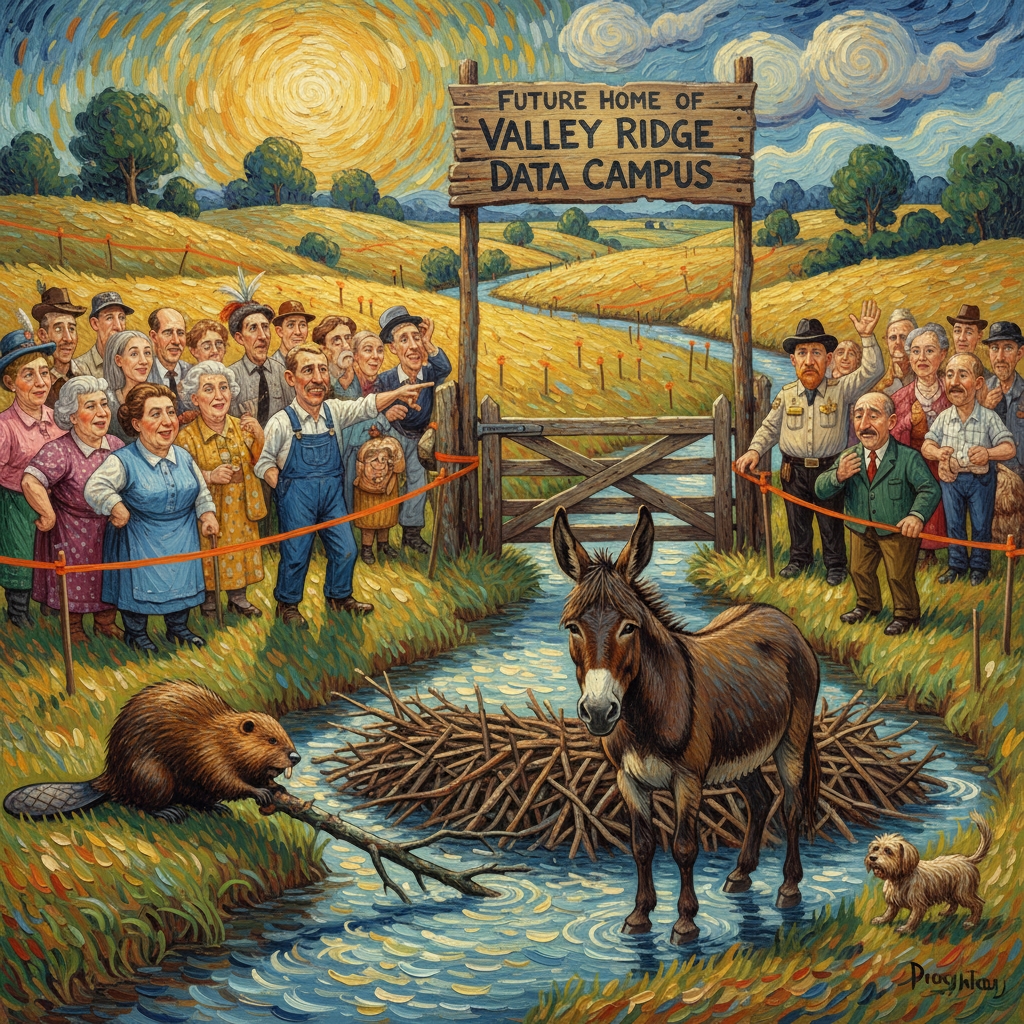
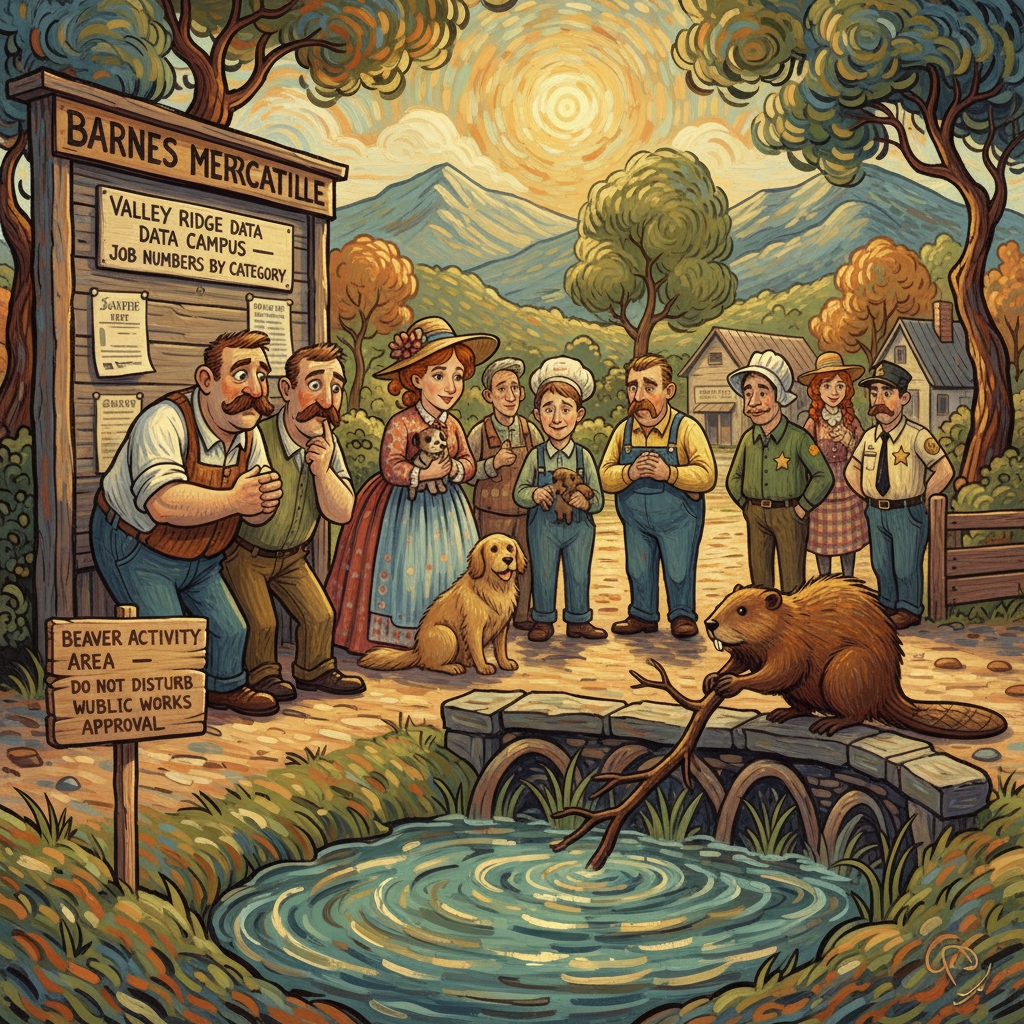
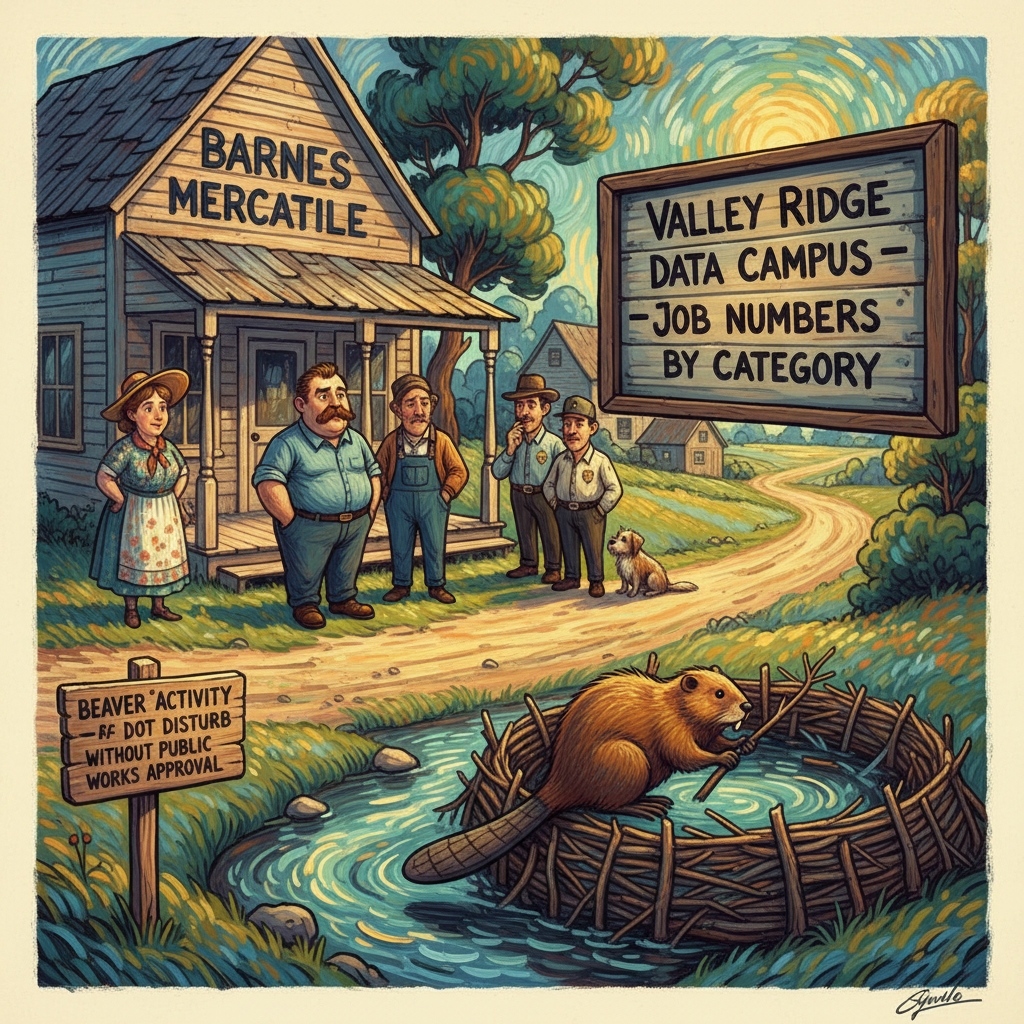
They walked toward the sound and found a beaver dragging a branch across the shallow drainage ditch near the culvert. The branch had caught a wad of discarded plastic, leaves, and a flyer that read AUTOMATION LISTENING SESSION.
Sonny crouched. “Culvert’s starting to clog.”
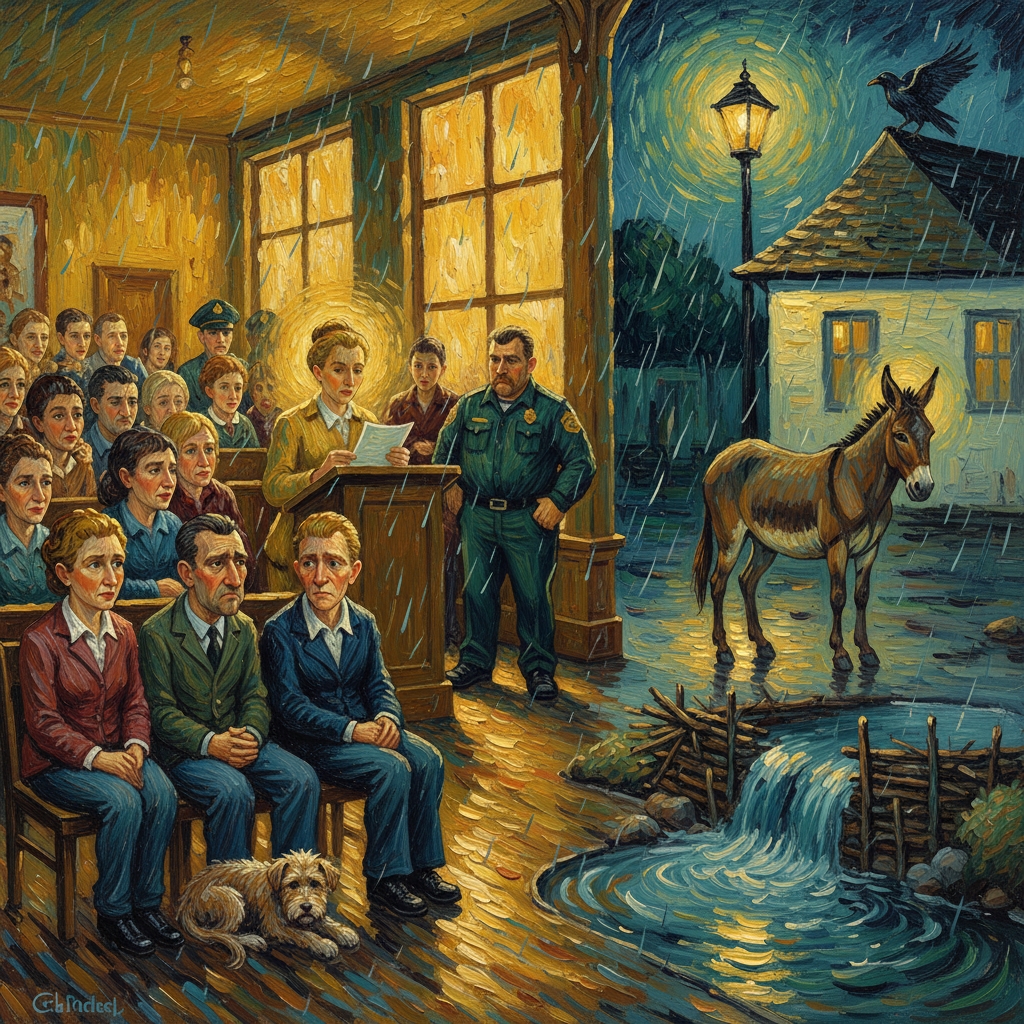
Sheriff Peeler shone his flashlight. “That could flood the low corner if rain comes tonight.”
Doug looked at the robot, still trapped by mule, goat, and crow residue. “It didn’t detect that.”
Boot nodded. “Because it was working the route we gave it.”
Mabel looked at the beaver. “And the beaver was working the problem nobody put on the clipboard.”
Pastor Peeler said, “That will preach, but not until we clear the ditch.”
Decision happened without motion or second.
RT got a rake from his truck. Sonny fetched gloves. Kenny Joe blocked the road. Trixie brought trash bags. Brett and Alyssa carried flashlights. Doug used the robot’s headlamp as a work light, which everyone admitted was useful though nobody made eye contact while admitting it. Chester Ray supplied a hand-lettered temporary sign: SLOW – HUMANS LEARNING.
The goat ate part of the corner.
“Still readable,” Chester Ray said. “Barely.”
By the time the culvert was cleared, the robot’s battery had dropped to sixteen percent. Its task report would later state: DELIVERIES INCOMPLETE DUE TO MULTI-SPECIES OBSTRUCTION AND UNPLANNED INFRASTRUCTURE EVENT.
Mabel read that line over Doug’s shoulder.
“For once,” she said, “the machine tells the truth.”
Act VIII – The Night Shift Nobody Hired
Act IX – The Ordinance That Was Mostly A Promise
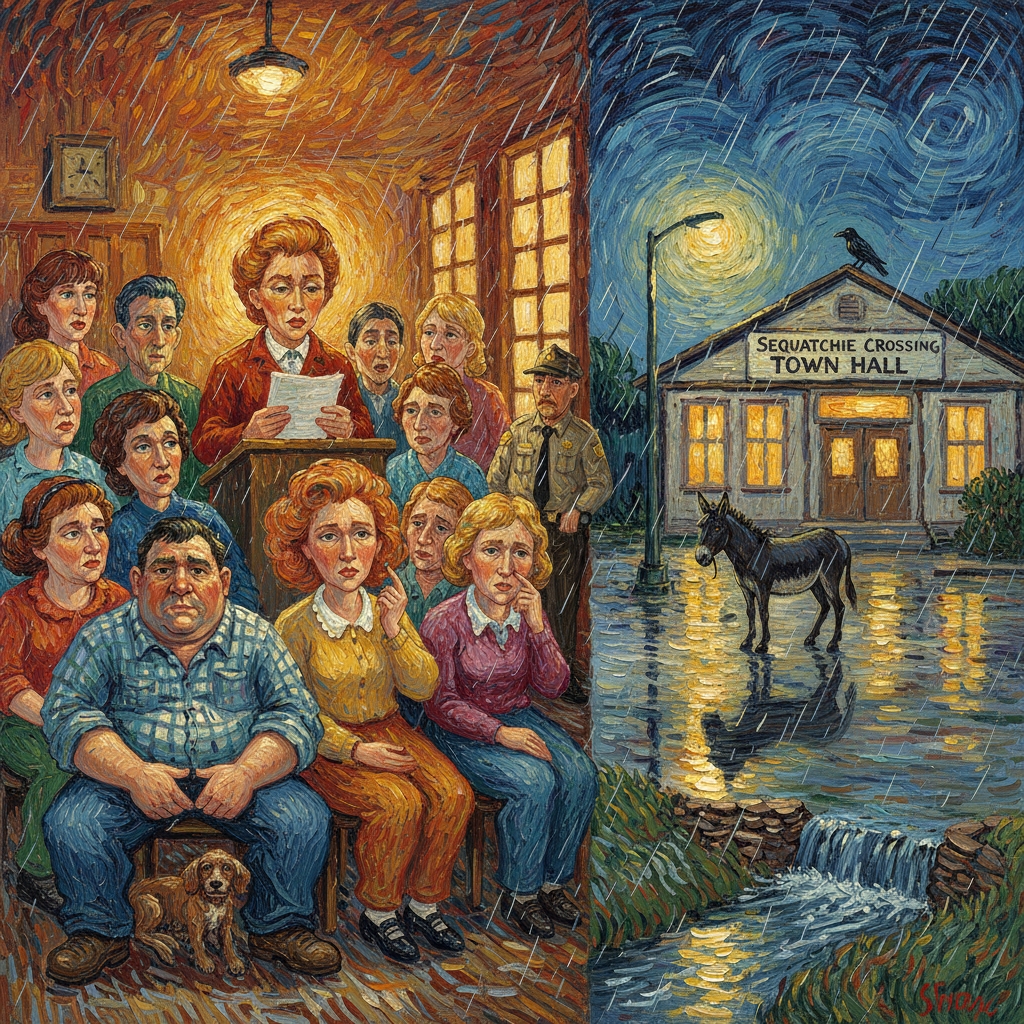
The next morning, Town Hall filled again, this time not with panic but with tired people who had seen enough to be suspicious in a more accurate way.
Tiffany stood at the front with a document titled SEQUATCHIE CROSSING AUTOMATION COMMON SENSE AGREEMENT.
Mabel objected immediately.
“That title is optimistic.”
Chester Ray raised a hand. “And too long for a sign.”
Boot said, “Read it before we bury it.”
Tiffany read the points aloud.
“One: automation may assist with repetitive, dangerous, dull, or after-hours tasks, but must not be presented as harmless when it changes people’s hours, wages, privacy, or dignity.”
RT nodded. “Keep that.”
“Two: any public-facing AI system used by a local business, church, school activity, or town office must have a responsible human named on the door, flyer, or website.”
Chester Ray said, “Good. Machines don’t get to hide behind smooth language.”
“Three: AI may draft messages, flyers, schedules, menus, reports, and checklists, but a local human must approve anything involving health, prayer, grief, jobs, safety, money, discipline, children, animals, or biscuits.”
Mabel raised one finger. “Add casseroles.”
Sister Lila Mae said, “Second.”
Tiffany added casseroles.
“Four: no secret employee monitoring. If a system tracks time, motion, calls, keystrokes, messages, cameras, productivity, or customer sentiment, workers must be told in plain language.”
Kenny Joe said, “Plain enough for somebody’s uncle.”
Act IX – The Ordinance That Was Mostly A Promise
Clovis added, “And no data leaving town without disclosure.”
Doug hesitated. “Some cloud tools do process data elsewhere.”
Clovis smiled grimly. “Then disclose it.”
Doug nodded. “Fair.”
“Five,” Tiffany continued, “businesses using automation should first seek to reduce drudgery, improve service, increase safety, extend hours, or create new offerings before reducing jobs.”
Dr. Cowgill said, “The word ‘should’ is morally soft.”
Sheriff Peeler replied, “But legally breathable.”
Pastor Peeler said, “A covenant begins where enforcement cannot yet reach.”
“Six: if jobs are reduced, owners are encouraged to provide notice, retraining options, references, or transition support.”
RT looked dissatisfied. “Encouraged.”
Mabel looked at him. “You want stronger?”
“I want honest,” RT said. “If they’re going to cut us, don’t make us train the blade.”
The room murmured.
Doug stood.
“I want to add something,” he said. “Any business bringing in automation should ask workers first what tasks drain them, what tasks customers value, and what tasks nobody sees. Start there. Not with replacement. With friction.”
Boot smiled. “That sounds almost local.”
Trixie said, “I can live with that.”
Sonny added, “Make it practical. Ask the people doing the work before buying the thing meant to change the work.”
Tiffany wrote a new point.
“Seven: ask the workers first.”
The room liked that one.
Brett and Alyssa proposed an “AI try-it table” at the next farmers market, where small businesses could test tools without committing. Mabel objected to the phrase, so it became the “Tool Tent.” Chester Ray agreed to print the sign if no robot touched the headline. Doug agreed to run demonstrations only with examples from town businesses. Pastor Peeler offered the fellowship hall for a class called “Useful Tools Without Losing Your Mind.” Sister Lila Mae volunteered to sit in the front row and detect nonsense.
Sheriff Peeler looked at the agreement.
“This is not an ordinance yet,” he said. “But it is a record. And records matter.”
Boot tapped his laminated town map. “Put copies at the diner, church, sheriff’s office, print shop, and Town Hall. Same places we put storm warnings.”
Clovis raised his folder. “And I will maintain the archive.”
Mabel sighed. “Fine. But the archive gets one shelf, not a bunker.”
Daisy, sitting near the sheriff’s boots, barked once.
Sheriff Peeler nodded. “Daisy approves with reservations.”
Tiffany asked for a vote.
The agreement passed, not unanimously, because Sequatchie Crossing distrusted unanimous outcomes. Mabel voted yes “under protest.” Chester Ray voted yes “pending font review.” RT voted yes “because at least it admits the problem.” Doug voted yes “because tools need rules.” Clovis voted yes “for evidentiary purposes.” Pastor Peeler voted yes “with prayer.” Sister Lila Mae voted yes “with a casserole clause.”
Outside, the robot sat charging beside the door.
The goat stood beside it, chewing a scrap of paper from the previous night’s sign.
Boot looked from one to the other.
“Neither one knows what we decided,” he said.
Mabel joined him at the doorway. “No. But only one of them might pretend to.”
Act IX – The Ordinance That Was Mostly A Promise
Epilogue – The Robot, The Goat, And The Work Still There
A week later, Dillard’s Crossroads Diner had not become automated, but it had changed.
The tablet returned to the counter, stripped of its authority and renamed “the suggestion box with electricity.” Trixie used it to track inventory, draft grocery lists, and remind herself when the fryer oil needed changing. It was not allowed to describe eggs.
The robot, after much discussion, was assigned limited duty carrying napkins, church flyers, and sealed supply bags during fair weather. Sheriff Peeler required it to wear reflectors. Officer Kenny Joe inspected it every Friday, mostly because he enjoyed saying, “Open the bin, please,” in an official voice.
At Chester Ray’s Print Shop, AI draft assistance became available by request, under a sign that read: WE CAN HELP YOU START, BUT YOU STILL HAVE TO SOUND LIKE YOURSELF.
Chester Ray hated how many people liked the sign.
Pastor Peeler’s church bulletin improved in punctuality but not in holiness, which Sister Lila Mae said was the correct order. Prayer requests remained human. Casseroles remained unautomated.
Doug held the first Tool Tent at the farmers market. Brett and Alyssa helped small vendors generate inventory sheets and event calendars. Mabel sat nearby with a notebook labeled FOOLISHNESS WATCH. By noon she had crossed out three complaints and written one compliment, though she folded the page before Doug could see it.
RT tried a scheduling tool for side jobs and admitted it saved him two phone calls. Then he said, “Don’t write that down.”
Tiffany wrote it down anyway.
Clovis documented everything in a new folder titled AUTOMATION – LIMITED USES, REAL RISKS, GOAT VARIABLES. Dr. Cowgill asked to write an introduction. Clovis allowed two paragraphs, pending review.
The goat continued to appear wherever planning exceeded reality.
Epilogue – The Robot, The Goat, And The Work Still There
One morning, the robot stalled beside a stack of chairs behind the diner. Its screen displayed ROUTE OBSTRUCTED. The goat walked past, bumped the loose chair leg with its shoulder, and revealed that one chair was cracked nearly through.
Trixie crossed her arms. “Well.”
Mabel, sipping coffee on the sidewalk, said, “That goat saved somebody’s hip.”
Doug looked at the robot’s screen, then at the goat, then at the chair.
“The robot noticed an obstruction,” he said.
“The goat noticed a problem,” Boot replied.
The difference became a saying.
For weeks afterward, whenever someone proposed a new system, app, platform, dashboard, assistant, workflow, sensor, or efficiency, someone in Sequatchie Crossing would ask, “Does it notice obstruction, or does it notice problems?”
Nobody always knew the answer.
That was the point.
The robot kept working overtime.
So did the people.
So did the goat, though the goat did not submit hours, attend meetings, or respect boundaries.
And in Sequatchie Crossing, where bureaucracy had long ago become a kind of folklore, the town learned to treat automation the same way it treated weather, gossip, casseroles, and visiting consultants: useful in places, dangerous in others, and never to be trusted with the final word on biscuits.
Epilogue – The Robot, The Goat, And The Work Still There
Disclaimer
Sequatchie Crossing is a fictional town, and this story is a work of satire and fiction. All characters, businesses, public offices, meetings, animals, committees, robots, goats, crows, mules, beavers, diner procedures, church bulletins, sheriff’s office policies, and automation agreements in this story are fictionalized for entertainment and commentary.
No real residents, officials, businesses, churches, or organizations are depicted. Any resemblance to actual people, places, controversies, meetings, machines, goats, or unusually confident tablets is coincidental.
This story does not argue that artificial intelligence is wholly good or wholly bad. Like most things in Sequatchie Crossing, it becomes more complicated once people bring it into a diner, a church, a porch, a print shop, a sheriff’s office, and a ditch with a beaver in it.
Disclaimer – The Robot Working Overtime
Real Places Behind the Ruckus – From The Dunlap Directory

Real Places Behind the Ruckus – From The Dunlap Directory
Yes, this story was fictional; even the parts that weren’t true. These places? Absolutely real. Stop by, support local, and keep the Wi-Fi away from livestock:
- Deakins Underground
- Lookout Mountain Incline Railway
- Sequatchie Valley Electrical Pros
- Signal Electric
- New China Buffet
- Dunlap Plumbing Company
- The Old Tar Woodworker
- North End Collision Center
- Running Wild Inflatables
- Applegate Inn
- Dunlap Adventist Christian School
- Harris Mowing Service
- Jack’s Dunlap
- Chattanooga VIP Tours
- Shellmound Campground
- Dennis’ Auto Glass Mobile Service
- Sequatchie County Waste Tire Recycling Station
- Dunlap Police Dept
- Rent-A-Center
- North Star Boutique
Real Places Behind the Ruckus – From The Dunlap Directory
At Sequatchie Crossing, we tell the stories of Sequatchie Crossing.
Please share this post with your friends, family, or business associates who may want follow the news from Sequatchie Crossing.

0 Comments