


The Lord Is Mighty – and So Is Feedback
By Tom Seest
At Sequatchie Crossing, we tell the stories of Sequatchie Crossing.
Please share this post with your friends, family, or business associates who may want follow the news from Sequatchie Crossing.
🎤 Audio Overview
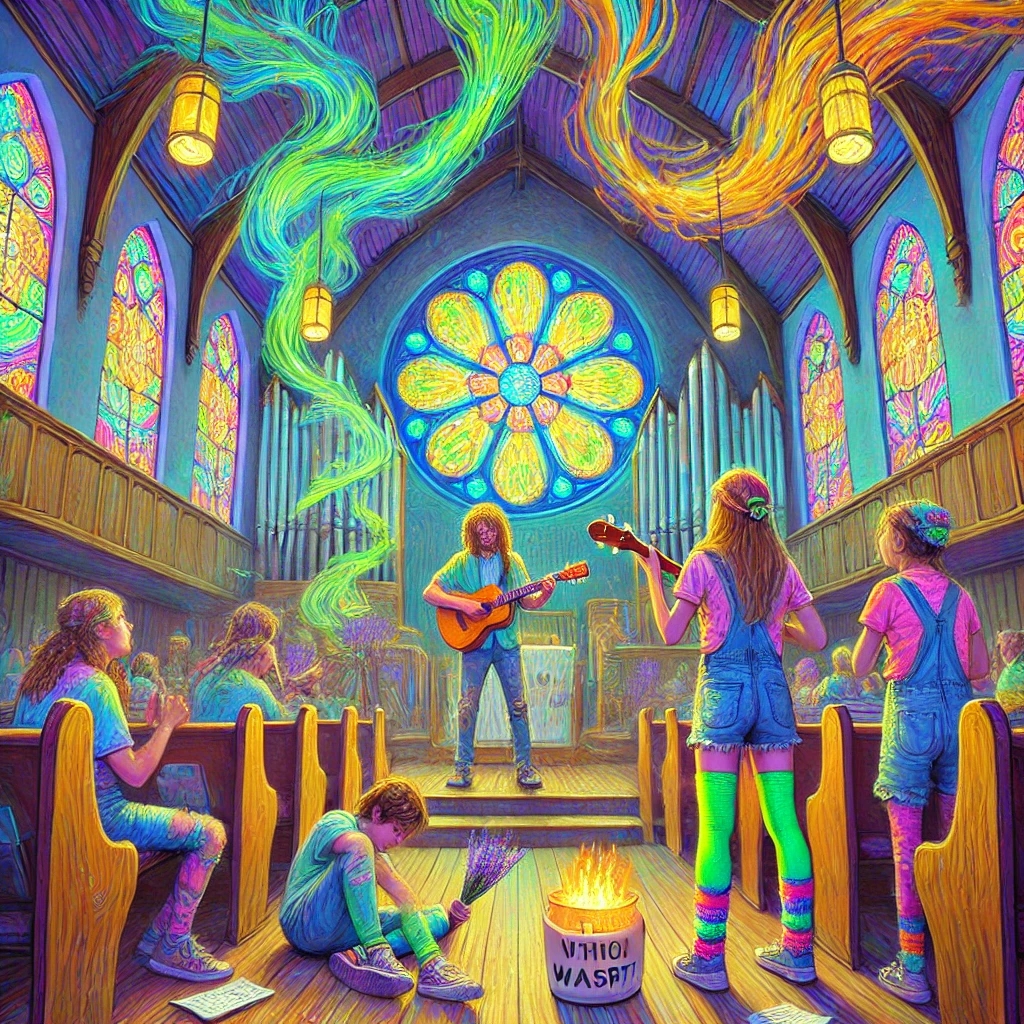
Sunday Like No Other – Punk Begins
The Setup: A Sunday Like No Other
It was supposed to be a routine Youth Choir Sunday at First Unaffiliated Missionary Temple. Mabel Dean had approved the bulletin font. Pastor Peeler had selected scripture from Psalms and added three of his signature rhyming sermon headers. Evelyn Grace Tipton had prepped the piano with a freshly embroidered doily. And Trixie Jo, Youth Choir President Emerita (self-declared), had insisted that this year’s performance include matching sashes that read: Praise Loud, Pray Proud.
No one expected what followed.
The children of Sequatchie Crossing, shepherded by Brett and Alyssa Crenshaw on their new mission to “vibrationally elevate church music,” took the stage in homemade patchwork denim, neon leg warmers, and eyeliner that glowed faintly under the emergency exit sign. Brett nodded solemnly from behind a portable amp.
“This is a devotional reconstruction of spiritual upliftment,” Alyssa whispered, holding a lavender-scented diffuser in one hand and a tambourine made of recycled wind chimes in the other.
And then it began.
The first wail of electric ukulele ripped through the sanctuary. The lights dimmed unexpectedly (Doughboy Teeter had hacked the dimmer switch “for ambiance”). A high-pitched screech of feedback looped once, twice, then gave way to the unmistakable chant:
“OHHHHH GREAT THOU AAAAART! YEAAAHHHH!”
Shelley Wexler waved an aura-cleansing wand. Clovis Strickland fainted into the collection plate, later insisting it had been weaponized frequency warfare. Pastor Peeler stood motionless at the pulpit, lips trembling, as if caught between rebuking and applauding. Several members of the congregation clutched their pearls (real and metaphorical). Others tapped along with the beat, confused but compelled.
Behind the altar, a projection screen dropped down displaying shifting color fields and the words “Vibe and Be Washed.” Doughboy’s doing, again.
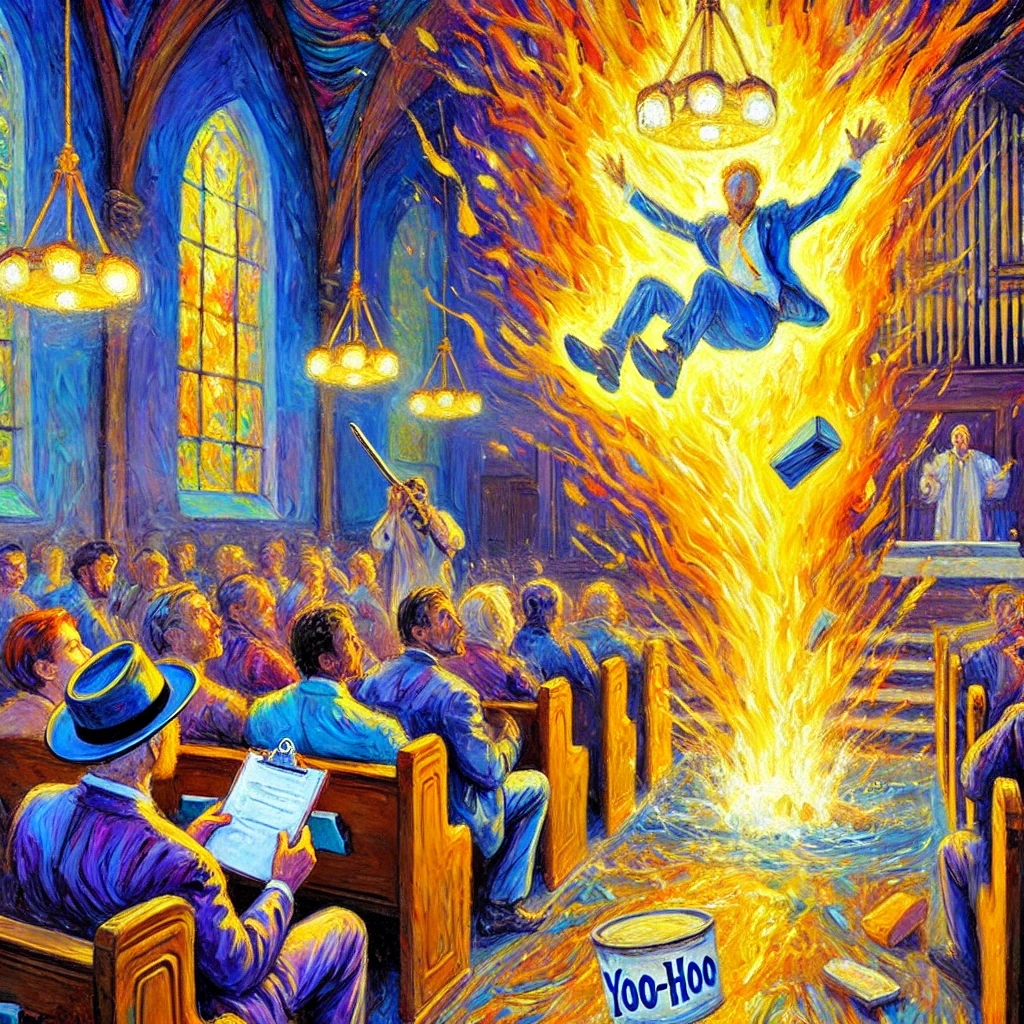
Sashes to Ashes – Chaos in the Sanctuary
The Aftershock: When Sashes Turn to Ashes
Mabel Dean, who had already begun coordinating the casserole procession to follow the service, dropped her clipboard. Her voice, calm but carnivorous, whispered: “That’s not praise. That’s polyester rebellion.”
Coach Freddie Stubblefield, however, leapt from his pew and shouted, “NOW THIS IS GRIT!” He attempted to start a one-man mosh pit but got tangled in the baptismal curtain and had to be rescued by Kenny Joe Teeter, who had slept through most of the performance until the smoke machine kicked in.
Kenny Joe simply said, “Well, that escalated faster than a squirrel on double espresso,” and sat back down with a Yoo-hoo.
Meanwhile, RT Mullins was livestreaming from the back of the church: “Y’all tune in, we got a spiritual riot in progress and potential for a merch drop. #GreatThouArtcore #PraiseWave #EzekielEmo”
Chester Ray Blevins, who had printed 50 laminated programs for the service, began editing them on the fly with a label maker. “Hymnal incident pending,” he muttered. When someone asked if he’d archive the moment, he replied, “It’ll go in the restricted drawer. Between the glitter scandal and the rogue hymn rewrite of 1994.”
Sister Lila Mae Pruitt stood in the lobby, hand on tambourine holster, murmuring scripture under her breath and eyeing the stage like it might sprout horns.
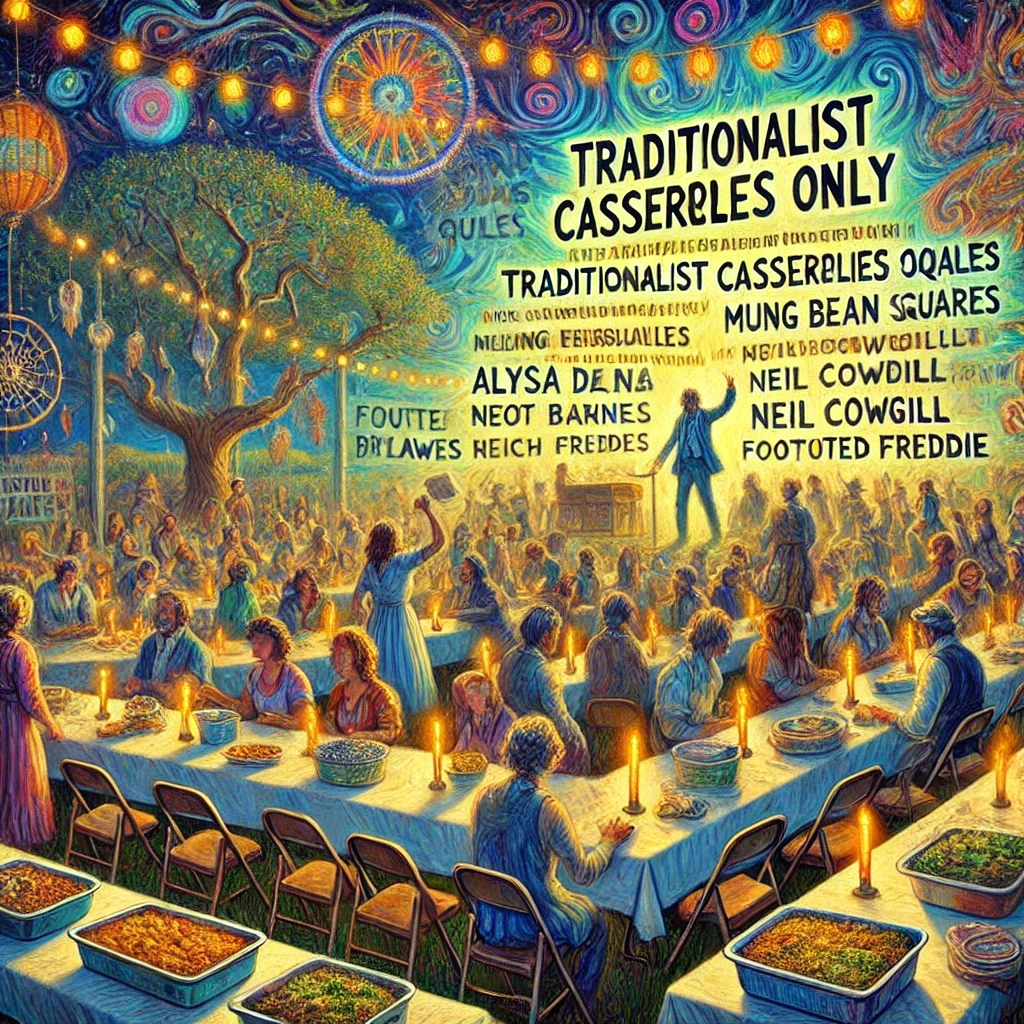
The Outdoor Potluck Uprising
The Turning Point: From Breakdown to Breakout
At the potluck that followed—now relocated outdoors due to concerns about lingering incense fog and spontaneous aura assessments—the debate escalated. Mabel Dean set up a table labeled “Traditionalist Casseroles Only.” Shelley and Alyssa offered fermented mung bean squares beside a sign that read “Eucharist Optional.
The air was thick with suspicion and tofu steam.
Boot Barnes arrived late, waving a 1983 church bylaws printout that he claimed banned “punk spiritual subgenres,” only to be countered by Dr. Neil Cowgill, who explained that the original Greek translation of “psalmos” could include “exuberant string noise,” citing three footnotes and an appendix on ecclesiastical acoustics.
Arguments flared. A minor food fight broke out when Coach Freddie mistook a kale crumble for a prank. Evelyn Grace Tipton quietly began playing the piano—a soft, slow version of “How Great Thou Art,” bridging the gap between versions. Half the crowd cried. Trixie Jo declared it a bipartisan miracle. Clovis swore the soundwave healed his tinnitus.
And then, Brett and Alyssa made an announcement:
“We’re proud to debut the Soul Punk Summer Retreat — a co-healing auditory cleanse featuring reclaimed hymnals and guided scream therapy. Early bird sign-ups include kombucha communion.”
Mabel Dean stared at them. Her left eye twitched. Then she fainted on a pile of tater tot casserole, which Evelyn calmly labeled *”Incident of Divine Recalibration.”
Boot took her clipboard and added three addendums to the casserole roster in her honor.
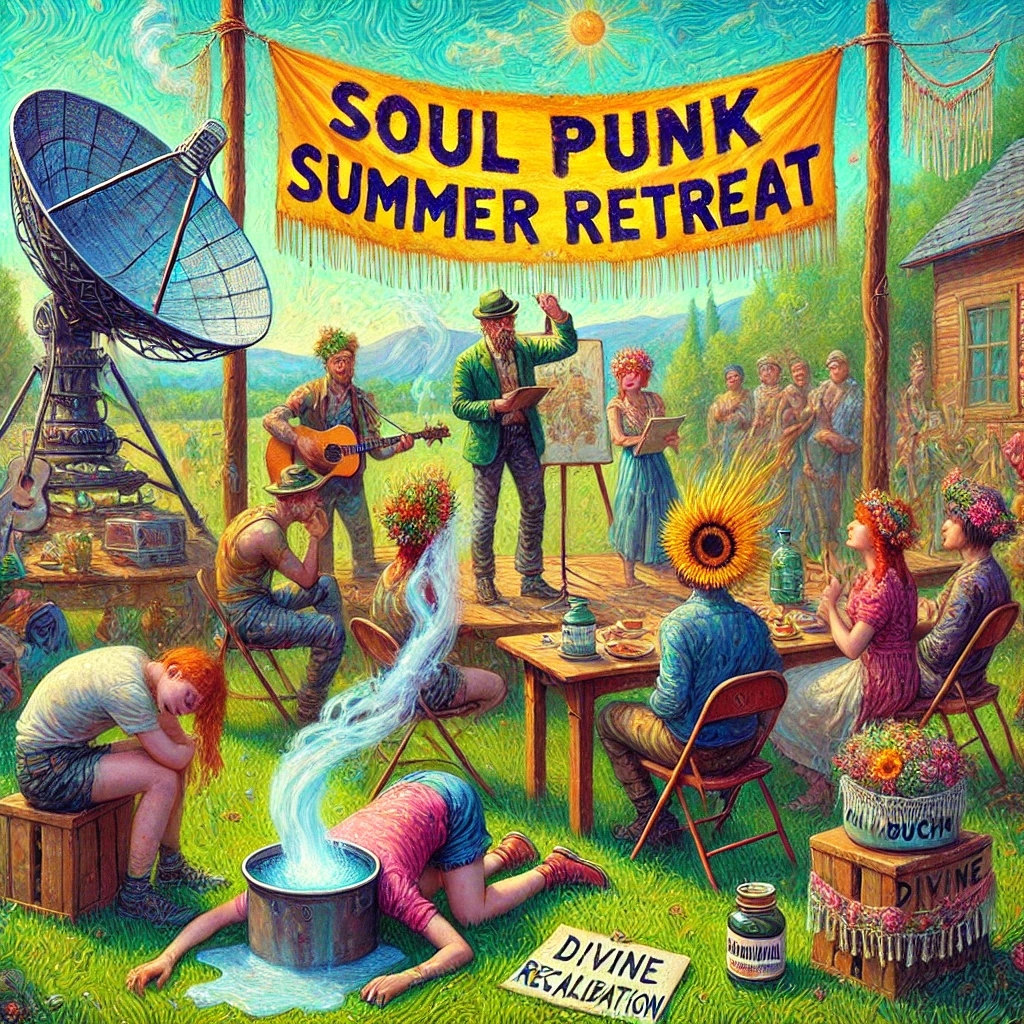
The Announcement – Punk Retreat Unleashed
The Resolution: When the Feedback Settled
By the next Sunday, the church had recovered, mostly. Pastor Peeler preached a sermon entitled “Noise, Notation, and the Narrow Way” and avoided naming names. Wade Langston installed a sign above the choir loft stating: Sound Checks Required By Ordinance 12.8
Trixie Jo launched a committee to formalize youth-led musical initiatives, including “Genre Days” and a provisional vote on a kazoo choir. Chester Ray began laminating punk hymnals under protest. Coach Freddie suggested next year’s Easter service include a fog machine “for drama and redemption.
Shelley Wexler passed out flower crowns made of sage and elderberry, claiming they offered forgiveness and slight pollen-related memory loss. Clovis, now convinced the feedback was a coded message from celestial intelligence, began attending choir practice with a homemade satellite dish hat.
And Boot Barnes quietly mailed a letter to the Southern Gospel Preservation Society requesting official clarification on whether cowbell constitutes an anointed instrument.
Evelyn Grace, once again, played the postlude with both dignity and flair—this time in E minor. It sounded like mercy in a minor key. Even the feedback stayed quiet.
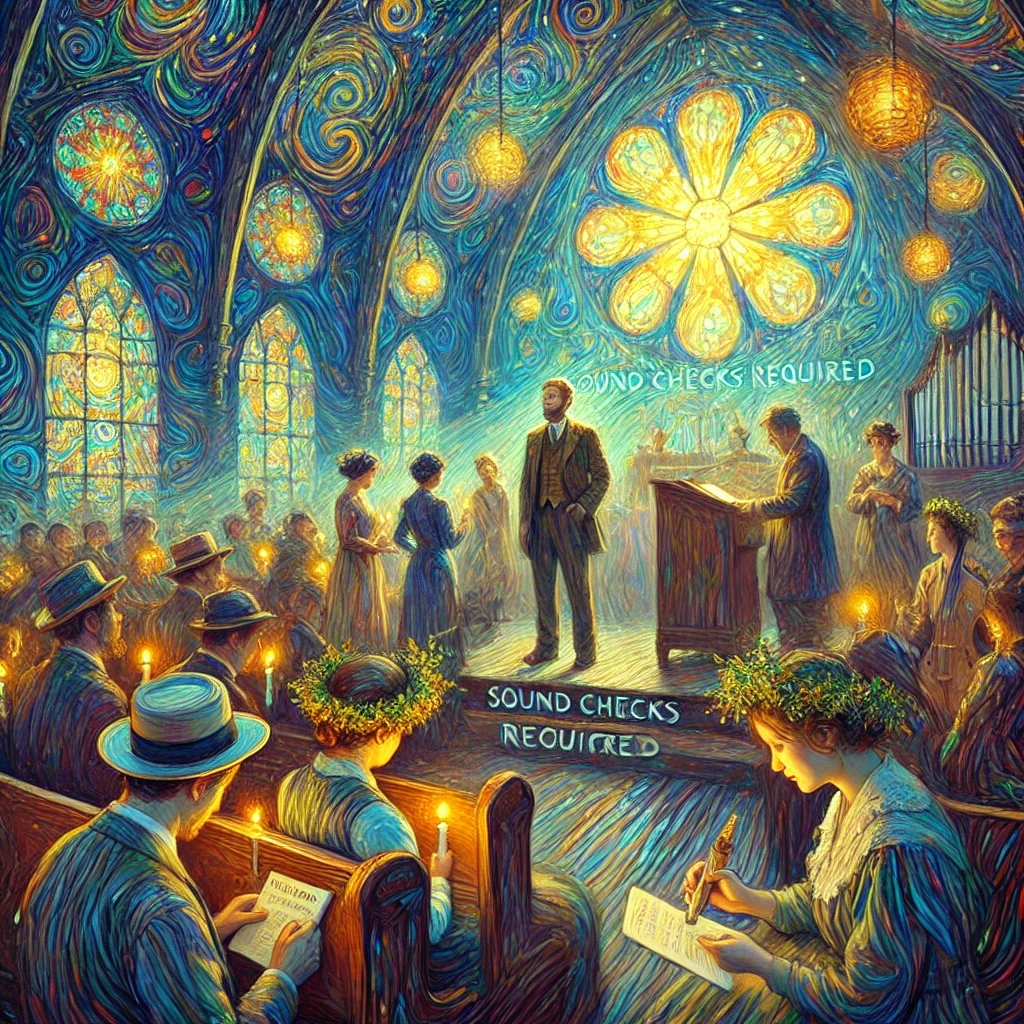
Quiet E Minor – The Aftermath
Moral of the Story:
Sometimes, you have to lose the key to find the harmony.
Disclaimer: This story is a complete and utter fabrication. No actual hymnals were harmed (though one was decoupaged). If this feels eerily familiar, it’s because every town has its moment of holy distortion. Amen and amp up. Any resemblance to real people, living or just stubborn, is purely accidental—but also maybe a little flattering. Sequatchie Crossing exists only in the minds of those brave enough to imagine a town where zoning laws, casseroles, and conspiracy cassettes collide in glorious disarray.
Real Places Behind the Ruckus – From The Dunlap Directory

Real Places Behind the Ruckus – From The Dunlap Directory
Yes, this story was fictional; even the parts that weren’t true. These places? Absolutely real. Stop by, support local, and keep the Wi-Fi away from livestock:
- Pure Plumbing LLC
- Bolt Farm Treehouse Tennessee
- Camp Chet
- Davis Pond Camping Area
- Griffith Elementary School
- Coops Creek Veterinary Clinic
- Dunlap Plumbing Company
- Perfect Blend Pest Solutions
- Campbell Tire
- Dunlap Masonic Lodge #693
- Hickerson Land Management
- Fredonia Builders
- Old CC Road Farm
- New Shade Painting & Co
- One Way Landscaping
- Dunlap Volunteer Fire Department
- Sequatchie County Rescue Squad
- Mountain Top Diesel Repair
- Kat’s Naturals

Real Places Behind the Ruckus – From The Dunlap Directory
At Sequatchie Crossing, we tell the stories of Sequatchie Crossing.
Please share this post with your friends, family, or business associates who may want follow the news from Sequatchie Crossing.

0 Comments