


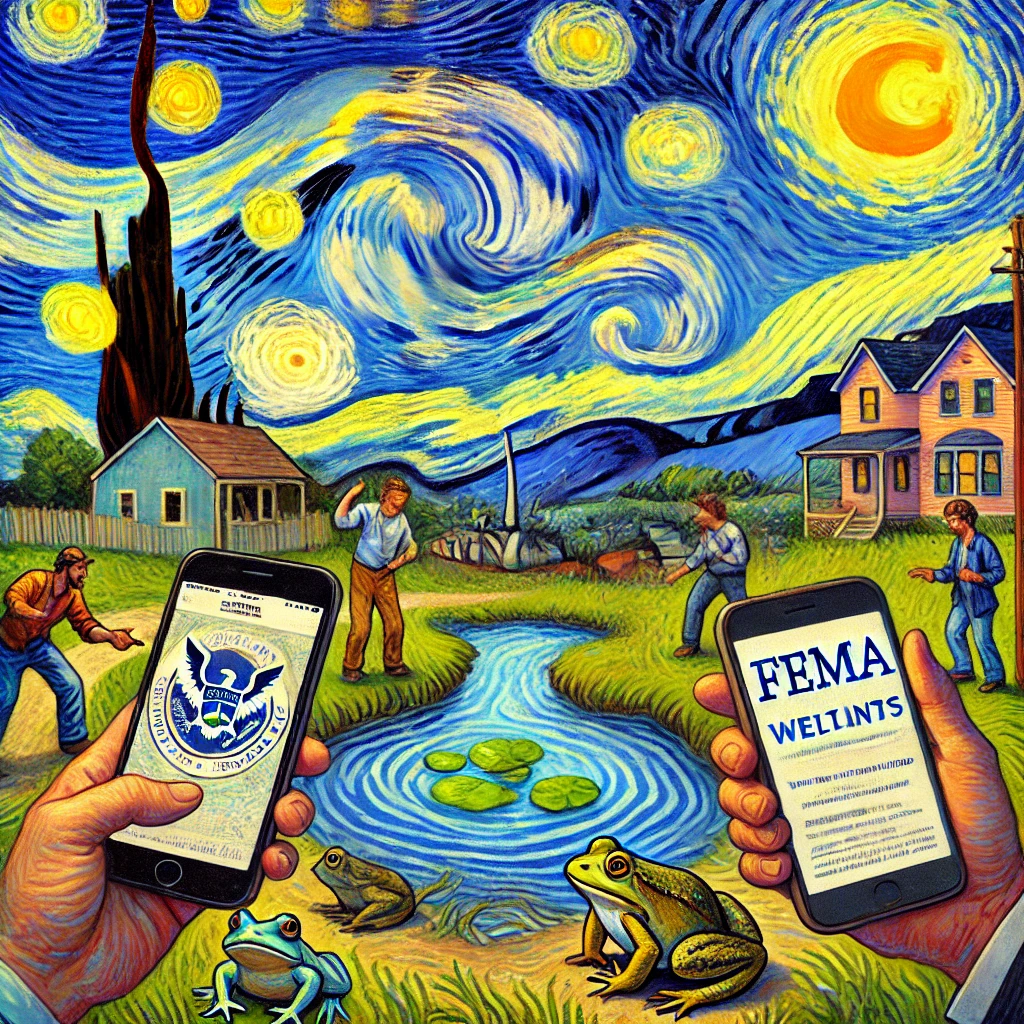
County Learns FEMA Doesn’t Actually Want Your Backyard Frog Pond.
By Tom Seest
At Sequatchie Crossing, we tell the stories of Sequatchie Crossing.
Please share this post with your friends, family, or business associates who may want follow the news from Sequatchie Crossing.
🎤 Audio Overview
The Wetlands That Weren’t Wet Until the Internet Said They Were
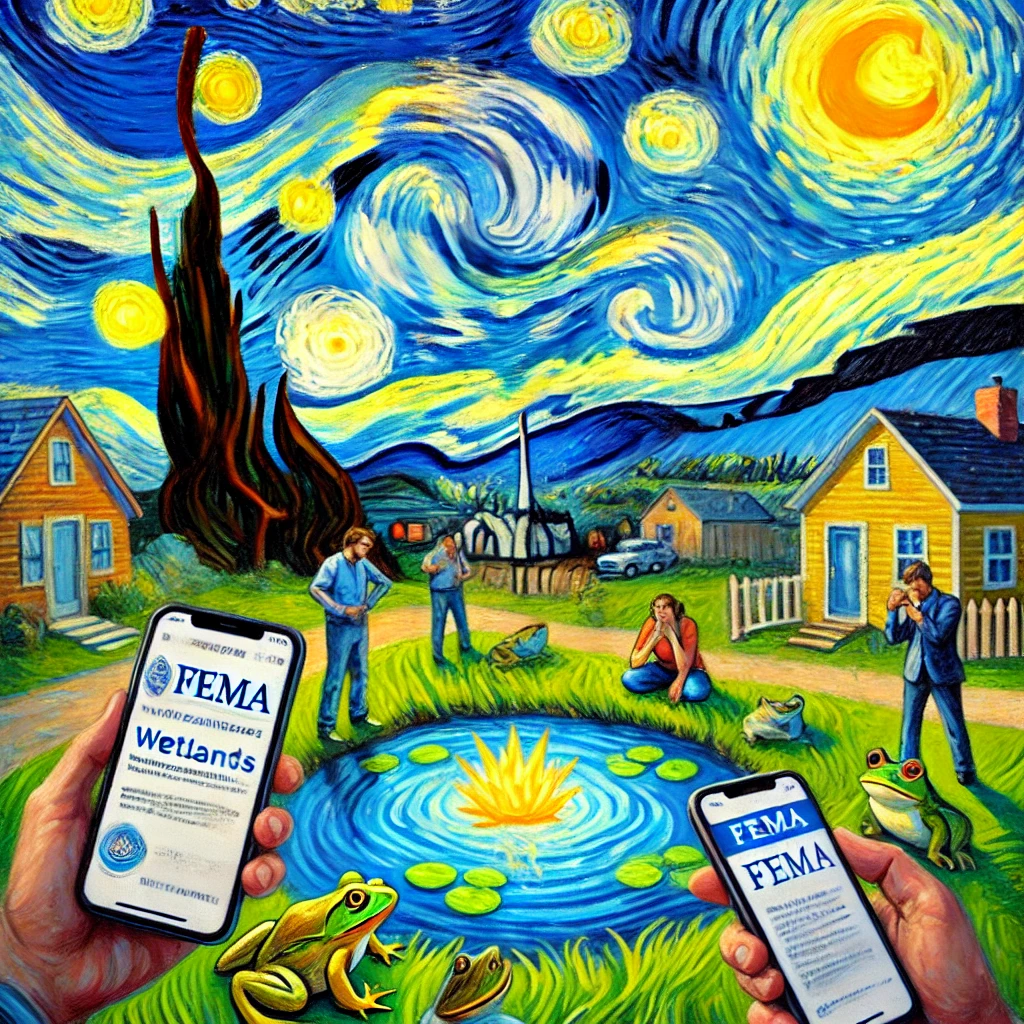
The Wetlands That Weren’t Wet Until the Internet Said They Were
Act I – The Internet Declares War on Dry Land
The trouble started, as most trouble now does, when a resident of Sequatchie Crossing clicked on something they should not have clicked: a government website.
Specifically, Clovis Strickland – the town’s self-appointed Online Compliance Officer (a title nobody asked him to take, yet he insists comes with “implied authority”) – found a new interactive FEMA flood map while investigating what he called “rising humidity trends.”
Clovis clicked his own address.
The map loaded.
Then glitched.
Then loaded again.
Then froze.
Then redrew itself with dramatic flair, throwing large blue blotches across the terrain while an error message staged a blinking revolt in the top right corner.
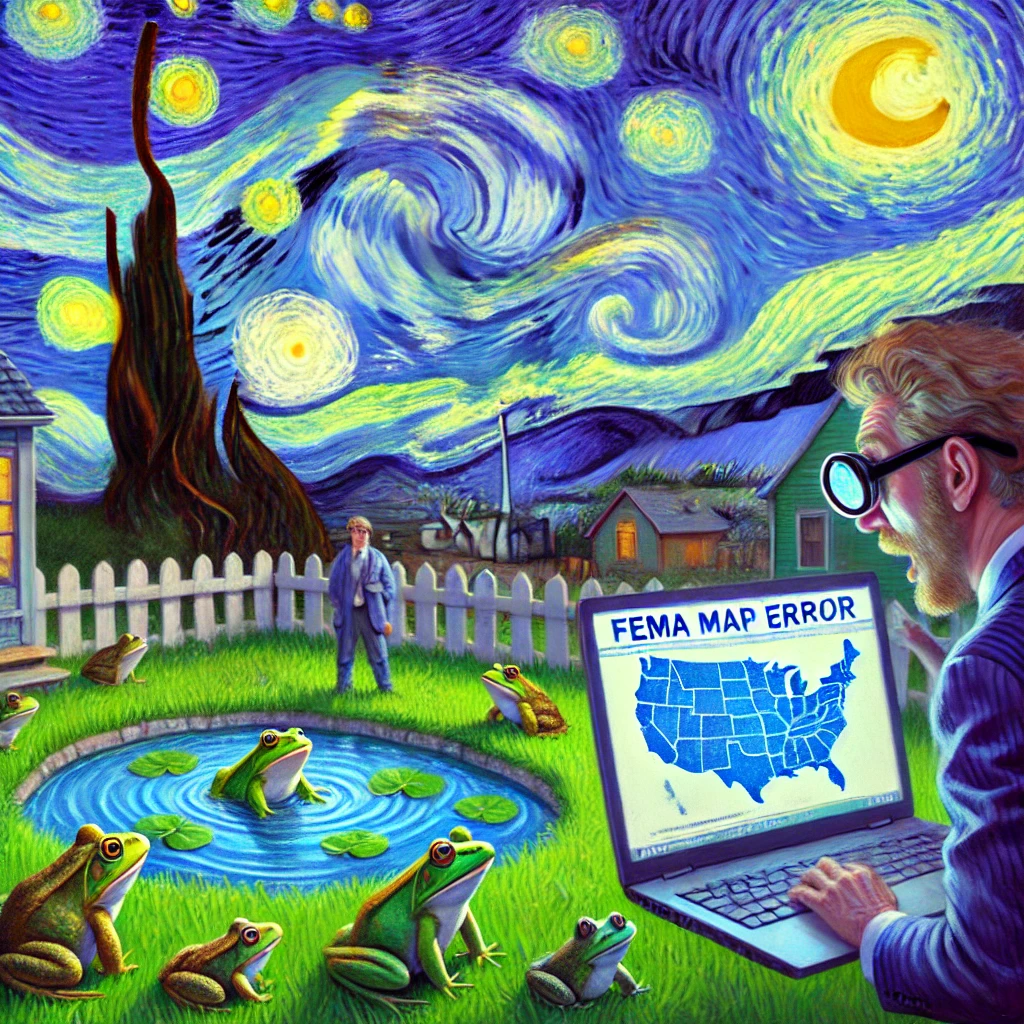
Clovis leaned in, wiped his glasses, squinted, and gasped.
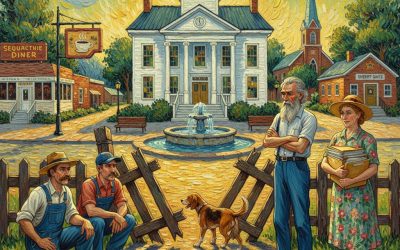
There, glowing like a neon prophecy, the FEMA map declared that his backyard frog pond – an eight-inch-deep depression where tadpoles vacation – had been reclassified as federally recognized wetlands.
“Well, ain’t that something,” Clovis whispered to nobody, because his wife Carla had already gone to bed after reminding him that screens after 9 p.m. made him paranoid.
He zoomed the map in.
Act I – The Internet Declares War on Dry Land
The blue blob grew.
He zoomed out.
The blob expanded across his neighbors’ yards, then down the road, then over Boot Barnes’s property line, eventually coating two full subdivisions in a shade of bureaucratic blue that implied both menace and environmental significance.
Clovis sat back in his recliner, eyes wide, chest tightening with civic panic.
“Oh Lord… We’re a wetlands community now.”
He took a screenshot.
He posted it in the Sequatchie Crossing Enquirer Facebook Group, which functions as a 24/7 rumor marketplace powered by caffeine, outrage, and intermittent satellite internet.
Within minutes, the first comments arrived:
Mabel Dean Ashcroft:
Clovis, that ain’t wetlands. That’s where your frog fellas splash around after a rain. Don’t stir folks up this late.
Boot Barnes:
I told y’all for years my property was waterfront. Guess I’m validated.
Sheriff Peeler:
This better not mean I gotta buy a boat.
And then the one that lit the fuse:
Linda Jo Farrington:
If FEMA says we’re wetlands, y’all better not mow, dig, build, sneeze, or disturb the natural migration patterns of anything amphibious. It’s federal law. Look it up.
Sequatchie Crossing looked it up.
Or rather, they skimmed a few out-of-context memes and declared themselves experts.
By sunrise, half the county believed their garden hoses now required environmental permits.

Act I – The Internet Declares War on Dry Land
Act II – The Great Wetlands Crisis Goes Full Government
The next morning, Clovis did what Clovis always does when the town panics: he marched into Town Hall to escalate things.
Town Hall was unusually busy, as though 7 a.m. had suddenly become a popular hour to demand government action.
At the front desk sat Janelle Peeler, Sheriff Peeler’s niece and the most overworked receptionist in county history. She had already fielded several calls:
One man asking whether his bird bath now required flood insurance.
Another wanting to know if tadpoles count as “livestock” under the new wetlands designation.
A third who believed his mortgage rate had changed overnight because “my property’s basically a lakefront home now.”
Clovis approached, armed with printed screenshots and highlighters.
“Janelle, alert the County Executive. We have a federal situation.”
Janelle blinked. “Sir… it’s Thursday.”
“I know what day it is. And FEMA has recognized my backyard as a sensitive aquatic ecosystem.”
She rubbed her temple. “Did you call FEMA?”
“No, because I don’t speak legalese, and the voicemail system scares me.”
He handed her the screenshot. She sighed the sigh of a woman who has spent her entire life in a small town and still gets surprised.
Act II – The Great Wetlands Crisis Goes Full Government
“Fine,” she muttered, “I’ll start the coffee and summon Keith.”
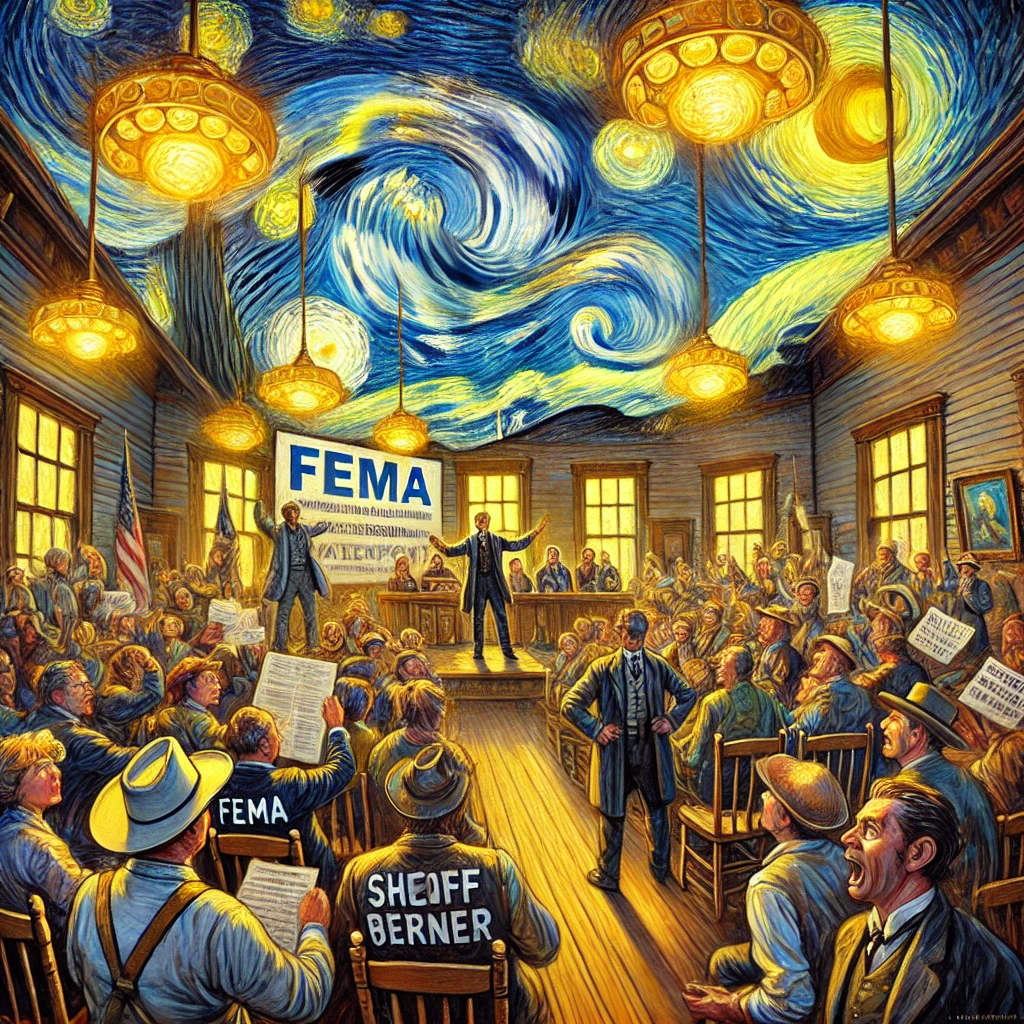
THE EMERGENCY MEETING
By 8 a.m., word spread that an official wetlands crisis was unfolding at Town Hall. Residents arrived carrying:
Notebooks
Lawn care receipts
Frogs in Tupperware
Old drainage maps
New drainage maps
Boot Barnes’s unsolicited PowerPoint titled Boot’s Vision For a Sequatchie Waterfront Renaissance
County Executive Keith Minor entered the room with the look of a man who regretted answering his phone.
“What’s the issue?” he asked.
Clovis raised his hand dramatically. “The government – our government – has designated new wetlands across Sequatchie Crossing.”
Keith looked at the screenshot. “Clovis… this looks like a rendering error.”
“Or,” Clovis countered, “a federal expansion of environmental boundaries based on never-before-recognized amphibian livelihood requirements.”
Keith stared harder at the image, then exhaled a long, quiet prayer.
“Clovis… your Wi-Fi froze and drew a big blue square. This is not wetlands.”
Boot Barnes immediately objected. “Well, now hang on. My property’s been soggy since ’94. You can’t rule out divine timing.”
Mabel Dean stood up next. “FEMA doesn’t want your frog puddle, Clovis. They’ve got real disasters to worry about.”
Linda Jo Farrington, who had been waiting for her moment, stepped forward. “Since when are we allowed to question federal documents? Clovis is showing us what they don’t want you to see.”
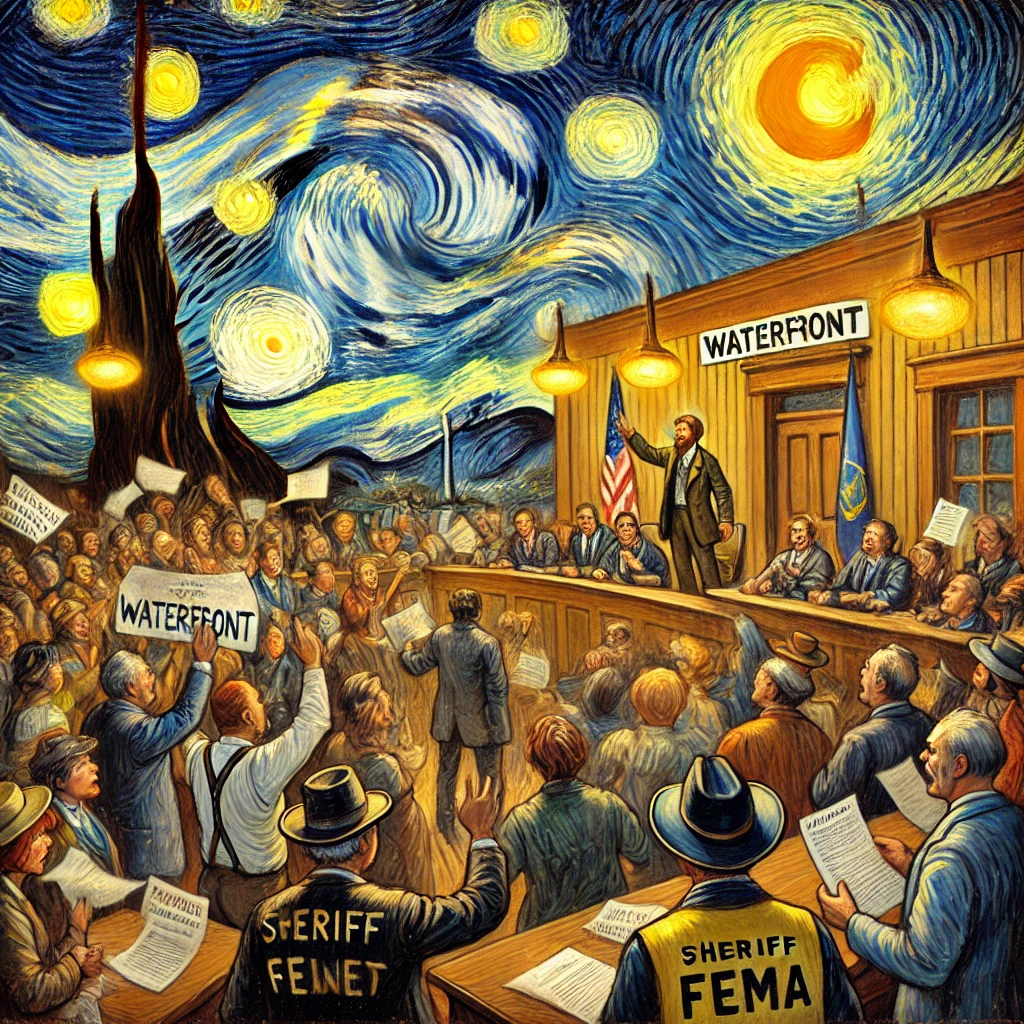
The room descended into uproar.
Keith Minor shouted, “We’re NOT a wetlands county!”
Someone yelled, “Prove it!”
Someone else shouted, “Check the frog density!”
Boot Barnes added, “If we ARE wetlands, I want a tax credit!”
And then Sheriff Peeler, who had finally slipped in, announced:
“If this means folks can’t mow till the tadpoles graduate, I’m retiring.”
The chaos deepened.
Act II – The Great Wetlands Crisis Goes Full Government
Act III – Outsiders, Realtors, and Frog Permits
The crisis moved quickly from Town Hall to the business community.
LOCAL REALTORS PANIC
Realtors, having heard the word “wetlands,” began calling one another in a frenzy:
“Does this mean disclosures?”
“Do frog ponds count as water features?”
“Can we increase the listing price if Clovis’s house is technically ‘lake adjacent’?”
Three realtors staged an emergency meeting at Biscuit Barrel, where Mabel Dean had added a new menu item called The Frog Fry-Up – not because she planned to serve frogs, but because she knew naming a breakfast after local drama guaranteed sales.
Boot Barnes wandered in, sipping a coffee and enjoying his temporary status as a waterfront property owner.
One realtor, Darla McMain, cornered him immediately.
“Boot, you ready to list your place? Lakeside properties move FAST.”
Boot grinned. “Darla, it ain’t a lake. It’s runoff.”
“That’s just branding,” she whispered.
THE BUREAUCRACY EXPANDS
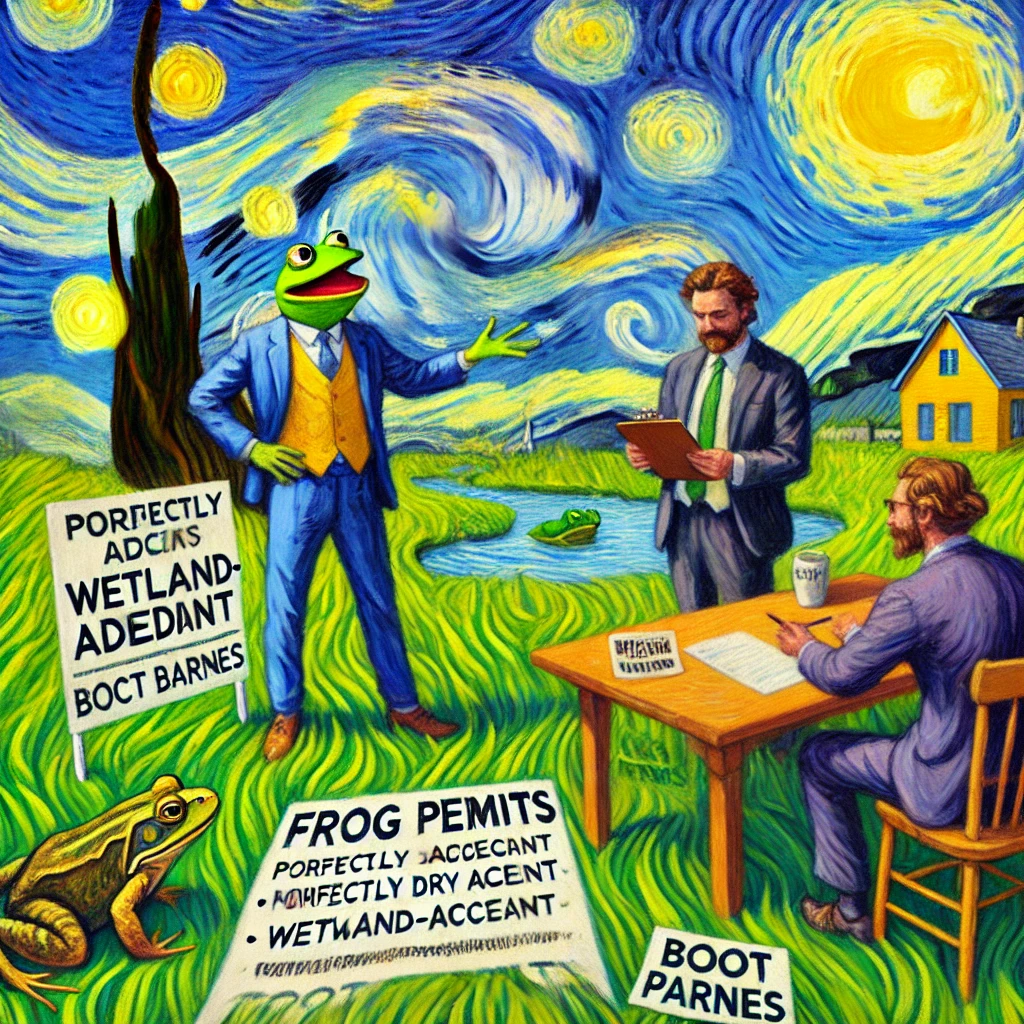
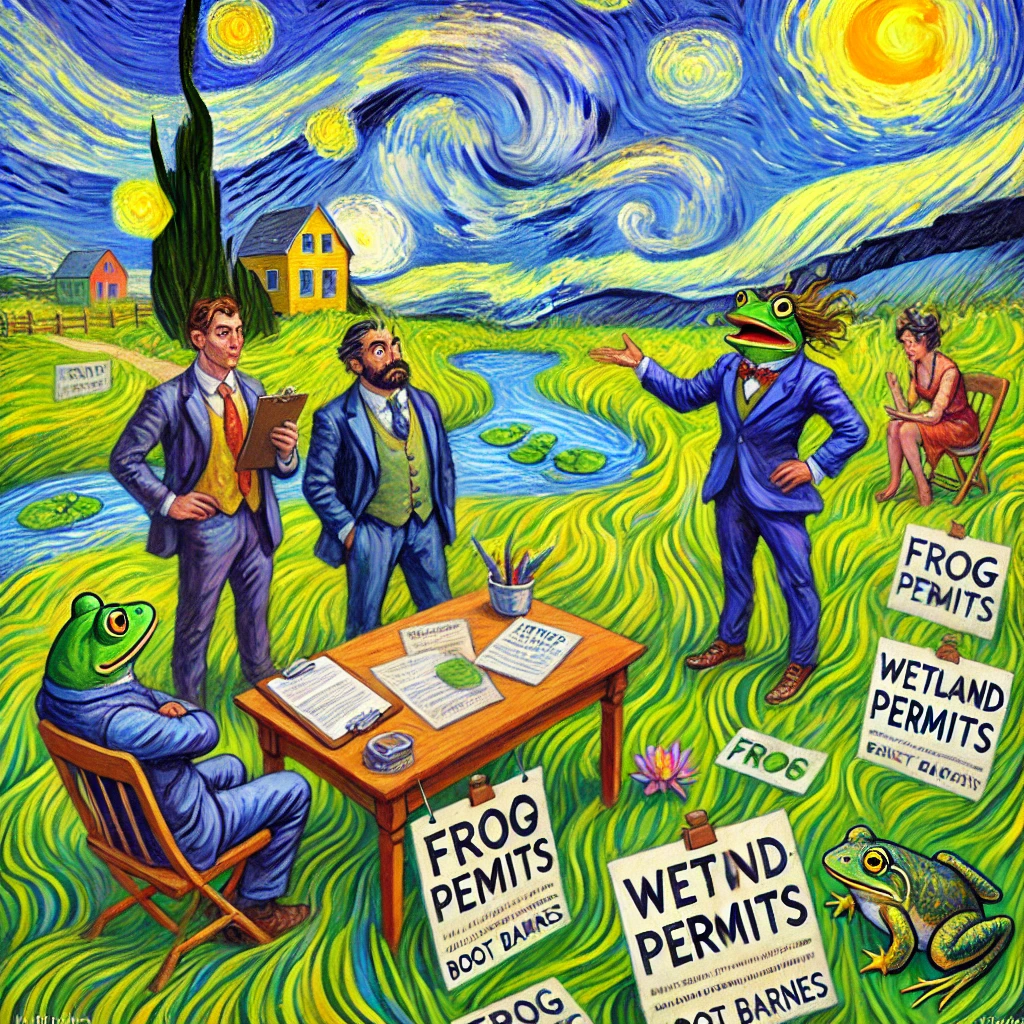
Meanwhile, Linda Jo Farrington began issuing what she called Provisional Wetland Activity Permits (PWAPs). These were not real forms, but she printed them on goldenrod paper and people trusted goldenrod.
Act III – Outsiders, Realtors, and Frog Permits
Linda Jo stood in the Piggly Wiggly parking lot, distributing PWAPs and shouting:
“Anyone wanting to mow, dig, weed, or expand a chicken coop MUST apply! No compliance? Fines begin Monday!”
People panicked.
A man postponed planting tomatoes.
Mrs. Curly delayed hosting her annual lawn gnome repainting day.
Someone attempted to relocate a frog to avoid breaking imaginary laws and was chased around their own yard by a very annoyed amphibian.
Sheriff Peeler confronted Linda Jo.
“You can’t issue permits for imaginary wetlands.”
“They’re not imaginary,” she replied, pointing at Clovis’s map printout as though it were gospel.
Sheriff Peeler replied with patience gained from 30 years on the force:
“Ma’am, I’ve arrested people for weird things, but enforcing frog rights ain’t one.”
ECONOMIC FALLOUT
Local stores reported extraordinary purchases:
Tractor Supply sold out of rubber boots, even though nothing was actually wet.
Ace Hardware sold 47 sump pumps in 2 hours.
Someone bought a canoe “just in case the yard expands.”
Walmart, never missing an opportunity, installed a display titled:
“Sequatchie Wetlands Survival Zone: For When Your Backyard Goes Federal.”
Clovis, flattered but overwhelmed, muttered, “I didn’t mean for this to get so… commercial.”
But the damage was done.
Act III – Outsiders, Realtors, and Frog Permits
Act IV – The Real FEMA Shows Up
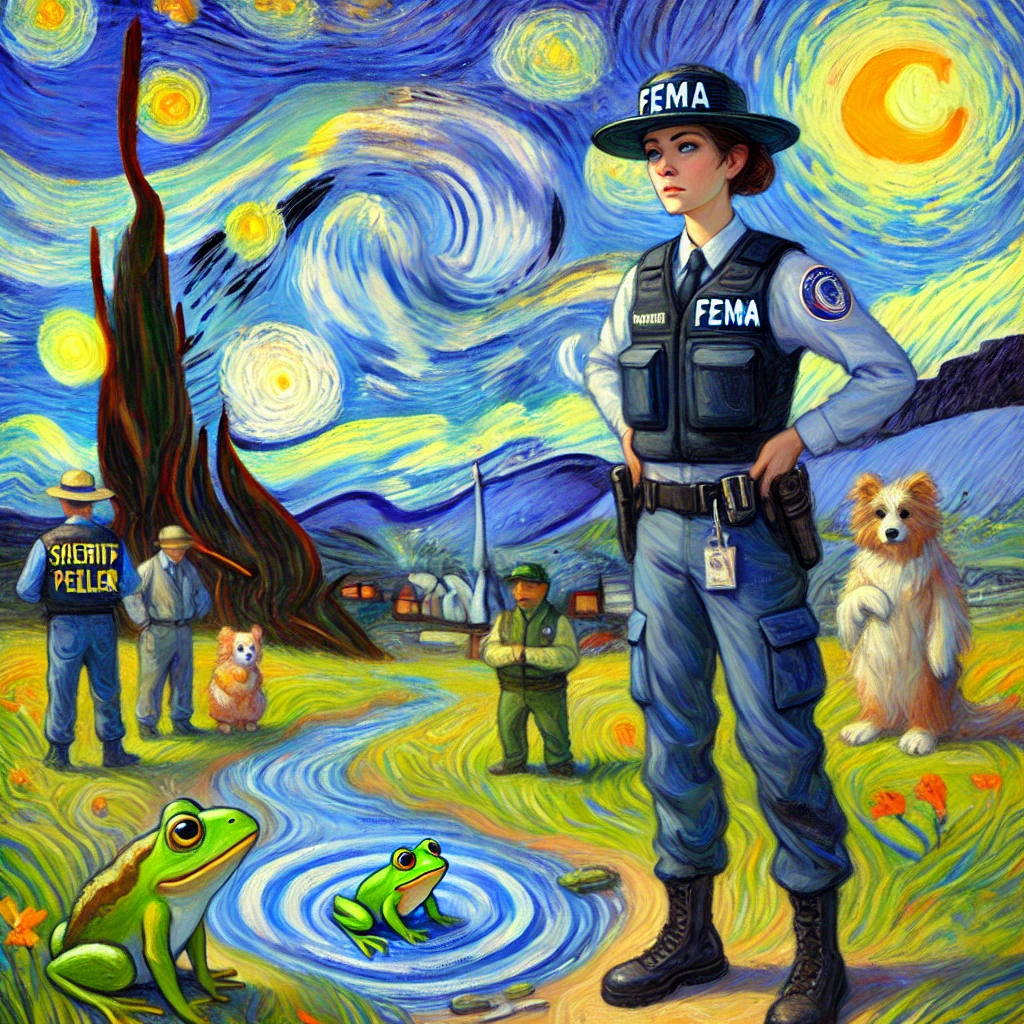
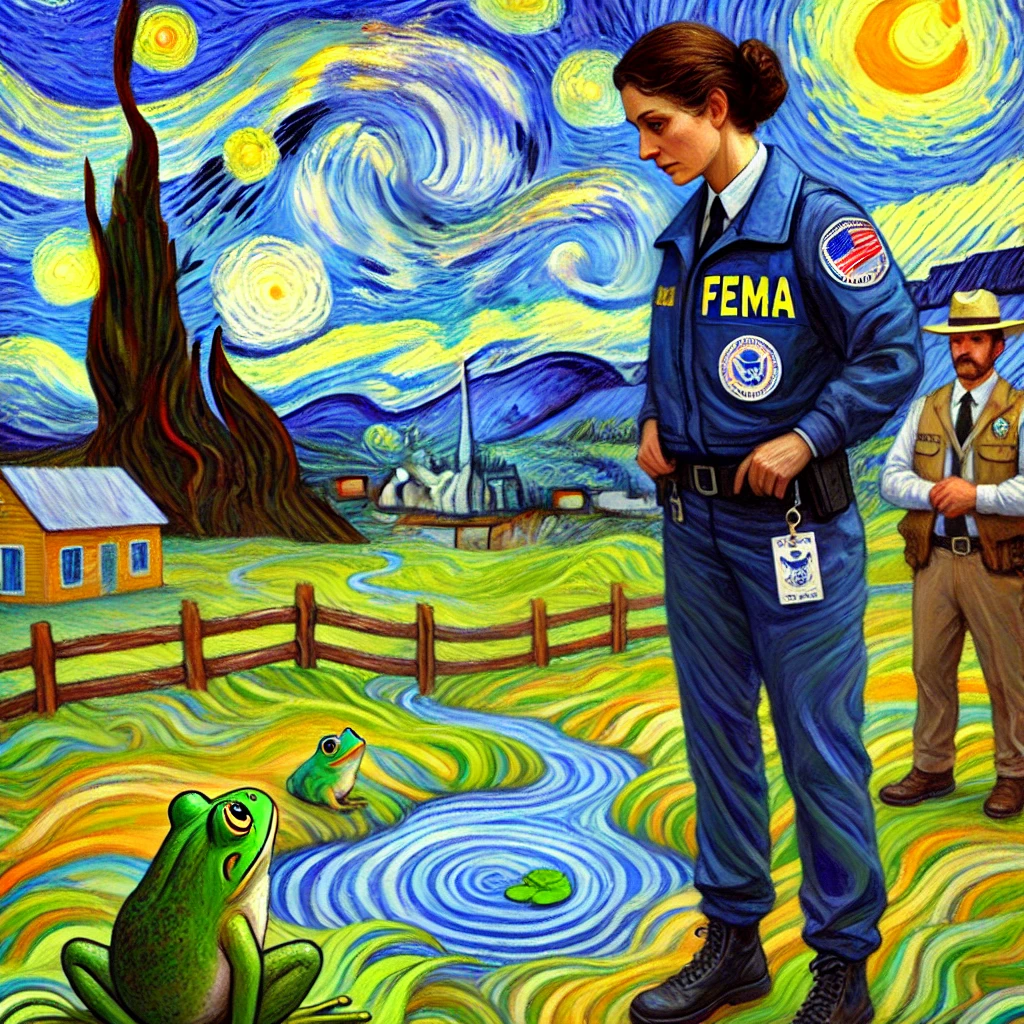
By Day Three, the confusion grew so widespread that an actual FEMA representative arrived to clarify matters. Her name was Janice Calhoun, a composed woman who had seen disasters, floods, tornadoes, and – most terrifyingly – local government meetings in multiple states.
Janice stepped out of her SUV wearing sunglasses and holding a folder labeled “For the Love of Sanity.”
THE INVESTIGATION
Clovis guided Janice to his frog pond while narrating its ecological significance.
“And here,” he said proudly, “you’ll observe the Northern Sequatchie Bubblefrog. Rare species. Visits my yard twice a year.”
Janice stared at the tiny muddy dip.
“Sir… this is not a wetland.”
“Yet,” Clovis insisted.
She crouched down, examined the area, stood up, and took out her clipboard.
“I can confirm,” she said loudly, “that FEMA has zero interest in your frog pond. Or your neighbor’s frog pond. Or any pond created by natural, unnatural, emotional, hypothetical, or accidental causes.”
Boot Barnes raised his hand. “What if it’s a seasonal slough?”
“A what?”
“A slough. S-L-O-U-G-H. I learned it from a duck documentary.”
Janice closed her eyes for a moment. “Sir… no.”
THE TOWN-HALL-LEVEL CORRECTION
Janice convened everyone at Town Hall for an official statement.
Act IV – The Real FEMA Shows Up
“Sequatchie County is NOT a designated wetland zone. The online map was displaying a rendering error tied to unstable bandwidth.”
She paused.
“Which, after driving around this morning, I completely understand.”
Linda Jo objected. “But the blue blob – ”
“Was a glitch.”
Clovis raised his hand. “But the frogs – ”
“Are frogs.”
Boot Barnes added, “But could I still get a tax credit?”
“No.”
Sheriff Peeler chimed in, “So I don’t need a boat?”
“No.”
Janelle asked, “Do we need new insurance codes? We got people buying kayaks.”
“No.”
From the back of the room, someone shouted, “Can we sue the internet?”
Janice sighed deeply. “Also no.”
THE ROOM DEFLATES
Members of the public lowered their heads, disappointed that their yards were less interesting than they’d briefly believed.
Local businesses reluctantly removed their wetlands-themed merchandise.
Linda Jo ripped up her PWAP permits and threw them into the air like bureaucratic confetti.
Clovis felt personally betrayed by the map error.
“I truly believed we’d entered a new ecological era,” he murmured.
But then Boot Barnes clapped him on the shoulder.
“Clovis, you gave this town three days of purpose. The last time folks were this excited was the Great Corn Festival Sash Mix-Up. You brought us together. Even if you did it by accident.”
Clovis nodded solemnly. “I suppose… wetlands were the friends we made along the way.”
“No,” Mabel Dean corrected. “Those were just frogs.”
Act IV – The Real FEMA Shows Up
Epilogue – A Celebration of Dry Land
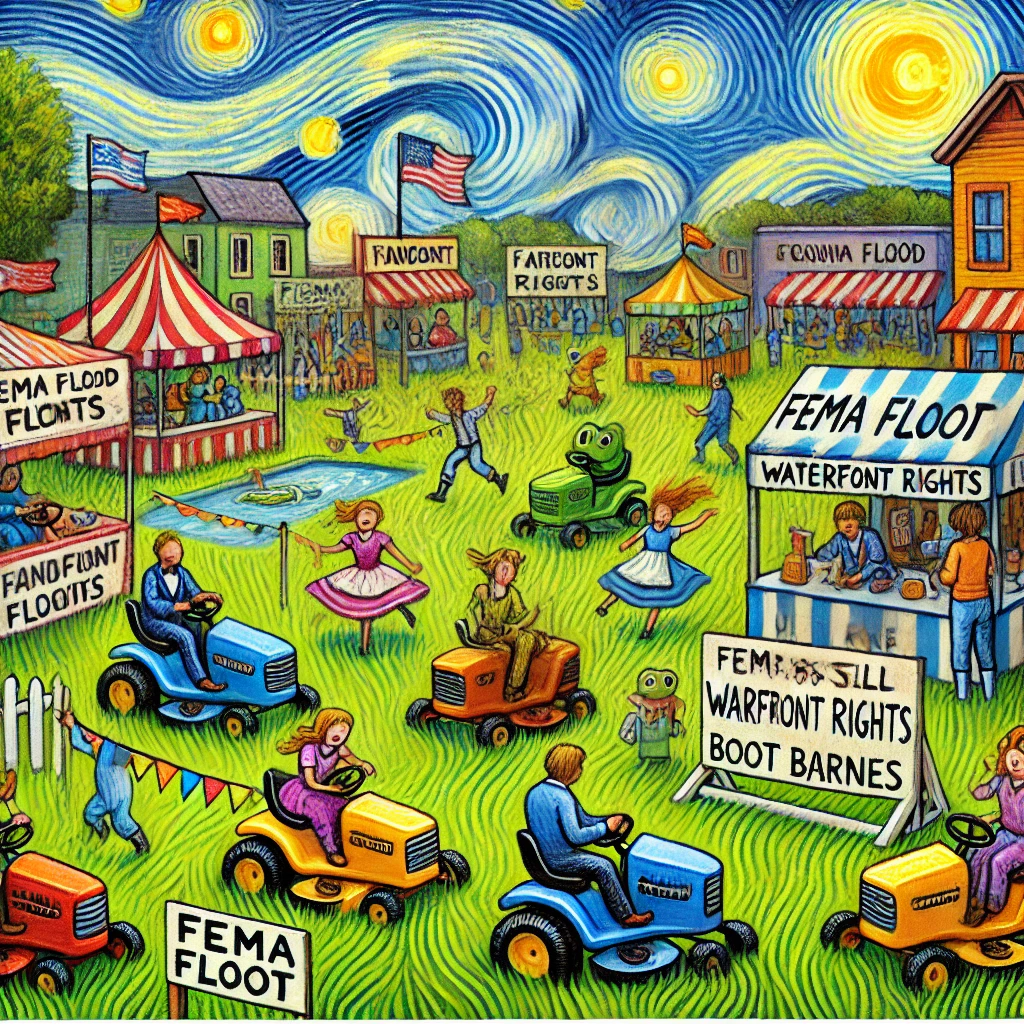
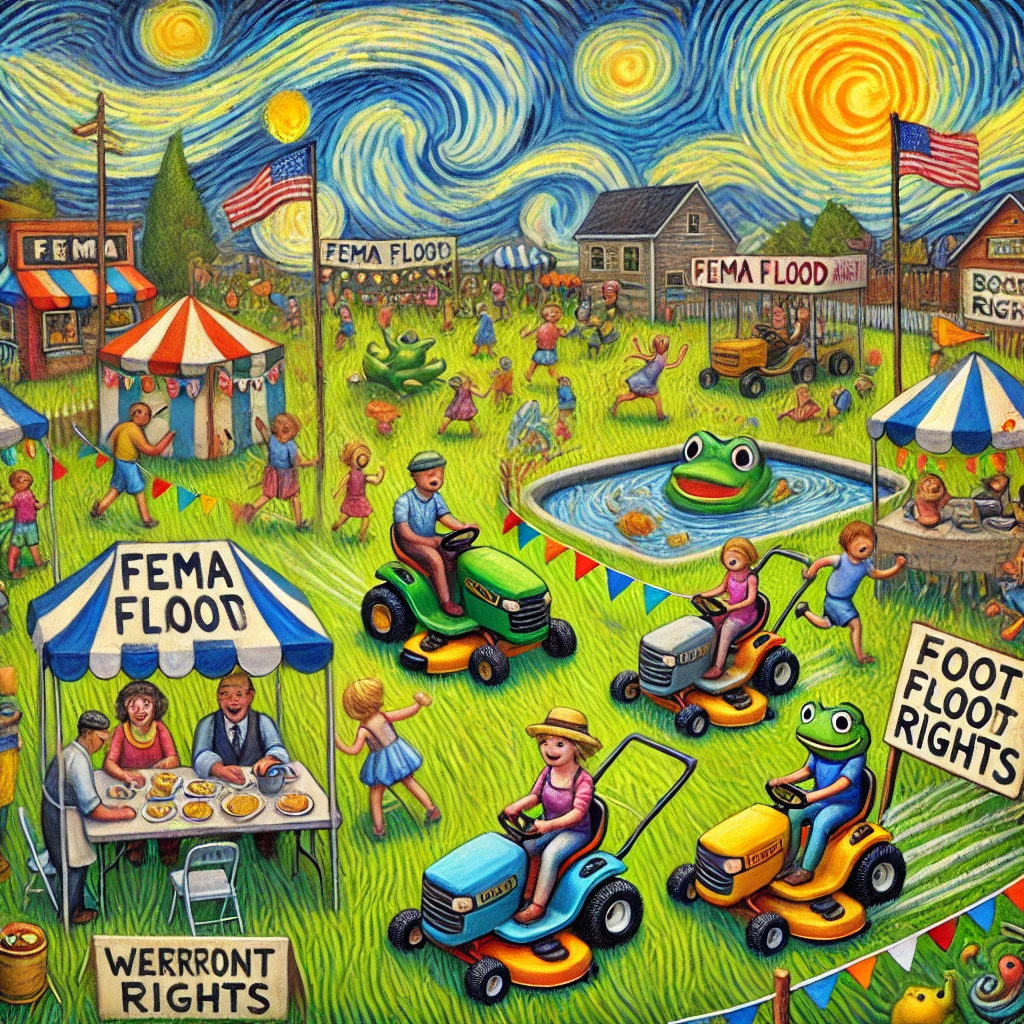
To commemorate the crisis that never was, Sequatchie Crossing held its first (and definitely last) Dry Land Festival.
Events included:
The Frog-Free Footrace: open to humans only
The Lawn Mower Parade: celebrating liberated yards
Build-Your-Own-Non-Wetland Diorama:
Sheriff Peeler’s Seminar: “How to Tell a Real Emergency from Clovis Clicking Something”
Epilogue – A Celebration of Dry Land
Mabel Dean’s Special Dish: The Almost-Wetlands Breakfast Platter (pancakes shaped like the FEMA blue blob)
Boot Barnes attempted to auction “exclusive waterfront property rights,” but no one was buying anymore.
Linda Jo gave a speech about her commitment to “learning official procedure before printing anything on goldenrod paper again.” No one believed her.
And Clovis? He returned home, sat on his porch, stared at his frog pond, and spoke softly:
“You caused a federal incident, buddy. Hope you’re proud.”
A frog croaked in response.
Clovis took that as validation.
Epilogue – A Celebration of Dry Land
DISCLAIMER (Presented in Hand-Stitched, Bureaucratically Approved Language)
This Dispatch is a work of satire inspired by life in Sequatchie Crossing – a town where the humidity is high, the tempers are higher, and the Wi-Fi signal is low but somehow still powerful enough to ignite county-wide chaos.
No person, committee, agency, frog, or frog-adjacent habitat should take offense, acknowledge involvement, or file paperwork as a result of what follows.
All characters are fictional, though they bear striking resemblance to people we know, love, tolerate, and occasionally elect.
The Wetlands That Weren’t Wet Until the Internet Said They Were – Disclaimer
Real Places Behind the Ruckus – From The Dunlap Directory
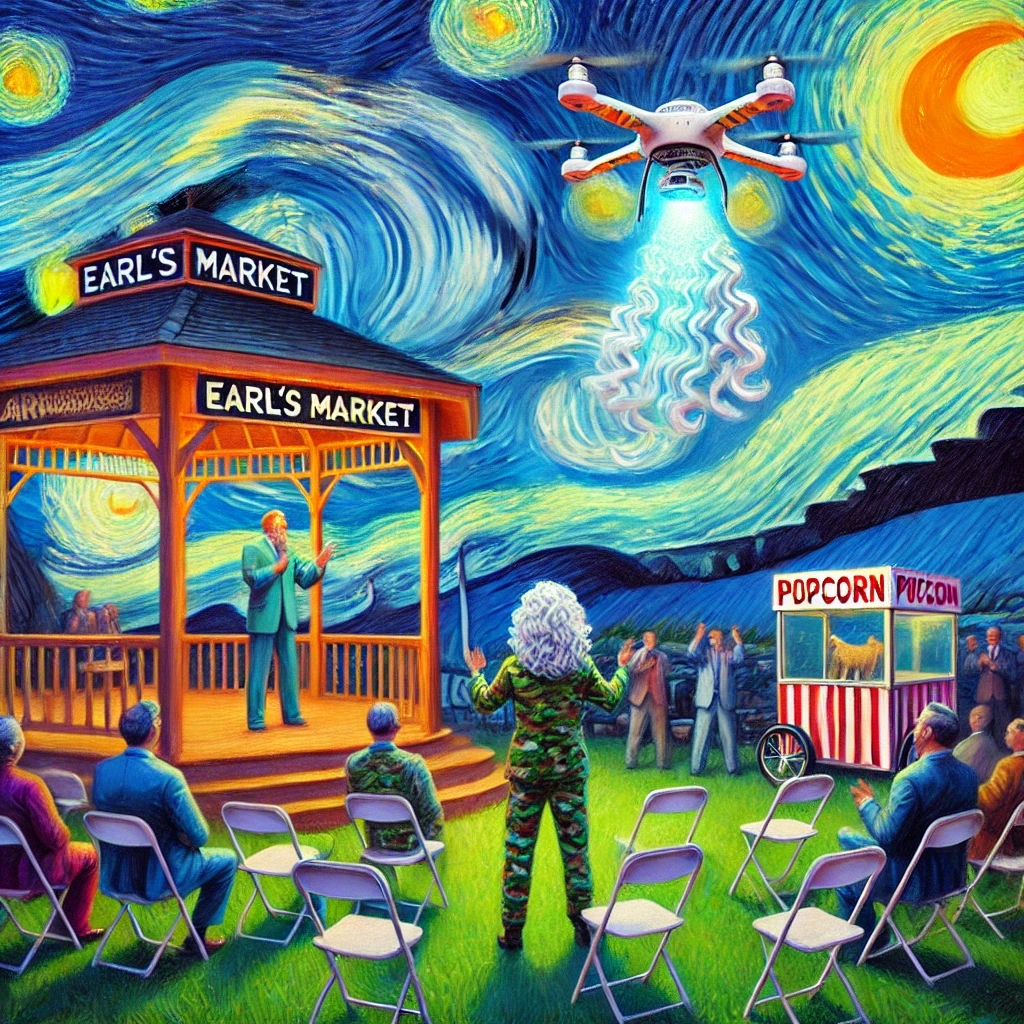
Real Places Behind the Ruckus – From The Dunlap Directory
Yes, this story was fictional; even the parts that weren’t true. These places? Absolutely real. Stop by, support local, and keep the Wi-Fi away from livestock:
- HumBug Pest Control
- Harris Park Splash Pad
- Running Wild Inflatables
- Tennessee Cumberland Plateau Campground
- Shell
- Wilson Dumpsters
- Dunlap Natural Gas System
- Affordable Storage Guys – North Dunlap
- Backwoods Fence and Decking
- StorageSmith
- Sequatchie Memorial Gardens Community Cemetery
- Housley Farm
- Valley Fest
- H&R Block
- Old CC Road Farm
- Flowers & Thyme
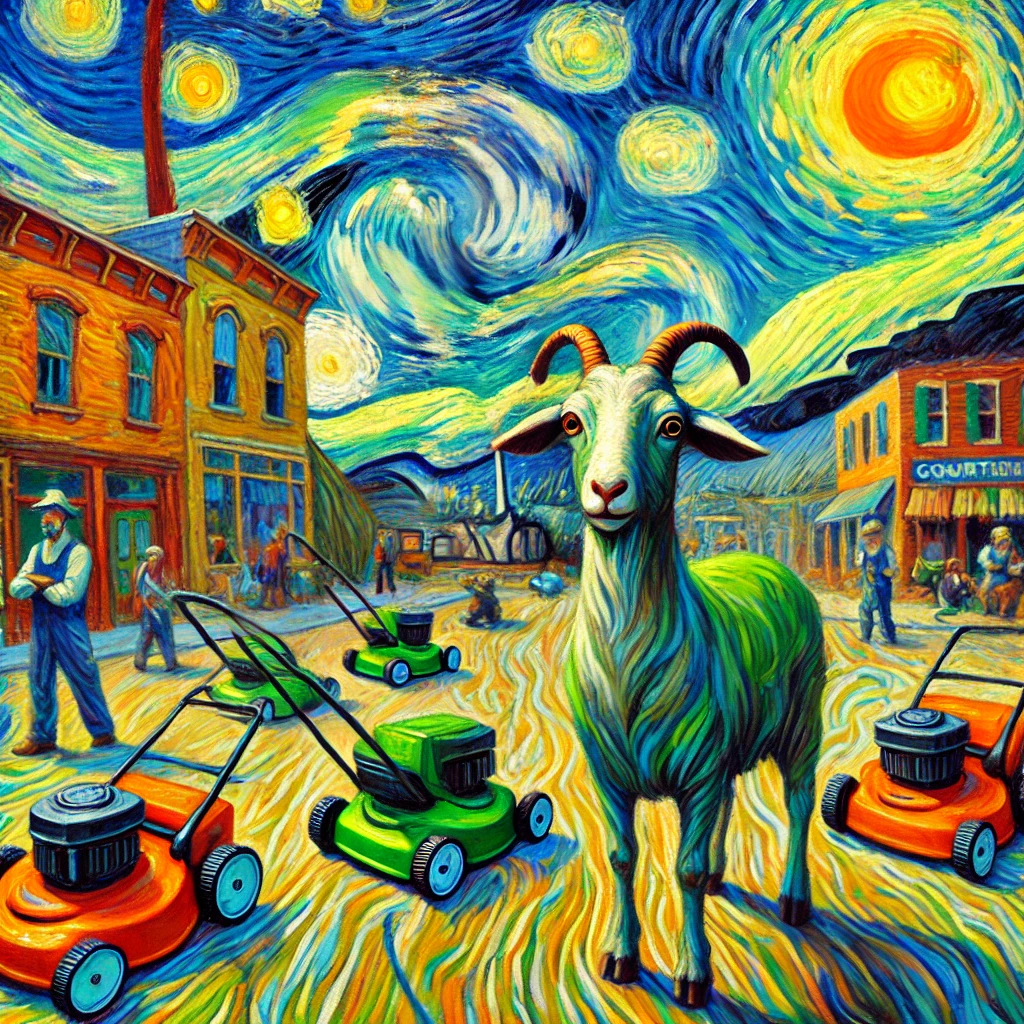
Real Places Behind the Ruckus – From The Dunlap Directory
At Sequatchie Crossing, we tell the stories of Sequatchie Crossing.
Please share this post with your friends, family, or business associates who may want follow the news from Sequatchie Crossing.

0 Comments