


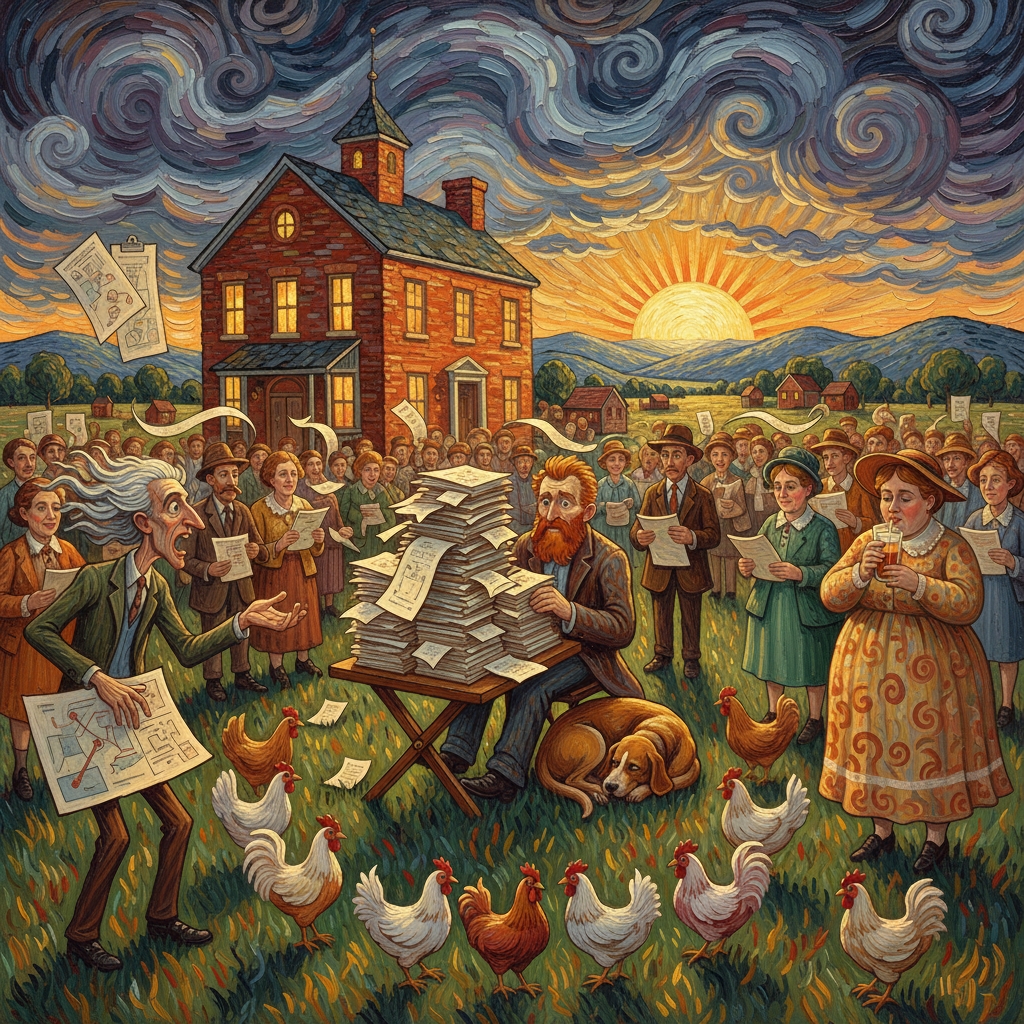
System Efficiency Improved Through Unintended Centralization
By Tom Seest
At Sequatchie Crossing, we tell the stories of Sequatchie Crossing.
Please share this post with your friends, family, or business associates who may want follow the news from Sequatchie Crossing.
🎤 Audio Overview
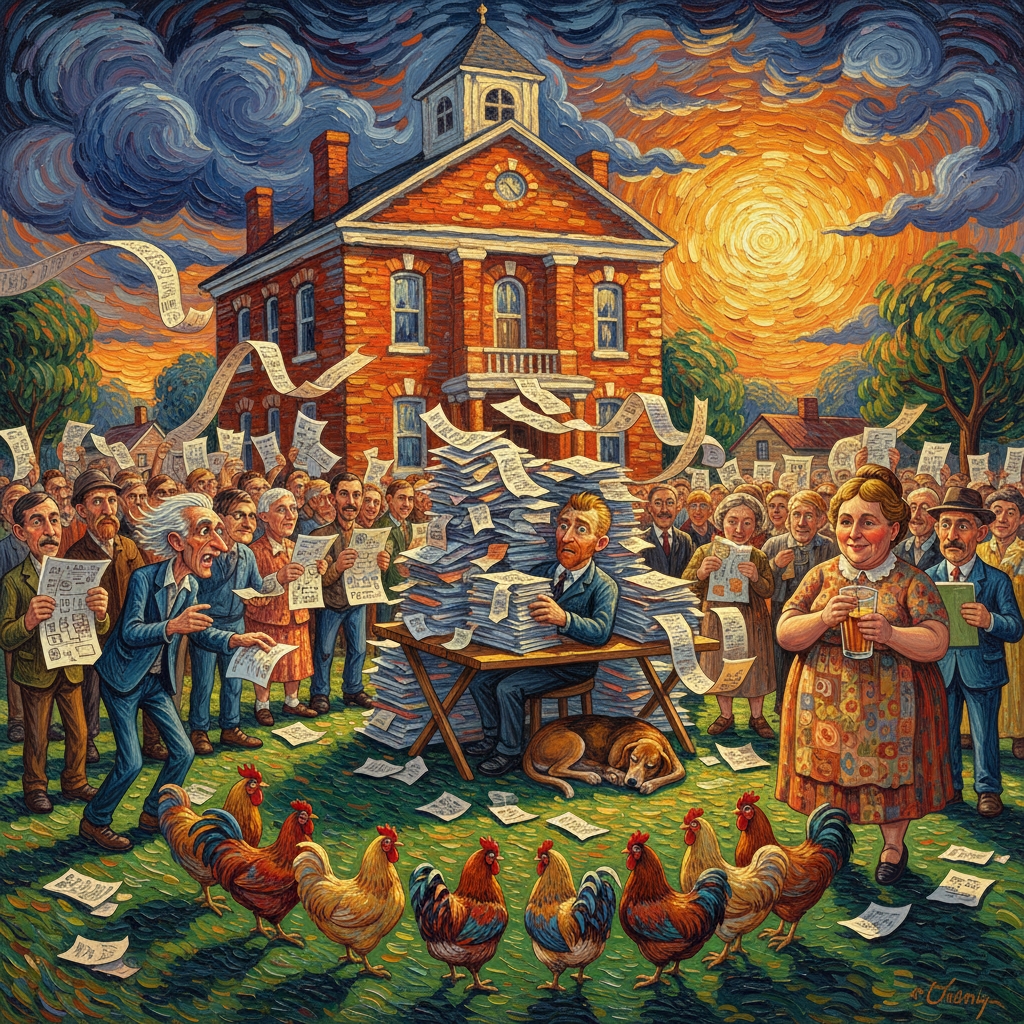
Not My Department App Accidentally Routes All Complaints to Same Person
ACT I – THE UPDATE
The trouble started on a Tuesday morning just after sunrise, when the fog still hung low across the valley and the parking lot behind Sequatchie Crossing Town Hall smelled faintly of wet cardboard and fryer grease drifting uphill from Dotty Mae’s Diner.
Nobody noticed the collapse of local bureaucracy immediately.
That was part of the problem.
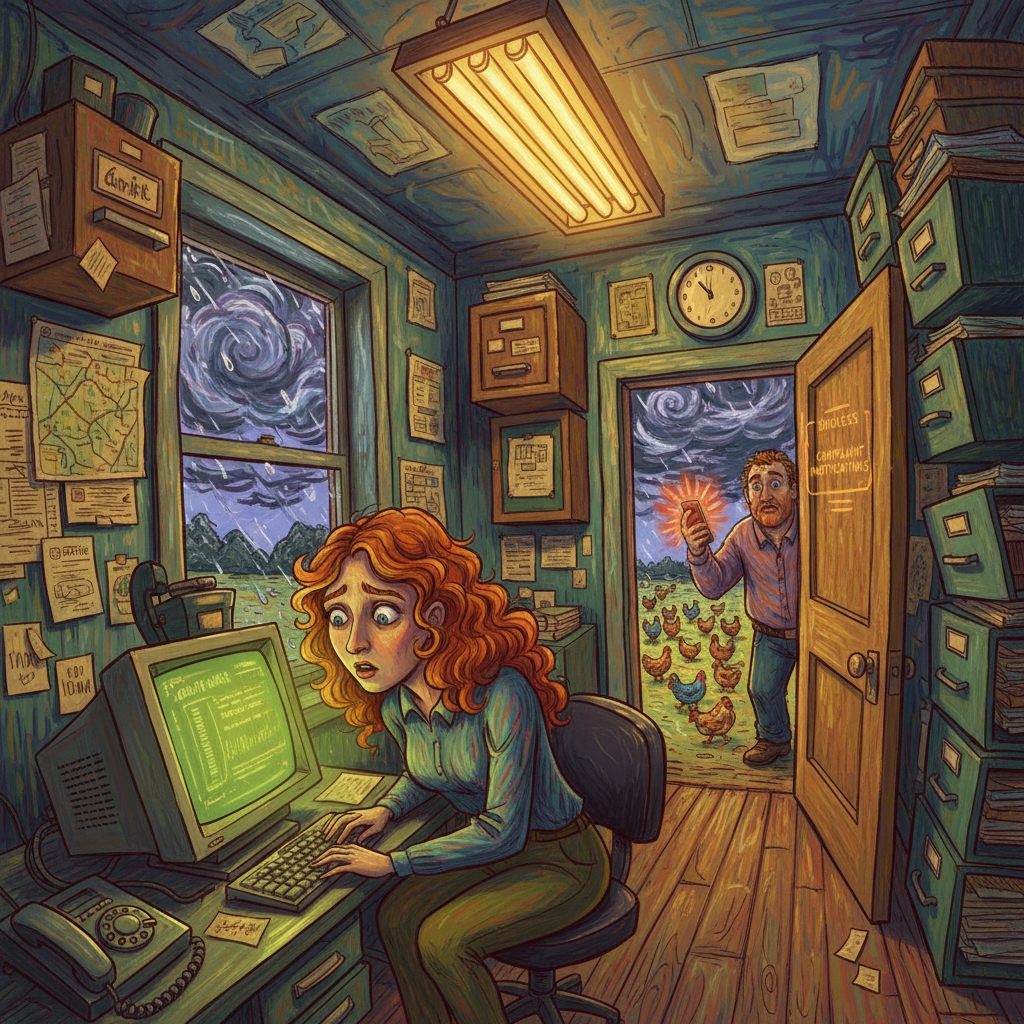
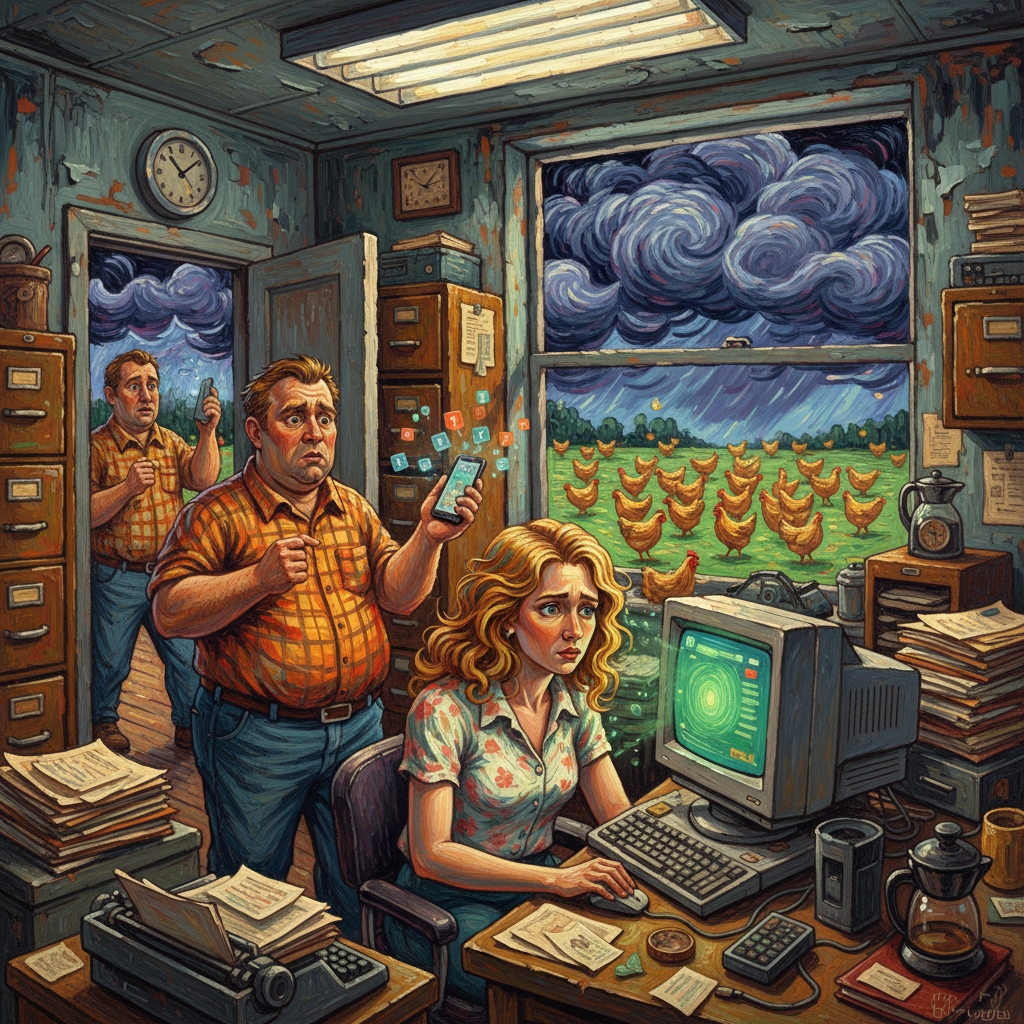
At 7:12 a.m., Shelley Fawn Wexler sat in the tiny Information Systems office beside the copier room, sipping cold coffee while waiting for the “Not My Department” municipal complaint application to reboot after what she called “routine optimization maintenance.”
The app had originally been developed three years earlier using county grant money, volunteer labor, two expired software licenses, and a nephew from Chattanooga who briefly attended community college for “something involving coding.”
Its official purpose was to help residents report problems.
Its actual purpose was to prevent anyone at Town Hall from having to answer the phone.
The system categorized complaints into thirty-seven departments, including:
- Drainage & Water Adjacent Concerns
- Livestock Confusion
- Parking Questions
- Parking Complaints
- Questions About Parking Complaints
- Fence Disputes (Verbal)
- Fence Disputes (Escalated)
- Unauthorized Seasonal Decorations
- Smells
- Possible Smells
- Loud Equipment During Quiet Reflection Hours
Shelley clicked ENTER.
The screen blinked.
Then froze.
Then blinked again.
“Hmm,” Shelley muttered.
Outside her office window, chickens belonging to Mister Wade Langston wandered across the courthouse lawn in an oddly organized cluster, all moving toward the same patch of grass near the flagpole.
Shelley frowned at them.
“That ain’t normal.”
The computer chimed.
UPDATE COMPLETE.
She exhaled with relief.
“Thank God.”
Then the first complaint arrived.
Across town, Trixie Jo Bartlett stood in line at Dotty Mae’s Diner waving her phone angrily.
“I filed three complaints already,” she announced to nobody in particular. “One about potholes, one about loose raccoons behind the laundromat, and one about that haunted Coke machine humming at midnight.”
Maggie Sue Dillard poured coffee.
“You file more complaints than taxes.”
“That’s civic participation.”
“It’s recreational dissatisfaction.”
Trixie checked her phone.
“Oh.”
“What?”
“It says my complaint has been assigned.”
“To who?”
Trixie squinted.
“Just says: ‘Assigned To: Ricky Travis Mullins.’”
RT Mullins was seated three stools down eating biscuits and gravy.
He looked up slowly.
“What?”
Trixie pointed.
“You got my raccoon complaint.”
RT blinked.
“I don’t work for the town.”
A second notification buzzed.
Then a third.
RT pulled out his phone.
His expression changed immediately.
“Oh no.”
Act I – The Update
By 8:30 a.m., RT had received:
- Fourteen pothole reports
- Three complaints about barking dogs
- Seven noise violations
- One suspicious casserole report
- Two concerns regarding “aggressive geese energy”
- A request to inspect mold in a baptismal changing room
- Eleven anonymous reports labeled simply “something oughta be done”
RT drove straight to Town Hall.
He burst through the front door sweating.
“This app’s sending me everything!”
Shelley looked confused.
“That ain’t possible.”
RT shoved his phone toward her.
Another notification appeared.
COMPLAINT #88421 – DEAD POSSUM NEAR FEED STORE
ASSIGNED TO: RICKY TRAVIS MULLINS
Shelley stared.
Then another.
COMPLAINT #88422 – CONCERNING VIBRATIONS IN CHURCH BASEMENT
ASSIGNED TO: RICKY TRAVIS MULLINS
Then another.
COMPLAINT #88423 – CHICKENS GATHERING UNNATURALLY
ASSIGNED TO: RICKY TRAVIS MULLINS
Outside, the chickens had now formed a complete semicircle facing Town Hall.
Mabel Dean Ashcroft walked by the window carrying groceries.
She glanced at the birds.
Then at RT.
Then at Shelley.
“Well,” she sighed, “that’s about right.”
Act I – The Update
ACT II – THE BACKLOG
By lunchtime, the system had collapsed inward entirely.
Every complaint filed within Sequatchie Crossing now routed directly to Ricky Travis Mullins.
Nobody knew why.
Nobody knew how to stop it.
And, most importantly, nobody knew who technically owned the problem.
Which meant the problem immediately became permanent.
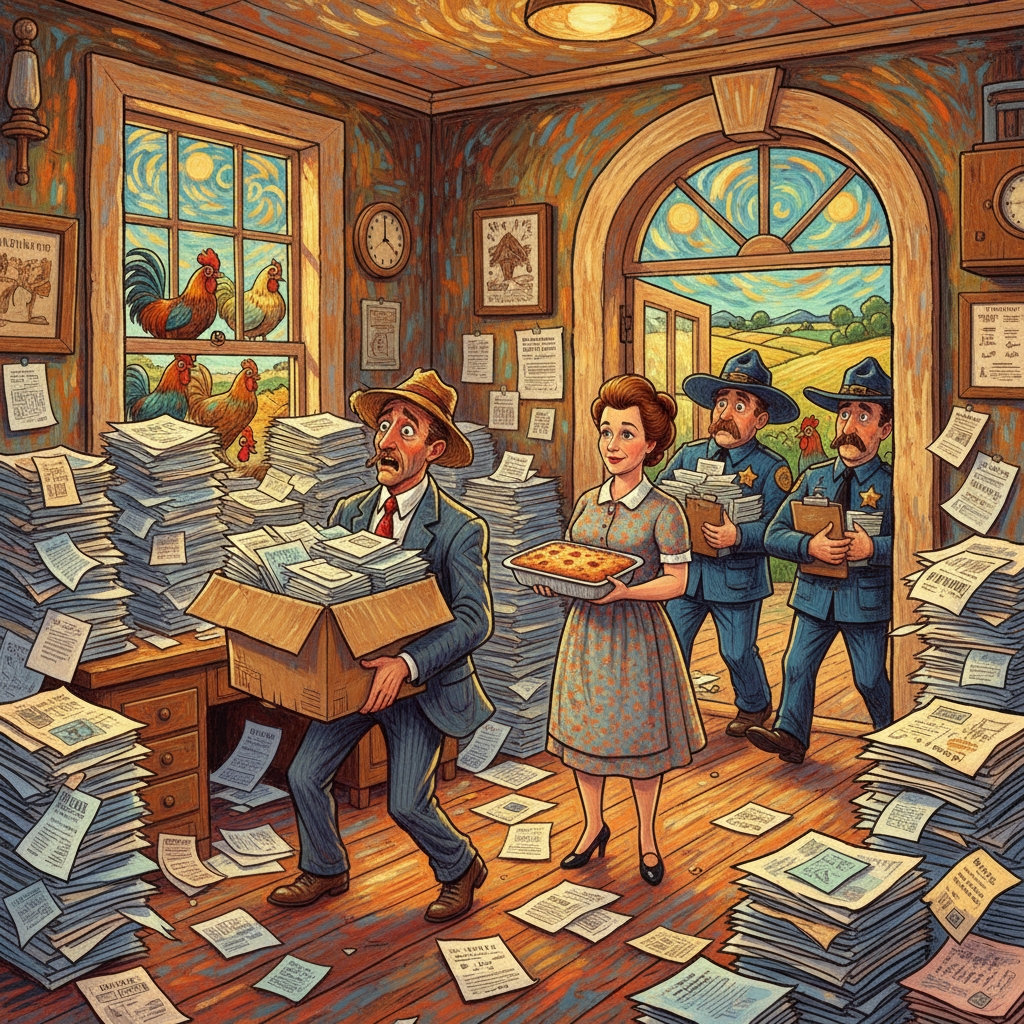
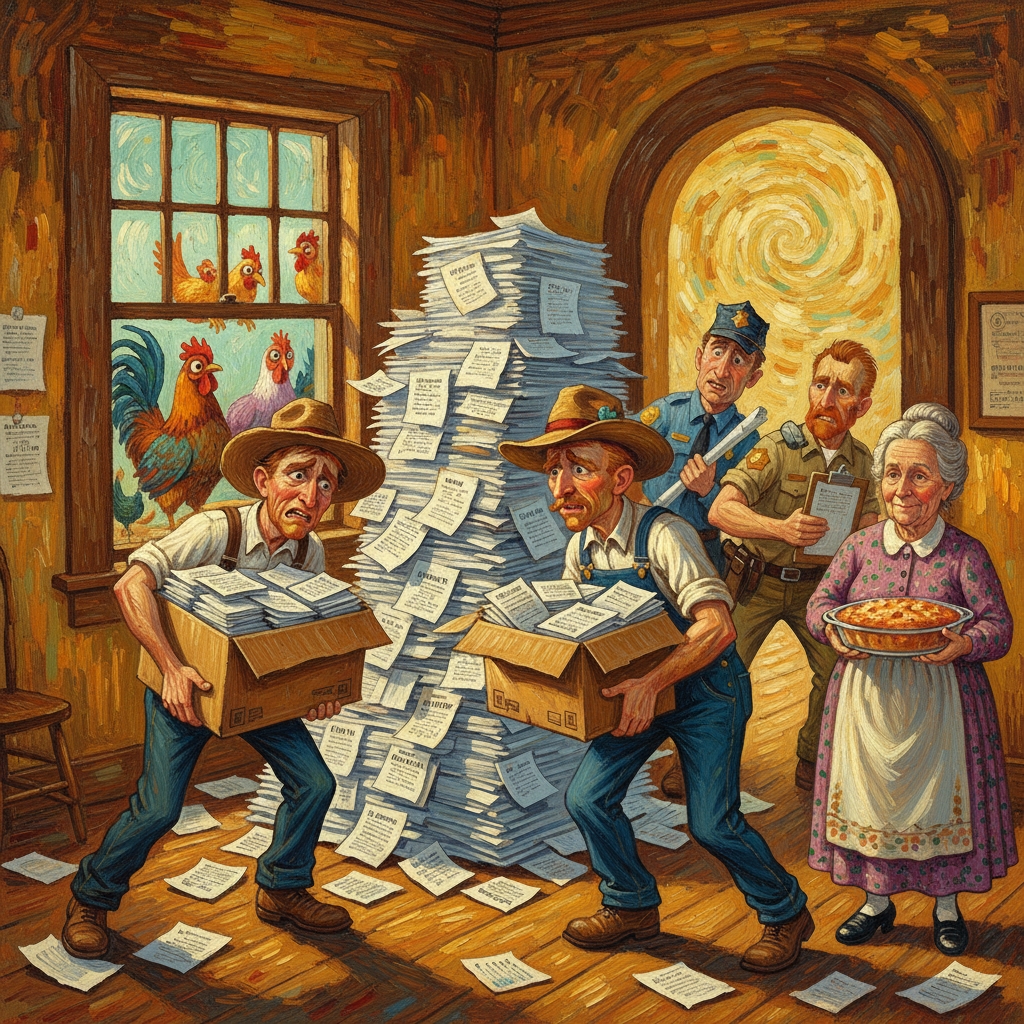
RT sat inside Town Hall surrounded by printed complaints stacked in wobbling piles around his chair.
Boot Barnes entered carrying two cardboard boxes.
“You alive?”
“Barely.”
Boot glanced around.
“My Lord.”
“I got six hundred complaints before ten-thirty.”
“What kind?”
RT pointed randomly.
“Mailbox anxiety. Drainage. Somebody says there’s a rooster with anti-government tendencies.”
Boot nodded thoughtfully.
“That rooster’s been escalating.”
Sheriff Peeler walked in holding a stapled packet.
“These came through dispatch.”
RT grabbed his head.
“Why dispatch?”
Sheriff Peeler shrugged.
“Said the app rerouted emergency and non-emergency concerns into one citizen-centered workflow.”
“What does that mean?”
“Nobody knows.”
Act II – The Backlog
Officer Kenny Joe Teeter entered carrying more paper.
“These were faxed.”
“Who still faxes complaints?”
“Church ladies mostly.”
Pastor Arnold Peeler arrived moments later with Sister Lila Mae “Hallelujah” Pruitt behind him.
Pastor Peeler looked concerned.
“Son, you look pale.”
“I’ve read seventy-four complaints about standing water.”
Sister Lila Mae peered over the piles.
“Ooo. Here’s one says somebody’s hearing whispering behind the Dollar Barn.”
“That’s probably raccoons.”
“No,” she whispered dramatically. “This says the whispering knows scripture.”
Boot started sorting papers into categories.
“We need organization.”
RT laughed hysterically.
“You think?”
Clovis Strickland appeared in the doorway carrying a spiral notebook and three pens tucked into his shirt pocket like surgical instruments.
“I’ve analyzed the situation.”
Sheriff Peeler sighed softly.
“Here we go.”
Clovis walked directly to the complaint stacks.
“The system has achieved bureaucratic singularity.”
Nobody responded.
Clovis continued anyway.
“See, most systems distribute responsibility so thoroughly nobody’s accountable. But this glitch reversed polarity.”
Shelley blinked.
“Polarity?”
“The bureaucracy collapsed inward like a dying star.”
Mabel Dean wandered in carrying peach cobbler.
“That’s about right.”
Clovis pointed triumphantly.
“Exactly.”
RT buried his face in his hands.
“You know what the worst part is?”
“What?” asked Boot.
RT lifted a complaint sheet.
“Half these problems are real.”
Silence settled over the room.
That disturbed everyone more than the glitch itself.
Act II – The Backlog
ACT III – THE PORCH COUNCIL
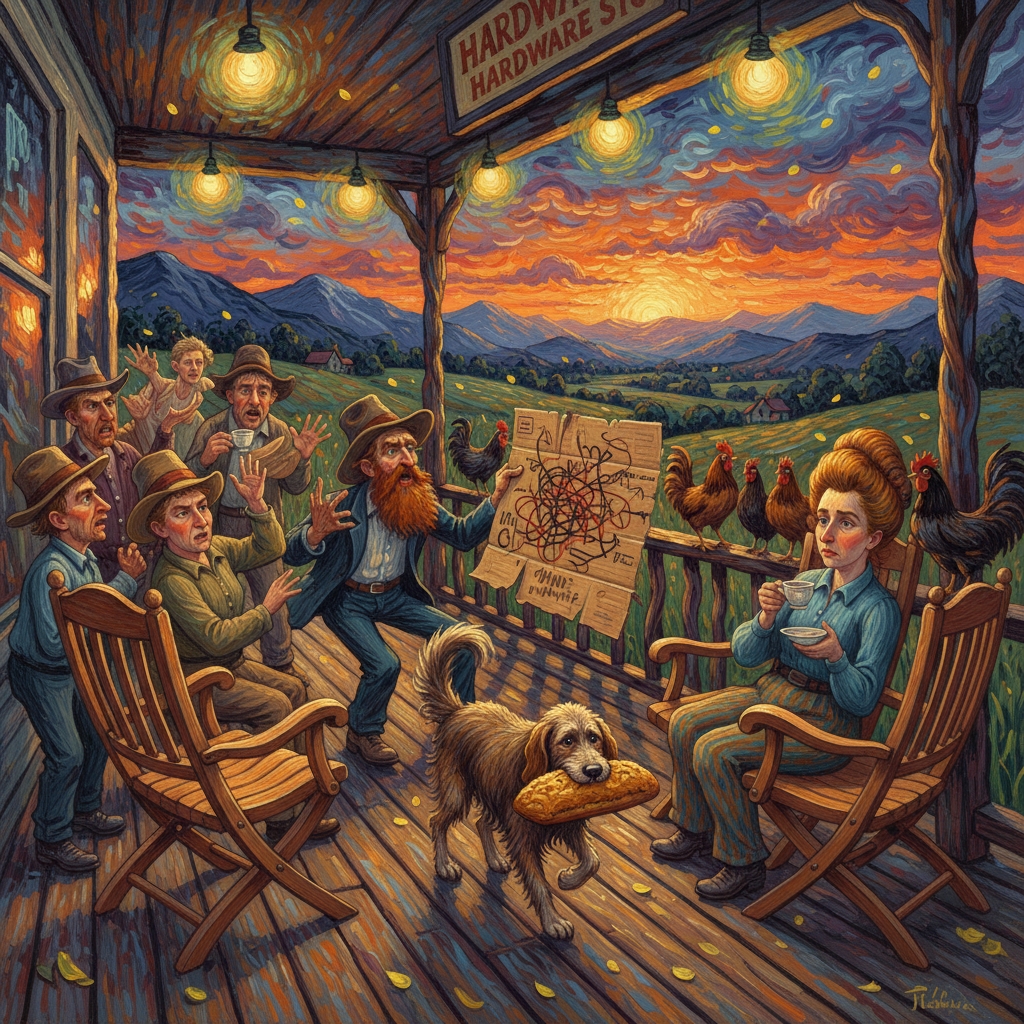
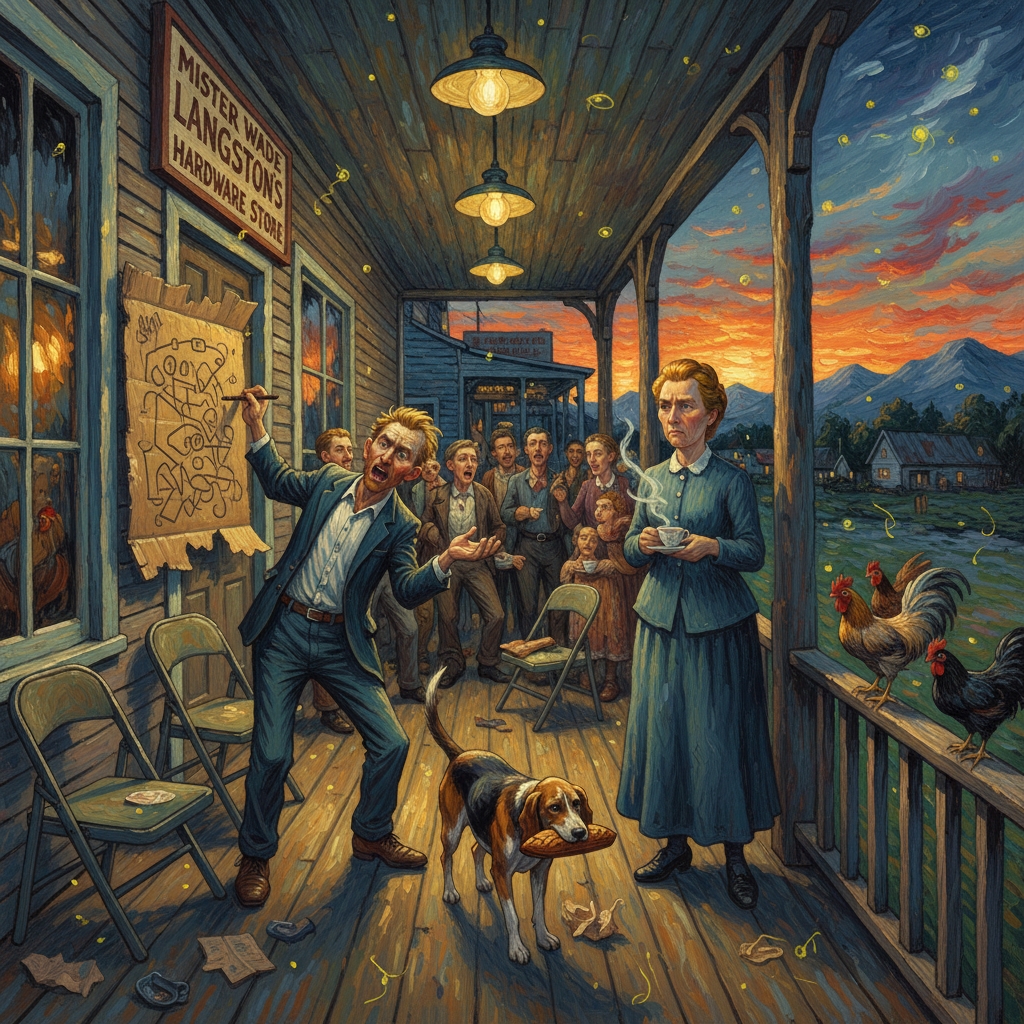
By Wednesday evening, the unofficial Porch Council convened outside Mister Wade Langston’s hardware store.
Folding chairs circled beneath humming bug lights while townspeople discussed the crisis with the seriousness usually reserved for tornadoes and pie contests.
The chickens remained gathered nearby.
Nobody liked that.
Mister Wade rocked slowly in his chair.
“I seen government failures before.”
“How many?” asked Sonny Morales.
“Depends if you count the parking meter experiment.”
Everyone nodded solemnly.
That had been difficult.
Brett and Alyssa Crenshaw arrived carrying lemonade.
Alyssa sat beside Trixie Jo.
“So every complaint really goes to RT?”
“Every single one.”
“What’s he doing with them?”
“Panicking mostly.”
Shelley Fawn flipped through printed screenshots.
“The app’s routing algorithm somehow replaced all department identifiers with RT’s employee number.”
“He ain’t an employee,” said Doughboy Teeter.
Act III – The Porch Council
“Apparently the system disagrees.”
Clovis stood near the porch railing drawing diagrams on cardboard.
“The problem runs deeper.”
“Oh Lord,” muttered Mabel Dean.
Clovis ignored her.
“For years the town created departments faster than solutions. Complaints entered loops. Citizens became exhausted.”
“True,” said Maggie Sue.
“But now,” Clovis continued dramatically, “the illusion of management has vanished.”
Tiffany Annette Roark leaned forward.
“You saying all these complaints existed already?”
“Yes.”
“And nobody handled them?”
“Correct.”
Silence again.
Daisy the hound wandered through the gathering carrying somebody’s cornbread.
Nobody stopped her.
Pastor Peeler folded his hands thoughtfully.
“That’s the danger of systems designed mainly to avoid responsibility.”
Boot scratched his chin.
“We got complaints dating back years.”
“How far back?” asked Sonny.
Boot checked a folder.
“One woman filed twelve reports about a ditch in 2022.”
“What happened?”
“She says the ditch won.”
The porch erupted in laughter.
Then stopped abruptly when RT arrived carrying two garbage bags full of paperwork.
“I can’t go home.”
“Why not?” asked Sheriff Peeler.
“People are standing in my yard filing complaints verbally.”
“That efficient?” said Clovis admiringly.
“No!”
RT dumped papers onto the porch.
“Look at this!”
Mabel picked one up.
“‘Concern regarding suspiciously confident squirrel near Methodist annex.’”
She nodded.
“That squirrel is pushy.”
Another.
“‘Request for investigation into why church piano smells like rain.’”
Sister Lila Mae crossed herself.
“I knew somebody else noticed.”
RT looked near tears.
“I got three hundred complaints today alone.”
Pastor Peeler placed a gentle hand on his shoulder.
“Son, maybe this happened for a reason.”
RT stared at him.
“What possible reason?”
Pastor Peeler looked toward Town Hall.
“Maybe people finally needed somebody to hear them.”
Nobody spoke for several seconds.
Even Clovis went quiet.
Then one chicken flapped onto the porch railing and stared directly at RT.
Mabel sighed.
“That definitely means something unpleasant.”
Act III – The Porch Council
ACT IV – DOTTY MAE’S DINER
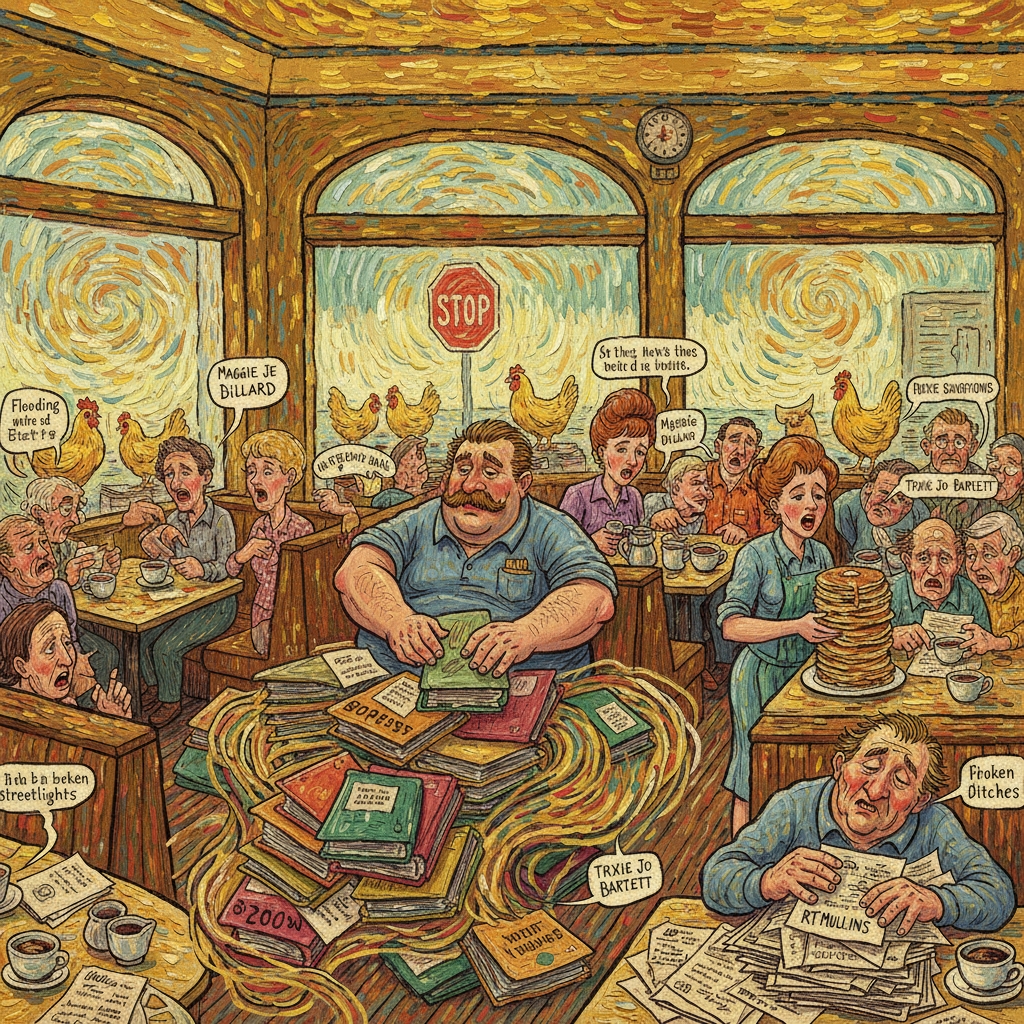
The next morning, Dotty Mae’s Diner transformed into an unofficial complaint processing center.
Boot Barnes arrived at dawn carrying file folders.
Maggie Sue cleared three booths.
“We’re using color codes now.”
“For what?”
“Severity.”
“How many colors?”
“Seven.”
“That feels excessive.”
“It’s government adjacent.”
By 8:00 a.m., the diner overflowed with complaints.
Not formal complaints anymore.
Real complaints.
People started talking.
A farmer described drainage problems flooding his field every spring.
Act IV – Dotty Mae’s Diner
An elderly widow explained she’d reported a broken streetlight thirteen times.
Sonny Morales discussed dangerous intersections nobody fixed because county and town maps disagreed about jurisdiction.
Shelley typed notes frantically.
“This is worse than I thought.”
Clovis adjusted his glasses.
“Systems fail gradually before failing visibly.”
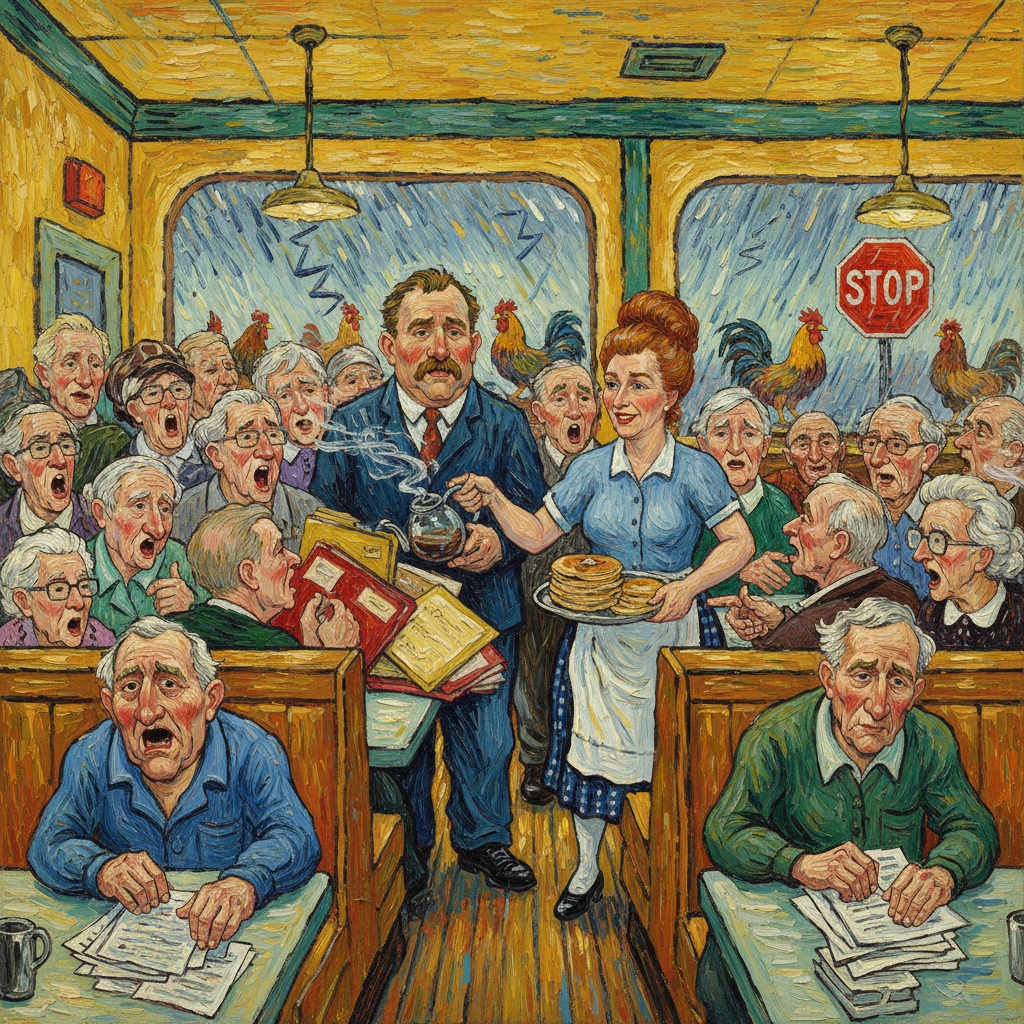
Trixie Jo carried pancakes between tables.
“So basically everybody ignored everybody till the computer accidentally told the truth?”
“Yes,” Clovis replied proudly.
“That’s depressing.”
“It’s sociology.”
Nearby, Evelyn Grace Tipton interviewed people with a small recorder.
“You mind repeating that about the sinkhole behind the feed store?”
“It ate a trampoline.”
“How large was the trampoline?”
“Medium.”
Evelyn nodded professionally.
RT sat in the corner surrounded by folders.
For the first time in days, he looked calmer.
Pastor Peeler handed him coffee.
“How you holding up?”
RT shrugged.
“I think I understand something now.”
“What’s that?”
“People weren’t filing complaints because they expected solutions.”
Pastor Peeler listened carefully.
“They just wanted acknowledgment.”
Outside the diner window, the chickens gathered again in a tight cluster beneath the stop sign.
Doughboy stared at them nervously.
“I don’t care what anybody says. Them chickens know something.”
Mabel sipped coffee.
“They always do.”
Suddenly Officer Kenny Joe Teeter burst through the diner door.
“We got another problem.”
Everybody groaned.
“What now?” asked Sheriff Peeler.
“The app updated itself again.”
RT stood slowly.
“No.”
“Yes.”
“What changed?”
Kenny Joe swallowed hard.
“It added a satisfaction survey.”
Silence.
Then collective horror.
“You mean people can now complain about how their complaints were handled?” asked Shelley.
“Yes.”
“And who receives those?”
Kenny Joe pointed at RT.
The diner erupted into chaos.
Act IV – Dotty Mae’s Diner
ACT V – THE CHURCH MEETING
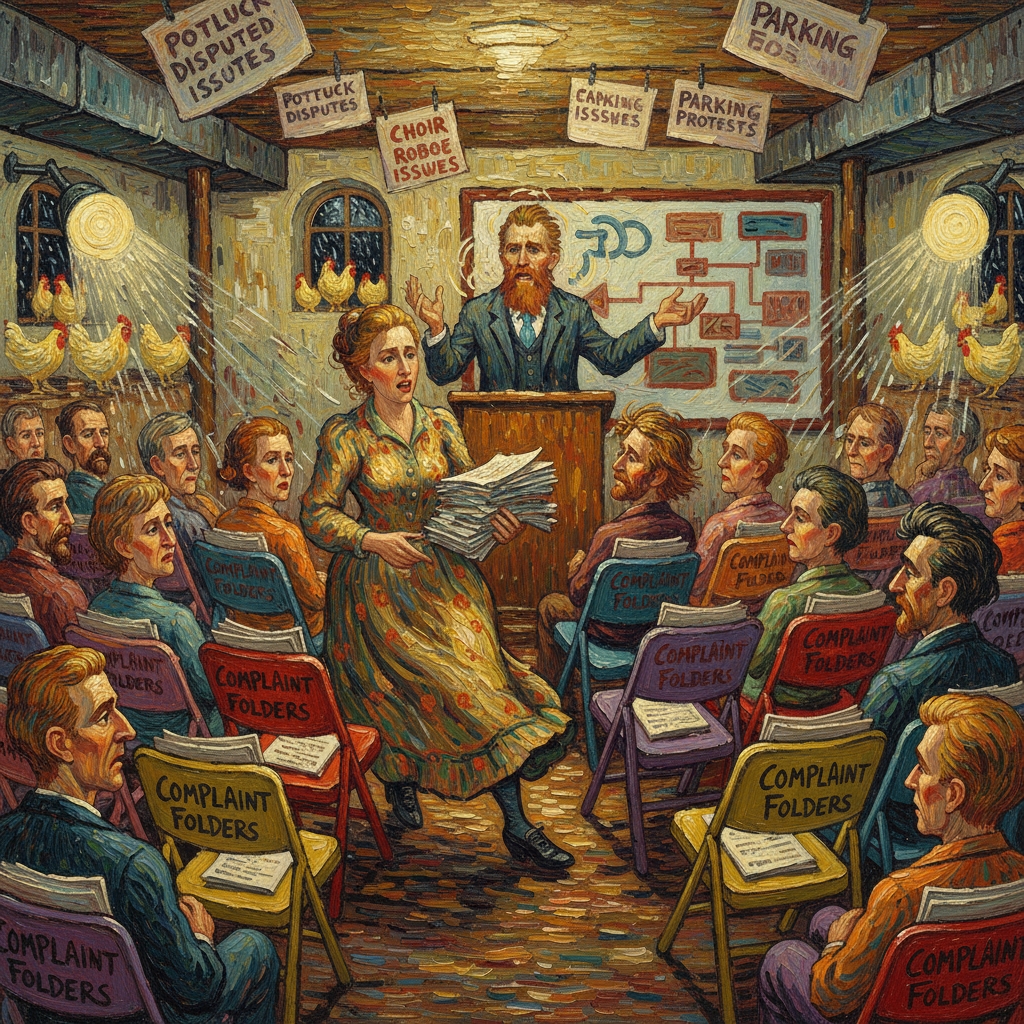
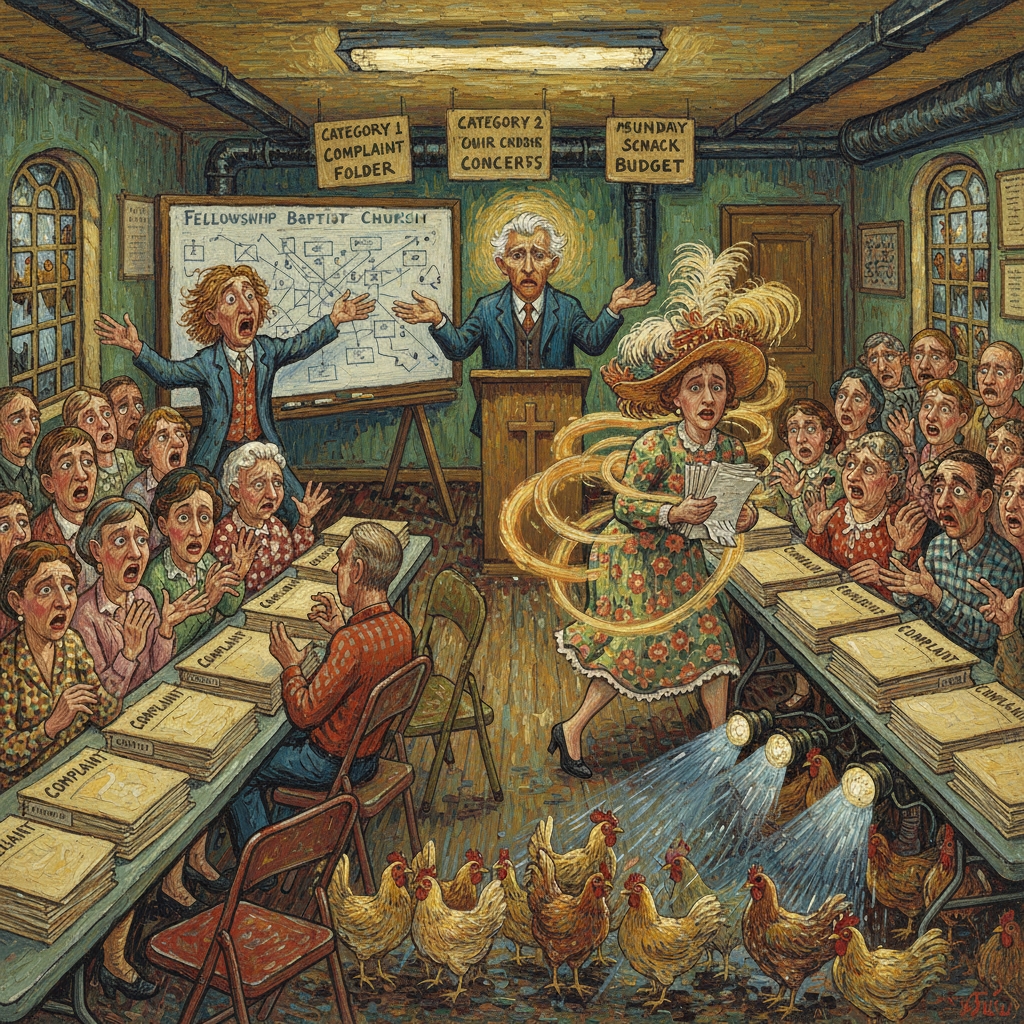
That evening Pastor Arnold Peeler opened Fellowship Baptist Church for what he called “a community discernment gathering,” though everybody else called it “the yelling meeting.”
Folding chairs filled the sanctuary basement.
Complaints covered every table.
Boot Barnes organized stacks beneath handwritten signs:
- INFRASTRUCTURE
- ANIMALS
- SMELLS
- SPIRITUAL UNCERTAINTIES
- OTHER
The OTHER pile was largest.
Sister Lila Mae marched through the room directing traffic like a battlefield nurse.
“No anonymous complaints unless they involve demons or raccoons!”
“Why raccoons?” asked Tiffany.
“Because they know how to open coolers.”
Reasonable enough.
Pastor Peeler stood at the podium.
“Friends, this situation has revealed something important.”
Mabel whispered to Maggie Sue.
“That nobody’s been doing anything?”
“Mostly.”
Pastor continued.
Act V – The Church Meeting
“We built systems to manage complaints instead of solving problems.”
A man near the back raised his hand.
“So what happens now?”
Nobody answered immediately.
That was concerning.
Dr. Neil Cowgill adjusted his glasses.
“Well medically speaking, the town appears to suffer from chronic administrative avoidance with acute procedural inflammation.”
Clovis nodded admiringly.
“Excellent phrasing.”
“Thank you.”
RT stood slowly.
“I can’t carry all this myself.”
“We know,” said Boot gently.
“But maybe nobody should’ve been carrying it alone to begin with.”
Quiet agreement moved through the room.
Then Shelley gasped.
“Oh no.”
“What?” asked Sonny.
She held up her laptop.
“The system’s learning.”
“What does that mean?”
“It’s generating automated responses now.”
“Read one,” said Mabel.
Shelley cleared her throat.
“‘Thank you for your concern. Your complaint is deeply valuable to our ongoing strategic framework initiative.’”
The room booed immediately.
“Here’s another,” Shelley continued. “‘Your issue has been elevated into a collaborative future-oriented review environment.’”
“Turn it off,” said Sheriff Peeler.
“I’m trying.”
“Can it be stopped?” asked Alyssa Crenshaw.
Clovis leaned forward.
“Possibly not.”
Everybody stared at him.
“The system has become self-preserving.”
“That ain’t possible,” said Doughboy.
Clovis pointed dramatically.
“Isn’t it? Look around. The bureaucracy learned from its creators.”
Pastor Peeler sighed deeply.
“That may be the saddest sentence ever spoken in this church basement.”
Suddenly Daisy the hound began barking wildly near the back door.
The chickens outside had multiplied.
Dozens now gathered beneath the fellowship hall floodlights, all facing the basement windows in total silence.
Nobody liked that at all.
Act V – The Church Meeting
ACT VI – THE INVESTIGATION
Friday morning brought rain.
The kind of steady mountain rain that made every pothole deeper and every unresolved town issue more philosophical.
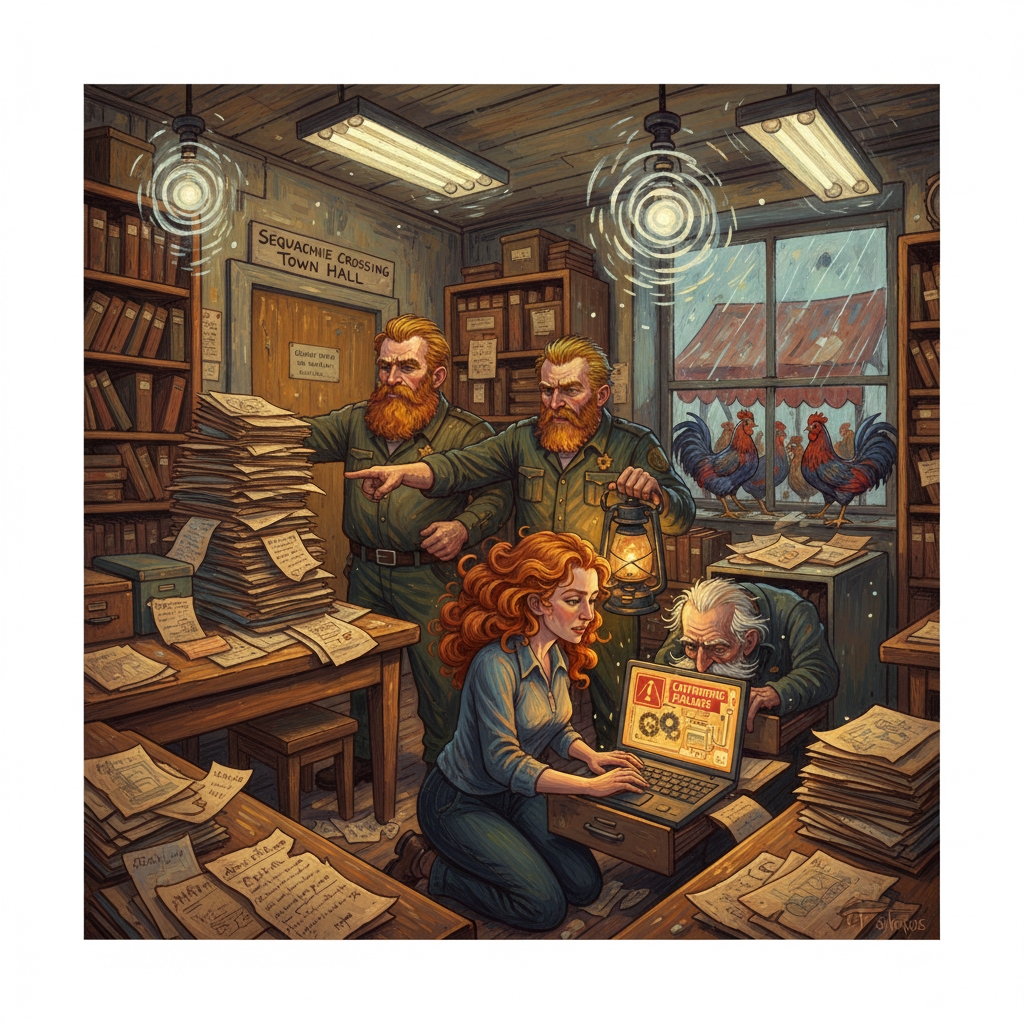
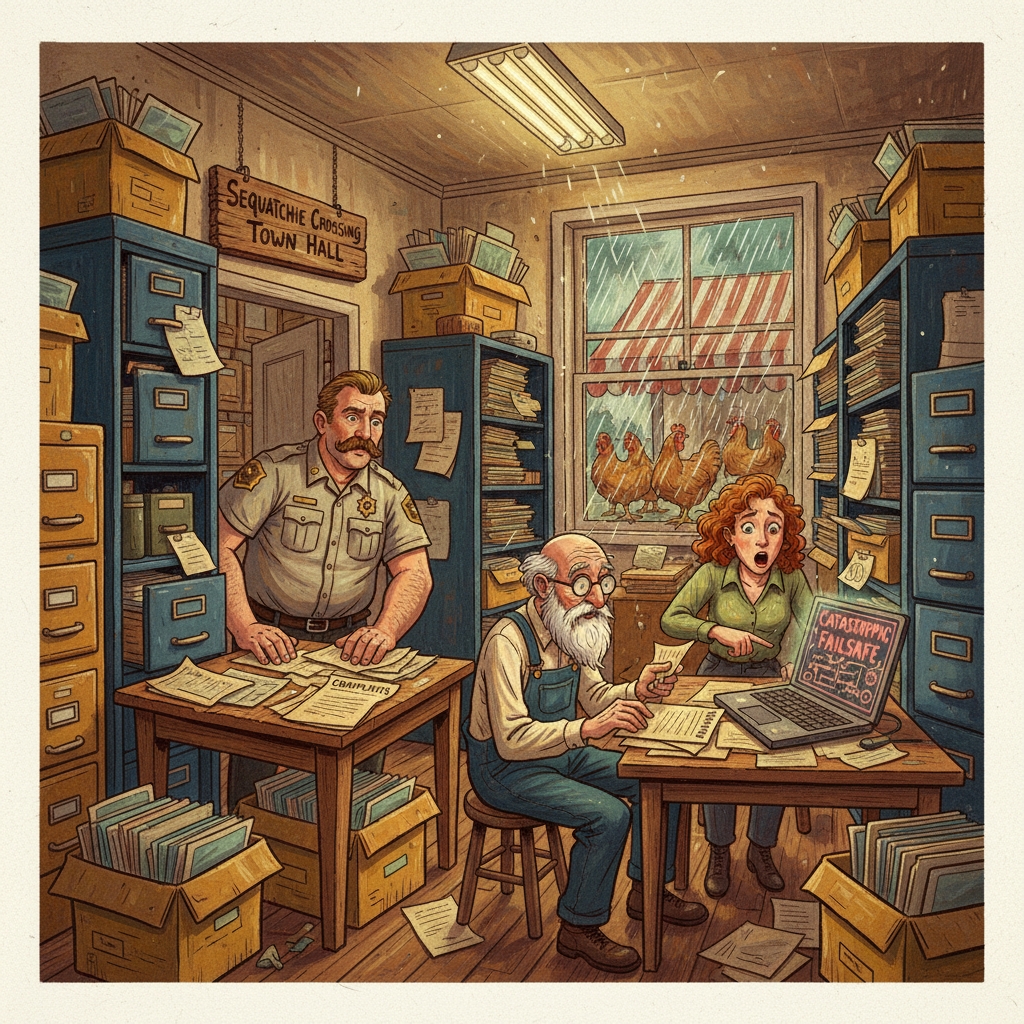
Sheriff Peeler, Officer Kenny Joe Teeter, Clovis Strickland, and Shelley Fawn Wexler assembled inside the Town Hall records room searching for answers.
Boxes leaned dangerously against walls.
Half the labels had faded.
One shelf simply read:
MISCELLANEOUS MUNICIPAL UNCERTAINTIES
Clovis loved that shelf immediately.
Shelley dug through old computer manuals.
“The original app contractor left no documentation.”
“Of course not,” muttered Kenny Joe.
Sheriff Peeler opened a filing cabinet.
“Good Lord.”
“What?” asked Clovis.
“These are unresolved complaints from 1998.”
“Any interesting ones?”
Sheriff scanned pages.
“Somebody reported ‘ominous ducks.’”
“Were the ducks ominous?”
“No follow-up.”
Clovis nodded gravely.
“Classic systemic abandonment.”
Shelley suddenly froze.
“I found something.”
Everybody crowded around.
She pointed at an old configuration file.
“See this?”
Nobody understood what they were seeing.
Clovis pretended he did.
Shelley continued.
“The system was designed with a failsafe.”
Act VI – The Investigation
“What kind?” asked Sheriff Peeler.
“If departmental routing failed completely…”
She stopped.
“What?” demanded Kenny Joe.
“It sends everything to the first available citizen.”
Silence.
“That’s insane,” said Sheriff Peeler.
“Apparently the original designer believed community participation should replace administrative bottlenecks during catastrophic workflow failure.”
Clovis smiled slowly.
“That’s beautiful.”
“No it ain’t,” said Shelley.
RT entered carrying more folders.
“Please tell me you found a fix.”
Shelley hesitated.
“Well…”
“That tone scares me.”
“The app technically isn’t malfunctioning anymore.”
RT stared blankly.
“What?”
“It’s operating exactly as designed.”
The room fell silent again.
Rain hammered the windows.
Outside, chickens clustered beneath the awning in unnerving formation.
Mabel Dean appeared in the doorway holding biscuits.
“Well,” she sighed, “that’s about right.”
Act VI – The Investigation
ACT VII – THE CENTRALIZATION EVENT
By Saturday the town had adapted.
Which frightened Clovis tremendously.
“You understand what this means?” he announced from the porch of Town Hall.
“That folks are lazy?” asked Mister Wade.
“No. It means the town accidentally discovered centralized governance.”
Nobody reacted strongly enough for Clovis.
“Historically speaking, this changes everything!”
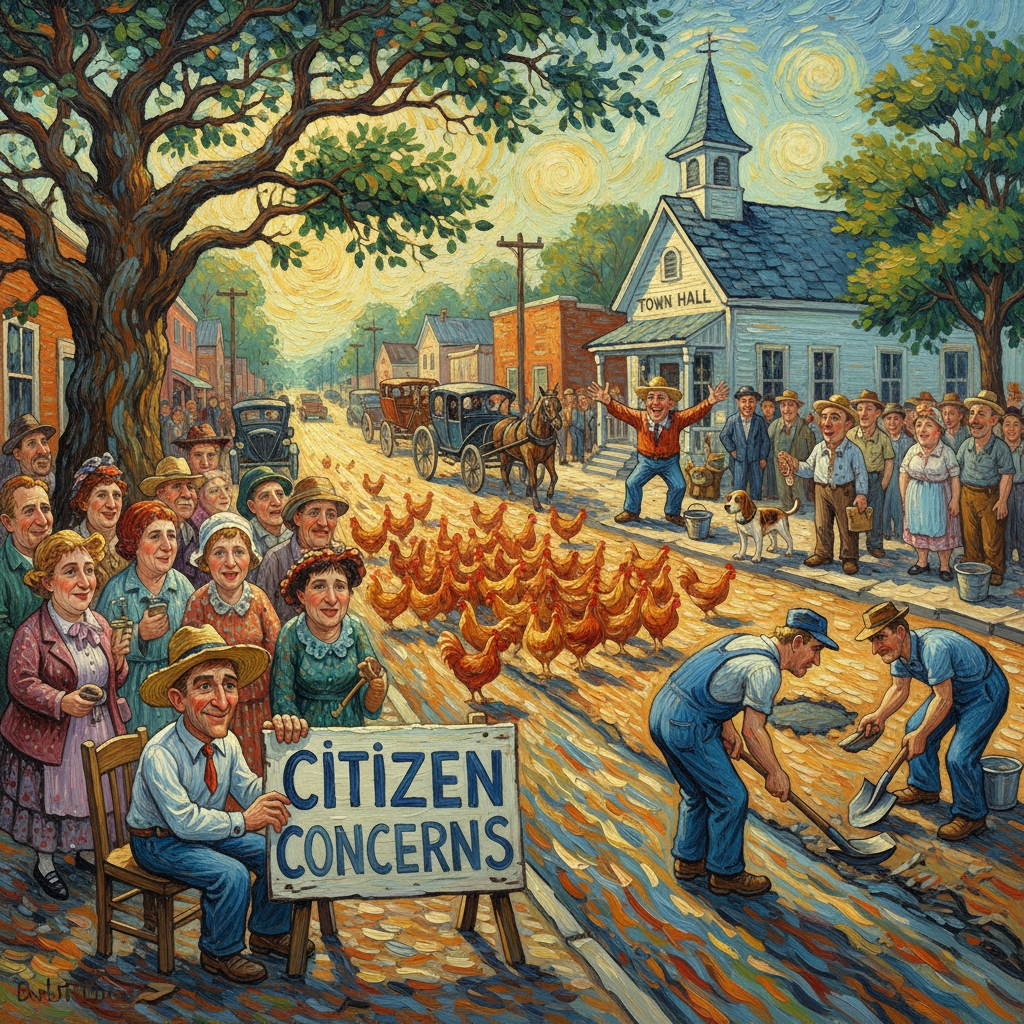
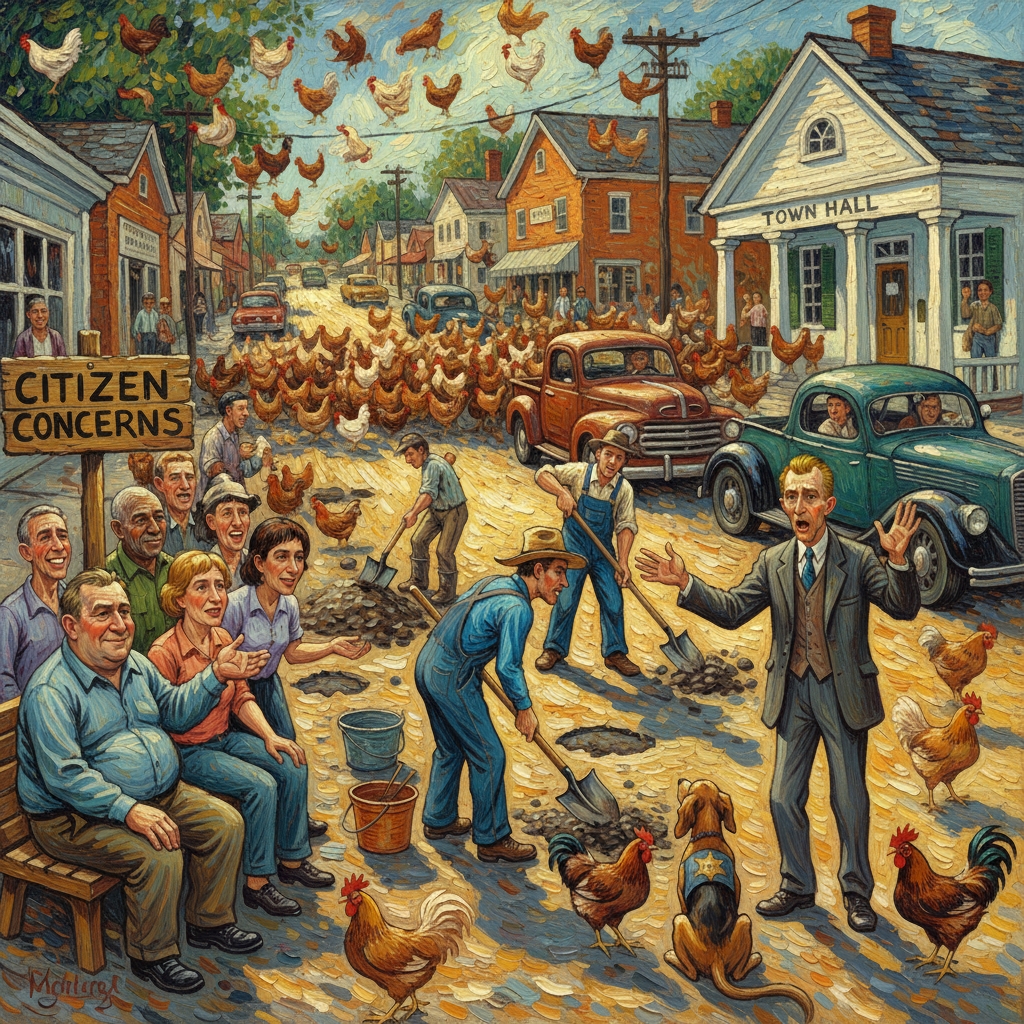
RT now operated from a folding table beneath a handmade sign reading:
CITIZEN CONCERNS – PLEASE FORM SINGLE FILE LINE
And people did.
They lined up peacefully.
They explained issues calmly.
Neighbors began helping neighbors directly rather than waiting for departments.
Boot organized volunteer crews.
Sonny coordinated drainage repairs.
Trixie Jo created spreadsheets.
Shelley manually reassigned critical infrastructure issues.
Act VII – The Centralization Event
Even Doughboy Teeter somehow became responsible for potholes.
“How’d that happen?” he asked.
“You made eye contact,” said Mabel.
At the diner, Maggie Sue posted daily updates titled:
THINGS ACTUALLY GETTING FIXED
The list shocked everyone.
Streetlights repaired.
Ditches cleared.
Signs replaced.
Fence disputes mediated.
Suspicious squirrel monitored.
Pastor Peeler visited RT regularly.
“You sleeping yet?”
“Not really.”
“But?”
RT looked around Town Hall.
“But people are finally talking to each other.”
Pastor smiled softly.
“That’s usually where healing starts.”
Outside, the chickens suddenly moved as one massive flock across Main Street, stopping traffic completely.
Sheriff Peeler removed his hat slowly.
“I don’t care for that.”
Clovis stared intensely.
“The chickens symbolize convergence.”
“No,” Mabel corrected. “They symbolize chickens.”
Still, nobody could ignore the timing.
As the town centralized its complaints, the animals centralized too.
Even Daisy the hound began following RT everywhere like a deputy assigned to emotional support duty.
Saturday afternoon brought the biggest revelation yet.
Shelley projected data onto the wall inside Town Hall.
“These are unresolved complaints from the last five years.”
The graph nearly touched the ceiling.
Gasps filled the room.
“How many is that?” asked Alyssa.
Shelley swallowed.
“Twenty-three thousand.”
Silence consumed everyone.
Mabel leaned back slowly.
“That’s about more right than usual.”
Act VII – The Centralization Event
ACT VIII – THE BREAKDOWN
Saturday night finally broke Ricky Travis Mullins.
The human nervous system can only absorb so many complaints about drainage culverts before consequences emerge.
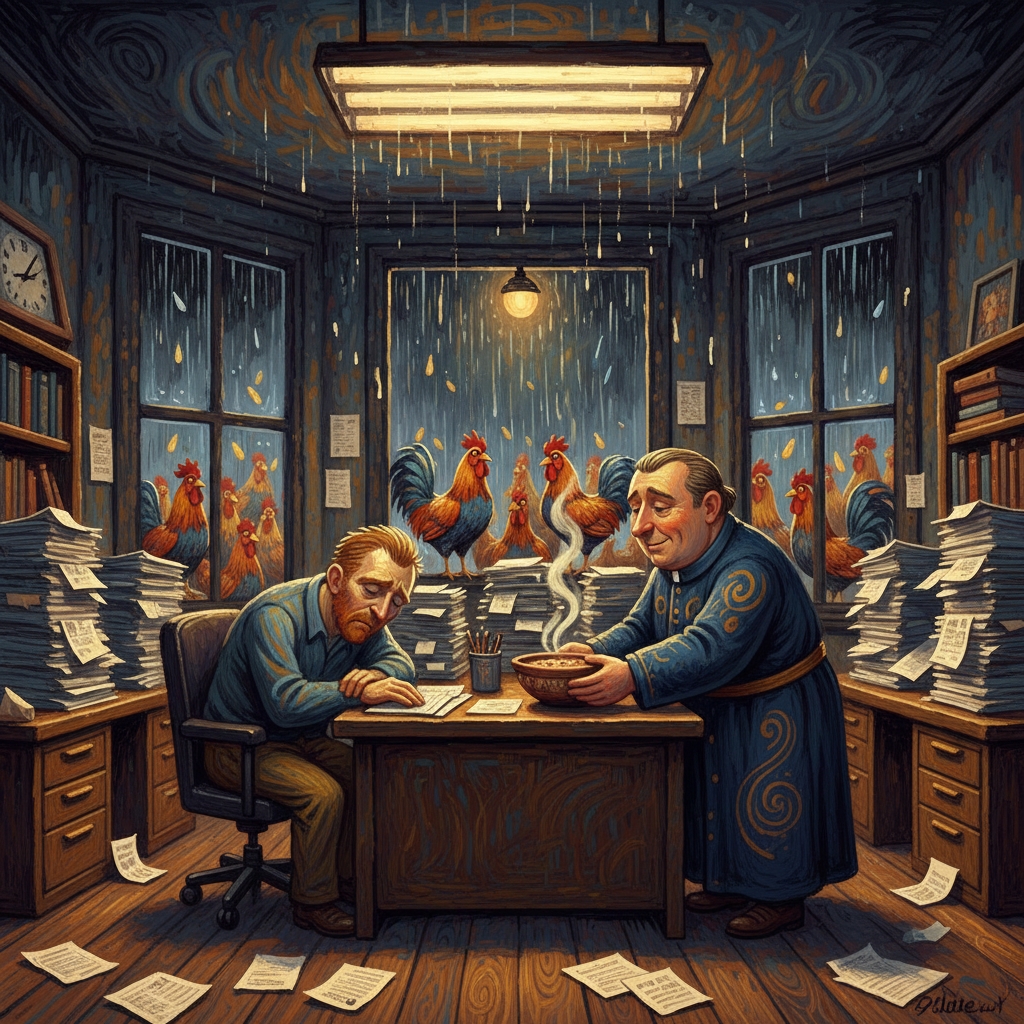
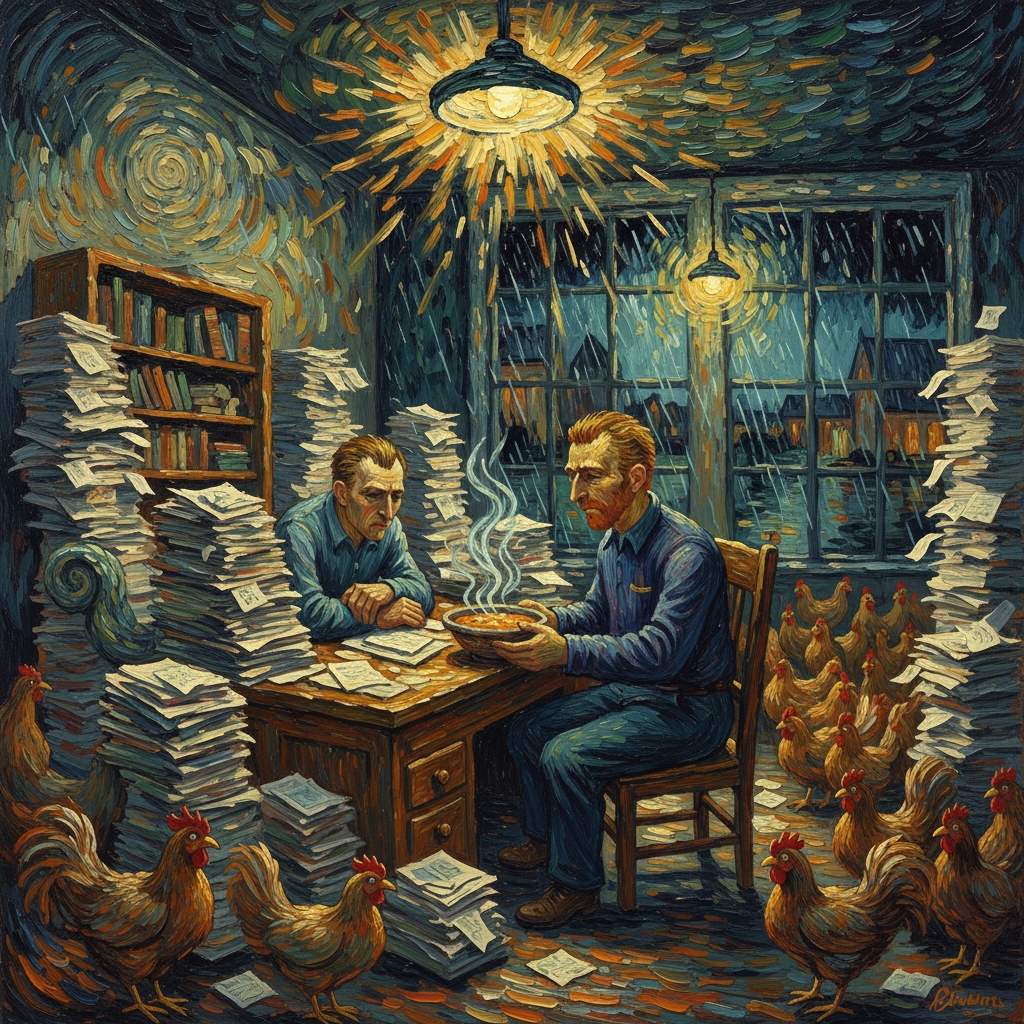
RT sat alone inside Town Hall surrounded by stacks of paper reaching shoulder height.
Rain tapped the windows.
The fluorescent lights buzzed softly.
He stared blankly at complaint number 23,004.
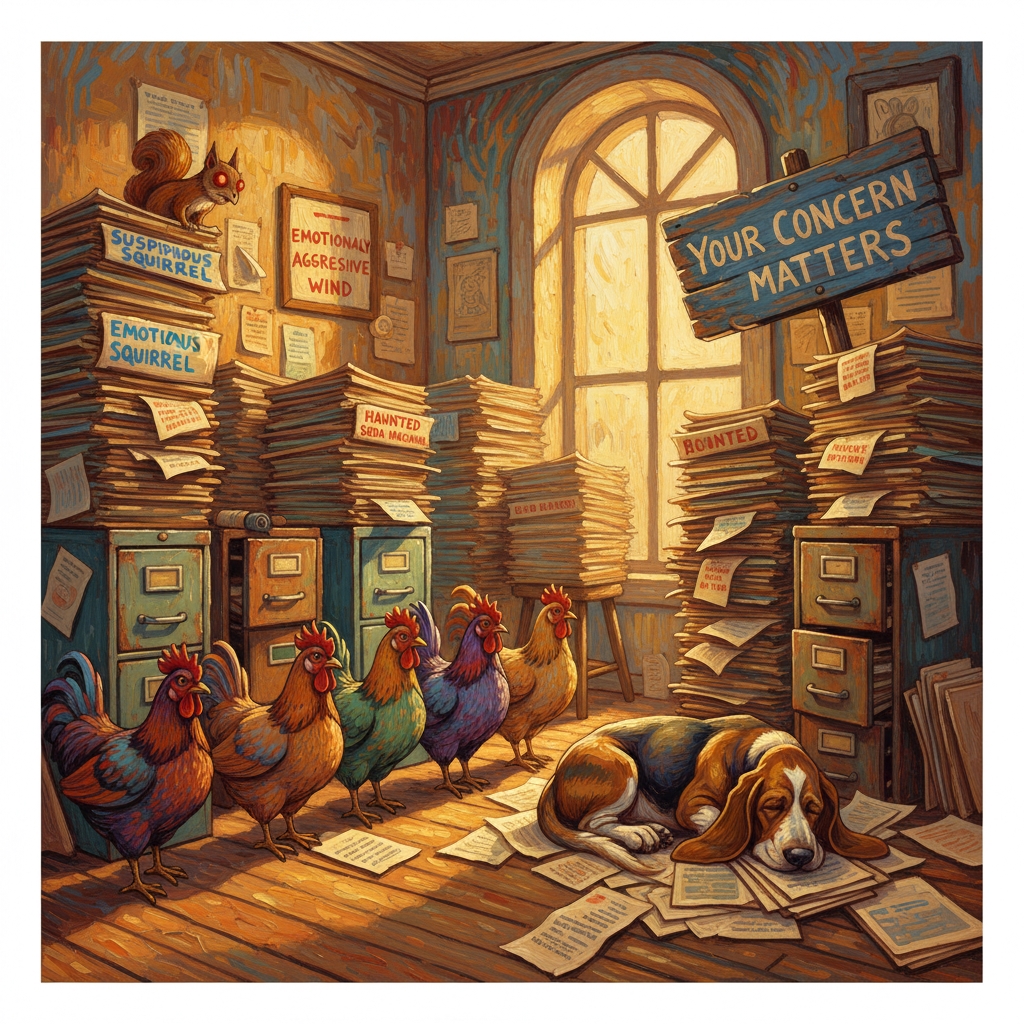
“Concern regarding emotionally aggressive wind near cemetery.”
RT laughed weakly.
Then cried.
Then laughed again.
Pastor Peeler entered quietly carrying soup.
“Oh son.”
RT wiped his face.
“I can’t tell which problems matter anymore.”
Pastor sat beside him.
“That’s what happens when systems fail.”
RT looked around hopelessly.
Act VIII – The Breakdown
“How’d we let it get this bad?”
Pastor thought carefully.
“Most folks assumed somebody else was handling things.”
“That’s not handling things.”
“No.”
Silence lingered.
Then RT gestured toward the mountains of paper.
“You know what scares me?”
“What?”
“Almost none of these complaints are crazy.”
Pastor nodded sadly.
“That’s the hardest part.”
Outside Town Hall the chickens gathered once more beneath the streetlight.
Dozens of them.
Perfectly still.
Like a committee.
Inside the diner, meanwhile, Clovis addressed an increasingly exhausted crowd.
“The collapse was inevitable.”
“Oh hush,” said Trixie.
“No seriously. Systems optimized for deflection eventually expose themselves.”
Maggie Sue poured coffee aggressively.
“You always talk like a haunted textbook?”
“Yes.”
Mabel entered slowly.
“He’s right though.”
Everybody looked at her.
She shrugged.
“The town spent years pretending complaints disappeared if you routed them enough times.”
“That’s bureaucracy,” said Sonny.
“No,” Mabel corrected. “That’s hiding.”
Quiet settled over the diner.
Even Clovis seemed impressed.
Act VIII – The Breakdown
ACT IX – THE REASSIGNMENT
Sunday morning dawned clear and bright.
For the first time all week, the chickens dispersed normally.
People considered that a positive sign.
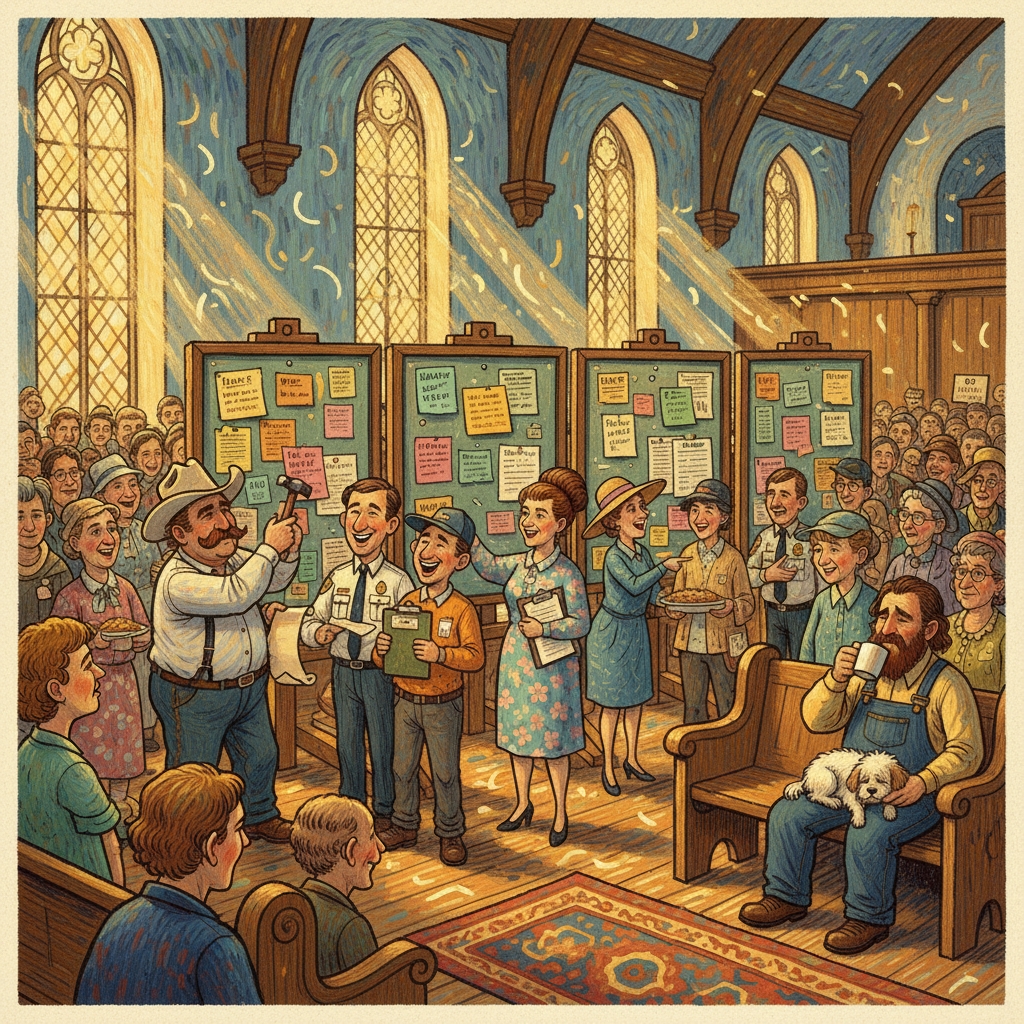
After church services, the entire town gathered at Fellowship Baptist for what Sheriff Peeler officially labeled “a practical civic restructuring event,” mostly because “meeting” felt too small.
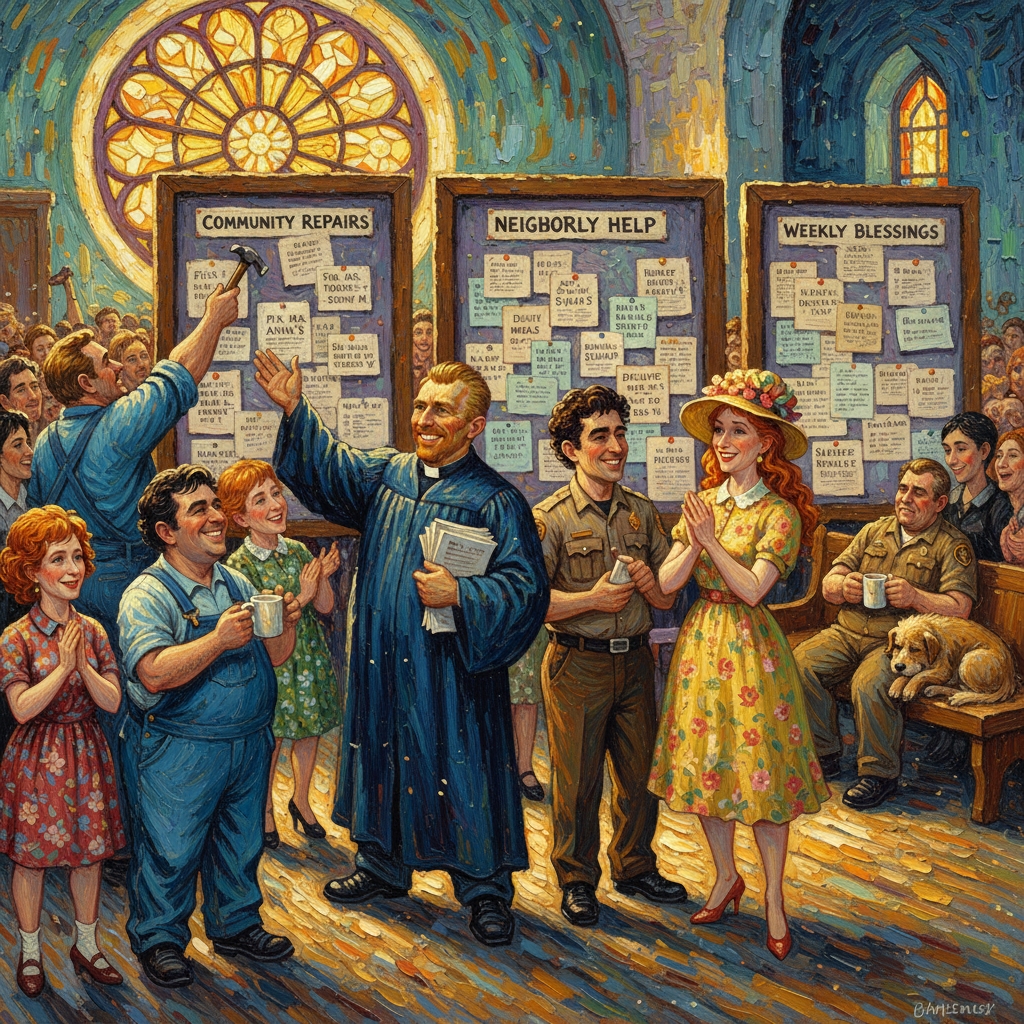
Boot Barnes stood beside enormous bulletin boards.
“This here’s the new system.”
Color-coded categories lined the walls.
REAL PEOPLE now appeared beside every responsibility.
Not departments.
Not apps.
People.
Drainage – Sonny Morales
Animal Issues – Sheriff Peeler and Daisy
Technology – Shelley Wexler
Road Concerns – Doughboy Teeter and volunteer crews
Community Mediation – Pastor Peeler and Mabel Dean
Spiritual Uncertainties – Sister Lila Mae, reluctantly supervised
Clovis pointed proudly at another sign:
NO ISSUE MAY BE TRANSFERRED MORE THAN TWICE
Act IX – The Reassignment
“That’s historic reform,” he declared.
RT sat quietly near the back drinking coffee.
For the first time in days, his phone remained silent.
Pastor Peeler approached gently.
“How’s it feel?”
“Strange.”
“Good strange?”
“I think so.”
Nearby, Trixie Jo addressed the crowd.
“We also added a rule requiring every complaint receive an actual answer.”
Maggie Sue nearly fainted hearing that.
Shelley stepped forward nervously.
“And the app’s being redesigned.”
“Can it be fixed?” asked Brett Crenshaw.
“Yes.”
“Can it be trusted?”
Long pause.
“Probably not.”
Reasonable answer.
Mabel Dean rose slowly from her folding chair.
“You know what the funniest part is?”
“What?” asked Kenny Joe.
“This whole town worked better once the system broke.”
Nobody argued.
Because it was true.
The glitch had revealed what the town spent years hiding beneath departments, committees, routing systems, forms, portals, and automated responses:
People still needed people.
Not workflows.
Not strategic initiatives.
Not collaborative frameworks.
Actual human beings willing to say:
“I heard you.”
Outside, Daisy barked happily as the chickens wandered normally through the churchyard again.
Clovis watched them thoughtfully.
“The flock decentralizes once accountability returns.”
Sheriff Peeler stared at him.
“You really do narrate life like a documentary.”
“Yes.”
Act IX – The Reassignment
EPILOGUE – THE FOLLOW-UP SURVEY
Three weeks later, Sequatchie Crossing officially retired the “Not My Department” app.
Nobody mourned it.
The server was unplugged during a brief ceremony attended by half the town and one deeply suspicious rooster.
The new system proved simpler.
People called actual people.
Volunteers handled overflow.
Town Hall posted updates publicly.
Complaints dropped nearly forty percent.
Not because problems disappeared.
Because people no longer felt invisible.
RT Mullins returned to relative normalcy, though strangers still occasionally approached him at grocery stores whispering concerns about drainage.
He handled it better now.
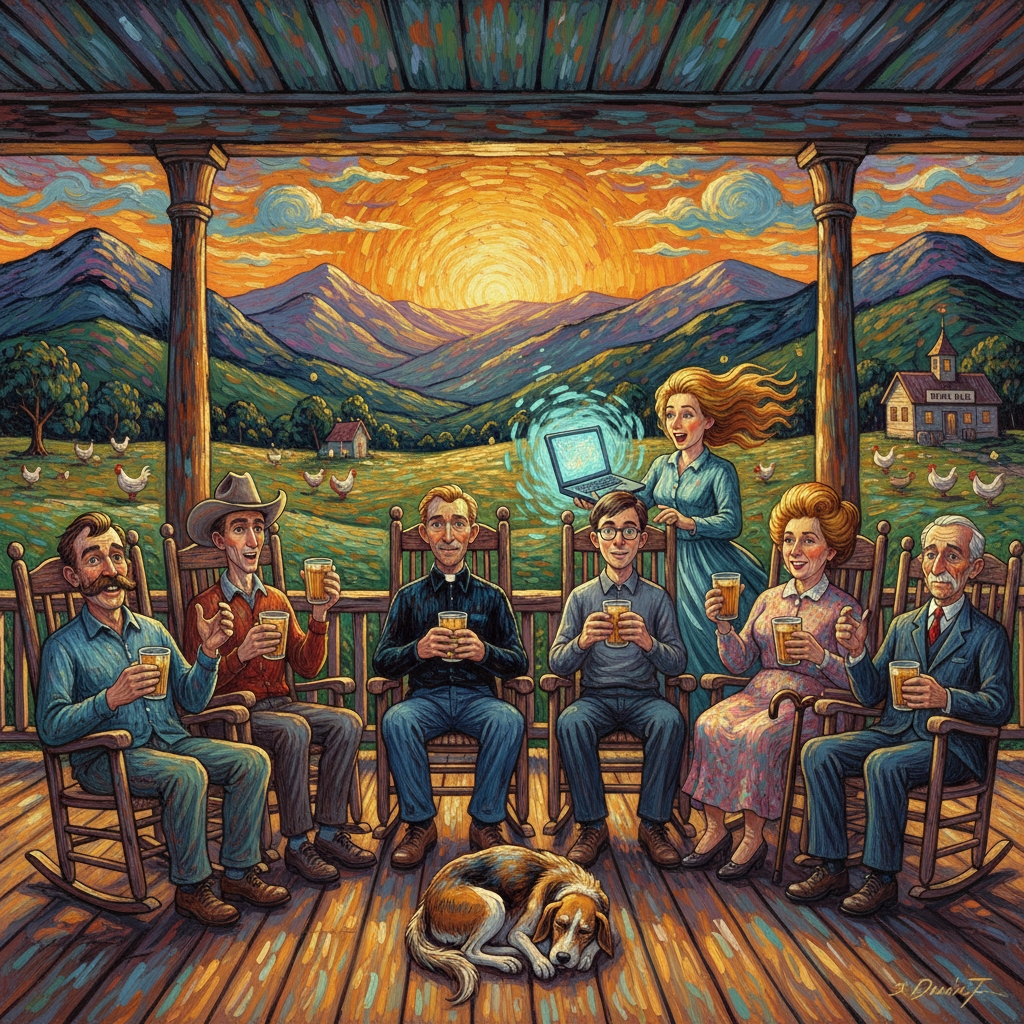
One evening he sat on Mister Wade Langston’s porch beside Boot Barnes, Pastor Peeler, Mabel Dean, and Clovis Strickland watching sunset settle over the valley.
Epilogue – The Follow-Up Survey
The mountains glowed copper beneath drifting clouds.
Daisy snored beneath a rocking chair.
“You know,” said Boot, “I still can’t believe twenty-three thousand complaints were sitting unresolved.”
Mabel sipped sweet tea.
“I can.”
Clovis leaned back thoughtfully.
“Broken systems often reveal truths functioning systems were designed to conceal.”
Mister Wade pointed toward him.
“That one sounded expensive.”
Pastor Peeler chuckled softly.
RT looked out toward Town Hall.
“Maybe folks just needed somebody to stop passing the buck.”
Silence settled warmly across the porch.
Then Shelley Fawn Wexler came jogging up the sidewalk holding her laptop.
Everybody groaned immediately.
“What now?” asked Sheriff Peeler.
Shelley hesitated.
“So… technically speaking…”
“No.”
“The app may have accidentally emailed a satisfaction survey to every resident in Sequatchie County.”
Dead silence.
Mabel closed her eyes.
“That’s about right.”
From somewhere down the road, hundreds of phones chimed simultaneously.
Daisy lifted her head.
And in the distance, the chickens began gathering again.

Epilogue – The Follow-Up Survey
DISCLAIMER
The preceding account from Sequatchie Crossing Dispatch is entirely fictional and intended as satirical commentary on bureaucracy, technology, community responsibility, administrative fragmentation, complaint culture, and the mysterious tendency of systems to become more complicated than the people they supposedly serve.
No real residents of Dunlap, Tennessee are depicted in this story.
Any resemblance to actual municipal dysfunction, unresolved complaints, haunted soda machines, spiritually concerning raccoons, aggressive squirrels, emotionally hostile wind patterns, or chickens displaying organizational behavior is purely coincidental.
Though honestly, some systems really do collapse inward eventually.
Disclaimer – Not My Department App Accidentally Routes All Complaints to Same Person
Real Places Behind the Ruckus – From The Dunlap Directory

Real Places Behind the Ruckus – From The Dunlap Directory
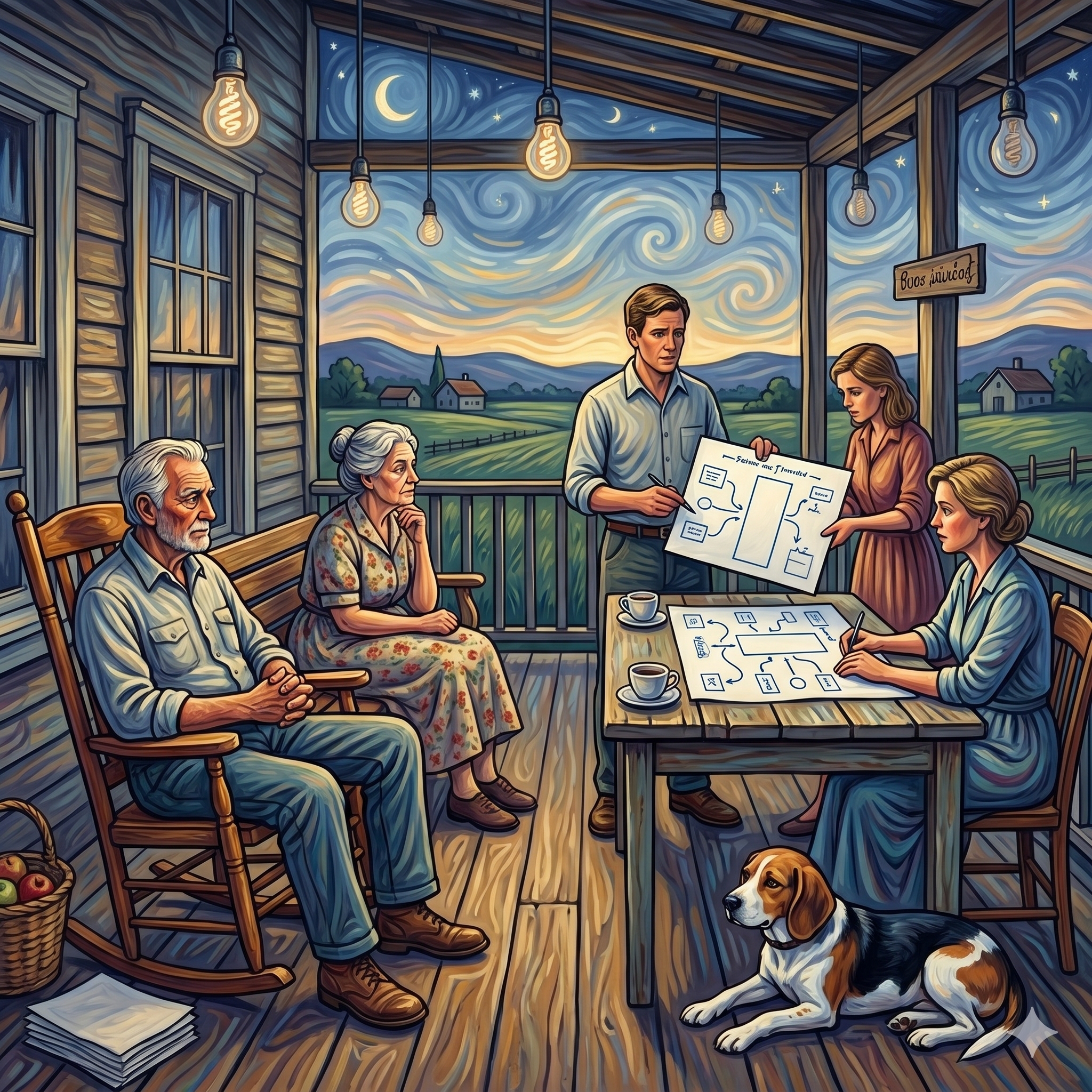
Yes, this story was fictional; even the parts that weren’t true. These places? Absolutely real. Stop by, support local, and keep the Wi-Fi away from livestock:
- Impact Athletics Co.
- Citgo – Little Store
- Cafe on 28
- Oak Ridge Pantry
- Sequatchie Valley Low Cost Spay & Neuter
- White Oak Ranch TN
- Wildwood Enterprise
- Results Physiotherapy Dunlap Clinic
- Dunlap Flower Shop
- Cascade Inn at Fall Creek Falls
- Greeter Falls Campground
- Dunlap Community Lost & Found Animals
- Dog Whisperette
- Taco Bell
- The Tin Shop Paint Shop
- Mt. Airy RV Park
- Chattanooga Zoo
- Shellmound Campground
Real Places Behind the Ruckus – From The Dunlap Directory
At Sequatchie Crossing, we tell the stories of Sequatchie Crossing.
Please share this post with your friends, family, or business associates who may want follow the news from Sequatchie Crossing.

0 Comments