


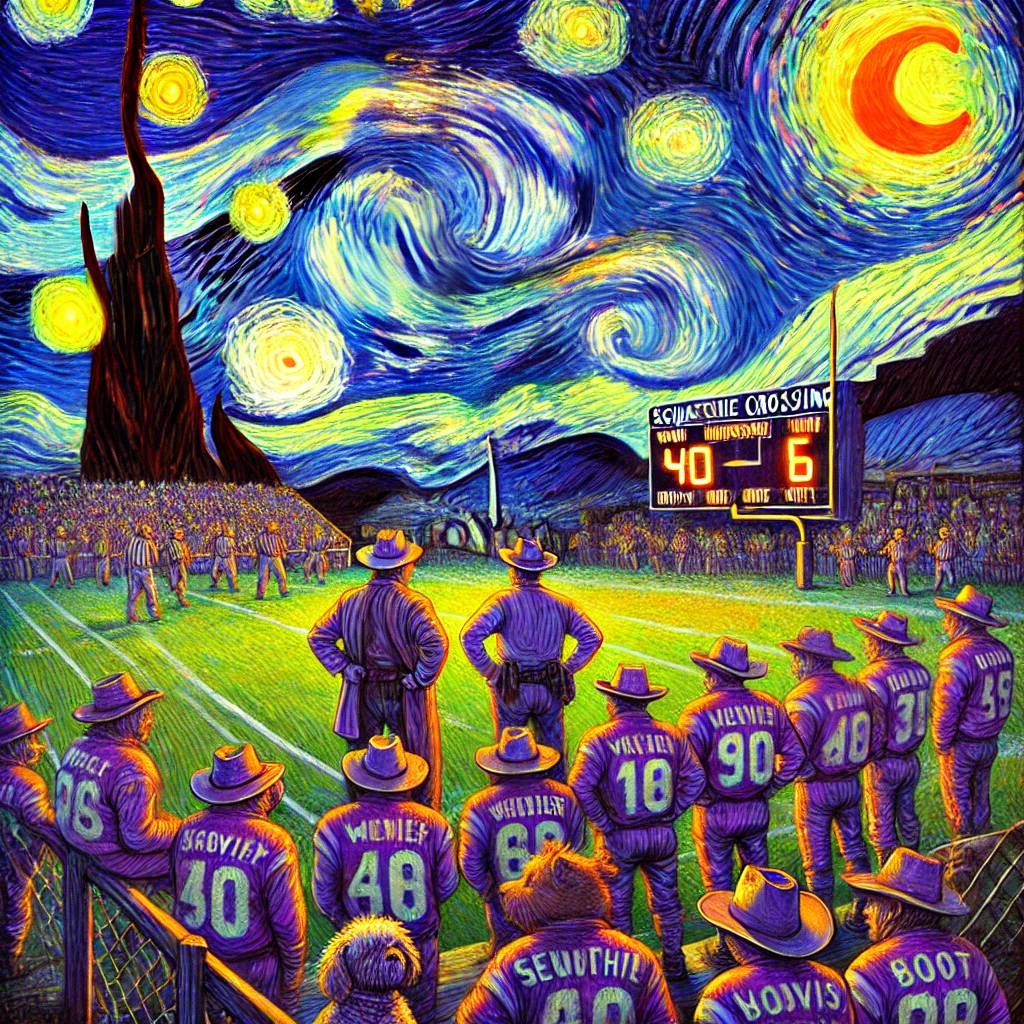
When the Local Football Rivalry Hits National Headline Energy
By Tom Seest
At Sequatchie Crossing, we tell the stories of Sequatchie Crossing.
Please share this post with your friends, family, or business associates who may want follow the news from Sequatchie Crossing.
🎤 Audio Overview
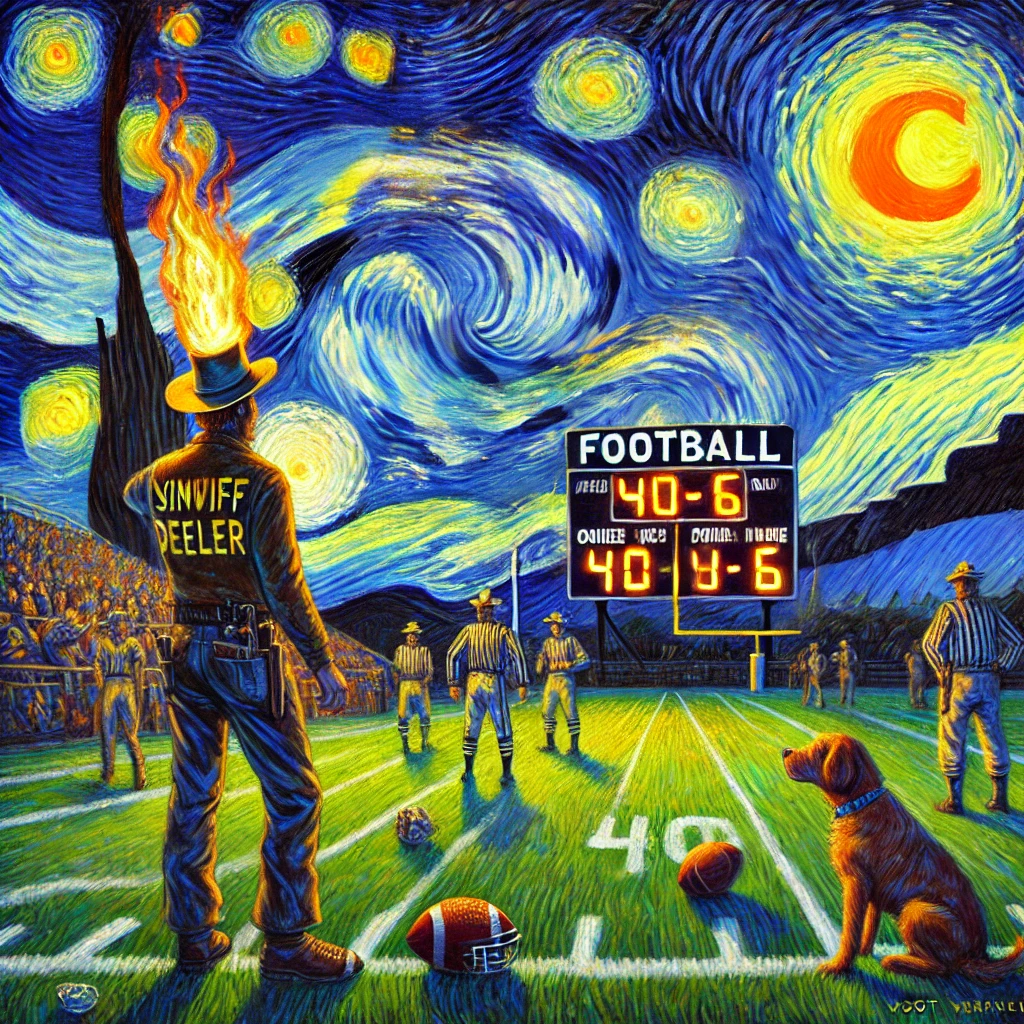
Dramatis Personae (Sequatchie Regulars)
-
Sheriff Peeler — Steady, unflappable, a little tired.
-
Daisy — His hound; unimpeachable moral authority.
-
Coach Hardwick — The Indians’ coach, part-wrangler, part-therapist.
-
Mabel Dean Ashcroft — Clipboard, policies, and a withering eyebrow.
-
Clovis Strickland — Tinfoil crown enthusiast; walking comment section.
-
Boot Barnes — Proud contrarian who communicates in declarative grumbles.
-
Reverend Gentry — Owns more sermon illustrations than neckties.
-
Trixie Jo Bartlett — Runs the booster stand like a military operation with sprinkles.
-
Roland Pike — School board member and part-time metaphor for bureaucracy.
-
“PR Consultant” — Kenzie Lake from Chattanooga, a portable slogan generator.
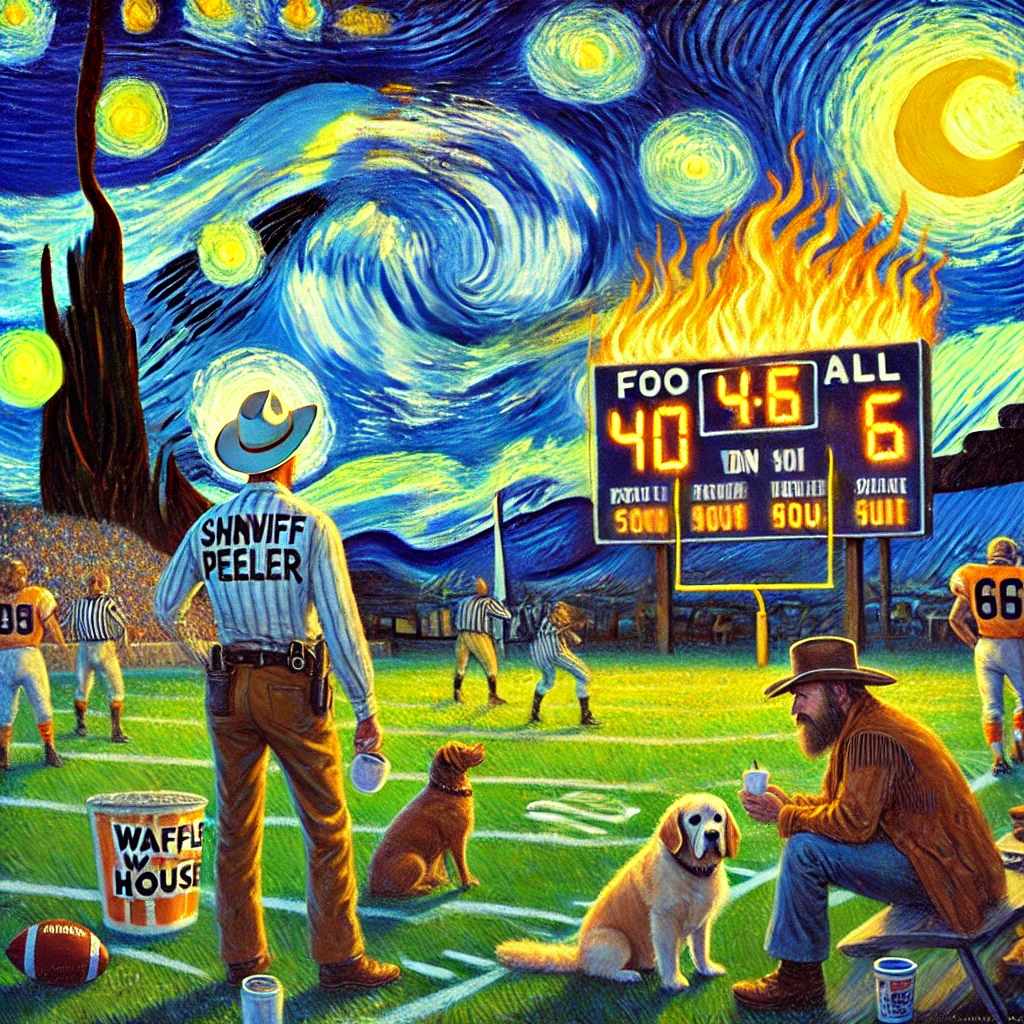
Act I: Friday Night, Forty–Six
Sequatchie Crossing’s field always smells like cut grass, cold iron, and hope. On most nights, hope wins the perfume war. On this night, it didn’t even take the field.
The scoreboard delivered its verdict with clinical indifference: South Pittsburg 40 — Sequatchie Crossing 6. The final horn blared like a smoke alarm in a biscuit factory. A few seconds of stunned silence followed, the kind that makes you hear the sound of your own blinking.
Sheriff Peeler leaned against the chain-link by the concession stand, one boot crossed over the other, paper cup cooling in his hands. Daisy lay at his feet with the philosophical calm of a dog who has seen many outcomes and knows they are all temporary.
“I’ve seen tractor pulls end closer than this,” he said. Daisy performed the smallest, most diplomatic sigh in dog history.
At midfield, Coach Hardwick absorbed condolences like a sponge. The man looked like he’d spent four quarters kneeling under a leaking roof. “It’s execution,” he told anyone within range. “Execution, discipline, and perspective.” The last word wobbled like a shopping cart with one bad wheel.
In the bleachers, Mabel Dean shook her head at the scoreboard as if it owed her money. “At 9:15 p.m., I’m supposed to believe the sun got in our quarterback’s eyes? Fine. Then we need night sunglasses. I’ll write a grant.”
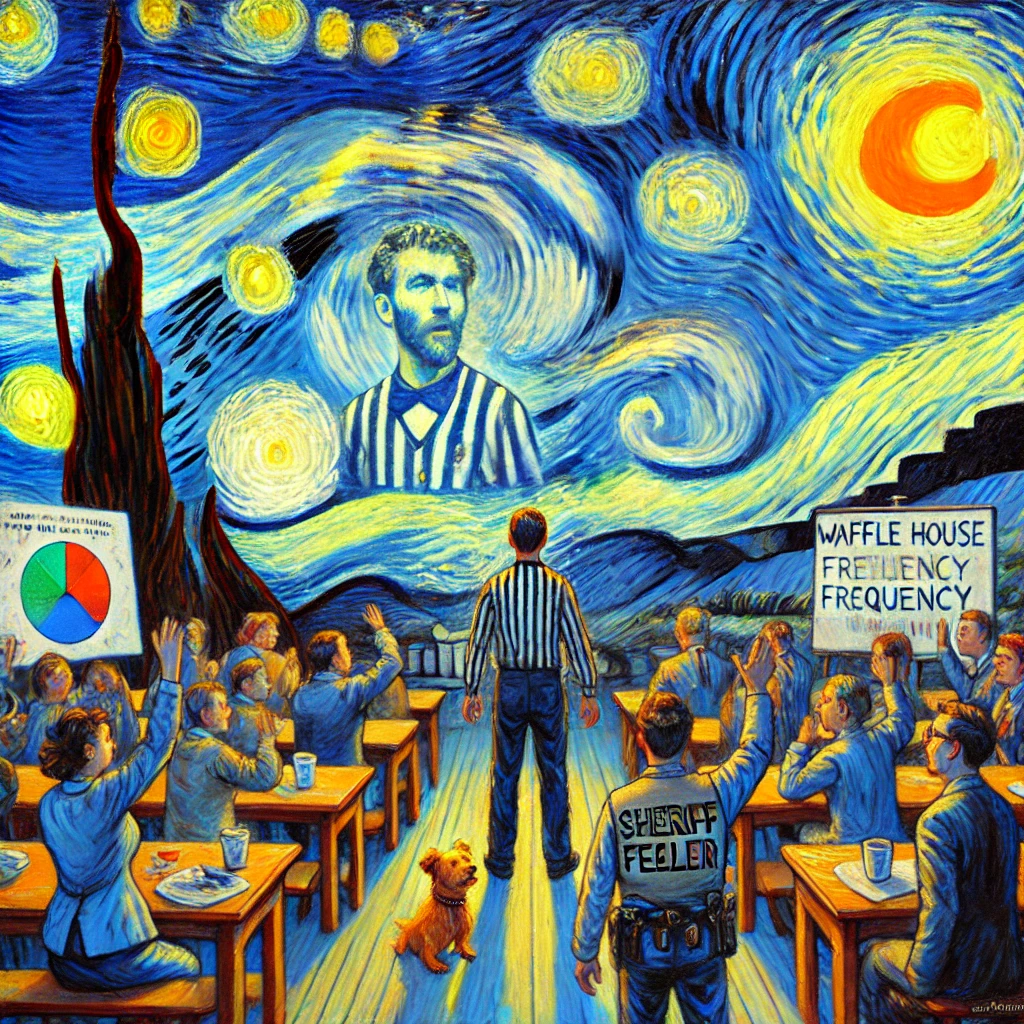
Clovis adjusted his foil crown, scanning the referees like a storm watcher. “This wasn’t a game,” he hissed to nobody and everybody. “This was a program. Notice the walkie-talkies? I counted three pings in the third quarter alone. That’s Jasper. That’s a Waffle House frequency.” He tapped his temple. “Hashbrown band.”
Boot Barnes gripped the rail, knuckles like walnuts. “Field’s slanted,” he pronounced. “Put a marble on the fifty and it’ll roll to their end zone every time. Been that way since the flood of ’97.”
Trixie Jo, last queen of the concession stand, slapped the cash drawer shut with battlefield finality. “If anybody wants optimism, I got one tray of unclaimed churros,” she announced. “But I won’t lie to you: they taste like second chances.”
The band tried to play post-game resilience, but even “Louie Louie” sounded like a eulogy performed on kazoos. When the lights cut, Sequatchie Crossing shuffled to the parking lot with the slow choreography of a town exiting a magic show after watching the magician saw the hope box in half and forget to put it back together.
Daisy rose, shook, and trotted forward. The dog walked exactly the way Sequatchie Crossing decided to: dignified, if not convinced.
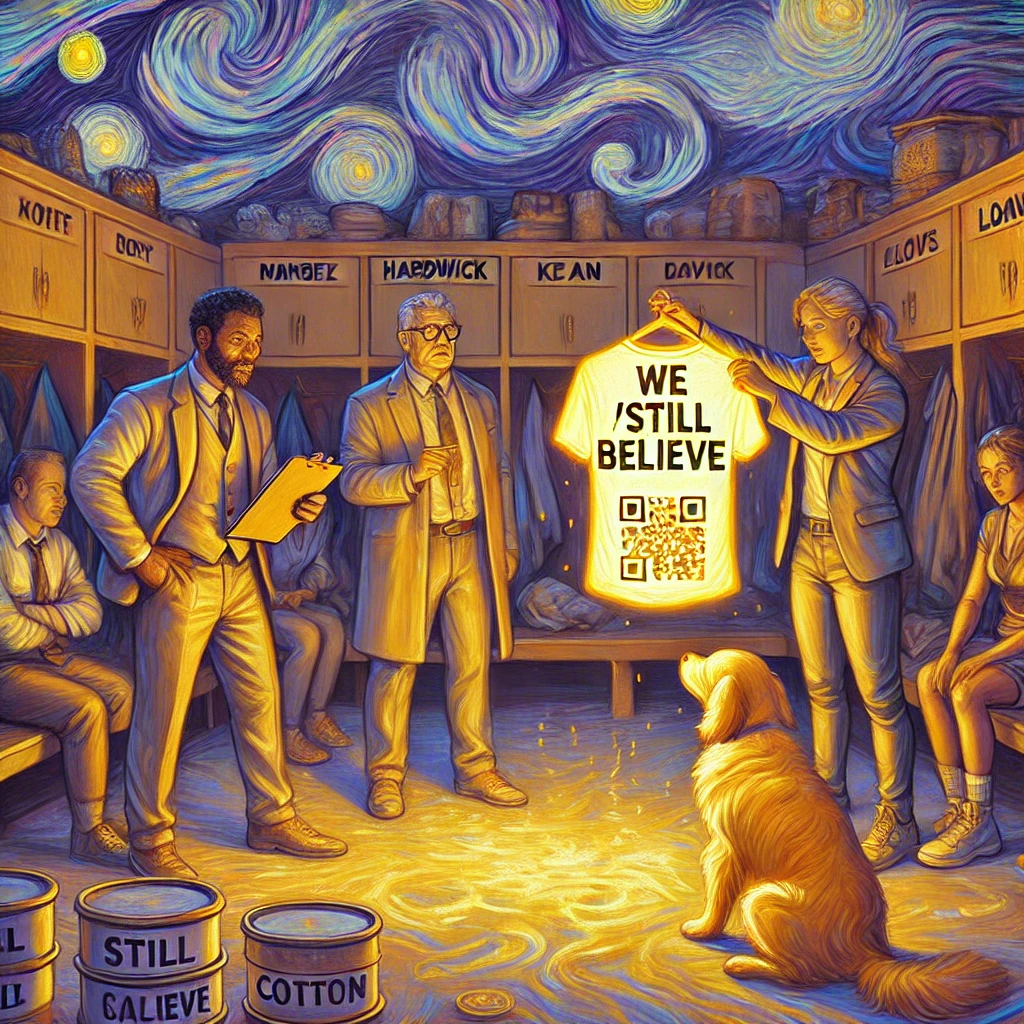
Act II: Damage Control Is a Contact Sport
By Sunday afternoon, Coach Hardwick’s stoop resembled a floral shop inside a lasagna factory. Sympathy casseroles and platitudes stacked in a masonry of goodwill. He opened one aluminum pan and whispered, “This one’s eggplant.” Then he set it reverently atop a ham-and-cheese tower and rubbed his temples.
Across from him stood Kenzie Lake, the PR consultant from Chattanooga, crisp blazer, neon sneakers, and a binder labeled “Turnarounds & Redemption Narratives.” She had the practiced gentleness of a person who can spin a scandal into a syllabus.
“Coach,” she began, “We’ll own the loss and control the headline. People don’t buy scores; they buy stories.” She slapped a mockup on the table. The bold font shouted: WE (still) BELIEVE.
Coach blinked. “Is the parentheses for humility or sarcasm?”
“Ambiguity,” Kenzie said. “Ambiguity travels.”
Mabel Dean appeared like a warrant. “Ambiguity invites committee edits,” she said. “Italicize still, capitalize WE, and don’t make the letter spacing look like it’s apologizing.”
Clovis leaned in. “Make it WE BELIEVE HARDER,” he demanded. “Also: add a QR code that links to evidence.”
“What evidence?” asked Kenzie.
“There’s always evidence,” Clovis replied.
Boot arrived last, scowling at the shirt like it had parked in his spot. “No cotton,” he pronounced. “Cotton tells lies in the wash. Make it wool. Or—” He considered. “—wood.”
Kenzie started a list: Material: TBD. Message: contested. Evidence: theoretical. Then, bright as a bandleader, she wheeled in two garment racks of tees in school purple. “Distribution strategy,” she declared. “Players wear them to practice. Parents wear them to school pickup. Sheriff wears one at church.”
Sheriff Peeler happened to be walking by. “Now hold on,” he said. “My wardrobe negotiates with no one.” Daisy wagged once—a legal tie-breaking vote in Sequatchie—and Peeler sighed. “Fine. But I’m not wearing it in the church. I’ll wear it to the church.”
Kenzie offered a multi-pronged plan:
-
Narrative: “We’re building, not broken.”
-
Visuals: Players doing early-morning drills, golden sunrise rising on commitment (she underlined “golden”).
-
Community Touches: Handwritten notes to the band, cheer squad, concession volunteers, custodian crew—“the blocking and tackling of a town.”
-
Content: Short behind-the-scenes videos. “Daisy cameo,” she added, circling it twice. “Dogs trend.”
Mabel wrote “policies” in the margins for reasons that were both obvious and unfathomable.
“Question,” Roland Pike said, stepping out of nowhere like he’d been waiting behind a fern. “Are we prepared for a score audit?”
“A what?” Coach asked.
Roland folded his arms, satisfied to be complicated. “Community wants the margin narrowed. I heard ‘32–12’ floated. Also we need to discuss the legality of counting the halftime turnstile stampede as a demerit.”
“What stampede?” Kenzie asked.
Trixie Jo rubbed her temples. “It was brisk traffic. The tots were hot. People got enthusiastic.”
Kenzie’s pen hovered. “We are not going to retroactively re-adjudicate tater tots.” She underlined NOT five times. “We talk about grit, discipline, and the long game. We sell belief without suing physics.”
Clovis whispered to Boot, “She’s never seen the Waffle House frequency maps.”
Boot replied, “Physics is a suggestion.”
Kenzie tapped the binder. “Listen. If we can’t win the game, we’ll win the frame.”
Daisy thumped her tail twice. Consensus, provisionally achieved.
Act III: Monday Night Lights (Town Edition)
Parent-Teacher Organization nights normally involve cookies and a polite argument about whether sheet protectors are wasteful. This one opened with a PowerPoint that had a title like a threat: “SEQUATCHIE DATA REVIEW: SCORE, SOUL, AND SNACKS.”
Slide one: a blurry ref circled in red.
Slide two: freeze-frames alleging “phantom offsides.”
Slide three: a line graph whose axes were labeled “Intensity” and “Narrative Momentum.”
“We believe,” announced the presenter (three dads operating as a single organism), “that the correct score should be adjusted to reflect moral yardage.”
“What’s moral yardage?” asked Reverend Gentry.
The dads conferred. “It’s the yardage you would have gotten if the universe wasn’t being petty,” they concluded.
Mabel, without looking up from her clipboard, said, “The universe is not petty. The universe is a teacher with a grading curve.”
From the back, Clovis projected a grainy security clip allegedly capturing “shadow coaching” from a parked car. “This individual tapped the horn exactly three times before our third-quarter offsides,” he declared. “Three is the Waffle House number for ‘scatter, smother, cover a small-town defense in confusion.’”
Boot crossed his arms. “I move we audit the scoreboard,” he said.
Roland Pike stood like a statue receiving lightning. “We don’t have a rubric for scoreboard audits,” he intoned, delighted. “We will need a subcommittee.”
They formed three subcommittees:
-
Score Integrity (philosophical and also loud),
-
Turnstile Incident Review (Trixie Jo, sighing),
-
Messaging & Apparel (Kenzie, whose smile hardened into a professional glaze).
Then the chants began, because there are nights when a town must choose between process and chorus, and Sequatchie Crossing loves a chorus.
“COUNT THE TOUCHDOWNS!”
“CHECK THE TATER TOTS!”
“REPLAY THE FOURTH QUARTER!”
Sheriff Peeler raised both hands. “Folks. The fourth quarter is over. It passed. It is history. I can fetch a calendar if it helps.”
Daisy barked three times, not at anyone, but as if to punctuate the sentence full stop. The room quieted, because Daisy barks like punctuation, not like content.
Kenzie stepped forward, thumbs hooked in her blazer pockets. “Here’s what we’re going to do,” she said, as if she were narrating the town’s next five minutes and five months. “We’ll honor the loss, protect the players, and cheer louder next week. We will not litigate tater tots.”
“You keep saying that,” Clovis observed suspiciously.
“Because every town I work with tries,” Kenzie said, “and it never helps.”
Act IV: Viral Belief
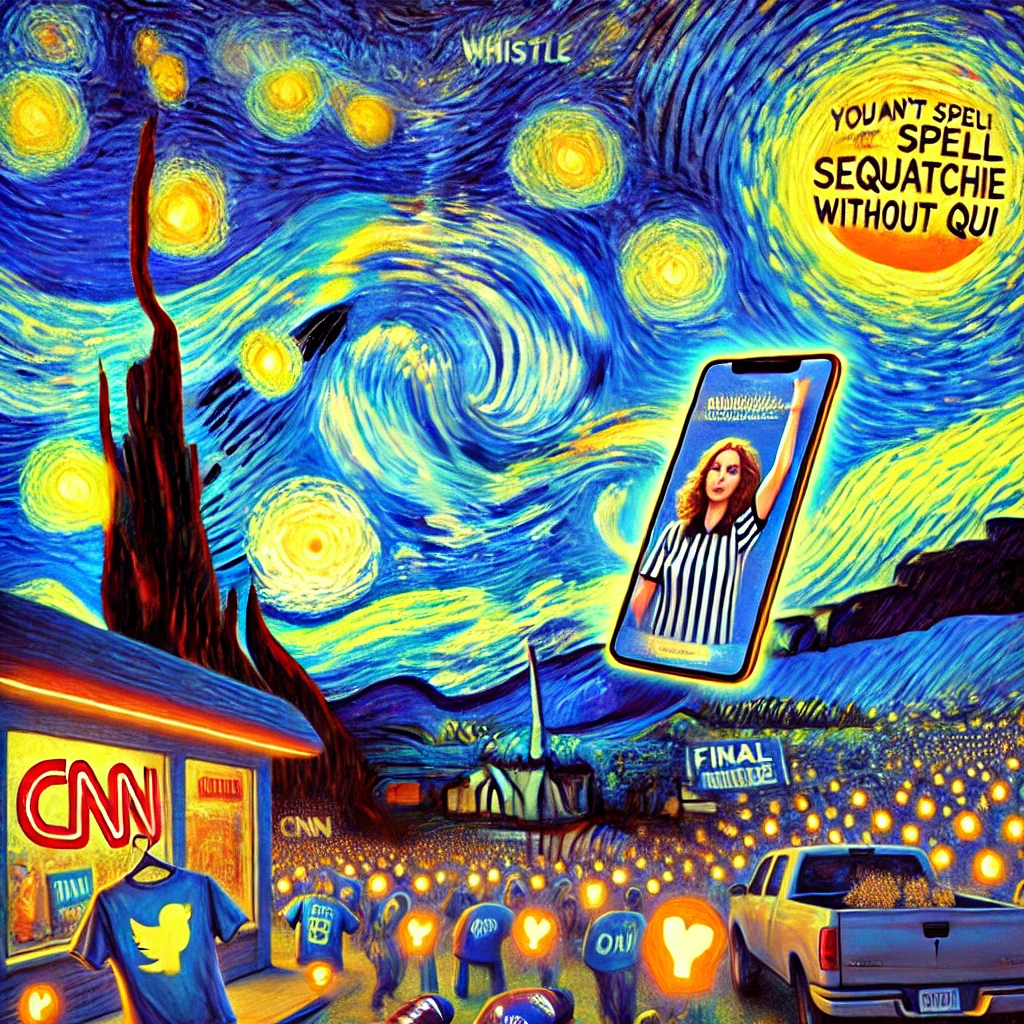
On Tuesday morning, the first day the WE (still) BELIEVE shirts hit the hallway ecosystem, a sophomore posted a mirror selfie captioned “Still? Still.” The image got 600 likes locally and then, through the mysterious migration of small-town content, exploded beyond the ridge.
By midafternoon, a TikTok of Mabel Dean waving her clipboard like a referee flag had 2.4 million views. The comments alternated between “We stan Accountability Auntie” and “Sequatchie invented postmodern cheerleading.”
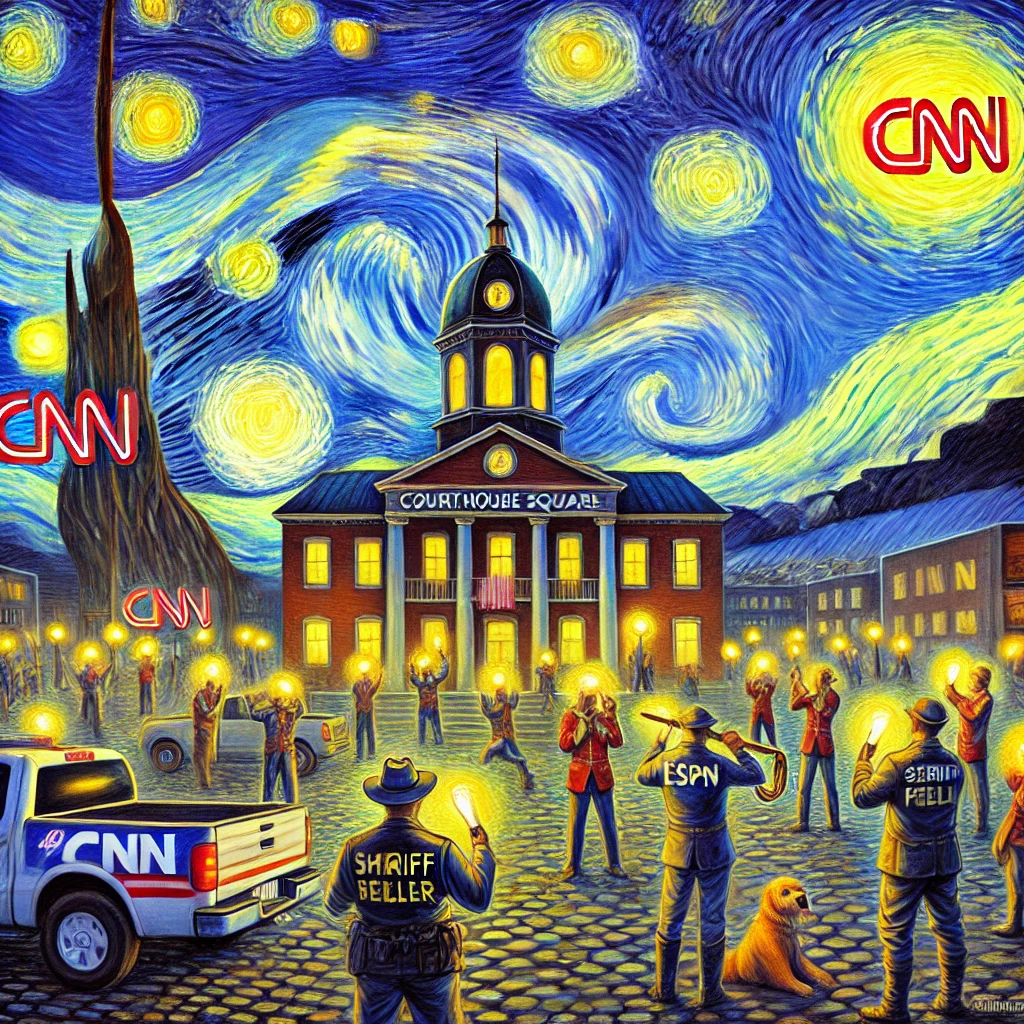
CNN ran a lower-third: “Tiny Tennessee Town Questions Physics, Gravity, and Scoreboards.” ESPN, for reasons of regulatory kindness, declined to comment—then replayed the South Pittsburg touchdowns three more times with the caption “FILM DOESN’T LIE, BUT IT DOES HAVE ANGLES.”
Kenzie kept the players off social media for a day with donuts and phone baskets. “Narrative fast,” she called it. “We’ll break the fast at sunrise with sprints.” Coach Hardwick nodded like a man who would now gladly sprint up a cliff.
Meanwhile, opportunists sensed opportunity. The gas station across from the school sold a knockoff shirt: FINAL WHISTLE: YOU CAN’T SPELL SEQUATCHIE WITHOUT ‘QUI.’ Nobody knew what it meant. They sold out by Saturday.
Boot passed the display, read the shirt, and said to the clerk, “You can’t spell ‘free market’ without ‘free’.” Then he paid cash and refused a bag.
At dusk, Kenzie staged a quiet reset. She marched the team to the elementary school to read with first-graders. The parents took photos. The story temporarily stopped being about 40–6 and became about No. 22 gently turning pages while a kid in a dinosaur hoodie sounded out “perseverance.”
“See?” Kenzie whispered to Coach. “We go smaller to go bigger. National energy runs on specific tenderness.”
Coach stared at the doorway. “I just want them to remember they like this game,” he said. “Not the circus.” He paused. “And I want a better second quarter.”
“You can have both,” Kenzie promised, with the reckless confidence of a professional.
Act V: Practice with a Pulse
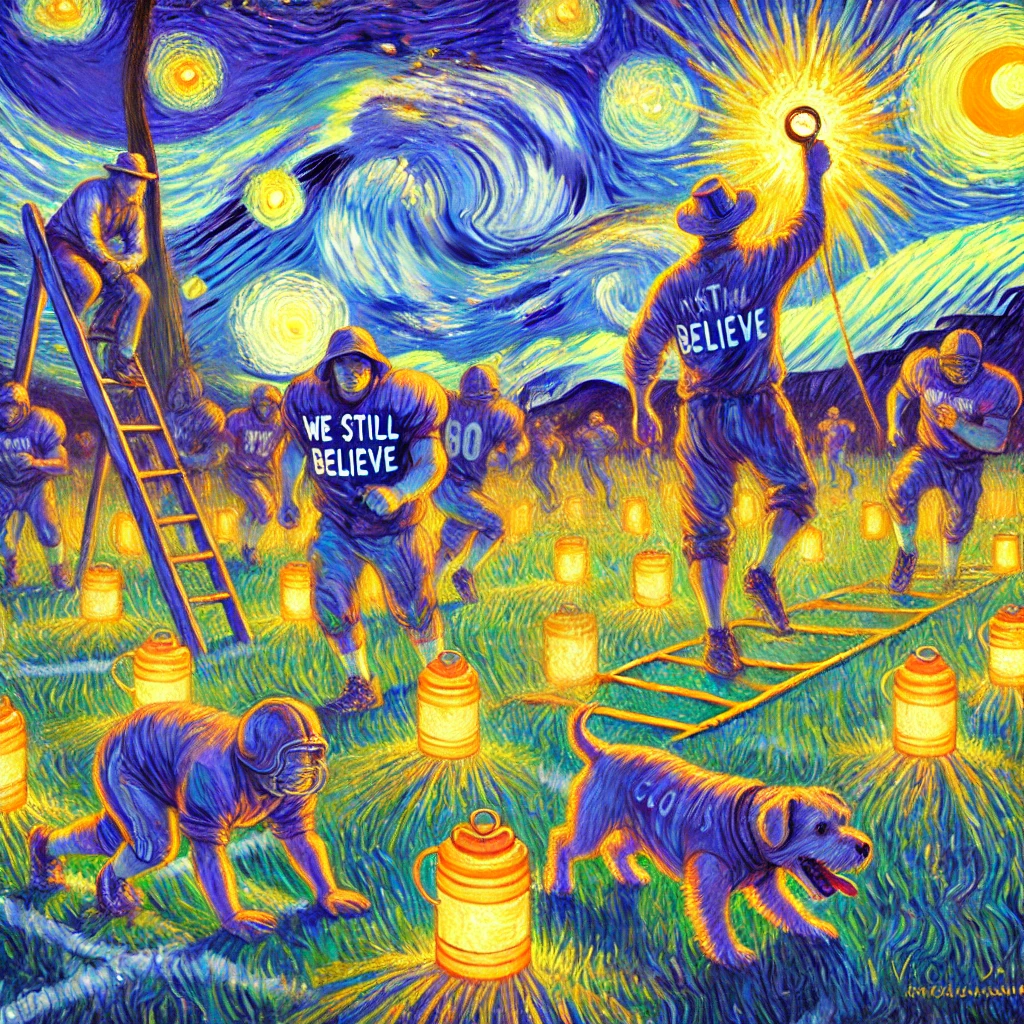
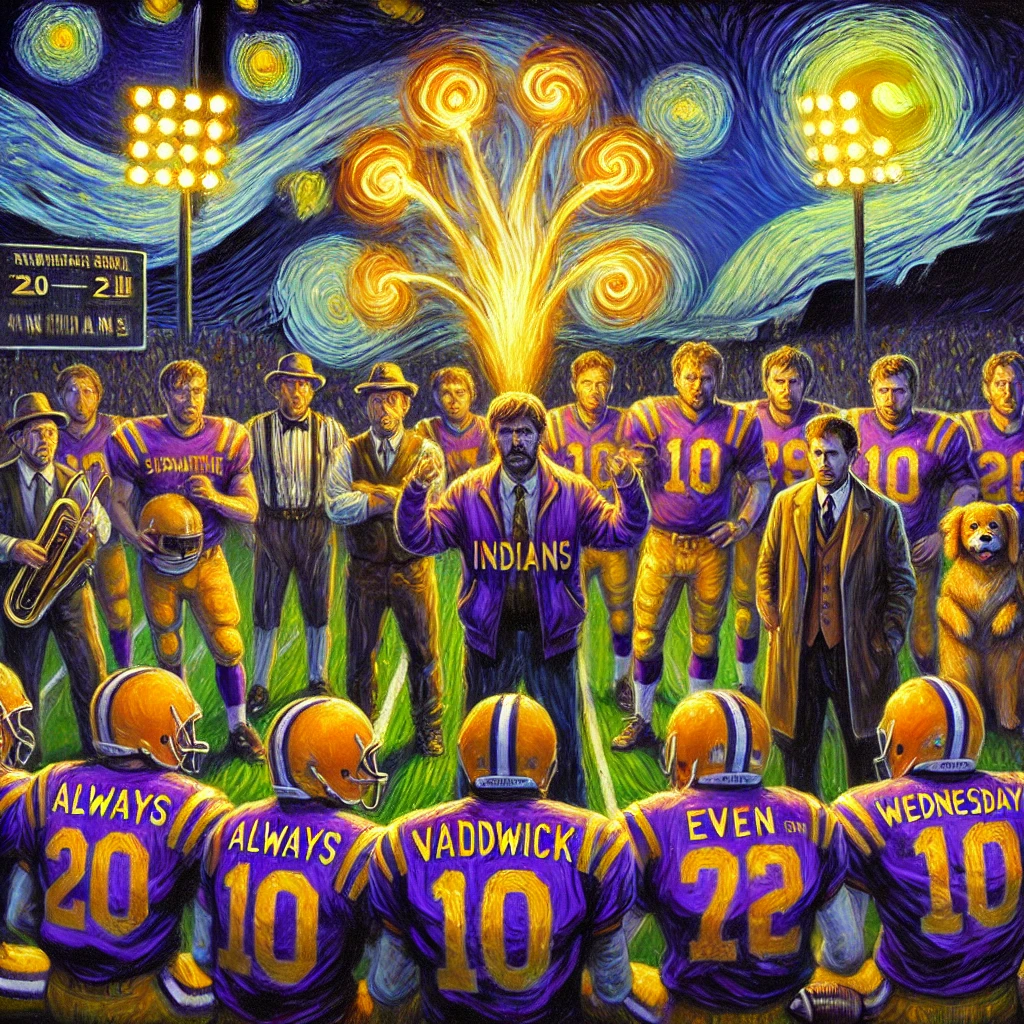
Wednesday at dawn, the field was all dew and resolve. The WE (still) BELIEVE shirts—now sharpied with personal addendums like “Always”, “Anyway”, and “Even on Wednesdays”—glowed under the lights.
“Again,” Coach called. Ladders. Sleds. Wind sprints that felt like wind indictments. The band, persistent as morning birds, rehearsed at the far end, pearl buttons and plumes catching first light. Daisy patrolled the sideline, sniffing grass divots with forensic interest.
“Discipline,” Coach said. “Discipline means your feet remember what your head forgets.”
No one spoke. Then from the end of the line, the center named Hollis—a gentle giant who liked knitting—puffed, “Sir, my feet have a learning disability.”
“Then we teach them,” Coach replied. “Gently. Repeatedly.”
Kenzie filmed five seconds: shoes slicing dew, a whistle chirp, a sunrise catching in facemasks. She posted nothing. She saved it. Not every candle needs to be a lighthouse.
Mabel Dean appeared with a cart of water jugs labelled with laminated hydration policy cards. “Two sips every drill,” she instructed. “Three if your last name begins with letters M through Z, for equity.”
Boot lugged a sled because he’d volunteered, which looks like punishment when someone else does it. “Only thing heavier than this sled is community opinion,” he muttered, then realized he’d said something poetic and promptly pretended he hadn’t.
Clovis unspooled a roll of orange tape and marked off a rectangle. “Observational demarcation zone,” he announced. “No narrative leaks.”
“Clovis,” Kenzie said gently, “we’re trying secrecy’s cousin: silence.”
He nodded solemnly and taped his own mouth for twenty minutes, a personal best.
At the water break, Coach told them a story about his grandfather’s pocket watch. “Keeps time when you’re not looking,” he said. “That’s discipline. That’s belief. That’s the thing we work on today. The score will come later. Or it won’t. Your job is the watch.”
They ran the two-minute drill until the sky forgot it had colors other than blue. They ran a goal-line stand until grit felt like a muscle group. Somewhere between drill twelve and thirteen, they became quieter, not because they were exhausted—though they were—but because they were concentrating.
Daisy, on her own initiative, trotted to the end zone and sat there like a docent guarding a museum of possibility.
Interlude: Tots, Turnstiles, and Truth
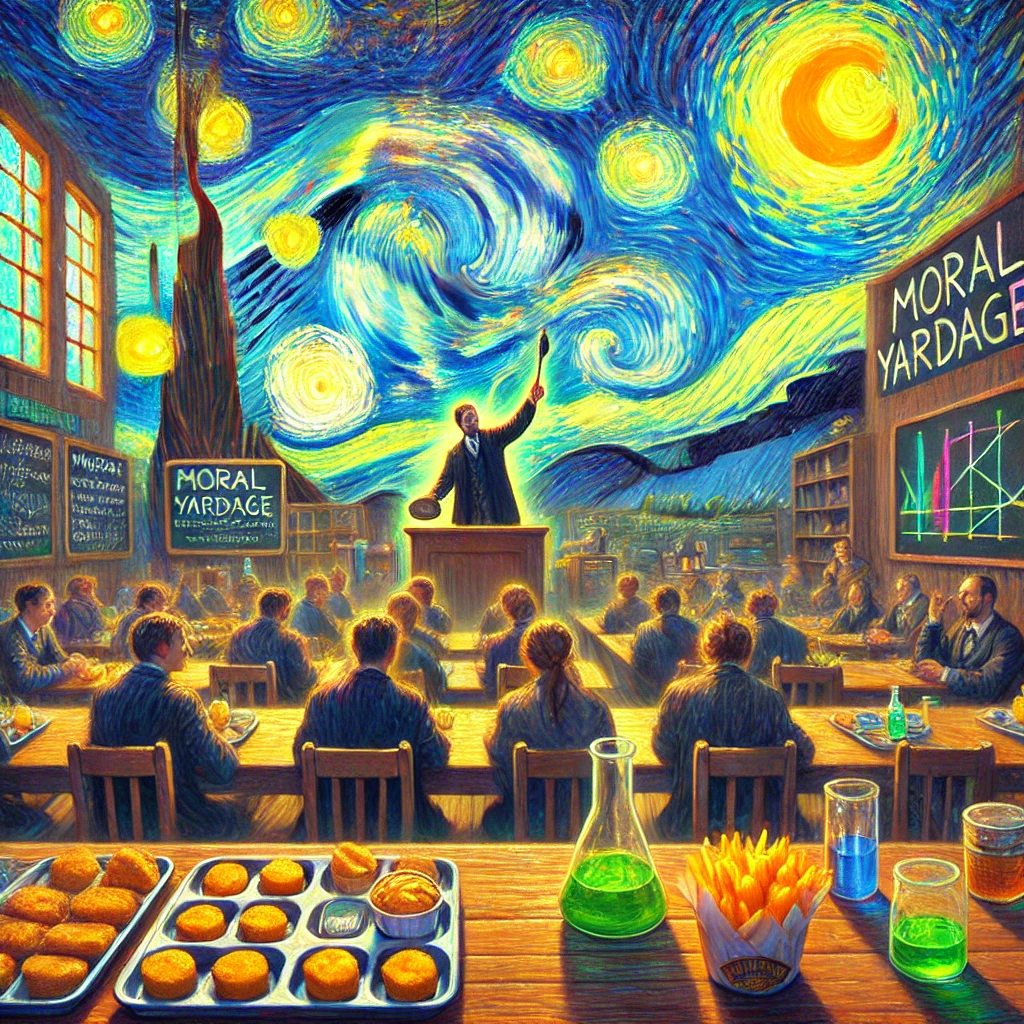
The Turnstile Incident Review met in the cafeteria beneath a banner that read “Be Kind, Rewind (Your Tone).” Trixie Jo chaired like a benevolent tyrant.
“Item one,” she began, “spirited movement is not a stampede. Item two, the tater tots were served at safe temperatures. Item three, the phrase ‘halftime snack demerit’ will be stricken from the record and from your mouths.”
A dad raised his hand. “Can we call it a spirited surge?”
“You can call it Tuesday,” Trixie Jo replied. “Meeting adjourned.”
Across the hall, the Score Integrity Committee drafted a document titled “A Framework for Moral Yardage.” After three hours, they produced a flowchart that—when taken seriously—awarded Sequatchie Crossing an additional eight hypothetical points and a renewed sense that they were part of something too intricate to explain.
Roland Pike looked proud. “We’ve invented a new statistic,” he said. “Narrative Expected Points Added.”
Reverend Gentry skimmed the draft. “You have drawn a very handsome map to the land of self-comfort,” he said, then smiled so no one had to be mad.
Act VI: National Headline Energy
By Thursday, the story had calcified into something the national news could package: A loss so big it became content. Local photos—players kneeling at practice, Daisy in silhouette, the words WE (still) BELIEVE catching morning—made their way to feeds that had never heard of Sequatchie Crossing.
A podcaster asked if the town would debate him about the role of moral yardage in American life. Mabel drafted a polite refusal, then turned it into a policy, then laminated it.
Kenzie practiced answers with Coach:
-
“What did you learn?” — “That discipline outlives disappointment.”
-
“Are you embarrassed?” — “The score is. We aren’t.”
-
“Is Daisy available for interviews?” — “She doesn’t take questions; she gives answers.”
At the gas station, a chalkboard read: “FREE COFFEE IF YOU CAN DEFINE ‘NARRATIVE MOMENTUM’ WITHOUT USING YOUR HANDS.” Nobody earned a coffee, but the gestures were inspiring.
That night the band rehearsed on the courthouse steps. Sheriff Peeler sat on the top stair, Daisy’s head on his boot. He watched people walking by—some with their new shirts, some with old cynicism, most with grocery bags and the practiced courage of ordinary errands.
“This town will be fine,” he told Daisy. “We’ve survived worse: power outages, zoning meetings, and that time the parade featured a live bear.” Daisy’s tail thumped once per memory.
Act VII: Friday Again
Game day came back around like a dog who knows where the porch is. Sequatchie Crossing filled the stands early, quiet in the anticipatory way of a congregation that has already decided to forgive whatever happens.
The shirts showed up in force. Some had evolved: WE (still) BELIEVE had cousins like WE WORK and WE (sometimes) IMPROVISE and, on one bold middle-schooler, WE (don’t) CHECK TIKTOK DURING WARMUPS.
Kenzie kept the cameras put away until the sun slid below the ridge and the lights took over. She captured a single shot: the team huddled around the old pocket watch Coach held aloft. “Time,” he said. “Ours to use.”
The first quarter wasn’t magic. Sequatchie Crossing missed a block, then missed a tackle. But a quiet thing began: they stopped missing the next thing. They reset faster. They listened. They found their breath after giving it away.
In the second quarter, Hollis the knitting center sealed an edge like a condemned door. The running back slipped inside that brief geometry and went twenty-seven yards. The band, caught between songs, played three bars of two different anthems, which accidentally harmonized with the crowd’s gasp and became an instant classic: The Sequatchie Mash-Up of Relief.
Halftime brought no stampede, only brisk commerce and healthy skepticism. Trixie Jo set out a handwritten sign: “Fries, Nachos, Diplomacy.” She sold out of two, kept extra of the third for after the game.
Third quarter: a goal-line stand stretched thin as a spider web and somehow held. Daisy, from the track, leaned forward with a scholar’s interest in the mechanics of courage.
Fourth quarter, two minutes left, down eight. Sequatchie Crossing began a drive that contained most of what a town wants to remember about itself. Feet that had been clumsy seven days ago now moved like they’d learned a second language in a week. Every huddle looked like a small prayer that forgot it was a prayer.
With twelve seconds remaining, the quarterback lofted a fade to the back pylon. The receiver—No. 11, quiet in class, loud in space—rises, taps both toes, and cradles the ball as if accepting a fragile verdict. The line judge’s arms go up. The stands lift like a springboard. Touchdown.
The two-point conversion fails by the length of a syllable. Final: Sequatchie Crossing 20 — Visitor 22. Another loss. The sort that feels like the beginning of something, not the ending.
The team walked, not trudged, to the handshake line. Parents—who had spent a week inventing yardages—found themselves without math, only clapping. Mabel Dean, who never wastes a teachable moment, did the respectful thing and filed the moment under “Resilience: Applied.” Clovis removed his foil crown, pressed it flat, and placed it inside his shirt over his heart like an invaluable document. Boot stared at the scoreboard as if daring it to be smug. It wasn’t. It just glowed.
Kenzie watched it all and didn’t film a thing. “Some stories,” she whispered, “you store, not share.”
Daisy wagged twice: the highest civilian honor.
Epilogue: After the Headline
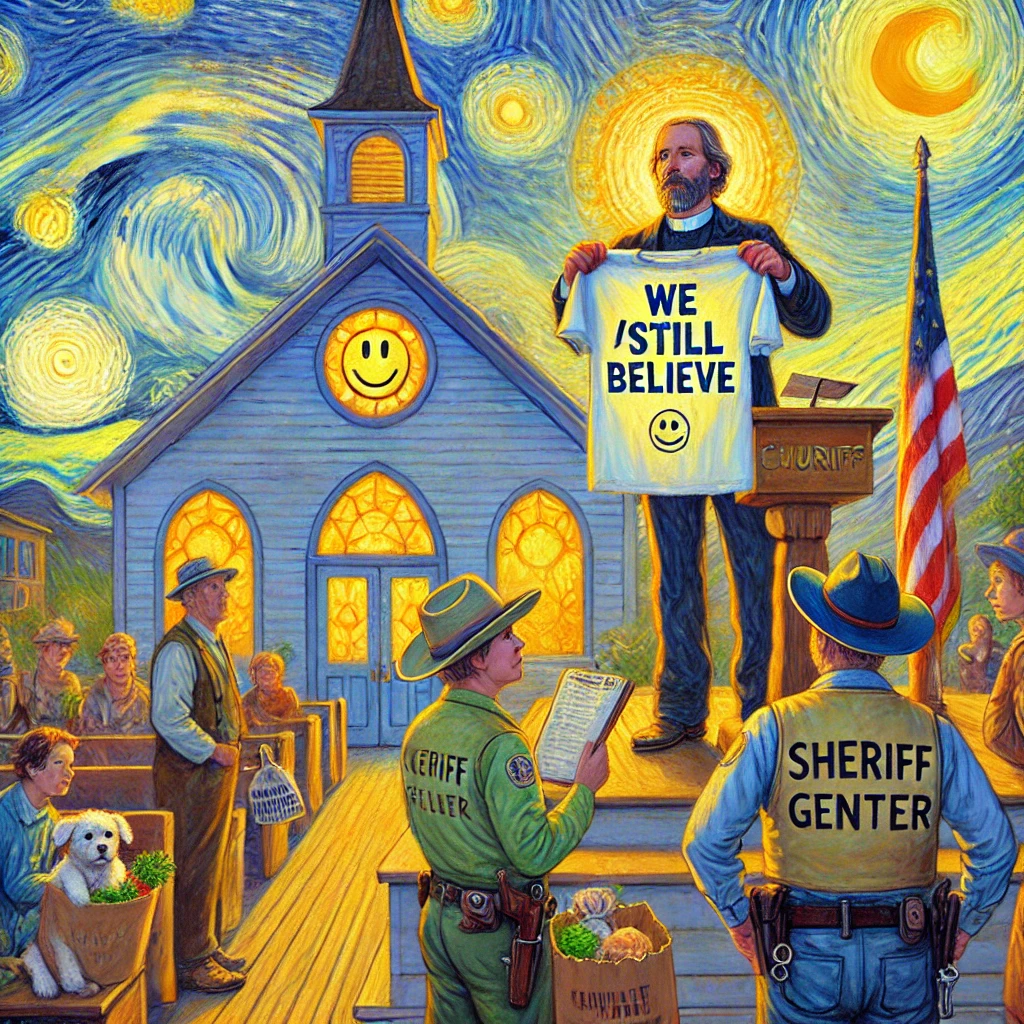
Sunday morning, Reverend Gentry lifted one of the WE (still) BELIEVE shirts from the pulpit. “Belief is not a scoreboard massage,” he said. “Belief is showing up when your throat still tastes like last week.” He smiled. “Also: thank you to our concession crew for the tots. God bless the fryers and those who stand near them.”
Outside the church, Sheriff Peeler sat on the brick planter with his to-go cup. The town flowed past like a river that knew every bend by name. He scratched Daisy’s ears. “Well,” he murmured, “we lost by two and gained a town back.”
Roland Pike approached with a sheaf of papers: “Narrative Expected Points Added — Revised.” Peeler held up a hand. “Roland,” he said gently, “some things can stay un-measured.” Roland looked disappointed, then strangely relieved, like a man released from jury duty by mercy instead of law.
Kenzie packed her binder, left one rack of shirts with Trixie Jo for a fundraiser, and wrote a note on Coach’s whiteboard: “Belief is a muscle. Keep it busy.” She took the sunrise clip from Wednesday and, after a long thought, deleted it. Some candles, some lighthouses, and some mornings belong to the people who lived them.
Coach Hardwick wound his grandfather’s pocket watch, listened to the steady tick. Outside, drills started up again—lighter now, faster. He smiled and stepped onto the field.
Boot lumbered past with the blocking sled. “Only thing heavier than this sled,” he said, “was last week.” He paused, considered the fresh light. “This one’s manageable.”
Clovis stapled a new poster to the community board: “Emergency Meeting: Did We Just Have Fun?” Then he drew a smiley face wearing a foil crown. Historical accuracy, to his mind.
Mabel Dean closed her clipboard and took a rare unstructured breath. “We’ll need policies,” she said, half to herself, because habit is also a muscle. But for a whole minute, she let the air be policy enough.
Daisy trotted a slow patrol of the fifty-yard line, sniffing yesterday into innocence.
Sequatchie Crossing carried on—debates eternal, belief stubborn, humor self-renewing, headlines already cooling on distant servers. The game had ended, the final whistle blown. The town kept playing anyway.
Disclaimer
The Sequatchie Crossing Dispatch is a satirical series. All characters, situations, and alleged scoreboard audits are works of parody. No referees were actually in communication with Waffle Houses, no tater tots were placed under official review, and no PR consultants were harmed during distribution of motivational t-shirts. Any resemblance to actual persons, places, or halftime stampedes is purely coincidental—except Daisy the hound, who remains entirely real and unimpeachably correct.
Real Places Behind the Ruckus – From The Dunlap Directory
Real Places Behind the Ruckus – From The Dunlap Directory
Yes, this story was fictional; even the parts that weren’t true. These places? Absolutely real. Stop by, support local, and keep the Wi-Fi away from livestock:
- Christy Cartwright Real Estate Agent
- Dunlap Natural Gas System
- ProMobile Automotive
- Fain Farm
- The Pumpkin Patch Playground
- Just Frosted
- Dunlap Grapevine 2.0
- Wilson Dumpsters
- Uplift Fitness Dunlap
- Rolling Oak Distillery
- Winchel’s Homestead Wonders
- Pine Dell Feed Mill
- Jim Garren – State Farm Insurance Agent
- Ed’s Lawn Care
- D and T Designs
- Eco Home Solutions
Real Places Behind the Ruckus – From The Dunlap Directory
At Sequatchie Crossing, we tell the stories of Sequatchie Crossing.
Please share this post with your friends, family, or business associates who may want follow the news from Sequatchie Crossing.

0 Comments