


Forward Progress Was Negotiable
By Tom Seest
At Sequatchie Crossing, we tell the stories of Sequatchie Crossing.
Please share this post with your friends, family, or business associates who may want follow the news from Sequatchie Crossing.
🎤 Audio Overview
The Donkey That Blocked a Parade
The Donkey That Blocked a Parade
There are towns that measure time by clocks, calendars, and the opening bell at the stock market, and then there are towns like Sequatchie Crossing, where time is measured by less reliable instruments: the first church casserole of spring, the arrival of banner season, whether the hardware store has put birdseed on sale, and how many people have already threatened to “bring this up at the next meeting.”
Sequatchie Crossing also measured time by parades.
Not because the town had so many of them that anyone might confuse it for New Orleans, but because every parade, however small, eventually became a local landmark. Folks remembered things by saying, “That was the year the Junior Miss Corn Court float lost a wheel,” or, “That happened two weeks after the Veterans Day parade when the confetti blower caught fire and sent glitter into the Methodist choir loft.”
So when the Beautification and Heritage Promotion Committee announced the first-ever Sequatchie Crossing Founder’s Forward Parade, there was, naturally, division.
Half the town thought it was a splendid idea. The other half wanted to know why the town needed a parade to celebrate moving forward when most of the roads still had potholes large enough to trap a riding mower. A third half—because local arithmetic had never answered to logic—wanted to know why the parade route cut past their houses if nobody had asked them whether they wanted to be celebrated in front of.
Still, once the committee printed flyers, it was too late to stop it. Nothing in Sequatchie Crossing became more real than a bad idea after somebody made a flyer.
At the center of the parade planning stood Miss Darlene Wicker, chairwoman of the committee and a woman who believed deeply in civic uplift, matching fonts, and the spiritual value of laminated schedules. Miss Darlene had selected the subtitle herself: Forward Progress Was Our Heritage. She had also designed a logo featuring a wagon wheel, a sunrise, and an eagle that looked more like an irritated chicken.
“This parade,” she said at Town Hall, tapping the podium with one fingernail, “is about momentum.”
That turned out to be unwise wording.
Because three rows back sat Clovis Strickland, who treated the phrase momentum the way other men treated a suspicious rustling in the woods. His eyes narrowed. He wrote it down in a pocket notebook. Then he underlined it twice.
Clovis had not trusted momentum since the county installed the new four-way stop by Honeycutt Hardware. In his view, momentum was what bureaucrats called it when things happened faster than decent people could object to them.
“What kind of momentum?” he asked.
“The good kind,” Miss Darlene said.
“There’s no such thing as uncontrolled good kind,” Clovis replied. “That’s how culverts get approved.”
Near the front, Boot Barnes leaned back in his chair until it complained beneath him. Boot had a long, generous face and the kind of expression that suggested he was always two sentences behind but somehow still ahead of everyone else in practical matters. He wore a seed cap with no seed company visible anymore and drank coffee as if it were a moral duty.
“What all’s in this parade?” he asked.
Miss Darlene brightened. “The high school marching band, antique tractors, church floats, the Little Miss Rhododendron Court, the 4-H banner team, the heritage quilting wagon, the Historical Society mule cart—”
“Mule cart?” Boot said.
“Decorative. Symbolic.”
“Because symbolic animals is how real trouble starts.”
The room murmured. This was true enough.
Sheriff Burl Peeler, who had come mainly because he had received three separate calls asking whether parade permits counted as emergency events, stood near the back with his hat in hand. Sheriff Peeler was a man of patient brow and slow speech, the kind that made people think he was simple until they realized he had heard every word they said and remembered the ones they wished he hadn’t.
“Do we anticipate any public safety issues?” he asked.
Miss Darlene gave a little laugh, which in Sequatchie Crossing was widely recognized as the traditional sound made immediately before a preventable problem.
“Why, no,” she said. “This is a family parade.”
That, too, turned out to be unwise wording.
Because on the eastern edge of town, up past Miller’s Creek where the road got narrow and opinions got louder, lived Emmett Rigsby and his donkey, Clementine.
Now, Clementine was not a mean donkey. She was not wild, vicious, or especially dramatic by the standards of her species. She simply possessed convictions. She believed in shade over sunlight, stillness over hurry, and the principle that no creature should be expected to move because another creature had developed an event schedule.
Emmett claimed Clementine was “smart as tax trouble.” He said it with pride.
“Donkey knows people,” he often remarked. “That’s why they don’t care for our arrangements.”
Emmett himself was a wiry man with a tobacco-browned mustache and suspenders that seemed to hold up more resentment than trousers. He had once hauled scrap, once bred hounds, once nearly run for county commissioner, and currently dedicated most of his time to not being told what to do. He and Clementine got along beautifully because they shared both this trait and approximately the same walking speed.
When word reached Emmett that the parade committee wanted to borrow Clementine to stand near the heritage wagon for “rustic flavor,” he rejected the request so hard it nearly registered on weather equipment.
“My donkey is not flavor,” he said.
Miss Darlene, to her credit, sent a polite follow-up letter.
Emmett nailed it to his shed.
That might have been the end of it, except Miss Darlene made the mistake of mentioning at the barber shop that “some people are holding back progress over personal stubbornness.”
By supper, the remark had traveled through town and returned to Emmett in a form that suggested Miss Darlene had called both him and Clementine “public enemies of pageantry.”
That was not exactly what she had said.
It was close enough.
The Donkey That Blocked a Parade
Act I – A Parade Forms, Sort Of
The morning of the parade dawned as parade mornings always do: too early for decent people and with skies so theatrically blue they seemed personally invested in a good turnout.
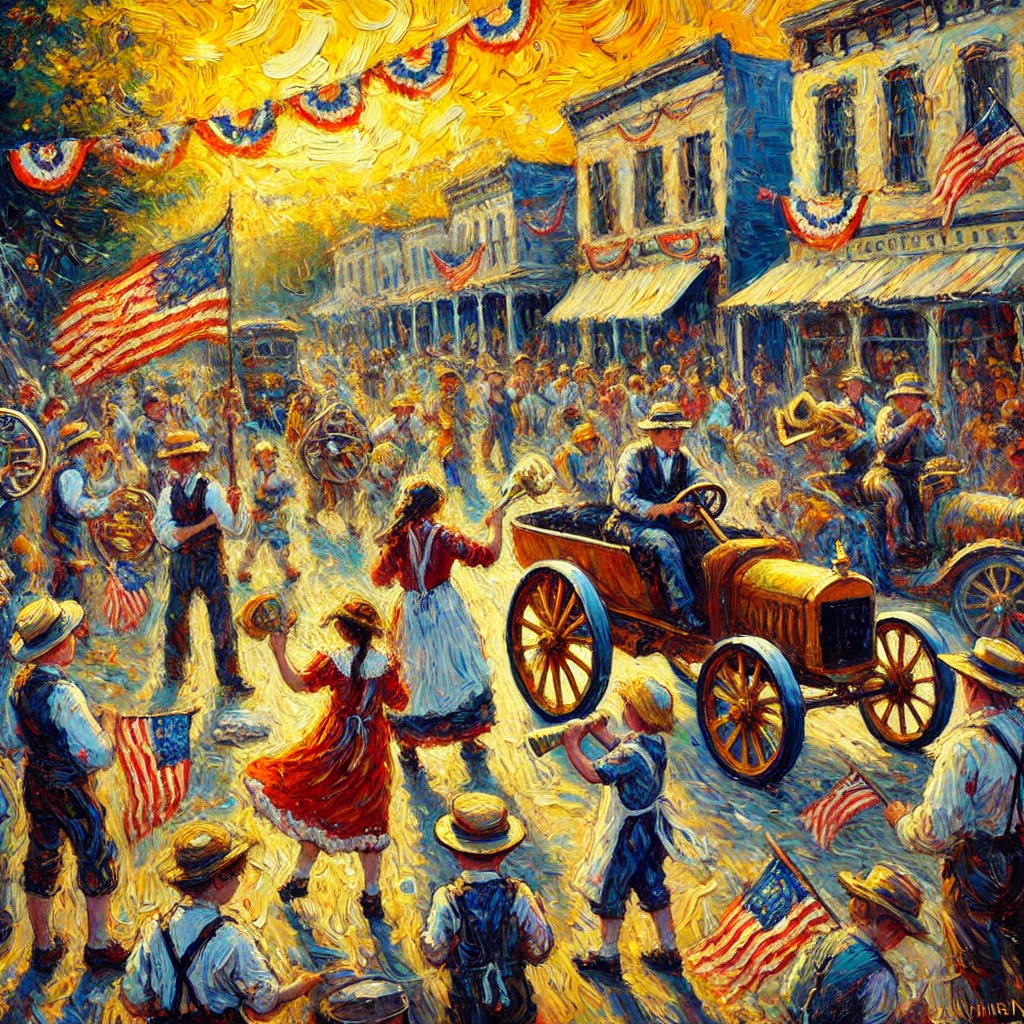
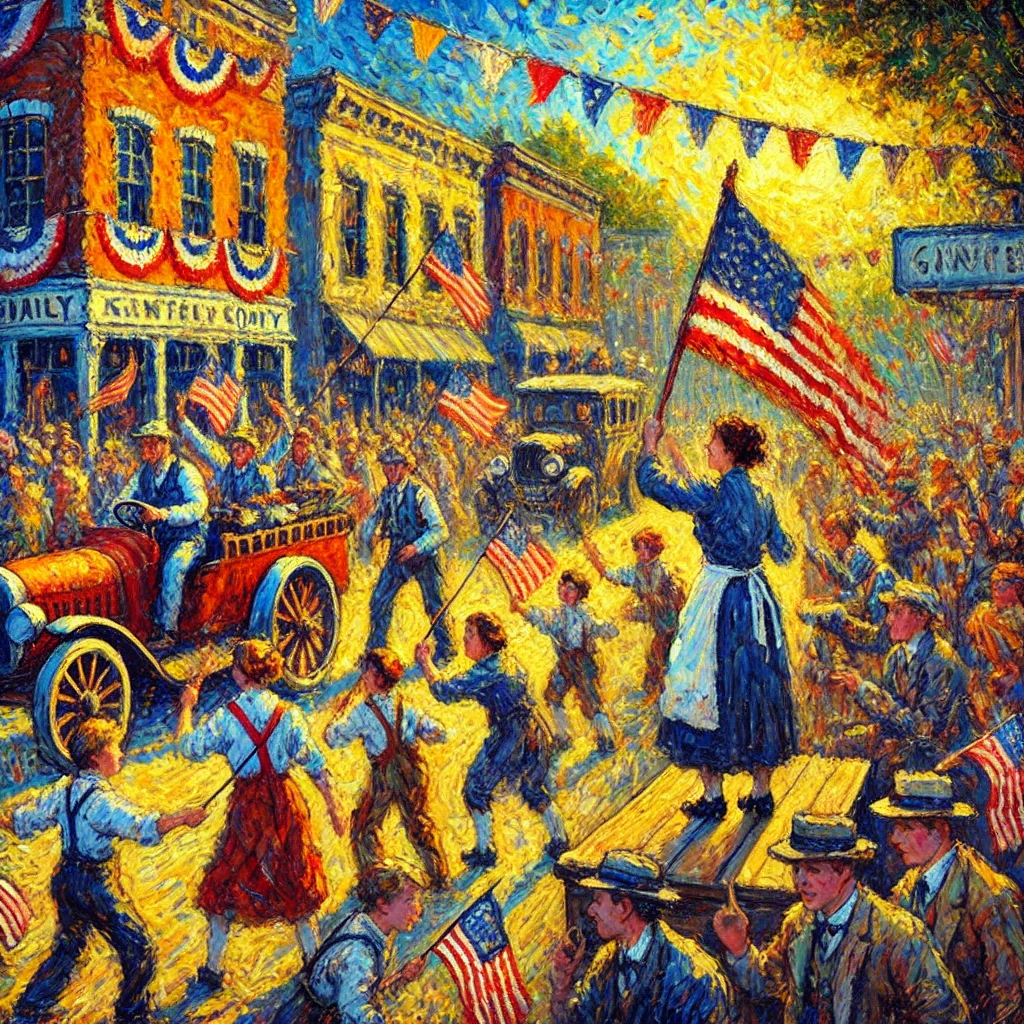
By eight o’clock, Main Street looked as though it had been dressed by three different committees who had not spoken to one another. Red, white, and blue bunting hung from storefronts. Paper sunflowers nodded from utility poles. Somebody had tied gold ribbon around the stop sign near the diner, which Sheriff Peeler quietly removed without comment. The marching band warmed up in scattered bursts that made it sound as if five patriotic songs were fighting in an alley.
Children ran in circles carrying small flags. Church ladies arranged pies under tent awnings no one had officially approved. The tractor club polished fenders that had not shone that brightly since the Eisenhower administration. Trixie Jo Bartlett sold commemorative lemonade in plastic cups stamped with Forward Progress stickers that began peeling in the heat.
Trixie Jo never missed an opportunity to monetize sentiment. She ran a boutique, a custom vinyl side operation, a seasonal candle table, and—during one memorable winter—a ham glaze consultancy. If there was a way to put a phrase on merchandise before the phrase had even been fully explained, she would find it.
“These’ll be collectibles by lunchtime,” she told anybody within earshot.
“Why?” asked Mabel Dean Ashcroft, who had come bearing pound cake and skepticism.
“Because something is always collectible after a disaster.”
Mabel Dean, broad-minded in theory and sharp-tongued in practice, peered down the street through rhinestone-framed sunglasses. “Has anyone confirmed the route?”
“They confirmed it three times,” said Trixie Jo. “Once on paper, once in committee, and once on Facebook.”
“That means it ain’t confirmed at all.”
At nine fifteen, the first sign of disorder arrived in the form of the high school tuba section, which had assembled behind the antique tractors instead of in front of the dance team. This caused Miss Darlene to flap her clipboard like a stressed water bird and reposition everyone by hand.
At nine twenty, one of the church floats shed a banner into the street.
At nine twenty-three, the antique fire truck would not start.
At nine twenty-five, Clovis Strickland announced to anyone who would listen that the route had “structural weaknesses.”
“It bottlenecks at the old pharmacy corner,” he said, pointing at a hand-drawn map. “All it takes is one refusal point and the whole operation goes ceremonial.”
“What’s a refusal point?” asked the mayor pro tem, regretting it instantly.
Clovis tucked his pencil behind one ear. “Anything with a mind of its own and no respect for whistles.”
He did not have long to wait.
Act I – A Parade Forms, Sort Of
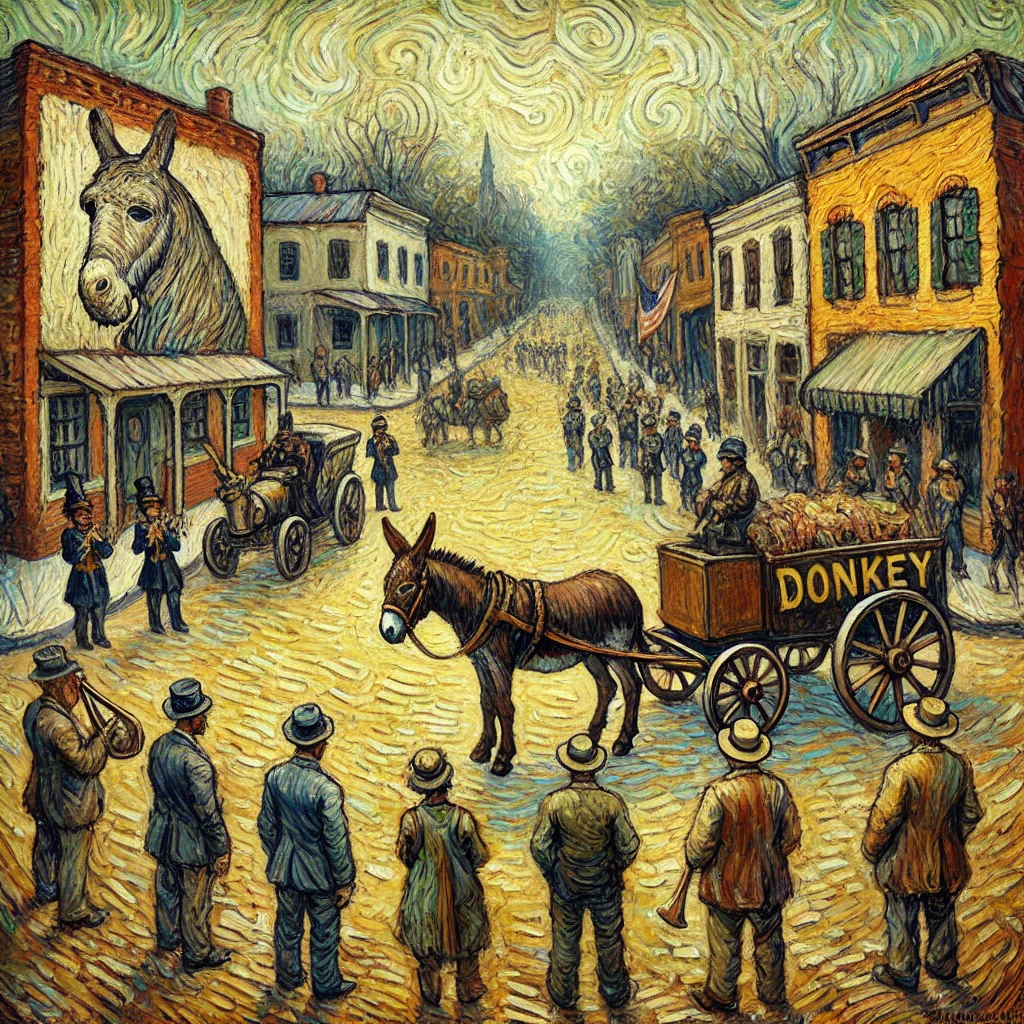
At precisely nine thirty-two, as the first edge of the parade began its noble, halting, overmanaged crawl down Main Street, there came from the side road near the former feed store the slow, unmistakable sound of hooves on pavement.
People turned.
Children pointed.
Band music faltered in mid-brass.
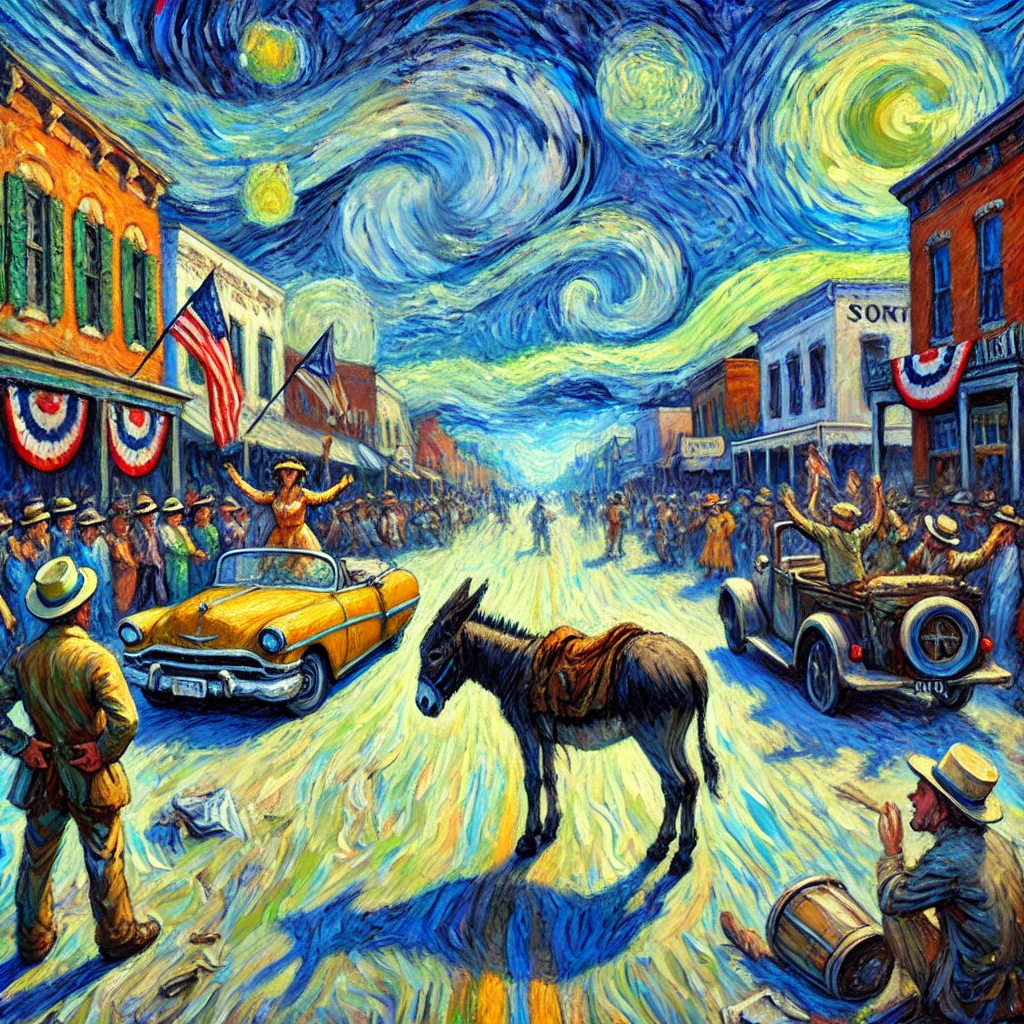
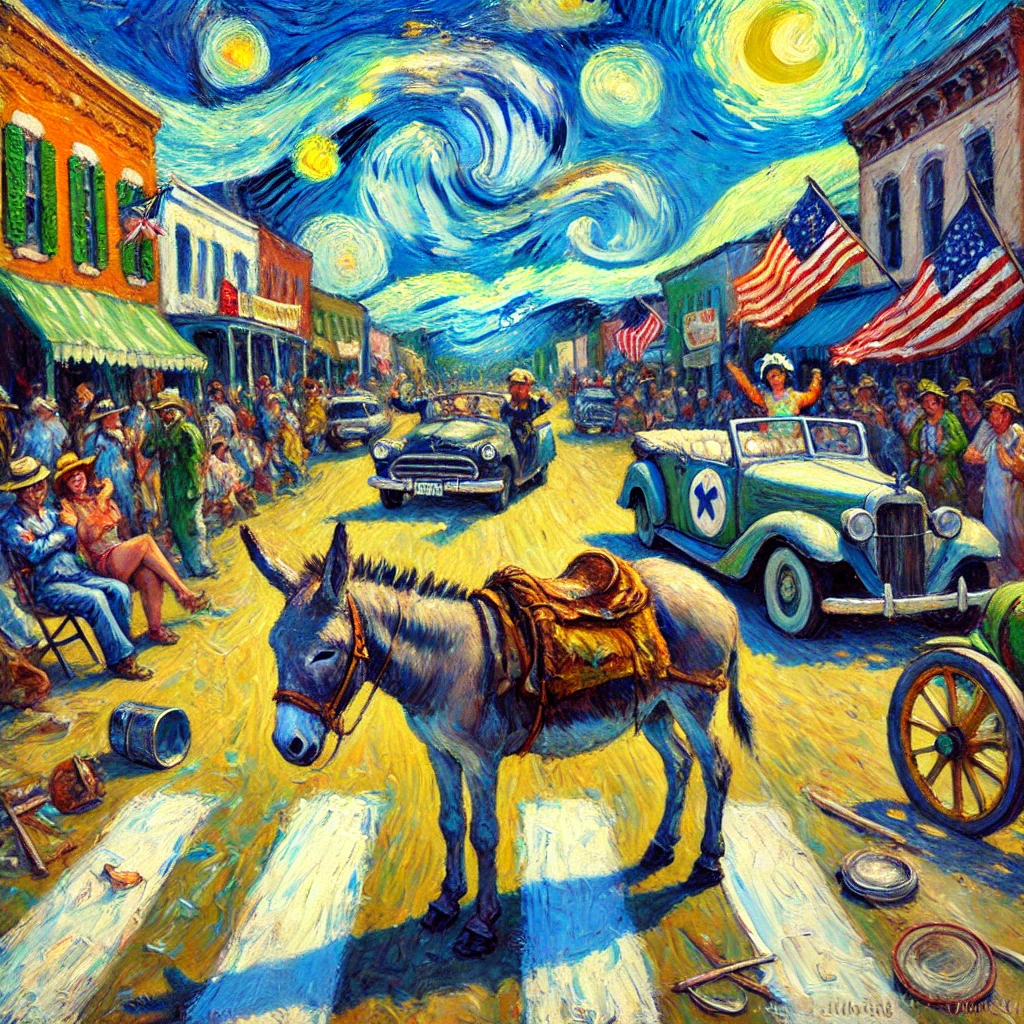
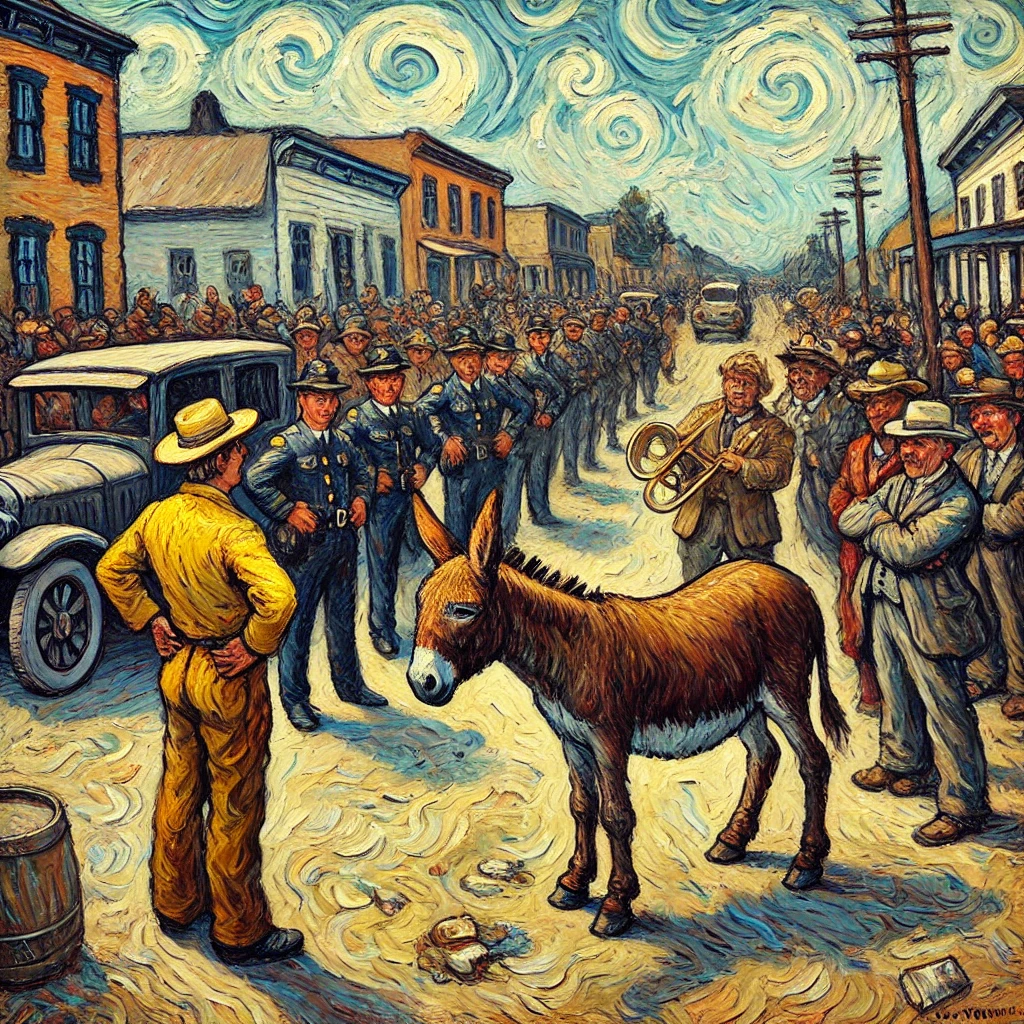
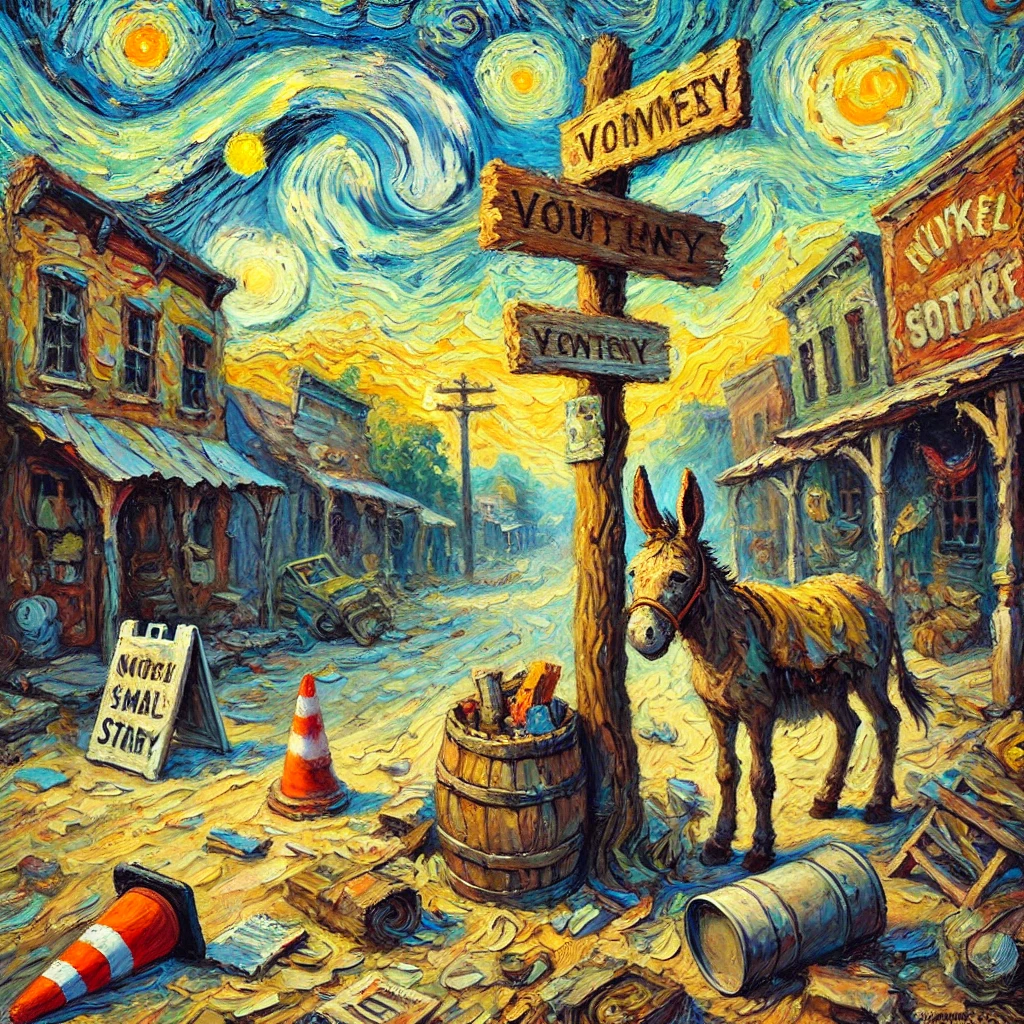
Down the side lane came Emmett Rigsby, sitting in a faded wagon seat behind Clementine the donkey, who wore no decorations, no ribbon, and no official credentials beyond an expression of firm disapproval. She plodded toward Main Street with the solemn pace of a judge entering a courtroom where everyone was already guilty.
“What in heaven’s name,” Miss Darlene whispered.
Emmett drew the wagon up to the center of the intersection, looked once to his left, once to his right, and then—whether by design, instinct, or providence—Clementine stopped.
Not paused.
Stopped.
She planted herself broadside across the parade route, directly between the Historical Society mule cart and the Little Miss Rhododendron convertible.
Then she lowered her head and entered a level of stillness usually associated with fence posts and old feuds.
The parade, which had never moved especially fast, ceased entirely.
At first everyone assumed this was temporary. Emmett tugged lightly on the reins.
“Come on, girl.”
Clementine did not move.
He clicked his tongue.
Nothing.
He shifted in the seat.
Nothing.
From the sidewalk, Mabel Dean said, “Well.”
Boot Barnes folded his arms. “There’s your symbolic animal.”
Miss Darlene hurried forward, her smile stretched so tight it could have opened a can. “Emmett. Good morning. I’m sure this is just a misunderstanding.”
“No ma’am,” Emmett said pleasantly. “This here’s a stoppage.”
The band members, left without guidance, began drifting into shade. Children sat on curbs. Trixie Jo immediately repriced her lemonade sign to include the phrase Official Parade Delay Refreshments.
Sheriff Peeler approached at the careful pace of a man trying not to alarm either the animal or the committee chair.
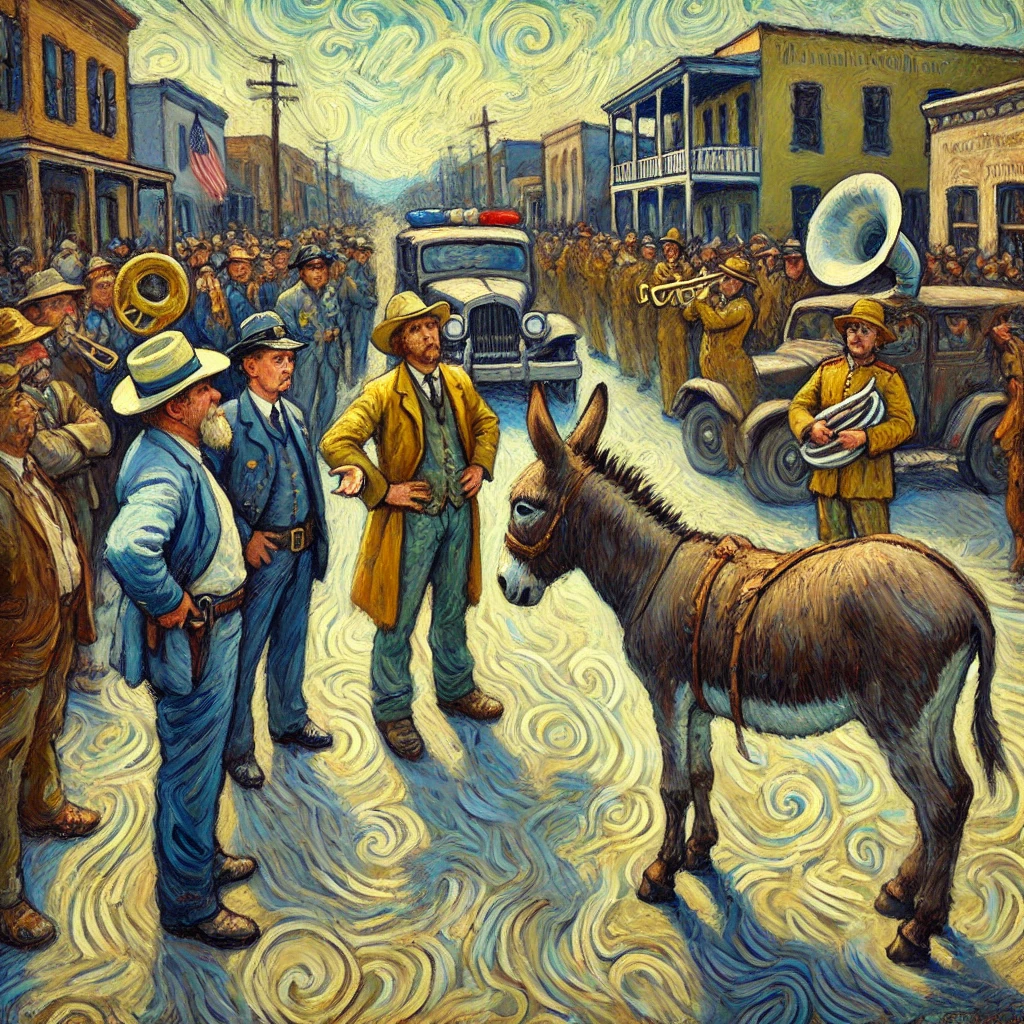
“Emmett,” he said, “you mind explaining the purpose of this maneuver?”
Emmett tapped the wagon rail. “Purpose is civic participation.”
Miss Darlene inhaled through her whole upper body. “You were not invited to participate.”
“That sounds less like a parade and more like a procession with gatekeeping.”
“I asked to borrow your donkey as part of the heritage display.”
“And I said no.”
“That does not authorize you to block Main Street.”
Emmett looked offended on Clementine’s behalf. “Clementine blocked Main Street. I’m just present.”
This distinction did not improve matters.
Act I – A Parade Forms, Sort Of
Act II – Negotiations With an Unmovable Party
There are, in any town, moments when people reveal their true gifts. Some rise to leadership. Some to compassion. Some to opportunism. Main Street that morning offered examples of all three.
Miss Darlene rose to furious logistics.
Sheriff Peeler rose to procedural patience.
Trixie Jo rose to record sales.
And Clementine rose to nothing whatsoever.
By ten o’clock, the donkey had become the fixed center of civic life. Everything else arranged itself around her. The parade lengthened backward in frustration. Floats idled. Children lost interest in patriotic symbolism and developed a strong preference for snow cones. Three separate men suggested backing up the whole procession and rerouting through the library lot, which was impossible for reasons both practical and spiritual.
Miss Darlene assembled an emergency huddle under the awning of Honeycutt Hardware. Present were Sheriff Peeler, Boot Barnes, Mabel Dean, Clovis Strickland, the pastor from First Fellowship, and, for reasons nobody could explain, the owner of the inflatable bounce house.
“We need solutions,” Miss Darlene said.
“We need oats,” said the pastor.
“We need authority,” said Clovis.
“We need to stop calling this momentum,” Boot said.
Sheriff Peeler rubbed his chin. “Anybody here know donkeys?”
That produced a silence both deep and local.
Finally Boot lifted one hand. “I know enough not to get in a contest with one.”
Mabel Dean nodded. “That’s more than some people know about most relationships.”
Miss Darlene pointed down the street. “Can she be pulled?”
“No,” said Boot.
“Pushed?”
“That’ll insult her.”
“Lured?”
“Maybe. But not by anybody desperate.”
Clovis inserted himself into the discussion with notebook ready. “This is psychological. You can’t approach a resistance point with visible agenda.”
Miss Darlene stared at him. “Do you hear yourself?”
“Frequently. It’s how I know I’m right.”
Out on the street, Emmett remained seated, calm as a porch rocker. He accepted a cup of lemonade from Trixie Jo and tipped his hat to onlookers. Clementine swished her tail once. That was her only public statement.
Someone suggested the fire department.
Someone else suggested prayer.
A child asked if the donkey was in charge now.
“No,” said Miss Darlene.
“Yes,” said half the town under its breath.
Sheriff Peeler tried formal persuasion first. He stepped up beside Clementine, hat in hand.
“Now, Clementine,” he said in the tone men use with toddlers, jury members, and machinery they paid too much for, “we need to clear this roadway.”
Clementine blinked.
Act II – Negotiations With an Unmovable Party
He reached toward the halter.
She rotated one ear backward in a manner that communicated a great deal about boundaries.
Sheriff Peeler withdrew his hand.
“I have received her position,” he said.
The pastor tried next with a soft apple and a hymn fragment. Clementine sniffed the apple, considered it, and then resumed her contemplation of the middle distance as if the pastor had offered a theological pamphlet.
Mabel Dean took a turn with a peppermint and what she called “womanly diplomacy.” Clementine breathed on her cardigan and remained immovable.
Then Boot Barnes walked over, slow and easy, carrying nothing at all.
“What’re you gonna do?” asked Trixie Jo, already readying her phone.
“Nothing flashy,” Boot said. “That’s for horses and county officials.”
He stopped near Clementine’s shoulder and stood in silence for nearly a minute, looking the same direction she was looking. People waited. The band members watched. Even Miss Darlene, though furious, understood when a man had entered a ritual older than process.
Finally Boot spoke.
“Seen many of these, have you?”
Clementine flicked one ear.
“Too much noise. Too much planning. Nobody asking whether the road wanted a parade.”
Another ear flick.
Boot nodded like he had just received a committee memo. “That’s what I thought.”
Miss Darlene whispered harshly, “Are you negotiating or narrating?”
Boot ignored her.
He stood another minute, then scratched Clementine gently along the neck. For one hopeful instant, the donkey shifted her weight.
The crowd inhaled.
Then she settled again, firmer than before.
Boot stepped back. “She says no.”
Miss Darlene nearly dropped her clipboard. “She does not say no. She is a donkey.”
Boot shrugged. “I’m translating tone.”
This was when Clovis, unable to bear the lack of strategic structure, launched his own operation.
He disappeared into his truck and returned with orange cones, caution tape, a folding sign that read TEMPORARY CONTROL ZONE, and a whistle hanging from a cord like a camp counselor whose camp had gone authoritarian.
“What are you doing?” Sheriff Peeler asked.
“Managing perimeter,” said Clovis. “If we can’t remove the obstruction, we formalize it.”
Within five minutes, he had created lanes for pedestrians, an observation zone, and what he called a “civic buffer corridor.” Folks hated it immediately but obeyed it instinctively, which was how most of Clovis’s projects worked.
Children now lined up to take photos with the donkey.
Trixie Jo sold out of lemonade and began offering I Survived Forward Progress stickers.
The historical society treasurer started taking donations for “unexpected heritage complications.”
And at ten forty-seven, Miss Darlene, driven beyond the edge of committee language, marched straight up to Emmett’s wagon.
“This has gone far enough.”
“I agree,” Emmett said. “That’s why I stopped early.”
“You are embarrassing this town.”
Emmett looked around. “Town seems lively to me.”
“You are making a mockery of a civic celebration.”
“No ma’am. I’m highlighting a truth.”
Miss Darlene’s eyes narrowed. “And what truth is that?”
Emmett leaned back, glanced at Clementine, then at the parade stalled behind her in all its bunting and brass and bottled indignation.
“That not everything worth honoring moves on schedule.”
For a brief moment, even Miss Darlene was caught off guard. It was a good line. Everyone could feel it. The problem with good lines in small towns is that they spread faster than facts.
Within minutes people were repeating it up and down Main Street like it had been stitched onto a sampler.
Act II – Negotiations With an Unmovable Party
Act III – The Town Divides, Predictably
By eleven o’clock Sequatchie Crossing had split into camps.
Not formal camps, with tents or manifestos, but the usual local kind, held together by snacks, tone, and who one stood next to while commenting.
On one side were those who believed the parade should proceed at any cost. They spoke in terms like tradition, community spirit, and if we give in now what message does that send. Miss Darlene led this faction, though she would not have called it a faction because she preferred organized majority.
On the other side were those who found the whole event deeply funny and, increasingly, profound. They saw in Clementine’s stand a rebuke to hustle, optics, and committee-driven optimism. Mabel Dean drifted toward this camp. So did Boot. So, quietly, did much of the crowd.
A third group emerged too: those who did not care about philosophy but were enjoying the snacks and hoped the standoff would last until fried pie was discounted.
Then social media entered the matter.
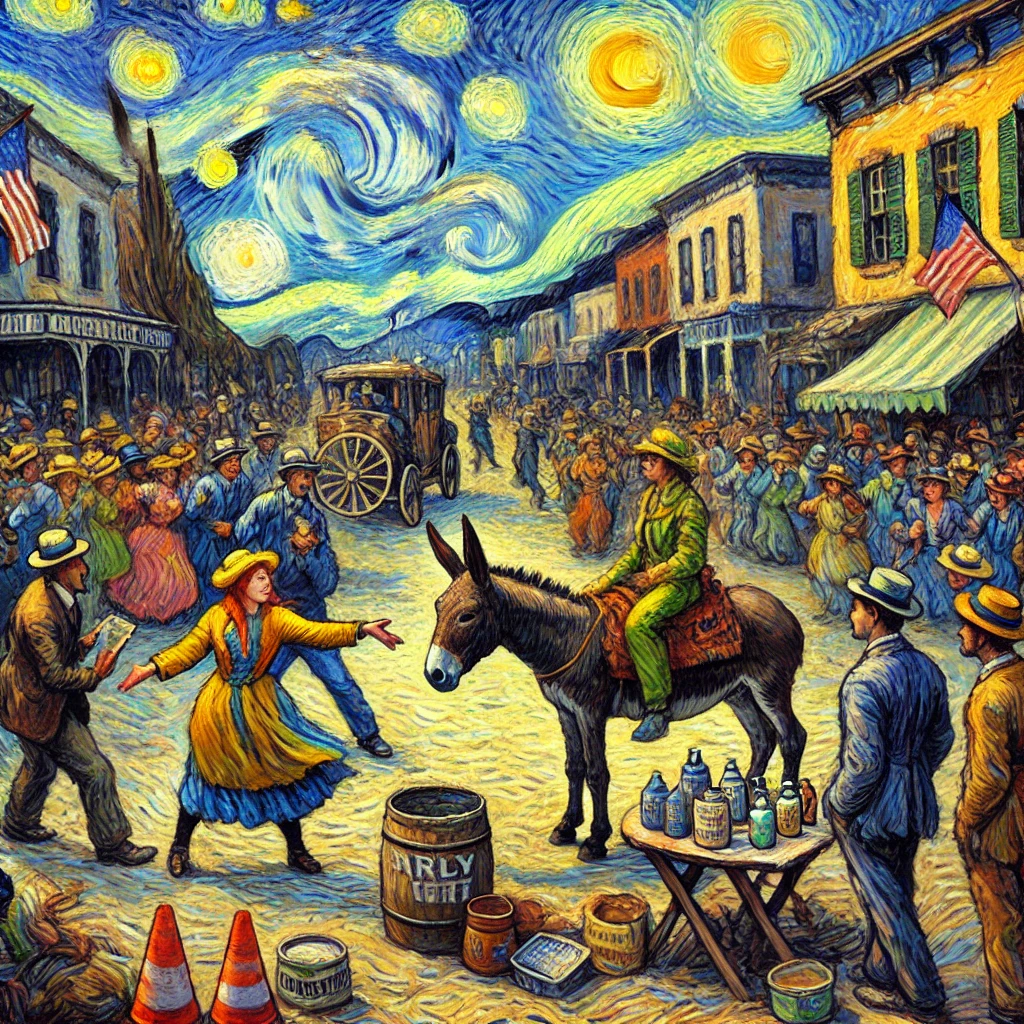
Because Trixie Jo, who had filmed the first five minutes of the obstruction and the best part of Miss Darlene’s facial collapse, uploaded a short video captioned:
DONKEY STOPS PARADE, TOWN REEVALUATES PURPOSE
By eleven twelve, people from three counties away were commenting.
By eleven twenty, somebody had called Clementine “an icon.”
By eleven twenty-five, another person had written, “This donkey understands boundaries better than most governments.”
By eleven thirty, a regional lifestyle account reposted the video with banjo music.
Miss Darlene, upon learning of this, had the specific expression of a woman watching her formal luncheon turn into a yard sale.
“This is not branding,” she said.
Trixie Jo, counting mobile order alerts for new sticker batches, said, “Depends who’s measuring.”
Act III – The Town Divides, Predictably
At Town Hall, the mayor pro tem attempted to convene an emergency advisory session, but nobody wanted to leave the street. That was the problem with live public drama: it produced stronger attendance than any legitimate governing matter in recent memory.
Sheriff Peeler, seeing that persuasion had failed and enforcement would be both difficult and unpopular, chose a fourth route: practical inconvenience.
He approached Emmett again. “How long you planning to stay here?”
Emmett shrugged. “Depends on Clementine.”
“And what does Clementine need?”
Emmett considered. “Respect. Shade. Maybe a cucumber.”
This intelligence was not useless.
Boot fetched shade in the form of a canvas tarp rigged from two poles and a tractor mirror. Mabel Dean procured cucumber slices from the church hospitality cooler. A little girl in patent leather shoes brought a bucket of water and asked politely if Clementine preferred it “with or without ice.”
The donkey drank.
The crowd cooed.
This only strengthened her position.
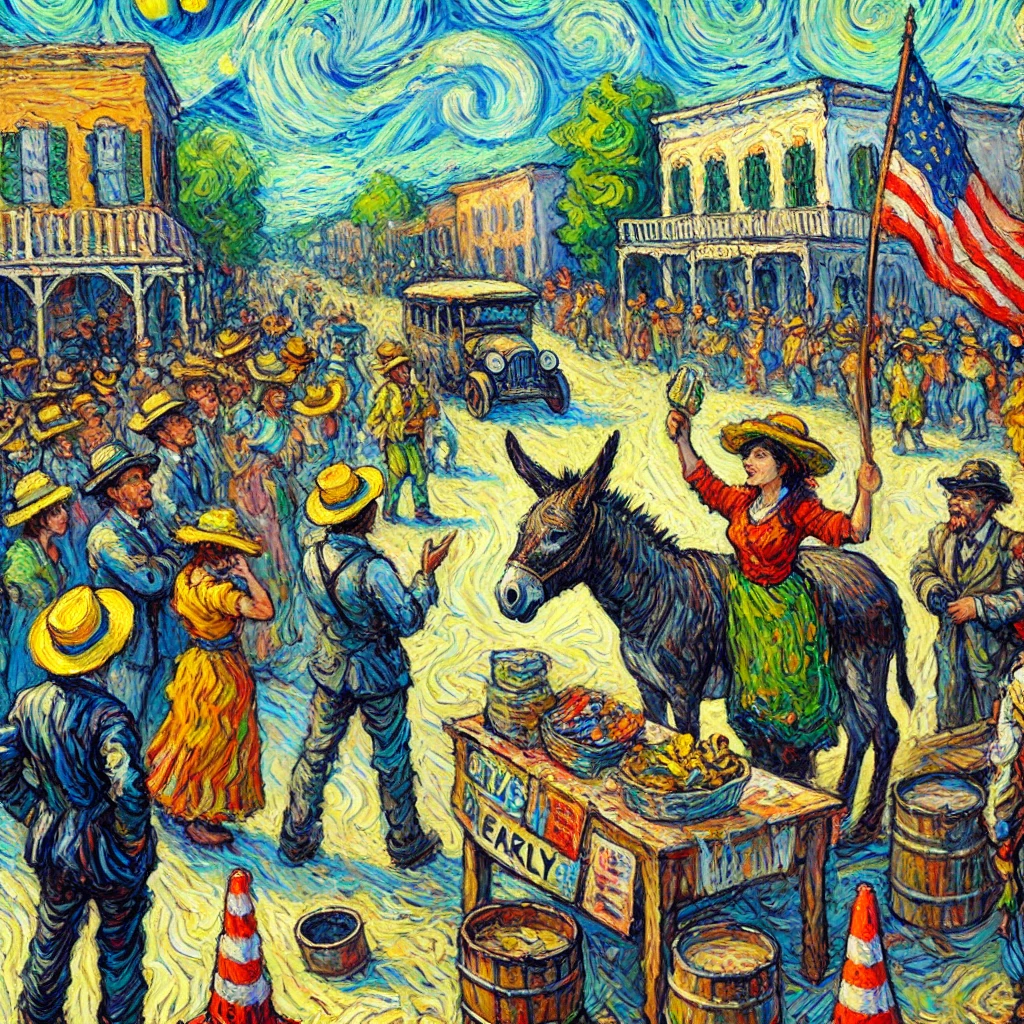
Miss Darlene could bear no more. She climbed onto the flatbed float meant for the quilting guild and seized the portable microphone.
“Attention,” she called, her voice bouncing against storefront glass. “This parade represents the shared heart of this community. We cannot permit one unauthorized animal event to define us.”
There were murmurs.
Then, from somewhere near the curb, a voice called out, “She seems pretty authorized by the street.”
Laughter followed.
Miss Darlene pressed on. “Progress requires participation!”
Emmett tipped back his hat. “We’re participating.”
“Not like this!”
Clementine chose that exact moment to bray.
It was a long, ragged, soul-scraping sound, part trumpet, part rusty gate, part ancient grievance. It rolled across Main Street and bounced off the diner windows and startled the mayor pro tem so badly he nearly sat on a pie.
When it ended, there was a beat of silence.
Then applause.
Not from everyone. But enough.
A terrible thing had happened to Miss Darlene’s parade: the crowd had begun rooting for the obstacle.
Clovis saw the shift first. He stepped beside Sheriff Peeler, eyes narrowed behind his glasses.
“We have entered symbolic territory,” he said.
“I noticed.”
“Once a stoppage acquires metaphor, it’s nearly impossible to disperse.”
“That from experience?”
“From county meetings.”
By noon, unofficial vendors had appeared. Somebody sold feed-store caps reading TEAM CLEMENTINE. A teenager offered hand-drawn postcards of the scene. The diner ran a special called the Stubborn Mule Melt even though everyone knew the central animal was a donkey.
Pastor Gentry, ever flexible where attendance was concerned, began discussing whether the following Sunday’s sermon might be called Blessed Are the Unmovable.
And through it all, Clementine remained where she was, neither angry nor dramatic. She just stood.
It unsettled people. Not because she was violent. Because she was calm. The whole town had been outmaneuvered by stillness.
Act III – The Town Divides, Predictably
Act IV – The Meaning of Motion
By early afternoon, the heat had begun laying a hand on the back of everyone’s neck. The brass instruments had gone silent. The little girls with pageant sashes had lost their smiles and their posture. One of the antique tractors needed a jump. Even Miss Darlene’s hair, which normally could withstand humidity, dissent, and acoustical mishap, had begun to loosen at the edges.
It was around then that old Juney Bell Haskins, who seldom said much at public events but had lived long enough to develop the authority of selective speech, eased herself from a lawn chair in front of the pharmacy and called for quiet.
People listened mostly because she had six children, twenty-two grandchildren, and the kind of stare that had once ended a fistfight behind Vacation Bible School.
“You all are approaching this wrong,” Juney Bell said.
Miss Darlene looked desperate enough to accept wisdom from any direction. “How, exactly, should we be approaching it?”
Juney Bell nodded toward Clementine. “Like she ain’t in a hurry.”
“That is the entire problem,” said Miss Darlene.
“No. The problem is you are.”
The old woman’s voice carried farther than seemed possible.
“You planned a parade about moving forward,” she said, “and the Lord sent you a donkey to ask whether you even know where you’re going.”
Even Clovis stopped writing for a moment.
Juney Bell went on. “This town’s got a bad habit of confusing movement with improvement. Half our trouble comes from folks wanting things to look alive. Donkey ain’t impressed by appearances. That’s why I trust her.”
Now, Juney Bell was not officially affiliated with any side. But once she said that, the mood shifted again—not toward chaos this time, but reflection, which was much rarer and therefore more dangerous.
Boot Barnes took off his cap and scratched his head. “She may have a point.”
Mabel Dean snorted. “Juney Bell always has a point. She just stores them until everybody else gets tired enough to hear them.”
Miss Darlene, trapped between civic pride and the growing realization that she had accidentally staged a philosophical festival, tried one final argument.
Act IV – The Meaning of Motion
“So what are you saying? That we cancel the parade because a donkey made us feel introspective?”
Juney Bell settled back into her chair. “I’m saying you stop trying to drag the day back into the brochure and pay attention to what day you actually got.”
That was the sort of sentence that could only come from age or poetry, and Sequatchie Crossing had little patience for poetry unless it sounded like instructions.
For several minutes nobody said much. Even the children sensed a change, the way children do when adults briefly become honest in public.
Then Boot spoke.
“What if,” he said slowly, “the parade don’t go around the donkey?”
Miss Darlene closed her eyes. “It cannot go through the donkey.”
“No,” Boot said. “I mean what if the parade ends here.”
“That is not a route. That is a failure point.”
“Maybe,” said Mabel Dean, “it’s a destination.”
The words hung there.
Clovis looked appalled, then intrigued, which for him counted as emotional upheaval.
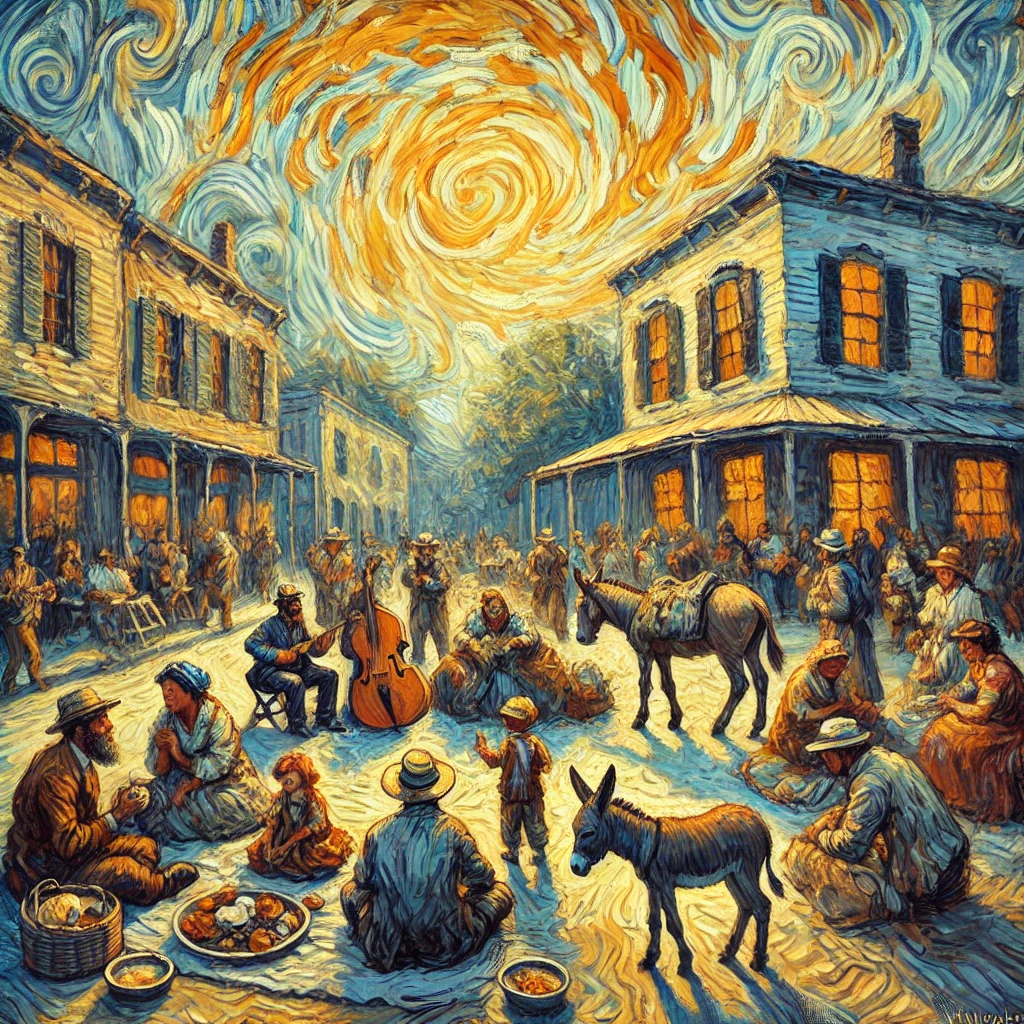
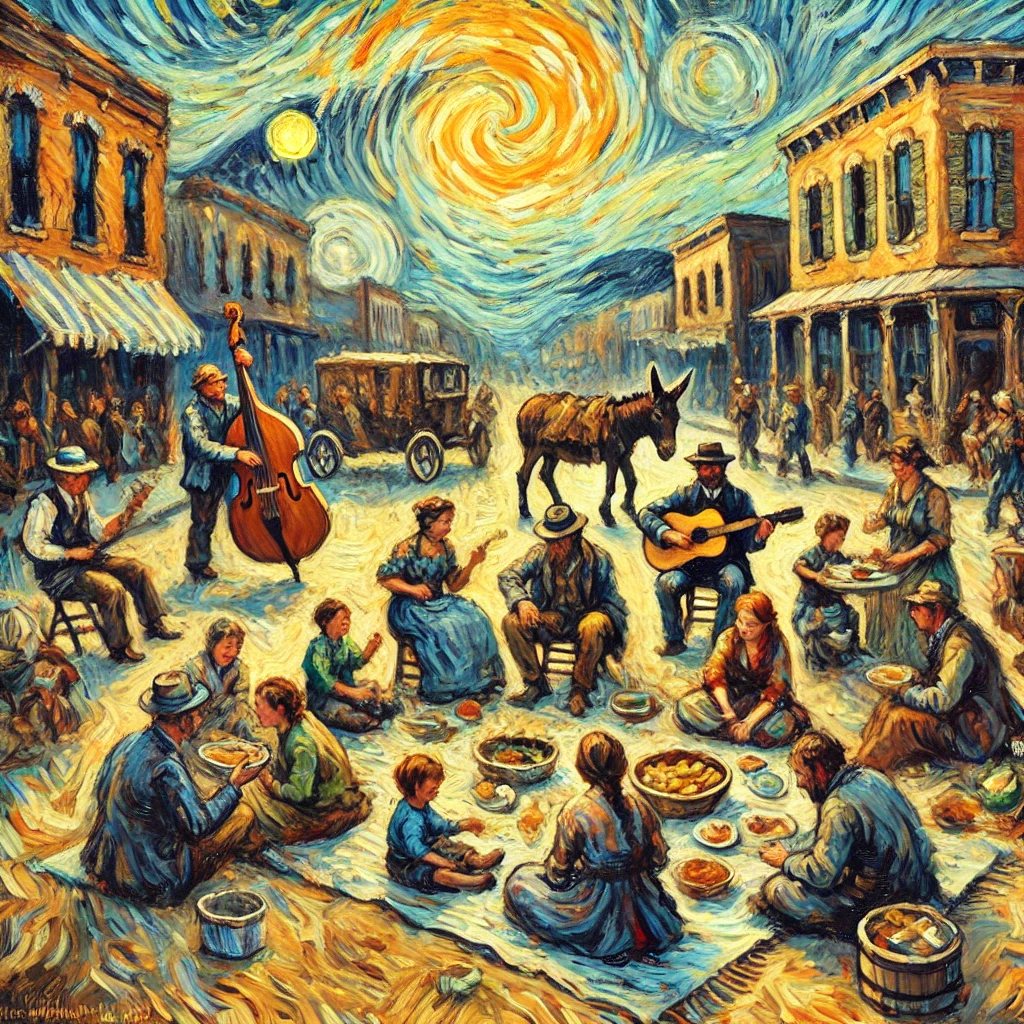
Sheriff Peeler glanced up and down the street: people already gathered, food already open, music idle but available, children parked on curbs, older folks in folding chairs, and in the middle of it all a donkey whose refusal had somehow drawn more of the town together than three months of planning ever had.
He smiled, just barely.
“Well,” he said, “public seems assembled.”
Miss Darlene stared at him. “You cannot possibly be suggesting we convert an obstruction into the event.”
“I believe,” he said carefully, “the public may have already done that.”
And just like that, because no one had enough energy left to oppose it and because the alternative involved admitting total defeat, Sequatchie Crossing did what it always did best: it reclassified the problem as tradition.
The marching band repositioned into a semicircle and played in place.
The quilting guild spread blankets along the sidewalk and called it a heritage exhibit.
The church float dispensed lemonade from the trailer.
Children were invited to march in loops around the square, which made no symbolic sense but did excellent business in terms of delight.
Someone hung a handwritten sign on an orange cone:
FOUNDER’S FORWARD PARADE – CEREMONIAL PAUSE SITE
Trixie Jo took one look and ordered shirts.
By one thirty, what had been a stalled parade had become a street festival centered on Clementine, who appeared untroubled by her accidental promotion to civic landmark.
Emmett accepted this outcome with the serene dignity of a man who had not had to apologize once.
Miss Darlene did not accept it serenely, exactly. But she did, eventually, sit down beneath the awning with a paper plate of barbecue and watch children braid temporary ribbons into Clementine’s mane.
“She’s not even officially part of the theme,” she muttered.
Mabel Dean, beside her, patted her arm. “Honey, she’s the only one who understood the theme.”
That might have stung more if it weren’t so obviously true.
Act IV – The Meaning of Motion
Epilogue – Clementine Day
In the weeks that followed, the town behaved as towns do after a public absurdity: it denied, reframed, embellished, and monetized in overlapping sequence.
The Beautification and Heritage Promotion Committee issued a summary report describing the Founder’s Forward Parade as “an adaptive community celebration centered on spontaneous rural symbolism.” Miss Darlene did not love that sentence, but she signed off on it after the fourth revision because the alternative was reading the social media comments.
Trixie Jo sold out of every Clementine shirt she printed. The best seller featured a donkey silhouette and the slogan:
FORWARD PROGRESS WAS NEGOTIABLE
Boot Barnes claimed he never picked sides, though he kept a photo of Clementine in his truck visor.
Clovis Strickland wrote a twelve-page memo titled Lessons in Civilian Bottleneck Psychology, which nobody officially requested but several people secretly enjoyed.
Pastor Gentry did, in fact, preach Blessed Are the Unmovable, though he softened the political implications by adding extra Scripture and a casserole auction.
Sheriff Peeler, when asked by a reporter from Chattanooga what exactly had happened, simply said, “The town arrived before the parade did.”
As for Clementine, she returned to her field unchanged by fame. That was perhaps the most instructive part. She did not leverage her visibility. She did not seek office. She did not start a line of novelty products. She stood when she wanted, moved when she chose, and seemed no more impressed by public affection than she had been by committee pressure.
Which only increased her legend.
By autumn, someone proposed making the “Ceremonial Pause Site” sign permanent. This idea was defeated, revived, tabled, and finally approved after the local tourism page reported that people were stopping to take photos in the intersection and ask where “the famous donkey event” happened.
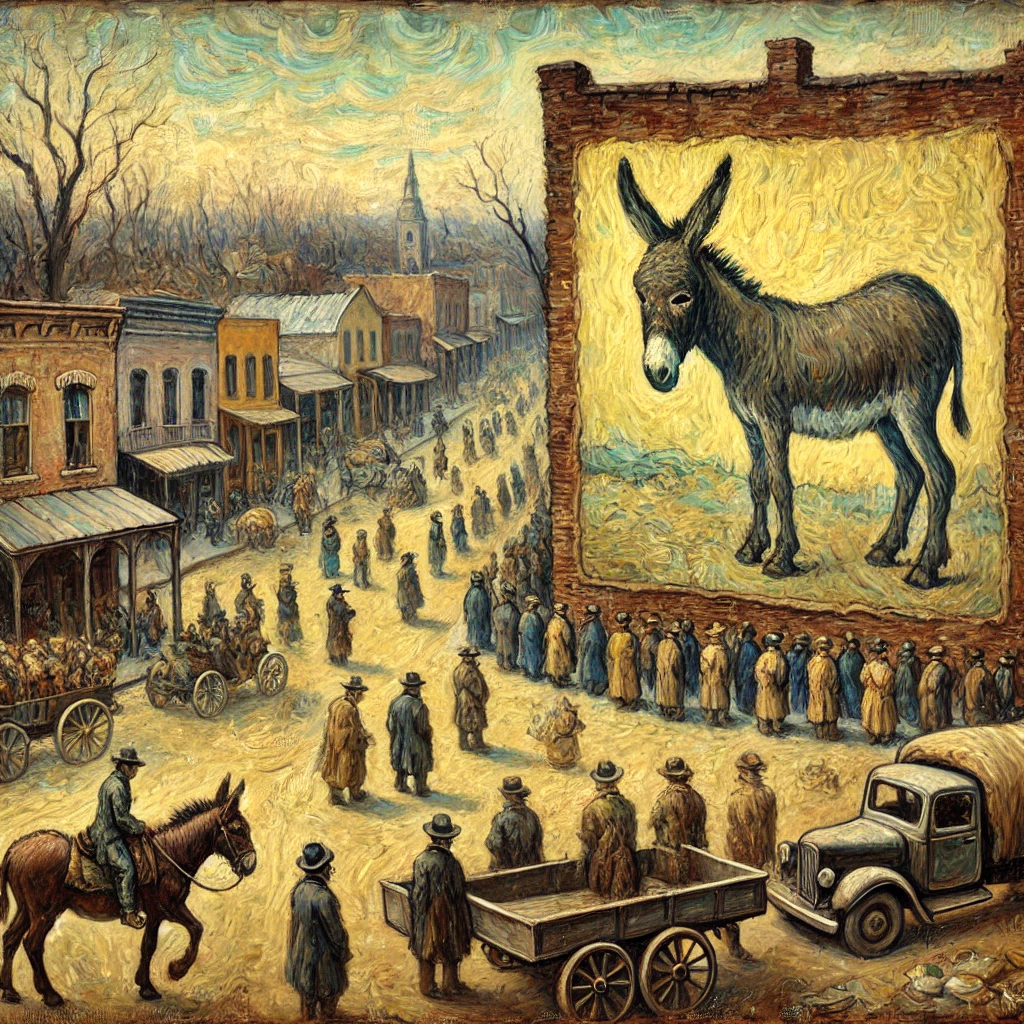
A small mural went up on the side of the old pharmacy. It depicted Clementine broadside across Main Street, surrounded by bunting, brass, and baffled humanity. Miss Darlene objected to the first draft because the artist had made her look “too alarmed,” but the revised version only made her look “resolute under stress,” which was as close to peace as the matter ever got.
And then, because fate enjoys repetition, the next spring the committee held another parade.
This time the official title was shorter. The route was looser. There were fewer speeches. And at the center of the printed program, beneath the schedule and pie competition rules, appeared a line in small respectful font:
In honor of Clementine, all progress remains subject to local conditions.
Nobody argued with that.
Not even Miss Darlene.
Epilogue – Clementine Day
Especially after Emmett, seated two rows back at the planning meeting, lifted one finger and asked in a mild voice, “You all want to borrow the donkey this year?”
The room froze.
Miss Darlene looked up slowly.
Emmett smiled.
“Just kidding,” he said.
The room laughed harder than the joke deserved, which is how relief often sounds in small towns.
On parade day, Clementine was visible only at a distance, standing in her pasture under a sycamore tree, watching the traffic move without urgency. The parade made it through town in under forty minutes. It was tidy, respectable, and widely agreed to be less memorable.
Because the truth, though nobody liked saying it too loud, was that Sequatchie Crossing had not fallen in love with delay.
It had fallen in love with being reminded that a town was not its agenda.
It was its interruptions. Its personalities. Its absurd little standstills that revealed what people valued when the schedule came apart. Anyone could organize a parade on paper. It took a real town to turn a blockage into fellowship, irritation into folklore, and one stubborn donkey into a permanent clause in community memory.
Years later, people still dated things by it.
“That was before Clementine blocked the parade,” they’d say.
Or, “That happened the summer after the donkey taught Town Hall humility.”
The children who had watched from the curb grew up and told the story with additions of their own. In some versions Clementine brayed down a microphone. In others she bowed to the crowd. In one especially dishonest retelling, she kicked over the mayor pro tem’s chair and then accepted a blue ribbon.
But the heart of the story stayed true.
A parade came to celebrate progress.
A donkey asked for a pause.
And for once, Sequatchie Crossing listened.
Epilogue – Clementine Day
Disclaimer
The town of Sequatchie Crossing is fictional, though it bears an uncomfortable resemblance to the way real towns behave when committees, pride, weather, and animals collide in public. Any similarity to actual parades, actual donkeys, actual beautification boards, or actual people who have confused momentum with virtue is entirely part of the American tradition.
No donkeys were consulted during the writing of this account, though several humans behaved as if they had been.
Disclaimer – The Donkey That Blocked a Parade
Real Places Behind the Ruckus – From The Dunlap Directory

Real Places Behind the Ruckus – From The Dunlap Directory
Yes, this story was fictional; even the parts that weren’t true. These places? Absolutely real. Stop by, support local, and keep the Wi-Fi away from livestock:
- TrueBlade Mowing
- Daus Building Supply & Hardware
- Sun Valley Coffee Shop
- Southeast Tennessee Human Resource Agency
- Joyce Houk – LPT Realty
- Cates Street Pharmacy
- Tri-Star Seamless Gutters
- Sequatchie Cove Farm
- Krispy Krunchy Chicken
- Domino’s Pizza
- Roberts Construction
- United Country Southeast Land Solutions
- Time To Improve
- Martinez Mobile Auto Detailing
- American Trust Cash Advance
- Kilgore’s Tilling & Bush-Hogging
Real Places Behind the Ruckus – From The Dunlap Directory
At Sequatchie Crossing, we tell the stories of Sequatchie Crossing.
Please share this post with your friends, family, or business associates who may want follow the news from Sequatchie Crossing.

0 Comments