


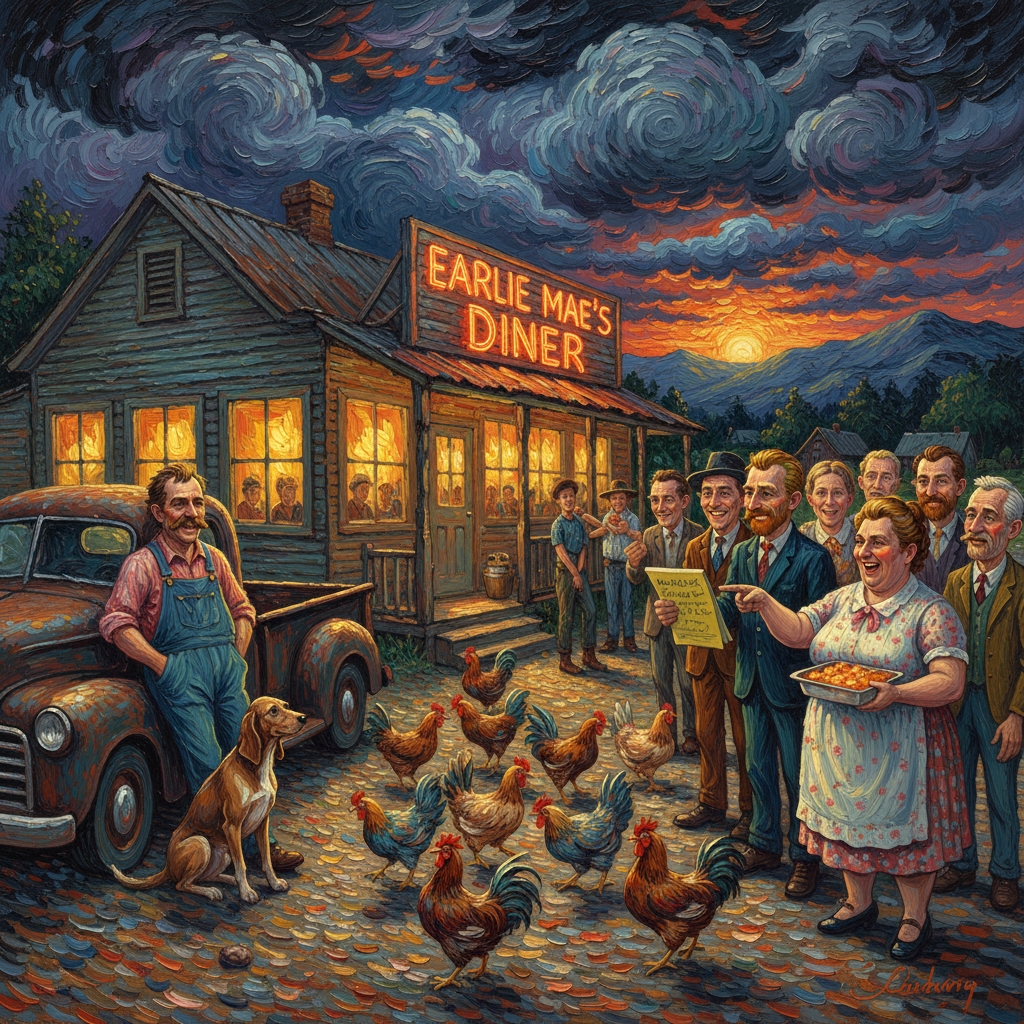
Humor Identified As Acceptable Entry Point for Acknowledgment
By Tom Seest
At Sequatchie Crossing, we tell the stories of Sequatchie Crossing.
Please share this post with your friends, family, or business associates who may want follow the news from Sequatchie Crossing.
🎤 Audio Overview
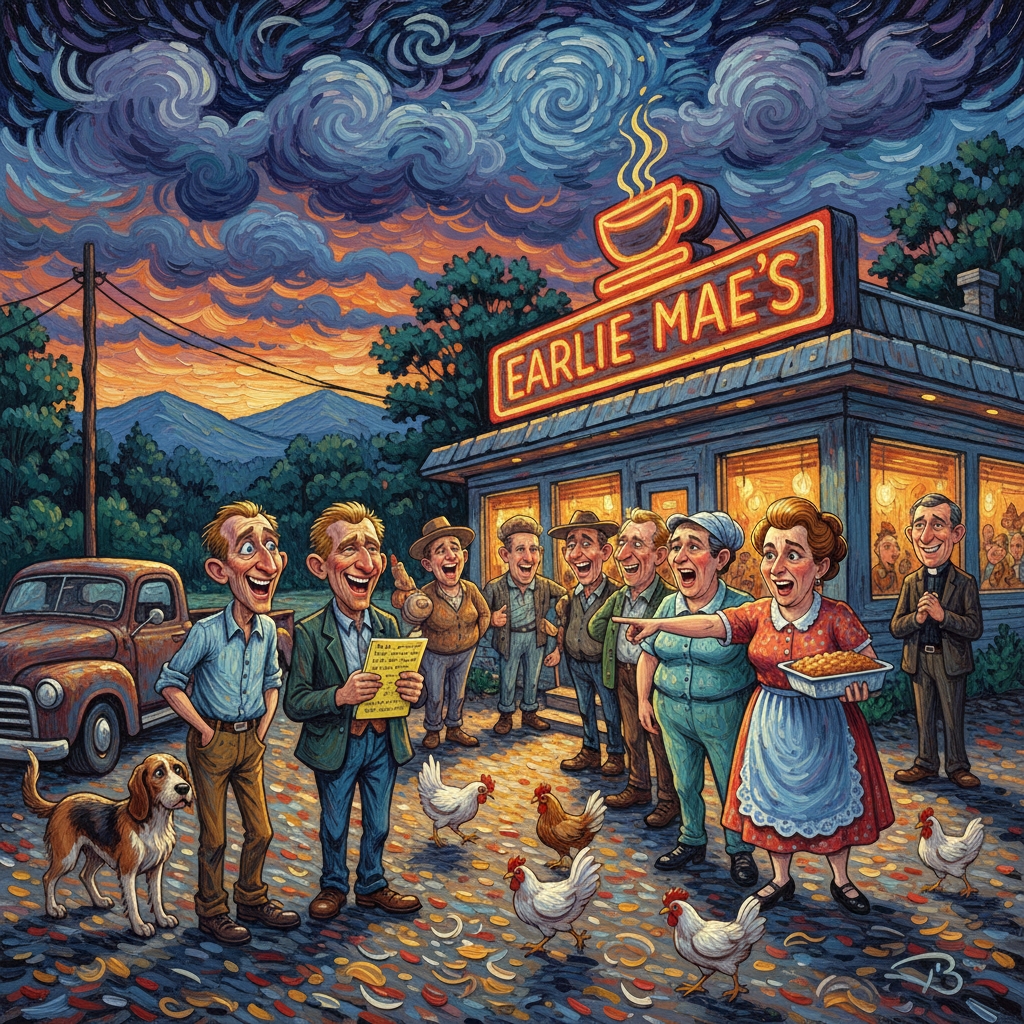
Jokes About Problem Become More Frequent Than Discussions About It
Act I – The First Laugh at Earlie Mae’s
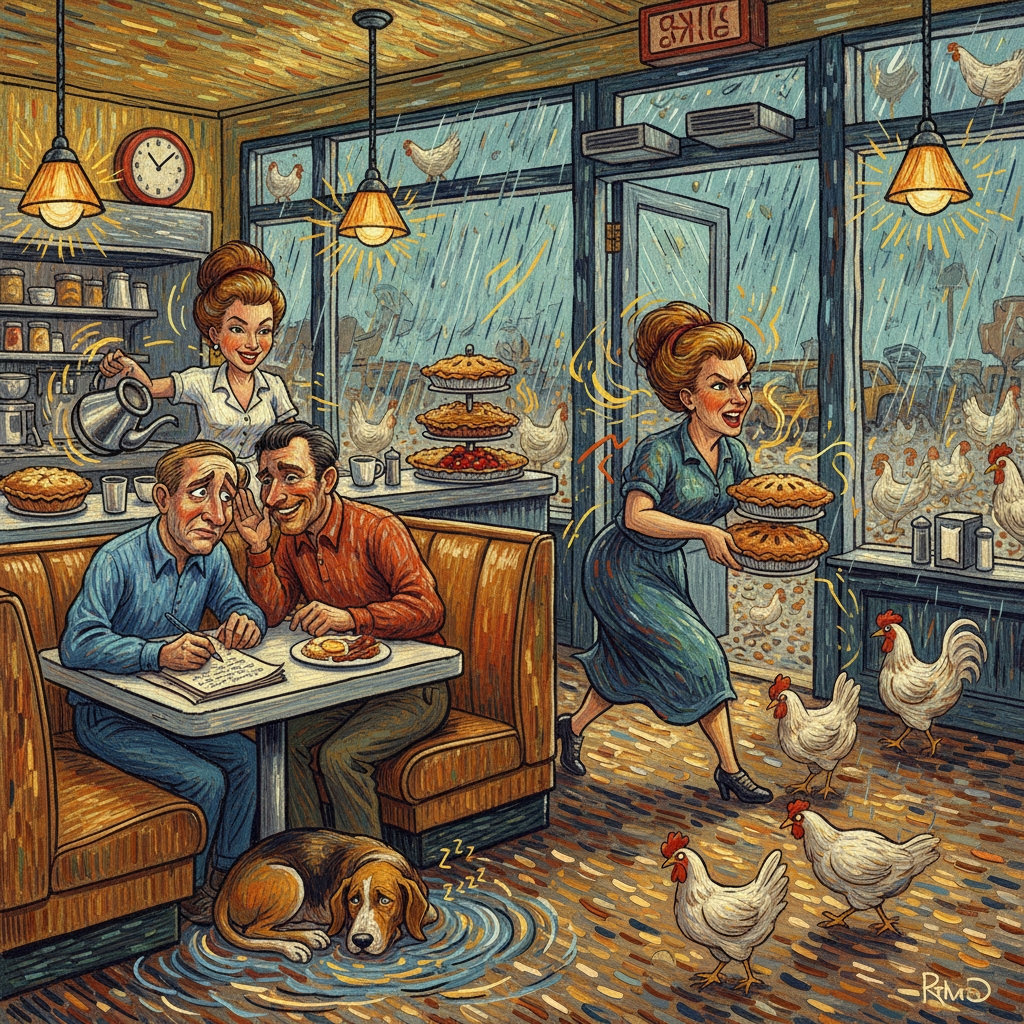
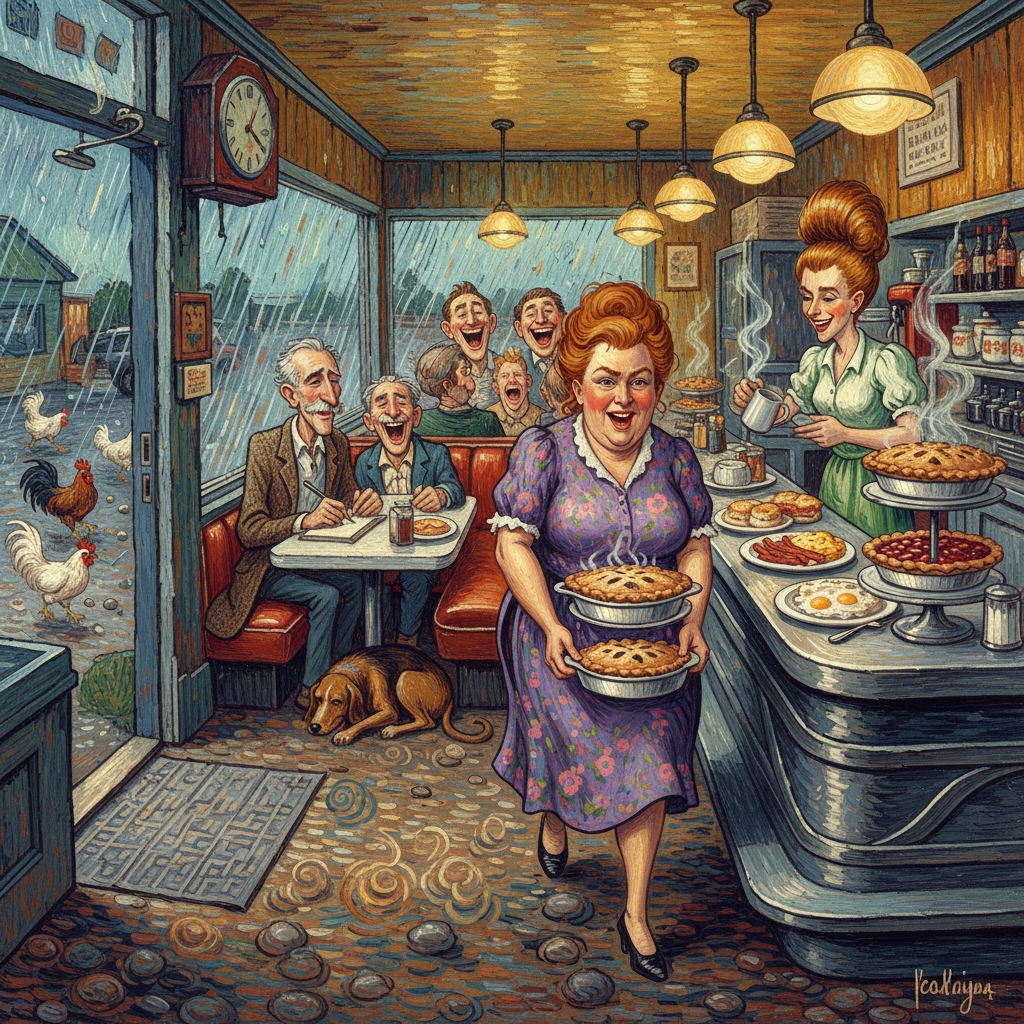
The first joke anybody admitted hearing happened at Earlie Mae’s Diner during the breakfast rush, though later there’d be arguments over whether it had technically been a joke or merely a statement delivered with enough smiling to avoid responsibility.
Boot Barnes sat in the corner booth beneath the faded Coca-Cola clock, stirring coffee he had already forgotten to sweeten. Daisy the hound slept beneath the table with one ear cocked toward the grill. The air smelled like sausage grease, burnt toast, and rain drifting in from the mountain.
Across from Boot, Clovis Strickland had a yellow legal pad open.
“Why’re you writin’ things down again?” Boot asked.
“Patterns,” Clovis said.
“You said that during the raccoon incident.”
“That turned out to be federal.”
“That turned out to be your cousin wearin’ a ghillie suit.”
Clovis ignored him and tapped the pad.
“People repeat themselves before events.”
“Everybody repeats themselves in this town. Half the county still tells stories about coupons from 1998.”
“That’s different repetition.”
At the counter, Trixie Jo Bartlett poured coffee for Mister Wade Langston while Tiffany Annette Roark rearranged pie slices with the seriousness of a museum curator.
Mabel Dean Ashcroft entered carrying three casserole dishes nobody had requested.
The bell above the door jingled.
“Morning,” Trixie Jo called.
Act I – The First Laugh at Earlie Mae’s
“It absolutely is not,” Mabel answered.
Everybody nodded. That was considered fair.
Mabel set the casseroles down and looked around suspiciously.
“What’s wrong with everybody?”
“Nothin’,” Boot said.
“That’s exactly how people act before somethin’.”
Clovis raised a finger.
“See?”
Mabel narrowed her eyes at him.
“You keep documentin’ people and one day somebody’s gonna put you in a museum beside a moonshine still.”
“That’d be an honor.”
At the far end of the counter, Doug “Doughboy” Teeter chuckled into his biscuit.
“What?” Trixie Jo asked.
Doug grinned.
“Nothin’. Just heard another one.”
“Another what?”
“That joke people keep makin’.”
Silence settled across the diner.
Not hostile silence.
Careful silence.
The kind folks used when approaching an electric fence they suspected might still be live.
“What joke?” asked Tiffany.
Doug shrugged.
“You know. About how everybody’s pretendin’ the thing ain’t happenin’ while clearly knowin’ it’s happenin’.”
Boot laughed once.
Then stopped.
“Yeah,” he said quietly. “Heard that one.”
Clovis immediately wrote something down.
Mabel pointed a finger.
“That ain’t a joke.”
Doug raised both hands.
“I didn’t say it was funny.”
“You laughed.”
“People laugh at funerals too.”
“That’s because they panic,” said Mabel.
At another booth, Shelley Fawn Wexler looked up from her laptop.
“What exactly are we all referring to?”
Nobody answered.
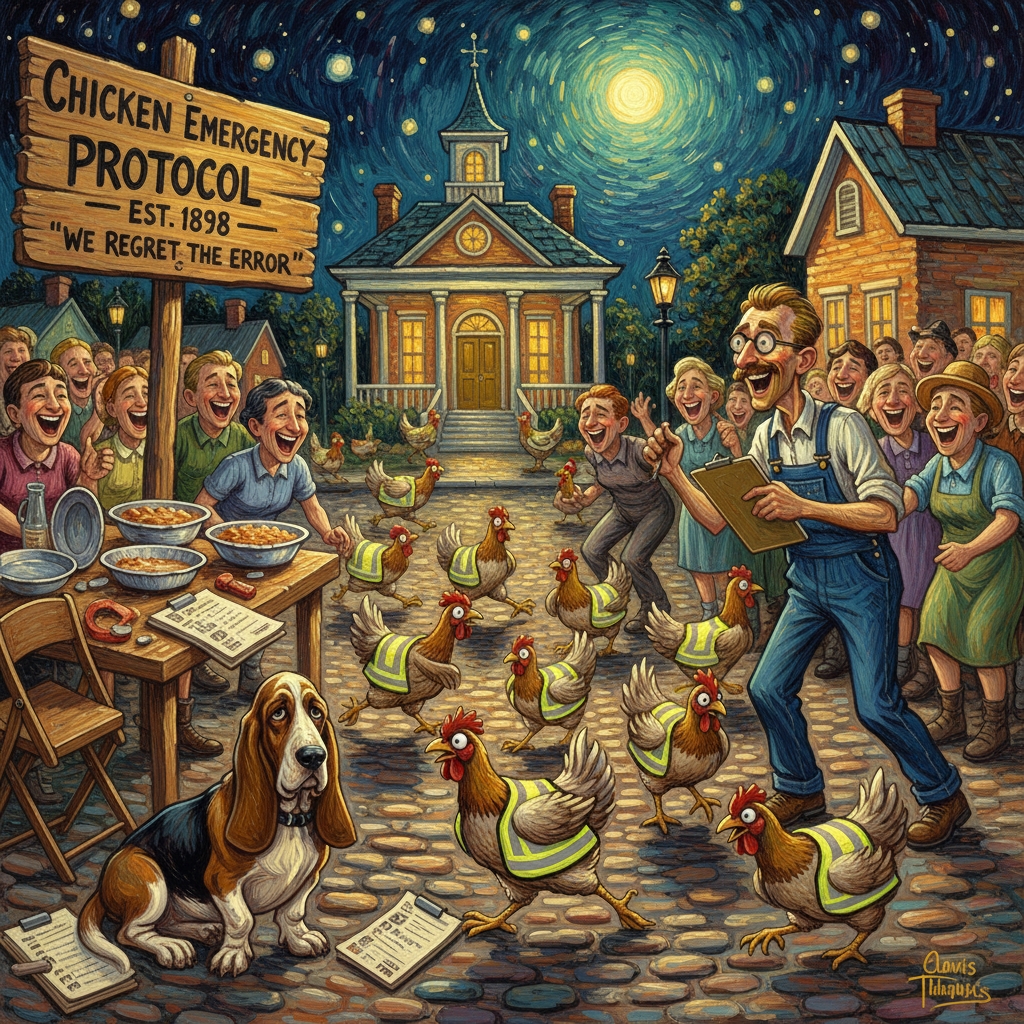
Outside the window, several chickens pecked around near the gravel lot. Chester Ray Blevins had brought them accidentally while delivering church flyers in the back of his truck again.
Pastor Arnold Peeler entered through the front door carrying damp hymnals.
“Morning, everybody.”
“Morning,” the diner muttered.
Pastor Peeler paused.
“You all look like somebody announced termites at a family reunion.”
Doug snorted.
“There’s another one.”
Another laugh rolled through the diner.
Sudden.
Sharp.
Outside, the chickens exploded in every direction, flapping across the parking lot like feathery shrapnel.
Daisy woke barking.
Boot stared toward the window.
Then he laughed again.
But softer this time.
And afterward he looked tired.
Act I – The First Laugh at Earlie Mae’s
Act II – The Porch Committee
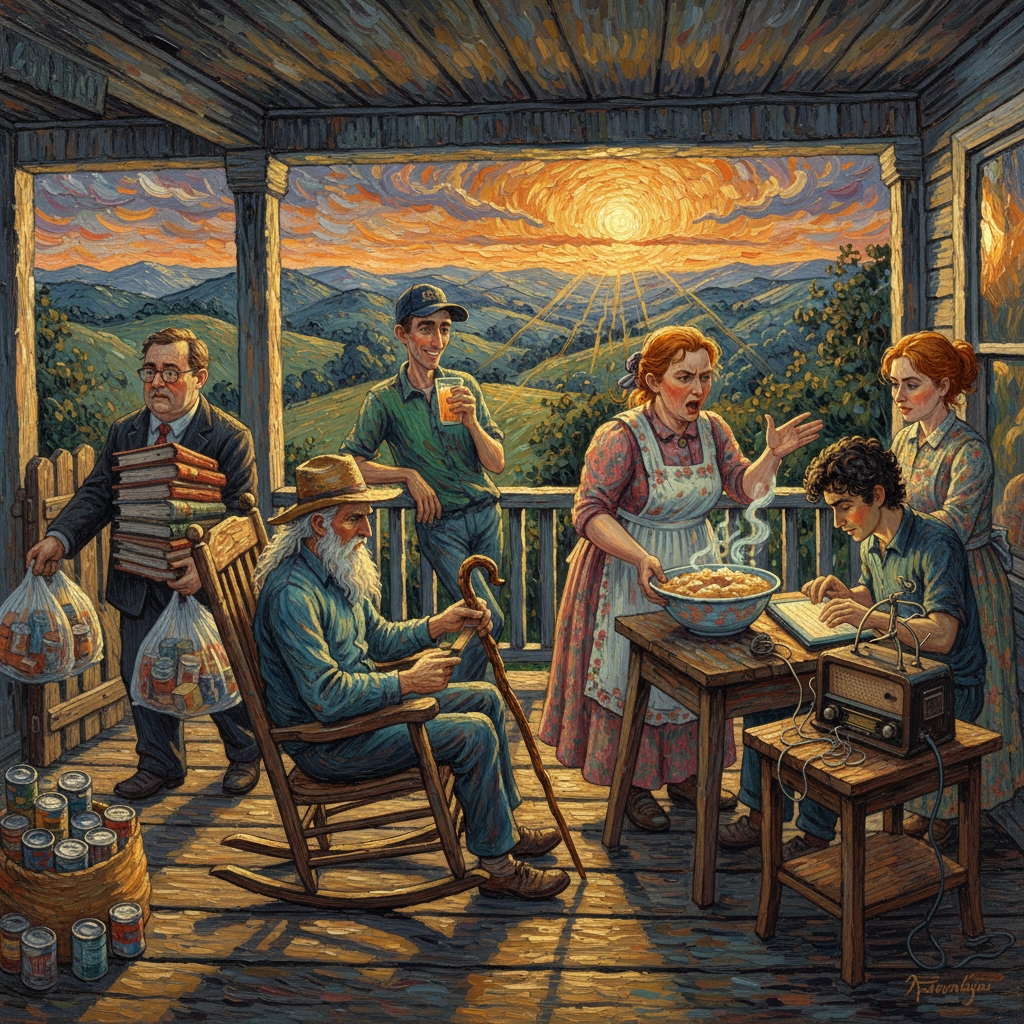
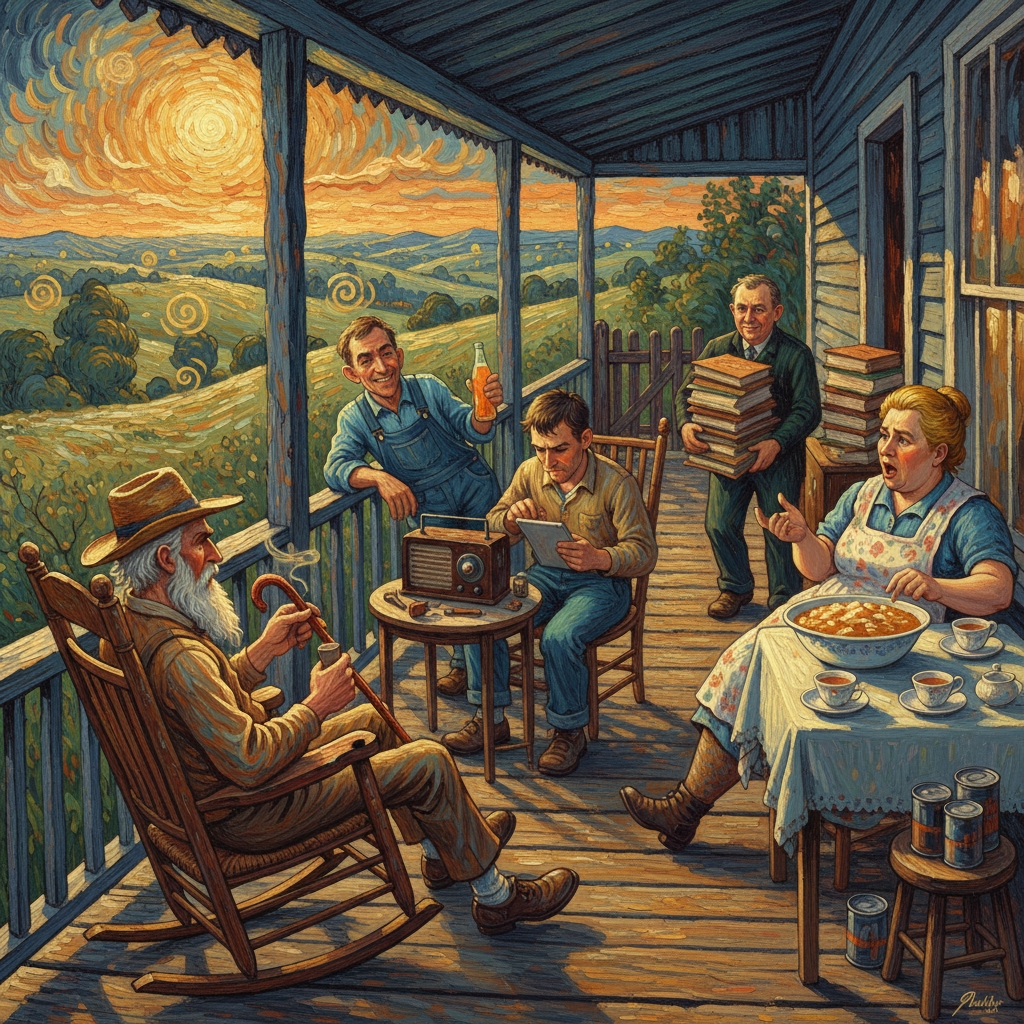
By afternoon the joking had migrated to Mister Wade Langston’s porch, which functioned as an unofficial municipal annex for people unwilling to enter actual government buildings.
Wade sat in a rocking chair sanding a cedar cane he’d been “nearly finishin’” for four years.
RT Mullins leaned against the railing drinking an orange soda while Sonny Morales repaired a radio nobody believed could still receive stations.
Shelley Fawn Wexler typed notes onto a tablet.
“What’re you writin’?” RT asked.
“Community behavioral adaptation.”
“That sounds expensive.”
“It means people are coping sideways.”
Wade nodded slowly.
“That’s accurate.”
Clovis arrived carrying three notebooks.
“Good,” Wade muttered. “Now we got documentation.”
“It’s spreading.”
“What is?” Sonny asked.
“The phrasing.”
RT grinned.
“Oh, I heard one at the feed store.”
Clovis leaned forward eagerly.
“What exactly?”
RT cleared his throat dramatically.
Act II – The Porch Committee
“‘At least if the whole thing collapses, traffic’ll improve.’”
Wade laughed despite himself.
Sonny laughed harder.
Even Shelley smirked.
Then everybody grew quiet again.
“See?” Clovis said. “That pause afterward. That’s the important part.”
“What pause?” RT asked.
“The moment after laughter when folks remember why they laughed.”
Wade rocked slowly.
“Used to be people argued.”
“About the issue?” Shelley asked.
“Nobody says the issue out loud no more.”
“That’s because every discussion turns into six Facebook posts and somebody threatenin’ legal action.”
RT pointed toward town.
“Now people just joke.”
Sonny tightened a bolt on the radio.
“Humor’s safer.”
“Safer than what?” asked Shelley.
“Admittin’ fear.”
The porch fell still.
Even Clovis stopped writing.
Mabel Dean climbed the steps carrying banana pudding in a glass dish.
“Who brought fear into this conversation?”
“Nobody,” RT said too fast.
“That’s worse.”
Mabel sat heavily.
“You know what worries me?”
“Naturally,” Wade replied.
“People are startin’ to smile before sayin’ terrible things.”
Shelley blinked.
“That’s… strangely precise.”
“Because they think if they grin first, it becomes socially acceptable.”
RT shrugged.
“Maybe it does.”
“No,” Mabel said. “It becomes survivable.”
Pastor Peeler appeared at the gate carrying a sack of canned goods for the church pantry.
“What’s survivable?”
“Modern conversation,” Wade said.
Pastor Peeler smiled knowingly.
“That bad?”
“That funny,” RT corrected.
Another ripple of laughter moved through the porch.
Again it faded too quickly.
Pastor Peeler noticed.
But didn’t correct anybody.
Instead he simply sat down and asked:
“So what’s today’s joke?”
Act II – The Porch Committee
Act III – Town Hall Introduces Informal Humor Buffer
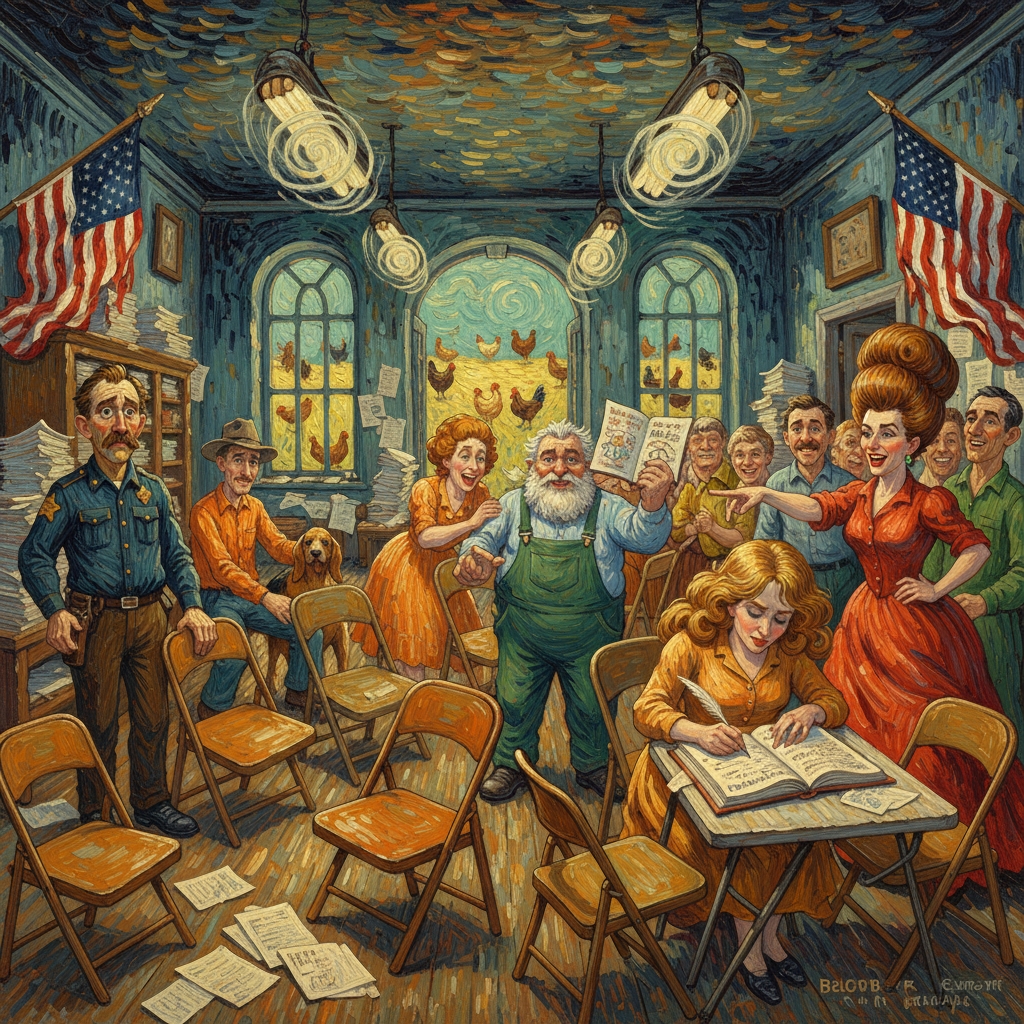
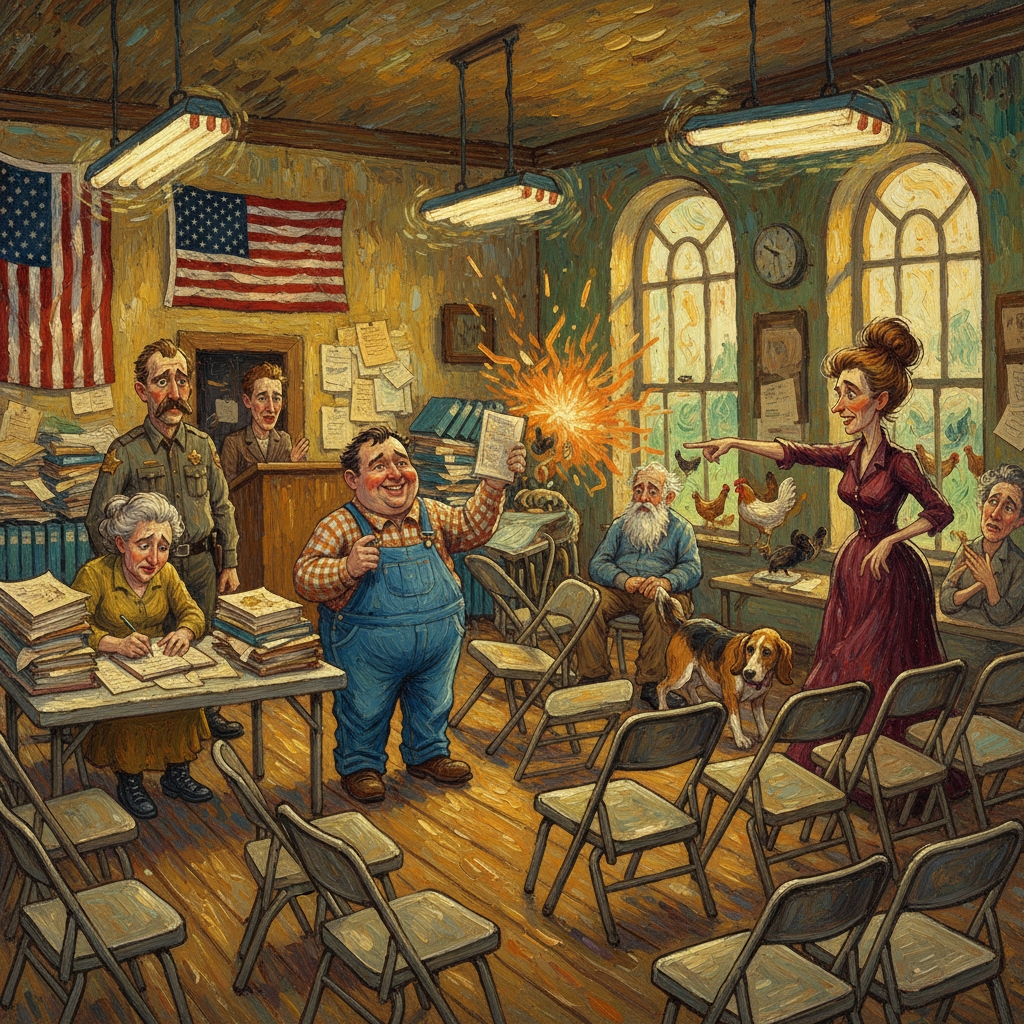
Town Hall smelled faintly of mildew, printer toner, and unresolved arguments.
Officer Kenny Joe Teeter stood near the entrance directing folding chairs into approximate rows while Evelyn Grace Tipton organized attendance sheets nobody would sign legibly.
The meeting topic had technically been listed as “General Community Clarifications,” which everybody understood meant nobody wanted to state the real topic publicly.
Boot sat near the back beside Daisy.
Coach Freddie Stubblefield leaned against the wall eating peanuts from a paper sack.
Trixie Jo whispered to Tiffany:
“This room got the emotional atmosphere of a waiting room before a colonoscopy.”
Tiffany covered her mouth trying not to laugh.
Sheriff Peeler entered with measured caution.
“Evenin’.”
“Evenin’,” came the reply.
Mabel Dean stood immediately.
“Before we start, I’d like it noted people are disguisin’ concern as comedy.”
Evelyn Grace paused with her pen.
“How would you like me to phrase that in the minutes?”
“Exactly like I said it.”
“That’s too honest for municipal documentation.”
Clovis raised a notebook.
“I’ve collected thirty-seven recurring jokes in the last week.”
“Thirty-seven?” Shelley asked.
“Thirty-eight if you count passive-aggressive casserole labeling.”
Mabel folded her arms.
“That casserole was appropriately labeled.”
Act III – Town Hall Introduces Informal Humor Buffer
“What’d it say?” asked Coach Freddie.
“‘For people pretendin’ everythin’s normal.’”
The room erupted laughing.
Outside, another cluster of chickens scattered across the courthouse lawn in alarm.
Officer Kenny Joe looked toward the window.
“Those birds got anxiety.”
“So does the county,” said Wade.
Sheriff Peeler rubbed his forehead.
“Can somebody explain why everybody’s suddenly makin’ jokes instead of complaints?”
Sonny answered first.
“Complaints require positions.”
“And jokes?” asked Shelley.
“Jokes allow retreat.”
The room quieted.
Pastor Peeler smiled gently.
“That’s true.”
Mabel pointed accusingly.
“You stop smilin’ like that.”
“Like what?”
“Like you understand somethin’ the rest of us don’t.”
Pastor Peeler folded his hands.
“I think folks use humor when truth becomes too heavy to carry directly.”
Coach Freddie tossed a peanut into his mouth.
“So instead of sayin’ ‘I’m worried,’ people say, ‘Well at least the apocalypse improved parkin’.’”
“Exactly,” said Shelley.
Boot chuckled.
Then paused again.
Daisy lifted her head and looked at him.
Sheriff Peeler noticed.
“You alright, Boot?”
“Yeah.”
“You don’t sound convinced.”
Boot leaned back.
“I think people know somethin’s wrong. They just don’t trust the room enough to say it plain.”
Nobody disagreed.
That was the disturbing part.
Not even Clovis wrote anything down for several seconds.
Finally RT raised his hand.
“I got another one.”
“Lord help us,” muttered Mabel.
RT grinned.
“‘This town don’t need therapy. We got biscuits and sarcasm.’”
Laughter exploded through Town Hall.
Even Evelyn Grace laughed hard enough to lose her pen.
Then the room settled into another long, thoughtful silence.
The kind where everybody suddenly recognized themselves.
Act III – Town Hall Introduces Informal Humor Buffer
Act IV – Revival Night at Mercy Ridge Church
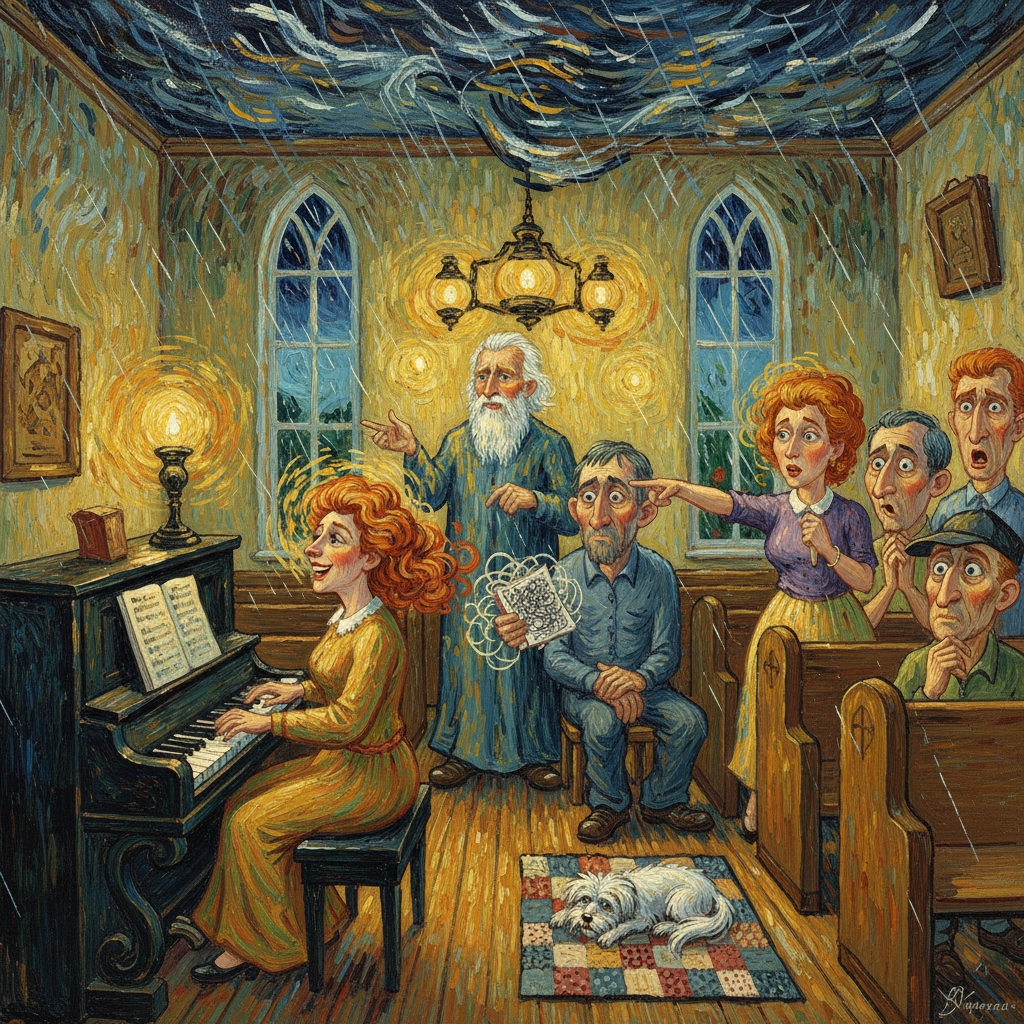
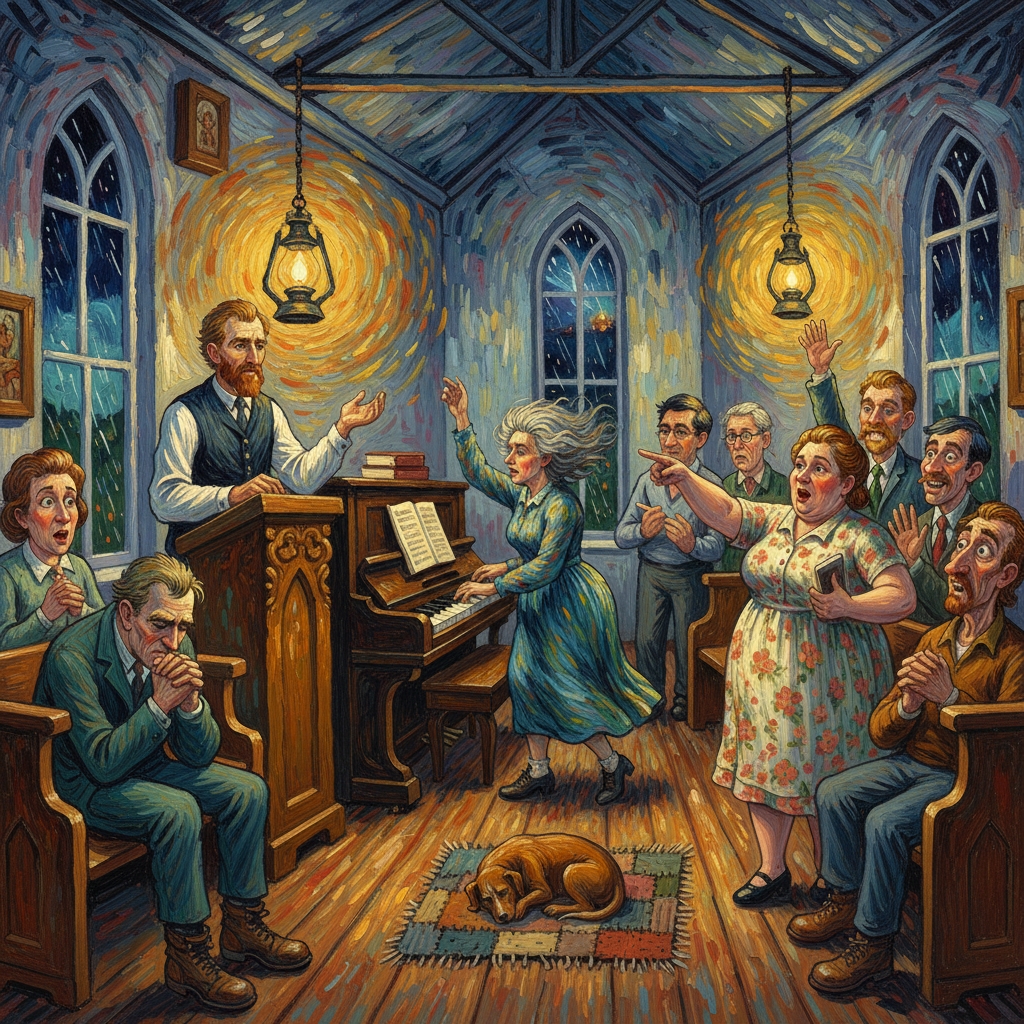
Mercy Ridge Fellowship filled slowly beneath flickering fluorescent lights while rain rattled the metal roof.
Sister Lila Mae “Hallelujah” Pruitt played piano with enough force to qualify as structural testing.
Pastor Peeler arranged sermon notes he had no intention of following.
Mabel Dean supervised the fellowship table like an armed checkpoint.
Boot sat beside Wade in the third pew while Clovis distributed peppermints nobody had requested.
“You documenting church too?” Wade whispered.
“Human behavior doesn’t pause for salvation.”
“That sentence alone should get you investigated.”
Choir practice dissolved into scattered conversation before service officially began.
Trixie Jo leaned toward Tiffany.
“You hear the new one?”
“There’s always a new one.”
“‘The town ain’t avoidin’ the problem. We’re just givin’ it privacy.’”
Tiffany laughed so hard she snorted.
Nearby, Shelley covered her face.
“Oh no. I laughed at that immediately.”
“That means it’s true,” said Sonny quietly.
Pastor Peeler stepped to the pulpit.
“Evenin’, church family.”
“Evenin’.”
“I had prepared remarks tonight.”
The congregation groaned knowingly.
Act IV – Revival Night at Mercy Ridge Church
“But I don’t believe the Lord’s interested in prepared remarks this evenin’.”
Mabel muttered, “Here we go.”
Pastor Peeler smiled.
“I’ve noticed somethin’ lately.”
Clovis uncapped a pen.
“People keep jokin’ about matters they refuse to discuss directly.”
A murmur swept through the sanctuary.
Coach Freddie whispered:
“He’s addressin’ it.”
“No,” said Wade. “He’s circlin’ it politely.”
Pastor Peeler rested his hands on the pulpit.
“When people are afraid to carry truth openly, they often smuggle it inside humor.”
Silence.
Then Sister Lila Mae unexpectedly shouted:
“Hallelujah, that’s accurate.”
Several people laughed reflexively.
Pastor Peeler nodded.
“There now. See?”
Mabel stood halfway up.
“That ain’t a joke.”
“No ma’am,” Pastor Peeler agreed gently. “It isn’t.”
The room settled.
Rain hammered the roof harder.
Boot stared at the floor.
“You know,” he said quietly, “sometimes laughin’s easier than admittin’ you’re tired.”
Heads turned toward him.
Boot rarely volunteered emotional honesty.
“It’s easier to say somethin’ funny than somethin’ true,” he continued. “Funny don’t obligate nobody.”
Clovis stopped writing.
Even Daisy, stretched near the aisle, lifted her head.
Pastor Peeler looked at Boot carefully.
“And truth does?”
Boot nodded once.
“Truth asks follow-up questions.”
Nobody laughed at that one.
Which somehow made it the heaviest statement of the night.
Act IV – Revival Night at Mercy Ridge Church
Act V – The Feed Store Phrase Collection
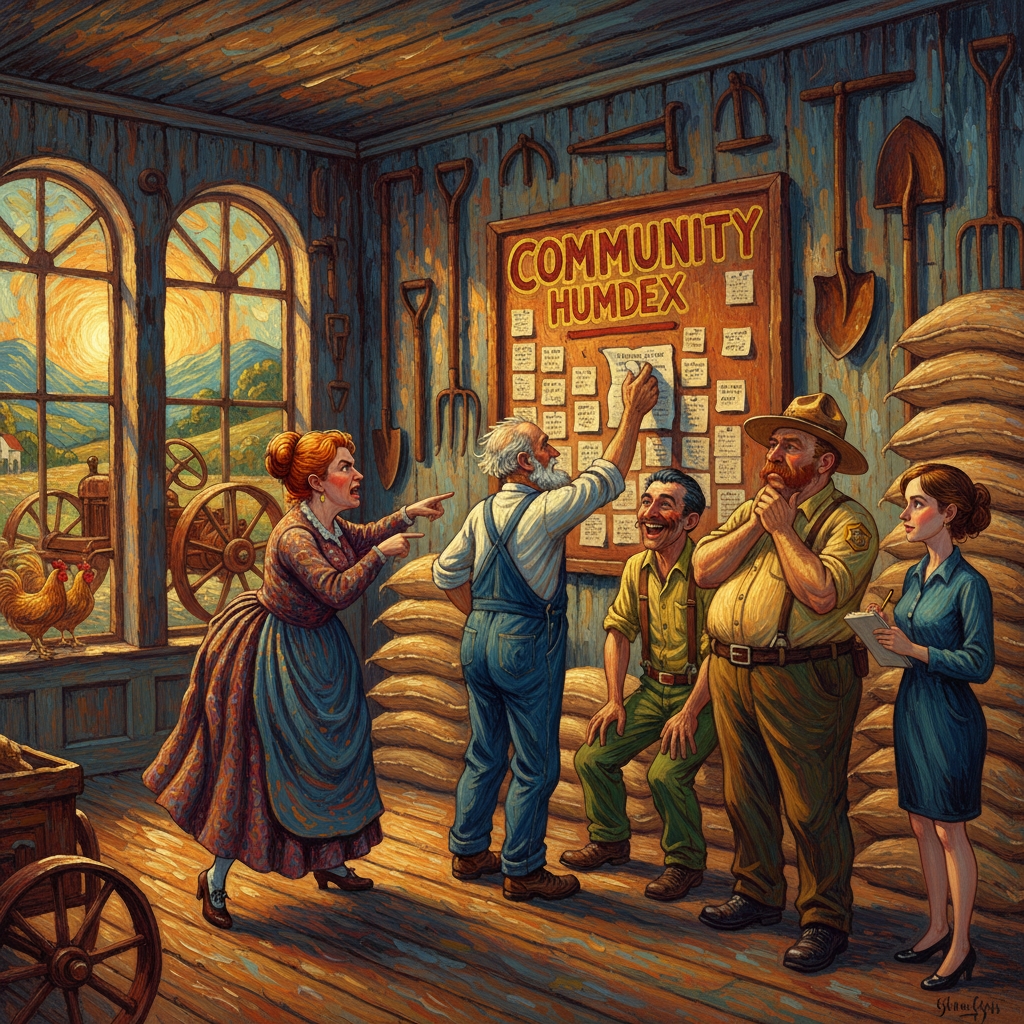
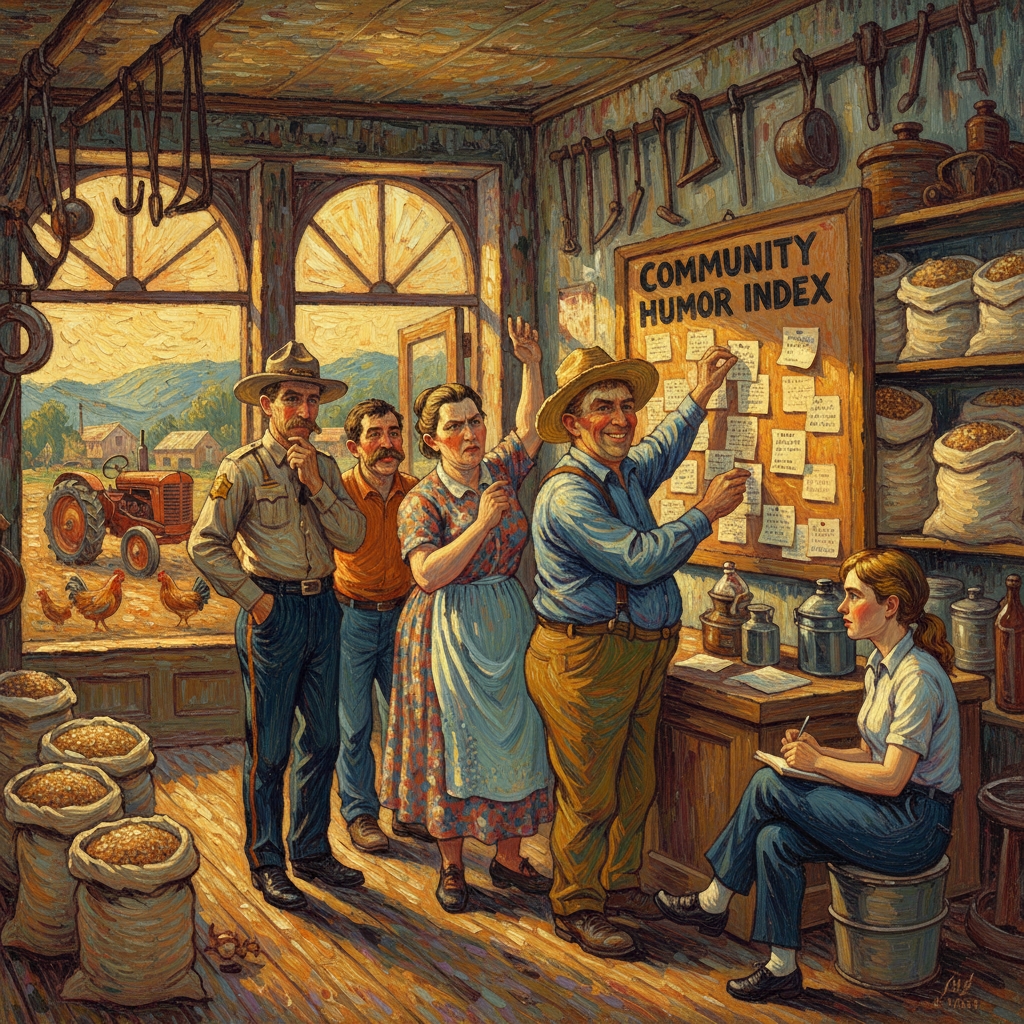
By Thursday, Clovis had transformed the feed store bulletin board into what he called “The Community Humor Index.”
Nobody approved it.
Nobody stopped him either.
Pinned to the corkboard were handwritten jokes collected from around town.
Mabel Dean arrived first and gasped like she’d discovered criminal evidence.
“You cannot archive sarcasm.”
“It’s anthropology,” Clovis argued.
“It’s emotional trespassin’.”
RT read one aloud:
“‘If denial burned calories, this county’d disappear.’”
Sonny laughed into a sack of seed corn.
Coach Freddie slapped the counter.
“That’s strong.”
Mabel glared.
“You people are encouragin’ this.”
Shelley studied the board thoughtfully.
“This is fascinating.”
“No it ain’t,” Mabel snapped.
“It genuinely is. Humor’s becoming a communal signaling system.”
Act V – The Feed Store Phrase Collection
“What’s that mean in English?” asked Doughboy.
“It means people are using jokes to identify who understands the situation without requiring direct confrontation.”
Doughboy blinked.
“So… secret emotional passwords?”
“Yes.”
“That’s actually kinda beautiful.”
Mabel groaned loudly.
Outside, Chester Ray’s chickens wandered beneath a rusted tractor display.
Sheriff Peeler entered carrying fencing supplies.
“What in the world is this?”
Clovis straightened proudly.
“Public morale documentation.”
Sheriff Peeler scanned the board.
Then he read one silently.
And laughed despite himself.
Boot noticed immediately.
“There it is.”
“What?”
“That pause after laughin’.”
Sheriff Peeler sighed.
“Yeah.”
The room softened.
Not dramatically.
Just enough.
Enough to admit mutual recognition.
Enough to stop pretending everyone existed in separate emotional universes.
Maggie Sue Dillard entered carrying two jars of preserves.
“What’s everybody starin’ at?”
“The truth,” Wade replied.
“Pinned to corkboard?”
“That’s government-approved presentation format around here.”
Maggie Sue read several phrases.
Then she laughed.
Then she frowned.
“Oh.”
Clovis pointed enthusiastically.
“Exactly! That reaction right there.”
“What reaction?”
“The realization after the humor lands.”
Mabel folded her arms.
“Humor’s become a bridge.”
Shelley looked surprised.
“That’s actually profound.”
“I’m old, not decorative.”
Pastor Peeler entered quietly.
He studied the board for nearly a minute.
Then he said:
“You know why parables work?”
Nobody answered.
“Because people can approach difficult truths sideways long before they’re ready to walk straight toward them.”
The feed store fell silent.
Outside, one chicken suddenly flapped into another and the entire flock exploded into panicked motion again.
The room burst laughing.
Even Mabel.
Though she immediately pointed afterward.
“That still ain’t funny.”
Act V – The Feed Store Phrase Collection
Act VI – Sheriff’s Office Complaint Intake
The sheriff’s office had accidentally become the county’s primary emotional processing center.
Not intentionally.
Mostly because people trusted the coffee there more than the counseling available through insurance.
Officer Kenny Joe Teeter sat behind the front desk eating cheese crackers while Sheriff Peeler sorted paperwork with visible resentment.
Boot occupied the visitor chair.
Daisy snored beside the radiator.
“What exactly are y’all reportin’ today?” Kenny Joe asked.
“Atmosphere,” said Wade.
“That ain’t a legal category.”
“It should be.”
Clovis spread notebooks across the desk.
“I’ve identified seventy-two recurring humor phrases.”
Sheriff Peeler rubbed his temples.
“Clovis, I’m beggin’ you to stop collectin’ jokes like forensic evidence.”
“They reveal social adaptation.”
“They reveal boredom.”
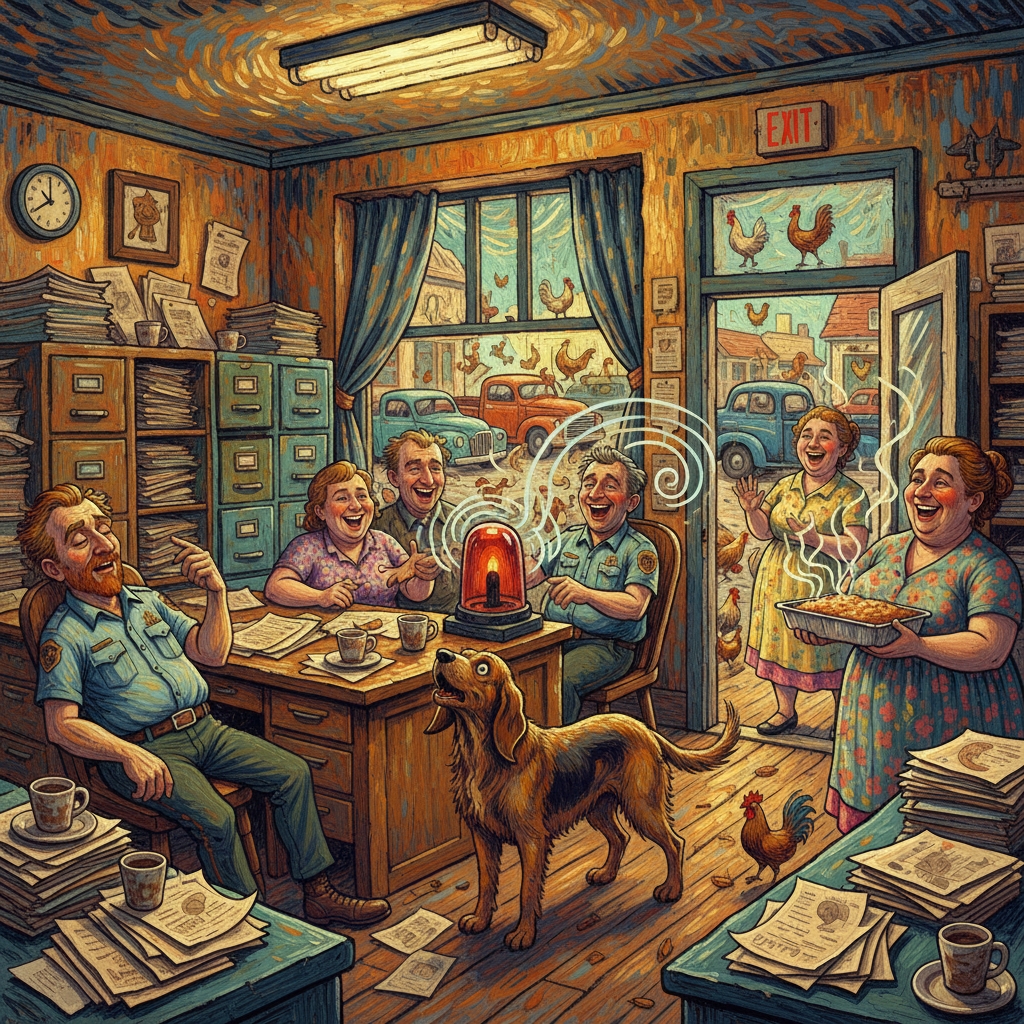
Mabel Dean entered carrying a foil-covered casserole.
“I brought food.”
Act VI – Sheriff’s Office Complaint Intake
“For us?” Kenny Joe asked hopefully.
“For whoever finally admits what everybody’s worried about.”
Kenny Joe leaned back.
“Well that narrows it down to literally everybody.”
Trixie Jo laughed from the hallway.
Then stopped herself.
“There it is again,” Boot muttered.
“What?” she asked.
“That little moment after.”
Shelley entered with Tiffany and Sonny.
“I’ve been thinking about this.”
“That’s dangerous,” RT warned.
Shelley ignored him.
“Humor’s acting like emotional scaffolding.”
“Still not English,” said Doughboy.
“It’s temporary support while people figure out how to stand near uncomfortable truths.”
Pastor Peeler nodded approvingly.
“That’s excellent.”
Mabel sighed.
“Wonderful. We’ve become a sociology documentary.”
Sheriff Peeler leaned back in his chair.
“You know what bothers me?”
Everybody looked at him.
“We’ve actually started understandin’ each other more through jokes than arguments.”
Nobody answered immediately because that sounded dangerously accurate.
Finally Boot spoke.
“Arguments require winners.”
“And jokes?” asked Tiffany.
“Jokes let everybody lose together.”
Silence settled across the office.
Not sad silence.
Relieved silence.
Like folks had finally located the edge of the thing they’d been circling for weeks.
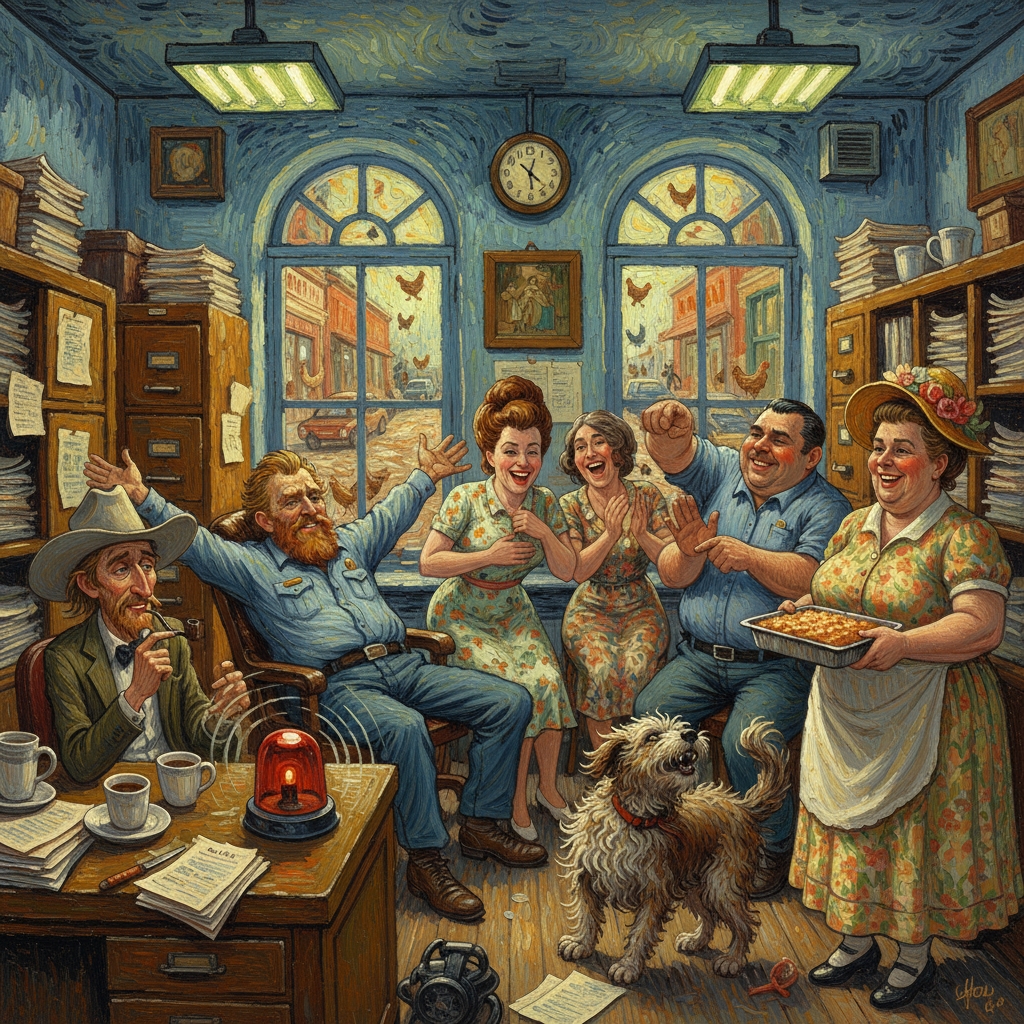
Then Kenny Joe accidentally leaned on the emergency siren button.
A deafening blast erupted through the office.
Outside, chickens exploded across Main Street in absolute terror.
Daisy howled.
Everybody screamed.
Then everybody laughed so hard Sheriff Peeler nearly fell out of his chair.
And afterward—
That pause again.
That quiet recognition beneath the laughter.
That shared understanding no official meeting had ever managed to produce.
Act VI – Sheriff’s Office Complaint Intake
Act VII – The Porch Gathering Becomes Officially Unofficial
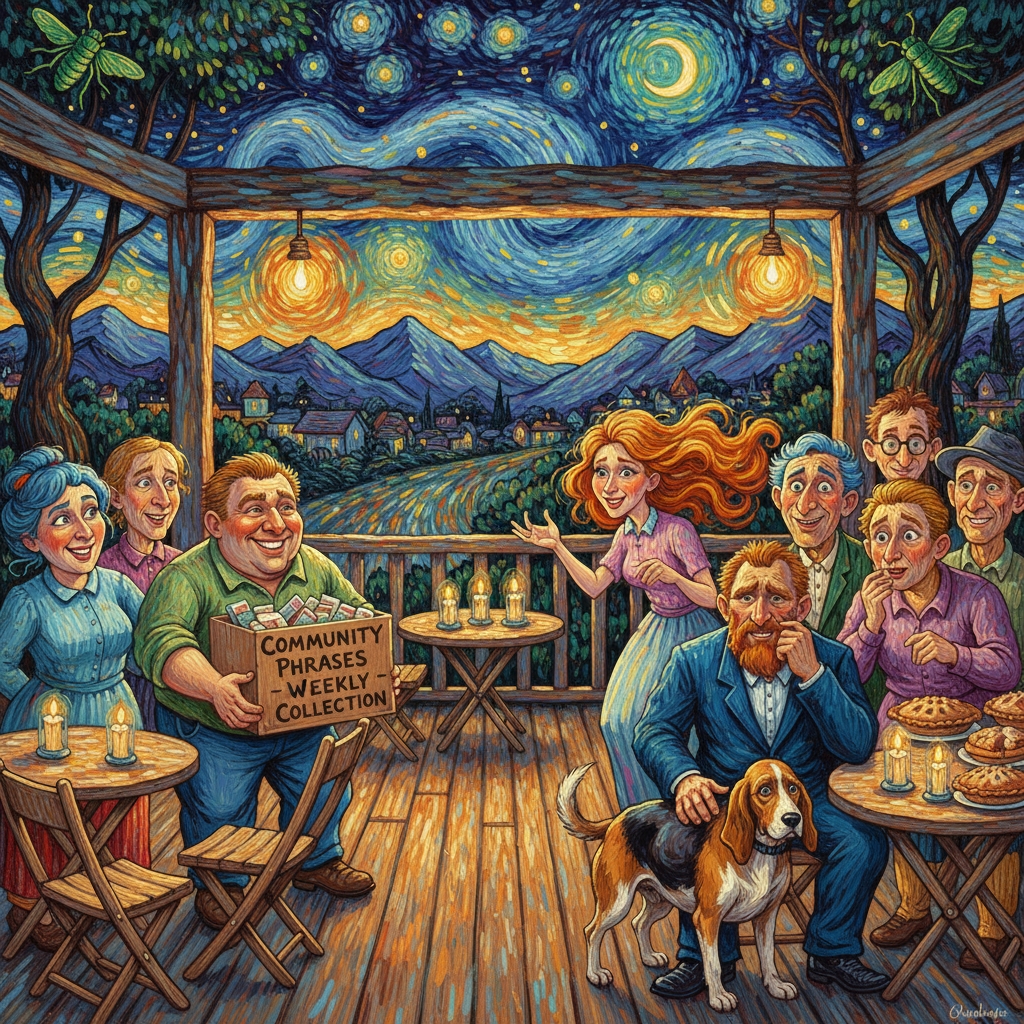
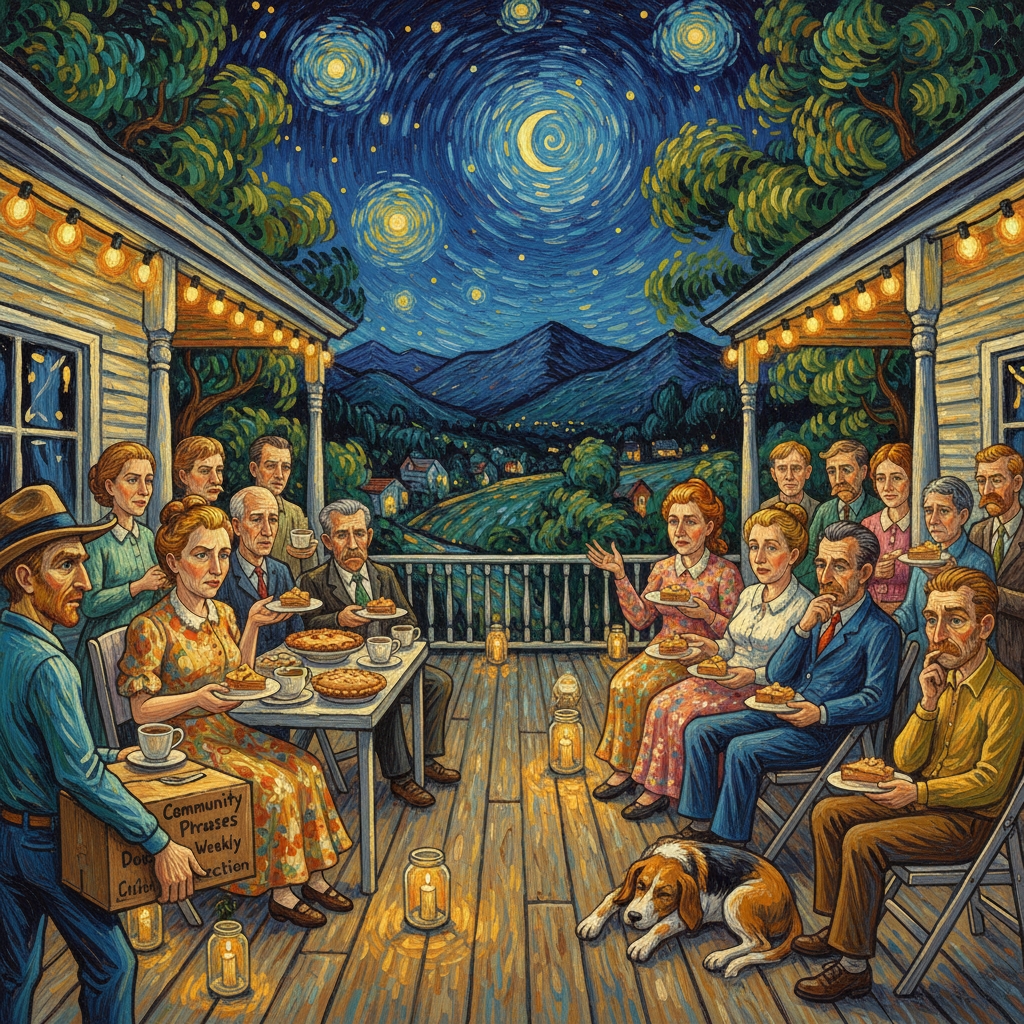
By Saturday evening, half the town had gathered on Wade Langston’s porch carrying folding chairs, desserts, unresolved opinions, and enough tea to survive minor infrastructure collapse.
Nobody called it a meeting.
Which was how everybody knew it absolutely was one.
The sunset spread orange across the valley while cicadas screamed from the trees.
Shelley arranged citronella candles.
Mabel inspected pie quality.
RT tuned a portable radio to static.
Clovis carried a cardboard box labeled:
COMMUNITY PHRASES – WEEKLY COLLECTION
Sheriff Peeler stared at it.
“That box alone feels illegal.”
“It’s historical preservation.”
“It’s emotional hoardin’.”
Boot sat quietly petting Daisy.
Pastor Peeler settled into a chair beside him.
“You alright?”
Boot shrugged.
“Think so.”
“You been quieter.”
Boot watched the hills.
“I keep thinkin’ about somethin’.”
“What?”
Act VII – The Porch Gathering Becomes Officially Unofficial
“How everybody started laughin’ before they started talkin’.”
Pastor Peeler nodded.
“Sometimes people need a softer doorway.”
Across the porch, Trixie Jo read aloud from Clovis’s collection.
“‘At this point the problem’s practically on the church prayer list and nobody’s named it yet.’”
Laughter erupted again.
Chickens down near the yard scattered wildly.
Coach Freddie wiped tears from his eyes.
“That one’s elite.”
Mabel pointed sternly.
“That ain’t funny.”
“Yes it is,” Maggie Sue said.
“No it ain’t.”
“It’s funny because it’s true.”
“That’s the worst kind.”
Shelley leaned forward thoughtfully.
“I think people were lonely inside the problem.”
Heads turned.
She continued carefully.
“When nobody discusses something directly, everybody starts believing they’re carrying it alone.”
RT nodded slowly.
“But jokes reveal witnesses.”
Nobody interrupted her.
“Humor became a signal,” she said. “A way of saying, ‘I see it too.’”
The porch grew still except for cicadas and rocking chairs.
Boot exhaled slowly.
“Yeah.”
Pastor Peeler smiled softly.
“And once people know they’re not alone, truth becomes less heavy.”
Mabel sat down hard beside the pie table.
“Well that’s annoyingly wise.”
Sheriff Peeler looked around the porch.
“You know what’s strange?”
“What?” asked Sonny.
“This is the calmest conversation we’ve had about the issue.”
“We still ain’t technically discussing it,” RT pointed out.
Everybody laughed again.
Then paused again.
This time the pause felt different.
Less fearful.
More honest.
Like the town had finally admitted something without needing formal permission.
Act VII – The Porch Gathering Becomes Officially Unofficial
Act VIII – Sunday Breakfast After Service
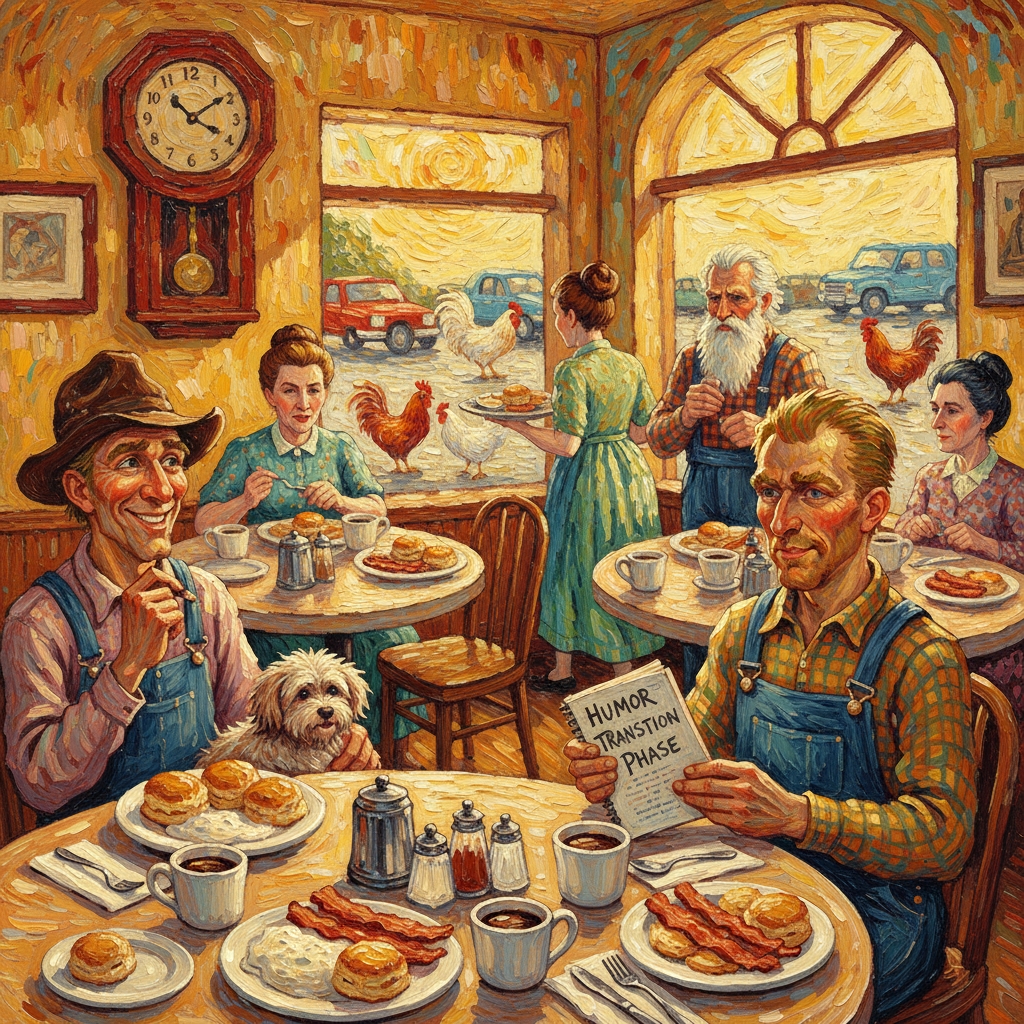
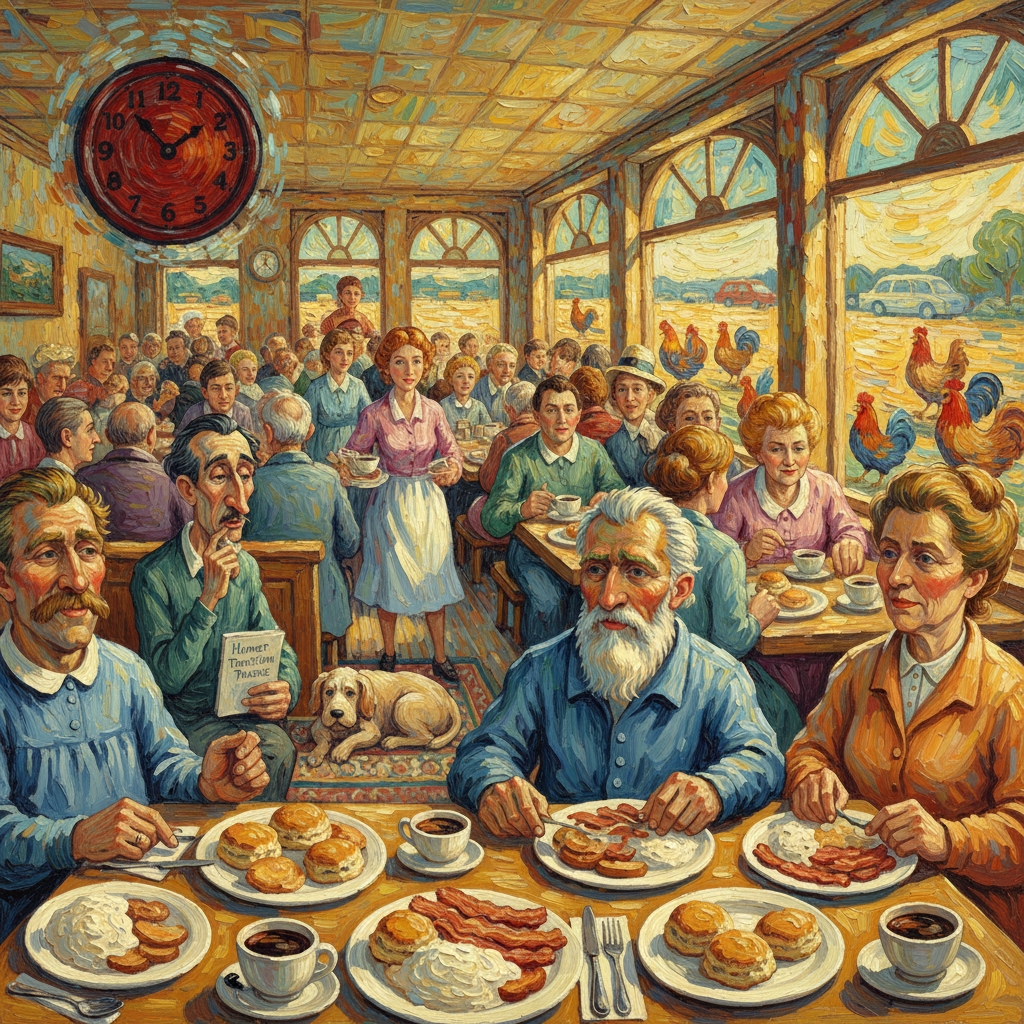
Sunday morning returned everybody to Earlie Mae’s Diner where the whole thing had quietly begun.
The post-church crowd filled every booth.
Biscuits vanished at alarming speed.
Coffee flowed like municipal necessity.
Trixie Jo balanced six plates at once while Tiffany shouted orders toward the kitchen.
Boot sat at the same booth beneath the Coca-Cola clock.
Only now nearly everybody from town had crowded nearby.
Clovis carried a fresh notebook labeled:
HUMOR TRANSITION PHASE
Sheriff Peeler nearly choked reading it.
“You genuinely scare me sometimes.”
Clovis smiled proudly.
Pastor Peeler stirred cream into his coffee.
“You notice somethin’?”
“What?” asked Wade.
“People are finally speakin’ more plainly now.”
Mabel looked around.
He was right.
The jokes still happened.
But now they led into actual conversation instead of replacing it.
Coach Freddie pointed with a strip of bacon.
Act VIII – Sunday Breakfast After Service
“That’s because once folks laughed together, they quit feelin’ judged.”
Shelley nodded.
“Humor reduced the social risk.”
Doughboy blinked.
“I understood that one.”
“Proud of you,” said RT.
Outside, Chester Ray’s chickens wandered peacefully through the parking lot again.
For once they weren’t panicking.
Boot watched them quietly.
Then he chuckled.
“What now?” Mabel asked suspiciously.
“I was just thinkin’.”
“That’s dangerous at your age.”
Boot smiled faintly.
“We spent weeks actin’ like acknowledgin’ the thing would somehow make it real.”
Pastor Peeler nodded.
“And?”
Boot looked around the diner.
“Turns out everybody already knew.”
Silence settled softly across the room.
Not uncomfortable.
Just true.
Mabel sighed deeply.
“Well.”
“Well what?” asked Tiffany.
“That ain’t a joke anymore.”
Nobody laughed immediately.
Then Daisy sneezed loudly beneath the table.
The entire diner erupted.
Outside, the chickens scattered one final time across the gravel lot.
And somehow—
This time—
The laughter didn’t sound afraid.
Act VIII – Sunday Breakfast After Service
Act IX – The Festival of Indirect Honesty
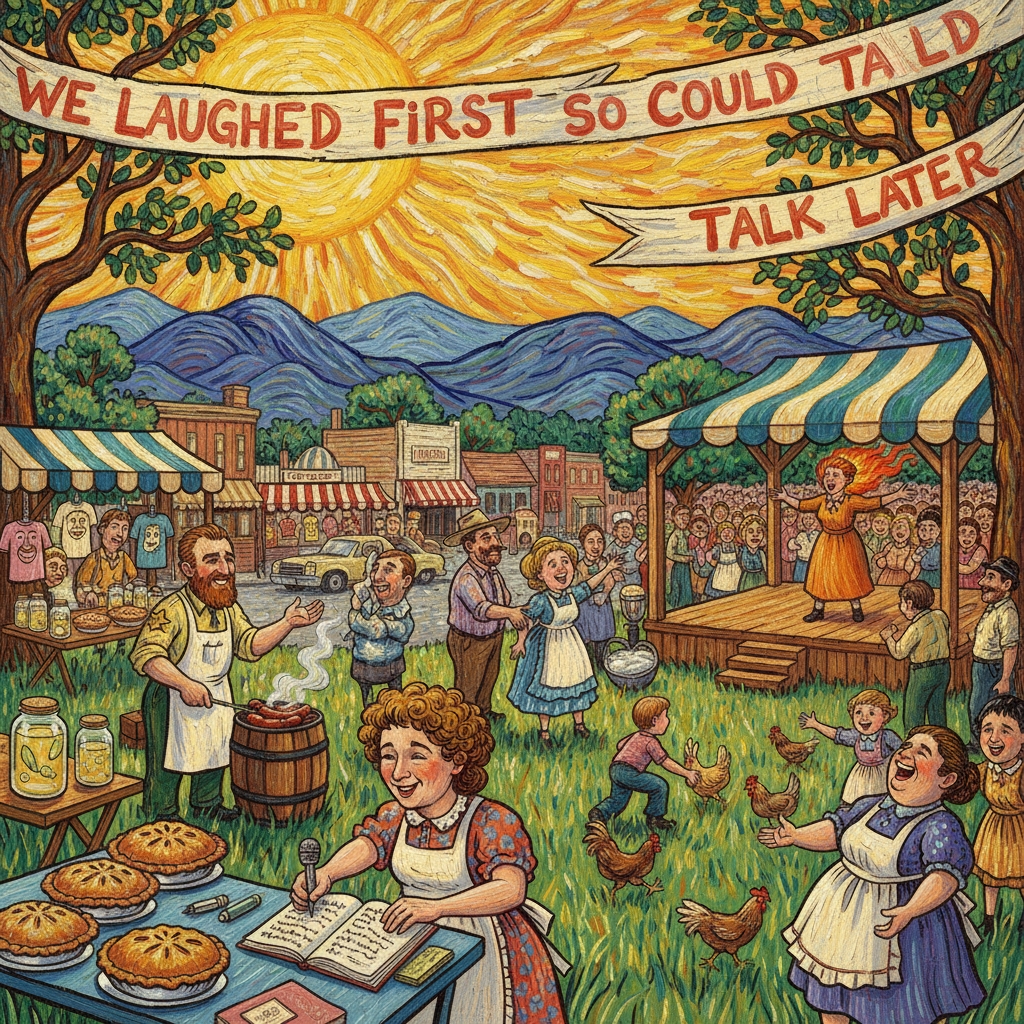
Three weeks later, Sequatchie Crossing hosted what Clovis officially titled:
THE FIRST ANNUAL COMMUNITY HUMOR AND HONESTY GATHERING
Everybody else called it:
“The Thing By The Pavilion.”
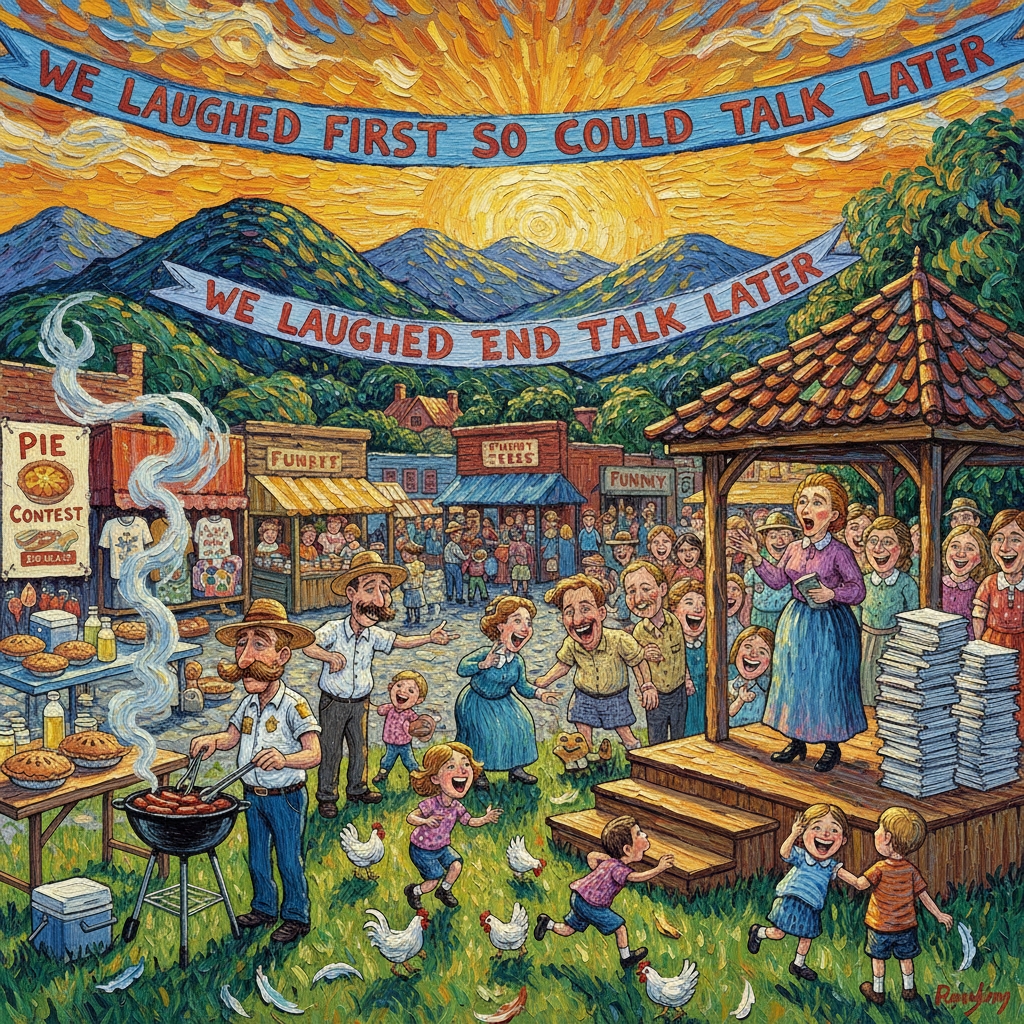
The town square filled with folding tables, lemonade coolers, pie contests, and handmade signs featuring local phrases collected during the Great Indirect Discussion.
One banner read:
WE LAUGHED FIRST SO WE COULD TALK LATER
Mabel still hated the slogan.
“Too emotionally organized,” she complained.
Children chased chickens through the grass while Daisy supervised with exhausted tolerance.
Sheriff Peeler grilled hot dogs.
Pastor Peeler delivered opening remarks nobody fully listened to because Doughboy had accidentally released balloons before the countdown.
Shelley documented interviews.
RT sold T-shirts that read:
I SURVIVED THE UNSPECIFIED SITUATION
They sold out in thirty minutes.
Boot stood near the pavilion watching townsfolk mingle.
People who’d argued for months now stood together laughing about the same fears they once treated like private shame.
Clovis approached carrying another notebook.
“I think we reached the integration phase.”
“You sound like a malfunctionin’ therapist.”
“It means the jokes stopped hiding the truth and started carrying it.”
Act IX – The Festival of Indirect Honesty
Boot nodded slowly.
“Funny thing.”
“What?”
“All this started because folks were too scared to speak directly.”
“And now?”
Boot looked around the square.
Now people spoke openly between laughs.
Not perfectly.
Not elegantly.
But honestly enough to matter.
Mabel climbed onto the pavilion stage unexpectedly.
The crowd quieted immediately because nobody ignored Mabel when elevated above ground level.
She crossed her arms.
“I got somethin’ to say.”
“Oh Lord,” whispered Wade.
Mabel pointed across the crowd.
“All you people kept tellin’ jokes because you thought bein’ serious would make everybody uncomfortable.”
A few heads lowered guiltily.
“But the jokes gave everybody permission to stop pretendin’.”
The square grew still.
Mabel sighed dramatically.
“And for the record… some of ‘em were pretty funny.”
The crowd exploded laughing.
Pastor Peeler covered his face smiling.
Boot laughed harder than anybody.
Then paused.
But this time it wasn’t sadness.
It was recognition.
The understanding that humor had not erased the burden.
Only distributed it.
Made it communal.
Carryable.
Human.
Above the square, chickens suddenly burst across the grass after a child dropped a funnel cake.
The entire festival roared with laughter.
And nobody looked away from each other afterward.
Act IX – The Festival of Indirect Honesty
Epilogue – Clovis Files the Records
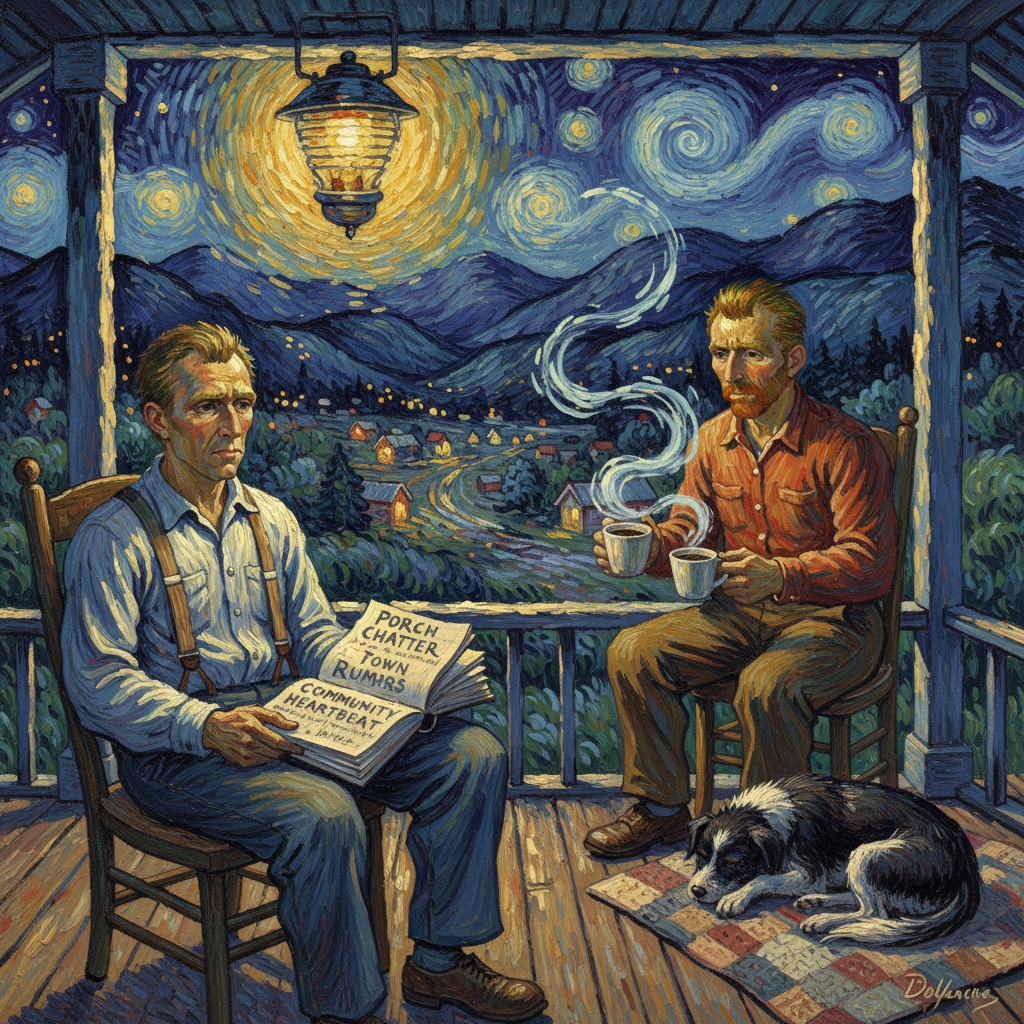
Late Sunday evening, Clovis sat alone on Wade Langston’s porch organizing notebooks beneath a yellow bug light.
The valley hummed quietly in the dark.
Inside one notebook he had written:
PHASE ONE: SILENCE
PHASE TWO: JOKES
PHASE THREE: CONVERSATION
Boot stepped onto the porch carrying two coffees.
“You still writin’?”
“History matters.”
Boot handed him a cup.
“You really think all this meant somethin’?”
Clovis looked out toward town.
Lights glowed softly below the ridge.
“I think humor let people touch truth without burnin’ themselves.”
Boot sat beside him quietly.
Down in the distance somebody laughed near the diner.
Then another voice answered.
Not hiding.
Not denying.
Just sharing the weight.
Boot smiled.
“Town sounds lighter.”
“Probably because folks finally quit carryin’ everything alone.”
The porch creaked softly.
Crickets sang.
And somewhere in the dark, one confused chicken flapped violently for absolutely no reason at all.
Epilogue – Clovis Files the Records
Disclaimer
The people, businesses, chickens, casseroles, emotional support jokes, panic laughter, indirect acknowledgments, porch sociology experiments, suspiciously accurate community observations, and all events depicted in this story are entirely fictional.
Any resemblance to actual towns, residents, meetings, church fellowships, feed store conversations, municipal coping mechanisms, unexplained public tension, emotionally revealing sarcasm, or socially therapeutic biscuit consumption is purely coincidental.
No chickens were harmed during the scattering incidents, though several reportedly requested quieter civic engagement procedures moving forward.
Disclaimer – Jokes About Problem Become More Frequent Than Discussions About It
Real Places Behind the Ruckus – From The Dunlap Directory
Real Places Behind the Ruckus – From The Dunlap Directory
Yes, this story was fictional; even the parts that weren’t true. These places? Absolutely real. Stop by, support local, and keep the Wi-Fi away from livestock:
- No Limit Fab
- Paul’s Redneck Salsa
- Rhea Family Farms
- George Hamilton Real Estate & Management Co.
- Studio Dunlap
- Scenic City Lawn Pros
- MaKyla-Kai Photography
- Sprouse Insurance Group, LLC
- dunlap grapevine
- Bella + Broach
- Sequatchie Valley Insurance LLC
- The Grove at Center Point
- Sequatchie County Courthouse
- One Way Landscaping
- Carolyn’s Acres Farm

Real Places Behind the Ruckus – From The Dunlap Directory
At Sequatchie Crossing, we tell the stories of Sequatchie Crossing.
Please share this post with your friends, family, or business associates who may want follow the news from Sequatchie Crossing.



0 Comments