


Short-Term Framing Maintained Despite Long-Term Evidence
By Tom Seest
At Sequatchie Crossing, we tell the stories of Sequatchie Crossing.
Please share this post with your friends, family, or business associates who may want follow the news from Sequatchie Crossing.
🎤 Audio Overview
Temporary Situation Enters Its Ninth Year Without Update
Act I – The Sign Nobody Removed
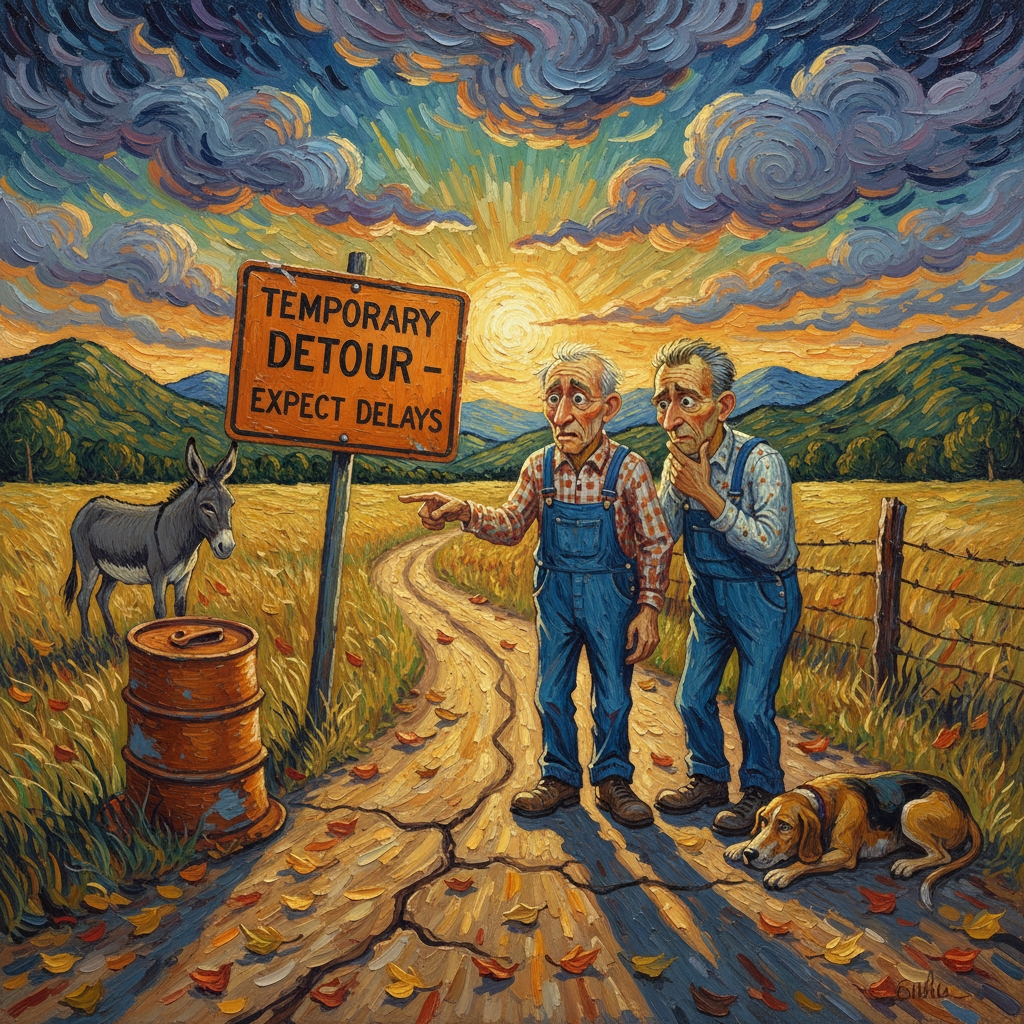
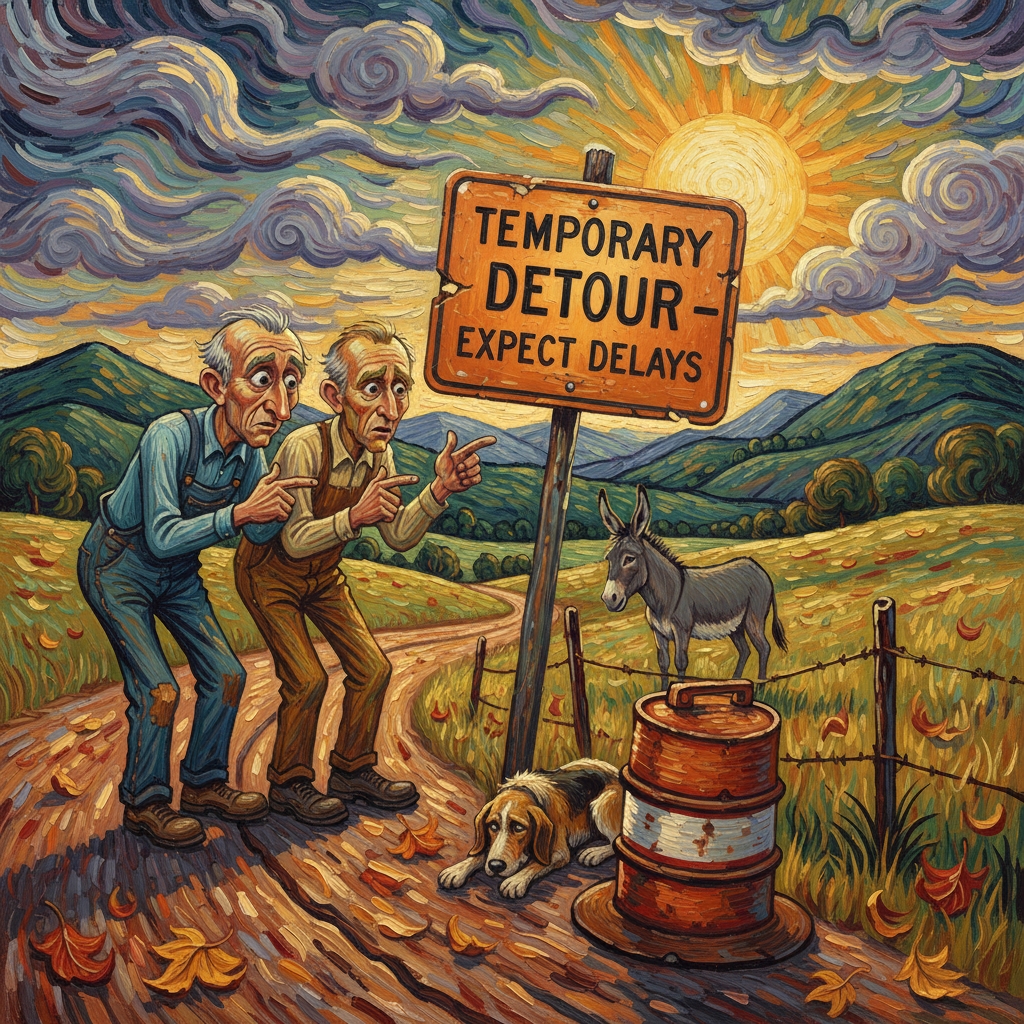
The sign stood just past the old feed store on Highway 127 where the pavement dipped low enough to collect rainwater, beer cans, and political promises. It leaned slightly to the left now, not from ideology but from weather. The plywood had softened along the bottom edge where winter ice had swollen the grain year after year.
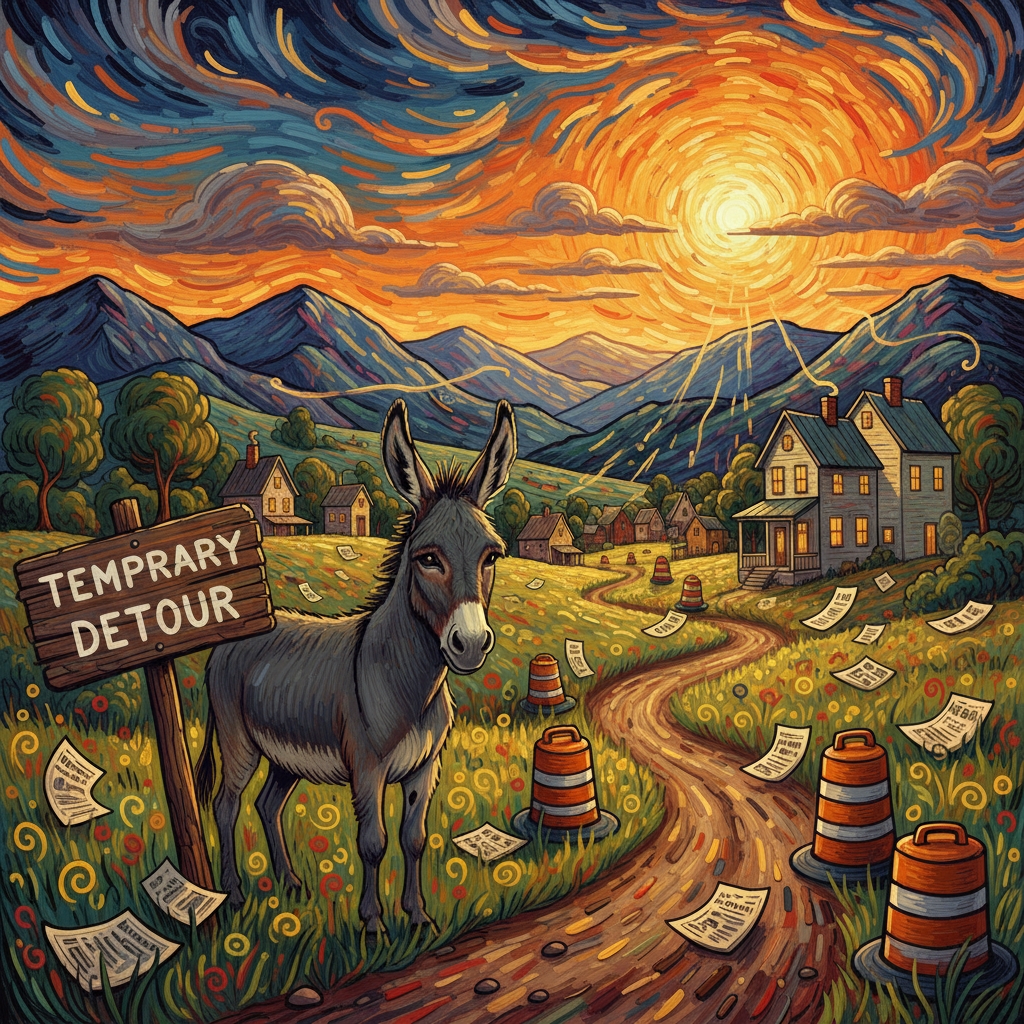
TEMPORARY DETOUR
EXPECT DELAYS
Below it sat an orange barrel with no reflective tape left on it whatsoever.
The detour itself had become so ordinary that teenagers giving directions referenced it like a permanent landmark.
“Turn left at the temporary thing,” they’d say.
Nobody asked which one.
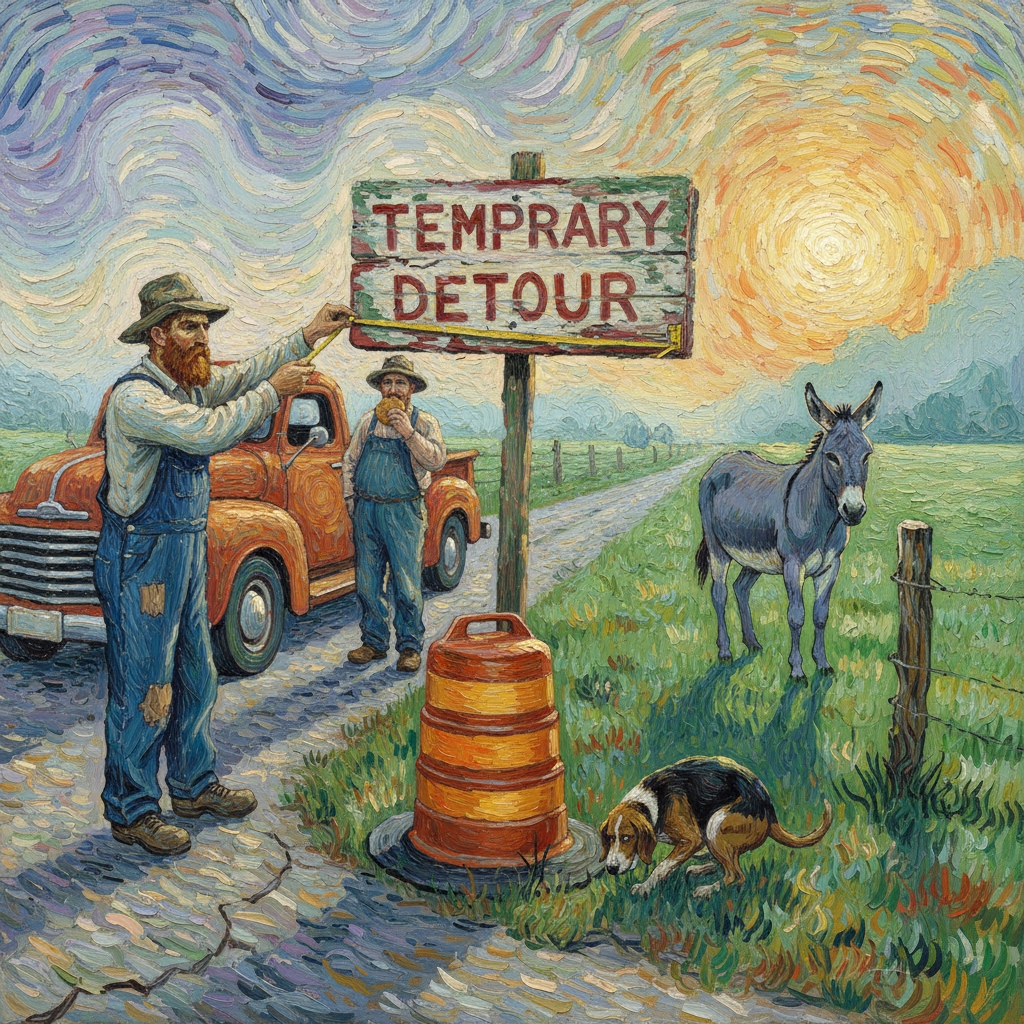
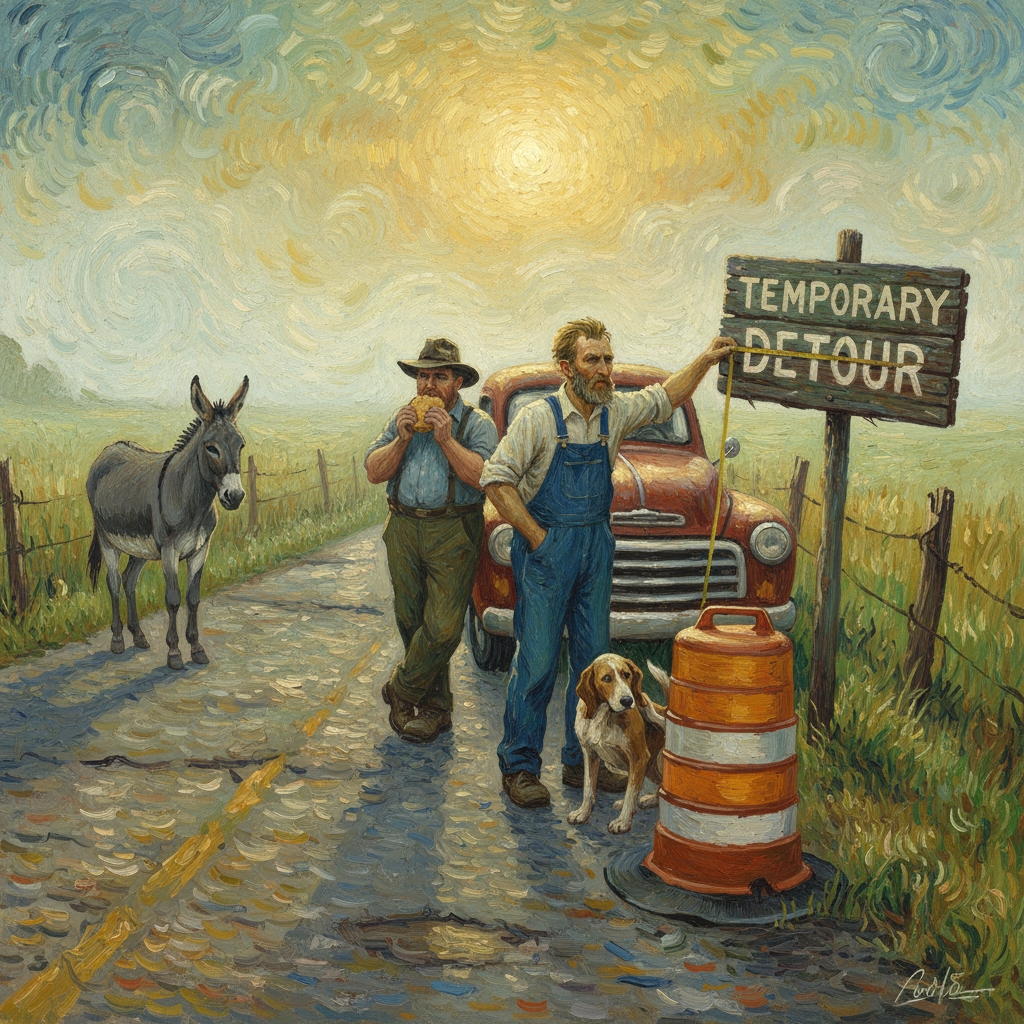
On a cool September morning, Clovis Strickland stood beside the sign with a yellow legal pad, a tape measure, and the solemn expression of a man preparing to testify before Congress.
Daisy the hound sat nearby scratching herself against the barrel.
Across the road, the donkey stood exactly where he always stood—in the Johnson pasture beside the rusted fence post. Summer flies circled him lazily. He neither reacted nor appeared concerned.
Clovis pointed toward the sign as Boot Barnes climbed out of his truck carrying a biscuit wrapped in wax paper.
“You notice anything peculiar?” Clovis asked.
Boot looked at the sign.
“Looks temporary.”
“It has looked temporary since the Obama administration.”
Act I – The Sign Nobody Removed
Boot chewed thoughtfully.
“Well,” he said, “government years is different than regular years.”
Clovis flipped several pages backward on his legal pad.
“I started documenting this detour eight years and nine months ago.”
“You document everything.”
“That is because nobody else does.”
Boot leaned against the truck.
“So what exactly are they detouring folks around now?”
“That,” Clovis said, “is the mystery.”
He pointed toward the blocked road.
Grass now grew through cracks in the pavement. A small cedar tree had emerged beside one of the concrete barriers sometime during Year Six.
The original bridge repair that caused the closure had supposedly been completed long ago, though nobody could say precisely when. At some point the temporary closure became a matter of habit.
“Has anybody tried drivin’ through there?” Boot asked.
“Officer Kenny Joe tried in 2022,” Clovis replied. “Said the county advised against it due to pending evaluations.”
“Evaluations of what?”
“That was not specified.”
Daisy barked once at nothing visible.
Across the pasture the donkey remained motionless.
Boot squinted.
“That donkey been standin’ there all summer.”
“All winter too.”
“Same donkey?”
“Far as anyone knows.”
Boot nodded slowly.
“That ain’t natural.”
Clovis lowered his voice.
“You know what else ain’t natural? Calling something temporary after three presidential elections.”
A church bell rang faintly from First Assembly down the road.
The morning fog began lifting from the valley while the sign cast its familiar shadow across the shoulder exactly as it had for nearly a decade.
And somewhere beneath the accumulated layers of weather, mold, county paint, revised budgets, deferred studies, and meeting minutes nobody could locate anymore, the town of Sequatchie Crossing quietly continued pretending the situation had not settled into permanence years ago.
Act I – The Sign Nobody Removed
Act II – Town Hall Reviews the Matter Again
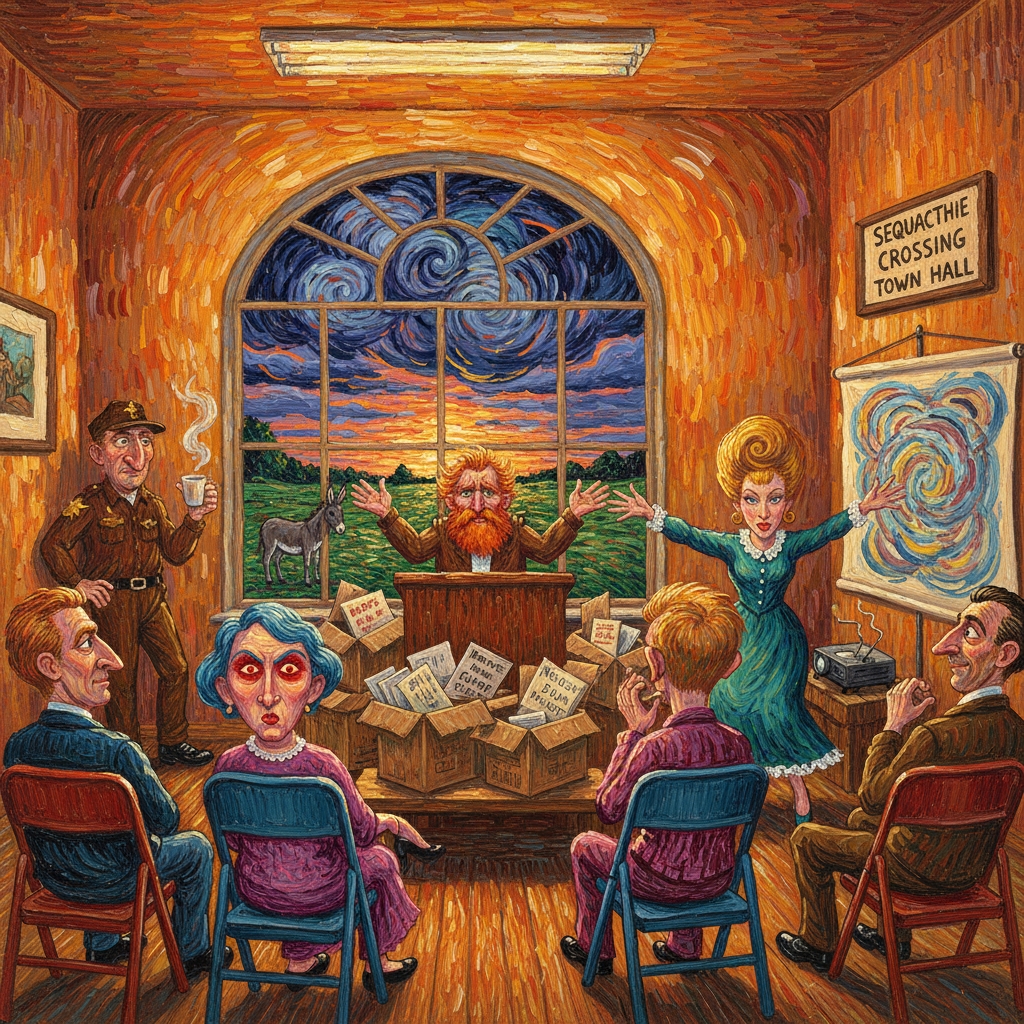
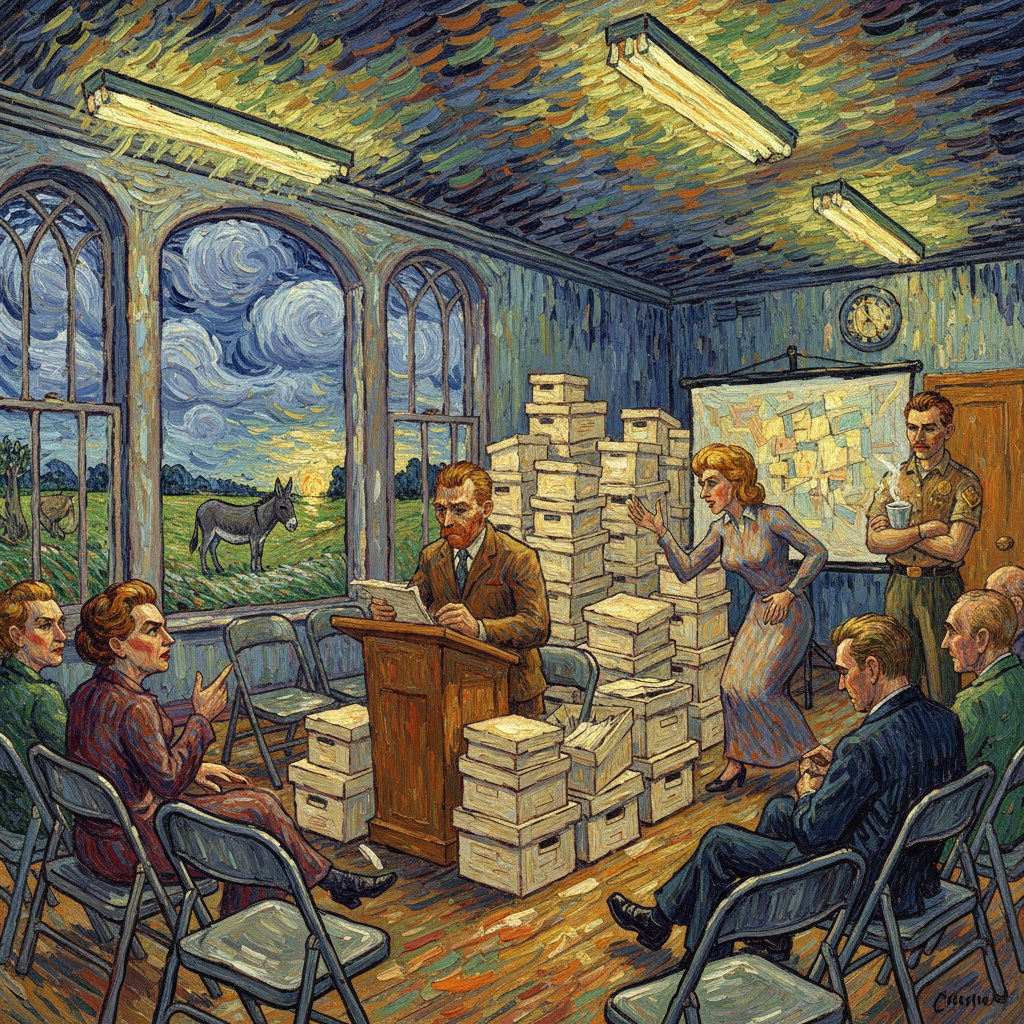
Town Hall smelled faintly of old coffee, floor wax, and wet cardboard.
The folding chairs had been arranged in rows by Ricky Travis “RT” Mullins, who considered himself the unofficial logistics coordinator for any civic confusion requiring extension cords.
Mabel Dean Ashcroft sat near the front holding a purse large enough to contain receipts from three decades of unresolved complaints.
Sheriff Peeler leaned against the back wall sipping gas station coffee while Officer Kenny Joe Teeter unsuccessfully attempted to connect a laptop to the projector.
“It says no signal,” Kenny Joe announced.
“That projector’s been temporary too,” Mabel muttered.
Shelley Fawn Wexler adjusted her scarf dramatically.
“I personally think the sign adds character,” she said. “Visitors enjoy authentic infrastructure uncertainty.”
“That ain’t a tourism category,” Boot replied.
“It absolutely is,” Shelley insisted. “Rustic ambiguity.”
Clovis approached the podium carrying a banker’s box overflowing with folders.
Pastor Arnold Peeler entered quietly and took a seat beside Sister Lila Mae “Hallelujah” Pruitt, who already appeared spiritually prepared for conflict.
Maggie Sue Dillard distributed styrofoam cups of sweet tea while Tiffany Annette Roark filmed portions of the gathering vertically on her phone for social media.
“People online are fascinated by this,” Tiffany whispered. “One fella from Oregon asked if the detour’s historical.”
“It is now,” Mabel said.
At precisely 6:12 PM, Mister Wade Langston struck the gavel against a stack of copier paper because the actual sound block had disappeared years earlier.
“This special review hearing of the Temporary Infrastructure Adjustment Committee will now commence.”
Boot raised his hand immediately.
“That committee sounds made up.”
“It was created in 2018.”
Act II – Town Hall Reviews the Matter Again
“Temporary?”
“Initially.”
Clovis cleared his throat.
“I have assembled a chronological overview.”
Nobody looked pleased.
He opened the first folder.
“The detour was established following structural concerns regarding Culvert Bridge Number Fourteen-B.”
Shelley frowned.
“I thought it was Bridge Twelve.”
“That confusion began in Year Three after revised numbering protocols.”
“Of course it did,” Boot sighed.
Clovis continued.
“In Year One, the county estimated repairs would require approximately six weeks.”
Mabel snorted loudly.
“In Year Two, additional assessments were requested.”
“In Year Three,” Clovis said, “temporary stabilization became semi-operational.”
“In Year Four,” Mabel interrupted, “they stopped mentioning it entirely unless somebody asked directly.”
“Correct.”
Pastor Peeler folded his hands thoughtfully.
“There are children now driving through this town who were not born when that sign first appeared.”
Silence settled briefly.
Even Kenny Joe stopped wrestling the projector cord.
Pastor Peeler continued softly.
“I have baptized babies during the life of that detour who are now nearly old enough to borrow tractors without supervision.”
“That feels spiritually incorrect,” Sister Lila Mae whispered.
Clovis lifted another sheet.
“The county records still categorize the closure as ‘short-duration mitigation infrastructure.’”
Boot stared at him.
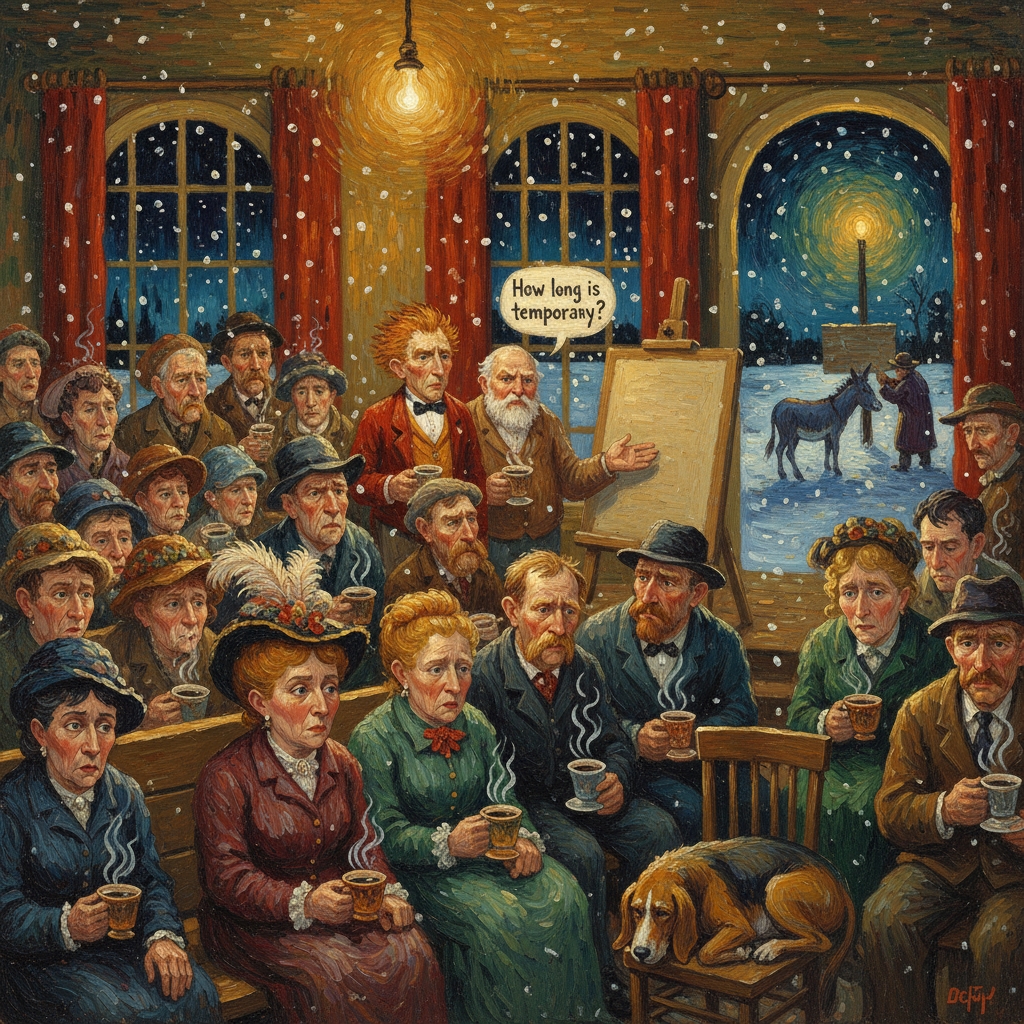
“How long is temporary?”
Nobody answered immediately.
Outside the Town Hall windows, dusk settled over the valley.
The donkey stood in the same pasture position visible from the parking lot.
Mabel pointed at it.
“That thing’s been there through thunderstorms, hail, Easter, and three Dollar General remodels.”
Sheriff Peeler glanced outside.
“Maybe he likes the spot.”
“Or maybe,” Mabel said, “everybody just stopped noticing.”
The room grew quiet again.
Because nobody in Sequatchie Crossing particularly enjoyed when Mabel accidentally said something true.
Act II – Town Hall Reviews the Matter Again
Act III – The Diner Conversation Ages Poorly
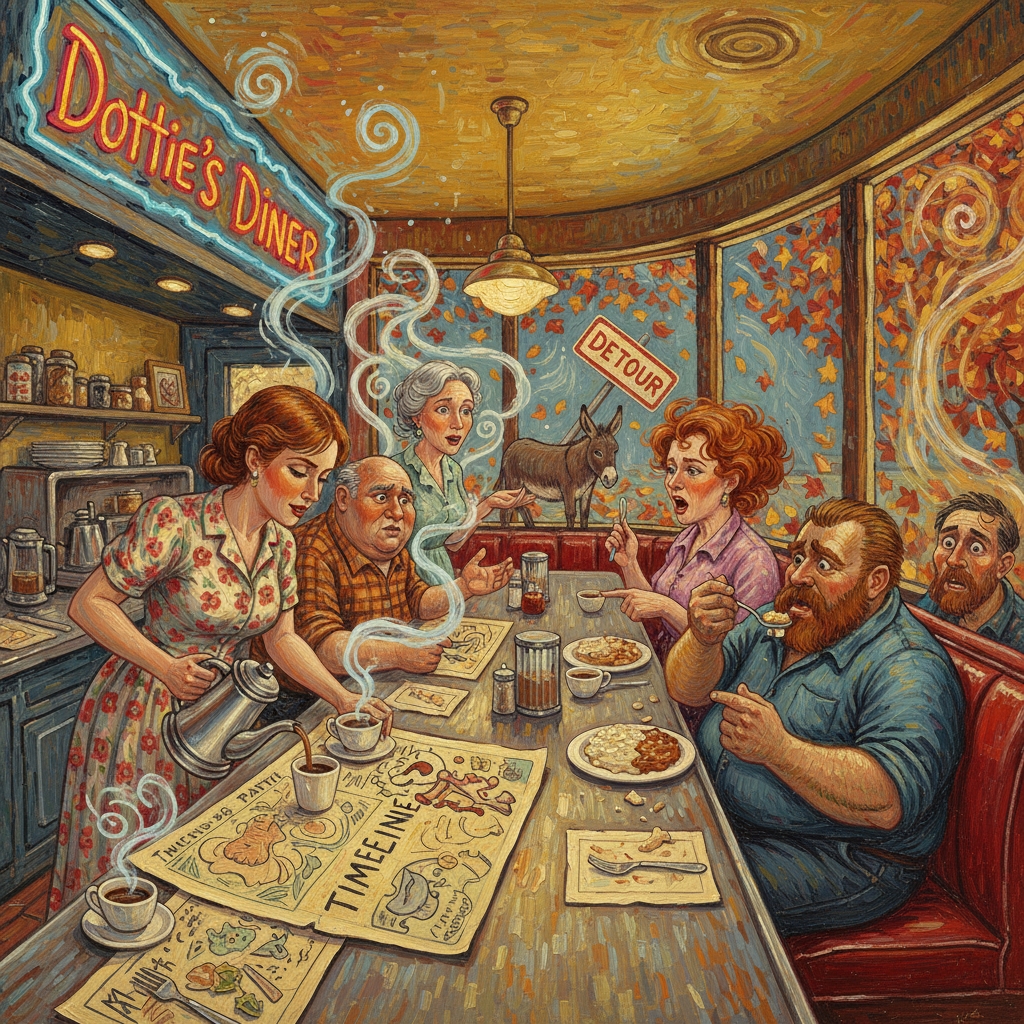
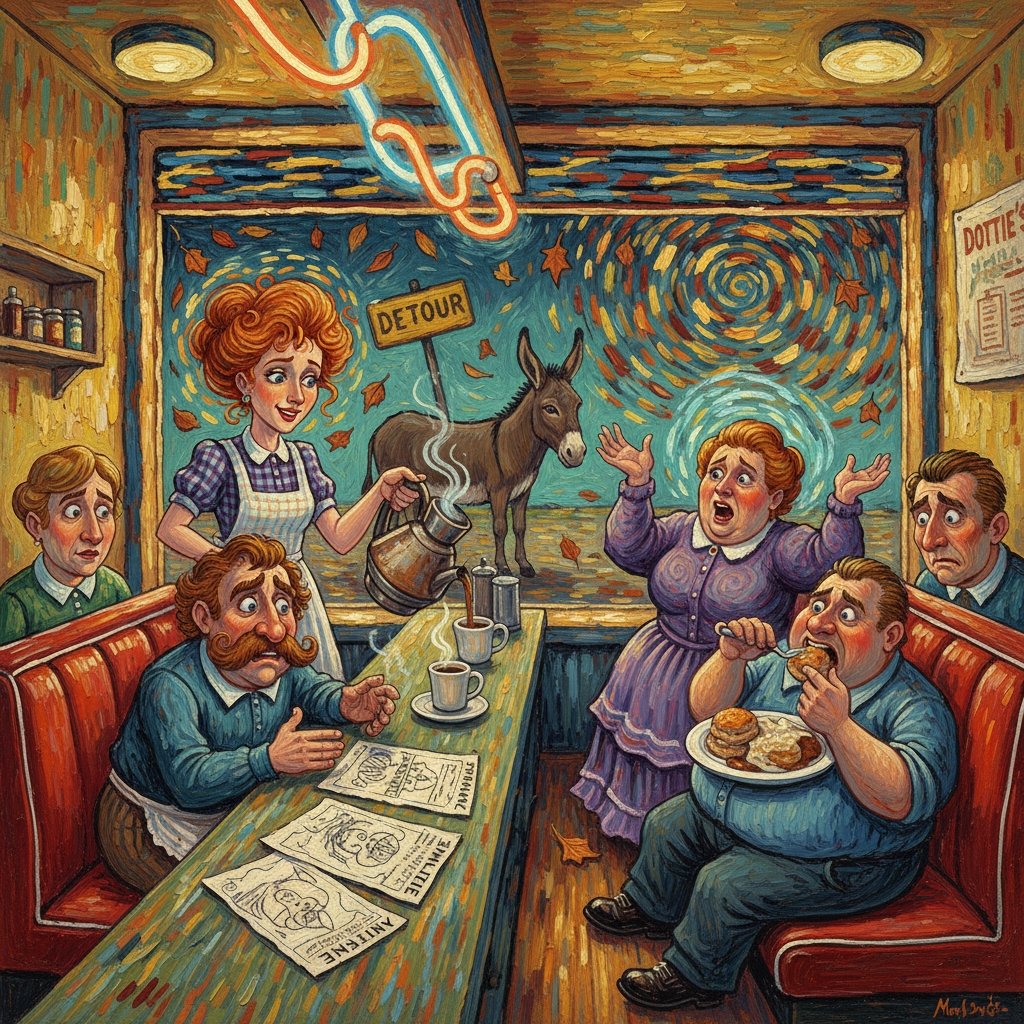
The next morning at Dottie’s Diner, conversation moved with the slow certainty of molasses in winter.
The temporary detour occupied Booth Three, Booth Five, and half the counter.
Trixie Jo Bartlett refilled coffee while simultaneously participating in six separate opinions.
“I remember when they first put that sign up,” she said. “I still had my old knee.”
Doug “Doughboy” Teeter looked up from his biscuits and gravy.
“You still got both knees.”
“Not emotionally.”
Chester Ray Blevins unfolded a faded newspaper clipping from his shirt pocket.
“I printed flyers for the reopening celebration in 2019.”
“Did they happen?” asked Sonny Morales.
“No.”
“Then why you still carryin’ the flyer?”
Chester Ray shrugged.
“Good paper stock.”
Boot entered carrying another legal pad Clovis had forced upon him.
“I got homework,” he announced grimly.
Nobody looked surprised.
Clovis sat at the far booth constructing a timeline across three placemats using different colored pens.
“What exactly are you proving?” RT asked.
“That language decays reality.”
Act III – The Diner Conversation Ages Poorly
Sonny blinked.
“You been readin’ philosophy again?”
“No. County minutes.”
“That’s worse.”
Mabel entered next wearing church shoes despite it being Thursday.
“I drove by there this morning,” she announced. “That donkey’s still standin’ there.”
“They move at night,” Doughboy offered.
“No they don’t.”
“They absolutely do.”
“That donkey,” Mabel declared, “has accepted reality better than this town.”
Trixie Jo laughed so hard she nearly dropped a syrup bottle.
At the counter, Evelyn Grace Tipton lowered her reading glasses.
“The issue,” she said carefully, “is that folks get attached to temporary explanations because permanent ones require responsibility.”
Several people stopped chewing.
Even Dottie paused near the grill.
Evelyn continued calmly.
“If something is temporary, nobody has to solve it today.”
“Or tomorrow,” Boot added.
“Or apparently before civilization collapses,” Clovis muttered.
Shelley Fawn swept dramatically into the diner carrying shopping bags and unnecessary urgency.
“Good news,” she announced. “The Chamber of Commerce is considering including the detour in the heritage driving tour.”
The diner erupted instantly.
“You can’t make bureaucratic neglect a landmark,” Sonny protested.
Shelley shrugged elegantly.
“America already has.”
Pastor Peeler entered quietly at that exact moment.
“Well,” he said, removing his hat, “that unfortunately is not inaccurate.”
Mabel leaned forward.
“Pastor, how long you reckon temporary lasts?”
Pastor Peeler smiled sadly.
“In Scripture, forty years was considered temporary wandering.”
Boot nearly choked on coffee.
“You tellin’ me we got thirty more years of orange barrels?”
“No,” Pastor Peeler replied gently. “I’m saying people become comfortable wandering sooner than they realize.”
Outside the diner windows, leaves drifted slowly across the road.
And there in the pasture stood the donkey.
Exactly where he had been yesterday.
Act III – The Diner Conversation Ages Poorly
Act IV – Four Seasons of the Donkey
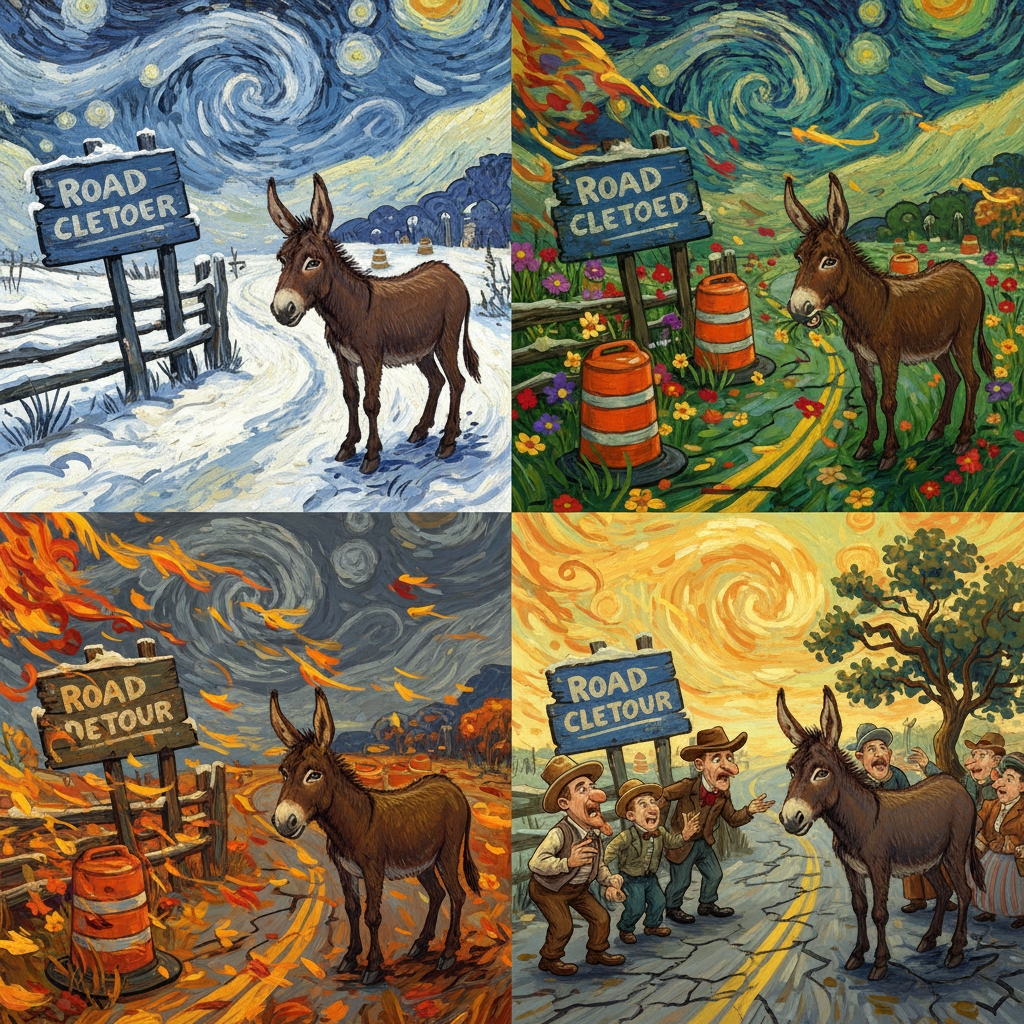
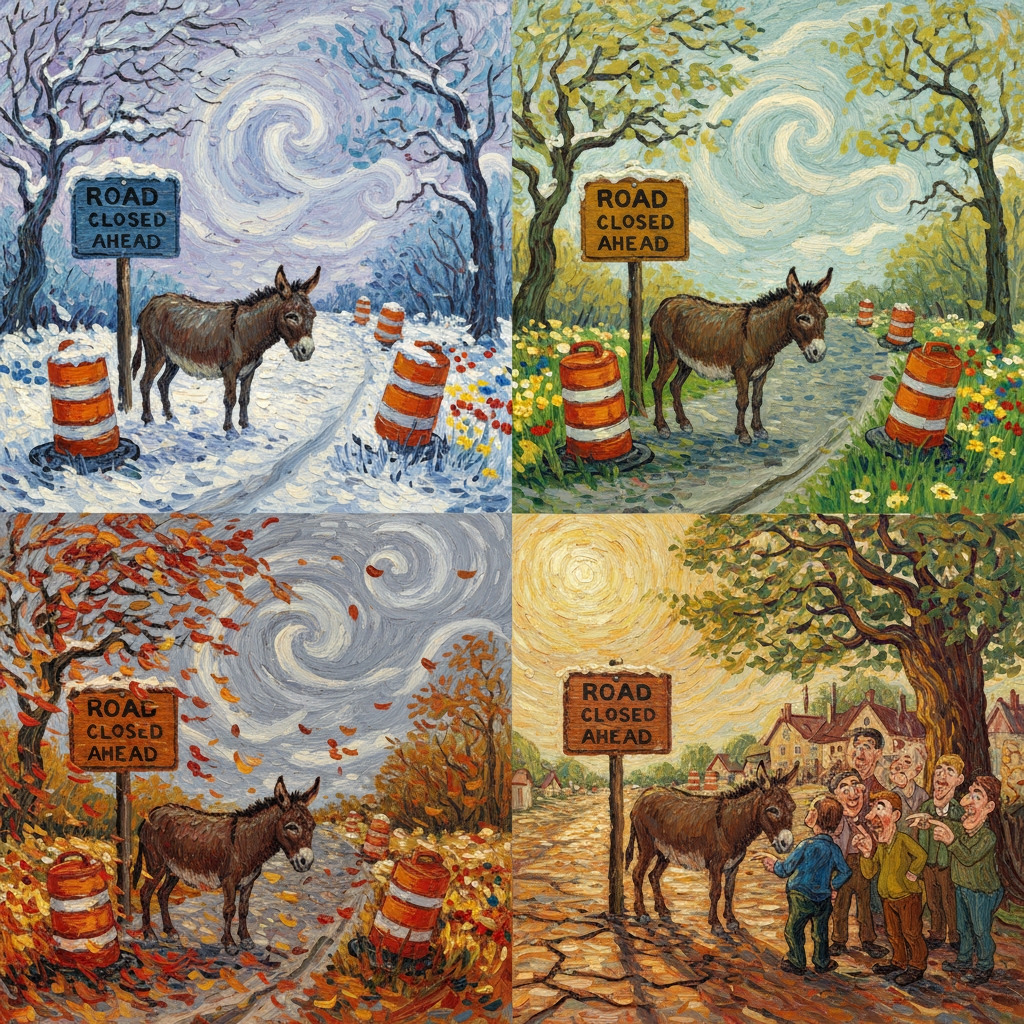
Winter arrived hard that year.
Snow layered the valley in quiet white sheets while Sequatchie Crossing slowed into its annual season of cautious driving and aggressive casserole delivery.
The temporary detour sign wore an icicle beard.
Clovis photographed it weekly.
“Documentation matters,” he insisted.
Boot stood beside him stamping warmth into his boots.
“You got photographs of this thing in every season now.”
“That is the point.”
Across the pasture the donkey stood surrounded by snow.
Same spot.
Same expression.
“He ain’t moved,” Boot whispered.
“Or perhaps,” Clovis said gravely, “we have.”
By spring, the snow melted into mud.
Wildflowers appeared beside the barricades. Someone tied an Easter ribbon around one of the barrels. Nobody admitted doing it.
Children rode bicycles around the closure as though it were part of the natural landscape.
Tiffany Annette uploaded a video montage titled Temporary Since Forever which received seventy-three thousand views online.
Tourists began stopping to photograph the sign ironically.
Shelley Fawn started selling postcards.
“Historic Temporary Detour,” the cards read.
Mabel threatened to sue everybody involved.
Summer brought heat thick enough to bend logic.
Act IV – Four Seasons of the Donkey
At the church picnic, Sister Lila Mae cornered Pastor Peeler beneath the pavilion fan.
“Arnold,” she whispered, “what if the Lord leaves certain things unresolved on purpose?”
Pastor Peeler sipped lemonade thoughtfully.
“You mean spiritually?”
“No, I mean county-wise.”
Nearby, Coach Freddie Stubblefield attempted unsuccessfully to organize a softball game around the detour route.
“It adds seventeen minutes to bus travel!” he shouted.
“Nine if you drive determined,” Kenny Joe replied.
Dr. Neil Cowgill joined the conversation carrying potato salad.
“I treated a teenager last week who believed that sign had always existed.”
“That ain’t healthy,” Boot said.
“Historically or medically?”
“Yes.”
Autumn returned again.
Leaves collected around the barriers.
The donkey stood among golden grass beneath gray skies.
Mabel drove past one evening with Maggie Sue riding shotgun.
“I swear that animal’s become symbolic.”
“Of what?”
“Refusal.”
“Whose refusal?”
Mabel stared at the sign.
“Everybody’s.”
At Town Hall later that week, Clovis unveiled a presentation titled:
TEMPORARY CONDITIONS AND THE EROSION OF COLLECTIVE HONESTY
The projector failed immediately.
“Fittin’,” Boot observed.
Clovis switched to printed charts.
“This graph demonstrates linguistic drift over time.”
Nobody understood the graph.
Not even Clovis seemed entirely confident.
But his conclusion landed anyway.
“At some point,” he said, “temporary stopped describing reality and started protecting people from admitting reality.”
Silence filled the room.
Outside, wind rattled the old sign.
And through the windows the donkey remained exactly where everyone expected him to be.
Which somehow made it worse.
Act IV – Four Seasons of the Donkey
Act V – The County Representative Visits
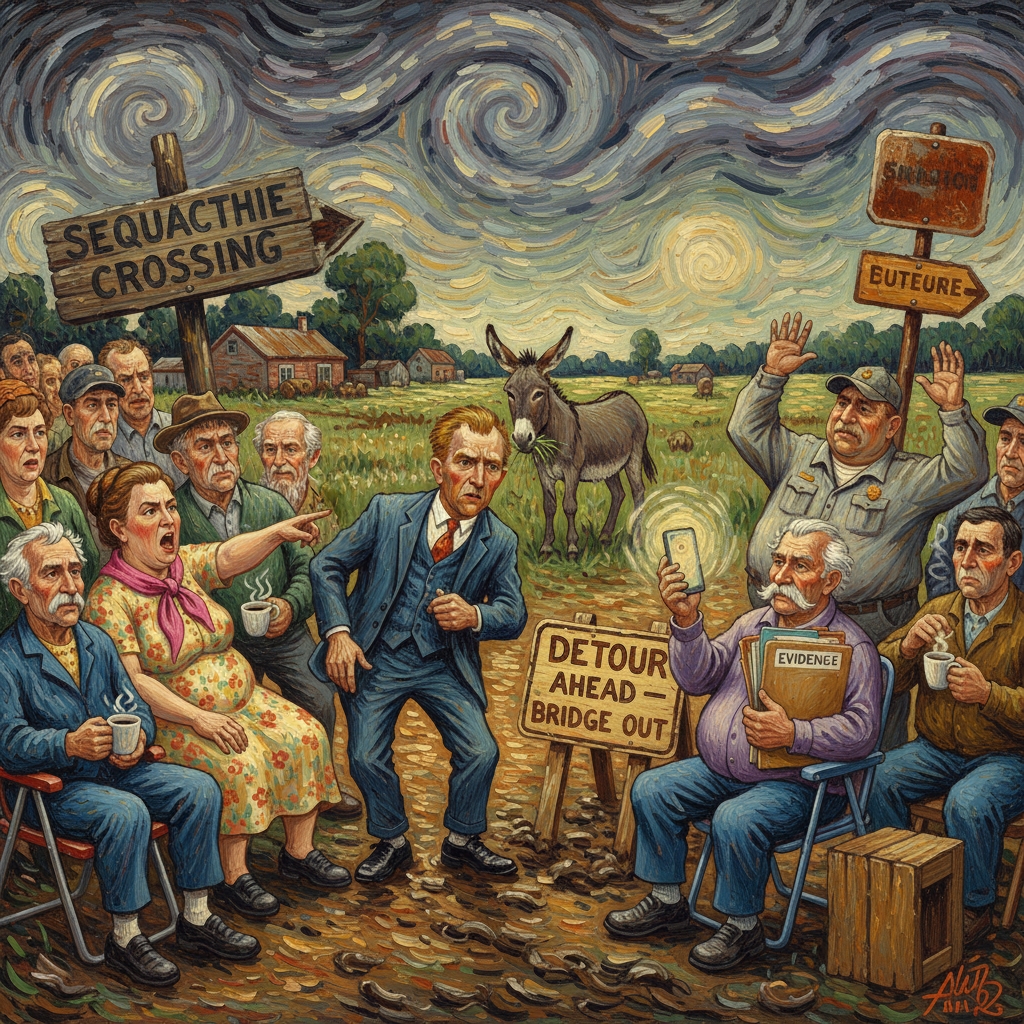
News spread quickly that a county representative would finally inspect the temporary detour personally.
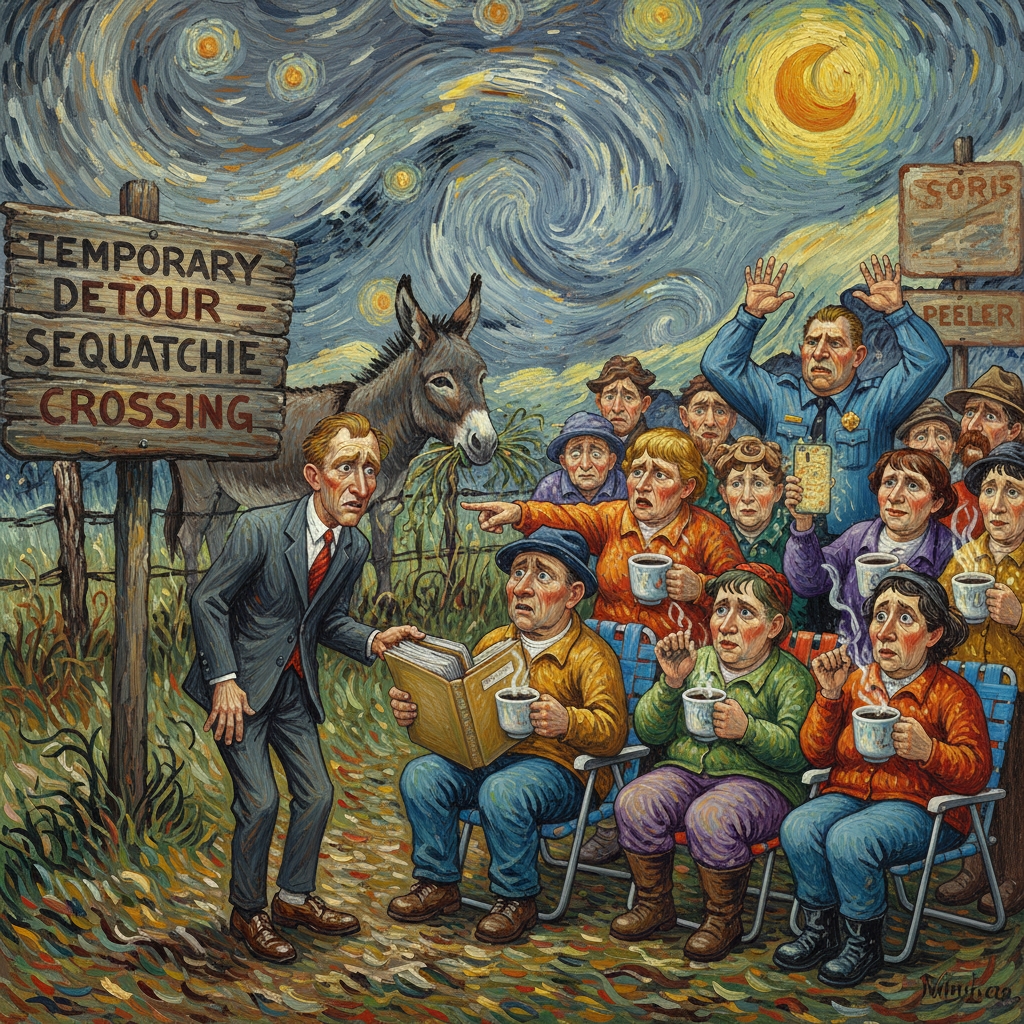
By noon, half the town had gathered near the barricades carrying folding chairs, snacks, and emotional investment wildly disproportionate to culvert infrastructure.
Sheriff Peeler attempted crowd management.
“This is not a festival.”
“It feels like one,” Shelley Fawn replied.
The representative arrived in a white SUV with magnetic county seals barely attached to the doors.
His name was Randall Pickmere, though everyone immediately called him Randy.
He wore polished loafers inappropriate for mud.
“Well,” Randy announced brightly, “good to finally assess the situation.”
Mabel stared at him in disbelief.
“You just now assessin’ it?”
“We’ve monitored conditions remotely.”
Clovis physically recoiled.
“You remotely monitored a bridge closure for nine years?”
“Eight years and nine months,” Randy corrected.
“That ain’t better.”
Randy opened a tablet.
“Current status remains categorized as temporary mitigation pending future review.”
Boot stepped forward slowly.
“Sir.”
“Yes?”
Act V – The County Representative Visits
“How long is temporary?”
Randy smiled professionally.
“That depends on projected timelines.”
“No,” Boot said patiently. “How long before a thing becomes what it is?”
The crowd murmured approval.
Randy adjusted his tie.
“Well, infrastructure terminology can be fluid.”
Mabel laughed so hard she frightened Daisy.
“That right there,” she declared, “is why nothin’ ever leaves committee.”
Pastor Peeler approached calmly.
“Sir, seasons have passed around this closure. Children grew up beside it. People changed jobs. Folks died.”
Randy nodded sympathetically.
“We understand community impact.”
“No,” Pastor Peeler said softly. “I don’t believe you do.”
Nearby, the donkey stood chewing weeds.
Randy finally noticed him.
“That animal belong to somebody?”
“He belongs to the truth,” Clovis muttered.
Randy ignored this.
Shelley Fawn began livestreaming.
Comments poured in instantly.
IS THE DONKEY PART OF THE PROJECT?
WHY IS THE SIGN STILL THERE?
IS THIS PERFORMANCE ART?
RT handed Randy a hotdog.
“You’re gonna need strength.”
Randy attempted diplomacy.
“The county remains committed to temporary stabilization.”
Mabel folded her arms.
“That bridge got stabilized before my niece’s second marriage.”
Randy hesitated.
“How many marriages has she had?”
“Three.”
The crowd nodded solemnly.
Randy glanced uneasily at the sign.
A section of paint peeled off slowly in the wind.
For one brief moment, even he appeared uncertain whether the word TEMPORARY still meant anything at all.
Act V – The County Representative Visits
Act VI – Sunday Sermons and Long Weather
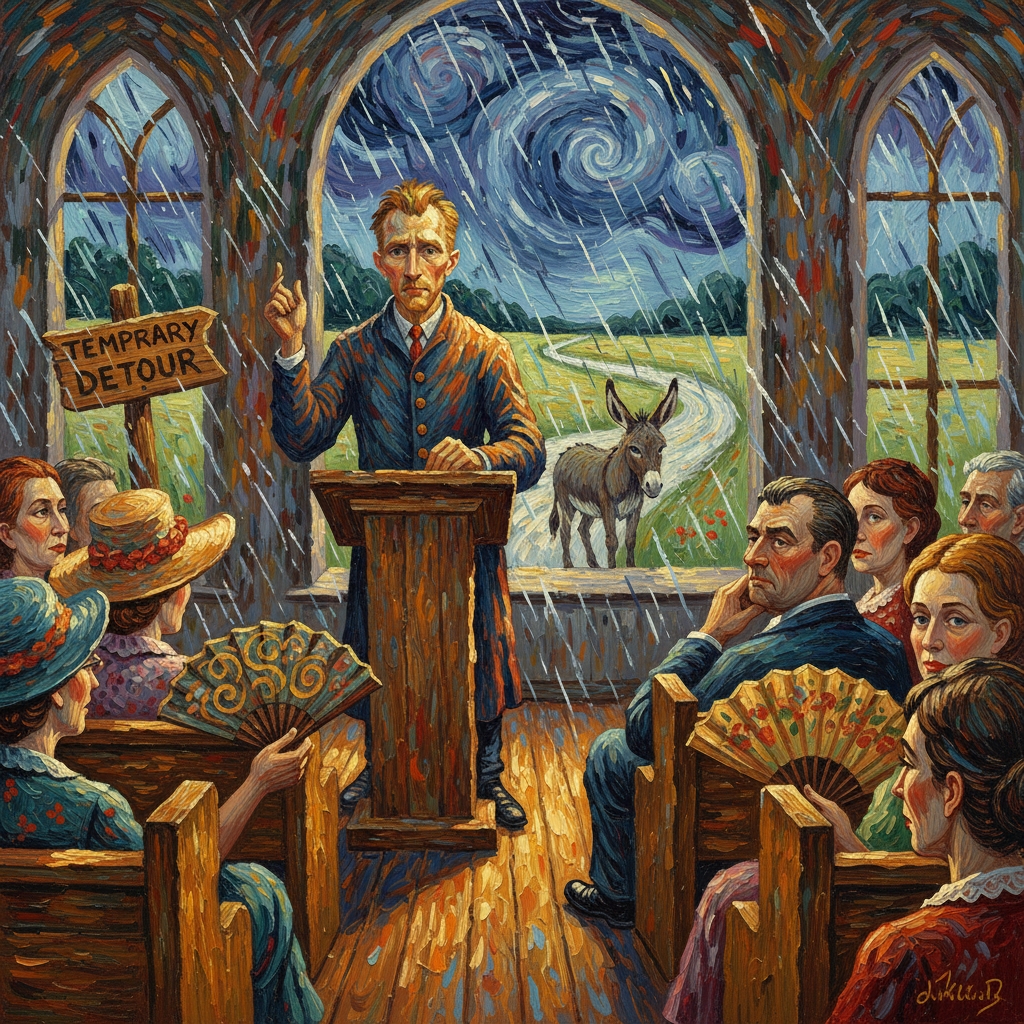
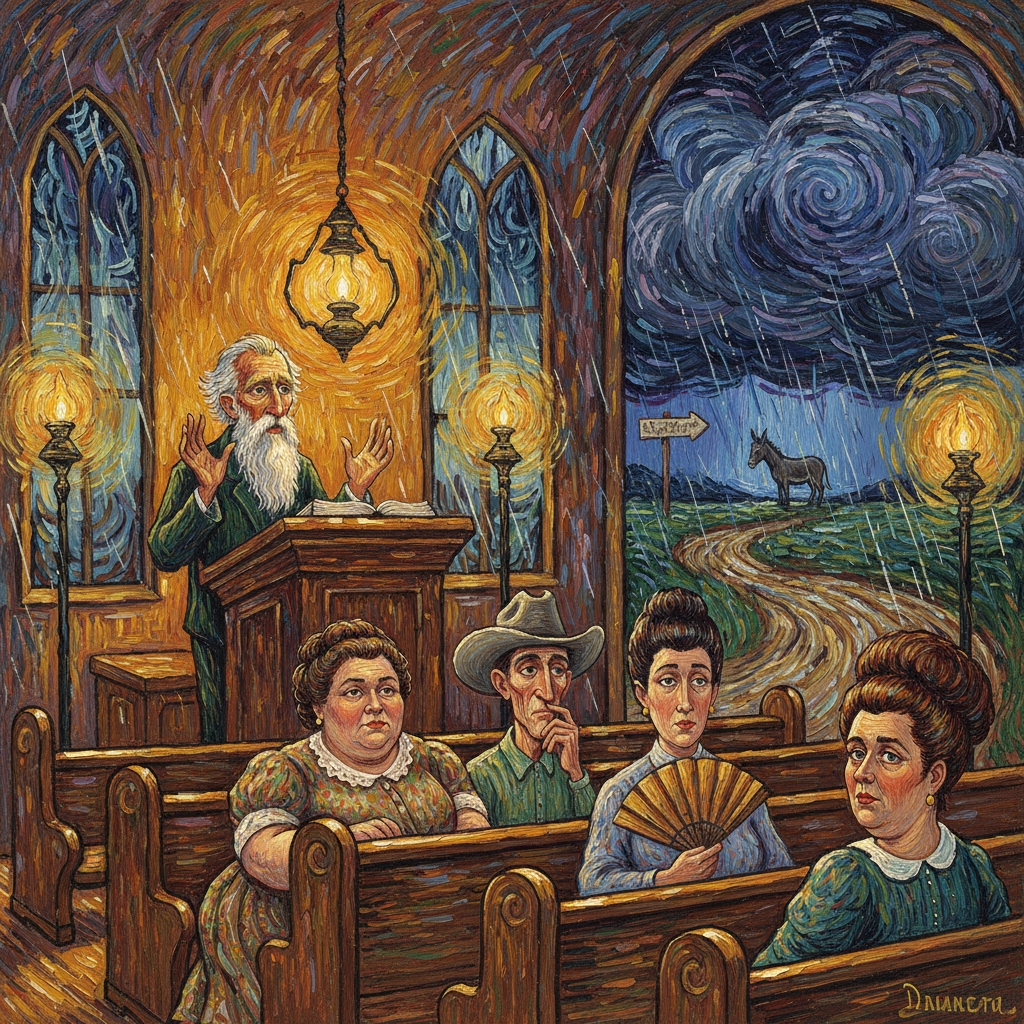
Rain hammered First Assembly Baptist all Sunday morning.
Inside, damp jackets steamed gently while ceiling fans pushed warm air across the sanctuary.
Pastor Arnold Peeler stood at the pulpit studying his notes.
Then quietly folded them closed.
“Church,” he began, “I had prepared a sermon about endurance.”
Congregants nodded.
“But frankly, the county already delivered one.”
Soft laughter moved through the pews.
Outside, rainwater pooled near the temporary detour sign again.
The donkey stood in drizzle without apparent concern.
Pastor Peeler continued.
“There is a danger in naming things incorrectly for too long.”
Sister Lila Mae whispered, “Amen.”
“When we call bitterness discernment long enough, we forget joy.”
“Amen.”
“When we call fear caution long enough, we stop living.”
Act VI – Sunday Sermons and Long Weather
Several heads lowered thoughtfully.
“And when we call permanence temporary long enough…”
He paused.
“…eventually we stop believing change is possible at all.”
Silence settled heavily.
Even children stopped fidgeting.
Pastor Peeler stepped away from the pulpit slightly.
“Some of you have driven around that detour so long you no longer remember the original road.”
That landed harder than expected.
Mabel stared straight ahead.
Boot shifted uncomfortably.
Clovis removed his glasses.
Pastor Peeler’s voice softened.
“Time reveals things words try to conceal.”
Rain drummed steadily overhead.
“Scripture teaches us there is a season for all things.”
He smiled faintly.
“But if your pumpkin decorations survive three Easter services…”
The congregation burst into laughter.
“…you may not be decorating anymore. You may simply have accepted new truth.”
Even Sheriff Peeler laughed at that one.
After service, townspeople gathered beneath the awning while rain continued falling.
The temporary detour sat visible down the road through gray mist.
Maggie Sue watched traffic reroute automatically.
“You know what scares me?” she asked quietly.
“What?” said Evelyn Grace.
“That nobody’s really angry anymore.”
Evelyn nodded slowly.
“That’s when temporary things become institutions.”
Across the pasture, the donkey stood unmoved by thunder.
As though weather itself had surrendered before he did.
Act VI – Sunday Sermons and Long Weather
Act VII – The Historical Marker Proposal
Two weeks later, Shelley Fawn Wexler formally proposed preserving the temporary detour as a historical site.
Town Hall reached emotional temperatures previously associated only with chili cook-offs and parking disputes.
“You cannot preserve a mistake,” Clovis shouted.
“America preserves mistakes constantly,” Shelley replied.
“She has a point,” Sonny admitted reluctantly.
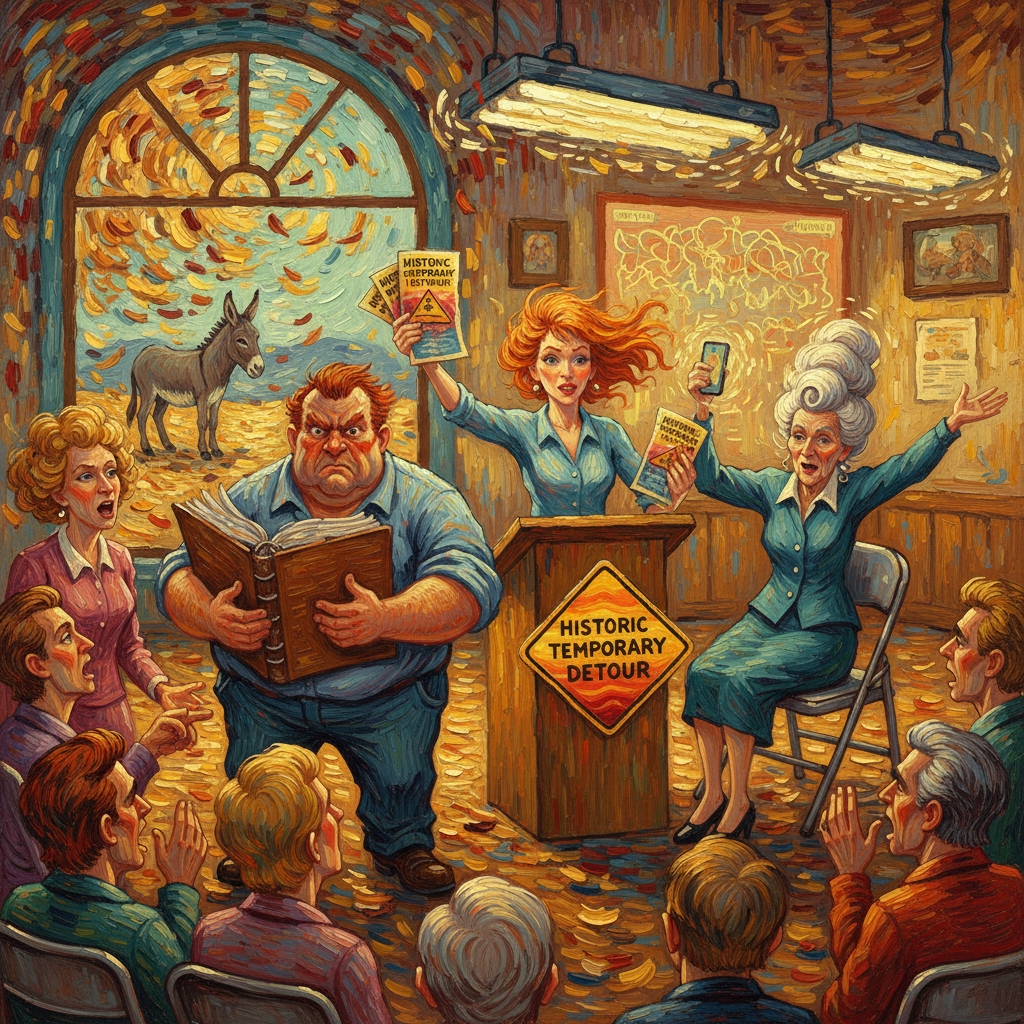
Shelley distributed pamphlets featuring artistic renderings of the sign at sunset.
“Imagine heritage tourism,” she said excitedly. “People love unresolved Americana.”
Boot examined the pamphlet.
“You made the barrel look majestic.”
“Branding matters.”
Mabel stood abruptly.
“This town has lost its mind.”
“We nearly lost it during the gazebo referendum,” RT reminded her.
“Different category.”
Tiffany Annette projected social media metrics onto the wall.
“Online engagement is extremely positive.”
“Online people once believed raccoons could predict weather,” Sheriff Peeler muttered.
Act VII – The Historical Marker Proposal
Kenny Joe raised his hand.
“Technically one raccoon guessed correctly three times.”
“Not helping.”
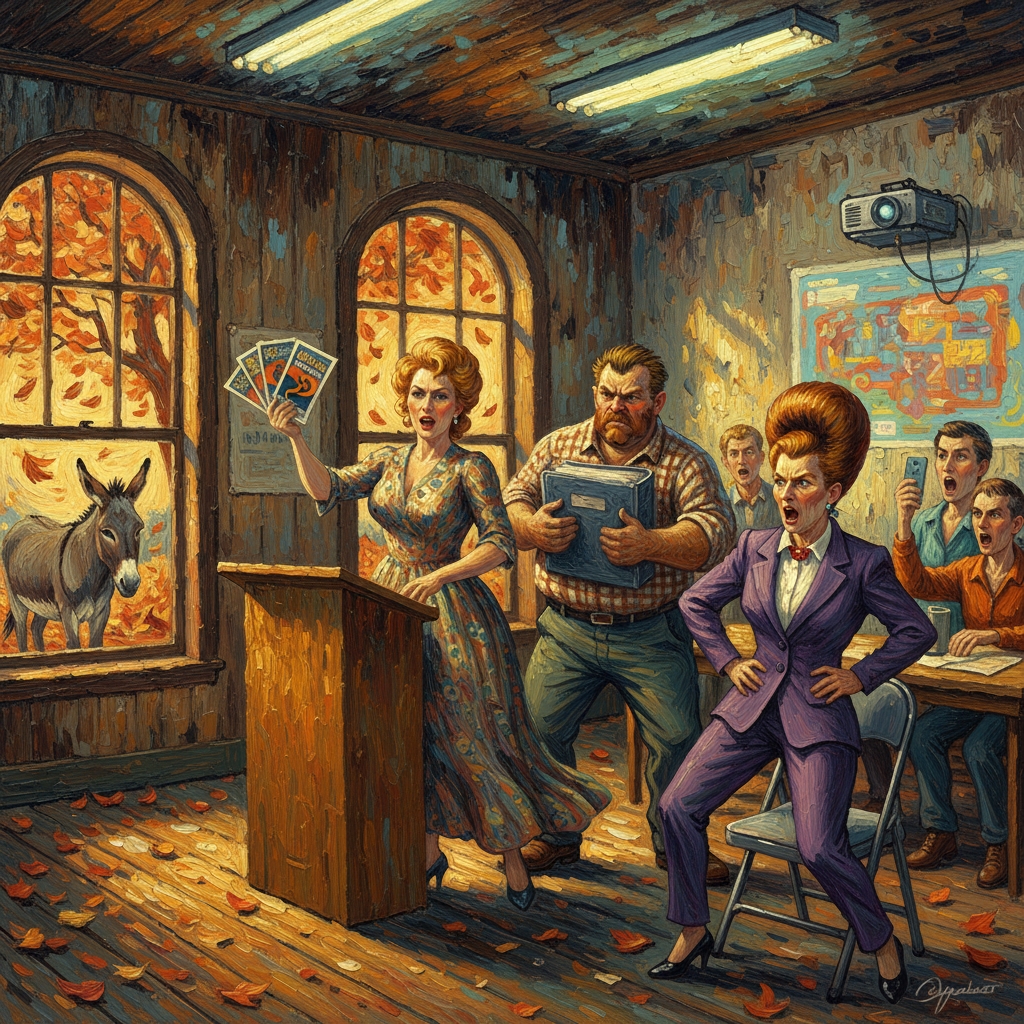
Clovis stepped forward holding a massive binder.
“I move that the town demand immediate removal of temporary terminology from all official documents.”
Shelley gasped theatrically.
“You’d erase the cultural identity?”
“It is a blocked road!”
“It is a living symbol.”
“Of administrative avoidance!”
The argument escalated rapidly.
Sister Lila Mae began fanning herself with church bulletins.
Coach Freddie attempted mediation.
“What if we compromise and call it ‘ongoing’?”
“That’s just temporary with lower self-esteem,” Mabel snapped.
Pastor Peeler observed quietly from the back.
Finally Boot stood.
The room gradually settled.
“I been thinkin’ about this,” he said slowly.
Dangerous words in Sequatchie Crossing.
“When I was younger, temporary meant you expected somethin’ to change.”
Several heads nodded.
“But nowadays folks use temporary like a blanket.”
Nobody interrupted.
“You throw it over a thing so you don’t gotta look directly at it.”
The room stayed still.
Boot glanced toward the windows.
The donkey stood there again beyond the parking lot.
Leaves drifted around him.
“That donkey don’t pretend seasons ain’t happenin’,” Boot said quietly. “He just stands there through all of ’em.”
Nobody laughed.
Because the worst part was that everyone understood exactly what he meant.
Act VII – The Historical Marker Proposal
Act VIII – The Timeline Becomes Unavoidable
Winter returned once more.
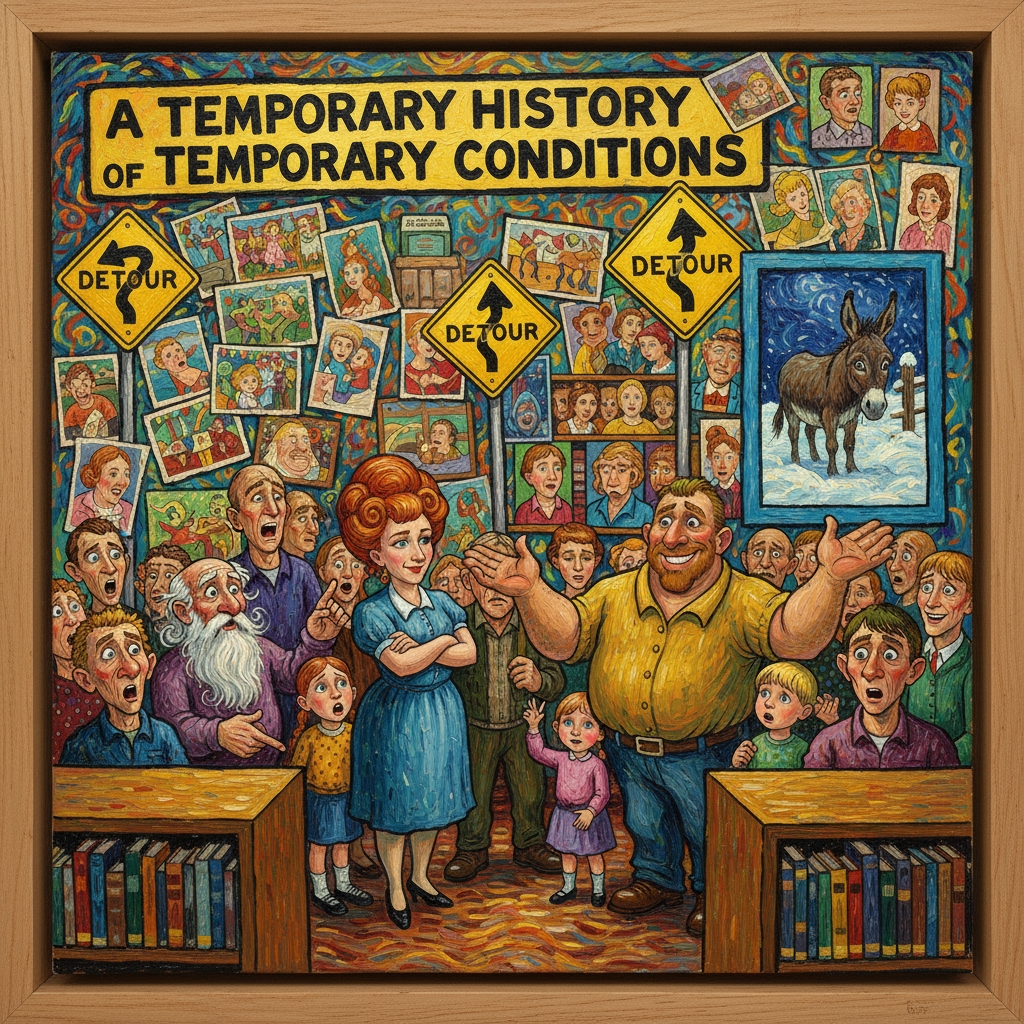
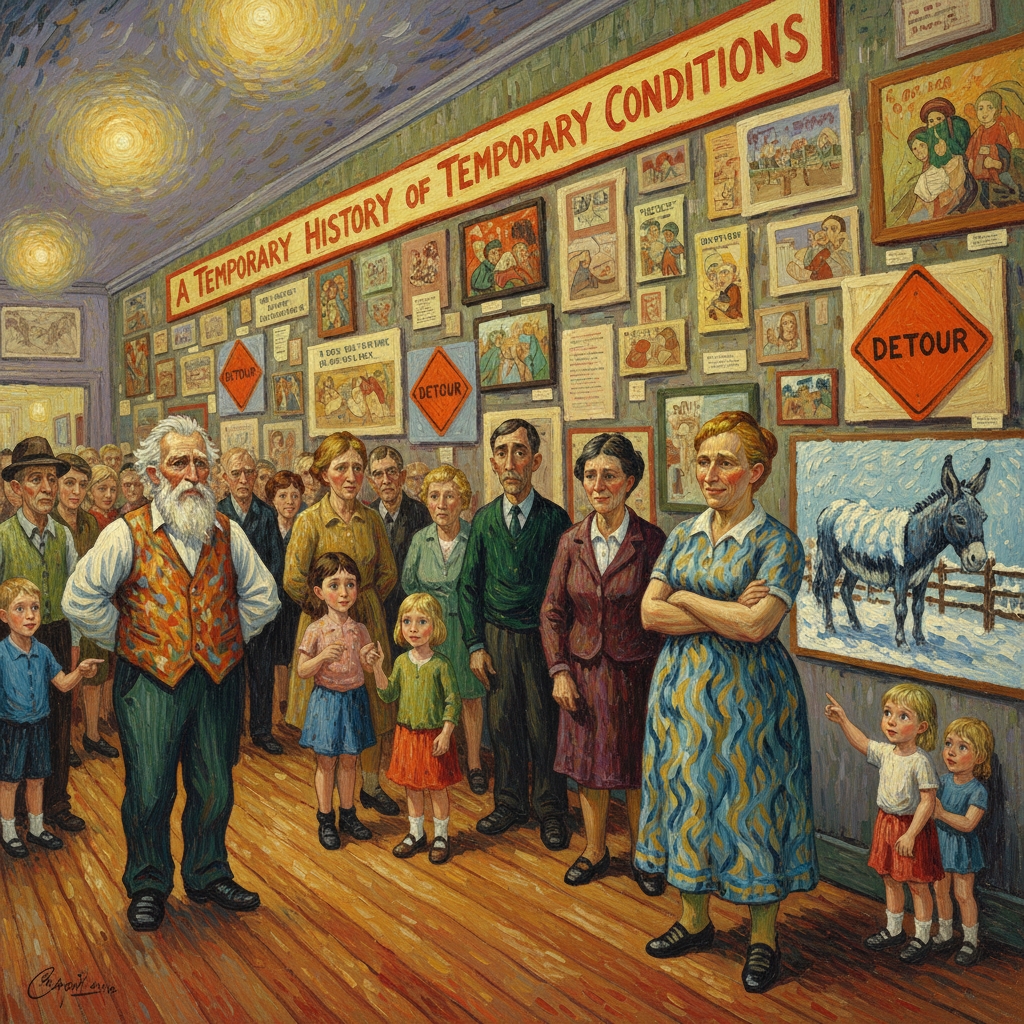
Clovis unveiled a public display in the library titled:
A TEMPORARY HISTORY OF TEMPORARY CONDITIONS
It stretched across an entire wall.
Photographs documented every year of the detour.
Snow. Rain. Elections. Festivals. School buses. Halloween decorations. Pandemic masks. Different gas prices visible on nearby signs.
One picture showed Daisy as a puppy.
Another showed Tiffany Annette graduating high school beside the barricade accidentally visible in the background.
Mabel walked slowly along the timeline.
“Oh my Lord,” she whispered.
Even Shelley Fawn fell silent.
Pastor Peeler studied a photograph from Year Two.
“We all looked younger.”
“Because we were,” Clovis replied.
Children wandered through the exhibit asking innocent questions.
“Why didn’t they fix it?”
Act VIII – The Timeline Becomes Unavoidable
Adults pretended not to hear.
Dr. Neil Cowgill adjusted his glasses thoughtfully.
“This may be the most honest thing this town’s produced in years.”
At the far end of the display hung a recent photograph.
The donkey.
Same fence post.
Same expression.
Different season.
RT stared at it.
“That thing really has been there the whole time.”
Mabel crossed her arms.
“I told y’all.”
Kenny Joe pointed at the dates.
“You know what’s weird? I honestly forgot when it started.”
“That,” Evelyn Grace said softly, “is how denial survives. Not loudly. Quietly.”
Shelley approached Clovis.
“What happens if they finally remove the sign?”
Clovis considered this carefully.
“Then we’ll discover whether the road was blocked…”
He tapped the timeline.
“…or whether we were.”
Nobody particularly enjoyed that answer.
Outside, snow began falling again over Sequatchie Crossing.
The temporary sign leaned slightly farther left than before.
Still standing.
Still temporary.
Still somehow believed by just enough people to continue existing.
Act VIII – The Timeline Becomes Unavoidable
Act IX – The Vote Nobody Expected
The final meeting occurred on a bitter February evening.
Town Hall overflowed.
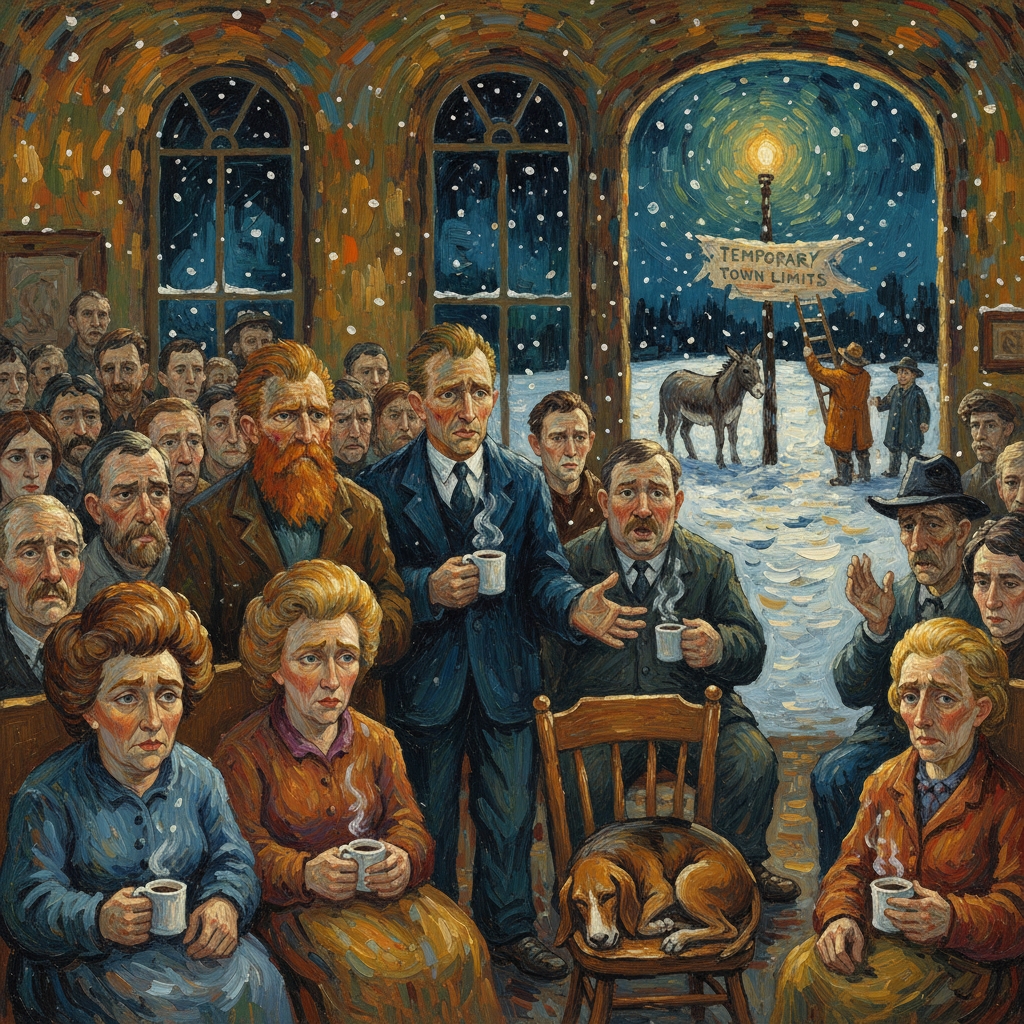
People lined walls holding coffee cups and exhaustion.
The agenda contained only one item:
TEMPORARY DETOUR STATUS REVIEW
Mister Wade Langston adjusted his glasses.
“We are here tonight to determine official terminology moving forward.”
“About time,” Mabel muttered.
Clovis stood first.
“For nearly nine years this town has maintained language disproven by reality.”
He gestured toward photographs lining the walls.
“We documented birthdays, funerals, graduations, floods, and elections beside that sign.”
He paused.
“Temporary is no longer accurate.”
Shelley Fawn rose next.
“Accuracy is not the only civic value.”
Groans erupted immediately.
Act IX – The Vote Nobody Expected
“Hear me out,” she insisted. “The sign became part of the town’s identity. It reminds people that unfinished things still belong to community life.”
“That’s disturbingly poetic,” Sonny whispered.
Pastor Peeler approached slowly afterward.
“I believe both sides are partially correct.”
Everyone sighed.
Classic pastor answer.
“The danger,” he said gently, “was never the sign itself.”
Silence settled.
“It was our willingness to hide behind words long after truth became visible.”
Boot stood beside him unexpectedly.
“How long is temporary?” he asked again.
This time nobody tried answering quickly.
Snow tapped softly against the windows.
Daisy snored beneath Kenny Joe’s chair.
Across the road outside, barely visible beneath the streetlight, the donkey stood in his usual place.
Finally Mabel spoke.
“It’s temporary right up until everybody finally admits it ain’t.”
The room stayed quiet.
Because there it was.
Simple.
Plain.
True.
Mister Wade cleared his throat.
“All in favor of reclassifying the detour from temporary to indefinite municipal condition?”
Hands slowly rose across the room.
Even Shelley raised hers eventually.
Motion carried unanimously.
Nobody applauded.
Because victory felt suspiciously similar to surrender.
Outside, Clovis walked toward the road with Boot beside him.
Workers had already begun removing the old sign.
The bolts squealed loudly in the cold air.
Boot watched carefully.
“You reckon anything changes now?”
Clovis looked toward the dark road ahead.
“I don’t know.”
The sign finally came loose.
For the first time in nearly nine years, the roadside stood empty.
Cold wind moved through the valley.
And out in the pasture, the donkey remained exactly where he had always been.
Watching.
Act IX – The Vote Nobody Expected
Epilogue – The New Sign
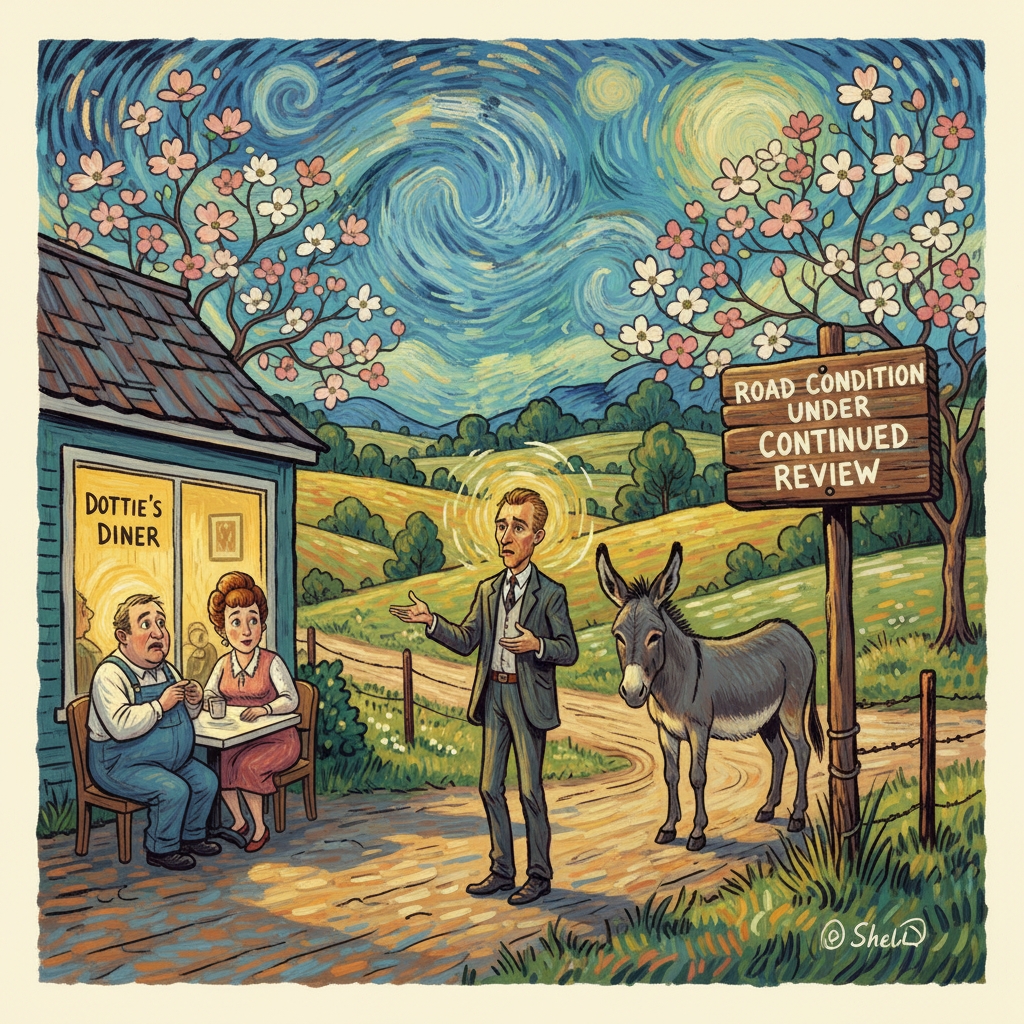
Three weeks later, a new county sign appeared.
ROAD CONDITION UNDER CONTINUED REVIEW
No orange barrels accompanied it.
No timeline.
No promises.
People drove past slowly at first, uncertain what to think.
Then eventually they stopped noticing again.
At Dottie’s Diner one quiet morning, Boot stared through the window toward the road.
“Well,” he said finally, “at least that one sounds honest.”
Mabel sipped coffee.
“Ugly truth ages better than pretty lies.”
Pastor Peeler smiled faintly.
Outside, spring sunlight spread across Sequatchie Crossing.
The valley looked exactly as it always had.
Beautiful.
Tired.
Patient.
And beside the pasture fence stood the donkey.
Older now.
Still in the same spot.
As if he had understood the whole thing from the beginning.
Epilogue – The New Sign
Disclaimer
The events, businesses, institutions, infrastructure failures, emotional support donkeys, civic misunderstandings, and permanently temporary conditions depicted in this story are entirely fictional and belong solely to the world of Sequatchie Crossing.
Any resemblance to real towns, actual government processes, unresolved county projects, mysteriously eternal roadwork, strategic misuse of the word “temporary,” or citizens emotionally adapting to absurdity over time is purely coincidental.
No real residents of Dunlap, Tennessee were referenced in this fictional story.
Though statistically speaking, somewhere in America, there is absolutely a sign still standing from 2017 that nobody wants to explain anymore.
Disclaimer – Temporary Situation Enters Its Ninth Year Without Update
Real Places Behind the Ruckus – From The Dunlap Directory
Real Places Behind the Ruckus – From The Dunlap Directory
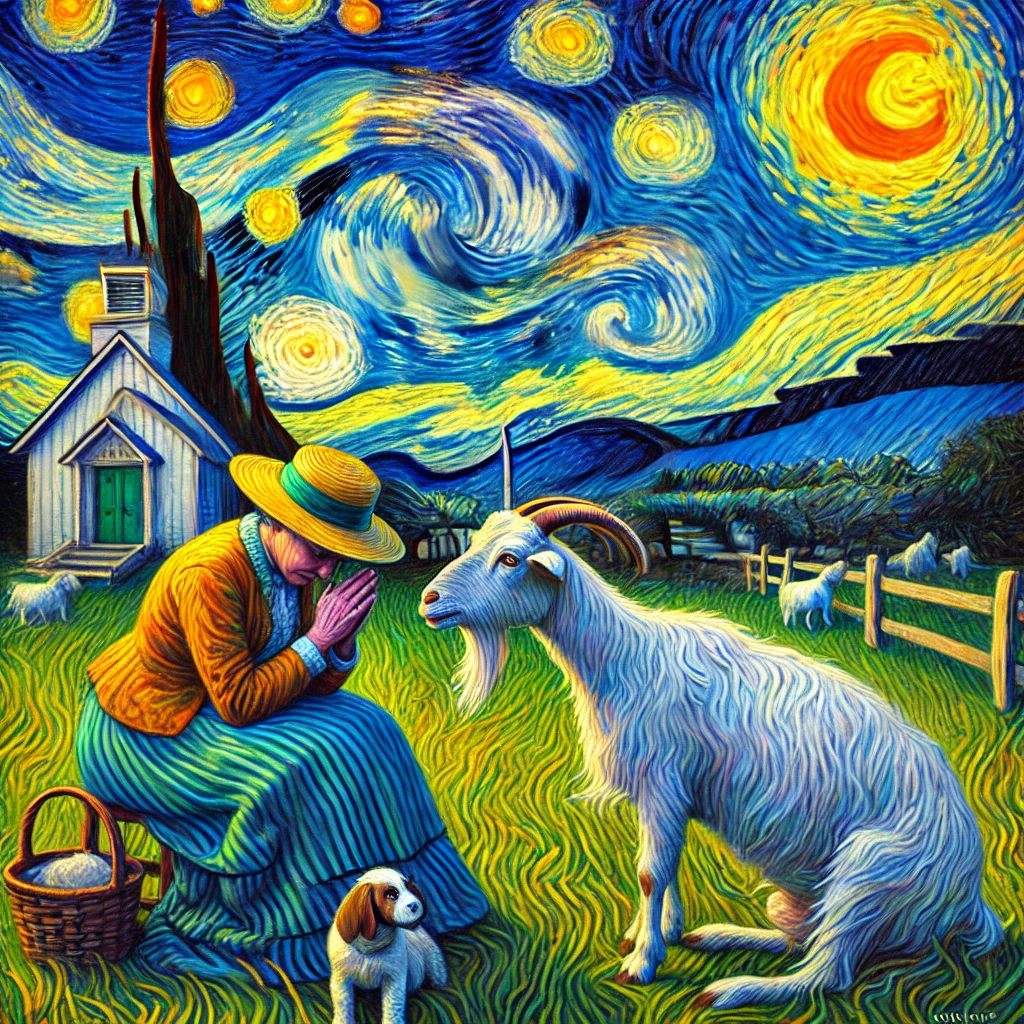
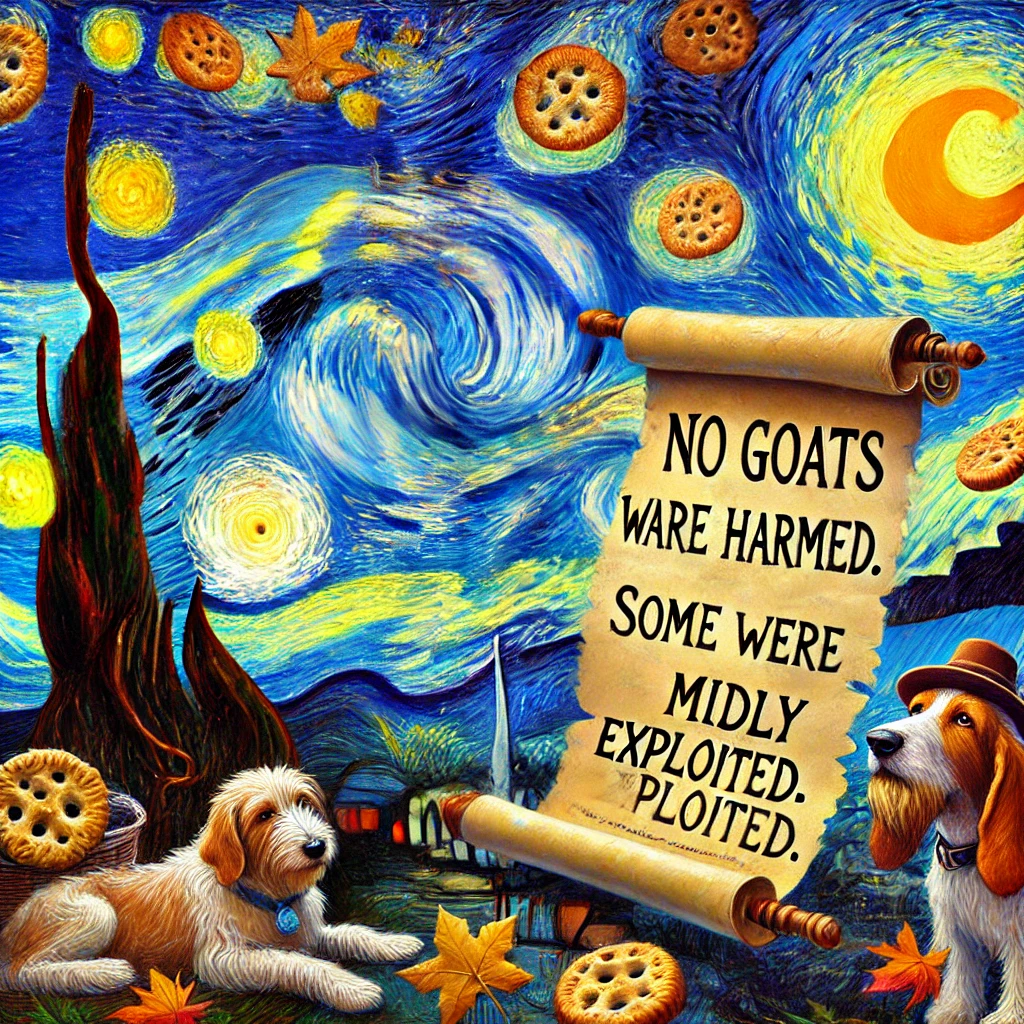
Yes, this story was fictional; even the parts that weren’t true. These places? Absolutely real. Stop by, support local, and keep the Wi-Fi away from livestock:
- United Country Southeast Land Solutions
- ATM at Circle K
- Tiger Rock Dunlap
- Stocker Tire & Services Center
- Willow Rose Stables – Event Pony Rental
- The Chef’s Restaurant
- Sequatchie Valley Homestead
- Rock City Gardens
- Local Depot
- Bigfoot Adventure TN Zipline
- Waldemar Design & Machine
- Pine Dell Feed Mill
- Dunlap Restaurant
- Mountain Inn & Suites
- Possum Creek RV Park & Campground
- Dunlap Grapevine 2.0
Real Places Behind the Ruckus – From The Dunlap Directory
At Sequatchie Crossing, we tell the stories of Sequatchie Crossing.
Please share this post with your friends, family, or business associates who may want follow the news from Sequatchie Crossing.

0 Comments