


Similar Conditions Observed In Other Locations, Not Locally
By Tom Seest
At Sequatchie Crossing, we tell the stories of Sequatchie Crossing.
Please share this post with your friends, family, or business associates who may want follow the news from Sequatchie Crossing.
🎤 Audio Overview
Town Agrees Problem Exists Elsewhere, Not Here
Act I – The Map on the Wall at Earlene’s Diner
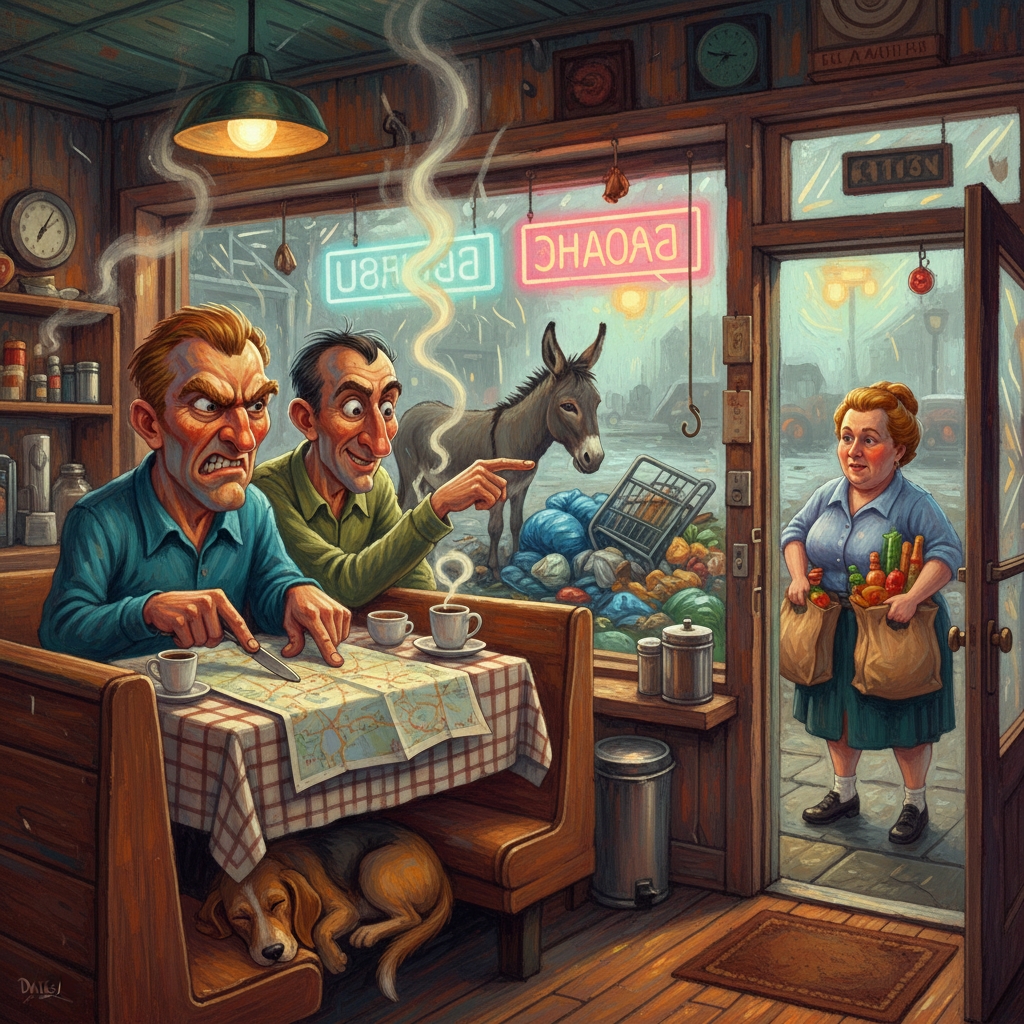
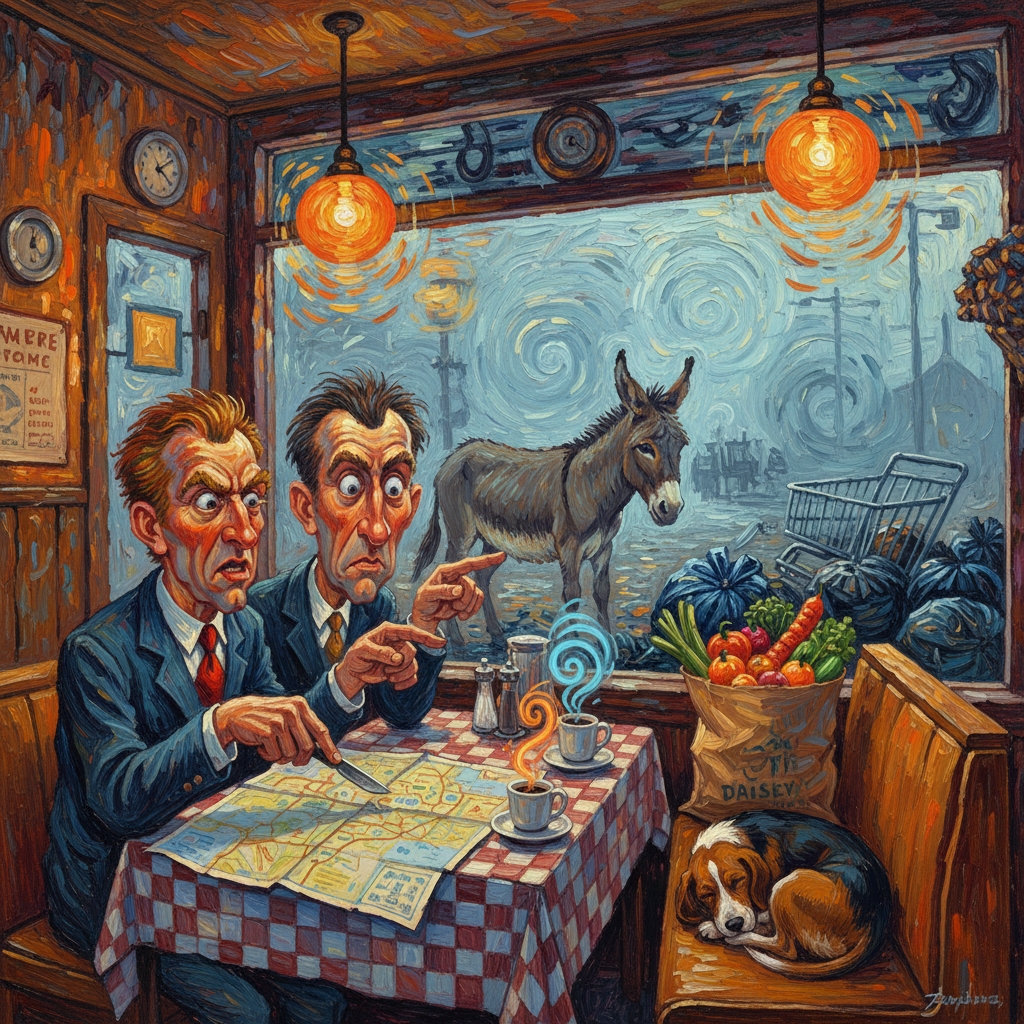
The first official discussion about the problem began at Earlene’s Diner around seven-thirty on a Tuesday morning while Daisy the hound slept beneath Booth Three and Clovis Strickland poked at a laminated highway map with the handle of a butter knife.
“You see right there,” Clovis said, tapping the paper so hard the syrup bottles rattled. “That’s Jasper. They got the exact same issue over there.”
Mister Wade Langston squinted over his coffee.
“What issue?”
“The one everybody’s talkin’ about.”
“That ain’t an answer.”
Clovis leaned back proudly.
“Exactly.”
Boot Barnes sat nearby wearing a faded overalls bib with one strap unhooked and stared through the window toward the parking lot.
“It’s in the parking lot,” Boot said.
“No it ain’t,” Clovis replied immediately.
“It absolutely is.”
“That’s mud.”
“That’s not mud.”
Mabel Dean Ashcroft entered carrying two grocery sacks and stopped beside the hostess stand.
“You boys still arguing about whether the county’s falling apart while sitting in it?”
“We are not falling apart,” Clovis declared. “We’re discussing regional deterioration.”
Mabel set the sacks down.
“Regional deterioration is sitting outside next to Earlene’s propane cage.”
Pastor Arnold Peeler folded his newspaper carefully.
“Now folks,” he said calmly, “we ought not exaggerate conditions.”
Boot pointed through the glass.
Act I – The Map on the Wall at Earlene’s Diner
“There’s literally a shopping cart upside down in the drainage ditch.”
“That cart blew over from somewhere else,” Clovis insisted.
Officer Kenny Joe Teeter entered at that exact moment carrying a sausage biscuit.
“Morning.”
Everyone pointed toward him at once.
“You seen the problem?” Clovis asked.
Kenny Joe paused.
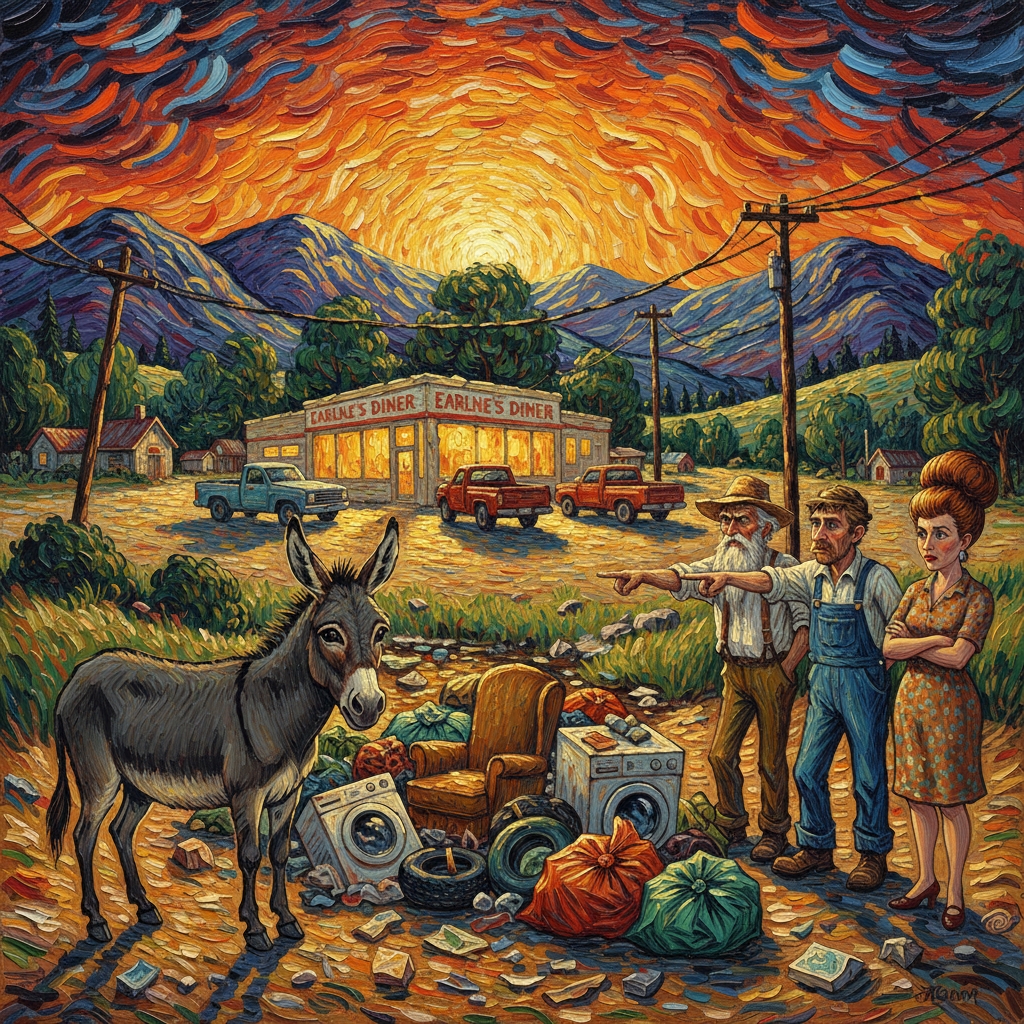
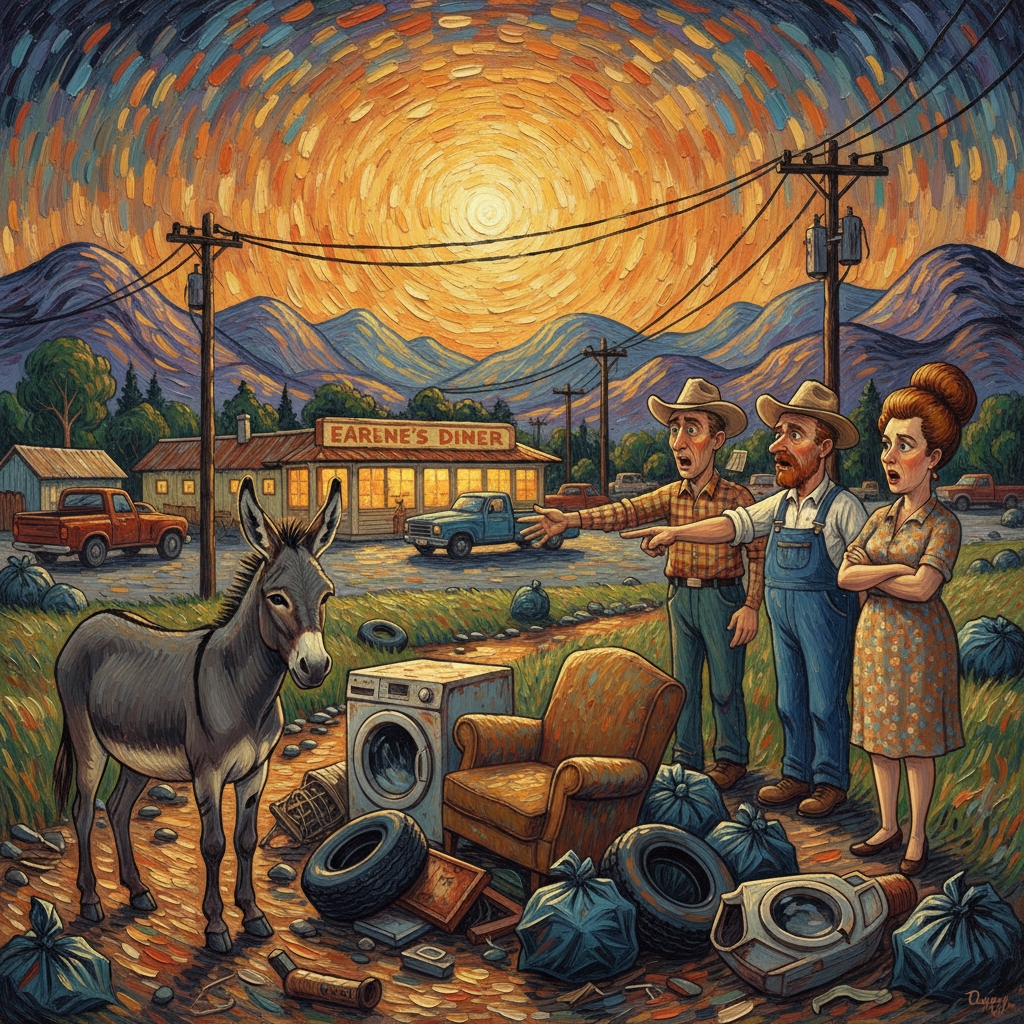
“You mean the donkey?”
Silence spread across the diner.
Mabel closed her eyes slowly.
“There is a donkey?”
“Standing by the ditch,” Kenny Joe said. “Been there since dawn.”
Boot slapped the counter triumphantly.
“THAT’S what I been trying to tell y’all.”
Clovis waved dismissively.
“That donkey ain’t the problem. That donkey is adjacent to the problem.”
Outside, through the fogged diner windows, the donkey stood perfectly still beside a leaning road sign and several black garbage bags that had split open near the ditch line.
Daisy lifted one eye from beneath the booth, considered the situation, then went back to sleep.
Trixie Jo Bartlett burst through the door carrying her phone high like evidence.
“It’s already on Facebook,” she announced. “People from Pikeville are commenting.”
“That proves my point,” Clovis said immediately. “Outside interference.”
Mabel stared at him.
“Clovis, the donkey is physically here.”
“But the criticism is external.”
Shelley Fawn Wexler entered next, carrying three folders labeled COMMUNITY IMAGE INITIATIVE.
“I just came from Town Hall,” Shelley said breathlessly. “The mayor wants everybody to avoid language that negatively impacts civic optimism.”
Boot frowned.
“What does that even mean?”
“It means don’t say we got problems.”
Mabel laughed so hard she nearly dropped her grocery sacks.
“So the official plan is blindness?”
“Strategic positivity,” Shelley corrected gently.
Pastor Peeler nodded thoughtfully.
“Well now, perspective matters.”
Boot pointed again through the window.
“The donkey’s eatin’ cardboard.”
Everybody turned.
The donkey was indeed chewing on a wet Amazon box beside the ditch.
Clovis shrugged.
“Animals adapt.”
Act I – The Map on the Wall at Earlene’s Diner
Act II – Town Hall and the Committee for Comparative Conditions
By noon the Town Hall meeting room had filled with folding chairs, humid air, and people pretending they had only stopped by accidentally.
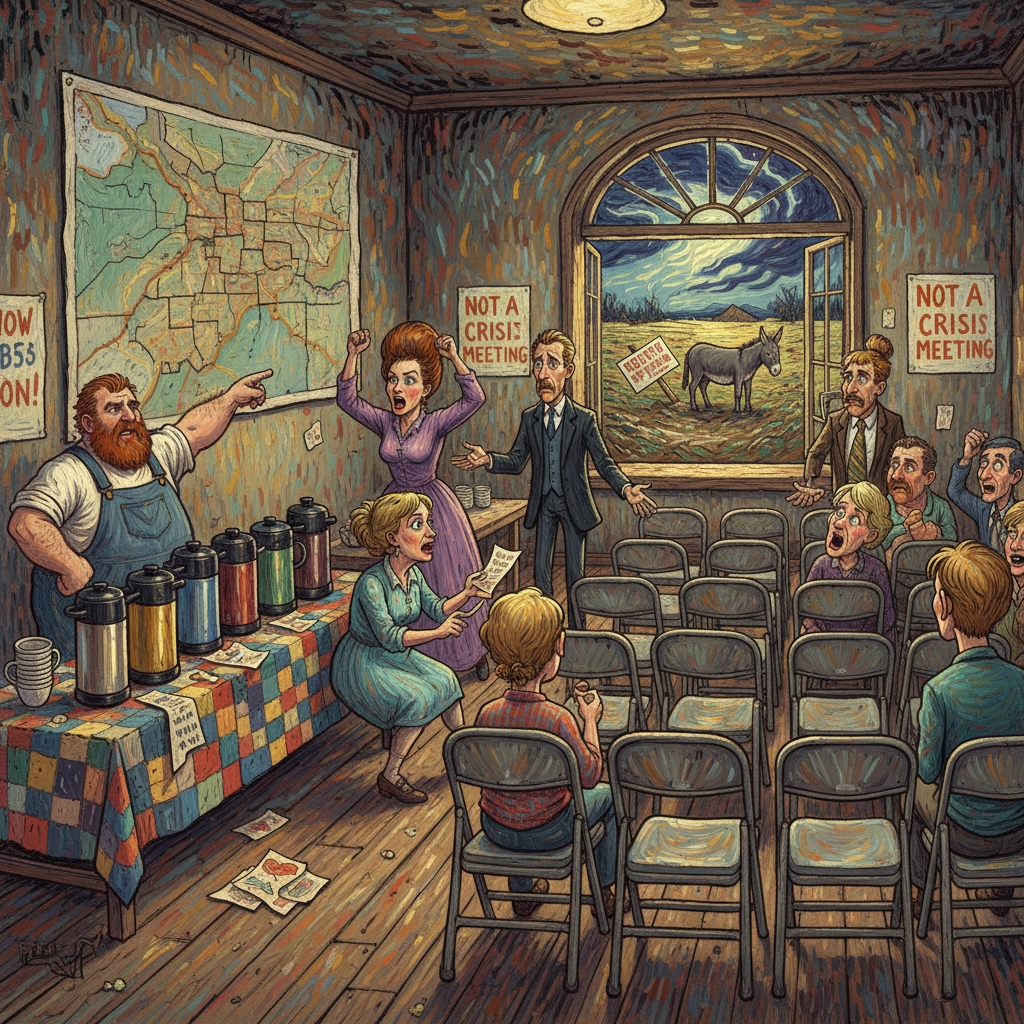
Shelley Fawn Wexler arranged printed signs along the walls:
COMMUNITY PRIDE FORUM
NOT A CRISIS MEETING
Maggie Sue Dillard whispered to Evelyn Grace Tipton near the coffee urn.
“If you have to put ‘not a crisis’ on the sign, it usually is.”
Evelyn nodded.
“That’s how the church kitchen fire started.”
Sheriff Peeler leaned against the rear wall beside Officer Kenny Joe.
“You think this gets ugly?” Kenny Joe asked quietly.
“It’s already ugly,” the sheriff replied. “Now it’s organized.”
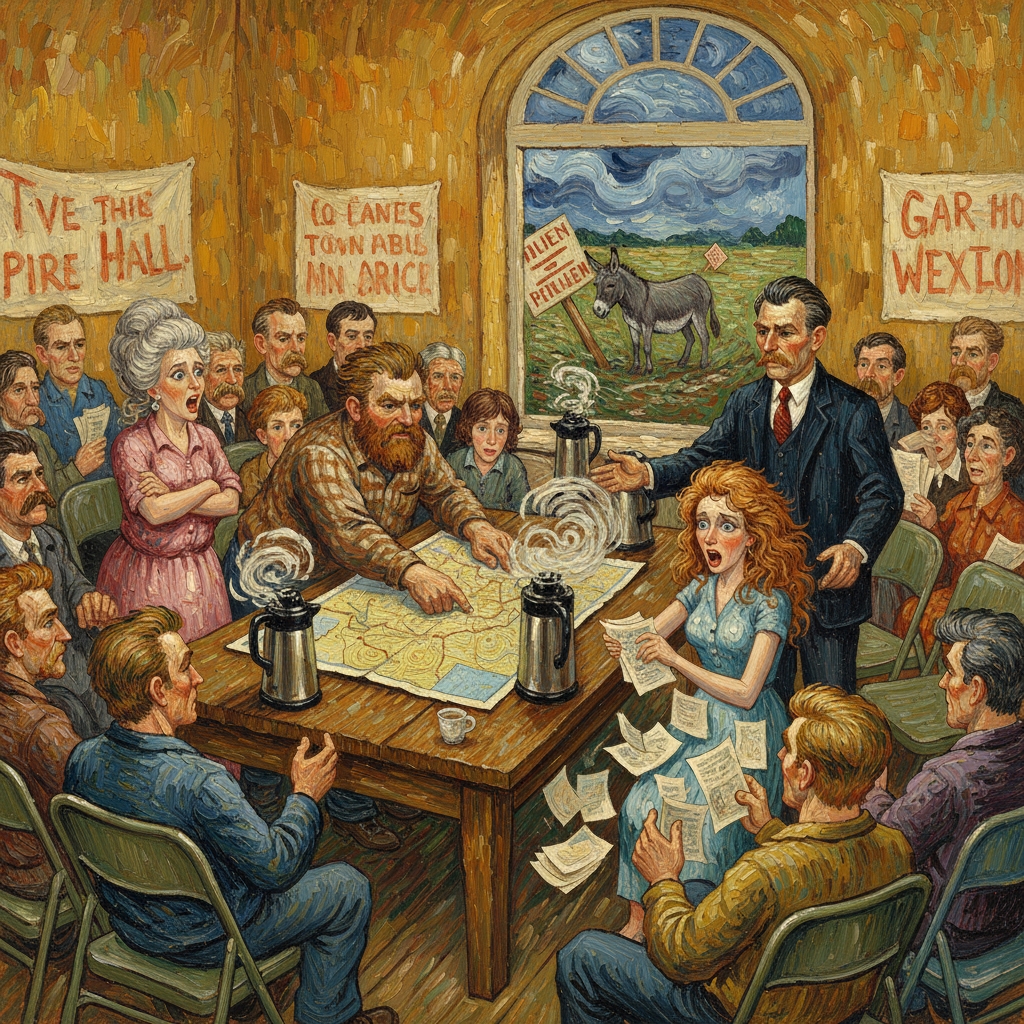
At the front table sat Shelley, Pastor Peeler, Clovis Strickland, and Coach Freddie Stubblefield, who looked deeply confused about why he had been invited.
“I thought this was about youth sports,” Coach Freddie muttered.
“It’s about morale,” Shelley explained.
“That somehow sounds worse.”
The meeting opened with Pastor Peeler standing slowly.
“Friends,” he said gently, “every town faces challenges. Scripture teaches us to maintain perspective.”
Boot Barnes raised a hand immediately.
“Can perspective remove a dead washing machine from a creek?”
Shelley winced.
“We are not discussing isolated incidents.”
Mabel stood from the audience.
“They stopped being isolated when they started breeding.”
Murmurs spread across the room.
Clovis walked to a map mounted on an easel.
“As you can see,” he began proudly, “neighboring communities exhibit substantially worse indicators.”
“What indicators?” asked Tiffany Annette Roark.
Clovis blinked.
Act II – The Committee for Comparative Conditions
“Well… indicators.”
“Like what?”
He pointed randomly.
“Abandoned couches per capita.”
“Did you make that statistic up?” Tiffany asked.
“I estimated it spiritually.”
Boot snorted loudly.
Pastor Peeler stepped forward diplomatically.
“The point Clovis is making is that hardship exists everywhere.”
“Yes,” Mabel interrupted. “Including here.”
“No,” Clovis corrected. “Here we have transitional irregularities.”
“Trash.”
“Temporary visual inconsistencies.”
“Broken appliances.”
“Localized aesthetic fluctuations.”
Boot stood up.
“There’s a refrigerator in the creek behind my cousin’s trailer.”
“That refrigerator came downstream.”
“From WHERE, Clovis? Cincinnati?”
Laughter erupted across the room.
Meanwhile outside Town Hall, unnoticed by most attendees, the same gray donkey had wandered into the courthouse lawn and stood directly beside a collapsed campaign sign from two elections ago.
Doug “Doughboy” Teeter looked out the window.
“That donkey’s movin’ strategically.”
“No animal moves strategically,” Clovis scoffed.
The donkey promptly scratched itself against the leaning sign until the entire thing fell flat into the mud.
Silence filled the room.
Trixie Jo raised her phone.
“I got that on video.”
Shelley pinched the bridge of her nose.
“Please don’t post that.”
“Too late.”
Mabel crossed her arms.
“Maybe the donkey’s trying to tell us something.”
Clovis shook his head firmly.
“The donkey is coincidental.”
“Coincidentally standing in every bad spot.”
Pastor Peeler sighed softly.
“Sometimes the Lord sends illustrations.”
Boot nodded solemnly.
“Sometimes He sends donkeys.”
Act II – The Committee for Comparative Conditions
Act III – The Porch at Mabel Dean’s House
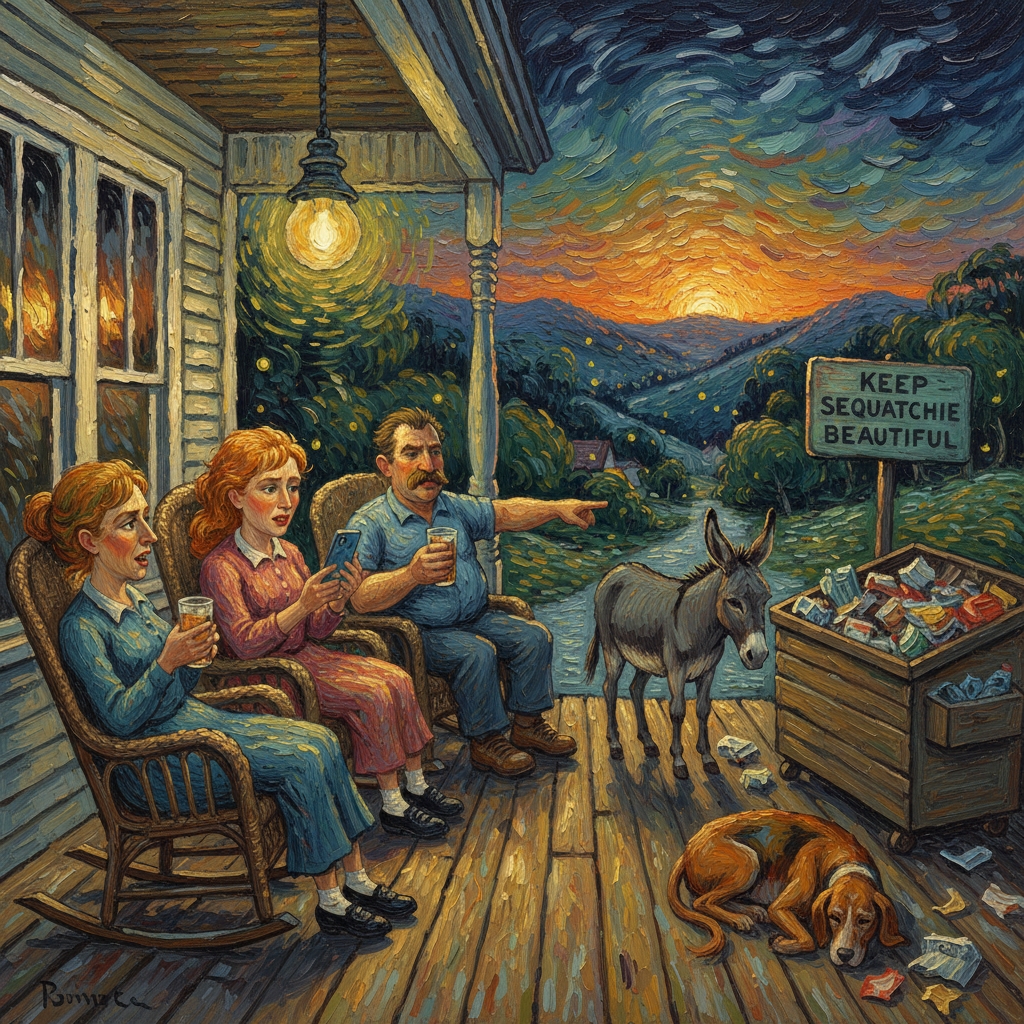
That evening several residents gathered on Mabel Dean Ashcroft’s porch beneath a flickering bug light while cicadas screamed from the trees.
Mabel poured sweet tea into mismatched glasses.
“You know what the real problem is?” she said. “Everybody wants the comfort of honesty without the inconvenience of admitting anything.”
Lurleen Davenport rocked slowly in a rusted chair.
“That’s been true here since the Nixon administration.”
Trixie Jo scrolled through comments online.
“People from Chattanooga are now arguing with people from Dunlap about whether we have visible decline.”
“How would Chattanooga know?” Clovis scoffed from the porch rail.
Shelley Fawn Wexler looked exhausted.
“Because y’all keep uploading pictures.”
Boot pointed toward the road.
“The donkey’s back.”
Everyone turned simultaneously.
Sure enough, the gray donkey stood beside an overflowing roadside dumpster directly beneath a sign reading KEEP SEQUATCHIE BEAUTIFUL.
Mabel stared at it.
“That animal has timing.”
Daisy barked twice from beneath the porch swing.
Pastor Peeler arrived carrying a casserole dish.
“My wife sent squash casserole.”
“Trying to calm the public?” Boot asked.
“Trying to survive it.”

Act III – The Porch at Mabel Dean’s House
They passed plates around while the conversation drifted.
Tiffany Annette Roark spoke carefully.
“I think people are scared.”
“Of what?” Clovis asked.
“Of being associated with decline.”
Mabel nodded.
“Exactly. Folks think admitting something exists means they caused it.”
Coach Freddie leaned against the railing.
“Same thing happened with the football field drainage problem. Everybody knew it flooded. Nobody wanted ownership.”
“What fixed it?” Shelley asked.
Coach Freddie shrugged.
“The field flooded during Homecoming.”
Boot grinned.
“Public embarrassment remains undefeated.”
Pastor Peeler looked thoughtful.
“There’s a difference between condemnation and acknowledgment.”
“Tell that to Facebook,” Trixie muttered.
The donkey wandered farther down the road and stopped beside a mattress lying near the creek bank.
Clovis pointed triumphantly.
“That mattress could belong to anybody.”
Mabel stared at him.
“Clovis, it’s growing moss.”
“Natural processes happen everywhere.”
“Not usually indoors.”
Sheriff Peeler arrived in his cruiser and stepped onto the porch.
“You folks seen a donkey?”
Everybody pointed silently.
The sheriff sighed.
“That thing’s been wandering all over town.”
“Seems intentional,” Boot said.
“Donkeys ain’t intentional.”
The donkey immediately walked into the center of the road and stood beside a pothole large enough to lose a lawn chair in.
Nobody spoke.
Kenny Joe finally whispered:
“Well… that’s eerie.”
Act III – The Porch at Mabel Dean’s House
Act IV – Sunday Service at Mercy Ridge Fellowship
By Sunday morning the issue had become impossible to avoid, which naturally meant everyone tried harder.
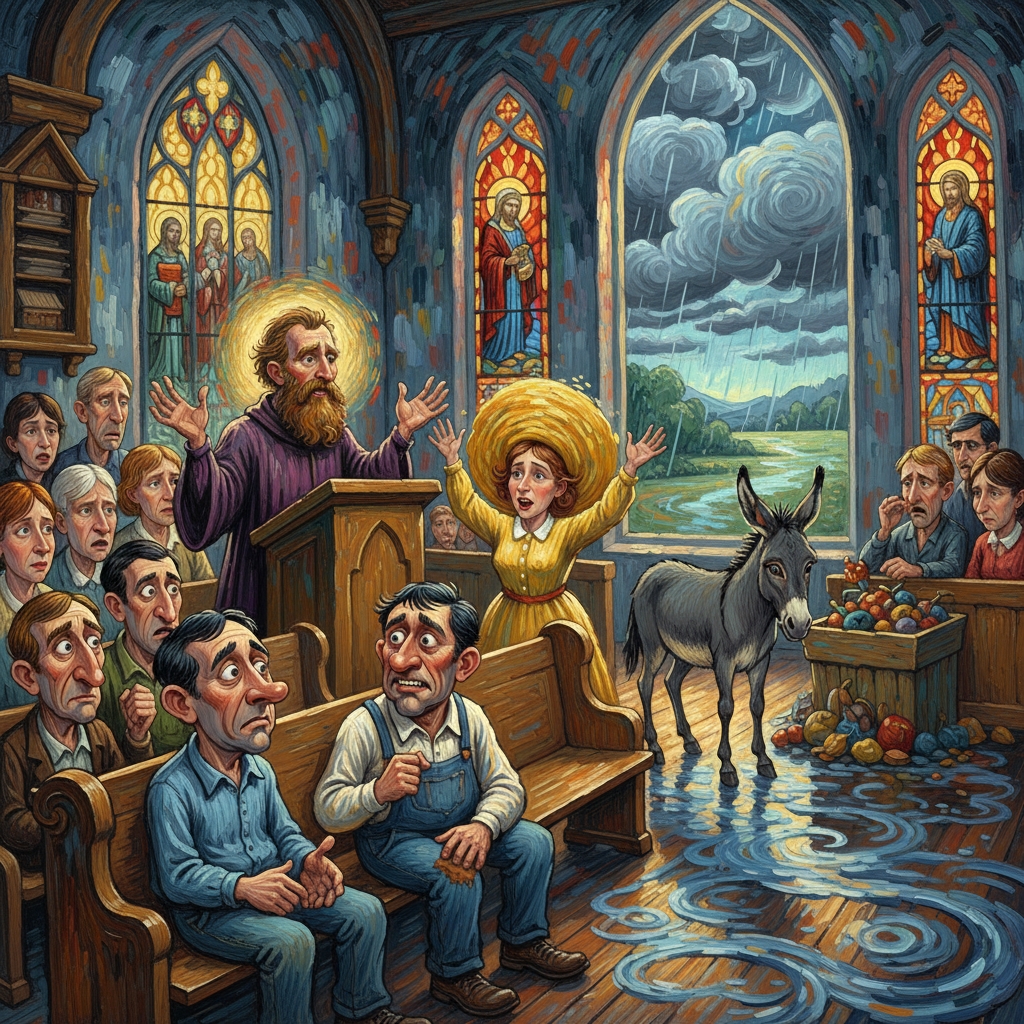
Mercy Ridge Fellowship filled early.
Pastor Arnold Peeler stood behind the pulpit while Sister Lila Mae “Hallelujah” Pruitt fanned herself dramatically in the front pew.
Outside, rain clouds gathered over the valley.
Inside, tension simmered beneath church politeness.
“We gather today,” Pastor Peeler began, “to remember humility.”
“Amen,” Sister Lila Mae shouted instantly.
“And perspective.”
“Amen again.”
“And honesty.”
That amen arrived weaker.
Boot Barnes sat beside Clovis wearing a shirt that read IF FOUND RETURN TO PORCH.
Mabel sat behind them with crossed arms.
Pastor Peeler continued carefully.
“There is wisdom in recognizing that every community faces burdens.”
Clovis nodded vigorously.
“Exactly.”
“But,” Pastor Peeler added, “there is also danger in pretending burdens only belong elsewhere.”
Mabel smiled slowly.
“Here we go.”
Shelley Fawn Wexler shifted nervously.
Pastor Peeler stepped from behind the pulpit.
“When floods came to neighboring counties, we prayed for them. When factories closed elsewhere, we pitied them. When roads crumbled in nearby towns, we shook our heads.”
“Amen,” Sister Lila Mae whispered.
“But compassion without reflection becomes arrogance.”
Silence fell.
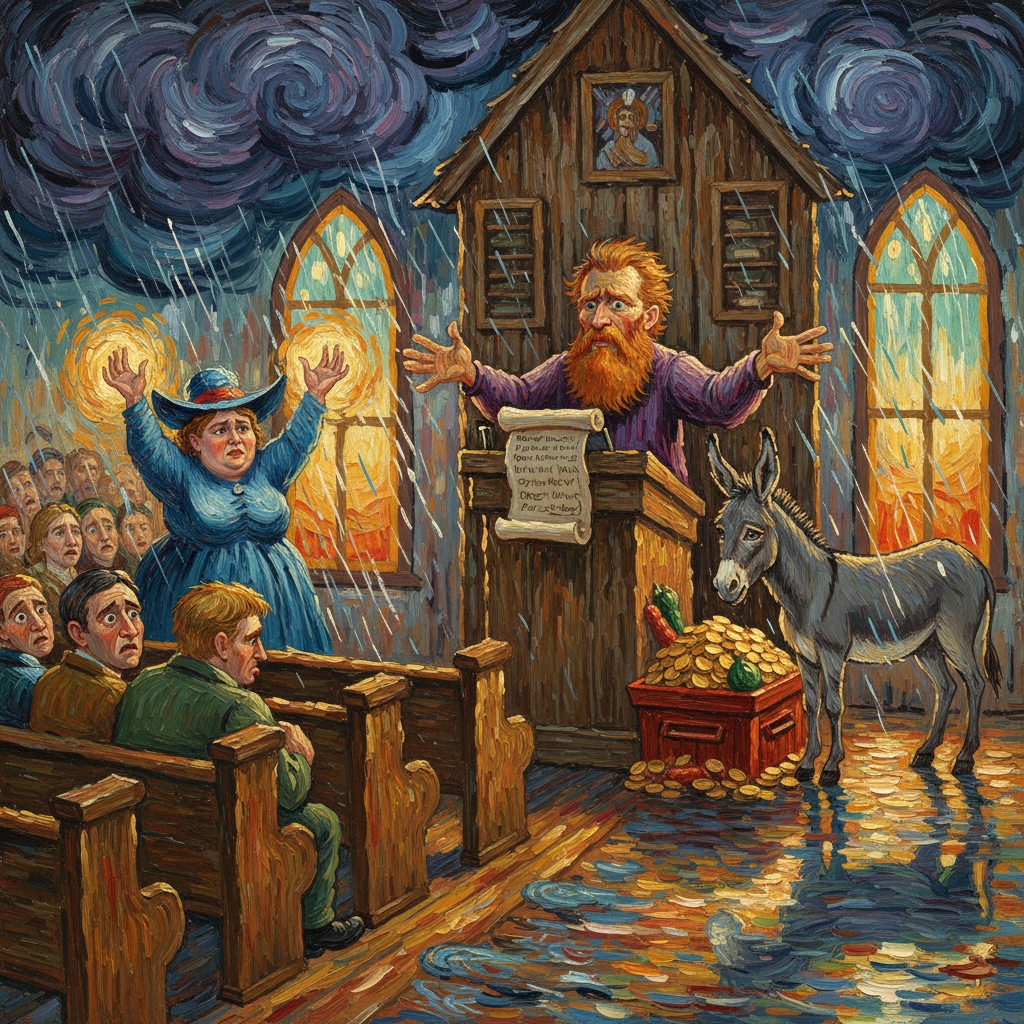
Boot raised one finger toward the stained-glass window.
“The donkey’s outside.”
Half the congregation turned.
Act IV – Sunday Service at Mercy Ridge Fellowship
There, visible through the fellowship hall windows, stood the gray donkey beside an overflowing church donation bin.
Pastor Peeler closed his eyes briefly.
“Oh come on.”
The congregation erupted into murmurs.
“That animal knows schedules,” Kenny Joe whispered.
Sister Lila Mae stood dramatically.
“The Lord has sent a four-legged parable!”
“It’s just a donkey,” Clovis protested.
“Then why’s it always standin’ where nobody wants to look?”
Nobody answered.
Outside, rain began falling softly while the donkey calmly chewed weeds beside the overflowing bin.
Pastor Peeler lowered his voice.
“Friends, sometimes the easiest thing in the world is believing suffering lives somewhere else.”
Mabel nodded quietly.
“Distance makes everything cleaner.”
Shelley wiped her forehead.
“We’re losing control of the narrative.”
Boot laughed.
“We never had control.”
The rain intensified.
Water began pouring through a clogged church gutter and flooding across the parking lot toward several rusting folding tables stacked behind the fellowship hall.
Everybody watched silently.
Clovis finally cleared his throat.
“That drainage issue’s been worse over in Whitwell.”
Mabel nearly threw her hymnal at him.
Act IV – Sunday Service at Mercy Ridge Fellowship
Act V – Sonny Morales and the County Line Theory
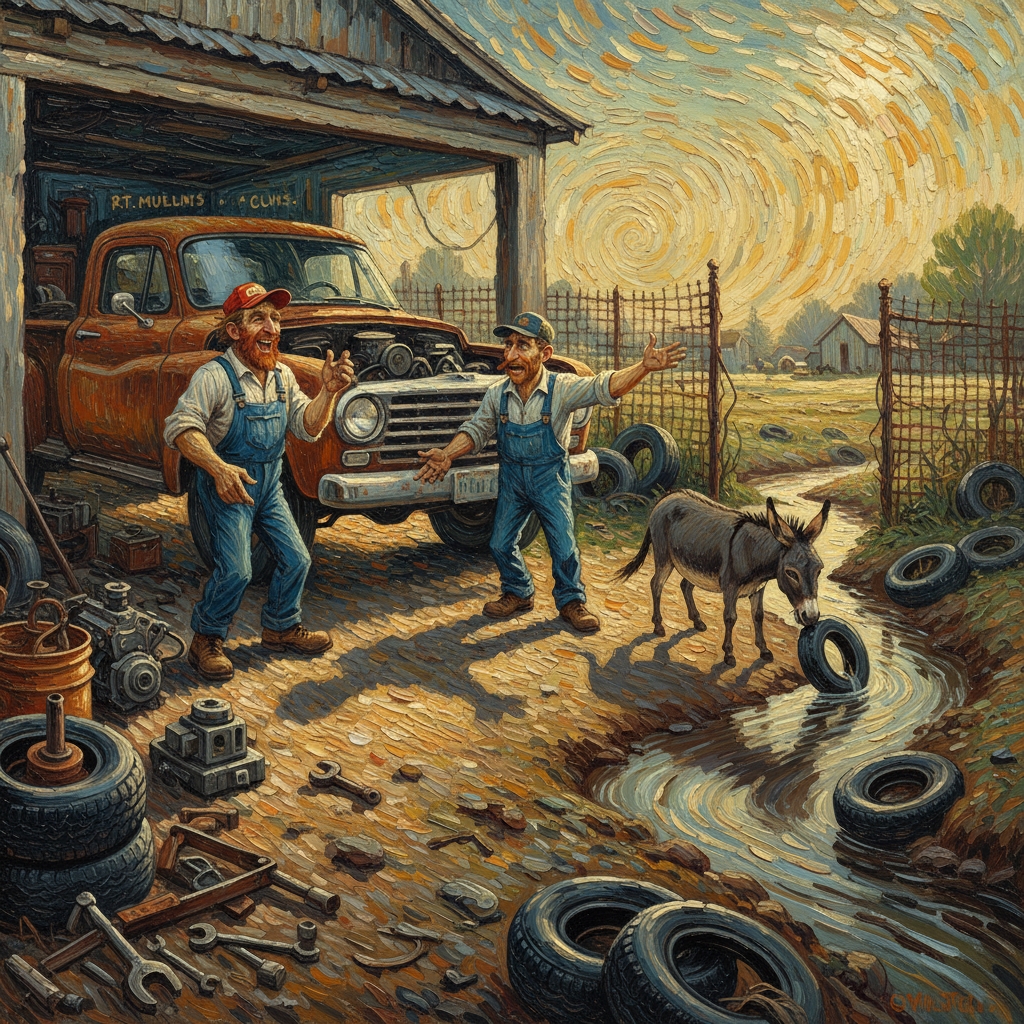
The following Tuesday Sonny Morales reopened his garage bay after lunch and found Clovis Strickland sitting on an upside-down bucket explaining geography to anybody trapped nearby.
“I’m tellin’ you,” Clovis said, “problems behave regionally.”
Sonny wiped grease from his hands.
“Trash don’t migrate like geese.”
“It absolutely does near county lines.”
RT Mullins snorted from beneath a truck hood.
“That may be the dumbest thing you’ve said this month.”
“Air currents.”
“Air currents carried a recliner into the creek?”
“It’s possible.”
Boot Barnes appeared holding a biscuit wrapped in foil.
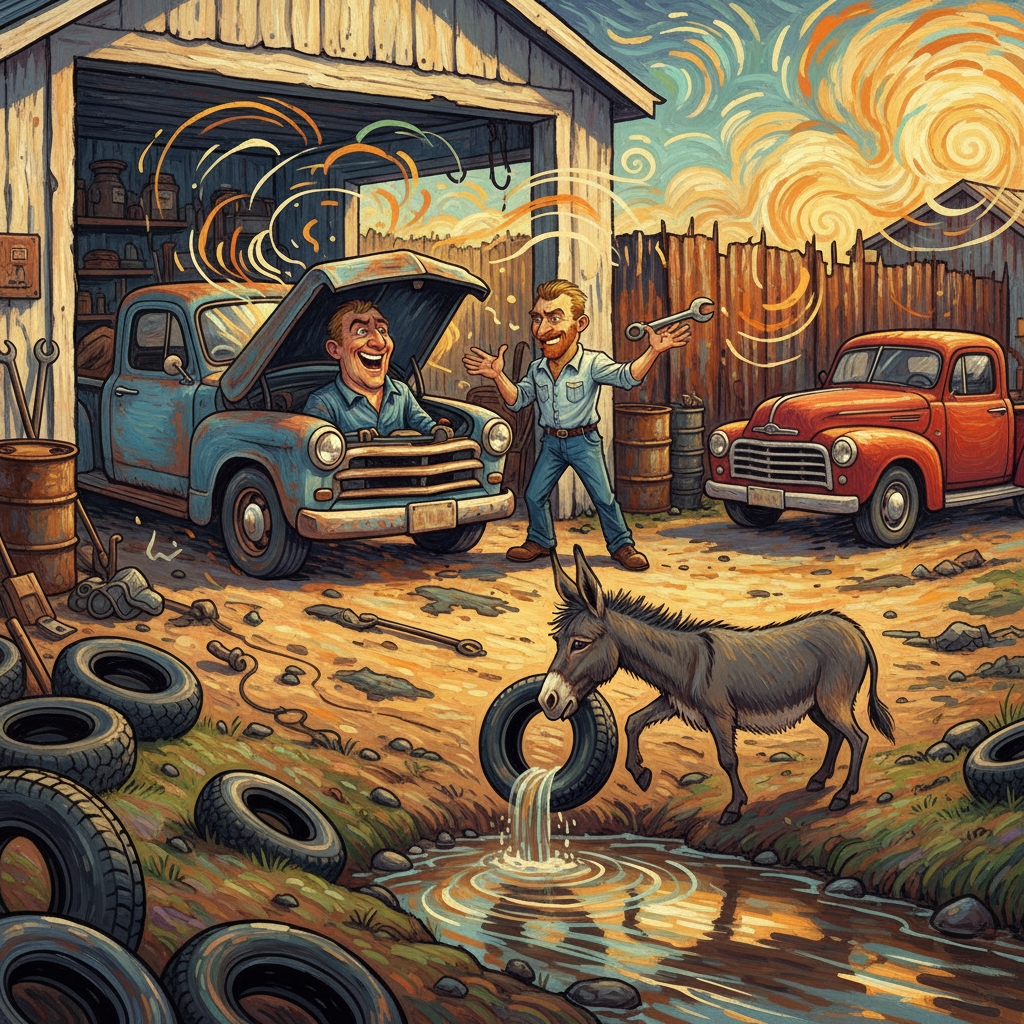
“The donkey’s over by the tire pile.”
Everyone turned.
Indeed, the donkey stood beside an illegal dumping area behind the garage where several ancient tires leaned against a collapsed fence.
Sonny rubbed his temples.
“How’s that thing always find the mess?”
RT looked thoughtful.
“Maybe it’s attracted to shame.”
“That’s not science,” Clovis objected.
“No,” RT replied, “but it tracks.”
Tiffany Annette Roark arrived carrying a clipboard.
“I’m documenting repeated denial behaviors.”
Clovis frowned.
“You can’t diagnose civic attitudes.”
“Watch me.”
Act V – Sonny Morales and the County Line Theory
She pointed her pen toward the tire pile.
“So what’s your explanation for that?”
“That’s historic clutter.”
Sonny barked out a laugh.
“Historic clutter.”
“We preserve heritage here.”
“Through appliance disposal?”
Meanwhile the donkey had begun nudging one tire downhill toward the creek.
“Oh no,” Sonny muttered.
The tire rolled slowly before splashing into muddy water.
Everybody watched.
The donkey stared proudly at the result.
Boot nodded solemnly.
“He’s makin’ statements now.”
Kenny Joe pulled into the gravel lot moments later.
“Sheriff says we can’t officially arrest a donkey.”
“Can we unofficially?” RT asked hopefully.
“Apparently not.”
Shelley Fawn Wexler arrived carrying fresh flyers.
COMMUNITY BEAUTIFICATION WEEKEND
Mabel read one and laughed bitterly.
“You scheduled cleanup after six months of arguing whether anything needs cleaning?”
Shelley sighed.
“Compromise.”
“That ain’t compromise,” Boot said. “That’s surrender with clip art.”
Clovis pointed toward neighboring hills.
“I still maintain conditions are worse elsewhere.”
Mabel crossed her arms.
“Why’s that matter?”
“Perspective.”
“No,” she said quietly. “Comfort.”
That stopped everybody for a moment.
Even the donkey stood still.
Act V – Sonny Morales and the County Line Theory
Act VI – The Sheriff’s Office and the Official Statement
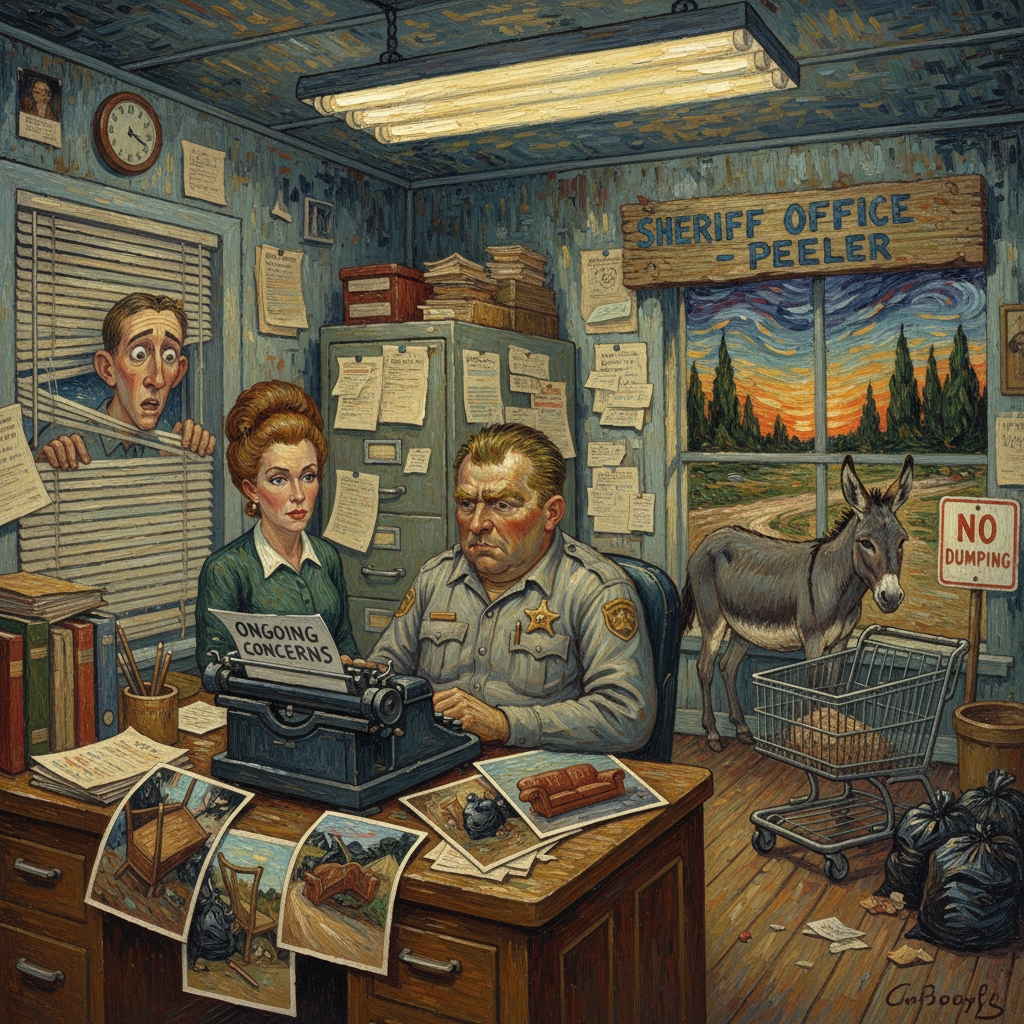
By Thursday the sheriff’s office had received thirty-seven complaints about “general conditions,” nineteen complaints about Facebook arguments, and four separate reports identifying the donkey as either suspicious or inspirational.
Sheriff Peeler sat behind his desk rubbing his forehead while Kenny Joe sorted handwritten complaints into stacks.
“What category is this one?” Kenny Joe asked.
Sheriff Peeler squinted.
“‘Atmospheric decline.’”
“Where’s that go?”
“Probably miscellaneous.”
Boot Barnes sat nearby eating crackers.
“The donkey’s outside.”
Sheriff Peeler didn’t even look up.
“Of course it is.”
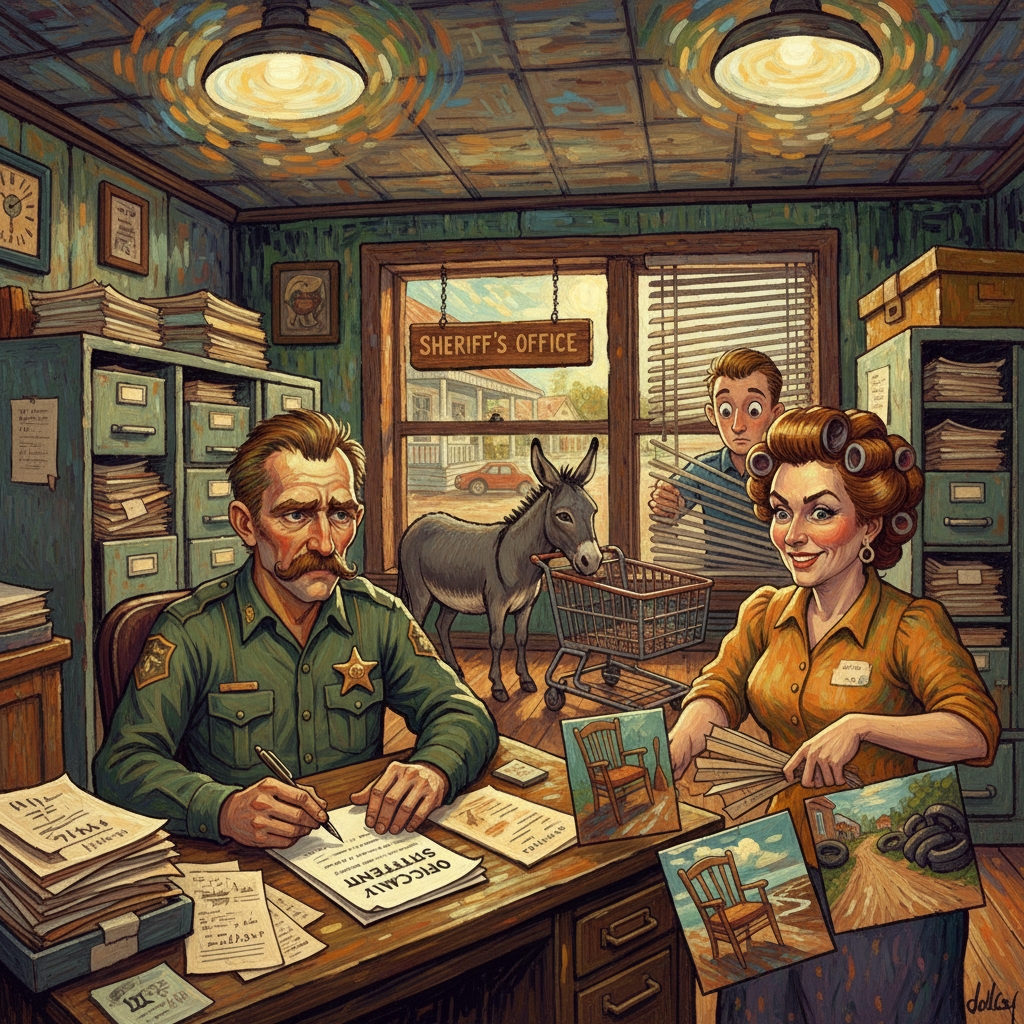
Outside the office window the donkey stood beside an abandoned shopping cart filled with broken paneling.
Kenny Joe peeked through the blinds.
“It’s almost artistic.”
“Don’t encourage it.”
Mabel Dean arrived carrying photographs.
“I brought evidence.”
Sheriff Peeler sighed heavily.
“Mabel, I know what litter looks like.”
“These ain’t just litter. These are people pretending not to notice litter.”
She spread photographs across the desk: discarded mattresses, weeds swallowing signs, abandoned trailers, broken appliances near creeks.
Clovis entered halfway through and immediately pointed at one picture.
“That’s technically outside town limits.”
“You drove twenty miles to avoid responsibility?”
“Accuracy matters.”
Pastor Peeler entered quietly behind him.
Act VI – The Sheriff’s Office and the Official Statement
“Folks,” he said gently, “perhaps we should spend less energy defining boundaries and more energy addressing conditions.”
Shelley Fawn Wexler burst in moments later.
“We need a public statement.”
Sheriff Peeler looked horrified.
“Why me?”
“Because people trust the sheriff.”
“No they don’t.”
“They trust the uniform.”
Boot pointed through the window again.
“The donkey moved.”
Now the animal stood directly beside the office sign reading PROTECTING OUR COMMUNITY.
Nobody spoke.
Finally Kenny Joe whispered:
“That thing has comedic instincts.”
Shelley straightened papers nervously.
“The statement should reassure residents that the issue is exaggerated.”
Mabel stared at her.
“So… lie professionally?”
“Use softer wording.”
Pastor Peeler folded his hands.
“Truth spoken softly remains truth.”
Clovis nodded.
“Exactly. We should say nearby regions face severe challenges while Sequatchie Crossing maintains relative resilience.”
Boot blinked slowly.
“There’s a toilet in the creek behind Earlene’s.”
“Relative resilience.”
Sheriff Peeler stood.
“All right. Here’s the statement.”
Everybody quieted.
He cleared his throat.
“‘The Town of Sequatchie Crossing recognizes that many communities face ongoing concerns related to maintenance, cleanup, and general appearance. Residents are encouraged to remain civic-minded and neighborly while avoiding unnecessary alarmism.’”
Mabel frowned.
“That says absolutely nothing.”
“Correct,” the sheriff replied. “Therefore everybody might accept it.”
Act VI – The Sheriff’s Office and the Official Statement
Act VII – Cleanup Day and the Geography of Excuses
Saturday morning arrived humid and gray.
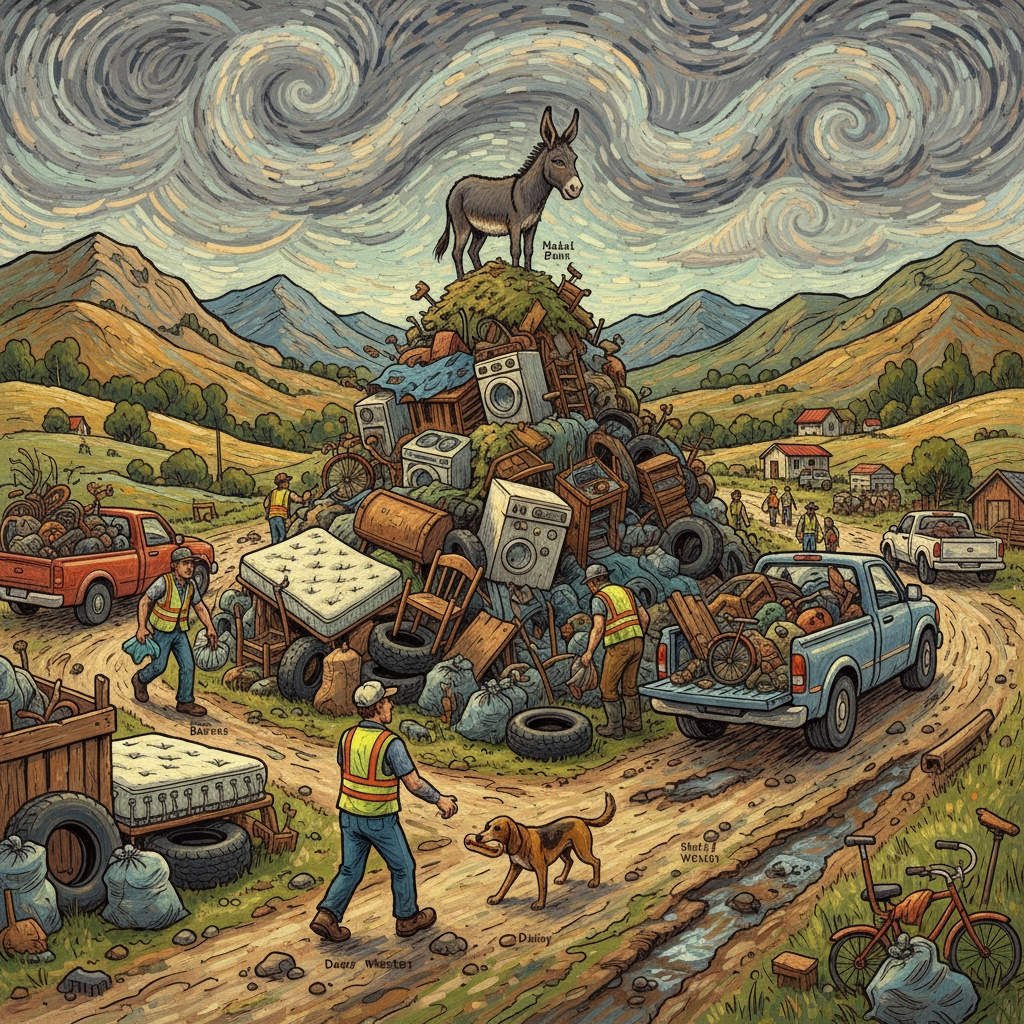
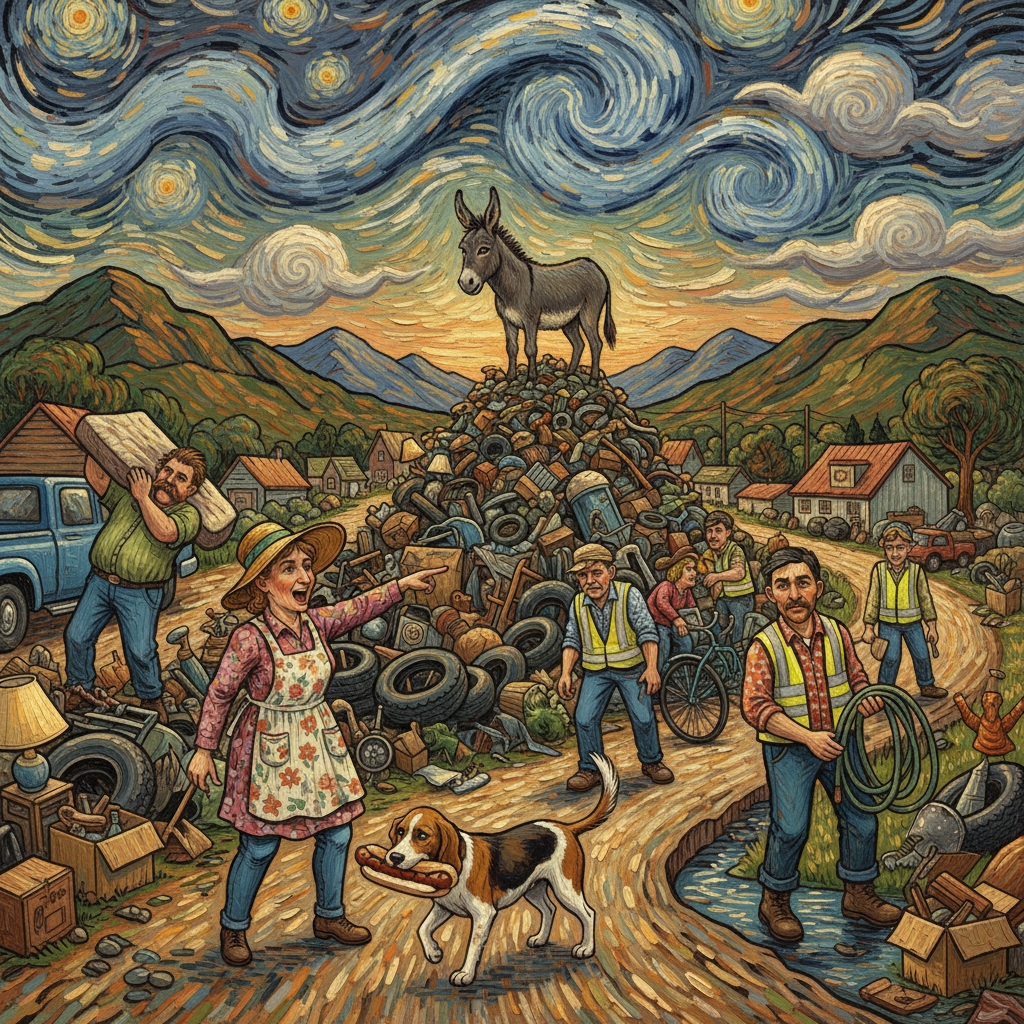
Community Beautification Weekend officially began with twelve volunteers, three pickup trucks, two borrowed weed eaters, and ongoing disagreement about whether cleanup itself implied failure.
Shelley Fawn Wexler distributed reflective vests.
“These were donated.”
“By who?” Boot asked.
“Chattanooga.”
Clovis frowned immediately.
“Outsider involvement.”
Mabel grabbed trash bags aggressively.
“If the outsiders are helping while locals argue definitions, maybe let ’em.”
Daisy wandered happily among volunteers carrying a half-eaten hotdog bun.
Coach Freddie organized teams.
“You four take the creek road. RT and Sonny handle the old rail line. Clovis—”
“I should probably oversee strategically.”
“No,” Coach Freddie interrupted. “You’re hauling mattresses.”
Pastor Peeler led a prayer beside Town Hall.
“Lord, help us care for what You entrusted to us.”
“Amen,” everybody muttered.
Except Clovis, who whispered:
“Still think Jasper’s worse.”
The volunteers spread out through town.
Boot, Mabel, and Kenny Joe worked near the drainage ditch behind Earlene’s Diner where weeds had nearly swallowed several rusted appliances.
Boot wiped sweat from his forehead.
“Funny thing is,” he said, “everybody saw this for years.”
“Seeing ain’t the same as admitting,” Mabel replied.
Nearby, the gray donkey stood beside the ditch chewing weeds calmly like a foreman supervising labor.
Kenny Joe pointed.
“That animal’s judging us.”
Act VII – Cleanup Day and the Geography of Excuses
“He earned the right,” Mabel said.
Across town, Sonny Morales and RT Mullins loaded tires into a trailer.
“You know what’s weird?” RT asked.
“What?”
“Once folks started cleaning, nobody argued anymore.”
Sonny nodded slowly.
“Hard to deny something while physically lifting it.”
Meanwhile at the church parking lot, Sister Lila Mae directed cleanup efforts like a battlefield commander.
“No, no, no! Sweep toward salvation, not sideways!”
Trixie Jo recorded video interviews.
“How does it feel participating in civic restoration?”
Doug “Doughboy” Teeter shrugged.
“Sticky.”
At Town Hall, Clovis reluctantly hauled a moldy recliner into a truck bed.
Shelley smiled encouragingly.
“See? Community action.”
“This chair could’ve originated anywhere.”
Mabel overheard him.
“Clovis, there are mushrooms growing in the cup holder.”
“Nature reclaims all things.”
The donkey wandered into the center of cleanup operations and stopped beside a mountain of collected debris.
Everybody paused.
The pile towered nearly six feet high.
Broken furniture. Tires. Rusted grills. Appliances. Trash bags. Scrap metal.
Visible proof.
Nobody joked for a moment.
Pastor Peeler stepped beside the pile quietly.
“Well,” he said softly, “there it is.”
Boot nodded.
“Been there the whole time.”
Clovis stared at the mountain uneasily.
Then, after a long silence, he finally muttered:
“Still smaller than Jasper’s.”
Mabel threw a work glove at him.
Act VII – Cleanup Day and the Geography of Excuses
Act VIII – The Festival Committee Tries to Rebrand Reality
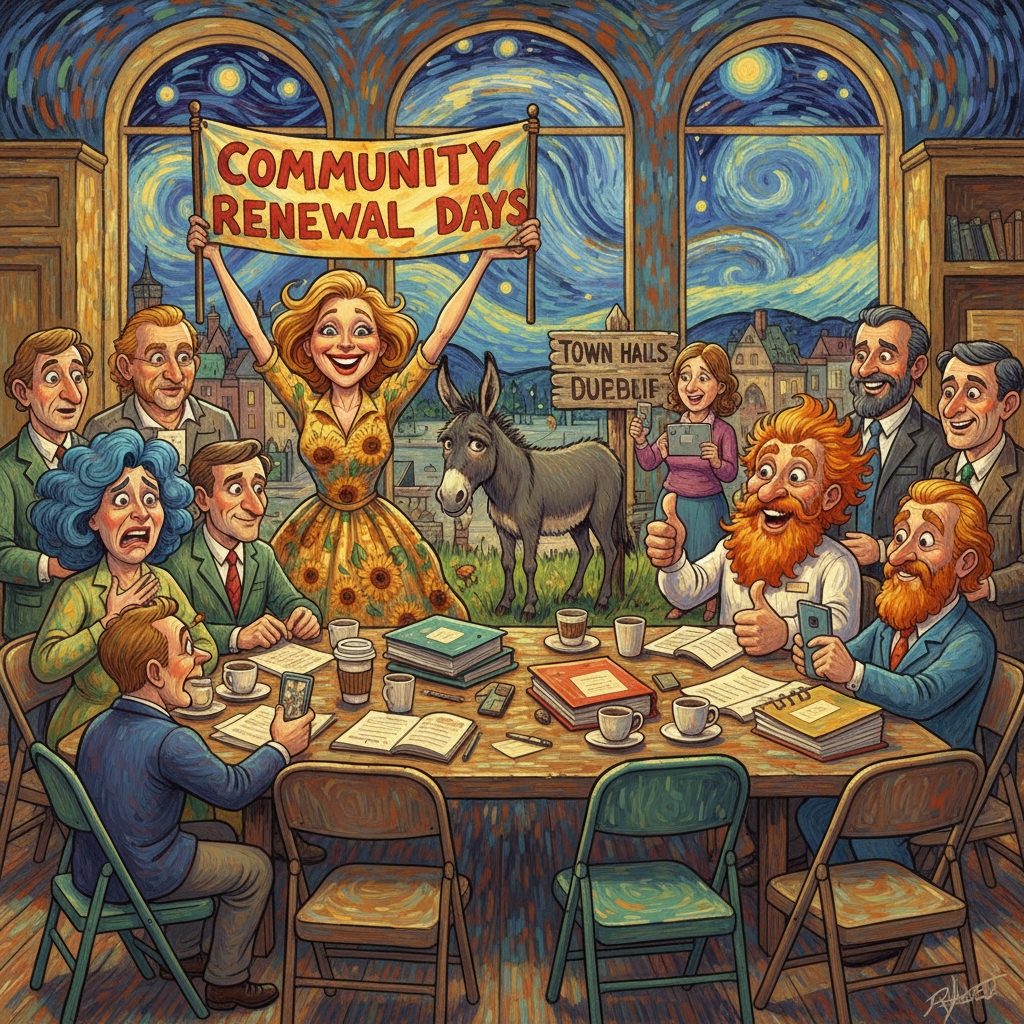
Three days later Shelley Fawn Wexler convened an emergency meeting of the Sequatchie Crossing Festival Committee.
“We have an opportunity,” she announced.
Maggie Sue narrowed her eyes immediately.
“That word always means trouble.”
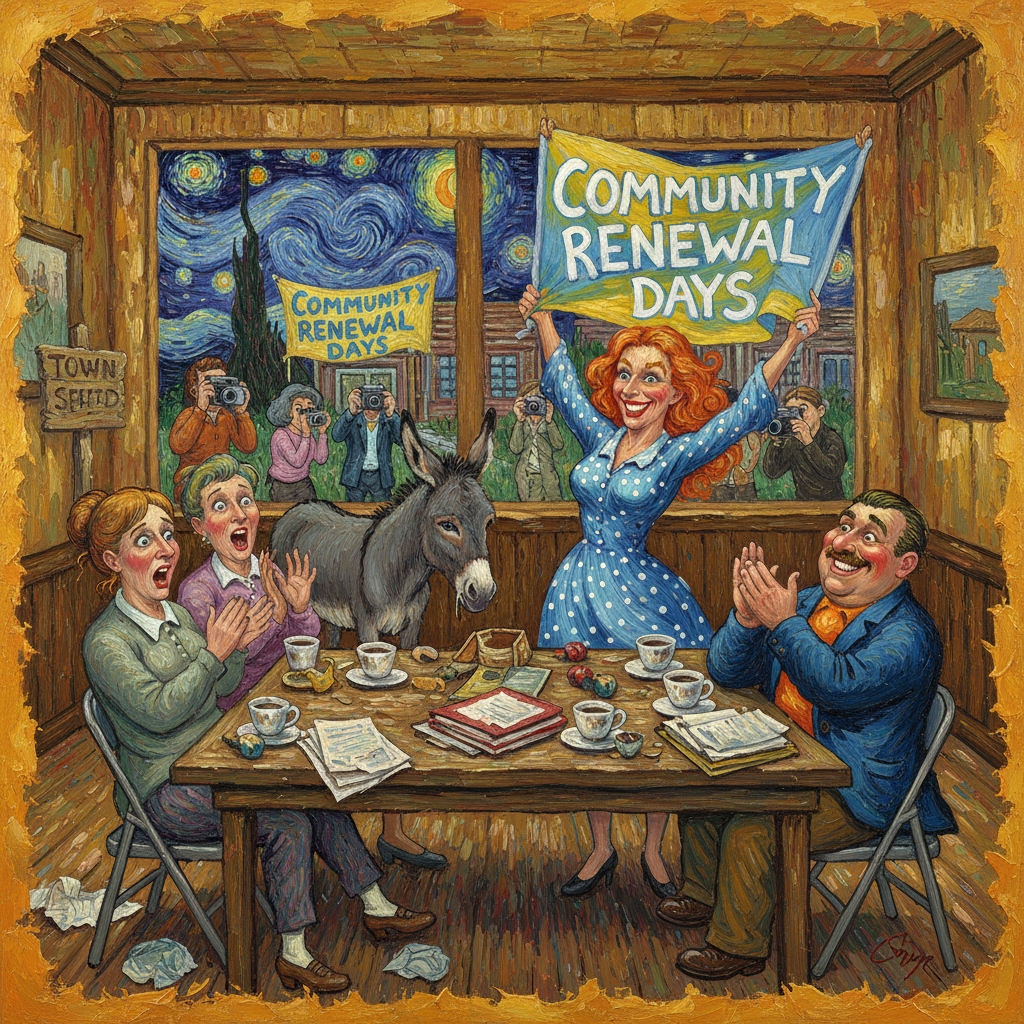
Shelley unveiled a banner sketch.
SEQUATCHIE CROSSING
COMMUNITY RENEWAL DAYS
Boot nearly choked on coffee.
“You’re turning cleanup into a festival?”
“Positive framing.”
Clovis nodded approvingly.
“Now that’s smart governance.”
Mabel looked appalled.
“So instead of admitting neglect, we celebrate delayed maintenance?”
“Exactly,” Shelley said brightly before realizing how that sounded.
Pastor Peeler sat quietly observing.
Tiffany Annette Roark flipped through survey forms.
“Most residents now agree the issue exists.”
Shelley smiled.
“Wonderful.”
“But eighty percent still claim it mainly affects other neighborhoods.”
The room groaned.
Sheriff Peeler leaned back.
“We cleaned three truckloads of junk outta town and folks still think the problem’s theoretical.”
“Because admitting proximity feels personal,” Tiffany explained.
Coach Freddie pointed toward the window.
“The donkey’s back.”
Sure enough, the gray donkey stood beside Town Hall directly underneath the new COMMUNITY RENEWAL banner.
Even Clovis laughed this time.
“All right,” he admitted. “That’s funny.”
Act VIII – The Festival Committee Tries to Rebrand Reality
Mabel smirked.
“Animal’s smarter than half this committee.”
Outside, tourists passing through town slowed to photograph the donkey beside the banner.
Shelley panicked.
“Oh no.”
Trixie Jo raised her phone excitedly.
“This is excellent engagement.”
“It’s humiliating.”
“It’s authentic.”
Pastor Peeler folded his hands.
“Authenticity often arrives before dignity.”
The committee continued arguing over branding.
“Should we call it beautification?” Shelley asked.
“Recovery?” Maggie Sue suggested.
“Maintenance optimization?” Clovis offered.
“Garbage pickup,” Mabel replied.
The donkey brayed loudly outside the window.
Everybody froze.
“That sounded judgmental,” Kenny Joe whispered.
Boot stood and looked out.
“You know what that animal’s been doing this whole time?”
“What?” Shelley asked.
“Standing exactly where nobody wants to look.”
Silence spread slowly through the room.
Outside, the donkey shifted slightly beside Town Hall, revealing behind it an old collapsed sign half-covered in weeds.
WELCOME TO SEQUATCHIE CROSSING
A PLACE OF PRIDE
The word PRIDE had nearly faded away entirely.
Pastor Peeler stared at it quietly.
“Maybe the problem was never the mess,” he said softly.
“What was it then?” Shelley asked.
“That we kept needing distance before we could recognize ourselves.”
Nobody answered.
Even Clovis looked thoughtful.
Which, for Clovis, qualified as a regional emergency.
Act VIII – The Festival Committee Tries to Rebrand Reality
Act IX – The View from Overlook Ridge
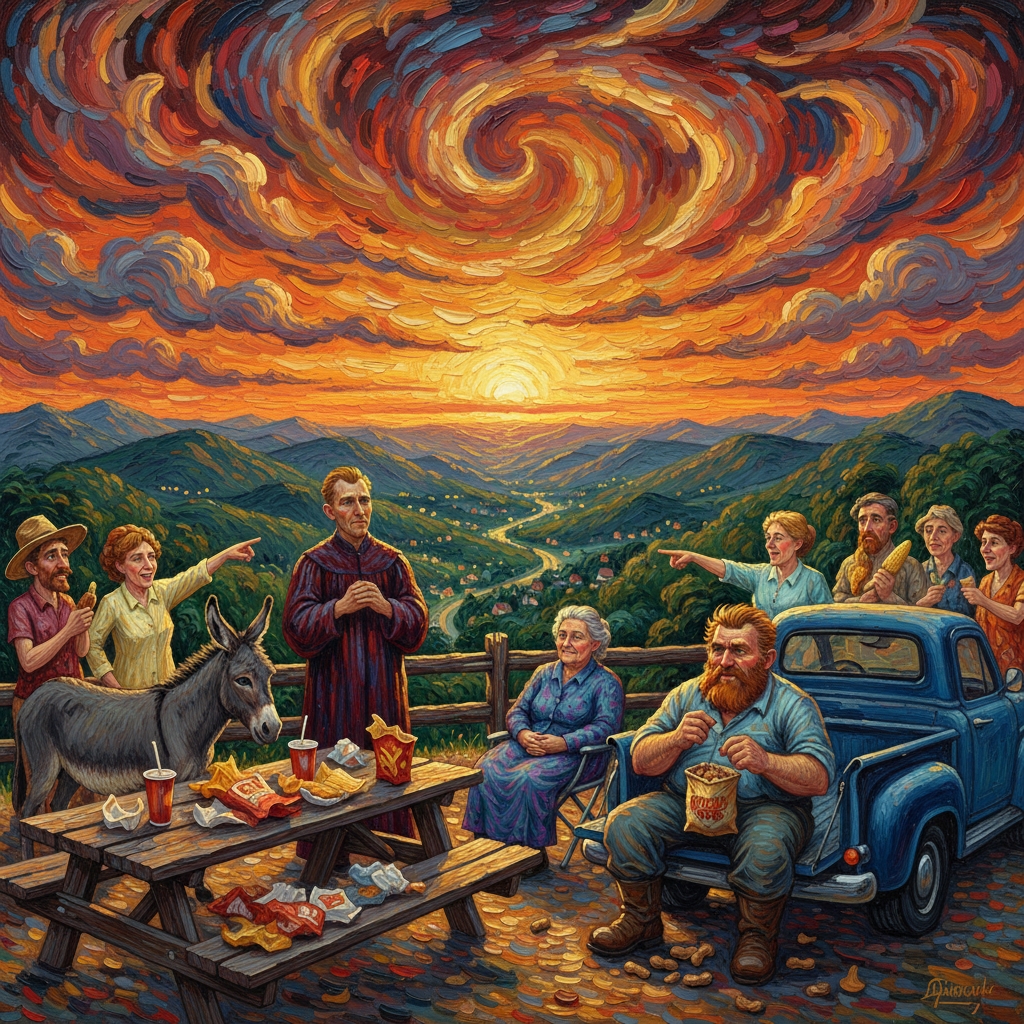
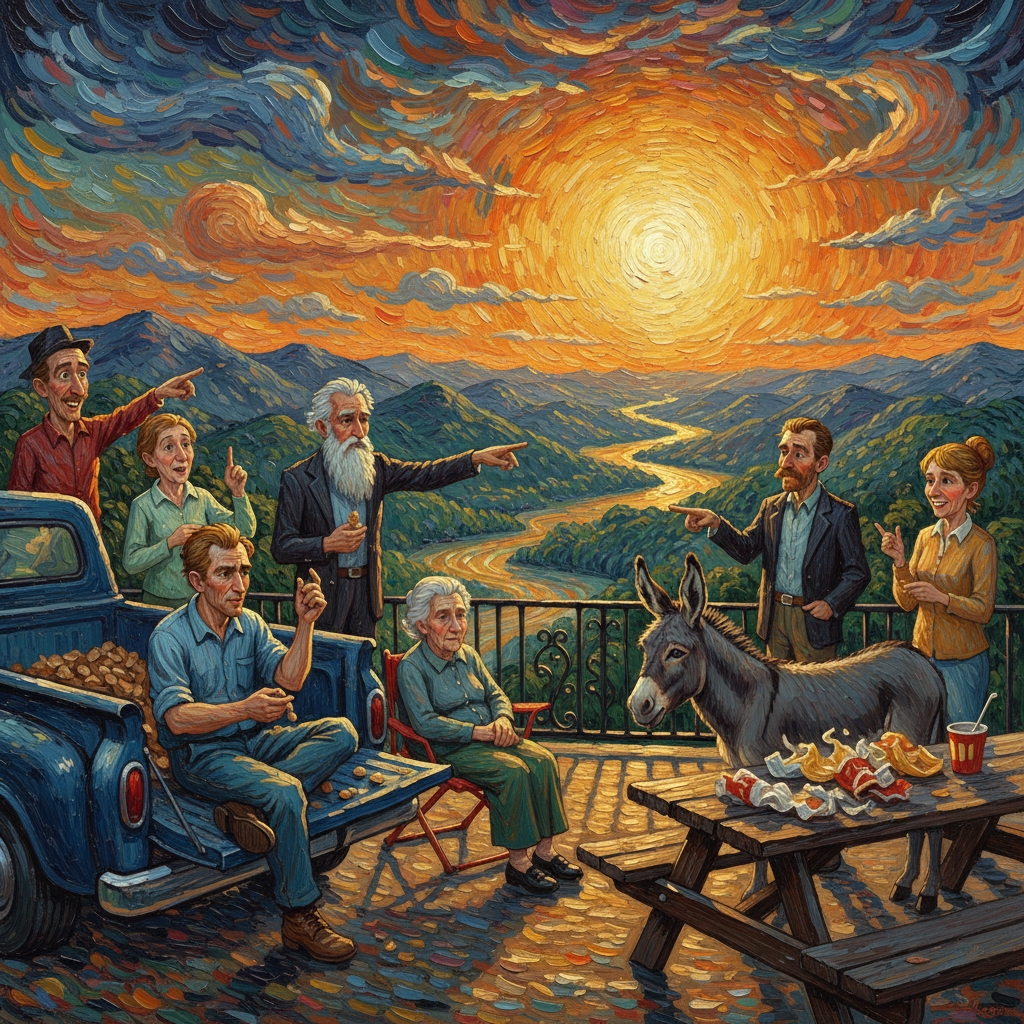
One week later several townspeople gathered at Overlook Ridge for sunset after somebody online described Sequatchie Crossing as “surprisingly self-aware.”
Nobody knew whether that was an insult.
Boot Barnes sat on the tailgate of his truck eating peanuts.
Mabel Dean rocked gently in a folding chair.
Pastor Peeler watched clouds drift across the valley.
The cleanup had changed parts of town visibly. Roadsides looked clearer. Ditches flowed again. Old signs emerged from weeds like rediscovered history.
But the deeper argument lingered.
Clovis stood near the overlook railing.
“I still think people exaggerated conditions.”
Mabel sighed.
“You physically carried three refrigerators.”
“That doesn’t mean we were uniquely bad.”
“No town’s uniquely bad,” Pastor Peeler replied quietly. “That’s the point.”
Daisy barked at something down the trail.
Moments later the donkey emerged from the trees.
Everybody burst out laughing instantly.
“Well I’ll be damned,” Sheriff Peeler muttered.
The donkey wandered directly toward a picnic table covered in forgotten fast-food wrappers left by tourists earlier that afternoon.
Boot pointed triumphantly.
“There it is again.”
The donkey stood beside the trash pile calmly while sunset lit the valley gold and orange behind it.
Nobody argued this time.
Trixie Jo lowered her phone.
“That’s almost poetic.”
“Almost?” Mabel replied.
Shelley Fawn Wexler sat beside the railing looking tired but calmer than before.
“You know what bothers me?” she asked. “We worked harder defending ourselves than fixing anything.”
Act IX – The View from Overlook Ridge
“Defensiveness burns calories,” RT said.
“Not productive ones.”
Pastor Peeler smiled faintly.
“Humans have always preferred distant sins.”
Clovis crossed his arms thoughtfully.
“I guess it’s easier to discuss problems when they belong to somebody else.”
Boot nodded.
“Because then they don’t accuse us back.”
The donkey nudged a soda cup off the picnic table.
It rolled downhill into the weeds.
Everybody watched silently.
Mabel finally stood.
“Well. Somebody gonna pick that up?”
Nobody moved.
The donkey stared directly at them.
Sheriff Peeler sighed heavily.
“All right, all right.”
He walked over, picked up the cup, and tossed it into a trash bag.
The group applauded sarcastically.
Pastor Peeler chuckled softly.
“Sometimes redemption begins embarrassingly small.”
Sunset settled deeper across the valley.
Below them Sequatchie Crossing glowed warm and quiet beneath the mountains.
Not perfect.
Not ruined.
Just human.
Clovis leaned against the railing.
“You think folks’ll remember any of this?”
Mabel smiled.
“No.”
“Then what was the point?”
Boot answered before anyone else could.
“Next time maybe we’ll recognize ourselves faster.”
The donkey brayed loudly toward the valley below.
And for the first time all week, nobody tried explaining it away.
Act IX – The View from Overlook Ridge
Epilogue – The Donkey Becomes Municipal Legend
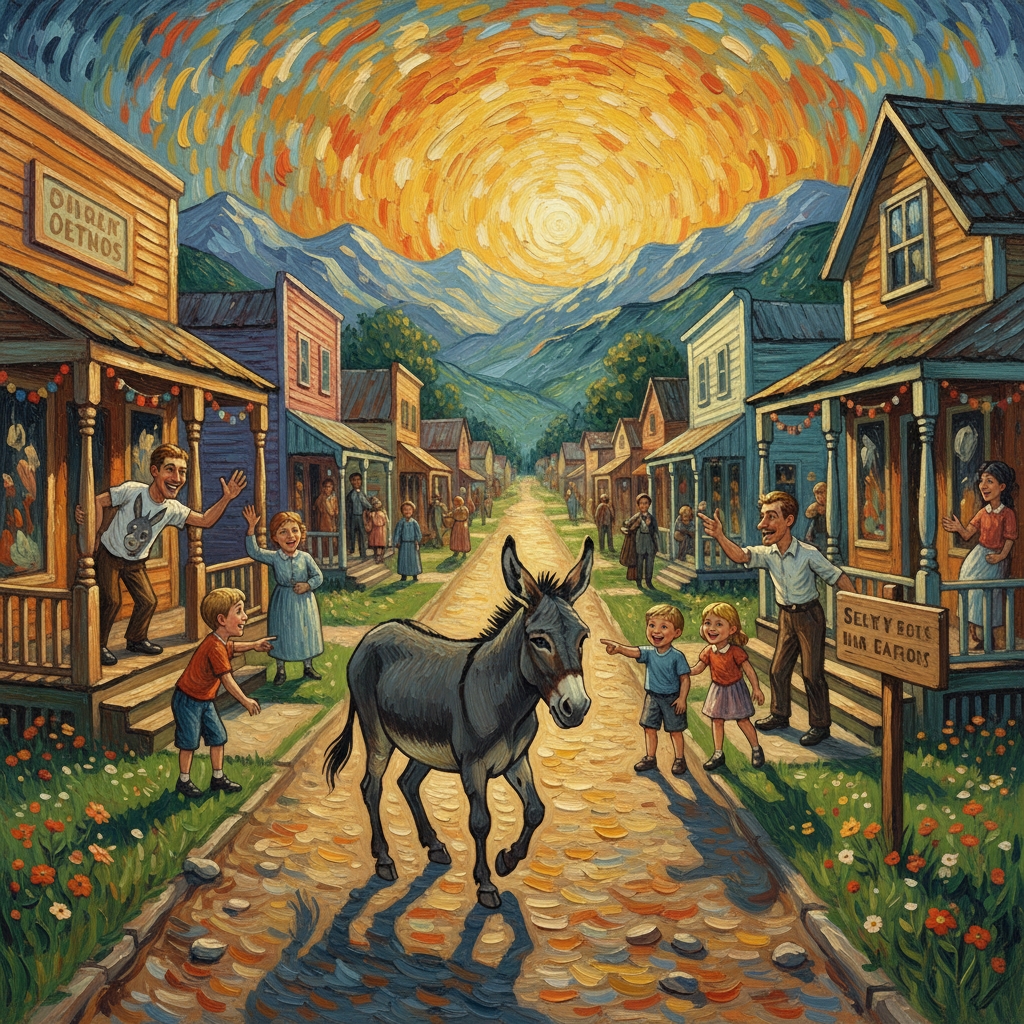
Within two months the donkey had acquired unofficial status inside Sequatchie Crossing folklore.
Nobody knew where it came from.
Nobody admitted feeding it.
Everybody absolutely fed it.
Children called it “Mayor Hee-Haw.”
Clovis still insisted conditions remained worse elsewhere.
Mabel still corrected him immediately.
Pastor Peeler occasionally referenced “the donkey of uncomfortable truth” during sermons, though he denied doing so intentionally.
Shelley Fawn Wexler successfully transformed Community Renewal Days into an annual event, mostly because residents discovered cleanup was easier than endless argument.
Boot Barnes had a T-shirt printed featuring the donkey standing beside a pothole.
Underneath it read:
LOOKS FINE FROM FAR AWAY
It became the town’s best-selling shirt by accident.
The donkey itself continued wandering calmly through Sequatchie Crossing, appearing periodically beside neglected places nobody wanted to acknowledge.
And every time it did, residents found themselves looking a little quicker than before.
Not because the problems were new.
But because distance had finally stopped protecting them from recognition.
Epilogue – Town Agrees Problem Exists Elsewhere, Not Here
Disclaimer
The characters, businesses, organizations, meetings, donkeys, drainage ditches, folding chairs, suspicious mattresses, philosophical cleanup campaigns, and emotionally confrontational livestock depicted in this story are entirely fictionalized for satirical purposes.
Any resemblance to real towns, real people, real community arguments, real potholes, real overflowing donation bins, or real Facebook comment sections is purely coincidental and probably being blamed on another county anyway.
No donkeys were elected to public office during the writing of this story, though several displayed qualifications exceeding expectations.
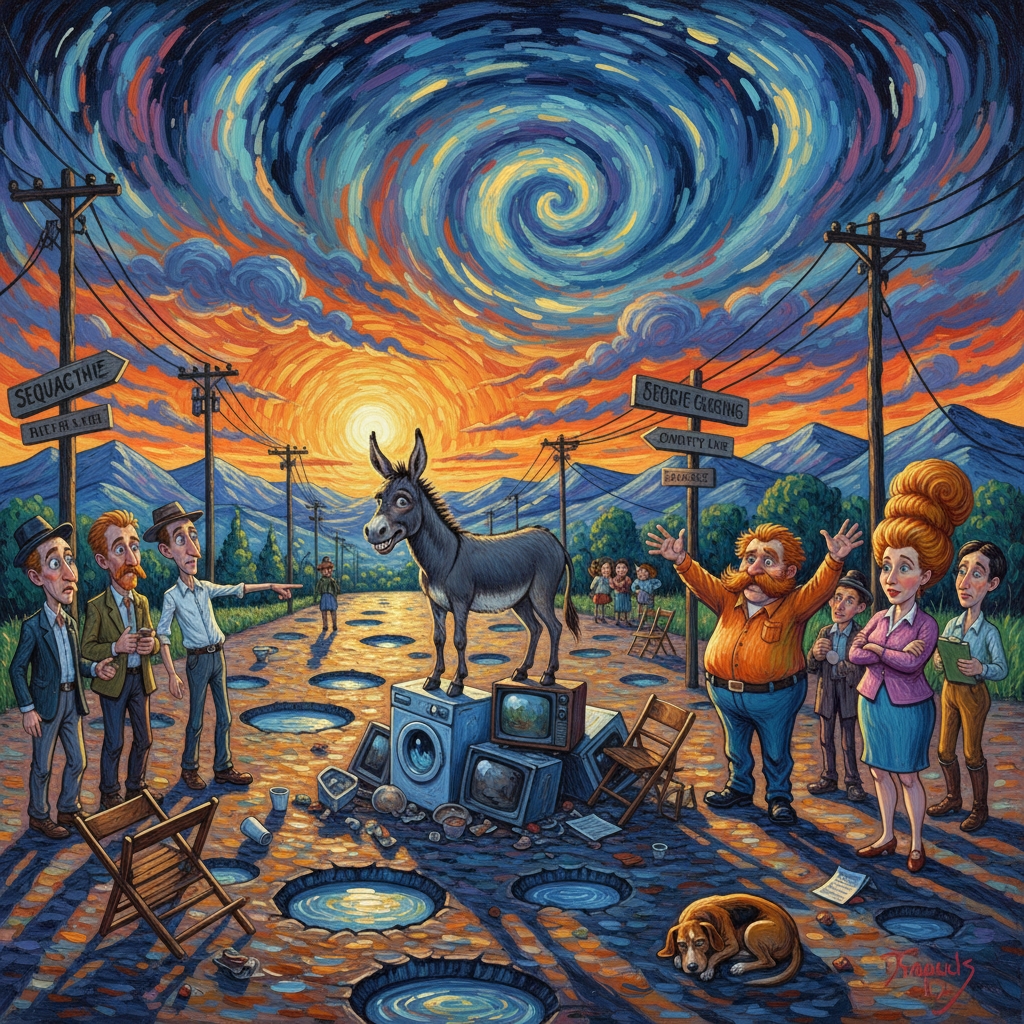
Disclaimer – Town Agrees Problem Exists Elsewhere, Not Here
Real Places Behind the Ruckus – From The Dunlap Directory
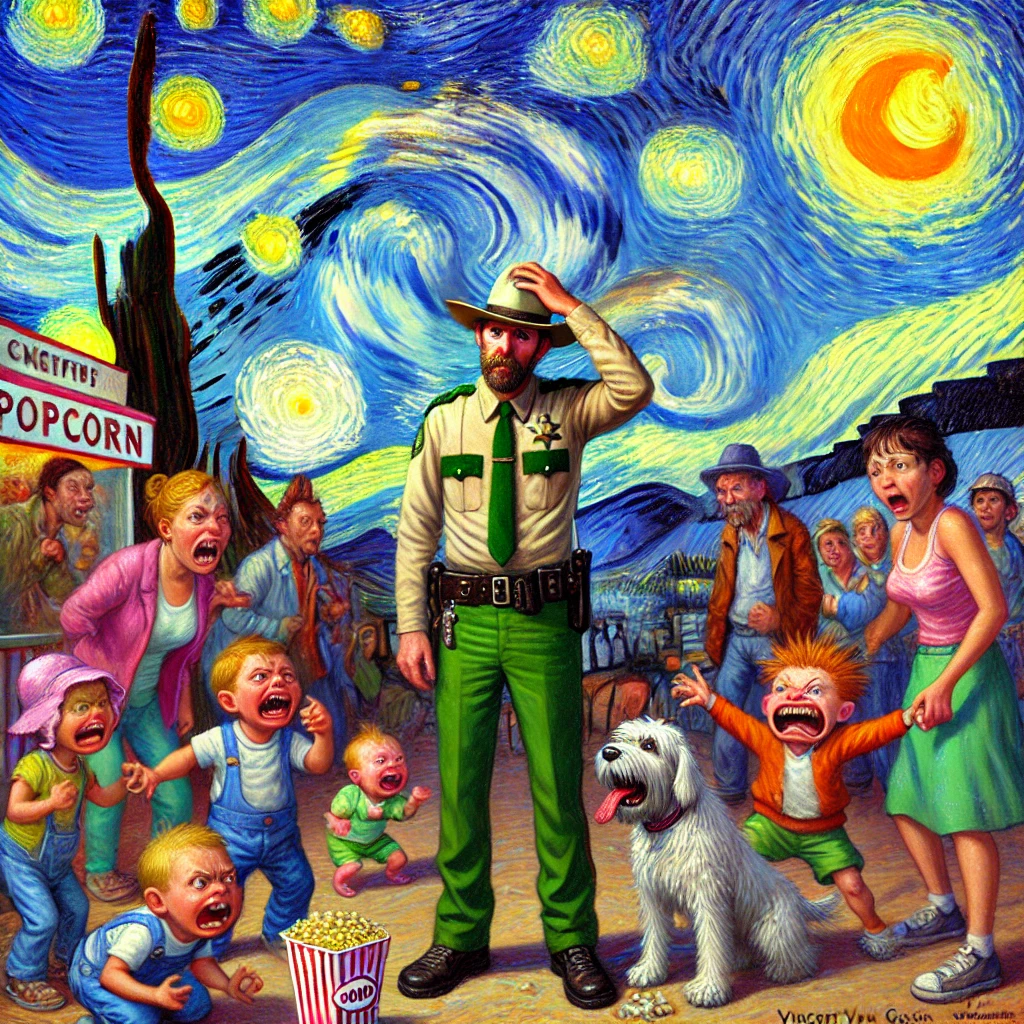
Real Places Behind the Ruckus – From The Dunlap Directory
Yes, this story was fictional; even the parts that weren’t true. These places? Absolutely real. Stop by, support local, and keep the Wi-Fi away from livestock:
- George Hamilton Real Estate & Management Co.
- Artistic Expressions Salon
- Barry Wallace Roofing
- Anthony and Theresa’s Homecookin’
- Harris Park Splash Pad
- Dunlap Animal Clinic
- Shell
- Unlocking Potential Educational Services
- The Pumpkin Patch Playground
- Yamato Japanese Steakhouse
- Marshall Renovations
- Dairy Queen
- Ponderosa Construction Company
- Harrison Bay State Park
- Best Western Royal Inn
- Diane Mahoney

Real Places Behind the Ruckus – From The Dunlap Directory
At Sequatchie Crossing, we tell the stories of Sequatchie Crossing.
Please share this post with your friends, family, or business associates who may want follow the news from Sequatchie Crossing.


0 Comments