


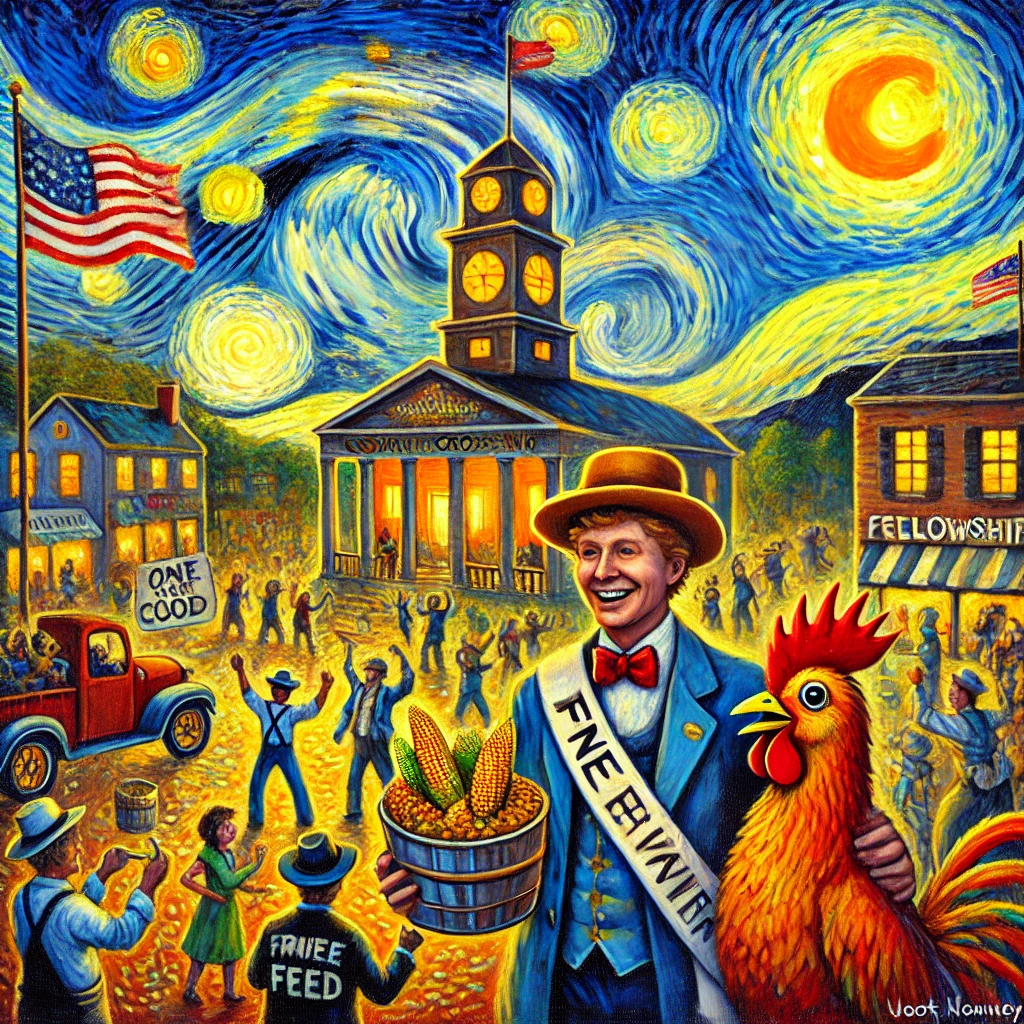
How Sequatchie Crossing Accidentally Elected a Chicken and Called It Democracy
By Tom Seest
At Sequatchie Crossing, we tell the stories of Sequatchie Crossing.
Please share this post with your friends, family, or business associates who may want follow the news from Sequatchie Crossing.
🎤 Audio Overview
The People’s Pecking Order
I. The Calm Before the Cluck
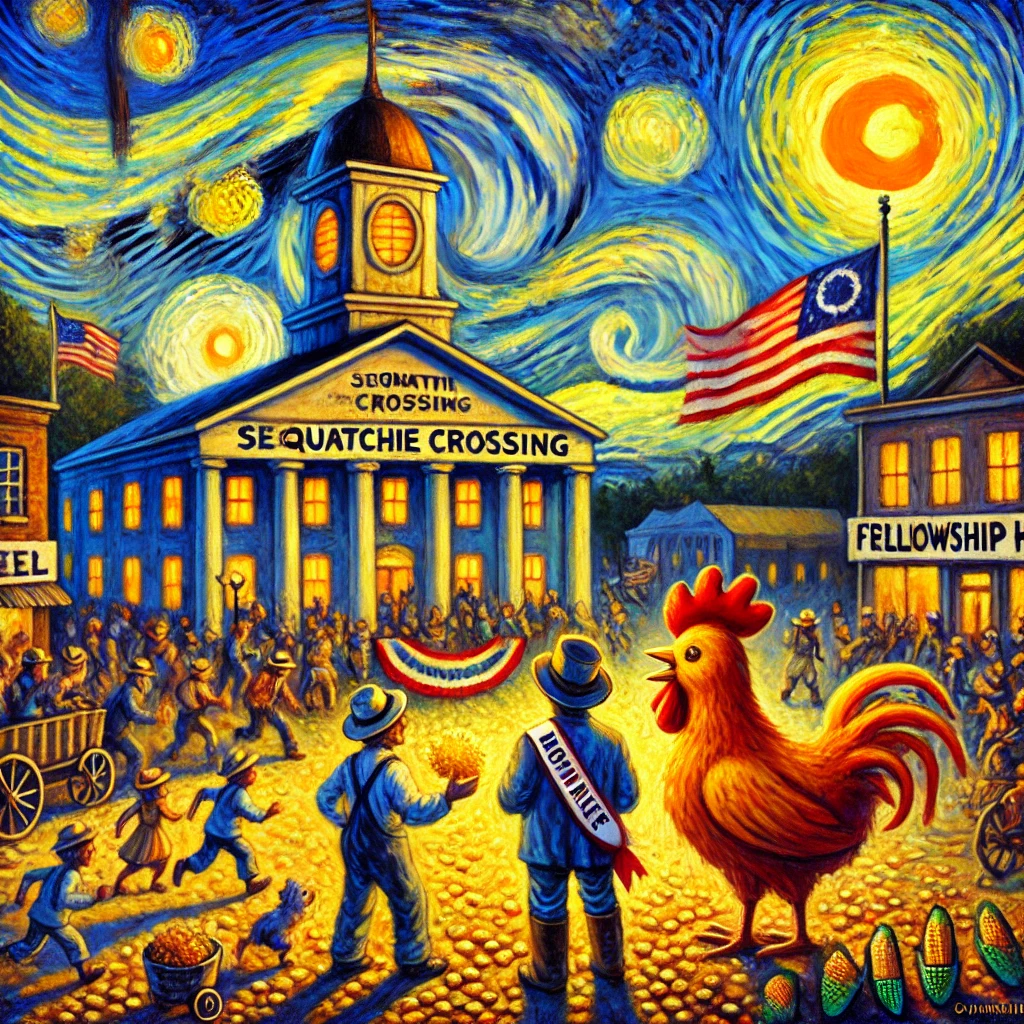
Sequatchie Crossing had been due for an election since the last one ended in a tie between two candidates who later discovered they’d accidentally voted for each other. No one wanted another fiasco like that. So when the new mayoral race came around, folks swore they’d take it seriously this time.
The League of Civic Responsibility — which was just Mabel Dean, the town librarian, and two members of the Quilters’ Guild — organized debates, printed flyers, and even borrowed a podium from the high school.
But the candidates didn’t inspire much confidence.
-
Clovis Gentry, who once campaigned on the slogan “Vote for Me, I Already Know Where Everything Is,” spent most of his speeches quoting half-remembered Bible verses and arguing with his own posters.
-
Tilly Boone, the town treasurer, ran mainly so she could stop Clovis from spending the budget on “more historical plaques about things that didn’t happen here.”
-
Reverend Gentry declared his candidacy late, insisting God told him to “fix the zoning map,” which confused even God.
It was shaping up to be a race no one wanted to win.
Then came Boot Barnes.
Boot wasn’t running — he just wanted to sell raffle tickets for his newest business idea: Barnes’ Backyard Experience & Mobile Petting Zoo (Cash Only). Among his traveling attractions was a particularly vocal chicken with a bright red comb and an attitude.
He called her Comrade Cluckles, though no one could remember why.
I. The Calm Before the Cluck
II. A Chicken Goes Viral
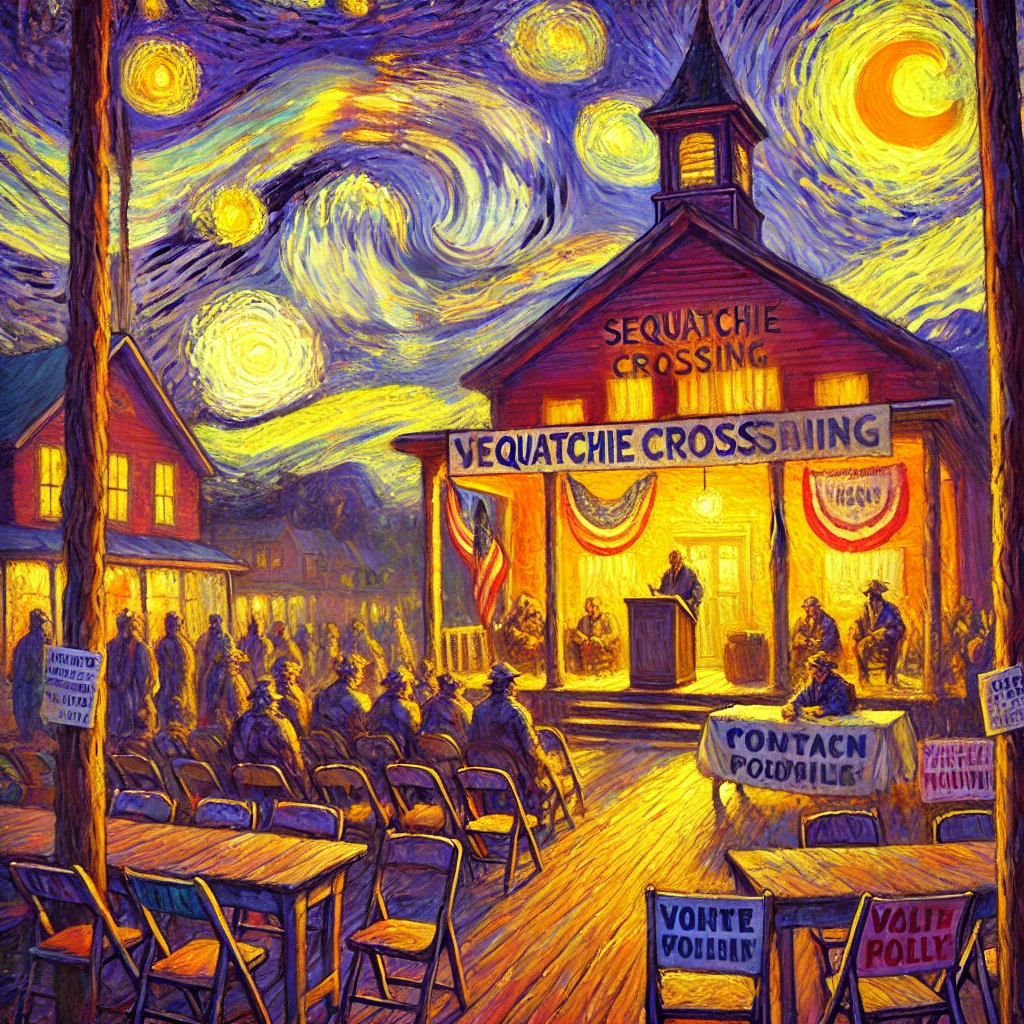
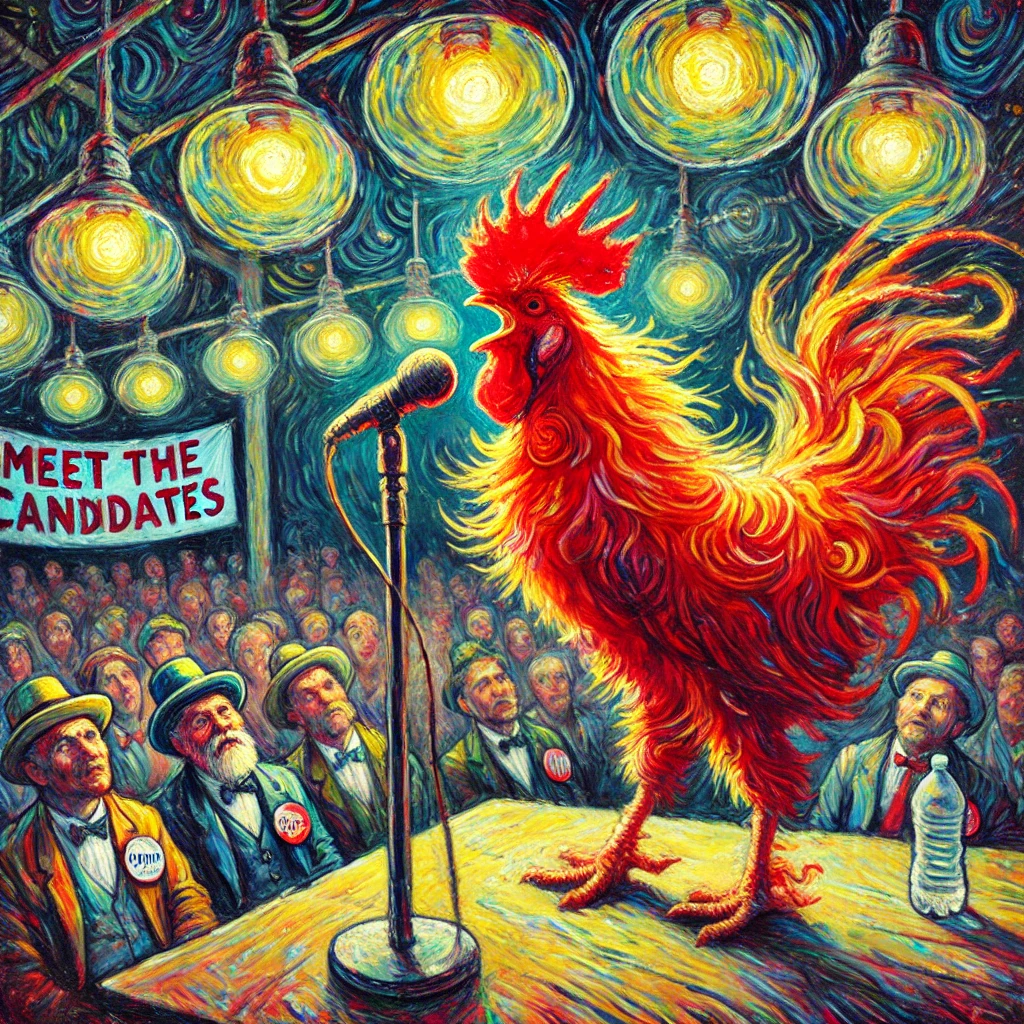
The trouble began at a “Meet the Candidates” event held in the fellowship hall behind the First Missionary Baptist Church (formerly a skating rink).
While Clovis Gentry was explaining his plan to “modernize city government by buying more clipboards,” Boot’s chicken strutted across the stage, hopped onto the podium, and began pecking at the microphone.
The sound system crackled, feedback screeched, and the crowd gasped as the chicken’s clucks echoed through the speakers in what sounded suspiciously like applause.
Boot, never one to miss an opportunity, stepped forward and said,
“Well, folks, looks like the chicken’s got more to say than any of these candidates combined.”
Laughter rolled through the hall. Someone — possibly Sheriff Peeler — shouted,
“I’d vote for that bird before I’d vote for Clovis again!”
Within an hour, someone had created a Facebook page called “Cluckles for Mayor — Pecking Order 2025.”
By morning, it had 2,000 likes.
II. A Chicken Goes Viral
III. Campaign Chaos
At first, everyone thought it was harmless fun. Boot leaned into it. He showed up at the Co-Op wearing a red tie and carrying Comrade Cluckles on his arm like a feathered dignitary.
He started giving mock speeches:
“My fellow citizens, this chicken believes in three things — liberty, equality, and cracked corn at cost!”
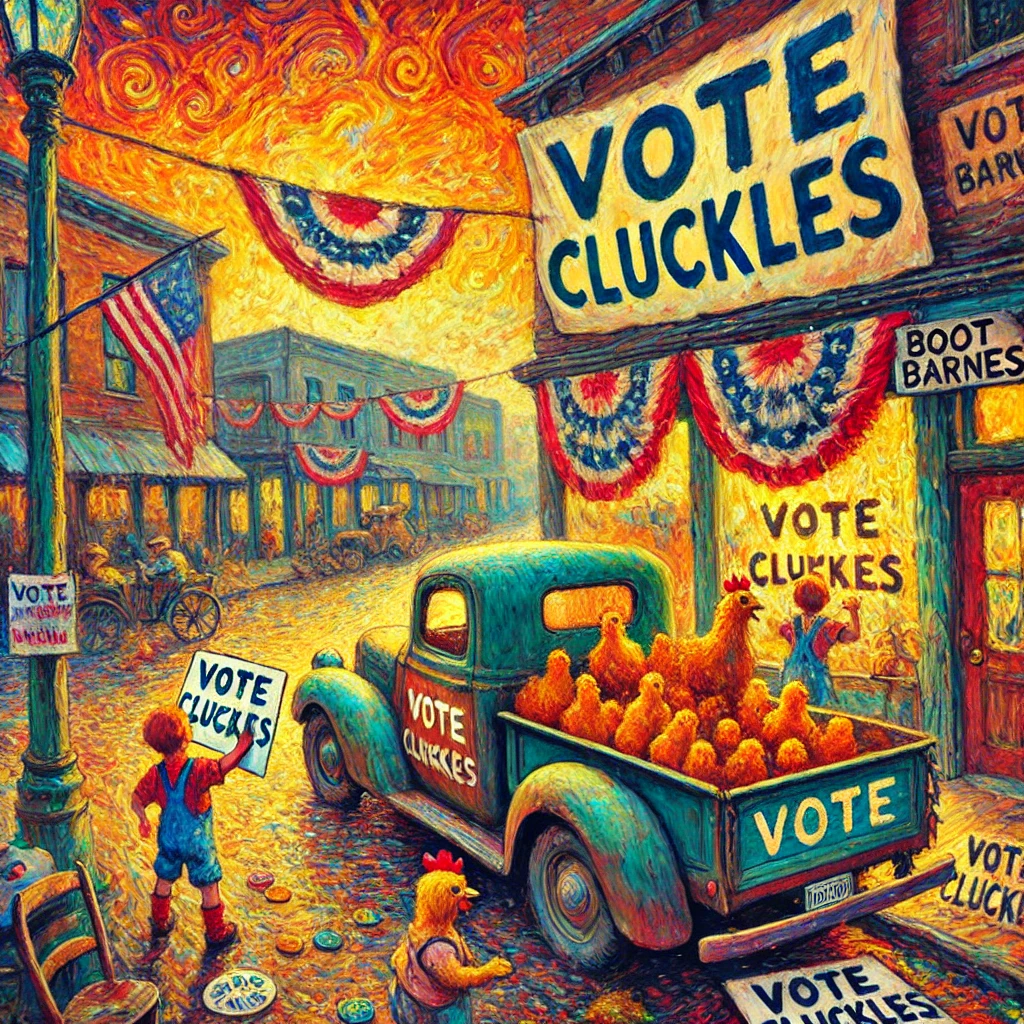
He handed out “Vote Cluckles” buttons featuring the bird’s profile against a hammer and sickle background (a leftover graphic from a failed town recycling initiative).
Tilly Boone called it “an insult to democracy.” Reverend Gentry called it “a sign of the End Times.”
But the rest of the town? They called it “refreshing.”
By the second week, someone spray-painted “POULTRY POWER” on the water tower, and Boot’s chicken had appeared in three campaign memes, two TikToks, and one barbershop mural.
Even the local kids joined in, chalking slogans on the sidewalks like “Make Sequatchie Coop Again” and “In Beaks We Trust.”
III. Campaign Chaos
IV. Election Day: Democracy, Fried
Election day arrived like a slow-motion barn fire — everyone saw it coming, but no one tried to stop it.
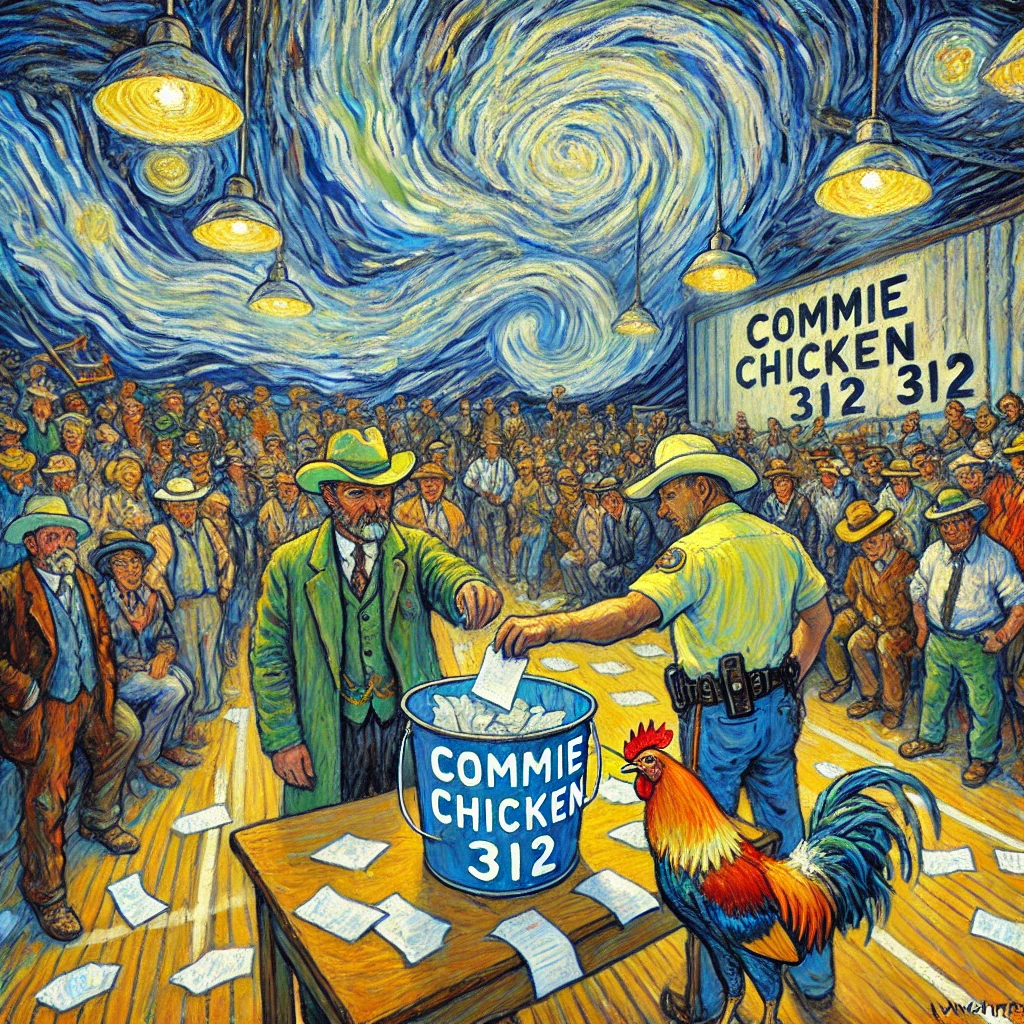
Voting was held at the town gymnasium. Sheriff Peeler had to confiscate three roosters brought “for emotional support.”
By noon, rumors spread that someone had voted using a piece of feed corn. The ballot box jammed twice from sticky notes reading “Cluckles Forever” and “We Demand Eggonomic Reform!”
When the polls closed, the election officials — which consisted of Mabel Dean, Clovis’s cousin Melvin, and a middle-schooler volunteering for extra credit — began counting.
They discovered the winning write-in name was not “Boot Barnes” or “Barnes the Chicken Guy,” but simply “Commie Chicken.”
Out of 612 total votes, “Commie Chicken” had received 312.
It was official:
The new mayor of Sequatchie Crossing was a chicken.
IV. Election Day – Democracy, Fried
V. The Swearing-In
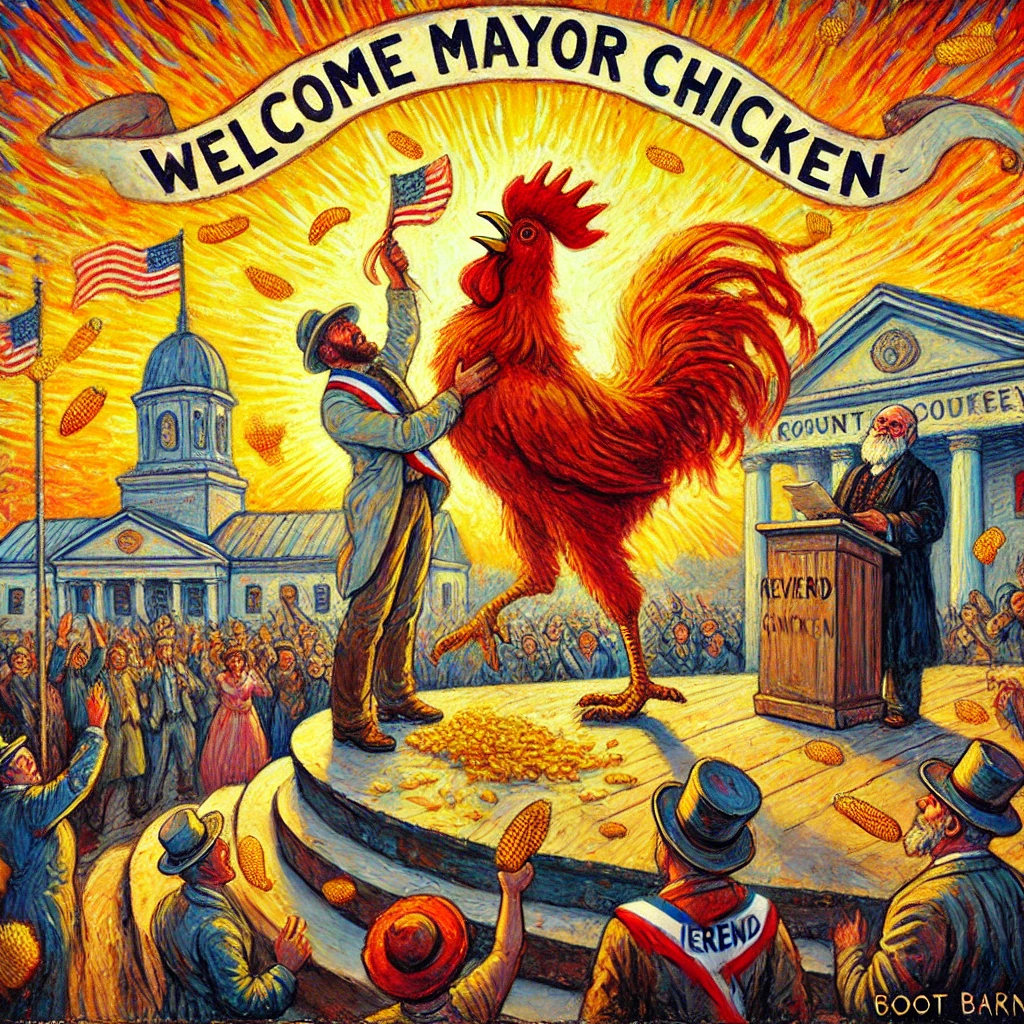
The inauguration was held two days later on the courthouse steps. Boot showed up wearing a borrowed tuxedo jacket, holding the new mayor in a small wicker basket lined with red velvet.
The town band played an off-key rendition of “Yankee Doodle.”
Reverend Gentry read from what he believed to be a Bible but turned out to be a Church Potluck Cookbook, 1983 Edition.
“Do you, Comrade Cluckles, solemnly swear to uphold the peace, prosperity, and poultry rights of Sequatchie Crossing?”
The chicken blinked once and pecked at his shoe.
“I believe that’s a yes,” said Boot.
Someone in the crowd shouted, “Long live the people’s pecking order!”
And just like that, Sequatchie Crossing had its first feathered mayor.
V. The Swearing-In
VI. The Free Feed Policy
Within a week, Boot had stapled flyers all over town announcing the mayor’s first executive order:
“FREE CHICKEN FEED FOR EVERY HOUSEHOLD — NO QUESTIONS ASKED.”
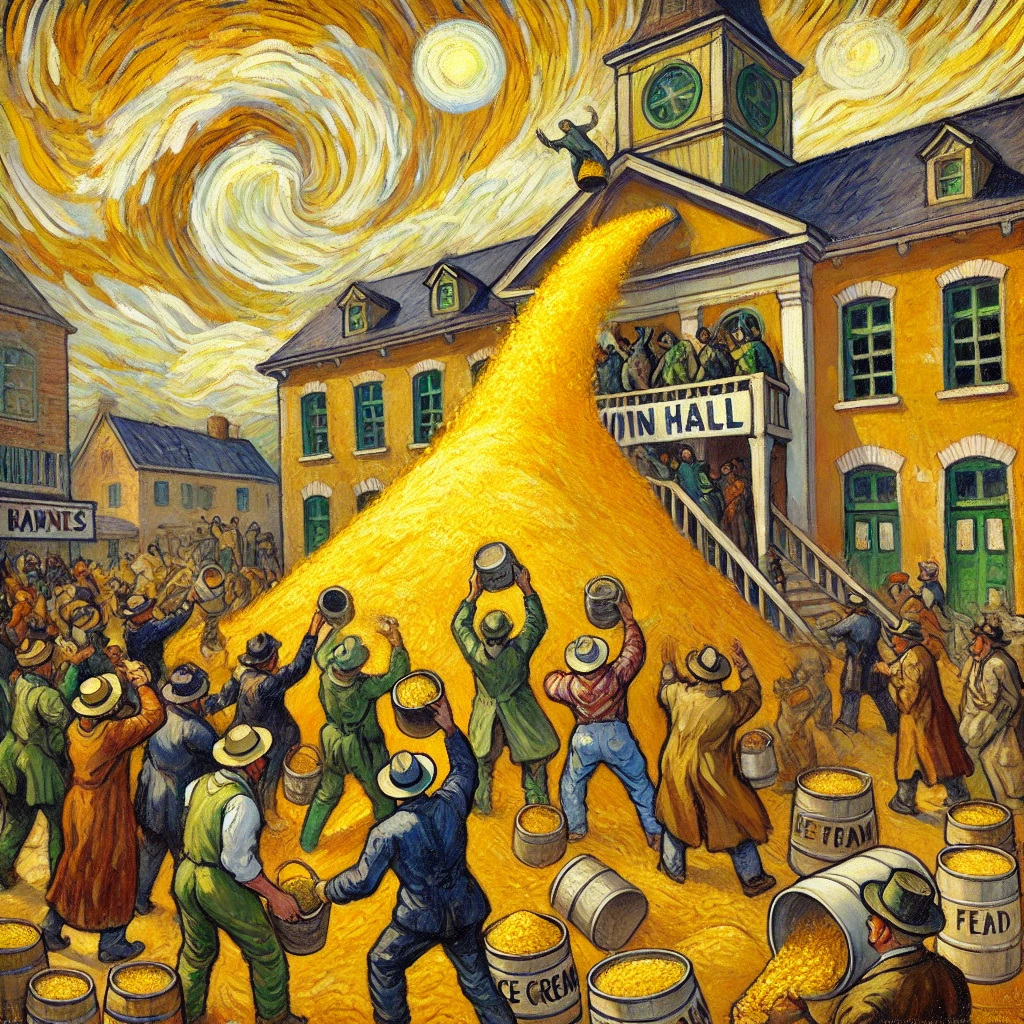
The program was simple. Anyone who showed up at City Hall with a bucket, bag, or recycled ice cream tub could fill it from the municipal feed pile.
Tilly Boone, as treasurer, tried to protest.
“Boot,” she said, “we can’t afford this. You’ve spent three months’ worth of the town’s budget on corn.”
“Corn builds community, Tilly,” he replied, tossing feed into the air like confetti.
Soon, the entire valley smelled faintly of cracked grain. Children played in corn drifts like snow. Squirrels grew fat. Pigeons developed entitlement complexes.
VI. The Free Feed Policy
VII. The Corn Economy
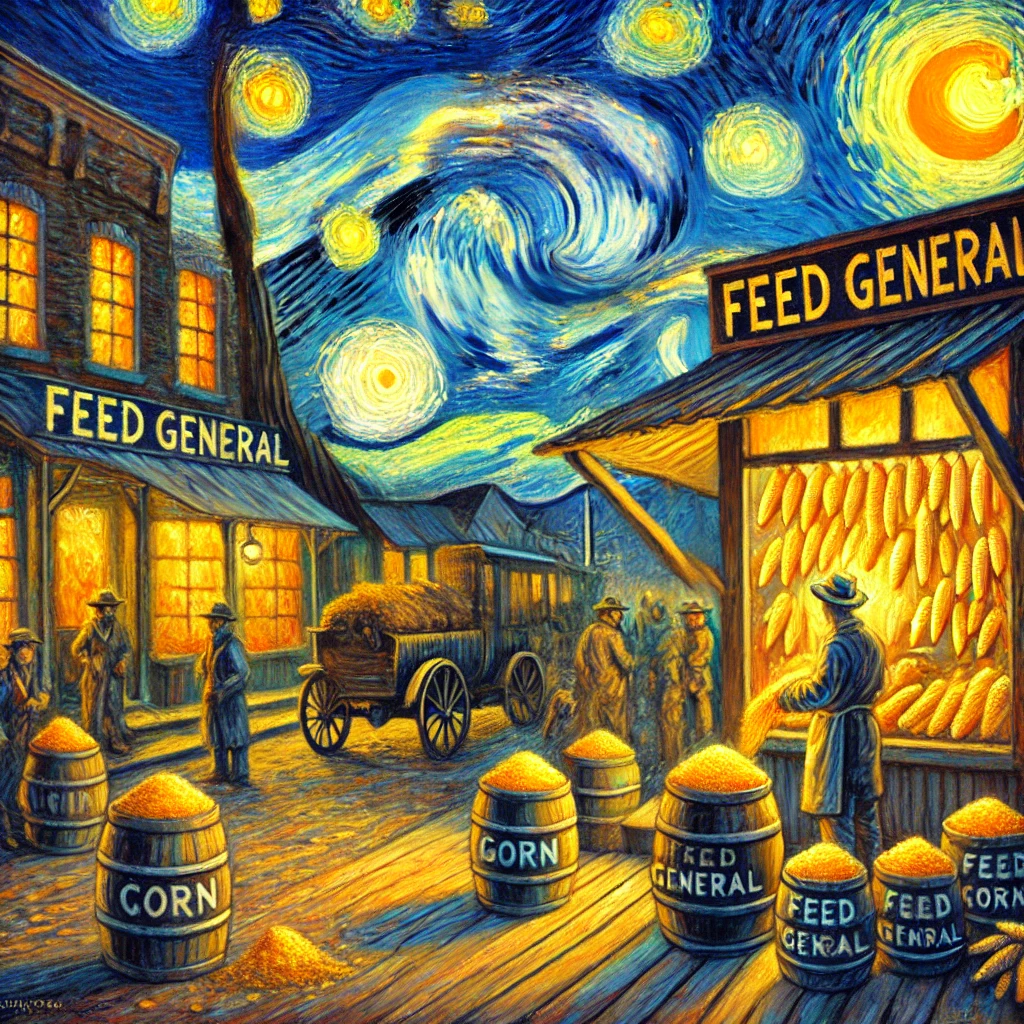
A new local currency emerged: The Sequatchie Corn Standard.
Folks started bartering with feed. A haircut cost two scoops. A tire rotation cost three.
Mabel Dean even started accepting feed donations in lieu of late library fines, though she complained about mice sneaking into the stacks.
The Dollar General temporarily rebranded as Feed General, and the town slogan unofficially became “Prosperity Through Poultry.”
At the height of the craze, Boot stood on the steps of Town Hall and announced:
“Comrade Cluckles envisions a future where every man, woman, and child shall know the taste of corn and the freedom of feathers.”
Nobody really knew what that meant, but the applause lasted five minutes.
VII. The Corn Economy
VIII. The Opposition
By mid-spring, however, cracks began to show in the great Corn Consensus.
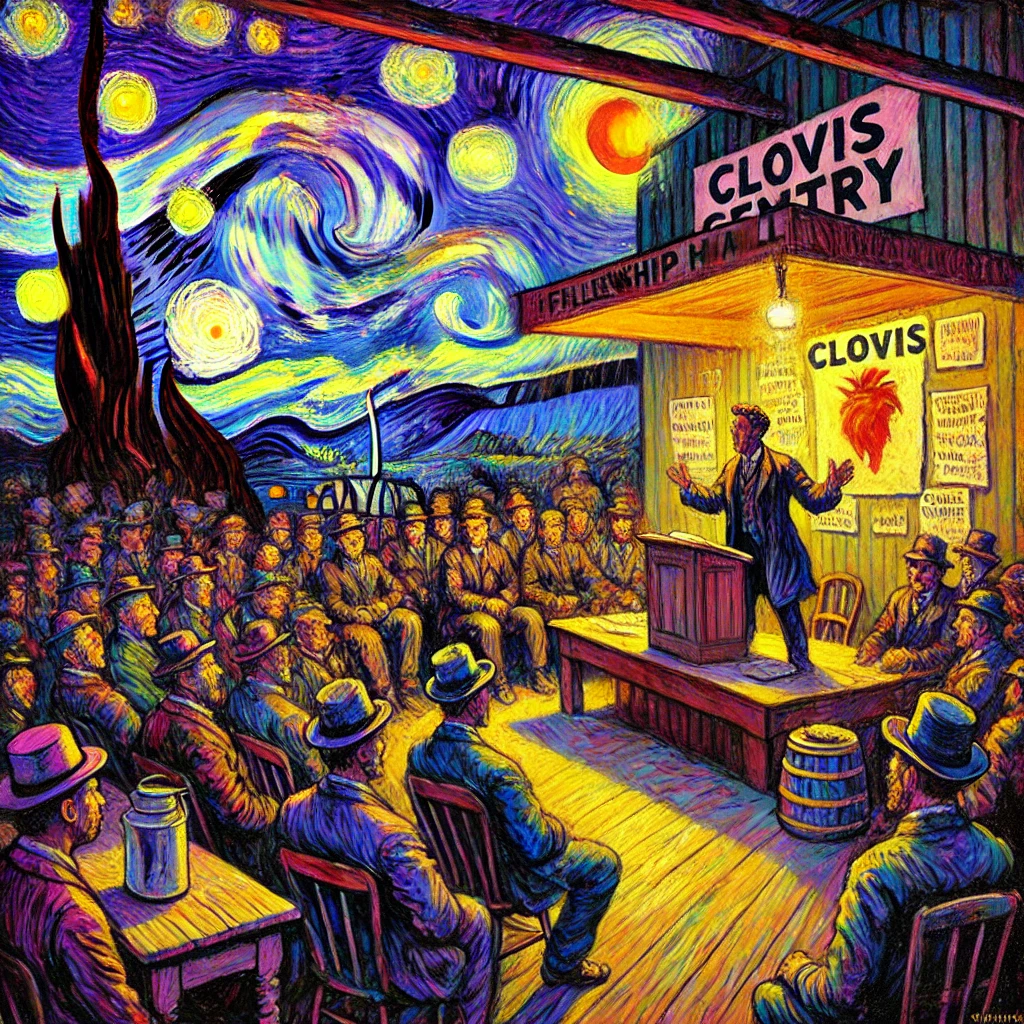
A shadow group calling itself Citizens for Reasonable Roosters (CRR) began meeting secretly in the Fellowship Hall. Their goal: restore “human representation in government.”
Clovis Gentry, now their de facto leader, made impassioned speeches:
“We’ve replaced leadership with livestock! What’s next? A goat on the school board?”
To which Boot responded publicly on the radio:
“If the goat can balance a budget better than you, Clovis, I’ll get it a nametag.”
Tensions rose. Feed theft became rampant. Fights broke out behind the Co-Op over “unregulated grain redistribution.” Sheriff Peeler had to issue a town-wide ordinance banning “possession of more than five buckets of feed per household.”
Boot called it “oppression.”
VIII. The Opposition
IX. The Great Feed Scandal
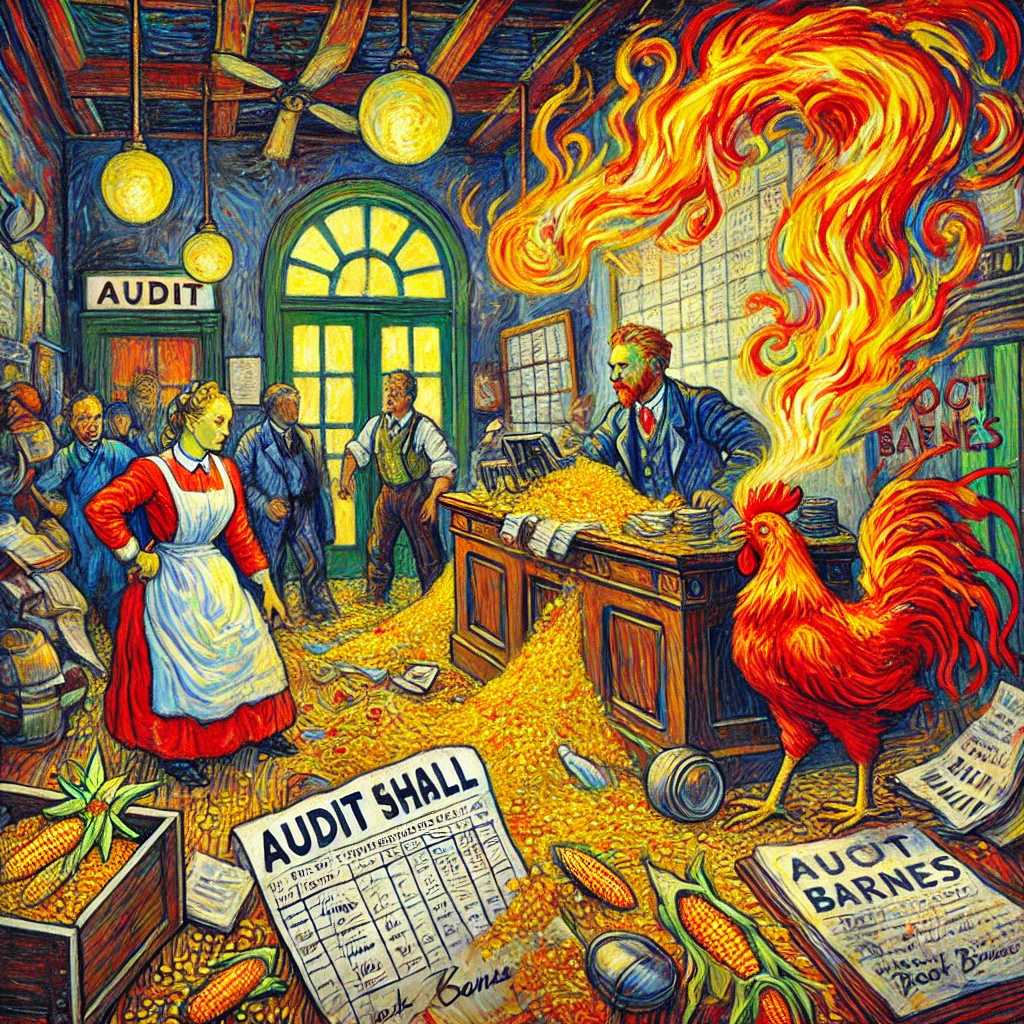
It all came crashing down when the county auditor arrived unannounced.
The audit revealed $8,436 worth of feed purchases listed under “public morale expenses.” Several checks were signed not with handwriting, but with what appeared to be a chicken footprint in red ink.
Tilly Boone resigned in protest, muttering, “I didn’t go to accounting school for this.”
Reverend Gentry declared it proof that “Satan works in mysterious feathers.”
Boot defended himself before a packed crowd at Town Hall:
“The mayor signs with her mark. That’s democracy. That’s authenticity. That’s poultry policy in action.”
The audience applauded again. Sequatchie Crossing had crossed the Rubicon — or rather, the Roost.
IX. The Great Feed Scandal
X. The People’s Parade
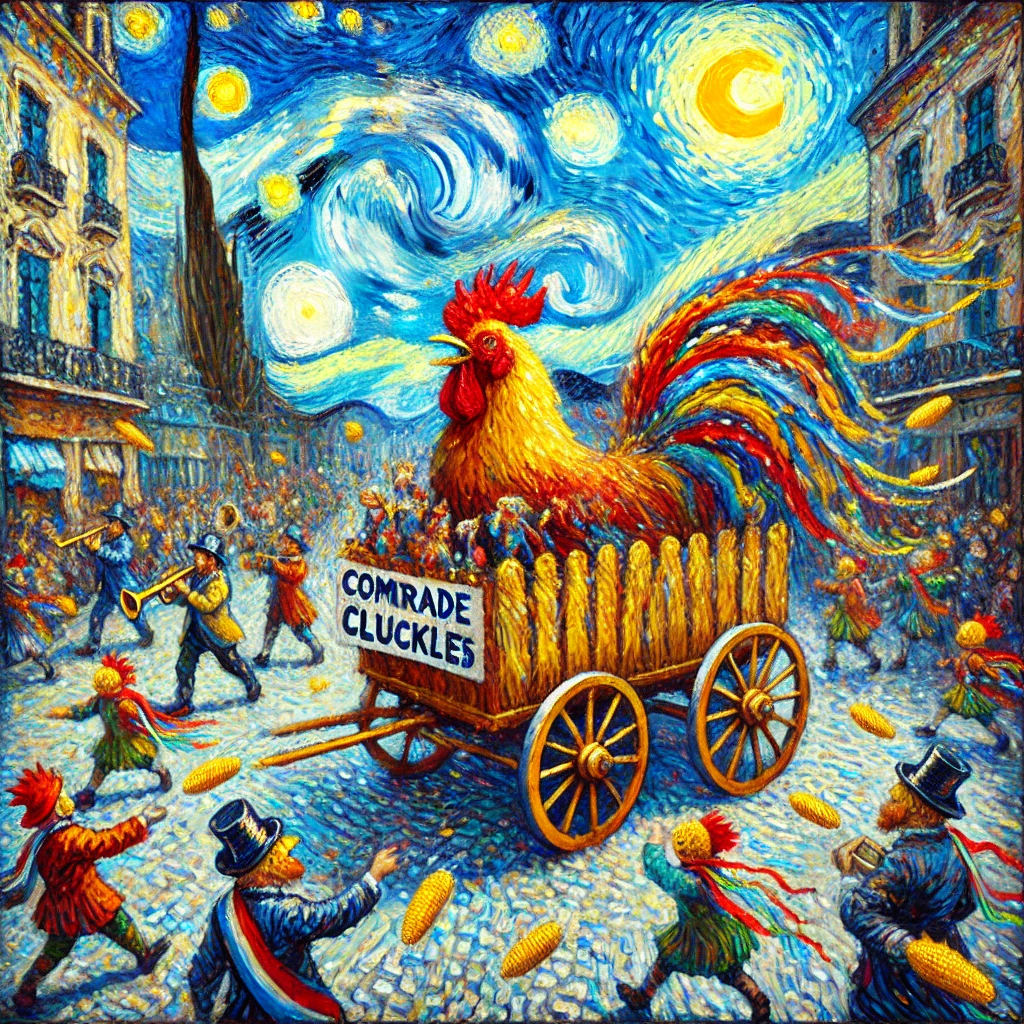
In defiance of county interference, Boot organized the First Annual People’s Poultry Parade.
Floats rolled down Main Street — hay wagons decorated with red streamers and slogans like “Eggs Over Bureaucracy” and “Power to the Poultry.”
Children wore beak masks and carried seed bags like candy buckets. Mabel Dean read poems about “avian equality.”
Comrade Cluckles rode in a gold-painted feed cart pulled by two miniature donkeys wearing red ribbons.
Half the county showed up to watch. The other half stayed home but argued about it online.
X. The People’s Parade
XI. The Fall of the Feathered Regime
The end came quietly.
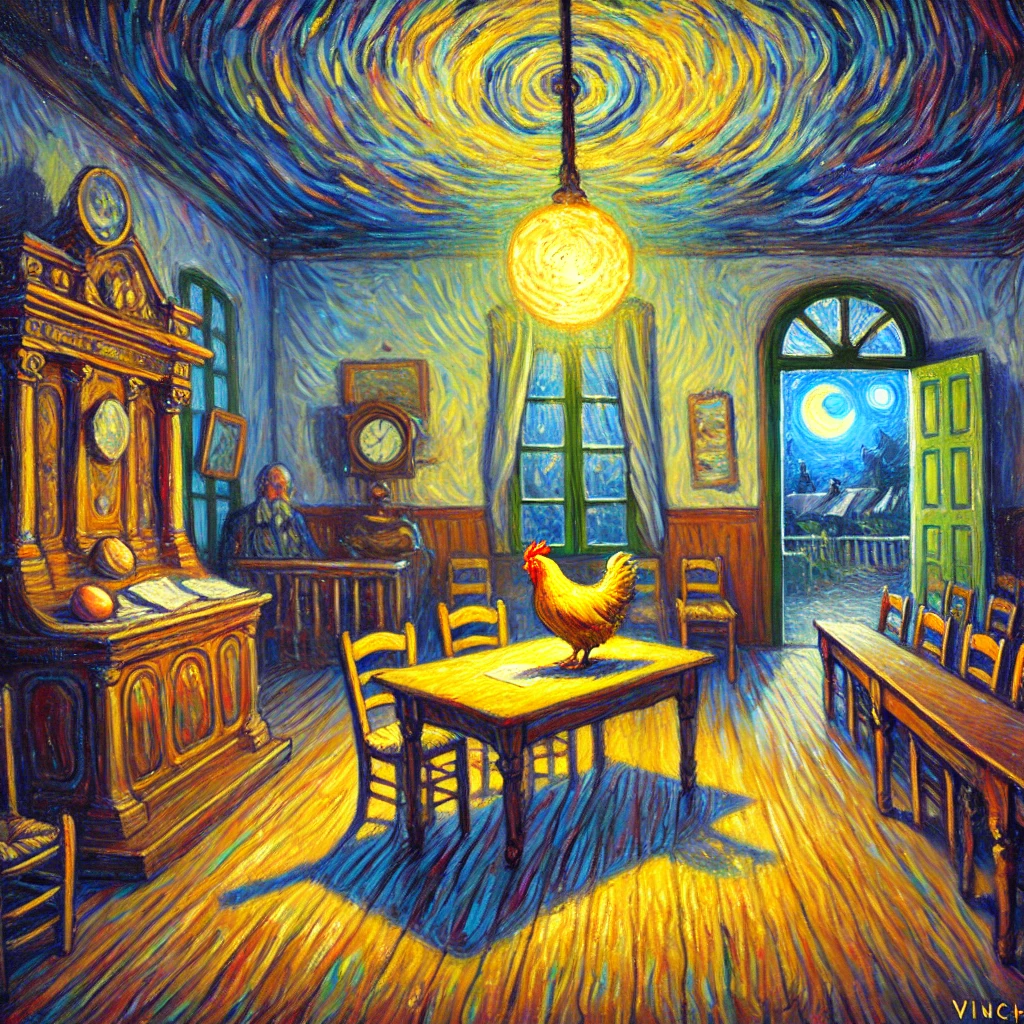
During one fateful town meeting, Cluckles, now growing old and somewhat disillusioned, flew up onto the council table, pecked at the microphone, and laid a single egg.
Then she hopped down, strutted to the open door, and wandered into the night.
Boot took it as a sign. “She’s ascending to higher office,” he whispered.
The next morning, the chicken was gone. Some say she joined a free-range commune across the valley. Others say she was abducted by Clovis’s supporters as evidence in their “Return to Sanity” campaign.
Regardless, Sequatchie Crossing was without a mayor again.
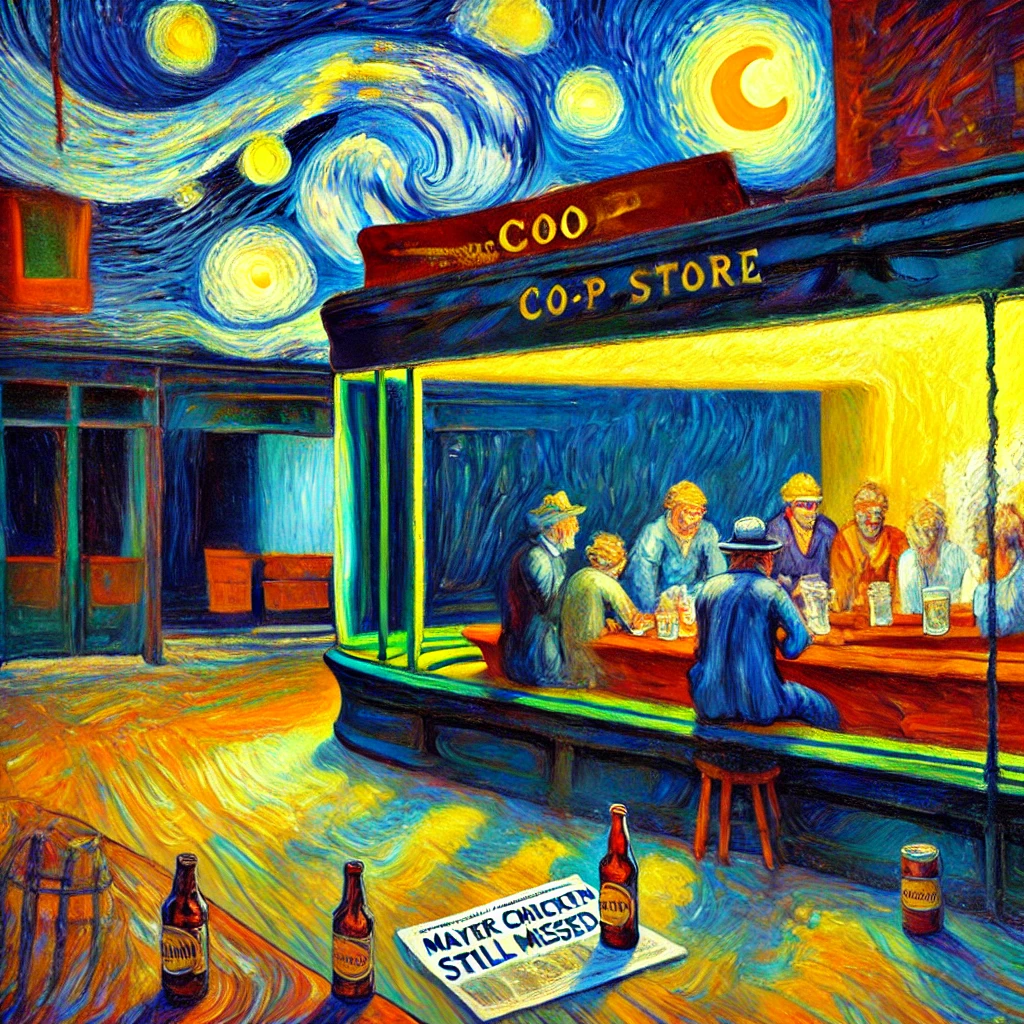
A special election was held, but turnout was low. Voters, exhausted from democracy, wrote in “None of the Above” and “Still Miss the Chicken.”
Eventually, the city council appointed a temporary administrator: Mabel Dean, who promised to “restore order, literacy, and common sense — though not necessarily in that order.”
XI. The Fall of the Feathered Regime
XII. The Legacy
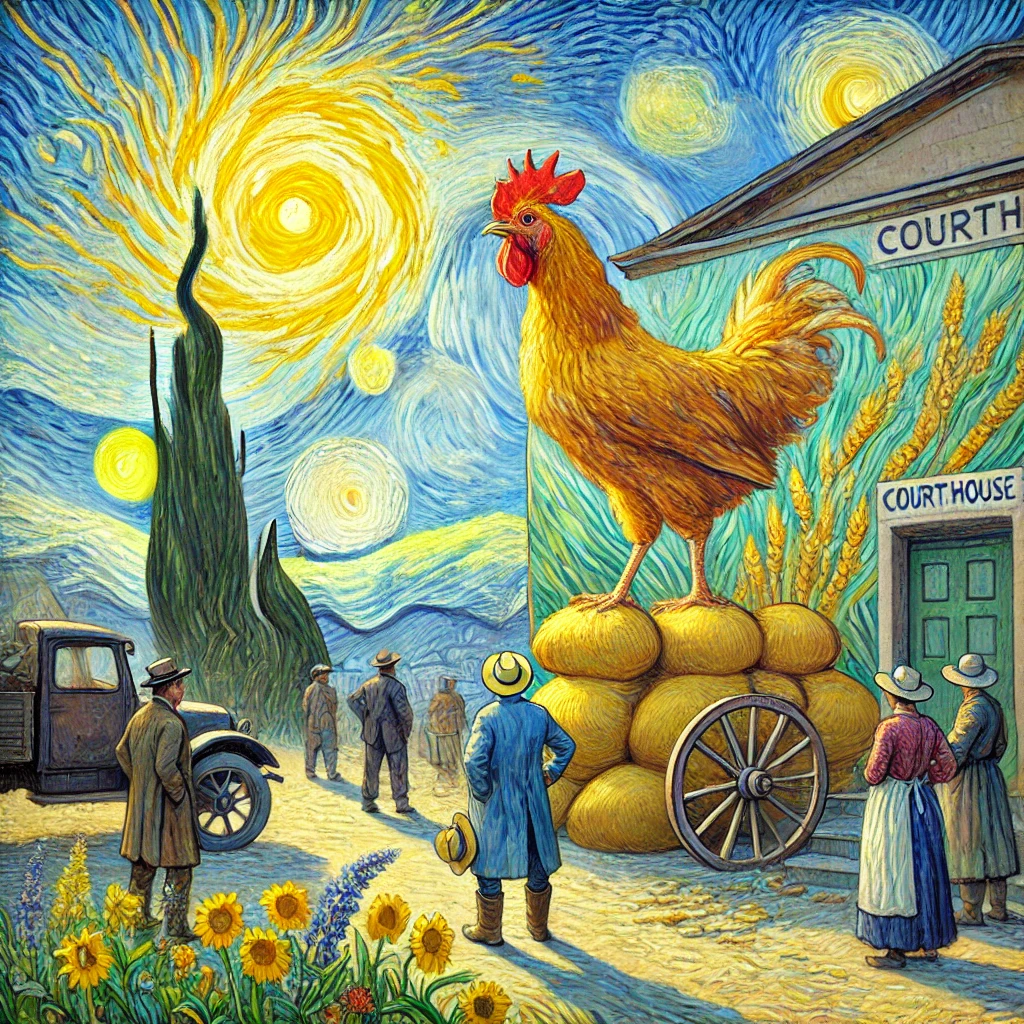
Today, years later, a mural still adorns the courthouse wall:
A noble chicken standing tall atop a pile of golden corn, wings outstretched, sunlight bursting behind her like a halo.
The caption reads:
“One Town, Under Coop.”
Every spring, Boot Barnes hosts a memorial barbecue in her honor. He still keeps a handful of feed in his jacket pocket “just in case she comes home.”
And every election season, someone inevitably writes “Commie Chicken” on the ballot — not out of rebellion, but out of nostalgia.
Because in Sequatchie Crossing, the line between joke and government is as thin as a chicken wire fence.
XII. The Legacy
XIII. Epilogue: The Cluck Heard ’Round the Valley
Reverend Gentry still preaches about the “Year of the Chicken” as a parable on hubris.
Clovis still claims the chicken cheated.
Tilly Boone still refuses to audit anything involving feathers.
But for most townsfolk, that strange season was a reminder that Sequatchie Crossing isn’t run by logic or policy — it’s run by personality, superstition, and the occasional accident.
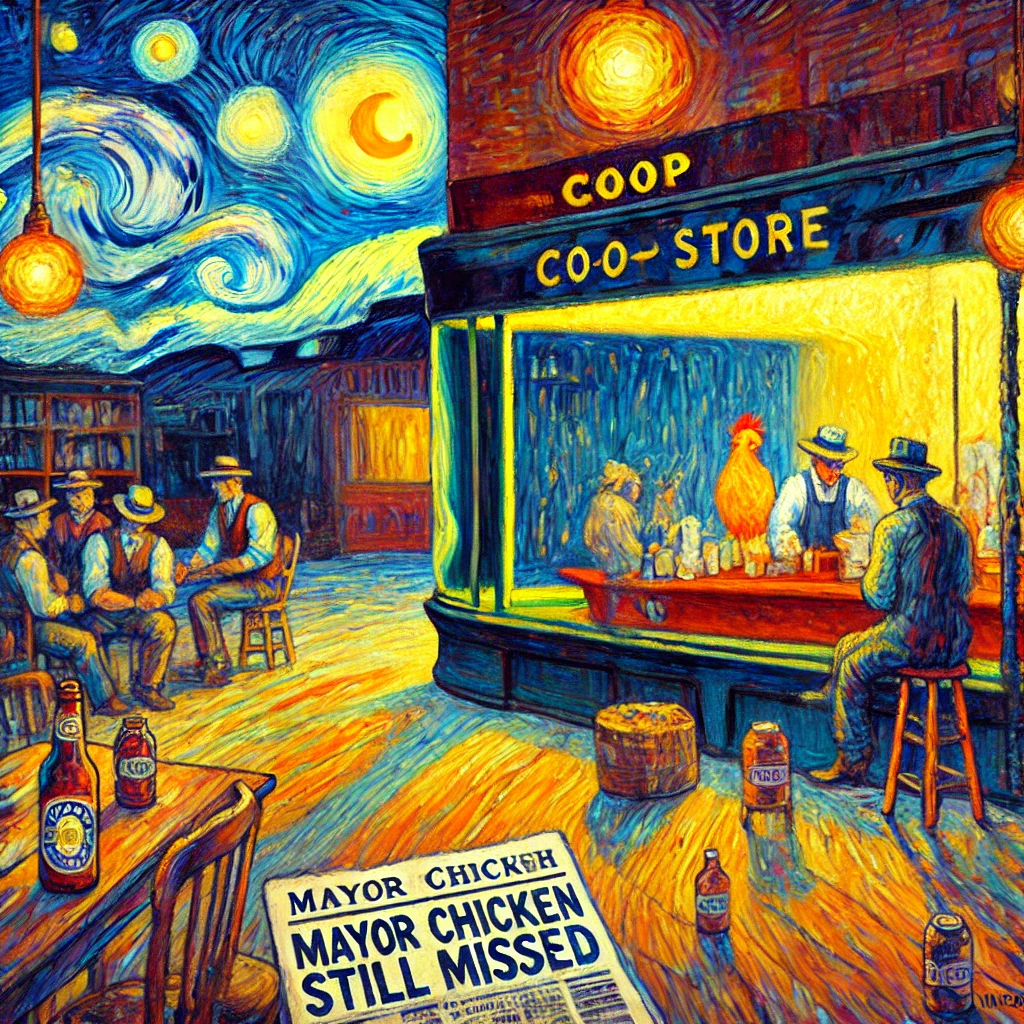
And in the dim light of the Co-Op at closing time, when someone’s had one too many root beers and the talk turns to politics, you can still hear someone say:
“Say what you want about that chicken, but at least things ran on time. And by ‘on time,’ I mean around feeding time.”
The laughter that follows always sounds the same — loud, familiar, and just a little proud.
Because in Sequatchie Crossing, democracy may not always be dignified…
…but by God, it’s never dull.
XIII. Epilogue – The Cluck Heard ’Round the Valley
Key Takeaways
-
Democracy in Sequatchie isn’t broken; it’s just winging it.
-
Boot Barnes remains a master of turning chaos into community theater.
-
Free chicken feed might not fix an economy, but it can sure make everyone show up.
XIII. Epilogue – The Cluck Heard ’Round the Valley
Disclaimer
The Sequatchie Crossing Dispatch is a work of satirical fiction based loosely (and lovingly) on the real quirks of small-town life in the Sequatchie Valley.
All characters, places, incidents, and fowl are imaginary or exaggerated for storytelling purposes. Any resemblance to actual people, chickens, or governing bodies—living, deceased, or democratically elected—is purely coincidental, accidental, or just plain funny.
The Dispatch exists to celebrate the humor, humanity, and contradictions of rural America: where good gossip travels faster than broadband, ordinances outlive logic, and democracy sometimes arrives on two feet and feathers.
No chickens were harmed during the writing of this article, though several were consulted for policy advice.
Disclaimer – The People’s Pecking Order
Real Places Behind the Ruckus – From The Dunlap Directory
Real Places Behind the Ruckus – From The Dunlap Directory
Yes, this story was fictional; even the parts that weren’t true. These places? Absolutely real. Stop by, support local, and keep the Wi-Fi away from livestock:
- Backwoods Fence and Decking
- Miller’s Bread
- Rigsby Farm Equipment
- RJ’s Garage
- Highland Drive Warehouse
- Rhea Family Farms
- Waste Wipeout
- Lookout Mountain Incline Railway
- The Bee’s Knees
- Mountain Glen RV Park & Campground
- Local Depot
- Legacy Ridge Farms
- Samuel Mills & Sons Well Drilling
- Willow Rose Stables – Event Pony Rental
- Dunlap Building Stone
- Mid-Tenn Diesel Truck Repair
- Crumb & Co.
Real Places Behind the Ruckus – From The Dunlap Directory
At Sequatchie Crossing, we tell the stories of Sequatchie Crossing.
Please share this post with your friends, family, or business associates who may want follow the news from Sequatchie Crossing.

0 Comments