


Officials Cite Safety Concerns
By Tom Seest
At Sequatchie Crossing, we tell the stories of Sequatchie Crossing.
Please share this post with your friends, family, or business associates who may want follow the news from Sequatchie Crossing.
🎤 Audio Overview
Meeting Adjourned Due to Excessive Agreement About Disagreement
Act I: The Agenda Was Approved Without Incident, Which In Retrospect Should Have Raised Concerns
The agenda was approved unanimously, and that was the first mistake.
It was 6:02 p.m. on a Tuesday, the traditional hour when the citizens of Sequatchie Crossing gathered to demonstrate – often unintentionally – that democracy is not a system so much as a shared endurance test. The folding chairs in the municipal building had been arranged in their usual hopeful rows. The microphone had been tested twice. The clock on the wall ran seven minutes fast, which everyone knew and no one trusted.
Madeline Griggs, City Clerk, read the agenda aloud in her precise, well-worn cadence. Each item landed with the soft authority of something that would later be misunderstood.
“Item one: call to order. Item two: approval of minutes from the previous meeting. Item three: public comment. Item four: discussion of the proposed amendments to the Discussion Guidelines.”
There was a pause after that last line. Not a dramatic pause. Just the kind of pause that happens when everyone in the room briefly realizes they are about to discuss how they discuss things.
“Any additions?” Madeline asked.
Silence.
“No?” she clarified.
Still silence.
Someone coughed. A chair leg scraped.
“All right then,” she said, making a checkmark. “Agenda approved.”
The gavel came down with a polite tap.
Outside, a truck backfired. Inside, democracy inhaled.
Act I – The Agenda Was Approved Without Incident
Act II: Agreement Emerges, And Everyone Immediately Objects To It
Mayor Alton Peebles leaned forward, hands folded, projecting the calm authority of a man who had once chaired a Homeowners Association and survived.
“Before we begin,” he said, “I just want to remind everyone that this meeting is about improving discourse. We all want the same thing here.”
That sentence – we all want the same thing – was met with instant resistance.
“I disagree with that,” said Boot Barnes, without waiting to be recognized.
Mayor Peebles closed his eyes for half a second. Not in frustration. In prayer.
“Mr. Barnes,” he said, “you’ll have time during public comment.”
“That’s fine,” Boot said, nodding. “I just want it on record that I disagree with the idea that we agree.”
Several heads nodded in support of that statement, including a few belonging to people who did not agree with Boot but felt he should be allowed to say it.
“That’s fair,” said Clovis Strickland, already writing. “He’s disagreeing with agreement, not the thing itself.”
Madeline glanced over. “Clovis, please don’t editorialize in the minutes.”
“I’m not,” Clovis said. “I’m clarifying.”

Act II – Agreement Emerges, And Everyone Immediately Objects
Act III: The Nature Of Disagreement Is Defined, Immediately Contested, Then Redefined
The proposed Discussion Guidelines had been drafted after the previous meeting ran three hours and ended with someone asking whether eye contact counted as intimidation.
Councilwoman Bernice Halloway read aloud the first proposed amendment.
“‘Disagreement shall be expressed respectfully and without repetition.’”
“That’s subjective,” said someone in the back.
“So is disrespect,” Bernice replied calmly.
“That’s my point.”
“So you agree it’s subjective?”
“No, I disagree with how you’re agreeing.”
This was noted.
Sheriff Peeler shifted in his chair. He had been invited as a courtesy, which meant he was there to observe and, if necessary, stand near the wall in a reassuring way.
“From a safety standpoint,” he said carefully, “we don’t usually intervene in philosophical disagreements.”
“That’s good,” said someone. “Because this is philosophical.”
“It’s also procedural,” said someone else.
“It’s emotional,” added a third.
The room nodded, collectively, at the idea that disagreement was many things at once.
Mayor Peebles smiled thinly. “See? Consensus.”
“No,” said Boot. “That’s concurrence, not consensus.”
Clovis underlined concurrence twice.
Act III – The Nature Of Disagreement Is Defined
Act IV: Public Comment Becomes A Mirror Held Too Close To The Face
Public comment opened with the usual instructions: five minutes per speaker, no personal attacks, no naming specific individuals unless they were already present and willing to make eye contact.
Mrs. Laverne Pickett stepped forward.
“I just want to say,” she began, “that I appreciate how we’re all trying to be civil.”
Several people shifted uncomfortably.
“But,” she continued, “I also think we’re overcorrecting.”
Overcorrecting, it turned out, was a word that resonated.
One speaker agreed wholeheartedly with Laverne’s concerns about overcorrection, while strongly objecting to her tone.
Another speaker agreed with her tone but not her concern.
A third speaker agreed with both but objected to the order in which she had presented them.
By the fourth speaker, the room had reached a rare state: nearly everyone agreed that disagreement was being mishandled, but no two people agreed on how.
This was, paradoxically, described by several attendees as “productive.”

Act IV – Public Comment Becomes a Mirror
Act V: A Motion Is Made, Seconded, Clarified, Amended, Then Supported For Conflicting Reasons
Councilman Ray Dobson made a motion to table the Discussion Guidelines until further review.
“I second,” said Bernice.
“Discussion?” asked the Mayor.
The discussion lasted forty-seven minutes.
Boot supported tabling because the guidelines were premature.
Clovis opposed tabling because the guidelines were insufficiently documented.
Another council member supported tabling because the disagreement had proven the need for guidelines.
Someone in the audience opposed tabling because it delayed resolution.
Another supported tabling because resolution was impossible.
Sheriff Peeler leaned over to Madeline. “Is this still one motion?”
“Yes,” she said. “Technically.”
Clovis’s pen snapped.

Act V – The Motion Expands Beyond Control
Act VI: Agreement About Disagreement Achieves Critical Mass
It happened gradually, like humidity.
People began saying things like:
“I think we all agree that we don’t agree.”
“I agree that disagreement is fine, but not this way.”
“I agree with your disagreement but disagree with your agreement.”
The room grew warm. Not emotionally – literally. The HVAC unit, long accustomed to mild contention, began to hum louder.
Mayor Peebles noticed something unsettling.
Everyone was nodding.
Not at the same statements – but continuously. Agreement had become ambient.
“We need to pause,” he said.
“No, I agree,” said three people at once.
“That’s the problem,” the Mayor replied.
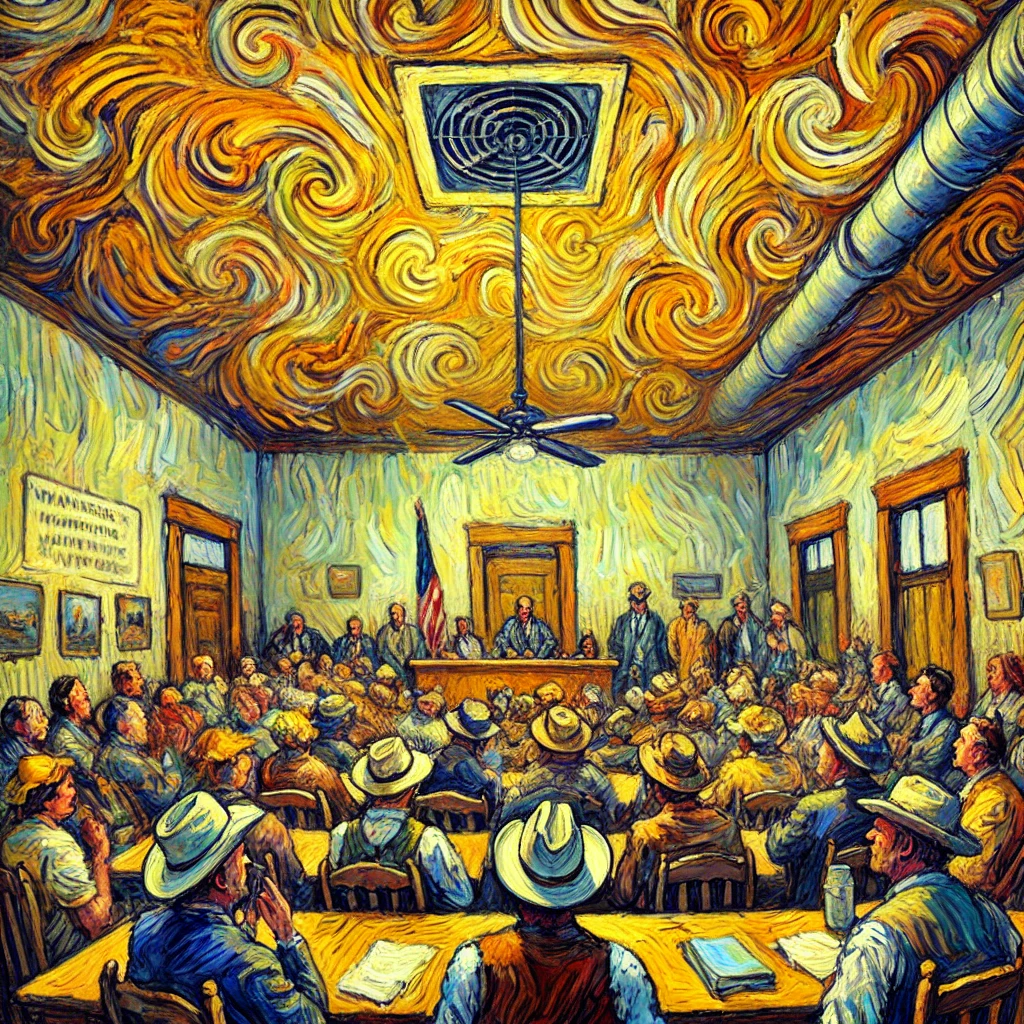
Act VI – Agreement Reaches Critical Mass
Act VII: Safety Concerns Are Raised, Somewhat Ironically
Sheriff Peeler stood.
“For the record,” he said, “I’m not declaring an emergency.”
This immediately alarmed everyone.
“But,” he continued, “I am noticing signs of cognitive overload.”
“Like what?” asked someone.
“Excessive nodding,” he said. “Circular consensus. People agreeing that disagreement is happening without disagreeing about whether it should.”
Madeline looked up. “Is that dangerous?”
“In large groups,” Peeler said, “anything abstract can be.”
The HVAC unit clicked off.
The room fell silent.
Someone whispered, “I agree.”
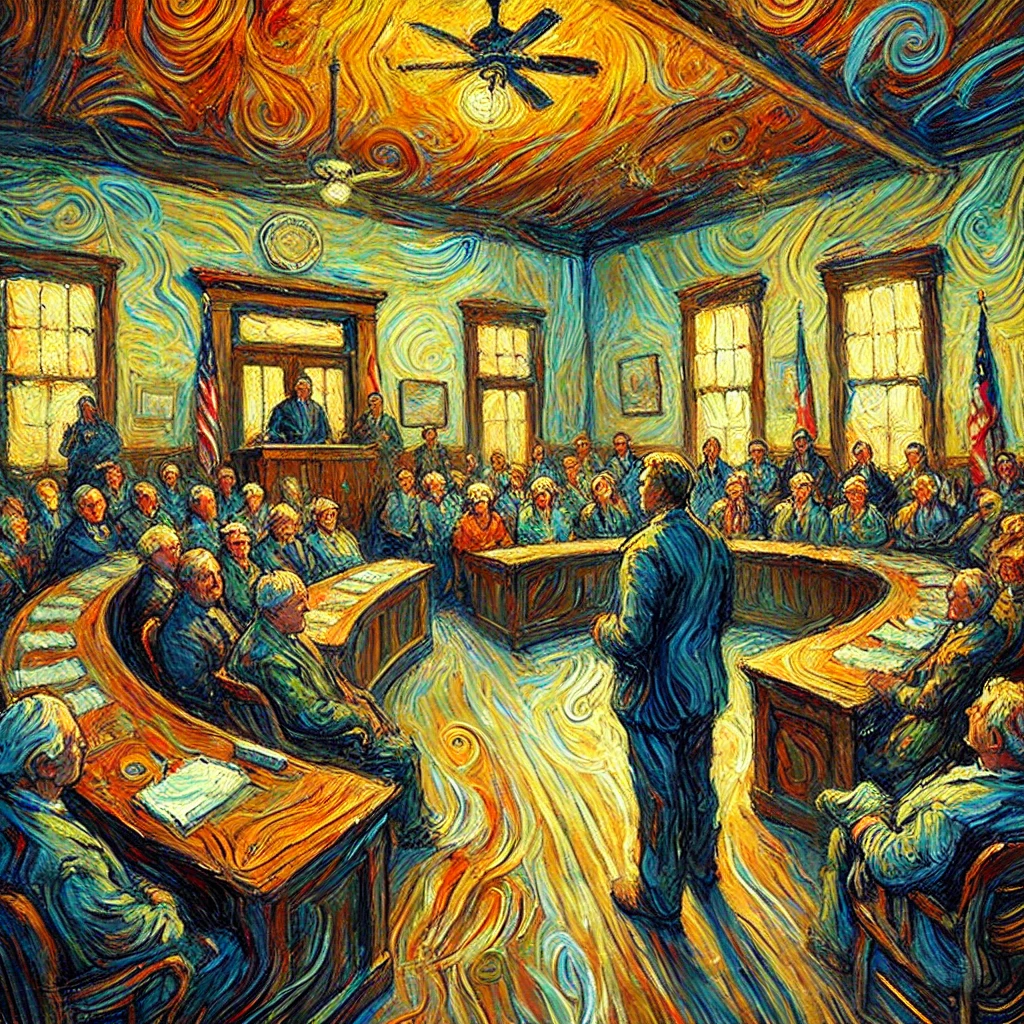
Act VII – Safety Concerns Are Raised
Act VIII: The Gavel Falls, And No One Is Sure Why
Mayor Peebles raised the gavel.
“Given the circumstances,” he said, “I am adjourning this meeting.”
“On what grounds?” Boot demanded.
“Safety,” the Mayor replied.
“What safety?” someone asked.
“The structural integrity of the discourse,” Peebles said.
Clovis stopped writing.
“That’s not a thing,” Boot said.
“It is now,” Bernice replied.
The gavel came down.
“Meeting adjourned due to excessive agreement about disagreement.”
The words echoed.
No one moved.

Act VIII – The Gavel Falls
Act IX: The Aftermath Is Characterized By Reflection, Reinterpretation, And Emails
By morning, three versions of events had circulated.
One claimed the meeting ended prematurely.
Another claimed it went exactly as planned.
A third insisted it never adjourned and was technically still ongoing.
Clovis filed his notes anyway.
Boot wrote a letter to the editor, then disagreed with it, then published both versions.
Sheriff Peeler added a line to his training manual: Watch for nodding.
Madeline updated the minutes with a footnote.
Mayor Peebles ordered new folding chairs.
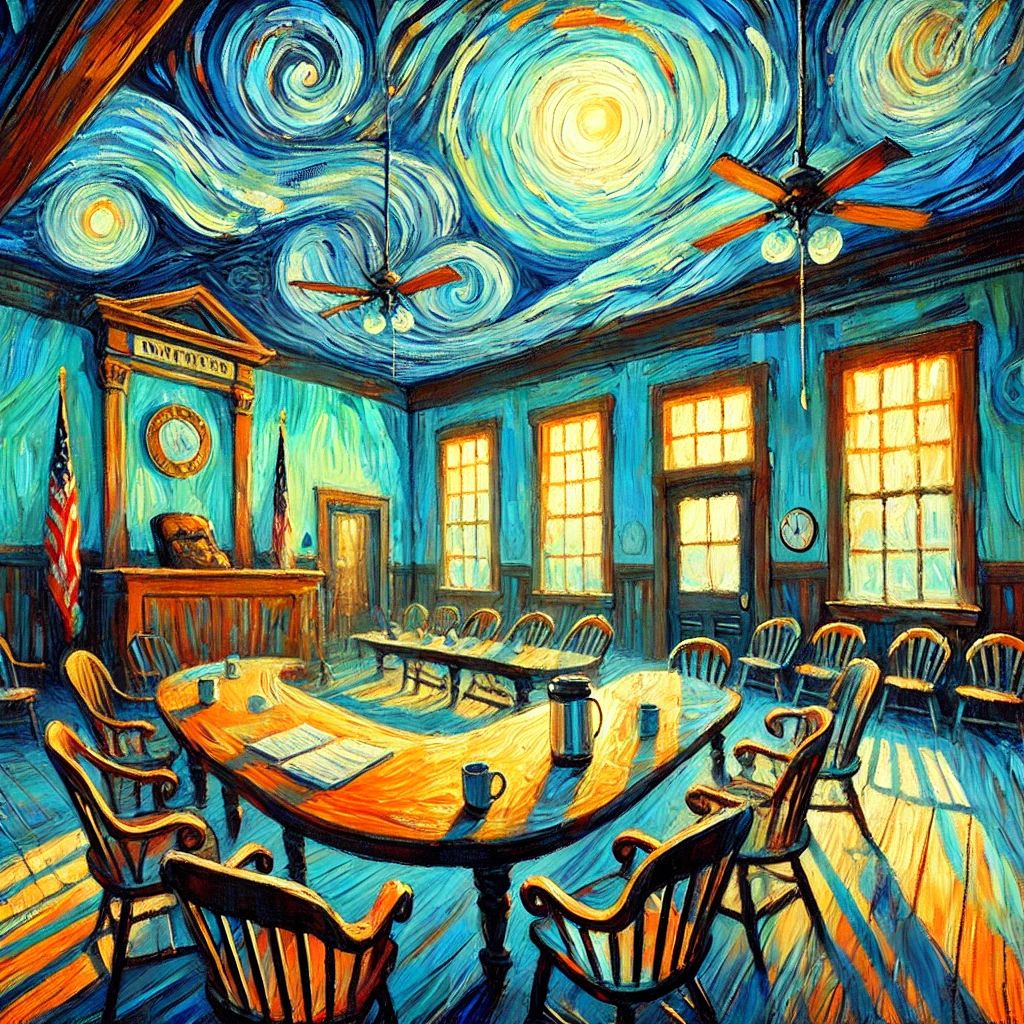
Act IX – The Aftermath
Epilogue: Agreement Remains Elusive, Which Everyone Finds Comforting
The following week, the agenda included a new item:
“Discussion of whether agreement about disagreement constitutes progress.”
It was approved unanimously.
No one trusted it.

Epilogue – Agreement Remains Elusive
Disclaimer
This story is a work of fiction. The town of Sequatchie Crossing, its meetings, officials, procedures, and residents are entirely imaginary, though they may feel uncomfortably familiar. Any resemblance to actual towns, public bodies, elected officials, or real-life civic meetings – past, present, or interminable – is purely coincidental and probably unavoidable.
No actual meeting was adjourned due to excessive agreement about disagreement, though several have come close. No safety determination was made by a real authority, no HVAC systems were harmed, and no one was cited for excessive nodding under any known municipal code.
The opinions expressed by fictional characters do not reflect the views of any real person, agency, or government entity, nor do they constitute guidance on public participation, parliamentary procedure, or the safe handling of abstract concepts in enclosed spaces.
Reader discretion is advised when encountering scenes of procedural ambiguity, circular consensus, or unmonitored civic enthusiasm.
Proceed accordingly.

Disclaimer – Meeting Adjourned Due to Excessive Agreement About Disagreement
Real Places Behind the Ruckus – From The Dunlap Directory

Real Places Behind the Ruckus – From The Dunlap Directory
Yes, this story was fictional; even the parts that weren’t true. These places? Absolutely real. Stop by, support local, and keep the Wi-Fi away from livestock:
- Southeastern Farmers Co-op Bledsoe
- Dunlap Iron & Metals
- Sequatchie Valley Low Cost Spay & Neuter
- 580 Tactical Training
- Hughes Produce Dunlap
- White Oak Ranch TN
- TN Waterfront Vacation Rental
- Scott Haston HVAC Services
- Sonic Drive-In
- Impact Athletics Co.
- Land’s Properties
- Standifer Orthodontics
- Pinpoint Customs Collision
- Cagle Mountain Trading Post
- Skull Island Campground
- Dennis Auto Glass Mobile Service
- Top of the Rock Restaurant and Brewery
- Wheeler’s Orchard & Vineyard

Real Places Behind the Ruckus – From The Dunlap Directory
At Sequatchie Crossing, we tell the stories of Sequatchie Crossing.
Please share this post with your friends, family, or business associates who may want follow the news from Sequatchie Crossing.
Related Posts
- Facebook Group Declares AI the Devil’s Work
- I’m Not Going to Argue with You
- Mabel Dean Installs Ring Camera on Fellowship Hall—Spots Ghost
- Are Outsiders People Too?
- Rising Rent and Falling Patience – the Year Sequatchie Held a Cost-Of-Living Potluck
- Trailer Rent Hits $1,000 – Town Demands to Know Who Bought All the $425 Trailers From 2013
- Am I A Local Yet? – The 23-Year Sequatchie Crossing Residency Hearing
- Reverend Gentry’s PowerPoint Got Possessed and Preached Heresy



0 Comments