


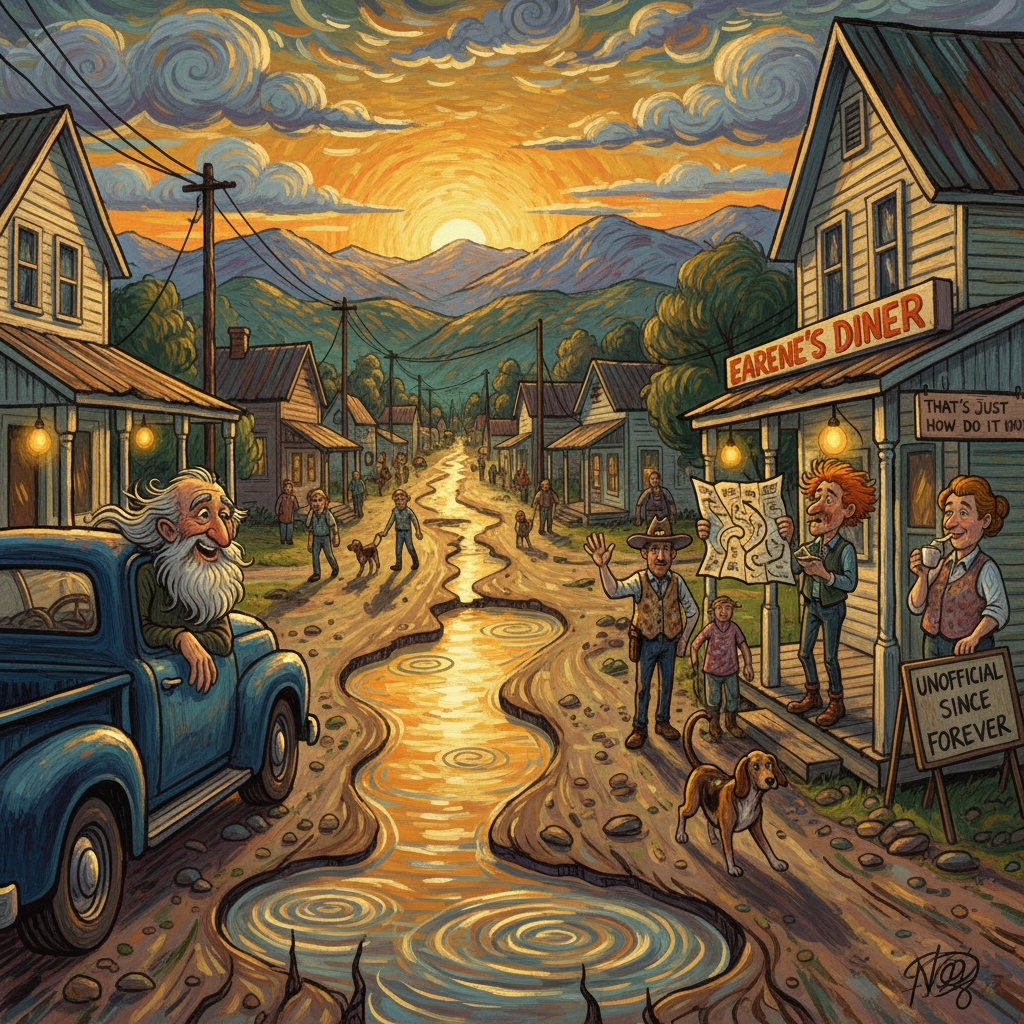
Unofficial Adjustments Now Function As Primary System
By Tom Seest
At Sequatchie Crossing, we tell the stories of Sequatchie Crossing.
Please share this post with your friends, family, or business associates who may want follow the news from Sequatchie Crossing.
🎤 Audio Overview
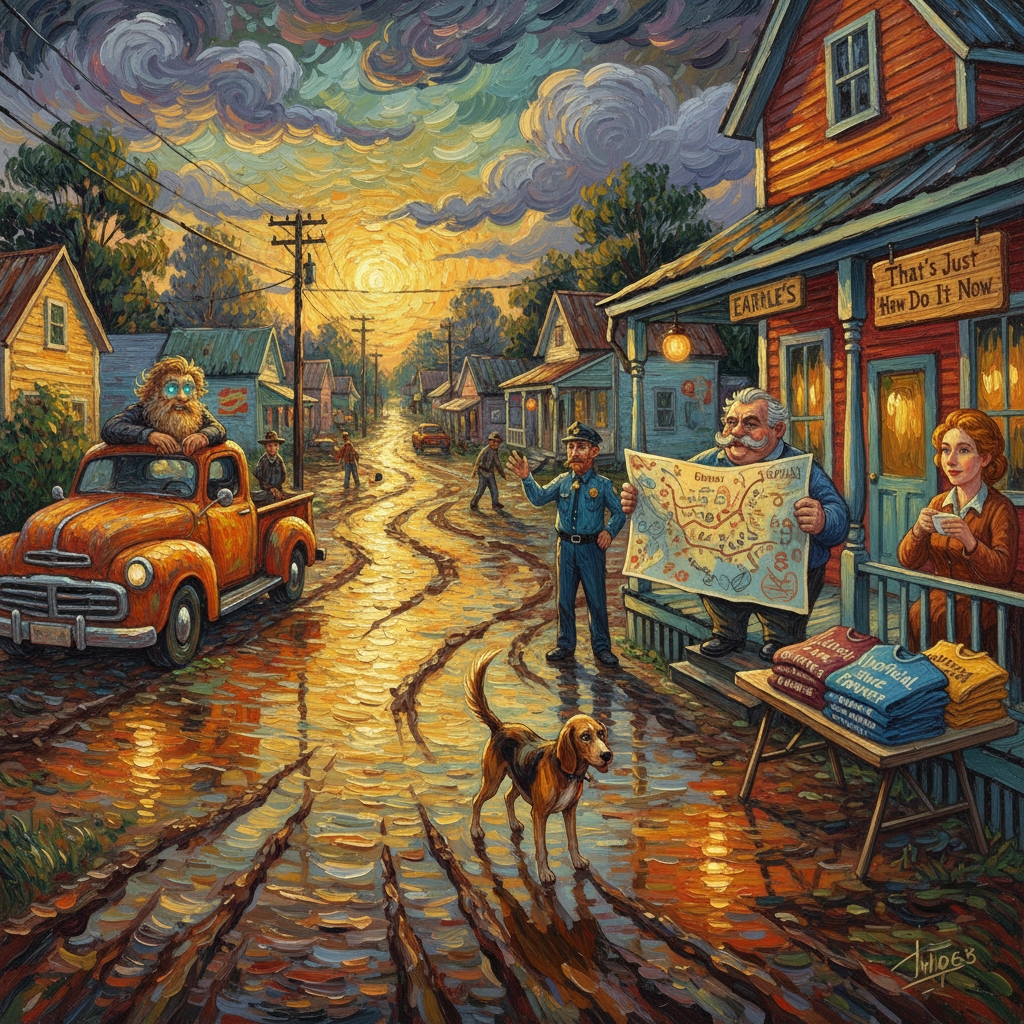
Workarounds Become Routine Despite Lack of Official Solution
Act I – The Route Nobody Questioned Anymore
By seven-thirty on a damp Tuesday morning, traffic through Sequatchie Crossing had already begun performing what Clovis Strickland referred to as “the customary avoidance ballet.”
Nobody had officially declared Main Street unusable.
No signs existed.
No barricades stood.
No government office had issued warnings.
And yet every vehicle in town—except tourists and one confused propane delivery driver from Pikeville—avoided the eastern stretch between Wheeler’s Feed and the old pharmacy parking lot as if the pavement itself carried a contagious disease.
The problem had begun eight months earlier with what Town Hall described in meeting minutes as “temporary drainage irregularities.”
What that meant in practice was that after even moderate rainfall, a deep pocket of muddy standing water formed directly over a section of broken asphalt. Trucks sank. Sedans scraped. One church van briefly disappeared nose-first to such an extent that Sister Lila Mae Pruitt declared it “a sign against modern suspension systems.”
The town had filed paperwork.
The county had reviewed the paperwork.
Then the state requested additional supporting paperwork regarding the original paperwork.
After that, nobody entirely knew what happened.
But the people adapted.
As they always did.
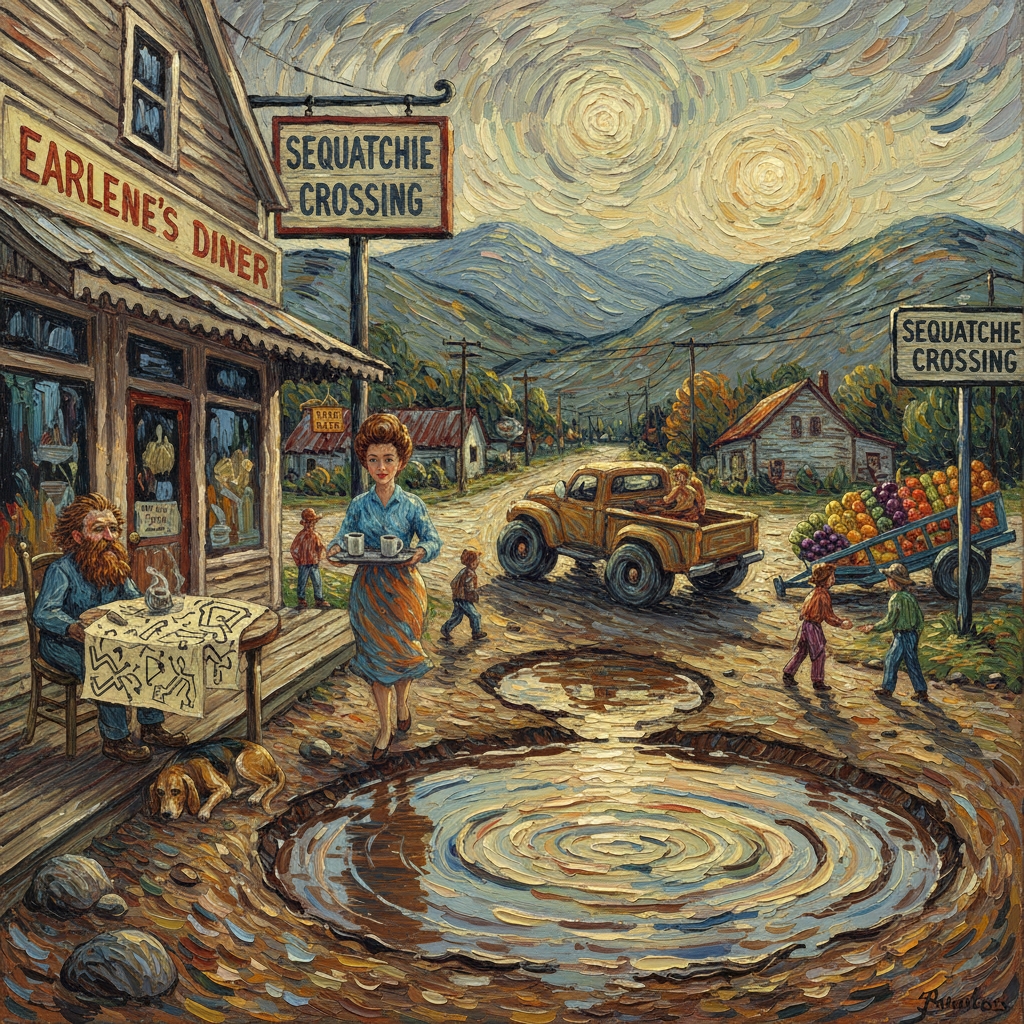
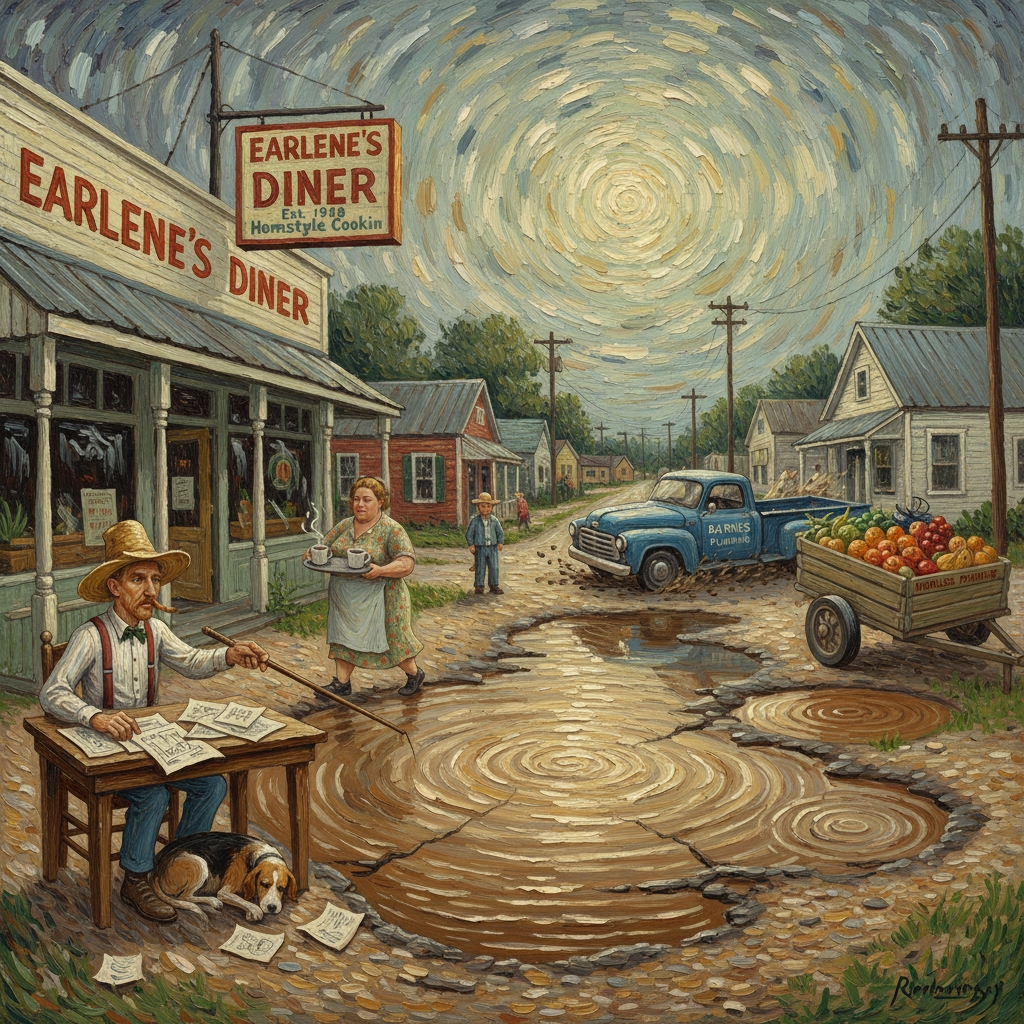
At the front porch of Earlene’s Diner, Clovis sat with a legal pad covered in arrows, circles, and oddly precise timing notes while Daisy the hound slept beneath his chair.
“I’m tellin’ you,” Clovis said, tapping the page, “the reroute now has five established branches dependin’ on weather conditions, church traffic, and whether Sonny’s got his produce trailer parked crooked again.”
Sonny Morales looked offended from inside the diner window.
“It ain’t crooked,” Sonny hollered. “It’s angled for customer visibility.”
“It blocks half the turn lane.”
Act I – The Route Nobody Questioned Anymore
“It invites commerce.”
Mabel Dean Ashcroft emerged carrying coffee in a mug that read BLESSED BUT OBSERVANT.
“That’s just how we do it now,” she said calmly.
Nobody argued.
Because it was.
Boot Barnes rolled up slowly in his truck, stopped twenty feet before the problematic section of road out of pure instinct, then blinked.
“Well I’ll be,” he muttered. “Almost drove through there.”
“You ain’t done that in six months,” Clovis said.
“I know. Body corrected itself before my brain did.”
Daisy stood immediately, walked around the truck automatically, and took the established side route through the gravel lot behind Wheeler’s Feed.
Boot stared after her.
“Even the dog knows.”
“She was the first one to adjust,” Clovis replied seriously.
Mabel nodded.
“That hound rerouted herself after the third mud incident. Smarter than government.”
Inside the diner, Tiffany Annette Roark was setting out laminated “Suggested Parking Patterns” she’d created unofficially after three separate delivery vans became trapped near the drainage area.
Nobody had asked her to.
Nobody had approved it.
But everyone followed them.
Shelley Fawn Wexler entered carrying yoga mats and herbal tea samples for the morning wellness circle she’d somehow started in the old insurance office.
“You know what’s fascinating?” Shelley said. “The town collectively developed behavioral adaptation without centralized leadership.”
Mabel sipped coffee.
“Mm-hmm.”
“That’s actually a sociological phenomenon.”
“No,” Mabel replied. “That’s living here.”
Officer Kenny Joe Teeter pulled into the diner parking lot backwards because the normal entrance route now required a three-point maneuver around a pothole, Sonny’s produce trailer, and a folding table Chester Ray Blevins kept using to sell commemorative “LOCAL DETOUR SURVIVOR” shirts.
Kenny Joe stepped out carefully.
“Sheriff says we’re not callin’ it a detour officially.”
“What’re you callin’ it?” RT Mullins asked.
Kenny Joe thought for a moment.
“A preferred alternative mobility corridor.”
Silence settled across the porch.
Then Boot nodded slowly.
“That somehow sounds worse.”
Act I – The Route Nobody Questioned Anymore
Act II – The Church Parking Doctrine
By Wednesday evening, the unofficial system had become so sophisticated that First Fellowship Church had adjusted its entire Wednesday night parking ministry around it.
No announcements were made.
No memos circulated.
People simply knew.
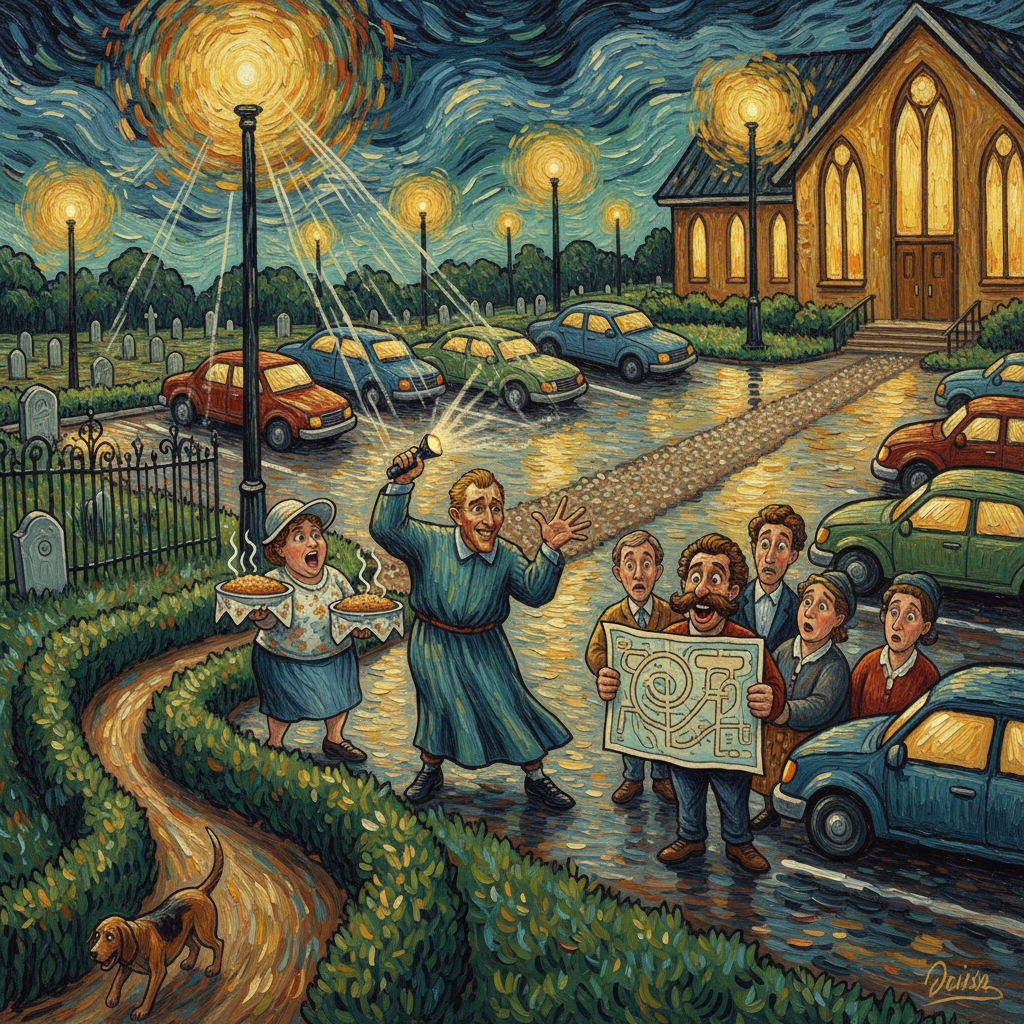
Pastor Arnold Peeler stood near the fellowship hall with a flashlight, directing vehicles in patterns that resembled aircraft movement during wartime evacuations.
“Angle left past the casserole table,” he instructed. “Don’t use the east gravel section unless your transmission already sounds expensive.”
Sister Lila Mae waved traffic onward while carrying three banana puddings simultaneously.
“Keep movin’,” she shouted. “The Lord did not intend for Buicks to idle this long.”
Mabel arrived precisely six minutes early because the new workaround required bypassing Town Hall, circling behind the dentist office, and approaching church from the cemetery road.
“It’s smoother now,” she observed.
Pastor Peeler nodded.
“Honestly better than before.”
“That concerns me spiritually.”
Boot parked beside a ditch nobody acknowledged publicly but everyone used for overflow parking.
“Is this legal?” he asked.
Pastor Peeler shrugged.
Act II – The Church Parking Doctrine
“We’ve entered what I call practical righteousness.”
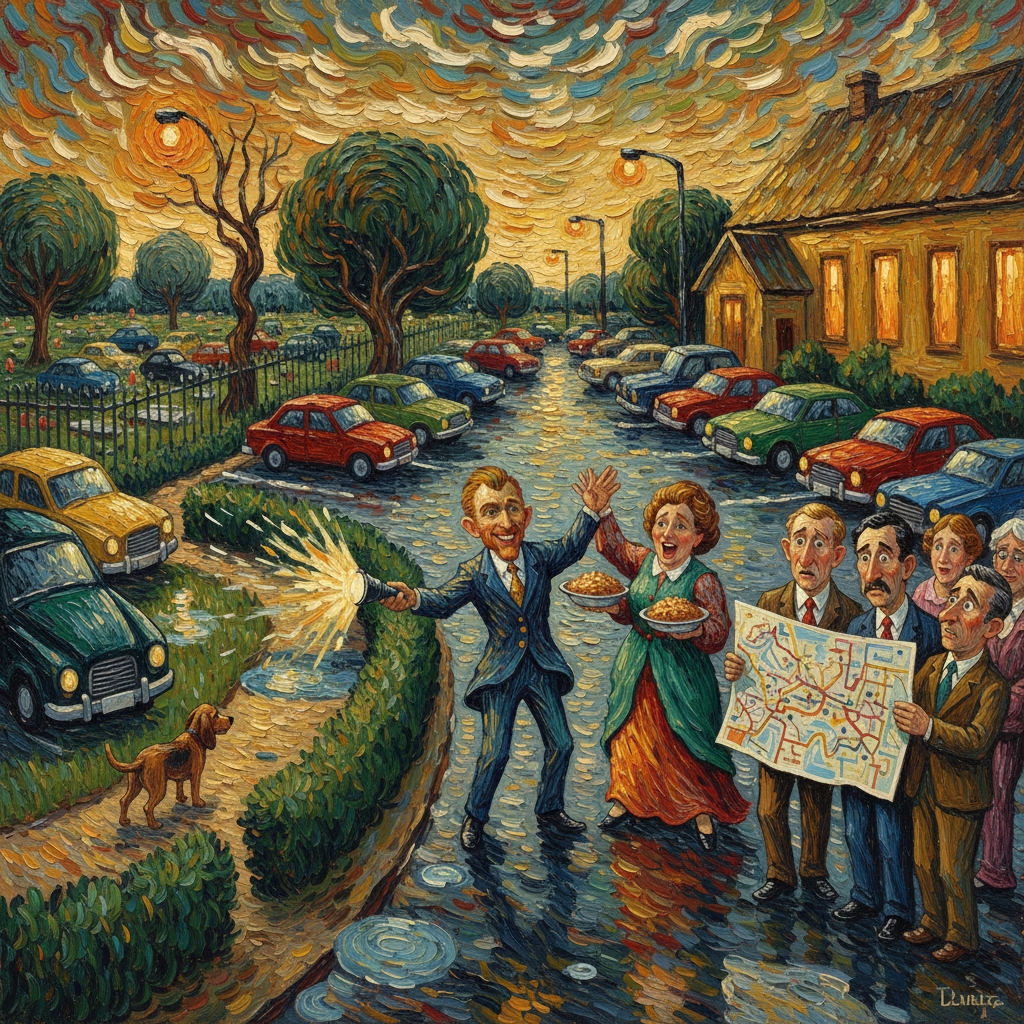
Clovis unfolded another map.
The others groaned.
“You made another one?”
“This here’s Version Seven,” Clovis said proudly. “I’ve incorporated school bus interference patterns.”
“Interference patterns?” Evelyn Grace Tipton asked.
“They throw off the entire western bypass from three-fifteen to four.”
Shelley examined the map.
“You’ve color-coded emotional stress zones.”
“People panic near the tractor supply corner.”
“That’s because Chester keeps sellin’ shirts in the roadway,” Maggie Sue Dillard muttered.
Sure enough, Chester Ray stood beneath a folding canopy yelling toward passing cars.
“LIMITED EDITION COMMEMORATIVE BYPASS APPAREL!”
“Why’s one shirt say ‘I Survived The Infrastructure Transition’?” asked Doug “Doughboy” Teeter.
“Marketing,” Chester replied proudly.
Inside the fellowship hall, conversations had shifted almost entirely toward workaround optimization.
Nobody discussed fixing the road anymore.
The issue itself had become background scenery.
The workaround was now the actual system.
Trixie Jo Bartlett sat beside Tiffany Roark comparing alternate grocery approaches.
“If you come in from the hardware store side after two o’clock, you save four minutes.”
“Unless Coach Freddie’s football boys are usin’ the side road.”
Coach Freddie Stubblefield looked up from his pie.
“We had to reroute practice ourselves.”
“How?”
“Run drills clockwise now instead of counterclockwise.”
“That fix it?”
“No,” Coach Freddie admitted. “But everybody acts calmer.”
Dr. Neil Cowgill entered late carrying muddy shoes.
“I attempted direct traversal.”
The room went silent.
“You WHAT?” Mabel asked.
Dr. Cowgill sighed heavily.
“My GPS suggested it.”
“Technology ain’t from here,” Lurleen Davenport said darkly.
Pastor Peeler patted the doctor sympathetically.
“You’re among friends.”
“I lost a hubcap.”
“Sacrifices happen.”
Outside, Daisy the hound casually ignored the normal church entrance altogether and took a narrow footpath between hedges that eventually led directly to the fellowship hall door.
Boot stared.
“She’s optimized farther than we have.”
Clovis scribbled furiously.
“Dog-generated tertiary access route…”
Act II – The Church Parking Doctrine
Act III – Town Hall Studies the Situation Indefinitely
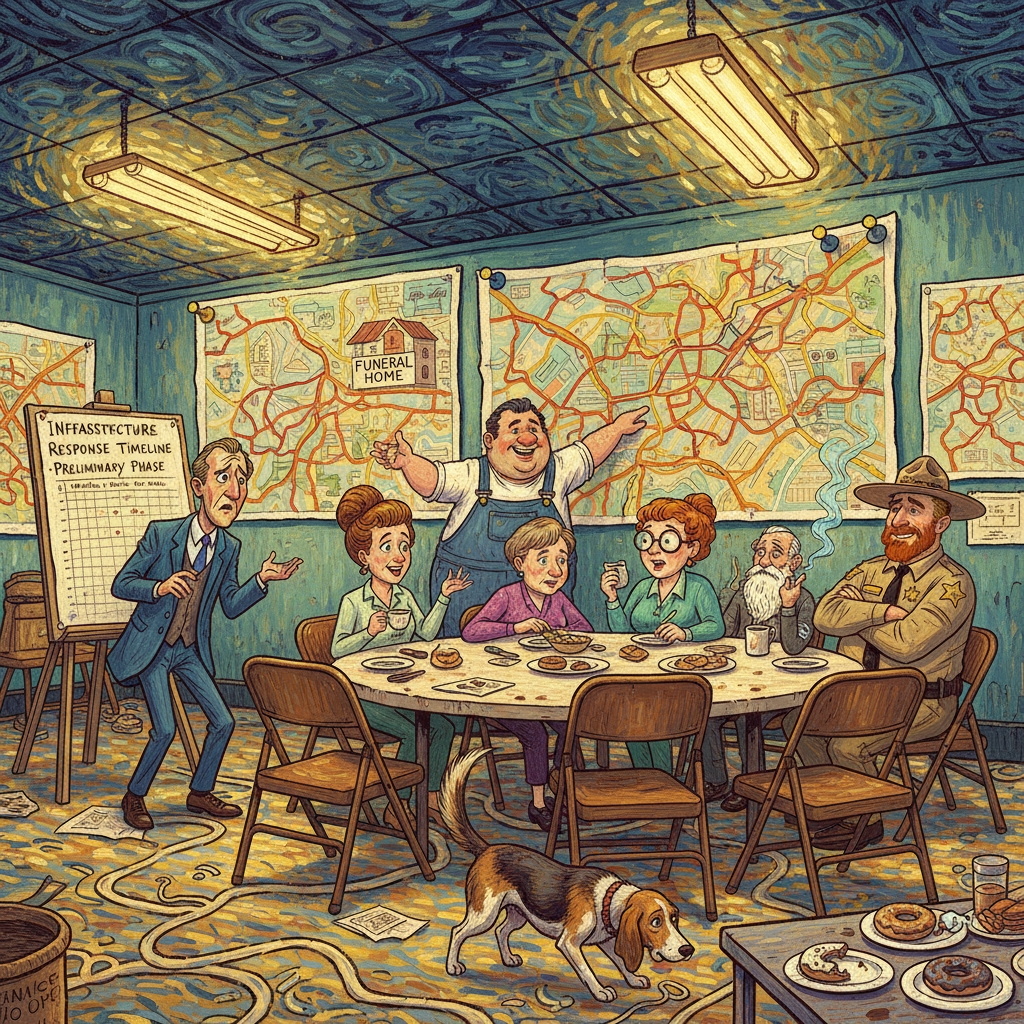
Thursday’s Town Hall meeting began forty minutes late because half the attendees arrived using different workaround routes that accidentally converged behind the library dumpster.
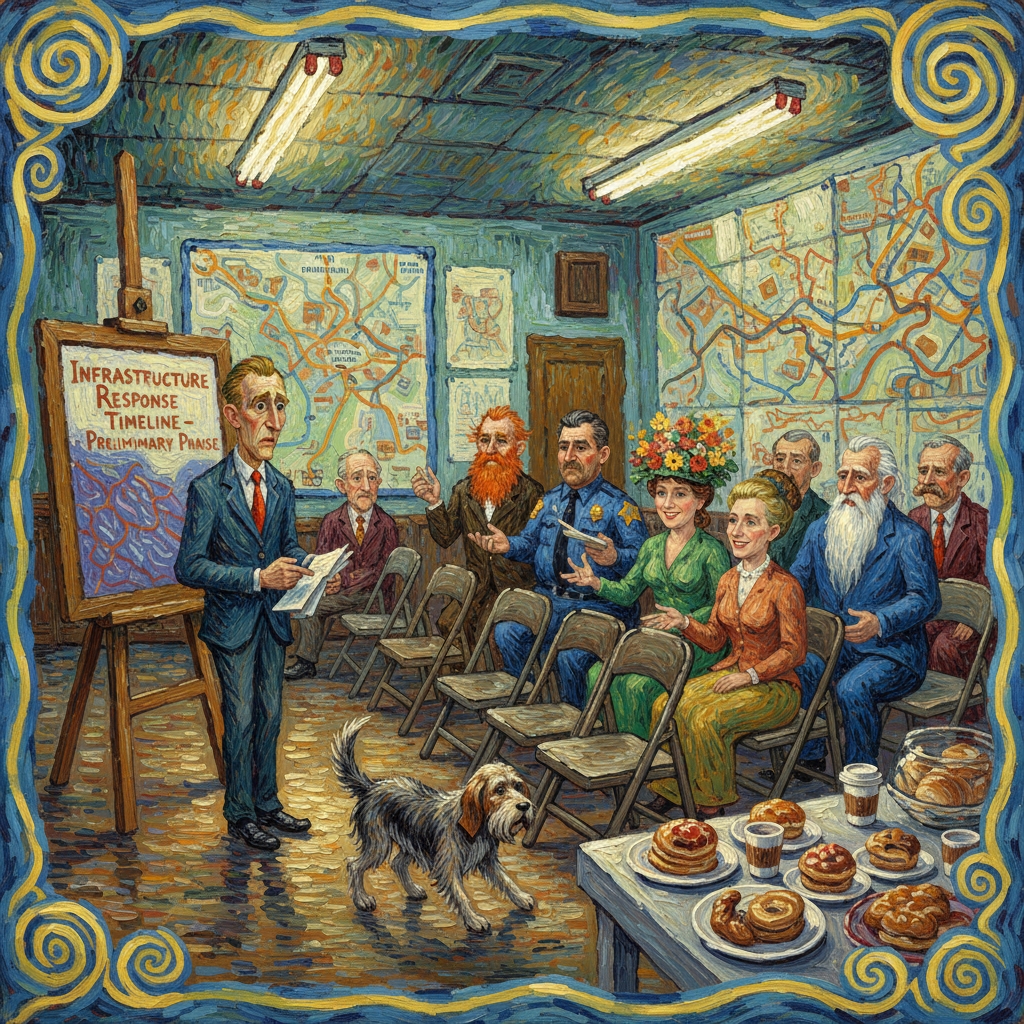
Mayor Pro Tem Harold Finchley—who possessed the exhausted look of a man slowly realizing nobody respected formal systems anymore—stood before a folding easel displaying a chart labeled:
INFRASTRUCTURE RESPONSE TIMELINE – PRELIMINARY PHASE
The chart contained seventeen arrows and no dates.
“We are continuing to evaluate long-term strategic remediation opportunities,” Finchley announced.
“Which means?” RT asked.
“We’re assessing.”
“For what?”
“The next phase of assessment.”
Mabel leaned toward Boot.
“That means nobody’s doing anything.”
“I know.”
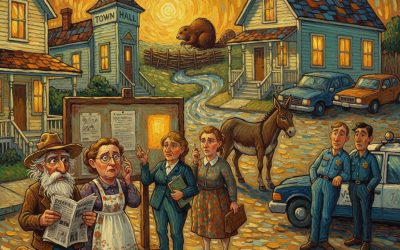
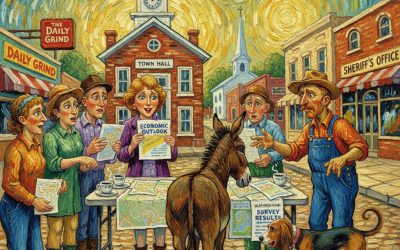
At the back of the room, Clovis had pinned three giant maps showing the town’s unofficial rerouting behavior over time.
Colored lines spiderwebbed across Sequatchie Crossing like nervous system diagrams.
“What exactly is this?” Finchley asked cautiously.
“Adaptive community movement patterns,” Clovis replied.
“Why are there arrows through the funeral home parking lot?”
“Fastest southbound bypass between eight and ten.”
“That can’t be allowed.”
“It already is,” Mabel said.
The room murmured agreement.
Finchley looked increasingly pale.
Shelley stood calmly.
“What we’re observing is emergent civic adaptation.”
Act III – Town Hall Studies the Situation Indefinitely
“What we’re observing,” Sheriff Peeler interrupted, “is people drivin’ wherever they think’ll work.”
Officer Kenny Joe nodded.
“We gave up issuing warnings after folks started explaining alternate routes better than we could.”
Tiffany raised her hand.
“I’ve created neighborhood-specific flow recommendations.”
She passed out laminated cards.
Each contained route diagrams based on weather, traffic, school schedules, and whether Sonny’s produce stand was operating.
Sonny looked proud.
“Community cooperation.”
“You parked sideways again yesterday,” Maggie Sue snapped.
“That was a strategic citrus display.”
Brett and Alyssa Crenshaw entered carrying iced coffees and a printed spreadsheet.
“We tracked average commute improvements,” Alyssa said.
“You WHAT?” Finchley sputtered.
Brett nodded seriously.
“The workaround system’s actually more efficient than the original road layout.”
Dead silence.
Pastor Peeler removed his glasses slowly.
“That feels spiritually dangerous.”
Dr. Cowgill adjusted papers nervously.
“I’ve observed lower blood pressure readings since residents stopped expecting repairs.”
“That can’t be medically sound,” Evelyn said.
“It isn’t,” Cowgill admitted. “But it’s measurable.”
Clovis pointed dramatically at the maps.
“The town has subconsciously decentralized transportation authority.”
“You say that like it’s good,” Finchley replied.
“It ain’t bad.”
Daisy wandered through the open Town Hall doors, ignored the main aisle entirely, and took a shortcut beneath folding chairs directly to the snack table.
Nobody reacted.
Because Daisy had already established that route weeks earlier.
“She’s become impossible to redirect,” Kenny Joe noted.
“She trusts the workaround,” Mabel said softly.
Nobody liked how true that sounded.
Act III – Town Hall Studies the Situation Indefinitely
Act IV – The Diner Implements Operational Adjustments
By Friday morning, Earlene’s Diner had fully reorganized itself around the unofficial routing ecosystem.
Breakfast hours shifted twenty minutes earlier.
The coffee rush now occurred in two separate waves.
Sonny’s produce trailer operated as an accidental directional landmark.
And Chester Ray had begun offering “Bypass Breakfast Bundles” for commuters unwilling to risk downtown parking.
None of this had been formally discussed.
It simply happened.
“That’s what fascinates me,” Shelley said while stirring herbal tea. “Nobody coordinated this.”
Mabel buttered toast calmly.
“People coordinate all the time without meetings. Meetings usually slow things down.”
Boot entered through the kitchen entrance because the front parking spaces now required an advanced turning radius.
“You got biscuits left?”
“You’re forty minutes early.”
“I adapted.”
“Proud of you.”
Across the diner, RT Mullins and Doughboy Teeter argued over whether the eastern alley counted as “officially unofficial.”
“If everybody uses it, it’s basically public.”
“It runs behind three sheds and a baptistry trailer.”
“That’s infrastructure.”
Coach Freddie entered carrying cones.
“Need coffee to survive football rerouting.”
“You still using cemetery road?” Tiffany asked.
Act IV – The Diner Implements Operational Adjustments
“Only during junior varsity congestion windows.”
“Smart.”
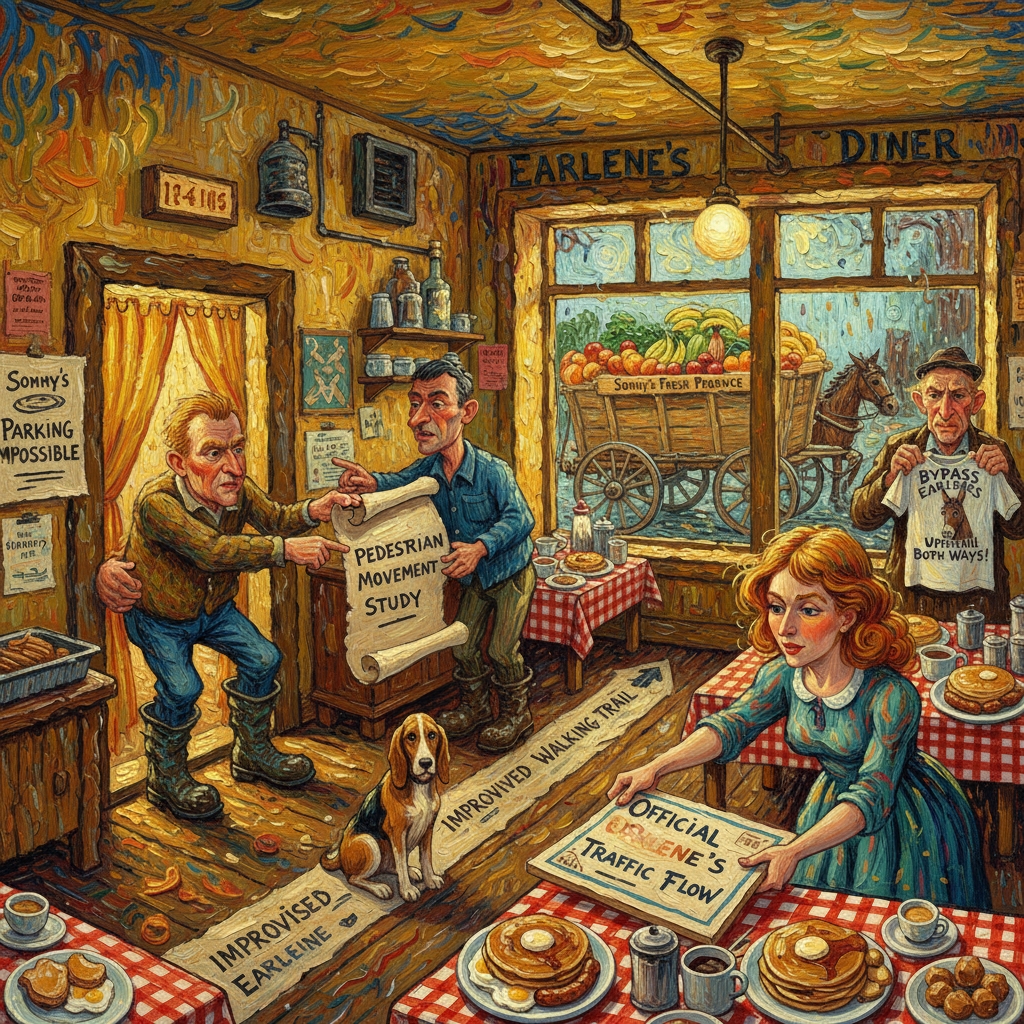
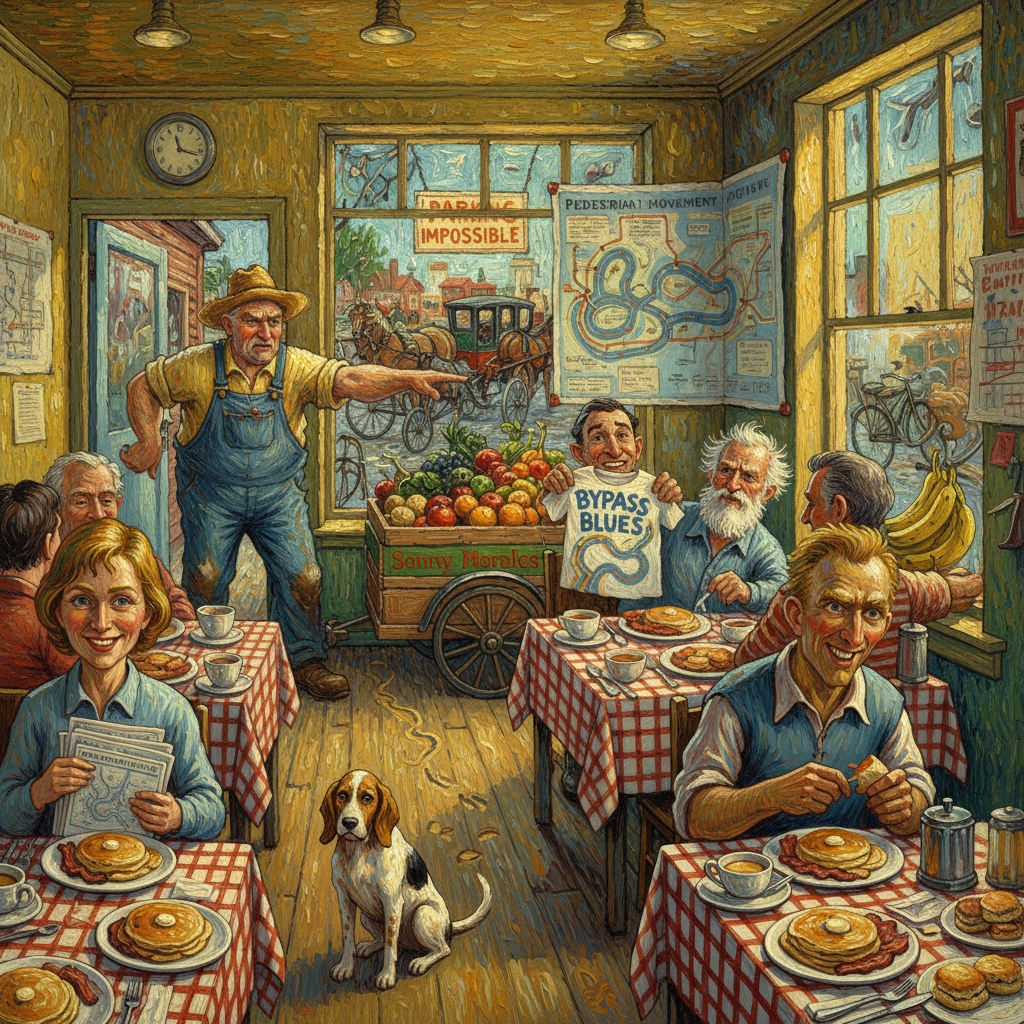
Clovis unfolded yet another map.
Maggie Sue groaned loudly.
“Lord have mercy, there’s more.”
“This one’s pedestrian behavior.”
“You tracked walking?”
“Folks naturally avoid the muddy section by instinct now.”
Indeed they did.
Outside the diner window, pedestrians crossed streets mid-block, cut behind benches, used planter edges as stepping paths, and bypassed puddles with the confidence of migratory animals following ancient instinct.
No signs directed them.
No paint marked the routes.
The patterns simply emerged.
“That’s unsettling,” Dr. Cowgill admitted.
“It’s efficient,” Clovis corrected.
Pastor Peeler entered quietly and removed his hat.
“I’ve decided something.”
Everyone looked up.
“The workaround has become tradition.”
Silence.
“That ain’t good,” Boot whispered.
“No,” Pastor Peeler agreed. “But traditions usually start exactly this way.”
Shelley looked delighted.
“You’re describing folk infrastructure.”
“I’m describing people adapting faster than paperwork.”
Outside, Daisy the hound stopped at the corner automatically, waited for three vehicles to pass through the unofficial bypass sequence, then crossed diagonally through Sonny’s produce stand without touching a single tomato crate.
Sonny blinked slowly.
“She knows traffic timing.”
“She lives here,” Mabel replied.
“That dog understands Sequatchie Crossing better than state engineers.”
“That bar’s low.”
Act IV – The Diner Implements Operational Adjustments
Act V – The Sheriff’s Office Stops Fighting It
Sheriff Peeler officially surrendered to reality sometime around noon Friday.
Not emotionally.
Administratively.
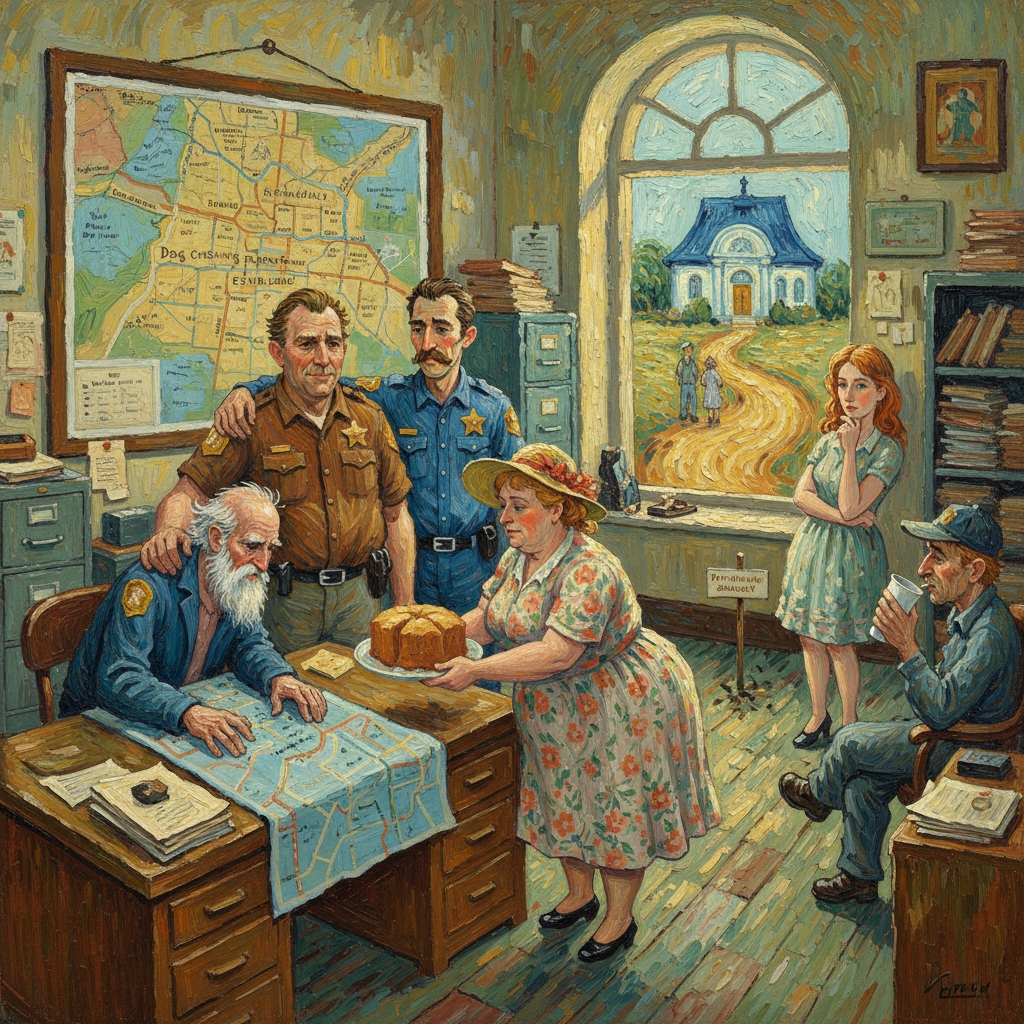
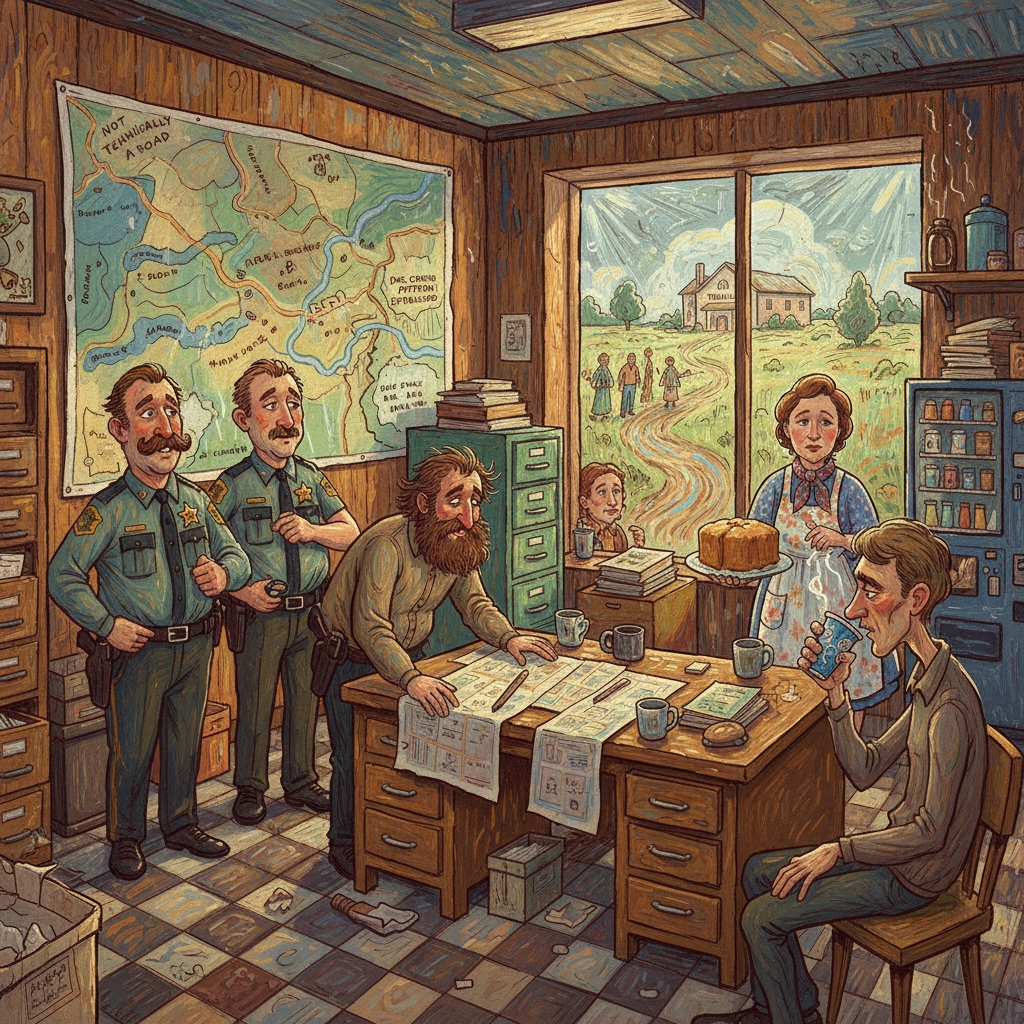
At the sheriff’s office, a giant county traffic map now hung beside the dispatch desk with handwritten notes in red marker.
NOT TECHNICALLY A ROAD
USE ONLY DURING RAIN
AVOID DURING CASSEROLE EVENTS
DOG CROSSING PATTERN ESTABLISHED
Officer Kenny Joe pointed proudly at one section.
“We added Daisy’s route.”
Sheriff Peeler rubbed his temples.
“Why did we add the dog route?”
“People follow it.”
Unfortunately, that was true.
After Daisy consistently avoided congestion by using a narrow side path behind Town Hall, residents began doing the same thing.
Now the grass had worn down into an actual trail.
“It’s become self-reinforcing,” Shelley observed while visiting the office for reasons nobody entirely understood.
“You keep sayin’ things that make this sound academic,” Sheriff Peeler replied.
“It is academic.”
“It’s also ridiculous.”
Boot sat nearby drinking vending machine coffee.
Act V – The Sheriff’s Office Stops Fighting It
“I kinda forgot what the original road pattern even was.”
“Me too,” Kenny Joe admitted.
Mabel entered carrying pound cake.
“I brought snacks since y’all are basically managing a folk transportation network now.”
Sheriff Peeler accepted the cake without argument.
At this point, resistance only wasted energy.
Clovis arrived moments later carrying transparencies.
“Good news.”
“No sentence beginning with that has helped us lately,” Sheriff Peeler sighed.
“I discovered workaround clusters.”
Nobody spoke.
Clovis placed layered maps onto the desk.
Colored markings revealed increasingly stable traffic behaviors.
Morning routes differed from afternoon routes.
Rain routes differed from funeral routes.
Saturday market routes differed from church overflow routes.
The town had unintentionally created an entirely parallel operational system.
Dr. Cowgill stared in horror.
“We’ve evolved.”
“Adapted,” Shelley corrected.
“Without permission,” Finchley muttered from the corner.
Mabel shrugged.
“Permission takes too long.”
Pastor Peeler arrived quietly.
“I’ve been thinkin’.”
“That usually means trouble,” Sheriff Peeler said.
“The Bible’s full of unofficial routes.”
Everyone stared.
“The Israelites wandered forty years.”
“That ain’t exactly encouragement,” RT replied.
“Point is, people make paths before governments make maps.”
Silence settled.
Because annoyingly, that also sounded true.
Outside, Daisy barked twice, then rerouted around a UPS truck blocking the alley.
Within thirty seconds, four pedestrians copied her route exactly.
Sheriff Peeler watched through the window.
“That dog’s accidentally become traffic leadership.”
Act V – The Sheriff’s Office Stops Fighting It
Act VI – The Festival Committee Adapts Completely
Saturday’s Spring Heritage Jubilee planning meeting proved the town had crossed a line nobody could uncross.
The workaround system was no longer temporary behavior.
It had become institutional memory.
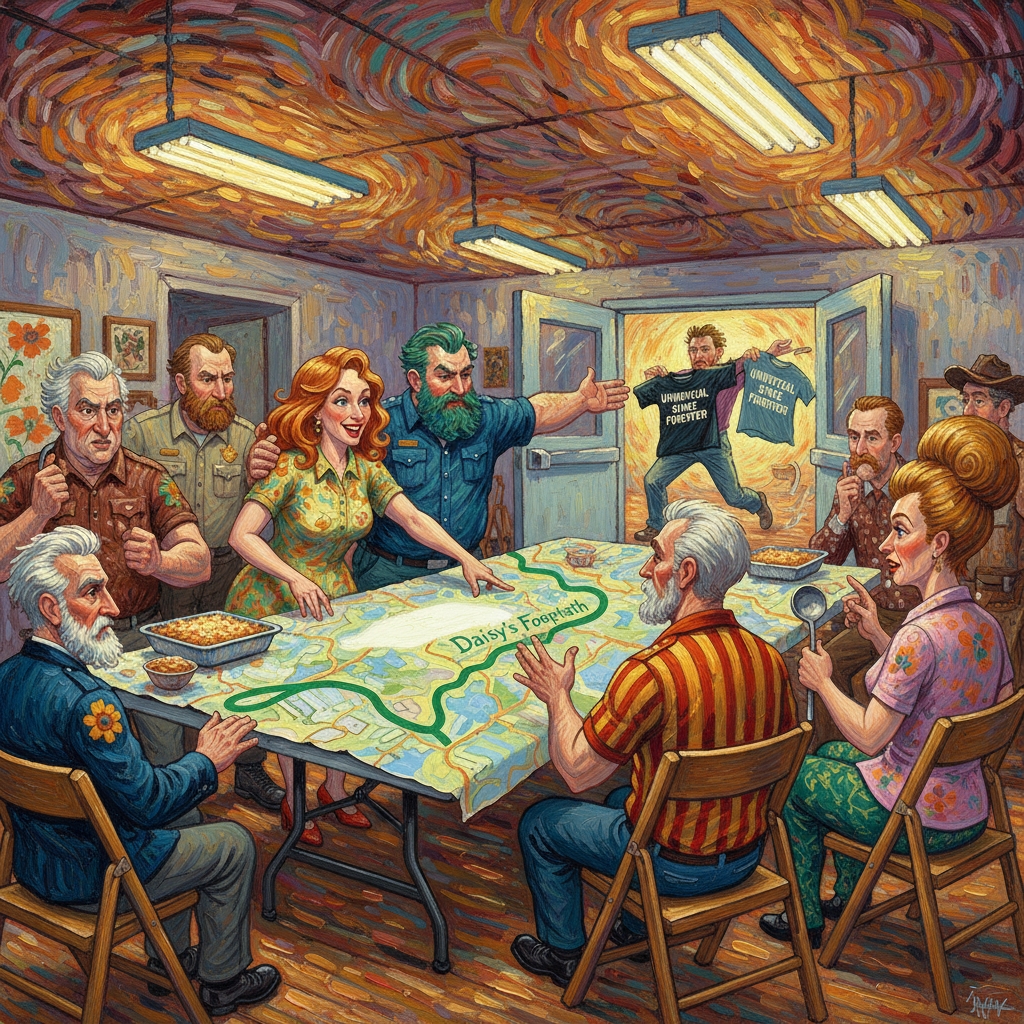
At the community center, folding tables displayed festival maps that no longer included the damaged roadway at all.
Not crossed out.
Not labeled.
Simply absent.
“We removed it from circulation planning,” Tiffany explained.
“You mean ignored it,” Finchley corrected.
“We mean adapted.”
Mabel nodded approvingly.
“That’s just how we do it now.”
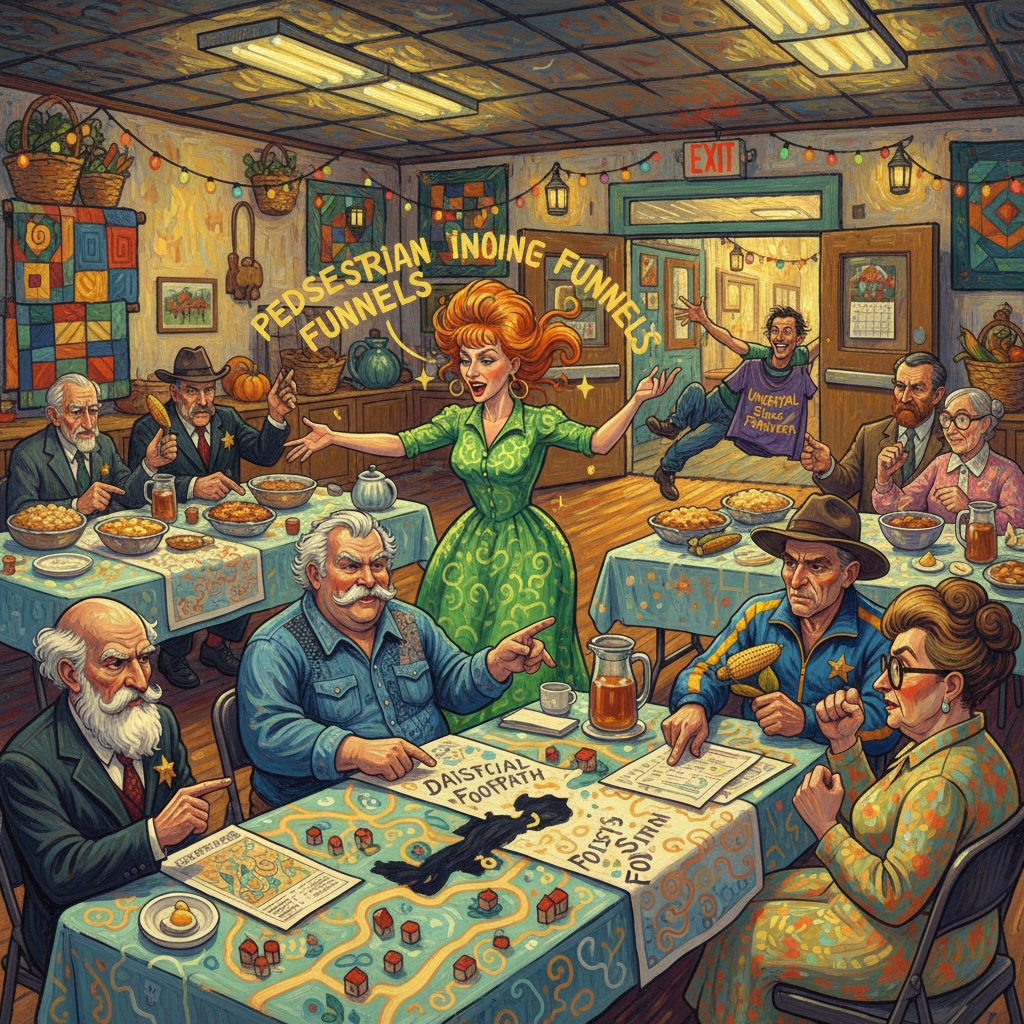
Clovis pointed at color-coded pedestrian funnels.
“We’ve integrated Daisy’s footpath into vendor overflow circulation.”
“THE DOG HAS A FESTIVAL ROUTE?” Finchley cried.
“Yes,” Tiffany said. “It reduces funnel congestion.”
Shelley smiled gently.
“You’re resisting organic optimization.”
“I’m resisting societal collapse.”
Coach Freddie entered carrying folding chairs.
“Football boosters are handling shuttle traffic.”
“How?” asked Maggie Sue.
“Three tractors and Ricky Mullins.”
RT looked proud.
“I got reflective tape.”
Boot scratched his chin thoughtfully.
“Feels like the workaround’s more organized than the actual town.”
Act VI – The Festival Committee Adapts Completely
Nobody disagreed.
Pastor Peeler stood examining maps.
“I’ve noticed somethin’.”
“That worries me,” Sheriff Peeler muttered.
“The workaround creates cooperation.”
Silence.
People considered it.
He continued carefully.
“Folks wave more now. Help each other more. Directions get shared. Businesses coordinate. Church ladies time casseroles around traffic flow.”
“That’s true,” Lurleen admitted.
“And people stopped expectin’ rescue from offices.”
Finchley looked wounded.
“I work in an office.”
“We know,” Mabel said sympathetically.
Outside the community center, Daisy casually led two tourists around the blocked section after they mistakenly followed GPS instructions.
The tourists followed the dog without hesitation.
“She’s become civic infrastructure,” Shelley whispered.
“That sentence should concern us more than it does,” Dr. Cowgill replied.
Chester Ray burst through the doors holding shirts.
“NEW DESIGN!”
The front read:
SEQUATCHIE CROSSING
UNOFFICIAL SINCE FOREVER
Mabel bought three immediately.
Act VI – The Festival Committee Adapts Completely
Act VII – Rain Reveals the Truth
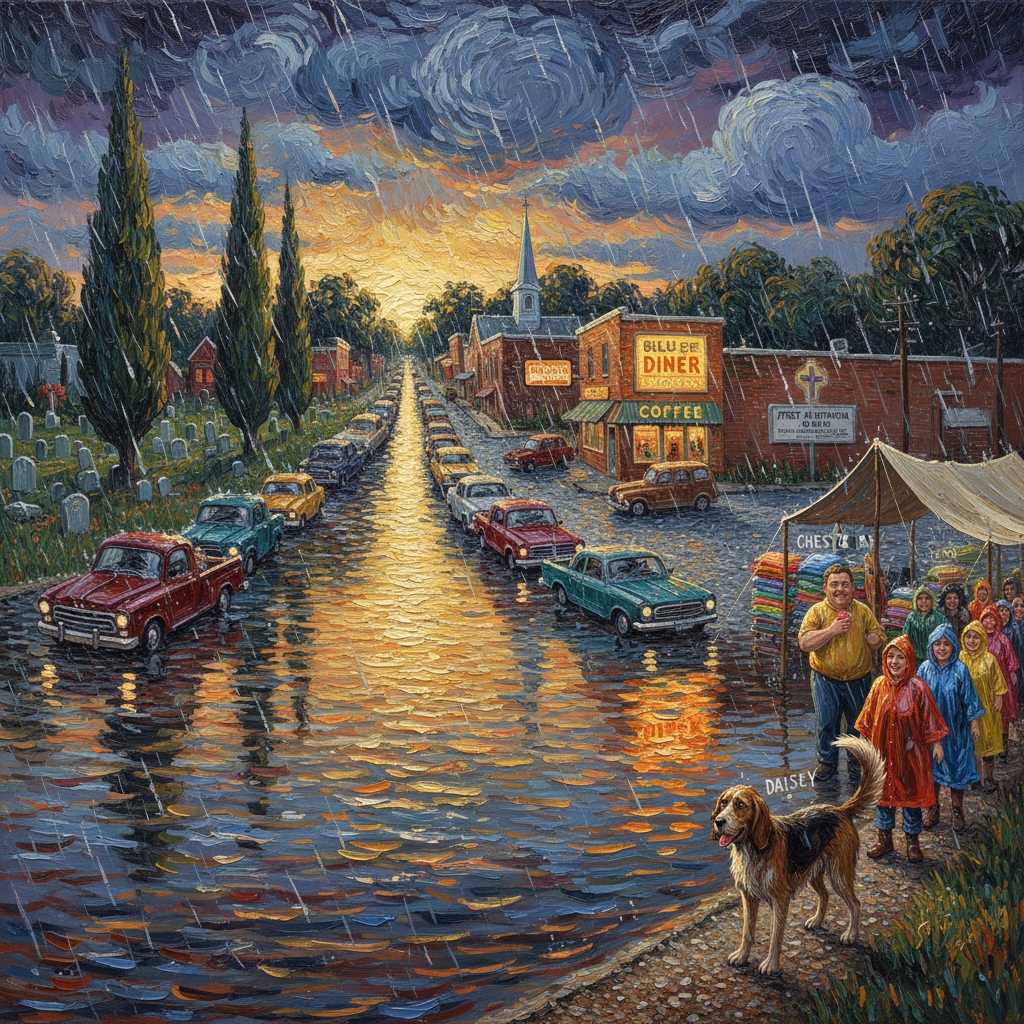
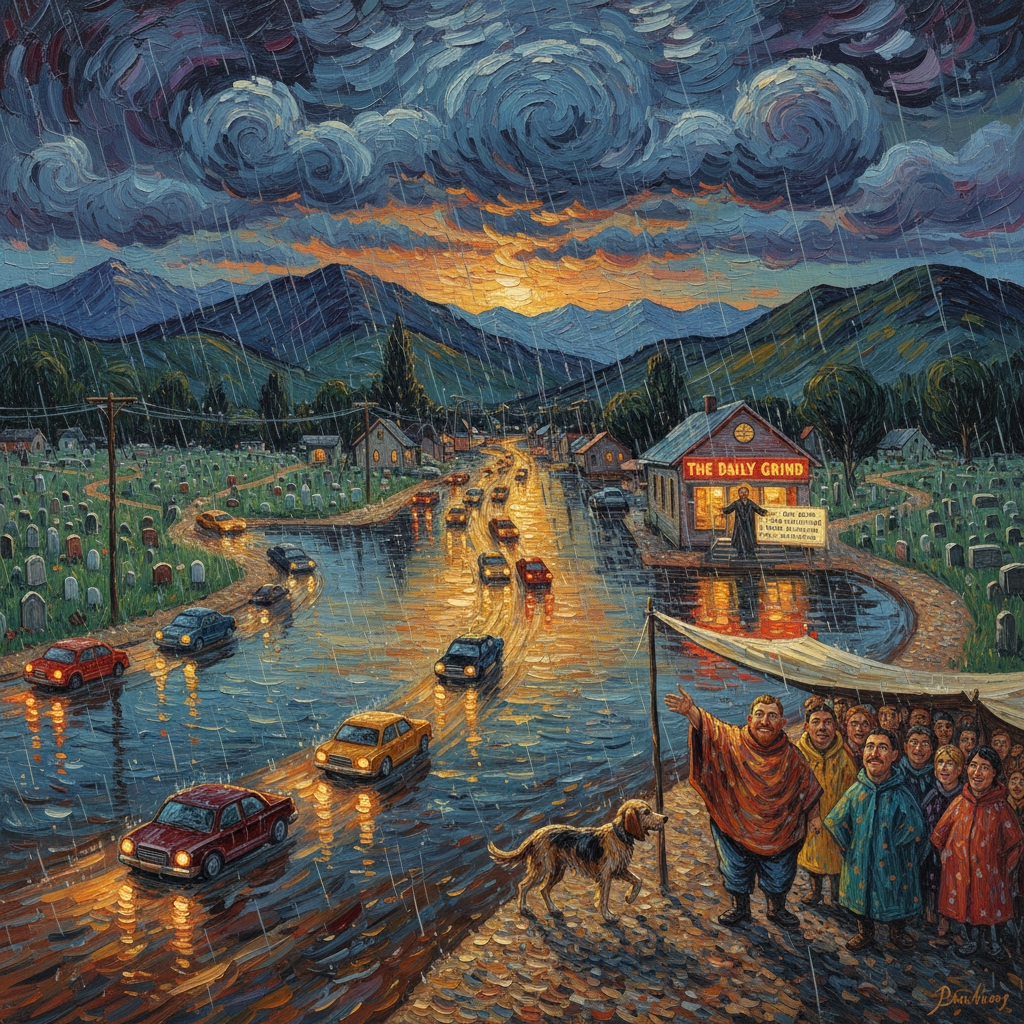
Sunday afternoon storms arrived hard and sudden.
Within thirty minutes, the original roadway vanished beneath muddy standing water so deep it reflected power lines like a lake.
Nobody panicked.
Nobody complained.
Nobody even slowed down.
The town rerouted itself automatically.
Church traffic diverted behind the feed store.
Families bypassed downtown through cemetery road.
Delivery trucks used Sonny’s produce corridor.
Pedestrians took Daisy’s path.
The adaptation happened so smoothly it almost looked choreographed.
From the porch at Earlene’s Diner, Clovis watched with awe.
“It’s complete.”
“What is?” Boot asked.
“The workaround replaced the system.”
Rain hammered the awning.
Across town, Sheriff Peeler directed vehicles not by stopping them but simply by nodding toward whichever unofficial route currently flowed best.
Nobody required explanation.
They already knew.
At church, Pastor Peeler shortened evening service by twelve minutes because rain congestion increased after dark.
No announcement necessary.
Congregants understood instinctively.
“That’s practical ministry,” Sister Lila Mae declared.
Shelley stood beneath the awning smiling softly.
“You know what happened?”
“We got wet?” RT asked.
“The town collectively accepted reality before institutions did.”
Mabel nodded.
“That’s called adulthood.”
Act VII – Rain Reveals the Truth
Dr. Cowgill stared at the flooded road.
“You realize nobody expects repair anymore.”
“That road died socially months ago,” Tiffany said.
The statement hung heavily in the damp air.
Because it felt true.
Boot watched Daisy trot confidently through the rain, using the exact sequence of dry gravel edges residents now copied daily.
“She never hesitates.”
“Animals don’t wait for committee approval,” Mabel replied.
Inside the diner, Chester Ray had already begun selling emergency rain ponchos labeled:
OFFICIAL UNOFFICIAL ROUTE USER
Business was excellent.
Act VII – Rain Reveals the Truth
Act VIII – The State Inspector Arrives Too Late
Monday morning brought unexpected danger.
A state transportation inspector arrived from Nashville.
His name was Randall P. Vickers, and he possessed the expression of a man who still believed maps reflected reality.
Within eleven minutes, he became hopelessly lost.
“You can’t turn there,” Kenny Joe warned.
“My GPS says I can.”
“That’s optimistic.”
Vickers attempted the original route anyway.
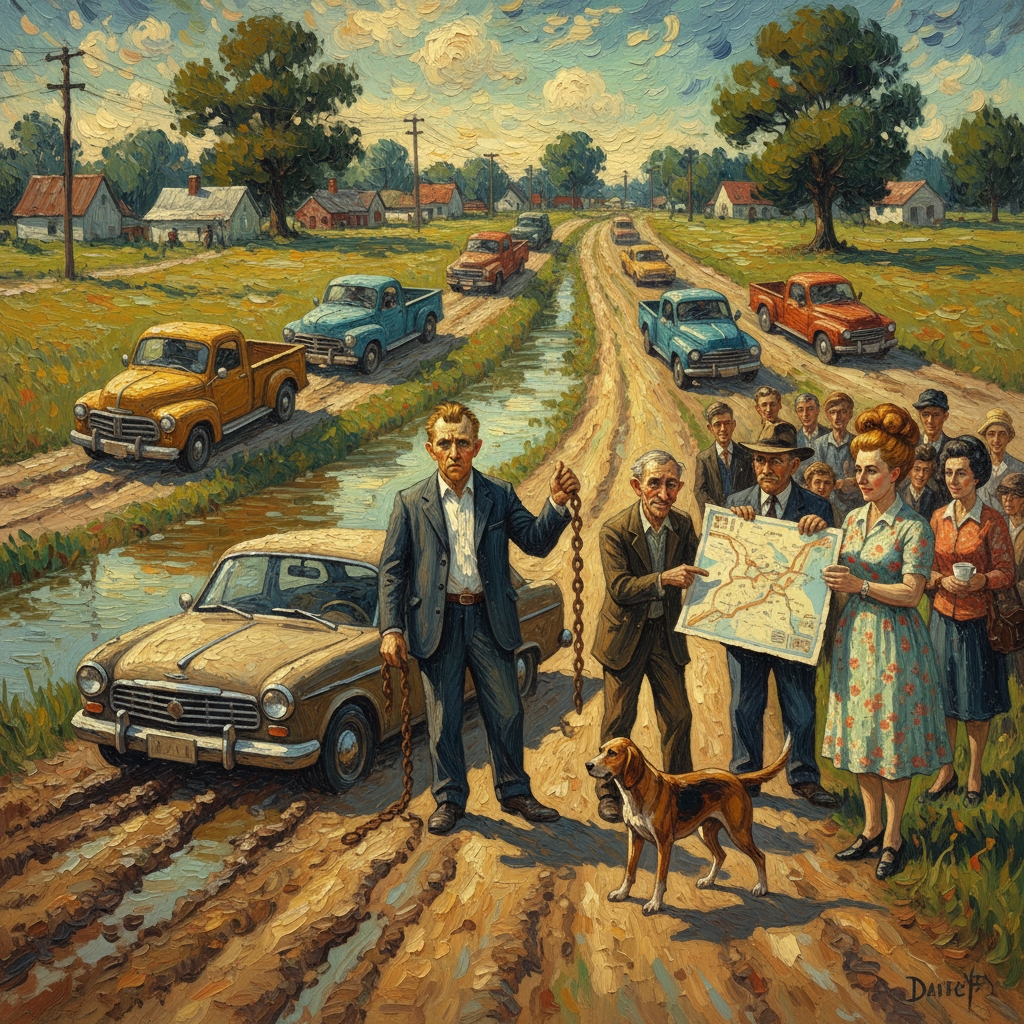
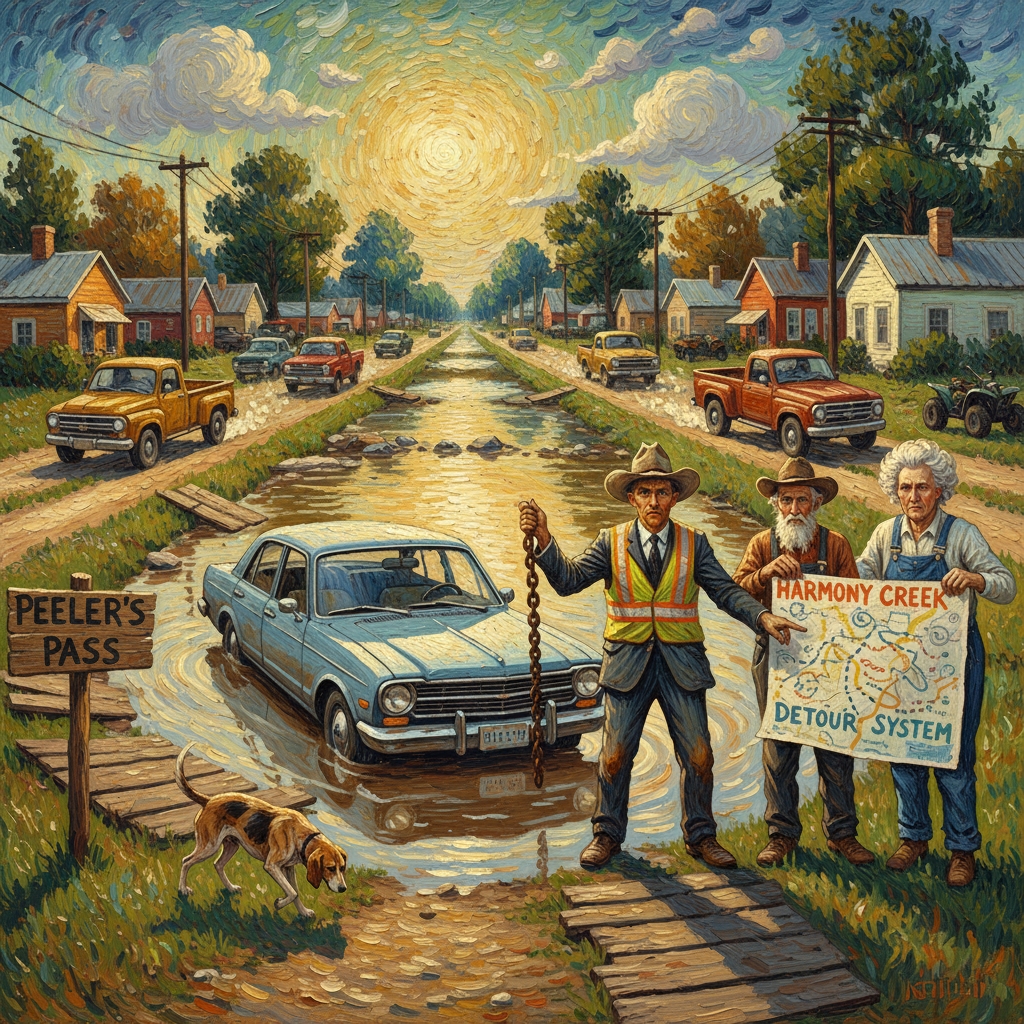
Three minutes later, his sedan became lodged axle-deep in mud.
By the time Sheriff Peeler arrived with a tow chain, half the town had gathered politely nearby.
Vickers emerged furious.
“Why isn’t this road closed?”
Mabel answered first.
“Because nobody uses it.”
“You just did,” Boot noted.
“That’s not the point.”
Clovis handed him a laminated workaround map.
Vickers stared blankly.
“What is this?”
“The actual transportation system.”
“That’s unofficial.”
“Yet functional,” Shelley said.
Act VIII – The State Inspector Arrives Too Late
Pastor Peeler stepped forward calmly.
“Sir, around here practicality outruns documentation.”
Vickers looked around in disbelief as vehicles smoothly navigated alternate paths around him.
No honking.
No confusion.
No delay.
The unofficial system flowed perfectly.
“How long has this been happening?”
“Depends,” RT replied.
“When’d we stop believing repair was coming?”
Nobody answered immediately.
Because nobody remembered exactly when hope quietly transformed into adaptation.
Daisy trotted past the stuck sedan without even glancing at it.
“She always use that path?” Vickers asked weakly.
“Since February,” Sheriff Peeler said.
The inspector looked spiritually exhausted.
“This is highly irregular.”
“That’s just how we do it now,” Mabel answered.
Again.
And somehow this time it sounded less like resignation and more like a founding principle.
Act VIII – The State Inspector Arrives Too Late
Act IX – Nobody Calls It a Problem Anymore
Tuesday evening settled warm and golden across Sequatchie Crossing.
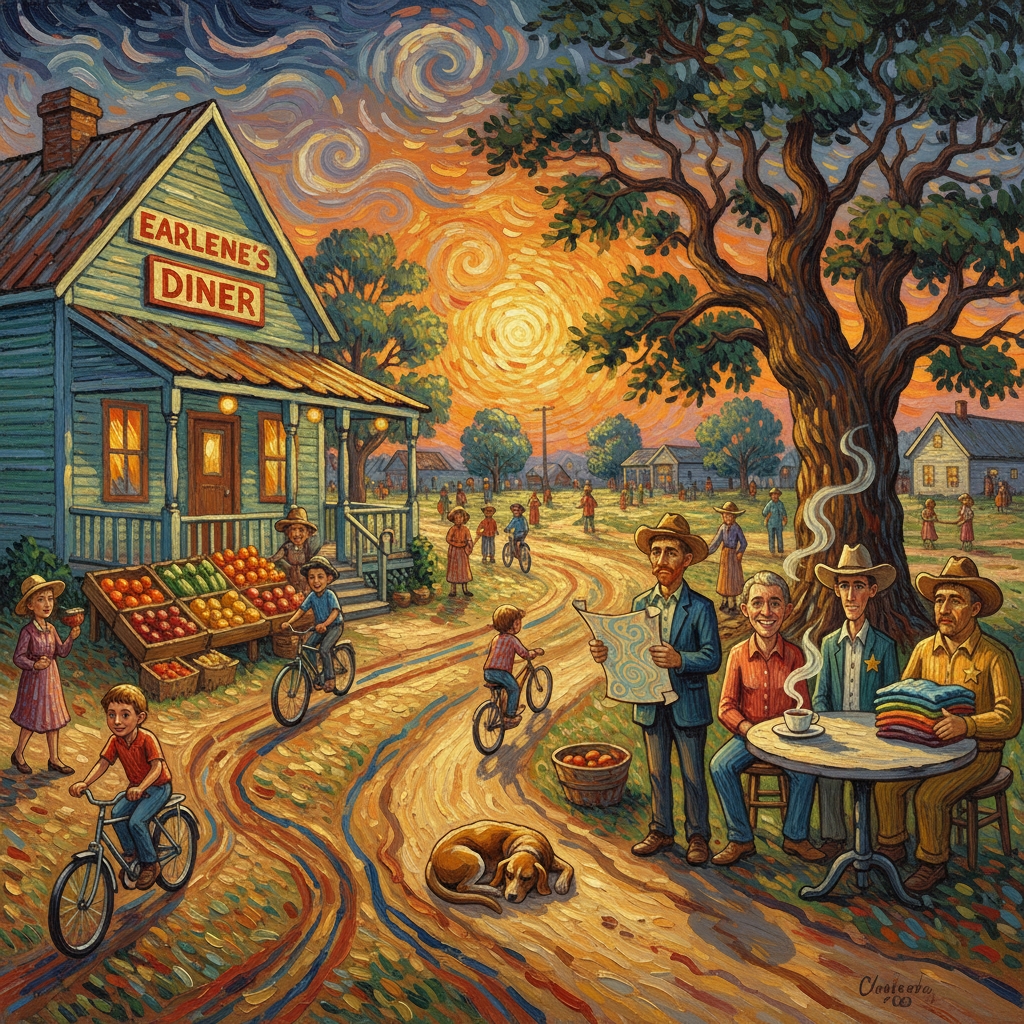
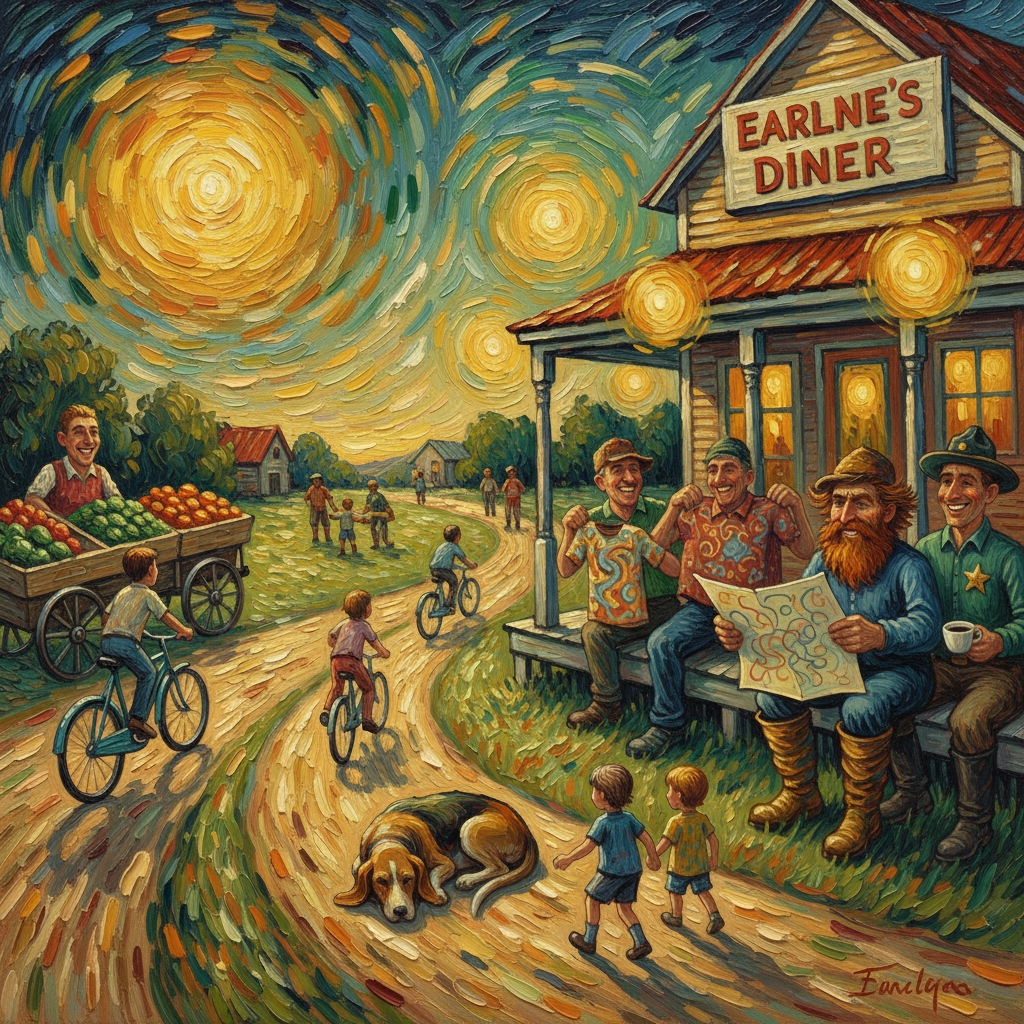
At Earlene’s Diner, residents gathered beneath humming porch lights while traffic moved quietly through invisible patterns everyone understood.
Children rode bicycles through bypass paths.
Church ladies timed errands around unofficial flow windows.
Coach Freddie’s players automatically parked near cemetery road.
Sonny angled produce displays according to traffic rhythm.
Chester sold shirts beside a route that technically did not exist.
And Daisy the hound slept peacefully in the center of a footpath used daily by nearly half the town.
Nobody disturbed her.
Because everybody simply adjusted around her naturally.
Clovis looked over his final map.
“It stabilized.”
“What stabilized?” Boot asked.
“The adaptation.”
Mabel sipped coffee.
“Towns always do.”
Shelley leaned back thoughtfully.
“Systems theorists would call this decentralized resilience.”
Maggie Sue rolled her eyes.
Act IX – Nobody Calls It a Problem Anymore
“We call it figuring things out.”
Pastor Peeler smiled softly.
“People usually solve problems long before institutions admit they exist.”
Sheriff Peeler nodded slowly.
“And by the time officials arrive, folks already built somethin’ else.”
Finchley sat quietly nearby holding a stack of untouched infrastructure reports.
For once, he looked less defensive than tired.
“I don’t know whether to feel relieved or insulted.”
“Both,” Tiffany said kindly.
Rain clouds gathered faintly in the distance.
Nobody worried.
Because everyone already knew which routes they’d take.
No signs needed posting.
No alerts required sending.
The workaround now lived inside people themselves.
Daisy suddenly stood, stretched, and casually changed direction before the first raindrop even fell.
Without speaking, three pedestrians immediately followed her alternate path.
Boot watched in amazement.
“That dog may be mayor someday.”
“She already kinda runs transportation,” RT replied.
Soft laughter drifted across the porch.
Then the rain began.
And the town adjusted instantly without missing a beat.
Act IX – Nobody Calls It a Problem Anymore
Epilogue – The Map in Clovis’s Garage
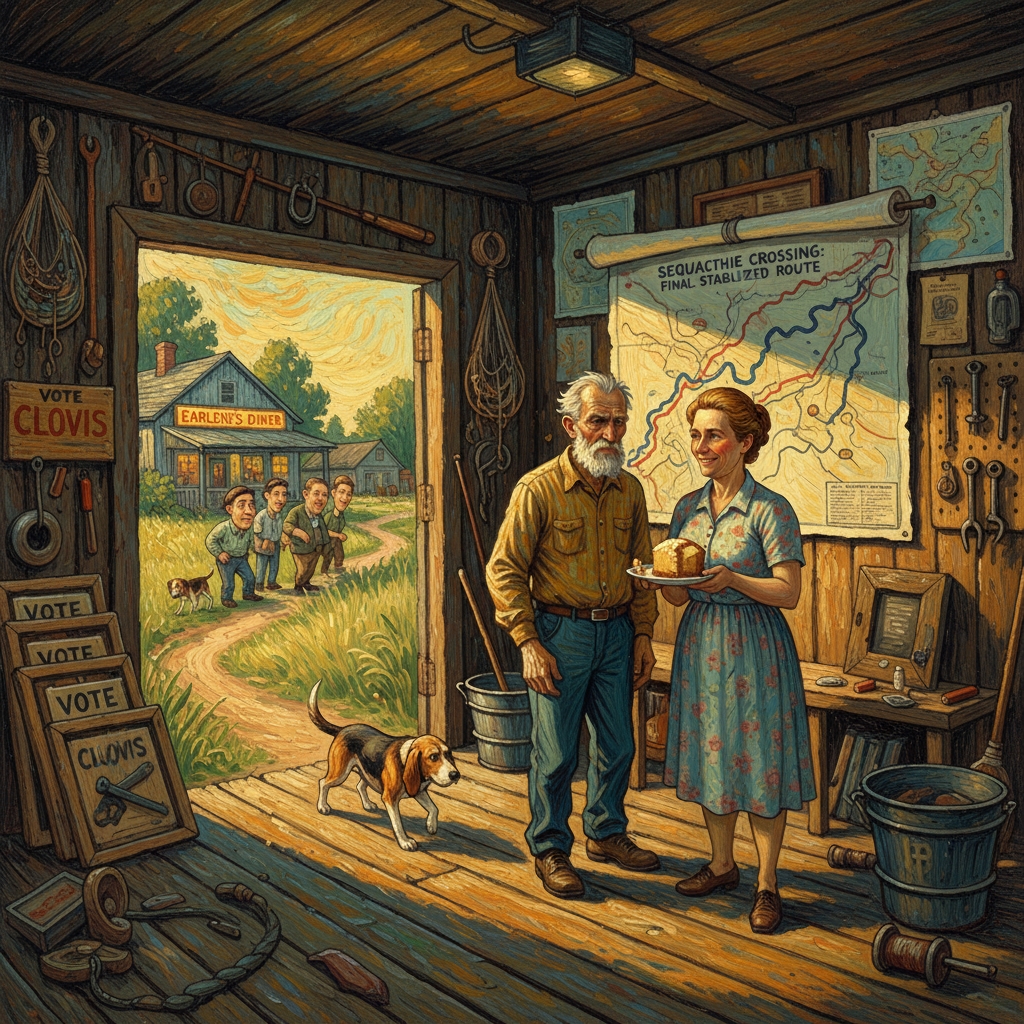
Several weeks later, Clovis Strickland hung the final workaround map in his garage beside old fishing gear and retired campaign signs.
The colored lines now looked less like traffic routes and more like roots beneath soil.
Living things.
Organic things.
Paths formed not by planning but by repetition, memory, and necessity.
Mabel visited that afternoon carrying pound cake.
“You finally done?”
“For now.”
She studied the map quietly.
“You know what’s funny?”
“What?”
“If they ever fix that road, people probably won’t use it.”
Clovis considered this seriously.
“You’re probably right.”
Outside, Daisy the hound ignored the paved sidewalk entirely and took the established shortcut through grass toward the diner.
Naturally.
Automatically.
Like she always had.
And one by one, the people of Sequatchie Crossing followed the path behind her.
Epilogue – The Map in Clovis’s Garage
Disclaimer
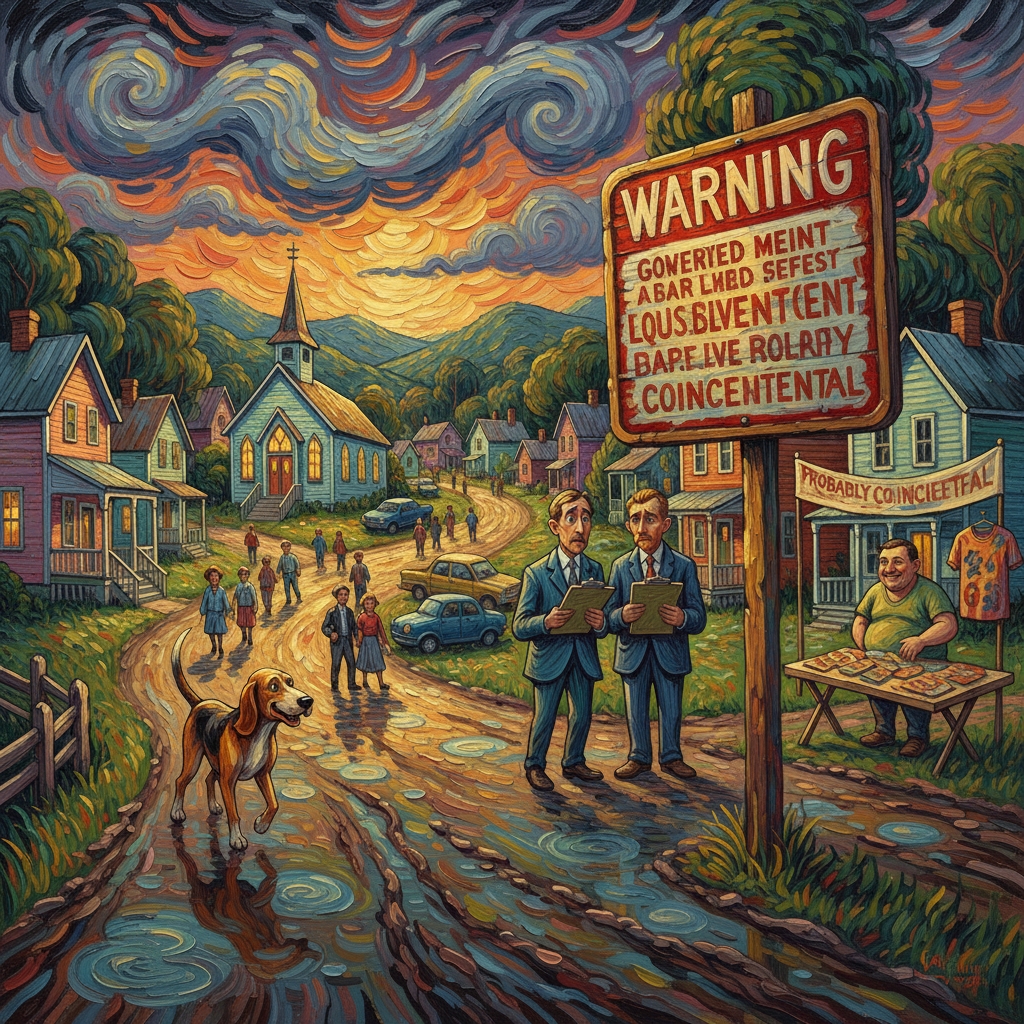
The events, institutions, potholes, bypass systems, improvised traffic doctrines, spiritually accepted detours, emotionally exhausted inspectors, casserole-adjusted mobility corridors, laminated workaround maps, and canine-led infrastructure models depicted in this story are entirely fictional.
No real residents of Dunlap, Tennessee are represented.
Any resemblance to actual bureaucratic conditions, adaptive community behavior, unofficial systems quietly replacing official ones, or dogs demonstrating stronger operational awareness than government entities is purely coincidental.
Probably.
Disclaimer – Workarounds Become Routine Despite Lack of Official Solution
Real Places Behind the Ruckus – From The Dunlap Directory

Real Places Behind the Ruckus – From The Dunlap Directory
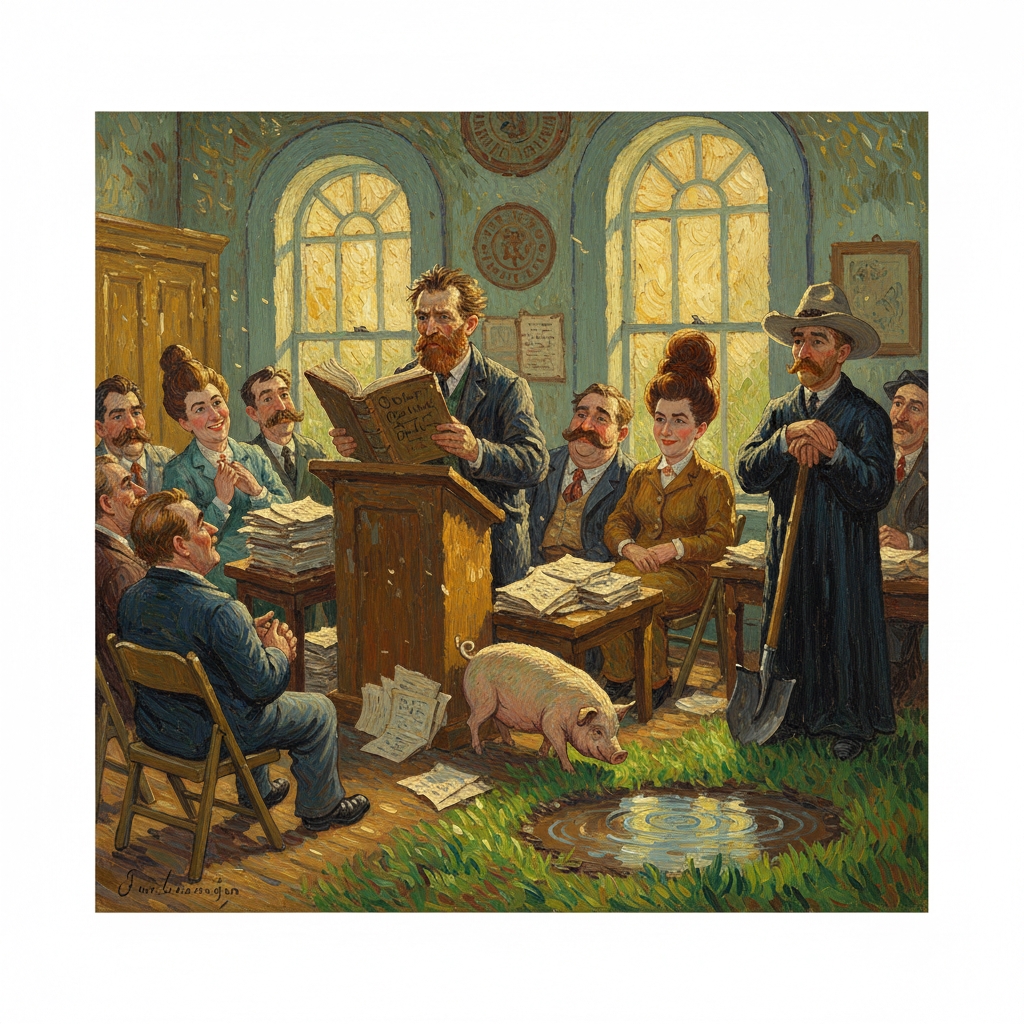
Yes, this story was fictional; even the parts that weren’t true. These places? Absolutely real. Stop by, support local, and keep the Wi-Fi away from livestock:
- Sequatchie Valley Homestead
- Camp Chet
- Busy Bees
- Fireside Camp + Lodge
- Dunlap Grapevine
- Valhalla Acres at TN Campground
- Chase Painting
- El Metate
- Liquidambar Art Gallery
- Sequatchie Liquor
- Subway
- Bird Fork Farm
- Lewis Chapel Volunteer Fire Department
- Sequatchie Valley National Scenic Byway
- Worth Coffee Co
- TN Heating & Cooling
- Cambri Hemp
- Akins Construction
Real Places Behind the Ruckus – From The Dunlap Directory
At Sequatchie Crossing, we tell the stories of Sequatchie Crossing.
Please share this post with your friends, family, or business associates who may want follow the news from Sequatchie Crossing.

0 Comments