


They Crossed with Purpose
By Tom Seest
At Sequatchie Crossing, we tell the stories of Sequatchie Crossing.
Please share this post with your friends, family, or business associates who may want follow the news from Sequatchie Crossing.
🎤 Audio Overview
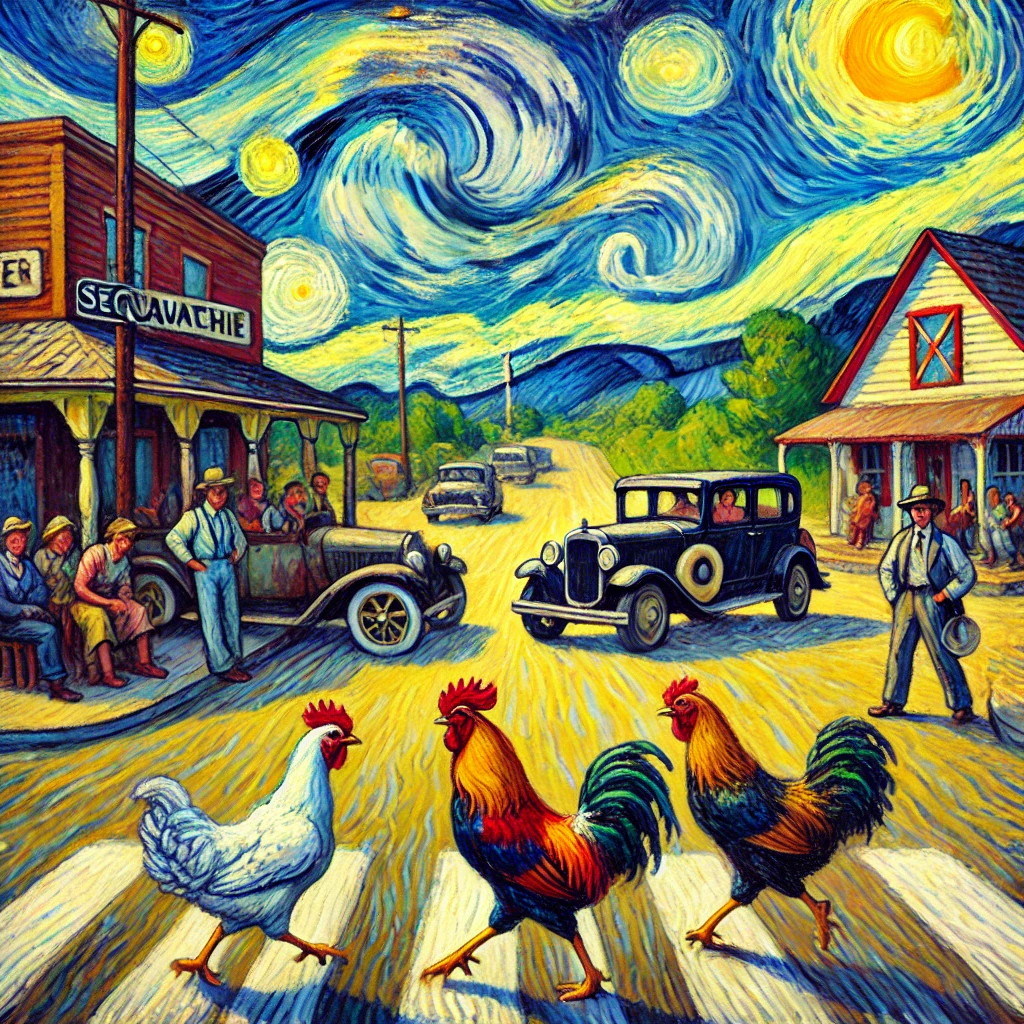
Three Chickens and a Traffic Pattern
There are towns where traffic is measured by engineering studies, white paint, and men in reflective vests holding clipboards as if they were carrying scripture. And then there is Sequatchie Crossing, where traffic is measured by what interrupted it, who witnessed it, and whether Mabel Dean Ashcroft had time to call three people before the sheriff arrived.
By the official count, which nobody trusted because it was performed by the county and therefore was considered suspicious from the start, the town had only two roads important enough to argue over and one intersection important enough to ruin friendships. The intersection sat between Honeycutt Hardware, the diner, and a little triangular patch of grass that had once been intended for flowers but had long since become the place where political signs, lost-dog notices, revival announcements, and one baffling flyer for accordion lessons went to bleach in the sun.
It was at this intersection, on a Thursday morning so ordinary it had nearly become arrogant about it, that three chickens walked into the middle of town and proceeded to alter local government.
Nobody knew at first whose chickens they were, which made them more interesting.
One was large and white, with the stern bearing of a church treasurer and the suspicious eyes of a woman who had once caught her nephew stealing casserole dishes after a funeral. One was reddish-brown and moved with nervous authority, as if she had read a manual on public safety but had not enjoyed the tone. The third was black, lean, and deliberate, with a stillness that made people lower their voices around her without knowing why.
They did not rush. They did not peck aimlessly. They did not do what chickens are expected to do by people who have only admired them from a distance.
They entered the intersection in single file.
The white one paused at the curb.
The red one looked left.
The black one looked right.
Then all three stepped into the road.
At that exact moment, Boot Barnes was easing his truck toward the stop sign with a sack of fence staples on the passenger seat and a sausage biscuit balanced precariously on the dash. He saw the chickens, took his foot off the gas, and stared at them through the windshield with the solemn respect usually reserved for funerals and tornadoes.
“Well now,” he said to nobody, “that ain’t random.”
Behind him, Pastor Peeler in his sedan stopped too. Behind Pastor Peeler came Trixie Jo Bartlett in her little blue hatchback, already leaning over the steering wheel to see what sort of inconvenience had dared rise before her before noon.
Clovis Strickland, who had been on the bench outside Honeycutt Hardware writing observations in a notebook labeled TRANSPORTATION IRREGULARITIES, stood up so fast he nearly lost his pencil.
He did not say, “This is unusual.”
He said, with the satisfaction of a man who had been lonely inside his own prophecy, “I knew it.”
By the time the chickens reached the center of the intersection, traffic from all four directions had stopped. Nobody honked, because honking at chickens in Sequatchie Crossing was widely regarded as the kind of behavior that eventually got discussed in prayer requests. Instead, windows rolled down and heads leaned out.
Mabel Dean came out of the diner carrying a coffee pot like she had intended only to top off a cup but, seeing events unfold, decided she would now supervise history.
“What’s going on?” she called.
Boot pointed. “Coordinated crossing.”
Mabel Dean squinted. “Those birds look organized.”
Trixie Jo shouted from her car, “Why are we respecting this?”
Pastor Peeler opened his door but stayed seated. “Because,” he said, “it appears the Lord is making a point.”
“Nobody knows that,” said Trixie Jo.
Clovis stepped off the curb and raised one finger, which in town meetings meant he was either about to clarify something or ruin it.
“The white bird is lead navigation,” he announced. “The red one is monitoring lateral threats. Black one’s rear security. This is a pattern.”
Boot looked impressed. “Like aviation?”
“Exactly like aviation,” said Clovis, though he had never been licensed in anything that left the ground.
The chickens reached the other side of the intersection, hopped up onto the curb, and stood there together, facing the stopped vehicles as if waiting for the rest of the town to catch on.
Then the white one clucked once.
All three turned.
And crossed back the other way.
That was how it began.
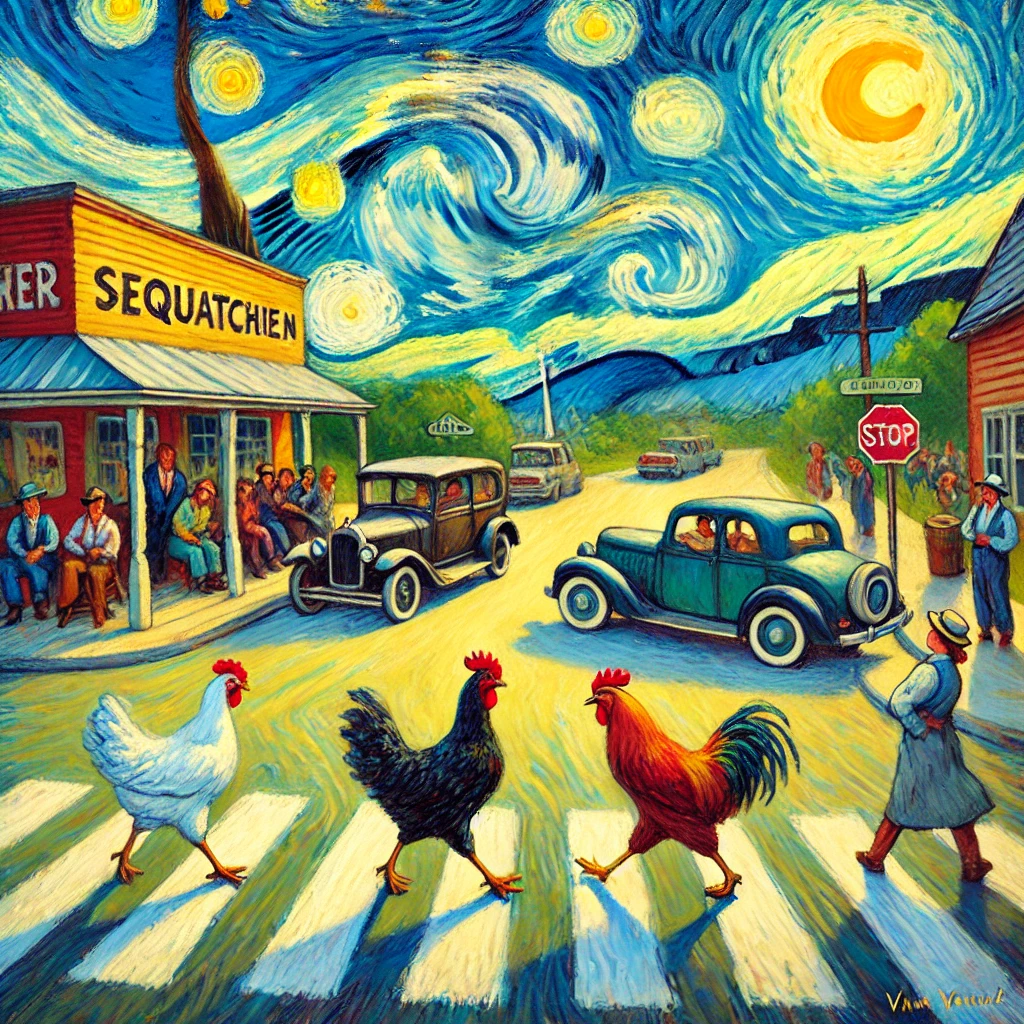
Three Chickens and a Traffic Pattern
Act I – The Interruption
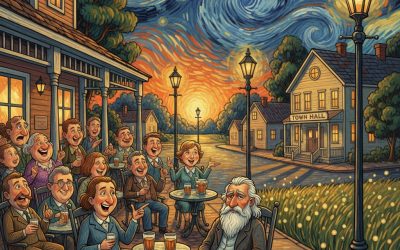
Within fifteen minutes, the intersection was full not just of vehicles but of opinion, which always arrived faster than any official response. The diner’s breakfast crowd had migrated outside. Curtis from the barber shop was standing in the doorway with half a haircut on a man named Leonard, who remained draped in a cape and looked offended that history had chosen to happen during his appointment. Miss Darlene from the beauty salon had brought out binoculars, though the chickens were no more than thirty feet away.
The birds crossed a third time.
This time, the red one hesitated in the exact center of the road, turned her head, and let Boot’s truck roll forward three inches before fixing him with a look so severe he stopped again on instinct.
“That’s control,” Clovis whispered.
“That’s attitude,” said Trixie Jo.
Sheriff Peeler arrived in his cruiser not because anyone had reported a crime but because six people had called at once and said, in various ways, “You need to get down here and see this before the county gets involved.”
He got out slowly, hands on hips, taking in the lineup of cars, the crowd, and the three chickens who had by then formed a neat triangle on the pavement.
“What in the world,” he said.
Nobody answered immediately, because everyone wanted him to say more first.
At last Mabel Dean stepped forward. “We got ourselves an organized poultry event.”
Sheriff Peeler looked at the birds. “Whose are they?”
“That,” said Clovis, “is what they want us asking.”
The sheriff turned to him with the patience of a man who had spent years being the only official barrier between Clovis and public policy. “They are chickens, Clovis.”
“That’s what they want you to think.”
Pastor Peeler cleared his throat from beside his car. “I’m not weighing in one way or another on motives, but I will say this. Those birds are behaving with more order than the parking lot after Wednesday prayer supper.”
Mabel Dean nodded. “And better lane discipline than the tourists during leaf season.”
Trixie Jo had already started recording on her phone.
“Folks online are going to love this,” she said. “I’ve got seventeen comments already and I ain’t even posted yet.”
“You can’t have comments before you post,” Boot said.
“I got a group chat,” Trixie Jo replied, as if this settled the matter of modern civilization.
The chickens crossed again, this time not straight across but in a graceful diagonal that forced the sheriff to step back.
Clovis pulled out his notebook and began sketching arrows. “There. You see that? They’re not wandering. They’re establishing flow.”
“Flow for what?” asked the sheriff.
Clovis looked up. “Maybe they’re improving visibility. Maybe they’re identifying weak points in our intersection geometry. Maybe they’re trying to show us something.”
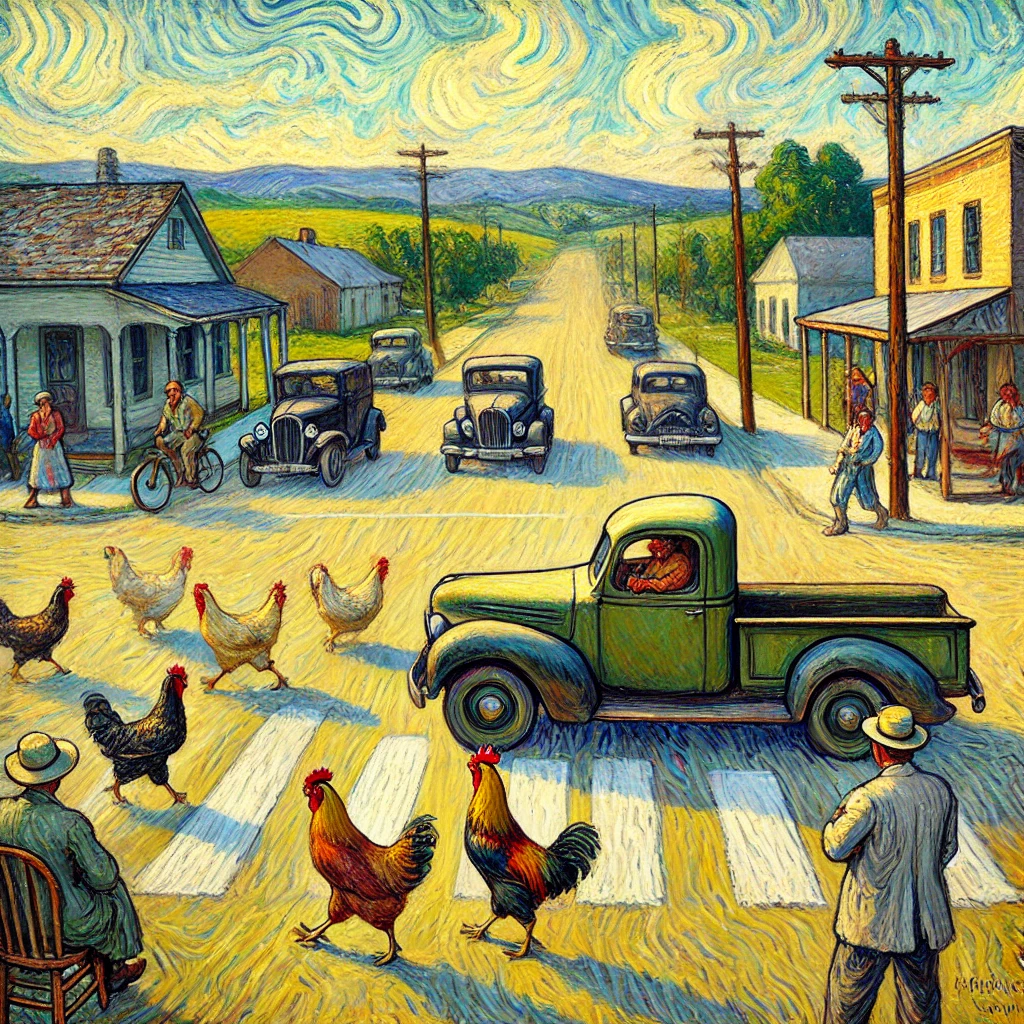
ACT I – The Interruption
Leonard, still half-barbered, said, “Maybe they’re just chickens.”
A silence fell over the crowd. Not because it was an unreasonable suggestion, but because it lacked imagination and therefore violated the spirit of the morning.
Then Miss Darlene lowered her binoculars and gasped.
“They’ve made a loop.”
Everyone stared.
The birds had indeed completed a kind of oval—curb to center line, center line to median patch, median patch back to the opposite curb—then paused in formation again. The white one stood forward. The red one turned slightly outward. The black one remained behind, still and watchful.
Clovis’ face lit with the pale radiance of vindication.
“Traffic pattern,” he whispered.
“Good gracious,” said Pastor Peeler.
“You mean like airplanes?” asked Mabel Dean.
Clovis nodded with tragic gravity. “Same principle. Sequencing. Yield order. Controlled movement. These birds are demonstrating an aerial concept using municipal pavement.”
Trixie Jo laughed so hard she had to steady herself on her car door. “That is the dumbest smart thing I’ve ever heard.”
Sheriff Peeler rubbed his face. “Nobody say ‘airspace’ around town hall, all right? I mean it.”
This was, naturally, the first mistake. Because in Sequatchie Crossing, the fastest way to ensure a bad idea spread was to say it out loud with authority and then suggest people stop repeating it.
By lunch, folks were calling it “the chicken traffic pattern.”
By one o’clock, the phrase had become “the poultry demonstration.”
By two, somebody on the town Facebook page had written, If birds can see the problem maybe we ought to listen, and that was enough to drag the mayor into it.
Mayor Bonny Crutcher had two defining qualities: she hated embarrassment, and she hated being left out of it. She arrived in a sun hat, carrying a legal pad, with the expression of a woman determined to transform nonsense into policy before somebody else did.
“All right,” she said, stepping out near the diner. “What exactly are we dealing with?”
Boot answered first. “Three chickens with a system.”
Clovis added, “They have executed repeated route patterns demonstrating safer intersection behavior than most of our citizens.”
Mabel Dean leaned in. “And frankly, if they can teach Harold Pruitt not to take that corner like he’s qualifying for Daytona, I say let ‘em finish.”
The mayor turned to Sheriff Peeler. “Can we move them?”
The sheriff looked at the birds, then at the crowd, then back at the birds. The truth was obvious to everyone. The birds might be movable, but the spectacle was not.
“We can try,” he said carefully, “but I suspect that would be unpopular.”
“Unpopular with whom?” the mayor asked.
The crowd made a small sound. Not loud. Not organized. But enough.
The chickens crossed again.
The mayor watched them this time without speaking.
Then she wrote something on her legal pad.
Nobody liked that.
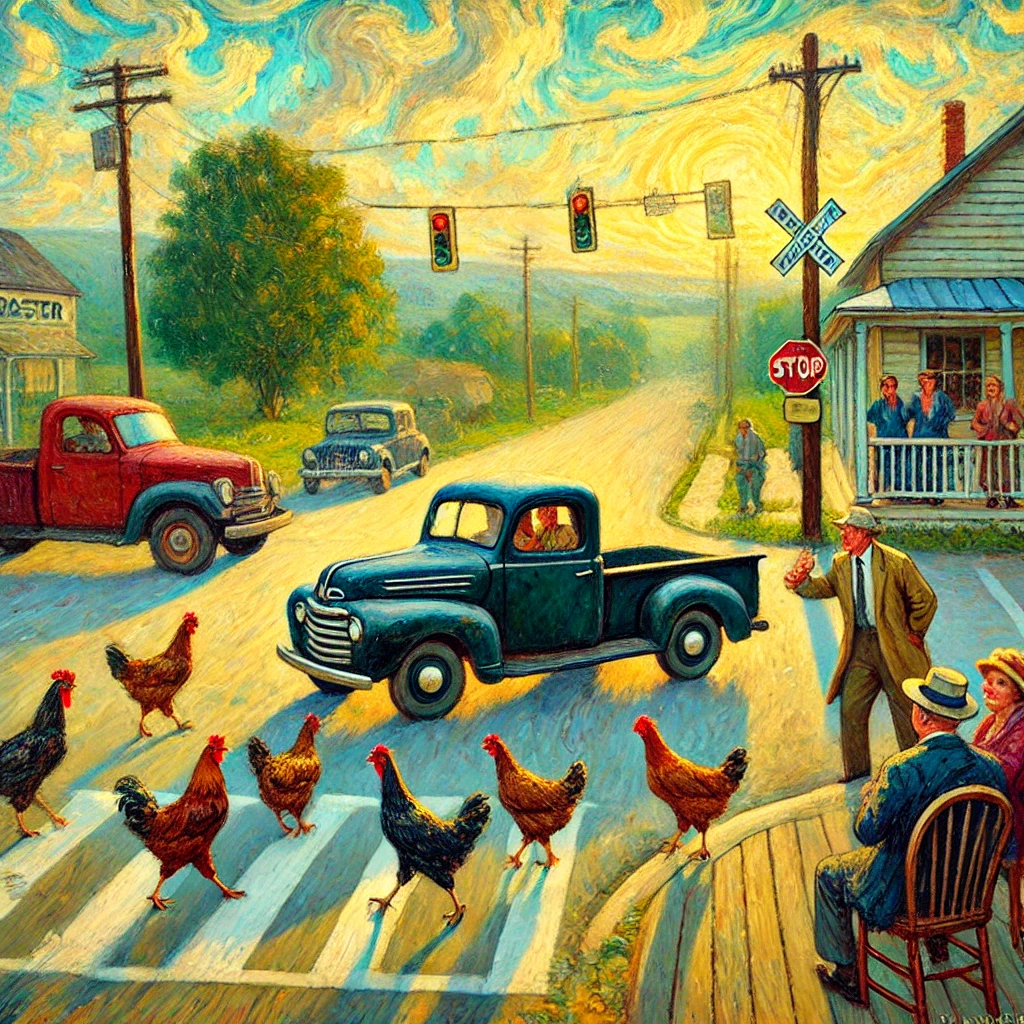
ACT I – The Interruption
Act II – The Study Committee
The first meeting about the chickens was supposed to be informal.
That is how terrible things are always introduced in Sequatchie Crossing—informally, so nobody feels responsible until it is too late.
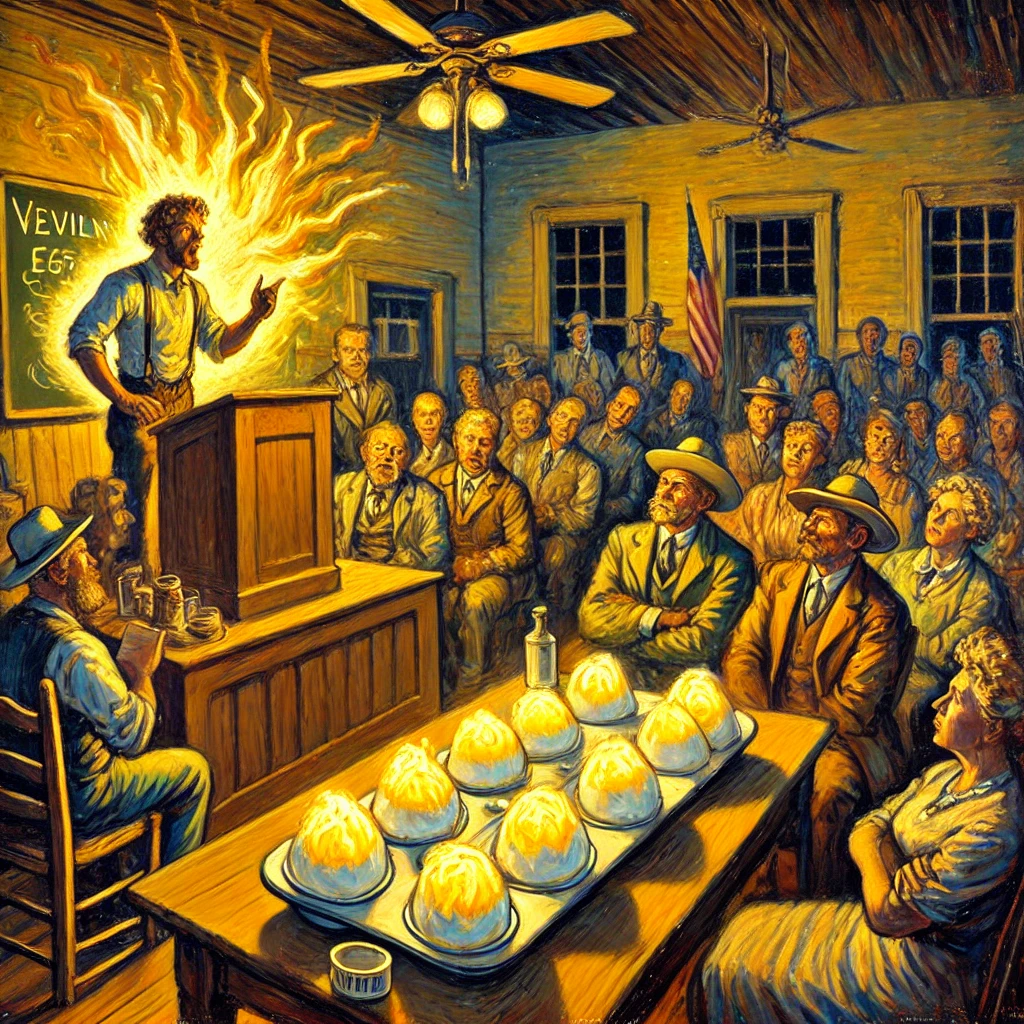
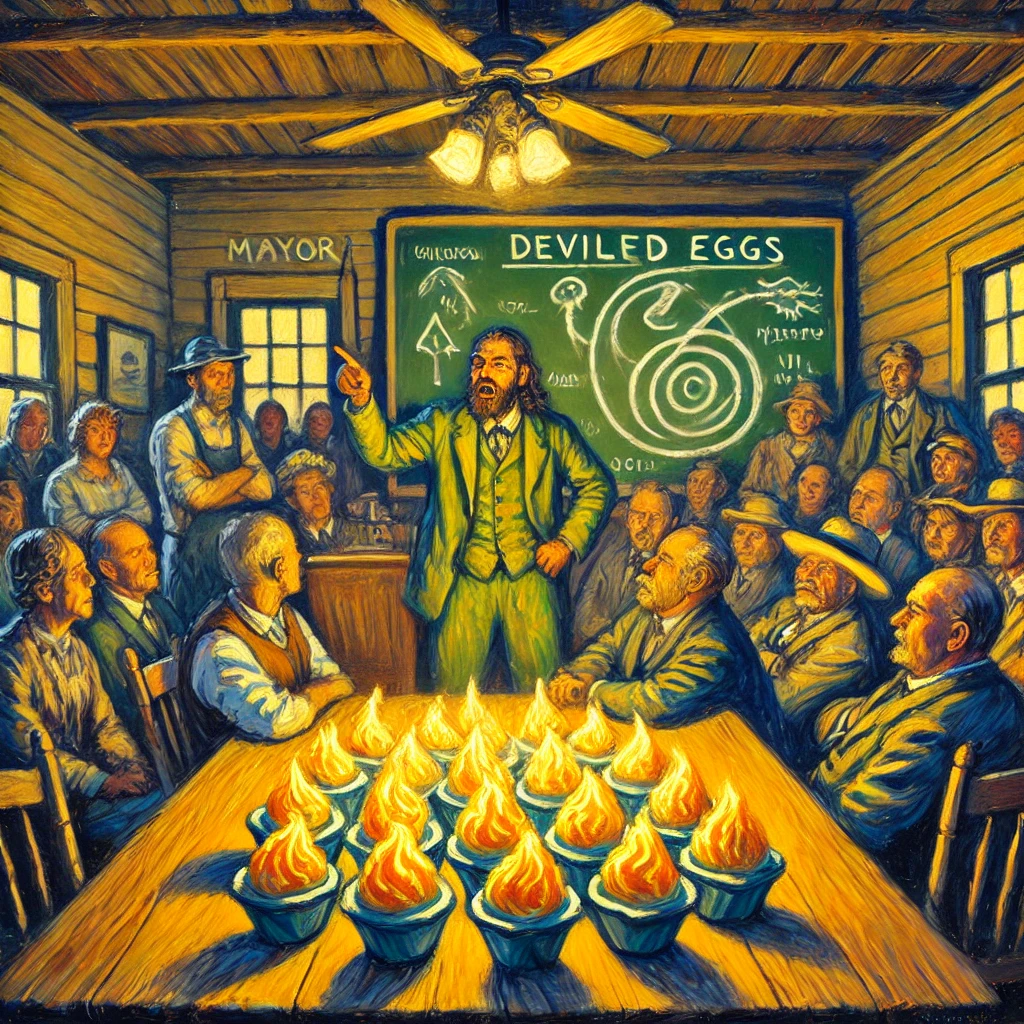
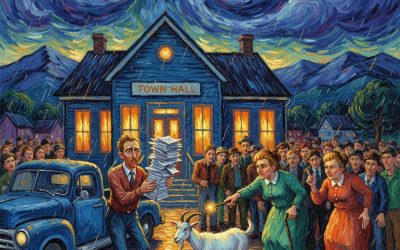
The mayor called for a “brief observational gathering” at town hall that evening. By supper time, every folding chair was full, the walls were lined three deep, and somebody had brought deviled eggs because no civic disturbance in town had ever improved by being underfed.
The chickens themselves were absent, which many found strategic.
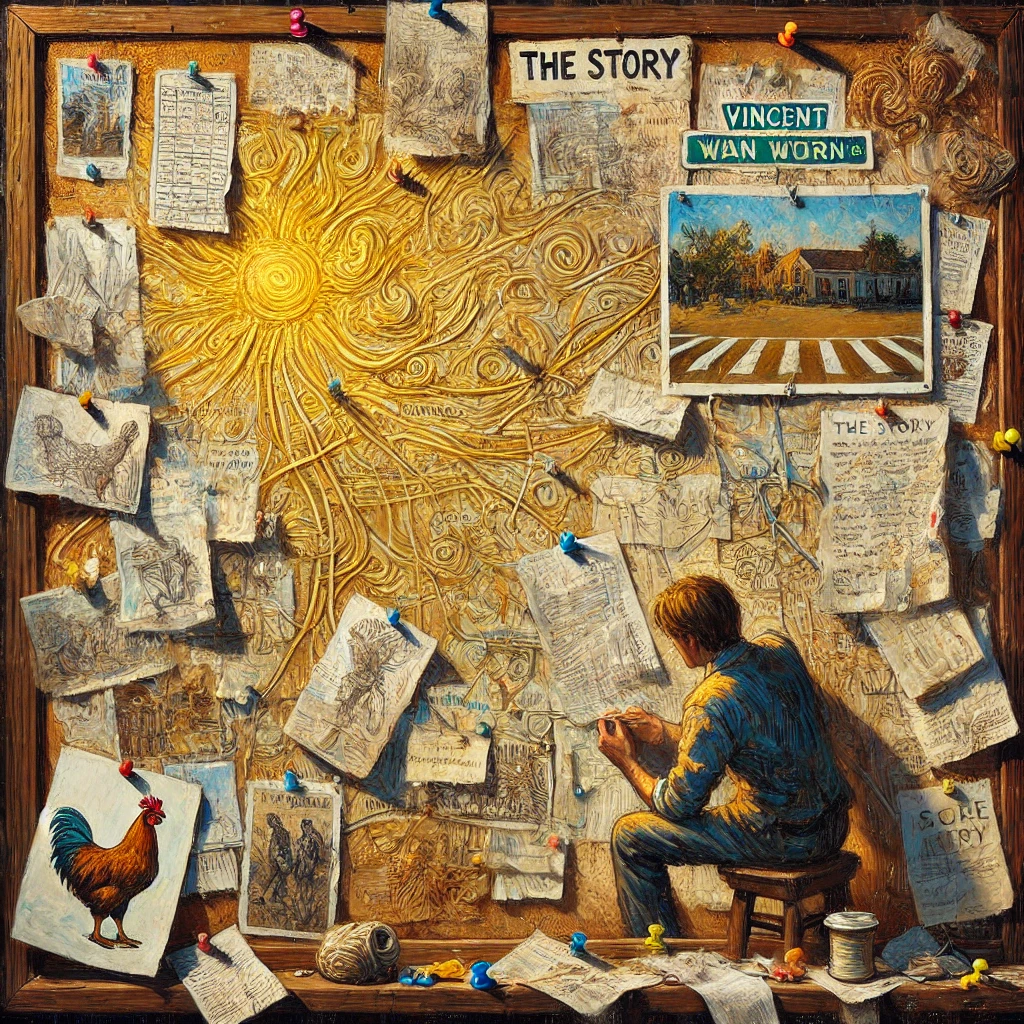
On the front table sat Mayor Crutcher, Sheriff Peeler, Pastor Peeler, and—through a series of events that no one later admitted supporting—Clovis Strickland, who now had a stack of diagrams clipped neatly together under the title PRELIMINARY FINDINGS: CHICKEN-LED INTERSECTION OPTIMIZATION.
Trixie Jo had claimed a seat in the front row just so she could sigh audibly at moments of her choosing.
Mayor Crutcher tapped the microphone. It shrieked, which people took as a bad sign.
“We are here,” she began, “to address citizen concerns regarding poultry activity in the central intersection.”
“Purposeful poultry activity,” Clovis corrected.
The mayor ignored him. “Our goal is to determine whether this is merely a livestock nuisance or whether there are legitimate traffic considerations being highlighted.”
Mabel Dean whispered to Miss Darlene, “That’s politician talk for ‘I do not know what I am doing but I’d like credit for it.’”
Sheriff Peeler stood. “At present, there is no evidence these chickens belong to any one nearby property. We’ve asked around. No one has claimed them.”
A man from the back shouted, “That means they’re independent!”
“Or dumped,” said someone else.
“Or feral,” offered Leonard, whose haircut now looked complete but spiritually unresolved.
Clovis rose before the sheriff had fully sat down. He placed one diagram on the easel.
It showed the intersection as a series of circles, arrows, dotted loops, and what appeared to be one chicken wearing a pilot’s cap.
“I have documented seven complete crossing cycles,” he said. “Observed changes in vehicle behavior include increased stopping compliance, reduced acceleration aggression, improved cross-direction attention, and one notable instance of patience from Trixie Jo Bartlett.”
The room turned to look at her.
Trixie Jo crossed her arms. “I was filming.”
“Intent doesn’t erase outcome,” Clovis said.
She pointed at the diagram. “Why is that chicken dressed like Amelia Earhart?”
“Visual aid,” Clovis replied.
Mayor Crutcher pinched the bridge of her nose. “Mr. Strickland, are you suggesting we redesign the intersection based on the actions of three unowned birds?”
“I am suggesting,” said Clovis, with the calm of a man about to be dangerous, “that the birds have revealed latent deficiencies in our current layout.”
A murmur went through the room. The phrase latent deficiencies impressed people. It sounded expensive.
Pastor Peeler stood next, adjusting his jacket. “I don’t know about latent anything, but I do know this town has long needed slower traffic at that corner. If it takes three hens sent—providentially or otherwise—to make us notice, then perhaps our pride should not outrun our gratitude.”
That landed well, because it sounded spiritual without being specific enough to argue with.
Boot Barnes rose from the second row. “I’d like to say the birds demonstrated better merging behavior than most people leaving the diner after catfish night.”
“True,” said Mabel Dean.
“Extremely true,” said Miss Darlene.
Mayor Crutcher scribbled again, and the room noticed.
“What are you writing?” Trixie Jo asked.
“Notes.”
“For what?”
The mayor looked up. “A task force.”
ACT II – The Study Committee
The room groaned as one organism.
“No,” said three people at once.
“You can’t do that,” said Leonard.
“She absolutely can,” said Mabel Dean darkly, “which is why we should’ve stopped this before she brought a notepad.”
Clovis, however, looked moved.
“Madam Mayor,” he said, “I would be honored.”
“That ain’t support,” Boot muttered. “That’s hunger.”
Within twenty minutes, despite opposition, mockery, and one brief argument about whether chickens could legally be consultants, the town had formed the Temporary Intersection Review and Poultry Observation Committee.
Its members were the mayor, the sheriff, Clovis, Mabel Dean, Boot Barnes, and—because she refused to be left out of anything that might later become funny—Trixie Jo Bartlett.
Its purpose was to observe the chickens, study the intersection, and recommend improvements.
Its unofficial purpose was to give the town something to talk about other than drainage complaints and the softball field lights.
The next morning, the committee assembled at dawn with folding chairs, coffee, and more seriousness than the subject deserved.
The chickens arrived precisely eight minutes later.
“They’re punctual,” said Boot.
“They’re managing us,” whispered Clovis.
“No,” said Trixie Jo, “they’re chickens.”
Yet when the birds repeated the same pattern from the day before—lead pause, lateral glance, rear hold, center pivot, diagonal correction—the committee fell silent.
Even Trixie Jo stopped smirking.
Sheriff Peeler pulled a notepad from his pocket.
Mabel Dean stared. “You’re taking notes?”
He kept writing. “I’m documenting.”
“Same sin, different hymn,” she said.
By the third day of observation, the committee had concluded four things:
First, the birds appeared only during the busiest daytime windows.
Second, they avoided trucks moving too fast.
Third, they preferred forcing full stops before making their crossing loop.
Fourth, and most unsettling of all, they seemed to adjust based on human behavior.
“If a car rolls through,” Clovis said, tapping his notes, “the red bird compensates.”
“You keep saying ‘compensates’ like she’s on salary,” Trixie Jo replied.
Mayor Crutcher, who had been hoping the matter would resolve itself through boredom, now faced the larger problem that the chickens were developing a constituency.
Children had begun drawing them in school.
The diner had named a breakfast special after them.
Someone had painted a little sign reading CHICKEN CROSSING DEMONSTRATION ZONE and stuck it in the median grass.
Worse, people were slowing down at the intersection even when the birds weren’t there, because nobody wanted to be the first one seen driving recklessly through an area that had effectively been moralized by poultry.
The mayor called an emergency committee session.
“We need to decide,” she said, “whether we are improving the intersection, removing the chickens, or pretending this never happened.”
“Too late for the third one,” said Boot.
“We can’t remove them now,” said Mabel Dean. “Folks are attached.”
“They’re attached to the idea,” said the mayor.
“That’s worse,” Trixie Jo said. “Ideas stay longer.”
Pastor Peeler, invited in an unofficial capacity that somehow gave him maximum influence with minimum blame, folded his hands and said, “I believe the town is being offered a chance to learn humility through absurd means.”
Nobody liked how accurate that sounded.
Clovis straightened a map on the table. “I propose a painted roundabout.”
The room froze.
“Absolutely not,” said the sheriff.
“Too expensive,” said the mayor.
“Too foreign,” said Boot.
“Too ugly,” said Trixie Jo.
Clovis lifted one finger. “Not a full roundabout. A symbolic one.”
“What does that even mean?” asked Mabel Dean.
“A painted loop. Guidance lines. Signage. Perhaps a yield pattern based on avian demonstration.”
There was a long silence.
Then Boot, against all expectations, said, “Well… a painted loop ain’t as bad as actual concrete.”
Trixie Jo stared at him. “Are you having a stroke?”
“I’m being practical. That’s different.”
The mayor looked around the table and realized, with visible dread, that the idea had crossed from ridiculous to possible.
That was all Sequatchie Crossing ever needed.
ACT II – The Study Committee
Act III – The Paint
Saturday was chosen for the pilot test because the county office was closed, which meant nobody from outside could arrive in time to stop them.
The plan, such as it was, involved temporary chalk paint, homemade signs, and volunteer traffic control. The mayor insisted this was not an official infrastructure project. The sheriff insisted he had not authorized it. Clovis insisted history rarely waited for paperwork.
By seven in the morning, half the town had gathered.
Children held paper chickens on sticks.
Mabel Dean had set up a folding table with sweet tea and cinnamon rolls “for morale.”
Boot brought measuring tape, string, and a leaf blower.
Trixie Jo brought a portable speaker and, after being threatened by three different people, reluctantly agreed not to treat the event like a parade.
The intersection was marked off while Clovis directed with the wild confidence of a man who had never met a limit he couldn’t reinterpret.
“A little wider there,” he called.
“That’s the gutter,” said Boot.
“Then the gutter participates.”
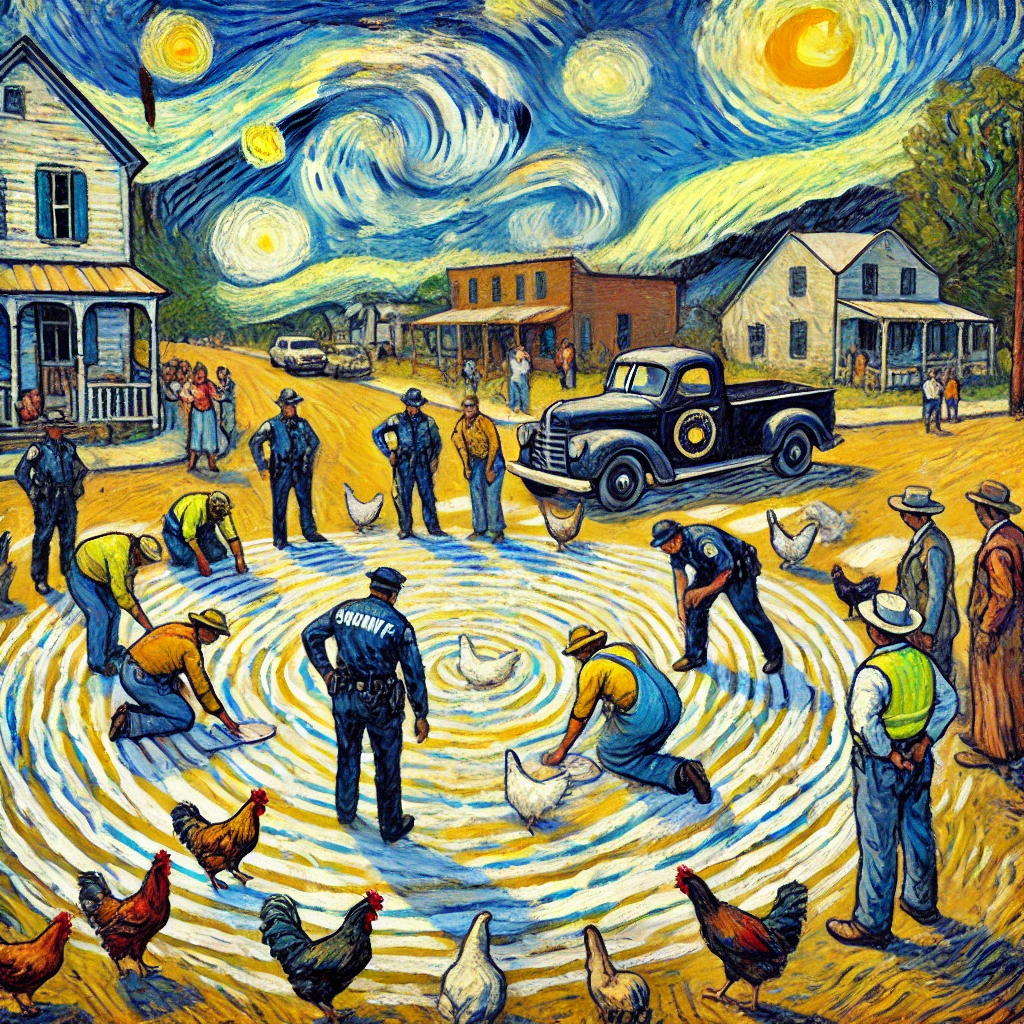
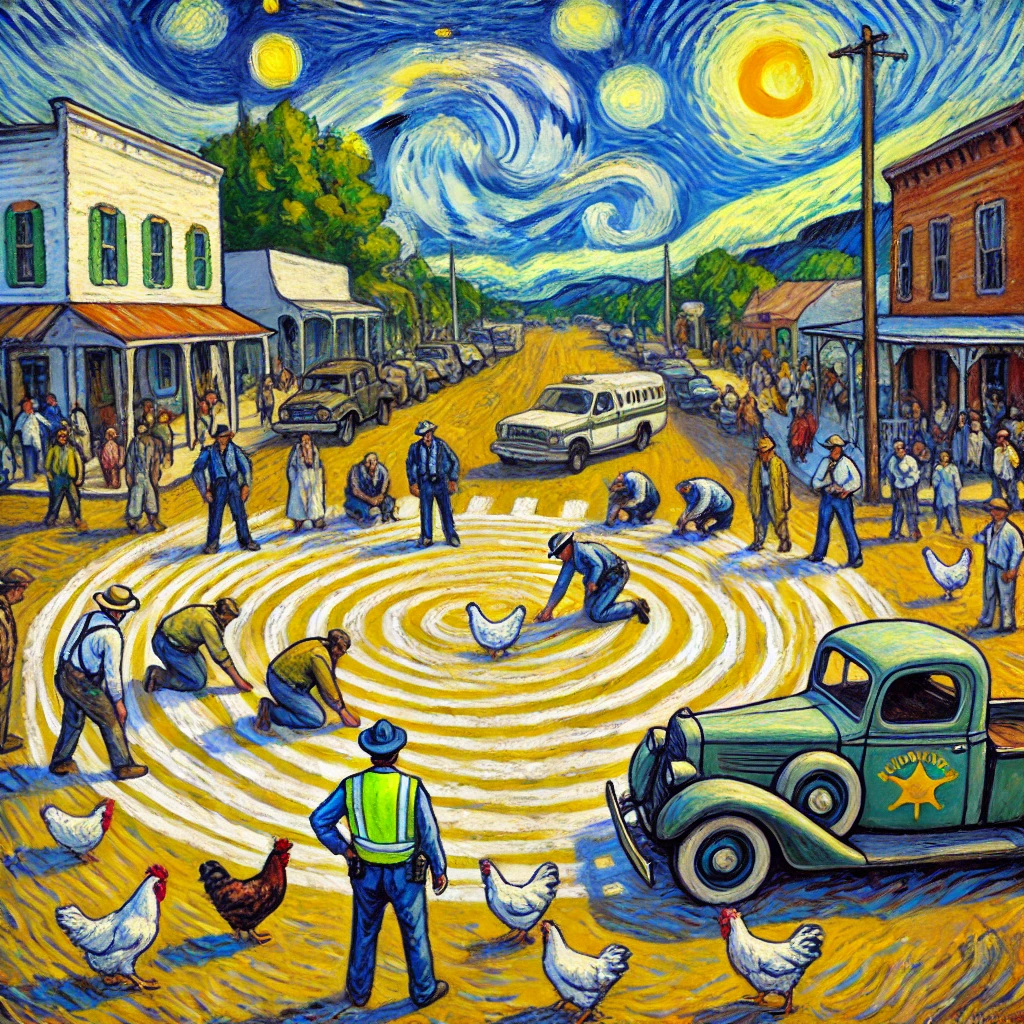
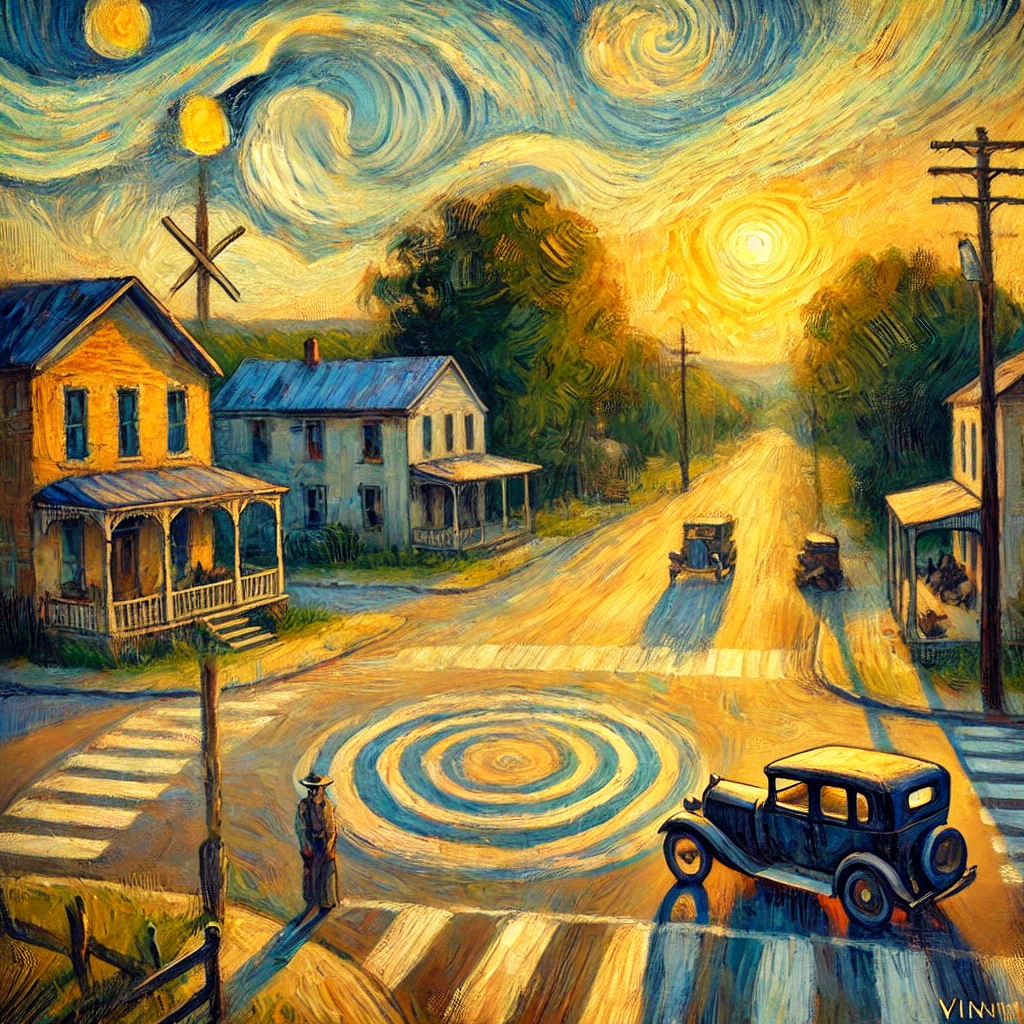
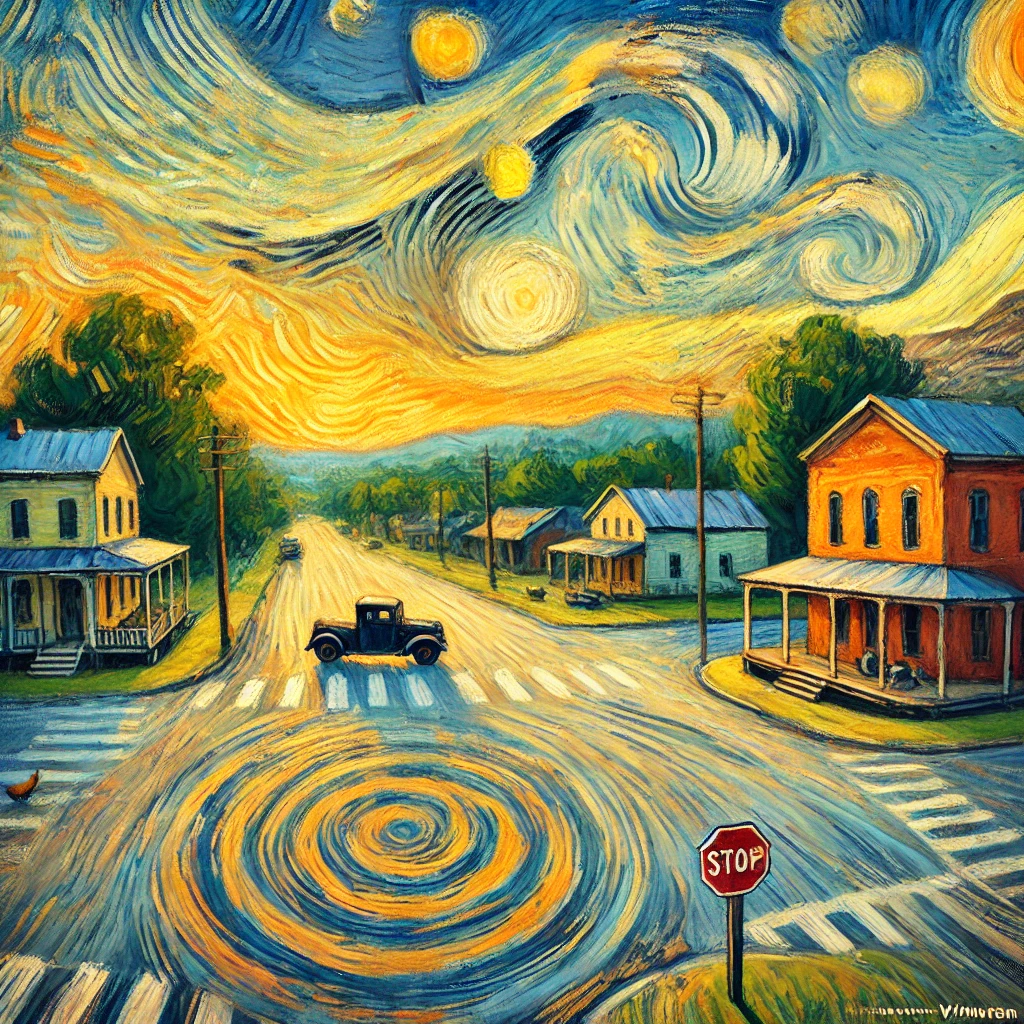
The painted pattern, once complete, looked like what might happen if a traffic engineer had a nervous spell while watching a county fair. It wasn’t quite a roundabout, not exactly a crosswalk, and not any known legal shape in the state of Tennessee. But it did create a visual funnel into the intersection, slowing vehicles as they approached and guiding them into a gentler turn.
And in the very center, because Trixie Jo insisted the town should at least be honest about why it was happening, they painted three small chicken silhouettes.
When the mayor saw them, she nearly fainted.
“You cannot put chickens in the road,” she said.
“They’re symbolic,” said Clovis.
“They’re incriminating,” she snapped.
By nine o’clock, the test began. Sheriff Peeler stood in the middle wearing a reflective vest that made him look deeply betrayed. Cars approached, slowed, followed the painted curve, and emerged from the intersection alive and calmer than before.
“Well I’ll be,” said Leonard from the sidewalk.
Boot folded his arms. “It does sort of work.”
“It works because people are scared of looking foolish,” said Trixie Jo.
“That,” said Pastor Peeler, “has been the foundation of civilization.”
Then, just as the town began to congratulate itself, Harold Pruitt came barreling down from Ridge Road in his pickup, not dangerously exactly, but with the same cheerful disregard for municipal nuance that had made his driving a frequent sermon illustration.
The crowd cried out.
Sheriff Peeler waved both arms.
Harold hit the brakes.
And at that exact moment, as if summoned by timing itself, the three chickens stepped from behind the diner and entered the painted pattern.
The entire crowd went still.
The white one led them onto the curved line.
The red one paused at the first yield mark.
The black one brought up the rear.
And the three of them walked, not across the road this time, but along the painted path, following the loop exactly, circling the center silhouettes as if inspecting tribute.
Harold removed his hat.
Mabel Dean whispered, “They’re dedicating it.”
Trixie Jo, for once, did not laugh.
Even the mayor looked shaken.
The chickens completed the loop, exited at the curb nearest the diner, and stopped. The white one gave a single sharp cluck.
Then all three walked away behind Honeycutt Hardware and out of sight.
No one moved for several seconds.
Finally Boot said, in the hushed voice of a man who had just watched a minor miracle or a major prank, “Well. That settles that.”
“What settles what?” asked the mayor weakly.
“That they approved it,” said Clovis.
The mayor opened her mouth to object, but the crowd had already accepted the interpretation. You could see it happen—that soft communal tipping point when doubt loses its footing and a story hardens into local fact.
Children cheered.
Someone began clapping.
Miss Darlene cried a little, though she later claimed dust had gotten in her eye.
By sundown the town had named the painted area The Crossing Circle, though it was neither fully crossing nor entirely circular. The diner was selling chicken salad sandwiches under the name Purpose Plates. Trixie Jo’s video had gone mildly viral outside the county, prompting comments like This is why I love small towns from people who would not have lasted two hours in one.
The county office did eventually hear about it, of course.
ACT III – The Paint
A letter arrived the following Wednesday asking whether the municipality had altered road markings without approval. Mayor Crutcher prepared a denial so cautious it could have been used to butter toast. Sheriff Peeler recommended silence. Clovis drafted a twelve-page explanation involving adaptive rural micro-design led by “nontraditional observational catalysts,” which everyone confiscated before it could be mailed.
Then something stranger happened.
Drivers kept slowing.
Accidents, never frequent but always loudly remembered, ceased altogether at that intersection.
People used their turn signals more.
Tourists approached with uncertainty, then followed the lines carefully because it looked like they were supposed to.
Harold Pruitt, against his will, became a model of restraint simply because he got tired of being watched.
The town had accidentally improved traffic by embarrassing itself into attention.
For nearly two weeks, the chickens did not return.
This led to theories.
Mabel Dean said they had finished their work.
Pastor Peeler said perhaps they had moved on to another ministry.
Trixie Jo said somebody probably found out whose they were and locked them up.
Clovis said, “Field deployment rarely lasts forever.”
Boot replied, “Every time you talk like that, an angel files retirement papers.”
Still, folks missed them.
They had not merely interrupted traffic. They had given the town a short-lived sense that nonsense could arrive from nowhere, expose a flaw, and leave behind a better arrangement. That was rare enough to be cherished.
Then, on the third Monday after the painting, the birds returned one last time.
It was late afternoon. The sun was low. The air had that soft gold in it that makes even ugly things look forgiven.
Boot saw them first from the hardware store porch.
“Showtime,” he murmured.
They emerged from beside the diner, walked calmly to the edge of the painted circle, and stood in a row facing the road.
Cars slowed without prompting.
People came out of shops.
Even Mayor Crutcher, hurrying from town hall, arrived in time to see the white chicken step forward and peck once at the smallest painted silhouette in the center.
Then the birds crossed the intersection in a straight line—simple, ordinary, no loops, no formation—and disappeared down the alley behind the barber shop.
They were never seen again.
Which, in a way, was perfect. Had they stayed, the town would have become used to them. Somebody would have tried to monetize them. Children would have chased them. The county would have intervened. Mystery cannot survive a planning committee.
Because they vanished, they remained useful.
By summer, the story had become standard local history. Not accurate history, certainly, but usable history, which in small towns matters more.
The chickens were said to have arrived at dawn in fog. They had been called by prayer, by traffic complaints, by a truck horn, by destiny, by leftover biscuit crumbs, depending on who told it. Some insisted there had been four birds. One man claimed the black one wore a red ribbon. A child drew pilot goggles on all three in a school mural, and no one corrected it because it felt rude to challenge art.
Mayor Crutcher, who had privately resented the entire episode, eventually began citing the Crossing Circle as an example of “citizen-responsive innovation.” Sheriff Peeler tolerated this because arguing would only lengthen the meetings.
Clovis added the event to his notebook archive under the heading CASE STUDY: AVIAN-ASSISTED CIVIC COMPLIANCE and began, to everyone’s alarm, keeping an eye on squirrels near the post office.
Mabel Dean sold commemorative tea towels at the diner fundraiser.
Trixie Jo printed stickers that read THEY CROSSED WITH PURPOSE and put one on her car.
Pastor Peeler worked the moral into three separate sermons, each from a different book of the Bible and one of them, frankly, a stretch.
Boot Barnes kept the original measuring string in his garage, though he would not admit why.
And the intersection remained better than before.
Not perfect. Nothing in Sequatchie Crossing ever reached perfection without first becoming intolerable. But better. Slower. More aware. Less likely to produce a fender-bender and a feud before supper.
Which was enough.
ACT III – The Paint
Epilogue – What the Town Decided
Years later, newcomers would ask about the odd painted curve by the diner, and locals would explain it in the tone people use when they know a story sounds untrue but consider disbelief a form of rudeness.
“No,” they would say, “it’s real.”
“Yes, actual chickens.”
“No, nobody knows whose.”
“Yes, they seemed purposeful.”
And if the newcomer laughed, somebody—usually Mabel Dean, if she was within range—would narrow her eyes and say, “You’d laugh too if you’d seen how folks were driving before those birds showed up.”
That shut most people up.
Because beneath all the embellishment, all the retelling, all the comic inflation that naturally gathers around an event once it survives its first week, the town had settled on one firm belief:
The chickens came because people had stopped paying attention.
Not in a mystical sense necessarily, though some preferred that version. And not in the literal sense either, because everybody in Sequatchie Crossing paid attention to one another far more than was healthy.
No, what the town meant was different.
People had stopped paying attention to ordinary things.
To the corner they took too fast.
To the stop sign they treated as advisory.
EPILOGUE – Three Chickens and a Traffic Pattern
To the near misses nobody mentioned because they had not yet become stories.
The chickens had walked into town and behaved with such ridiculous intention that human beings, out of pride if nothing else, had been shamed into noticing their own habits.
That was the miracle, if there was one.
Not that chickens had intelligence beyond their station.
Not that the town had been visited by feathered engineers.
Not even that an intersection had improved.
It was this:
For one brief season, a town famous for talking past itself had been forced to stop, look, and yield.
And for Sequatchie Crossing, that counted as progress.
EPILOGUE – Three Chickens and a Traffic Pattern
Disclaimer
The events described here occurred in the same way all meaningful things in Sequatchie Crossing occur: partly in fact, partly in memory, and partly in the improvements people make later for the sake of telling it right.
No chickens were elected, ordained, appointed, or formally retained as consultants, though public support for at least one of those measures was briefly stronger than anyone found comfortable.
Any resemblance between the behavior of these birds and that of actual traffic engineers is strictly coincidental, though in a few cases unfavorable to the engineers.
And if you find yourself doubting that three chickens could improve a town simply by crossing the road with conviction, then perhaps you have never lived in a place where embarrassment accomplishes what government cannot.
DISCLAIMER – Three Chickens and a Traffic Pattern
Real Places Behind the Ruckus – From The Dunlap Directory

Real Places Behind the Ruckus – From The Dunlap Directory
Yes, this story was fictional; even the parts that weren’t true. These places? Absolutely real. Stop by, support local, and keep the Wi-Fi away from livestock:
- Cravens House
- Sequatchie Valley TN
- Wendy’s
- Highland Drive Warehouse
- Dunlap Tennessee Overview
- Happy Bottom Office Services
- Dunlap Enquirer
- Willow Rose Stables – Event Pony Rental
- Bolt Farm Treehouse Tennessee
- Dunlap Adventist Christian School
- VFW Post 5772 Dunlap
- Dog Whisperette
- Daniels Business Solutions
- McCarty Farmstead
- The Game Shack
- Davis Pond Camping Area
- Best Western Heritage Inn
- Farley Self Storage
- Farm Bureau Insurance

Real Places Behind the Ruckus – From The Dunlap Directory
At Sequatchie Crossing, we tell the stories of Sequatchie Crossing.
Please share this post with your friends, family, or business associates who may want follow the news from Sequatchie Crossing.

0 Comments