



Compliance Becomes a Moral Statement
By Tom Seest
At Sequatchie Crossing, we tell the stories of Sequatchie Crossing.
Please share this post with your friends, family, or business associates who may want help telling the stories of their legacy.
🎤 Audio Overview

Mabel Dean Self-Reports
By the time the trouble started, the sign in question had already been in Mabel Dean’s yard for six days, fourteen hours, and—according to the yellow legal pad on her kitchen table—twenty-two minutes.
It was not a flashy sign.
That, in Mabel’s view, made the matter worse.
A flashy sign could claim confusion. A flashy sign could plead theatrical excess. A flashy sign might say it had been carried away by enthusiasm and glitter paint and poor supervision. But Mabel’s sign was rectangular, measured, legible, and disturbingly tasteful. It sat in the grass beside her mailbox in a posture of complete innocence, as if it had emerged from the earth by natural means.
It read:
PEACH COBBLER SUPPER
THURSDAY – FELLOWSHIP HALL
$8 DONATION SUGGESTED
There were no flashing lights. No inflatable attachments. No fluttering streamers. The wooden stakes were set straight, and the lettering had been done in blue by hand, because Mabel held that a person could tell the moral character of an event by the steadiness of the letters advertising it.
That was precisely the problem.
By then, the new enforcement of the town sign ordinance had already begun turning ordinary citizens into students of dimensions, setbacks, stake depth, and the legal distinction between temporary, portable, accessory, and “impermissibly attention-seeking” displays. Banners had come down. Portable signs had vanished from gas stations under cover of dusk. A man on Valley View had been told to remove a plywood sign advertising smoked bologna because it counted, somehow, as a “freestanding promotional structure.” Nobody liked this, but most people responded as people in Sequatchie Crossing always did when the law became visible all at once: they complained loudly while hoping someone else would become the example.
Then Mabel Dean read the ordinance.

Proglogue – Mabel Dean Self-Reports
She did not read it the way most people read an ordinance, which is to say while irritated, half-listening, and prepared to reject anything containing the phrase “as defined herein.” Mabel read it the way other people read a warning label on medication they did not intend to take but wished to morally understand. She sat down after lunch with her glasses low on her nose, a can of peaches cooling on the counter, and Sheriff Peeler’s photocopied packet of municipal regulations spread before her like Holy Writ.
She read every page.
She underlined.
She cross-referenced.
She made notes in the margin beside Section 8.4(c), which addressed temporary event signage in a manner both specific and unhelpful. She placed a star beside the section limiting placement within certain distances of public right-of-way markers. Then she rose from the table, walked to the front yard with a tape measure, measured from the edge of the ditch to the sign, then back to the mailbox, then from the mailbox to the pecan tree, then back inside to consult her notes.
At 3:17 p.m., Mabel Dean came to a conclusion that would disturb the whole town.
Her own sign was illegal.
She stood at the kitchen sink for a full minute with one hand on the counter and the other still holding the ordinance packet.
“Lord,” she said softly to nobody in particular, “that will not do.”
Most people, upon learning that a church cobbler sign violated a selectively enforced, eleven-year-old ordinance no one had cared about until recently, would have removed it quietly and considered the matter closed. But that presumed the average citizen possessed Mabel Dean’s peculiar alloy of conscience, pride, piety, and competitive public decency.
Mabel did not merely want to obey the law.
Mabel wanted it known that she obeyed the law.
That distinction would ruin everybody’s week.

Proglogue – Mabel Dean Self-Reports
Act I – A Matter of Conscience, Publicly Shared
At 4:02 p.m., Mabel called Town Hall.
Miss Darlene Pickett, who answered the phone because she always answered the phone whether or not it was technically her responsibility, recognized trouble the instant she heard Mabel’s voice adopting its careful tone.
“Mabel,” said Darlene, “what’s happened?”
“I need to report a violation.”
There was a pause.
Darlene glanced toward the mayor’s office, though Mayor Len Pickett was not in it. He had gone to the feed store to avoid several matters and had thus become temporarily inaccessible, which was his preferred managerial posture when citizens began using official words like violation.
“What sort of violation?” Darlene asked.
“My own.”
Darlene sat up straighter. “Your own what?”
“My own yard sign. It appears to be in noncompliance with Section 8.4, Subsection C, unless one interprets ‘temporary event’ generously, which I no longer feel ethically at liberty to do.”
Darlene closed her eyes.
“Mabel,” she said, “you do not have to report yourself.”
“I believe I do.”
“Nobody’s complained.”
“I have.”
“That doesn’t count.”
“It surely does. I am a resident.”
Darlene pinched the bridge of her nose. “Mabel, just pull it up and let that be the end of it.”
But this suggestion, sensible on its face, failed to account for the fact that Mabel had already crossed an invisible line known only to certain temperaments: the line beyond which private obedience no longer satisfied, and public acknowledgment became essential.
“That would create,” Mabel said, “the appearance of concealment.”
“It would create the appearance of common sense.”
“I don’t want there to be any question.”
“Question from who?”
There was another pause.
Mabel spoke with quiet gravity. “From the town.”
Now, in Sequatchie Crossing, “the town” was not a government body, nor a formal electorate, nor even an organized public. It was a living weather system of observation. It was porches, checkout lines, passing glances, church foyers, Facebook comments, parking-lot conversations, and the cumulative pressure of people saying, “Well, now, that’s interesting,” in a tone that meant they would discuss you over pie.
Darlene recognized at once what had happened.
Mabel had not become afraid of the ordinance.
She had become afraid of hypocrisy.
Which was far more dangerous.
“Mabel,” Darlene said, lowering her voice, “nobody is auditing your heart.”
“That is not the principle.”
“No, it’s worse than a principle. It’s a performance with scripture behind it.”
“I beg your pardon?”
“Nothing. Hold, please.”
Darlene set down the receiver and went in search of the mayor, though what she really needed was not the mayor but someone willing to absorb the moral shrapnel of a citizen voluntarily entering herself into evidence.
By 4:25 p.m., Clovis Strickland knew.
This was because Clovis knew everything within twenty-seven minutes if the matter involved paperwork, archives, suspicion, or the prospect of being early to history. He received the news from Darlene’s nephew, who overheard enough from the hall to understand that Mabel Dean had “turned herself in over a church dessert sign,” which Clovis recognized instantly as the kind of sentence that only appeared at the beginning of larger civic problems.
He arrived at Town Hall with a notebook, three pens, and an expression of professional gratitude.
“Is it true?” Clovis asked before even stepping fully inside.
Darlene looked up from her desk with the deadened eyes of a woman who had hoped the event might yet remain local to a single office.
“Yes.”
“She file a written statement?”
“Not yet.”
“She should.”
“She absolutely should not.”
Clovis nodded as though this confirmed his deepest suspicions about procedural weakness. “Without documentation, it turns emotional.”
“It is already emotional.”
“No,” Clovis said, opening his notebook. “At present it is personal. Emotion is what happens when others see themselves in it.”
This, unfortunately, was correct.
By suppertime, three versions of the story were moving through town.

Act I – The Self-Report
In the first, Mabel had nobly confessed her own sign violation because she believed the law ought to apply equally, even to peach cobbler.
In the second, she had called Town Hall to draw attention to the arbitrary nature of the ordinance and shame the officials into backing down.
In the third, which spread fastest because it was both false and satisfying, Mabel had demanded they cite her personally so nobody could accuse the church ladies of getting special treatment.
By seven o’clock, people had begun walking or driving past Mabel’s house more slowly than usual.
The sign remained in place.
It was no longer a church supper notice.
It had become a test.
Boot Barnes, who considered himself a defender of practical freedom and had already been involved in earlier sign disputes of both legal and emotional character, stood in the gravel lot outside the hardware store and squinted toward the road where two women in separate cars had just slowed nearly to a stop near Mabel’s mailbox.
“They’re making a pilgrimage,” he muttered.
Sheriff Peeler, who was drinking a cup of coffee that had gone from hot to punitive, leaned against the hood of his cruiser.
“What is it with this town,” Peeler asked, “that the minute anybody behaves responsibly, everyone gets mean about it?”
Boot thought about that.
“Because,” he said, “if a person does something wrong on purpose, that’s understandable. But if they confess voluntarily, it suggests the rest of us have choices we were hoping not to discuss.”
Sheriff Peeler sighed. “That is the most exhausting thing I have ever heard, and I believe it.”
At 8:15 p.m., Mabel herself posted a statement in the town Facebook group.
She typed it carefully, revised it twice, and had her cousin from Jasper proofread it for tone.
It read:
Friends, in the interest of transparency and consistency, I want to acknowledge that the sign currently placed in my yard regarding Thursday’s Peach Cobbler Supper may not comply with the recently enforced town ordinance. I have notified Town Hall accordingly. I do not make this statement to draw attention to myself but because I believe standards, if they exist, should apply evenly and with a clean conscience. We will proceed with humility and, Lord willing, dessert.
The post was disastrous.
Not because it was rude. It was not rude.
Not because it was self-righteous. It was only slightly self-righteous.
It was disastrous because it was perfectly worded to make everyone else feel grubby.
Within fourteen minutes there were forty-seven comments.
Some praised her integrity.
Some accused her of virtue signaling, though half the people using that phrase pronounced it as two words and meant only that somebody seemed pleased with herself.
Some argued that church signs should be exempt.
Some asked whether this meant garage sale signs, graduation signs, “It’s a Boy” signs, memorial cross signs, and the handmade plywood notice for Earl’s rabbit cages were now subject to inspection.
One person wrote, “This town has lost the plot.”
Another replied, “No, some of us are finally reading the plot.”
And by bedtime, four people had gone outside to inspect their own yards with flashlights.

Act I – The Self-Report
Act II – The Burden of Voluntary Goodness
The next morning Sequatchie Crossing woke to a phenomenon rare even for that place: a civic mood.
Not a consensus. God forbid.
A mood.
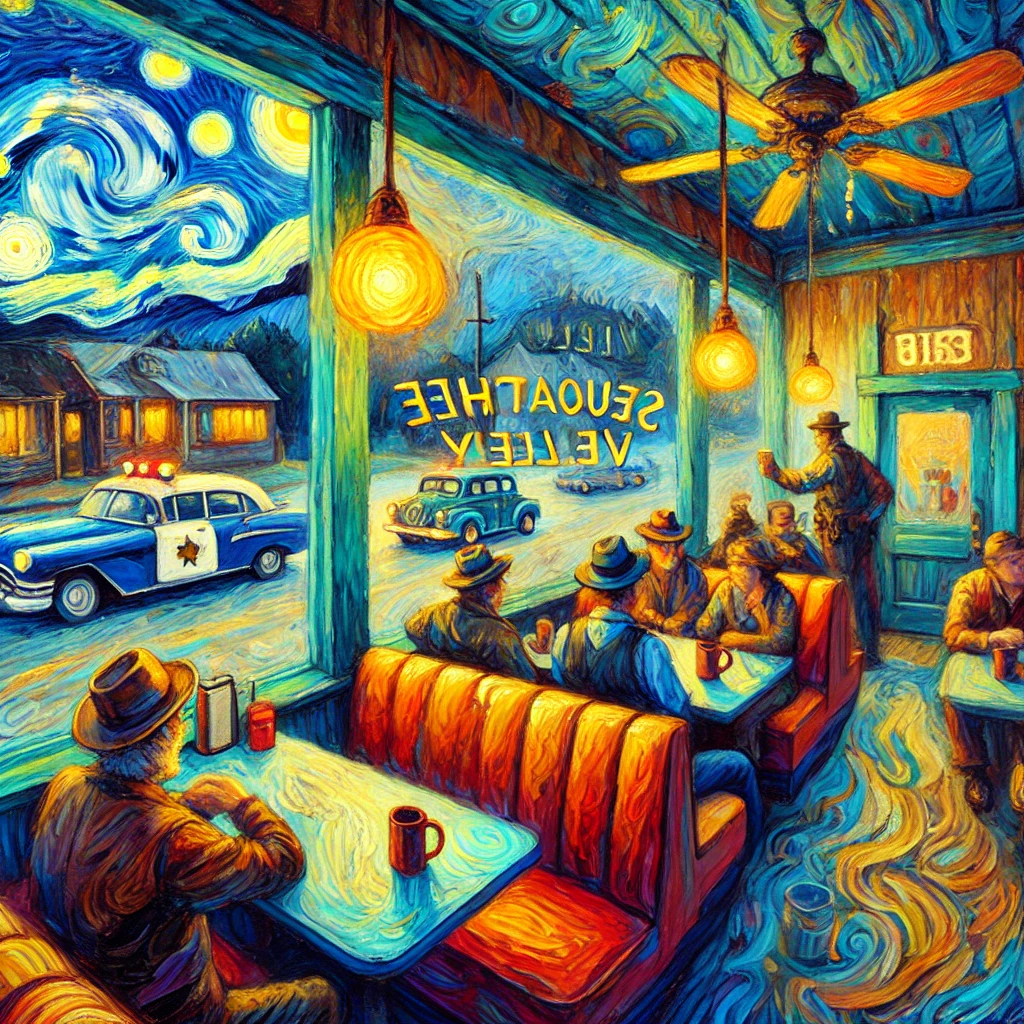
At the diner, people spoke in lowered tones as if discussing a funeral, though the deceased in question was ambiguity. The waitress, Rhonda, had to refill the same cups repeatedly because nobody was drinking so much as gesturing with coffee while making escalating arguments about fairness.
At one booth, two retired men insisted Mabel had done the right thing because law without equal application was merely selective nuisance.
At the next booth, a woman in a fleece vest said the whole business was sanctimony in orthopedic shoes.
At the counter, Junior Tate, who ran the muffler shop and had once left a sign trailer out for six months advertising brake specials, asked the question that had begun troubling many of the less ceremonially lawful citizens of town.
“Are we now expected,” Junior said, “to tell on ourselves?”
The room went quiet in the way rooms do when someone has moved from commentary to consequence.
Rhonda set down a plate of biscuits with the solemnity of a bailiff.
“That,” she said, “is what everybody’s trying not to ask.”
Because if Mabel Dean’s act stood as admirable, then noncompliance was no longer merely a matter of dodging enforcement. It became, by contrast, a moral decision. Her confession had transformed the field. Overnight, the issue ceased to be “Will the town make me take this down?” and became “What kind of person leaves it up knowing what Mabel did?”
This angered people not because they were villains, but because nobody liked having a church cobbler sign turn into an ethical mirror.
By nine in the morning, Town Hall had received five calls.
One woman wanted to know if her hand-painted sign for her grandson’s graduation counted as temporary celebratory expression or prohibited display material.
A man on Ridge Road asked whether a wooden board saying FRESH EGGS was commerce, agriculture, or heritage.
Another caller, who refused to give his name and therefore was almost certainly not protecting anonymity so much as performing it, asked whether “performative compliance by known church ladies” had now become binding precedent.
Darlene wrote that one down word for word because she intended to repeat it later.
Mayor Pickett returned to Town Hall around ten with a sack from the feed store and the expression of a man who knew, before anyone spoke, that events had progressed in his absence.
“What happened?”
Darlene slid the phone message pad toward him.
He read three notes, looked up, and said, “What in the world is ‘performative compliance’?”
“Basically,” Darlene said, “Mabel obeyed the law too visibly.”
Mayor Pickett stared into the middle distance.
“I was gone forty minutes.”
“Ninety-two,” said Clovis from a chair in the corner, where he had taken up observation as if attending a trial.
“Nobody asked you.”
“You did not ask,” Clovis conceded. “But history will.”
Mayor Pickett took a long breath. “Where is the sign now?”
“In place.”
“Why?”
“Because,” said Darlene, “she does not want to remove evidence before the town has had time to process the lesson.”
“The lesson?”
“That’s not a direct quote, but close.”
Mayor Pickett rubbed his forehead.
It was decided, against everyone’s better instincts, that someone should go speak with Mabel in person before the matter expanded into pamphlets, prayer circles, or a special-called meeting. Sheriff Peeler was dispatched because he had already measured more illegal things that month than anyone else and possessed, beneath his irritation, a talent for sounding humane when the situation required.
Boot Barnes volunteered to accompany him.
“No,” said the mayor.
“Why not?”
“Because every time you accompany anything, it gains an audience.”
“That is not fair.”
“It is accurate.”
So Sheriff Peeler went alone.
He found Mabel in the front yard, clipping dead stems from a hydrangea bush in the shadow of the now-famous sign. She wore a light cardigan and a look of spiritual steadiness that made Peeler immediately wish he had brought backup anyway.
“Mornin’, Mabel.”
“Sheriff.”
He glanced at the sign, then back at her. “I understand you’ve got concerns.”
“I do.”
He waited.

Act II – The Town Starts Looking
She waited.
Peeler shifted his weight. “Would you like to tell me what outcome you’re hoping for here?”
“Yes,” she said. “I would like clarity.”
“On whether the sign violates the ordinance?”
“No. It does.”
He blinked. “You’re sure?”
“Quite.”
“Well,” said Peeler, “that narrows one thing.”
Mabel set down the clippers. “The issue is not whether the sign is compliant. It is whether we intend to live in a town where standards are selectively burdensome and privately resented, or plainly acknowledged and honestly borne.”
Sheriff Peeler let silence sit there a moment, partly because he respected her seriousness and partly because he needed time to untangle that sentence into sheriff-sized pieces.
“So,” he said at last, “you want honesty.”
“I want integrity.”
“Same county, different road.”
Mabel almost smiled, but did not.
Peeler tried again. “Couldn’t you just remove it and say you learned something?”
“I could. But then the entire event would remain private. People would say the church ladies were quietly let off, or that I called only to protect myself preemptively, or that once I understood the law I folded it back into convenience. No. If the rule exists, let it touch me openly.”
“Most folks,” said Peeler, “are tryin’ to avoid being touched openly by town government.”
“That is because most folks have not spent thirty-two years organizing fellowship meals among people who watch one another with scriptural enthusiasm.”
That, too, was difficult to argue with.
He looked at the sign again. It was a good sign. Respectful. Mild. Tragically noncompliant.
“Mabel,” he said, “I need to be honest. The more public this gets, the weirder everyone else is acting.”
“That is not my intention.”
“No, but it appears to be your gift.”
She sighed then, the first sign of weariness he had seen. “Sheriff, I did not set out to become an illustration. I simply don’t want to live one way in church and another in my front yard.”
Peeler nodded slowly.
There it was. Not politics. Not optics. Not even town drama, though there was plenty of that. Beneath the whole thing lay a private terror familiar to decent people everywhere: the fear of becoming visibly smaller than one’s own stated beliefs.
He took off his hat, rubbed the back of his neck, then put it on again.
“Well,” he said, “I don’t reckon I can arrest a conscience.”
“No.”
“But I would appreciate it if you’d stop feeding the whole town one.”
This time she did smile, sadly.
Around noon, a fresh complication arose: other people began self-reporting.
Not many at first.
A retired teacher called to ask if her VOTE HERE NEXT TUESDAY sign left over from a church auxiliary election counted.
A man with three metal signs advertising firewood sent an email titled IN THE INTEREST OF FAIRNESS.
Two sisters on Creek Bend submitted photographs of a folding yard display for their annual Christmas bazaar, though it was March, which suggested either lingering guilt or admirable planning.
By one o’clock, Clovis had created a folder labeled VOLUNTARY COMPLIANCE MATERIALS.
Darlene tried to snatch it away and failed.
By two, the Baptist minister, the Pentecostal assistant pastor, and the woman who chaired the Methodist hospitality committee had all spoken separately to Mabel, each hoping to encourage calm without appearing to discourage integrity. This proved impossible. Every conversation ended with the same vague dissatisfaction people feel when someone has behaved better than social circumstances allow.
That afternoon, Mabel’s post was screenshotted and shared outside town.
A cousin in Chattanooga commented, “This is why y’all are impossible.”
A former resident wrote, “Nothing has ever made me homesick and relieved at the same time.”
And in the local pharmacy, three women standing near the greeting cards began a conversation about yard signs, personal witness, and whether excessive public conscience was a form of pride.
“Depends,” said one.
“On what?” asked another.
“Whether you’re the one doing it or watching it.”
Act II – The Town Starts Looking
Act III – The Fellowship Hall Hearing
By Wednesday, what had begun as Mabel’s voluntary confession could no longer be contained by phone calls, side comments, or digital muttering. Too many people now wished to speak in a setting large enough to feel official but informal enough to deny they were making a spectacle.
Thus, in one of the least surprising developments in town history, an “informational community conversation” was scheduled at Fellowship Hall.
Nobody called it a hearing.
Everybody treated it as one.
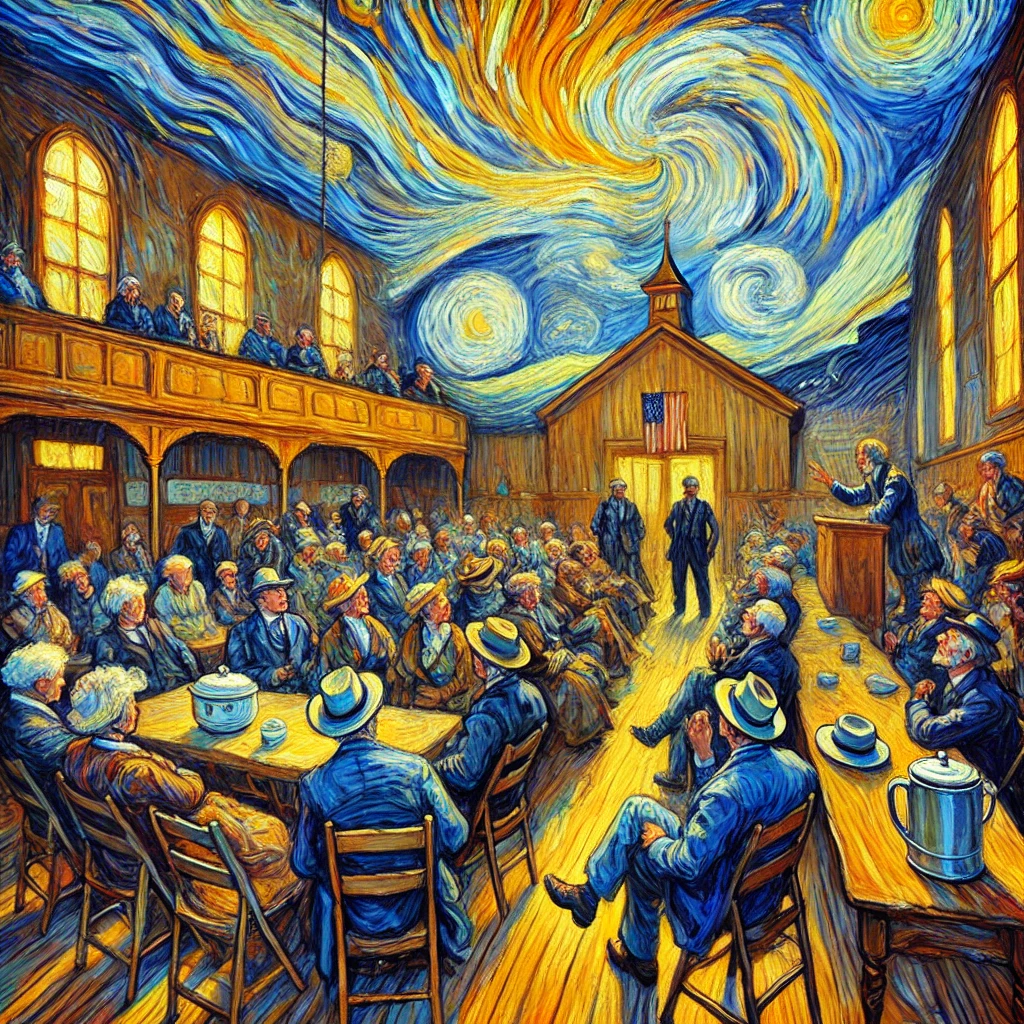
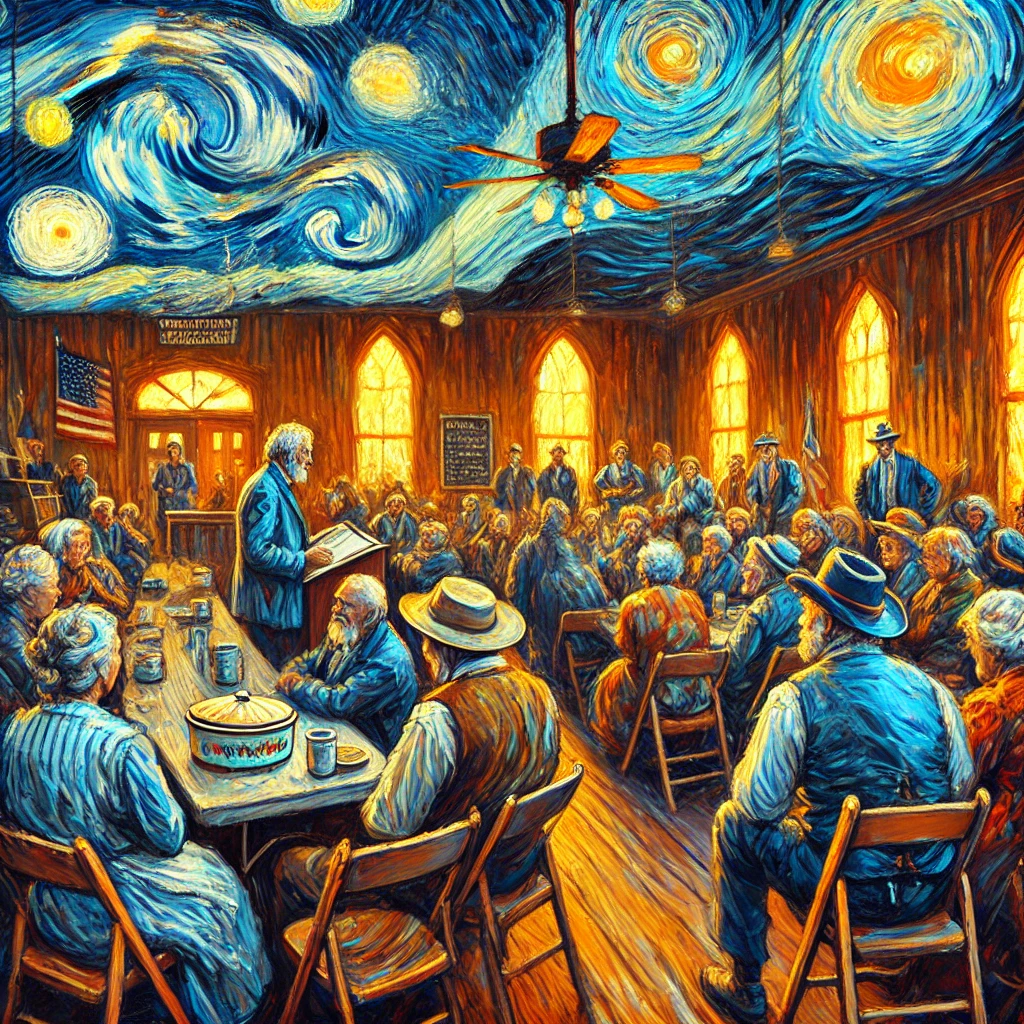
The folding chairs filled early. There were casseroles on the side table, because conflict in Sequatchie Crossing was never considered a reason to skip hospitality. Mayor Pickett stood near the front with a stack of ordinance copies and the posture of a substitute teacher who had inherited a room already emotionally committed to mutiny. Darlene sat beside him with a legal pad. Clovis sat in the second row with his notebook and three sharpened pencils aligned like scalpels. Sheriff Peeler took a position near the coffee urn in case he needed distance. Boot Barnes came despite explicit discouragement and immediately became a gravitational center for whispered commentary.
Mabel arrived without fanfare, carrying a covered dish no one had asked her to bring.
That was when the room changed.
Up until then, many had imagined her as the instigator of a moral demonstration, perhaps pleased with the stir she had caused. But she entered not like a crusader but like a woman still intending to feed people through the awkwardness.
There are gestures more powerful than speeches, and bringing deviled eggs to a meeting convened partly because of your own conscience is one of them.
Mayor Pickett cleared his throat.
“Well. We are here to discuss recent questions regarding sign enforcement and community concerns about consistency.”
“Consistency and dignity,” said someone from the back.
Mayor Pickett chose not to identify the voice.
“We are not here,” he continued, “to accuse one another.”
“Speak for yourself,” muttered Boot, softly but not softly enough.
Darlene shot him a look sharp enough to peel varnish.
The mayor went on. “Miss Dean has asked to make a statement, after which we will take comments in an orderly fashion.”
Mabel rose.
She did not hurry.
She stood with her hands clasped in front of her and looked, for a moment, not at the mayor or the sheriff but at the gathered townspeople—people she had eaten with, prayed beside, loaned cake pans to, mailed condolence cards for, and occasionally judged from a distance.
“I did not mean,” she began, “to create a burden.”
That sentence softened the room more than any apology could have. She was not sorry for what she had done. But she recognized the weight it had placed on others.
“I put a sign in my yard for the peach cobbler supper. After reading the ordinance, I believed the sign to be in violation. I could have removed it quietly. Instead, I reported it because I did not think it right to ask fairness of others while benefiting from silence myself.”
There was no dramatic flourish. That was not Mabel’s way.
“I understand some of you feel I made a private matter public. I did. But the ordinance is already public, and so is the life of a small town. I did not confess in order to stand above anyone. I confessed because I did not want to stand aside from what I expected others to bear.”
A woman in the third row dabbed one eye with a tissue, which annoyed her husband because he had hoped to remain on the legal side of things.
Mabel continued.
“If I have embarrassed anyone, that grieves me. But I would be more grieved to keep my own advantage by calling it modesty.”
She sat down.
Nobody clapped.
This was not because the room was unmoved. It was because clapping would have forced everybody to declare themselves too quickly.
Mayor Pickett shuffled his papers. “Thank you, Mabel.”
Then came the comments.
Junior Tate stood first.
“I’ll say this plain,” he began. “I don’t enjoy being morally upstaged by dessert advertising. But I also don’t enjoy laws that sit in a drawer for eleven years and then come out acting like they’ve been supervising us the whole time.”
A murmur of agreement.
“So I ask: are we discussing signs,” Junior said, “or are we discussing the town deciding, all of a sudden, to care?”
That landed.
Then the retired teacher rose. Then one of the sisters from Creek Bend. Then a young mother who had recently bought a decorative graduation sign shaped like a cap and now feared it might be categorized as civic rebellion. Then a man who spoke for seven minutes about selective enforcement, constitutional ambiguity, and the historical role of portable messaging in free communities, though nobody was certain what exactly he meant by the last part.
Boot Barnes eventually stood, because of course he did.
“Mabel,” he said, turning toward her rather than the front, “I don’t fault your conscience. But I do fault a situation where your conscience now functions like a flashlight in every yard. Some folks were content to live in peace with a little practical inconsistency. Now all at once the town’s measuring itself against your peach cobbler sign, and that’s not healthy.”
“It is not my sign you resent,” Mabel replied calmly. “It is comparison.”
This caused several people to make involuntary throat sounds.
Boot tipped his head. “That may be true, but comparison is how small towns metabolize information.”
Sheriff Peeler closed his eyes briefly as if praying for lightning.
Clovis, who had been waiting all evening for history to become quotable, raised one finger. The mayor ignored him. Clovis raised two. Darlene sighed.
“Fine,” said the mayor. “Briefly.”
Clovis stood with the solemn delight of a man entering his lane.
Act III – The Fellowship Hall Meeting
“The underlying issue,” he announced, “is that Miss Dean has unintentionally converted compliance from an administrative matter into a social referendum. Prior to her statement, enforcement could be resisted as nuisance. After her statement, resistance appears comparative and therefore characterological.”
The room stared.
One man whispered, “Did he just accuse us of having character?”
Clovis went on. “In plain language, she made it harder to be casually noncompliant without seeming spiritually lazy.”
“That is the rudest correct thing I have ever heard,” said Darlene.
And because it was correct, people grew restless.
The conversation, once about signs, now tilted openly toward that older and more volatile topic: the burden of living among witnesses.
A woman near the wall said the town had become too interested in appearing upright.
Another replied that appearing upright would be less of a concern if more people tried being upright first.
Somebody brought up scripture.
Somebody else objected to scripture being deployed in zoning-adjacent matters.
A third person said this was precisely why churches should not be put in the position of learning land-use code.
Then, unexpectedly, Miss Darlene stood.
She did not stand often, because she understood that her voice carried more force when she saved it.
“Everybody hush.”
They did.
“I have listened for three days,” she said, “to people complain that Mabel made them feel looked at. Let me help you. You were already looked at. That is what a town is. Y’all are acting like she invented public conscience. She did not. She just stopped pretending it only applies to people you don’t like.”
Silence.
Darlene rested both hands on the table.
“If you want my opinion, and apparently nobody does but you’re getting it anyway, the real offense here is not that Mabel reported her own sign. It’s that the rest of you were comfortable discussing fairness only as long as you remained hypothetical.”
No one moved.
“And another thing,” Darlene added, warming now to a point long ripening in her. “If the law is foolish, change the law. If enforcement is uneven, fix enforcement. But do not act scandalized because one woman refused to keep her own exemption hidden under a church casserole.”
Several people looked at the casserole table involuntarily, as though exemptions might indeed be under there.
Mayor Pickett, sensing that the room had crossed into genuine civic clarity—always a dangerous condition—did the only thing available to a mayor in such moments.
He proposed a committee.
Groans rose instantly.
“No,” said three people at once.
“Not a long-term committee,” he said quickly. “A temporary review group.”
“That’s a committee wearing a cardigan,” Boot said.
But the mayor persisted. There would be a review of the sign ordinance. Enforcement priorities would be reconsidered. Citizens could submit concerns. Existing violations would not be treated as moral indictments but as matters for policy clarification. Temporary community and event signs would be specifically addressed.
“And,” he added, because the room required it, “Miss Dean will not be singled out for citation tonight.”
At this, Mabel rose one more time.
“With respect,” she said, “I do not request exemption.”
The room nearly came apart.
“No!” shouted somebody, shocking themselves.
“Mabel, sit down,” Darlene said with the deep affection one reserves for impossible people.
Sheriff Peeler stepped forward. “Now hold on. Nobody’s exempting anybody. We are de-escalating.”
“But if the sign is in violation—”
“Mabel,” he said, with a weariness touched by kindness, “for once in this town, let the mercy be public too.”
That stopped her.
Not because she loved mercy more than principle, but because she understood at once the distinction he was offering. If her self-report had made compliance visible, perhaps the town needed equal visibility in refusing to weaponize that honesty.
She sat.
And all at once the room, having edged up to the cliff of collective self-examination, stepped back.
Act III – The Fellowship Hall Meeting
Act IV – After the Confession
The next day, the sign came down.
Mabel removed it herself in the morning light, not furtively, not ceremonially, just steadily, the way one takes down Christmas decorations after Epiphany. She carried it into the garage and leaned it against the wall beside two folding tables and a box labeled TABLECLOTHS – FALL COLORS.
Then she stood for a moment in the empty patch of grass where it had been.
The yard looked larger without it. Less accused. Less declarative.
But something had changed in town that would not go back as easily as stakes out of soft soil.
For several days afterward, people behaved with unusual politeness around visible rules. Some removed signs. Some left them up but with newly thoughtful expressions. One man painted NOT A SIGN across a wooden board and placed it by his tomatoes, which caused six separate arguments about whether irony counted as advertisement.
Town Hall received a flood of suggestions for revising the ordinance, including one proposal that all signs be judged according to “basic reasonableness and whether they look ugly.” Clovis objected that such language lacked archival durability. Darlene said that was exactly why it might work.
Boot Barnes came by Mabel’s place on Saturday afternoon carrying a sack of apples he had no real reason to bring except that men of his type preferred produce to apology.
She invited him onto the porch.
For a while they talked about weather, which was not weather but approach.
Finally Boot said, “You know people are still discussing it.”
“I know.”
“I was irritated with you.”
“I know that too.”
He set the apples down beside the swing. “Still am a little.”
“That seems fair.”
He looked at her then, not unkindly. “But I’ve been thinking. A person doesn’t usually get this town to show its hand unless somebody does something either scandalous or decent enough to embarrass the rest of us. And scandal wears off faster.”
Mabel folded her hands in her lap.
“I did not wish to embarrass anyone.”
“No,” said Boot. “That’s how you know it worked.”
She laughed softly.
After a moment he nodded toward the bare patch by the mailbox. “You gonna put anything else there?”
“No.”
“Not even a smaller sign?”

Act IV – After the Sign Comes Down
“Moral history suggests that would be unwise.”
They sat a while longer, and the quiet between them was better than agreement.
At church the following Sunday, the Peach Cobbler Supper was announced verbally from the front, then repeated in the bulletin, then mentioned three additional times in hall conversation by women determined that attendance should not suffer merely because land-use code had briefly entered the dessert ministry.
The supper itself drew the largest turnout in recent memory.
Some came for cobbler.
Some came because they had missed the meeting and wished to collect details firsthand.
Some came because a public disturbance wrapped in conscience always boosted attendance better than flyers ever had.
At one table, Sheriff Peeler ate with two deacons and remarked that he had measured fewer objects that week than the week before, which he regarded as progress. At another, Darlene observed that people were suddenly reading ordinances with the intensity formerly reserved for prophecy. Clovis took notes on attendance patterns and referred to the event as “post-compliance fellowship,” earning him a look from three separate directions.
Mabel moved from table to table with a serving spoon, replenishing cobbler and refusing compliments that were too pointed.
“You did a brave thing,” said one woman.
“I did a necessary thing,” Mabel answered.
“You started something,” said another.
“That remains to be seen.”
But privately she knew she had. Not reform, exactly. That would have been too grand and too clean. Sequatchie Crossing was not a place of grand reform. It was a place of incremental discomfort, awkward recognition, and people slowly adjusting to truths they would never have chosen in advance.
What she had started was smaller and stranger.
She had made it harder for the town to pretend that law, conscience, and reputation occupied separate yards.
And once seen, that could not be entirely unseen.
Weeks later, when the review group finally met to revise portions of the ordinance, the discussions were still contentious, still cluttered with suspicion, jokes, and local theory. But there was also a new habit in the room: people admitted more openly what they wanted for themselves and what they were willing to permit in others. That did not solve everything. It merely improved the quality of the argument, which in Sequatchie Crossing counted as a civic achievement.
The revised language made modest accommodations for temporary community event signs under certain dimensions and placement restrictions. It was neither elegant nor satisfying to all involved. But it was more honest than what came before.
When the final version passed, Clovis insisted on recording in the minutes that “community testimony contributed materially to policy clarification.” Darlene crossed out materially and wrote a whole lot in the margin before letting him rewrite it.
And as for Mabel’s original sign, it stayed in the garage until autumn, when she repurposed the back side for a canned food drive. This time she placed the notice on the fellowship hall bulletin board, fully compliant, slightly less visible, and impossible for anyone to misunderstand.
Still, from time to time, somebody driving past her mailbox would glance toward that patch of grass and remember the week when Mabel Dean voluntarily confessed a yard sign and made the whole town examine itself by accident.
Which, in the end, was the true scandal.
Not that she had broken the rule.
Not even that she had reported herself.
But that in doing so, she had reminded everyone of a fact most communities prefer to keep soft around the edges:
Compliance is easy when it is private.
It becomes a moral statement only when someone is willing to be seen obeying at personal cost.
And in a town like Sequatchie Crossing, being seen is always where the real trouble begins.

Act IV – After the Sign Comes Down
Epilogue – The Empty Spot
By October the grass where the sign had stood grew back thicker than before.
Mabel noticed this one afternoon while carrying in groceries. The patch was greener, somehow. More stubborn. She stood by the mailbox with a sack of onions in one arm and looked down at it as if the ground itself had rendered a verdict she was still trying to interpret.
Across the road, Mrs. Hensley lifted one hand from her porch in greeting.
Mabel waved back.
Neither woman mentioned signs.
That was another thing about Sequatchie Crossing: after the storm of talk, people often returned to silence not because nothing remained, but because too much did. The silence was not forgetting. It was storage.
Children still played in yards. Dogs still barked at UPS trucks. Boot still argued at the hardware store. Sheriff Peeler still found himself measuring things he had never imagined measuring when he first accepted the badge. Darlene still ran Town Hall by the force of disapproval properly directed. Clovis still archived everything as though posterity were a hungry and irresponsible tenant.

Epilogue – The Empty Spot
And Mabel still organized meals, folded bulletins, mailed sympathy cards, and kept a conscience too visible for everyone’s comfort.
Life resumed.
Only not quite in the same arrangement.
Because now, whenever anyone in town said, “Well, nobody’s going to make a fuss about it,” someone else would eventually answer, “That may be so. But is it right?”
And though this reply was often delivered with annoyance, sarcasm, or theatrical groaning, it had entered the bloodstream of local conversation all the same.
That was Mabel’s doing.
She never put up another yard sign.
But for a long while after, it felt as if one remained.

Epilogue – The Empty Spot
Disclaimer
The events described in this story are part of the fictional world of Sequatchie Crossing, a satirical portrait of small-town life in the Sequatchie Valley. While the setting may feel familiar and the situations may resemble real community debates, the characters, conversations, and specific incidents are works of imagination created for storytelling and humor.
Any resemblance to real individuals, businesses, town officials, or actual events is purely coincidental—or the natural result of small towns everywhere sharing the same kinds of meetings, misunderstandings, and porch-level commentary.
The purpose of the Sequatchie Crossing Dispatch series is to explore community life with a light touch: highlighting the quirks, contradictions, and occasional wisdom that emerge when neighbors care deeply about the same place.
No church supper, yard sign, or municipal ordinance was harmed in the making of this story.
If you recognize something that feels familiar, it probably means the story captured a truth about small towns—not a specific person within them.

Disclaimer – Mabel Dean Self-Reports
Real Places Behind the Ruckus – From The Dunlap Directory

Real Places Behind the Ruckus – From The Dunlap Directory
Yes, this story was fictional; even the parts that weren’t true. These places? Absolutely real. Stop by, support local, and keep the Wi-Fi away from livestock:
- U-Haul – Affordable Storage Guys
- Walker’s Dirt Work LLC
- Patron Mexican Grill
- Campbell Tire
- Bryant Self Storage
- Hampton Inn Chattanooga-North/Ooltewah
- Sequatchie County Rescue Squad
- Little Caesars
- South Cumberland State Park
- Stone Creek Farm
- Dolce In Dunlap
- Standifer Orthodontics
- Lookout Mountain Incline Railway
- O’Reilly Auto Parts
- Buy, and Sale in Crossville, Pikeville, Dunlap, Cookeville TN
- AMC Northgate 14

Real Places Behind the Ruckus – From The Dunlap Directory
At Sequatchie Crossing, we tell the stories of Sequatchie Crossing.
Please share this post with your friends, family, or business associates who may want help telling the stories of their legacy.



0 Comments