


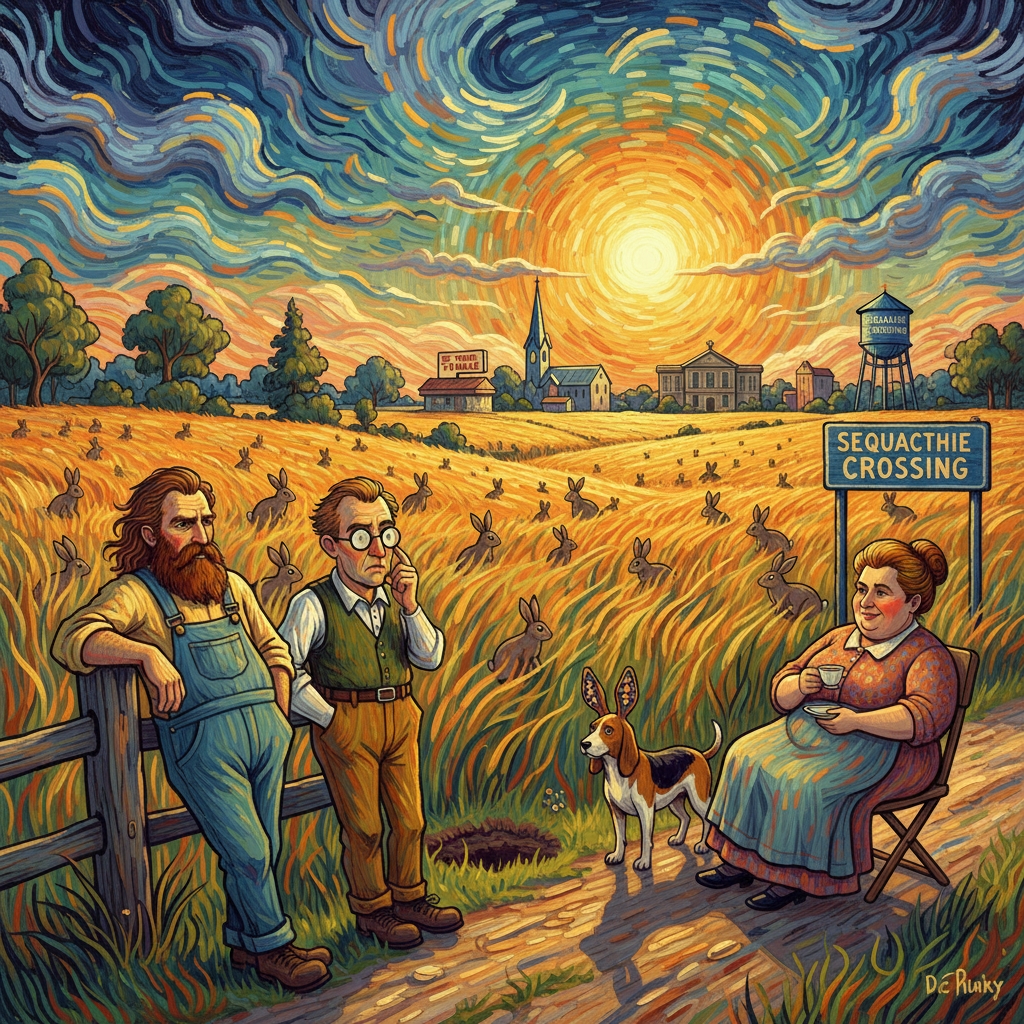
One Empty Parcel Held a Hundred Futures
By Tom Seest
At Sequatchie Crossing, we tell the stories of Sequatchie Crossing.
Please share this post with your friends, family, or business associates who may want follow the news from Sequatchie Crossing.
🎤 Audio Overview
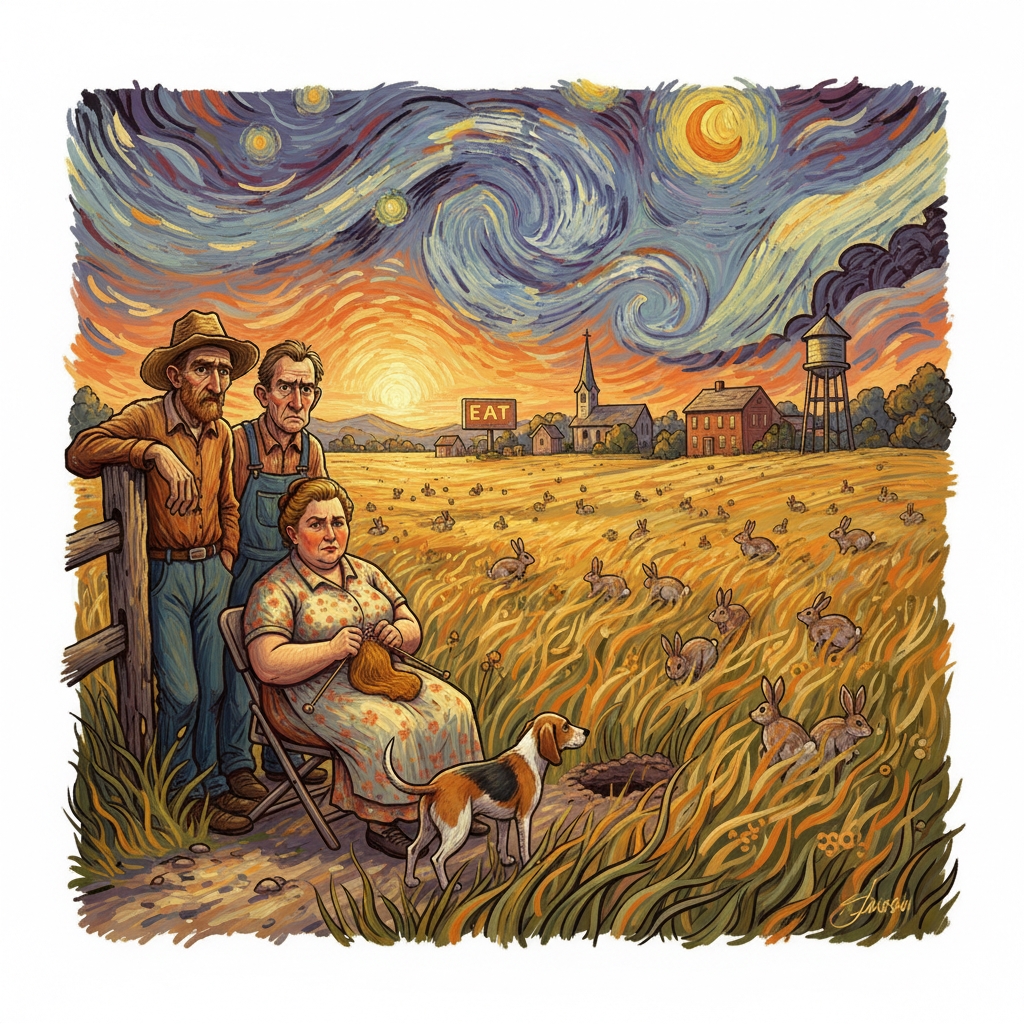
The Field That Could Have Been Anything
Act I – The Fence Post Meeting
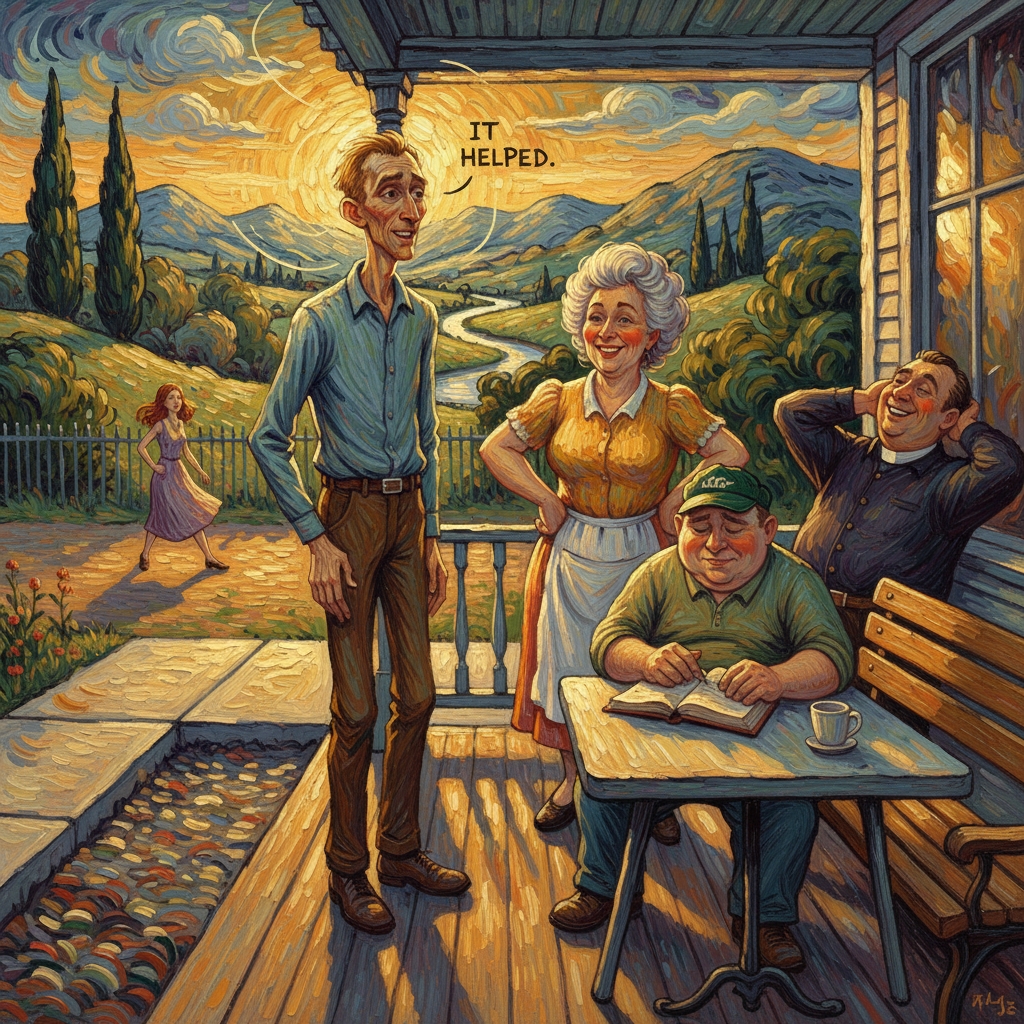
The argument began, as many important Sequatchie Crossing arguments did, beside something nobody had paid much attention to for years.
The field sat just beyond town, bordered by an aging fence, three crooked cedar trees, and a drainage ditch that had achieved local landmark status despite having no official name.
Eugene “Boot” Barnes stood with one hand resting on a weathered fence post.
“Back in ’79,” Boot announced, “that field nearly became a roller rink.”
Clovis Strickland squinted.
“You say that about every piece of property in this county.”
“Because every piece of property in this county nearly became a roller rink.”
“That doesn’t seem statistically possible.”
“It was a different time.”
Daisy the hound sniffed at a rabbit hole and sneezed.
Across the field, dozens of rabbits moved through the tall grass.
The colony had expanded considerably over the previous year.
Nobody knew exactly how many rabbits existed.
Several people had attempted counts.
Every estimate differed wildly.
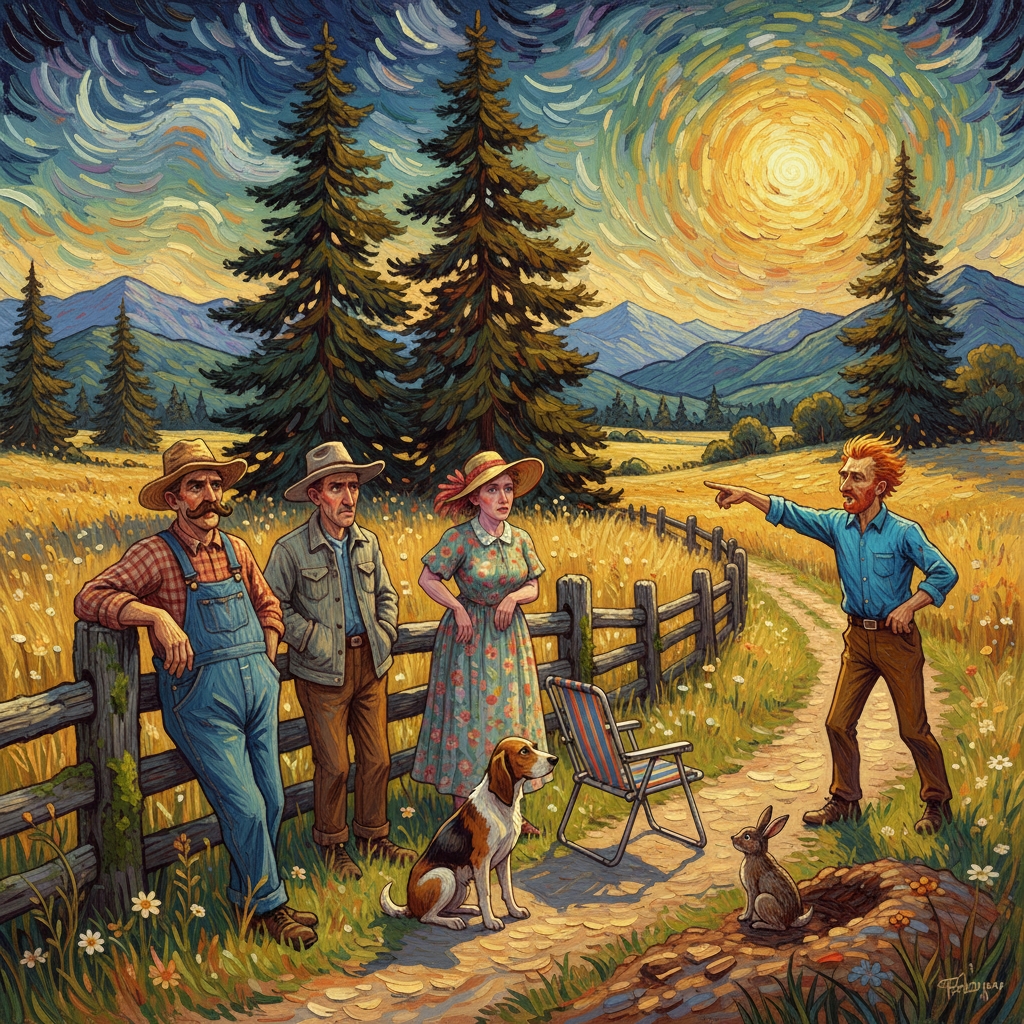
Mabel Dean Ashcroft arrived carrying a folding chair.
“You know what I heard?” she said.
“That depends,” said Clovis. “How frightened should I be?”
“They might develop it.”
Act I – The Fence Post Meeting
Boot nodded slowly.
“There it is.”
“The rumor?”
“No,” Boot said. “The annual tradition of somebody deciding an empty field is about to become something.”
Mabel pointed toward the property.
“It’s good farmland.”
“It hasn’t been farmed in fifteen years.”
“That’s not the point.”
“What is the point?”
“The point is it could be farmed.”
“That’s true,” Boot admitted.
A pickup truck pulled beside the road.
RT Mullins stepped out.
“Everybody talking about the field?”
“We’re talking about what it might become,” said Mabel.
RT grinned.
“My favorite kind of conversation.”
“Because you’re a realtor.”
“Because possibility is more interesting than certainty.”
Clovis looked over the field.
“What are the possibilities?”
RT spread his arms.
“Subdivision.”
Mabel groaned.
“Industrial site.”
Clovis frowned.
“Solar farm.”
Boot scratched his chin.
“Data center.”
Everyone looked at him.
“What?” RT said. “People talk.”
“A grocery store?”
“A campground?”
“A warehouse?”
“A wedding venue?”
“A giant statue of a cat?”
“That escalated quickly,” said Clovis.
RT shrugged.
“My point is that land can become almost anything.”
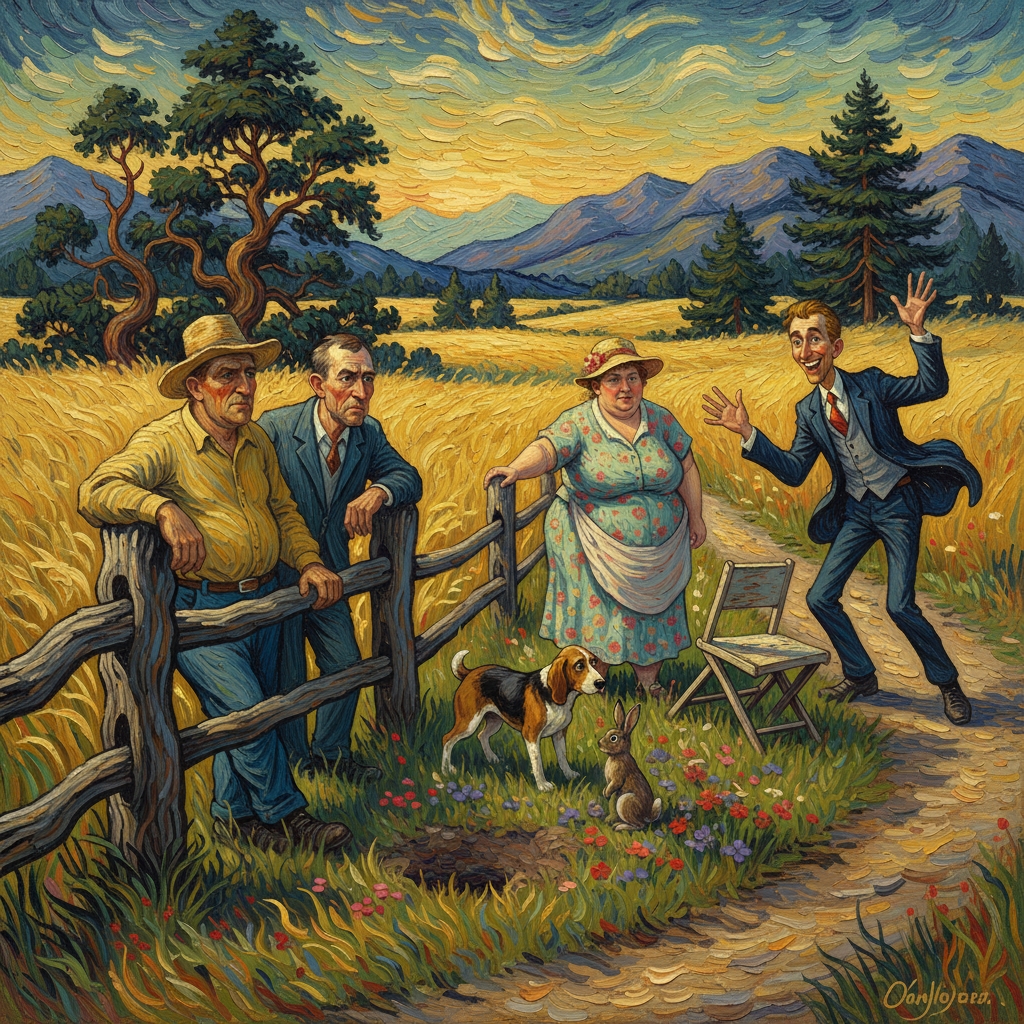
A rabbit emerged from the grass and sat perfectly still.
Daisy stared at it.
The rabbit stared back.
Neither moved.
“Looks like they’ve got opinions too,” Boot said.
The rabbit remained motionless.
“Strong opinions,” Clovis agreed.
Act I – The Fence Post Meeting
Act II – Breakfast At Maggie Sue’s Diner
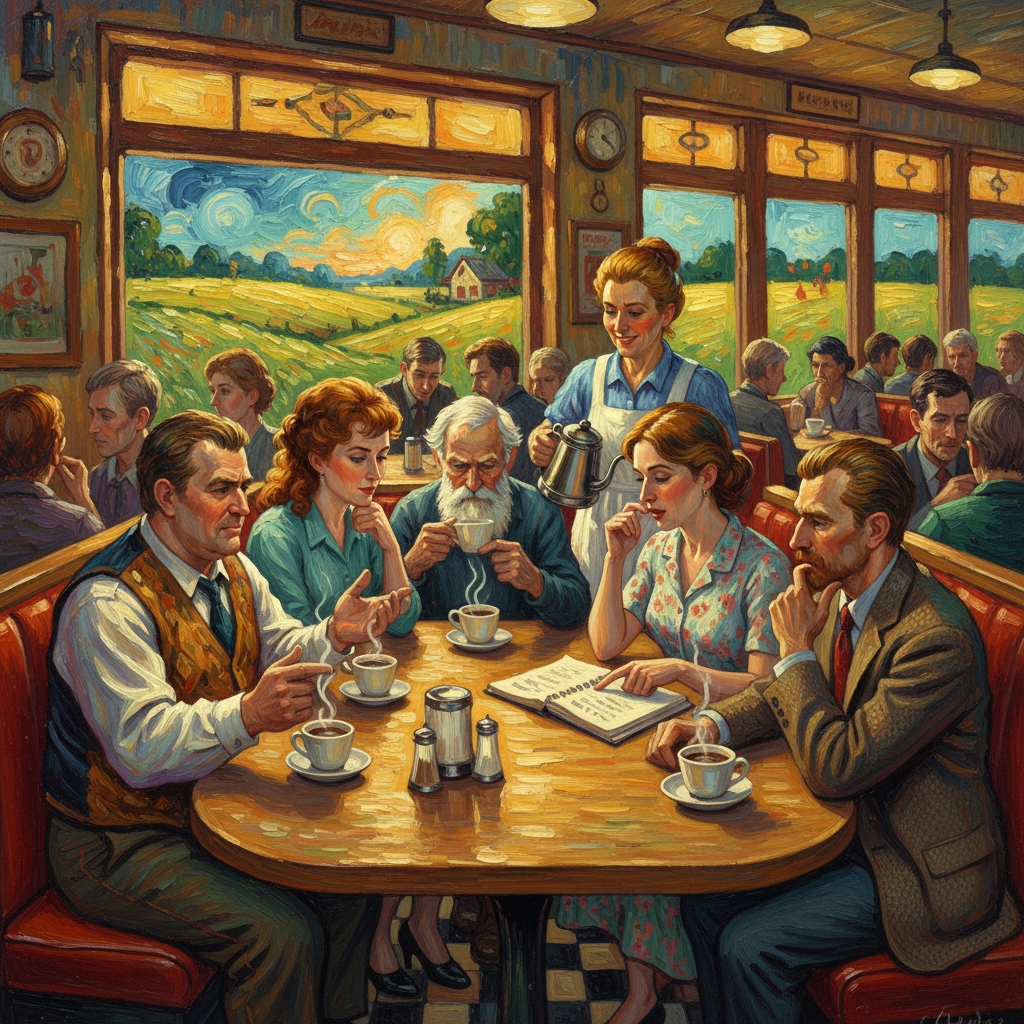
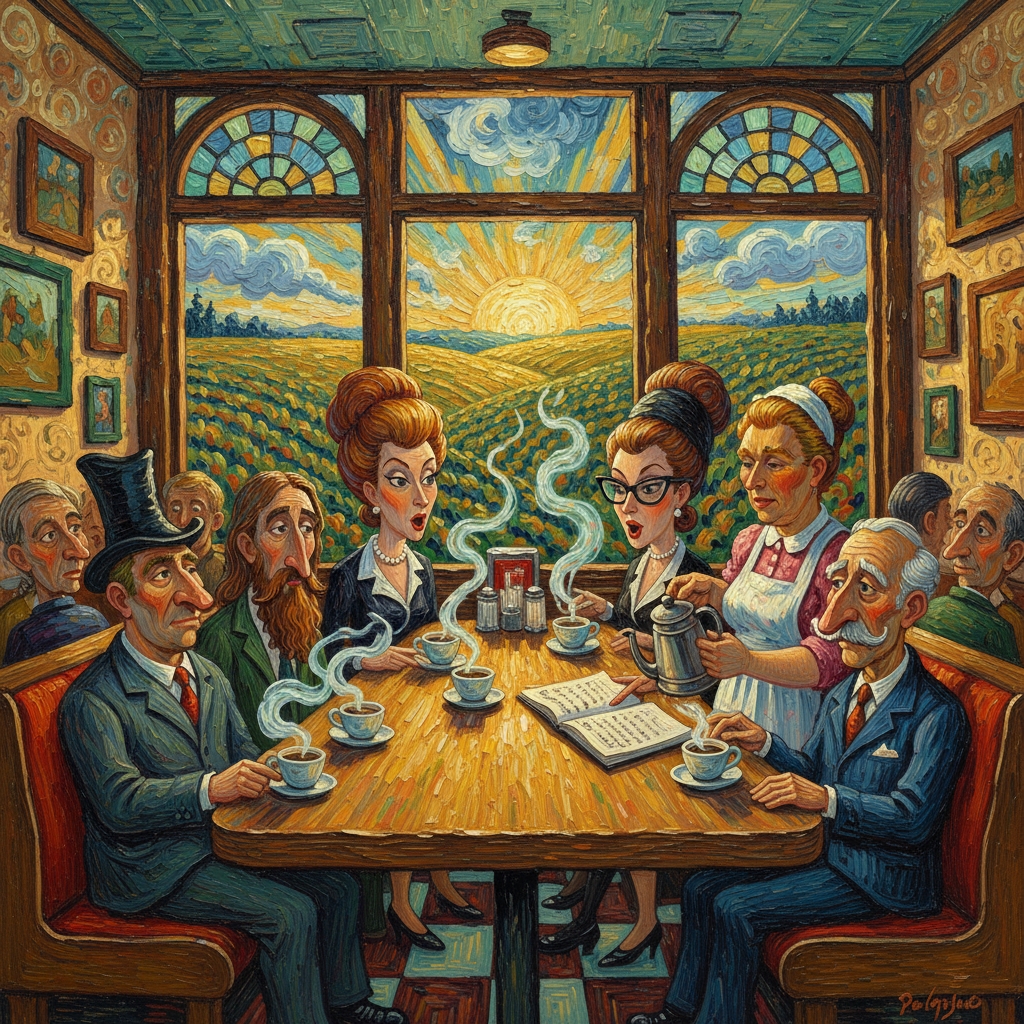
The following morning, Maggie Sue Dillard’s diner contained more theories per square foot than any building in Tennessee.
Coffee cups rattled.
Forks clinked.
Opinions multiplied.
At the corner table sat Mabel, Boot, Clovis, Tiffany Annette Roark, Evelyn Grace Tipton, and Dr. Neil Cowgill.
Maggie Sue topped off coffee.
“You all discussing the field again?”
“We’re discussing civilization,” Mabel replied.
“That sounds expensive.”
Tiffany pulled out her notebook.
“I’ve been collecting comments.”
“That’s dangerous,” said Clovis.
“Listen to these.”
She read aloud.
“Keep it farmland forever.”
Reasonable nods followed.
“Build houses.”
Act II – Breakfast At Maggie Sue’s Diner
Mixed reactions.
“Build businesses.”
More mixed reactions.
“Build nothing.”
Silence.
“Build a drive-through alpaca museum.”
Boot nearly inhaled coffee.
“Somebody actually wrote that?”
“They were very passionate.”
Dr. Cowgill leaned forward.
“The interesting question isn’t what should happen.”
“It isn’t?” asked Evelyn.
“No.”
“What is?”
“Why everyone believes their preferred future is the obvious one.”
The table went quiet.
“That’s annoyingly professor-like,” said Clovis.
“Thank you.”
Dr. Cowgill pointed toward the window.
“Imagine five people standing in that field.”
Everyone looked outside.
“One sees food production.”
Mabel nodded.
“One sees jobs.”
RT waved from another table.
“One sees tax revenue.”
“Lurleen,” said Boot.
“One sees nature.”
“Shelley Fawn,” said Tiffany.
“One sees investment.”
“RT again,” Clovis said.
Dr. Cowgill smiled.
“The field hasn’t changed.”
“No.”
“Only the stories attached to it.”
Maggie Sue folded her arms.
“Seems like everybody wants the field to solve a different problem.”
The table became quiet again.
“That,” Dr. Cowgill said, “is exactly the issue.”
Act II – Breakfast At Maggie Sue’s Diner
Act III – Town Hall And The Map
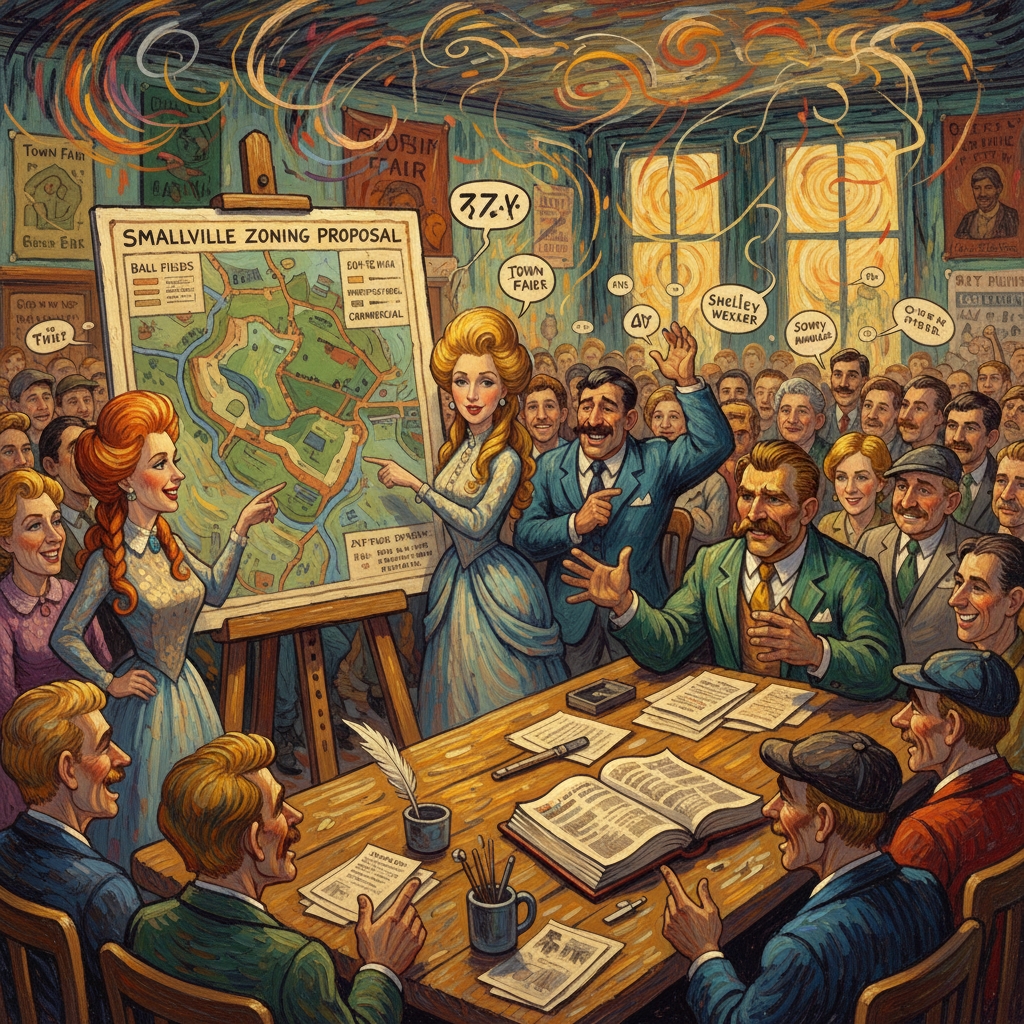
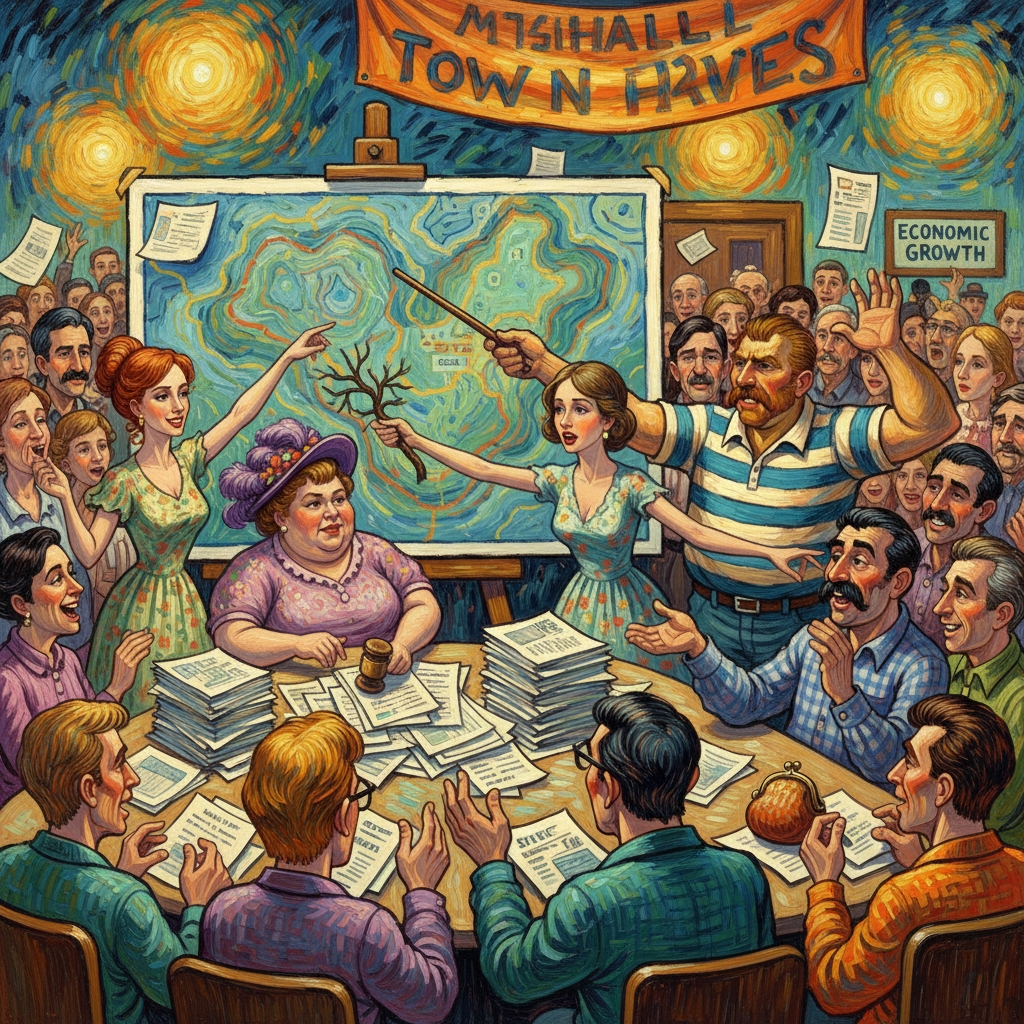
Town Hall filled beyond normal capacity.
Lurleen Davenport stood beside a large zoning map.
She looked tired already.
“This is an informational meeting.”
Nobody believed her.
Mayor Bea Crowe sat at the front table.
“Tonight,” she said, “we’re discussing possible futures for the parcel.”
“Which future?” someone shouted.
“All of them.”
Groans erupted.
“That sounds like government.”
“It is government,” Lurleen replied.
The crowd settled.
Boot, Clovis, Mabel, Tiffany, Dr. Cowgill, RT, Sonny Morales, Coach Freddie Stubblefield, Brett and Alyssa Crenshaw, Chester Ray Blevins, Shelley Fawn Wexler, Pastor Arnold Peeler, Sheriff Peeler, Officer Kenny Joe Teeter, Mister Wade Langston, and Evelyn Grace Tipton all occupied various seats.
Lurleen pointed to the map.
“The property is approximately one hundred acres.”
Coach Freddie stood immediately.
Act III – Town Hall And The Map
“Ball fields.”
“No,” said Mabel.
“Yes.”
“No.”
“Kids need space.”
“Farmers need space.”
“Kids become farmers.”
“Not if they’re playing baseball all day.”
The room erupted.
Mayor Crowe sighed.
“Please.”
Shelley raised her hand.
“What if it became a nature preserve?”
“Tax revenue?” asked RT.
“Peace has value.”
“So do payrolls.”
“Not everything should be monetized.”
“Everything eventually gets monetized.”
“Sadly true,” Boot muttered.
Sonny stood.
“What about a community market?”
“That’s actually interesting,” said Tiffany.
“Local produce. Local vendors.”
“Reasonable,” said Sheriff Peeler.
Clovis looked suspicious.
“I don’t trust how reasonable that sounds.”
Mister Wade Langston cleared his throat.
“Land should produce something.”
“Such as?”
“Depends on the era.”
Everyone looked toward him.
“A hundred years ago, food.”
Nods.
“Fifty years ago, factories.”
More nods.
“Today?”
Nobody answered.
“That’s the question,” Wade said.
The room fell thoughtful.
For nearly ten seconds.
Then Coach Freddie yelled, “BALL FIELDS.”
And the meeting resumed its normal pace.
Act III – Town Hall And The Map
Act IV – The Rabbit Colony
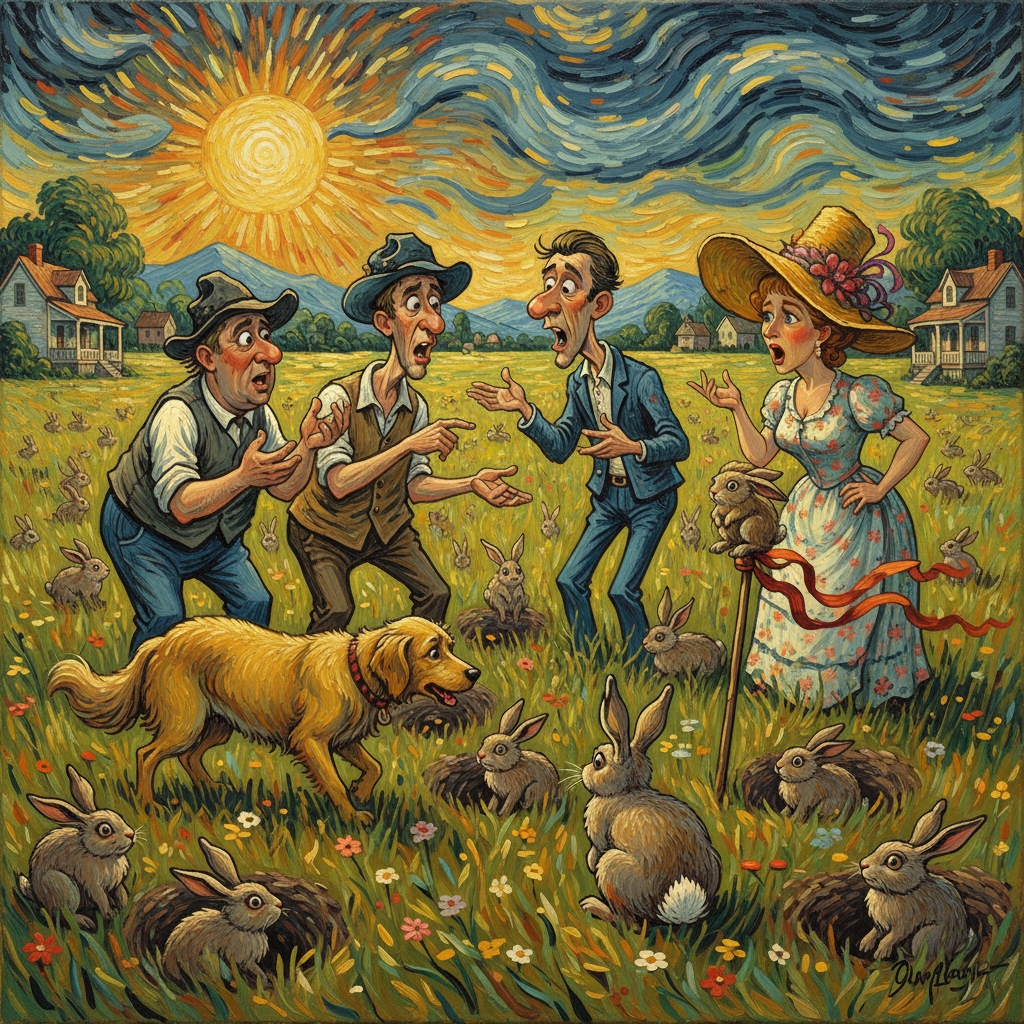
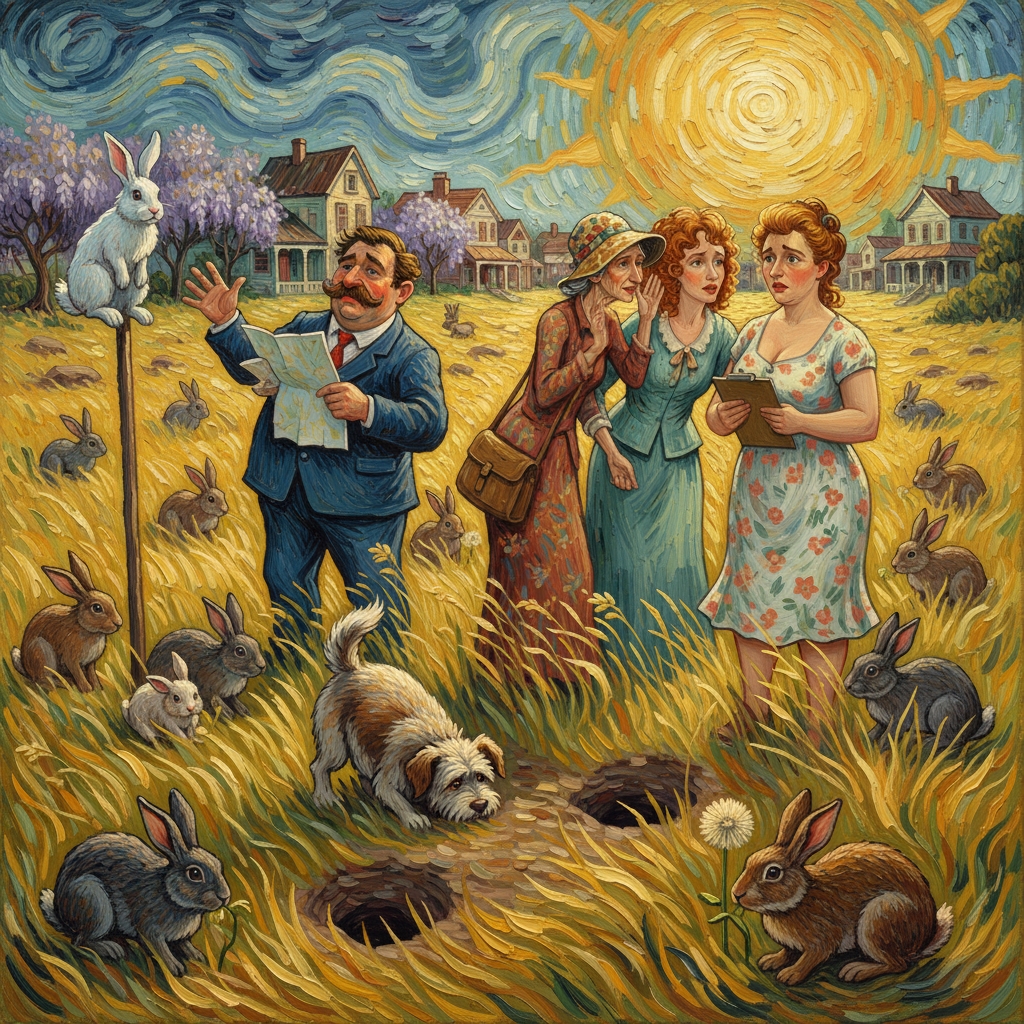
Three days later, Daisy led Boot and Clovis into the field.
The rabbits had become unexpectedly relevant.
Someone had discovered nearly two dozen active burrow systems.
Tiffany arrived carrying a camera.
“Why are we surveying rabbits?”
“Because apparently they live here,” said Clovis.
“Groundbreaking discovery.”
“No,” Boot said. “The discovery is how many.”
The grass moved.
Rabbits appeared everywhere.
Small rabbits.
Large rabbits.
Confident rabbits.
Nervous rabbits.
A rabbit that appeared unusually judgmental.
“Good grief,” Tiffany whispered.
Shelley Fawn arrived carrying binoculars.
Act IV – The Rabbit Colony
“They’re thriving.”
“They certainly are.”
“Nature chose a use.”
Clovis sighed.
“Please don’t turn rabbits into a zoning argument.”
“I’m not.”
“You are.”
“I absolutely am.”
The rabbits continued hopping.
Boot watched them.
“Interesting.”
“What?”
“Nobody asked them.”
“That’s because they’re rabbits.”
“Still.”
Tiffany laughed.
“The rabbits think they already own the place.”
A large rabbit emerged from a burrow.
Several others followed.
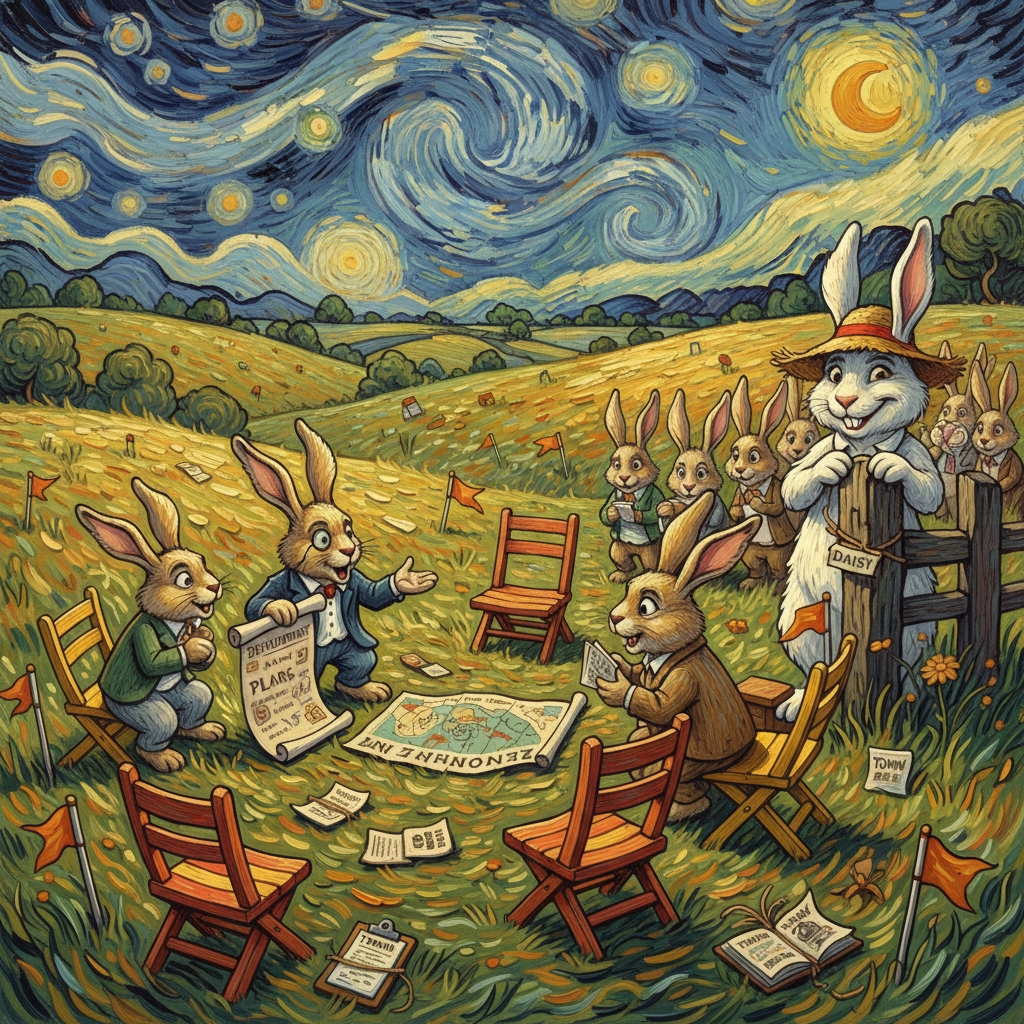
They crossed directly through a survey marker.
Nobody missed the symbolism.
“Look at that,” said Clovis.
“What?”
“Rabbits don’t care about our plans.”
“Nope.”
“They’re using the land already.”
“Yep.”
A rabbit stood upright.
Daisy barked.
The rabbit ignored her completely.
“That rabbit has confidence,” said Boot.
“That rabbit has lawyers,” Clovis replied.
Act IV – The Rabbit Colony
Act V – The Church Discussion
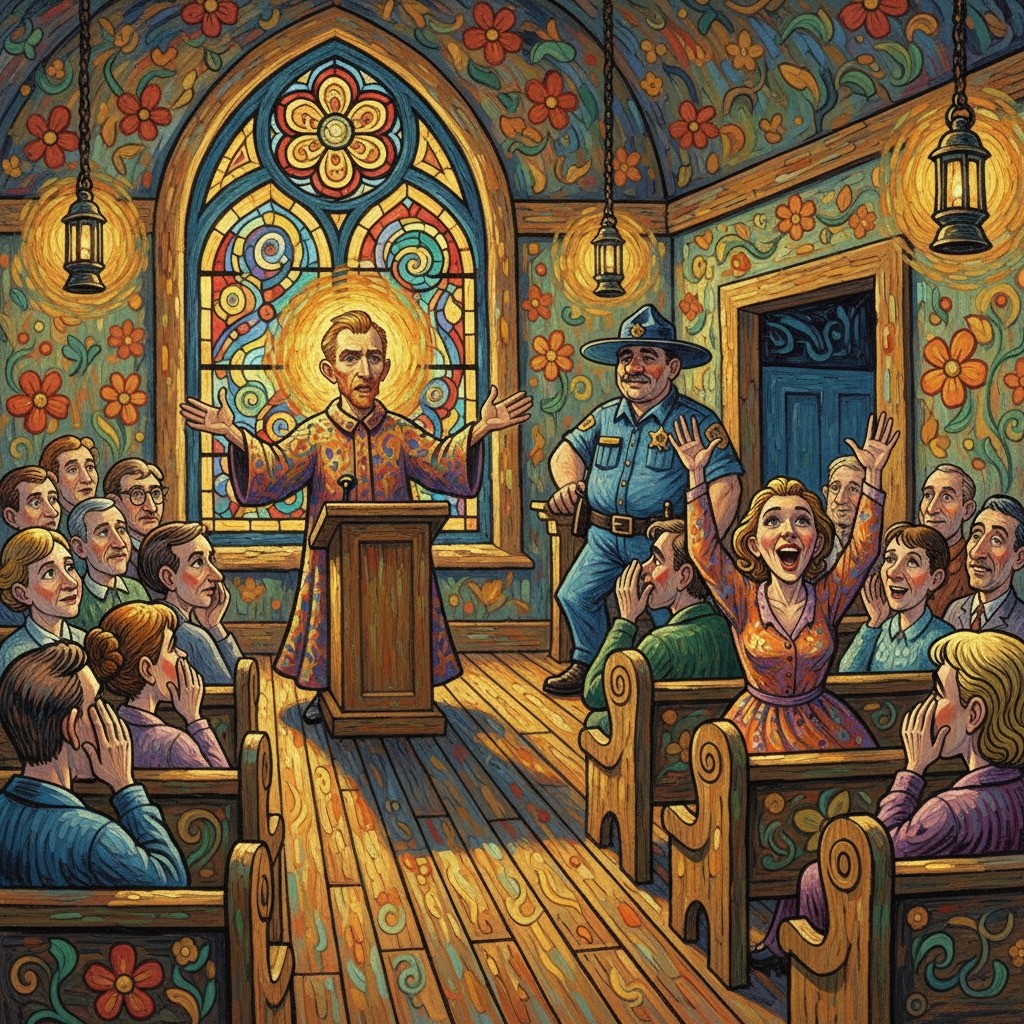
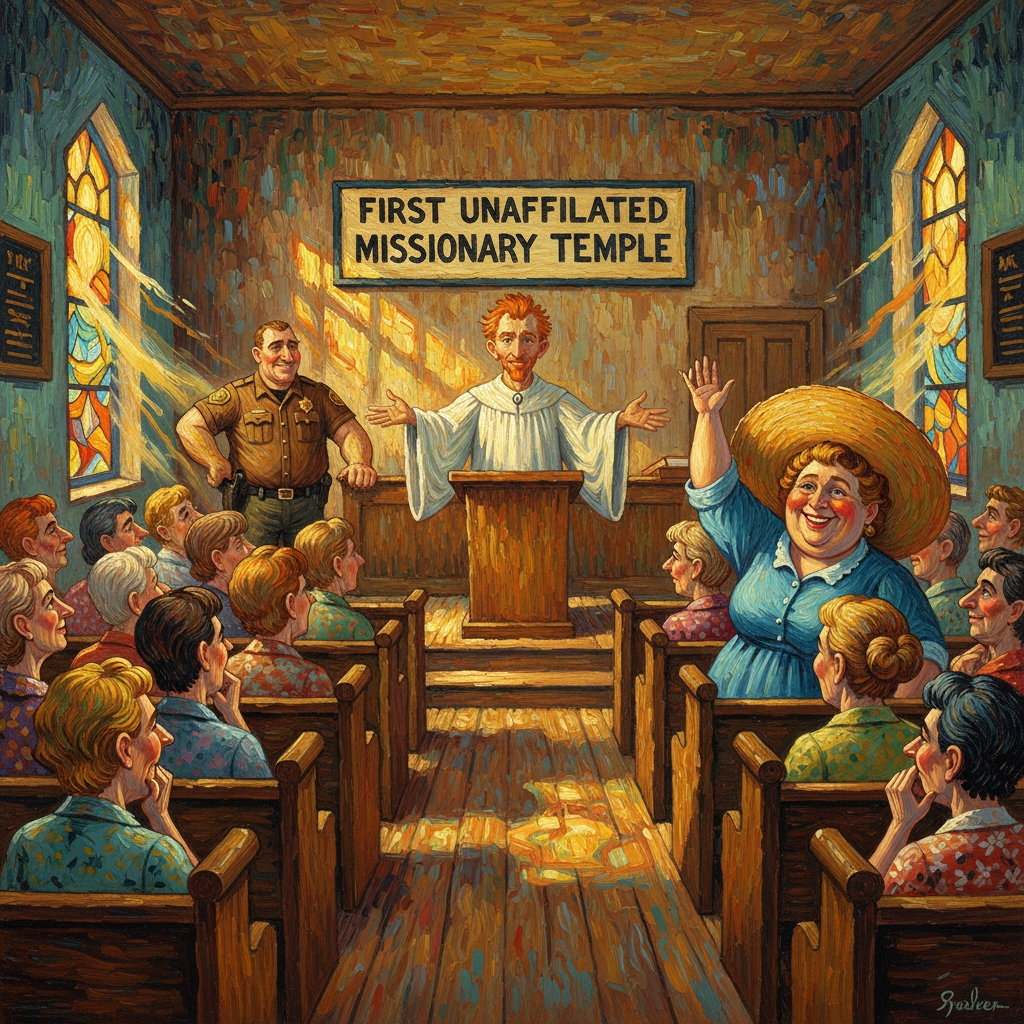
Pastor Arnold Peeler hosted a community discussion at First Unaffiliated Missionary Temple.
Attendance exceeded expectations.
Several attendees seemed surprised to discover they had entered a philosophical debate disguised as a property conversation.
Pastor Peeler stood at the front.
“Folks, land has always caused arguments.”
“Amen,” shouted Sister Lila Mae Pruitt.
“People fight over who owns it.”
“Amen.”
“They fight over how to use it.”
“Amen.”
“They fight over what it ought to become.”
“Amen.”
“They even fight over land they don’t own.”
A louder amen followed.
Pastor Peeler smiled.
“Funny thing is, every generation thinks it finally knows the correct answer.”
The congregation laughed.
“And does it?”
“No.”
Act V – The Church Discussion
More laughter.
Sister Lila Mae stood.
“The Lord gave us minds.”
“He did.”
“And different people use them differently.”
“Also true.”
She pointed toward the crowd.
“One person sees stewardship.”
“Yes.”
“One sees opportunity.”
“Yes.”
“One sees preservation.”
“Yes.”
“One sees prosperity.”
“Yes.”
“And all of them think they’re the only one paying attention.”
The church erupted in laughter.
Pastor Peeler nodded.
“That may be the most accurate thing spoken all week.”
Sheriff Peeler leaned against the back wall.
“People keep asking me what should happen.”
“What do you tell them?”
“The sheriff’s office doesn’t issue futures.”
The crowd laughed.
“We investigate facts.”
“And?”
“The fact is nobody knows the future.”
Silence settled.
That fact seemed strangely difficult for everyone.
Act V – The Church Discussion
Act VI – The Sheriff’s Office
Rumors reached critical mass by Friday.
The sheriff’s office became unofficial headquarters for rumor management.
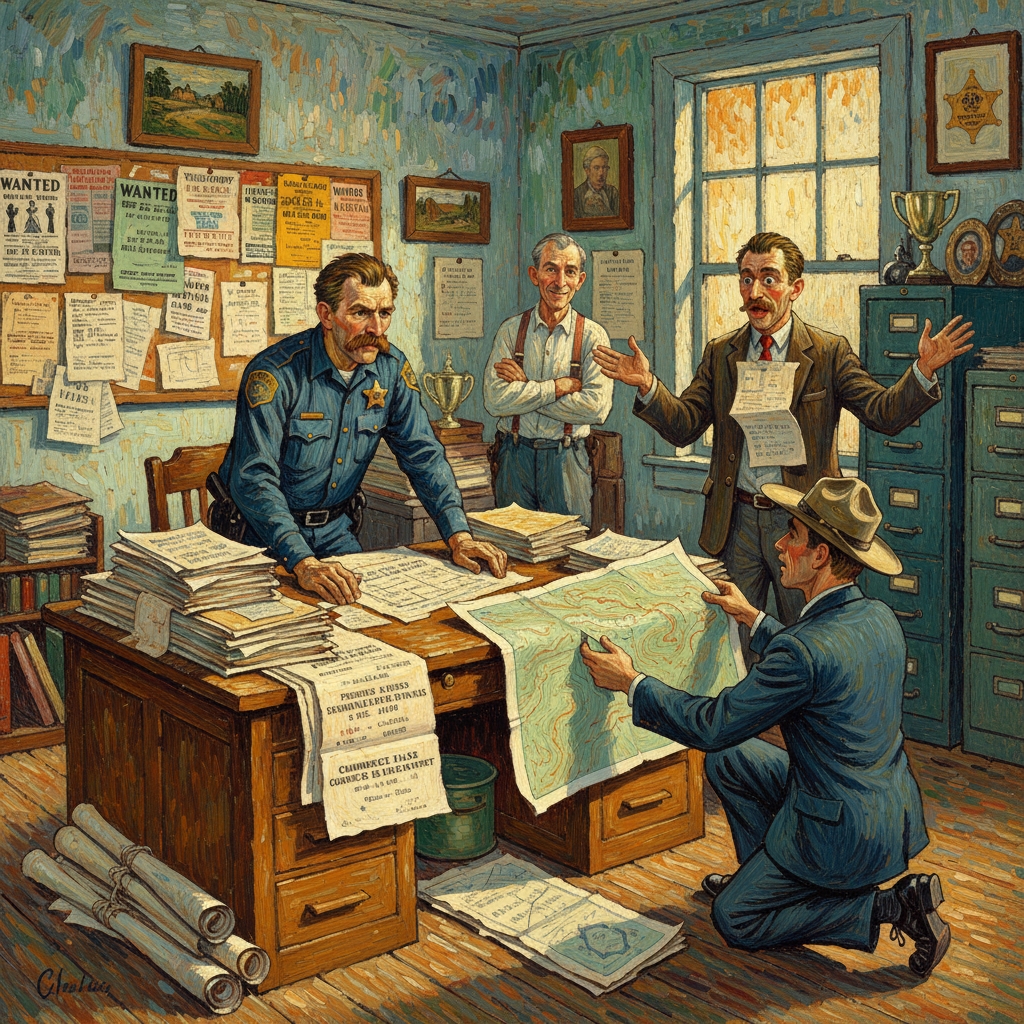
Officer Kenny Joe Teeter sat behind a desk.
“I have heard seven versions today.”
Sheriff Peeler nodded.
“I’m up to eleven.”
“What’s your favorite?”
“The underground airport.”
Kenny laughed.
“My favorite is the robotic strawberry factory.”
“That’s strong.”
Clovis entered carrying papers.
“I have evidence.”
“No,” Sheriff Peeler said immediately.
“You haven’t seen it.”
“No.”
“It’s maps.”
“Still no.”
Act VI – The Sheriff’s Office
Boot followed.
“We’re trying to help.”
“That sentence rarely ends well.”
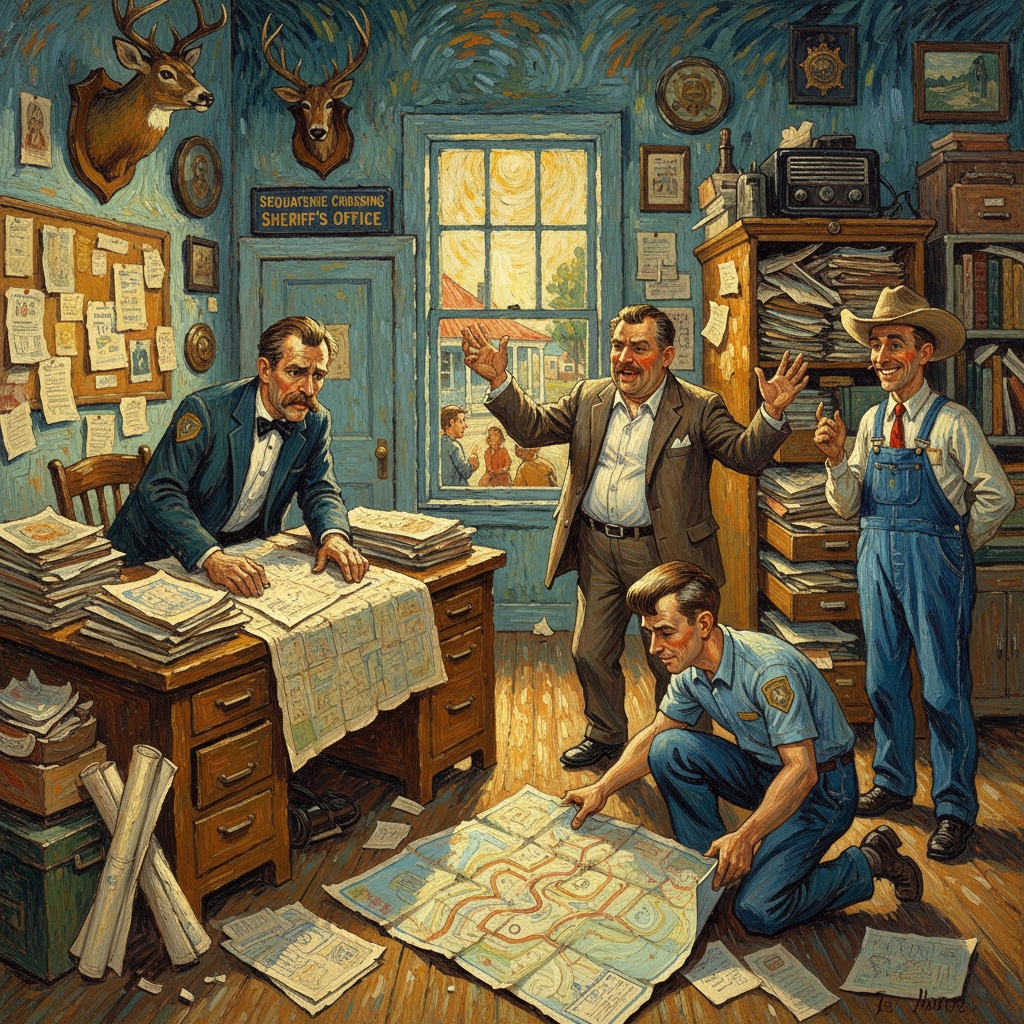
Clovis spread papers across a table.
“The field could become anything.”
“We know.”
“No. I mean literally anything.”
Sheriff Peeler stared.
“That’s not reassuring.”
Kenny studied the papers.
“These are old development proposals.”
“Exactly.”
“How many?”
“Thirty-two.”
“Thirty-two?”
“Over twenty years.”
Boot laughed.
“Everybody keeps acting like this debate is new.”
“It isn’t.”
Sheriff Peeler looked through the stack.
Golf course.
Warehouse.
Apartments.
Festival grounds.
Horse park.
Solar project.
Business park.
Farm cooperative.
Retirement village.
Data center.
“Interesting,” he said.
“What?”
“The field has spent twenty years being almost everything.”
Nobody spoke.
“That’s oddly profound,” Kenny admitted.
“Thank you.”
Act VI – The Sheriff’s Office
Act VII – The Porch Summit
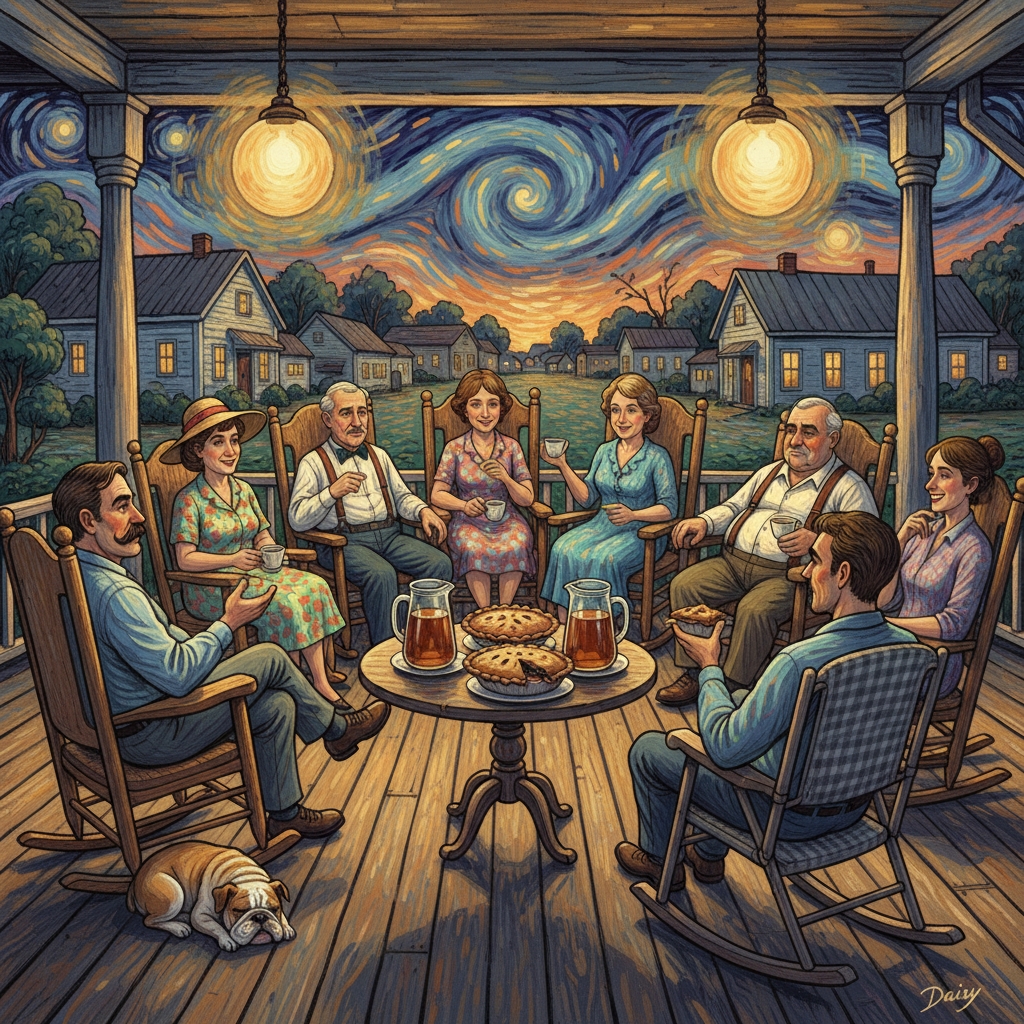
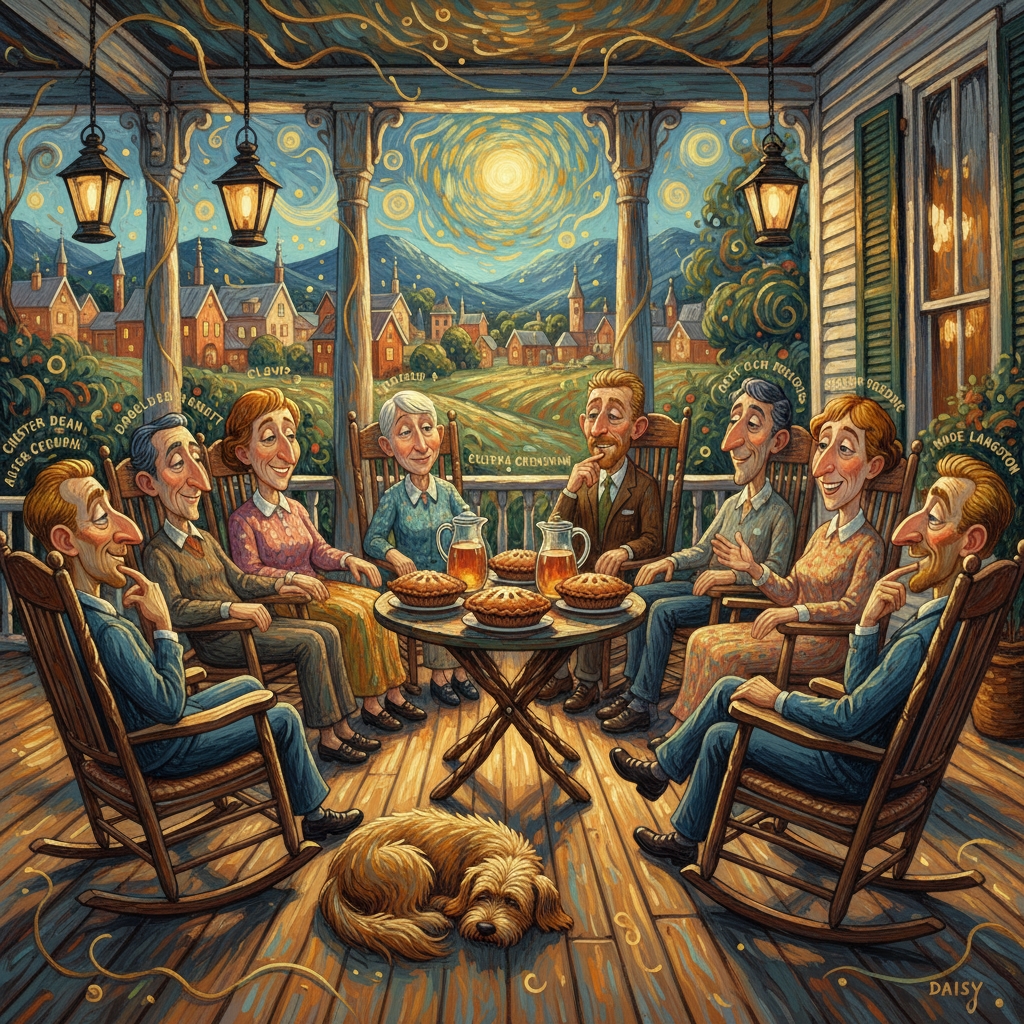
Mabel’s porch hosted the most productive conversation of the entire controversy.
Which was ironic because it had no agenda, no microphone, and no public comment period.
Everyone simply showed up.
Mabel.
Boot.
Clovis.
Shelley.
RT.
Tiffany.
Wade.
Evelyn.
Dr. Cowgill.
Sonny.
Coach Freddie.
Brett and Alyssa.
Chester Ray.
Several folding chairs.
One pie.
Act VII – The Porch Summit
Two pitchers of sweet tea.
Daisy slept beneath a rocker.
The discussion drifted.
“What’s highest and best use?” asked Tiffany.
RT answered first.
“Whatever creates the most value.”
Shelley shook her head.
“Value to whom?”
“People.”
“Which people?”
RT paused.
“That’s fair.”
Wade spoke next.
“Every definition excludes someone.”
The group considered that.
Coach Freddie pointed toward the field.
“Ball fields still make sense.”
Everyone ignored him.
Dr. Cowgill smiled.
“Notice something.”
“What?”
“Everybody uses the phrase ‘best use.’”
“Yes.”
“But nobody defines ‘best’ the same way.”
Silence followed.
“That’s irritatingly correct,” said Clovis.
Alyssa Crenshaw spoke.
“What if there isn’t one best answer?”
“Explain.”
“What if land has different values simultaneously?”
Brett nodded.
“Economic.”
“Environmental.”
“Social.”
“Historical.”
“Future potential.”
Mabel leaned back.
“So the argument never ends.”
“Probably not.”
“Wonderful.”
Chester Ray finally spoke.
“Print shops.”
Everyone stared.
“What?”
“You’ve been quiet for two hours.”
“I was thinking.”
“About?”
“The field could become a print shop.”
“No.”
“Fine.”
He shrugged.
“But somebody had to say it.”
Act VII – The Porch Summit
Act VIII – The Unexpected Demonstration
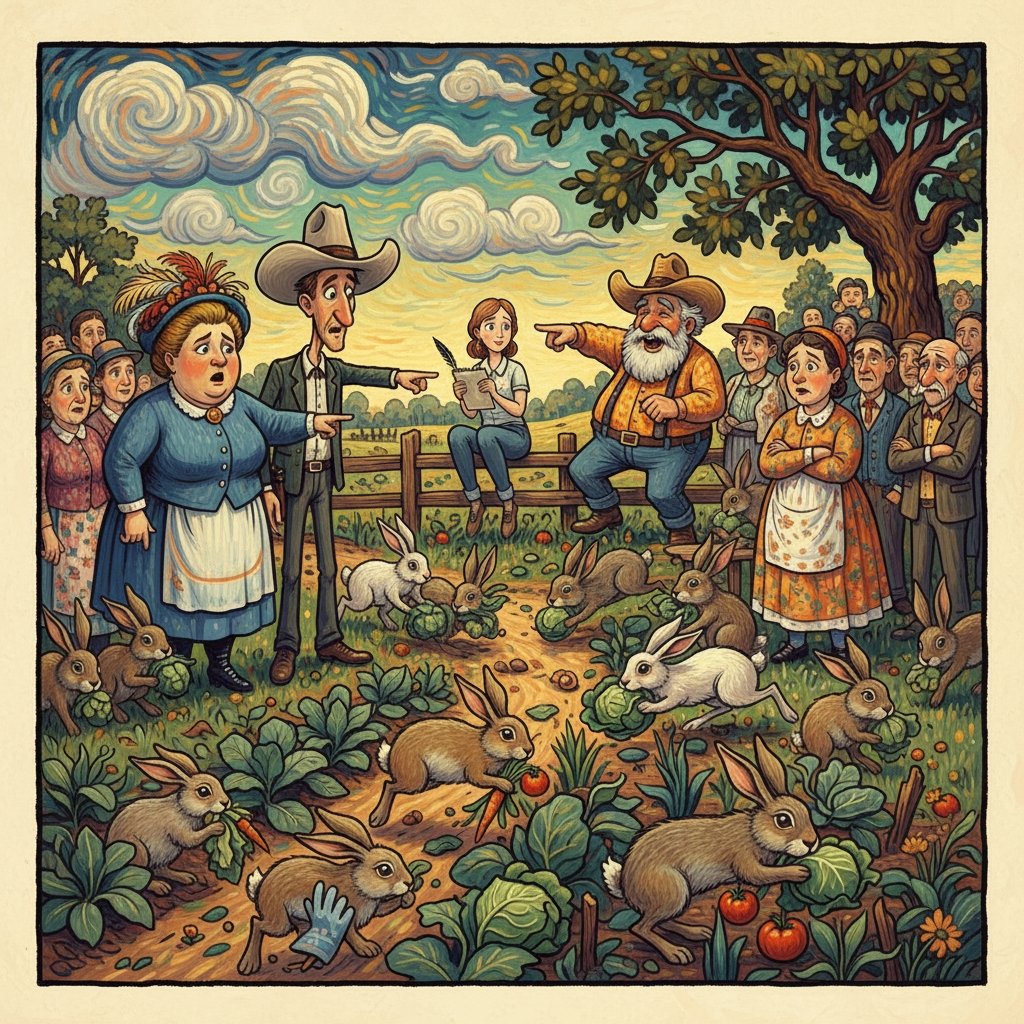
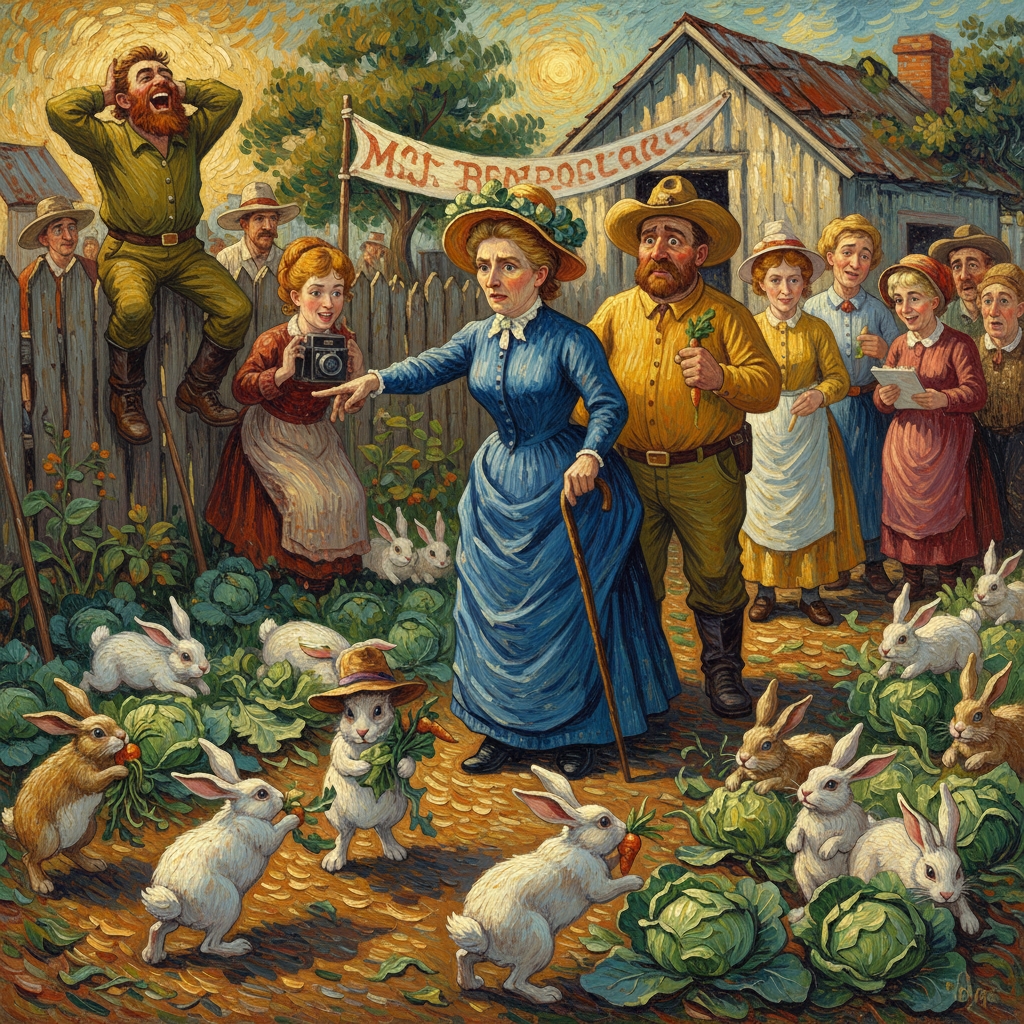
The following week, the rabbit colony staged what many later described as an unauthorized public demonstration.
Nobody knew exactly how it happened.
A section of fencing collapsed.
Several dozen rabbits crossed into a neighboring garden.
The garden happened to belong to three people who disagreed about the future of the field.
By morning, vegetables had vanished.
Mayor Crowe arrived.
“So let me understand.”
“Yes,” said Sheriff Peeler.
“The rabbits crossed property lines.”
“Yes.”
“They ignored boundaries.”
“Yes.”
“They consumed resources.”
“Yes.”
“And now everyone is upset.”
Act VIII – The Unexpected Demonstration
“Yes.”
Mayor Crowe stared.
“That’s remarkably similar to every planning meeting.”
The sheriff laughed.
Nearby, Boot nearly fell off a fence laughing.
Clovis pointed.
“The rabbits have united the town.”
“How?”
“Everybody’s mad at them.”
For the first time in weeks, opponents stood together.
Farm supporters.
Development supporters.
Environmental advocates.
Business advocates.
Everyone agreed on one thing.
The rabbits were entirely out of control.
“Look at that,” said Tiffany.
“What?”
“Common ground.”
A rabbit emerged from a cabbage patch.
Chewed thoughtfully.
Then disappeared.
“Diplomacy has failed,” said Mabel.
Act VIII – The Unexpected Demonstration
Act IX – The Decision That Wasn’t
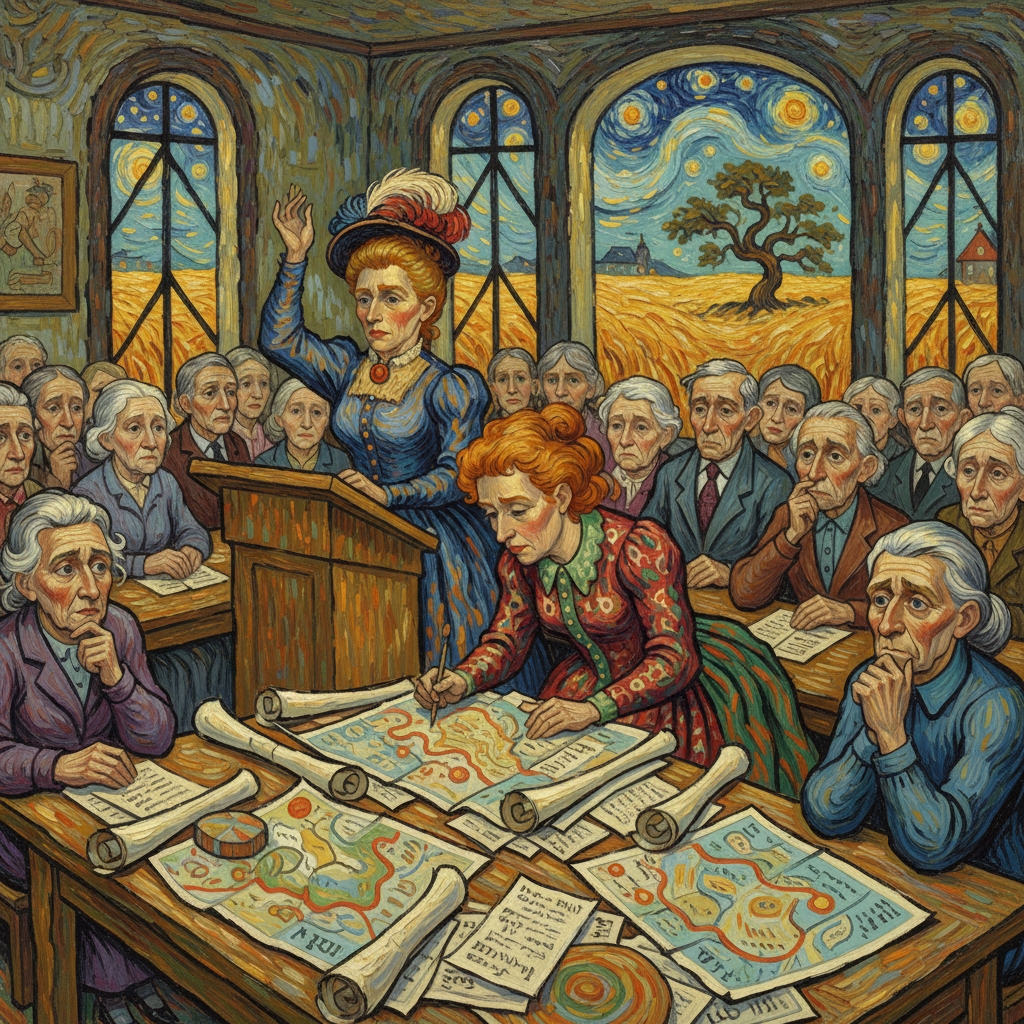
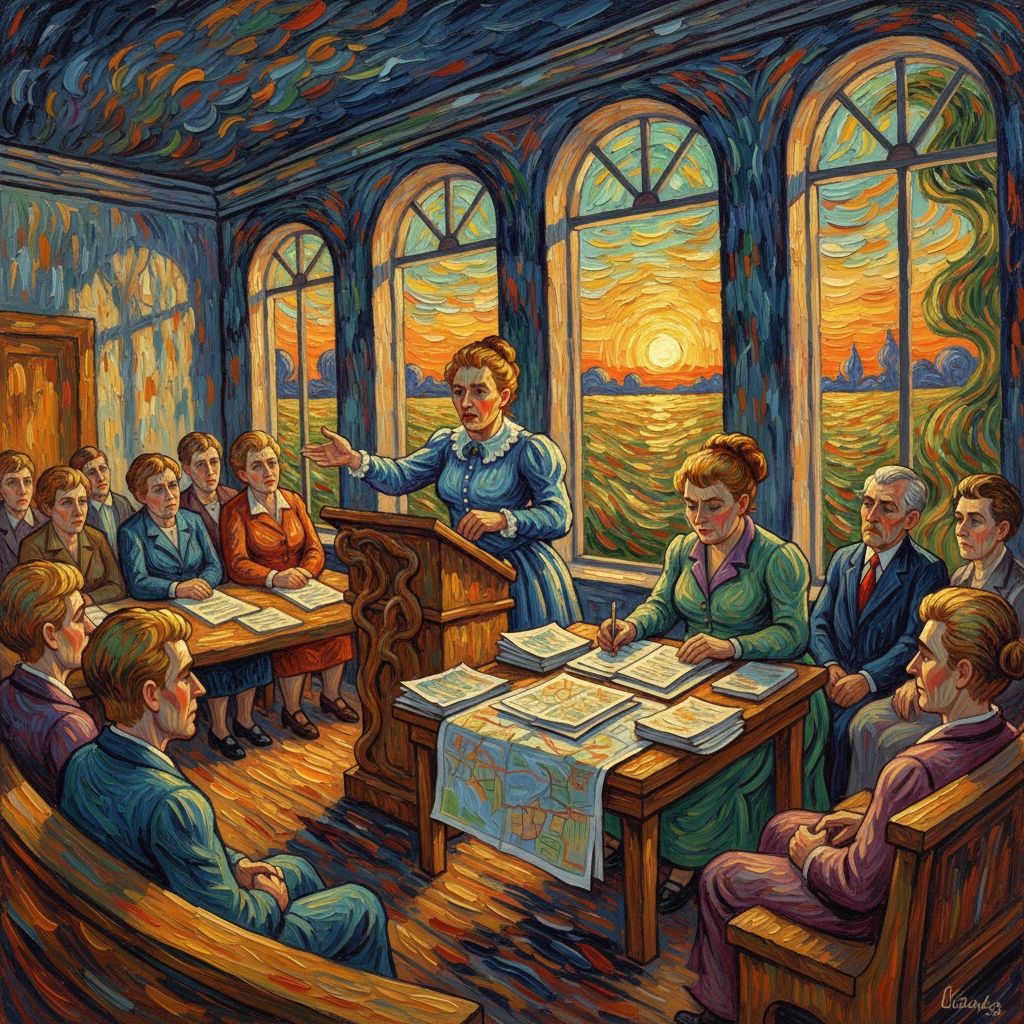
Town Hall hosted one final meeting.
The room felt calmer.
Not because consensus had emerged.
Because everyone was tired.
Mayor Crowe stood.
“We have heard every argument.”
“Several times,” muttered Lurleen.
“Sometimes repeatedly by the same person.”
Coach Freddie looked away.
“We have discussed farming.”
Nods.
“Business development.”
More nods.
“Conservation.”
Nods.
“Housing.”
Nods.
“Community uses.”
Nods.
“Technology projects.”
Act IX – The Decision That Wasn’t
Nods.
“Rabbit governance.”
Laughter.
Mayor Crowe smiled.
“What have we learned?”
Nobody answered.
Then Boot stood.
“We learned the field matters.”
The room grew quiet.
“Not because of what it is.”
He pointed toward the map.
“Because of what people imagine it could become.”
Mabel nodded.
“That’s true.”
Shelley nodded too.
“So is this.”
Everyone turned toward her.
“The field already has value.”
“Yes.”
“Even before we decide anything.”
RT sighed.
“I hate agreeing with everyone.”
“You’re doing great,” Clovis said.
Mayor Crowe looked around.
“No development proposal is being approved tonight.”
The crowd seemed surprised.
“We’re continuing evaluation.”
Groans emerged.
“But.”
The room quieted.
“We’re also documenting agricultural value.”
More silence.
“Environmental value.”
More silence.
“Economic value.”
Still more silence.
“Community value.”
Lurleen smiled.
“Turns out it’s complicated.”
The crowd laughed.
Because it was.
Nobody fully won.
Nobody fully lost.
The field remained exactly where it had always been.
Waiting.
Act IX – The Decision That Wasn’t
Epilogue – A Hundred Futures
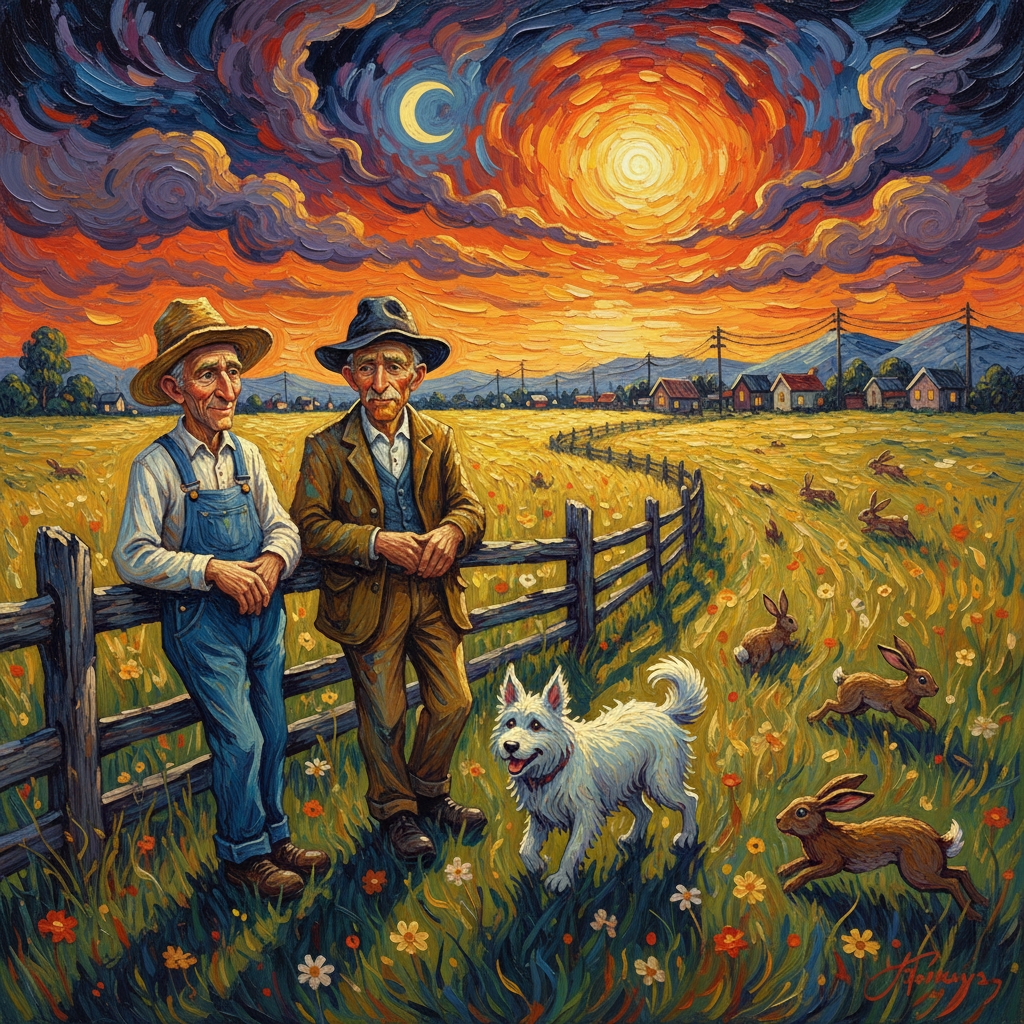
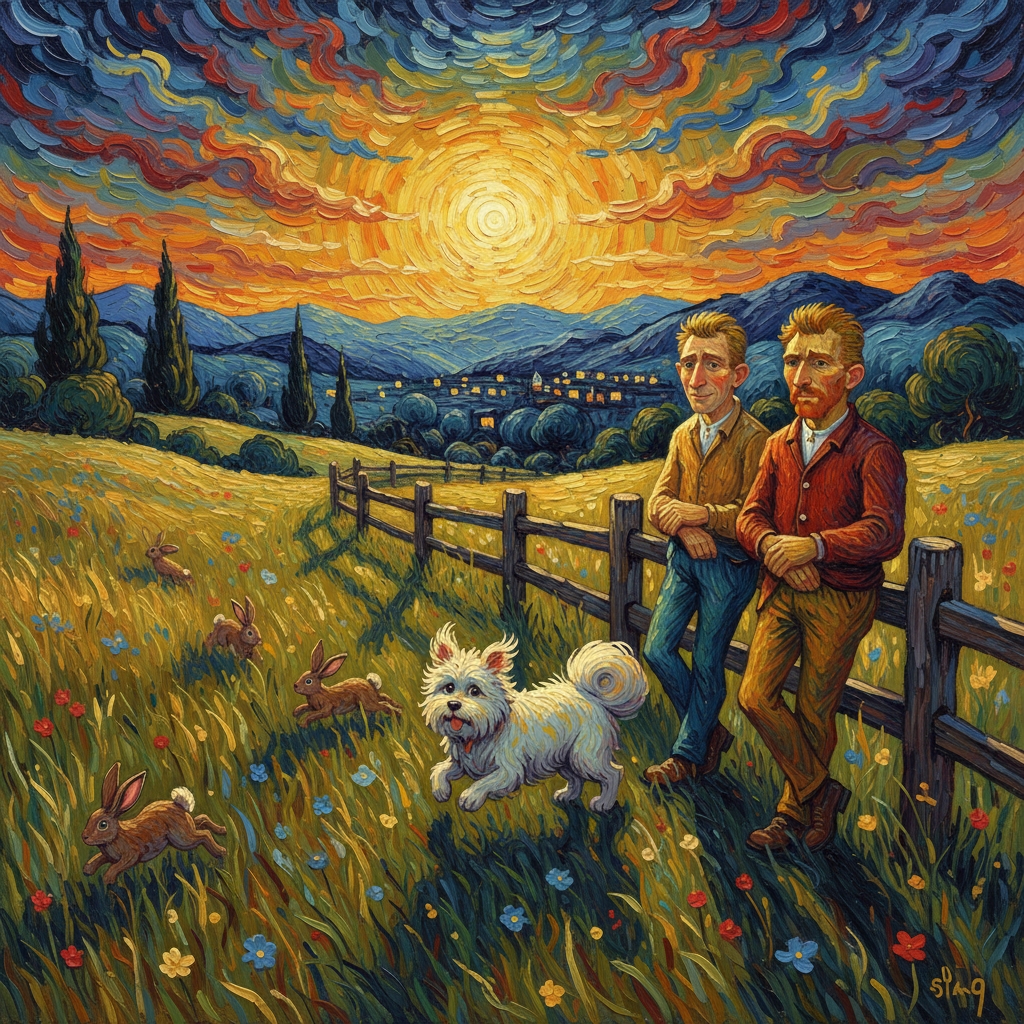
A month later, Boot and Clovis stood beside the fence again.
Daisy wandered through the grass.
The rabbits remained unconcerned.
“What do you think happens?” Clovis asked.
“To the field?”
“Yes.”
Boot looked across the open land.
“I don’t know.”
“That’s unusual.”
“Not really.”
The evening sun stretched across the valley.
Rabbits moved among the shadows.
Birds crossed overhead.
Far away, town lights flickered.
“You know,” Boot said, “everybody kept talking about the future.”
“Sure.”
“But they were really talking about themselves.”
Clovis looked over the field.
“How do you mean?”
“The farmer saw farming.”
“The developer saw development.”
“The conservationist saw conservation.”
“The business owner saw opportunity.”
“The historian saw memory.”
“The dreamer saw possibility.”
Clovis smiled.
Epilogue – A Hundred Futures
“So what did the field see?”
Boot pointed toward a rabbit disappearing into a burrow.
“Probably lunch.”
The two men laughed.
The field remained open.
Not empty.
Open.
Containing a hundred possible futures and no obligation to choose one quickly.
Behind them, Sequatchie Crossing continued debating nearly everything.
Ahead of them, the field continued existing.
Patiently.
As if it understood something people often forgot.
The future is usually larger than the argument happening about it today.
Epilogue – A Hundred Futures
Disclaimer
This story is a work of fiction set in the fictional town of Sequatchie Crossing. All characters, businesses, organizations, events, and incidents portrayed in this story are fictionalized for entertainment, satire, and storytelling purposes.
Any resemblance to actual persons, living or deceased, real businesses, public meetings, development proposals, land-use disputes, or communities is purely coincidental. The story is not intended to endorse or oppose any specific land-use policy, development project, agricultural practice, conservation effort, zoning decision, political position, or economic viewpoint.
The central question explored in this story—what constitutes the highest and best use of land—has no universally accepted answer. Different communities, property owners, planners, conservationists, businesses, and residents may reasonably arrive at different conclusions. The perspectives expressed by characters are their own and are presented to illustrate the variety of viewpoints commonly found in public discussions.
No rabbits, hounds, fence posts, survey markers, zoning maps, community gardens, or folding chairs were consulted during the writing of this fictional account, though several may have held strong opinions if given the opportunity.
Disclaimer – The Field That Could Have Been Anything
Real Places Behind the Ruckus – From The Dunlap Directory
Real Places Behind the Ruckus – From The Dunlap Directory
Yes, this story was fictional; even the parts that weren’t true. These places? Absolutely real. Stop by, support local, and keep the Wi-Fi away from livestock:
- Rent-A-Center
- Little Tail Farms
- Baker & Sons Plumbing
- Dunlap Medical Center
- TN Waterfront Vacation Rental
- Kate’s Simply Baked Dough
- Sequatchie Valley Automotive & Off-Road
- Cambri Hemp
- Uplift Fitness Dunlap
- Delashmitt Road Baptist Church
- John Pauls Cycle Shop
- Adoration Home Health and Hospice
- North Star Boutique
- New China Buffet
- Savage Gulf State Natural Area
- Fall Creek Bike Shop
- Athena Bitcoin ATM
- FedEx OnSite at Dollar General
- Campbell’s Tree Service
- Sequatchie Valley Construction
Real Places Behind the Ruckus – From The Dunlap Directory
At Sequatchie Crossing, we tell the stories of Sequatchie Crossing.
Please share this post with your friends, family, or business associates who may want follow the news from Sequatchie Crossing.

0 Comments