


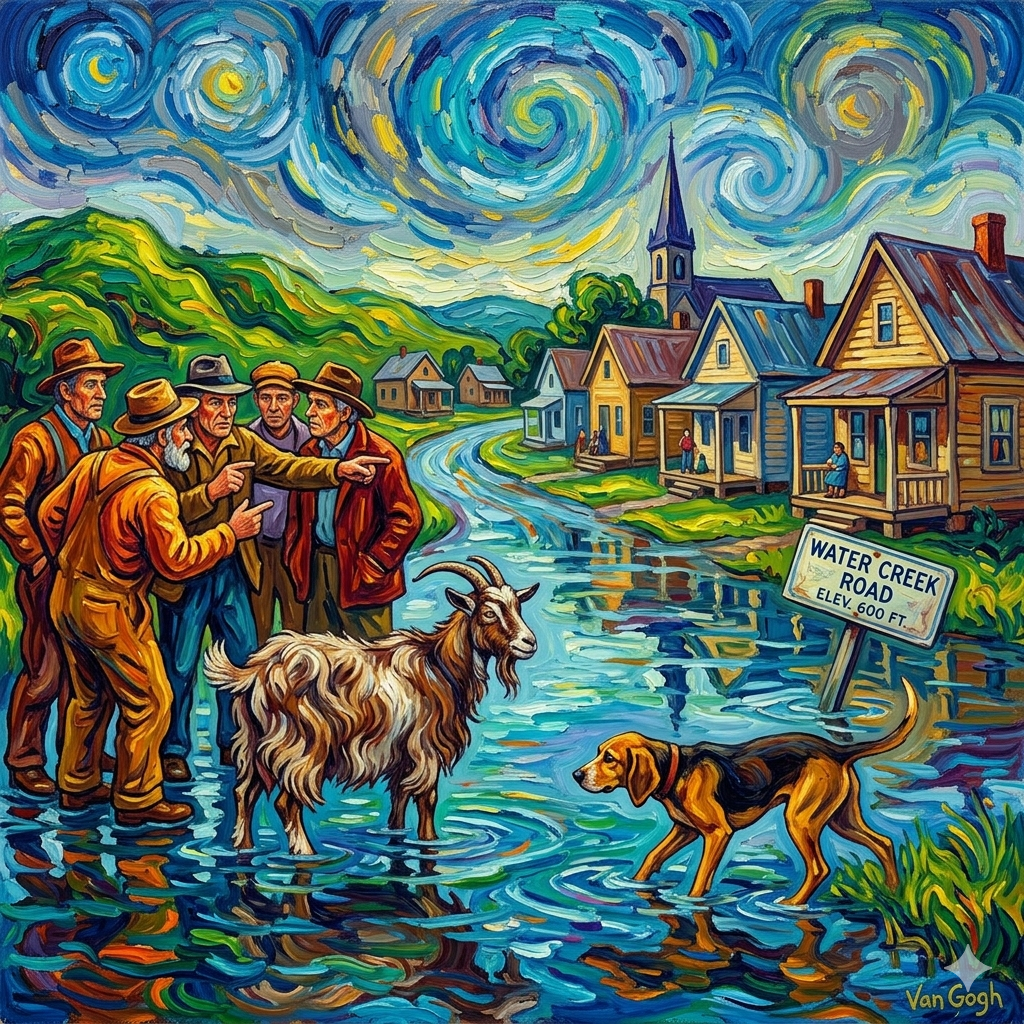
Historical Issues Reassigned to Recently Arrived Individuals
By Tom Seest
At Sequatchie Crossing, we tell the stories of Sequatchie Crossing.
Please share this post with your friends, family, or business associates who may want follow the news from Sequatchie Crossing.
🎤 Audio Overview
🎤 Song For This Story
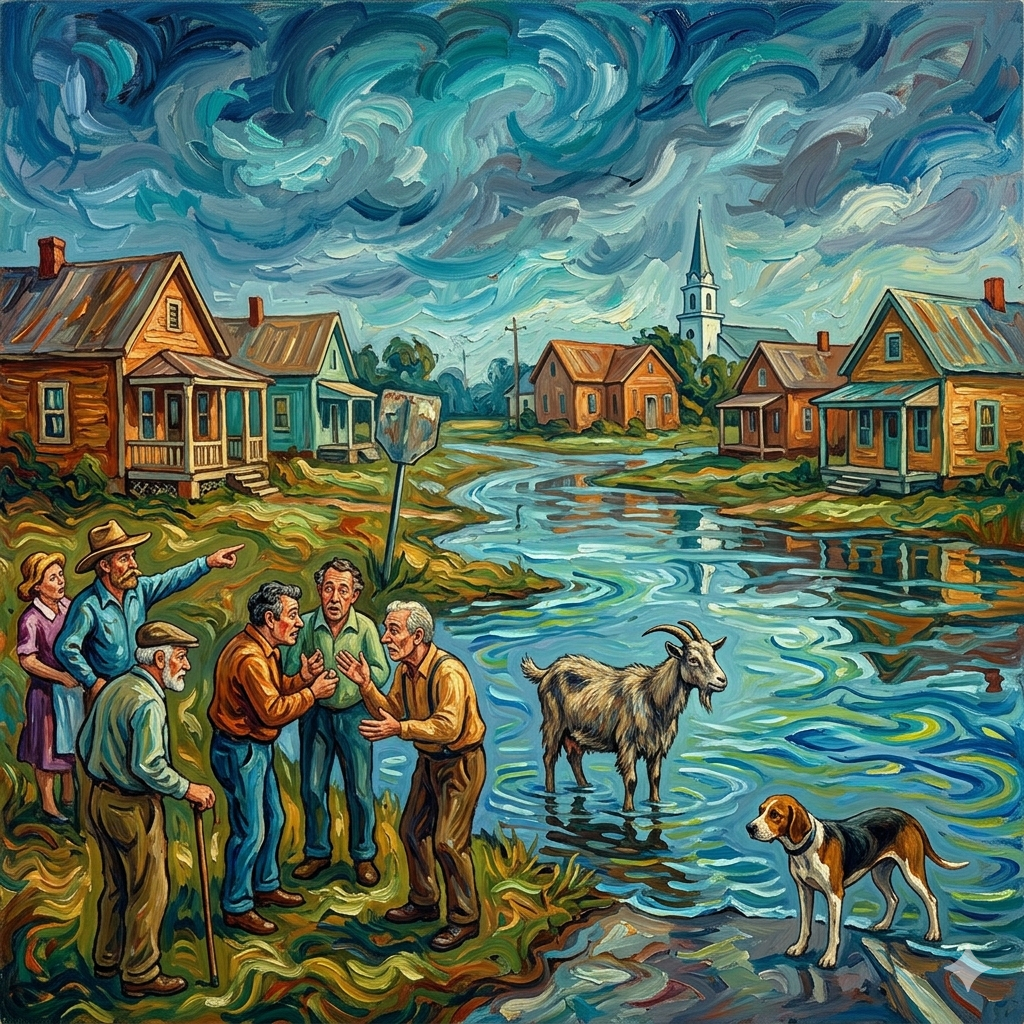
Locals Blame Newcomers for Problems That Predate Them by 40 Years
Act I – The Water That Remembers
It started, as most things in Sequatchie Crossing did, with water that had nowhere in particular to go.
On a gray Tuesday morning, the low stretch of Old Mill Road had filled again—slow, patient water pooling across the dip like it had signed a long-term lease decades ago and saw no reason to vacate now.
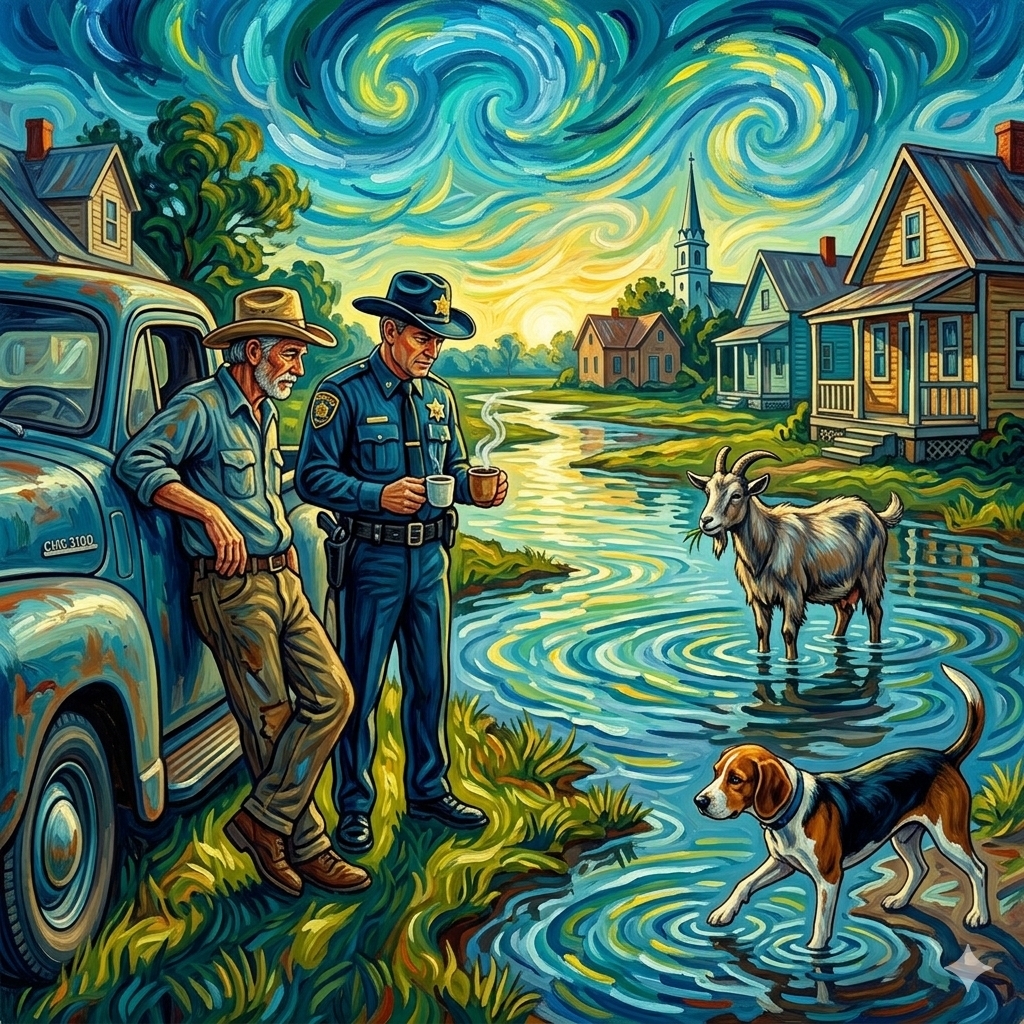
Daisy the hound stood at the edge of it, sniffing with professional concern.
Eugene “Boot” Barnes leaned against his truck, hands on hips, studying the scene.
“Well,” Boot said, “it’s back.”
Sheriff Peeler, standing nearby with his coffee, nodded slowly. “Never really leaves.”
Daisy stepped one paw into the water, withdrew it, and gave Boot a look that suggested this was, once again, a failure of human governance.
Across the road, an old goat—nobody quite knew whose it was anymore—stood exactly where it always stood, knee-deep in the flooded patch, chewing with the calm resignation of a creature who had long ago accepted the conditions of existence.
Clovis Strickland arrived with a clipboard.
“I’ve been expecting this,” Clovis said.
“You been expecting water?” Boot asked.
“I’ve been expecting the reaction to water,” Clovis corrected. “There’s a difference.”
A small group had gathered already: Maggie Sue Dillard, Lurleen Davenport, and Evelyn Grace Tipton, all looking at the flood with the intensity of people who intended to assign responsibility.
“It’s worse this year,” Maggie Sue declared.
“It is not worse,” Mabel Dean Ashcroft said, stepping up beside them. “It’s exactly the same.”
“You always say that,” Lurleen said.
“Because it’s always true,” Mabel replied.
At that moment, a pickup truck pulled up and parked carefully along the edge of the flooded area. Brett and Alyssa Crenshaw stepped out, surveying the water with the cautious optimism of people who had moved to Sequatchie Crossing six months earlier and still believed most problems had solutions.
“Is this… normal?” Alyssa asked.
The group turned toward them.
There was a pause.
“Well,” Maggie Sue said slowly, “it wasn’t until recently.”
Boot raised an eyebrow.
Clovis looked up sharply.
The goat continued chewing.
Act I – The Water That Remembers
Act II – The First Accusation
By mid-morning, the matter had migrated, as it inevitably would, to the porch of the diner.
Trixie Jo Bartlett wiped down a table while Tiffany Annette Roark leaned over the counter, listening with sharp interest.
“I’m telling you,” Maggie Sue said, stirring her coffee like it had personally offended her, “this didn’t used to happen.”
Mabel Dean Ashcroft sat upright, hands folded. “It did.”
“No, it didn’t.”
“It did.”
Tiffany leaned in. “How long we talking?”
“Forty years, give or take,” Mabel said.
“That’s not accurate,” Maggie Sue snapped. “Maybe twenty.”
“It was flooding when your second husband tried to build that shed,” Mabel replied calmly.
“That shed failed for unrelated reasons.”
“It floated away.”
At another table, Ricky Travis “RT” Mullins laughed into his biscuit.
Brett and Alyssa sat quietly, absorbing the conversation like people trying to learn a new language under mild duress.
“So,” Brett said carefully, “what caused it?”
Silence again.
“Well,” Lurleen said, “it’s been worse since folks started moving in.”
Boot, seated near the window, turned around slowly.
“Now hold on,” he said. “That water’s been there longer than half of us.”
“Maybe,” Maggie Sue said, “but it’s different now.”
“How?” Boot asked.
“It feels worse.”
Clovis arrived just then, carrying a stack of papers.
“I have documentation,” he announced.
Everyone groaned.
“You always have documentation,” Tiffany said.
Clovis set the papers down anyway. “These are archived complaints about Old Mill Road flooding. Going back to 1983.”
“That don’t prove nothing,” Maggie Sue said.
“It proves something,” Clovis replied.
Across the room, Chester Ray Blevins looked up from his coffee. “I printed half those myself back in the day.”
“That’s correct,” Clovis said. “You used slightly thinner paper in ’87.”
Chester Ray nodded solemnly. “Budget cuts.”
Alyssa leaned toward Brett. “Are we being blamed for this?”
Brett considered it. “I think we’re in the early stages of it.”

Act II – The First Accusation
Act III – The Research Begins
Later that afternoon, the Crenshaws found themselves at Clovis’s kitchen table.
Stacks of documents covered every available surface.
“This is everything?” Brett asked.
“This is what I could retrieve without going into the secondary archive,” Clovis said.
“There’s a secondary archive?” Alyssa asked.
Clovis nodded. “My attic.”
Alyssa blinked.
“So what do these say?” Brett asked.
Clovis adjusted his glasses.
“They say,” he began, “that in 1983, a complaint was filed regarding standing water on Old Mill Road.”
“Same spot?” Brett asked.
“Same spot.”
“Same goat?” Alyssa asked.
Clovis paused. “Possibly a predecessor goat.”
They flipped through the pages.
1987 – “Flooding persists. No action taken.”
1992 – “Drainage discussed. Deferred.”
1999 – “Committee formed. No findings recorded.”
2004 – “Water remains.”
2011 – “Concern noted.”
2018 – “Still there.”
Alyssa leaned back. “So this has just… always been happening?”
“Yes,” Clovis said.
“And no one fixed it?”
“That is also correct.”
Brett rubbed his forehead. “Then why are we getting blamed?”
Clovis leaned forward.
“Because you are new,” he said. “And the problem is old. That creates a useful narrative alignment.”
Alyssa stared at him. “That doesn’t make sense.”
Clovis nodded. “Correct.”
Act III – The Research Begins
Act IV – The Town Hall Reckoning
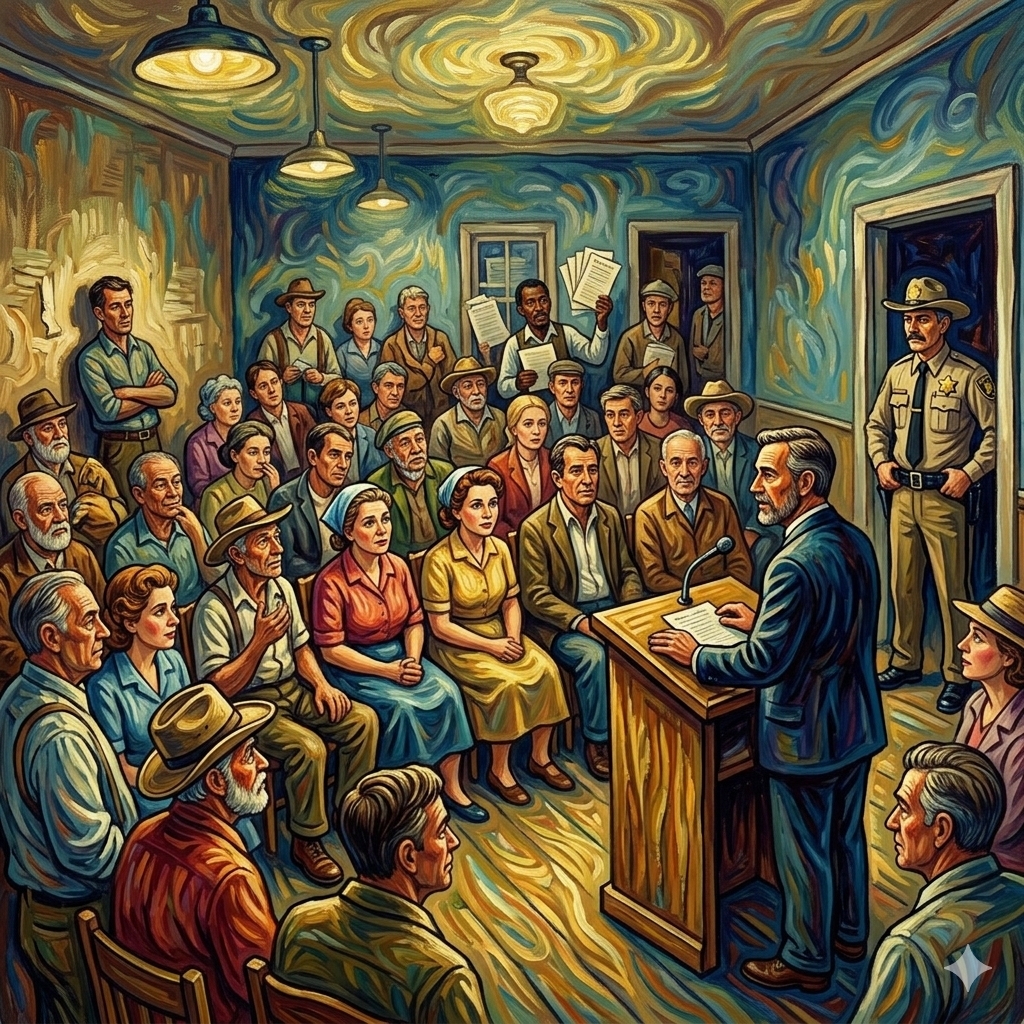
That evening, the Town Hall filled to capacity.
Sheriff Peeler stood near the door, while Officer Kenny Joe Teeter attempted to manage seating in a way that suggested authority but produced no measurable order.
“Everybody take a seat!” Kenny Joe called.
“No,” Lurleen replied.
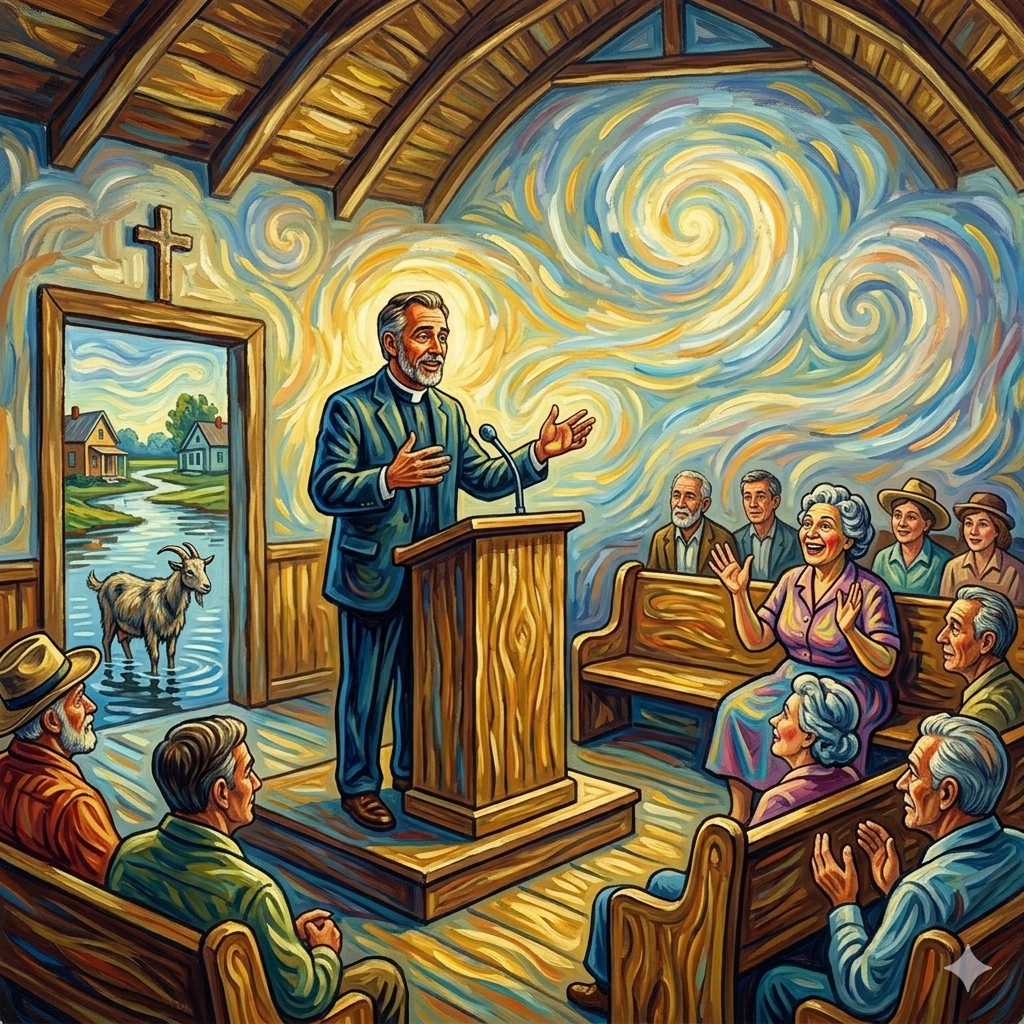
Pastor Arnold Peeler stood at the front, hands raised.
“We’re here,” he said, “to discuss the flooding issue with understanding and unity.”
“Or accountability,” Maggie Sue added.
“Or historical context,” Clovis said from the back.
Boot leaned against the wall. “Or common sense.”
Mabel sat front and center, already prepared to correct anyone.
Dr. Neil Cowgill adjusted his tie. “From a scientific standpoint—”
“We don’t need science,” Maggie Sue interrupted.
“We might,” Dr. Cowgill said gently.
Brett stood up.
“I just want to understand why we’re being blamed for something that’s been happening since before we got here.”
Murmurs spread through the room.
Shelley Fawn Wexler raised a hand. “As someone who tracks community sentiment, I can say the perception has shifted.”
“What does that mean?” Alyssa asked.
“It means people feel like something changed,” Shelley said.
“But nothing changed,” Clovis said.
“Except who’s here,” Lurleen added.
Boot stepped forward.
“Let me ask something simple,” he said. “If this has been going on forty years… why wasn’t it fixed?”
Silence.
The kind that settled deep and stayed awhile.
Finally, Maggie Sue said, “Well… we always meant to.”
Act IV – The Town Hall Reckoning
Act V – The Church Perspective
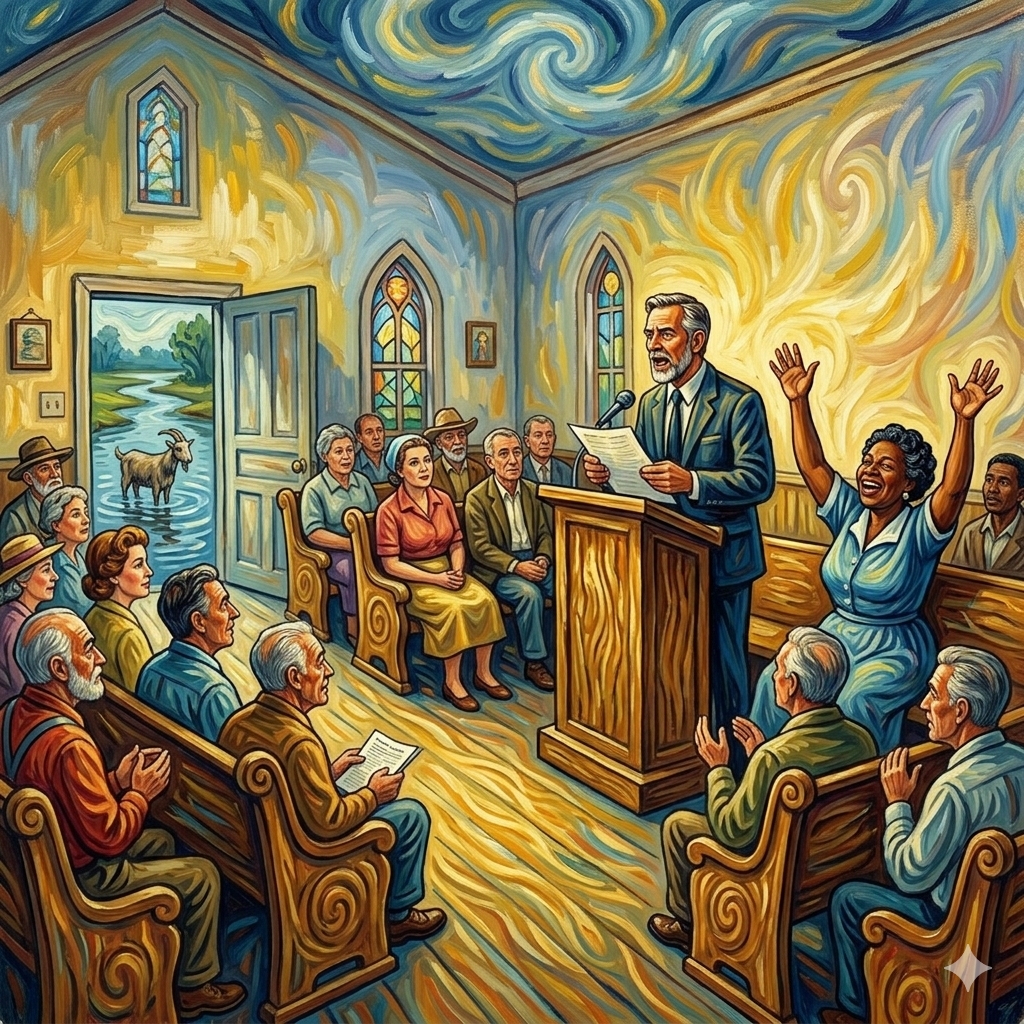
The next morning, Pastor Arnold Peeler addressed the matter during service.
Sister Lila Mae “Hallelujah” Pruitt sat in the front row, nodding vigorously before the sermon even began.
“Friends,” Pastor Peeler said, “we must be careful how we assign blame.”
“Amen!” Sister Lila Mae shouted.
“We must recognize that problems often outlive the circumstances that created them.”
“Hallelujah!”
“And we must avoid placing responsibility on those who had no part in their origin.”
Murmurs of agreement.
Boot sat in the back, arms crossed.
Mabel nodded once.
The Crenshaws sat quietly, unsure whether they were being defended or studied.
“And perhaps,” Pastor Peeler continued, “we must ask ourselves why we accepted certain conditions for so long.”
Silence again.
Sister Lila Mae stood. “Because we got used to it!”
“That is… one possibility,” Pastor Peeler said.
Daisy wandered down the aisle.
The goat, somehow, was visible through the open door, still standing in the flooded spot.
Act IV – The Town Hall Reckoning
Act VI – The Expert Analysis
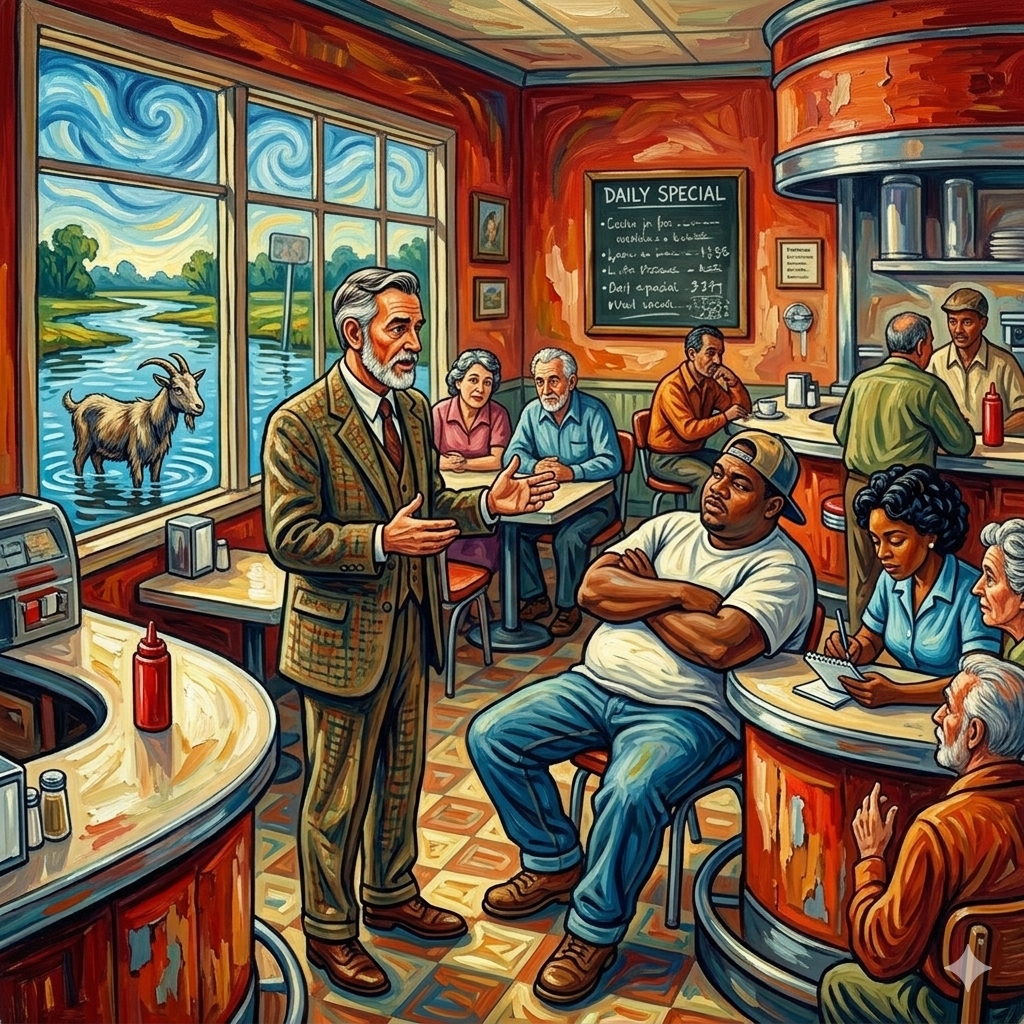
Back at the diner, Dr. Neil Cowgill attempted to introduce data.
“I’ve reviewed the terrain,” he said. “The issue is a combination of poor grading and inadequate drainage infrastructure.”
“So you’re saying it’s fixable?” Brett asked.
“Yes.”
“Then why hasn’t it been fixed?”
Dr. Cowgill hesitated.
“Well,” he said, “it would require coordination, funding, and sustained effort.”
Everyone nodded.
That sounded suspiciously like work.
Doug “Doughboy” Teeter leaned back in his chair. “Sounds expensive.”
“It would be,” Dr. Cowgill said.
“Well there you go,” Doughboy said. “That explains it.”
Tiffany tapped her pen. “So instead of fixing it, we just… kept talking about it?”
“That appears to be the established pattern,” Shelley said.
Mabel sipped her tea. “And it worked fine.”
Boot looked out the window at the flooded road.
“Did it?” he asked.
Act V – The Church Perspective
Act VII – The Historical Record Expands
Clovis returned with more documents.
“I went into the attic,” he said.
“No,” Tiffany whispered.
“Yes,” Clovis confirmed.
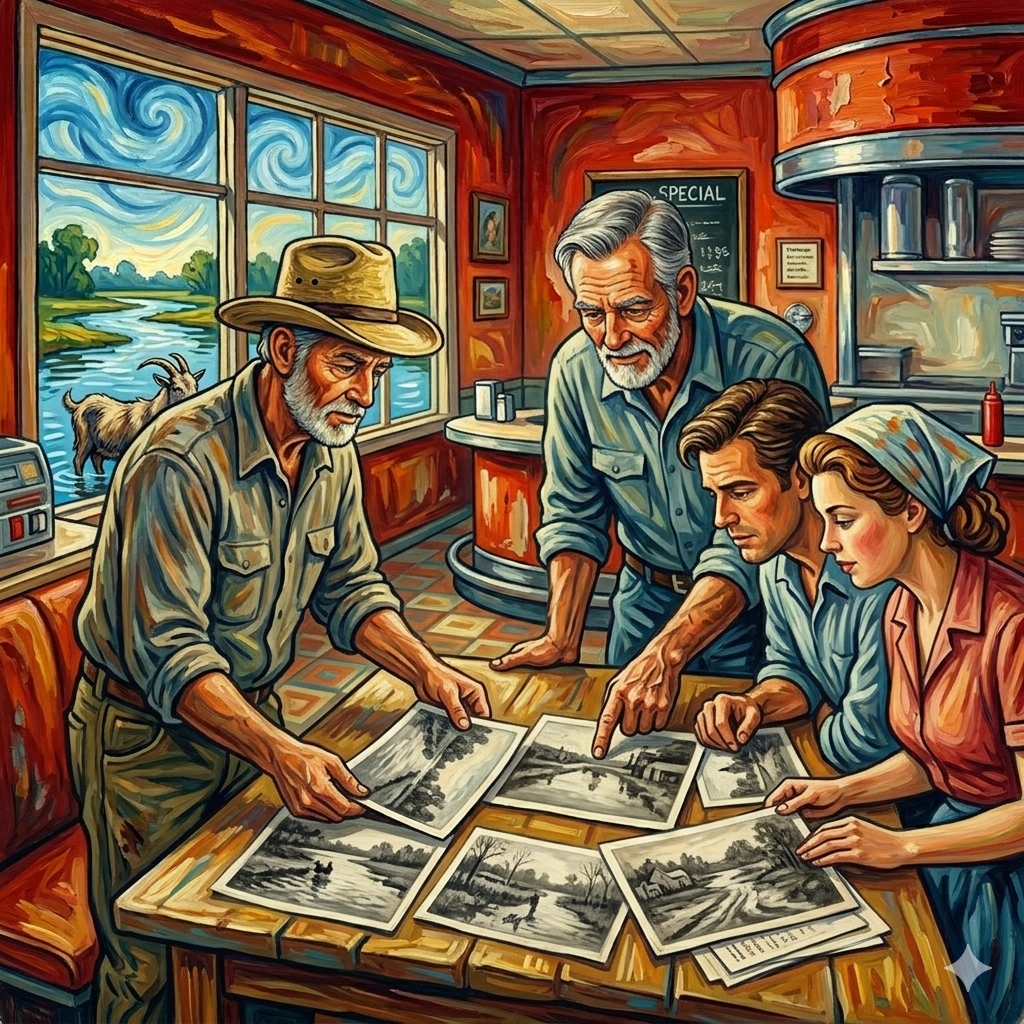
He laid out photographs.
Black-and-white images of Old Mill Road, flooded.
In one, a younger version of Chester Ray stood beside the water, holding a sign that read “THIS AGAIN.”
“That’s me,” Chester Ray said proudly.
“So this goes back even further,” Alyssa said.
“Yes,” Clovis said. “At least fifty years.”
Maggie Sue frowned. “That don’t change anything.”
“It changes everything,” Brett said.
“How?”
“It means the problem isn’t new. And we’re not the cause.”
Lurleen crossed her arms. “Well something changed.”
Boot stepped forward.
“Yeah,” he said. “The patience ran out.”
The room went quiet.
Act VI – The Expert Analysis
Act VIII – The Confrontation
That evening, the group gathered again at Old Mill Road.
The water was still there.
The goat was still there.
Daisy barked once, as if filing a formal complaint.
Brett stepped into the edge of the flooded area.
“This is fixable,” he said. “We’ve looked into it. It’s not even that complicated.”
“Then why didn’t you fix it when you got here?” Maggie Sue asked.
Alyssa stared at her. “We’ve been here six months.”
“Well you noticed it,” Lurleen said.
“So did you,” Brett replied.
“That’s different.”
“How?”
Silence again.
Boot stepped forward.
“It ain’t different,” he said. “We just got comfortable not fixing it.”
Mabel nodded slowly. “That is accurate.”
Clovis held up a document. “I have records of multiple opportunities to address this.”
“And what happened?” Alyssa asked.
Clovis shrugged. “We discussed it.”
The goat shifted slightly, water rippling around its legs.

Act VII – The Historical Record Expands
Act IX – The Decision
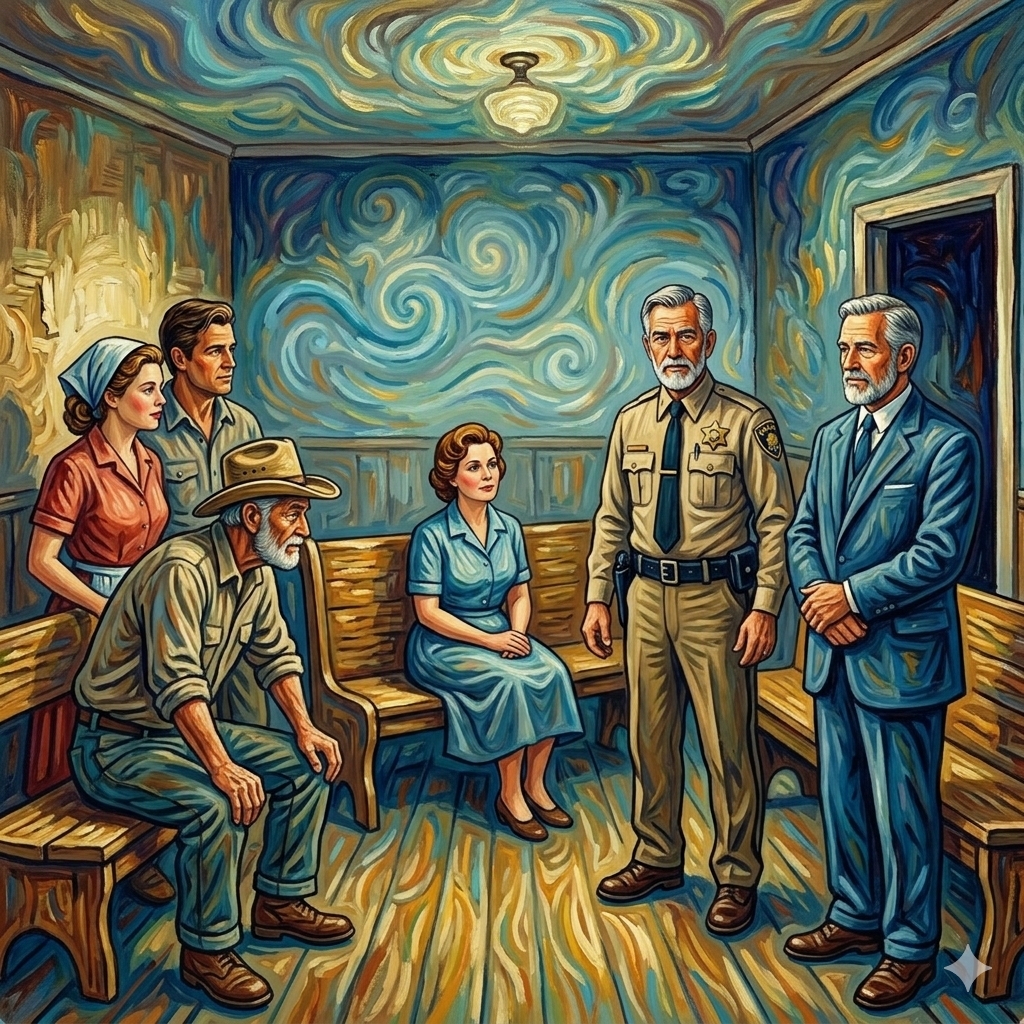
At Town Hall, the final meeting was called.
Sheriff Peeler stood at the front.
“We’re gonna decide what to do about the flooding,” he said.
Kenny Joe nodded like he understood.
Pastor Peeler folded his hands.
Clovis arranged his documents.
Mabel prepared to confirm things.
Boot leaned forward.
Brett and Alyssa stood together.
“So,” Sheriff Peeler said, “options are… we fix it… or we don’t.”
“That’s a good summary,” Shelley said.
Dr. Cowgill stepped up. “I can outline a plan.”
“Will it cost money?” Doughboy asked.
“Yes.”
Groans.
Boot raised his hand.
“Or,” he said, “we can keep blaming folks who ain’t been here long enough to cause it.”
Maggie Sue looked at the floor.
Lurleen sighed.
Evelyn Grace adjusted her glasses.
Finally, Mabel spoke.
“It has always been this way,” she said. “But it does not have to remain this way.”
Silence.
Then Pastor Peeler nodded.
“I believe,” he said, “we have our answer.”
Act VIII – The Confrontation
Epilogue – The Water Moves (Slightly)
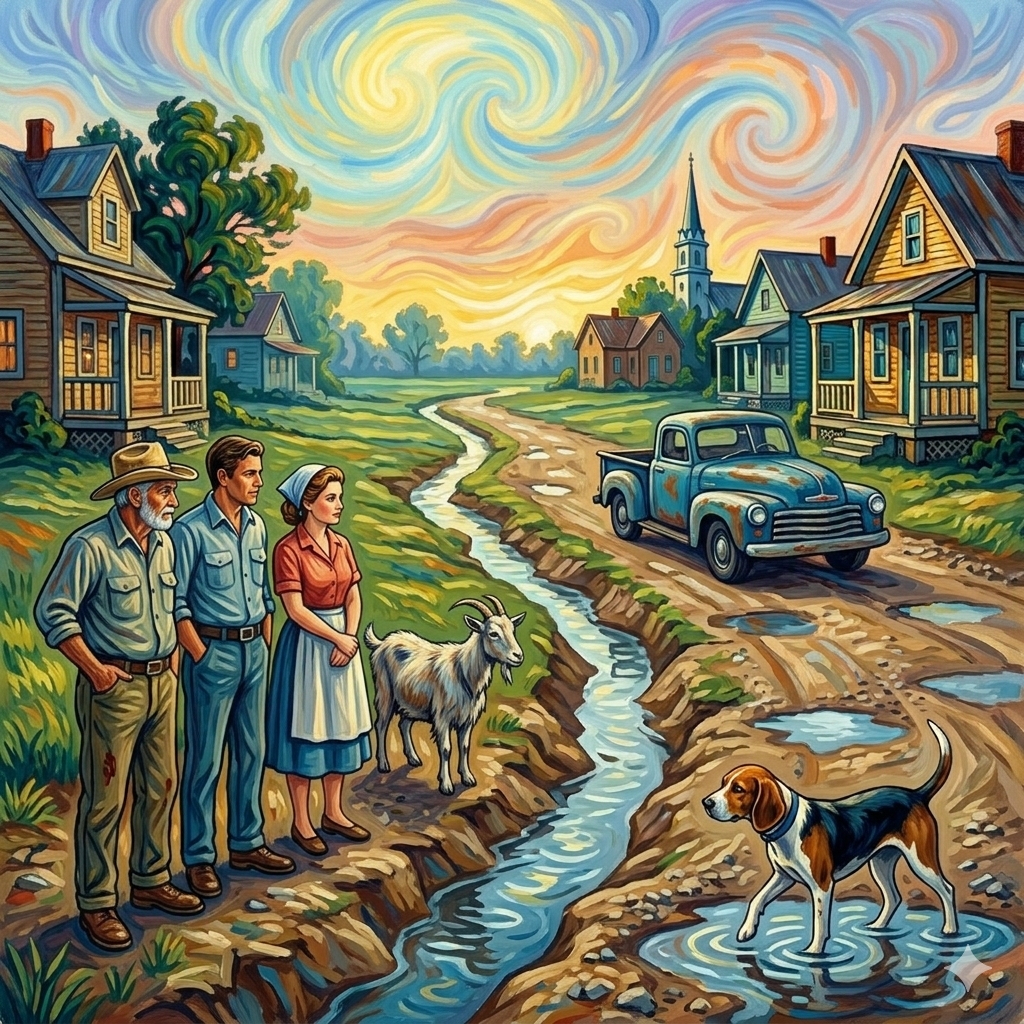
Weeks later, work began.
Slowly.
Cautiously.
Suspiciously.
But it began.
The ditch was cleared.
The grading adjusted.
The water… shifted.
Not gone.
But moving.
Boot stood beside the road, watching.
Clovis held a new document.
Mabel nodded once.
Brett and Alyssa stood together.
Daisy splashed through a shallow puddle.
The goat stood nearby, now only ankle-deep.
Progress.
Measured.
Reluctant.
Real.
Epilogue – The Water Moves Slightly
Disclaimer
The events depicted in this story are entirely fictional, though the patterns may feel familiar. Any resemblance to real people, places, or longstanding drainage issues is purely coincidental. The town of Sequatchie Crossing exists in a space where memory is selective, responsibility is negotiable, and water tends to settle where it is allowed.

Disclaimer – Locals Blame Newcomers for Problems That Predate Them by 40 Years
Real Places Behind the Ruckus – From The Dunlap Directory

Real Places Behind the Ruckus – From The Dunlap Directory
Yes, this story was fictional; even the parts that weren’t true. These places? Absolutely real. Stop by, support local, and keep the Wi-Fi away from livestock:
- Dunlap Enquirer
- Clayton Homes
- Gigi’s Sweet Stop
- Ketner’s Mill
- Jason Brown
- Highly Lifted Smoke & Vape
- Creekside Apartments
- O’Reilly Auto Parts
- S & S Farmers Market
- Sunflower Corner Floral Arrangements and Gifts
- D&W Window Cleaning and Pressure Washing
- North End Collision Center
- Beau Brown Of Jason Lewis Dunlap Supercenter
- Stocker Tire & Services Center
- Cody’s Lawn Care
- Uplift Fitness Dunlap
- StorageSmith
- Coops Creek Greenway

Real Places Behind the Ruckus – From The Dunlap Directory
At Sequatchie Crossing, we tell the stories of Sequatchie Crossing.
Please share this post with your friends, family, or business associates who may want follow the news from Sequatchie Crossing.


0 Comments