



A Committee Was Formed, a Responsibility Was Filed, and Then It Was Filed Again Somewhere Else
By Tom Seest
At Sequatchie Crossing, we tell the stories of Sequatchie Crossing.
Please share this post with your friends, family, or business associates who may want follow the news from Sequatchie Crossing.
🎤 Audio Overview

Blame Assigned to Task Force
Act I – The Form That Started It
The morning began, as most consequential mornings in Sequatchie Crossing do, on a porch.
Mabel Dean Ashcroft sat in her usual rocker, the wood creaking in a rhythm that suggested both patience and judgment. In her lap rested a single sheet of paper—creased once, carefully—held down by a mason jar half-filled with sweet tea and entirely filled with intent.
Clovis Strickland stood nearby, staring at the paper as if it might rearrange itself into something more agreeable.
“I’m just saying,” Clovis said, arms folded, “it ain’t clear what department this belongs to.”
“It belongs,” Mabel said without looking up, “to whoever fixes things.”
Clovis blinked slowly. “Well that ain’t a department.”
Mabel lifted the jar, slid the paper closer, and tapped it twice.
“It is today.”
Boot Barnes ambled up the steps, wiping his hands on a rag that had seen more responsibility than most elected officials.
“What we looking at?” Boot asked.
“A complaint,” Mabel said.
“About what?”
Mabel inhaled, the kind of inhale that meant she had already said it three times that morning and would say it thirty more.
“The ditch behind the diner don’t drain right. Water’s standing. Mosquitoes have established governance.”

Act I – The Form That Started It
Boot nodded. “Well that’s not good.”
“It’s not just not good,” Mabel said. “It’s a problem.”
Clovis leaned in again. “Yeah but what kind of problem?”
“The kind that needs fixing.”
Boot scratched his chin. “Sounds like infrastructure.”
Clovis shook his head. “Could be environmental.”
“Public health,” Mabel added.
Boot’s eyes widened. “That’s three departments.”
Clovis straightened. “Well then it needs to go to Town Hall.”
Mabel folded the paper neatly.
“It needs to go to someone who will read it.”
Clovis smiled faintly. “Well now you’re asking for a fourth department.”

Act I – The Form That Started It
Act II – Town Hall Receives Itself
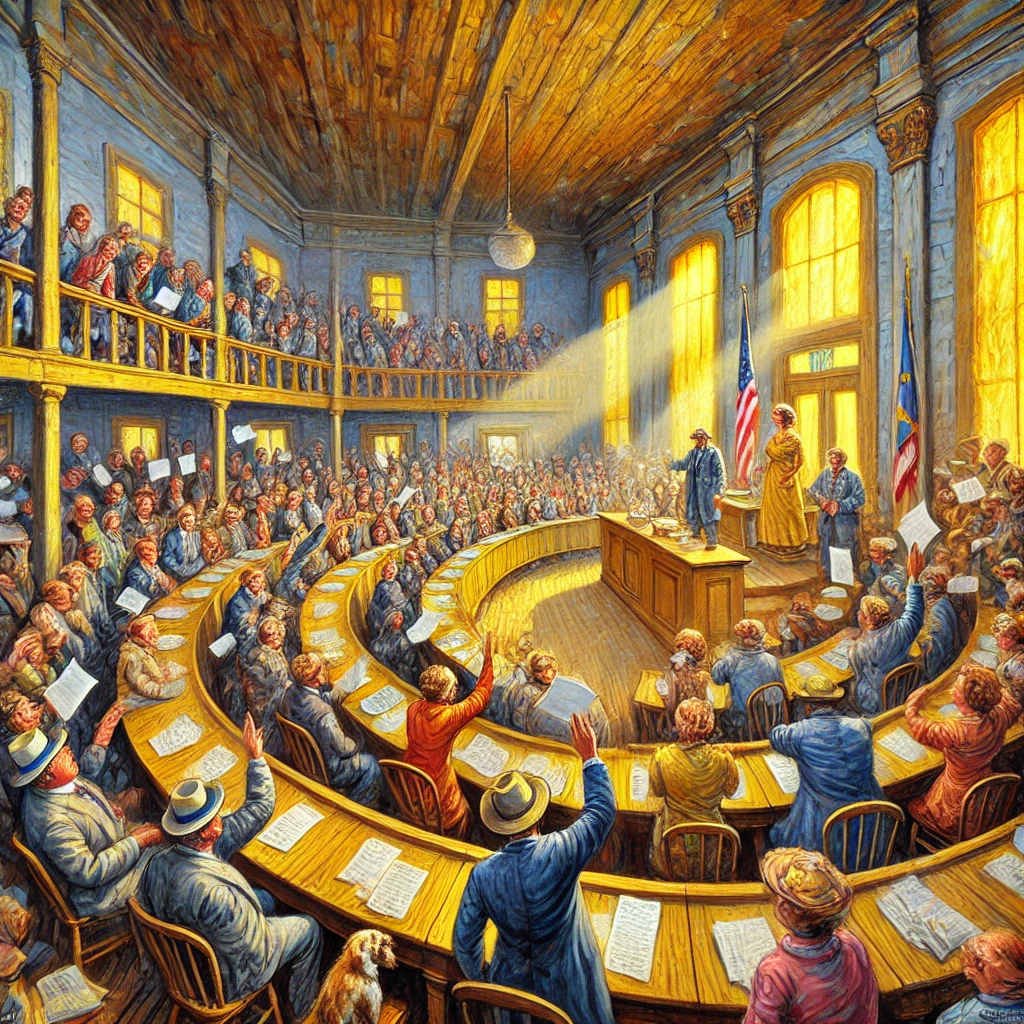
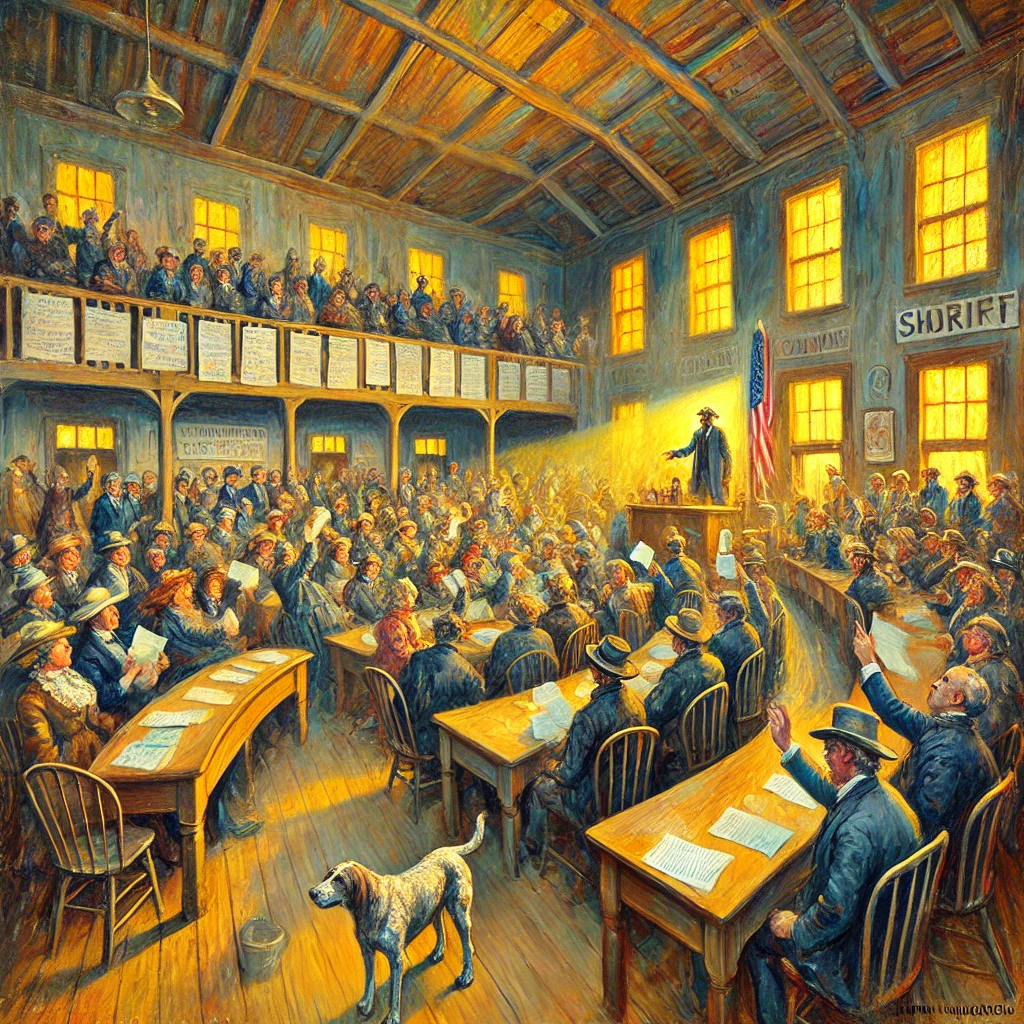
Town Hall was already full by the time Mabel arrived, which meant something had been scheduled or something had been avoided.
Sheriff Peeler stood near the doorway, arms crossed, watching the room with the calm of a man who had seen responsibility change hands without ever changing outcomes.
Daisy the hound lay beside him, head resting on her paws, ears twitching at the sound of papers being shuffled without purpose.
Mabel walked straight to the front.
“I’ve got a complaint,” she said.
The room quieted—not because of the complaint, but because of Mabel.
Tiffany Annette Roark looked up from a stack of documents that appeared to multiply when unattended.
“Is it in writing?” Tiffany asked.
Mabel held up the paper.
Tiffany nodded. “Then we can process it.”
Clovis stepped forward. “We believe it falls under multiple jurisdictions.”
“That’s helpful,” Tiffany said, writing something down that would later be unreadable.
Shelley Fawn Wexler raised a hand delicately.
“Before we assign jurisdiction,” Shelley said, “we should determine whether this is a legacy issue or an emergent concern.”
Act II – Town Hall Receives Itself
Mabel stared at her.
“It’s water in a ditch.”
Shelley nodded thoughtfully. “That sounds like a hybrid.”
Ricky Travis “RT” Mullins leaned back in his chair.
“We could form a task force.”
The room shifted.
Not in resistance—but in recognition.
Sheriff Peeler sighed softly.
“Task forces,” he said, “are where problems go to wait.”
Pastor Arnold Peeler nodded solemnly. “Sometimes waiting is a form of faith.”
Mabel looked around the room.
“I didn’t come here to wait.”
RT smiled. “You came to participate.”
Within minutes, the paper was no longer just a complaint.
It was an agenda item.
Then a motion.
Then a second.
Then a vote.
“All in favor of forming a task force to evaluate the drainage issue behind the diner?”
Every hand went up.
Even Daisy raised her head briefly, then went back to sleep.
Act II – Town Hall Receives Itself
Act III – The First Meeting of the Task Force
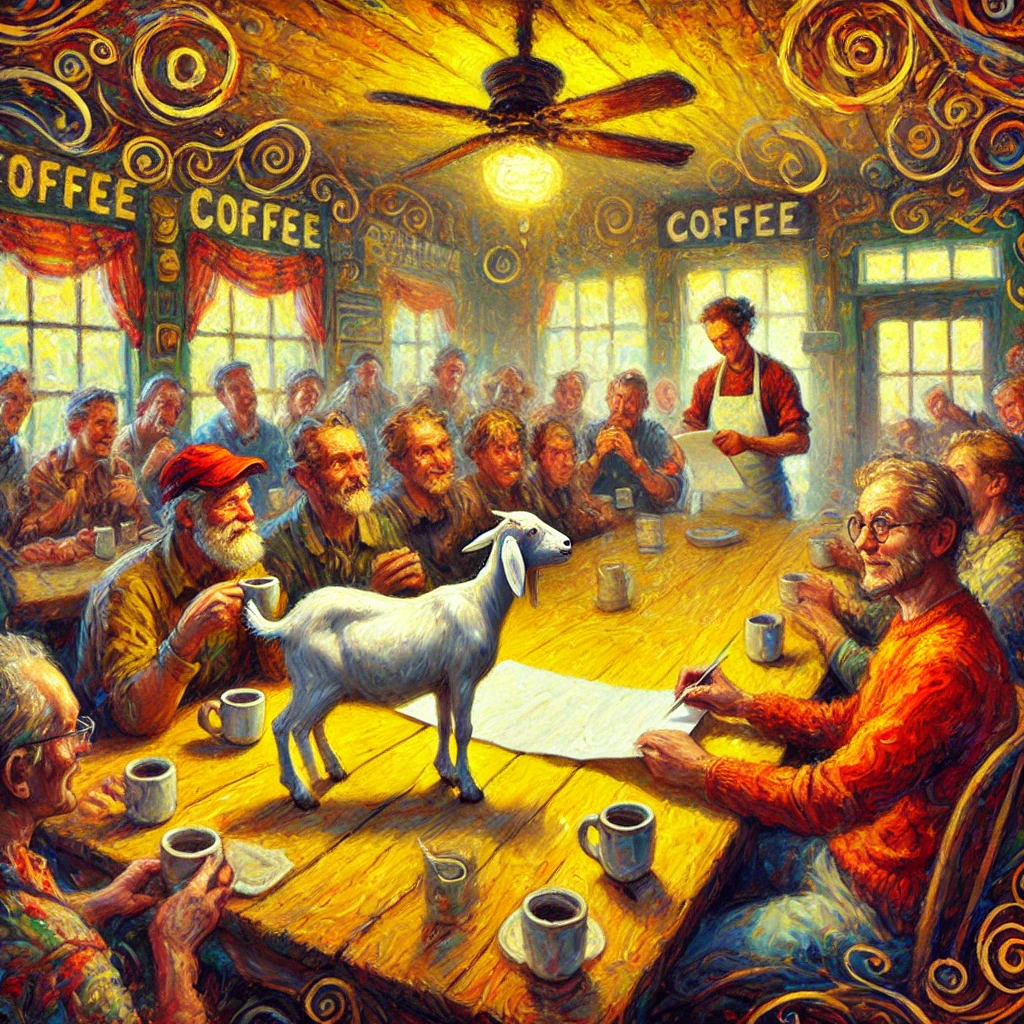
The task force convened that afternoon at the diner, because that was closest to the ditch and furthest from accountability.
Santiago “Sonny” Morales poured coffee for everyone, including those who didn’t want it.
“Helps with clarity,” he said.
“It helps with staying,” Boot replied.
Mabel sat at the head of the table, though no one had assigned her that position.
“I brought the original complaint,” she said.
“Good,” Clovis said. “We’ll need that for context.”
Maggie Sue Dillard flipped open a notebook.
“We should establish roles,” she said.
“Chair,” Shelley suggested.
“Co-chair,” Tiffany added.
“Vice chair,” RT offered.
“Advisory chair,” Lurleen Davenport said from the corner.
“Honorary chair,” Evelyn Grace Tipton chimed in.
Mabel blinked.
“I’m not sure chairs are what’s needed.”
“They help structure discussion,” Shelley said.
“They help avoid decisions,” Sheriff Peeler muttered from the doorway.
Dr. Neil Cowgill adjusted his glasses.
“We should begin with a review of the complaint.”
Mabel slid the paper across the table.
Act III – The First Meeting of the Task Force
At that exact moment, the diner door swung open.
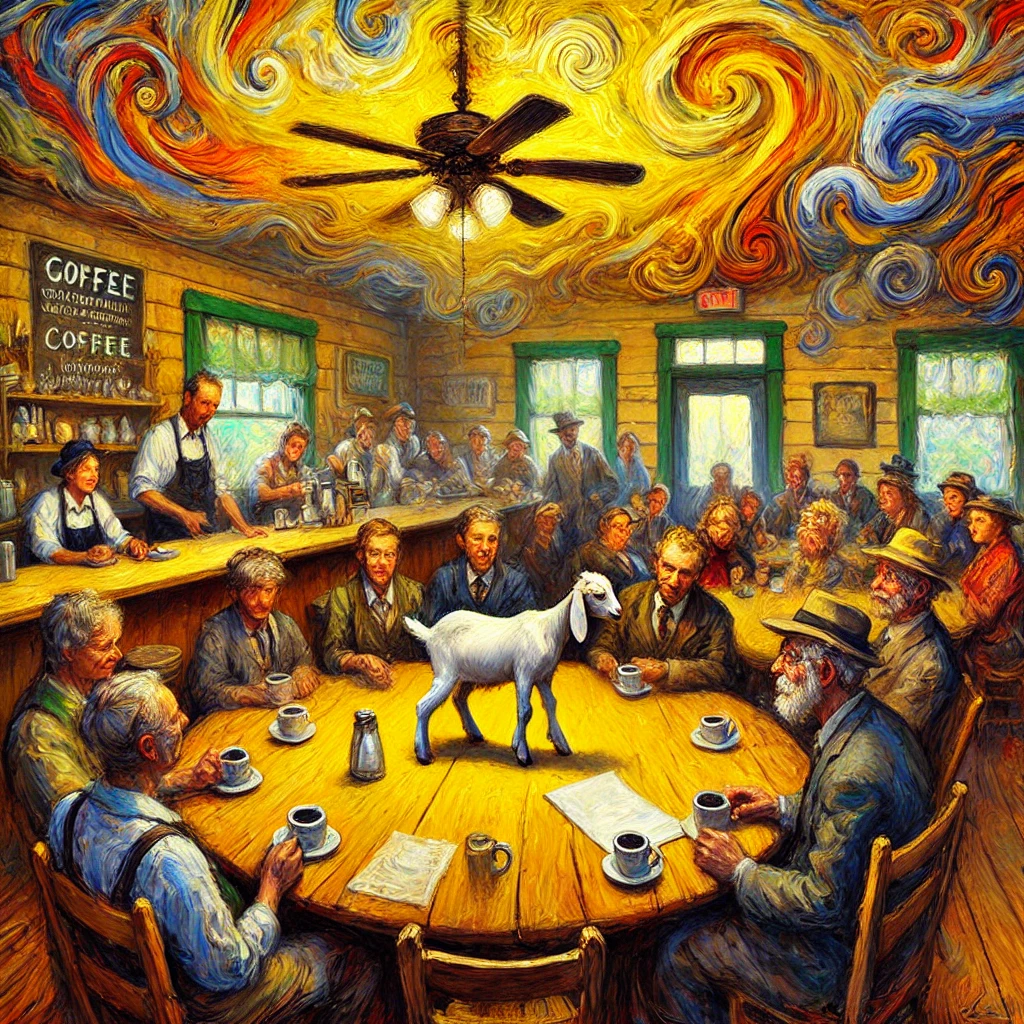
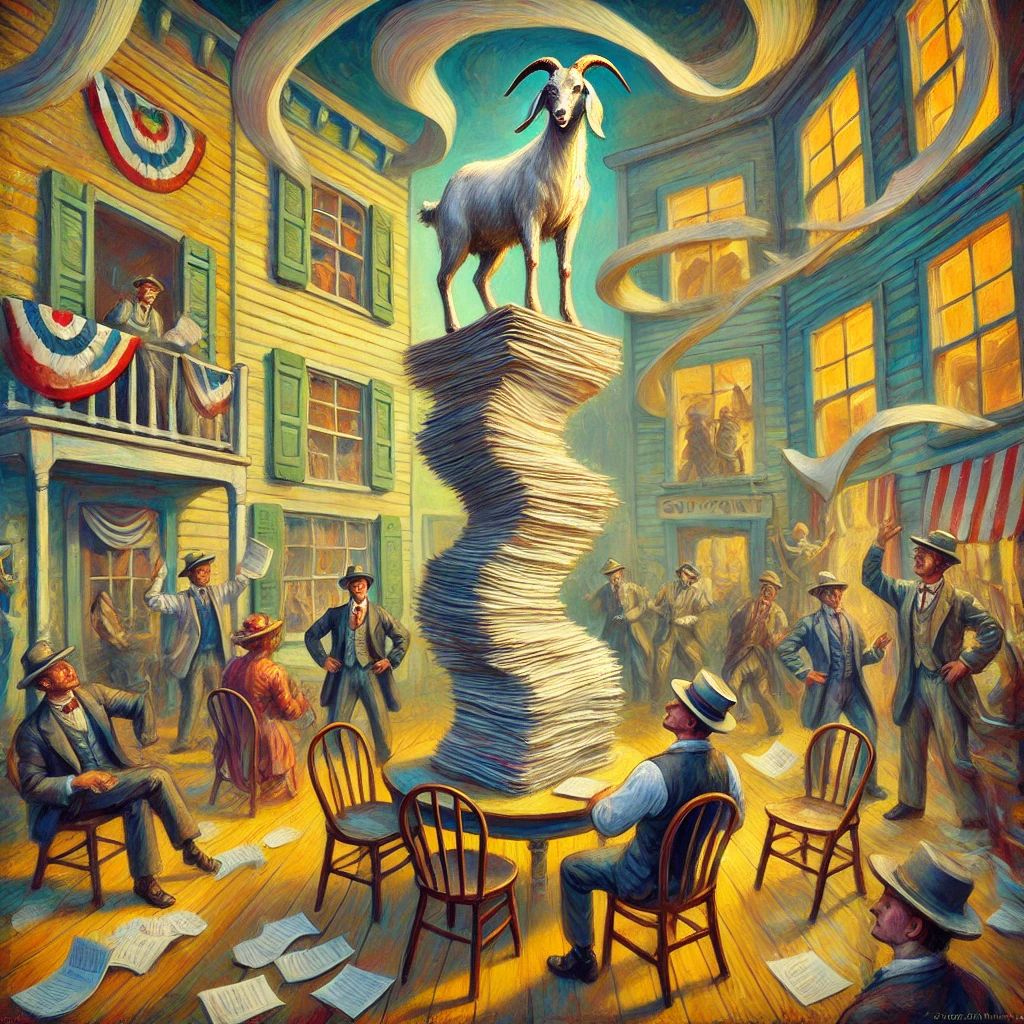
Doug “Doughboy” Teeter entered, followed closely by a goat that no one had officially invited but everyone had previously tolerated.
“Found him outside,” Doughboy said. “Figured he might belong to someone.”
The goat walked straight to the table.
Paused.
Looked at the paper.
And ate it.
Silence settled over the room like a decision no one wanted to claim.
“Well,” Clovis said finally, “that changes things.”
Mabel stared at the goat.
“That was the complaint.”
The goat chewed thoughtfully.
Shelley leaned forward. “Without the original document, we may need to reconstruct the issue.”
“I remember it,” Mabel said.
“That’s subjective,” Tiffany replied.
Mabel leaned back slowly.
“So is everything else in this room.”
Act III – The First Meeting of the Task Force
Act IV – Reconstruction Without Memory
The task force reconvened at Town Hall the next morning, now without the original complaint but with significantly more paperwork.
Chester Ray Blevins had already printed twenty copies of a form titled “Reconstructed Complaint Intake Sheet.”
“Figured we’d need backups,” he said.
“We don’t have the original,” Mabel said.
“That’s why we have copies,” Chester Ray replied.
Clovis stood at the front with a marker.
“Let’s list what we think the issue was.”
Boot raised a hand. “Water.”
“Good,” Clovis said, writing it down.
Shelley added, “Standing water.”
“Excellent.”
RT chimed in. “Possible liability.”
“Important.”
Tiffany said, “Potential regulatory oversight.”
“Critical.”
Mabel spoke. “It’s a ditch that won’t drain.”
Clovis paused.
“That’s one interpretation.”

Act IV – Reconstruction Without Memory
Mabel closed her eyes briefly.
“Is there another?”
Clovis gestured to the board. “We have four.”
Sheriff Peeler leaned against the wall.
“You’ve got four ways to not fix it.”
Pastor Peeler stepped forward. “We mustn’t rush to action before understanding.”
Mabel stood.
“I understood it yesterday.”
“Yesterday,” Shelley said gently, “we had a document.”
Mabel looked at the goat, now tied loosely to a chair.
“You had a document,” she said. “I had a problem.”

Act IV – Reconstruction Without Memory
Act V – Expansion of Responsibility
By the third meeting, the task force had grown.
Coach Freddie Stubblefield attended “to observe team dynamics.”
Brett and Alyssa Crenshaw arrived “to represent community stakeholders.”
Officer Kenny Joe Teeter took notes “for potential enforcement implications.”
Mister Wade Langston sat quietly, nodding at intervals that suggested agreement with something—though no one could say what.
The whiteboard now contained twelve bullet points and no solutions.
“We should subdivide,” Shelley suggested.
“Into what?” Boot asked.
“Subcommittees.”
RT nodded. “Drainage, health, liability, and communications.”
Tiffany added, “And documentation.”
Clovis smiled. “Now we’re getting somewhere.”
Mabel looked around the room.
“Where?”
No one answered directly, but several people wrote things down.
Dr. Cowgill cleared his throat. “We should consider field observation.”
“That sounds like work,” Boot said.
“It sounds like data,” Shelley corrected.
Sheriff Peeler stood up.
“It sounds like walking behind the diner.”
There was a pause.
A long one.
“Well,” Clovis said finally, “we should schedule that.”
Act V – Expansion of Responsibility
Act VI – The Scheduled Observation
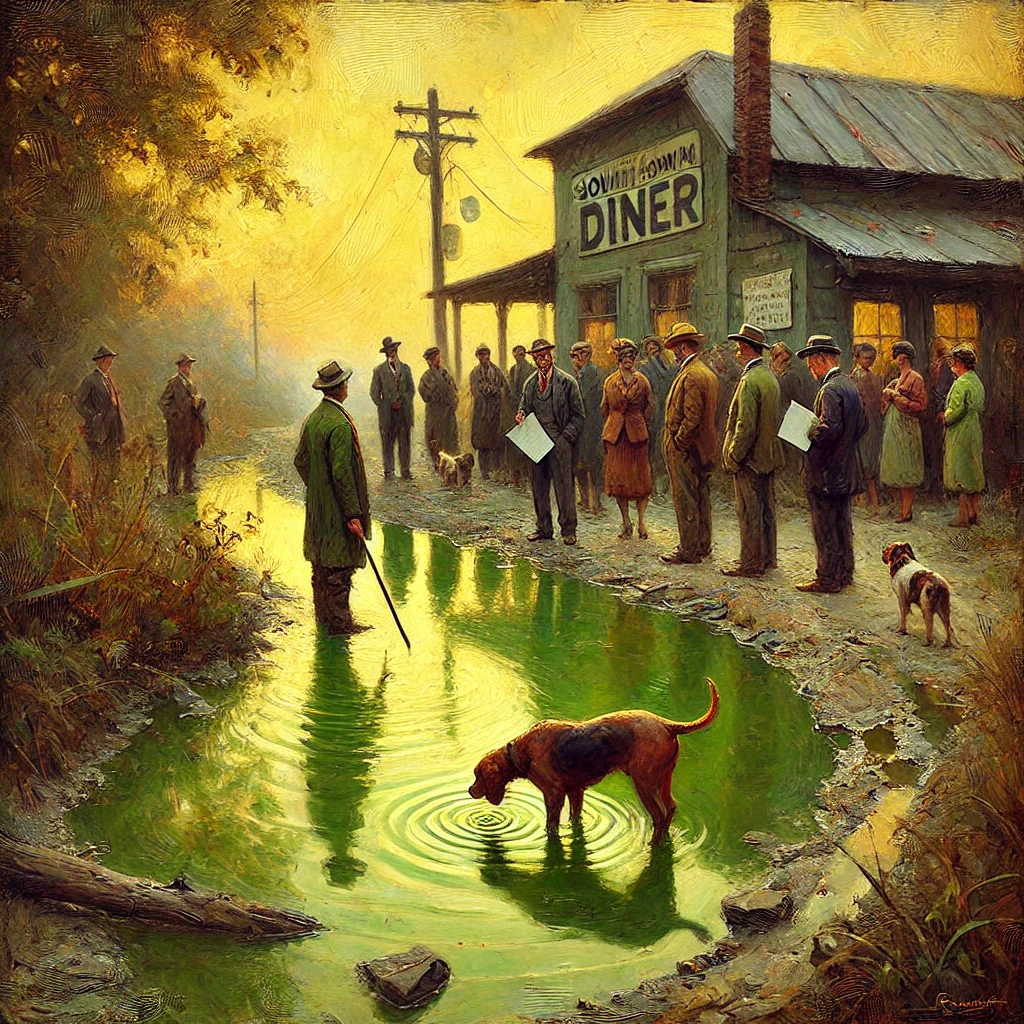
Three days later, the task force gathered behind the diner.
The ditch remained.
The water remained.
The mosquitoes had, by all appearances, expanded their operations.
Mabel stood at the edge.
“This is it.”
“Confirmed presence of water.”
Shelley added, “Observed stagnation.”
RT said, “Potential risk.”
Boot picked up a stick and poked the water.
“It’s not draining.”
Everyone wrote that down.
Sheriff Peeler looked at Mabel.
“You still got the problem?”
“I never lost it,” she said.
Daisy barked once, then sniffed the edge of the ditch.
The goat, having slipped its rope, wandered over and drank.
“Well,” Tiffany said, “that introduces a new variable.”
“What variable?” Mabel asked.
“Livestock interaction.”
Mabel stared.
“It’s a ditch.”
Shelley nodded. “A complex ditch.”

Act VI – The Scheduled Observation
Act VII – Formalization of the Task Force
Back at Town Hall, the task force was officially renamed:
“The Multi-Jurisdictional Drainage Evaluation and Response Task Force.”
Chester Ray printed new badges.
“We needed something official,” he said.
Clovis stood proudly at the front.
“With this designation,” he said, “we can now apply for recognition.”
“From who?” Boot asked.
“Other task forces.”
Mabel sat down heavily.
“You’ve named it,” she said. “Have you fixed it?”
Shelley smiled. “We’ve structured it.”
RT added, “We’ve expanded it.”
Tiffany said, “We’ve documented it.”
Sheriff Peeler shook his head.
“You’ve buried it.”
Pastor Peeler raised a hand.
“Sometimes things must be buried before they can be resurrected.”
Mabel stood again.
“It’s not dead.”
Act VII – Formalization of the Task Force
Act VIII – The Meeting About the Meeting
The next gathering was not about the ditch.
It was about the meetings.
“We need to streamline,” Shelley said.
“Or expand,” RT countered.
“Or rotate leadership,” Tiffany suggested.
Clovis nodded. “Or all three.”
Mabel raised her hand.
“What about the ditch?”
Shelley looked sympathetic.
“That’s under review.”
“By who?”
“Several groups.”
“Doing what?”
“Evaluating.”
Mabel sat back.
“You’ve turned a ditch into a philosophy.”
Sheriff Peeler leaned forward.
“They’ve turned it into a schedule.”
Daisy barked again.
The goat chewed something that may or may not have been a meeting agenda.

Act VIII – The Meeting About the Meeting
Act IX – The Original Problem Returns
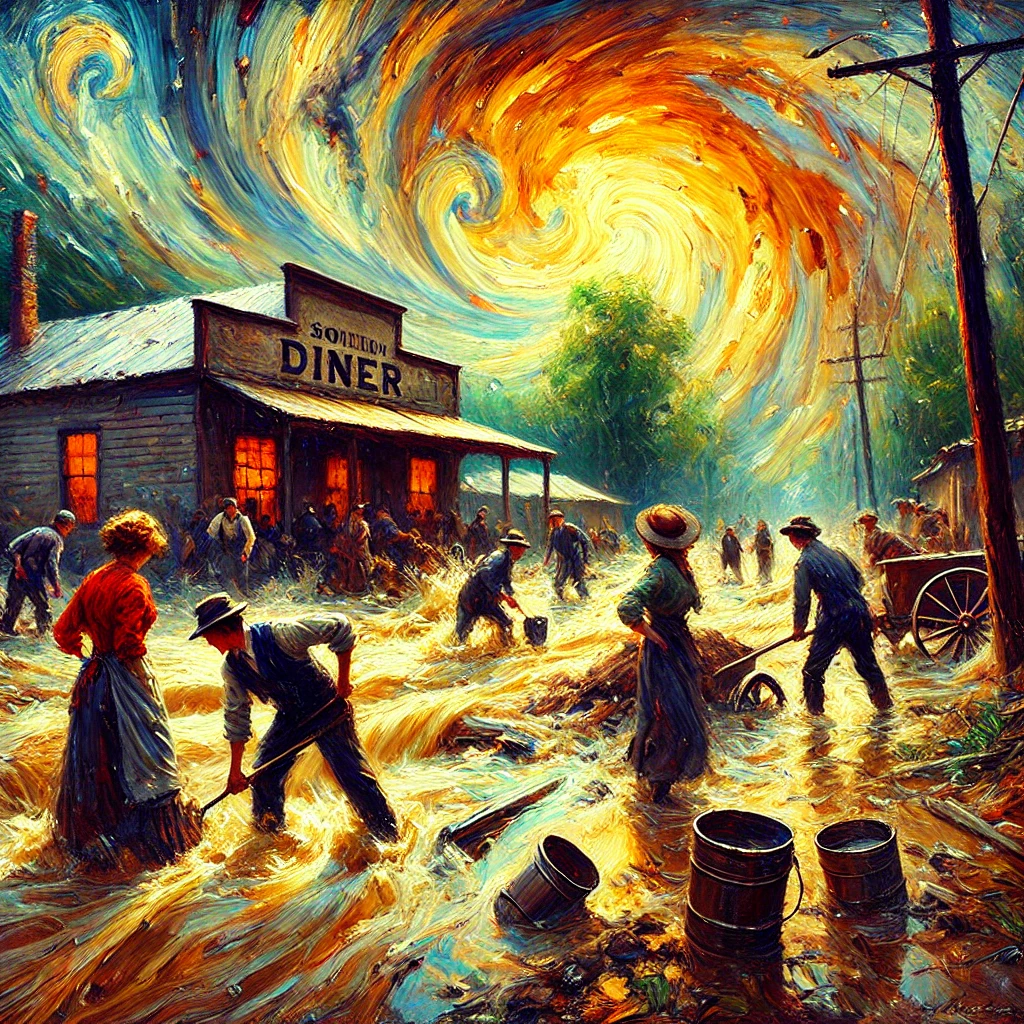
It rained.
Not heavily—but enough.
By morning, the ditch had overflowed.
Water crept toward the diner.
Sonny stood in the doorway, watching it approach like an uninvited customer.
Mabel arrived first.
Then Boot.
Then Sheriff Peeler.
Then everyone else.
No one brought a clipboard.
Clovis looked at the water.
“Well,” he said, “this escalated.”
Mabel stepped into the mud.
“This continued.”
Shelley looked concerned. “We may need emergency authorization.”
RT nodded. “Or rapid response coordination.”
Sheriff Peeler took off his hat.
“Or a shovel.”
Boot found one.
So did Sonny.
Mabel picked one up.
Daisy barked.
The goat stood nearby, chewing thoughtfully.
For a moment, no one moved.
Then Mabel did.
She dug.

Act IX – The Original Problem Returns
Boot followed.
Sheriff Peeler joined.
Slowly, reluctantly, the rest of the task force stepped forward.
Clovis hesitated—then grabbed a shovel.
Shelley removed her jacket.
Tiffany rolled up her sleeves.
RT muttered something about liability and started digging anyway.
The water shifted.
Just slightly.
Then more.
A path opened.
Not perfect.
But enough.
Mabel stopped.
Looked at the ditch.
Then at the group.
“That’s what it needed.”
No one wrote that down.
Act IX – The Original Problem Returns
Epilogue – The Task Force Remains
Weeks later, the ditch still drained.
The mosquitoes had relocated.
The diner resumed its usual rhythm.
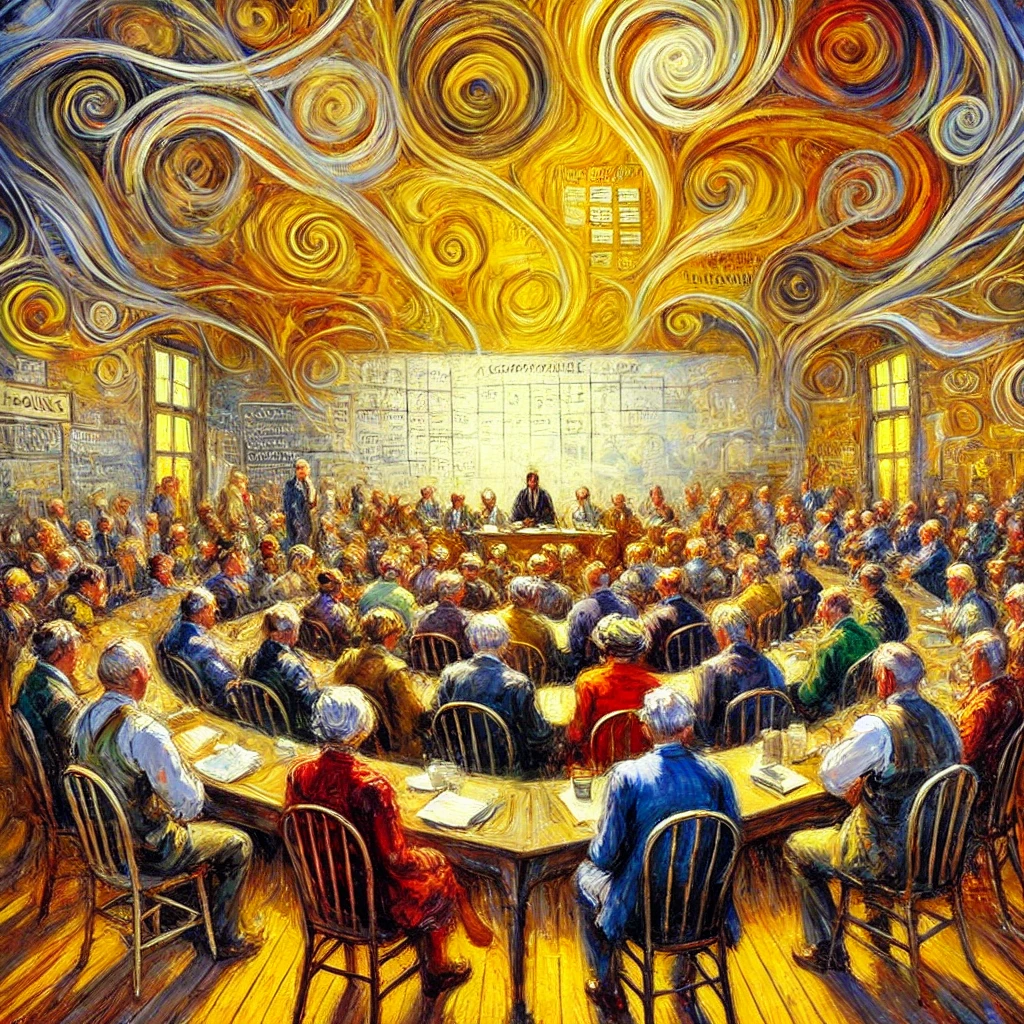
The task force, however, did not dissolve.
It met regularly.
Reviewed documents.
Discussed expansion.
Considered new issues.
The original complaint was never refiled.
There was no need.
Mabel still kept a blank sheet of paper on her porch.
Just in case.
Clovis still attended meetings.
Boot still brought a shovel.
Sheriff Peeler still watched.
Daisy still listened.
The goat still wandered.
And the task force—
It continued.
Not because it was needed.
But because it existed.
Epilogue – The Task Force Remains
Disclaimer
This story is a work of fiction set in the entirely fictional town of Sequatchie Crossing. Any resemblance to real people, places, or bureaucratic processes is purely coincidental, though perhaps statistically inevitable. No actual task forces were harmed in the making of this story, though several may have been formed in response. The goat’s actions, while narratively convenient, should not be interpreted as a formal critique of document retention policies.

Disclaimer – A Completely Fictional Process
Real Places Behind the Ruckus – From The Dunlap Directory

Real Places Behind the Ruckus – From The Dunlap Directory
Yes, this story was fictional; even the parts that weren’t true. These places? Absolutely real. Stop by, support local, and keep the Wi-Fi away from livestock:
- Mountain Top Diesel Repair
- Studio Dunlap
- Walker’s Dirt Work LLC
- Sunrise Sorghum
- Creekside Apartments
- Raccoon Mountain Caverns and Campground
- Prime Income & Tax Services
- Sequatchie Valley TN
- Bird Fork Farm
- Ed’s Lawn Care
- Beau Brown Of Jason Lewis Dunlap Supercenter
- Love Cleaning
- Dunlap Ballet School
- Dollar Tree Store #5152
- River Life RV Resort

Real Places Behind the Ruckus – From The Dunlap Directory
At Sequatchie Crossing, we tell the stories of Sequatchie Crossing.
Please share this post with your friends, family, or business associates who may want follow the news from Sequatchie Crossing.


0 Comments