


Sparks, Sirens, and the Moment Sequatchie Lost Power
By Tom Seest
At Sequatchie Crossing, we tell the stories of Sequatchie Crossing.
Please share this post with your friends, family, or business associates.
🎤 Audio Overview
The Blessing Of The Fireworks Dry Run – Sparks Fly As Sequatchie Loses Power
In Sequatchie Crossing, there’s a fine line between civic tradition and rural improvisation. The Annual Fireworks Dry Run straddles that line like Clovis Strickland straddles his lawn chair: precariously, with questionable balance, and always while holding a beer.
Held every year behind the VFW—conveniently located just a short jog away from both the cow pond and the fire station—the Dry Run was ostensibly for “safety testing.” In reality, it was an excuse for Boot Barnes to show off his new pyrotechnic inventory, half of which he’d picked up in a questionable swap meet down in Trenton, Georgia.
“Got this one from a fella who swore it was street-legal in Romania,” Boot bragged, patting a crate labeled in Cyrillic and reeking of gunpowder and goat.
Pastor Peeler insisted on beginning with a “blessing of the combustibles,” a practice he claimed dated back to the Old Testament but had in fact only begun last year, after Sister Bertie caught a Roman candle in the wig during an ill-timed bathroom break.

The Blessing Of The Fireworks Dry Run – Sparks Fly As Sequatchie Loses Power
As the sun dipped below the horizon, painting the Sequatchie Valley a warm golden hue, a collective buzz hung in the air, tinged with anticipation. There’s something inherently magnetic about fireworks—a promise of illumination that stirs both childhood wonder and deeply-held traditions. But this year’s dry run, a test for the grand display to come, took an unexpected turn as the power flickered and then vanished. Instead of a mere hiccup, it turned into a spectacle of resilience, igniting the spirit of a community that knows how to rise from the ashes of misfortune.
When the lights went out, the initial reactions were a tapestry of confusion and concern. Spirits sagged, and murmurs of disappointment washed over the crowd. But then something remarkable happened: instead of retreating to their cars or murmuring their grievances, people stepped forward, drawn together in a shared challenge. Neighbors became partners, and strangers turned into comrades, united by the unpredictable nature of life itself. A portable generator was summoned, sparking a wave of creativity. What started as a setback morphed into an impromptu gathering of laughter and camaraderie.
In that moment, Sequatchie wasn’t just a town; it was a living, breathing entity—an embodiment of the idea that resilience is forged in the face of adversity. The flickering of the generator became a metaphor for persistence, a nod to the power of community over the flicker of failure. The cheers that erupted from the crowd when those first few bursts of light illuminated the night were not just for the colors above, but a celebration of humanity’s unwavering spirit.
Each spark resonated deeper than the mere visual spectacle; it was a reminder of the bonds that tie us, of trust built in the spaces between. People, arms linked, stood side by side, witnessing the transformative power of connection. This night became more than just a dry run for a fireworks show—it evolved into a testament to Sequatchie’s heartbeat, a celebration of the strength that emerges when we confront unexpected challenges together.
In a world often overshadowed by struggles, this community’s ability to find joy in the unpredictable can serve as an enlightening spark for us all. It poses the question: when the lights go dim in your own life, how will you illuminate the darkness?

By 7:00 p.m., a small crowd had gathered in a crescent of lawn chairs and coolers. Trixie Jo Bartlett, recently self-appointed Youth Mayor (elected 1–0 at recess), stood with a clipboard, insisting on conducting a pre-show inspection.
“These sparklers are clearly non-biodegradable, Boot. As Youth Mayor, I cannot endorse this environmental negligence.”
Boot looked at her like she was a tax form.
Mabel Dean Ashcroft, matriarch of the Ladies for Civic Decency, arrived in full patriotic regalia—complete with sequined flag hat and a sash reading “BLAST RESPONSIBLY.”
Clovis Strickland was assigned security, which consisted of yelling “STAND BACK!” every few minutes while trying to light a Marlboro in the breeze.
Meanwhile, three confused tourists in cargo shorts wandered into the event after taking a wrong turn on their way to the Buc-ee’s in Cleveland. They were swiftly recruited by Pastor Peeler as honorary deacons for the blessing.

As the sun dipped behind the ridge, Pastor Peeler raised his hands skyward and began the invocation.
“Lord, we thank you for freedom, fireworks, and the firmament from which they rise…”
That’s when Boot, mistaking the pause after “Amen” as go-time, hit the ignition on the first fuse.
A low whistle turned into a high-pitched shriek as the rocket corkscrewed sideways—past the deacons, through the snack table, and directly into the fuse pile.
There was a brief silence, followed by what Clovis would later describe as “the opening scene of Platoon.”
Roman candles ricocheted off the VFW siding. A neon green comet launched through Pastor Peeler’s hymnbook, igniting a psalm. The “Romanian special” shot fifteen feet in the air, rotated slowly, then plummeted directly into Old Man Tarpin’s cow pond, which promptly began to boil and flash like a disco.
Mabel Dean Ashcroft, clutching her pearls and a Tupperware of deviled eggs, shouted, “This is exactly what happened in 1982!”
Trixie Jo, ever the aspiring despot, declared a Code Red Curfew on all adults over 30 and tried to confiscate Boot’s keys.
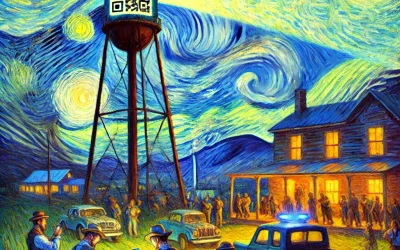
Then the power cut out.
Sequatchie Crossing doesn’t have a real power grid so much as a cooperative understanding with the TVA, mediated by a squirrel-infested substation and a retired lineman named Uncle Delton. So when half the town lost electricity—including the Piggly Wiggly, the radio station, and the CrossFit studio run by that one guy from Atlanta who never quite fit in—everyone knew who to blame.
Boot.
“I ain’t sayin’ it was my fault,” he offered from behind a burnt lawn chair, “but maybe the Romanian one had…a little more kick than expected.”
With the fireworks temporarily paused (by which we mean all the ones hadn’t already exploded), the crowd moved indoors to the VFW, lit by emergency lanterns and at least one gas-powered margarita blender.
Pastor Peeler offered a second prayer—this time less about blessings and more about “legal liability.”
Meanwhile, Clovis emerged triumphantly from the shed with a backup generator powered by lawn mower engines and chewing gum. It coughed, sputtered, and roared to life, just as Boot remembered the box labeled “DO NOT STORE IN DIRECT LIGHT.”
Trixie Jo tried to call for backup on her kid-safe smartwatch, but the only app installed was a multiplication game.
By 10:00 p.m., power was restored, most of the grass fires were out, and the fire department (volunteer, but enthusiastic) arrived just in time to eat pie and take selfies.
The town survived. Barely. Mabel Dean submitted a five-page grievance to the city council, which consisted of three pages of scripture and two of glitter. Pastor Peeler announced a new policy: all fireworks must be blessed and background-checked. Boot was gently advised to restrict future inventory purchases to Tennessee-legal products or, at the very least, things with English instructions.
Trixie Jo held an emergency Youth Mayoral Press Conference in her backyard treehouse, demanding a federal investigation and proposing a “Firework-Free Freedom Festival” featuring interpretive dance instead.
No one showed up.
In Sequatchie Crossing, the only thing more combustible than fireworks is civic pride. And both, when handled improperly, tend to explode right around suppertime.
Disclaimer: This story is entirely fictional except for the parts that aren’t true. Any resemblance to real people, living or just stubborn, is purely accidental—but also maybe a little flattering. Sequatchie Crossing exists only in the minds of those brave enough to imagine a town where zoning laws, casseroles, and conspiracy cassettes collide in glorious disarray.
At Sequatchie Crossing, we tell the stories of Sequatchie Crossing.
Please share this post with your friends, family, or business associates.

0 Comments