


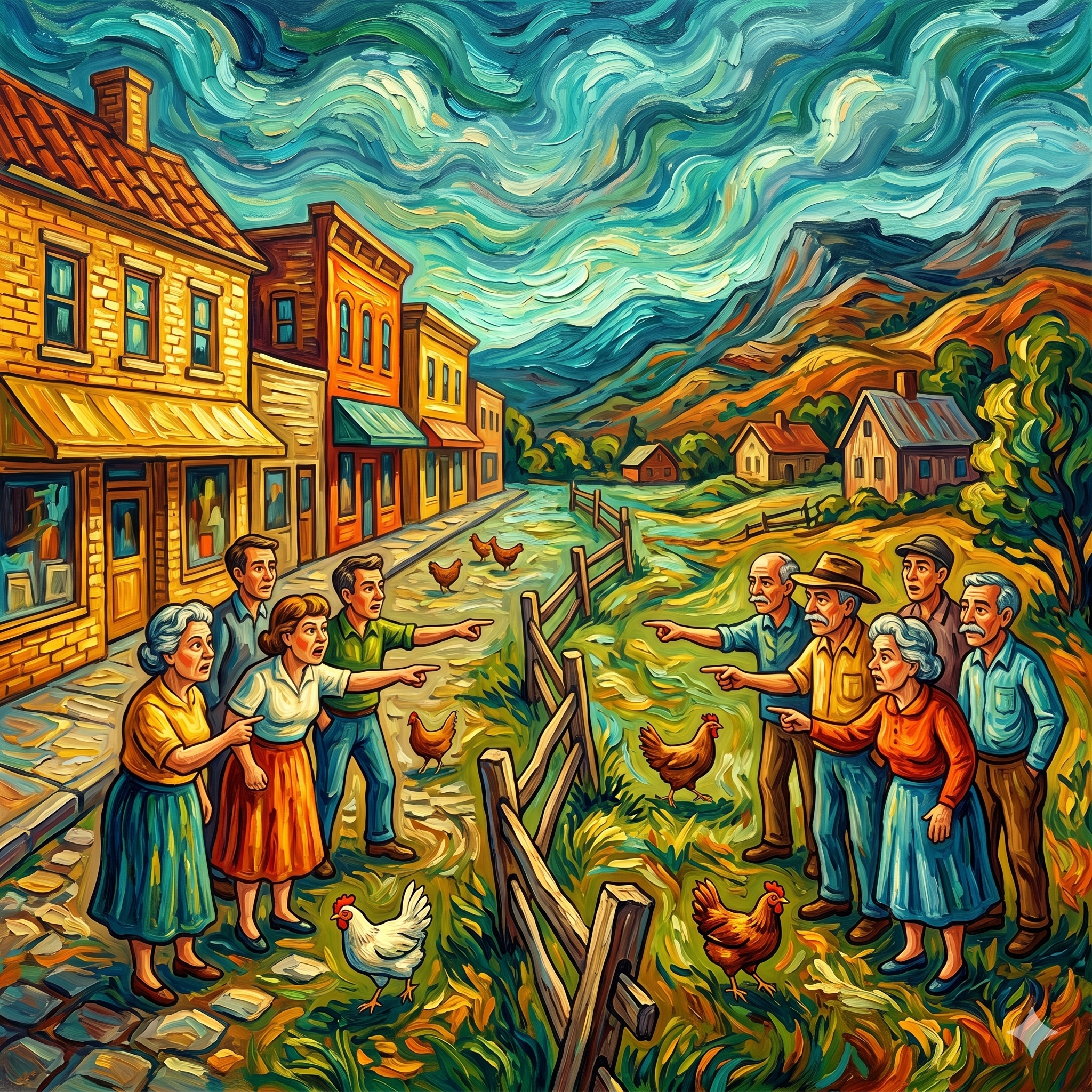
Mutual Certainty Achieved Without Shared Accountability.
By Tom Seest
At Sequatchie Crossing, we tell the stories of Sequatchie Crossing.
Please share this post with your friends, family, or business associates who may want follow the news from Sequatchie Crossing.
🎤 Audio Overview
🎤 Song For This Story
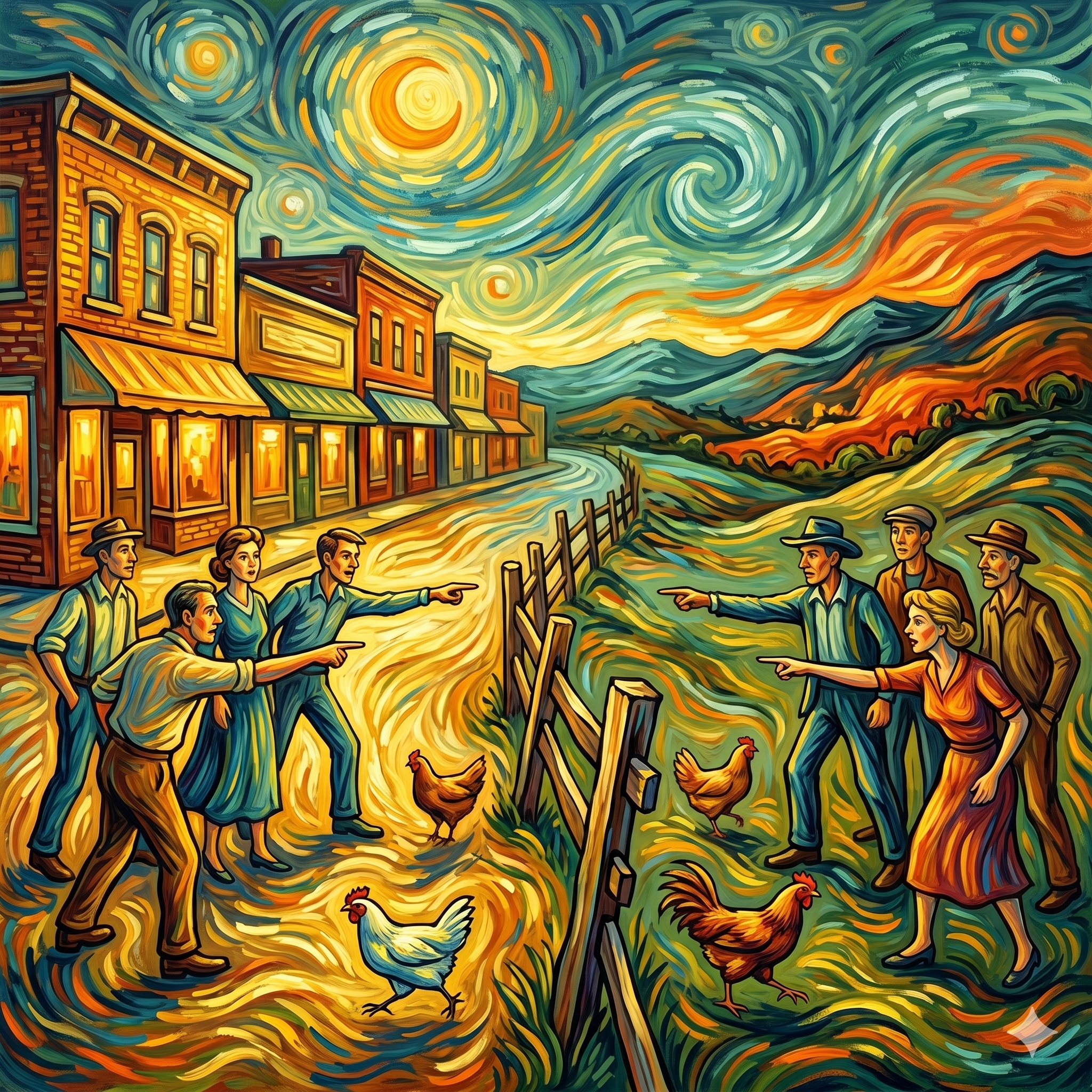
Townies and Hill Folks Agree It’s the Other One’s Fault
Act I – The Porch That Faced Both Ways
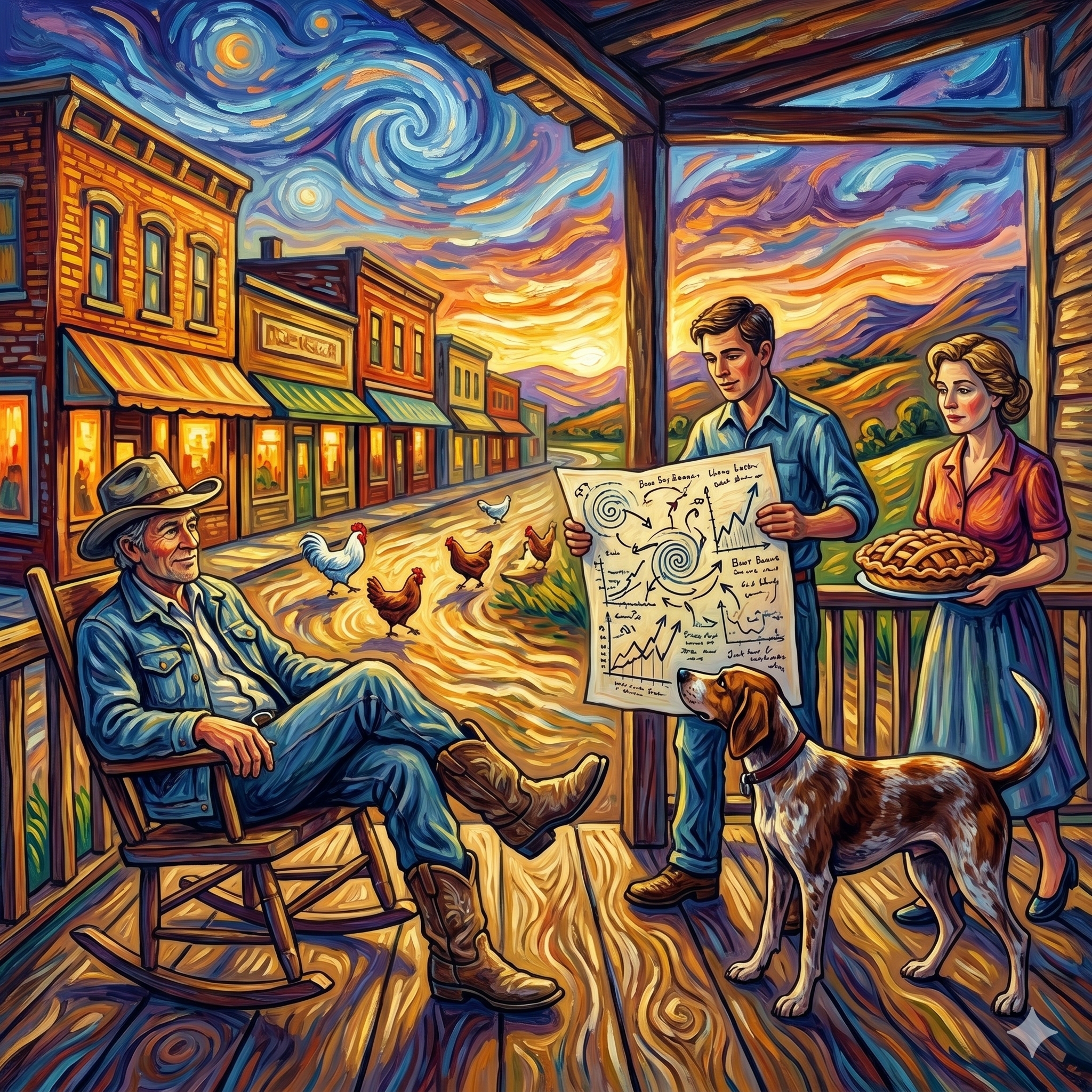
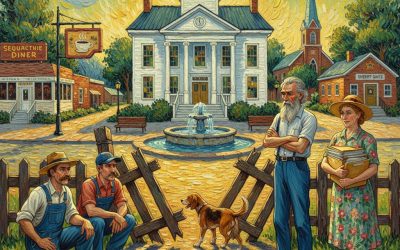
Boot Barnes sat on his porch in a chair that leaned slightly left, though nobody had ever agreed on whether that was by design or deterioration.
From that vantage point, he could see the town proper—brick storefronts, the diner, the courthouse—and just beyond, rising up in stubborn defiance of municipal planning, the hills.
Boot sipped coffee and watched as Clovis Strickland approached with a poster board tucked under one arm like it was a newborn calf.
“Morning, Boot,” Clovis said, adjusting his glasses.
“That one look like trouble,” Boot replied, nodding at the poster.
“It’s not trouble,” Clovis said, setting it against the porch railing. “It’s clarity.”
Boot squinted. “Clarity usually comes in smaller sizes.”
Clovis ignored that. “I’ve compiled a comparative analysis.”
“Of what?”
“Townies versus Hill Folks,” Clovis said. “Cause-and-effect relationships across a thirty-year degradation curve.”
Boot blinked once. “You mean who’s to blame.”
Clovis beamed. “Exactly.”
Just then, Daisy the hound wandered up, sniffed the chart, and sneezed twice.
“That’s peer review,” Boot said.
Clovis tapped the board. “You’ll see here—” He pointed to a series of hand-drawn graphs. “Property disputes, road maintenance complaints, festival disagreements—all trending upward. Correlation aligns with increased Hill Folk participation in town affairs.”
Boot leaned forward. “Participation or presence?”
Clovis paused. “Presence… leading to participation.”
Boot nodded slowly. “That’s a flexible definition.”
From down the road, Mabel Dean Ashcroft approached, carrying a pie and a memory.
“I remember when folks didn’t need charts to decide who was wrong,” she said, setting the pie down without invitation. “We just rotated it.”
“Rotated what?” Clovis asked.
“Blame,” Mabel said. “Every Sunday after service, we’d swap grievances like casseroles. Kept things fair.”
Boot nodded. “That sounds efficient.”
Clovis frowned. “Efficiency is not the goal. Accuracy is.”
Mabel smiled. “Well, you’ve certainly made it complicated enough to feel accurate.”
From the hills, a distant clucking rose—two flocks of chickens, separated by a fence that neither side claimed to have built.
They scattered in opposite directions.
Boot watched them go. “That’s about right.”
Act I – The Porch That Faced Both Ways
Act II – The Diner That Served Both Sides
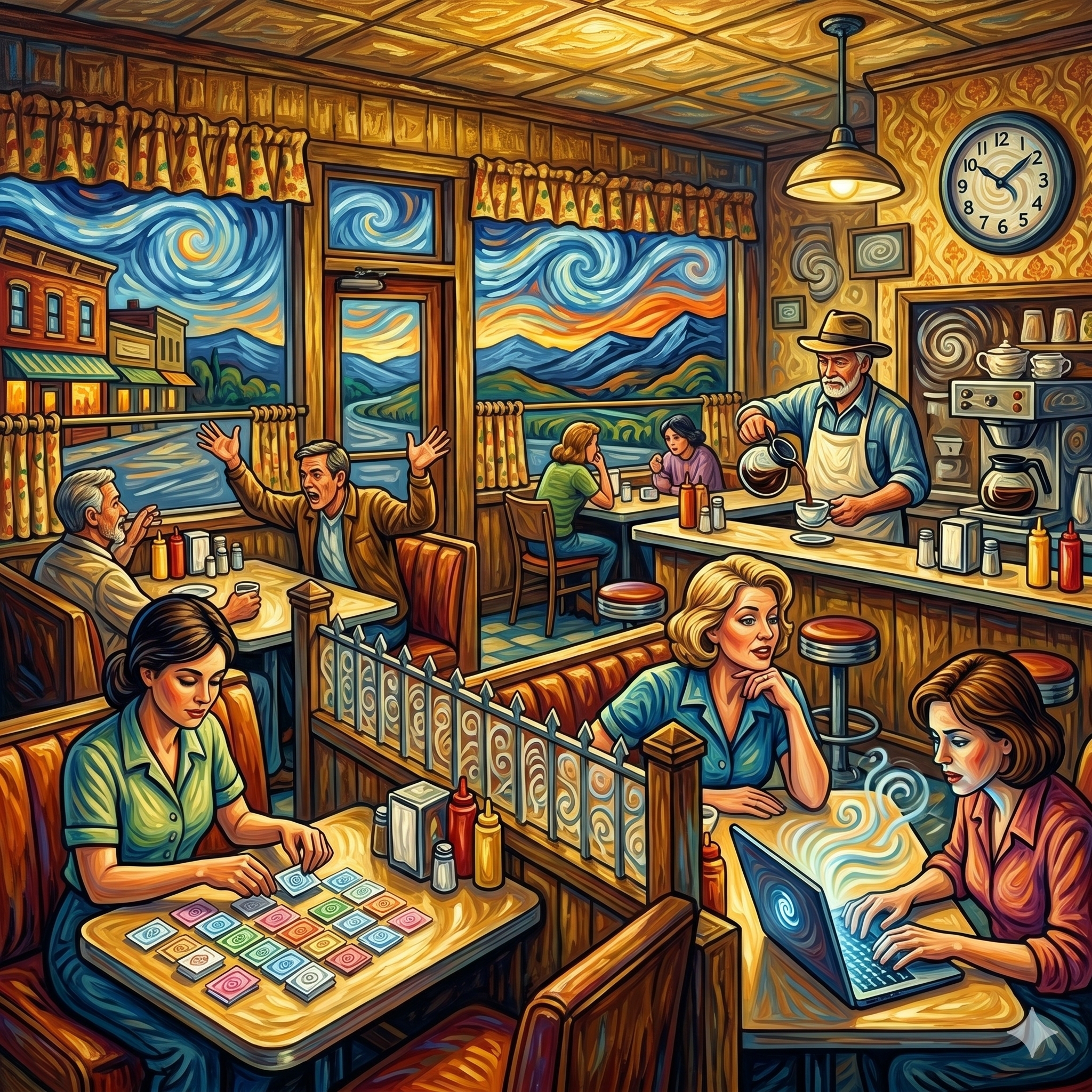
Inside the diner, Tiffany Annette Roark was organizing sugar packets by perceived intention.
“White for neutral, brown for conflicted, pink for denial,” she muttered.
Trixie Jo Bartlett slid into a booth. “You got anything for confusion?”
Tiffany handed her a yellow packet. “That’s artificial clarity.”
At the counter, Shelley Fawn Wexler typed furiously into her laptop.
“I’m documenting this,” she said. “Dual narratives, conflicting identities, shared geography.”
Santiago “Sonny” Morales poured coffee. “You writing a story or a warning label?”
“Both,” Shelley said. “Depends who reads it.”
At a nearby table, RT Mullins leaned back, boots on the seat.
“I been saying it for years,” he said. “Townies think they run everything. Hill Folks just react.”
From across the room, Maggie Sue Dillard stood up. “React? We built half the roads you complain about!”
“They curve too much,” RT said.
“They follow the land,” Maggie Sue shot back.
“They confuse the GPS,” RT replied.
“That’s because you trust it,” Maggie Sue said.
The room went quiet.
Chester Ray Blevins, sipping sweet tea, whispered, “That’s a fair point.”
Behind the counter, Sonny nodded. “GPS don’t know where it is half the time. Just like the rest of us.”
Tiffany looked up. “So who’s fixing it?”
Everyone paused.
Then, in perfect unison: “They are.”
Boot, who had wandered in unnoticed, leaned against the doorframe.
“That’s a clean split,” he said. “Nobody owns it, everybody’s certain.”
Daisy barked once.
Shelley typed faster.
Act II – The Diner That Served Both Sides
Act III – The Town Hall That Hosted Both Arguments
Town Hall was filled beyond capacity, which in Sequatchie Crossing meant twelve people and a folding chair.
Clovis stood at the front, chart now mounted on an easel.
“Exhibit A,” he said. “Water usage discrepancies correlated with hillside irrigation patterns.”
From the back, Lurleen Davenport raised her hand. “You mean gardens?”
“Yes,” Clovis said. “Unregulated agricultural expansions.”
“That’s tomatoes,” Lurleen said.
“Tomatoes are data,” Clovis replied.
Sheriff Peeler stood beside him, arms crossed.
“We’re not here to argue tomatoes,” he said. “We’re here to assign responsibility.”
“Same thing,” Clovis muttered.
Officer Kenny Joe Teeter stepped forward. “We got reports of noise complaints, fence disputes, and one incident involving a goat and a mailbox.”
“That goat was provoked,” someone shouted.
Dr. Neil Cowgill adjusted his glasses. “I treated that goat. It had emotional trauma.”
“From the mailbox?” Kenny Joe asked.
“From the accusation,” Dr. Cowgill said.
Pastor Arnold Peeler stood up. “Folks, we need unity.”
Boot raised a hand. “Before unity, maybe a little ownership?”
The room shifted uncomfortably.
“Ownership implies fault,” Clovis said.
“Fault implies consequence,” Tiffany added from the back.
“Consequence implies change,” Shelley typed aloud.
Everyone froze.
“That escalated,” Sonny whispered.
From outside, the chickens clucked again—this time louder, more divided.
They scattered once more.
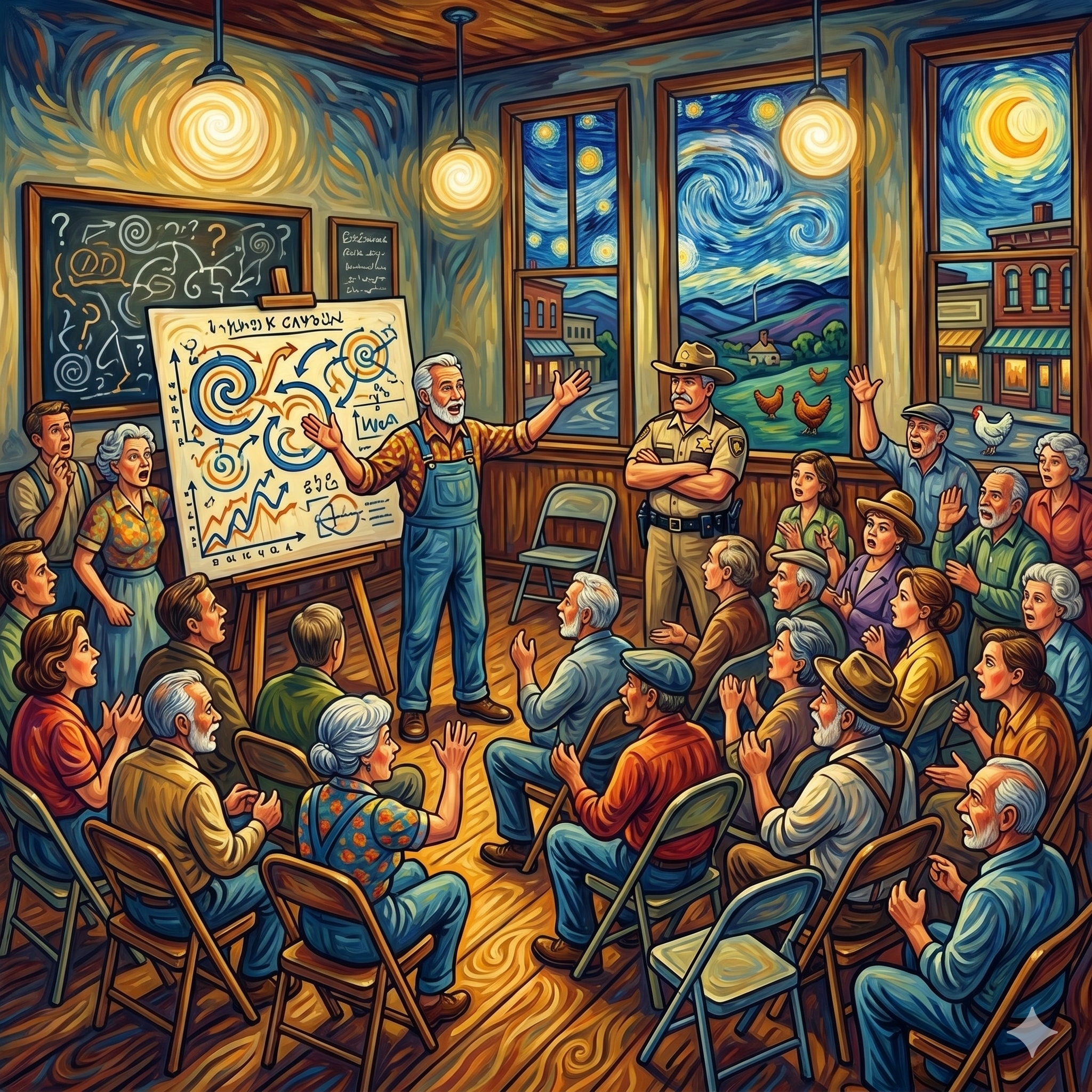
Act III – The Town Hall That Hosted Both Arguments
Act IV – The Church That Heard Both Confessions
Sunday service was packed, mostly because people suspected something might be said about them.
Pastor Arnold Peeler stood at the pulpit.
“We are gathered,” he began, “not as Townies or Hill Folks, but as one community.”
A murmur passed through the pews.
“That’s ambitious,” Mabel whispered to Evelyn Grace Tipton.
“We tried that in ’82,” Evelyn said. “Ended in a pie dispute.”
Pastor Peeler continued. “We must lay down our grievances.”
Boot leaned toward Clovis. “You got a chart for that?”
Clovis whispered, “I’m working on a forgiveness matrix.”
Sister Lila Mae “Hallelujah” Pruitt stood up. “I rebuke division!”
“Amen,” someone said.
“I rebuke charts!” she added.
Clovis flinched.
“I rebuke passive blame!” she continued.
Boot nodded. “That one’s new.”
From the back, Doug “Doughboy” Teeter raised his hand. “What if we rebuke the other side first, then unify?”
“That’s not how unity works,” Pastor Peeler said.
“It’s how we’ve always done it,” Doughboy replied.
Mabel stood. “We used to fix things together.”
“When?” Tiffany asked.
“Before we started keeping score,” Mabel said.
Shelley typed: “Scorekeeping as cultural shift.”
Outside, the chickens gathered briefly—then split again.
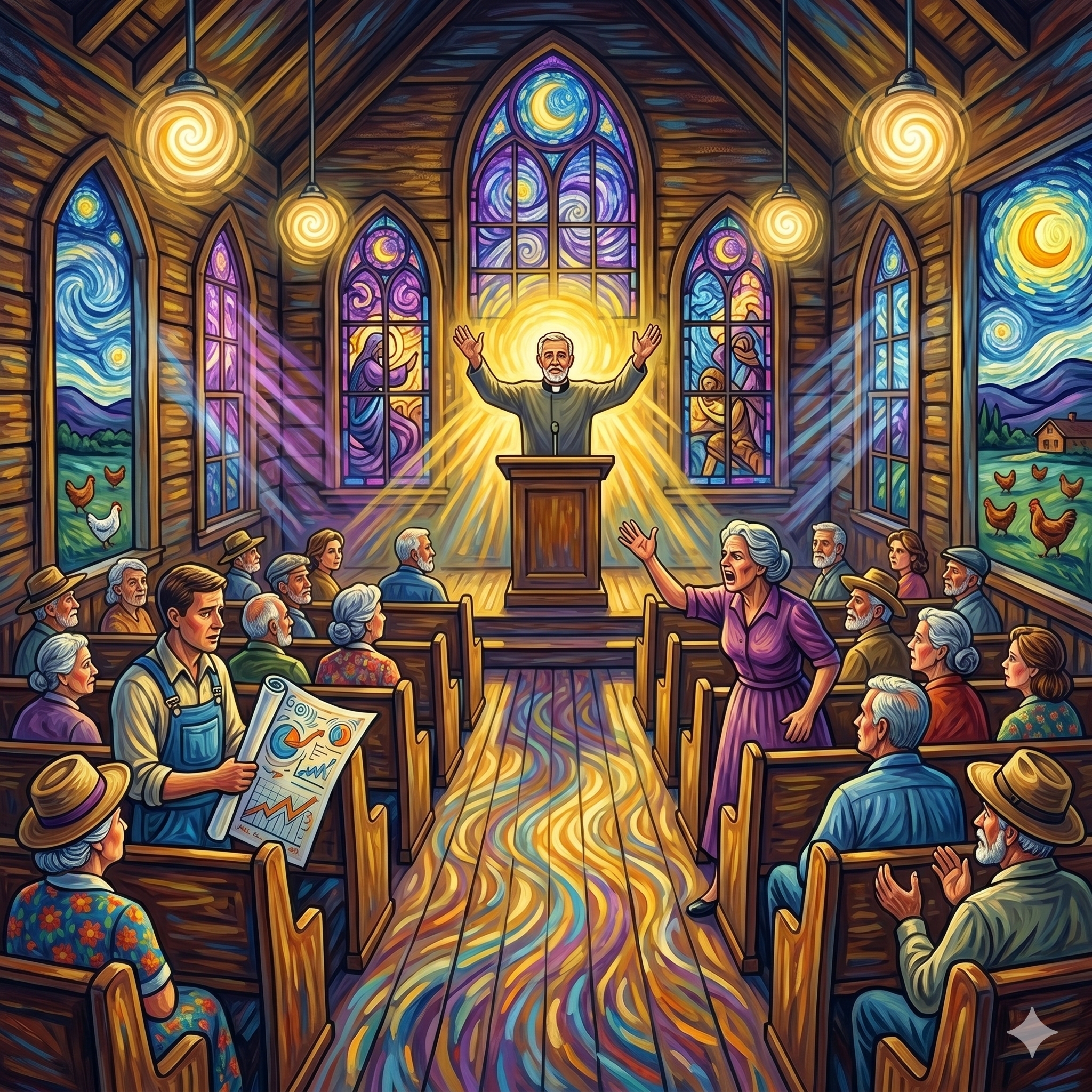
Act IV – The Church That Heard Both Confessions
Act V – The Sheriff’s Office That Filed Both Reports
Sheriff Peeler sat behind his desk, reviewing two identical complaints.
“Noise disturbance,” he read. “Filed by Townie against Hill Folk.”
He flipped the page. “Noise disturbance. Filed by Hill Folk against Townie.”
Kenny Joe Teeter leaned in. “Same time, same place.”
“Same wording,” Peeler said.
“They copied each other,” Kenny Joe said.
“They mirrored each other,” Peeler corrected.
Daisy barked twice.
“That’s agreement,” Peeler said.
Dr. Cowgill entered. “I’ve completed the psychological profiles.”
“Of who?” Kenny Joe asked.
“Everyone,” Dr. Cowgill said. “Symptoms include projection, deflection, and chronic certainty.”
“Treatment?” Peeler asked.
“Ownership,” Dr. Cowgill said.
The room went silent.
“Side effects?” Kenny Joe asked.
“Accountability,” Dr. Cowgill replied.
Daisy whimpered.
“Let’s hold off,” Peeler said.
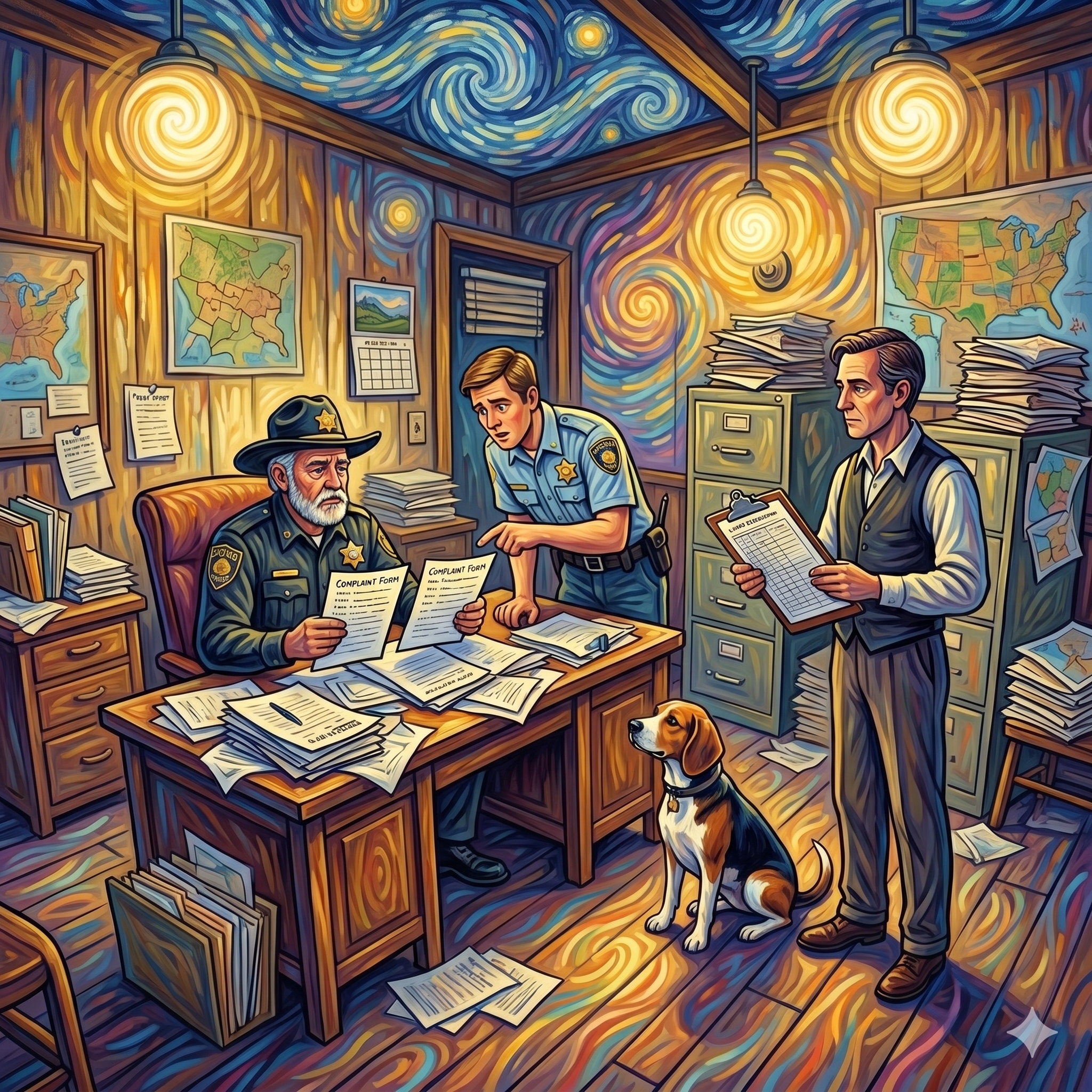
Act V – The Sheriff’s Office That Filed Both Reports
Act VI – The Field That Divided Itself
Out in the field between town and hill, Brett and Alyssa Crenshaw had set up a neutral zone.
“We thought maybe a shared space would help,” Alyssa said.
“For what?” RT asked.
“For dialogue,” Brett said.
Clovis arrived with a second chart.
“This one shows mutual escalation,” he said.
“Looks like a mirror,” Boot said.
“It is,” Clovis admitted.
Mabel stepped forward. “We used to meet here for picnics.”
“What happened?” Tiffany asked.
“We started assigning sides,” Mabel said.
Shelley typed: “Geography becomes identity.”
Sonny set up a grill. “Food usually helps.”
The chickens approached—two groups, eyeing each other.
Then someone sneezed.
They scattered again.
Boot sighed. “That’s the third time.”
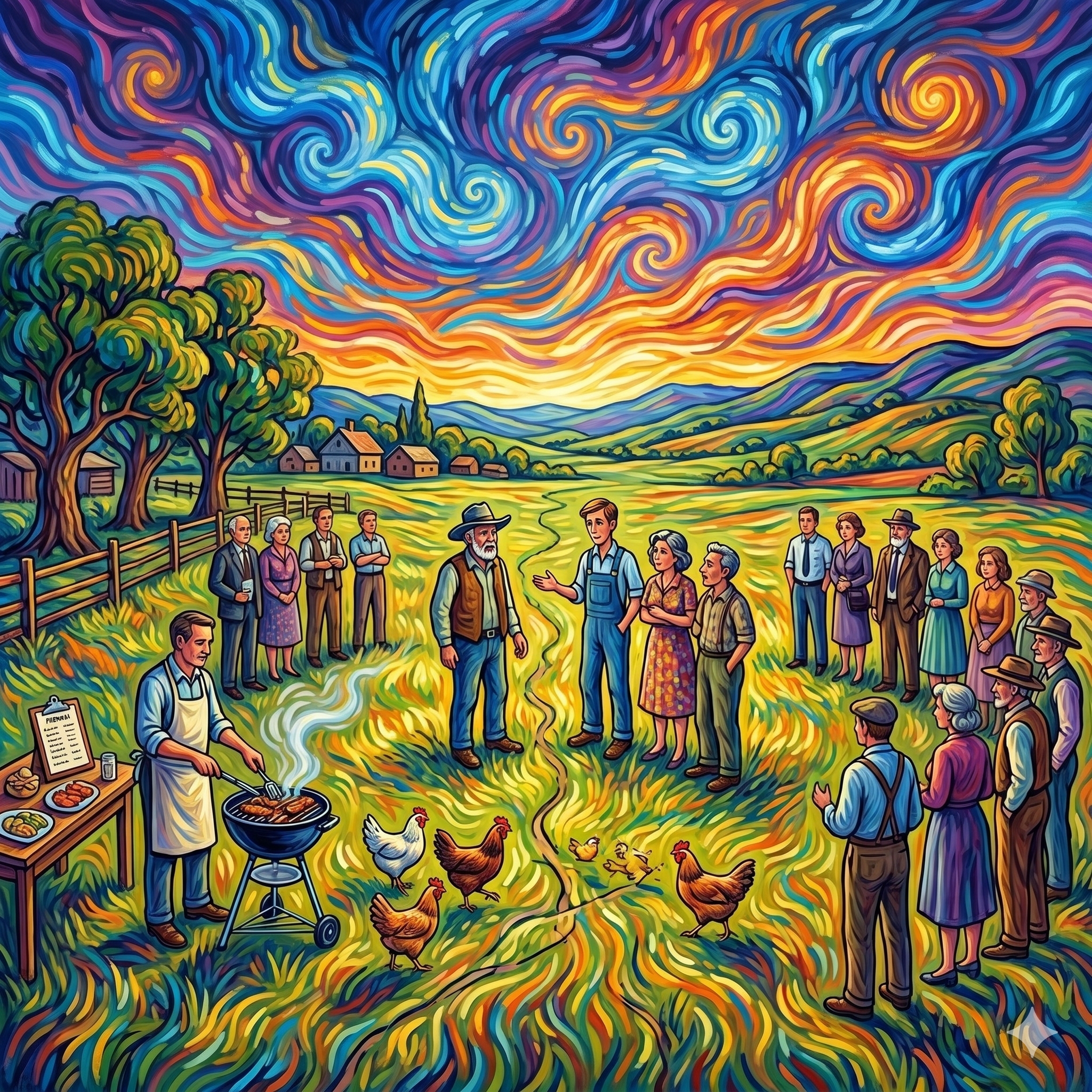
Act VI – The Field That Divided Itself
Act VII – The Diner Again, Now With More Opinions
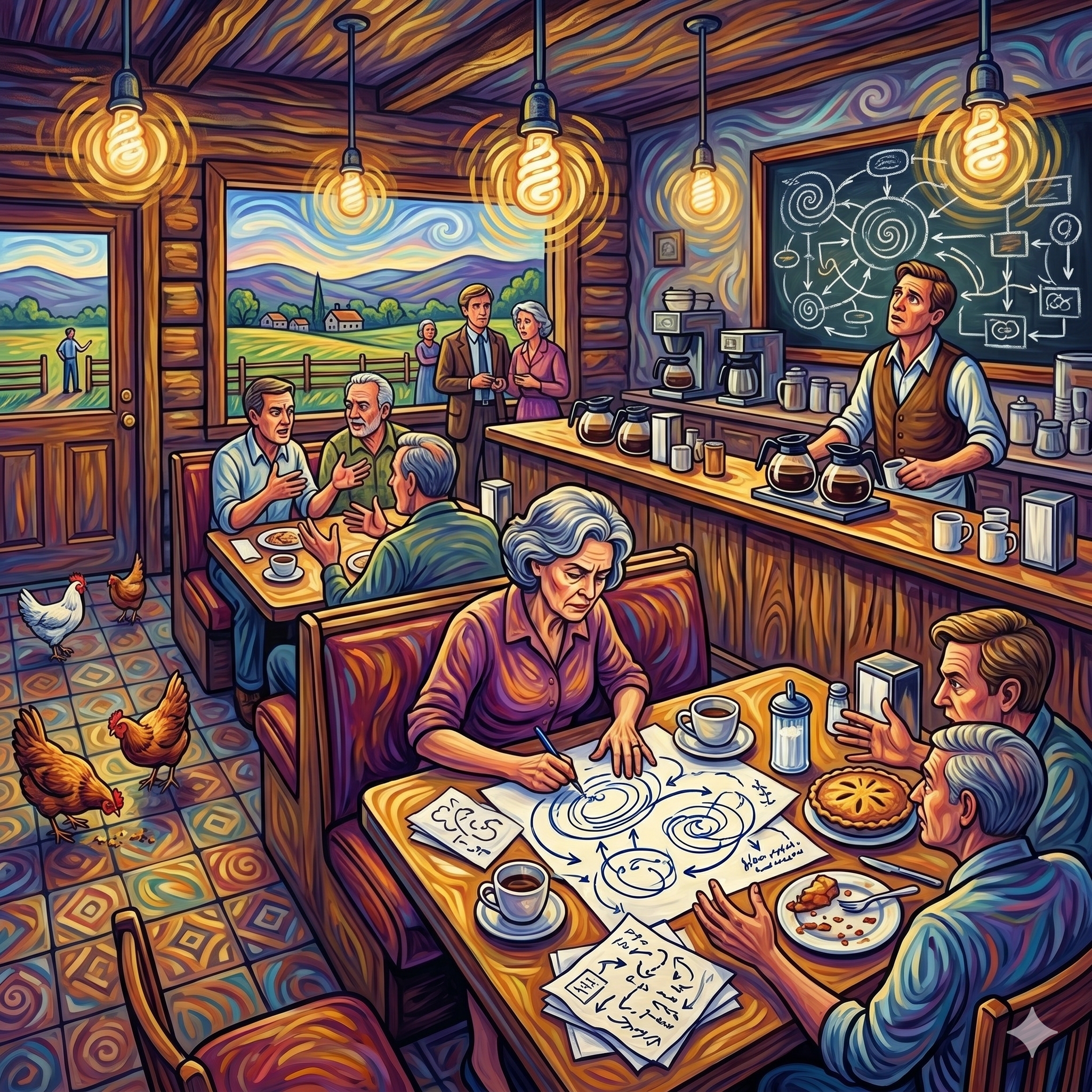
Back at the diner, the conversation had evolved into a loop.
“They started it.”
“No, they did.”
“They escalated.”
“They reacted.”
Shelley drew arrows on a napkin.
“It’s symmetrical,” she said. “Perfectly balanced blame.”
Clovis nodded. “Mathematically elegant.”
Mabel frowned. “Emotionally exhausting.”
Pastor Peeler sat down. “We need resolution.”
Boot leaned back. “Or we need someone to fix it.”
Everyone looked around.
No one moved.
Daisy barked once, then lay down.
Act VII – The Diner Again, Now With More Opinions
Act VIII – The Porch Again, Now With Less Certainty
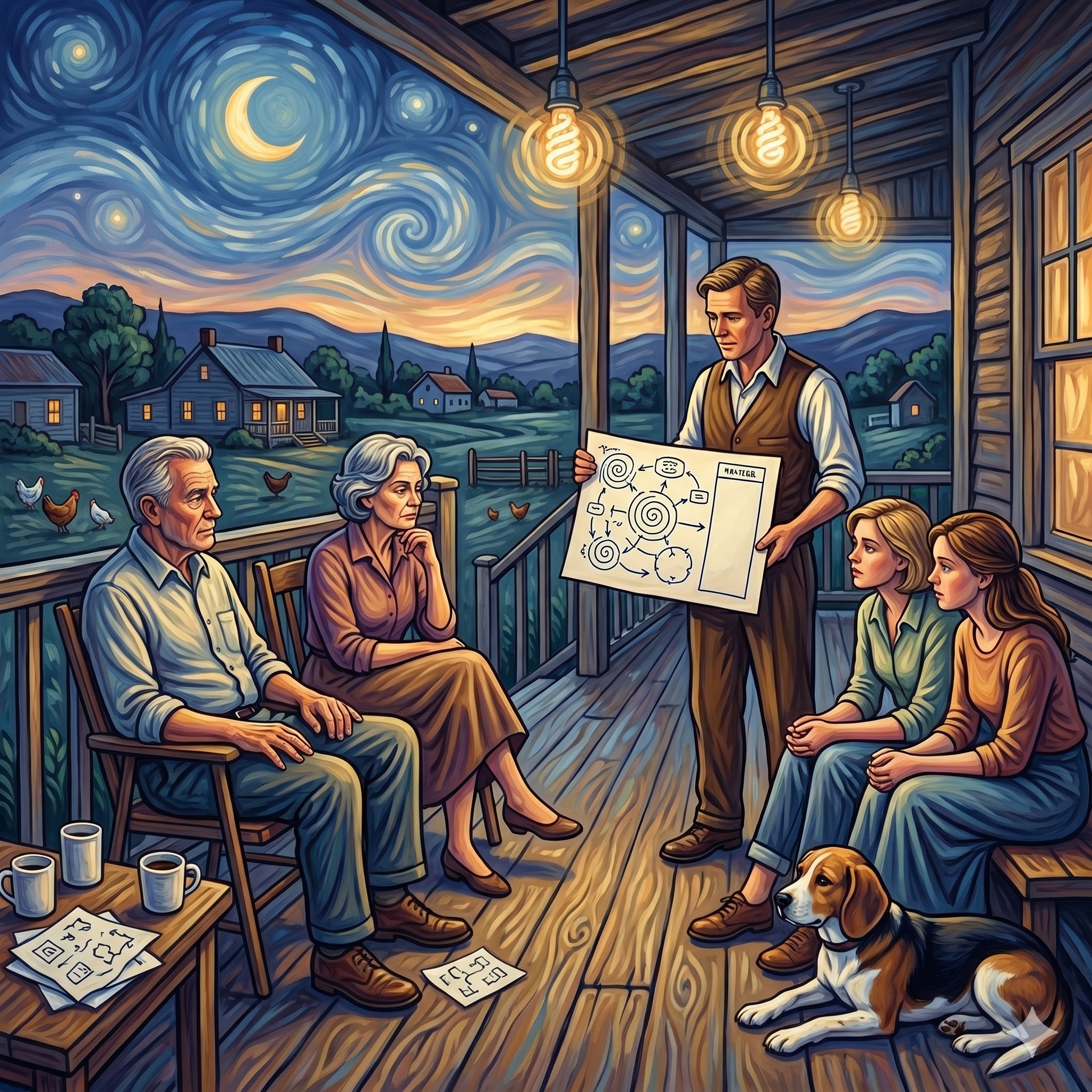
Back on Boot’s porch, the group gathered again.
Clovis had revised his chart.
“I’ve added a third column,” he said.
“What is it?” Tiffany asked.
“Unclaimed responsibility,” Clovis said.
The column was empty.
“That’s accurate,” Boot said.
Mabel sat beside him. “We used to fill that in.”
“With what?” Shelley asked.
“Effort,” Mabel said.
Silence settled.
Even the chickens were quiet.
Act VIII – The Porch Again, Now With Less Certainty
Act IX – The Town That Waited
Days passed.
The arguments continued.
The charts grew.
The sermons repeated.
The reports filed.
But nothing changed.
Because nothing was owned.
Boot sat on his porch, watching.
Daisy beside him.
Clovis adjusting a chart.
Mabel remembering.
Pastor Peeler praying.
Everyone speaking.
No one fixing.
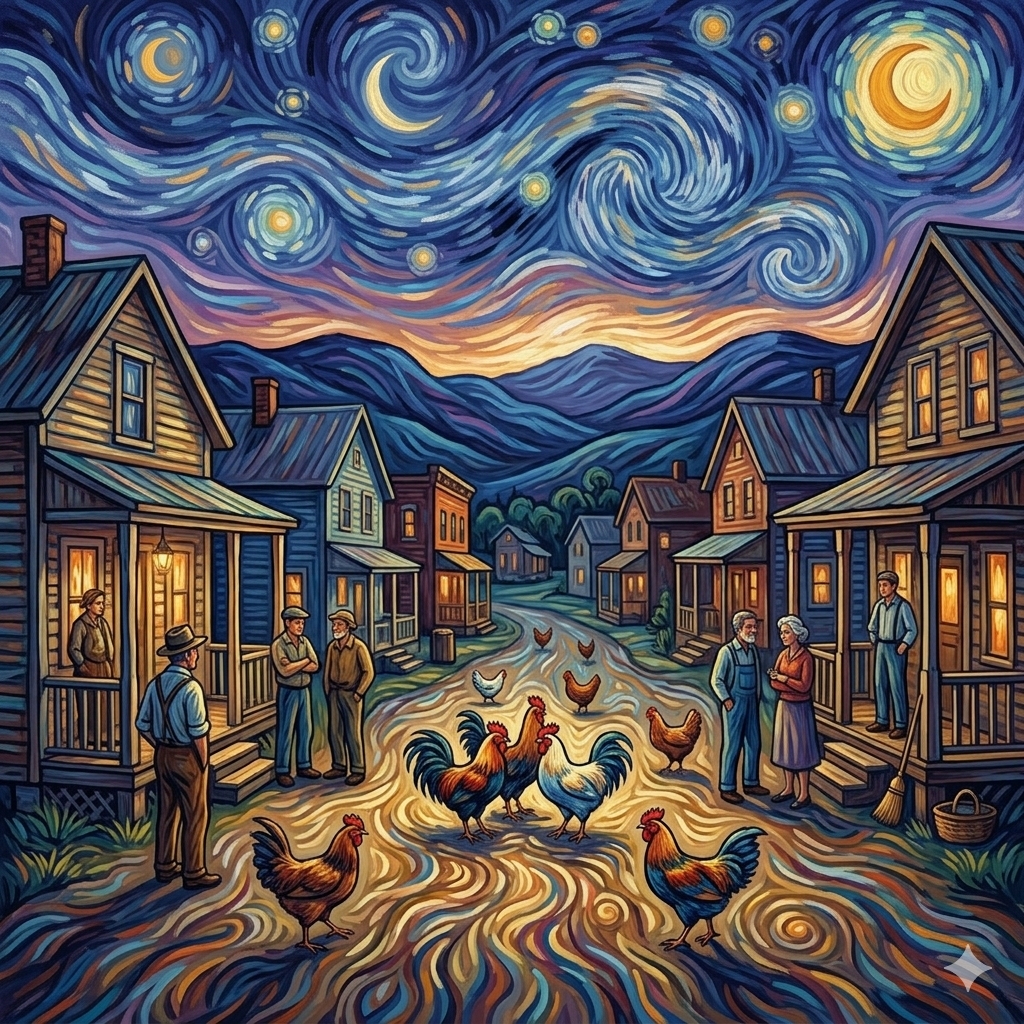
From the hills, the chickens clucked again.
They gathered.
They looked at each other.
And for a moment—just a moment—they stayed.
Then someone shifted.
And they scattered.
Act IX – The Town That Waited
Epilogue – The Chart That Explained Everything and Nothing
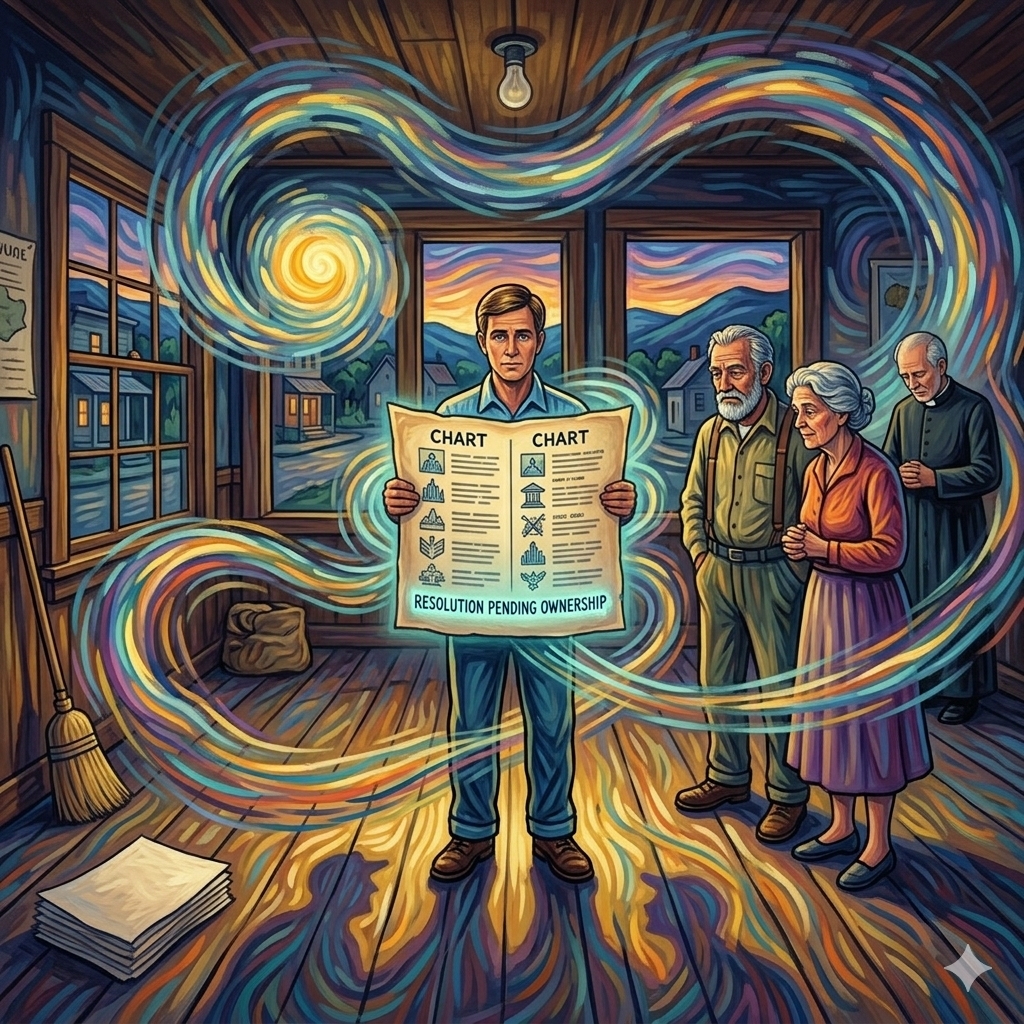
Clovis presented his final chart.
Two columns.
Townies.
Hill Folks.
And beneath them:
A perfect symmetry of blame.
At the bottom, a single line:
“Resolution pending ownership.”
Boot looked at it.
“Looks right,” he said.
“Feels wrong,” Mabel added.
Pastor Peeler closed his eyes.
“Still praying,” he said.
Daisy barked once.
No one responded.
Epilogue – The Chart That Explained Everything and Nothing
Disclaimer
No chickens were harmed in the making of this story, though several were confused.
All characters are fictional, though their habits may feel familiar.
Any resemblance to real towns, real arguments, or real blame is purely coincidental and entirely intentional.
No responsibility was accepted during the writing of this piece.
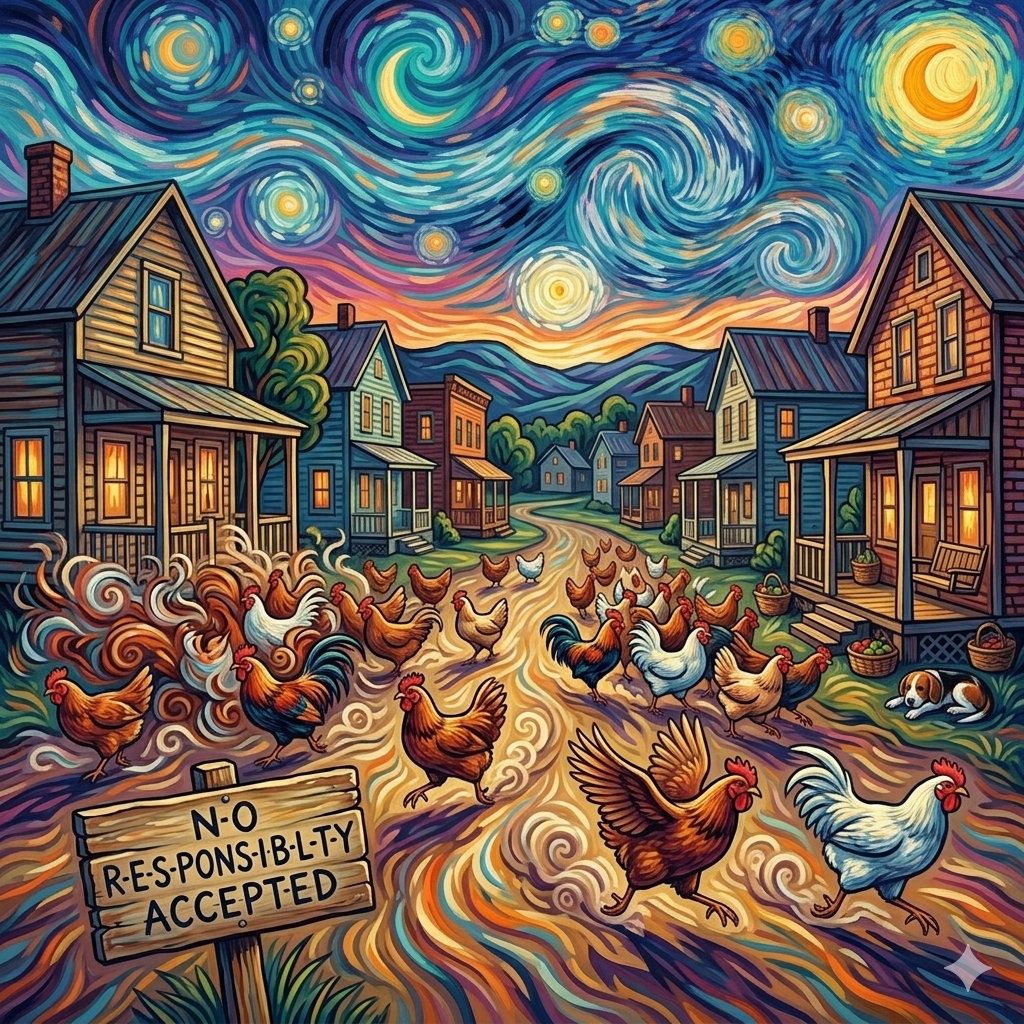
Disclaimer – Townies and Hill Folks Agree It’s the Other One’s Fault
Real Places Behind the Ruckus – From The Dunlap Directory
Real Places Behind the Ruckus – From The Dunlap Directory
Yes, this story was fictional; even the parts that weren’t true. These places? Absolutely real. Stop by, support local, and keep the Wi-Fi away from livestock:
- N-Stitches
- Rolling Oak Distillery
- Volunteer Eyecare
- Dead Zero Shooting LLC
- Dellview Homestead
- George Hamilton Real Estate & Management Co.
- Baker & Sons Plumbing
- Clark’s Bakery at Stone Cave
- Dunlap Plumbing Company
- Skull Island Campground
- Heatwave
- Bluff View Art District
- Circle K
- Busy Bees
- Fireside Camp + Lodge
- ATM Jiffy Junction Market
- Dunlap Animal Clinic
- Waterfall Car Wash
- Audubon Acres

Real Places Behind the Ruckus – From The Dunlap Directory
At Sequatchie Crossing, we tell the stories of Sequatchie Crossing.
Please share this post with your friends, family, or business associates who may want follow the news from Sequatchie Crossing.

0 Comments