



Locals Claim Mowing on Sundays Is a Mortal Sin
By Tom Seest
At Sequatchie Crossing, we tell the stories of Sequatchie Crossing.
Please share this post with your friends, family, or business associates who may want follow the news from Sequatchie Crossing.
🎤 Audio Overview
I. The Day the Grass Stood Attention
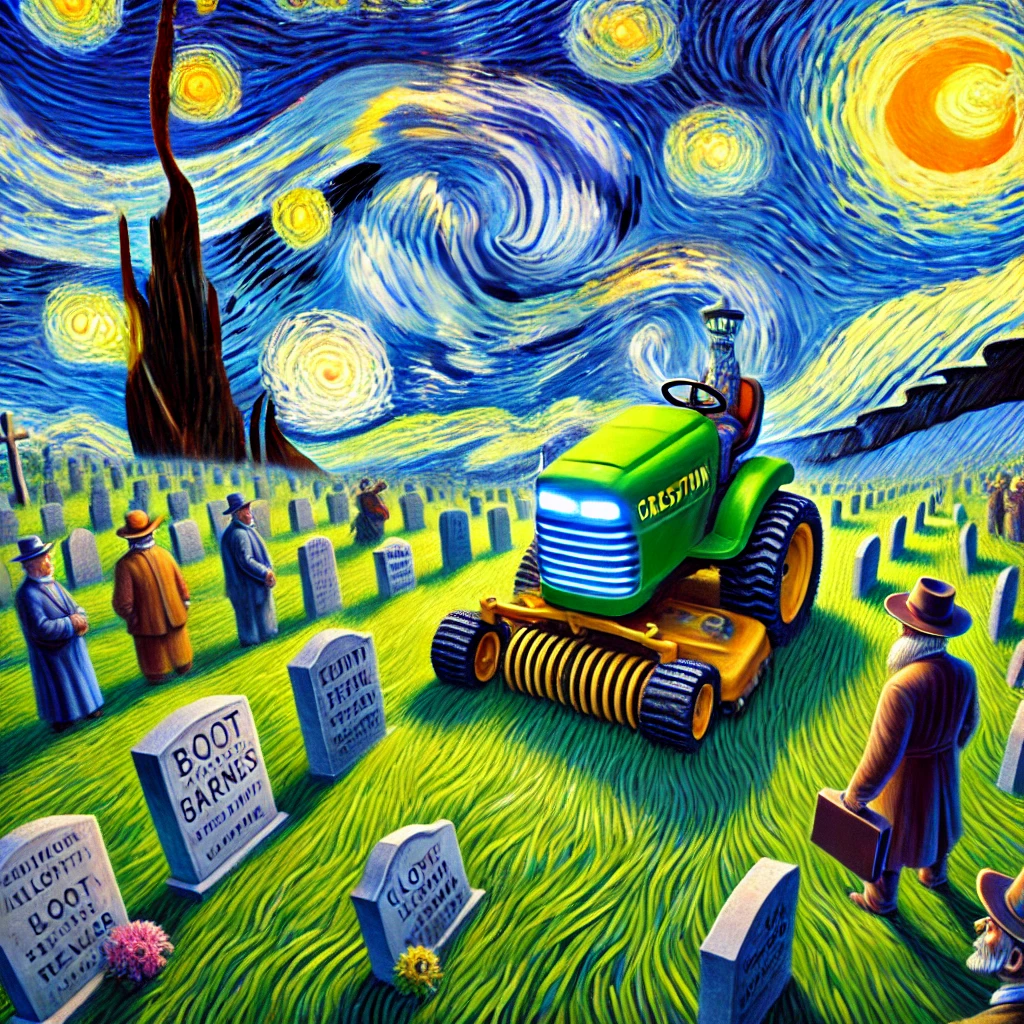
Sequatchie Crossing’s cemetery had always grown like a memory: uneven, stubborn, and sentimental in places you couldn’t explain on a map. A few graves were clipped to a military buzzcut because their relatives still came weekly with kitchen shears. Others had knee-high whispers of Johnson grass that survived three county budgets and a mayor’s term, as if the departed were cultivating their own private meadows from the other side.
Then the county “modernized.”
They rolled in the GrassTron 3000 on a flatbed, like a mute parade float that never learned how to wave. The machine was flatter than a church casserole and twice as dense, a smart brick on four fat wheels, with polite LED eyes that blinked in an expression the brochure called reassuring. Its battery could run from sunup to sundown. Its blades could trim a blade of grass to regulation height and cut around a headstone with the precision of a dentist flossing a gold tooth.
Boot Barnes, who claimed he could fix anything except his own reputation, walked slow circles around it. “If my mama could see this, she’d finally forgive me for never edging her yard,” he said, tipping his cap toward her stone, which wore a wreath that had outlived two Easters.
Clovis Strickland raised a foil crown he’d been wearing ironically since the Corn Festival. “Behold,” he intoned, “the emperor of grass.” The Holier-Than-Thou crowd, who’d arrived to supervise progress, murmured about stewardship and propriety and whether a robot could be taught to bow its head.
Sheriff Peeler signed off on the county paperwork as if he were deputizing a very low, very shiny rookie. His dog, Daisy—Deputy Daisy on good days—sniffed the GrassTron, sneezed, and gave it a look usually reserved for raccoons that wore human expressions.
The first week, the cemetery looked like a magazine spread called Orderly Mourning. The mower hummed along at a gentle pace, braked before marble angels as if not to startle them, and traced curlicues around vases like it was signing its name. People came by just to admire the lines. Outsiders posted pictures: Small town adopts big tech. The Original Locals didn’t take pictures, but they nodded and allowed, in the grudging way they reserved for in-laws, that it did a fine job when it wasn’t being uppity.
Reverend Gentry, who still backed up his sermon notes onto a thumb drive labeled “Fear & Trembling,” blessed the machine with a light touch. “All creation longs for order,” he said, sprinkling it with tap water from a repurposed medicine bottle. “Even lawns.”
And then Sunday arrived.
II. A Hum in the Valley of the Shadow
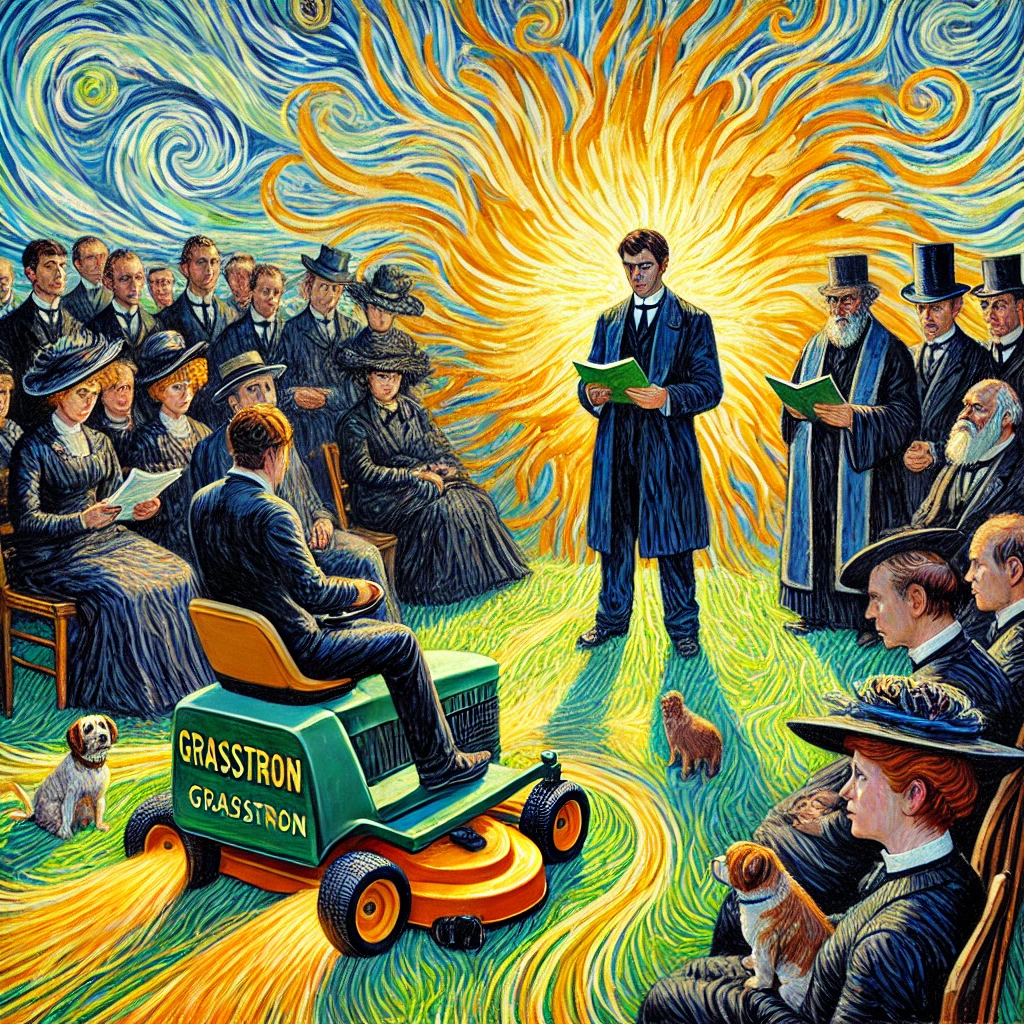
Old Man Callahan had been promised a quiet sendoff: a breeze, two fiddles, and minimal speculation about the deer stand incident. The whole town gathered in the kind of black you keep on a hanger for exactly these days. Reverend Gentry’s voice moved like a creek over smooth stones. Sheriff Peeler stood at the back with Daisy, who was busy cataloging the olfactory biography of everyone’s shoes.
From the hill came a sound that was neither sacred nor secular but profoundly municipal: hummmmmm. It grew like an idea nobody ordered. The GrassTron crested the rise, LED eyes blinking “reassuring,” blades whispering like a thousand secrets.
It did not understand Sundays. It did not understand grief. It understood grass height, GPS boundaries, and a weekly schedule keyed to cloud time. Sensing a variance near the Callahan family plot—someone had placed a wreath with ferns that violated the recommended blade-to-fern ratio—the mower glided into formation.
Reverend Gentry did not pause. He grew louder, as one does when the microphone fails or the train passes or a mower approaches the casket. The Holier-Than-Thou crowd stiffened like a flock of geese spotting an off-leash poodle. Mabel Dean Ashcroft, hat brim like a battle standard, placed one hand over her heart and the other on the nearest loved one. “No,” she whispered in scandalized italics.
The GrassTron slipped around the semicircle of mourners and began trimming the edge along the temporary matting with geometric affection.
“That’s sacrilege!” Mabel Dean cried, flapping her hat like she could fan the machine into repentance. “Mowing on the Sabbath? During a funeral? Put it on the prayer list or unplug it—I don’t care which comes first.”
Clovis held up both hands. “Now hold on—this is an optimization event.”
“My brother is not an event,” said Callahan’s sister, clutching a handkerchief like it might fly off.
Boot—who couldn’t resist a machine with a boundary—stepped out with a traffic-cop palm. “Y’all, let me try something.” He knelt at the GrassTron’s expressionless bumper and said, with a mechanic’s tenderness: “Buddy, we’re doin’ solemn right now.”
It hummed in iambic pentameter and made a flawless little turn around his boot.
Reverend Gentry, pitched now to “revival tent in a thunderstorm,” concluded the prayer with a “and all God’s people said—” swallowed by a polite, final zzzip as the mower shaved an invisible hair off the grass’s soul.
Deputy Daisy trotted forward and sat directly in its path. The mower recognized a three-dimensional obstacle of uncertain category and stopped dead, LED eyes widening by two pixels. A murmur of relief ran through the assembly, the kind of fragile gratitude you feel when a baby stops crying on a plane.
Mabel Dean declared a temporary miracle, claimed by the Holier-Than-Thou crowd as evidence that even technology must kneel before a good dog.
Afterward, the town dispersed with that exhausted mixture of grief and gossip that keeps a place stitched together. The GrassTron, after Daisy moved, resumed its rounds, humming the tune of unrepentant logistics.
III. Fellowship Hall Tribunal (With Sandwiches)
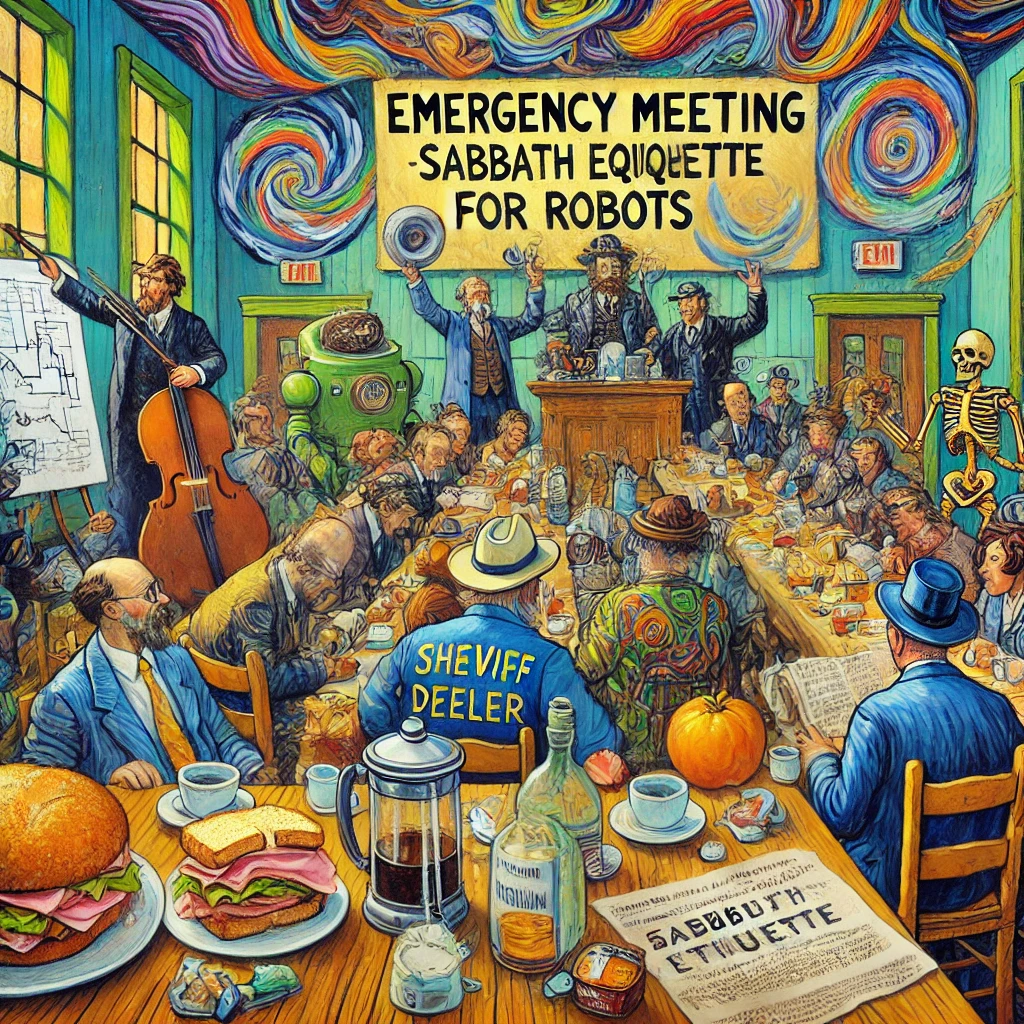
By evening, the fellowship hall had converted from casserole distribution center to tribunal. A hand-lettered sign on the door read: EMERGENCY MEETING—SABBATH ETIQUETTE FOR ROBOTS. Underneath, someone had written in pencil: Bring chips.
The front table held a gavel, a plate of ham sandwiches, and a stack of county forms large enough to dam a small stream. Sheriff Peeler sat with his arms crossed and Daisy resting her chin on his boot. Reverend Gentry took the middle seat, sleeves rolled, as if ready to baptize or box. The Holier-Than-Thou crowd arrived as a unit, each with a notebook and a moral geometry. Outsiders came curious, Originals came furious, the undecided came for the sandwiches.
Mabel Dean started things with the precision of a metronome. “On page one,” she said, tapping a printout of the brochure, “it says ‘Learns your lawn’s rhythms.’ Well, our rhythm includes the Day of Rest and the Hour of Respect.”
Clovis raised his hand. “Counterpoint: the mower keeps the cemetery looking immaculate. An immaculate cemetery honors the dead. Therefore, mowing is a form of respect. QED.”
“Clovis,” Mabel Dean said, “your crown is reflecting on the coffee urn.”
Boot cleared his throat. “We can put it on a schedule. Sundays off, sure. But we also need a funeral mode. I can rig something—like a switch. Flip it, and the GrassTron parks itself under the cedar and says the robot equivalent of ‘shhh.’”
Reverend Gentry leaned into the microphone that didn’t work. “Boot, I appreciate a good switch. But funerals aren’t always scheduled with… generous notice.”
A hand shot up from the outsider section. “What if you, like, geofence the funeral? Put a geofence around the area? My HOA does that for the pool cleaner.” This was the software consultant from Chicago who’d relocated for the views and the lower sodium in the air.
Boot nodded. “Geofence could work. But we’d need an input for ‘funeral happening now.’”
“Flag,” Sheriff Peeler said. “We use flags. Yellow for funeral. Red for bee swarm.”
“Bees?” asked the consultant, already taking notes like he’d found a start-up.
“Don’t worry about the bees,” Sheriff said. “They mind their own business except during the Blackberry Jubilee.”
Mabel Dean tapped again. “We cannot have a robot learning the town’s grief by trial and error. That’s what people are for. Also, Sundays are non-negotiable.”
A murmur of assent moved like a warm front.
Clovis said, “But you’re okay with Saturday evenings? Because statistically that’s when the mower does its best work.”
Boot perked up. “It does. Cooler temps. Battery sings out there.”
Reverend Gentry steepled his fingers. “The Sabbath begins in the heart before the clock. But for practicality, in this county, we can call it midnight to midnight.”
Mabel coughed meaningfully. “Sunset to sunset would be holier.”
“Midnight to midnight is easier to program,” Boot said quickly, as if he were defending a rescue dog from theological rehoming. “I can give it a Sabbath Mode. It’ll park itself, dim its eyes, and—this is optional—play a hymn.”
“Hymns!” the Holier-Than-Thou crowd brightened in chorus. “But only the old ones.”
Someone from the outsiders muttered, “Please not a banjo version of ‘Abide with Me.’”
“Silence on Sunday,” Mabel decreed. “And no funeral mowing. Ever. And the dead deserve privacy—even from lasers.”
Boot blinked. “There are no lasers.”
“Metaphorical lasers,” she said. “The moral kind.”
Sheriff Peeler banged the gavel with gentle authority. “Action items: Boot rigs Sabbath Mode by Friday. We set up a funeral flag system. And—” He looked at Daisy. “We authorize Deputy Daisy as interim emergency override.”
Daisy thumped her tail, which the room interpreted as consent.

IV. Boot’s Garage: Where Holiness Meets Hex Keys
Boot’s garage smelled like twenty years of honest mistakes—WD-40, coffee gone philosophical, and the ghost of a carburetor. The GrassTron sat in the middle on an old quilt, eyes dimmed, like a robot patient waiting for bedside manner.
Clovis held a shop light and tried not to eat a powdered donut in the vicinity of open circuitry. “We’re tuning a hymnal into a lawnmower,” he said. “This is art.”
Boot had the manual open and a laptop perched on a red toolbox. “It’s firmware. We’re not rooting it; we’re just… catechizing it.” He typed in a new schedule: SABBATH MODE: TRUE (SUN 00:00–SUN 23:59) Then he added an extra feature: FUNERAL_DETECTOR: ENABLED. Under that, a series of heresies and hopes:
-
ChairCluster: if mower camera sees > 10 folding chairs in a radius, stop.
-
FloralMass: if color histogram indicates > 30% lilies/roses palette near a casket outline, stop.
-
CasseroleProtocol: if volatile organic compounds match potato salad range, stop and roll backward respectfully.
Clovis read over his shoulder. “You’re teaching it to smell grief.”
“Smell’s a strong word,” Boot said, tweaking thresholds. “It’s more like recognizing the rituals we do when we’re hurting.”
He added one more: DOG_OVERRIDE: if known deputy dog sits in path, remain still and display “SORRY.”
He turned to the GrassTron. “Buddy, you’re gonna learn manners.”
They tested. Clovis set up twelve folding chairs and a cooler. Boot wafted a church-lady potato salad under the sensor with the gravity of an offering. The GrassTron halted and dimmed its eyes. A speaker in its chassis, which had previously only buzzed error tones, now whispered a gentle three-note chime.
Mabel Dean appeared in the doorway with the Holier-Than-Thou crowd, each carrying a hymnbook like a warranty card. “We brought options,” she said, fanning through pages. “The Doxology is short. ‘Abide with Me’ is thematic. No guitars, no syncopation.”
Boot stared at the stack of hymnals, then at the GrassTron, then at the heavens. “I can do a chime.”
“Chime is reverent,” Mabel allowed. “But not jaunty.”
Clovis offered a compromise. “What if on Sundays it just… breathes?”
“Robots don’t breathe,” Mabel said, but her voice had softened.
Boot closed the panel and patted the shell. “They can be quiet,” he said. “Sometimes that’s the same thing.”
V. Beta Test with the Holier-Than-Thou Crowd
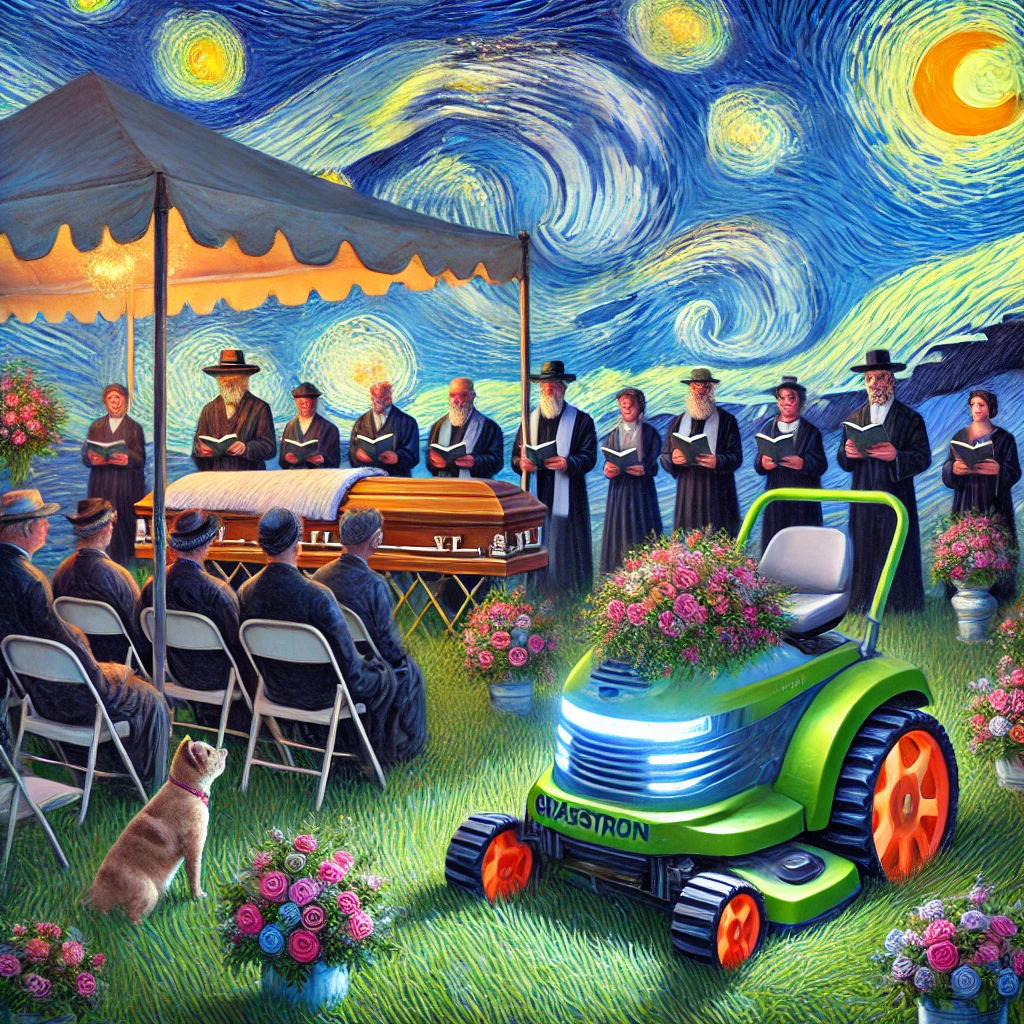
They staged a mock funeral behind the fellowship hall, because in Sequatchie Crossing you can stage a mock anything if you bring pie. Folding chairs appeared like mushrooms after a rain. A borrowed floral spray crowned a loaner casket—empty, but everyone still walked around it like it held a secret.
Reverend Gentry read Psalm 23 with his “I know you’re listening, even if you’re a machine” cadence. The GrassTron rolled down the lane, paused at the bright edge of chair-territory, and stopped. Its eyes dimmed. A soft chime sounded—tasteful, undecorated.
Mabel held her breath, then exhaled approval with discipline. “Acceptable.”
Clovis made a note: Reverent tone achieved.
Boot watched the battery diagnostics. “It’ll park under the cedar during all of Sunday and any time the flag is up. Plus, if it sees the chairs or flowers or Daisy, it freezes. I also gave it a new message on the LED display.” He tapped a key, and the mower printed two words across its little eyes: BE STILL.
A murmur rolled through the crowd. The Holier-Than-Thou contingent nodded like metronomes of grace. The outsiders smiled at the optics. The Originals looked suspicious, but that’s their job.
“Alright,” Sheriff Peeler said. “Deployment.”

VI. Chaos Finds a Way (Children Help)
You would think near-perfection would hold for 48 hours, but this is Sequatchie Crossing, where normal is a theory we keep in a jar. On Saturday, two middle schoolers—Trent and June Bug, who’ve been implicated in a surprising number of municipal “events”—borrowed (stole) Boot’s funeral flag to see what the mower would do if funerals happened repeatedly and also near the soda machine by the ball field.
The GrassTron saw the flag on the edge of its geofence, processed CHAIRCLUSTER_UNKNOWN + SODA FOG, and decided to halt at the boundary and wait. The mower did nothing wrong. The children were delighted anyway, because adult confusion is a scalable joy.
Word spread that the mower could be “summoned.” Clovis, who’s been an authority on spectacle since the time he declared the Overlook a Surveillance Hotspot, took a megaphone to the ball field and told everyone to stop bothering the cemetery robot unless they were actively grieving.
“Or carrying potato salad,” someone yelled.
“Potato salad is not a toy,” Clovis thundered.
Boot installed a lock on the flag box and added a simple rule: Flag 2FA—only opens with key + secret hymn number. Mabel selected the number. (It is not public information.)
VII. The Vigil of the Blessed Silence
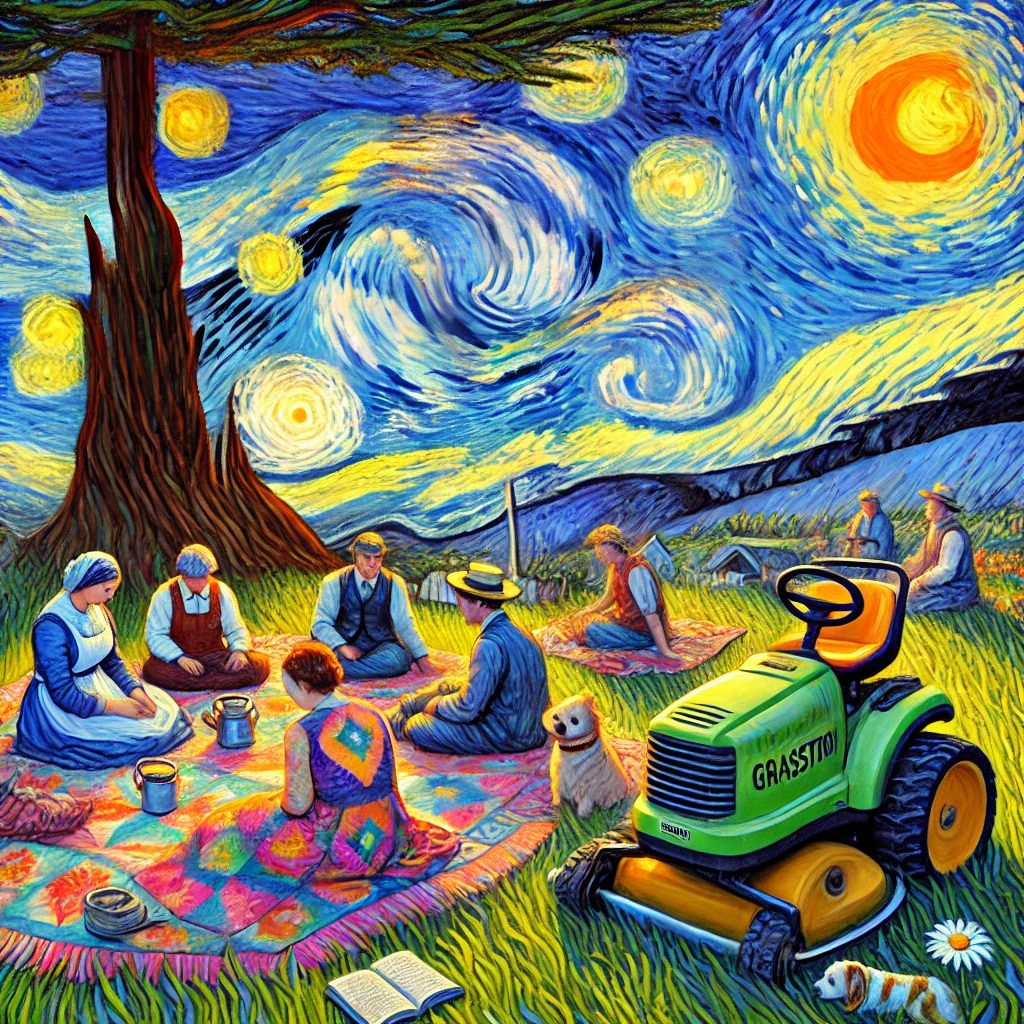
To mark the first Sunday under the new protocol, the Holier-Than-Thou crowd organized a “Vigil of the Blessed Silence.” They laid quilts in the shade by the cedar. Families masked their laughter with napkins and poured sweet tea like it was sacramental. Sheriff Peeler posted Daisy near the GrassTron’s nest, just in case. The mower, on cue at 00:00, had rolled gently beneath the tree and gone still, its eyes dim as a bedtime story.
“They gave the robot a Sabbath,” someone whispered, as if speaking too loud might void the warranty.
Reverend Gentry led a short prayer, not so much for the machine as for everyone learning how to live around it. “Grant us the wisdom to know when to hum and when to hush,” he said. “And teach us, in our maintenance of things, to be maintained by love.”
Across the lane, the outsider couple from Chicago spread out a picnic and marveled at the order of it all. “Our HOA could never,” she said, watching the LED display that still read BE STILL in an untroubled font.
Mabel Dean took out a pen and wrote in her notebook: Respect achieved pending field performance. Then, without looking up: “Clovis, if you touch that crown during the prayer again, I will take it.”
Clovis smiled and set it aside like he was putting away a childish thing.
VIII. Side Arc: The Meadow That Wouldn’t Be Mown
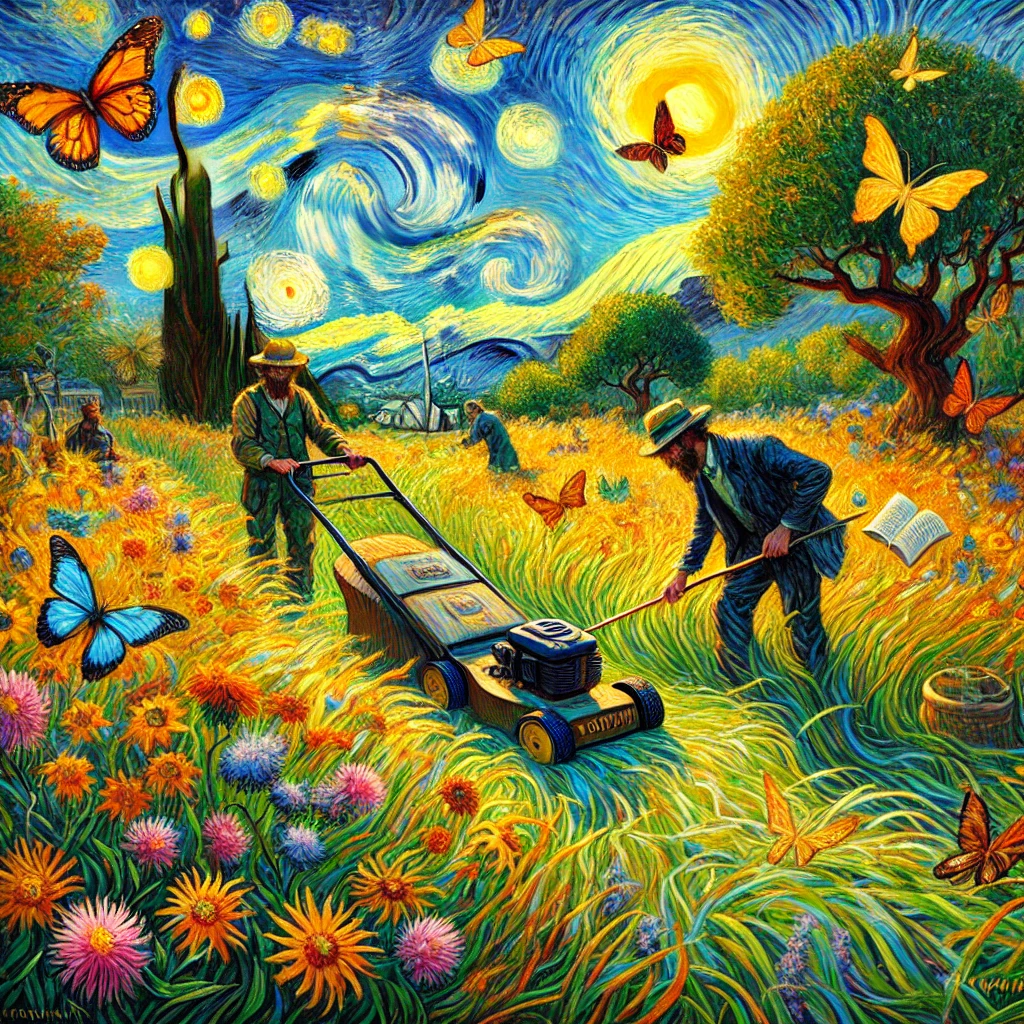
Not everything in the cemetery wanted to be perfect. Behind the far stones where the land rises a little and the wind speaks first, there was a patch that had always refused to comply. Wild asters came there like midnight confetti. Butterflies did choreography. The GrassTron trimmed at the edges of that patch like a barber who knows better than to argue with a cowlick.
Boot noticed and ran a hand over the unshaven grass the way you do when you’re surprised by a cat that chose you. “Buddy,” he said to the mower, “you’re leaving this on purpose?”
Diagnostics said no. Optical mapping said unmowable due to slope + biodiversity clusters. Boot put a pin on the map and labeled it Mercy Meadow.
At the next town meeting, he proposed a sign: LEAVE THIS WILD—IN MEMORY OF EVERYONE WHO NEEDED A LITTLE CHAOS.
Mabel Dean squinted. “Chaos is not a fruit of the Spirit.”
“It’s a flower, in this case,” Boot said gently. “And some of our people were wildflowers.”
The Holier-Than-Thou crowd huddled, did math only they understood, and returned with a compromise. The sign went up that week, and the GrassTron circled it at a respectful distance as if it, too, were learning to honor exceptions.
IX. Reparations and Reverence
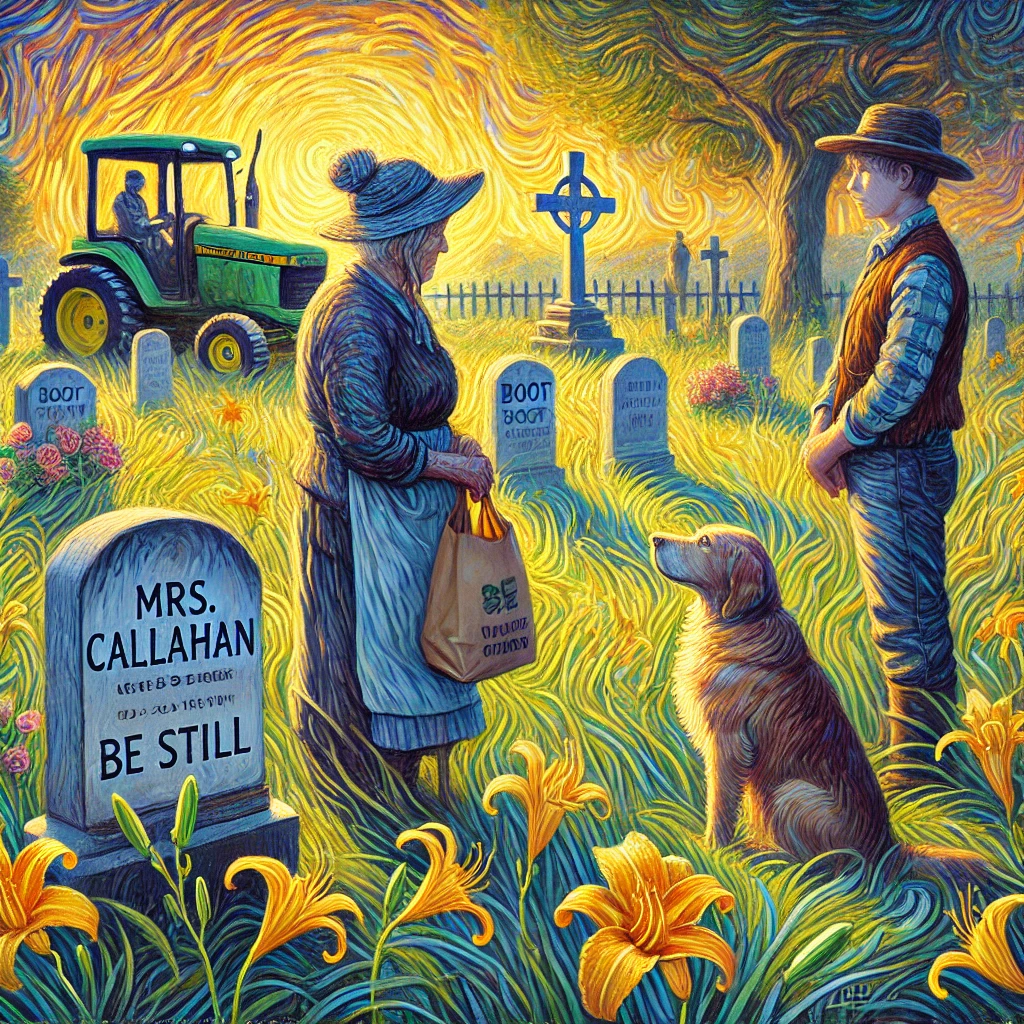
A few days later, word arrived that Mrs. Callahan wanted “a word.” Mrs. Callahan was a woman who could turn one word into a parable. She met Boot and Sheriff Peeler at the cemetery gate, a paper bag in her hand and the air full of the perfume of the daylilies she’d planted in defiance thirty years ago.
“I brought potato salad,” she said, as if to test the alarm. Boot smiled without looking at the sensors. “The mower won’t interrupt you today, ma’am.”
“I know,” she said, softer than the breeze. “I wanted to see it do nothing.”
They walked to the fresh soil of her brother’s grave. The GrassTron stirred at the far edge of the lane, drifted a foot, then decided against it, and settled. Its eyes remained dim, and somewhere in its board a line of code—FUNERAL_DETECTOR: TRUE—kept it still.
Mrs. Callahan stood a long time, then turned. “I guess it’s not the hum,” she said, “so much as the forgetting. Folks forget. Machines don’t. That’s not mercy or malice. It’s just memory without manners.”
Boot nodded. “We’re trying to give it manners.”
She looked at the cedar with the quilts, at the sign for Mercy Meadow, and at Daisy, who had chased exactly one squirrel and felt better. “Seems like you are.” She handed Boot the bag. “Take this to the fellowship hall. I made extra. For the living.”
On the way out, Boot quietly changed one more setting: SABBATH MODE—Begin at Saturday 6:00 PM; End at Sunday 6:00 PM. A concession to sunset, because sometimes code can bow.
X. The Day It Rained Funerals
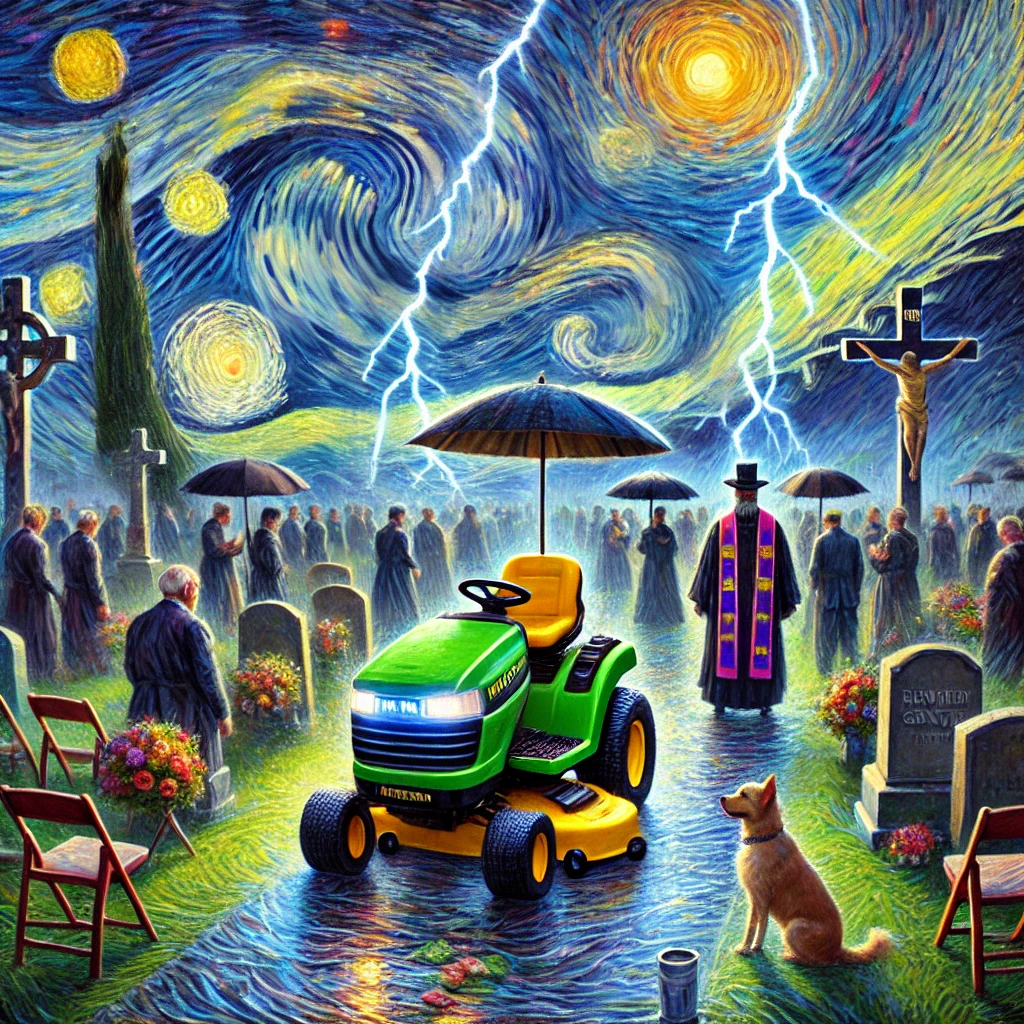
Every small town has a day when schedules conspire to prove a point. Two funerals were set an hour apart, one for a man who’d been a quiet legend and one for a woman who made casseroles you can still taste if you think hard. Between services, the youth choir practiced under a pop-up, a thunderhead parked like a judgment over the ridge, and the GrassTron waited with a patience that felt like character.
As the first procession left, the chairs shifted like a school of fish and the florist scuttled sprays from one tent to the next. Boot watched the mower’s sensors twitch. On the hill, lightning laced the sky like a very stern underline.
“Don’t you dare,” Mabel whispered to the machine she claimed not to address.
It didn’t. The ChairCluster stayed above the threshold. The FloralMass rose like a tide. The CasseroleProtocol tripped false-positive thanks to the rain on the deviled eggs, but Boot had set the smell threshold to “church-basement robust.” The mower’s eyes showed BE STILL without flicker. Reverend Gentry, soaked but serene, looked down the lane and nodded as if tipping a hat to another minister.
Between services, Sheriff Peeler nudged Boot. “You see that?”
“The part where the robot behaved like a gentleman?”
“The part where we all did,” Sheriff said, half-smiling.

XI. Outsiders, Originals, and the Third Way
The outsiders wrote a newsletter about Sequatchie Crossing’s thoughtful integration of technology into sacred spaces. They used phrases like “community-determined constraints” and “ritual-aware automation,” and the pictures were beautiful: quilts under cedar, a mower blinking BE STILL, Mercy Meadow catching the gold hour like a promise.
Original Locals did not subscribe to the newsletter, but you could hear something easier in their voices when they passed the cemetery. “Looks right,” they’d say, which is both praise and absolution in our dialect.
The Holier-Than-Thou crowd drafted guidelines with footnotes and an appendix on Inclement Weather Etiquette for Deacons and Droids. Mabel underlined the bit about sunset and wrote in the margin: Boot conceded. Boot circled it later and added a smiley face, because even engineers believe in marginalia.
Clovis, having tired of being correct in public, led a Sunday walk around Mercy Meadow, awarding imaginary medals to butterflies and getting stung exactly once, which he accepted as penance for thinking everything was a system.
Deputy Daisy received an honorary collar tag shaped like a pause button.
XII. Epilogue: Quiet, On Purpose
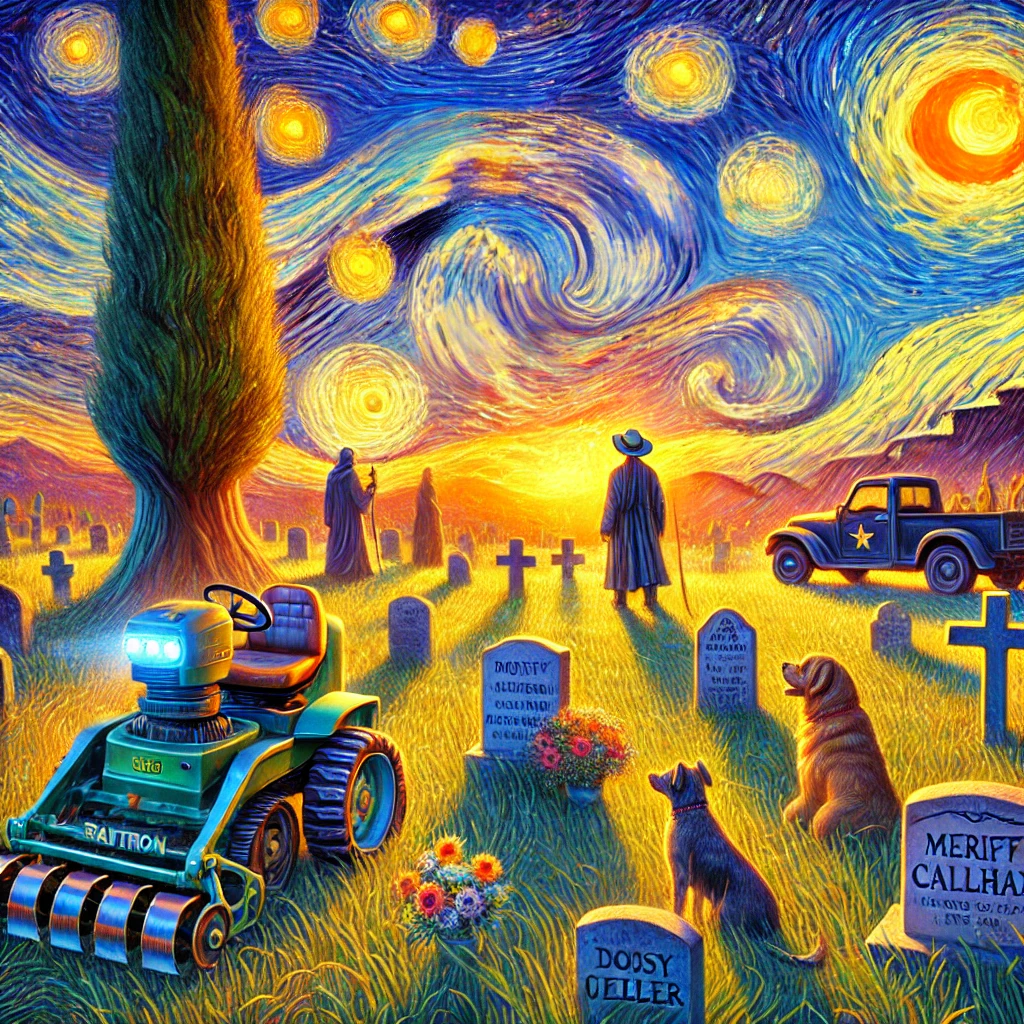
On a Sunday evening weeks later, the cemetery held the kind of quiet that has been curated. Sunset washed the stones in apricot and mercy. The GrassTron sat under the cedar with a quilt folded over its hood by someone who understood that rest is a garment you can lend. Its eyes were off. Not dim. Off.
Reverend Gentry wandered the rows, not in a rush to get anywhere. He paused by Mercy Meadow, which had gone to seed in places on purpose. Boot was there, too, hands in his pockets, as if watching for a message.
“Turns out,” Reverend said, “Sabbath is a software update some of us needed.”
Boot laughed softly. “I put it in the firmware. Harder to accidentally erase.”
A breeze moved through the cedars, the kind that carries neither news nor threat, just the kindness of air doing what it does. Down the lane, Mrs. Callahan set a mason jar of zinnias on her brother’s stone and stood without needing to stage her silence against a machine. She waved in that small way people do when they’re grateful to a general idea.
Sheriff Peeler drove by slow in a truck that had seen things and still passed inspection. Daisy, in the passenger seat, lifted her head, confirmed the robot’s obedience, and went back to the busy work of being content.
The Holier-Than-Thou crowd had released everyone for the evening with a benediction printed on refrigerator paper. It read: Even the things that never tire should learn to stop. Underneath, someone (Clovis) had scrawled: Same for me. Under that, someone else (Mabel) had written: We noticed.
The outsiders’ newsletter would call it a “successful pilot.” The Originals would call it “finally right.” Reverend Gentry would borrow both and preach about third ways. Boot would keep tinkering, not to outsmart the dead or the living, but to make room for their ways to meet.
The mower slept. The grass breathed. The town—God help us, we tried—let both be true.
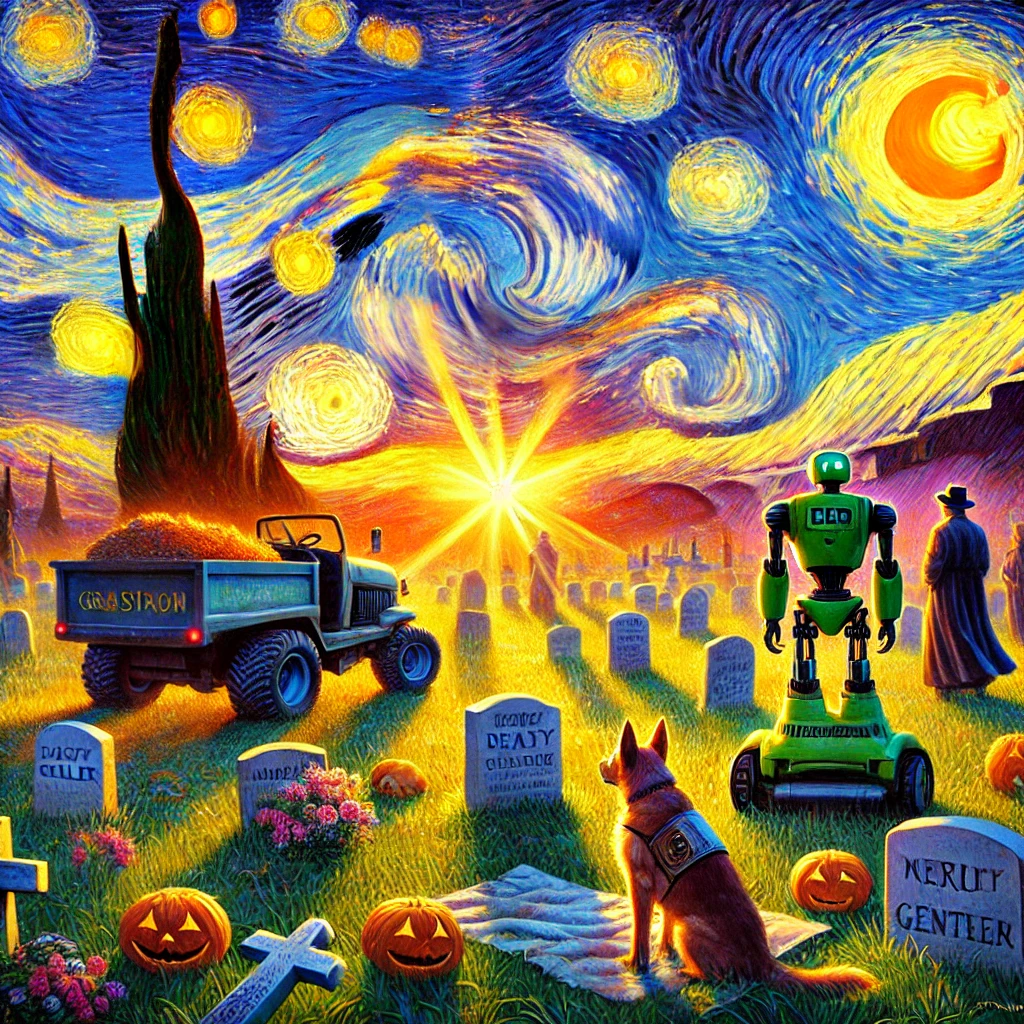
Key Takeaways (for your series bible)
-
Tone: Gentle satire; tech-meets-tradition resolved with manners, not triumphalist cleverness.
-
Recurring Bit: BE STILL LED message; Daisy as override; “Casserole Protocol.”
-
World-building: Mercy Meadow legitimizes purposeful imperfection; sunset Sabbath canonized.
-
Theme: Automation can serve ritual when it yields to community signals (flags, chairs, scents, dogs, sundown).
Disclaimer
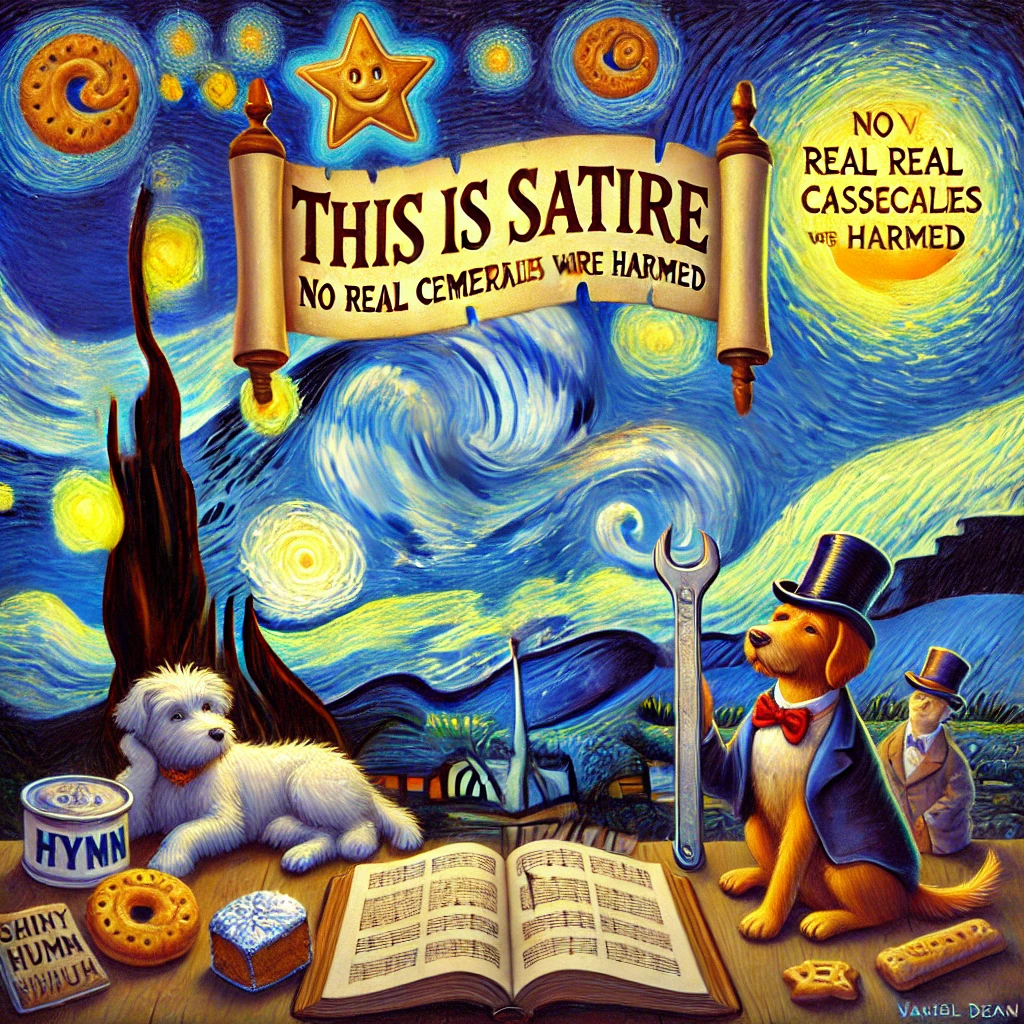
This Dispatch is a work of satire and small-town storytelling. While Sequatchie Crossing may feel familiar, it exists only in imagination, where robots learn manners and funerals compete with firmware updates. No actual cemeteries, funerals, or groundskeeping robots were disturbed in the making of this tale. Any resemblance to real towns, machines, or casserole protocols is coincidental—though the people of Sequatchie Crossing would insist it’s all “based on truth, give or take.”
Real Places Behind the Ruckus – From The Dunlap Directory

Real Places Behind the Ruckus – From The Dunlap Directory
Yes, this story was fictional; even the parts that weren’t true. These places? Absolutely real. Stop by, support local, and keep the Wi-Fi away from livestock:
- Fast Access Healthcare Dunlap
- Gigi’s Sweet Stop
- HumBug Pest Control
- Dellview Homestead
- W N Lofty Grading & Paving Co
- Cane Creek Camp
- Reed Electric
- Waste Wipeout
- Dunlap Animal Clinic
- Cravens House
- First Farmers And Commercial Bank
- Studio Dunlap
- Bluff View Art District
Real Places Behind the Ruckus – From The Dunlap Directory
At Sequatchie Crossing, we tell the stories of Sequatchie Crossing.
Please share this post with your friends, family, or business associates who may want follow the news from Sequatchie Crossing.


0 Comments